Engagement and Experience Strategy
            2017-2020
←
→
Page content transcription
If your browser does not render page correctly, please read the page content below
Engagement and Experience Strategy
2017-2020Document Information
Version: 1 Date: August 2017
Ratified by: King’s Patient Experience Committee / King’s
Executives
Date ratified: 2/10/17 – 17/10/17
Author(s): Jessica Bush – Head of Engagement and Patient
Experience
Responsible Shelley Dolan, Chief Nurse and Director of Midwifery
Director:
Responsible Patient Experience Committee
committee:
Date when August 2017
policy comes
into effect:
Review date: July 2020
Target Whole trust
Audience:
Location of Kingsdocs
document:Contents 1. Introduction 1 2. Engagement and Experience 2 3. Looking to the future – King’s Strategy 5 4. The purpose of this strategy 7 5. Support to deliver the strategy 17 6. Accountability, implementation and monitoring 18 7. Appendices 19
Engagement and Experience Strategy

1. Introduction

   1.1. King’s College Hospital NHS Foundation Trust

 King’s College Hospital NHS Foundation Trust is one
 of the UK’s largest and busiest teaching hospitals, with
 over 13,000 staff providing millions of patient contacts
 each year. King’s has a unique profile, with a full range
 of local hospital services for people in the London            Understanding you
 boroughs of Lambeth,Southwark, Bromley and                     Inspiring confidence in our care
 Lewisham, as well as specialist services to patients           Working together
 both locally and from further afield. The Trust is             Always aiming higher
 recognised internationally for its work in liver disease
                                                                Making a difference in our local
 and transplantation, neurosciences, cardiac,
 paediatrics and haemato-oncology. King’s College               community
 Hospital is also one of four major trauma centres and
 also a designated hyper-acute stroke centre for London.

 King’s runs services out of five main hospital sites:

     •   Denmark Hill
     •   Princess Royal University Hospital
     •   Orpington Hospital
     •   Queen Mary’s Hospital, Sidcup
     •   Beckenham Beacon

 The Trust plays a key role in the training and education of medical, nursing and dental
 students with its academic partners, King’s College London and other local universities.

 The active involvement of patients, carers and families, volunteers, the public and local
 organisations helps us deliver King’s Values and to ensure the highest quality care by
 putting patients at the heart of everything we do and providing person-centred care.

     •   Understanding the needs of our patients and families (Understanding You)
     •   Linking us to our local communities, local groups and their networks (Working
         together)
     •   Playing a role in the community (Making a difference in our community)

The NHS belongs to the people…It touches our lives at times of basic human need, when
care and compassion are what matter most.
                                                                       The NHS Constitution

    1|Page
1.2. King’s Health Partners – Pioneering Better Health for all
King’s Health Partners was formally accredited in March 2009 as one of the UK’s
first Academic Health Sciences Centres (AHSC) – an organisation that integrates
research, clinical care and education and training for the benefit of patients.
The King’s Health Partners AHSC is a partnership between King’s College London
Guy’s and St Thomas’, King’s College Hospital and South London and Maudsley
NHS Foundation Trusts. These four strong organisations combine the research,
clinical education and training elements of one of the world’s leading research-led
universities and three of London’s most successful NHS Foundation Trusts.
A guiding principal for King’s Health Partners is to always put our patients first by
ensuring that the patient is at the heart of everything we do. One of the core strategic
goals is to be the best AHSC for patient experience.
Creating an Academic Health Sciences Centre brings added benefits to the local
area in terms of regeneration, education, jobs and economic growth.
King’s Health Partners is pioneering better health and well-being, locally and
globally, through integrating excellence in research, in education and training, and
in patient care.
2. Defining Engagement and Patient Experience
2.1. Definitions
Patient experience can be defined as what happens to patients whilst they are in our
care and how that makes them feel.
The Department of Health in 2009 defined good patient experience as:
Getting good treatment in a comfortable, caring and safe environment, delivered in
a calm and reassuring way; having information to make choices, to feel confident
and feel in control; being talked to and listened to as an equal and being treated
with honesty, respect and dignity.
Department of Health 2009
2|PagePatient, public and member engagement is defined as the active participation of
citizens, patients and carers and their representatives and Foundation Trust
Members in the development of health services and as partners in their own health
care. This includes the planning, designing, delivering and improvement of health
services.
The White Paper, ‘Equity and excellence: Liberating the NHS’, set out the
Government’s vision of patients and the public being at the heart of the NHS. Central
to delivering this vision is ensuring that all patients are fully involved in decisions
about their own care and treatment so that the principle of shared decision making
—“no decision about me, without me”— becomes the norm across the NHS.
Department of Health 2012
2.2. Why are engagement and experience important?
Good engagement and experience benefits patients, the public, staff 1 and
organisations:
Firstly, in terms of outcomes for patients:
• On a one to one basis patients feel involved in their care when they are treated
as equal partners, listened to and properly informed. It’s also makes them feel
valued and appreciated.
• Improvement in satisfaction is another clear outcome of involvement. Patients
perceive a wide variety of benefits including greater confidence, reduction in
anxiety, greater understanding of personal needs, improved trust, better
relationships with professionals, as well as positive health outcomes.
• Reducing anxiety and fear is known to speed up healing, shorten length of stay
and decrease acuity levels.
• The provision of information and informed decisions is known to reduce post-
operative complications and increase or improve treatment compliance and co-
operation and promote empowerment.
• Good communication and information enables patients and their families to
manage and care for themselves better.
• Good communication promotes understanding and ownership of the plan of care,
improves medications compliance and reduces need for pain relief in some
cases. It also enables patients to remain in control of their care.
• There is a clear link between good patient experience and better clinical
outcomes.
1
Patient and Public Involvement in Health: The Evidence for Policy Implementation,
Department of Health 2004
3|PageSecondly for the organisation:
• Providing choices is an important way to empower parents and patients; it shows
we care about patients and will drive people to choose to use our services.
• Good patient and staff experience will help us recruit and retain the best staff
• Positive staff experience has a positive impact on how staff interact with patients
results in better patient experience
• Good patient experience is the best marketing and advertising tool, and actively
improves the reputation of the Trust.
• For staff engagement offers benefits including personal reward, improved
understanding of patients’ health problems; increased patient compliance, greater
mutual trust and better management of the consultation process.
• Excellent parent/ patient experience is our Trust goal but it is also important in
ensuring we meet our statutory and regulatory obligations.
• patient experience is a core domain in the NHS Outcomes Framework
• Costs in managing complaints and litigation will be reduced as we improve
parent/patient experience.
NHS organisations must actively seek out, respond positively and improve services in
line with patient feedback. This includes acting on complaints, patient comments,
local and national surveys and results from ‘real-time’ data techniques
NHS Operating Framework 2012 /2013
Engagement helps to ensure that services are responsive to individual needs, that
they are focussed on patients and our local community and support us in improving
the quality of care that we provide.
Recent reports about NHS care, in particular the Francis Inquiry, have made a call
for real patient and public involvement in all that is done and a cultural change
across the NHS to ensure greater openness, transparency and a duty of candour to
patients. The Keogh Review established a number of ambitions and most pertinent
to this strategy is ambition 3, which calls for patients to be equal partners in the
design and assessment of NHS services, with the patient voice being central to
those who plan, run and regulate hospitals.
2.3. Engagement and Experience - The National Picture
All major policy drivers make it clear that we must carry on embedding good practice
in patient experience and engagement in all that we do so that the views of patients
and the public are heard and inform decision making.
The NHS Constitution (2015) puts patients at the centre of everything that the NHS
does:
4|PageThe NHS should support individuals to promote and manage their own health. NHS
services must reflect, and should be coordinated around and tailored to, the needs
and preferences of patients, their families and their carers. Patients, with their
families and carers, where appropriate, will be involved in and consulted on all
decisions about their care and treatment. The NHS will actively encourage feedback
from the public, patients and staff, welcome it and use it to improve its services.
NHS Constitution 2015
The Health and Social Care Act (2012) underlines a commitment to put patients at
the centre by providing them with better information, more choice and a stronger
voice.
The Five Year Forward Plan (2104) reinforces the tenet that “The NHS– at its best -
is ‘of the people, by the people and for the people’ and asks trust to empower
patients and engage with communities.
The Care Quality Commission assessment framework (2017) has a clear focus on
understanding how trusts ensure that patients have a good experience and are
actively involved in decisions about their care and that we take account of the views
of our local community and stakeholders:
• How does the service ensure that people are treated with kindness, respect and
compassion, and that they are given the emotional support when needed?
• How does the service support people to express their views and be actively
involved in making decisions about their care, treatment and support as far as
possible?
• How are people’s privacy and dignity respected and promoted?
• How are people’s concerns and complaints listened and responded to and used
to improve the quality of care?
• Are the people who use services, the public, staff and external partners engaged
and involved to support high-quality sustainable services?
3. Looking to the future: King’s Strategy 2016 - 2020
Quality is at the heart of everything we do. This is reflected in our values, which
underline the organisation’s commitment to:
• Empathy and listening (“Understanding You”)
• Building confidence in our care through effective communication and
attending to patients’ needs in a professional manner (“Inspiring Confidence
In Our Care”)
• Working collaboratively within the hospital and with our health system
partners to deliver the very best care (“Working Together”)
• Thinking innovatively about how we can improve our care (“Always Aiming
Higher)
5|Page• Being actively engaged in the communities we serve (“Making A Difference In
Our Communities”).
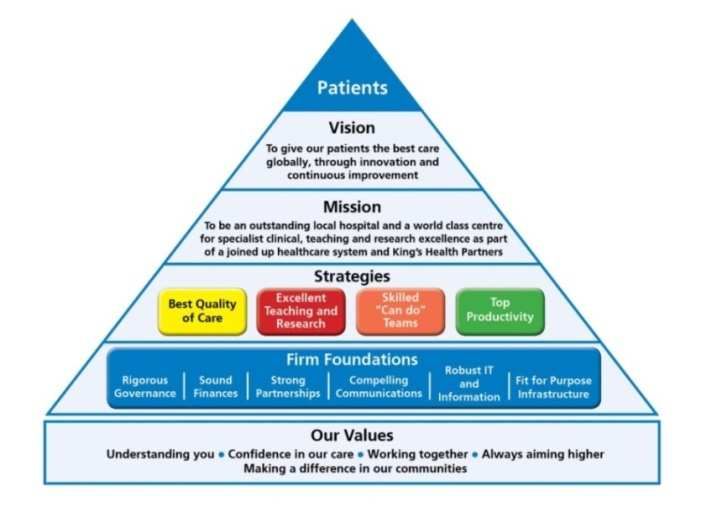
Quality is also at the core of our corporate strategy, which is founded on these
values:
• We have set ourselves the ambitious vision “to deliver the best care globally,
through innovation and continuous improvement”.
• Our mission – “to be an outstanding local hospital and a world class centre of
teaching and research excellence at the heart of a joined up healthcare
system and King’s Health Partners” - also reflects this drive for excellence.
• This vision and mission is supported and underpinned by five enabling
strategies, one of which is “Best Quality Of Care”, and also by a series of
principles linked to these enabling strategies which set out clearly how as an
organisation we intend to conduct ourselves – in effect, the corporate
behaviours we intend to adopt.
Our corporate strategy and our principles are summarised below:
King’s has a long history of involving patients, the public and its foundation trust
members in ensuring we provide high quality services which are responsive to the
needs of the diverse community that we serve. Through our well established “How
are we doing?” patient feedback programme, we have made good progress towards
improving the experience of our patients which remains key to everything that we do.
We want to build on this success and ensure that we continually improve the quality
of the service we provide in line with the standards laid out for us both nationally and,
importantly by our patients.
6|Page4. The purpose of this strategy
The purpose of this strategy is to set out the Trust’s commitment to:
1. Develop a culture that places excellent patient experience at the
heart of everything we do
2. Improve the patient experience by listening to and acting on what
patients tell us
3. Involve patients as equal partners in their healthcare including
children and those with significant mental health issues.
4. Engage and consult with key stakeholders including those from
vulnerable or seldom heard groups
5. Ensure that we have a Foundation Trust membership which reflects
the diversity of our community and that we provide a range of
opportunities for members to be involved with the trust
6. Work together with our partners in King’s Health Partners to
engage with our stakeholders in the development of KHP services
and to work together to improve patient experience
This strategy links key King’s Values and My Promise as well as key corporate
strategies including:
• Forward Plan Strategy Document for King’s College Hospital
• King’s Quality Strategy
• Equality Delivery System 2
• King’s Membership Strategy
• Stakeholder Strategy
4.1. Developing a culture that places patient experience at the heart of
everything that we do
Understanding You
Inspiring confidence in our care
All staff across King’s College Hospital are committed to delivering safe, kind and
compassionate care resulting in a positive patient experience.
7|PageUnderpinning this are the Trust Values and My Promise which have been created by
the people of King’s, staff, patients and their carers - out of their experiences. We will
continue to embed these values in all that we do at King’s to ensure that we have a
culture of care from Board to ward.
Patients tell us that being treated with respect and dignity and being involved in
decisions about their care and treatment are what’s most important to them 2
We will ensure that our doctors, our nurses, all our front-line staff are caring and
compassionate, treat our patients with respect and dignity and involve them as an
equal partners in their care.
We will harness our staff’s enthusiasm and focus our attention on what matters most
to Patients and their families: high quality, safe, effective and personalised care.
To achieve this, we will continue to support our staff through providing good
leadership, training and by engaging staff and motivating them to provide excellent
care to our patients.
We have made good progress in ensuring that our patients are at the centre of what
we do and that King’s has a compassionate culture:
• Launched regular programme of patient stories at our monthly Board of Directors
meetings and Governor Patient Experience and Safety Committee
• Trust Quality Strategy which sets out clear targets for improving patient
experience
• Staff engagement programme to train and equip staff to deliver high quality and
compassionate care
• Through our King’s Way Transformation Programme – launched the King’s
Academy to support staff development and equip our staff to lead service
improvement projects
• Continued a programme of listening events such as ‘Whose Shoes?” for
maternity service users and listening events to inform improvements to outpatient
services
• Appointed Quality and Safety clinical leads for our clinical care groups to help to
drive the patient experience and engagement agenda within the
• A range of initiatives such as the compassionate leadership programme, dignity
month
• New Associate Directors of Medicine and Nursing to lead on the quality agenda
• Compliance with NHS Accessible Information Standards
We want to build on this work to further support staff to deliver a good patient care
and to enhance their own job satisfaction.
2
“Frontiers of NHS Performance II” MORI 2008
8|Page___________________________________________________________________
4.2. Improve the patient experience by listening to patients and acting on what
they tell us
Understanding You
In order to understand patient experience and to ensure that our services meet the
needs of our patients, both now and in the future, we need to actively listen to our
patients and our wider community.
How does the service support people to express their views and be actively involved
in making decisions about their care, treatment and support as far as possible?
CQC Assessment Framework
King’s continues to make progress in improving the experience of our patients
evidenced by local and national surveys including the CQC and Department of
Health National Patient Surveys and the Friends and Family Test.
Our aim is to be in the top 10% of trusts nationally for patient experience over the
lifetime of this strategy.
Patient experience varies across our services, with excellent patient experience in
the majority of our inpatient wards and for day surgery patients. However, the
experience of our outpatients and patients visiting our emergency departments is
less positive. We need to build on and learn from our successes to ensure that our
patients receive a first class service each and every time they receive care and
treatment in any of our services and at any of our hospitals
We will continue to drive improvement in patient experience across our services.
Local surveys
King’s has a well-established feedback programme which centres on our ‘How are
we doing? Patient surveys and the national Friends and Family Test. We will work to
ensure that all our patients, including those from vulnerable groups, are able to
access our surveys or provide their feedback in other ways through our PALS
service, through advocates and the community and voluntary sectors.
Response rates vary across our wards and departments and we need to increase
the amount of feedback we receive to ensure that actions that we take to make
improvements are a true reflection of what our patients are telling us. We will work
with staff to improve our response rates and also implement new strategies to
achieve this, including further expansion of texting and digital feedback through our
9|Page‘Experience’ app and developing bespoke feedback methodologies to suit different
patient groups
We want to ensure real-time feedback for all services and will be transferring our
remaining paper surveys to digital feedback to enable staff to quickly address issues
raised by patients.
Our Clinical Divisions will drive improvement through local ‘Patient and Family Action Plans’
to improve performance and achieve target scores for patient satisfaction in the core areas
that matter most to patients and that are the proven drivers for patient satisfaction including:
• Treating patients with respect and dignity
• Involving patients in their care
• Treating patients with kindness and understanding
Performance and impact will be monitored through the trust’s new performance framework
and through the strengthened committee structure from Board to Ward. We will share good
practice from our highest rated services through regular reporting at the Patient Experience
Committee and at divisional and care group quality and governance meetings. (Please see
appendix 2 for Trust Governance Structure).
We will analyse and use patient comments as a tool to improve patient experience and
strengthen our programme of patient stories and listening events. This will include
developing a mechanism for sharing comments made through public opinion websites and
social media with our clincial divisions.
We will ensure that patient feedback is heard by all our staff through accessible reporting via
our electronic patient experience reporting system- 'Experience' so that all staff understand
how they can play their part to improve patient experience.
We will engage in a number of focussed improvement and transformation initiatives, through
the King’s Way transformation programme and working with local partners and through
delivery of our quality priorities for patient experience.
National Surveys
Although patient experinece has improved in many areas, there are key areas where the
trust continutes to perform less well and we want to improve our performance in the CQC
and Department of Health national patient experience survey programme. In oder to to this,
we will develop robust action plans in response to the national CQC patient surveys in order
to achieve year on year improvement in the Care Quality Commmission and Department of
Health national surveys with zero red rated metrics and learn from top performing trusts.
Complaints and Patient Advice and Liaison Service
How are people’s concerns and complaints listened and responded to and used to
improve the quality of care?
CQC Assessment Framework
10 | P a g eWe acknowledge that we don't always get things right. If our patients are not happy
with the care or treatment they received they have the right to complain, have their
complaint investigated, and be given a full and prompt reply. These rights are
enshrined in the NHS Constitution.
When a patient does have cause to complain, we are committed to responding in a
timely way through:
• Using our Patient Advice and Liaison Service to provide a front line service to give our
patients information and support and, where possible, to resolve issues for patients
immediately
• Identifing consultant lead in each department accountable for complaints
• Continuous improvements in the complaints processes
• Designing and implemeningt new patient involvement procedures
• Embedding recorded complaints review, feedback and action planning into departmental
processes
• Reducing the overall number of complaints
• Developing robust mechanisms for learning from complaints
Volunteering
King’s award winning volunteers give their time to support patients and staff to improve
patient experience on our wards, in our outpatient clinics and our emergency departments.
Volunteers have been show to have a positive impact on patient experinece. Data from our
inpatient surveys tell us that, when a patient has contact with a volunteer, they are bewteen
2 and 4% more likely to recommend King’s as a place to be cared for.
The service is well established and held up as a beacon of excellence for NHS volunteering.
This is demonstrated not only by positive patient experience but through securing significant
external funding for the service from organisation like NESTA, an innovation charity funded
by the Government’s Office for Civil Society and continued funding from the King’s Charity.
The service continues to innovate and develop new roles for volunteers. For example, our
Home Hamper scheme provides food supplies for our most vulnerable patients returning
home and our hand massage volunteers are providing hand massage and company to
patients undergoing palliative care.
We will continue to build the service to ensure good coverage of volunteers across our
service areas, particuarly in our outpatient clinics and in our emergency departments. We
will also develop a bespoke volunteering offer for young people of school age to facilitate
access to volunteering at King’s.
11 | P a g e___________________________________________________________________
4.3. Involve patients as equal partners in their healthcare including children
and those with significant mental health issues
Understanding You
How does the service support people to express their views and be actively involved
in making decisions about their care, treatment and support as far as possible?
CQC Assessment Framework
Person centred coordinated care: “I can plan my care with people who work together to
understand me and my carer(s), allow me control, and bring together services to achieve
the outcomes important tome.”
National Voices
We will respond to the new national guidance from NHS England to deliver person-
centred care and to actively encourage patients’ and families participation in
decisions about their care.3 Our priority is to ask our patients ‘what matters to you?’
during their treatment and care. Our main areas of focus are:
• Introducing more personalised care and support planning for people with one or
more long term conditions
• The introduction of more self management programmes for patients with long
term conditions
• More shared decision making between patients and clinicians to select tests,
treatments and support programmes as their conditions change for example with
cancer patients
• The introduction of social prescribing in outpatients – linking patients to non-
medical emotional and practical support in the community
• More accessible information and supporting patients’ health literacy (including
signage and patient information about our services)
3
NHS Standard Contract 2017/18 and 2018/19 requires providers to provide clear information to service users,
that questions are responded to promptly and effectively and actively engage, liaise and communicate with
service users in an open and clear manner in accordance with the law and good practice (service condition 12)
CQC regulation 9 states that providers must ‘provide support to help (individuals) understand and make informed
decisions about their care and treatment options’. In addition ‘accessible information and communication’ is one
of the CQC equality objectives 2017-19 and from October 2017 all inspection reports will include how providers
are applying the standard.
More on the expectations on providers in involving people in their own care is on page 20 of this statutory
guidance for CCGs and NHS E Involving People in their own health and care
https://www.england.nhs.uk/publication/involving-people-in-their-own-health-and-care-statutory-guidance-for-
clinical-commissioning-groups-and-nhs-england/
12 | P a g e• Early identification and support for carers including the introduction of John’s
Campaign
This will include the roll-out of Patient Activation Measures (PAMs) across a range of
outpatient services and the offer of personal health budgets for those eligible
We will continue to roll out of IMPARTs – to better support patients in managing their
mental and emotional support alongside their physical care as part of our three year
Mind and Body quality priority.
___________________________________________________________________
4.4. Engage and consult with key stakeholders
Working together
Are the people who use services, the public, staff and external partners engaged and
involved to support high-quality sustainable services?
CQC Assessment Framework
King’s will work in partnership with patient and public representatives, advocacy
organisations and the voluntary and community sector to ensure our services are
developed and delivered to meet the needs of our patients and local residents. We
will improve our engagement and consultation with our partner organisations on:
• King’s estates and clinical site strategies at Denmark Hill
• Trust-wide quality priorities
• King’s Way transformation programmes
The duty to involve
We will meet our legal responsibilities to involve the public in planning, developing
and delivering our services (in line with section 242 of the National Health Service
Act 2006, as amended by the Health and Social Care Act 2012). In particular, we will
demonstrate good practice in engaging the public and their representatives
throughout the informal and formal stages of planning our new estates and clinical
site strategies over the next 3 years.
Working with patient and public representatives
We will work closely with our Health Overview and Scrutiny Committees and local
Healthwatch organisations through regular meetings and joint projects; responding
promptly and openly to formal requests for information and supporting Healthwatch
13 | P a g eenter and view visits to make best use of their independent feedback on the quality of our services. King’s has improved our internal complaints procedure and response times. We will now engage more effectively with our partners involved in advocacy, including NHS complaints advocacy, to make better use of the feedback they gather when supporting our patients with additional needs and who find it difficult to raise their concerns. Our transformation programmes (the King’s Way) will involve patient and public representatives more directly in developing patient pathways and service standards and in monitoring the impact on patients when the changes are made. We will involve our partners in transforming our services from outpatient services through to our cancer care pathways. Our maternity services will support the development and expansion of the new Maternity Voices Partnerships to give women and their families a greater say in the care they receive during pregnancy and childbirth. Partnerships with the voluntary and community sector We have a strong voluntary and community sector across our local boroughs with many hundreds of larger and smaller voluntary organisations representing local communities, residents and patient groups. In line with the national drive for partnership working with the voluntary sector, we are introducing an Associate Membership of King’s for voluntary and community organisations (see under Foundation Trust membership below). We will engage with national, regional and local voluntary organisations who support our patients and local communities. We will draw on their expertise, connect our service staff to the community support available for their patients, and share information about King’s developments. Public engagement across SE London We recognise the importance of linking to the local partnerships already in place across our local area and the engagement plans of our Clinical Commissioning Groups (CCGs) and council partners. We will support wider patient and public engagement in King’s and the development of a more integrated local health and care system. In particular, we will engage through the partnerships in Our Healthier South East London, our Local Care Networks and Patient Participation Group (PPG) networks across the general practices in our boroughs. This benefits the development of joined-up care for our patients and informs our own service improvements. For example, our engagement with the LCNs and PPGs will be particularly important as we develop pathways of more integrated care for people with mental health needs, long term conditions such as diabetes, and rehabilitation for people who have used our neurosciences, critical care, stroke and cardiac specialist centres. 14 | P a g e
Equalities and diversity

King’s provides care for some of the most diverse communities in the country and
the Equality Delivery System 2 is an important tool for King’s to ensure we
understand the needs of our communities and our staff from the range of protected
characteristics.

We will develop more accessible information and feedback mechanisms for patients
and the public, including people with a learning disability.

We will work with our partners to better understand the experiences of care at King’s
from different equalities groups. For example in the development of our King’s
Adolescent Outreach Service and Variety Children and Young People’s Hospital;
and the services for older people and those with dementia.

We will seek to engage groups representing traditionally seldom heard communities
and those in more vulnerable circumstances who may experience the poorest health.
Some of these communities are over-represented in our emergency departments
and struggle to maintain outpatient appointments to support their long term
conditions. Priorities include engaging with groups who support people with mental
health, drug and alcohol needs, young people with complex needs and people with
English as a second language?

___________________________________________________________________

4.5. Foundation Trust membership

                   Understanding You
                   Working together
                    Making a difference in our community

King’s has been a Foundation Trust since December 2006 and has a thriving
membership of nearly 11,000 members made up of people from our local
community, our patients and over 13,000 staff. By 2020, our vision is that the King’s
membership will be a more representative and active community of patients, citizens
and local voluntary and community organisations who work with us to improve and
support our services.

We will encourage more members to vote in governor elections, contribute to
transformation projects and take part in engagement events and advisory groups,
including annual members’ events to report on progress and consult on our plans.
We will build partnerships with local voluntary and community organisations to help
us hear from local communities and to improve the care and support to our patients,
carers and families.

We will improve the ways we communicate with our members about the positive
changes we are making and the challenges we face.

15 | P a g e
We will build on our successful programme of health talks - creating more
opportunities for patients and communities to talk with us about their health needs
and experiences, as well as learn about the developments in medical care at King’s.
Our recruitment priorities for the next three years are to retain our current members
and to build our membership in those areas and from those communities who are
under-represented. This includes Lambeth residents, some minority ethnic
communities and younger people under 21 years of age.
It is now three years since King’s acquired the Princess Royal Hospital Bromley,
Orpington Hospital and services at Beckenham Beacon and Queen Mary’s Sidcup.
King’s membership across Bromley stands at 2672 (33.4% of our membership),
meeting the targets set in the previous membership strategy. We will ensure we
retain our current membership numbers across Bromley and continue to develop the
ways our Bromley members get involved in developments across the Princess Royal
and our south sites.
Finally, we will use King’s membership to formally strengthen our engagement with
voluntary and community groups and patient charities linked to King’s, (a King’s
‘Associate membership’). We aim to improve two-way communication, providing
better information to voluntary organisations about our work, but also promoting the
important support these organisations provide local people and our patients.
Associate membership will also ensure voluntary organisations have a greater voice
in designing and helping us monitor the quality of our services.
King’s membership strategy forms part of the King’s patient and public engagement
and experience strategy 2017-2020. It includes an annual action plan for 2017-18.
___________________________________________________________________
4.6. King’s Health Partners – working together
Working together
Always aiming higher
King’s Health Partners provides a unique opportunity for King’s to work with its KHP
partners to ensure that the development of KHP is informed by patients and the
public and to enable us to provide an excellent patient experience. KHP aspires to
be the best Academic Health Sciences Centre for patient experience measured by
what patients tell us in both national and local surveys.
Working with our partners, we will:
• Align approaches to patient, public and member engagement in development
of services across KHP.
• Work together to develop engagement in the implementation of King’s Health
Partners Institutes
• Support the development of KHP Outcomes Books which are designed to
help patients, service users, carers, referring clinicians and commissioners to
make better-informed decisions, and our staff to drive up the quality of the
16 | P a g ecare we provide. The books report key outcomes for treatments including
patient experience
• Work with our partners to promote health and wellbeing and linking with the
aims of the Public Health Outcomes Framework
• Share good practice in engagement and experience
___________________________________________________________________
4.7. Be a good corporate citizen
Making a difference in our community
As a key provider of health services across our key local boroughs and as a major
employer locally, King’s is committed to working in partnership with our local
community to enhance opportunities for local people and businesses.
• We will work with local partners in the public and voluntary sectors to support
improvements for our local community – e.g. campaigning for improvement to
local transport links, promoting employment, supporting local businesses by
prioritising procurement from local suppliers and businesses
• Continue to develop our award winning King’s Volunteering programme to
widen access opportunities for local people into volunteering, particularly
those from the more deprived areas that the trust serves.
• Work with our Governors through their Membership and Community
Engagement Committee to engage with our local community and enhance
King’s role as good corporate citizen
• Work to support and promote good public health in our local community
linking with our new voluntary and community sector Associate Members
5. Support to deliver the strategy
Individual Divisions, services or departments will be responsible for ensuring that
patient experience and engagement is taken into account in business planning and
service delivery. Divisions will also be responsible for developing and implementing
local action plans for improvement and ensuring appropriate engagement of patients,
the public and key stakeholders in service redesign or development.
Advice and guidance will be provided by the following groups or departments,
however they are not accountable for implementing the engagement plans of the
various services:-
• Patient and Public Involvement Team – advice on all aspects of engagement,
Foundation Trust membership, How are we doing and Friends and Family
feedback programme, main point of contact Healthwatch
• Communications – external stakeholder relations including Overview and
Scrutiny Committees, MPs, local Councils
17 | P a g e• King’s Way Transformation team
• Education and Development team – development and delivery of a range of
training and organisational development programmes to support staff to engage
and involve patients appropriately and to equip them to deliver a quality service to
our patients
6. Accountability, implementation, and monitoring
Patient and stakeholder engagement must be integral to all service management
and development activities. The Patient Experience Committee will have operational
responsibility for ensuring implementation of this strategy. Implementation of the
strategy and the associated work plan will be monitored quarterly by the Trust
Patient Experience Committee and the Governors Membership and Community
Engagement Committee.
The Patient Experience Committee will report through to the Board via the Executive
Quality Committee which reports directly to the Quality and Research Governance
Committee
18 | P a g eAppendix 1 – King’s Values and King’s Promise King’s Values Understanding you Listening is the key to understanding what matters – whether it’s one of our patients or another member of staff. Only by hearing what they say and trying to put yourself ‘in their shoes’ will you really appreciate their situation and understand their concerns • We appreciate each person as a unique individual • We start by listening - then act based on what we learn • We're open and we talk to one another • We consider how our actions affect others Inspiring confidence in our care By providing the right information at the right time and attending to their needs in a calm and professional manner, patients will feel confident in their treatment and the people who care for them. • We always put our patient's needs first • We reassure our patients with our calm and confident care • We act to protect our patients from harm • We value all patients equally • We do the right thing for our patients, even when it's difficult Working together We can’t always make the right decisions as individuals - no one person can hold all the knowledge and skills required to answer every problem. By working together as a team – learning from each other and cooperating, we can get the job done. • We think and act as "Team King's" • We value what each of us brings to King's • We share information and give everyone a voice • We cooperate and we support one another at all times • We get things done with our "can-do" spirit Always aiming higher With such a rich pool of talent at King’s, there are always opportunities to make things better for our patients and for each other. We look to find innovative solutions to overcome the problems that arise and to learn from our experiences. • We seize opportunities to make things better for our patients and each other • We learn from our experiences - and from what other teach us • We think differently and create new solutions • We see problems as opportunities to try new things Making a difference in our community King’s is a hospital with a world class reputation, providing services both nationally and internationally but our roots lie in the heart of our local community. Many of our staff are local people, a large number of local businesses provide services and support for the hospital and we in turn look to support and sustain the local community. • We take pride in providing the best possible care • We are active in community affairs • We employ people who care about our community • We use local businesses for supplies and services 19 | P a g e
My Promise
In Always aiming higher...
• I will be a positive role model for others and go that extra mile for the benefit of my
• patients, their families and colleagues
• I will accept constructive feedback as important in improving the quality of my work
• I will make sure that I keep up-to-date with what is expected of me within my role by
• having an annual appraisal
In Always aiming higher...
• I will not ignore the value of learning from colleagues as a way to improve patient care
• I will not automatically ignore the contributions of others
• I will not ignore what I have learnt from problem solving or ignore opportunities to try
• out new ideas
• I will not behave in a rude, patronising, bullying or disrespectful way to
In Understanding you...
• I will actively listen to patients to understand their needs
• I will include patients, families and colleagues when making care-based decisions
• I will take time to do what I say when I say
• I will communicate with patients, families and colleagues in plain English
• I will create a work environment that is friendly, professional and which respects others
In Understanding you...
• I will not ignore the needs and concerns of patients, families, visitors and colleagues
• I will not make promises that I cannot keep
• I will not allow negative feelings and behaviours to affect how I behave to others
• I will not ignore the needs of individuals
• I will not turn a blind eye when I see others behaving badly
When Inspiring confidence...
• I will take responsibility for how my actions affect others
• I will treat others as I would like to be treated myself
• I will be less judgemental of patients and how they choose to cope with their conditions
• I will ensure that I participate in research, education and training, keeping my skills,
  knowledge and expertise up-to-date to improve patient care
• I will make sure that everyone in the team is clear how they can raise concerns
  confidently
When Inspiring confidence...
• I will not ignore requests for information, help and support from patients,
• their families and colleagues
• I will not fail to challenge a colleague who I know is working below or outside agreed
• professional standards of experience and competence
• I will not be dismissive and intolerant of the experiences, background and culture of
  others
• I will not knowingly use jargon, rude, or potentially offensive language when talking to
  patients
When Working together...
• I will work together with everyone to improve the service I provide
• I will be honest, open, transparent and willing to share information
• I will always make an effort in the first instance to resolve problems for patients and
• colleagues myself
• I will provide constructive criticism and advice when I see quality of work falling below
• acceptable expectations

20 | P a g e
When Working together...
• I will not dismiss the needs of the team, especially during stressful times
• I will not deliberately ignore working with others in improving the service that King’s
• provides to patients, their families and staff
• I will not ignore a request but will try to find out information for patients and colleagues,
• especially when the solution is not obvious

In Making a difference to our community...
• I will actively help people who are new to or unfamiliar with King’s, whether they are
• patients, families or visitors
• I will support where necessary local community projects within my team or service
• I will always motivate others to value the difference they can make, whatever their role,
• to the experience of patients and their families
• I will make sure that I treat individuals from our local community with common courtesy

In Making a difference to our community...
• I will not ignore or fail to support new members joining the team
• I will not ignore our Whistleblowing Policy when I have concerns about poor care, or the
• incorrect use of resources and facilities which are meant for patients and colleagues
• I will not speak in a negative way about

21 | P a g e
Appendix 2 – Governance and Reporting Structures

22 | P a g e
23 | P a g e
You can also read


