2018-2020 Champaign County Illinois - Community Health Improvement Plan
←
→
Page content transcription
If your browser does not render page correctly, please read the page content below
Community Health
                                           Improvement Plan

2018-2020
Champaign County Illinois

   Covenant Medical Center

                     United Way
                     of Champaign County
TABLE
OF
CONTENTS
EXECUTIVE
SUMMARY
..............................................................................................................................................
3
ACKNOWLEDGEMENTS
.............................................................................................................................................
5
INTRODUCTION
AND
FRAMEWORK
..........................................................................................................................
9
BACKGROUND
........................................................................................................................................................
10
COMMUNITY
ASSETS
..............................................................................................................................................
10
MAPP
ASSESSMENTS
............................................................................................................................
11
COMMUNITY
HEALTH
STATUS
ASSESSMENT
........................................................................................................
11
Demographics
.......................................................................................................................................
12
Socioeconomic
and
Priority
Populations
...............................................................................................
14
Chronic
Disease
and
Health
Behaviors
.................................................................................................
19
Quality
of
Life
.......................................................................................................................................
20
Infectious
Disease
.................................................................................................................................
21
Death,
Injury,
and
Violence
...................................................................................................................
22
Maternal
and
Child
Health
...................................................................................................................
32
Environmental
Health
...........................................................................................................................
32
COMMUNITY
THEMES
AND
STRENGTHS
ASSESSMENT
...........................................................................................
34
Demographics
.......................................................................................................................................
34
Neighborhood
Traffic
and
Roads
..........................................................................................................
35
Neighborhood
Safety
Concerns
............................................................................................................
36
Community
Resources
..........................................................................................................................
37
Health
Behaviors
...................................................................................................................................
37
Healthcare
............................................................................................................................................
37
Personal
Satisfaction
............................................................................................................................
38
Community
Health
Concerns
................................................................................................................
38
LOCAL
PUBLIC
HEALTH
SYSTEM
ASSESSMENT
......................................................................................................
40
FORCES
OF
CHANGE
ASSESSMENT
.....................................................................................................................
45
PRIORITY
HEALTH
ISSUES
......................................................................................................................
47
REDUCING
OBESITY
AND
PROMOTING
HEALTHY
LIFESTYLES
...................................................................................
47
BEHAVIORAL
HEALTH
.....................................................................................................................................
56
VIOLENCE
....................................................................................................................................................
62
APENDICES
SECTION
.............................................................................................................................
68
APPENDIX
1
–FORCES
OF
CHANGE
ASSESSMENT
SURVEY
RESULTS
..........................................................................
69
APPENDIX
2
–
LOCAL
PUBLIC
HEALTH
SYSTEM
ASSESSMENT
..................................................................................
91
APPENDIX
3-‐
COMMUNITY
SURVEY
..................................................................................................................
91
APPENDIX
4
-‐
COMMUNITY
SURVEY
(SPANISH)
..................................................................................................
92
APPENDIX
5
–
COMMUNITY
STAKEHOLDER
SURVEY
.............................................................................................
97
2
Executive
Summary
The
Champaign-‐Urbana
Public
Health
District
(CUPHD)
is
the
local
public
health
authority
for
the
Cities
of
Champaign
and
Urbana
and
Champaign
County.
CUPHD,
in
conjunction
with
Carle
Foundation
Hospital,
Presence
Covenant
Medical
Center,
and
United
Way
of
Champaign
County,
used
the
Mobilizing
for
Action
through
Planning
and
Partnership
(MAPP)
model,
a
community-‐based
model
that
necessitates
community
engagement
at
all
levels
to
conduct
the
Champaign
Community
Health
Assessment
(CHA)
and
Community
Health
Improvement
Plan
(CHIP).
We
assessed
the
current
health
status
of
the
community,
identified
needs,
and
created
a
comprehensive
plan
to
improve
our
community’s
health
by
acquiring
input
from
community
partners,
planners,
elected
officials,
and
residents.
The
MAPP
process
is
composed
of
four
assessments.
Approximately
90
community
leaders
met
multiple
times
to
participate
in
the
assessment
and
to
review
the
results
of
the
survey
and
community
health
data,
set
a
vision,
and
identify
priorities
and
goals
for
the
2018-‐2020
Community
Health
Improvement
Plan.
Vision:
Champaign
County
will
be
the
Healthiest
and
Safest,
environmentally
sustainable
community
to
live,
work,
and
visit
in
the
State
of
Illinois.
The
Four
MAPP
Assessments:
1.
The
Community
Health
Status
Assessment
evaluated
the
basic
demographics
and
health-‐related
statistics
of
residents
in
Champaign
County.
We
used
aggregated
data
accessed
from
Countyhealthrankings.org
and
city
and
county
agencies
including
the
Champaign
and
Urbana
Police
Departments.
• Champaign
County
had
an
estimated
208,419
residents
in
2016,
an
increase
of
3.6%
from
2010.
The
population
is
73%
White,
13%
Black/African
American,
11%
Asian,
and
6%
Hispanic.
• Close
to
20%
of
Champaign
County
residents
live
in
poverty,
and
54%
of
children
attending
public
schools
were
eligible
for
free
or
reduced
price
lunches.
• 25%
of
Champaign
Residents
reported
being
obese,
a
drop
from
27%
in
2014
• Violent
crime
in
Champaign
County
is
much
higher
than
the
state
and
national
averages.
• 9%
of
Champaign
County
residents
under
65
years
of
age
are
uninsured
compared
to
11%
overall
Illinois
uninsured
rate.
• The
teen
birth
rate
(per
1,000
female
population,
ages
15-‐19)
is
18,
almost
half
of
the
prevalence
in
Illinois.
Champaign
County
is
close
to
the
top
US
counties
when
it
comes
to
teen
pregnancy
with
the
top
US
County
having
a
teen
birth
rate
of
17.
• As
of
2015,
there
were
186
fast
food
establishments
in
Champaign
County.
The
rate
of
fast
food
restaurants
per
100,000
populations
in
Champaign
County
is
92.5,
which
is
substantially
higher
than
state
and
national
rates
of
77.67
and
74.6.
• The
leading
cause
of
death
in
Champaign
County
from
2003
to
2014
was
heart
disease.
In
2015,
cancer
surpassed
heart
disease
as
the
leading
cause
of
death
in
Champaign
County
with
a
rate
of
129.8
per
100,000
populations.
3
2.
To
perform
the
Community
Themes
and
Strengths
Assessment,
we
surveyed
748
community
residents
representing
different
community
groups
to
get
an
in-‐depth
picture
of
strengths
and
weaknesses
of
the
community.
• Residents
identified
access
to
public
transportation,
access
to
health
care,
and
employment/ability
to
find
a
job
as
community
strengths
• Respondents
identified
access
to
mental
health
services,
drug
treatment
services,
and
affordable
childcare
were
threats
in
the
community.
• Respondents
were
satisfied
with
Champaign
being
a
good
place
to
raise
children
and
were
satisfied
that
Champaign
County
is
a
racially,
ethnically,
and
culturally
diverse
place
to
live
• Respondents
reported
being
satisfied
with
access
to
high
quality
healthcare,
although
they
were
dissatisfied
with
the
cost
of
healthcare.
• Crime
rate,
road
maintenance,
and
crime
patrols
were
identified
as
neighborhood
issues
• Mental
health,
Substance
Abuse,
Gun
Violence,
Obesity,
and
Domestic
Violence
were
identified
as
top
health
priorities.
3.
The
Local
Public
Health
System
Assessment
(LPHSA)
included
84
community
leaders
from
over
50
different
agencies,
including
local
government,
community
planners,
public
health
professionals,
clinicians,
police
and
fire,
local
nonprofits,
emergency
preparedness,
and
the
University
of
Illinois.
This
measured
how
the
local
public
health
system
is
addressing
the
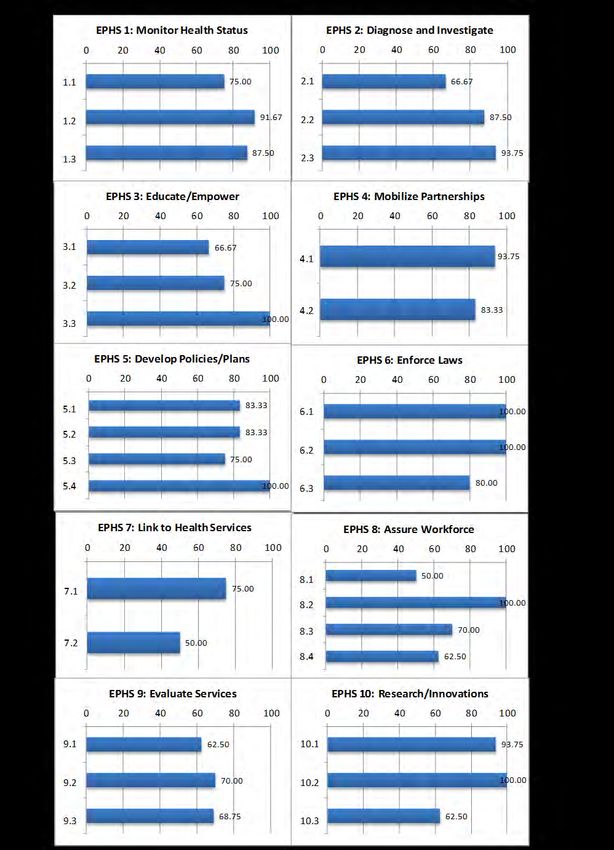
10
essential
public
health
services.
• Strengths:
enforcing
laws,
mobilizing
partnerships,
developing
policies/plans,
research/innovations,
reviewing
and
improving
laws,
emergency
planning,
risk
communication,
academic
linkages,
fostering
innovations,
community
partnerships
• Needing
Improvement:
linking
community
members
to
health
services,
evaluating
the
local
public
health
system,
assuring
a
competent
and
diverse
workforce,
evaluation
of
population
health,
leadership
development,
and
health
education/promotion.
4.
The
Forces
of
Change
Assessment
identified
the
changing
ACA
legislation
as
a
force
impacting
many
sectors;
as
well
as
immigration
laws,
increased
use
of
social
media
and
smartphones,
mental
health
issues,
divisive
political
climate,
lack
of
state
budget,
and
climate
change
as
major
forces
of
change.
Health
Priorities
Based
on
the
four
MAPP
assessments,
community
leaders
convened
to
identify
priorities.
After
identifying
top
health
concerns,
participants
voted
to
select
the
top
three
priorities
to
address
in
2018-‐
2020
implementation
cycle.
Special
consideration
was
given
to
ensure
that
all
priority
health
actions
align
to
include
environmental
determinants
of
Public
Health.
Based
on
the
CDC’s
model,
SMART
objectives
were
used
to
identify
goals
and
objectives
within
each
priority
that
were
feasible,
actionable,
and
could
be
implemented
in
the
upcoming
years.
Workgroups
then
formed
and
met
separately
to
formulate
goals
and
action
plans
to
address
each
of
the
priorities.
4
• Behavioral
Health:
increase
capacity,
create
behavioral
health
triage
center,
promote
education
and
training
on
mental
and
behavioral
health
to
reduce
stigma,
provide
youth
targeted
prevention
programs.
• Reducing
Obesity
and
Promoting
Healthy
Lifestyles:
improve
access
to
healthy
food
options,
expand
physical
activity
prescription
program,
and
increase
access
to
physical
activity.
• Violence:
promote
police-‐community
relations,
increase
community
engagement,
and
reduce
community
violence
through
partnering
with
local
initiatives
Ensuring
Environmentally
Sustainable
Community
All
community
partners
are
in
consensus
and
recognize
the
many
connections
between
health
in
our
county
and
environmental
factors.
In
seeking
an
environmentally
sustainable
community,
we
want
safe
air
and
water,
natural
spaces
for
exercise
and
mental
relaxation,
conservation
of
flora
and
fauna
that
support
local
food
production,
control
of
insects
that
spread
diseases,
and
other
health
benefits.
We
also
recognize
the
dangers
to
health
from
extreme
weather
events
like
heavy
rains,
heat
waves
and
drought.
Promoting
environmental
health
requires
monitoring
conditions,
preparing
for
emergencies,
and
reducing
activities
that
impair
the
sustainability
of
our
community's
environment.
The
Community
Health
Improvement
Plan
will
promote
a
culture
of
environmental
sustainability
across
all
sectors.
Acknowledgements
The
Champaign
Regional
Executive
Committee
would
like
to
thank
all
of
the
agencies
and
individuals
who
participated
in
this
process,
as
well
as
the
agencies
and
organizations
that
make
up
the
Champaign
County
Local
Public
Health
System.
We
appreciate
their
knowledge,
collaboration,
dedication,
and
commitment
to
making
our
community
a
great
place
to
live,
work,
and
visit.
Beth
Edrington
Carle
Foundation
Hospital
Elizabeth
Silver
Carle
Foundation
Hospital
Jonathan
Woods
Carle
Foundation
Hospital
Julianna
Sellett
Carle
Foundation
Hospital
Kathleen
Crowder
Carle
Foundation
Hospital
Mike
Billimack
Carle
Foundation
Hospital
Timothy
Meneely
Carle
Foundation
Hospital
John
Beck
Carle
&
Health
Alliance
Brooke
Adams
Court
Appointed
Special
Advocates
for
Children
Allen
Jones
Champaign
County
Sheriff's
office
5
Pius
Weibel
Champaign
County
Board
Hollie
Ronk
Champaign
County
Head
Start
Ashley
Buckley
Champaign
County
Health
Care
Consumers
Chris
Garcia
Champaign
County
Health
Care
Consumers
Claudia
Lenhoff
Champaign
County
Health
Care
Consumers
Julia
Robinson
Champaign
County
Health
Care
Consumers
Mark
Driscoll
Champaign
County
Mental
Health
Board
Chelsea
Norton
Champaign
Park
District
Jameel
Jones
Champaign
Park
District
Ronnie
Heugel
Champaign
Police
Department
Amy
Roberts
Champaign
Urbana
Public
Health
District
Awais
Vaid
Champaign
Urbana
Public
Health
District
Brandon
Meline
Champaign
Urbana
Public
Health
District
Candi
Crause
Champaign
Urbana
Public
Health
District
Debra
Fruitt
Champaign
Urbana
Public
Health
District
Jamie
Perry
Champaign
Urbana
Public
Health
District
Jim
Roberts
Champaign
Urbana
Public
Health
District
Julie
Pryde
Champaign
Urbana
Public
Health
District
Michael
Flanagan
Champaign
Urbana
Public
Health
District
Talia
Shaw
Champaign
Urbana
Public
Health
District
Robert
Davies
Champaign
Urbana
Public
Health
District
Michelle
Antonacci
Christie
Clinic
Janel
Gomez
City
of
Champaign
Neighborhood
Services
Lorrie
Pearson
City
of
Urbana
Anita
Ung
College
of
Medicine
Robin
Arbiter
Community
Gardens
at
Leirman
Pattsi
Petri
County
Board
Member
Dottie
Vura-‐Weis
County
Board
of
Health
Kevin
Kegley
CRIS
Healthy
Aging
Katie
Adams
Crisis
Nursery
Rob
Dalhaus
C-‐U
at
Home
Cynthia
Hoyle
C-‐U
Mass
Transit
District
Marlin
Livingston
Cunningham
Children's
Home
J
Berry
Howell
Dental
Society
Dale
Morrissey
Developmental
Services
Center
Danielle
Matthews
Developmental
Services
Center
Candace
Gilbert
Faith
in
Action
Brenda
Koester
Family
Resiliency
Center
Pat
Babich-‐Smith
Family
Service
Center
Mike
Benner
Greater
Community
AIDS
Project
Sheila
Dodd
Habitat
for
Humanity
6
Nikki
Hillier
Healthy
Champaign
County
Angela
Boley
Land
of
Lincoln
Eva
Palmer
McKinley
Health
Center
Anna
Casey
Midwest
Center
for
Investigative
Reporting
Debra
Medlyn
National
Alliance
on
Mental
Illness
Jeff
Kilar
Parkland
College
Joe
Omo-‐Osagie
Parkland
College
Kevin
Garcia
Planner
for
City
of
Urbana
Gail
Raney
Prairie
Center
Alejandra
Coronel
Presence
Health
Brianna
Roy-‐Rankin
Presence
Health
Elise
Boyer
Presence
Health
Jacob
Ozier
Presence
Health
Jolene
Bowen
Presence
Health
Mackenzie
O'Shea
Presence
Health
Michael
Jenkins
Presence
Health
Miriam
Romine
Presence
Health
Patty
Brown
Presence
Health
Sallie
Miller
Presence
Health
Sheri
McKiernan
Presence
Health
Nancy
Greenwalt
Promise
Healthcare
Nicole
Bridges
Prosperity
Garden
Lisa
Benson
Regional
Planning
Commission
Rebecca
Woodard
Regional
Planning
Commission
Rita
Black
Regional
Planning
Commission
Juli
Kartel
Rosecrance
Kristin
Rice
Rosecrance
Sheila
Ferguson
Rosecrance
Warren
Gary
Lavey
U
of
I
Schools
of
Earth,
Society,
and
Environment
Sue
Grey
United
Way
of
Champaign
County
Amy
Huang
United
Way
of
Champaign
County
Beverley
Baker
United
Way
of
Champaign
County
Julia
Willis
United
Way
of
Champaign
County
Bala
Mutyala
University
of
Illinois
Hillary
Klonoff
Cohen
University
of
Illinois
Lisa
Bievenue
University
of
Illinois
Caitlin
Kownacki
University
of
Illinois
Extension
Office
Chelsey
Byers-‐Gerstenecker
University
of
Illinois
Extension
Office
Kathy
Sweedler
University
of
Illinois
Extension
Office
Melissa
Schumacher
University
of
Illinois
Extension
Office
Stephanie
Vogelsang
University
of
Illinois
Police
Dept.
7
       Nancy
  Roth
                                Urbana
  Adult
  Education


       Bill
  Brown
                                Urbana
  Councilman

       Janice
  Mitchell
                           Urbana
  Neighborhood
  Connections
  Center

       Elsie
  Hedgspeth
                           Urbana
  Park
  District

       Linda
  Gibbens
                             Urbana
  School
  District

       Celeste
  Eichelberger
                      Wells
  Fargo


Geographic
  Data
  Mapping
  done
  by
  Bill
  Brown
  and
  Lisa
  Bievenue
  from
  the
  University
  of
  Illinois


     Julia
  Willis


     Community
  Health
  Plan
  Coordinator


           The
  Champaign
  Regional
  Executive
  Committee
  Members:


           Awais
  Vaid


             Champaign
  Urbana
  Public
  Health
  District


                                                                                                  Mike
  Billimack

                                                                                                  Carle
  Foundation
  Hospital


             Elizabeth
  Silver


         Sheri
  McKiernan


           Carle
  Foundation
  Hospital


         Presence
  Health


           Julie
  Pryde


         Sue
  Grey


           Champaign
  Urbana
  Public
  Health
  District


         United
  Way
  of
  Champaign
  County


           Melissa
  Rome


             Vermilion
  County
  Health
  Department


                                                                                                  Sherri
  Askren


                                                                                                  United
  Way
  of
  Danville
  Area


             Doug
  Toole


           Vermilion
  County
  Health
  Department


                                                                                                                                                 8
Introduction
and
Framework
The
Champaign
County
Community
Health
Plan
provides
a
current
portrait
of
the
health
assets
and
needs
of
the
residents
of
Champaign
County.
Illinois
state
law
requires
every
local
health
department
to
participate
in
this
process,
called
the
Illinois
Project
for
Local
Assessment
of
Needs
(IPLAN).
This
process
must
be
conducted
at
minimum
every
five
years.
The
detailed
assessment
and
plan
provides
the
foundation
for
evidence-‐
based
health
planning
and
decision-‐making.
The
essential
elements
of
IPLAN
are:
1.
An
organizational
capacity
assessment;
2.
A
community
health
needs
assessment;
and
3.
A
community
health
plan,
focusing
on
a
minimum
of
three
priority
health
problems.
The
Champaign
County
Community
Health
Plan
was
created
using
a
model
called
Mobilizing
for
Action
through
Planning
and
Partnerships
(MAPP).
This
collaborative
approach
to
community
health
planning
was
developed
by
the
National
Association
of
County
and
City
Health
Officials
(NACCHO)
in
cooperation
with
the
Public
Health
Practice
Program
Office
and
the
federal
Centers
for
Disease
Control
and
Prevention
(CDC).
MAPP
helps
communities
form
effective
partnerships
that
can
better
identify
their
unique
circumstances
and
needs
and
use
their
resources
wisely.
MAPP
is
a
community-‐driven
process.
It
is
more
intense
than
other
approaches
in
that
it
requires
a
high
level
of
participation
from
community
organizations
and
residents.
This
model
employs
a
variety
of
methods
to
uncover
community
health
trends,
identify
gaps
in
care,
evaluate
assets
and
–
most
importantly
–
develop
and
implement
a
plan
that
successfully
addresses
community
health
needs.
The
four
components
of
MAPP
include:
1)
The
Community
Health
Status
Assessment
collects
and
analyzes
health
data
and
describes
health
trends,
risk
factors,
health
behaviors
and
issues
of
special
concern.
2)
The
Community
Themes
and
Strengths
Assessment
uses
parkcipants
to
make
a
list
of
issues
of
importance
to
the
community,
idenkfy
community
assets
and
outline
quality
of
life
concerns.
3)
The
Local
Public
Health
System
Assessment
measures
the
local
public
health
system’s
ability
to
conduct
essenkal
public
health
services.
4)
The
Forces
of
Change
Assessment
idenkfies
local
health,
social,
environmental
or
economic
trends
that
affect
the
community
or
public
health
system.
9
Since 2013 The Health District and Hospitals have moved from independently conducting the Community Health Assessment and Improvement Plan to a true collaborative model. Both Carle Hospital and Presence Covenant Medical Center, the Local chapter of United Way, and the Health District formed an Executive Committee to conduct the Champaign Community CHIP and CHA to fulfill the requirements for certification. A diverse group of health providers, civic leaders and community representatives participate in this process. The goal is for all partners in the local public health system to work together to implement the recommendations outlined in this plan. Background Champaign County is located in east central Illinois and is 998.39 square miles with a population density of 208.8 people per square mile. The two major cities, Champaign and Urbana, are home to the University of Illinois, as well as Parkland College and numerous businesses and companies. In 2016 the US Census Bureau estimated the population to be 208,419 residents, a 3.6% increase since 2010. Champaign County also includes the following villages: Bondville, Broadlands, Fisher, Foosland, Gifford, Homer, Ivesdale, Longview, Ludlow, Mahomet, Ogden, Pesotum, Philo, Rantoul, Royal, Sadorus, Savoy, Sidney, St. Joseph, Thomasboro, and Tolono. Townships include: Ayers, Brown, Champaign, Colfax, Compromise, Condit, Crittenden, Cunningham, East Bend, Harwood, Hensley, Kerr, Ludlow, Mahomet, Newcomb, Ogden, Pesotum, Philo, Rantoul, Raymond, Sadorus, Scott, Sidney, Somer, South Homer, St. Joseph, Stanton, Tolono, and Urbana. Champaign County includes the following zip codes: 61820-‐2, 61801-‐3, 61866, 61874, 61873, 61880, 61864, 61877-‐8, 61847, 61863, 61871, 61815, 61824-‐6. Community Assets Participating Organizations and Community Resources Carle Foundation Hospital Habitat for Humanity Court Appointed Special Advocates for Children Health Alliance Champaign County Sheriff’s Office Healthy Champaign County Champaign County Board Illinois Dental Society Champaign County Board of Health Land of Lincoln Champaign County Head Start Midwest Center for Investigative Reporting Champaign County Healthcare Consumers National Alliance on Mental Illness Champaign County Mental Health Board Parkland College Champaign County Regional Planning Commission Prairie Center Champaign Park District Presence Covenant Medical Center Champaign Police Department Promise Healthcare Champaign Urbana Public Health District Prosperity Gardens Inc. Christie Clinic Rosecrance City of Champaign United Way of Champaign County City of Urbana University of Illinois 10
Community
Gardens
at
Leirman
University
of
Illinois
Extension
Office
CRIS
Healthy
Aging
University
of
Illinois
McKinley
Health
Center
CU
Mass
Transit
District
University
of
Illinois
Police
Cunningham
Children’s
Home
Urbana
Adult
Education
Development
Services
Center
Urbana
Park
District
Faith
in
Action
Urbana
School
District
Family
Resiliency
Center
Urbana
Neighborhood
Connections
Center
Family
Services
Center
Wells
Fargo
Greater
Community
AIDS
Project
MAPP
ASSESSMENTS
I.
Community
Health
Status
Assessment
(CHSA)
The
CHSA
explores
how
healthy
our
residents
are,
and
what
the
health
status
is
of
our
community.
This
shows
the
community's
health
status
and
ensures
that
our
priorities
include
specific
health
status
issues
(e.g.,
high
lung
cancer
rates
or
low
immunization
rates).
The
operational
definition
of
health
utilized
in
this
assessment
is
taken
directly
from
the
World
Health
Organization:
Health
is
a
state
of
complete
physical,
mental,
and
social
wellbeing
and
not
merely
the
absence
of
disease
or
infirmity.
The
indicators
analyzed
represent
this
philosophy.
Methodology
The
Institute
of
Medicine
identifies
a
need
for
two
kinds
of
indicators
and
indicator
sets
for
use
in
a
community
health
improvement
plan.
The
first
is
a
community
health
profile
with
indicators
proposed
by
the
Institute
of
Medicine
to
provide
an
overview
of
a
community’s
characteristics
and
its
health
status
and
resources.
The
second
is
the
development
of
indicator
sets
for
performance
monitoring.
Interpretation
of
this
data
through
comparison
over
time
or
with
data
from
other
communities
can
help
identify
health
issues
that
need
to
be
focused
on
within
Champaign
County.
We
used
aggregated
data
accessed
from
Countyhealthrankings.org,
Center
for
Disease
Control,
US
Census
Bureau,
Illinois
Department
of
Public
Health,
Illinois
State
Police
Crime
Reports,
Illinois
Department
of
Healthcare
and
Family
Services,
and
local
city
and
county
agencies.
Distribution
of
the
Population
by
Age,
Race,
and
Ethnicity
Like
many
areas
in
the
United
States,
Champaign
County
is
becoming
more
diverse
each
year.
Being
the
home
of
the
University
of
Illinois
at
Urbana-‐Champaign,
the
county
was
the
home
to
12,085
international
students
in
the
2015-‐2016
school
year,
representing
over
110
Countries.
This
has
increased
dramatically
from
only
4,800
in
2005,
and
has
added
much
diversity
to
both
the
campus
and
Champaign
County.
This
also
affects
the
age
distribution
of
Champaign
County,
with
the
18-‐24
age
range
well
above
the
state
and
national
average.
11
https://factfinder.census.gov
Demographics
• The
total
estimated
population
of
Champaign
County
was
208,419
in
2016,
an
increase
of
3.6%
from
2010.
• 25.6%
of
Champaign
County's
population
is
below
the
age
of
20,
and
11.8%
of
the
population
is
over
the
age
of
65.
• The
estimated
percentage
of
Hispanic
residents
in
Champaign
County
in
2016
was
5.8%.
• Rural
residents
comprise
13%
of
the
population
• In
2016,
16.3%
of
all
persons
in
Champaign
County
speak
a
language
other
than
English
at
home
• Foreign-‐born
residents
make
up
11.8%
of
Champaign
County's
total
population.
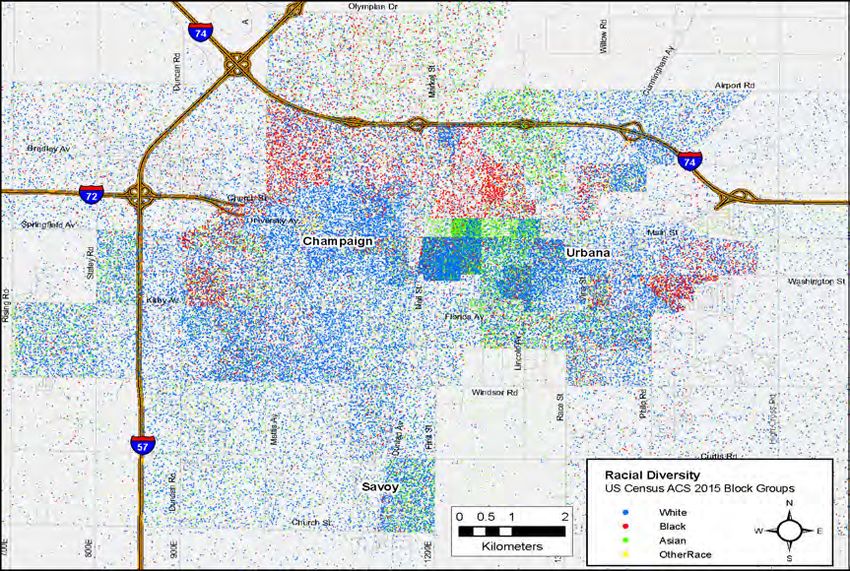
Racial
Diversity,
2015
A
dot-‐density
plot
of
the
population
based
on
the
2015
US
National
Census
estimates
broken
down
by
race
depicts
the
population
density
and
the
racial
diversity
of
their
neighborhood.
The
center
of
the
12
You can also read


