ACCESSIBILITY GUIDE
Wisconsin Forward Exam

 Spring 2021
←
→
Page content transcription
If your browser does not render page correctly, please read the page content below
ACCESSIBILITY GUIDE Wisconsin Forward Exam Spring 2021

Accessibility Guide
Wisconsin Forward Exam
                   Developed by
        Office of Educational Accountability

  Wisconsin Department of Public Instruction
    Carolyn Stanford Taylor, State Superintendent
                 Madison, Wisconsin
This publication is available from:
The Office of Educational Accountability
Wisconsin Department of Public Instruction
125 South Webster Street
Madison, WI 53703
(608) 267-1072
https://dpi.wi.gov/assessment
osamail@dpi.wi.gov
Copyright @ August 2020 Wisconsin Department of Public Instruction
The Wisconsin Department of Public Instruction does not discriminate on the basis of sex,
race, color, religion, creed, age, national origin, ancestry, pregnancy, marital status or
parental status, sexual orientation, or ability and provides equal access to the
Boy Scouts of America and other designated youth groups.Table of Contents
TABLE OF CONTENTS ................................................................................................................................................................................. IV
PURPOSE OF THE GUIDE ............................................................................................................................................................................ 1
SECTION I: UNIVERSAL TOOLS ................................................................................................................................................................... 2
Embedded Universal Tools .................................................................................................................................................................................................... 2
Table 1: Embedded Universal Tools ................................................................................................................................................................................................. 2
Non-Embedded Universal Tools ............................................................................................................................................................................................ 6
Table 2: Non-Embedded Universal Tools ......................................................................................................................................................................................... 6
SECTION II: DESIGNATED SUPPORTS ......................................................................................................................................................... 7
Embedded Designated Supports............................................................................................................................................................................................ 7
Table 3: Embedded Designated Supports ........................................................................................................................................................................................ 7
Non-Embedded Designated Supports .................................................................................................................................................................................. 10
Table 4: Non-Embedded Designated Supports .............................................................................................................................................................................. 10
SECTION III: ACCOMMODATIONS ............................................................................................................................................................ 17
Embedded Accommodations ............................................................................................................................................................................................... 17
Table 5: Embedded Accommodations ........................................................................................................................................................................................... 18
Non-Embedded Accommodations ....................................................................................................................................................................................... 19
Table 6: Non-Embedded Accommodations ................................................................................................................................................................................... 19
Accessibility Rules – Options that are Mutually Exclusive..................................................................................................................................................... 24
Request for Accommodation ............................................................................................................................................................................................... 24
APPENDIX A - ACCOMMODATION REQUEST FORMS ............................................................................................................................. 25
APPENDIX B - LIST OF ACCESSIBILITY RESOURCES .................................................................................................................................. 26
APPENDIX C - ACCESSIBILITY ABBREVIATIONS ........................................................................................................................................ 27
APPENDIX D - DECISION TREE TO ASSIST IN SELECTION OF SUPPORTS FOR ENGLISH LEARNERS. ....................................................... 29
APPENDIX E - TTS VS. READ ALOUD AND DESIGNATED SUPPORT VS. ACCOMMODATION.................................................................. 30Purpose of the Guide
State and federal laws require that state assessments must allow for the inclusion of all students, including students with disabilities and English learners
(ELs).
Accommodations and supports are practices and procedures that provide equitable access to grade-level content. They are intended to reduce or eliminate
the effects of a student’s disability or level of language acquisition; they do not reduce learning expectations. The accommodations or supports provided to a
student must be consistent with classroom instruction, classroom assessments, and district and state assessments. It is important to note that while
some accommodations or supports may be appropriate for instructional use, they may not be appropriate for use on a standardized assessment because
of what the test is intending to measure.
District Assessment Coordinators (DACs) and School Assessment Coordinators (SACs) should be knowledgeable of the information in The Accessibility Guide
to ensure valid and reliable test administration. It is also the responsibility of the DAC to ensure that all district and school staff are aware of this guide and its
contents.
The Accessibility Guide is intended for school personnel and decision-making teams (e.g., IEP teams) as they prepare for and administer the Forward Exam.
The guide contains information for classroom teachers, English development educators, special education teachers, and related services personnel as they
select and administer universal tools, designated supports, and accommodations for those students who need them.
All students are administered the Forward Exam except for a very small number of students with the most significant cognitive disabilities who are assessed
with an alternate assessment, the Dynamic Learning Maps (DLM).
PLEASE NOTE: In the DRC INSIGHT Portal (the Forward Exam data management portal), ALL accessibility features are referred to as “online”. Please
disregard this column in the portal. Accessibility features are either embedded (part of the online testing system) or non-embedded (not part of the
system).
IMPORTANT: Providing designated supports or accommodations can be stressful for a student who does not use these accessibility features on a
regular basis. Too many accessibility features can be a distraction rather than a support during testing. Please keep this in mind when assigning
designated supports and accommodations for your students.
For information about how to enter student accessibility settings reference the DRC INSIGHT Portal Guide available at
http://dpi.wi.gov/assessment/forward/resources.
Frequently Asked Questions on accessibility information is available at http://dpi.wi.gov/assessment/forward/faq.
Page 1Section I: Universal Tools
This section describes the Universal Tools available for use on the Forward Exam. These tools are available to all students and are based on student
preference. No action is needed in the DRC INSIGHT Portal to make these tools available or to associate their use with a particular student. The Universal
Tools are available as part of the online testing system to all students. There is no option to “turn off” the tools.
Embedded Universal Tools
Table 1 describes all embedded Universal Tools available to all students as part of the INSIGHT online system (Forward Exam testing platform).
Table 1: Embedded Universal Tools
Embedded Universal Tools Description
Calculator (See non-embedded For calculator-allowed items, students may only use the online calculator provided in the assessment. If a
accommodations for students who student has a visual impairment (with IEP or 504 plans) and is unable to access this online calculator, they may
cannot use the embedded calculator.) use the calculator that they typically use, which is offered under non-embedded accommodations (e.g., talking
calculator or braille calculator). The calculator accommodation is only permitted for calculator-allowed items.
Test administrators must ensure the non-embedded calculator is only available for calculator-allowed items.
Click to Enlarge This feature allows all test item content to fit within a single test page without introducing unnecessary
scrollbars by using a thumbnail image of a portion of the item. When clicked on, this thumbnail is enlarged as a
pop-up box that students can drag to any area of their screen allowing them to interact with the enlarged test
item and tools simultaneously.
Cross-off Tool (Strikethrough) The student uses this feature to eliminate (or cross-off) those answer choices that do not appear correct to the
student. Students can remove the cross-off by simply re-selecting the crossed off item.
Page 2Embedded Universal Tools Description
Flag/Mark for Review Students may mark (or flag) a question for review at a later point in the test. Students can see which items have
been marked for review by the flag icon that appears on the go to question menu and on the review page at the
end of the session.
NOTE: It is recommended but not required that students remove item flags before submitting a test session. All
flagged questions should be reviewed prior to exiting the test session for the day since students may not go
back to any questions worked on during the previous day. Students should only work forward from where they
left off when exiting the test.
Help/What's This? The help library provides information on tool usage, test directions, helpful hints, and other topics. It also
includes a “What’s This?” feature that allows a student to access contextual help for a specific tool or button.
Highlighter This tool can be used to highlight some test content. Students can also remove highlights one-by-one or by
using the clear-all option.
NOTE: The highlighter tool can be used to highlight passage text, item text, and on the text of the Multiple
Choice (MC) answer options. The highlighter does not work where the student would type/click/drag any
response option (e.g. drop down boxes, drag and drop, selecting sentences in a paragraph, a blank box for
typing a response, or MC response bubbles). The highlighter also does not work on graphics and images that are
"click to enlarge" or are within a response area (e.g. tables, graphs).
Go to Question Allows a student to jump to any item or passage set on the test by choosing the item from a drop-down list.
Items that have been flagged by the student for review display a flag icon in this menu.
Keyboard Navigation Move through the test, access tools, and answer questions using the keyboard.
Line Guide Movable, straightedge line used to follow along with each line of text. Students can drag the guide up or down
on the screen as an aid in reading an item or passage.
Page 3Embedded Universal Tools Description
Magnifier Tool (Zoom) Magnify/enlarge the entire screen, including all text, images, and objects, by 150% or 200% for better viewing.
This support may meet the needs of students with visual impairments and other print disabilities.
If the Magnifier tool is not sufficient for a student, utilizing a high resolution, large-format monitor may be an
option, and is the online equivalent to “large print”.
NOTE: For students who use it in their regular instructional environment, third-party screen magnification
software (such as MAGic or ZoomText) is compatible for use with DRC INSIGHT but may lead to some pixelation
at high magnification levels due to the way magnification is achieved by the third-party software.
Measuring Tools (Math Tools) This tool set includes both standard and metric rulers that can be dragged to the desired location on the screen
and pivoted to take measurements in both inches and centimeters. Also included is a transparent protractor for
measuring angles that can be moved over any object on the screen and rotated.
Pause (Breaks) Students may be allowed to take breaks periodically as determined by their test administrator. Students should
select the pause button in the lower toolbar to pause the test and to ensure that their test questions and
responses are not visible to others while they are away from their device. The pause feature lasts up to 20
minutes. If the student returns to the paused device within the 20 minutes (a countdown timer displays the
amount of time remaining in the pause) the student will not need to log back in to the test session. If the 20-
minute time limit expires prior to the student resuming, the system automatically saves and exits the test
session. To resume testing, the student will need to log back into the session with their test ticket.
Review Page Selecting the review/end test button in the lower toolbar allows the student to see which items have been
attempted or flagged, and which remain unanswered. Clicking on any particular item number on the Review
page will take the student directly to that item page. Upon reaching the Review page, a student may decide
that their test session is ready to submit for scoring, or that they need to go back and make changes or
complete missed items.
NOTE: The review page may, in some cases, report an attempt or partial answer as an “answered question”. For
example, a multi-select item that asks a student to choose more than one answer will indicate that the question
has been answered even if the student selects only one answer.
Page 4Embedded Universal Tools Description
Sticky Notes (Digital Notepad) Creates and places a note on the screen in which a student can type a short message for later reference.
Multiple notes can be created for each item or passage, and the notes can be moved around the screen,
minimized or completely hidden, and re-opened. For a passage or scenario that contains multiple parts (for
example, one passage that has several questions associated with it), the student can use the sticky note tool to
take notes that are visible for all questions associated with that passage or scenario.
Test Directions Easy-to-follow instructions are provided at the beginning of the test to guide students on how to use the online
tools and how to navigate and submit the test. Students can return to them at any point during the test by
selecting the help menu in the item page toolbar.
Tooltips Pop-up labels that describe each tool/function within the testing interface. Tooltips appear when the student
hovers over a tool with the mouse pointer. For students who use the text-to-speech audio accommodation, the
tooltip description will be read aloud to the student.
Writer’s Checklist (ELA Session 1 only) The checklist is available for students during ELA Session 1 only. The checklist is designed to help focus student
writing and help ensure a complete Text Dependent Analysis (TDA) response. To access the checklist, students
select the “click to enlarge” button in the TDA and the checklist will open in a new pop-up window. The pop-up
window is maneuverable and may be opened and closed as often as needed. The Writer’s Checklist is also
available in a printable Spanish version on the Forward Exam Resources web page.
NOTE: This resource is also available as a non-embedded resource. See Table 2.
Page 5Non-Embedded Universal Tools
Table 2 describes the non-embedded Universal Tools that may be provided to any student but are not part of the online system. Non-embedded
Universal Tools should be provided locally and the use of these tools is not recorded in the DRC INSIGHT Portal..
Table 2: Non-Embedded Universal Tools
Non-Embedded Universal Tools Description
Graph Paper Optional resource for students in grades 6-8. While not necessary for grades 3-5, these students may also be
provided graph paper to use as scratch paper. Graph paper must be collected and securely disposed of
immediately after each testing session. The graph paper should be plain graph paper and must also be free of
axis lines, points, numbers, and/or letters. Graph paper is provided for students to create organized sketches of
points, lines, and/or shapes to solve problems in grades 6-8.
There is no need for a consistent requirement in graph paper size; however, the recommendation is the 1/4
inch graph paper.
Scratch Paper Required resource for all students in all content areas to allow students to take notes, make computations,
sketch, or plan responses. May be plain or lined (i.e. must not contain any graphic organizers). Scratch paper
used by students is secure test material and all scratch paper must be collected and securely disposed of
immediately after the testing session.
Writer’s Checklist (ELA Session 1 only) The Writer’s Checklist is available as a PDF on the Forward Exam webpage under TDA resources. The checklist is
designed to help focus student writing and help ensure a complete TDA response. The checklist may be printed
and provided to students for use during the TDA session only. Any print versions of the checklist used during
ELA Session 1 must be collected and securely destroyed immediately after the session.
The checklist is also available as an online tool for all student during ELA Session 1 only.
The Writer’s Checklist is also available in a printable Spanish version on the Forward Exam Resources web page.
Page 6Section II: Designated Supports
This section describes the designated supports currently available for the spring 2020 Forward Exam. Designated supports are those features that are
available for use by any student for whom the need has been indicated by an educator or team of educators (with parent/guardian and student input as
appropriate) and are part of the student’s classroom instruction. They are either provided as part of the online testing system (embedded) or separate from
it (non-embedded). Students should have time to practice using the accommodation with the Forward Exam Online Tools Training (OTT) prior to actual
testing.
ALL designated supports must be entered into the DRC INSIGHT Portal prior to printing test tickets and test administration. See the DRC INSIGHT Portal
Guide for instructions about entering accommodations and supports into the DRC INSIGHT Portal.
• Test tickets will have an abbreviation next to “accommodations” on the student’s test ticket if the support was entered prior to printing tickets and
the support will be available during testing.
• Test tickets printed prior to having supports entered into the DRC INSIGHT Portal will not have an abbreviation appear next to “accommodations” on
the ticket and the supports will NOT be available during testing.
• Test Administrators should have a list of all students who should receive designated supports and accommodations, whether embedded or non-
embedded, during testing to ensure these students are receiving the accessibility options assigned.
Embedded Designated Supports
Table 3 describes the embedded designated supports that may be selected for a student in the DRC INSIGHT Portal prior to printing the test ticket.
Table 3: Embedded Designated Supports
Embedded Test
Designated Ticket
Supports Abbr. Description Guidance
Color Choices CC The background color changes Students with attention difficulties, visual impairments, or other print disabilities
according to the color selected may benefit from this support. Color supports should be informed by evidence that
without changing the color of text, color selections meet the student’s needs.
graphics or response areas.
Page 7Embedded Test
Designated Ticket
Supports Abbr. Description Guidance
Contrasting CTC Using color combinations that are in Students with attention difficulties, visual impairments, or other print disabilities
Color opposite positions on the color may benefit from this support. Color supports should be informed by evidence that
wheel, the font and background color selections meet the student’s needs.
colors change according to the
combination selected.
Reverse RC All colors on the test page are Students with attention difficulties, visual impairments, or other print disabilities
Contrast displayed in the reverse (negative) may benefit from this support. Color supports should be informed by evidence that
color. color selections meet the student’s needs.
Masking MSK Allows the student to cover up Students with attention difficulties, visual impairments, or other print disabilities
(mask) content that may be may wish to mask content that may be distracting during the assessment.
distracting, enabling the student to
more easily focus their attention on a
specific part of the screen. Masked
areas are re-sizeable and moveable
on the item page.
Stacked ST Stacked Spanish translations are For students whose primary language is Spanish and who use dual language supports
Translations available as a language support to in the classroom, the use of the stacked translation designated support may be
(Spanish) designated students on all appropriate.
mathematics, science, and social
studies assessments. For ELA
assessments, only the test directions
are available in stacked translation.
Stacked translations present students
with a complete translation (Spanish)
of all test content together with the
full text of the original English.
Page 8Embedded Test
Designated Ticket
Supports Abbr. Description Guidance
Text-to- TTS The text-to-speech (TTS) function Text-to-speech (TTS) (computer voice) is allowed as a designated support for all
Speech allows the student to listen via grades in mathematics, science, social studies, and English language arts (ELA) as
(Computer headphones or speakers to test appropriate (not allowed for ELA Session 4 reading passages). With this feature, test
Voice) information displayed on the screen. content is read aloud by the computer in the English language. The TTS designated
Words and numbers, test directions, support is intended only for students who are struggling readers who may need
(Not allowed
questions, answer choices, and other assistance accessing the assessment or for students with reading-related disabilities.
for ELA
information is read aloud by the Students should use a similar support on a regular basis in the classroom. Allowing
Session 4
computer and may be replayed as TTS for all students is not a proper use of this support. Students who use this support
reading
necessary. will need headphones unless tested individually in a separate setting.
passages.)
NEW: TTS automatic playing See Appendix E for more information about TTS vs. Read Aloud, and Designated
(autoplay) can be turned off if a Support vs. Accommodation.
student only wants to use this
feature on demand. The majority of students who require text read to them should use the TTS
designated support, to ensure these students are provided a standardized support
across the state. This includes students who have IEP or 504 plans. Human readers
(Read Aloud) are ONLY permitted in cases where students cannot manage to work
with the computer audio voice (e.g., some students with autism or hearing
impairments).
NOTE: Read Aloud (human reader) and TTS (computer voice) are mutually exclusive
and must not be assigned together, because they are the same support provided in
different formats (human read vs. computer read). Both supports provide the
information auditorily, therefore only one needs to be selected. If you are unsure
which support to provide, have the student use the Online Tools Training (OTT) with
TTS (computer voice) prior to assigning.
Page 9Non-Embedded Designated Supports
Table 4 describes the non-embedded designated supports that may be selected for a student in the DRC INSIGHT Portal prior to printing the test ticket. Non-
embedded designated supports are provided locally and may be provided to students who regularly use a similar support as part of their classroom
instruction. All non-embedded supports need to be entered into the DRC INSIGHT Portal for reporting purposes.
Table 4: Non-Embedded Designated Supports
Non-
Embedded Test
Designated Ticket
Supports Abbr. Description Guidance
Amplification AD The student adjusts the volume Students who are hard of hearing may use amplification assistive technology (e.g.,
Device control beyond the computer built- FM System) to increase the volume provided in the assessment system. Use of this
in settings using non-embedded resource may require a separate setting. If the device has additional features that
devices (e.g., Assistive listening may compromise the validity of the test (e.g., internet access), the additional
devices (ALDs), or FM devices). functionality must be deactivated to maintain test security.
Word-to-Word BD A Word-to-word bilingual dictionary Not permitted on ELA tests. Refer to the DPI accommodations and supports
Bilingual may be provided as a designated webpage linked below for a list of DPI-approved word-to-word dictionaries.
Dictionary language support.
NOTE: Word-to-word dictionaries are simply paper or electronic forms of words
provided in two languages. Definitions are not included.
http://dpi.wi.gov/assessment/forward/accommodations
Color Overlay CO A transparent colored sheet that is Provides assistance to students who normally use this support when reading to
placed over a page of text or is reduce visual stress.
affixed to a computer screen.
Page 10Non-
Embedded Test
Designated Ticket
Supports Abbr. Description Guidance
Magnification MAG The size of specific areas of the Students accustomed to viewing enlarged text or graphics, or navigation buttons
screen (e.g., text, formulas, tables, may need magnification to view content. This support also may meet the needs of
graphics, and navigation buttons) students with visual impairments and other print disabilities. The use of this
may be adjusted by the student with designated support may result in the student needing additional overall time to
an assistive technology device. complete the assessment or possibly the need for an administration in a separate
Magnification allows increasing the setting if the support used creates a test security concern.
size to a level not provided for by
the zoom universal tool. Utilizing a Third-party screen magnification software (such as MAGic or ZoomText) may lead to
larger monitor is the online some pixilation at high magnification levels due to the way magnification is achieved
equivalent to “large print”. by the third-party software. Do not activate screen readers if using third party
screen magnification, as they are not compatible.
Noise Buffers NB Ear mufflers (e.g., noise cancelling Student (not groups of students) wears equipment to reduce environmental noises.
headphones) and/or white noise Students may have these testing variations if regularly used in the classroom.
used to block external sounds. Students who use white noise will need headphones unless tested individually in a
separate setting.
Page 11Non-
Embedded Test
Designated Ticket
Supports Abbr. Description Guidance
Read Aloud RA Read Aloud (human reader) allows Read Aloud (human reader) is allowed as a designated support for all grades in
(Human the student to listen to test mathematics, science, social studies, and English language arts (ELA) as appropriate
Reader) in information displayed on the screen (not allowed for ELA Session 4 reading passages). It is provided only in the English
English read to them by a qualified human language. Read Aloud (human reader) is intended only for students who are
reader. Words and numbers, test struggling readers who may need assistance accessing the assessment, or students
(Not allowed
directions, questions, answer with reading-related disabilities. Students should use a similar support on a regular
for ELA Session
choices, and other information is basis in the classroom. Allowing Read Aloud (human reader) for all students is not a
4 reading
read aloud by a human reader and proper use of this support. Students receiving the Read Aloud support will need to
passages.)
can be repeated as necessary. be tested individually in a separate setting.
The majority of students who require text read to them should use the TTS
(computer voice) designated support, to ensure these students are provided a
standardized support across the state. This includes students who have IEP or 504
plans. Human readers (Read Aloud designated support) are ONLY permitted in cases
where students cannot manage to work with the computer audio voice (e.g., some
students with autism or hearing impairments).
Note that Read Aloud and TTS are mutually exclusive and must not be assigned
together, because they are the same support provided in different formats
(computer read vs. human read). Both supports provide the information auditorily,
therefore only one needs to be selected.
Read Aloud (human reader) Guidelines and Confidentiality Forms are available on
the Forward Exam Accommodations and Supports webpage:
http://dpi.wi.gov/assessment/forward/accommodations.
Page 12Non-
Embedded Test
Designated Ticket
Supports Abbr. Description Guidance
Read Aloud RAS Read Aloud (human reader) in Read Aloud (human reader) in Spanish is allowed as a designated support for all
(Human Spanish allows the student to listen grades in mathematics, science, and social studies for students who need the
Reader) in to Spanish translation (stacked) test Spanish portion of the Spanish translation (stacked) read to them. For English
Spanish information displayed on the screen language arts (ELA), only the test directions may be read aloud in Spanish (see NOTE
read to them by a qualified human below). Read Aloud (human reader) in Spanish is intended only for students who are
(Not allowed
reader in Spanish. Words and struggling readers who may need assistance accessing the assessment, or students
for ELA)
numbers, test directions, questions, with reading-related disabilities. Students should use a similar support on a regular
answer choices, and other basis in the classroom. Students receiving the Read Aloud (human reader) in Spanish
information is read aloud in Spanish support will need to be tested individually (or in a small group) in a separate setting.
by a human reader and can be
repeated as necessary. Spanish translation (stacked) and TTS (computer voice) cannot be used at the same
time. The TTS (computer voice) is available in English only, however, the computer
will try to read the Spanish translation as if it were English. If a student requires
both TTS (computer voice) and stacked translation you should select (in the DRC
INSIGHT Portal) the Spanish translation (stacked) and either Read Aloud (human
reader) in English if the student needs the English portion of the stacked translation
read aloud and/or Read Aloud (human reader) in Spanish if the student needs the
Spanish portion of the stacked translation read aloud. During test administration,
provide the student with a human reader and the stacked translation.
NOTE: Translation is not permitted during ELA as the ELA test is designed to
measure the student’s knowledge of the English Language.
See Appendix E for more information about TTS vs. Read Aloud, and Designated
Support vs. Accommodation.
Read Aloud (human reader) Guidelines and Confidentiality Forms are available on
the Forward Exam Accommodations and Supports webpage:
http://dpi.wi.gov/assessment/forward/accommodations.
Page 13Non-
Embedded Test
Designated Ticket
Supports Abbr. Description Guidance
Scribe SC Students dictate their responses to a Students who have a significant motor disability, processing difficulties, sensory
human who records verbatim what issues (e.g. students with autism who cannot touch a monitor/keyboard), or who
they dictate. have had a recent injury (such as a broken arm) that make it difficult to provide
responses directly, may need to dictate their responses to a human, who then
records the student’s responses verbatim.
Translators who scribe student responses from a native language to English should
translate word-for-word to the extent possible for all content areas except Text
Dependent Analysis (TDAs) items. The TDA items must be scribed in English.
The TDA item measures composition, grammar, punctuation, capitalization, spelling
as well as citing evidence and the use of textual support. Therefore, a student must
dictate their response exactly as it is to be written. Before assigning this support,
review the Scribing Guidelines, available on the Forward Exam Accommodations and
Supports webpage at http://dpi.wi.gov/assessment/forward/accommodations.
NOTE: The use of a scribe can be stressful to a student who does not normally use
this support, especially during the TDA. Discuss the scribing process with the
student ahead of time, as some students may opt to go without it if possible.
Separate SS Test location is altered so that the Students who are easily distracted or who may distract others may need an
Setting student is tested in a setting alternate location for their assessment (e.g., behavior differences, Read Aloud). It is
different from that made available permissible to have multiple students, who are assigned separate setting, testing in
for most students. the same room depending on their individual needs.
Page 14Non-
Embedded Test
Designated Ticket
Supports Abbr. Description Guidance
Small Group SGT Ensures all students receive the This support allows a translator/interpreter to read the test aloud to a small group
Translation same test form allowing the test of students (up to four) at the same time. Small Group Translation is only available
administrator to read the stacked as a language support to designated students on all mathematics, science, and
translation in Spanish, or translate social studies assessments. For ELA assessments, only the test directions may be
the exam in a language other than translated/interpreted.
Spanish, to a small group at one
time. SGT may be used for all If providing SGT in Spanish the translator must read from the Spanish stacked
mathematics, science, and social translation provided for standardization.
studies assessments. For ELA
assessments, only the test directions For more information, please review the Translator/Interpreter Guidelines and
may be translated/interpreted. Qualifications document available on the Forward Exam Accommodations and
Supports webpage at https://dpi.wi.gov/assessment/forward/accommodations.
Translators/Interpreters should use the Guidelines for Read Aloud (human reader)
to assist in the translation/interpretation. Translators/Interpreters are required to
complete the Read Aloud (human reader) Confidentiality Agreement Form prior to
test administration.
Small Group Translation will appear on the student’s test ticket next to
accommodations as SGT.
NOTE: The use of SGT needs to be used in conjunction with the TI
(Translator/Interpreter) designated support. If the student is a Spanish speaker, use
ST (stacked translation) in small groups. You must select ST as a designated support
in conjunction with SGT and Read Aloud (human reader) in English and/or Spanish.
See EL supports decision tree in Appendix D.
Page 15Non-
Embedded Test
Designated Ticket
Supports Abbr. Description Guidance
Translator/ TI Translator/Interpreter is available as Students requiring language support in languages other than Spanish may use a
Interpreter a language support for languages translator/interpreter on all mathematics, science, and social studies assessments.
other than Spanish to designated For ELA assessments, only the test directions may be translated/interpreted.
students on all mathematics,
science, and social studies For more information, please review the Translator/Interpreter Guidelines and
assessments. For ELA assessments, Qualifications document available at on the Forward Exam Accommodations and
only the test directions may be Supports webpage at https://dpi.wi.gov/assessment/forward/accommodations.
translated/interpreted.
Translators/Interpreters should use the Guidelines for Human Read Aloud to assist
in the translation/interpretation. Translators/Interpreters are required to complete
the Read Aloud Confidentiality Agreement Form prior to test administration.
Translation/Interpretation will appear on the student’s test ticket next to
accommodations as TI. See EL supports decision tree in Appendix D for more
information about assigning EL supports.
Page 16Section III: Accommodations
This section describes accommodations currently available for the spring 2021 Forward Exam. Accommodations are features that are available for use by a
student for whom there is a documented need on an Individualized Education Program (IEP) or 504 plan and who use a similar accommodation as part of
their classroom instruction. Educator teams make decisions, provide evidence of the student’s need for the accommodation, and ensure that it is noted on
the student’s IEP or 504 plan. Accommodations need to be selected in the DRC INSIGHT Portal for each student prior to printing a test ticket. Students should
have time to practice using the accommodation with the Forward Exam Online Tools Training (OTT) prior to actual testing.
All accommodations must be entered into the DRC INSIGHT Portal prior to printing test tickets. See the DRC INSIGHT Portal Guide for instructions on
entering accommodations and supports into the DRC INSIGHT Portal. .
• Test tickets will have an abbreviation next to “accommodations” on the student’s test ticket if the accommodation was entered prior to printing
tickets and the accommodation will be available during testing.
• Test tickets printed prior to having accommodations entered into the DRC INSIGHT Portal will not have an abbreviation appear next to
“accommodations” on the ticket and the accommodations will NOT be available during testing.
• Test Administrators should have a list of all students who should receive designated supports and accommodations, whether embedded or non-
embedded, during testing to ensure these students are receiving the accessibility options assigned.
Embedded Accommodations
Table 5 describes the embedded accommodations that may be selected for a student in the DRC INSIGHT Portal, as specified in an IEP or 504 plan, prior to
printing the test ticket.
Page 17Table 5: Embedded Accommodations
Test
Embedded Ticket
Accommodations Abbr. Description Guidance
Video Sign VSL Online delivery of test content Students who are deaf or hard of hearing and who typically use ASL may utilize this
Language (VSL) (ASL) in American Sign Language (ASL) accommodation when accessing audio and text-based content in the assessment.
is presented as a pre-recorded
(Not allowed for
embedded video of a human In-person sign interpretation services or direct communication of the test content
ELA Session 4
signer. Students activate the VSL in sign language is not an allowable accommodation and invalidates the assessment.
reading passages.)
and can view as often as needed
using the controls provided. VSL A sign language interpreter is allowed to sign scripted directions from the test
is available for mathematics, administration manual that proctors read to students prior to testing.
science, social studies, and ELA
(not allowed for ELA Session 4
reading passages). The pre-
recorded VSL allows for
standardization and consistency
in administration of the sign
language accommodation.
Closed Captioning C CAP Closed captioning is displayed This accommodation is for students who are deaf or hard of hearing who typically
immediately above the access information presented via audio by reading words that are synchronized with
(Only for ELA
embedded audio player on all the audio.
Session 2 listening
listening passages as the
passages)
passage is played. Students
without closed captioning on
their printed test tickets will
not see captioning as the
passage audio plays.
Page 18Non-Embedded Accommodations
Table 6 describes the non-embedded accommodations that may be selected for a student in the DRC INSIGHT Portal, as specified in an IEP or 504 plan, prior
to printing student test tickets. With the exception of braille (BRL), print-on-demand (POD), and listening scripts (LS), all non-embedded accommodations
should be provided locally. All non-embedded accommodations need to be selected in the DRC INSIGHT Portal for reporting purposes.
Table 6: Non-Embedded Accommodations
Test
Non-Embedded Ticket
Accommodations Abbr. Description Guidance
Abacus AB This tool may be used in place of Some students with visual impairments use an abacus in place of using scratch
scratch paper for students who paper.
typically use an abacus.
Alternate ARO Alternate response options Some students with physical disabilities may need to use the alternate response
Response Options include but are not limited to options accommodation. Some alternate response options are external devices
adapted keyboards, large that must be plugged in and be compatible with the assessment delivery system. It
keyboards, StickyKeys, is important to test compatibility ahead of time with the Online Training Tools.
MouseKeys, FilterKeys, adapted
mouse, touch screen, head
wand, and switches.
Page 19Test
Non-Embedded Ticket
Accommodations Abbr. Description Guidance
Braille BRL A paper copy braille version of In addition to selecting the braille accommodation for a student in the DRC
the test will be available at each INSIGHT Portal, DACs must order printed braille tests using the “additional
grade level and content area. All materials” request page in the DRC INSIGHT Portal.
tests will be presented in
Unified English Braille (UEB) and All student responses must be transcribed into the online testing system (INSIGHT)
will follow Nemeth Code for by the test administrator or other designated person using the student’s test
mathematical and scientific ticket. The test ticket must have BRL next to accommodations to ensure that the
notation where appropriate. online test form and the braille form have matching content for all questions.
The printed test must be treated as secure testing material. See the Test
Administration Manual on the Forward Exam Resources webpage for more
information on the braille process including test security procedures.
http://dpi.wi.gov/assessment/forward/resources
For Braille administration instructions refer to the Test Administration Manual.
NOTE: Braille Item Samplers are available on request from the test vendor. Please
contact your DAC to request these materials.
Calculator NEC A calculator that is considered Students with visual impairments who are unable to access the online calculator
an assistive technology device provided in the assessment for calculator-allowed items will be permitted to use
such as a talking calculator or the calculator that they typically use, such as a braille calculator. Test
braille calculator. administrators must ensure the calculator is only available for calculator-allowed
items.
Calculators provided online in the Forward Exam by grade level for calculator-
allowed items only:
• For grade 6, a basic four-function calculator is required.
• For grades 7 and 8, a scientific calculator with exponents, trigonometry, and
logarithmic functionalities is required.
All other students must use the online calculator provided in the assessment.
Page 20Test
Non-Embedded Ticket
Accommodations Abbr. Description Guidance
Listening Scripts LS Printable listening scripts of the Listening scripts may be provided to test administrators working with students
(ELA Session 2 audio presentations in ELA who are deaf or hard of hearing who are unable to access the embedded listening
listening passage Session 3 are provided for use passages via the embedded audio, closed captioning, or video sign language. This
only.) by a qualified human reader. accommodation would be for a student that would need the test administrator to
The human reader reads the read the listening passages aloud to the student, allowing the student to view the
script aloud to a student who is test administrators’ face so the student may lip read.
deaf or hard of hearing and
needs to view the reader’s face The decision to allow this accommodation must be based on each individual
while having the passage read to student’s need and documented in a student’s IEP or 504 Plan.
them in order to access the
material. There is a special protocol for requesting the listening script accommodation. If a
student requires listening scripts, the DAC must submit a request via the Listening
Script Accommodation Approval Form located at
http://dpi.wi.gov/assessment/forms.
After receiving the request, DPI will review, and if approved, activate the process.
If approved, the accommodation must be selected in the DRC INSIGHT Portal for
the student prior to printing test tickets.
Multiplication MT A paper-based single digit (1-9) For students in grades 4 and above with a documented and persistent calculation
Table multiplication table will be disability (i.e. dyscalculia). A student must have a documented disability/disorder
(Allowed for available for reference. that significantly impacts a person’s ability to learn and perform math calculations
grades 4 and as evidenced by documentation in the student’s IEP. The Multiplication Table is
above.) available on the Forward Exam Accommodations and Supports webpage at
http://dpi.wi.gov/assessment/forward/accommodations.
Page 21Test
Non-Embedded Ticket
Accommodations Abbr. Description Guidance
Print-on-Demand POD A print-on-demand version of The print-on-demand accommodation is intended for those extremely rare
the test is available at each instances (e.g., photosensitive epilepsy, zoom or magnification not large enough
grade level and content area in for a student with significant visual impairments) where a student’s condition
PDF format. The test prevents him or her from accessing test material online. Access to printed
administrator or other items/stimuli should not be assigned based on a preference. The decision to allow
designated person will print the this accommodation must be based on each individual student’s need and
test and provide it to the documented in a student’s IEP or 504 Plan. There are emergency circumstances in
student with this which medical documentation is acceptable (i.e. concussion with no screen time
accommodation. permitted).
All responses must be entered into the student’s online test by the test
administrator or other designated person using the student’s test ticket. The
printed test must be treated as secure testing materials.
There is a special protocol for requesting a print-on-demand accommodation. If a
student requires print-on-demand, the DAC must submit a request for Print-on-
demand Accommodation Approval Form located at
http://dpi.wi.gov/assessment/forms.
DPI will review the request, and if approved, activate the process. If approved, the
accommodation must be selected in the DRC INSIGHT Portal for the student prior
to printing test tickets.
Page 22Test
Non-Embedded Ticket
Accommodations Abbr. Description Guidance
Read Aloud RAP Read Aloud (human reader) This accommodation is only available to a student with visual impairments who is
(Reading Passages accommodation allows a visually receiving instruction in contracted braille but is not yet proficient.
for Visually impaired student to listen via a
Impaired) qualified human reader to ELA Read Aloud (human reader) is available as an accommodation for students whose
test information displayed on need is documented in an IEP or 504 plan and have met all five criteria on the
(Including ELA the screen, including test Request for Read Aloud Accommodation for the Forward Exam. See link below to
Session 4 reading directions, questions, answer request form.
passages.) choices, and ELA Session 4
reading passages, and can be There is a special protocol for requesting the Read Aloud (human reader)
repeated as necessary. accommodation. If a student requires the Read Aloud (human reader)
accommodation, the DAC must submit a Request for the Read Aloud
Accommodation Approval Form located at http://dpi.wi.gov/assessment/forms.
DPI will review the request and if approved, activate the process. If approved, the
accommodation must then be selected in the DRC INSIGHT Portal for the student
prior to printing test tickets.
Students who do not meet these criteria but require Read Aloud (human reader)
should use the designated support Read Aloud including those who have IEP or
504 plans.
Read Aloud (human reader) Guidelines and Confidentiality Forms are available on
the Forward Exam Accommodations and Supports webpage:
http://dpi.wi.gov/assessment/forward/accommodations.
Page 23Accessibility Rules – Options that are Mutually Exclusive
The following supports and accommodations are mutually exclusive (one cannot be used with another):
ELA:
• Spanish Translation (stacked) [ST] – See NOTE below
• Text-to-Speech (Computer Voice) [TTS] – See NOTE below
• Video Sign Language (VSL) [VSL (ASL)]
• Print-on-Demand [POD]
• Braille [BRL]
Mathematics, Science, and Social Studies:
• Spanish Translation (stacked) [ST] – See NOTE below
• Text-to-Speech (Computer Voice) [TTS] – See NOTE below
• Video Sign Language (VSL) [VSL (ASL)]
• Print-on-Demand [POD]
• Braille [BRL]
NOTE: Spanish translation (stacked) and TTS (computer voice) cannot be used at the same time. The TTS (computer voice) is available in English only,
however, the computer will try to read the Spanish translation as if it were English. If a student requires both TTS and stacked translation you should select (in
the DRC INSIGHT Portal) the Spanish translation (stacked) and either Read Aloud (human reader) in English if the student needs the English portion of the
stacked translation read aloud and/or Read Aloud (human reader) in Spanish if the student needs the Spanish portion of the stacked translation read aloud.
During test administration, provide the student with a human reader and the stacked translation.
NOTE: TTS and Read Aloud are mutually exclusive and must not be assigned together because they are the same support provided in different formats
(computer read vs. human read). It is redundant for a human to be reading to the student at the same time that the student has headphones on and is
listening to the computer voice reading aloud (TTS).
Request for Accommodation
Any accommodation or support not in The Accessibility Guide must be approved by DPI prior to use during the Forward Exam. DPI staff will determine
whether the requested accessibility option impacts the validity of the test results and/or the construct the test is intended to measure. See Appendix A.
Page 24Appendix A - Accommodation Request
Forms
All forms are available at https://dpi.wi.gov/assessment/forms#accom.
• Forward Exam Guidelines for the Administration of Read Aloud (human reader) Accommodation to
Visually Impaired Students for the Forward Exam
• Forward Exam Request for Accommodation Form
• Forward Exam Request for Print-on-Demand Accommodation Form
• Forward Exam Request for Listening Script Accommodation Form
• Forward Exam Request for Read Aloud Accommodation Form
Page 25Appendix B - List of Accessibility Resources
Available on the Forward Exam Accommodations and Supports webpage
https://dpi.wi.gov/assessment/forward/accommodations.
Resource/Training Material Description
Accessibility Guide Provides information about universal tools, designated supports,
and accommodations that are available for those students who
need them during the administration of the Forward Exam. This
guide also provides descriptions and guidelines for each
accessibility feature.
Accessibility Training PowerPoint This PowerPoint provides training on accessibility features,
including their descriptions and policies for use.
Multiplication Table This Non-embedded Accommodation is available only for grades
4-8.
Read Aloud Guidelines This document outlines the qualifications, guidelines, and
procedures required for a test reader. Test readers must sign the
Read Aloud Agreement to Maintain Confidentiality prior to
administration. Completed agreement forms are retained by the
DAC/SAC.
Scribe Guidelines This document outlines the qualifications, guidelines and
procedures when using a scribe.
Translator/Interpreter Guidelines This document outlines the qualifications, guidelines, and
procedures required when using a translator/interpreter.
Word-to-Word Bilingual This document provides a list of allowable bilingual dictionaries.
Dictionaries
Page 26Appendix C - Accessibility Abbreviations
Accommodation / Embedded / Non-
Abbreviation Description
Designated Support Embedded
CC Color Choices Designated Support Embedded
CTC Contrasting Color Designated Support Embedded
RC Reverse Contrast Designated Support Embedded
MSK Masking Designated Support Embedded
ST Stacked Translations (Spanish) Designated Support Embedded
TTS Text-to-Speech (Computer Voice) Designated Support Embedded
AD Amplification Device Designated Support Non-Embedded
BD Word-to-Word Bilingual Dictionary Designated Support Non-Embedded
CO Color Overlay Designated Support Non-Embedded
MAG Magnification Designated Support Non-Embedded
NB Noise Buffers Designated Support Non-Embedded
Read Aloud (Human Reader) in
RA Designated Support Non-Embedded
English
Read Aloud (Human Reader) in
RAS Designated Support Non-Embedded
Spanish
SC Scribe Designated Support Non-Embedded
SS Separate Setting Designated Support Non-Embedded
SGT Small Group Translation Designated Support Non-Embedded
TI Translator / Interpreter Designated Support Non-Embedded
VSL (ASL) Video Sign Language Accommodation Embedded
C CAP Closed Captioning Accommodation Embedded
AB Abacus Accommodation Non-Embedded
ARO Alternate Response Options Accommodation Non-Embedded
Page 27Accommodation / Embedded / Non-
Abbreviation Description
Designated Support Embedded
BRL Braille Accommodation Non-Embedded
NEC Calculator Accommodation Non-Embedded
LS Listening Scripts Accommodation Non-Embedded
MT Multiplication Table Accommodation Non-Embedded
POD Print-on-Demand Accommodation Non-Embedded
Read Aloud (Reading Passages for
RAP Accommodation Non-Embedded
Visually Impaired)
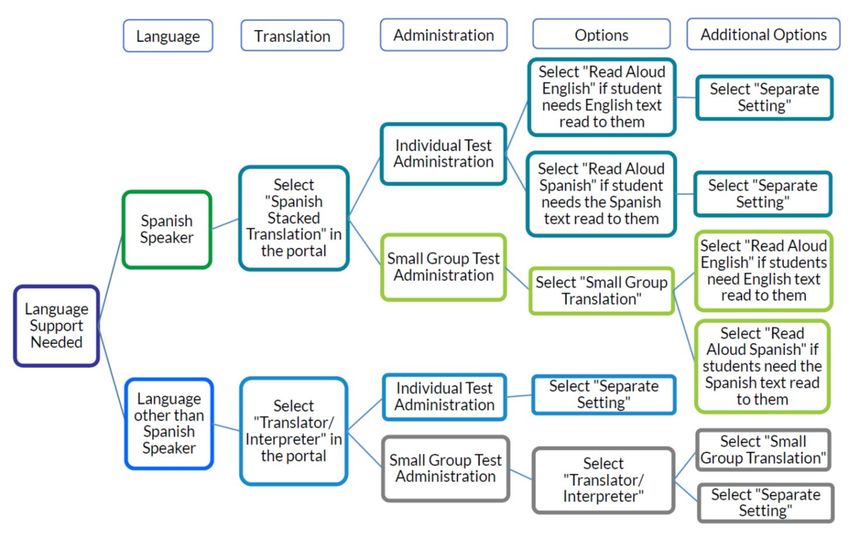
Page 28Appendix D - Decision Tree to Assist in Selection of Supports
for English Learners
Reminder: Only select supports the student needs and uses regularly in the classroom.
[ Language ) [ Translation ] [ Administration ) [.___ _O_P_t_io_n_s_~) [ Additional Options ]
Select " Read Aloud
English" if student
needs English text - Select "Separate
Setting"
Individual Test
Administration
I read to them
~
V
Select " Read Aloud
Select Spanish" if student Select "Separate
"Spanish needs the Spanish
- Setting"
Spanish V Stacked text read to them
Speaker Translation" in ~ -
Select " Read A loud
the portal Small Group Test English" if students
Administration Select "Small Group need English text
Translation" read to t hem
Language
Support
Select " Read
Needed
Aloud Spanish" if
students need the
Individual Test Select "Separate Spanish t ext read
Language Select Administration ---- Setting" to them
other than
Spanish r-- "Translator/ /
~ Small
Interpreter" in Select "Small
Speaker
the portal Group Test
Administration .............
Select V Group Translation"
"Translator/
Interpreter" I"- Select "Separate
Setting"
Page 29You can also read


