Agreement Between The Nation Institute And CWA Local 1180, AFL-CIO - March 1, 2018 - February 28, 2021
←
→
Page content transcription
If your browser does not render page correctly, please read the page content below
Agreement
          Between
     The Nation Institute
            And
   CWA Local 1180, AFL-CIO

March 1, 2018 – February 28, 2021

                i
TABLE OF CONTENTS
Article I—RECOGNITION 1
Article II—MEMBERSHIP AND PAYMENT OF DUES 1
Article III—GRIEVANCE PROCEDURE 3
Article IV—DISCIPLINE 6
Article V—NO DISCRIMINATION/AFFIRMATIVE ACTION 6
Article VI—WHISTLEBLOWER PROTECTION 7
Article VII—MANAGEMENT RIGHTS 9
Article VIII—HOURS OF WORK AND OVERTIME 9
Article IX—JOB CLASSIFICATIONS 10
Article X—SENIORITY 11
Article XI—PROBATIONARY PERIOD 11
Article XII—TERMINATION OF EMPLOYMENT 12
Article XIII—UNION RIGHTS 13
Article XIV—NEW TECHNOLOGY 14
Article XV—SALARIES 14
Article XVI—HOLIDAYS 15
Article XVII—PAID TIME OFF 16
Article XVIII—TELECOMMUTING 18
Article XIX—CONTRACTED SERVICES 19
iArticle XX—HEALTH BENEFITS 19
Article XXI—RETIREMENT PLAN 20
Article XXII—REIMBURSEMENT OF EXPENSES 20
Article XXIII—SEPARABILITY 20
Article XXIV—COMPLAINT PROCEDURE FOR ALLEGED
SEXUAL HARASSMENT AND OTHER
DISCRIMINATORY CONDUCT 21
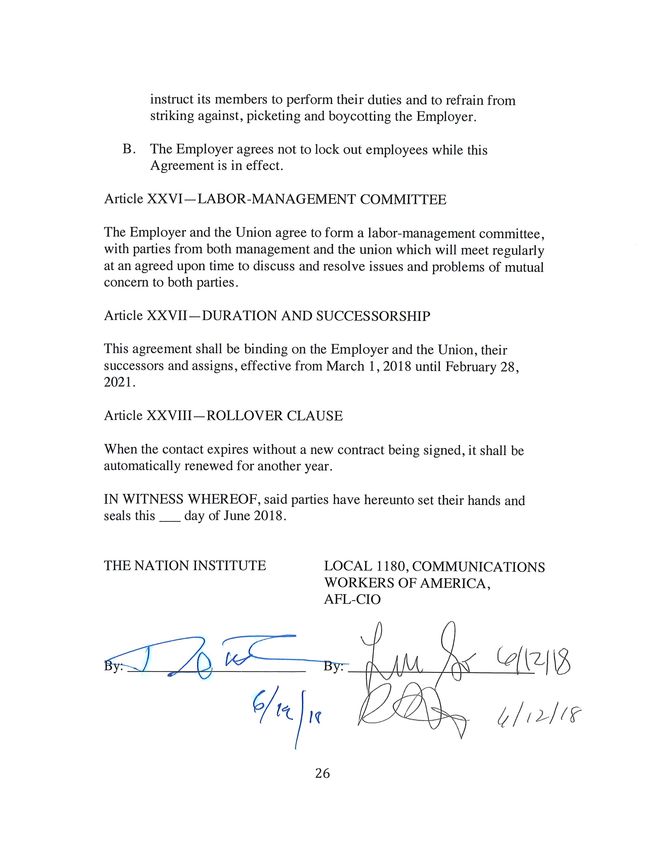
Article XXV—NO STRIKE/NO LOCK OUT 25
Article XXVI—LABOR-MANAGEMENT COMMITTEE 26
Article XXVII—DURATION AND SUCCESSORSHIP 26
Article XXVII—ROLLOVER CLAUSE 26
iiTHIS AGREEMENT entered into at New York, NY, as of (date)
between THE NATION INSTITUTE (hereinafter referred to as the
Employer) and COMMUNICATIONS WORKERS OF AMERICA,
LOCAL 1180 (hereinafter referred to as the Union), acting for and on behalf
of itself and of all the employees of the Employer described in Article I
hereof.
Article I—RECOGNITION
A. The Nation Institute (herein “The Employer”) hereby recognizes
Communications Workers of America, on behalf of its Local
1180 (herein “The Union”) as the exclusive and sole bargaining
representative in the following unit:
All full and part time employees but excluding interns,
confidential employees, managerial employees, guards
and supervisors as defined in the Act.
B. The Employer agrees not to negotiate concerning wages, hours
and other terms and conditions of employment of personnel
defined in Paragraph A above, with any other organization other
than the Union for the duration of this Agreement.
C. The Employer agrees to negotiate with the Union over the
creation of new titles and their placement in the bargaining unit
as required by law. The Employer further agrees to notify the
Union upon commencing a search to fill non-supervisory, non-
managerial or non-confidential administrative or clerical job
titles. The terms supervisors, managerial and confidential shall
have the same definitions as applied by the National Labor
Relations Board.
D. When used herein “the Executive Director” shall include his/her
designee.
Article II—MEMBERSHIP AND PAYMENT OF DUES
A. The Employer and the Union agree that as a condition of
employment, all employees within the scope of the bargaining
1unit shall become members of the Union within 30 days
following the effective date of this Agreement.
1. All employees who become members of the Union shall
remain members during the life of this Agreement.
2. Upon receiving a signed statement from the Union
indicating that an employee has failed to comply with the
conditions of Article II.A, said employee shall be
terminated within 30 working days after the receipt of
notification unless the employee has complied with the
conditions of Article II.A.1.
3. The Union agrees to indemnify and hold harmless the
Employer in connection with any grievances, charges,
complaints, claims or lawsuits which may arise in
connection with action taken by the Employer at the
request of the Union pursuant to the terms of this Article.
B. Maintenance of Dues (Check-Off)
Upon an employee’s voluntary and written assignment, all dues
for Union membership, as prescribed in the constitution and by-
laws of the Union, shall be deducted in equal amounts from each
payroll check of each member and remitted to the Union. Such
membership dues shall be deducted from the employees’
earnings in accordance with the Union schedule of rates. Said
schedule will be furnished to the Employer by the Union and may
be amended at any time. Notification of such amendment must be
made to the Employer 30 days prior to the payroll date nearest to
the effective date of the dues change.
1. The permission to retain dues shall be granted through the
assigning of authorization cards on a form approved by the
Union.
2. The Union shall indemnify the Employer against any and
all claims or other forms of liability that may arise from
such authorization.
23. The withdrawal of authorization may be accomplished
only through the termination of the Agreement, or though
the members’ written notification, to both the Employer
and the Union, of his/her desire to withdraw such
authorization thirty days prior to the annual anniversary of
the granting of such authorization. Otherwise, the granting
of such authorization shall remain in effect during the life
of this Agreement.
Article III—GRIEVANCE PROCEDURE
A. Declaration of purpose
The purpose of this procedure is to establish and maintain a method
of ensuring smooth and uninterrupted operation of the Employer
under the terms of this Agreement; to have a smooth process for
handling and disposing of differences equitably within the shortest
period of time and at the lowest available level. The Employer may
only discipline employees for just cause. The Employer further
commits to the principle of progressive discipline.
B. Definitions
1. A grievance is defined as any controversy or dispute arising
between the parties hereto relating to any matter of discipline,
wages, hours and working conditions, or any dispute between
the parties involving interpretation or application of any
provision of this Agreement.
2. Days shall mean calendar days.
C. The processing of a grievance filed by an employee or the Union to
arbitration shall be the sole and exclusive right of the Union.
D. General procedures
1. Meetings between the Employer and the employee and/or the
Union regarding the processing of a grievance shall be
conducted during the hours of employment.
32. The time limits imposed upon either party during any step of
this procedure may be extended by mutual oral agreement,
and shall be confirmed in writing.
3. Except for the informal decision at Step I, all decisions shall
be rendered in writing at each step of the grievance procedure
and reasons shall be stated only for the denial of a grievance.
4. If a decision at one stage is not appealed to the next stage of
the procedure within the time limit specified, the grievance
will be deemed to be discontinued and further appeal under
this Agreement will be barred.
5. The Employer and the Union agree to facilitate any
investigation which may be required and to make available
any and all material and relevant documents, communications,
and records concerning the alleged grievances to the extent
such material is required to be disclosed under the Nation
Labor Relations Act.
E. The steps of the grievance procedure shall be as follows:
Step I
An employee or the Union shall bring the grievance to his/her
immediate supervisor with the object of resolving the matter
informally. The Shop Steward shall be present at the grievant’s
request. This step shall be taken no later than 30 days after the date
on which the action giving rise to the grievance occurred or the
grievant should have become aware of the action or had knowledge
thereof. Any resolution of the grievance at this level shall be in
accordance with the submission of a grievance. The supervisor may
extend the period of response with the consent of the Union, which
shall not be unreasonably denied.
Step II
If the grievance is not resolved, it shall be reduced to writing and
submitted to the Executive Director within 14 days of the proposed
Step I resolution. The Executive Director shall provide a written
response within 14 days of the submission of a grievance. The
4Executive Director and the Union may agree to an extension of the
period of response for up to an additional 14 days, and upon the
Executive Director’s request. The Union shall not unreasonably
deny the Executive Director’s request for additional time.
F. Arbitration
If either the Union or the Employer desire to proceed to arbitration,
the process shall be as follows:
1. Within 14 days after the final meeting between the parties or a
final decision on the grievance, whichever comes later, either
party may file with the other a written Notice to Arbitrate.
2. The Notice to Arbitrate shall set forth the issue to be
arbitrated and the relief requested.
3. The matter shall be submitted to an Arbitration Panel
consisting of one representative selected by the Union and one
representative selected by the Employer.
4. The two selected representatives shall confer and, within 14
days after the receipt of the Notice to Arbitrate, select a third
member who may be chosen only by the agreement of both
members of the panel.
5. Should the arbitration panel not agree upon a neutral member
within 14 days, the New York State Employment Relations
Board (SERB) shall be requested to provide a list of 7
arbitrators. The Union and the Employer shall each strike one
name at a time, with the initiating party striking first. The last
remaining name shall serve as the neutral member of the
panel.
6. The arbitration panel shall hear the appeal as quickly as
possible following notification of the appointment of the
neutral.
7. The rules of the hearing shall be those utilized by SERB in
their arbitration proceedings.
58. The decision of the panel shall be issued within 30 days from
the close of the hearing.
9. The decision of the arbitrator shall be final and binding upon
both parties.
10. All joint fees and expenses of the arbitration shall be equally
divided between the Employer and the Union.
Article IV—DISCIPLINE
A. Just Cause Discipline
The Union recognizes the employer’s right to immediately terminate
employees for serious “just cause” violations of employer rules and
policies enumerated in the Employee Handbook – infractions that
threaten the existence of the organization or the lives or welfare of
other employees or managers or visitors or other business relations.
Such Just Cause violations include, for example, violence,
discrimination, harassment, retaliation, theft, drug or alcohol abuse
and other unsafe conduct. The union retains the right to utilize the
Grievance Procedure to challenge the factual validity of alleged just
cause violations.
B. Progressive Discipline
The employer shall practice the principles of “Progressive
Discipline” of union employees for violations of employer rules and
policies such as issues of skill, ability, performance, attendance or
other such violations which do not present an immediate threat to the
organization or to the lives or welfare of other employees or
managers or visitors or other business relations. The principles of
progressive discipline require two written warnings of an infraction
of a company rule or policy prior to imposing suspension or
termination for that specific infraction. The union may file a
grievance at any stage in this process.
Article V—NO DISCRIMINATION/AFFIRMATIVE ACTION
A. The Employer does not discriminate in employment opportunities or
practices on the basis of actual or perceived race, color, creed,
6religion, sex, gender, gender identity, sexual orientation, partnership
status, pregnancy status, marital status, familial status, national
origin, ancestry, alienage or citizenship status, age, veteran status,
military status, disability, genetic predisposition, genetic
information, domestic violence victim status, sex offense or stalking
victim status or any other characteristic protected by applicable law.
The Institute will make reasonable accommodations for qualified
individuals with known disabilities unless doing so would result in
undue hardship.
B. The Employer shall treat all employees with dignity and respect.
C. The Union and the bargaining unit members shall treat the Employer
with dignity and respect.
Article VI—WHISTLEBLOWER PROTECTION
A. WHISTLEBLOWER PROTECTION POLICY
Prohibited Behavior and Reporting Responsibility
The Nation Institute (the “Institute”) requires that its directors,
officers, employees, consultants, contractors and volunteers observe high
standards of business and personal ethics in the conduct of their duties and
responsibilities. The purpose of this Whistleblower Protection Policy is to
encourage all employees and others to report any violation or suspected
violation of applicable laws, regulations and/or policies of the Institute,
including the Institute’s Business Ethics and Conduct Policy (which is set
forth in the Institute’s Employee Handbook), internally, without fear of
reprisal, so that the Institute can address and correct any inappropriate
conduct.
No Retaliation
The Institute strictly prohibits any form of retaliation against any
individual who in good faith reports a violation, or a suspected violation, or
who cooperates in the investigation of any such report. This prohibition
against retaliation may include but is not limited to, remarks or threats of
punishment or revenge, actual punishment or revenge, harassment,
7reassignment to a less desirable position or shift, pay decrease, denial of
promotion or discharge. Any individual within the Institute who retaliates
against another individual who in good faith reported a violation or
suspected violation or who cooperated in the investigation of any such report
will be subject to discipline, including, potentially, termination of
employment.
Complaint Procedure
All employees and others who believe they have information relating
to violations or suspected violations of applicable laws, regulations and/or
policies of the Institute, or any form of retaliation, are strongly encouraged
to report the matter to their supervisor, the Executive Director and/or any
member of the Executive Committee of the Board of Directors. Union
member employees also have the option of utilizing the grievance procedure
set forth in Article III of the Collective Bargaining Agreement, and if the
allegation is against the Executive Director, the union member employee
may contact the Chair of the Board of Directors, or his/her designee.
The Institute will conduct a prompt, thorough and impartial
investigation of the matter and cause the appropriate corrective action to be
taken if warranted by the findings of the investigation.
While the Institute encourages anyone reporting a violation or
suspected violation, or retaliation, to identify him/herself when making a
report in order to facilitate the investigation of the same, such reports may
also be made anonymously. Regardless of how the reports are submitted, the
Institute cannot guarantee complete confidentiality regarding such reports or
complaints as there are circumstances where certain information must be
disclosed. However, the Institute will endeavor to keep such reports or
complaints confidential to the extent practicable.
Any individual reporting a violation or a suspected violation must act
in good faith and have reasonable grounds for believing the information
disclosed indicates a violation. Any allegations that prove to have been made
maliciously or knowingly to be false (and that prove to be unsubstantiated)
will be viewed as a serious disciplinary offense.
8Acknowledgement
All directors, officers, employees, consultants, contractors and interns
will receive a copy of this policy and will be required to sign, date and return
a form acknowledging, among other things, that they received, read,
understood and will comply with this policy, and that they were afforded an
opportunity to ask questions about the policy.
Article VII—MANAGEMENT RIGHTS
A. All management functions, responsibilities, rights power and
authority to direct the work force, including the right to hire and fire
employees, to assign them work, to lay off employees and to make
reasonable rules for the work place, are vested and retained
exclusively by the Employer except as specifically limited by the
express provision of this Agreement.
B. The parties recognize that any employee in the bargaining unit can
be assigned to perform any task necessary for the success of the
Employer. However, before any adverse action is taken against any
employee for poor performance, the Employer will advise the
employee of the steps necessary to improve his/her performance.
C. The Employer will not exercise the authority in this Article in an
arbitrary manner.
D. Mandatory subjects of negotiation not covered by this Agreement
shall be discussed between the parties as required by law.
Article VIII—HOURS OF WORK AND OVERTIME
A. The standard work week shall consist of an eight-hour day, worked
consecutively between the hours of 8 a.m. and 7 p.m., Monday
through Friday. Nothing contained herein shall prevent the parties
from agreeing to a variation from these hours or for a flexible work
week. Permission from the Employer for such flexible working
schedules shall not be unreasonably withheld. Time worked shall be
recorded in a manner prescribed by the Employer.
9B. Consistent with the terms of the Federal Fair Labor Standards Act
(“FLSA”), where the needs of the Employer require additional work
time, nonexempt employees covered under the FLSA shall be paid a
50% premium for all hours worked beyond 40 in a workweek.
Employees exempt under the FLSA, who are required to work
beyond the regular work week, shall receive compensatory time off
on an hour for hour basis. Additionally, part-time, non-exempt
employees who are regularly scheduled to work less than the
standard work week (described in Subsection A immediately above),
who in a given workweek are required to work beyond their
regularly scheduled number of hours per workweek shall receive
compensatory time off on an hour for hour basis for all hours
worked in excess of their regularly scheduled hours per workweek
up to 40 hours worked in that workweek. If such part-time, non-
exempt employees are required to work in excess of 40 hours in that
workweek, they shall be paid a 50% premium for such hours worked
beyond 40 in that workweek.
C. Compensation time: In addition to existing compensation time
policies, members of the bargaining unit shall receive one (1)
compensatory day off for every three (3) evening events they work
and one (1) compensatory day off for every three (3) days required
to travel for work, provided such travel requires overnight stay.
Employees must use their compensation time within one year of
accrual date.
Article IX—JOB CLASSIFICATIONS
A. A job description for each covered job classification shall be
provided within 60 days of the execution of this Agreement to the
employee and the Union. Job descriptions are guides to the general
duties of the position; however, the duties listed on the job
classifications are not to be construed as a limitation on the
Employer’s right to assign work. In the event that the Employer
chooses to reassign or significantly alter an employee’s assigned
duties, encompassing at least 20% of the employee’s work
responsibilities, the employee may request a meeting with the
Employer and the Union to confer over the impact of the new duties.
10B. Prior to filling any positions covered by this Agreement, the
Employer shall post a notice of vacancy in a prominent place on the
Employer’s premises for at least 7 working days. The notice shall
state the duties and qualifications and the deadline for filing an
application for the position. In case of an emergency vacancy, the
Employer may fill such vacancy position on an acting basis for up to
90 days without posting the position.
Article X—SENIORITY
Seniority shall be defined as the length of continuous employment at the
Employer, including any authorized leave of absence or lay-off.
ARTICLE XI—PROBATIONARY PERIOD
There shall be a 6-month probationary period for all employees hired during
the life of this Agreement. It is expressly understood that the Employer
retains the right to terminate the services of a probationary employee at any
time during such period without being subject to any of the provisions or
requirements of Article III or of Article IV.B. of this Agreement. If the
Employer fails to advise probationers of known performance deficiencies
within the first 60 days of employment or thereafter when known, the
probationary period will be extended by 30 days upon the request of the
Union.
The Employer shall have the right to extend the probationary period for up
to an additional 60 days for employees staffed on the Nation Books and
Investigative Fund projects if, in its sole discretion, such additional time is
required. The discretion to extend the probationary period shall not be
routinely exercised.
During the probationary period, members of the bargaining unit shall be
afforded all other benefits outlined in this contract, subject to eligibility
requirements and all other applicable terms and conditions.
11Article XII—TERMINATION OF EMPLOYMENT
Decision to Layoff
The Employer shall have the right to lay off employees for economic
reasons after the Union is notified with at least four weeks notice. After
providing such notice, the Employer agrees to meet with the Union to
discuss the layoff.
A. Order of Layoffs
1. Layoffs for economic reasons shall be made in reverse order
or length of service with the department and job classification
concerned, but an employee of outstanding ability or one who
is engaged in a special function may be exempted from this
provision. Otherwise, the employee having the least length of
service in the department and classification shall be the first
employee laid off.
B. Seniority
1. Employees laid off for economic reasons shall retain their
seniority for a period of two years thereafter.
C. Offer of Reemployment
1. Any employee laid off for economic reasons that has retained
his/her seniority shall be offered reemployment in the same or
similar job before anyone else may be hired for such job. The
reemployment offer shall be transmitted by certified mail,
return receipt requested, to the employee’s last known
address.
D. Order of Recall
1. When more than one employee in the same classification has
been laid off for economic reasons, recall shall be in reverse
order of layoff.
E. Terms of Departure
1. Except in cases of termination for Just Cause or where such a
meeting would not be practicable under the particular
12circumstances, prior to cessation of employment, at the
request of the employee or the Employer, the employee and
management will meet with a union representative present to
discuss terms of departure. In addition to any agreement
reached between the employee and the Employer, the
Employer will compensate the employee for accrued unused
paid vacation days and comp days. Except in cases of
termination for Just Cause, the Employer will also pay for the
employee’s COBRA Continuation of Health Coverage for two
months after the employee’s termination date.
Resignation and Retirement
When an employee resigns or retires, the Employer shall pay out
any accrued unused paid vacation days and comp days. Except in
cases of termination for Just Cause, the Employer will endeavor to
conduct an exit interview before any employee’s departure. The
employee may choose to have union representation present at the
exit interview.
Exit Interviews
Prior to employee’s departure for any reason (other than
terminations for Just Cause), the Employer will endeavor to
conduct an exit interview. The employee may choose to have
union representation present at the interview.
Article XIII—UNION RIGHTS
A. The Employer shall designate a Bulletin Board for the posting of
Union notices.
B. The employees shall elect a shop steward for the purpose of
conducting routine Union business. The shop steward shall be
allowed reasonable time during working hours to conduct such
necessary Union business as long as it does not interfere with the
employee’s job responsibilities.
13C. Up to three employees shall be designated by the Union to attend a
negotiating meeting or other meeting between the Employer and the
Union and shall be released for that purpose without loss of pay.
D. Upon request, a duly authorized representative of the Union shall be
permitted reasonable access to the employment premises during
working hours for the purposes of ascertaining compliance with this
Agreement, investigating grievances, or conducting other Union
business as long as it does not interfere with the job responsibilities
of the employees.
E. The Employer shall supply the Union with a seniority list of all
employees, showing date of hiring and rate of pay and shall update
the list upon any change.
ARTICLE XIV—NEW TECHNOLOGY
Training on any new equipment or computer software shall be offered to
appropriate staff members. Good faith effort shall be made to provide
regular management/leadership training to employees, including the
Employer, who supervise one more employees.
ARTICLE XV—SALARIES
A. Effective June 1, 2016, the Employer will institute a minimum
salary for members of the bargaining unit of $35,000 for full-time
employees, excluding interns. Effective June 1, 2017, the Employer
will apply a raise equal to New York City’s Cost of Living
Adjustment to the minimum salary for members of the bargaining
unit. The Employer will apply a raise equal to New York City’s Cost
of Living Adjustment to the minimum salary for members of the
bargaining unit on June 1, 2018; June 1, 2019; and June 1, 2020.
B. Effective June 1, 2018, the Employer will apply a 3.5% increase to
the base salaries in effect on May 31, 2018 for members of the
bargaining unit.
14C. Effective June 1, 2019, the Employer will apply a 3.5% increase to
the base salaries in effect on May 31, 2019 for members of the
bargaining unit.
D. Effective June 1, 2020, the Employer will apply a 3.5% increase to
the base salaries in effect on May 31, 2020 for members of the
bargaining unit.
E. The Employer will provide an annual performance review and salary
discussion for each employee within two weeks of the anniversary
of date of hire.
ARTICLE XVI—HOLIDAYS
The following holidays will be observed as paid time off:
New Year’s Day Martin Luther King, Jr. Day
Indigenous People’s Day Presidents Day
Veterans Day Memorial Day
Independence Day Labor Day
Thanksgiving Day Black Friday
Christmas Eve Christmas Day
New Year’s Eve*
Employees required to work on any of the paid holidays shall receive a 50%
premium for all hours worked and shall receive a compensatory day off.
In addition, an employee may designate one other day off as a “floating”
holiday, to be used for religious observance, or any other purpose. The
floating holiday shall be used during the calendar year and may not be
carried over.
* On New Year’s Eve, the office will remain open and the employer will
require at least one employee to work. Any employees working on
New Year’s Eve shall receive a 50% premium for all hours worked and shall
receive a compensatory day off.
15Article XVII—PAID TIME OFF
A. Vacation
1. Employees shall accrue vacation in accordance with the
following schedule:
After 6 months: 10 days
After 1 year of service: 15 days
After 5 years: 20 days
At 10 years of service, and at every 5-year interval after
that: all employees shall be entitled to an additional
10 days in that year.
2. Requests for vacation shall be submitted at least seven days
in advance, and the Employer shall respond to such requests
within five days. Employees may not take vacation in excess
of three weeks without the express approval of the
supervisor. Employees asked to forego all or part of their
vacation shall be permitted to carry it over into the next
year, to be used within 90 days.
B. Sick Leave
Employees shall be entitled to six (6) days of paid sick leave. The
minimum sick leave usage shall be in increments of one hour, and
shall be used for the personal illness of the employee, or for
necessary medical appointments. In extraordinary circumstances,
such as a serious illness, the Employer may extend paid sick leave
beyond what has been accrued. In determining whether to extend
sick leave, the Employer shall consider the nature of the illness and
the length and character of the employee’s service.
This contract expressly waives the provisions of the New York City
Earned Sick Time Act (Paid Sick Leave Law) and the parties hereto
acknowledge that this contract provides comparable or better paid
time off benefits to employees.
16C. Personal Days
Employees shall be entitled to four (4) personal days off with pay.
D. Bereavement Leave
1. Employees who suffer a death in the immediate family shall
be entitled to four (4) days off with pay.
2. Members of the bargaining unit whose deceased family
member lived abroad, shall be entitled to two (2) more
bereavement leave days with pay, for a total of six (6) days.
E. Jury Duty
Employees summoned for jury duty service shall be paid their full
salary while serving on a jury, provided however, that any payment
received for such jury service shall be remitted to the Employer.
F. Parental Leave
Employees who become parents of a child either through birth or
adoption shall be entitled to four (4) months of paid leave to be
taken anytime within one year of the birth or adoption date.
G. The parties further agree that the Employer shall provide leave in
accordance with the provisions of the Family and Medical Leave
Act.
H. The paid Vacation, Sick Leave, Personal Days, and Parental Leave
benefits provided for in subsections A, B, C, and F, respectively,
above shall be pro-rated for part-time employees who are regularly
scheduled to work less than five (5) days during the work week.
Strictly by way of example, a part-time employee who is regularly
scheduled to work four (4) days per work week who has completed
six (6) years of service shall be entitled to sixteen (16) paid vacation
days under subsection A above.
17Article XVIII—TELECOMMUTING
There shall be a Telecommuting Policy, as described below:
A. General provisions
1. All employees shall be eligible for at least two
telecommuting days per calendar month. Such days must be
requested at least one day in advance and may not be taken
without the Employer’s prior approval, which shall not be
unreasonably withheld. In the request, employees must
specify what work they intend to perform, their hours of
work, and how best to reach them. If the Employer does not
respond within twenty-four (24) hours of receipt of a
request, the request will be deemed to have been granted for
that particular day, without precedential effect. Employees
who are telecommuting must work their usual number of
hours per work day and are still required to record their
hours worked.
2. Employees may submit requests to the Employer for
additional telecommuting days, which the Employer may
grant or deny at its discretion.
3. The Employer is not obligated to supply an employee who
has been approved for telecommuting with any equipment
or supplies nor shall the Employer be responsible for any
additional costs incurred by the employee as a result of
telecommuting including the cost of telephone or fax
submissions.
B. Telecommuting when Ill
1. In the interest of maintaining a healthy workplace, any
employee who is ill but able to productively perform a full
day of work may request permission to work from home
rather than from The Nation Institute Offices.
2. An employee approved for telecommuting when ill will not
be charged for a sick day for the time telecommuting.
183. Prior or subsequent to approving such telecommuting, the
Employer may require the employee to provide a note from
the employee’s healthcare provider substantiating the
employee’s request to telecommute due to illness.
4. It is not anticipated that Telecommuting when ill will be
granted for more than two consecutive days.
Article XIX—CONTRACTED SERVICES
The Employer will inform the Union if the use of an outside contractor to
perform bargaining unit work will result in the reduction in the hours of
work or the lay-off of any bargaining unit employee and will bargain with
the Union, to the extent required by the Nation Labor Relations Act, over the
contracting out.
Article XX—HEALTH BENEFITS
Bearing in mind issues relating to, for example, cost, coverage and
availability of coverage, the Employer agrees to endeavor in good faith to
continue to make available to the employees the Oxford Freedom Plan or
comparable group health insurance coverage, including dental and vision
care, with availability of coverage for spouse, domestic partner, and
dependent children subject to the eligibility and other applicable terms and
conditions of the insurance policy or plan. If Employer intends to select a
new group health plan for the employees, where possible and practicable the
Employer will provide the Union with at least 30 days’ notice before
entering into a contract for such new group health plan coverage, including,
for example, the types of coverage and monthly premium cost. Where notice
of at least 30 days is not possible or practicable, the Employer shall provide
the Union with such notice as soon as practicable. Upon request of the
Union, the Employer shall discuss with the Union such possible new group
health plan coverage. For employees covered under the Employer’s group
health plan, the Employer will make an annual contribution to a Health
Reimbursement Account (HRA) in the amount of 1,000 for individual
coverage and $2,000 for family coverage in 2018; the Employer will
negotiate with the union regarding any HRA contributions in 2019 and 2020.
19Employee Premium Contribution
Employees shall contribute 4% of the monthly premium cost for individual
coverage under the Employer’s group plan. Employees whose spouse,
domestic partner, or dependent children are covered will contribute 4% of
that extra premium. Proof of spousal relationship, domestic partnership, or
dependent children satisfactory to the Employer shall be provided upon
request.
Flexible Spending Account
The Employer will contribute $500 to each employee Flexible Spending
Account (FSA) for healthcare reimbursements for fiscal years 2019, 2020,
and 2021. Eligible employees must be employed by the Employer at the time
any such contribution is made.
Article XXI—RETIREMENT PLAN
Subject to the terms and conditions of the plan, including but not limited to
the requirement that employees must have been employed by the Employer
for at least one (1) year before becoming eligible, the Employer shall
contribute 5% of a bargaining unit member’s gross salary into the retirement
savings plan set up under the IRC 403 (b). Effective March 1, 2019 the
Employer shall contribute 6% of a bargaining unit member’s gross salary
into the retirement savings plan set up under the IRC 403 (b). Employees
must have been employed by the Employer for at least one (1) year before
becoming eligible.
Article XXII—REIMBURSEMENT OF EXPENSES
Employees required to travel or otherwise expend personal funds shall be
reimbursed for reasonable business expenses that they properly incur on
behalf of the Employer within five (5) days of presenting proper receipts and
other documentation verifying the expenditure and its business nature.
Article XXIII—SEPARABILITY
If any provision of this Agreement shall be adjudicated illegal or on
violation of any law, such an adjudication shall not invalidate any other
portion of this Agreement nor relieve either party from their obligations and
20liabilities under this Agreement and the remainder of the Agreement shall
continue in full force and effect. In the event any provision of this
Agreement is ruled illegal, the parties agree to promptly meet in order to
agree upon a proper and legal substitute.
Article XXIV—COMPLAINT PROCEDURE FOR ALLEGED SEXUAL
HARASSMENT AND OTHER DISCRIMINATORY CONDUCT
There shall be a Sexual Harassment Policy, as described below. The
Employer shall offer Sexual Harassment Training at reasonable intervals.
The Institute is committed to providing a work environment that is free of all
forms of discrimination, harassment and retaliation and in which all
individuals are treated with respect and dignity. In keeping with this
commitment, the Institute strictly prohibits all forms of discrimination and
harassment on the basis of actual or perceived sex, gender, sexual
orientation, gender identity, partnership status, marital status, familial status,
pregnancy status, race, color, national origin, ancestry, religion, age,
alienage or citizen status, veteran status, military status, disability, genetic
predisposition, genetic information, domestic violence victim status, sex
offense or talking victim status and any other characteristics or categories
protected by applicable law.
A. Sexual Harassment
For the purposes of this policy, sexual harassment is defined as unwelcome
sexual advances, requests for sexual favors and other unwelcome verbal,
visual or physical conduct of a sexual nature and/or based on one’s gender
when: (i) submission to such conduct is made either an explicit or implicit
term or condition of the individual’s employment; (ii) submission to or
rejection of such conduct by an individual is used as a basis for an
employment decision affecting such individual; or (iii) such conduct has the
purpose of effect of interfering with an individual’s work performance or
creating an intimidating, hostile or offensive working environment.
Sexual harassment may include a range of subtle and not so subtle behaviors
and sexual harassment (as well as sex discrimination) may involve
individuals of the same or different gender. Depending on the circumstances,
these behaviors may include but are not limited to:
21 coerced sexual acts;
unwelcome sexual advances;
requests for sexual favors in exchange for favorable performance
reviews, assignments, promotions, raises or other favorable treatment;
being threatened with (or actually being subjected to) adverse
employment action (e.g., discharge, demotion, pay reduction, etc.) for
refusing to perform a sexual favor;
sexual jokes and innuendo;
verbal abuse of a sexual nature and/or based on one’s gender;
commentary about an individual’s body, sexual prowess or sexual
deficiencies;
inappropriate touching;
insulting or obscene comments or gestures;
leering or staring at an individual’s body parts;
viewing, display or circulation in the workplace of pornographic or
sexually suggestive objects, images, pictures, printed materials or
other graphic of visual materials in whatever form including those in
electronic form;
negative or disparaging remarks about a particular gender (male or
female) even if the content of such remarks is not sexual in nature;
and
other physical, verbal or visual conduct of a sexual and/or gender
based nature.
B. Harassment on the Basis of Other Protected Characteristics
Other forms of harassment are also strictly prohibited. Under this policy,
such harassment is verbal, visual or physical conduct that denigrates or
shows hostility or aversion toward an individual because of his/her race,
color, creed, religion national origin, ancestry, age disability, genetic
predisposition, genetic information, sexual orientation, gender identity,
partnership status, pregnancy status, marital status, familial status, veteran
status, alienage or citizenship status, domestic violence victim status, sex
22offense or stalking victim status, and any other characteristics or categories
protected by applicable law or that of his/her relatives, friends or associates,
and that: (i) has the purpose or effect of creating an intimidating, hostile or
offensive work environment; (ii) has the purpose or effect of interfering with
an individual’s work performance; or (iii) otherwise adversely affects an
individual’s employment opportunities. Such harassing conduct may
include, but is not limited to:
epithets, slurs or negative stereotyping that relate to race, religion,
age, national origin or any of the other categories protected by law;
threatening, intimidating or hostile acts that relate to race, religion,
age, national origin or any of the other categories protected by law;
denigrating “jokes” that relate to race, religion, age, national origin or
any of the other categories protected by law; and
viewing, display or circulation in the workplace of objects, images,
pictures, printed materials or other graphic or visual materials in
whatever form including those in electronic form that denigrate or
show hostility or aversion toward an individual or group based upon
any of the categories protected by law.
C. Individuals and Conduct Covered
This policy applies to all applicants, employees, supervisors, managers,
members, officers, directors and owners and prohibits harassment,
discrimination and retaliation whether engaged in by coworkers, supervisors,
managers, members, officers, directors, owners, or individuals not directly
connected to the Institute (e.g., outside vendors, suppliers, consultants,
independent contractors, visitors, etc.). Conduct prohibited by this policy is
unacceptable in the workplace and in any work-related setting outside of the
workplace, such as during Institute business trips, business meetings, and
business-related social events.
Similarly unacceptable under this policy is participation in work-related
activities whether in or outside of the work place that are inconsistent with a
professional atmosphere that promotes equal employment opportunity or
that are exclusionary with respect to any individual’s race, color, creed,
religion, sex, national origin, sexual orientation, age, disability, marital
status or any other characteristic protected by law. This includes, for
23example, patronizing, in connection with work-related activities, adult
entertainment establishments or facilities that exclude use by any individual
on the basis of his or her protected status.
D. Retaliation
The Institute strictly prohibits retaliation against any individual who: makes
a complaint of discrimination, harassment or retaliation; participates in the
investigation of such a complaint; or engages in any other such protected
activity. In other words, the Institute will not tolerate the adverse treatment
of employees or applicants because they report discrimination, harassment
or retaliation or because they provide information related to such reports or
complaints. This prohibition against retaliation may include but is not
limited to, remarks or threats of punishment or revenge, actual punishment
or revenge, verbal or physical abuse, reassignment to a less desirable
position or shift, pay decrease, denial of promotion or discharge.
E. Complaint Procedure
Individuals who believe that they have been subjected to discrimination,
harassment or retaliation in violation of this policy and/or the Institute’s
Equal Employment Opportunity Policy or who have witnessed or otherwise
been made aware of any of the same, must promptly report the matter to
their supervisor, the Executive Director and/or any member of the Executive
Committee of the Board of Directors.
The availability of this complaint procedure does not preclude individuals
who believe they are being subjected to discrimination, harassment or
retaliation in violation of this policy and/or the Equal Employment
Opportunity Policy from promptly advising the offender that her/his
behavior is unwelcome and offensive and requesting that it be discontinued.
If you experience conduct that you believe is in violation of this policy
and/or the Equal Employment Opportunity Policy, you may have a legal
obligation to take advantage of this complaint procedure. Your failure to
fulfill this obligation could affect your right to pursue legal action.
All reports or complaints of discrimination, harassment or retaliation in
violation of this policy and/or the Equal Employment Opportunity Policy
24will be investigated in a prompt, thorough and impartial manner. While the
Institute cannot guarantee complete confidentiality regarding such reports or
complaints because, among other things, an effective investigation cannot be
conducted without revealing certain information to, for example, the alleged
offender and potential witnesses, the Institute will protect the confidentiality
of such reports or complaints to the extent practicable. Individuals are
expected to cooperate fully with the investigative process. Additionally, any
individual making such a report or complaint and any individual cooperating
with or otherwise participating in the investigation of such a report or
complaint may do so without fear of reprisal or retaliation.
Anyone found to have engaged in discrimination, harassment or retaliation
in violation of this policy and/or the Institute’s Equal Employment
Opportunity Policy will be subject to disciplinary action up to and including
dismissal. (Even where a violation is not found, it may be appropriate to
counsel or require training for individuals regarding their behavior.) The
Institute will undertake other immediate and appropriate corrective action as
necessary to stop the offending behavior, correct its effects on the employee
victim, and ensure that the offending behavior does not recur.
All current and new employees will receive a copy of this policy and will be
required to sign, date and return a form acknowledging, among other things,
that they received, read, understood and will comply with this policy.
NOTE: Members of the bargaining unit also have the option of utilizing the
grievance procedure set forth in Article III of the CBA, and if the allegation
is against the Executive Director, the Union member employee may contact
the Chair of the Board of Directors, or his/her designee.
Article XXV—NO STRIKE/NO LOCK OUT
A. The Union agrees that during the term of this Agreement: (a) it will
not strike against, picket, or boycott the Employer directly or
indirectly; (b) neither the Union nor any officer or employee thereof
will directly or indirectly authorize, direct aid, encourage, abet or
participate in any such strike, picketing or boycott; and (c) it will
instruct its members to perform their duties and to refrain from
striking against, picketing and boycotting the Employer.
_
25You can also read


