ALERT TAX & EXCHANGE CONTROL - Cliffe Dekker Hofmeyr
←
→
Page content transcription
If your browser does not render page correctly, please read the page content below

9 APRIL 2020

   TAX &
   EXCHANGE
   CONTROL
   ALERT

IN THIS            Expectations exceeded? SARS releases revenue
                   data for 2019/2020
ISSUE
                   Foreign exchange and local change: The
                   Supreme Court of Appeal considers section 24I
                   of the Income Tax Act and the effect of COVID-19
                   on time periods in the Tax Administration Act

                   Donations and funds established to assist with
                   the COVID-19 disaster relief efforts: The special
                   tax dispensation

                                                             CLICK HERE
                                                          FOR MORE INSIGHT
                                                          INTO OUR EXPERTISE
                                                          AND SERVICES
TAX & EXCHANGE CONTROL

                                                Expectations exceeded? SARS
                                                releases revenue data for 2019/2020
                                                On 1 April 2020, the South African              The Media Statement indicates that
   While the 2020                               Revenue Service (SARS) issued a media           the following were the main sources of
                                                statement announcing the preliminary            revenue for the 2019/2020 financial year:
   budgeted revenue for                         revenue outcomes for the 2019/2020              ∞   Personal Income Tax (PIT), constituting
   this past fiscal year was                    financial year (Media Statement).                   39% of the net collections;
   R1,359 billion, SARS                                                                         ∞   Value Added Tax (VAT), constituting
   collected a net amount                       According to the Media Statement,
                                                                                                    25.6% of the net collections;
                                                while the 2020 budgeted revenue for
   of R1,356 billion.                           this past fiscal year was R1,359 billion,       ∞   Company Income Tax (CIT),
                                                SARS collected a net amount of R1,356               constituting 15.8% of the net
                                                billion. This is an increase of 5.3% in net         collections; and
                                                collections from the 2018/2019 financial        ∞   Customs duties, constituting 4.1% of
                                                year and comprised a gross collection of            the net collections.
                                                R1,647.8 billion, which was set off against
                                                                                                From the figures disclosed by SARS,
                                                refund payments by SARS amounting to
                                                                                                it is evident that revenue collection
                                                R291.9 billion.
                                                                                                has continued with the trend of being
                                                Even though the Media Statement                 increasingly dependent on the collection
                                                indicates that there was an increase of         of PIT in order to meet the budgeted
                                                5.3% in net collections in this financial       figures. The Media Statement indicates
                                                year, these collections indicate a deficit of   that this is due to tax policy changes
                                                R66.2 billion (being 4.7%) when measured        implemented by National Treasury, in
                                                against the budget presented in 2019,           particular the introduction of partial fiscal
                                                and a deficit of R3.1 billion (being 0.2%)      drag relief.
                                                measured against the budgeted figures
                                                presented in 2020.

                    CDH’S COVID-19
                    RESOURCE HUB
                    Click here for more information

2 | TAX & EXCHANGE CONTROL ALERT 9 April 2020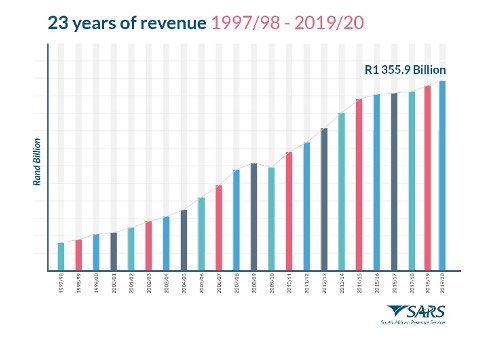
TAX & EXCHANGE CONTROL

                                                Expectations exceeded? SARS
                                                releases revenue data for 2019/2020
                                                ...continued

                                                The Media Statement further states that          SARS has indicated that these results are
   It is promising that                         the impact of weak economic growth and           preliminary and will be subject to detailed
                                                lower consumer and investment spending           financial reconciliation and a final audit.
   the yearly revenue                           in South Africa’s economy is evident in
   collection appears to at                     the overall collection of VAT and import
                                                                                                 Comment
   least be systematically                      duties, which have continued to decrease         Despite the deficit in the total revenue
   increasing.                                  in terms of their relative contribution to the   collected in the 2019/2020 financial
                                                total tax revenue collected. In addition, the    year, it is promising that the yearly
                                                CIT collected in the 2019/2020 financial         revenue collection appears to at least
                                                year also evidences the impact of the            be systematically increasing. The graph
                                                struggling economy on businesses, as the         below (published by SARS) is indicative of
                                                CIT collected decreased from 16.6% of            the upward trend of revenue collection
                                                the total revenue collected in 2018/2019         in recent years, notwithstanding the
                                                to 15.8% of the total revenue collected in       perceived plateau that stemmed from the
                                                2019/2020.                                       2014/2015 to 2017/2018 financial years.

3 | TAX & EXCHANGE CONTROL ALERT 9 April 2020
TAX & EXCHANGE CONTROL

                                                Expectations exceeded? SARS
                                                releases revenue data for 2019/2020
                                                ...continued

                                                In keeping with this trend, the 2020 Budget    a tax perspective, the income producing
   It remains to be seen                        estimated that revenue collections for         capacity of the majority of businesses
                                                the 2020/2021 fiscal year will amount to       and individuals has been limited in some
   what the ultimate                            approximately R1,430 billion, an increase      or other respect, with the potential result
   impact of the COVID-19                       of 4.9% from the previous year. The            being lower than projected revenue
   pandemic and the                             2020 Budget also seeks to reduce the           collection by SARS in the 2020/2021
                                                main budget expenditure baseline by            fiscal year.
   downgrade in South
                                                R156.1 billion over the course of the next
   Africa’s credit rating will                  three years.
                                                                                               This is aggravated by the recent
                                                                                               downgrade of South Africa’s sovereign
   be on SARS’ revenue
                                                However, recent events, both locally and       credit rating to “ junk” status by ratings
   collection for the                           internationally, may have a detrimental        agency Moody’s Investors Service.
   2020/2021 fiscal year.                       effect on the abovementioned positive
                                                                                               It remains to be seen what the ultimate
                                                trend in revenue collection and these
                                                                                               impact of the COVID-19 pandemic and the
                                                optimistic 2020 budgeted figures.
                                                                                               downgrade in South Africa’s credit rating
                                                The COVID-19 pandemic has resulted             will be on SARS’ revenue collection for the
                                                in a national lockdown in South Africa,        2020/2021 fiscal year.
                                                placing significant strain on the economic
                                                activity in the country. In particular, from   Louise Kotze

    CDH is a Level 1 BEE contributor – our clients will benefit by virtue of the recognition of
    135% of their legal services spend with our firm for purposes of their own BEE scorecards.

4 | TAX & EXCHANGE CONTROL ALERT 9 April 2020
TAX & EXCHANGE CONTROL

                                                Foreign exchange and local
                                                change: The Supreme Court of
                                                Appeal considers section 24I of the
                                                Income Tax Act and the effect of
                                                COVID-19 on time periods in the Tax
                                                Administration Act
                                                In the recent Supreme Court of Appeal           By 2011, USD346,000,000.00 of the loans
   In the 2012 year of                          (SCA) judgment, Telkom SA SOC Limited           had been converted into preference share
                                                v The Commissioner for the South                equity while the remainder of the loans
   assessment tax return,                       African Revenue Service [2020] ZASCA            in the amount of USD531,022,900.86
   Telkom claimed a                             19 (25 March 2020), the SCA dealt with          were outstanding on the loan account.
   deduction in the amount                      two separate legal issues stemming from         During Telkom’s 2012 year of assessment,
   of R3,961,295,256 as                         an appeal and a cross-appeal brought            the equity interests of Telkom and its
                                                by the respective parties to the case.          subsidiary in the Nigerian Company
   a foreign exchange                                                                           were sold to a third party. Telkom’s rights
   loss in terms of                             In the Tax Court, the issue pertaining to the   in respect of its loans to the Nigerian
   section 24I of the ITA.                      application of section 24I of the Income        Company were also sold to the third party
                                                Tax Act 58 of 1962 (ITA) was decided in         for USD100.
   SARS disallowed the said
                                                favour of the Commissioner for the South
   deduction and issued an                      African Revenue Service (SARS), whereas
                                                                                                In the 2012 year of assessment tax return,
                                                                                                Telkom claimed a deduction in the amount
   additional assessment                        the findings pursuant to the dispute
                                                                                                of R3,961,295,256 as a foreign exchange
   in terms of which SARS                       regarding section 23H of the ITA favoured
                                                                                                loss in terms of section 24I of the ITA.
                                                Telkom SA SOC Limited (Telkom). As a
   assessed Telkom for                          consequence, Telkom brought an appeal
                                                                                                SARS disallowed the said deduction and
   tax in the amount of                                                                         issued an additional assessment in terms
                                                against the findings of the Tax Court
                                                                                                of which SARS assessed Telkom for tax in
   R425,188,643 as a                            regarding the section 24I findings and
                                                                                                the amount of R425,188,643 as a foreign
   foreign exchange gain.                       SARS brought a cross-appeal against the
                                                                                                exchange gain.
                                                findings in terms of section 23H of the ITA.
                                                                                                Judgment
                                                The Appeal
                                                                                                In coming to its findings, the SCA stated
                                                Facts
                                                                                                that the resolution of this dispute was
                                                During the period 2007 to 2009,                 to be found in the interpretation of the
                                                a subsidiary of Telkom acquired                 provisions of section 24I of the ITA. This
                                                100% of the issued share capital of a           section provides for the tax treatment of
                                                telecommunications company that was             gains or losses incurred by taxpayers on
                                                resident in Nigeria (Nigerian Company).         foreign exchange transactions and requires
                                                In order for the Nigerian Company               that any such gain or loss must be included
                                                to become financially viable, Telkom            in or deducted from the income of a
                                                advanced numerous shareholder loans             taxpayer to the extent that the provisions
                                                amounting to USD877,022,900.86 to it.           apply thereto.

5 | TAX & EXCHANGE CONTROL ALERT 9 April 2020
TAX & EXCHANGE CONTROL

                                                Foreign exchange and local
                                                change: The Supreme Court of
                                                Appeal considers section 24I of the
                                                Income Tax Act and the effect of
                                                COVID-19 on time periods in the Tax
                                                Administration Act...continued
                                                Section 24I contains many definitions to         date or date realised, such spot
   It was Telkom’s                              which regard must be had in applying the         rate shall be deemed to be the
                                                section. For the present matter, the crucial     acquisition rate or disposal rate, as
   submission that the                          definition was that of “ruling exchange          the case may be.”
   proviso to the definition                    rate” (RER). The pertinent aspects of the
                                                                                               At issue between the parties was the
   of RER applied to the                        definition of “ruling exchange rate” are set
                                                                                               determination of the RER on the realisation
   facts and that a rate                        out in section 24I(1) as follows:
                                                                                               date of the loan, which rate would
   other than the spot rate                       ‘”ruling exchange rate” means, in            ultimately dictate the extent of the gain
   at the date on which the                       relation to an exchange item, where          or loss that was to be included in, or
                                                  such exchange item is –                      deducted from, Telkom’s income.
   loan was realised stood
                                                  (a) a loan or advance or debt in a           It was Telkom’s submission that the proviso
   to be used to determine
                                                      foreign currency on –                    to the definition of RER applied to the facts
   the foreign exchange                                                                        and that a rate other than the spot rate at
                                                      (i) transaction date, the spot
   gain or loss.                                                                               the date on which the loan was realised
                                                          rate on such date;
                                                                                               stood to be used to determine the foreign
                                                      (ii) the date it is translated, the      exchange gain or loss. It was argued
                                                           spot rate on such date; or          that the USD100 received by Telkom as
                                                                                               consideration for the disposal of the loan
                                                      (iii) the date it is realised, the
                                                                                               was clearly not determined by applying the
                                                            spot rate on such date:
                                                                                               spot rate at the time to the transaction, as
                                                  Provided that where the rate                 a consequence of which it was apparent
                                                  prescribed in respect of a loan or           that “a rate other than […] the spot rate”
                                                  advance or debt in terms of this             had been utilised.
                                                  definition is the spot rate on the
                                                                                               Telkom contended that the pertinent
                                                  transaction date or the spot rate
                                                                                               question to be answered was whether the
                                                  on the date on which such loan
                                                                                               consideration of USD100 was determined
                                                  or advance or debt is realised, and
                                                                                               by applying a “rate”. It was submitted
                                                  any consideration paid or payable
                                                                                               that “rate” should be taken to mean “the
                                                  or received or receivable in respect
                                                                                               price paid or charged for a thing or class
                                                  of the acquisition or disposal of
                                                                                               of things”, with the result being that
                                                  such loan or advance or debt was
                                                                                               the consideration of USD100, having
                                                  determined by applying a rate other
                                                                                               been agreed upon by the parties to the
                                                  than such spot rate on transaction
                                                                                               transaction, fell within the meaning of

6 | TAX & EXCHANGE CONTROL ALERT 9 April 2020
TAX & EXCHANGE CONTROL
Foreign exchange and local
change: The Supreme Court of
Appeal considers section 24I of the
Income Tax Act and the effect of
COVID-19 on time periods in the Tax
Administration Act...continued
“rate”. The basis of this argument was that calculation which utilised the ‘rate’ as
The SCA agreed that the context of the word “rate” indicated a factor to produce that result. The
that the word did not refer to an exchange only type of rate that would have been
section 24I is not rate between currencies, but rather to an able to perform this function was one
intended to deal with agreement as to value or worth. Ultimately, which compared two items against
the tax consequences Telkom concluded that the consideration one another, such as a currency
of commercial losses of USD100 was determined using a rate exchange rate. It was apparent that the
other than the spot rate, and that the consideration for the loan of USD100
and that its operation proviso to the definition of RER had to be was agreed by reference only to the
is limited to gains and applied to the transaction. perceived value of the loan and that
losses arising out of The SCA, in agreeing with the findings of
currency exchange ratios played no
role in the determination of the price.
currency fluctuations. the Tax Court and the submissions made
by SARS, found that Telkom’s arguments The SCA agreed that section 24I is
stood to be rejected for the following not intended to deal with the tax
reasons: consequences of commercial losses and
that its operation is limited to gains and
1. Section 24I deals with losses or
losses arising out of currency fluctuations.
gains caused by foreign exchange
In the result, the SCA dismissed Telkom’s
fluctuations and is not applicable to a
appeal with costs.
‘business’ loss of the kind incurred by
Telkom. The Cross-Appeal
2. When the proviso to the definition of Facts
RER is interpreted in the context of
In the 2012 year of assessment, Telkom
the section as a whole, the use of the
made a “cash incentive bonus” payment to
word ‘rate’ means an exchange rate
Velociti (Pty) Ltd (Velociti) in the amount of
which reflects the value of a particular
R178,788,421 in respect of the connection
currency. It is a currency exchange
of initial subscriber contracts relating to
rate, and not a discount rate, that is
special tariff plans. These connections
contemplated by the proviso.
were made by Velociti on behalf of Telkom
3. In order to satisfy the requirement and the amount paid by Telkom as the
in the proviso that the consideration cash incentive bonus was claimed as a
must be ‘determined’ by ‘applying’ the deduction. However, SARS only allowed
rate, the consideration would have a portion thereof as a deduction and
had to be the result of a process of added back the remainder in terms of
section 23H(1)(b)(ii) of the ITA.
7 | TAX & EXCHANGE CONTROL ALERT 9 April 2020TAX & EXCHANGE CONTROL
Foreign exchange and local
change: The Supreme Court of
Appeal considers section 24I of the
Income Tax Act and the effect of
COVID-19 on time periods in the Tax
Administration Act...continued
Judgment It was contended by Telkom that the cash
The SCA concurred with Section 23H of the ITA limits the
incentive bonus was paid to Velociti in
respect of the connections that had to
the submissions of SARS deductions claimable in a year of
have been made prior to 30 September
that the true benefit assessment in respect of certain
2011 and that the benefit therefore did not
expenditure that has been incurred in
derived by Telkom was advance, and makes provision for the said
extend past the 2012 year of assessment,
the monthly subscriber expenditure to be claimed over a period
resulting in section 23H not being
applicable. Furthermore, it was contended
payments over the to be determined in accordance with the
that the fact that Telkom paid a separate
anticipated 24-month provisions of the section.
commission to Velociti for the benefit that
period and that the At issue in the cross-appeal was whether it derived from the subscription fees over
SARS was entitled to apply section 23H the period of the contracts was indicative
term of the contracts
to limit the deduction in the 2012 year that the cash incentive bonus was paid
therefore represented of assessment, with the result that the solely in respect of the connections that
the periods in respect of balance paid was spread out over a had been made and did therefore not
which the benefit was number of years. The SCA embarked on an relate to the fees paid by customers over
inquiry into the benefits derived by Telkom the contract periods.
derived by Telkom. from the expenditure incurred, specifically
The SCA concurred with the submissions
when and how the benefit was enjoyed
of SARS that the true benefit derived
by Telkom, and agreed that the period to
by Telkom was the monthly subscriber
which the expenditure relates must be
payments over the anticipated 24-month
the period during which the benefit was
period and that the term of the contracts
enjoyed.
therefore represented the periods in
It was submitted on behalf of SARS that respect of which the benefit was derived
Telkom did not incur the cash incentive by Telkom. It was held that:
bonus expenditure merely to establish
“Although the conclusion of the
the new connections with customers,
contract benefitted Telkom, the
but rather that the benefit was derived
enjoyment of that benefit was
by Telkom by means of the subscription
spread out over the period of the
fees paid by the customers over the
contract, so that the period to which
fixed term period of the contract. In this
the expenditure related could not be
manner, Telkom only derives a benefit
limited to the first year.”
from the expenditure incurred when the
connection turns into fee income, and
this only happens over the period of the
contract when subscription fees are paid
by customers.
8 | TAX & EXCHANGE CONTROL ALERT 9 April 2020TAX & EXCHANGE CONTROL
Foreign exchange and local
change: The Supreme Court of
Appeal considers section 24I of the
Income Tax Act and the effect of
COVID-19 on time periods in the Tax
Administration Act...continued
Lastly, in response to the submission To the extent that the Rand continues to
The findings of the SCA by Telkom that it paid a separate weaken, South African entities may face
ongoing commission to Velociti over substantial losses, including those arising
in the Telkom matter the subscription period and that this from foreign exchange items.
are binding. However, commission, and not the connection
At present, the findings of the SCA in the
Telkom has announced bonus, was the quid pro quo for the
Telkom matter are binding. However,
that it intends appealing subscription fees, the SCA stated that the
Telkom has announced that it intends
pertinent question was whether Telkom
the adverse findings derived a benefit from the connections
appealing the adverse findings of the SCA
of the SCA to the to the Constitutional Court, the outcome
over the contract period. The SCA
of which may influence the application
Constitutional Court, the answered this question in the affirmative
of section 24I and section 23H in similar
and held that the fact that another
outcome of which may circumstances.
payment was made by Telkom did not
influence the application render this fact irrelevant. In the result, the While the timelines in which Telkom must
of section 24I and SCA upheld the cross-appeal and found lodge its appeal to the Constitutional
section 23H in similar that section 23H was to be applied to the Court are determined by the rules
cash incentive bonus paid by Telkom. applicable to that court, taxpayers who
circumstances. are involved in audits or dispute resolution
Comment
proceedings with SARS should take note
The findings of the SCA pertaining to of the effect that the lockdown (pursuant
the interpretation of the provisions of to the COVID-19 pandemic) will have on
section 24I are significant in light of certain time periods prescribed in the Tax
the current economic climate in which Administration Act 28 of 2011 (TAA).
South African taxpayers find themselves.
On 1 April 2020, the Draft Disaster
The recent downgrade of South Africa’s
Management Tax Relief Administration
sovereign credit rating to “ junk” status by
Bill, 2020 (Bill) was published for public
rating agency Moody’s Investors Service,
comment. The Bill contains a proposal
the increasingly negative impact of the
regarding the extension of certain time
COVID-19 pandemic on South Africa’s
periods prescribed in the TAA and provides
economy, and the overall weakening of the
that the period of the national lockdown
rand, have had negative repercussions for
be regarded as dies non for those specified
South African entities.
time periods listed in the Bill.
9 | TAX & EXCHANGE CONTROL ALERT 9 April 2020TAX & EXCHANGE CONTROL
Foreign exchange and local
change: The Supreme Court of
Appeal considers section 24I of the
Income Tax Act and the effect of
COVID-19 on time periods in the Tax
Administration Act...continued
Dies non is a day (or days) that has no legal e) in respect of a ruling under Chapter 7
The days of the effect and which will not be counted for of the TAA;
purposes of the calculation of the time
lockdown period will periods listed in the Bill. As such, the days
f) under section 99(1) of the TAA (dealing
be excluded from any of the lockdown period will be excluded
with the issuance of assessments and
prescription);
calculation regarding from any calculation regarding the time
the time period during period during which either SARS or a g) in relation to section 100 of the
taxpayer is required to adhere to those TAA (dealing with the finality of
which either SARS or a obligations that are listed in the Bill. assessments); and
taxpayer is required to
The sections (prescribing the time periods h) in respect of dispute resolution under
do those things that are to which dies non will apply) that are Chapter 9 of the TAA, including
listed in the Bill. listed in the Bill are stated below. Dies non the dispute resolution rules under
will apply: section 103 (dealing with objections
and appeals).
a) in respect of a notice under
section 47 of the TAA if the notice The Explanatory Memorandum to the
requires a taxpayer to attend an Bill explains that the purpose of this
interview on a date within the national proposal is to “provide individuals and
lockdown period; businesses impacted by COVID-19 with
additional time to comply with selected tax
b) in respect of a notice under
obligations or due dates that are affected
section 48(1) of the TAA if the date of
by or fall within the lockdown period”.
the field audit in the notice is on a date
It should, however, be noted that these
within the national lockdown period;
extended time periods do not apply to
c) for a notice to appear at an inquiry the filing of tax returns or the payment
under section 53 of the TAA if the date obligations of taxpayers.
of appearance is on a date within the
A similar proposal has been made in
national lockdown period;
the Bill regarding specified time periods
d) under section 60(3) in respect of a prescribed in the Customs and Excise
warrant of search and seizure issued Act, 91 of 1964.
under section 60 of the TAA;
10 | TAX & EXCHANGE CONTROL ALERT 9 April 2020TAX & EXCHANGE CONTROL
Foreign exchange and local
change: The Supreme Court of
Appeal considers section 24I of the
Income Tax Act and the effect of
COVID-19 on time periods in the Tax
Administration Act...continued
The following example illustrates 9 April 2020. However, due to the resultant
how a taxpayer may be affected by exclusion of the days falling within the
The public is invited these proposals in the Bill, should lockdown period, the taxpayer will only
they come into effect, without further have to lodge the objection by 4 May 2020.
to submit written amendment: A taxpayer is issued with
comments on the an additional income tax assessment on
The public is invited to submit written
comments on the proposed legislation
proposed legislation to 27 February 2020 and the taxpayer intends
to the National Treasury’s tax policy
the National Treasury’s lodging an objection in respect thereof.
depository at 2020AnnexCProp@treasury.
In terms of Rule 7 of the Tax Court Rules
tax policy depository promulgated in terms of section 103 of
gov.za and Adele Collins at acollins@
sars.gov.za by close of business on
at 2020AnnexCProp@ the TAA, the taxpayer has 30 days in which
15 April 2020.
treasury.gov.za and to lodge the objection. In the absence
of the national lockdown, the taxpayer
Adele Collins at Louise Kotze
would have had to lodge the objection by
acollins@sars.gov.za by
close of business on
15 April 2020.
CHAMBERS GLOBAL 2019 - 2020 ranked our Tax & Exchange Control practice in Band 1: Tax.
Emil Brincker ranked by CHAMBERS GLOBAL 2003 -2020 in Band 1: Tax.
Gerhard Badenhorst ranked by CHAMBERS GLOBAL 2014 - 2020 in Band 1: Tax: Indirect Tax.
Mark Linington ranked by CHAMBERS GLOBAL 2017- 2020 in Band 1: Tax: Consultants.
Ludwig Smith ranked by CHAMBERS GLOBAL 2017 - 2020 in Band 3: Tax.
Stephan Spamer ranked by CHAMBERS GLOBAL 2019-2020 in Band 3: Tax.
11 | TAX & EXCHANGE CONTROL ALERT 9 April 2020TAX & EXCHANGE CONTROL
Donations and funds established to
assist with the COVID-19 disaster
relief efforts: The special tax
dispensation
In our Tax & Exchange Control Alert In order to prevent the tax leakage that
In order to prevent the of 3 April 2020, we briefly discussed may arise due to the various funding
the proposed tax relief in relation to structures and mechanisms that will be
tax leakage that may COVID-19 disaster relief funds and the used by private donors to assist with
arise due to the various making of donations to such funds, COVID-19 relief measures, Government
funding structures which is provided for in the 2020 Draft proposes a streamlined special tax
and mechanisms Disaster Management Tax Relief Bill dispensation for funds established to
(Draft Tax Relief Bill). We discuss this assist with COVID-19 relief measures. The
that will be used by relief measure here in more detail. streamlined special tax treatment for funds
private donors to assist will be similar to the current special tax
In the President’s announcement on
with COVID-19 relief 23 March 2020 regarding the lockdown,
dispensation applicable to public benefit
organisations (PBOs) that provide disaster
measures, Government he indicated that private donors have
relief as envisaged in sections 10(1)(cN)
proposes a streamlined also pledged funding with the aim of
and 30 read together with Part I and Part
providing assistance to the public. The
special tax dispensation Explanatory Memorandum on the Disaster
II of the Ninth Schedule to the Income Tax
for funds established to Management Tax Relief Bill, 2020 (Draft)
Act 58 of 1962 (Act).
assist with COVID-19 (Draft EM), states that the pledge funding Currently receipts and accruals of a
relief measures. envisaged by private donors may take the PBO, other than from certain business
following forms: undertakings or trading activities, are
∞ Loan funding by a fund to SMMEs on exempt from income tax. Donations made
favourable terms. The terms attached to a PBO are exempt from donations tax
to the loans range from an initial and donations made to the PBO may be
zero interest with interest only being tax deductible in the hands of the donor,
charged in later years to long-term where the donation complies with section
repayment periods. 18A of the Act. However, the amount of
tax that is deductible in respect of the
∞ Financial assistance provided to
donations in any year of assessment is
SMMEs, but the amount will not be
limited to 10% of the taxable income of
paid directly to the SMMEs but paid in
that donor. These special tax dispensations
terms of weekly allowances directly to
for PBOs are not automatic and are
the employees of approved SMMEs in
subject to a pre-approval process by the
order to ensure that jobs are retained,
South African Revenue Service (SARS).
while the loan obligation remains with
the SMMEs.
12 | TAX & EXCHANGE CONTROL ALERT 9 April 2020TAX & EXCHANGE CONTROL
Donations and funds established to
assist with the COVID-19 disaster
relief efforts: The special tax
dispensation...continued
COVID-19 disaster relief funds deemed contained in these sections. This means
The receipts and to be PBOs that the receipts and accruals of COVID-19
disaster relief funds will be exempt from
accruals of COVID-19 In terms of section 10(1)(cN) of the Act the
income tax and donations made to or by
disaster relief funds will receipts and accruals of any PBO approved
the COVID-19 disaster relief funds will be
by the Commissioner for the SARS
be exempt from income (Commissioner) in terms of section 30(3)
exempt from donations tax.
tax and donations are exempt from normal tax. The receipts Deduction in respect of donations
made by to or by the and accruals are exempt to the extent that made to COVID-19 disaster relief funds
COVID-19 disaster relief they are derived otherwise than from a
In terms of section 18A of the Act, any
business undertaking or trading activity,
funds will be exempt or from any undertaking or activity if the
taxpayer may deduct from its income
so much of the sum of any bona fide
from donations tax. undertaking or activity is integral and
donation in cash or of property made in
directly related to the sole or principal
kind which was actually paid or transferred
object of that PBO.
during a year of assessment to a PBO
A PBO is defined in section 30 of the Act which carries on in South Africa any
as any organisation which is a non-profit activity contemplated in Part II of the
company or trust or an association of Ninth Schedule to the Act. In terms of
persons of which the sole or principal Part II of the Ninth Schedule to the Act,
object is carrying on one or more public one of the listed public benefit activities
benefit activities. Such activities must be is the provision of disaster relief. Once
carried on in a non-profit manner and a COVID-19 disaster relief fund is on
with an altruistic or philanthropic intent. approval deemed to be a PBO in terms of
No such activities should be intended section 30, section 18A will be applicable
to directly or indirectly promote the to the COVID-19 disaster relief fund.
economic self-interest of any fiduciary
The Draft Tax Relief Bill provides “that
or employee of the organisation
there must be allowed to be deducted,
other than by way of a reasonable
in accordance with section 18A in the
renumeration payable.
determination, for the purposes of that
The Draft EM states that for a period of Act, of the taxable income, as defined in
four months beginning from 1 April 2020 section 1 of that Act, of any taxpayer, as
until 31 July 2020, COVID-19 disaster relief defined in that section, so much of any
funds will on application and approval by bona fide donation by that taxpayer in cash
the Commissioner be deemed to be PBOs which was actually paid during the year of
as contemplated in sections 10(1)(cN) assessment by that taxpayer to a COVID-19
and 30 of the Act, subject to the criteria disaster relief trust”.
13 | TAX & EXCHANGE CONTROL ALERT 9 April 2020TAX & EXCHANGE CONTROL
Donations and funds established to
assist with the COVID-19 disaster
relief efforts: The special tax
dispensation...continued
This means that for the period of four This means that the allowances paid by the
Donations made to months, donations made to COVID-19 COVID-19 disaster relief fund will not result
disaster relief funds will qualify for a tax in employees’ tax withholding obligations
COVID-19 disaster deduction in the hands of the donor, by the SMME. The payments made to the
relief funds will qualify subject to the section 18A limitation. employees will be treated as income in the
for a tax deduction The limitation being that the donor may hands of the employees and the payments
in the hands of the deduct in any year of assessment the will be subject to tax in the hands of
amount of the donation made limited the employees in accordance with the
donor, subject to the to 10% of the taxable income of that applicable tax brackets on assessment.
section 18A limitation. donor before a section 18A deduction or The loan obligation will remain with the
The limitation being section 6quat deduction. SMME. The reason for this measure is to
ensure that the jobs of the employees of
that the donor may What is important to note is that the Draft
the SMMEs are retained.
deduct in any year of Tax Relief Bill refers to cash donations
and not donations of property in kind. Status of COVID-19 disaster relief funds
assessment the amount
Only once the final legislation is adopted at the end of the four-month period
of the donation made by Parliament will there be certainty as
At the end of the four-month period, the
limited to 10% of the to whether donations other than in cash
provisions set out in the Draft Tax Relief Bill
taxable income of made will also be provided for under
will cease to apply to COVID-19 disaster
the proposals.
that donor before a relief funds. In terms of the Draft Tax Relief
section 18A deduction Loans advanced to SMMEs by COVID-19 Bill, any COVID-19 disaster relief funds that
disaster relief funds are not dissolved and the assets thereof
or section 6quat not distributed on or before 31 July 2020
deduction. Where loans are made by a COVID-19
will be deemed to be a small business
disaster relief fund to SMMEs and the
funding entity in terms of section 30C of
amount of the loan is not paid directly to
the Act.
the SMME but is paid in terms of weekly
advances to the employees of the SMME, Members of the public still have until
it would be difficult for the SMME to 15 April 2020 to make submissions on the
withhold employees’ tax in respect of the tax relief legislation, including the issues
allowances paid to its employees. dealt with in the article.
In terms of the Draft Tax Relief Bill it is
Aubrey Mazibuko and Louis Botha
proposed that for a period of four months,
“any amount received or accrued from
a COVID-19 disaster relief trust, must be
deducted or excluded from remuneration,
as defined in... [the Fourth] Schedule, in
calculating the balance of remuneration
as referred to in... [paragraph 2(4) of the
Fourth Schedule]”.
14 | TAX & EXCHANGE CONTROL ALERT 9 April 2020OUR TEAM
For more information about our Tax & Exchange Control practice and services, please contact:
Emil Brincker Mark Linington Stephan Spamer
National Practice Head Private Equity Sector Head Director
Director Director T +27 (0)11 562 1294
T +27 (0)11 562 1063 T +27 (0)11 562 1667 E stephan.spamer@cdhlegal.com
E emil.brincker@cdhlegal.com E mark.linington@cdhlegal.com
Gerhard Badenhorst Ben Strauss
Director Director
T +27 (0)11 562 1870 T +27 (0)21 405 6063
E gerhard.badenhorst@cdhlegal.com E ben.strauss@cdhlegal.com
Petr Erasmus Louis Botha
Director Senior Associate
T +27 (0)11 562 1450 T +27 (0)11 562 1408
E petr.erasmus@cdhlegal.com E louis.botha@cdhlegal.com
Dries Hoek Jerome Brink
Director Senior Associate
T +27 (0)11 562 1425 T +27 (0)11 562 1484
E dries.hoek@cdhlegal.com E jerome.brink@cdhlegal.com
Heinrich Louw Varusha Moodaley
Director Senior Associate
T +27 (0)11 562 1187 T +27 (0)21 481 6392
E heinrich.louw@cdhlegal.com E varusha.moodaley@cdhlegal.com
Howmera Parak Louise Kotze
Director Associate
T +27 (0)11 562 1467 T +27 (0)11 562 1077
E howmera.parak@cdhlegal.com E louise.Kotze@cdhlegal.com
BBBEE STATUS: LEVEL ONE CONTRIBUTOR
Cliffe Dekker Hofmeyr is very pleased to have achieved a Level 1 BBBEE verification under the new BBBEE Codes of Good Practice. Our BBBEE verification is
one of several components of our transformation strategy and we continue to seek ways of improving it in a meaningful manner.
This information is published for general information purposes and is not intended to constitute legal advice. Specialist legal advice should always be sought in
relation to any particular situation. Cliffe Dekker Hofmeyr will accept no responsibility for any actions taken or not taken on the basis of this publication.
JOHANNESBURG
1 Protea Place, Sandton, Johannesburg, 2196. Private Bag X40, Benmore, 2010, South Africa. Dx 154 Randburg and Dx 42 Johannesburg.
T +27 (0)11 562 1000 F +27 (0)11 562 1111 E jhb@cdhlegal.com
CAPE TOWN
11 Buitengracht Street, Cape Town, 8001. PO Box 695, Cape Town, 8000, South Africa. Dx 5 Cape Town.
T +27 (0)21 481 6300 F +27 (0)21 481 6388 E ctn@cdhlegal.com
STELLENBOSCH
14 Louw Street, Stellenbosch Central, Stellenbosch, 7600.
T +27 (0)21 481 6400 E cdhstellenbosch@cdhlegal.com
©2020 8828/APR
TAX & EXCHANGE CONTROL | cliffedekkerhofmeyr.comYou can also read


