All Agency Inventory (AAI) User Guide Version 9.2 January 12, 2021 - Federal Acquisition Service
←
→
Page content transcription
If your browser does not render page correctly, please read the page content below
Federal Acquisition Service

           All Agency Inventory (AAI)
                  User Guide

                     Version 9.2

                  January 12, 2021

                      PREPARED FOR
              General Services Administration
                Federal Acquisition Service
                     1800 F Street NW
                  Washington, DC 20405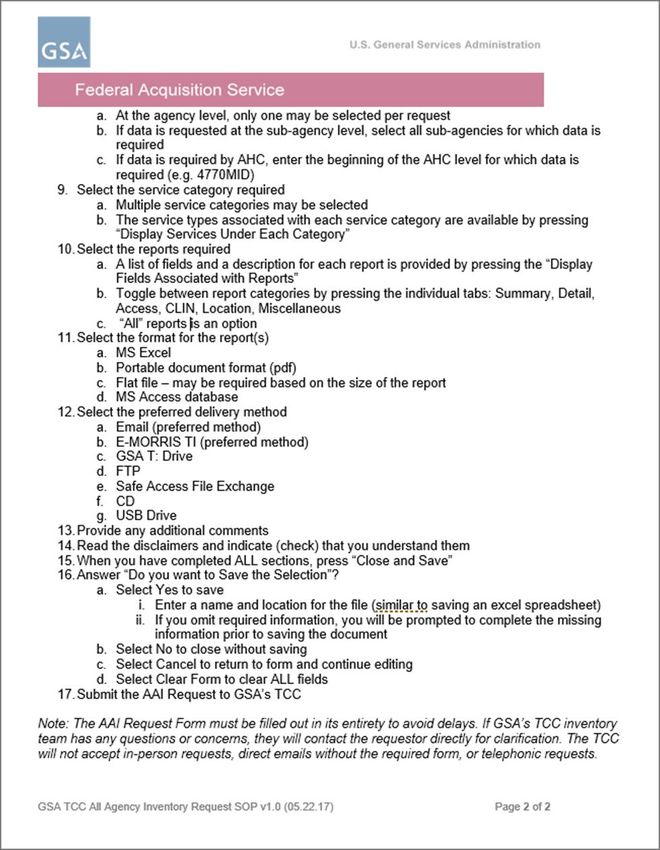
DOCUMENT HISTORY

   VERSION         ISSUE DATE   CHANGES

   1.0             06/05/17     ORIGINAL SUBMISSION

   1.1             06/29/17     UPDATED APPENDIX B AND C

   2.0             09/30/17     UPDATED APPENDIX A, B, AND C

                                UPDATED APPENDIX B, C AND ADDED APPENDIX H, I, J.
   3.0             11/03/17
                                UPDATED SECTION 3.3.1

   4.0             02/28/18     UPDATED APPENDIX B, C, H

   5.0             10/01/18     UPDATED APPENDIX C AND F

   6.0             03/01/19     UPDATED APPENDIX B, C, H, AND J

                                UPDATED APPENDIX C, ADDED APPENDIX L, MOVED
   7.0             06/17/19
                                ACRONYMS AND DEFINITIONS TO APPENDIX M

   8.0             04/06/20     UPDATED DOCUMENT FOR QUARTERLY DELIVERABLE

   8.1             04/08/20     ADDED TSMS AS GSA INVENTORY POINTS OF CONTACT

   9.0             01/07/21     UPDATED MICROTECH NAME CHANGE IN APPENDIX F

                                UPDATED SECTIONS 1.2, 2, 3.3.1, AND 5 TO REFERENCE
   9.1             01/08/21
                                SOLUTIONS BROKER ROLE [EFFECTIVE NOV 2020]

                                UPDATED TABLE 1 AND TABLE 7 TO REFERENCE SOLUTIONS
   9.2             01/12/21
                                BROKER ROLE

                                   ii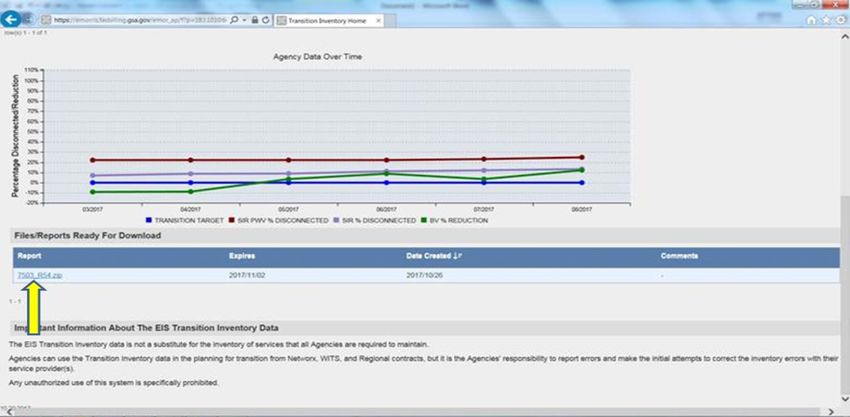
TABLE OF CONTENTS

1.       INTRODUCTION .................................................................................................................................................... 1

     1.1 OVERVIEW ................................................................................................................................................................... 1
     1.2 BACKGROUND ............................................................................................................................................................. 1
     1.3 PURPOSE .................................................................................................................................................................... 2
     1.4 KEY DEFINITIONS ........................................................................................................................................................ 2
        1.4.1 Transition ......................................................................................................................................................... 2
        1.4.2 Transition Inventory (TI) ................................................................................................................................. 2
        1.4.3 Service Instance.............................................................................................................................................. 2
        1.4.4 Inventory Validation ........................................................................................................................................ 2
        1.4.5 All Agency Inventory (AAI)............................................................................................................................. 2
     1.5 ASSUMPTIONS ............................................................................................................................................................. 3

2        ROLES AND RESPONSIBILITIES ....................................................................................................................... 3

3        ALL AGENCY INVENTORY COMPONENTS ..................................................................................................... 4

     3.1 DATA SOURCES .......................................................................................................................................................... 4
     3.2 DATA FIELDS ............................................................................................................................................................... 5
     3.3 REPORTS .................................................................................................................................................................... 6
        3.3.1 Requesting Data ............................................................................................................................................. 7
        3.3.2 Delivery Process ............................................................................................................................................. 8
     3.4 PERMISSIONS .............................................................................................................................................................. 9
        3.4.1 Available Report Formats .............................................................................................................................. 9
        3.4.2 Delivery Methods ............................................................................................................................................ 9

4        REQUESTING ASSISTANCE ............................................................................................................................... 9

     4.1     REPORTING AAI ERRORS AND ISSUES ...................................................................................................................... 9
     4.2     INVESTIGATING AAI ERRORS AND ISSUES ............................................................................................................... 10

5        CONTACT INFORMATION ................................................................................................................................. 11

APPENDIX A – DATA SOURCES ............................................................................................................................... 12

APPENDIX B - AVAILABLE DATA FIELDS .............................................................................................................. 18

APPENDIX C – REPORTS AND FILES ...................................................................................................................... 26

APPENDIX D – AAI REQUEST SOP .......................................................................................................................... 54

APPENDIX E – SAMPLE AAI REQUEST FORM ...................................................................................................... 56

APPENDIX F – AWARDED EIS CONTRACTORS .................................................................................................... 57

APPENDIX G – ERROR FORM ................................................................................................................................... 59

APPENDIX H - AVAILABLE DATA FIELDS WITH CURRENT CONTRACT BILLING INFORMATION.............. 60

APPENDIX I – UNMAPPED CLIN CODES ................................................................................................................. 69

APPENDIX J – BILLING CODES ................................................................................................................................ 70

APPENDIX K – BILLING PERIODS REPRESENTED IN DATA .............................................................................. 72

                                                                                          iii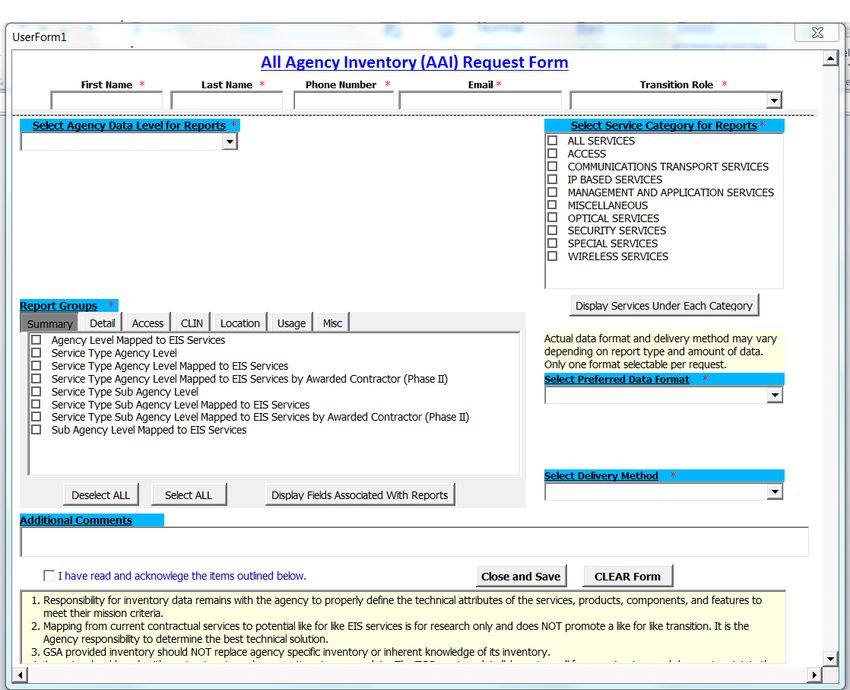
APPENDIX L – REPORT 45 DUPLICATE TN CATEGORY CODES ....................................................................... 73

APPENDIX M – ACRONYMS AND DEFINITIONS .................................................................................................... 74

LIST OF TABLES

TABLE 1. AAI ROLES AND RESPONSIBILITIES ............................................................................................................. 3
TABLE 2. SAMPLE SOURCE FILE COMPARISON ......................................................................................................... 5
TABLE 3. DATA SOURCE TYPES ...................................................................................................................................... 5
TABLE 4. SAMPLE TI RECORD.......................................................................................................................................... 6
TABLE 5. EXPANDED TI RECORD TO AAI RECORD ................................................................................................... 6
TABLE 6. REPORT GROUPS AND DESCRIPTIONS ..................................................................................................... 7
TABLE 7. EIS TRANSITION STAKEHOLDERS AUTHORIZED TO REQUEST AND/OR RECEIVE AAI DATA .... 7
TABLE 8. CONTACT INFORMATION............................................................................................................................... 11

                                                                                 iv
1. INTRODUCTION
1.1 Overview
All Agency Inventory (AAI) is a reporting mechanism that assists agencies to define
their current inventory and applies standard business rules, technical specifications, and
contract requirements to project their future state under the Enterprise Infrastructure
Solutions (EIS) contract, assuming a like-for-like transition. AAI extends Transition
Inventory (TI) data to a detailed level to include individual Contract Line Item Numbers
(CLINs), features, equipment, bandwidth, and other data not currently available within
TI. Current contract data is mapped to EIS services (both primary and secondary),
CLINs, Core Based Statistical Areas (CBSAs), and other contract components. AAI
leverages this mapping to reduce the level of effort by saving hours required to obtain
required inventory data, at both an agency and Government-wide level; minimize
associated transition planning costs; and expedite the Fair Opportunity (FO) process.
1.2 Background
In January 2016, the General Services Administration (GSA) created a validated service
inventory database to capture TI from expiring Networx, Washington Interagency
Telecommunications System (WITS) 3, and regional local service (RLS) contracts. TI is
accessible within the GSA Enhanced Monthly On-Line Records and Reports of
Information Technology Services (E-MORRIS) application to authorized agency users
for the purposes of transition planning. GSA continues to validate TI on a monthly basis,
updating data to account for new records, disconnected services, and other
discrepancies.
Transition progress is tracked at the service instance record (SIR) level, which provides
a summarized roll-up of current base services within TI. Agencies may require
additional TI content during acquisition planning to ensure services are grouped
properly within FO solicitations, or more robust data to assist with content for EIS
service orders. Therefore, to further assist agencies as they develop their solicitations
and subsequent service orders, GSA has created AAI. Similar to TI, the data is derived
from contractor inventory, billing, and orders for Networx, WITS 3, and RLS contracts.
Numerous standard report formats have been created to allow flexibility based on
agency needs. Agencies should contact their GSA Solutions Broker (SB) to discuss
their requirements and request AAI from GSA’s Transition Coordination Center (TCC)
inventory team.
1
AAI User Guide v9.11.3 Purpose
This document explains the components of AAI, including data sources (input),
available data fields, reports (output), the process to request AAI, and how to report
issues.
1.4 Key Definitions
1.4.1 Transition
Transition is the movement of services from expiring Networx, WITS 3, and RLS
contracts to the replacement EIS contract(s). These transitions can be: (1)
administrative, where orders are issued to move service from an incumbent’s contract to
the same service provider’s replacement contracts; (2) physical, where the service is
moved from an expiring contract to a different service provider’s replacement contract;
or (3) transformative, where the service is converted during the transition, such as to
replace a legacy service with a newer technology.
1.4.2 Transition Inventory (TI)
Transition Inventory (TI) is a collection of SIR level data that enables agencies to plan
and prepare for the transitioning of telecommunications services from expiring Networx,
WITS 3, and GSA RLS contracts. TI is updated monthly to reflect services as they are
added, changed, or disconnected from the expiring contracts. This data is available to
authorized agency users through the E-MORRIS application.
1.4.3 Service Instance
GSA tracks and measures transition progress at the service instance level.
Service instance is defined as a summarized roll-up of a base service, including any
associated and/or supporting feature CLINs. It may also describe a single record that
represents each ordered service. Service instance level data does not provide enough
detail as a single data source to support FO decisions.
1.4.4 Inventory Validation
Inventory validation is the result of a process where service instances are compared
and reconciled against available data sources by the TCC inventory team on behalf of
the agency.
1.4.5 All Agency Inventory (AAI)
All Agency Inventory (AAI) is data that has been received from multiple sources and
synthesized into various reporting formats to assist agencies with FO solicitations and
other transition ordering requirements.
2
AAI User Guide v9.11.5 Assumptions
1. It is the agency’s responsibility to define the technical and operational attributes
of the services, products, components, and features to meet their mission
requirements.
2. GSA-provided inventory should NOT replace agency-specific inventory or an
agency’s inherent knowledge of its inventory.
3. AAI data represents current, active services only; therefore, timing may distort
the status of records. Disconnect orders can take several months to process and
be reflected in AAI source data from the date an agency issues the disconnect
order.
4. Mapping from current services to potential EIS services should be used for
informational purposes only and does NOT promote a like-for-like transition.
5. Mapping from current CLINs to EIS CLINs should be used for informational
purposes only. This mapping is NOT always accurate enough to meet agency
needs and should be reviewed carefully.
6. The TCC inventory team inputs source data received from contractors but does
not have the authority to make changes. Agencies should work with their
contractors to correct any errors in source data.
7. The TCC inventory team will provide AAI as frequently as required, however it
will remain the agency’s responsibility to identify differences between the data
sets.
8. It may be possible for the TCC inventory team to address missing information,
components, and CLINs if omitted from one of the primary data sources available
to the TCC inventory team. However, it remains the agency’s responsibility to
obtain additional data as needed for contractor inventory, billing, and orders if
NOT available through AAI source data.
2 ROLES AND RESPONSIBILITIES
Table 1 summarizes AAI roles and responsibilities by stakeholder.
Table 1. AAI Roles and Responsibilities
Stakeholder Role Responsibilities for Inventory
Agency Lead Leads agency’s transition Utilize inventory to assist with Statements
Transition Manager of Work (SOWs), Independent
(LTM) Government Cost Estimates (IGCEs),
and other pre-transition activities
GSA TCC Inventory Assists agencies develop and Develops and maintains AAI approach
Team execute their Agency Transition and processes
Plans (ATPs) Manages all AAI activities
Tracks and reports EIS transition Validates inventory on a monthly basis
progress Provides Tier 2/3 Help Desk support to
resolve AAI cases
Conducts inventory training
3
AAI User Guide v9.1Stakeholder Role Responsibilities for Inventory
Area Coordinates transition of regional Prepares and provides to the TCC
Telecommunications and local services inventory team the monthly combined
Managers (ATMs) and WITS Telephone Number file containing
WITS 3 Program records from Verizon and Level 3
Management Office Updates Telecommunications Ordering
(PMO) and Pricing System (TOPS) and
communicates with local service
providers for changes required to
regional inventory
Implements orders for full service
customers and GSA-assisted transition
Liaises with local telecommunications
suppliers
Liaises with agency regional
representatives
Service Supports the implementation of Provides the TCC inventory team with
Provider/Contractor ATPs monthly updates to source data
Works with agencies to address
inventory discrepancies
GSA Solutions Brokers Primary liaison between GSA and Requests AAI data
(SBs) agency for pre-award activities Assists agencies with using AAI to
including inventory develop FOs
Provides AAI assistance to agencies
GSA Transition Assists agencies with acquisition Requests AAI
Ordering Assistance planning and development Assists agencies through SB with using
(TOA) Staff AAI to develop FO solicitations
Provides AAI assistance
3 ALL AGENCY INVENTORY COMPONENTS
3.1 Data Sources
TI data provides baseline data from which AAI is determined. This baseline data is
supplemented by expanded contractor inventory files (I), the Networx Management
System (NIM) Service Order Completion Notifications (SOCNs) (O), billing (B), CLINs,
CBSAs, and other available data. See Appendix A for a complete list of data sources.
4
AAI User Guide v9.1The TCC inventory team correlates source files with a core TI record in list format to
ensure all possible CLINs have been captured. Table 2 shows an example of: the
inventory file contains seven (7) CLIN records for the TI record; the NIM file contains
five (5) CLIN records; the billing file contains seven (7) CLIN records; and of these, four
(4) records match across all three sources. However, in this example eight (8) total TI
records are then used to develop AAI content.
Table 2. Sample Source File Comparison
TI Record Inventory NIM Billing All CLIN Source
File Inventory
Match UBI 144002 144002 144002 144002 Populate with Source(s) (ex. I, O, B)
Match UBI 760311 760311 760311 760311 Populate with Source(s) (ex. I, O, B)
Match UBI 916332 916332 916332 916332 Populate with Source(s) (ex. I, O, B)
Match UBI 213845 213845 213845 213845 Populate with Source(s) (ex. I, O, B)
Match UBI 289010 289010 289010 Populate with Source(s) (ex. I, O)
Match UBI 212699 212699 212699 Populate with Source(s) (ex. I, B)
Match UBI 212899 212899 212899 Populate with Source(s) (ex. I, B)
Match UBI 212999 212999 Populate with Source(s) (ex. B)
Types of data used to generate AAI reporting output are identified in Table 3.
Table 3. Data Source Types
Type Description
Reference File Used to support some fields, but not a primary file. Used to support and/or apply
business rules.
Processing File Primary file used to create aggregate TI SIRs. Additionally, provides data for
specific fields not provided as part of TI. Used for support of business rules.
Lookup Table Static table to ensure standardization of data. Also used as reference but
remains static and is not received monthly as a file.
Derived File created from other source files and used to create aggregate TI SIRs.
Processing File Additionally, provides data for specific fields not provided as part of TI.
Derived Reference Reference table to ensure standardization of data and to update specific fields
Table not received or standardized on processing files.
3.2 Data Fields
Available data fields including descriptions, lengths, and primary sources are described
in Appendix B. Identifiers have been assigned to group components of a unique service
instance (e.g. GSA Tracking Id, GSA Secondary Tracking Id). Note that all fields may
not be populated; their population is dependent on contract and data availability.
Approximately half of the available fields are derived directly from TI (e.g. Contract,
Source, Address, Agency Hierarchy Code (AHC), Agency Name, and Agency Service
Request Number (ASRN)).
5
AAI User Guide v9.1The remaining fields are unique to AAI, including:
CLINs and aspects of CLINs (description, charge type, charge unit)
CLIN mapping to EIS CLINs
Service Enabling Devices (SEDs) and aspects of SEDs (Part, Manufacturer)
Location mapping to CBSA
Service mapping to EIS Services
Secondary service identification
Bandwidth
Terminating address, Network Site Code (NSC), City, State, Zip
Table 4 provides an example of a unique TI record. Note: The field name is represented
in dark blue, and the individual record appears in white as the body of the record.
Table 4. Sample TI Record
Ex Agency Address City St Service Circuit/TN Contractor Contract Source UBI
1 XXX 122 Rte 7 Leesburg VA NBIP-VPNS NBI-420195 Verizon Networx V LEESVAMN-987564-NBVPN
Table 5 reflects the same TI record expanded to multiple AAI records. Note: Only a few
source fields were selected for this example. The field name is represented in dark blue,
the source for the data is represented in gray, and the individual records appear in white
as the body of the record.
Table 5. Expanded TI Record to AAI Record
Ex Agency Address City St Service Circuit/TN CLIN Chg Type Chg Unit CLIN Description
Source-
TI TI TI TI TI TI CLIN Map CLIN Map CLIN Map
NIM, Bill
1 XXX 122 Rte 7 Leesburg VA NBIP-VPNS NBI-420195 144002 MRC Per circuit TSP Rest One Local Acc Crd
1 XXX 122 Rte 7 Leesburg VA NBIP-VPNS NBI-420195 760311 MRC Per circuit T-1 Access Charge
1 XXX 122 Rte 7 Leesburg VA NBIP-VPNS NBI-420195 916332 MMRC Per device Cisco CISCO2921-SEC
1 XXX 122 Rte 7 Leesburg VA NBIP-VPNS NBI-420195 213845 MRC Per port CONUS Enhanced DS1
1 XXX 122 Rte 7 Leesburg VA NBIP-VPNS NBI-420195 289010 MRC Per line CONUS Managed Bus Line
3.3 Reports
A report represents a pre-defined summary, grouping, or set of data, which is comprised
of specific fields and/or combinations of fields. The “Group” describes the category the
report is addressing. Delivery frequency transitioned from monthly to quarterly
beginning in January 2020 and the number of canned reports included as part of the
standard package was reduced from 45 to 21. The reduction of canned reports was
made after consultation with agencies and GSA.
6
AAI User Guide v9.1Table 6 illustrates report Groups, Descriptions, and the # Reports available for that
group based on the original reporting package. All pre-defined reports are described in
Appendix C. Contact the TCC inventory team if additional AAI reports are required.
Table 6. Report Groups and Descriptions
Group Description # Reports
Used to assist agencies in identifying all access, bandwidths, and
Access 1
locations within their agencies.
Provides CLIN based information for all contracts, mapping (where
CLIN 6
available) to EIS CLINs, counts, and descriptions.
Provides detail level files to assist with transition orders. Some
Detail reports contain all data fields available to the TCC inventory team, 6
which includes data down to the CLIN and/or component level.
Provides location level detail data including mapping to EIS
Location CBSAs. Addresses are normalized to the iCONECTIV database 7
based on the NSC.
Miscellaneous Reports that have ancillary relationships to the inventory data.
8
(labeled as Misc.)
Provides data that incorporates current contract billing amounts;
Spend 10
and in some cases, pricing data.
Provides summary level data groups providing SOW type of
Summary 5
information.
Provides durations for usage-based services for one years’ worth
Usage 2
of data.
3.3.1 Requesting Data
Agencies do NOT have direct access to AAl data; the data is unavailable in the TI
module in a spreadsheet type view. The refreshed AAI data is pushed to the T:/ drive by
transition entity for all agencies. Any special requests for data groupings, different
combinations of transition entities, or delivery methods must be requested. For agency-
specific delivery, the TCC can place the AAI files in the TI module, which serves as a de
facto file transfer location.
Table 7 identifies the list of participants authorized to request and/or receive special
request AAI data.
Table 7. EIS Transition Stakeholders Authorized to Request and/or Receive AAI Data
Stakeholder Request Data Receive Data
GSA SBs (Representatives formerly titled
Agency Managers or Technology Service Yes Yes
Managers)
TOA and TCC Staff Yes Yes
Agency LTM Through their SB Yes
LTM Designated Staff Through their SB Yes
TI Users Based on Permissions Through their SB Yes
7
AAI User Guide v9.1The TCC inventory team will provide requested data within three (3) business days from
receipt of a request.
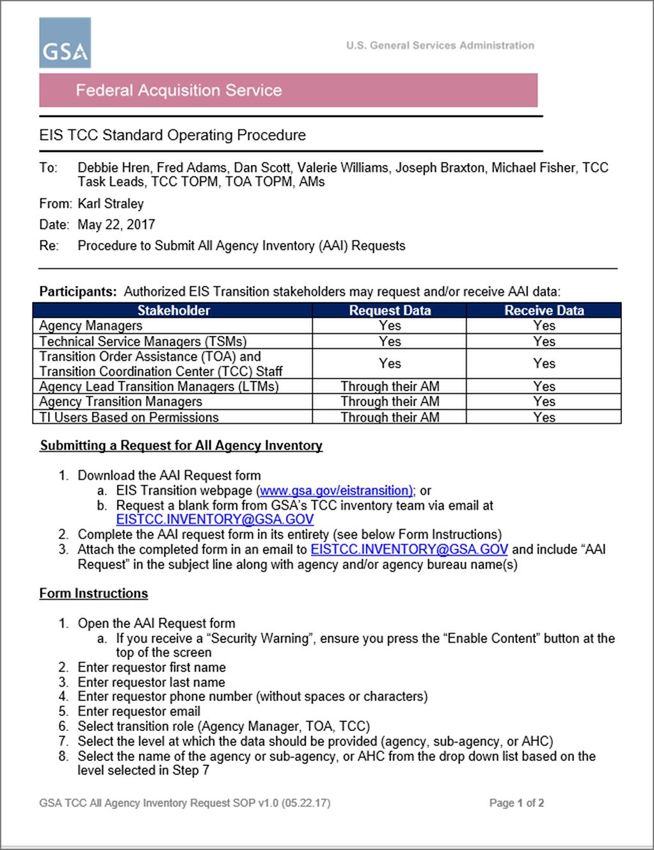
The procedure to submit AAI Requests is included as Appendix D. A sample request
form is provided as Appendix E.
3.3.2 Delivery Process
The process for agency-specific delivery of AAI reports and data within the TI module is
two-fold and summarized in this section.
3.3.2.1 Placing Files on the Transition Inventory Module
1. The TCC uploads AAI reports to a user's E-MORRIS account when requested.
All reports and data will be contained within a single, zipped file.
2. The user will be notified by email message when the files are available for
download. Files will be available for thirty (30) calendar days after being
uploaded to the E-MORRIS TI home page by the TCC.
3.3.2.2 Retrieving Files from the Transition Inventory Module
1. To retrieve files from the AAI files from TI, first log into E-MORRIS.
2. Enter the TI Module at the far, right side of screen.
3. Uploaded files are located in the "Files/Reports Ready For Download" section
near the bottom of the home page.
4. To download a file, select the file name in the “Report” column.
5. Extract all reports and data files from the downloaded zip file (using an archive
tool like WinZip or the Window extract feature).
6. Save the file to the desired location on your local PC using the “Save As” feature.
8
AAI User Guide v9.13.4 Permissions
The TCC inventory team provides reports based on authorized permissions and the
requested level of reporting, which includes:
Agency
Sub-Agency(s)
AHC string (up to 28 characters)
3.4.1 Available Report Formats
The TCC inventory team provides reports in the following formats:
MS Excel
Flat File - may be required based on the size of the report
MS Access Database - by special request only
3.4.2 Delivery Methods
Reporting packages will be placed in a zip file and delivered to the requestor when
requested. The file is password protected and the password is sent in a separate email.
In most cases and when reports/files exceed email space limitations; the TCC inventory
team places the zip file in the E-MORRIS TI module for retrieval by an authorized user
of E-MORRIS.
The zip file can be provided using multiple methods. These include:
GSA T: Drive (GSA Staff-shared drive);
E-MORRIS TI Application
File Transfer Protocol (FTP);
Safe Access File Exchange (SAFE);
Compact Disk (CD); and
Universal Serial Bus (USB) Drive
4 REQUESTING ASSISTANCE
A stakeholder may identify an issue or error in an AAI report. Stakeholders must report
these items to the TCC inventory team for review, analysis, and resolution.
Stakeholders should follow the steps below for reporting AAI errors.
4.1 Reporting AAI Errors and Issues
Any issues or errors related to AAI shall be reported to the TCC inventory team using
the following steps:
1. Download the Error Form (See Appendix G).
a. From the EIS Transition webpage (www.gsa.gov/eistransition); or
9
AAI User Guide v9.1b. Request a blank form from the TCC inventory team via email at
EISTCC.INVENTORY@GSA.GOV
2. Enter Point of Contact Information: First Name, Last Name, Phone Number,
Email, and Agency
3. Provide all errors - annotate the report and explain issue
a. Enter at least one of the key identifiers, but as many as are available: UBI,
Circuit Id, Phone Number, GSA Tracking Id
b. Enter the name of the report for the error
c. Enter the report date (found on the file name)
d. Enter the error/exception reason
e. Provide additional comments
4. Save and attach the completed form in an email to
EISTCC.INVENTORY@GSA.GOV and include “AAI Error” in the subject line.
The TCC inventory team will track and respond to AAI errors in conjunction with
the Tier 2/3 TCC Help Desk.
4.2 Investigating AAI Errors and Issues
The TCC inventory team will perform the following actions when investigating report
errors:
1. Contact the sender directly with any questions or clarification, if needed.
2. Provide action items for contractor (source) required actions, and AAI specific
actions.
3. Partner with contractors and agencies when necessary to correct the error.
a. Errors need to be fixed at the source and may require direction from an
agency to a contractor for correction
b. Errors determined to be AAI specific errors will be repaired by the TCC
inventory team
4. Annotate the error form with the resolution and/or required actions for each error
record; to include:
a. Findings
b. Actions taken or to be taken by the TCC inventory team
c. Date actions will be completed
d. Actions needing to be taken by the agency with specific instructions
5. Send an email response including the following:
a. Steps taken to address the exception(s)
b. Details of annotated error form addressed in Step 4
6. Analyze and track all AAI errors and resolutions in conjunction with the Tier 2/3
TCC Help Desk
10
AAI User Guide v9.15 CONTACT INFORMATION
Contact information to address general AAI questions and request AAI forms is
provided in Table 8.
Table 8. Contact Information
Area Source Email Phone Number
See Telecommunications
See EIS Contact Support listing
GSA Solutions Services Customer Support listing
General (https://gsa.gov/portal/content/10
Brokers (https://gsa.gov/portal/content/10
3828)
3828)
National Customer
AAI
Service Center ITCSC@gsa.gov 855-482-4348 (ITaid4U)
Questions
(NCSC)
AAI Data -
TCC eistcc.inventory@gsa.gov
Detailed
11
AAI User Guide v9.1Appendix A – Data Sources
The following list provides the data files and primary tables required for the TCC inventory team to provide acquisition planning and
order data.
Source
# Contract Contractor Data Source Purpose Type Frequency
Responsible
Monthly or
1 All All TI Data Establishes baseline for all data Processing File E-MORRIS
as updated
Standardizes all agency and sub
2 All All Transition Entities Lookup Table TCC As updated
agency names
Includes mapping of Networx,
Regional, and WITS services to TI Derived
3 All All Service Type Mapping Table TCC As updated
and then to EIS, Include Mandatory Reference Table
or optional service categorization
Includes mapping of Networx, Networx
Derived
4 All All CLIN Mapping Table Regional, and WITS CLINs to TI and Hosting Center As updated
Reference Table
then to EIS (NHC)/TCC
CBSA Data to NSC Mapping Assists in data needs for FO Derived
5 All All TCC As updated
(includes physical addresses) selection Reference Table
No NSC / Bad NSC – Address Assists in data needs for FO Derived
6 All All TCC As updated
Standardization and CBSA mapping selection Reference Table
7 All All Contract IDs Establishes standardized data for TI Lookup Table TCC As updated
TCC
8 All All Contractor Names Establishes standardized data for TI Lookup Table As updated
Provides a list of Contractors by EIS TCC
9 All All EIS Service Type Contractors Lookup Table As updated
service type
Provides a list of Contractors by EIS TCC
10 All All EIS CLIN Contractors Lookup Table As updated
CLIN
Provides a list of Contractors by EIS TCC
11 All All EIS CBSA Contractors Lookup Table As updated
CBSA
Provides a list of billing types to a TCC
12 All All Networx Registered AHCs Lookup Table As updated
Networx AHC
TOPS Long Distance (LD) files Establish standardized data for TI for
Federal Technology Service Billing Networx LD from WITS and Regional Derived TCC
13 All All Weekly
Table (FTSB) and WITS Federal data. Assists with AHC definition for Processing File
Technology Service Billing Table regional and WITS data.
12
AAI User Guide v9.1Source
# Contract Contractor Data Source Purpose Type Frequency
Responsible
(WFTSB)
Assists in determining contractors
Derived
14 All All EIS Contractor Service Mapping that have EIS services that map to TCC As updated
Reference Table
existing services
Assists in determining contractors
Derived
15 All All EIS Contractor CBSA Mapping that have EIS CBSAs that map to TCC As updated
Reference Table
current inventory
Assists in deriving address based on GSA Shared
16 Networx All Work Site ID file Reference File Monthly
worksite for FTSB Networx. Drive
Provides the bundled TNs for AT&T
NIM Multi Master Voice Service E-MORRIS
17 Networx All and CenturyLink (CL) sent as Processing File Monthly
(VS)
SOCNs
Determine service instances for
E-MORRIS
18 Networx All NIM Extract services and for inventory Processing File Weekly
components based on the SOCNs
Provides unbundled NIM information
that is bundled in the Multi Master
and NIM extract. To determine Derived
19 Networx All NIM Expanded TCC Weekly
service instances for services and for Processing File
inventory components based on the
SOCNs
Assists in data needs for All E-MORRIS
20 Networx All Detail Billing File (CLIN Detail) Processing File Monthly
Inventory Approach
Assists in data needs for All E-MORRIS
21 Networx All Detail Billing File (Call Detail) Processing File Monthly
Inventory Approach
Assists in data needs for All E-MORRIS
22 Networx All Detail CLIN Billing Usage file Processing File Monthly
Inventory Approach
Pricing CLIN with Description, Unit, Assists in data needs for All Derived
23 Networx All TCC As updated
Charge Type Inventory Approach Reference Table
Pricing SEDs CLIN, Description, Assists in data needs for All Derived
24 Networx All TCC As updated
Manufacturer, Part # Inventory Approach Reference Table
Assists in data needs for All Derived
25 Networx All Pricing Auto Sold CLINs NHC As updated
Inventory Approach Reference Table
Determine service instances for
AT&T via
26 Networx AT&T Inventory Snapshot services and for inventory Processing File Monthly
E-MORRIS
components
13
AAI User Guide v9.1Source
# Contract Contractor Data Source Purpose Type Frequency
Responsible
Determine service instances for N X
AT&T Inventory N X Ranges Derived
27 Networx AT&T service and for inventory TCC Monthly
Unbundled Processing File
components
Determine NIC addresses for AT&T Derived
28 Networx AT&T AT&T Service Address Split TCC Monthly
TI data Reference Table
Determine service instances for
29 Networx AT&T AT&T Calling Card Report calling card service and for inventory Processing File AT&T Monthly
components
Determine service instances for all
Verizon via
30 Networx Verizon Inventory Snapshot services and for inventory Processing File Monthly
E-MORRIS
components
Determine service instances for all
31 Networx Level 3 Inventory Snapshot services and for inventory Processing File Level 3 Monthly
components
Determine service instances for all
Provisioned Inventory file (One Data
32 Networx Sprint services and for inventory Processing File Sprint Monthly
file)
components
Determine service instances for all
Provisioned Inventory file (Multiple
33 Networx Sprint services and for inventory Processing File Sprint Monthly
Voice files)
components
Determine service instances for all
CenturyLink via
34 Networx CenturyLink CL Inventory Snapshot file services and for inventory Processing File Monthly
E-MORRIS
components
Unbundle snapshot bundled services
and then used to determine service Derived
35 Networx CenturyLink CL Inventory Unbundled Voice TCC Monthly
instances for all services and for Processing File
inventory components
Determine service instances for
36 Networx CenturyLink Calling Cards calling card service and for inventory Processing File CenturyLink Monthly
components
Determine service instances for
37 Networx CenturyLink Audio Conferencing Services file audio conferencing service and for Processing File CenturyLink Monthly
inventory components
GSA Cust Acct W Rates Value Added Assists in data needs for All TOPS Help
38 All Processing File Monthly
RLS Inventory Approach Desk
Determine service instances for all
GSA TOPS Help
39 All Cust Acct W Rates (non-sur) services and for inventory Processing File Monthly
RLS Desk
components
14
AAI User Guide v9.1Source
# Contract Contractor Data Source Purpose Type Frequency
Responsible
Determine service instances for all
GSA TOPS Help
40 All Cust Acct W Vendor Rates services and for inventory Reference File Monthly
RLS Desk
components-reference only
GSA Assists in data needs for Fair Derived
41 All NSC to System and Location TCC As updated
RLS Opportunity (FO) decision Reference Table
To determine service instance
GSA Derived
42 All Line Type Mapping service, line service, and analog TCC Monthly
RLS Reference Table
distinction
GSA To provide further designation for the Derived
43 All Sub Line Type Mapping for Other TCC Monthly
RLS “other” service type Reference Table
GSA Product Code / Product Description Provide bandwidth information for Derived
44 All TCC Monthly
RLS Bandwidth regional records Reference Table
Determine service instances contract
GSA Derived
45 All Regional Contract Information field related data for all services and TCC Monthly
RLS Reference Table
for inventory components
Assists in determining Private
GSA Branch Exchange (PBX) and Derived
46 All System File TCC As updated
RLS maintenance accounts for field level Reference Table
data population
To determine agency identification
GSA and Designated Agency GSA Shared
47 All Customer ID Reference File Monthly
RLS Representative (DAR)/Point of Drive
Contact (POC)
Networx Inventory Code (NIC) To determine Service Delivery Point GSA Shared
48 WITS 3 Verizon Reference File Monthly
Contractor (SDP) Drive
GSA Shared
49 WITS 3 Level 3 NIC Address To determine SDP Reference File Monthly
Drive
Individual Invoice (Portal/Customer
GSA Service Record Financial
50 All To assist with validation Reference File Monthly
RLS (CSR)/Invoices/Telecommunications Service Center
Inventory Management (TIM))
Provide additional component detail
based on limited CLIN detail
GSA Category and Subcategory
51 All availability for All Inventory Lookup Table TCC Monthly
RLS Description
approach. Assists in determining
derived line service.
GSA Normalizes contract names to Derived
52 All Contractor Name Normalization TCC Monthly
RLS standardized names for TI SIRs Reference Table
15
AAI User Guide v9.1Source
# Contract Contractor Data Source Purpose Type Frequency
Responsible
Determine service instances for all
53 WITS 3 Level 3 WITS Telephone Number (TN) file services and for inventory Processing File WITS team Monthly
components (bundled)
Determine service instances for all
54 WITS 3 Verizon WITS TN file services and for inventory Processing File WITS team Monthly
components (bundled)
Unbundle TN bundled services and
then used to determine service Derived
55 WITS 3 All WITS TN Unbundled TCC Monthly
instances for all services and for Processing File
inventory components
Determine service instances for all
56 WITS 3 Verizon Service Instance ID Info Billing services and for inventory Processing File NHC Monthly
components
Determine service instances for all
57 WITS 3 Level 3 Service Instance ID Info Billing services and for inventory Processing File NHC Monthly
components
Determine service instances for all
WITS services Monthly Recurring
58 WITS 3 Verizon services and for inventory Processing File NHC Monthly
Charge (MRC) Billing
components
Determine service instances for all
59 WITS 3 Level 3 WITS services (MRC) Billing services and for inventory Processing File NHC Monthly
components
Determine service instances for all
WITS services Non-Recurring
60 WITS 3 Verizon services and for inventory Processing File NHC Monthly
Charge (NRC) Billing
components
Determine service instances for all
61 WITS 3 Level 3 WITS services (NRC) Billing services and for inventory Processing File NHC Monthly
components
Determine service instances for all
62 WITS 3 Verizon WITS services (Usage) Billing services and for inventory Processing File NHC Monthly
components
Determine service instances for all
63 WITS 3 Level 3 WITS services (Usage) Billing services and for inventory Processing File NHC Monthly
components
Determine address and agency
64 WITS 3 Verizon Customer Info Reference File NHC Monthly
identification
Determine address and agency
65 WITS 3 Level 3 Customer Info Reference File NHC Monthly
identification
Assist with CBSA mapping and
Derived
66 WITS 3 All NSC to Location Group analysis between contracts (address TCC As updated
Reference Table
mapping)
16
AAI User Guide v9.1Source
# Contract Contractor Data Source Purpose Type Frequency
Responsible
Pricing CLIN with Description, Unit, Assists in data needs for All Derived
67 WITS 3 All TCC As updated
Charge Type Inventory Approach Reference Table
Billing Account Code (BAC) to AHC
68 WITS 3 ALL Determine ownership Reference File WITS team Monthly
Mapping
Determine ownership where there is Derived
69 WITS 3 ALL BAC to AB TCC Monthly
no AHC Reference Table
CLIN to line service and service
70 WITS 3 ALL WITS SVS TN CLIN Mapping Reference File TCC As updated
description definition for each TN
CLIN to service and service
71 WITS 3 ALL WITS Billing CLIN Mapping Reference File TCC As updated
description definition for each SIR
Determine unbundling rules for
72 WITS 3 ALL TN Unbundle service map Lookup Table TCC As updated
bundled TNs
Assists in population of terminating
73 WITS 3 Verizon Terminating Address for DTS Reference File WITS team Monthly
address field(s) within AAI
Assists in population of terminating
74 WITS 3 Level 3 Terminating Address for DTS Reference File WITS team Monthly
address field(s) within AAI
Assists agencies with knowing the
75 WITS 3 ALL DAR DARs that are responsible for Reference File WITS team As updated
services under a specific BAC
To provide disconnect order
76 Networx Verizon Disconnect Orders Processing File Portal Weekly
information
Disconnect Orders To provide disconnect order
77 Networx Level 3 Processing File Portal Weekly
information
Disconnect Orders To provide disconnect order
78 Networx ATT Processing File Portal Weekly
information
Disconnect Orders To provide disconnect order
79 Networx CenturyLink Processing File Portal Weekly
information
Disconnect Orders To provide disconnect order
80 WITS 3 Verizon Processing File Portal Weekly
information
Disconnect Orders To provide disconnect order
81 WITS 3 Level 3 Processing File Portal Weekly
information
GSA To provide disconnect order
82 Disconnect Orders Processing File Regional Team Weekly
RLS information
17
AAI User Guide v9.1Appendix B - Available Data Fields
The following list describes data field attributes available for agency reporting.
Ord # Field Length Description Source
1 Data Source 15 This field identifies the Networx Contractor, TOPS or WITS sources for the data record. From Source of
Networx Contractor is identified by the first letter in the Contractor Name. Other sources Record
include TOPS, TOPS_FTSB, TOPS_WFTSB, WITS_BILLING, WITS_TN
2 Agency 255 Agency name as displayed in TI. This is a standardized agency name to ensure consistency TI
across all day sources. Reports can be generated based on the Agency. In most cases the
SOW will be issued at the Agency level.
3 Sub Agency 255 Sub Agency name as displayed in TI. This is a standardized agency name to ensure TI
consistency across all day sources. There are some cases where a Sub Agency will issue the
SOW. Data is grouped by Sub Agency for analysis and planning.
4 Source Agency Name 255 Agency Name as it appears in source file before standardization (e.g. WITS BAC name, TI
Regional TOPS name). Not always provided by contractors. Allows an agency to compare
detailed agency name as it was entered into the source system during order entry.
5 AHC 28 Agency Hierarchical Code captured from source files for Networx data. Derived from the TI
agency bureau and/or related LD records for WITS and Regional as it is not required for local
services during ordering. Agencies track spending and other statistics by AHC. One Sub
Agency can have multiple AHC Codes.
6 Agency Bureau Code 4 Provides the Agency Bureau (AB) Code based on the AHC received from the primary source TI
files
7 Contract 10 There are 3 Contracts- Networx, WITS 3 and GSA RLS. Agencies will need for FOs and TI
transition purposes.
8 Contract Id 50 Provides standardized contract Ids for each of the three groups of contracts: TI
Networx=ENTERPRISE or UNIVERSAL
Regional= REGIONAL (Local contracts with each of the Local Exchange Carriers); TARIFF
(procured via Tariff Services); GSA INTERNAL (GSA provided PBX, GSA provided other
minor services)
WITS 3=WITS 3
9 Contractor Name 255 Standardized name for service providing contractors. Based on TI. Used to know the current TI
contractor to assist in obtaining technical attributes of service when determining transition
orders with the new contractor. Also required for the disconnect order.
10 Service 255 Standardized current service. All source file service data is mapped to a standardized service TI
for TI and AAI. This is done as each contractor “names” services somewhat differently.
Standardized service names are primarily predicated on Networx naming conventions. Helps
in determining EIS service, how it is delivered, and how it should be ordered.
11 Line Service 255 Used to provide additional distinction for standardized current service types. Helps in TI
determining EIS service, how it is delivered and how it should be ordered.
12 Service Description 255 Current literal contract service description based on Service or Line Service. TI
13 EIS Service 255 36 Services are identified in the EIS contract. Current services are mapped to an EIS Service Service Type Map
18
AAI User Guide v9.1Ord # Field Length Description Source
to assist agencies with FO decisions. The Solicitation Assist Tool is organized by EIS Service. Table
14 EIS Service 255 Provides full mapped EIS Service Descriptions as defined in the EIS RFP, Section B. Service Type Map
Description Agencies need for FOs and transition purposes. Table
15 EIS Mandatory/Option 255 Denotes the mapped EIS service and whether it is mandatory or optional. Assists agencies Service Type Map
Designation during the FO process in determining potential for contractors bidding on their mapped service Table
inventory requirements. M=Mandatory, O=Optional, C= Conditional (e.g. Access/SRE must be
available to any awarded service), MO=Where an awardee must provide either IPVS or CSVS
as a mandatory service, but not necessarily both.
16 EIS Service Type 255 List of contractors awarded the specific mapped EIS service. First two letters used for Service Type Map
Contractors contractor with contractors separated by commas. (e.g. AT, BT, CL, ME) Table
17 Secondary Service 255 Derived based on CLINs. Provides additional detail for the particular record. E.g. For a CLIN to Service
Network Based IP VPN service grouping-VPNS would be the primary service, but a specific Type Map Table &
CLIN (0730311) may have a secondary service of DAA (dedicated access arrangement). This Secondary
detail assists for transition orders. Service
18 Secondary Service 255 Current literal contract secondary service description based on secondary service. CLIN to Service
Description Type Map Table &
Secondary
Service
19 EIS Secondary Service 255 Derived based on CLINs mapped from current contracts to EIS CLINs. Provides additional CLIN to Service
Mapping detail for the particular record. E.g. For a Network Based IP VPN service grouping-EIS VPNS Type Map Table &
would be the primary service, but a specific CLIN (0730311) may have a secondary EIS Secondary
service of DAA (dedicated access arrangement). This detail assists for transition orders. Service
20 EIS Secondary Service 255 Current literal contract secondary EIS service description based on secondary EIS service. CLIN to Service
Description Type Map Table &
Secondary
Service
21 UBI 55 Unique Billing Identifier (UBI) for Networx inventory. Is frequently used as a key identifier by TI
Networx contractors to show all inventory elements related to a primary service order.
Additionally, the UBI, circuit Id, and/or phone number is populated for 99% of all records and
can be used by an agency for matching and joining purposes.
22 Circuit 55 Used by contractors to provide an identifier for data services-normally called the Circuit Id. TI
Population of the specific identifier used is dependent on the Id sent by the contractor.
Consistency across data sources (order, inventory, and billing) is NOT always consistent. In
many cases Circuit ID is blank. Additionally, the UBI, circuit Id, and/or phone number is
populated for 99% of all records and can be used by an agency for matching and joining
purposes. For Verizon WITS data, the circuit Id is populated as a concatenation of an internal
Service@Once Identifier (LCM Configuration Identifier) and the Circuit ID.
23 Phone No 15 The telephone number (voice services) or voice identifier (e.g. calling card, audio TI
conferencing service (ACS), etc.) associated with service. This is not always populated. The
Phone Number identifies a unique line or PBX Station. Numbering Plan Area Office Code
(NPANXX) can also be used to identify City and State. Additionally, the UBI, circuit Id, and/or
phone number is populated for 99% of all records and can be used by an agency for matching
19
AAI User Guide v9.1Ord # Field Length Description Source
and joining purposes.
24 Identifier 1, Directed to 50 Used to specify additional identifiers based on contract. Directed to number (Toll Free Service TI
Number, BTN (TFS)) and Private Internet Protocol (PIP) circuit Ids provided for Networx when available. For
WITS and Regional, the Billing Telephone Number (BTN) is populated when available.
25 Identifier 2, Customer 50 Used to provide the Customer Account Number for Networx. For regional, the contract TI
Acct #, Regional number is populated. For Regional, the contract number code identifies the contract if the
Contract No service is non-tariff.
26 System 3 Used to denote WITS and Regional System IDs and Networx LD corresponding records. TI
27 Customer/BAC 15 Used to denote WITS Billing Account Code (BAC) and Networx LD corresponding records. TI
Used to denote Regional Customer Ids.
28 BAN 15 Used to denote WITS Billing Account Number (BAN). TI
29 WSID LG 15 Provides a specific street, city, state, zip for a WITS (LG=Location Group) code, Regional TI
(WSID=Worksite System ID) code, and Networx LD corresponding records.
30 TSP Codes 255 The code that represents a service that is part of the Telecommunications Service Inventory,
Priority (TSP) program authorizing national security and emergency preparedness (NS/EP) Ordering, Billing
organizations to receive priority treatment for vital voice and data circuits or
other telecommunications services.
31 Quantity 10 Provides a “quantity” that gets multiplied against a unit cost to create the total CLIN charge. Inventory,
(E.g. minutes, miles, feet of cable, hours worked). Can be a fixed or variable factor. Ordering, Billing,
TOPS
32 Prod Code 13 Local code used to identify components for regional records. Used prior to the introduction of TI, TOPS
CLINs in the local program. In the great majority of cases, the same code as the CLIN for
regional only.
33 CLIN 15 Contract Line Item Number – permissible individual pricing element is identified by a Contract Inventory,
Line Item Number. CLIN has specific elements of the service and the charge associated with Ordering, Billing,
it. For SEDs, the master CLIN identifier is provided. The specific contractor SED CLIN is TOPS
provided in the SED CLIN field.
34 CLIN Prod Description 255 Current CLIN/Prod descriptions provide literal details for the service component. Current Pricing Map
CLIN/Prod Descriptions assist in identifying EIS Services at the element level. Tables (Networx
and WITS), TOPS
Product
Description
35 Cat Description 255 Category (Cat) is selected during the Regional ordering process to provide high level Category and
information for the service component (e.g. Line Type, Feature, Circuit, Surcharge, etc.). The Subcategory
Cat description is mapped to a specific category code. Description Table
36 Subcat Description 255 Sub Category (Subcat) is selected during the Regional ordering process to provide specific Category and
information for the service component (e.g. Centrex line, voicemail, E911 charge, etc.) Subcategory
Description Table
20
AAI User Guide v9.1Ord # Field Length Description Source
37 CLIN Source 15 Data source where the CLIN is identified. Values include Contractor Inventory (I), Billing Data Inventory,
(B), order/inventory data for Networx (O). Ordering, Billing
38 CLIN Charge Type 15 Provides the CLIN charge type associated with the record and includes MRC, NRC, or Usage. Pricing Map
Tables (Networx
and WITS)
39 CLIN Charge Unit 15 CLIN units are used to assist in defining billing purposes. Values can include 6 sec increment, Pricing Map
per circuit, per device, per minute, per port, per survey, etc. Tables (Networx
and WITS)
40 SEDs CLIN 15 Service Enabling Devices Contract Line Item Number – Unique Pricing element for SED Pricing Map
CLINs. Tables (Networx
and WITS)
41 SED Type 255 Represents the equipment category (standalone, base unit package, accessory, configurable Pricing Map
component). Tables (Networx
and WITS)
42 Manufacturer 255 Manufacturer of SED equipment or equipment part. Contractors may have restrictions on Pricing Map
which manufacturers they support. Tables (Networx
and WITS)
43 Part # 255 Service Enabling Devices (SEDs) are often assembled from various parts to perform their Pricing Map
function. Provides the specific part number if available Tables (Networx
and WITS)
44 SED description 255 Service Enabling Device (SED) –Description for circuit terminating equipment used as an Pricing Map
interface and often includes trouble location capability. SEDs can be customer owned or Tables (Networx
owned and maintained by the Contractor. Agencies need to identify reusable SEDs obsolete and WITS)
SEDs and SEDs that otherwise cannot be used with the new service.
45 ICB Case Number 255 For Networx, all individual case (ICB) based CLINs must be accompanied by a case number. Pricing ICB Table,
Many ICB CLINs are for large bandwidth services, other services that may require special Billing, Inventory,
construction or special circumstances. Ordering
46 EIS CLIN 15 Provides the mapping between the Networx, WITS, or Regional contract to the CLIN Map Table
closest/equivalent EIS CLIN, which represents the permissible individual pricing element.
Aspects of CLIN mapping:
1) Current CLIN mapping begins by viewing the current Networx service as it maps in a
like-for-like environment to an EIS service type. Mapping occurs at both primary and
secondary service levels (if applicable/needed).
2) Current contractual CLINs mapped to potential like-for-like EIS CLINs is for
information only and does NOT promote a requirement or solution.
3) CLIN mapping does NOT address transformational or modernization possibilities.
4) Provides the mapping between the Networx contracts to the equivalent (or closest
equivalent) CLIN(s).
5) It is the agency’s responsibility to define requirements that allow a contractor to use
CLINs that will provide the best value cost and technical solution.
6) Mapping occurred for CLINs that were part of inventory. Mapping did NOT occur for
CLINs appear on the contract without inventory.
21
AAI User Guide v9.1Ord # Field Length Description Source
7) The mapping does NOT attempt to provide a configuration of the service and is based
solely on the CLINs appearing on inventory, ordering, or billing data available to GSA.
However, WITS and Regional CLIN mappings may also be predicated on the
configuration of the CLIN structure at the record level for some services; this results in
the same WITS CLIN requiring a different mapping to the appropriate EIS CLIN(s)
specific to a service record.
8) NRC, feature CLINs, and other service level CLINs are mapped if part of current
service. If a CLIN does not appear in inventory, it is NOT mapped even if it is required
for configuration.
9) Where a current CLIN does NOT have a direct bandwidth map to an EIS CLIN, the
CLIN was mapped “up” to the next available bandwidth, or in some cases to a TUC if
the “jump” was too big. For example, Frac T-1s were mapped to T-1s, but most Frac
T-3s were NOT mapped to a full T-3.
10) Some current CLINs map to two or more EIS CLINs to achieve an equivalency. For
example, current channelized contract CLINs were mapped two EIS CLIN for >=OC.
11) There are some CLINs that “cross” CLIN Charge Types due to how they were
charged under the contract. For example, NRC CLINs under the current contract may
be usage based under EIS.
12) TUCs were used when an equivalent CLIN for the service could not be determined.
This does NOT promote the use of TUCs.
13) “Unmapped CLINs” contain codes denoting when a mapping cannot occur between
the current contractual CLIN and EIS. The “Unmapped” values used in the EIS CLIN
and EIS CLIN description fields in AAI reports and files assist the users with
information on why the current contract CLIN was NOT mapped to EIS.
14) The quantity on the EIS CLIN is predicated on quantity needed for an equivalent to
the current contract CLIN. For example: 3 half rack CLINs in Networx would map to
two full rack EIS CLINs.
15) SED CLINs are mapped to an UNMAPPED status since they are catalog based in
EIS.
47 EIS CLIN Description 255 EIS mapped CLIN description provides literal details for the potential EIS service component. CLIN Map Table
48 EIS CLIN Type 15 Provides the CLIN charge type associated with the record and includes MRC, NRC, or Usage CLIN Map Table
for EIS.
49 EIS CLIN Quantity 50 Provides the number of EIS CLINs needed for similar current contract CLIN(s). CLIN Map Table
50 EIS CLIN Unit 15 CLIN units are used to assist in defining billing purposes. Values can include 6 sec increment, CLIN Map Table
per circuit, per device, per minute, per port, per survey, etc. for EIS.
51 EIS CLIN 255 Provides the EIS CLIN mandatory optional designation. CLIN Map Table
Mandatory/Option
Designation
52 EIS CLIN Contractors 255 List of EIS CLIN awarded contractors for the specific mapped EIS CLIN for MANDATORY CLIN Map Table
CLINs only. All optional CLINs will refer to the EIS Pricer for specifics. First two letters used
22
AAI User Guide v9.1You can also read


