Automated Tackle Injury Risk Assessment in Contact-Based Sports - A Rugby Union Example
←
→
Page content transcription
If your browser does not render page correctly, please read the page content below
Automated Tackle Injury Risk Assessment in Contact-Based Sports - A Rugby
                                                                        Union Example

                                                           Zubair Martin                                                    Sharief Hendricks
                                           African Robotics Unit, University of Cape Town                     Exercise Science & Sports Medicine Division,
                                                          MRTZUB001@myuct.ac.za                                         University of Cape Town
arXiv:2104.10916v1 [cs.CV] 22 Apr 2021

                                                                                            Amir Patel
                                                                          African Robotics Unit, University of Cape Town

                                                                 Abstract

                                             Video analysis in tackle-collision based sports is highly
                                         subjective and exposed to bias, which is inherent in human
                                         observation, especially under time constraints. This lim-
                                         itation of match analysis in tackle-collision based sports
                                         can be seen as an opportunity for computer vision appli-
                                         cations. Objectively tracking, detecting and recognising an
                                         athlete’s movements and actions during match play from a
                                         distance using video, along with our improved understand-
                                         ing of injury aetiology and skill execution will enhance our
                                         understanding how injury occurs, assist match day injury
                                         management, reduce referee subjectivity. In this paper, we
                                         present a system of objectively evaluating in-game tackle
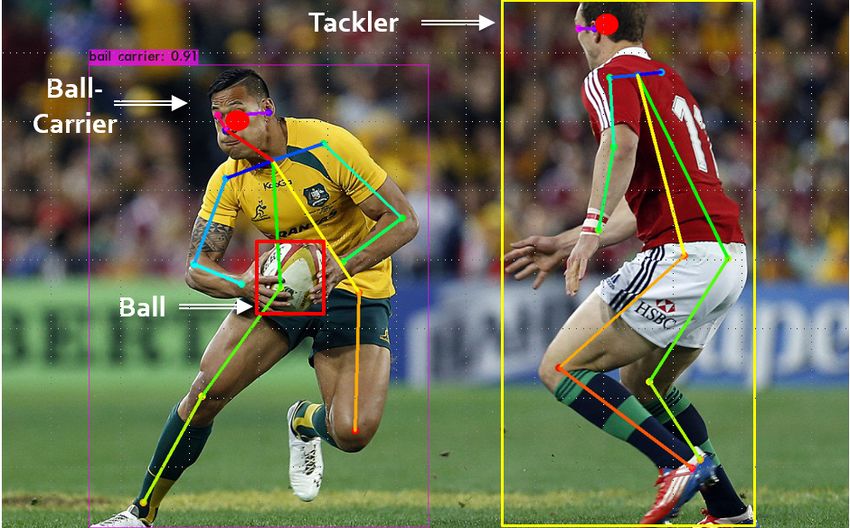
                                                                                                             Figure 1. Illustration of the tackle frame - highlighting the ball,
                                         risk in rugby union matches. First, a ball detection model is
                                                                                                             tackler and ball-carrier detection. The figure further displays the
                                         trained using the You Only Look Once (YOLO) framework,              key point estimates of both players (outline of skeleton) and esti-
                                         these detections are then tracked by a Kalman Filter (KF).          mate of the head-centre of both players (red dot).
                                         Following this, a separate YOLO model is used to detect
                                         persons/players within a tackle segment and then the ball-
                                         carrier and tackler are identified. Subsequently, we utilize        pede the attacker’s (the ball-carrier) progression towards the
                                         OpenPose to determine the pose of ball-carrier and tackle,          goal-line and regain possession of the ball [15, 22, 6]. This
                                         the relative pose of these is then used to evaluate the risk        action is called tackling and is the main form of defence
                                         of the tackle. We tested the system on a diverse collection         in tackle-collision based sports. As a result, it is the most
                                         of rugby tackles and achieved an evaluation accuracy of             frequently occurring contact event in tackle-collision based
                                         62.50%. These results will enable referees in tackle-contact        sports and associated with player and team performance
                                         based sports to make more subjective decisions, ultimately          [14, 3]. For example, in Rugby League, the tackle event
                                         making these sports safer.                                          can occur up to 700 times in an 80-minute match [17]. At
                                                                                                             the same time, the frequency of occurrence and technical-
                                                                                                             physical nature of the tackle places both the ball-carrier and
                                         1. Introduction                                                     tackler at high-risk of injury. In the Rugby Union, tackle
                                                                                                             injuries have the highest injury incidence [34] - which may
                                            The tackle is a physically and technically dynamic con-          cause the greatest number of days lost (severity) [2] and
                                         test between two opposing players for territory and ball pos-       carry a high injury burden (injury incidence rate × mean
                                         session. The tackle event is common in all tackle-contact           days absent per injury)[33].
                                         based sports, such as Rugby Union, Rugby Sevens, Rugby                  Head injuries during the tackle specifically, is a major
                                         League and American Football. During a tackle, the de-              concern for these tackle collision-based sports. The over-
                                         fending player(s), known as the tackler, attempts to im-            all incidence (injuries/1000 playing hours) of concussion in

                                                                                                         1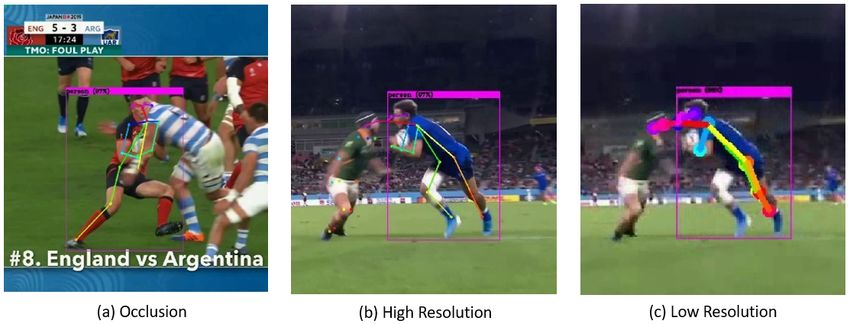
the rugby union, rugby sevens and rugby league are 4.7[10]             ing future concussive injuries [11]. Furthermore, television
, 8.3 [7] and 8.0-17.5 [9], respectively. Preventing these             match officials (TMOs) make use of video footage to assist
head injuries will require a multi-faceted approach – under-           the referee in making a fair decision [25]. Therefore, the
standing injury mechanisms and risk factors, driving player,           aim of this paper is to explore computer vision solutions to
coach, referee and stakeholder education, advancing how                address an alternative strategy of concussion prevention (us-
we train the tackle, and modifying the laws of the game. A             ing in-game live video footage). The objective is to identify
key risk factor for tackle head injuries is ball-carrier and           a high and low-risk tackle which in future may aid coaches
tackler technique (13-17) . Specifically, tacklers are not             in improved training tackle techniques and referees in gen-
moving from an upright to low body position, thereby in-               erating an objective decision.
creasing the likelihood of head to head contact [31].                      Video analysis plays a vital role in understanding injury
    Recently, to nudge tacklers to modify their tackling tech-         mechanisms and risk factors, and assisting medical proto-
nique and reduce their tackling height, World Rugby (WR),              cols (e.g., head injury assessment) [8, 12] and referee deci-
rugby union’s governing body, have implemented stricter                sion making (e.g., television match official reviewing dan-
rulings around high tackles and trialled a law change to               gerous play). However, video analysis for tackle-collision
lower the height of a legal tackle, from above the line of             based sports still remains subjective. In this paper, we
the shoulders to above the line of the armpit [23, 28]. Im-            present a method of automatic tackle risk assessment for
plementing these law change injury prevention strategies is            rugby union. This system automatically detects the ball,
highly reliant on referee decision-making, and in 2018, the            ball-carrier and tackler and uses their relative pose to pre-
second season of stricter high tackle sanctioning, WR noted            dict tackle risk as depicted in Figure 1.
intra-competition and inter-competition inconsistencies, es-
pecially when referees issued yellow and red cards. These              2. Related Works
inconsistencies exposed WR to public criticism, which can
diminish the potential effectiveness of an injury preven-                  There is seen to be a great opportunity in computer vi-
tion initiative. In response and to improve consistency and            sion applications of capturing statistical data in sports. The
fairness, WR introduced the high tackle decision making                use of capturing data at a distance - without any contact,
framework – a flow chart to assist match day officials in              allows for a non-invasive strategy whereby the actions of
sanctioning high-tackles [23]. The match day referee and               the players are not influenced [20]. With the advantage of
assistant referees can apply this decision making framework            tracking, detection and recognition - the understanding of
in real-time or when reviewing video replays (in slow mo-              injuries can be improved [20].
tion and from different angles). Referee decisions however,                A recent approach in detecting tackle risk (specifically
are influenced by a number of factors such as decision-                concussions) embeds sensors within the player kits (ac-
making time, home advantage and crowd [27]. A system                   celerometers) [21]. The main downfall of this approach is
that can objectively classify tackle head injury risk may as-          that acceleration alone does not provide enough information
sist referees with their decision-making. Spectators, players          to identify tackle risk [21]. Implementing additional sensors
and coaches can also then view the decision-making process             can become invasive to the natural behaviour of players and
of the referee.                                                        therefore would influence the collected data. Other methods
                                                                       such as marker based motion capture (Vicon) require mul-
    In the world of rugby, the final referee rulings are based         tiple marker key points which may result in high cost and
on whether a tackle was legal or illegal. From a coaching              limited to a control test environment (as shown in [29]).
technical perspective, not all high-risk tackles are illegal.              One study investigated a non-invasive method (Organic
However, they do influence the referee’s decision as they              Motion markerless motion tracking) in determining the
are dangerous and prone to injury. According to an ana-                kinematic measurements of players who are at high-risk of
lyst with expertise and experience in rugby video analysis,            concussion [21]. The experiments conducted focused on
a high-risk tackle is defined as a tackle in which the heads           testing the cognitive behaviour of four players in a given ob-
of the tackler and ball-carrier are in proximity [13]. These           stacle course [21]. Video capture of the experiments were
are identified by the ball-carrier and tackler having the same         collected using 16 stationary cameras by tracking key player
body position when contact is made (upright or low). On the            points. To our knowledge, there is currently no previous
other hand, a low-risk tackle is defined as one whereby the            study which utilized computer vision for tackle risk evalua-
body positions differ. The risk is referred to any player in-          tion (high or low-risk) from in-game (live) footage.
volved (overall) and not specific to the ball-carrier or tackler
[13].
                                                                       3. Proposed Approach
    Video footage plays an important role in the world of
rugby. Throughout the match, team doctors compile a video                 Automatic tackle risk evaluation during a rugby match
analysis of concussion incidents - with the goal of prevent-           has become a new challenge in the world of rugby. The

                                                                   2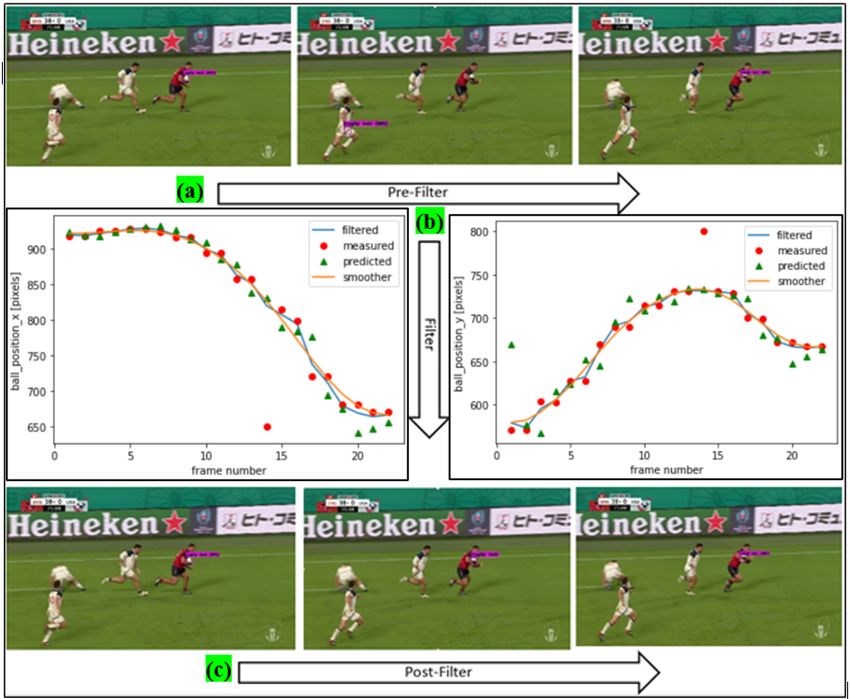
Figure 2. Illustration representing the system overview. An input tackle video is passed through two YOLO networks (ball detection and
person/player detection). The boundary box centre coordinates (x and y) are then filtered to track the ball - using a Kalman Filter (KF).
The filter and person detection outputs are then used to determine the tackle frame, ball-carrier and tackler. The tackler and ball-carrier
boundary box coordinates are then passed through the OpenPose network - producing key head points (head-centre). The head-centre of
the ball-carrier and tackler are then compared and evaluated for the tackle type (high or low-risk).

aim of this research project was to explore and implement               is described in the upcoming subsections. The project re-
a computer vision approach to aid rugby referees in mak-                ceived its data from secondary data sources as the required
ing objective decisions. Specifically, to influence their final         images and videos were pre-existing (specifically in-game
ruling by classifying a tackle as either high or low-risk us-           footage).
ing the baseline criterion as mentioned above (focusing on
head proximity). This paper is limited to focusing on the               3.1.1. Training Data
position of the player’s heads in determining the tackle risk.
                                                                            A total of 551 images were used to train the ball de-
In this study, a high-risk tackle was defined as the orienta-
                                                                        tection network. These images were collected from open-
tion whereby the head-centre of the ball-carrier aligns with
                                                                        source websites (royalty free images) such as OpenImage,
the head-centre of the tackler. Whereas a low-risk tackle is
                                                                        Adobe Stock, MS-COCO dataset, Pexels, Pixabay and Un-
defined as the orientation whereby the head-centres do not
                                                                        splash. When exploring these databases, the search was
align.
                                                                        refined using keywords: “sports”, “rugby”, and “ball”.
    The study focusses on implementing an unstudied ap-                 Specifically, any image relating to the sport of rugby was
proach by using markerless motion capture frameworks,                   selected as part of the training dataset (in-game, training, or
namely: You Only Look Once version 4 (YOLO) Object                      any frolic relating to rugby). Therefore, any image contain-
Detection and Tensorflow OpenPose (OP) – along with in-                 ing a rugby ball - restricted to only include one rugby ball
game rugby union videos. A Kalman Filter (KF) was used                  per image was included. In addition, these images were not
as an intermediate step to refine detections made by the neu-           restricted to any location, time, league, clothing type and
ral networks. The initial step was to determine the boundary            colour, or player/person. Furthermore, the images were se-
box of the ball (using a YOLO trained network) and all per-             lected using various zoom levels varying from 36 to 1023
sons/players within each frame. Using this information, the             pixels in height and 16 to 1023 pixels in width – however,
location of the ball-carrier, tackler and tackle frame could be         the entire shape of the ball was required in order to be in-
determined. Thereafter, the boundary box coordinates were               cluded in the dataset. The camera angles of these images
used in estimating the pose of the tackler and ball-carrier             were not restricted while the image quality was limited to
(using OpenPose). Finally, the pose estimates were used to              1024x518 to 1024x1007. Furthermore, the various light in-
evaluate the tackle – classifying it as either high or low-risk         tensity images were included - limited to the ability for the
tackle (within the frame at which pre-contact is made). An              user to see the rugby ball. These images along with annota-
overview of this system is shown in Figure 2 and illustrated            tions are provided as part of the paper1 .
in the supplementary video.
                                                                        3.1.2. Testing/Input Data
3.1. Data Collection
                                                                           To evaluate the reliability of the system output,
   The main source of data used to compile project models               truth/ground data was required as a baseline of comparison.
and test evaluations were qualitative. Therefore, the data              Multiple rugby union match videos (tackle segments) were
comprised of images, video segments and a classification                  1 Link to ball detection data: https://drive.google.com/
table provided by an analyst with expertise and experience              drive/folders/1GvtlN-3CBxiI4CCvQW0dtIiupx39yEg_
in rugby video analysis. A detailed description of the data             ?usp=sharing.

                                                                    3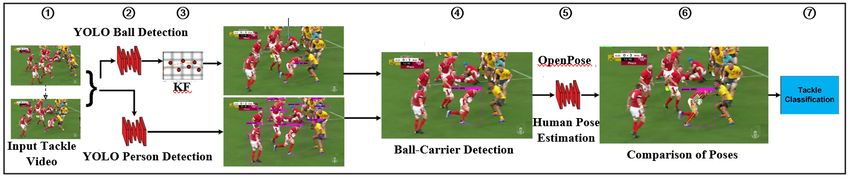
provided to test the reliability of system’s output. These              3.2.2. Trained Network
tackle segments were obtained from a registered rugby
                                                                            Images were labelled using LabelImg software by ap-
video analysis database and labelled (high or low-risk) by
                                                                        pending boundary boxes which allowed for YOLO anno-
an analyst with expertise and experience in rugby video
                                                                        tation formatting (class index; x centre; y centre; width
analysis [15]. A total of 109 tackle segments were pro-
                                                                        and height) parameters being measured in pixels. After la-
vided which can be found at link.2 These videos varied
                                                                        belling 551 images, the dataset was split 8:2 (train:test data).
in quality (pixel dimensions 854 x 480 to 1920 x 1080),
                                                                            Training parameters for ball detection (single class) were
frames per second (25 to 30), zoom, angle (similar to the
                                                                        set using the recommendations provided by [1]. Therefore,
above mentioned). The length of these tackle segments be-
                                                                        the learning rate was set to 0.001, batch size of 64, 64 subdi-
gun from the point at which ball-carrier is visible to the
                                                                        visions, network width and height to 352, iterations to 8000,
point of pre-contact. The participants in these videos were
                                                                        and filter size (preceding the “yolo” layer in the neural net-
limited to those part of the Rugby World Cup and Super
                                                                        work) was set to 18. Equations (2) and (3) represents the
Rugby teams. Furthermore, the video segments selected
                                                                        calculation used to determine the recommended (minimum)
were front-on one-on-one tackles. It should be noted that
                                                                        number of iterations and the filter size, respectively.
the camera frame follows the ball-carrier (the camera is not
stationary as it ensures that the ball-carrier is present in ev-
                                                                                       iterations = 2000 × classes                  (2)
ery frame). Tackle segments were omitted when the cam-
era zoom was far out (players’ boundary box were
When initializing the state matrix, the position states            determined. These coordinates were passed through the
were set to the centre of the image (pixels), while the ve-            Tensorflow OpenPose network where the pose estimates (x
locity and acceleration states were set to zero (both x and            and y coordinates of 18 key points) of the tackler and ball-
y). The initial values of the covariance matrix were 50 pix-           carrier were determined as shown in step 5 and 6 in Figure
els for the position states, 10 pixels/s for the velocity states       2. OpenPose provides pose estimates of a person in a given
and the acceleration state covariance was set to 1 pixels/s2           frame, highlighting key points and generating a 2D skele-
for both x and y.                                                      ton [4]. Given that high-risk tackles focus on the head loca-
    Outlier rejection was required to maintain the stability           tion and orientation of the player/s, the pose estimates cor-
of the filter. A common approach used for outlier detec-               respond x and y pixel coordinates of the left and right ear,
tion is to monitor the residual error (innovation) [30]. This          left and right eye, and nose were averaged (head-centre).
extends to evaluating whether the innovation remains within               It should be noted that OpenPose is subjected to potential
three standard deviations computed by the filter [30]. To im-          errors when generating inferences (mislabelling key head
prove the number of reliable data measurements, the bound-             points or not being able to generate a label when analysing
ary was extended to five standard deviatons. The innova-               a video). Therefore, in an attempt to reliably estimate the lo-
tion ỹ, covariance of the innovation S, and confidence score          cation of the ball-carrier’s head-centre (in the tackle frame),
of the detection are required to evaluate whether the mea-             the head-centres of the final three frames were averaged af-
sured point is an outlier. Once the confidence score was               ter being passed through a KF. The same filter parameters
less than 0.1 or/and the innovation for a measurement falls            were used as the above mentioned KF with the exception
outside five times the square root of the innovation covari-           of the measurement covariance matrix parameters (both x
ance, S, the innovation for that measurement was set to zero.          and y were set to 50 pixels), position state variance was set
Additionally, if the YOLO confidence score was less than               to 70 and evaluating the innovation within three standard
0.1, the variance values of the measurement covariance ma-             deviations as less outliers were detected.
trix R was set to the pixel dimensions and the maximum
                                                                           On the other hand, due to the limitation of not detecting
change in acceleration of both x and y would be set to
                                                                       the tackler in frames prior to the tackle frame - a filter could
50 pixels/s2 . As real time estimation was not required, a
                                                                       not be implemented. Therefore, to address the issue men-
Kalman Smoother was also implemented to further improve
                                                                       tioned above, the y-coordinate of the head-centre produced
the system results [18].
                                                                       by OpenPose was averaged with the estimated location of
                                                                       the tackler’s head-centre. The estimation takes advantage
3.4. Ball-Carrier, Tackle Frame and Tackler Detec-                     that the head to body height ratio is 1:8 (12.5% 1̃5%) [19].
      tion                                                             Therefore, the pixel position of 7.5% (assuming head-centre
    Using the filtered coordinates of the ball detection, the          is the middle of the head) of the boundary box height (from
ball-carrier was determined by selecting the closest player            the top) was used to obtain the y-coordinate head-centre es-
to the ball. This was done by calculating the euclidean dis-           timate. This parameter was then averaged with the Open-
tance from each player’s boundary box centre to ball. The              Pose head data.
analyst indicated that a tackle frame is required to evalu-                When evaluating the tackle, head-centres of the tackler
ate the risk of a tackle, this frame occurs within a seconds           and ball-carrier in the tackle frame (step 6 in Figure 2) are
before the ball-carrier and tackler makes direct contact (pre-         compared. If the head-centre (y-coordinate) of the tackler
contact). The approach used in determining the tackle frame            falls within the high-risk region (as shown in Figure 3), the
involved the use of boundary box overlap between “specta-              tackle would be classified as a high-risk tackle (otherwise
tor” players and the ball-carrier.                                     low-risk). The high risk-region is defined as boundary limit
    Therefore, a counter registered the total number of over-          with the head-centre of the ball-carrier located in the mid-
laps throughout the tackle segment and the final overlap was           dle. The head-centre of the ball-carrier was normalised to
labelled as the tackle frame. Furthermore, the tackler was             the height of the boundary box to the height of an average
identified as the player: (i) with the boundary box centre             male. To obtain the best limits, the boundary limits were
(y-coordinate) within the height range of the ball-carrier’s           adjusted relative to the ball-carrier’s head-centre (5%, 10%,
boundary box and (ii) closest to the ball-carrier in the tackle        15%, 20%, and 25%).
frame (horizontal distance between boundary box centres).
The resulting output is shown at step 4 in Figure 2.
                                                                       4. Results and Discussion
3.5. Pose Estimation And Tackle Evaluation
                                                                           This section will evaluate the output of the KF and the
   Using the boundary box coordinates of the tackler and               reliability of the system output. In addition, the system lim-
ball-carrier, the pose estimates for the two players were              itation and shortcomings will be discussed and addressed.

                                                                   5
Figure 3. Illustration of the tackle frame - highlighting the ball-
carrier and tackler. Two high risk- regions are displayed (15% and
20%) with reference to the ball-carrier’s head-centre. It should be
noted that the head-centre of the tackler falls within both 15% and
20% high- risk region - classifying the tackle as a high-risk.
4.1. Kalman Filter Output Figure 4. Tackle segment displaying three frames (16, 17 and 18)
of the YOLO ball detection network before and after applying the
4.1.1. Ball Detection KF. The YOLO ball detection network mislabels frame 17 as an
outlier whereby the KF rectifies.
Figure 4 represents the input and output of the ball detec-
tion KF. The figure displays YOLO inferences made across
three frames (16, 17 and 18) from a 24-frame tackle seg- outliers detected within a dataset when implementing the
ment. When viewing the frames of the Pre-Filter in Figure KF for the ball detection network. This convinced the al-
4a, it is observed that the YOLO network incorrectly iden- gorithm that the outlier points were part of the true dataset.
tifies the ball in the second image (frame 17). All YOLO A potential solution is to improve the ball detection training
ball detection inferences made can be viewed in Figure 4b regime. This can be done by expanding the dataset such that
and can be seen that the measured coordinate in frame 17 more samples can be used for training and testing. Addi-
is an outlier. Therefore, after filtering the coordinate in- tionally, increasing the number of iterations with augmented
ference points, it is observed that the algorithm correctly data would also improve the inferences made by the model.
reduces the error between the measured and predicted data Another challenge faced was the large magnitude of the
points. Furthermore, it is observed that the smoothing algo- change in acceleration parameters. Any large jump in the
rithm generates a refined transition dataset of the estimates measured position would cause the filter to diverge and be-
from one frame to the next (Figure 4b). Finally, Figure 4c come unstable. One approach used to overcome this limita-
displays the final filtered output, Post-Filter (omitting and tion was to adjust the change in acceleration relative to the
replacing the outlier with refined data point). confidence score produced by the YOLO network. There-
fore, should the confidence score be less than 0.1 (indicat-
4.1.2. Pose Estimation ing that the model is uncertain about detections), the change
When implementing the KF for the pose estimates of the in acceleration would be set to 50 pixels/s2 . Another ap-
head-centres, some measured coordinates were outliers (in proach is to utilise techniques from a Moving Horizon Esti-
some instances the key points of the ball-carrier was an out- mation as done in markerless 3D pose estimation [16].
lier on the tackle frame). Therefore, it was discovered that
filtering and averaging (the corresponding coordinates of 4.2. System Evaluation
the head-centres in the final three frames) key points were A total of 109 tackles were used and evaluated on the
required. The KF produced head-centre coordinates with system. These tackles were selected based on the appro-
improved accuracy in the tackle frame (corresponding to the priate zoom level, camera angle and tackle type (head-on)
ball-carrier’s head position). of the recorded tackle. Of these 109 tackles, 58 of them
ran successfully without any manual adjustments made to
4.1.3. Challenges
the system’s algorithm. Six additional tackles ran success-
Although the KFs mentioned above refined the coordi- fully after manually adjusting selected algorithm parame-
nates, many challenges and limitations reduced the robust- ters. These parameters include adjusting the ball detection
ness of the system. One key challenge was the consecutive threshold (to 0.3), tackle frame (two/three frames before
65% 10% 15% 20% 25% Ground Truth
Accuracy 39.44% 37.61% 36.70% 33.03% 30.28% High Risk Low Risk
(n=109) System High Risk [5, 8, 12, [9 ,14, 19,
Accuracy 67.19% 64.06% 62.50% 56.25% 51.56% Output 12, 14] 23, 28]
(n=64) Low Risk [12, 9, 5, [38, 33,
Recall) 29.41% 47.06% 70.59% 70.59% 82.35% 5, 3] 28, 24,
Precision 35.71% 36.36% 38.71% 34.29% 33.33% 19]
F1 Score 0.32 0.41 0.50 0.46 0.47
Table 2. CKC confusion matrix representing the classification of
the system output compared to the ground truth data (high-risk re-
Table 1. Evaluation of overall tackle accuracy, recall, precision and
gion indices of array corresponds to: [5%, 10%, 15%, 20%, 25%]).
F1 Score for high-risk regions of 5%, 10%, 15%, 20% and 25%
using the total number of tackles (109) and evaluated tackles (64).
Parameter Value Value Value Value Value
(HRR (HRR (HRR (HRR (HRR
contact), and KF parameters (standard deviation in the x 5%) 10%) 15%) 20%) 25%)
and y to 50 pixels) to obtain the correct tackler within the
P0 0.67 0.66 0.64 0.57 0.53
tackle frame. Therefore, a total of 64 tackles were success-
P HR 0.06 0.10 0.14 0.16 0.19
fully evaluated (73.4% classified as low-risk tackles by the
P LR 0.56 0.47 0.36 0.31 0.24
analyst).
Pe 0.62 0.57 0.50 0.47 0.42
The values in Table 1 represent the overall tackle accu-
CKC 0.13 0.20 0.28 0.19 0.19
racy calculated using equation (4) . The accuracy calcula-
tion was done using the total number of tackles (109) and Table 3. Table highlighting the probability parameters which are
the total number of tackles that ran successfully without any used to determine the inter-rater reliability coefficient, Cohen’s
adjustments (64). Furthermore, the accuracy calculation Kappa. All high-risk region (HRR) values are displayed (5%,
was done for multiple high-risk regions (5%, 10%, 15%, 10%, 15%, 20%, 25%).
20% and 25%) containing high and low-risk tackles.
risk, respectively - the values of recall, precision and F1
Correct Detections Score (equation (5)) are shown in Table 1.
Accuracy of T ackles =
T otal N umber of T ackles
(4) CHD
It is observed that the high-risk region of 5% produces F1 = (5)
CHD + 0.5 × (HLL + LLH)
the highest overall tackle accuracy in both total and eval-
uated tackles. A possible data influence is that 26.6% of Given that the F1 Score is determined with an equal con-
the total tackles are high-risk (17/64). Therefore, the 5% tribution in precision and recall when evaluating the sys-
region is most likely to classify a tackle as low-risk given tem’s performance – the higher the score, the better the per-
it is the smallest high-risk region compared to the 10% to formance. Therefore, it is observed from Table 1 that the
25% regions (small window for both tackler and ball-carrier high-risk region of 15% has the highest F1 Score (0.5) com-
head-centres to be located). However, it is observed that the pared to the other high-risk regions. Furthermore, represent
25% high-risk region obtains the highest high-risk accuracy the reliability of the system accurately – the Cohen’s Kappa
(82.35%) while the 5% high-risk region obtains the highest coefficient (CKC) is determined.
low-risk accuracy (80.85%). Therefore, the 15% high-risk Table 2 and 3 represents the CKC for all five high-risk re-
region represents a midway point for high-risk and low-risk gions using the 64 successfully evaluated tackle. The CKC
tackle accuracy. matrix (Table 2) compares the classification of the system
Given that the low-risk tackles greatly outnumber the output to the ground truth data. Each cell contains an ar-
number of high-risk tackles, it can be viewed as an imbal- ray of five numbers, these represent the number classifica-
anced classification problem. Therefore, the recall statistic tions made for the high-risk region of [5%, 10%, 15%, 20%,
would model the relevant cases (high-risk tackles) in the 25%]. Furthermore, Table 3 represents probability parame-
dataset. To compensate for the low precision of the recall ters (probability of agreement [P 0], probability of random
metric, the actual relevant data (influenced by the propor- agreement [P e], probability of high-risk tackles [P HR]
tion of points) should be determined (precision). Therefore, and probability low-risk tackles [P LR])used to determine
the F1 score finds the harmonic mean (optimal balance) be- the inter-rater reliability coefficient, Cohen’s Kappa for all
tween precision and recall. With CHD, HLL and LLH be- high-risk regions.
ing the correct high-risk detections, the high-risk tackles la- It is observed in both instances, the high-risk region of
belled as low-risk and the low-risk tackles labelled as high- 15% produces the highest Cohen’s Kappa coefficient indi-
75. Future Work
Occlusion is one of the biggest challenges with the pro-
posed approach. This problem is important to address as
rugby tackle footage always contain occlusions. A poten-
tial solution to this issue is to explore alternative multi-
person pose estimation frameworks (with improved detec-
tions when players overlap or come into contact). Further-
more, a new model could be trained which identifies the
Figure 5. Illustration representing various challenges experienced pose of players before and during a rugby tackle (a classi-
by the model. Occlusion (a) is observed as the ball-carrier and fier model detecting the tackle frame could also be inves-
tackler share the same skeleton generated by OpenPose. The in- tigated). Furthermore, in an attempt to improve the tackler
fluence on video quality on the inferences made is shown in (b) and detection, efforts could focus on determining which player’s
(c) - higher resolution indicates an improved key point mapping.
boundary box overlaps the most with tackler in the previous
frame (and back track the location of the tackler using the
same procedure). To improve the quality of the model, a
cating the highest level of agreement between the system larger dataset should be used - specifically increasing the
output and the ground truth data. Therefore a CKC of 0.28 number of high-risk tackles. In addition, efforts could be
indicates a fair level of reliability while the other high risk- focused on not only assisting the referee’s decision but pre-
regions indicates a non to slight level of reliability. dict the final ruling (legal or illegal) by using the entire pose
of the tackler and ball-carrier.
4.2.1. Challenges
6. Conclusion
There were many reasons for the system only being able
to evaluate 64 out of the 109 tackles. Most reasons were With the increasing frequency of concussion incidents
closely linked to the shortcomings of YOLO and OpenPose in the world of rugby, various protocols are being investi-
(inferences). One of the biggest limitations was the occlu- gated and implemented to prevent future concussions. Most
sion surrounding the ball-carrier or tackler within the tackle protocols focus on improving the orientation of the tackler
frame. This made it difficult for YOLO and OpenPose to when engaging in a tackle. This paper suggests an auto-
identify individual players and generate separate sets of key matic tackle risk classification approach using YOLO and
points (when two players overlap - OpenPose tends to gen- OpenPose. This method aims at assisting referees in mak-
erate key points for one player across two people as shown ing objective decisions of foul play. The system does this
in Figure 5a), respectively. This issue limited the frame at by estimating the pose of the tackler and ball-carrier, there-
which the tackle occurs - occlusion will occur if the play- after, evaluating the pose of their head centres. The system
ers are too close. Furthermore, the problem extends to er- will either indicate a tackle is high-risk or low-risk which
rors in identifying the tackle frame as the pose estimates is influenced by the high-risk region. When analysing the
overlap between ball-carrier and tackler before their bound- results, the 15% high-risk region was identified as the most
ary boxes overlap (suggesting that frames before the tackle reliable due to finding a midway between high-risk and low-
frame should be used). In addition, the task of correctly risk tackle accuracy, has the highest F1 Score (0.50), and the
identifying the ball and ball-carrier in every frame becomes highest CKC (0.28) – it was used as the final output to the
challenging. These challenges were addressed by using a system.
KF as mentioned above.
Many challenges became apparent from the system
Video quality stemmed as an additional obstacle for the dynamics including: presence of occlusion, low quality
YOLO and OpenPose network when generating inferences. videos, multiple outliers, and fine tuning the KF parameters
The reason for this is that the network is not familiar with to maintain its stability. Therefore, further research may
low quality images (OpenPose), making it much harder for be conducted to address the classification system shortcom-
the network to identify key points. This is seen in Figure ings. This paper serves as a proof-of-concept for the imple-
5b and 5c whereby the OpenPose network identifies more mentation of markerless motion capture techniques within
key points in the high resolution image compared to the low the field of collision-based sports. An example of this is to
resolution one. This issue can be addressed by re-training generate a neural network which directly classifies a tackle
the OpenPose network (from its latest weights) using low (high or low-risk) possibly using a recurrent neural network
quality images. [26].
8References sis consensus group. British journal of sports medicine,
54(10):566–572, 2020. 1, 4
[1] AlexeyAB. Yolo v4, v3 and v2 for windows and linux. [16] D. Joska, L. Clark, N. Muramatsu, R. Jericevich, F. Nicolls,
https://github.com/AlexeyAB/darknet, 2020. A. Mathis, M. W. Mathis, and A. Patel. Acinoset: A 3d pose
Accessed: 2021-03-11. 4 estimation dataset and baseline models for cheetahs in the
[2] J. H. Brooks, C. Fuller, S. Kemp, and D. B. Reddin. Epi- wild. arXiv preprint arXiv:2103.13282, 2021. 6
demiology of injuries in english professional rugby union:
[17] D. King, A. P. Hume, and T. Clark. Video analysis of tack-
part 1 match injuries. British journal of sports medicine,
les in professional rugby league matches by player position,
39(10):757–766, 2005. 1
tackle height and tackle location. International Journal of
[3] N. Burger, M. Lambert, and S. Hendricks. Lay of the Performance Analysis in Sport, 10(3):241–254, 2010. 1
land: narrative synthesis of tackle research in rugby union
[18] R. Labbe. Kalman and bayesian filters in python. Chap,
and rugby sevens. BMJ Open Sport & Exercise Medicine,
7:246, 2014. 4, 5
6(1):e000645, 2020. 1
[19] G. Mather. Head–body ratio as a visual cue for stature in peo-
[4] Z. Cao, G. Hidalgo, T. Simon, S.-E. Wei, and Y. Sheikh.
ple and sculptural art. Perception, 39(10):1390–1395, 2010.
Openpose: realtime multi-person 2d pose estimation using
5
part affinity fields. IEEE transactions on pattern analysis
and machine intelligence, 43(1):172–186, 2019. 5 [20] T. B. Moeslund, G. Thomas, and A. Hilton. Computer vision
in sports, volume 2. Springer, 2014. 2
[5] D. A. Forsyth and J. Ponce. Computer vision: a modern
approach. Pearson,, 2012. 4 [21] H. Nguyen, F. Ayachi, E. Goubault, C. Lavigne-Pelletier,
[6] C. W. Fuller, T. Ashton, J. H. Brooks, R. J. Cancea, J. Hall, B. J. McFadyen, and C. Duval. Longitudinal study on the
and S. P. Kemp. Injury risks associated with tackling in rugby detection and evaluation of onset mild traumatic brain injury
union. British journal of sports medicine, 44(3):159–167, during dual motor and cognitive tasks. In icSPORTS, pages
2010. 1 77–83, 2015. 2
[7] C. W. Fuller, A. Taylor, and M. Raftery. Epidemiology of [22] K. L. Quarrie and W. G. Hopkins. Tackle injuries in pro-
concussion in men’s elite rugby-7s (sevens world series) and fessional rugby union. The American journal of sports
rugby-15s (rugby world cup, junior world championship and medicine, 36(9):1705–1716, 2008. 1
rugby trophy, pacific nations cup and english premiership). [23] M. Raftery, R. Tucker, and É. C. Falvey. Getting tough on
British journal of sports medicine, 49(7):478–483, 2015. 2 concussion: how welfare-driven law change may improve
[8] G. Fuller, S. Kemp, and M. Raftery. The accuracy and repro- player safety—a rugby union experience, 2020. 2
ducibility of video assessment in the pitch-side management [24] J. Redmon, S. Divvala, R. Girshick, and A. Farhadi. You
of concussion in elite rugby. Journal of science and medicine only look once: Unified, real-time object detection. In Pro-
in sport, 20(3):246–249, 2017. 2 ceedings of the IEEE conference on computer vision and pat-
[9] A. Gardner, G. L. Iverson, C. R. Levi, P. W. Schofield, tern recognition, pages 779–788, 2016. 4
F. Kay-Lambkin, R. M. Kohler, and P. Stanwell. A system- [25] W. Rugby. Television match official (tmo) global trial proto-
atic review of concussion in rugby league. British journal of col ..., Aug 2019. 2
sports medicine, 49(8):495–498, 2015. 2 [26] M. Schuster and K. K. Paliwal. Bidirectional recurrent
[10] A. J. Gardner, G. L. Iverson, W. H. Williams, S. Baker, and neural networks. IEEE transactions on Signal Processing,
P. Stanwell. A systematic review and meta-analysis of con- 45(11):2673–2681, 1997. 8
cussion in rugby union. Sports medicine, 44(12):1717–1731, [27] J. Spitz, J. Wagemans, D. Memmert, A. M. Williams, and
2014. 2 W. F. Helsen. Video assistant referees (var): The impact of
[11] A. J. Gardner, R. Kohler, W. McDonald, G. W. Fuller, technology on decision making in association football refer-
R. Tucker, and M. Makdissi. The use of sideline video review ees. Journal of Sports Sciences, 39(2):147–153, 2021. 2
to facilitate management decisions following head trauma in [28] K. A. Stokes, D. Locke, S. Roberts, L. Henderson, R. Tucker,
super rugby. Sports medicine-open, 4(1):1–8, 2018. 2 D. Ryan, and S. Kemp. Does reducing the height of the
[12] A. J. Gardner, R. Kohler, W. McDonald, G. W. Fuller, tackle through law change in elite men’s rugby union (the
R. Tucker, and M. Makdissi. The use of sideline video review championship, england) reduce the incidence of concussion?
to facilitate management decisions following head trauma in a controlled study in 126 games. British journal of sports
super rugby. Sports medicine-open, 4(1):1–8, 2018. 2 medicine, 55(4):220–225, 2021. 2
[13] S. Hendricks, Nov 2020. 2 [29] Y. Tanabe, T. Kawasaki, H. Tanaka, K. Murakami,
[14] S. Hendricks, B. Jones, and N. Burger. Tackle injury epi- K. Nobuhara, T. Okuwaki, and K. Kaneko. The kinematics of
demiology and performance in rugby league–narrative syn- 1-on-1 rugby tackling: a study using 3-dimensional motion
thesis. South African Journal of Sports Medicine, 33(1):1–8, analysis. Journal of shoulder and elbow surgery, 28(1):149–
2021. 1 157, 2019. 2
[15] S. Hendricks, K. Till, S. Den Hollander, T. N. Savage, S. P. [30] J.-A. Ting, E. Theodorou, and S. Schaal. A kalman filter
Roberts, G. Tierney, N. Burger, H. Kerr, S. Kemp, M. Cross, for robust outlier detection. In 2007 IEEE/RSJ International
et al. Consensus on a video analysis framework of de- Conference on Intelligent Robots and Systems, pages 1514–
scriptors and definitions by the rugby union video analy- 1519. IEEE, 2007. 5
9[31] R. Tucker, M. Raftery, S. Kemp, J. Brown, G. Fuller, B. Hes-
ter, M. Cross, and K. Quarrie. Risk factors for head in-
jury events in professional rugby union: a video analysis of
464 head injury events to inform proposed injury prevention
strategies. British journal of sports medicine, 51(15):1152–
1157, 2017. 2
[32] W. Wang, N. He, K. Yao, and J. Tong. Improved kalman filter
and its application in initial alignment. Optik, 226:165747,
2021. 4
[33] S. W. West, L. Starling, S. Kemp, S. Williams, M. Cross,
A. Taylor, J. H. Brooks, and K. A. Stokes. Trends in match
injury risk in professional male rugby union: a 16-season
review of 10 851 match injuries in the english premiership
(2002–2019): the rofessional ugby njury urveillance roject.
British journal of sports medicine, 2020. 1
[34] S. Williams, G. Trewartha, S. Kemp, and K. Stokes. A meta-
analysis of injuries in senior men’s professional rugby union.
Sports medicine, 43(10):1043–1055, 2013. 1
10You can also read


