Bachelor of Science (Computing & Law) - Student Handbook BSc (C&L) - Singapore ...
←
→
Page content transcription
If your browser does not render page correctly, please read the page content below
SMU Classification: Restricted

Bachelor of Science (Computing & Law)
                   BSc (C&L)
            Student Handbook

(For students admitted in AY 2020-21 onwards)

                                                 As of 04 December, 2020
SMU Classification: Restricted
TABLE OF CONTENTS
OVERVIEW ........................................................................................................ 3
BACHELOR OF SCIENCE (COMPUTING & LAW) STRUCTURE ............................................ 4
CORE CURRICULUM ....................................................................................... 5
CAPABILITIES – 3 COURSE UNITS .................................................................................................... 6
COMMUNITIES – 2 COURSE UNITS ................................................................................................ 8
CIVILISATIONS – 2 COURSE UNITS ................................................................................................. 9
MAJOR REQUIREMENTS .............................................................................. 10
FREE ELECTIVES – 3 COURSE UNITS ....................................................... 11
ADDITIONAL GRADUATION REQUIREMENTS ..................................... 11
SINGAPORE STUDIES ................................................................................................................................ 11
ASIA STUDIES ............................................................................................................................................ 12
GLOBAL EXPOSURE.................................................................................................................................. 12
SECOND MAJOR ............................................................................................ 13
REGISTRATION OF COURSES.................................................................... 14
EXCHANGE PROGRAMMES ........................................................................ 14
PROCEDURES FOR SELF-ARRANGED EXTERNAL STUDY PROGRAMMES ........................................... 14
TRANSFER OF PROGRAMME ...................................................................... 15
ONLINE ACCESS TO STUDENT INFORMATION SYSTEM (OASIS)... 15
ACCESSIBILITY AND ACCOMMODATIONS ........................................... 16
ACADEMIC INTEGRITY................................................................................ 16
FREQUENTLY ASKED QUESTIONS .......................................................... 16
CONTACT US ................................................................................................. 17
Page 2 of
Office of the DeanSMU Classification: Restricted
OVERVIEW
SMU’s holistic undergraduate programme is designed to help students develop into broadly educated
individuals, with depth of knowledge in selected domains, and workplace capabilities required to
thrive in the 21st century.
Through our undergraduate curriculum and student life experience, SMU is committed to nurturing
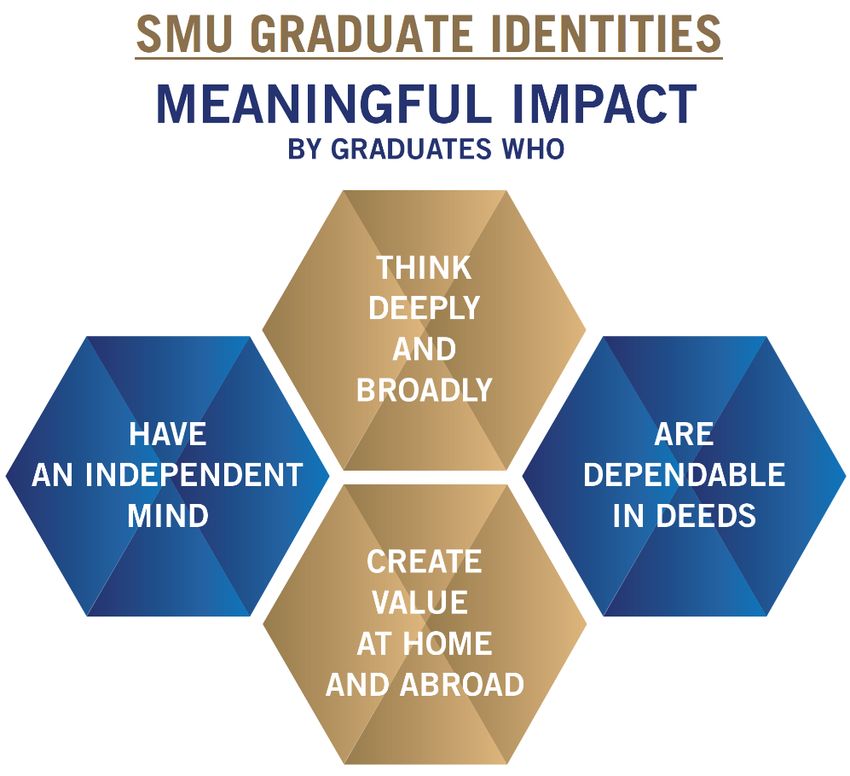
graduates distinguish themselves with the SMU Graduate Identities:
1. Independence in mind (encompasses problem solving, entrepreneurial thinking and critical
thinking) vs Dependability in deeds (includes collaboration and communication);
2. Thinking vs Action – able to delve deeply into issues across disciplines, and deliver meaningful
impact locally and globally.
Page 3 of
Office of the DeanSMU Classification: Restricted
BACHELOR OF SCIENCE (COMPUTING & LAW) STRUCTURE
The Bachelor of Science (Computing & Law) programme comprises three key sections: (1) the
University Core, which helps students cultivate a stable intellectual core, cutting across disciplines; (2)
the Computing & Law Major Requirements, which help students develop depth in their chosen
discipline of study; and (3) the Free Electives, which afford students choice for flexible self-directed
learning, towards greater disciplinary depth or multidisciplinary breadth.
Satisfactory completion of the degree requirements will lead to the award of BSc (C&L) degree.
Course Units Period of Study
(CUs)
University Core
Capabilities 3 Year 1 to 4
Communities 2 Year 1 to 4
Civilisations 2 Year 1 to 3
Major Requirements Period of Study
Major Core 18 Year 1 to 4
Major Electives 8 Year 2 to 4
Free Electives Period of Study
Any SMU course 3 Year 3 to 4
Graduation Requirements Period of Study
Singapore Studies - Year 1 to 4
Asia Studies - Year 1 to 4
Global Exposure - Year 3 to 4
Total Required 36
Page 4 of
Office of the DeanSMU Classification: Restricted
CORE CURRICULUM
Students who complete the courses under the three pillars of SMU’s Core Curriculum—Capabilities,
Communities, Civilisations—will become competent, adaptable, and responsible decision-makers who
can apply themselves to anything, anywhere, for the good of all.
Disciplinary knowledge: By the end of the program, students will be able to demonstrate
fundamental disciplinary competencies that they can flexibly deploy across domains,
contexts, and spaces.
Multidisciplinary knowledge, Inter-cultural understanding and sensitivity: Exercise an
integrative intelligence to traverse and to reconcile disciplinary, perspectival, and socio-
cultural differences with agility and sensitivity.
Critical Thinking and Problem Solving: Master and apply a range of techniques of inquiry and
analysis to diagnose and solve problems across domains, contexts, and spaces.
Ethics and Social Responsibility, and Global Citizenship: Identify normative and ethical
considerations that apply to the activities of the workplace and society, and articulate a
personal conception of global citizenship that recognizes the cultural and perspectival
diversity in the world.
Page 5 of
Office of the DeanSMU Classification: Restricted
The Core Curriculum serves as a means for students across all disciplines to bond through a common
intellectual experience. It stands on three pillars of learning, or inter-related paths of development:
Capabilities, Communities and Civilisations, based on a menu of twelve carefully selected course units
(CUs), to initiate undergraduates into their journey to become fully realised SMU graduates. It forms
the root intellectual experience that every undergraduate will undergo at SMU, providing a broad-
based education that develops students’ wide knowledge of the world, interdisciplinary and
contextual perspectives, understanding of self and society, and capability in key 21st-century skills.
CAPABILITIES – 3 COURSE UNITS
The first pillar, Capabilities, is about imparting to students the 21st century skills necessary to
dexterously operate in an increasingly digitised and data-driven working environment. These skills will
be imparted in courses from five baskets. BSc (C&L) students will be required to complete only the
Modes of Thinking, Numeracy and Internship requirements from this pillar. You may pursue more
courses from the pillar using Free Electives.
Basket Course Units (CUs) Course Listing
Managing - Courses include:
Accounting for Entrepreneurs
Business, Government and Society
Capital Markets in China
Spreadsheet Modelling and Analytics
Leadership and Team Building
Management Communication
Modes of Thinking 1 Computational Thinking#
Numeracy ^ 1 Calculus#
Writing and Reasoning -
Internship 1
# Compulsory for C&L Students
Students may be given exemptions for some courses on the basis of good pre-university grades for
GCE A-level, Polytechnic Diploma, or other recognised qualifications. Please refer to OASIS > Academic
Policies > Exemption Policy for more information on SMU’s exemption policy.
Core curriculum courses are not to be double counted towards any other requirements. In cases
where a core curriculum course overlaps with another requirement, students will need to take an
additional course to fulfil both requirements.
The courses listed here may not be exhaustive. Please refer to the course catalogue for updated
course offerings each term. BSc (C&L) students are not required to complete courses from the
Managing and Writing and Reasoning baskets, although you may still take courses from these baskets
using Free Electives.
Page 6 of
Office of the DeanSMU Classification: Restricted
^ Numeracy
Students taking either of the Political Science, Psychology, or Sociology majors are required to
complete Calculus to fulfil the Numeracy basket.
Students taking the Politics, Law and Economics major are required to complete Introductory Statistics
to fulfil the Numeracy basket. In addition, students on the Politics, Law and Economics major who
have not met the criteria for exemption in Calculus based on their pre-university grades will also be
required to complete Calculus, i.e. complete both Introductory Statistics and Calculus. Students who
are required to complete both Introductory Statistics and Calculus will have one fewer Free Elective,
i.e. 6 instead of 7.
All students who have been granted provisional enrolment into BSc(Econ) secondary degree will have
to take Introduction to Statistical Theory instead of Introductory Statistics.
Students taking the Computer Science and Computing & Law degree are required to complete Calculus
to fulfil the Numeracy basket. Students taking Information Systems Major or Smart-City Management
and Technology Major are required to complete Introductory Statistics to fulfil the Numeracy basket.
INTERNSHIP
Internship is a mandatory degree requirement for all undergraduates and carries 1 CU, except for
students in the LLB programme.
For undergraduates enrolled from AY2019 onwards, the prerequisites for embarking on their first
recognised internship include the completion of the following online learning units on eLearn:
Reflective Practice Unit (RPU), which must be completed before progressing to the following:
Five Internship Readiness Modules
o Self-Discovery and Basic Career Planning (IRM101)
o Creating and Managing your Professional Digital Footprints (IRM102)
o Resume and Cover Letter Writing (IRM103)
o Job Search Strategies (IRM104)
o Interviewing Skills (IRM105)
e-Internship Quiz after reading the e-Internship Guide
SIS students will need to undertake a minimum 10-week continuous (full time) internship related to
their course of study. They also have to complete at least one academic year of coursework before
embarking on internships, although it is advisable that students embark on their first internship after
completion of Year 2 when they are more likely to have met their Career Coach at least once and have
given sufficient thought to their majors and career choices for their future.
SIS students can only embark on term-time internships requiring Leave of Absence after 4 academic
terms of study.
To earn the 1 CU credit, students are required to complete pre-, mid- and post-activity reflections on
their selected learning objectives for all internships that contribute to the degree requirement of total
10 weeks.
For more information on Internships, please refer to OASIS> Careers & Comm Service > Internship.
Page 7 of
Office of the DeanSMU Classification: Restricted
COMMUNITIES – 2 COURSE UNITS
The Communities pillar aims to help students understand the economic, technological, and cultural
systems that structure our interactions with our communities. It comprises four baskets. BSc (CS)
students will be required to complete 2 CU from this pillar as illustrated below. You may pursue more
courses from the pillar using Free Electives.
Basket Course Units (CUs) Course Listing
Economics and Society - Economics and Society
Technology and Society Choose one from:
Climate Change: Global and Local
Solutions
Climate, History and Society
Digital Cultures
Science and Technology Studies: Where
Science Meets Society
Science, Environment and Empire
Technological Solutions to Urban
Challenges
Can Machines Think? AI in History,
Philosophy, and Fiction
Technological Innovations Enhancing
Urban Sustainability
Technology and World Change
Innovations for Asia’s Smart Cities
Cultures of the Modern 1 Choose one from:
World Cultural History of the Cold War in Asia
Singapore: Imagining the Next 50 Years
Film in Southeast Asia
Urban Cultures
Foreign Languages, e.g. Bahasa Melayu,
French, Italian, Japanese, Korean,
Mandarin, Spanish, Thai
Understanding China’s Economics
Miracles
Politics of Southeast Asia
Contemporary South Asian Societies
Global and Transnational Sociology
Jurisprudence: Modern and Critical
Theories of Law
Constitutions, Cultures, and Context
Community Service 1
Page 8 of
Office of the DeanSMU Classification: Restricted
Core curriculum courses are not to be double counted towards any other requirements. In cases
where a core curriculum course overlaps with another requirement, students will need to take an
additional course to fulfil both requirements.
The courses listed here may not be exhaustive. Please refer to the course catalogue for updated
course offerings each term. BSc (C&L) students may take additional courses from this using Free
Electives.
COMMUNITY SERVICE
Community Service is a mandatory degree requirement for all undergraduates and carries 1 CU,
except for students in the LLB programme.
For undergraduates enrolled from AY2019 onwards, the prerequisites for embarking on your
community service include the completion of the following online learning units on eLearn:
Reflective Practice Unit (RPU), which must be completed before progressing to the following:
Three Community Service Units (CSUs)
o Self & Community Engagement (CSU101)
o Service-Learning (CSU102)
o Needs Analysis & Asset Mapping (CSU103)
e-Guidebook and a Final Community Service Quiz
The prerequisites listed above, when duly completed, will allow you to view and apply/self-propose
community service projects on OnTRAC II.
To earn the 1 CU credit, students are required to complete pre-, mid- and post-activity reflections on
their selected learning objectives for all Community Service Projects (CSPs) that contribute to the
degree requirement of total 80 hours of CSP.
For more information on Community Service, please refer to OASIS > Careers & Comm Service >
Community Service.
CIVILISATIONS – 2 COURSE UNITS
The third pillar of the University Core, Civilisations, aims to immerse students in fundamental and
perennial debates that cut across time and space, to a critical dialogue between multiple and
competing traditions of thought and problem-solving. The pillar has three requirements:
Requirement Course Units (CUs)
Ethics and Social Responsibility 1
Big Questions 1
Global Exposure -
(refer to Additional Graduation
Requirement for details)
Page 9 of
Office of the DeanSMU Classification: Restricted
For further queries on core curriculum matters, please contact the OCC at
corecurriculum@smu.edu.sg.
MAJOR REQUIREMENTS
The BSc (Computing & Law) degree equips you with skillsets in IT and business innovation, operating
IT and business innovations within a legal framework, and employing IT in legal practice. Beyond a
solid foundation in Computing and Law, you will specialise in advanced technology tracks to become
future-ready for Business and Public Sectors, Consulting and Finance Sectors, as well as the Legal
Sector.
COMPUTING & LAW MAJOR CORE – 18 COURSE UNITS
Requirement Course Units (CUs)
Computing Core: 8
Introduction to Programming
Information Systems & Innovation
Data Management
Statistical Thinking for Data Science
Business Process Analysis & Solutioning
Digital Business Technology & Transformation
Interaction Design and Prototyping
Software Product Management
Law Core: 9
Contract Law I
Contract Law II
The Singapore Legal System and Legal Analysis Skills
Criminal Law (1.5 CU)
Law of Torts (1.5 CU)
Intellectual Property Law
Company Law
Privacy & Data Protection Law
Computing & Law Project Experience 1
COMPUTING & LAW MAJOR ELECTIVES – 8 COURSE UNITS
The list of courses is not exhaustive and subject to change. Students should use the “Class Search”
option in BOSS to browse the full list of courses offered.
Page 10 of
Office of the DeanSMU Classification: Restricted
Students are required to complete 8 CUs from the following:
Basket Course Units (CUs) Course Listing
Computing Electives 6 Choose from the list of IS and CS courses
that will count towards Computing
Elective.
Law Electives 2 Choose from the list of Law courses that
will count towards Law Elective.
FREE ELECTIVES – 3 COURSE UNITS
The Free Electives component in the curriculum allows students to choose courses from their major
to deepen their disciplinary domain knowledge, or courses from other majors and schools to broaden
their knowledge across disciplines. Students may take any SMU course to fulfil the Free Electives
component. These courses may be double-counted towards a second major or a second degree.
Students may be given exemptions for up to 3 Free Electives CUs on the basis of good pre-university
grades for GCE A-level, Polytechnic Diploma, or other recognised qualifications. Please refer to OASIS >
Academic Policies > Exemption Policy for more information on SMU’s exemption policy.
ADDITIONAL GRADUATION REQUIREMENTS
In addition to the afore-mentioned credit-bearing requirements, students must fulfil a Singapore
Studies requirement and an Asia Studies requirement, as well as undertake a Global Exposure
experience, prior to graduation. These requirements may be fulfilled through a range of pre-identified
courses and activities either in the Core Curriculum, in the disciplinary curriculum, or co-curricular
activities. Some of the qualifying courses and activities are listed below for reference. Multiple-
counting for these graduation requirements is allowed: students will be allowed to use the same
course or activity—where suitable—to fulfil the Singapore studies, Asia studies, and/or Global
Exposure requirements.
Singapore Studies
It is imperative that SMU students understands deeply the complexities and intricacies of living and
working in Singapore, as well as considers how they may bring meaningful impact to the growth and
development of Singapore. Students may fulfil the Singapore Studies graduation requirement by
completing any of the following courses:
Singapore – Imagining the next 50 years
Urban Cultures
Science, Environment and Empire
Climate Change: Global and Local Solutions
Taxation
The Singapore Legal System
Finding Home in Globalised World
And many more…
Page 11 of
Office of the DeanSMU Classification: Restricted
The courses listed here may not be exhaustive. Please refer to the course catalogue for updated
course offerings each term.
Asia Studies
In addition to achieving a deeper comprehension of Singapore, SMU believes our students should
acquire knowledge of Singapore’s continental context, in particular the complex and dynamic societies
in Southeast Asia, and nearby China and India. Students may fulfil the Asia Studies graduation
requirement by completing any of the following courses:
Capital Markets in China
Chinese Contract Law
Chinese Corporate and Securities Law: A Comparative Perspective
Contemporary South Asian Societies
Cultural History of the Cold War in Asia
Economic Development in Asia
Exploring Asian Identities*
Managing Diversity in Asia*
Understanding China’s Economic Miracles
Selected overseas study mission (Asia)
And many more…
The courses listed here may not be exhaustive. Please refer to the course catalogue for updated
course offerings each term.
Global Exposure
Global traction and understanding underpins success in careers in today’s globally connected
environment. To have global exposure from the vantage of a university education is invaluable for
international networking and global vision; it also open doors to bigger opportunities. Therefore, SMU
has made it mandatory for all students to complete a Global Exposure experience prior to their
graduation. Students may fulfil the Global Exposure requirement by participating in any of the
following SMU-organised overseas activities:
Global Exposure Activity Qualifying duration
International Exchange Programme As per programme requirement
Summer Exchange Programme As per programme requirement
Short-Term Study Programme As per programme requirement
Community Service 5 days of activity or longer
Study Mission 5 days of activity or longer
Co-Curricular Activities 5 days of activity or longer
Page 12 of
Office of the DeanSMU Classification: Restricted
Global Exposure Activity Qualifying duration
Internship 5 days of activity or longer
Global Innovation Immersion Programme 5 days of activity or longer
SMU-X Overseas 5 days of activity or longer
Cultural, Technological or Socio-Economical Immersion 5 days of activity or longer
Programme
To make sure no student misses out on this precious global experience, the University is committed
to giving global exposure participation an extra push by enhancing support and by providing more
(and new) opportunities for students.
For more information on the Global Exposure graduation requirement, please refer to OASIS >
Academic Policies > Global Exposure.
SECOND MAJOR
All SMU students enrolled in a single degree programme may opt to undertake a second major offered
by the School of Information Systems (SIS), or by other schools. The second majors offered by SIS
include:
Computing Studies (Artificial Intelligence)*
Computing Studies (Cybersecurity)*
Computing Studies (Cyber-Physical Systems)*
IT Solution Management
Technology for Business Solutions (Artificial Intelligence)**
Technology for Business Solutions (Digitalisation & Cloud Solutions)**
Technology for Business Solutions (Financial Technology)**
Technology for Business***
*Not applicable to Computer Science students
**Not applicable to IS Major students
***For non-SIS students only
All students MUST declare their first and second (if any) major within their first 4 regular terms of
study (inclusive of any terms with a leave of absence and/or international exchange) via OASIS >
Academic > Programmes & Majors > Declare Major.
For details on the requirements for the various second major options, please refer to OASIS >
Academic > Advisement & Curriculum > Second Major Requirements.
Page 13 of
Office of the DeanSMU Classification: Restricted
REGISTRATION OF COURSES
We encourage you to read and be familiar with SMU’s Bidding Online System (BOSS). Please refer to
OASIS > BOSS > Course Enrolment & Drop.
Note: Courses may have pre-requisites/co-requisites. Please refer to the Course Catalogue on OASIS
for the most updated list of pre-requisites/co-requisites for a particular course.
EXCHANGE PROGRAMMES
Students may be granted approval to transfer credits from approved institutions for courses taken
outside SMU after matriculation. Such approvals must be obtained before students embark on these
programmes:
International Exchange Programmes (via SMU International Office)
Local Exchange Programmes (via Registrar’s Office)
Summer Study Programmes (via SMU International Office)
External Study Programmes (self-arranged by students)
Students are not allowed to go on external study programmes with SMU partner universities during
regular term. Students may choose to do external study programmes at high-ranking and good
standing non-partner universities during regular term.
Students who are going on external study programme especially in Term 3B must ensure that they are
able to complete the external study programme and return to SMU for their studies at least 1 week
before the start of the next term.
Procedures for Self-Arranged External Study Programmes
You may submit your application via OASIS > Campus Life & Exchange > Other Study Programmes>
Self-arranged External Study Programme for School’s approval. If a university is not on the selection
list, you can then write to sis_ugrad@smu.edu.sg for approval. Generally, you are encouraged to take
up the overseas exchange programmes co-ordinated by the SMU International Office.
Note: A student is allowed to submit only one self-arranged external study application per regular
term/summer term.
Once the application has been approved:
If your external study is during regular term, you need to apply for LOA under the reason for other
external study” before the start of the term. The Letter of Acceptance must be attached in your
LOA application as a supporting document. Any delay in the submission of the LOA application will
result in School fees penalty.
You need to submit the online worksheet for the courses you plan to take. The course duration
must be indicated on the worksheet. We will not be able to process the worksheets without course
syllabus.
Page 14 of
Office of the DeanSMU Classification: Restricted
The onus is on you to ensure that the SMU credits are keyed in accurately on the worksheet. If
there are any discrepancies found, you will not be able to transfer the full credit back to SMU.
Please note that the school does not accept Certificate of Attendance as documentary proof for
any credit transfer.
School to evaluate / approve worksheet course areas.
You must ensure that the worksheets have been approved before embarking on the external
study.
You are required to submit the offer letter of acceptance and provide your flight details such as
departure date, emergency contact* to sis_ugrad@smu.edu.sg once you have confirmed your
exchange programme.
It is required for all students to remain contactable during their exchange programmes. You are
advised to obtain a local contact number from the country of your exchange programme. Please
provide us the local contact number within one week after your arrival.
After you have successfully enrolled in the courses, you need to login to OASIS to confirm these
courses for credit transfer.
After your exchange program, please submit the original official transcript to SIS Dean’s Office, Level
5.
You must be familiar with the credit transfer policy before applying for external study. Please refer to
OASIS > Academic > Advisement & Curriculum > Credit Transfer Policy.
TRANSFER OF PROGRAMME
SMU students are allowed to transfer to another programme of study within SMU, subject to approval
of the Deans of both the current and new programmes. Students may apply for a programme transfer
only at the end of Year 1 or Year 2 (after release of examination results) before the start of the first
term of the next academic year.
Please refer to OASIS > Calendar > Critical Dates for the application period. For information on the
criteria for applying for a programme transfer, please refer to OASIS > Academic > Programme &
Majors > Programme Transfer Policy.
Note: Being eligible to apply does not mean that your application will be approved.
Online Access to Student Information System (OASIS)
Online Access to Student Information System (OASIS) is the student portal that hosts various self-
service functions under different categories such as Study, Personal & Finances, Resources, Career &
Jobs, Student Life and Schools & Community. It is a one-stop self-service centre for all things related
to your student life in SMU. For more information on SMU Undergraduate Regulations and Procedures,
please refer to OASIS > Policies & Self Service.
Page 15 of
Office of the DeanSMU Classification: Restricted
ACCESSIBILITY AND ACCOMMODATIONS
SMU strives to make learning experiences accessible for all. If you anticipate or experience physical or
academic barriers due to disability, please inform SIS Dean’s Office immediately. You are also welcome
to contact the SMU Diversity & Inclusion team (included@smu.edu.sg) if you have questions or
concerns about academic provisions.
ACADEMIC INTEGRITY
All acts of academic dishonesty (including, but not limited to, plagiarism, cheating, fabrication,
facilitation of acts of academic dishonesty by others, unauthorized possession of exam questions, or
tampering with the academic work of other students) are serious offences.
All work (whether oral or written) submitted for purposes of assessment must be the student’s own
work. Penalties for violation of the policy range from zero marks for the component assessment to
expulsion, depending on the nature of the offense.
When in doubt, students should consult the instructors of the course. Details on the SMU Code of
Academic Integrity may be accessed at http://www.smuscd.org/resources.html
FREQUENTLY ASKED QUESTIONS
1. What requirements do I need to fulfil to be eligible for a BSc (C&L) degree?
To be eligible for a BSc (C&L) degree, a student must satisfactorily complete all requirements of the
programme, including the compulsory internship, community service requirements and other
required non-coursework requirements.
Students pursuing the C&L degree must attain at least 36 credited CUs, including exemptions/credit
transfers.
For those who are pursuing C&L degree with a second major, the CUs required will depend on your
declared major (please refer to OASIS > Study > Advisement & Curriculum for details). Double counting
of courses between your C&L degree and second major is allowed, provided the courses are listed in
both areas.
Students must attain a cumulative GPA of at least 2.00 and obtain the minimum credits required for
their declared degree (degree with no/single/double major).
Note:
You must obtain a passing grade of "D" or better to receive credit in any course. An "F" grade in a
course will remain on your transcript permanently and will be factored in when calculating your GPA.
If you retake the course at a future time, both the old and new grades will be appear on transcript.
The new grade will count toward your GPA and you will receive credit for the repeated course. If you
receive an "F" grade in a required course, you must retake that course. If you receive an "F" grade in
a non-required course, you may either repeat the course or substitute it with another.
Page 16 of
Office of the DeanSMU Classification: Restricted
2. Can I still take a course when I have yet to complete its pre-requisite?
If a course is a pre-requisite for another course, the courses cannot be taken together. No special
arrangements will be made.
3. How can I know the attributes of a course?
Please refer to the BOSS User Guide on OASIS. OASIS > Self Service Apps > My Apps > BOSS Bidding >
Plan & Bid > Add to Cart
4. How can I check if I have fulfilled my course requirements?
We encourage all students to go to OASIS to generate their own academic advisement reports. The
report will indicate how many outstanding courses there are and which areas these courses fall under.
OASIS > Academic > Advisement & Curriculum > My Degree Progression > Supporting Functions>
Degree Progression Report
If the advisement report does not tally with your own records, then attach the degree progress report
from OASIS and indicate specifically which area of the report that you have queries with. Send your
queries to sis_ugrad@smu.edu.sg
5. How can I request a letter of certification that I am studying in SMU?
Please go to OASIS > Finance & Admin > Certification & Personal Info > Enrolment letter & Academic
Summary (Select the appropriate letter type).
6. How can I make changes to my personal details?
Please go to OASIS > Finance & Admin > Certification & Personal Info > Update Personal Info &
Citizenship.
7. How can I apply for a Leave of Absence to undertake an Internship?
Please go to OASIS > Finance & Admin > Absence & Withdrawal > Apply for Leave of Absence.
You are required to attach supporting documents such as Internship Offer Letter and email your email
confirmation from the Dato’ Kho Hui Meng Career Centre.
Do note that approval is given on a case-by-case basis.
CONTACT US
SIS Undergraduate Enquiries
Email: sis_ugrad@smu.edu.sg
Page 17 of
Office of the DeanYou can also read


