Bachelor of Social Work (Honours) - PROGRAMME HANDBOOK 2021 - The University of Auckland
←
→
Page content transcription
If your browser does not render page correctly, please read the page content below
PROGRAMME HANDBOOK 2021

      School of Counselling, Human Services and Social Work
      Te Kura Tauwhiro Tangata

      Bachelor of Social Work
      (Honours)

     EPSOM CAMPUS
     Private Bag 92601
     Symonds Street Auckland 1150, NZ
     Gate 3, 74 Epsom Ave,
     Epsom Auckland

The University of Auckland
Faculty of Education and Social Work
www.education.auckland.ac.nz
0800 61 62 63
Faculty of Education and Social Work Academic Roles

 Dean of Education and Social Work                      Associate Professor Mark Barrow

 Te Tumu                                                Associate Professor Te Kawehau Hoskins

 Head of Initial Teacher Education                      Associate Professor Fiona Ell

 Associate Dean, Academic                               Dr Barbara Staniforth

 Associate Dean, Academic Transition                    Dr Camilla Highfield

 Associate Dean, International (Strategic Engagement)   Associate Professor Marek Tesar

 Associate Dean, Pasifika                               Jacoba Matapo

 Associate Dean, Postgraduate                           Professor Gavin Brown

 Associate Dean, Research                               Professor Carol Mutch

 Associate Dean, Teaching and Learning                  Gail Ledger

 School                                                 Head of School
 Counselling, Human Services and Social Work            Associate Professor Allen Bartley

 Critical Studies in Education                          Professor John Morgan

 Curriculum and Pedagogy                                Associate Professor Katie Fitzpatrick

 Learning, Development and Professional Practice        Associate Professor Richard Hamilton
                                                        (to 31 August 2021)

 Te Puna Wānanga                                        Dr Helene Connor

Page 2
Contents
Faculty of Education and Social Work Academic Roles.................................................................. 2
Contents ...................................................................................................................................... 3
Programme Contacts ................................................................................................................... 5
Key Dates for 2021 ...................................................................................................................... 6
Introduction to programme ......................................................................................................... 7
Project ......................................................................................................................................................7
Programme pathway and structure .............................................................................................. 8
Bachelor of Social Work (Honours) year ........................................................................................................8
Regulations for the Degree of Bachelor of Social Work (Honours) ................................................ 9
Graduate Profile for the Bachelor of Social Work (Honours) ........................................................11
DELNA (Diagnostic English Language Needs Assessment) ..........................................................12
Timeframe............................................................................................................................................... 12
More information about the DELNA process ................................................................................................. 12
Applied Professional Practice: Guidelines....................................................................................13
Supervised field practice: Guidelines ........................................................................................................... 13
Honours year field placement (2021) .......................................................................................................... 13
General requirements (duration, hours, etc) ................................................................................................ 13
Part time students: Supervised field practice ............................................................................................... 14
External Standards .....................................................................................................................14
Assignment Process ...................................................................................................................15
Assignment Submission ............................................................................................................................ 15
Extensions............................................................................................................................................... 15
Penalties for Late work.............................................................................................................................. 16
Return of Marked Assignments ................................................................................................................... 16
Special Consideration (Unavoidable Personal Circumstances) ......................................................................... 16
Resubmission........................................................................................................................................... 16
Assessment and Grading Scale................................................................................................................... 17
Support Systems for Students ....................................................................................................18
Te Tumu Herenga | Libraries & Learning Services : Essentials for using the Sylvia Ashton-Warner
Library .......................................................................................................................................19
Library hours – Epsom Campus .................................................................................................................. 19
Short Term Loan ...................................................................................................................................... 19
Study Space ............................................................................................................................................ 19
Computers .............................................................................................................................................. 20
Workshops .............................................................................................................................................. 20
General University information and policies ................................................................................21
Academic English Language Requirement .................................................................................................... 21
Academic Misconduct ................................................................................................................................ 21
Academic Standing (Unsatisfactory progress) .............................................................................................. 22
Aegrotat and Compassionate Consideration ................................................................................................. 22
Appeal of Course Marks or Grades .............................................................................................................. 22
AskAuckland ............................................................................................................................................ 22
Availability of Examination Scripts .............................................................................................................. 22
Change of Name ...................................................................................................................................... 22
Children’s Act 2014 .................................................................................................................................. 22
Conceded passes...................................................................................................................................... 23
Course Deletions and Withdrawals .............................................................................................................. 23
Deferring from a programme ..................................................................................................................... 23
Digital Resources ..................................................................................................................................... 23
Enrolments .............................................................................................................................................. 23
Examinations ........................................................................................................................................... 23
Fees ....................................................................................................................................................... 23
Forms, Policies and Guidelines ................................................................................................................... 23
General Education .................................................................................................................................... 24
Group assessment .................................................................................................................................... 24
Graduation .............................................................................................................................................. 24
Inclusive Learning .................................................................................................................................... 24
Learning Resources .................................................................................................................................. 24
Lecture Capture at the University of Auckland .............................................................................................. 24
MyAucklandUni ........................................................................................................................................ 24
Partial Resits ........................................................................................................................................... 24
Page 3Personal support ...................................................................................................................................... 24 Resignation from a programme .................................................................................................................. 25 Request an official transcript...................................................................................................................... 25 Resolution of Student Academic Complaints and Disputes ............................................................................. 25 Student Charter and Responsibilities ........................................................................................................... 26 Student email .......................................................................................................................................... 26 Storage and Disposal of Student Work ........................................................................................................ 26 Student Services Online (SSO) ................................................................................................................... 26 Submission in Māori.................................................................................................................................. 26 Texts and resources ................................................................................................................................. 27 Third party assistance ............................................................................................................................... 27 Transfers between University of Auckland, Faculty of Education and Social Work Programmes ........................... 27 Transfer to other Colleges / Faculties of Education........................................................................................ 27 Updating addresses and personal details ..................................................................................................... 27 University Proctor ..................................................................................................................................... 27 Professional Requirements and Conduct .....................................................................................28 Attendance .............................................................................................................................................. 28 Cheating and Plagiarism ............................................................................................................................ 28 Referencing ............................................................................................................................................. 29 Professionalism and the use of social media ................................................................................................. 29 Jury Service............................................................................................................................................. 29 Social Worker Registration .........................................................................................................29 Student Feedback (University of Auckland, 2018) .......................................................................30 Do students have to give feedback? ............................................................................................................ 30 Make sure your feedback is constructive and effective .................................................................................. 30 Types of feedback .................................................................................................................................... 30 SET ........................................................................................................................................................ 30 Learning and Teaching Survey ................................................................................................................... 30 Student representatives ............................................................................................................................ 30 What happens to your feedback? ................................................................................................................ 31 Courses with low ratings ........................................................................................................................... 31 Page 4
Programme Contacts

 Program Director of BSW & BSW (Hons) (Qualifying
 Programmes)                                                              Extn: 48989      Office: N408
 Shirley Ikkala                                                           Email: shirley.ikkala@auckland.ac.nz

 School’s Administration Office                                           Extn: 48767     Office: N302
 Amanda Moller                                                            Email: a.moller@auckland.ac.nz
 Group Services Coordinator CHSSWK & CRSTIE                               Phone 09 373 7999 ext 48767
                                                                          Fax: 09 623 8903

 Head of School
 Associate Professor Allen Bartley                                        Extn: 48140     Office: N312D
 School of Counselling, Human Services and Social Work (CHSSWK)           Email: a.bartley@auckland.ac.nz

Website www.education.auckland.ac.nz

                                               E nga iwi o te motu,
                                                 tena koutou E rau
                                                rangatira ma, tena
                                                      koutou
                                    E nga kaumatua, nga koroua, nga whaea,
                                     tena koutou E nga tamariki, mokopuna,
                                                    tena koutou
                                     E nga tangata o nga tau e wha o te Ao,
                                  tena koutou, tena koutou, tena koutou katoa.

                                                     Piki mai,
                                                     Kake mai.
                                                     Nau mai,
                                                     Haere mai
                                          ki tenei pukapuka matauranga

‘Social work involves entering into the lives of people who are in distress, conflict or trouble. To do this
requires not only technical competence but also qualities of integrity, genuineness and self awareness’.

Lishman, J. (2002). Personal and professional development. In R. Adams, L. Dominelli, & M. Payne (Eds.).
Social work themes, issues and critical debates. (2nd ed.). (pp. 95-118). London, England: Macmillan.

                                                                                                               Page 5
Key Dates for 2021
Semester One – 2021
Semester One begins Monday 1 March 2021
Va’atele week Monday 1 March 2021
Mid Semester Break/Easter Friday 2 – Friday 16 April 2021
ANZAC Day Monday 26 April 2021
Graduation Tuesday 1 and Wednesday 2 June 2021
Lectures end Friday 4 June 2021
Queen’s Birthday Monday 7 June 2021
Study break Tuesday 8 – Wednesday 9 June 2021
Examinations Thursday 10 June – Monday 28 June 2021
Semester One ends Monday 28 June 2021
Semester Two – 2021
Semester Two begins Monday 19 July 2021
Mid-semester break Monday 30 August – Friday 10 September 2021
Graduation Monday 27 September 2021
Lectures end Friday 22 October 2021
Labour Day Monday 25 October 2021
Study break Tuesday 26 – Wednesday 27 October 2021
Examinations Thursday 28 October – Monday 15 November 2021
Semester Two ends Monday 15 November 2021
Semester One – 2022
Semester One begins Monday 28 February 2022
Page 6Introduction to programme
Nau mai rā ki Te Kura Akoranga me Te Tauwhiro Tangata, otirā, ki Te Whare Wānanga o Tāmaki-
makaurau. Kia ora, talofa lava, mālō e lelei, kia orana, fakaalofa lahi atu, namaste, 你好 nĭ hăo
The Bachelor of Social Work is a professional degree that enables graduates to apply for Social Work
registration and receive recognition to practice using the title social worker from the Social Workers
Registration Board. A high level of ethics and integrity is required by the profession and as part of this
professional programme and you will be required to undergo several safety, fit and proper and vetting
procedures including Police checks and assessments in relations to the Children’s Act 2014, throughout the
course.
The Bachelor of Social Work (Honours) BSW(Hons) provides a pathway to postgraduate study for successful
students who qualify for and are motivated to pursue further research. Students are selected into the
BSW(Hons) in their fourth year of study, on the basis of successful study in the Bachelor of Social Work. To be
eligible to enter the BSW(Hons) students will have completed 360 points in required courses from the BSW
schedule, with an average grade of B or higher in 60 points of specified courses above stage II with an average
grade of B or higher in 60 points in courses above stage II..
Students will still meet the requirements for a degree recognised by the Social Workers Registration Board,
while benefitting from a year of postgraduate study and the opportunity to prepare for further research
involvement. Achieving the BSW (Hons) will enable most graduates to commence masters by thesis. In some
cases students with exceptional grades may be able to apply to enter doctoral study.
The courses in the BSW (Hons) are at postgraduate level and attract postgraduate fees.
Project
In recognition of the nature of the BSW(Hons) project, it will be vital that students entering the Honours year are
able to commit to project preparation over the summer break prior to commencing the course.
Page 7Programme pathway and structure The Bachelor of Social Work (Honours) students who are eligible to enter the BSW (Hons) will undertake a Supervised Field Placement (30 points),three compulsory courses (45 points), one elective course (15 points), plus a 30 point research project. BSW (Hons) is at postgraduate level. Listed below are relevant courses in this degree for 2021. For all course pre-requisites please see the University of Auckland Calendar 2021 – www.calendar.auckland.ac.nz Bachelor of Social Work (Honours) year The Honours year provides you with the opportunity to develop an advanced level of critical and analytical ability, as well as gaining strength in developing evidence-led approaches and interventions in social work practice. Semester One Compulsory SOCWORK 711 SOCWORK 713 Social Work Interventions for Best Practice The Social Work Discourse SOCWORK 726 SOCWORK 780A Practice with Communities Research Project Semester Two Compulsory 2021 elective: SOCWORK 715 SOCWORK 701 Statutory Social Work Supervised Field Practice and Professional Development SOCWORK 780B Research Project Page 8
Regulations for the Degree of Bachelor of Social Work (Honours)
The regulations for this degree are to be read in conjunction with all other relevant statutes and regulations
including the Academic Statutes and Regulations.

Admission
1.   a   No student on whom the Degree of Bachelor of Social Work has already been conferred may enrol for
         this degree.
     b   In order to be admitted to this degree, a student needs to have:
         (i) completed 360 points of the Degree of Bachelor of Social Work from this University with a Grade
             Point Average of 5.0 or higher in 60 points above Stage II
         and
         (ii) been recommended for admission by the Dean of Faculty of Education and Social Work.
     c   Where the Dean of Faculty of Education and Social Work approves enrolment for the Degree of
         Bachelor of Social Work (Honours) the courses previously passed for the Degree of Bachelor of Social
         Work will be reassigned to the Degree of Bachelor of Social Work (Honours).

Duration and Total Points Value
2. A student enrolled for this degree must follow a programme of the equivalent of eight full-time semesters
   and pass courses with a total value of 480 points, unless credit is granted under the Admission Regulation
   and/or the Credit Regulations.

Structure and Content
3. Of the 480 points required for this degree, a student must pass:
     a   330 points from the Bachelor of Social Work Schedule
         and
     b   (i) 30 points from courses offered in either the General Education Open Schedule or the General
             Education Faculty Schedule approved for this degree or from a combination of these schedules
         (ii) In order to complete the requirements for General Education students must pass the Academic
              Integrity course as specified in the Enrolment and Programme Regulations, Academic Integrity, of
              the University Calendar
         and
     c   120 points from courses listed in the Bachelor of Social Work (Honours) Schedule.
4. The programme for each student requires the approval of the Dean of Faculty of Education and Social
   Work.

Research Project
5.   a   The research project is to be carried out under the guidance of a supervisor/s appointed by Senate
         or its representative, on the recommendation of the Dean of Faculty of Education and Social Work.
     b   The research project topic must be approved by the Dean of Faculty of Education and Social Work
         prior to enrolment.
     c   A student enrolled must complete the research project by the last day of the final semester of
         enrolment in the research project.
     d   In exceptional circumstances beyond the student’s control, Senate or its representative, acting upon
         the recommendation of the Head of Department, may approve a limited extension of time, not
         exceeding two months.

General Education Exemption
6.   a   A student is exempted from the requirement to pass courses in the General Education Schedules
         who has:
         either
         (i) completed an undergraduate degree at a tertiary institute
         or
         (ii) been admitted to this degree having completed 240 points or more of degree-level study at
              another tertiary institution.
     b   A student who has been exempted from the requirement to pass courses offered in the General
         Education Schedules must substitute 30 points from courses approved by the Dean of Faculty of
         Education and Social Work.
                                                                                                           Page 9
c A student admitted to this degree, who has completed between 120 and 235 points inclusive of
degree-level study at another tertiary institution, must pass:
(i) 15 points from courses offered in the General Education Schedules
and
(ii) a further 15 points from courses available for this degree.
d A student who has been fully or partially exempted from the requirement to pass courses offered in
the General Education Schedules is nonetheless required to complete the Academic Integrity Course.
Practical and Professional Requirements
7. a At the discretion of Senate or its representative, a student who does not pass a required Professional
Practice course (SOCWORK 317, 715) may be declined permission to re-enrol in this degree.
b Re-enrolment in any of SOCWORK 317, 411 or 715 after failing that course requires the permission of
the Dean of Faculty of Education and Social Work.
c A student must continue to meet the requirements for registration throughout the duration of
enrolment in the programme as outlined in the programme handbook.
Termination of Enrolment
8. a If the behaviour of a student in a learning or practice environment is found, after due and fair
inquiry, to be offensive, disruptive or likely to rise to a risk of harm to the welfare of any person, the
enrolment of the student in the programme may be terminated by Senate or its representative and
any application to re-enrol may likewise be declined.
b A student who is subject to any such inquiry may be suspended by Senate or its representative from
lectures, classes and any practical placement pending the outcome of the inquiry.
c A student whose enrolment is terminated under Regulation 8a may appeal from that decision to the
Council or its duly appointed delegate.
Honours
9. a This degree will be awarded with Honours in one of three classes: First Class Honours, Second Class
Honours, or Third Class Honours. Second Class Honours are awarded in either First Division or Second
Division.
b The class of Honours is determined by the student’s overall grade in 120 points of 700 level courses
as follows:
7.0 to 9.0 - First Class Honours
5.5 to 6.9 - Second Class Honours First Division
4.0 to 5.4 - Second Class Honours Second Division
3.9 and below - Third Class Honours
Reassignment
10. A student may apply to reassign the courses passed to the Degree of Bachelor of Social Work.
Variations
11. In exceptional circumstances Senate or its representative may approve a personal programme which does
not conform to these regulations.
Commencement
12. These regulations and/or schedule have been amended with effect from 1 January 2020.
Page 10Graduate Profile for the Bachelor of Social Work (Honours)
At the completion of the Bachelor of Social Work (Honours) graduates will have developed the following
capabilities:
Disciplinary Knowledge and Practice
• Able to gain an understanding of the definition, roles and context of social work practice in Aotearoa New
Zealand and in international contexts.
• Able to develop knowledge about theories and models relevant to social work and the context it is
practised within and to apply them to practice.
• Able to develop skills required to engage in social work practice at individual, family/whanau, group,
community and organisational levels.
Critical Thinking
• Able to develop ability to understand policy, and apply critical analysis to the understanding of power and
the relationship between structural issues and individual difficulties.
• Able to develop an understanding of multiple world views in the construction of knowledge and the social
construction of oppression; and develop skills for interventions that promote human rights and social and
economic justice.
• Able to develop ability to critically engage with the relevance of evidence in practice and to conduct
research for social work practice at an advanced level.
Solution Seeking
• Able to develop ability to consider the problems facing individuals, communities and society and
systematically apply robust research and analysis techniques to seek positive resolutions.
• Able to develop knowledge and skills to work alongside people to recognise their own strengths, seek their
own solutions and promote their empowerment.
Communication and Engagement
• Able to develop the skills to build and sustain relationships with service users, colleagues, and people in
other agencies.
• Able to develop ability to reflect upon self in the context of who we are, our place in the world, our values,
and how these impact upon our relationships with others and the work we do with them.
Independence and Integrity
• Able to develop ability to reflect upon self in the context of who we are, our place in the world, our values,
and how these impact upon our relationships with others and the work we do with them.
• Able to develop strategies for resilience and self care and develop knowledge for proactive use of
supervision in practice.
Social and Environmental Responsibilities
• Able to recognise the importance of Te Tiriti o Waitangi and gain knowledge and skills to work well with
Māori, and Māori organisations.
• Able to develop the competence to practise social work with different ethnic and cultural groups in
Aotearoa New Zealand and to work respectfully and inclusively with diversity and difference in practice.
• Able to consider the social, cultural, environmental and economic consequences of national and
international issues in relation to the impact upon people and promote practice that encourages cultural
and environmental sustainability.
Page 11DELNA (Diagnostic English Language Needs Assessment)
What is DELNA for?
In professional programmes, students need well-developed academic English language skills to meet the
graduating standards of their particular programme. All undergraduate students at the Faculty of Education
and Social Work are required to complete the DELNA language requirements.
Orientation Day
All students are required to do a 20-minute DELNA screening on Orientation Day. The result will show if you
need to develop your knowledge of academic English OR if your level is already sufficient.
Students who need further language assessment: DELNA process
During the first two weeks after the DELNA screening, complete a DELNA diagnosis (2 hour pen and paper
assessment) and make an appointment with an adviser to discuss results and what ongoing English language
support you need. Advisers give individual plans (IP).
Timeframe
➢ Complete the DELNA screening during orientation
➢ Complete the DELNA Diagnosis assessment (if needed) within two weeks of your DELNA Screening
At the latest, you need to have completed the DELNA Diagnosis and seen a language adviser to get your
individual study plan by the mid-semester break in Semester 1 of your first year of study.
➢ In 2021, this is by 1st April.
More information about the DELNA process
Epsom Campus or City Campus for assessments
• Both the Screening and Diagnosis will be available at Epsom Campus until the end of the first semester
break (1st April). After this time, you will have to go to City Campus to take these assessments.
• Students’ individual plans (IP) are linked to online modules of the Academic Language Enrichment
programme on Canvas. Students complete the modules as soon as possible.
• Post DELNA: Students who receive the lowest scores in the DELNA Diagnosis will be required to complete
another assessment once they have accessed support. This is called a Post DELNA assessment.
• Students who have a diagnosed Learning Disability, and have had special conditions approved, can
make an appointment with Student Disability Services to access accommodations for DELNA.
• Regular meetings with an Academic Language adviser are necessary for success.
English Language Competency: EDUCSW 199 (A/B)
DELNA completion is linked to a zero point paper EDUCSW 199. Students will be required to pass EDUCSW
199 in order to graduate.
Page 12Applied Professional Practice: Guidelines
Supervised field practice: Guidelines
Students in the Bachelor of Social Work go on placement in Year Three and Four. The following information is
intended as a brief overview only. Full information will be provided in the semester preceding the first
placement.
Note: it is essential that students have a full driving licence by the end of the Semester One prior to their first
placement. Note that some placement agencies require students to be able to drive both a manual and automatic
car.
In the event of a COVID lockdown should occur during your placement, the process to ensure students
completing their learning goals and competencies will follow the guidelines from the Government, Social
Workers Registration Board and the University of Auckland. Please follow the University Website
https://www.auckland.ac.nz for further notice.
Honours year field placement (2021)
You must enrol in the course SOCWORK 715 Supervised Field Practice and Professional Development.
Placements will be approved by your Academic Advisor and the Placement Coordinator. The second placement
in Semester Two is designed as a block placement and is a 60day placement. Students are provided with the
opportunity to work at a more advanced level than at their first placement and may take more responsibility.
It is required that the second placement will be in a different setting. Placements will be approved by your
Academic Advisor and the Placement Coordinator.
General requirements (duration, hours, etc)
Placements are designed to meet national standards and international professional expectations. The NZ
Social Workers Registration Board also set requirements for placements. Our requirement is that 120 days
supervised field practice must be completed. These requirements are also important for graduates who may
wish to seek work overseas. It is national and international expectation that social work graduates will have
undertaken two placements in different agency settings.
Attendance – students must attend their placement daily. Absences must be notified in advance and
negotiated with the agency supervisor. Students must ring in if they are sick. Failure to meet these basic
professional requirements will be considered unsatisfactory conduct and may lead to a review.
Social Worker Registration
All social work students on practicum must meet the fit and proper requirements as set out by the Social Work
Registration Board. See http://swrb.govt.nz/about-us/policies/ for further information about the policy
Absence on placement - Attendance on placement
When students are on placement they will be required to attend for the normal agency hours.
Students who are unable to attend because of illness or any other reason, are expected to notify the agency
before 8.30 am or as soon as possible. On returning to the campus students should complete an absence form.
Absence for more than five days requires a medical certificate. Longer absences while on placement must be
discussed with your fieldwork educator and University Fieldwork Coordinator. A total of 120 days on placement
must be completed successfully in order for you to meet the requirements of a professional qualification in
social work.
Please keep a careful record of your placement attendance, including significant after hours work and/or
weekend work, relevant conferences, training events, hui, etc. Students are expected to work agency hours
unless the agency works reduced hours or they have negotiated other arrangements. (NB part time
placements are not available). If you have special needs e.g. transport, childcare, financial problems, other
commitments, please inform your Academic Advisor of the Fieldwork team as soon as possible.
Students will be placed in agencies where staff consider their learning needs will be best met. There is
considerable demand for social work placements in the Auckland region as there are at least six programmes
requiring supervised practice opportunities. Staff of the Social Work Programme will act to ensure that
sufficient quality placements are available. Students do not have the right to turn down placements unless
there are exceptional circumstances. Students can assist the Field Education Coordinator by being well
prepared. It is vital that students have:
Page 13• a current valid full drivers licence able to be produced immediately unless excused on medical grounds
• made adequate arrangements for childcare and family responsibilities during placement
• notified staff of any transport difficulties/requirements
• an up to date, concise Curriculum Vitae (the Fieldwork Coordinator may assist you in preparing this)
• participated fully in developing a statement of learning needs and preferences for your placement
• informed the placement team or programme director of any issues that could impact on your placement
in a timely and professional manner. Placements cannot proceed without the approval of the Director of
Social Work. If a student’s academic progress or conduct is unsatisfactory, placement may be postponed
or withheld.
Part time students: Supervised field practice
Please note that all students must undertake the field placement, which must be in a different agency setting
from that which you undertook in your third year.
Part time students will be expected to complete the placements.
It is the responsibility of students enrolled part time to negotiate with their employers regarding time off to
complete placement requirements. Part time students need to ensure the degree of support being offered by
their employers is clarified prior to engaging in any negotiation with potential host agencies, in order to avoid
disappointment and frustration.
While Social Work programme staff may assist students to negotiate some aspects of time off for placements,
the Programme cannot be held responsible if the student is held back in their course of study by circumstances
determined by employers.
NB Agency placements
Where a practitioner / student undertakes a placement within their current employment organisation, policy
should require that learning goals, related to the integration of new knowledge and skills are in place. Their other
placement must be in a different organisation. There is no exception to this, as it is a requirement of the Social
Workers Registration Board.
External Standards
The BSW(Hons) is recognised by the Social Workers Registration Board. As such the programme is regularly
reviewed. Please see http://swrb.govt.nz/about-us/policies/ for social work programme recognitions
standards.
Page 14Assignment Process
Assignments are submitted either electronically, or via canvas, or in person.
Paper based and other non-electronic submissions will continue to be collected at the designated on-campus
locations. These should be submitted with the coversheet that will be available via the Cover Sheet link
located in the left hand navigation bar in your Canvas course site. The coversheets will be individualised with
a QR code that will be scanned on receipt.
All non-electronic assignments are handed in at the campus where you attend the course (unless your lecturer
advises otherwise).
Students must keep a copy of the written component of all assessment tasks submitted.
Assignments with non-electronic submission should be submitted at the campus where you attend the course,
unless your lecturer/Canvas site advises otherwise. Please see below for details of drop off locations and their
opening hours:
• Epsom Campus (except Flexi Learning: see below): A109A (The Assignment Centre, located at
the Education Student Centre is open Monday – Friday, from 9.30am – 4pm during semester,
and reduced hours during semester breaks).
Drop box on left hand wall; after-hours drop box located beside the main entrance.
The Assignment Centre will send an automated email to students to confirm receipt of assignments for non-
electronic submission only.
Assignment Submission
Non-electronic submission of Assignments
Faculty students across all campuses will generate their own individual coversheets for each assignment.
Every coversheet will contain a unique barcode to facilitate prompt processing and automated emails to
confirm receipt and advise when an assignment is ready to be picked up.
Find the answers to common questions about preparing and handing in your assignments where it has been
indicated the submission is to be on paper via www.education.auckland.ac.nz/en/for/current-
students/assignments.
If you still have questions please contact foedassignments@auckland.ac.nz.
Electronic Submission of Assignments
All electronic submission of assignments must be uploaded to an assignment dropbox on Canvas, or Turnitin
as assigned by your lecturer. You will be notified at the beginning of your course that the submission of
assignments is electronic. You will also be notified about how you will receive your marked assignment back.
Usually online submission means your marked script will be made available to you online. Information will be
provided as to how to upload your assignment and how to access your marked script online from the Course
Director. No coversheet is required for electronic submission.
The submission times of 12:30pm for undergraduate and 4:30pm for postgraduate level 7
coursework apply to submission of all assignments.
Find information about coversheets, forms and course information and assignments frequently asked
questions via link: www.education.auckland.ac.nz/en/for/current-students/assignments
Extensions
Requests for extensions must be made to the Course Director (or nominee where applicable) in advance of the
due date. Applications must be accompanied by evidence of the need for an extension. Extensions will not be
granted for academic workload reasons (for example, a number of assignments due at the same time) but
may be considered in the case of temporary illness or injury, or for compassionate reasons. Extensions are
granted at the discretion of the Course Director (or nominee where applicable). For further information see
www.education.auckland.ac.nz/en/for/current-students/assignments.
Page 15Penalties for Late work
If you submit coursework after the notified deadline, or after the approved extension, you will have the marks
for that coursework adjusted as follows:
a. within one calendar week late – deduct 10% of the total value of the assessment (e.g., for an assignment
worth 40%, you score 32 but hands the work in a day late. You lose 4 marks – 10% of 40 – and is
awarded a final mark of 28)
b. one to two calendar weeks late – deduct 50% of the total value of the assessment
c. later than two calendar weeks but not after the handing back of other students’ work – 100% deduction.
Note: under Examination Regulations 1c and d students must complete “to the satisfaction of the examiners.”
This means that you will still need to hand in assignment work even if it is later than two calendar weeks after
the deadline.
Return of Marked Assignments
You can expect to have marked assignments and tests returned within three weeks from the due date. Online
assignments are usually returned online, while non-electronic assignments may be returned in class or via the
Assignment Centre. An automated email will be sent when these are ready to be collected. You must produce
your ID card to collect your assignment.
Special Consideration (Unavoidable Personal Circumstances)
If you face unavoidable personal circumstances that mean that you are unable to submit a component of
coursework, you may apply to the Programme Director for special consideration. You must apply no later
than two weeks after the due date of the assignment.
The application is made on the form Special Consideration: Unavoidable Personal Circumstances and must be
supported by written evidence from a doctor or counsellor. The form can be found here:
https://cdn.auckland.ac.nz/assets/education/for/current-students/FoEd-96B-Special-Considerationnew.pdf
If the Programme Director supports the application, the Course Director in consultation with the Head of
School may:
a. either, require the student to re-enrol in the course, or
b. where at least 50% of the coursework has been completed at a grade well above the minimum pass
standard, award an assessed grade for the course based on:
i. either the grade achieved for completed work (one grade lower would normally be awarded in this
case)
ii. or the allocation of a mark for the missing work derived from your ranking on the completed work,
or
c. ask you to submit the work by a revised deadline, or
d. submit a new task by a revised deadline.
Resubmission
With the exception of the two clauses below no provision should be made for resubmission of work for
remarking.
At the discretion of the Programme Director, and in consultation with the Head of School, a student who, at
the end of the programme has failed no more than one non-practicum course with a D+ grade may be invited
to submit to the Programme Director a supplementary piece of work that addresses the areas of concern in
the failed course. If the student meets the requirements of this supplementary work a grade of C- will be
awarded.
Page 16Assessment and Grading Scale
Assessment comprises examinations and coursework. Examinations are run centrally. Programme coursework
refers to all other assessments (assignments, seminars, practicum, tests etc.):
1. In courses that involve coursework and examinations students must complete both components to the
satisfaction of the examiners.
2. In courses that only include coursework students must complete to the satisfaction of the examiners such
oral, practical, written or other tests and assignments as have been prescribed for the completion of the
course.
3. In any course, students must complete all assignments.
4. In any course that has a practicum component, a student must pass all components in order to have
passed that course as a whole.
5. Course results are reported as grades. There are ten pass grades and three fail grades.
The development of assessment criteria for coursework should be adapted from the general university
expectations for grade-level performance set out below
Grade Description Designation % range Grade
Points
Work of high to exceptionally high quality showing
A+ excellent knowledge and understanding of subject High first 90 - 100 9
matter and appreciation of issues; well formulated
A arguments based on strong and sustained evidence; Clear first 85 - 89 8
maps and diagrams, graphs and tables, etc included
where appropriate; relevant literature referenced;
A- high level of creative ability, originality and critical Bare first 80 - 84 7
thinking; excellent communication and presentation
skills.
Work showing good to strong grasp of subject matter
B+ and understanding of major issues though not High second 75 - 79 6
necessarily of the finer points; arguments clearly
B developed and based on convincing evidence; Clear second 70 - 74 5
relevant literature referenced; evidence of creative
ability, originality and critical thinking; good
B- Bare second 65 - 69 4
communication and presentation skills.
Work showing a knowledge of subject matter and
C+ Sound pass 60 - 64 3
appreciation of main issues though possibly with
some lapses and inadequacies; arguments developed
C and supported by some evidence and references; Pass 55 - 59 2
creative ability, originality and critical thinking
C- present but limited; adequate communication and Marginal pass 50 - 55 1
presentation skills.
D+ Work lacks breadth and depth. Work generally has Marginal fail 45 - 49 0
D gaps. Frequently work of this grade takes a simple
factual approach and understanding and coverage of
material is inadequate; does not attempt to interpret
the material; at the lower end, indicates a need for Clear fail 40 - 44 0
considerable effort to achieve improvement;
communication and presentation skills are poor.
D- Highly unsatisfactory. Work shows a lack of
knowledge about and understanding of the topic.
Inadequate in degree of relevance, sometimes Poor fail 0 - 39 0
completeness, sometimes both. Communication and
presentation skills are weak.
NA NA must be entered where a grade is not
(Not immediately available, but expected at a later date.
Available) The final grade must be submitted within the
deadlines for results submission.
DNS DNS (Did Not Sit) -must be entered if the student did
(Did Not not sit the exam.
Sit)
DNC DNC must be entered in the following circumstances:
(Did Not where a student has gained more than 50 percent in
Complete) a course but has not completed the approved
compulsory coursework and tests; where a student
has gained less than 50 percent in an internally
assessed course because of the failure to complete
coursework and test but the entry of a final grade
would inappropriately represent the reasons for
failure of the level achievement.
Page 17Support Systems for Students
Where students have questions or concerns about their programme, performance, or personal professional well-
being they are urged to seek immediate assistance from an appropriate source.
Nature of your query or concern: Who to see:
Academic Success Centre Student Engagement and Experience Rebekah Williams ext 48855
(Student Support) Academic English Language Advisers
N Block Level 3 foyer Donglan Zhang, Denise McKay, Ann O’Byrne: edswdelna@auckland.ac.nz
Primary Maths Support Angela Spavin ext 48217
Counselling Support Epsom Campus Counsellors: make appointment online under ‘Student Health
and Counselling Services’ or phone 923-7681
Deferral, Resignation, Transfer Education and Social Work Student Centre – request appropriate form
Difficulty with course content Your lecturer/s
Academic Success Centre – N Block
Feeling at risk of failure/progress Your lecturer/s, Academic Success Centre, Student Health and Counselling
causing concern Services, Associate Director or Programme Leader, Course Directors,
Pouarataki
Financial, Hardship, Student ESSA (Education and Social Work Students Association)
Association etc. Office: N335 from 10.30 am – 2 pm during semester time.
Email: essauoa@gmail.com
Health/Medical Student Health and Counselling Service, Epsom Campus, R Block
Phone: 623 8889 or ext 48526
International Students Associate Dean International
Dr Marek Tesar, ext 46375
LGBTI Student Support Faculty Rainbow Network
Email: rainbowEDSW@auckland.ac.nz
Scholarships Faculty Scholarships or
University scholarships: www.scholarships.auckland.ac.nz
Student Allowances/Loans StudyLink, 0800-889 900
Student Disability Services Email: disability@auckland.ac.nz
Website: www.disability.auckland.ac.nz
Support for Māori students Kaitiaki Tauira Māori /Māori Student Support Advisor:
Te Korowai Atawhai tekorowaiatawhai@auckland.ac.nz
Kaiāwhina & student study space
Support for Pasifika students Pasifika Success Coordinator (Level 2 N211)
Pasifika Success Tim Baice, Coordinator Pasifika Success, ext 48469
Support for Students from Denis McKay, Academic Success Centre
Refugee Backgrounds
Sylvia Ashton Warner Library Epsom Campus – contact us via
www.forms.auckland.ac.nz/en/public/library/ask-us.html
Timetables, programme of study. Education and Social Work Student Centre, A Block
Fails, resits, changes to your
programme
You will be advised further about these during orientation (Va’atele) week, as well as the following faculty
services:
• Parents room – H404
• Prayer room – E14B (Female) and E14C (Male)
Page 18Te Tumu Herenga | Libraries & Learning Services : Essentials for using
the Sylvia Ashton-Warner Library
The greatest source of your research information, learning essentials, and study support services will be
found in the Libraries & Learning Services website www.library.auckland.ac.nz
Library hours – Epsom Campus
Semester hours – for more details, see www.library.auckland.ac.nz/hours
Monday - Thursday 8 am – 8 pm
Friday 8 am – 6 pm
Saturday & Sunday 10 am – 4 pm
Term break hours
Monday – Friday 9 am – 6 pm
Saturday & Sunday closed
Te Tumu Herenga | Libraries & Learning Services lending policy is explained in detail on the website here:
http://www.library.auckland.ac.nz/services/borrowing-and-requesting. It also explains how to request an item
and how much the fines are.
Key points to remember:
• Visit the Helpdesk for staff assistance if you have any queries, or use the Ask Us form:
https://www.forms.auckland.ac.nz/en/public/library/ask-us.html
• Explore www.learningessentials.ac.nz for help with studying at University, reading effectively, finding
information, writing, and referencing.
• You are welcome to attend various face to face and online workshops, held from time to time. You can
book at: www.library.auckland.ac.nz/workshops/
• Always check your library account on the Te Tumu Herenga Libraries & Learning Services Catalogue, to
find out when your books are due back. You can also renew your books online from here.
• If you receive a recall notice, return the item immediately or by the new due date. There are heavy fines
for recalled books not returned by the new due date.
• Email notices about recalled books or overdue items are sent to your student email.
• If you are going to be away from the campus please ensure that you return any library books before you
go to avoid incurring any penalty charges.
Many course readings may also be available as an electronic resource on reading lists accessed through
Canvas.
Short Term Loan
You will find that within the reading lists of most of your courses, an indication that some of the books will be
placed on short term loan. This means that items of heavy demand are placed behind the Helpdesk as short
term loan. The items are for use within the library only, but most may be borrowed as overnight loans. An
overnight loan is issued in the last 2 hours before the library closes and must be returned by opening
time of the library to avoid a fine.
Study Space
Most study space is provided in the Sylvia Ashton Warner Library and the Student Commons located in A
Block and E Block. Many more study places and computers are provided in the Kate Edgar Information
Commons on the City Campus. You are encouraged to make use of these facilities, as regular study habits will
prevent overloaded work commitments and stress. Students may request access to classrooms for study
groups/seminar practice at times when classrooms are not scheduled. You must make a booking to guarantee
access. Discuss your request with your lecturer.
Page 19Computers In general, students are expected to complete all their assignments on a computer. Information technology is an integral part of social work practice, and all students should be computer literate at the time of their graduation. Students have access to computers in the library, both for library use and for casual use for the completion of assignments as well as research. The Epsom campus also offers to students a range of network services such as internet access, email services and printing. Computers in the teaching labs in N block are also available for student use, Monday to Fridays, when classes are not running Workshops Te Tumu Herenga | Libraries and Learning Services also offer advice and workshops to assist you with University study. Workshops include referencing, how to search and find relevant journal article, improving listening and speaking skills, note taking and writing skills are offered. To view the full range of available workshops and register for these courses, visit the Libraries and Learning Services website here. Page 20
General University information and policies
Academic English Language Requirement
The University has an Academic English Language Requirement (AELR) for all its bachelor degree
programmes. The aim of the AELR is to ensure you have a sufficient level of competence in academic English
to support your study at University. Students will be advised if they have met the AELR requirements at time
of enrolment. For those that have not met the AELR, this may be met through satisfactory completion of an
approved course in your first 12 months of study. For more information visit http://www.auckland.ac.nz/aelr.

Academic Integrity
Students at the University of Auckland have a responsibility to understand the requirements of academic
integrity as they apply to their coursework. All students admitted to an undergraduate degree and all
postgraduate students who have not already completed the Academic Integrity Course are required to do so
as a condition for completing their programme of study. Completion of the course is a requirement in order for
any degree, diploma or certificate to be conferred or awarded. Full details are in the University of Auckland
Calendar Enrolment and programme regulation 17.

Through this online course students will learn how to demonstrate academic integrity in their study and
research, improve their knowledge about University rules relating to academic conduct, and understand the
consequences of academic misconduct. For more information see here.

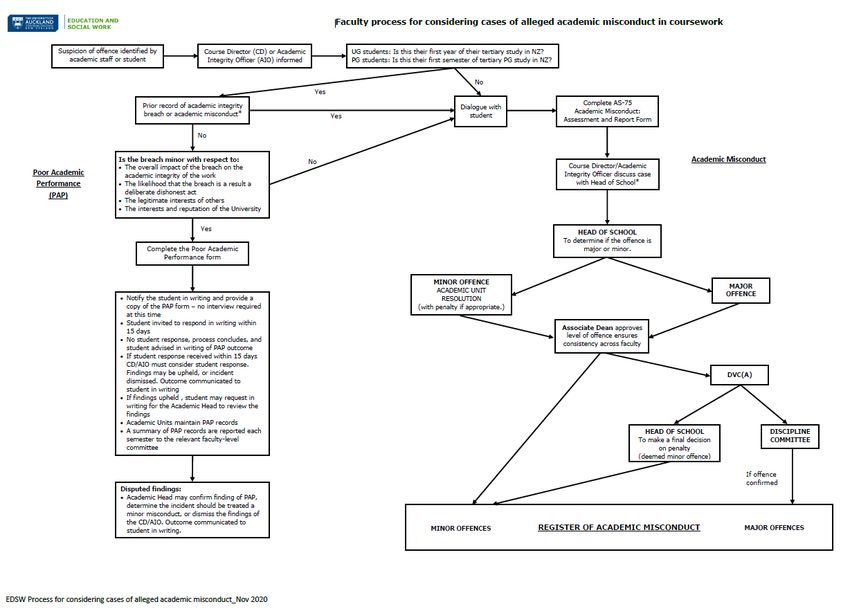
Academic Misconduct
The University expects all students to complete their coursework, tests and exams with integrity and honesty.
The work that a student submits for grading must be the student's own work, reflecting their learning. Where
work from other sources is used, it must be properly acknowledged and referenced. This requirement also
applies to sources on the internet.A student's assessed work may be reviewed against online source material
using computerised detection mechanisms. Allegations of academic misconduct will be investigated under the
Student Academic Conduct Statute.

Allegations of academic misconduct at the Faculty of Education and Social Work shall be managed by the
following process:

                                                                                                      Page 21
You can also read


