Belfast active travel - action Plan 2014 - 2020 Focusing on Life Inequalities - HSC Public ...
←
→
Page content transcription
If your browser does not render page correctly, please read the page content below

Belfast Active Travel
   Action Plan 2014 – 2020

    Focusing on Life Inequalities
                                    1
2
Contents

Foreword													4

What we mean by Active Travel									6

Why Active Travel should be a priority								7

Where we are now											10

Where we want to get to and how we will get there					                                                                                  12

What we will do												14

How we will know if it is working									25

Appendix: 1 Belfast Strategic Partnership (BSP)						                                                                                   27

Appendix 2: Belfast Strategic Partnership - Central Priority				                                                                        29

Appendix 3: Belfast Active Travel Action Planning Task and Finish Group                                                                 30

Appendix 4: Links to local, regional and national policies				                                                                          31

Appendix 5: Timeline for all actions								32

Contact details												35

Acknowledgements

Belfast Strategic Partnership would like to acknowledge the work of the Active Belfast Partnership and Belfast Active Travel Action Planning
Task and Finish Group in driving and supporting the development of this action plan.

                                                                                                                                               3
Foreword
    Belfast is a city that is well suited to walking        There has never been a better time to take this
    and cycling. Many local amenities such as               work forward. The Department for Regional
    schools, shops, places of employment and leisure        Development has created a Cycling Unit which
    opportunities are within a short distance from          is currently consulting on its draft Bicycle
    residential areas, with many of the journeys made       Strategy for Northern Ireland. In addition, the
    in the city, within distances that could be easily      DRD Committee has been hearing evidence on the
    walked or cycled, for most people.                      economic benefits of cycling, and the Department
                                                            for Health, Social Services and Public Safety has
    Incorporating walking and cycling into everyday         issued a public health framework which highlights
    lives helps to meet many priorities. At an individual   the contribution that active travel can make to
    level, it improves both physical health and mental      improving health and wellbeing.
    wellbeing, as well as releasing us from dependence
    on the car. Within communities, it helps connect        There will be challenges and difficult decisions
    people with places and services and makes streets       to be taken as this work progresses. But, given
    safer for people. At a city level, it improves the      the potential for active travel to reach across a
    vibrancy of the centre, opens up inviting places,       wide range of interests, we believe there is merit
    supports retail and enhances the environment and        in facing these challenges. Improving synergies
    in addition, it strengthens our regional economy.       with existing work, while incorporating ‘early
                                                            stage’ integration for walking, cycling and public
    Walking and cycling levels in Belfast have been         transport with new developments, will go some
    increasing over the last decade, and now account        way to delivering the benefits of active travel.
    for almost one in every five journeys to work taken
    in the city. This is in contrast to the rest of Northern Better connecting our communities to local
    Ireland where the trend for walking and cycling          services through enhanced walking and cycling
    journeys have been declining.                            networks and building confidence in children
                                                             to walk or cycle to school by providing practical
    In recent years much work has been undertaken            training, are just some examples of how we will
    across the city to support walking and cycling,          develop a culture for Active Travel in Belfast.
    including infrastructure improvement schemes
    and behaviour change programmes within schools, This plan sets out our vision for active travel,
    workplaces and communities. In addition, much            building on existing work, identifying and
    has been done to promote public transport,               prioritising new opportunities and by measuring
    encouraging more people to take public transport         the impact and success of our actions in a
    for all or part of their journey.                        coherent and collaborative way. We believe this will
                                                             give active travel the focus it requires to transform
    However, much remains to be done. For this reason, Belfast into an exemplar city for walking, cycling
    the Belfast Strategic Partnership set up a multi-        and public transport.
    agency Belfast Active Travel Action Planning Task
    and Finish Group to develop a coordinated approach
    to active travel.

4
be realised including significant building and
                                                       re-development projects. I believe that walking
                                                       and cycling represents a fundamental strategic
                                                       approach to increasing physical activity levels
                                                       across Belfast.

                                                       The approach in developing this plan has
                                                       required commitment and collective action from
                                                       all partners. All partners understand that the
                                                       challenges we face cannot be overcome by a
Dr Eddie Rooney                                        single organisation and that success depends on
Co-Chair, Belfast Strategic Partnership                identifying multiple opportunities to maximise
Chief Executive, Public Health Agency                  Belfast as a more active, healthier and cleaner
Chair, Belfast Active Travel Action Planning Task      city. In doing this the city will meet one of the
and Finish Group                                       core aims of being a member of the World Health
                                                       Organisation European Healthy Cities Network, by
                                                       ‘tackling the major public health challenges in the
Being physically active every day is good for our      European region’.
health. As little as 30 minutes of moderate physical
activity each day can help to prevent obesity and
reduce the risk of many chronic conditions including
coronary heart disease, stroke, type 2 diabetes
and cancer. Physical activity can also improve
our feelings of mental wellbeing and self-worth
and improve social interaction and community
engagement.

For the majority of people, walking and/or cycling
are the easiest and most sustainable ways to
include physical activity into their everyday lives.
However, the majority of local journeys in Belfast
(journeys shorter than 5 miles) are currently made
using the car. Creating the conditions which help
to replace these local journeys with walking and
cycling will improve the health and wellbeing of
people living, working and visiting Belfast.           Andrew Hassard
                                                       Director of Parks and Leisure, Belfast City Council
Considerable work is currently underway to support     Chair of Active Belfast
Belfast to be a more active city and during the
lifetime of this action plan, much of this work will

                                                                                                             5
What we mean
    by Active Travel
    “An approach to travel and transport Integrating walking and cycling
    by physically active, human powered  journeys with public transport
    modes as opposed to motorised ones”.
                                                                       Public transport in the Belfast area is generally
    “Living a sedentary lifestyle can                                  a convenient, cost effective and environmentally
                                                                       cleaner option for travelling longer distances or for
    potentially contribute to increased risk                           trips which are more challenging (for example, trips
    of long-term health problems. Active                               involving steep climbs).
    Travel is an easy way for people to build
                                                                       It is also worth noting that most journeys taken by
    physical activity into their daily life, for                       public transport will include an element of walking
    example walking or cycling instead of                              or cycling, as part of the overall journey.
    taking the car.”
                                                                       “We, in Northern Ireland, have among
    Dr Michael McBride
                                                                       the lowest levels of walking and cycling
    Northern Ireland Chief Medical Officer
                                                                       anywhere in Europe. Yet experience
    This action plan will focus on increasing the                      from elsewhere demonstrates
    number of short journeys walked and cycled, and                    that there are significant benefits
    on integrating walking and cycling into public
    transport for longer or more challenging journeys .                in adopting a more sustainable
                                                                       approach to transport and that real
    Walking and cycling                                                improvements to personal health and
    For short journeys                                                 wellbeing, community spirit and the
                                                                       wider environment can be achieved
    Walking and cycling are healthy, convenient,
                                                                       when active travel is integrated into
    environmentally cleaner, cost effective and
    sustainable options for travelling short distances.                transport and planning policy from the
    In Northern Ireland, approximately 33% of all                      very start.”
    journeys taken are less than 2 miles long, with a
    further 17.5% of all journeys being between 2 and 5 Danny Kennedy MLA
    miles long. Many of these could easily be walked or Minister for Regional Development
    cycled by most people. However, currently 35% of
    all trips under 1 mile, 69% of all trips between 1 and
    2 miles and 84% of all trips between 2 and 5 miles
    are made by car, either as a driver or a passenger. 1

    1. Travel Survey for Northern Ireland In-depth Report, 2010-2012

6
Why Active Travel should
be a priority
Research and experience regionally, nationally and                              Connected communities
internationally have demonstrated the wide ranging
benefits which can result from a significant change                               People living in heavily trafficked streets have
in travel behaviour, or modal shift, from the private                             fewer friends in their neighbourhood when
car to walking and cycling.                                                       compared to people living in lightly trafficked
                                                                                  streets. 5
Healthier people
                                                                                  The flow of pedestrians and cyclists can also
      Being active everyday by walking and cycling,                               create street life, which improves community
      has many positive benefits for physical health                              safety. It can also encourage new groups to use
      including reducing the risk of coronary heart                               the street and strengthen community
      disease, stroke, obesity and type 2 diabetes. 2                             cohesion. 6

      Active people are also more likely to experience
      good mental wellbeing and feelings of self-
      worth and have lower levels of smoking and
      substance misuse. 3

      Walking and cycling are simple ways for people
      to be more active every day and when adopted
      for short journeys to work or to the shops, are
      likely to be sustained. 4

2. NICE: Walking and cycling: Local measures to promote walking and cycling
as forms of travel and recreation (2012)
3. Scottish Executive: A Walking Strategy for Scotland (Consultation
Document) (2012)
4. Royal Town and Planning Institute: London (2010) Good Practice Note:
Delivering health communities
5. Appleyard, D (1969) The Environment Quality of City Streets: The residents
viewpoint. Journal of the American Planning Association
6. Barton, H (2009) Land use planning and health and wellbeing. Land Use
Policy 26S (2009)

                                                                                                                                     7
                                                                                                                                     7
A more vibrant city                                  A stronger region
     Walking and cycling can also positively benefit           Employees who lead a more active lifestyle
     the local retail economy. A London study                  report higher levels of productivity, work
     demonstrated that pedestrians and cyclists                relationships, work-life balance and lower levels
     spent on average £93 per month compared to                of work related overload, when compared to
     car drivers who only spent £56 per month. 7               non-active employees. 10

     Replacing motorised journeys with walking                 Active employees take fewer sick days than
     and cycling reduces greenhouse gas emissions              inactive employees. It is estimated that
     which contribute to air pollution. 8                      overweight and obesity are costing the NI
                                                               economy approximately £197m a year in
     Walking and cycling can also reduce the noise             absenteeism. A population shift to active
     levels within neighbourhoods leading to quieter           travel could bring significant benefits not just
     communities. Evidence shows that children                 to health but also to the economy. 11
     living in quieter communities have greater levels
     of reading skills, attention and problem solving          Some walking and cycling schemes can be
     abilities. 9                                              quick to start, can be delivered with relatively
                                                               small budgets, and within short timescales.
                                                               They also make an important contribution to
                                                               the local economy as the work tends to be
                                                               carried out by small local engineering firms. 12

                                                               Investment in walking and cycling has been
                                                               found to have a median benefit to cost ratio of
                                                               between 13:1 and 19:1, when health benefits
                                                               are included. 13

                                                         7. Transport for London, Town Centre Study (2011)
                                                         8. Sustainable Development Commission (2010) Sustainable development: the key to
                                                         tackling health inequalities. London
                                                         9. Matheson, M (2003) The influence of noise on psychological patterns and cognitive
                                                         abilities in children.
                                                         10. Foresight Mental Capital and Wellbeing (2008)
                                                         11. Perry, Ivan et al 2012, The cost of overweight and obesity on the island of Ireland,
                                                         Safefood.
                                                         12. Active Travel, Active Scotland (2012)
                                                         13. Davis, A (2010) Value for money: an economic assessment of investment in walking
                                                         and cycling

8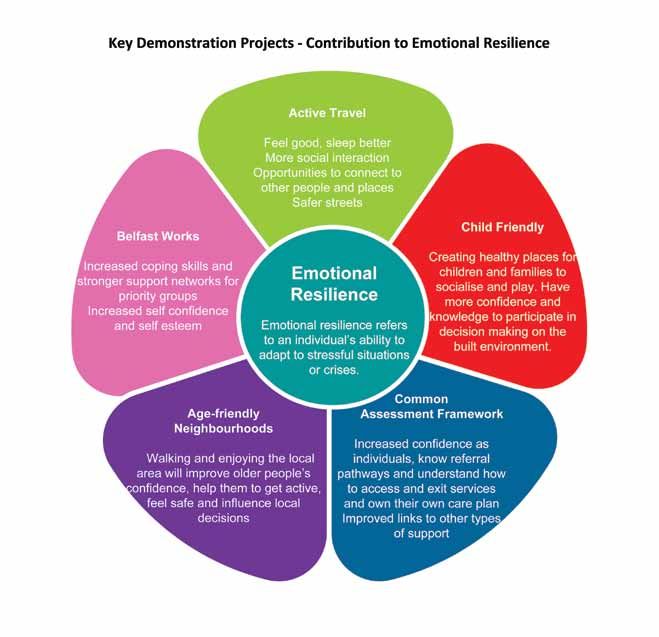
Better connecting people to the places and services    stations. This will contribute to and support the
they wish to use, through the provision of ‘fit for    development of a better connected region.
purpose’ walking and cycling routes, improved links
with public transport and extensive training and       There is clear evidence that the benefits of active
support programmes, will be key to increasing levels   travel are wide reaching and cut across a range of
of active travel.                                      policies, strategies and plans.

The impact of this increase will be significant in     A number of these documents at national, regional
terms of the health and economic prospects of          and local level have influenced the development of
Belfast in the future. The more attractive our city    this Belfast Active Travel Action Plan. A summary
is and the easier it is to travel to and around, the   list is set out in Appendix 4.
greater the opportunity for growth and prosperity.

These opportunities extend beyond Belfast city
boundaries, to the surrounding areas included
within the Belfast Metropolitan Area Plan, by
improving connectivity between walking and
cycling routes and linkages with public transport

                                                                                                             9
                                                                                                             9
Where we are now
     Over the past number of years many organisations     During this time the number of walking and cycling
     have undertaken schemes of work, which have          journeys to work, the distance travelled by walking
     improved and enhanced opportunities to walk, cycle   and cycling and the average number of walking
     and use public transport within Belfast.             and cycling journeys per person have continued to
                                                          increase in Belfast, as evidenced below.
     Organisations such as the Department for
     Regional Development and Department for              However, we must be mindful that the starting
     Social Development have enhanced the city’s          point of this journey was relatively low; what we
     infrastructure through the provision of cycle        want to see now is a step change in the way that
     lanes and environmental improvement schemes,         people travel, where walking and cycling and using
     while Belfast City Council, Public Health Agency,    public transport are seen as the norm.
     Sustrans and Belfast Healthy Cities have
     encouraged and promoted walking and cycling as
     both recreational and commuter activities.

 Table 1: Change in method of travel to work (resident population) between 2001 and 2011
 (Census 2001; Census 2011, Number of journeys, all persons (16-74 years) in employment and
 currently working)

                            2001               2011                Difference            %
     Walking (Belfast)      15,992             17,249              1,257                 +7.9
     Cycling (Belfast)      1,439              2,282               853                   +59.7
     Walking (rest of NI)   50,839             39,941              -10,898               -21.4
     Cycling (rest of NI)   4,530              3,970               -560                  -12.4

     Table 2: Difference in average distance travelled (in miles) per person per year by mode in Belfast
     between 2008 and 2012
     (Travel Survey for Northern Ireland In-depth Reports; 2008-2010 and 2010-2012)

                            2008-10             2010-12             Difference           %
      Walking               216                 221                 +5                   +2.3
      Cycling               29                  55                  +26                  +89.7
      Public transport      389                 403                 +14                  +3.6

10
Table 3: Average number of journeys per person per year by selected main mode,
Belfast residents only
(Travel Survey for Northern Ireland 2000-02, 2005-07, 2009-11 and 2010-12)
2000-02 2005-07 2009-11 2010-12
Walking 289 235 232 242
Cycling 8 10 12 15
Public transport 65 66 66 81
Walking levels in Belfast Copenhagen, like Belfast is today, was
characterised by areas of dense traffic and car
Based on information from the Census 2011, parks.
Belfast has more walking journeys to work (15.7%)
than other comparable cities such as Manchester Now in Copenhagen 36% of journeys to work
(14.8%), Liverpool (13%) and Leeds (12%). and educational institutions are made by bicycle
Walking levels in Belfast are almost on a par with and the city is benefiting from its reputation as a
those of Cardiff (16%). 14 ‘better bicycle city, a more liveable city’. 16
Cycling levels in Belfast
In contrast to Belfast’s strong position regarding
walking levels, current levels of cycling fall short of
our comparable neighbours. Figures from the 2011
Census show the current level of journeys cycled to
work in Belfast is 2.2%, compared to Manchester
(4.2%) and Cardiff (3.9%). 15
Lessons we can learn from our
European neighbours
Many other European cities have overcome the
challenges that Belfast now faces in becoming
a city for walking and cycling. Until the 1960s
14. Census 2011; Method of travel to work (resident population). All persons (16-74
years) in employment and currently working (excluding those working from home
15. See note 14
16. Good, better, best. The City of Copenhagen’s Bicycle Strategy 2011-2025.
11
11Where we want to get to
and how we will get there
Our vision is of a shared, connected city where We recognise that journeys to work are only one
people want to live, work and visit, a city for learning area of our focus and that consideration must also
and commerce, a green, clean and healthy city. We be given to regularly measuring other everyday
want to see a city where walking and cycling are journeys which could be walked and cycled,
part of everyday living because they are convenient, including school journeys and trips to local services
attractive, enjoyable and safe, and are seen as such as shops and leisure opportunities.
fundamental to the development and success of
the city and region. To achieve the cultural shift required to increase
cycling and walking to these levels, we will:
By 2025, we aim to have increased the percentage
of cycling journeys to work to 10% and the Work on coordinated approaches with partners;
percentage of walking journeys to work to 20%. Develop a high quality network of dedicated
These targets are based on the level of success we walking and cycling routes, which connect
have seen in recent years with increasing walking people to places and services;
and cycling and also from benchmarking ourselves Improve the integration between walking,
against similar cities such as Manchester, Leeds cycling and public transport;
and Cardiff. Work with schools, workplaces and
communities to increase walking and cycling
Realising this vision will need a change in our levels;
thinking on travel and the role that it plays in Work across departments and agencies to
all aspects of our lives. A cultural shift towards develop walking and cycling related health and
walking and cycling as everyday travel options will wellbeing initiatives;
help Belfast to develop into a city of choice, while Work with Belfast City Council and other
reducing our reliance on private car journeys. agencies responsible for planning decisions, to
ensure focus is given to walking, cycling and
integration with public transport;
Develop a robust monitoring and evaluation
framework for all partners to use; and
Support ongoing engagement with key
stakeholders and interested partners.
12
12Given the wide range of benefits that increasing The actions set out are categorised under four
walking and cycling can bring to our city and region, themes, based on best practice from other areas.
we would like to see the Regional Project Board for They are:
Public Health, champion an approach to evaluating
the wider social benefits of this work, through the Improving the walking and cycling network
new Public Health Strategy; Making Life Better Building new skills for active travel
(2013-2023). Promoting opportunities for active travel
Supporting others to prioritise active travel.
To realise the vision we have identified a series of
actions which will form part of the first steps of our The actions have been prioritised by the Belfast
journey. We plan to take these actions forward in Active Travel Action Planning Task and Finish
the next five years, conscious that we must adjust Group into those which will be delivered in the
and adapt to new opportunities as they arise. first two years of the plan and for which we have
already received commitment and those which we
hope to progress thereafter. Reference has also
been made to the extensive range of work currently
being delivered across the city, which supports
and complements this action plan. A summary of
actions is presented in Appendix 5.
13
13What we will do
Improving the walking and cycling network
We aim to:
Support the development and enhancement of a walking and cycling network
across the city and improve the city’s road environment to enable all road
users to safely share space with mutual respect.
We will build on work already underway, including:
Development of the Connswater Community Greenway, led by the East Belfast Partnership and
funded by the Big Lottery, Belfast City Council and Department for Social Development.
Implementation of the Belfast Public Bike Share Scheme, which will provide 300 bikes, spread
across 30 docking stations in the main city centre area. The scheme is funded by the Department
for Regional Development and led by Belfast City Council.
Development of the Integrated Transport Hub for Belfast, providing a world class Transport Hub for
the city, led by DRD and Translink.
Streets Ahead Phase 3, led by DSD and Belfast City Council.
Development of Rapid Transit routes in the East and West of the city with future extensions to the
North and South of the city, led by DRD .
Junction and environmental improvement schemes, led by DRD and DSD respectively.
Development of a pedestrian and cycle bridge linking Ormeau Park and the Gasworks, led by DRD.
Expansion of the Lagan View Lookout Bridge, led by DSD and Belfast City Council.
Research undertaken by Queen’s University Belfast and Belfast Healthy Cities, from the Knowledge
Exchange Spatial Analysis and Healthy Urban Environments (KESUE) initiative.
14In the first two years of the plan:
The Department for Regional Development will lead on the development of design guidance for
walking and cycling infrastructure, including the development of consistent, uniform signage and
lighting standards.
Key partners: DRD, BCC, DSD, Belfast Healthy Cities, others.
The Department for Regional Development will lead on the creation of a Cycling Framework for
Belfast, to include a range of connected arterial and quiet routes, reflecting the design guidelines.
Key partners: DRD, others.
The Department for Regional Development will lead on the development of two demonstration ‘end
to end’ cycling routes, as part of the Cycling Framework.
Key partners: DRD, BCC, DSD, Sustrans, CTC, others.
DRD will introduce a pilot 20mph zone within Belfast City Centre and will explore the potential for
the inclusion of similar zones in line with the Cycling Framework for Belfast.
Member organisations of the Task and Finish Group will install high quality street furniture and
appropriate cycle parking at their workplaces and other facilities, with a particular focus on the
demonstration ‘end to end’ routes and key sites open to the public.
Key partners: PHA, BCC, DRD, DSD, BHSCT, Translink, BHC, Sustrans, others.
Translink will provide high quality secure bicycle parking at railway and bus stations, and park and
ride facilities.
Key partners: Translink, DRD.
The Department for Regional Development and Translink will explore the potential to pilot the
carriage of bicycles on at least one bus route serving the city.
Key partners: DRD, Translink, others.
Active Belfast will support the development of community bike hubs in areas with low levels of
bicycle ownership.
Key partners: Active Belfast Partnership, others.
Streets Ahead will ensure that adequate cycle parking is provided in Phase 3 of development.
Key Partners: DSD, Belfast City Council.
15We aim to progress the following actions for years three, four and five of the plan:
Align existing infrastructure improvement schemes and behaviour change programmes, including
the Safer Routes to School initiative and the Active School Travel programme.
Develop a potential bicycle hub, as part of the Integrated Transport Hub for Belfast.
Use the demonstration routes, to explore the potential to inform policy and practice on safe routes
for walking and cycling in relation to maintenance and cleansing.
Improve integration between walking/cycling and public transport by :
• Improving connectivity between major bus and rail routes and the walking and cycling network,
including signage;
• Explore the potential to increase cycle capacity on new rolling stock.
Roll out the Cycling Framework for Belfast, with the creation of additional safe, continuous routes, in
line with the Bicycle Strategy for Northern Ireland.
16
16Building new skills for active travel
We aim to:
Enhance skills, knowledge and confidence of walkers, cyclists and road users
We will build on work already underway, including:
Travelwise NI initiative aimed at promoting sustainable methods of travel including walking and
cycling, led by Department for Regional Development (DRD).
Enhancement of the Cycling Proficiency Scheme for primary school children, led by Department of
the Environment.
Active School Travel Programme, which delivers walking and cycling skills to primary and post-
primary school children and supports schools to promote active travel. This programme is funded by
DRD and Public Health Agency (PHA) and is delivered by Sustrans.
The Active Belfast grants scheme, supporting individuals and organisations to be more active
through walking and cycling, funded by BCC and PHA.
Volunteer walk leaders training, led by PHA and Belfast Health and Social Care Trust.
Translink’s bus driver and cycling education programme.
Seminars on active travel and developing the links between planning and public health, led by Belfast
Healthy Cities.
In the first two years of the plan:
The Public Health Agency will pilot a Workplace Active Travel programme, delivered by Sustrans,
which will enable key workplaces to lead by example in encouraging and enabling staff to walk, cycle
and take public transport to work.
Key partners: PHA, BCC, BHSCT.
Belfast City Council will provide practical training and information sessions to local businesses and
students, linked to the Belfast Public Bike Share Scheme.
Key partners: BCC, Sustrans, CTC, others.
The Active Belfast Partnership will support the development of a community based cycling skills
development programme, in line with the proposed community bike hub.
Key partner: Active Belfast Partnership.
17CTC will support the development of trainers to deliver cycling skills development programmes
including National Standards, Off-Road Cycling and Cycling maintenance.
Key partners: CTC, Cycling Ireland, Sport NI, others.
Partner organisations will provide ‘cycle aware’ driver training courses for all staff employed as
drivers of buses and larger goods vehicles, building on the programme developed by Translink.
Key partners: Translink, BCC, BHSCT, others.
The Active Belfast Partnership will expand Healthwise (Physical Activity Referral Programme) to
include walking and cycling.
Key partner: Active Belfast Partnership.
The PHA will develop a framework for a pilot programme to support local communities to walk and
cycle, aligned to the ‘end to end’ demonstration routes.
Key partners: PHA, BCC, Sustrans, CTC, others.
Belfast Healthy Cities will facilitate training to local councillors and planners, on the Health
Economic Assessment Tool (HEAT) for walking and cycling, with World Health Organisation advice
and experts.
Key partners: BHC, others.
Begin discussions on the potential to expand the National Standards Cycle Training to all P6
children in Belfast.
Key partners: PHA, DRD, DoE, DE.
DRD will explore the possibility of developing a code of good behaviour for cyclists, walkers and
drivers
Key partners: DRD, DoE, PSNI, others.
18We aim to progress the following actions for years three, four and five of the plan:
Support local communities to walk and cycle more through an Active Travel Communities
programme.
Encourage the use of the HEAT tool in active travel related planning proposals.
Roll out a scheme of volunteer cycle leaders training.
Increase the number of community bicycle hubs and ‘re-cycle’ schemes.
Support the development of an active travel programme for university campuses and further and
higher education facilities.
Work with road haulage industry and taxi companies on sharing road space safely.
19
19Promoting opportunities for active travel
We aim to:
Increase public awareness of the benefits of active travel and the
opportunities available, while promoting and enhancing the ethos and culture
of walking and cycling.
We will build on work already underway, including:
Annual Week of Walking and Week of Cycling initiatives, led by DRD.
Promotion of local walking routes, led by Belfast City Council and Outdoor Recreation NI.
Promotion of active travel routes by NI Greenways.
‘Ride On Belfast’ cycle to work day.
20
20In the first two years of the plan:
Belfast City Council will lead on a marketing campaign, promoting existing opportunities to walk and
cycle in the city.
Key partners: BCC, DRD, PHA, Sustrans, CTC, others.
Belfast City Council will coordinate a range of walking and cycling ‘taster’ sessions within its parks.
Key partners: BCC, PHA, DRD, Sustrans, CTC, others.
Sustrans will deliver an annual citywide cycle challenge event, as part of the pilot Workplace Active
Travel programme.
Key partners: Sustrans, PHA, BCC, BHSCT, others.
Sustrans will work with local retail outlets, including coffee shops and bike shops, on the
introduction of an incentives scheme for cycling.
Key partners: Sustrans, PHA, others.
Belfast City Council will explore the potential of including distance and approximate walking /
cycling time on all new street level signage in and around the city centre.
Key partners: BCC, DSD, others.
DRD will develop a detailed map of walking and cycling routes across the city.
Key partners: DRD, others.
DRD will explore the possibility of establishing an annual ‘in town without my car’ day or a mass
family cycling event as a follow on from the 2014 Giro d’Italia.
Key partners: DRD, PHA, and BCC.
Active Belfast Partnership will explore the potential to deliver an annual Active Travel Summit.
Key partners: Active Belfast Partnership, BHC, CTC, Sustrans, others.
21We aim to progress the following actions for years three, four and five of the plan:
Deliver a combined active travel challenge for all (schools, workplaces and communities).
Explore the potential for the development of ‘Walking / Cycling in Belfast’ apps.
Develop an active travel ‘dashboard’ to communicate progress against key targets.
22
22Supporting others to prioritise active travel
We aim to:
Support organisations to develop and promote policies
which support walking and cycling
We will build on work already underway, including:
The Cross-sectoral Cycling Group established and chaired by the Minister for Regional Development.
Development of a Bicycle Strategy for NI, led by DRD.
The Northern Ireland Assembly All Party Group on Cycling.
The development of a ‘Bicycle Account’ for Belfast, led by the DRD and Sustrans.
The Belfast: Future City ‘Initial Directions’ proposal, led by Belfast City Council.
In the first two years of the plan:
DRD will explore the potential of future legislation to enhance the role of active travel.
Key partner: DRD.
All members of the Task and Finish Group will encourage the inclusion of active travel as an agenda
item at appropriate meetings.
PHA, BCC, DRD, DSD, BHSCT, Translink, BHC, Sustrans.
Belfast Healthy Cities will develop enhanced links between planning and public health.
Key partners: BHC, Queen’s University Belfast, Planning NI, BCC, PHA, DRD, DSD, others.
Sustrans and DRD will lead on work to produce a Belfast Bicycle Account which will develop into a
biennial exercise to assess cycling attitudes and infrastructure in Belfast.
Key partners: Sustrans, DRD, BCC.
23We aim to progress the following actions for years three, four and five of the plan:
Explore the potential of utilising the transfer of planning powers, to encourage long term land use
changes which support increased levels of walking, cycling and public transport.
Explore the potential to incorporate design guidance for walking and cycling into relevant future
planning policies and applications.
Ensure the needs of walkers and cyclists are included early in all planning considerations.
Work across agencies on the enforcement of on street parking.
Develop support at all levels, for active travel.
24
24How we will know
if it is working
It will be important for us to monitor progress The framework will include measures on the
across a range of measures, in order to know if we following:
are achieving the desired modal shift.
The amount and quality of the walking and
We will build on existing and developing monitoring cycling network;
work including the:
The number of bicycle parking spaces within
Travel Survey for Northern Ireland; the city centre, at bus and rail stations and in
schools and workplaces;
Census;
Changes in walking and cycling journey
‘Bicycle Account’ for Belfast; behaviour, including distances covered and
average number of journeys taken; and
Active School Travel questionnaire; and
Attitudes to and perceptions of walking and
Workplace Active Travel Programme. cycling.
We will develop a framework for measuring walking The Belfast Strategic Partnership will undertake
and cycling levels, providing a more complete to collate monitoring across all actions contained
picture of active travel in the city. We will look for within this plan and provide an annual report
opportunities to engage and partner with local on progress made against each area of work.
expertise including Queen’s University Belfast and Organisations will report quarterly on progress
the University of Ulster. made to ensure momentum is sustained.
A full review of this action plan will be carried out
after the first two years, measuring progress on
the agreed actions, adjusting as required to fit with
local and regional priorities and making the most of
available opportunities.
25Appendixes 26
Appendix 1: Belfast Strategic Partnership

Belfast Strategic Partnership                         Framework for Action to Address
                                                      Life Inequalities (2011 – 2015)
The Belfast Strategic Partnership (BSP) was
established by the Public Health Agency (PHA),       In 2011 a wide consultation process was
Belfast City Council (BCC), and Belfast Health       undertaken across the city to identify the priority
and Social Care Trust (BHSCT) to provide             areas which the BSP would focus its efforts on to
a collaborative approach in addressing life          reduce the life inequalities people experience in the
inequalities in Belfast.                             city. This process resulted in the development and
                                                     publication of the Framework for Action to Address
The BSP is led by the three Chief Executive Officers Life Inequalities 2011 – 2015.
and has representation from a wide range of
organisations, including the community, statutory, Figure 1 shows the priority areas and underlying
voluntary and private sectors.                       (cross cutting) themes supported by the BSP.

The aim of the BSP is “to champion and lead
the case for tackling life inequalities across all    Belfast Health Development Unit
communities in the Belfast area”.
                                                      The Belfast Health Development Unit (BHDU)
                                                      supports and drives the work of the BSP and will
                                                      support the delivery of the Framework for Action.

Figure 1: Belfast Strategic Partnership: Framework for Action to Address Life Inequalities.

                                                                                                             27
Vision Key Principles
‘All people and communities in Belfast can To successfully reduce inequality and address the
confidently expect to have access to the wider determinants of health we must:
opportunities and resources they need to live longer,
healthier lives.’ Maximise our combined impact by working
better together
Mission Be accountable to others based on the results
of our work
‘To reduce life inequalities and improve the health Base our decisions and actions on evidence and
and wellbeing of people in Belfast by changing learning from others
the way we work together. We do this by jointly Be open to innovative approaches and be
harnessing the enthusiasm, efficiency and prepared to work differently
experience of our stakeholders to seek health and Encourage the active involvement of all
wellbeing gains in ways that we cannot do by stakeholders and strengthen relationships
working alone.’ Build on the success of existing partnerships
and programmes of work
Engage with communities and seek to
Purpose contribute to Community Planning
Make effective use of our collective resources
To shape the future health and wellbeing
through better joint planning and priority
priorities for Belfast
setting
To foster and take advantage of strategic
Drive Equity in Health and Wellbeing through
opportunities to achieve better health outcomes
all of our policies
To work together on areas where we can achieve
Share our learning to change the way the public
the most impact
sector works.
To inform and influence future policy
development
To focus on the prevention of ill-health ‘Making Belfast a Resilient City’
To develop and deliver an overarching health and We will work to make Belfast a
wellbeing action plan for the city Resilient City, by:
Improving the walking and cycling network
Building new skills for active travel
Promoting the opportunities for active travel
Supporting others to prioritise active travel.
28Appendix 2: Belfast Strategic Partnership -
Central Priority
The central priority of the partnership is to strengthen the emotional wellbeing and resilience of
individuals and communities in Belfast. Emotional Resilience refers to an individual’s ability to adapt to
stressful situations or crises that may have occurred in the past, present or into the future.
Active Travel is one of Belfast Strategic Partnership’s Key Demonstration Projects, contributing to the
building of Emotional Resilience. See Diagram 1 below.
Diagram 1:
29Appendix 3: Belfast Active Travel
Action Planning Task and Finish Group
Name Organisation Role
Dr Eddie Rooney Public Health Agency / Belfast Strategic Partnership Chair
Andrew Hassard Belfast City Council / Active Belfast Vice-Chair
Andrew Steenson Belfast Health Development Unit Lead Officer
Caroline Bloomfield Public Health Agency Member
Ciaran de Burca Department for Regional Development Member
Gordon Clarke Sustrans Member
Rose Crozier Belfast City Council Member
Joan Devlin Belfast Healthy Cities Member
Anne Doherty Belfast City Council Member
Andrew Grieve Department for Regional Development Member
Mandy Magee Belfast Health and Social Care Trust Member
Clifford McIlwaine Planning Service NI Member
Kevin Monaghan Department for Regional Development Member
Carol Ramsey Department for Social Development Member
Tom Reid Department for Regional Development Member
Ian Richardson Cyclist’s Touring Club Member
Ciaran Rogan Translink Member
30Appendix 4: Links to local, regional and national policies
Summary of policies, strategies and plans.
National policy and Regional policies, strategies Local policies, strategies
strategies and plans and plans
• Marmot Review – • DHSSPS Public Health Framework • Belfast Strategic
Fair Society, Healthy Making Life Better (2013-2023)) Partnership – Framework for Action
Lives, 2010 • A Fitter Future for All – Obesity Prevention to Address Life Inequalities (2011 –
• Start Active Stay Framework for Northern Ireland (2011 – 2015)
Active 2011 2021) • Belfast City Council –
• Let’s Get Moving – A New • Programme for Government (2011 – 2015): Draft Investment
Physical Activity Building a Better Future Programme (2012 – 2015)
Care Pathway for NHS • Older People’s Strategy: Ageing in an • Belfast City Council – Masterplan
• Every Child Matters: Inclusive Society: (draft)
Change For Children • Sport Matters: The Northern Ireland Strategy • Belfast City Council
Programme 2012 for Sport and Physical Recreation Transport Policy
• NHS Choices: (2009 – 2019) • Belfast Strategic
Mental Health and • A Strategy to Improve the Lives of Disabled Partnership – Active
Wellbeing People: (2012 – 2015) (OFMDFM) Belfast Strategy
• Promoting physical • Learning Disability Service Framework • Belfast Strategic
activity and active • Northern Ireland Children and Young People’s Partnership – Emotional Resilience
living in urban Plan Plan (2011 – 2014) Strategy
environments: the • Healthy Futures (2010 – 2015) (DHSSPS) • Belfast Metropolitan
role of local • Regional Development Strategy 2035 Area Plan
government, 2006 (DRDNI) • Belfast City Council Investment
• Accessible Transport Strategy (2009 – Programme
2012)
• Building an Active Travel Future for Northern
Ireland, DRD 2013
• Regional Transportation Policy for Northern
Ireland (2002 – 2012) (DRDNI)
• Our Children and Young People – Our
Pledge – A 10 year strategy for Children and
Young people (2006 – 2016)
• Consultation on Priorities for Youth (DENI)
• Planning Policy Statement 8 – Open Space,
Sport and Recreation (DOENI)
• Bicycle Strategy for Northern Ireland (Draft)
DRD
31Appendix 5: Timeline for all actions
Work that is happening Work planned for the first two Work we hope to progress By 2025
now years for years three to five
Development of the The development of design Align existing infrastructure
Belfast is a shared,
Connswater Community guidance for walking and cycling improvement schemes
connected city
Greenway infrastructure and behaviour change
where people
programmes
want to live, work
Implementation of the The creation of a Cycling Develop a potential bicycle and visit, a city
Belfast Public Bike Share Framework for Belfast hub, as part of the Integrated for learning and
Scheme Transport Hub commerce, a
Development of the The development of two Explore the potential to green, clean and
Integrated Transport Hub demonstration ‘end to end’ cycling inform policy and practice on healthy city. A city
routes safe routes for walking and where walking and
cycling cycling is part of
everyday living and
Streets Ahead Phase 3 A pilot 20mph zone within Belfast Improving connectivity fundamental to the
City Centre between major bus and rail growth and success
routes and the walking and of the city and
cycling network region.
Development of Rapid Installation of high quality street Explore the potential to
Transit routes furniture and appropriate cycle increasing cycle capacity 10% of journeys are
parking at key sites on new rolling stock of fleet by cycling and 20%
vehicles of journeys are by
walking.
Junction and High quality secure bicycle parking Roll out the Cycling
environmental at railway and bus stations, and Framework for Belfast
improvement schemes park and ride facilities
Development of a Explore the potential to pilot the Support local communities
pedestrian and cycle bridge carriage of bicycles on at least one to walk and cycle more
linking Ormeau Park and bus route through an Active Travel
the Gasworks Communities programme
Expansion of the Lagan The development of community Encourage the use of
View Lookout Bridge bike hubs the Health Economic
Assessment Tool (HEAT) in
active travel related planning
proposals
32Research undertaken from A pilot ‘Workplace’ Active Travel Roll out a scheme of By 2025
the (KESUE) initiative programme volunteer cycle leaders
training
Belfast is a shared,
The Travelwise NI initiative Practical training and information Increase the number of
connected city
sessions linked to the Belfast community bicycle hubs and
where people
Public Bike Share Scheme. ‘re-cycle’ schemes
want to live, work
Cycle proficiency training The development of a community Support the development of and visit, a city
for primary school children based ‘cycling’ skills development an active travel programme for learning and
programme for university campuses commerce, a
The Active School Travel The development of trainers to Work with road haulage green, clean and
Programme deliver ‘cycling’ skills development industry and taxi companies healthy city. A city
programmes on sharing road space safely where walking and
cycling is part of
The Active Belfast grants ‘Cycle aware’ driver training Develop a code of good everyday living and
scheme courses for all staff employed as behaviour for cyclists, fundamental to the
drivers of buses and larger goods walkers and drivers growth and success
vehicles of the city and
Volunteer walk leaders Expand Healthwise (Physical Deliver a combined active region.
training Activity Referral Programme) to travel challenge for all
include walking and cycling 10% of journeys are
by cycling and 20%
Bus driver and cycling Develop a framework for a pilot Explore the potential for the of journeys are by
education programme programme to support local development of ‘Walking / walking.
communities to walk and cycle Cycling in Belfast’ apps
Seminars on developing the Training on the Health Economic Develop an active travel
links between planning and Assessment Tool (HEAT) for ‘dashboard’ to communicate
public health walking and cycling progress against key targets
Annual Week of Walking Explore the potential to expand the Explore the potential to
and Week of Cycling National Standards Cycle Training incorporate design guidance
initiatives to all P6 children in Belfast for walking and cycling into
relevant future planning
policies and applications
Promotion of local walking A marketing campaign, promoting Ensure the needs of
routes existing opportunities to walk and walkers and cyclists are
cycle in the city included early in all planning
considerations
33Promotion of active travel A range of walking and cycling Work across agencies on the By 2025
routes ‘taster’ sessions within its parks enforcement of on-street
parking
Belfast is a shared,
Ride On Belfast, cycle to An annual citywide cycle challenge Develop support at all levels,
connected city
work day event for active travel
where people
The Cross-sectoral Cycling Explore the potential of including want to live, work
Group the distance and approximate and visit, a city
walking / cycling time to all new for learning and
street level signage in and around commerce, a
the city centre green, clean and
Development of a Bicycle Develop a detailed map of walking healthy city. A city
Strategy for NI and cycling routes across the city where walking and
cycling is part of
The Northern Ireland Explore the possibilities of everyday living and
Assembly All Party Group establishing an annual ‘in town fundamental to the
on Cycling without my car’ day growth and success
The development of a Explore the potential of an annual of the city and
‘Bicycle Account’ for Active Travel Summit region.
Belfast
10% of journeys are
The Belfast: Future City Explore the potential of future by cycling and 20%
‘Initial Directions’ proposal legislation to enhance the role of of journeys are by
active travel walking.
Encourage the inclusion of active
travel as an agenda item at
appropriate meetings
Develop enhanced links between
planning and public health
Produce a Belfast Bicycle Account
34For further information on
this document please contact:
Andrew Steenson
Project Development Senior Officer
Belfast Health Development Unit
5th Floor, 9 Lanyon Place, Belfast BT1 3LP.
E: andrew.steenson@bhdu.org
T: 028 9050 2073
M: 077 6897 8924 Published by Belfast Strategic Partnership
35
35You can also read


