Blockchain for Increased Trust in Virtual Health Care: Proof-of-Concept Study - Journal ...
←
→
Page content transcription
If your browser does not render page correctly, please read the page content below
JOURNAL OF MEDICAL INTERNET RESEARCH                                                                                             Hasselgren et al

     Original Paper

     Blockchain for Increased Trust in Virtual Health Care:
     Proof-of-Concept Study

     Anton Hasselgren1, MSc; Jens-Andreas Hanssen Rensaa2, MSc; Katina Kralevska2, PhD; Danilo Gligoroski2, PhD;
     Arild Faxvaag1, MD, PhD
     1
      Department of Neuromedicine and Movement Science, Norwegian University of Science and Technology, Trondheim, Norway
     2
      Department of Information Security and Communication Technology, Norwegian University of Science and Technology, Trondheim, Norway

     Corresponding Author:
     Anton Hasselgren, MSc
     Department of Neuromedicine and Movement Science
     Norwegian University of Science and Technology
     Mellomila 71
     Trondheim
     Norway
     Phone: 47 46948498
     Email: anton.hasselgren@ntnu.no

     Abstract
     Background: Health care systems are currently undergoing a digital transformation that has been primarily triggered by emerging
     technologies, such as artificial intelligence, the Internet of Things, 5G, blockchain, and the digital representation of patients using
     (mobile) sensor devices. One of the results of this transformation is the gradual virtualization of care. Irrespective of the care
     environment, trust between caregivers and patients is essential for achieving favorable health outcomes. Given the many breaches
     of information security and patient safety, today’s health information system portfolios do not suffice as infrastructure for
     establishing and maintaining trust in virtual care environments.
     Objective: This study aims to establish a theoretical foundation for a complex health care system intervention that aims to
     exploit a cryptographically secured infrastructure for establishing and maintaining trust in virtualized care environments and,
     based on this theoretical foundation, present a proof of concept that fulfills the necessary requirements.
     Methods: This work applies the following framework for the design and evaluation of complex intervention research within
     health care: a review of the literature and expert consultation for technology forecasting. A proof of concept was developed by
     following the principles of design science and requirements engineering.
     Results: This study determined and defined the crucial functional and nonfunctional requirements and principles for enhancing
     trust between caregivers and patients within a virtualized health care environment. The cornerstone of our architecture is an
     approach that uses blockchain technology. The proposed decentralized system offers an innovative governance structure for a
     novel trust model. The presented theoretical design principles are supported by a concrete implementation of an Ethereum-based
     platform called VerifyMed.
     Conclusions: A service for enhancing trust in a virtualized health care environment that is built on a public blockchain has a
     high fit for purpose in Healthcare 4.0.

     (J Med Internet Res 2021;23(7):e28496) doi: 10.2196/28496

     KEYWORDS
     blockchain; ethereum; decentralization; Healthcare 4.0; virtualization; trust

                                                                           born. The overall increase in life expectancy between 1970 and
     Introduction                                                          2013 was 10.4 years on average for Organization for Economic
     Overview                                                              Cooperation and Development countries [1]. A direct effect of
                                                                           this demographic shift [2,3] is that noncommunicable and
     As a result of health care development, societies are undergoing      chronic diseases become more prevalent, which presents a
     a current demographic shift—people live longer, and fewer are         substantial socioeconomic challenge. Consequently, fewer

     https://www.jmir.org/2021/7/e28496                                                              J Med Internet Res 2021 | vol. 23 | iss. 7 | e28496 | p. 1
                                                                                                                   (page number not for citation purposes)
XSL• FO
RenderX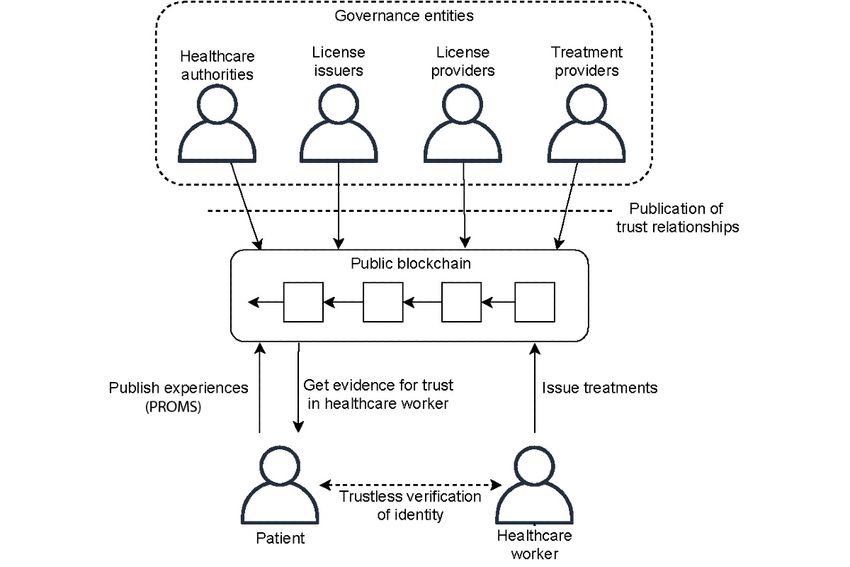
JOURNAL OF MEDICAL INTERNET RESEARCH                                                                                            Hasselgren et al

     caregivers need to support an ever–increasing number of retirees      and presents a trust issue in a virtualized health care
     with a rising number of chronic diseases. This unsustainable          environment; the next section presents a novel blockchain-based
     scenario is the strongest motivation behind many different            trust model for competence verification of health care personnel,
     ongoing proposals for transformations in the health care              and the final section provides a discussion and conclusions of
     industry. Delivering health care, as we know it today, will most      the work.
     likely be unaffordable for any health system in 15 years from
     now, and many health services will have to be delivered by
                                                                           Related Work and Blockchain Overview
     nonprofessionals and machines. This includes artificial               Blockchain can be seen as an unconventional platform that
     intelligence health workers and devices connected via                 alleviates the reliance on a single, centralized authority, yet it
     machine-to-machine protocols and automated, computerized              still supports secure and pseudoanonymous (or anonymous)
     services, which will be accessible via fast connections from          transactions and agreements directly between interacting parties.
     anywhere, anyhow, and at any time (5G).                               It offers various degrees of decentralization, immutability, and
                                                                           consensus firmly founded in the mathematical principles of
     Furthermore, individuals will be forced to take more                  modern cryptography. A blockchain can also be described as
     responsibility for their own health, take preventative measures,      an immutable ledger that logs data entries in a decentralized
     seek proper care in a timely manner, and behave more like             manner. In its original form, a blockchain enables entities to
     autonomous patients. To facilitate this, there is a need to provide   interact without a central trusted third party. The blockchain
     the right tools to encourage and enforce this transformation,         consists of a continuously growing set of data entries bundled
     both from the delivery side (health care providers) and the           together into blocks of data (Figure 1). Upon acceptance of the
     receiver side (patients). This transformation toward Healthcare       blockchain, these blocks are linked to the previous and future
     4.0 will challenge many of the present key components in a            blocks sequentially [4]. In blockchain’s original definition, this
     functional health system, where the concept of trust is one.          ledger of data blocks is decentralized and distributed across
     The first contribution of this paper is to review and predict the     many nodes. This distributed ledger is transparent, verifiable
     evolution of health care, and to identify the potential problems      by all, and tamper-proof. Owing to these properties, the
     that could emerge in this transformation. It forms a theoretical      blockchain has gained much attention for various applications.
     foundation and urges the need for novel solutions to enhance          The first use case of a blockchain, Bitcoin, was introduced by
     trust. Second, the presented theoretical design principles are        a person or a group under the name of Satoshi Nakamoto in
     supported by the concrete implementation of a proof of concept.       2008 [5]. Bitcoin is also known as a cryptocurrency. Although
     For this contribution, we choose the cornerstone in our               cryptocurrencies remain the primary use case for blockchain,
     architecture to be a blockchain technology implemented as an          there is a substantial interest in applying this technology for
     Ethereum-based platform called VerifyMed.                             other purposes and sectors [6]. Additionally, a blockchain allows
                                                                           for smart contracts—self-execution contracts that do not require
     The remainder of this paper is organized as follows: the first        any central authority. The use cases of blockchain in the health
     section introduces blockchain and previous related work; the          domain are increasing exponentially, as shown by Hasselgren
     next section presents the method applied in this work; the            et al [7], among others.
     following section outlines the results of technology forecasting

     Figure 1. A generic overview of a blockchain structure.

     https://www.jmir.org/2021/7/e28496                                                             J Med Internet Res 2021 | vol. 23 | iss. 7 | e28496 | p. 2
                                                                                                                  (page number not for citation purposes)
XSL• FO
RenderX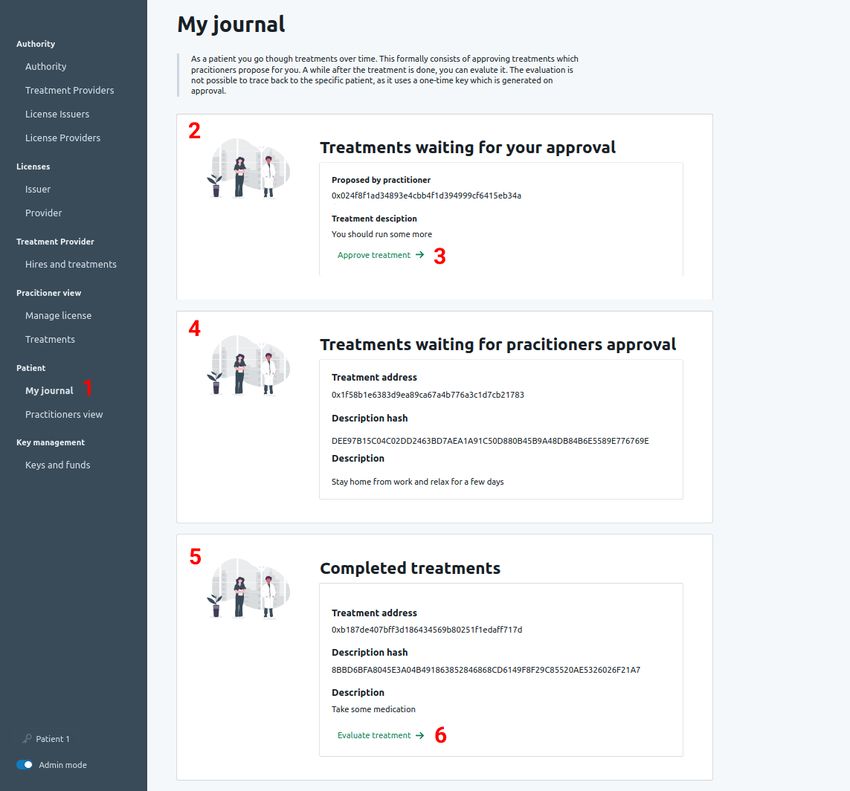
JOURNAL OF MEDICAL INTERNET RESEARCH                                                                                           Hasselgren et al

     Blockchain technology has five fundamental attributes that           facilitate communication among various parties and handle the
     define the technology: (1) distribution, (2) decentralization, (3)   exchange of sensitive patient data. In the study by Kuo et al
     time stamping, (4) data provenance, and (5) nonrepudiation.          [10], there were clear indications that Ethereum, Hyperledger,
     These five attributes are applied when addressing the                and Multichain are more suitable platforms for the health domain
     fundamental problems in health care informatics and are part         than other blockchains.
     of driving the transformation toward Healthcare 4.0. The first
                                                                          Blockcerts [12] is a standard developed for verifying certificates
     generation of blockchain platforms led by Bitcoin [5] had a
                                                                          of competence by storing signatures on a blockchain. The
     specially defined programming language for users to construct
                                                                          standard relies on existing trust relationships between the issuer
     different transactions in the blockchain. The initial design
                                                                          and verifier of the certificate. Baldi et al [13] showed that
     rationale was that the programming language should be as
                                                                          certificates within this system could be spoofed. They also
     simple as possible to satisfy the needs for building various
                                                                          proposed the use of decentralized identifiers to govern such
     transaction types and should not be a fully developed and
                                                                          certificates. At present, there are private initiatives for medical
     powerful programming language. In computer science, the
                                                                          credentials that use a blockchain. The first on the market was
     category of powerful programming languages is called the
                                                                          ProCredEx by Hashed Health [14]. They state that they have
     Turing Complete. The first blockchain platform that offered a
                                                                          developed a blockchain-based solution that enables faster
     Turing Complete language for programming, not just simple
                                                                          onboarding and credential verification.
     transactions but also more complex smart contracts and fully
     developed apps, was Ethereum [8]. There is an active debate          Furthermore, a newly introduced collaborative project between
     on which concept is better and safer—development of malicious        Axuall, Inc and Metro-Health [15] announced a service for
     programs for blockchain platforms that do not have the Turing        credentials of clinical practitioners. They state that they will
     Complete programming language is very difficult and limited,         enable digital portfolios that will include documentation of a
     in contrast to blockchain platforms that have the Turing             practitioner’s education, specialty training and board
     Complete languages [5,9]. Nevertheless, it seems that the            certifications, licenses, sanctions or medical malpractice
     blockchain platforms that come with a fully developed Turing         judgments, evaluations, work history, and hospital affiliations.
     Complete programming language are very suitable for                  As these are private endorsers, there is no published
     developing decentralized applications (dApps) for Healthcare         peer-reviewed literature on their technical solutions. In addition
     4.0, which is further elaborated in the next section.                to what is mentioned above, based on our knowledge, there is
                                                                          no published research that has addressed the same scope as our
     Blockchain Platforms, dApps, and Smart Contracts                     framework. As described earlier, several private organizations
     There are several decentralized platforms and frameworks for         have created solutions for medical credentials by using
     building dApps. Ethereum is the most common in health care           blockchain technology. However, these are all based on the
     applications [10]. This is most likely due to the large number       United States and are somewhat tailored to the US health system.
     of developers in the Ethereum community. Nevertheless,               We explore a broader solution in the form of a decentralized
     Ethereum has proven to be a solid platform for health care           trust model that addresses the current issues with board
     dApps [11]. Compared with the first and largest blockchain to        certificates and credentials and creates an immutable portfolio
     date—Bitcoin—Ethereum has incorporated smart contracts, a            of completed clinical work by a health care professional that is
     function that substantially opens up the features of dApps built     verifiable by all. The research approach used in this study is
     on Ethereum.                                                         described in the following section.
     Smart contracts can be considered as self-executing contractual
     agreements, where preagreed upon provisions are formalized           Methods
     in the source code. Smart contracts can be automatically
                                                                          Overview
     enforced based on these preagreed provisions, and they can
     work without any third party. The functions within a smart           The research approach used in this study, as shown in Figure
     contract can be awoken in a blockchain transaction, and the use      2, follows one of the frameworks presented by Campbell et al
     of this functionality could appeal to the health domain [8].         [16], which describes a framework for the design and evaluation
                                                                          of complex intervention research within health care. Our study
     Zhang et al [11] stated that a well-designed health care dApp        aims to address the following two key issues outlined in the
     should limit the storage of encrypted sensitive data on the          framework: (1) establish the theoretical basis of the intervention
     blockchain. Furthermore, they recommend that a dApp dealing          and (2) identify and describe the components of the complex
     with health care data should support Turing completeness to          intervention.

     https://www.jmir.org/2021/7/e28496                                                            J Med Internet Res 2021 | vol. 23 | iss. 7 | e28496 | p. 3
                                                                                                                 (page number not for citation purposes)
XSL• FO
RenderX
JOURNAL OF MEDICAL INTERNET RESEARCH Hasselgren et al
Figure 2. Research approach for the presented work.
from hospital or professional-centered health care (patient in
Summary of Knowledge and Technology Forecasting hospitals) to a globalized, virtualized, and self-administered
We applied the most common method for addressing technology health care via distributed patient-centric care (multiple care
forecasting by reviewing the current literature and consulting providers) and later to patient-driven care fueled by personally
domain experts [17]. The domain expert consultation was generated health data.
conducted in an unstructured manner; a convenient sample of
(health) informatics experts from Norway was consulted about Lasi et al [21] define Industry 4.0 with a wide range of current
their views on the future of health care and Healthcare 4.0. A concepts: smart factories, cyber-physical systems,
scoping review of the literature on the future of health care was self-organization, new systems in distribution and procurement,
performed in a semisystematic manner, and this is described in new systems in the development of products and services,
the section Summary of Knowledge: Healthcare 4.0. adaptation to human needs, and corporate social responsibility.
Similarly, this categorization has been applied to health system
Identifying Components of the Intervention development in the Healthcare 4.0 concept.
On the basis of the forecasting of Healthcare 4.0, a potential Thuemmler and Bai [20] state that:
trust challenge is described and elaborated as the primary
component of the intervention. This is presented in section Trust The aim of Healthcare 4.0 is to allow for progressive
in Healthcare 4.0. virtualization in order to enable the personalization
of healthcare next to real-time for patients,
Proof of Concept professionals, and formal and informal caregivers.
Furthermore, our work presents some technical components of The personalizing of healthcare will be achieved
a proof of concept to conceptualize (1) and (2), following the through the massive use of cyber-physical systems,
principles of design science [18] and requirements engineering cloud/edge computing, the Internet of everything
[19]. This is presented in the section VerifyMed: A Novel Trust including things, services and people and evolving
Model. mobile communication networks (5G).
The six design principles from Industry 4.0 could be applied to
Results Healthcare 4.0 to forecast health care transformation and to
design applications with a high fit for purpose. The following
Overview design principles were proposed [22]:
We first describe a technology forecast of health care and then
1. Interoperability: enable people and machines to
demonstrate how trust will emerge in this transformed health
communicate through data standards and standardized
care system as a component of an intervention. The
infrastructure.
proof-of-concept VerifyMed is presented in a separate section,
2. Virtualization: technologies for interoperability, faster
that is, VerifyMed: A Novel Trust Model.
internet connections, and connected devices enable the
Summary of Knowledge: Healthcare 4.0 movement of parts of the physical processes in health care
Healthcare 4.0 [20] is a strategic concept for the health domain to a virtual environment.
3. Decentralization: linking real-time data and users together
derived from the Industry 4.0 concept. The aim of Healthcare
4.0 is to allow for advanced virtualization to enable the opens up more autonomous decisions and reduces the
personalization of health care in real time for patients, necessity of centralized services.
4. Real-time capability: a higher proportion of connected
professionals, informal health workers, and nonhuman health
workers. A transformation toward Healthcare 4.0 will be a shift devices and people enables changes in real time.
https://www.jmir.org/2021/7/e28496 J Med Internet Res 2021 | vol. 23 | iss. 7 | e28496 | p. 4
(page number not for citation purposes)
XSL• FO
RenderXJOURNAL OF MEDICAL INTERNET RESEARCH Hasselgren et al
5. Service orientation: a shift from products to services based The General Medical Council states “patients must be able to
on accumulating data could adapt faster to market changes. trust doctors with their lives and health” [28]. This is also a part
6. Modularity: a higher degree of module-based delivery and of the obligations of other health care professionals such as
configuration enables faster adoption of changing needs. nurses [29]. Trust in health care professionals is considered a
foundation for effective service delivery [30] and a core attribute
From an academic perspective, design principles are the
in patient-centered care [31].
foundation of the design theory [23]. As outlined in the section
Proof of Concept, the design theory method is followed in Commonly, trust is divided into interpersonal, social, and
developing our proof-of-concept platform, VerifyMed. dispositional trust [32].
The following section presents an emerging problem in Furthermore, trust between a trustor and a trustee is encouraged
Healthcare 4.0, which serves as the basis for the components by the trustee’s reliability (good reputation), competence (having
of our intervention. skills to perform the task at hand), and integrity (honesty) [33].
Trust in a physician is related to increased treatment adherence,
Trust in Healthcare 4.0 patient satisfaction, and improved health status [34]. Patients
Overview most commonly base their trust on doctor’s characteristics such
as competence, compassion, privacy and confidentiality,
The definition of trust is a broad, multilayered, and complex
reliability and dependability, and communication skills [35].
concept that varies depending on the academic discipline that
uses the term [24]. For this study, we have adopted the following We know from other industries that a successful web-based
broad definition of trust: a psychological state comprising the consultation in health care delivery service requires a value
intention to accept vulnerability based upon positive cocreation between the caregiver and the patient [36]. Caregivers
expectations of the intentions or behavior of another [25]. need active participation from patients to benefit from this
cocreation. Several factors contribute to the trust foundation,
Trust From a Human Psychology Perspective
which is the basis for value creation, as illustrated in Figure 3.
A central part of clinical practice is trust between a patient and Our approach targets the verification of competence, experience,
a health care professional [26]. Maintaining trust with patients and training (highlighted in Figure 3).
is a core function for physicians in their clinical practice [27].
Figure 3. Factors influencing trust in a patient-caregiver interaction.
health problem of that specific patient; otherwise, the patient
Trust in Medical Technologies will possibly go somewhere else.
When trusting medical technologies, institutional trust and
technical reliability are deeply intertwined [37]. A key takeaway There are currently few or no systematic and objective tools to
when reviewing Industry 4.0 is the need to explore further and verify the competence and experience of health professionals
understand how to build trust in the context of digital and in a transparent and accessible manner. The records of cases of
virtualized health. This is related to trust in systems and delivered care are often stored in the electronic health record
information (human system) and people having the control of of the respective hospital. If a health care worker changes an
sharing information (human-human through the system). employer, there is little or no opportunity to bring the ledger of
given care (work experience). Like other industries, the health
Trust Issues in Healthcare 4.0 care industry has experienced a fast turnover of personnel. More
To conceptualize one part of the trust ecosystem in health care, health care workers change employers at a faster rate [38]. More
we present the following theoretical issues with trust in a virtual health care workers are also moving across borders and
patient-caregiver relationship: the patient needs to trust that the jurisdictions at an increasingly higher pace [39]. In these cases,
caregiver has the right competence (and authority) to deal with a tamper-proof, accessible record of the work history of someone
his or her health problem in a physical as well as in a virtualized as a health care professional, owned and controlled by no single
health care environment. The caregiver needs to show the patient entity, could be valuable. If this portfolio was stored in a
that he or she possesses the right competence to deal with the decentralized manner, easily accessible with the consent of the
https://www.jmir.org/2021/7/e28496 J Med Internet Res 2021 | vol. 23 | iss. 7 | e28496 | p. 5
(page number not for citation purposes)
XSL• FO
RenderXJOURNAL OF MEDICAL INTERNET RESEARCH Hasselgren et al
particular health care worker, onboarding processes for for future employers, freelance work, and increased confidence
employers in the health care domain could be improved and among health care workers.
that the health care worker could feel confident in that they
Previous work has concluded that perceived competence and
control their own reputation by providing evidence-based care
perceived goodwill are contributing factors to the system and
that could be verified at any time.
interpersonal trust [24,32]. In a virtualized health care
There is a need for patients, health care workers, and health care environment, it becomes increasingly important to verify the
facilities to be able to verify the skill, competence, and formal competence and credentials of health care professionals, as
certificates of health care personnel, especially when health care perceived competence is an essential component in building
is moving toward Healthcare 4.0. Furthermore, it is essential to trust [40,41]. This highlighted component of perceived
create an audit trail of complete work for health care workers; competence in Figure 4 is one part that the concept of
this could function as a portfolio that could potentially be used VerifyMed partially addresses.
Figure 4. Trust model (adapted from Leimeister et al [32]).
The following section presents a proof of concept that addresses Nonfunctional requirements often have a sizable architectural
those needs. impact on how the system is implemented, whereas the
functional requirements present the functionality that should be
VerifyMed: A Novel Trust Model present within the architecture. These requirements are deduced
Overview from both industry requirements for handling patient data and
the perceived problems deduced from our problem statement.
Our proposed architecture’s technical core and the operational
functionality are described in the studies by Rensaa et al [42-44]. Previous research on blockchain apps within the health care
In addition to that technical part, we describe some of the crucial industry has defined general principles for the requirements and
functional and nonfunctional requirements and the principles system design principles that should be followed. Zhang et al
that influenced our design rationale. [11] defined the metrics for evaluating blockchain apps within
the health care industry. Although they are primarily directed
Our proposed architecture provides a solution for enhancing
toward the American Health Insurance Portability and
trust between a caregiver and a patient within a virtualized health
Accountability Act (HIPAA), we generalize and try to capture
care environment. The cornerstone feature in our architecture
some of these principles in our requirements.
is its ability to capture trust relationships within the health care
system and put them in a blockchain. Patients can use this trust Regulatory Compliance: Compliance With Current
mechanism to confirm credentials and potentially enhance trust Health Data Laws and (Health) Privacy Regulations
in a caregiver during their interaction. Furthermore, the
Several regulatory bodies are responsible for preserving privacy
architecture includes tools for evaluating these interactions
and access rights to personal health data. The most prominent
publicly on a blockchain. These evaluations served as a file for
are the HIPAA for the United States and the General Data
the caregiver’s experience. We proposed the following three
Protection Regulation (GDPR) for the European Union. In
types of evidence for building trust in a virtualized health care
addition, most countries have national health data laws that
environment: evidence of authority, evidence of experience,
further regulate health data for their citizens. In the scope of
and evidence of competence [43].
this study, we explored the GDPR compliance for VerifyMed.
The functional requirements describe the key features that we There are currently some uncertainties around general
desire in our system based on our problem statement. blockchain compliance with the GDPR [44], and these
Nonfunctional requirements describe the properties of the uncertainties, mainly around the level of anonymization and
system, such as security, privacy, and performance requirements. identification of data controllers in a decentralized network,
https://www.jmir.org/2021/7/e28496 J Med Internet Res 2021 | vol. 23 | iss. 7 | e28496 | p. 6
(page number not for citation purposes)
XSL• FO
RenderXJOURNAL OF MEDICAL INTERNET RESEARCH Hasselgren et al
have not yet been clarified in any court case by the European Nonfunctional Requirements (via Quality Attributes)
Data Protection Board. However, it has been argued that there
are no compliant blockchains, only complaint use cases, and Overview
apps [44]. The VerifyMed platform is designed to enhance user In addition to the functional requirements above, we also surface
privacy and access control, and the following relevant GDPR the nonfunctional attributes of the system through quality
articles have been addressed [45]. attributes. The number of quality attributes of a system is
unbounded. Therefore, this section presents the quality attributes
The VerifyMed platform is also designed to enhance the right that are considered to have the most significant architectural
of access by the data subject (Article 15 of the GDPR). As the impact on the system.
system is designed not to store any personal data on the
blockchain, it is also compliant with Article 17 of the GDPR Security Requirements
(right to erasure or “right to be forgotten”), which only refers Fraudulent Treatments
to personal data.
A treatment cannot be published in the blockchain by
As the system is decentralized by design and there are unauthorized parties. All treatments must be cryptographically
possibilities for the user to access and receive the data at any protected by an entity with direct or implicit authority to publish
time, it is compliant with Article 20 of the GDPR (right to data treatments.
portability). The system requires an identity management
solution to ensure full anonymization of the users and complies Fraudulent Treatment Approvals
with Article 32 of the GDPR (security of processing). Identity A treatment cannot be approved on the blockchain by
management is not addressed within the scope of this study. unauthorized parties. All treatments must be approved by a
license holder who the patient approves.
Key Functional Requirements
Fraudulent Evaluation
In accordance with the patient-centric health care system, we
chose to define our main functional requirements in the context It should be impossible to publish an evaluation without going
of the patient. As will be described later, the blockchain through a valid treatment. Once treatment has a related
component of our architecture can be defined as a patient-reported outcome measure (PROM) published, it should
provider-centered model. We also note that fulfilling our not be possible to create another PROM related to the same
patient-centered requirements allows the architecture to be used treatment.
in settings outside of the patient and caregiver relationship. The The Integrity of Treatments
main purpose of the model was to serve a patient-centered use
It must be possible to ensure that a treatment or evaluation has
case. The key patient-centered functional requirements were as
not been tampered after their publication to ensure the credibility
follows:
of these data sets. It is possible to prove this by using blockchain
1. Verification of caregiver credentials: a patient using a data.
third-party system to talk with a caregiver should be able
Privacy Requirements
to verify the credentials by only using data from the
blockchain. The patient must be able to do so without Unlinkability to Patients
relying on any trust in the medical professional. The identity of patients must be treated as confidential. It should
2. Verification of caregiver experience: a patient should be not be possible to link a transaction on the blockchain to a
able to evaluate the experience of a medical professional specific patient without any further knowledge from outside the
by looking at data from the blockchain. Thus, the credibility blockchain. This will contribute to making the proposed system
of the data on blockchain must be enforced. The presented GDPR and HIPAA compliant (reference to regulatory
patient-centered requirements trigger opinionated system compliance).
design choices to support this functionality. We additionally
define two key features and refer to them as other deduced The Anonymity of Patients
requirements. Therefore, these features will be subject to The content of evaluations and treatments published on the
further specifications through nonfunctional requirements. blockchain should not reveal the identity of patients. The data
3. Transparency of blockchain data: to support data published on the blockchain should either be a summary that
transparency to patients, we chose to use a publicly cannot be linked to the patient or in another format that cannot
available blockchain to store the blockchain data. As these be linked to a specific patient.
blockchains often have an associated fee with transactions,
Access to Patient Data
the system must take this into account.
4. Governance of blockchain data: to ensure that the trust The complete evaluations, including data linkable to patients,
relationships on the blockchain are anchored in the real should be stored outside the blockchain. These data sets should
world, they should be anchored in the existing be used to control patients. Access to these data sets for entities
corresponding trust relationships within the health care outside the patient and caregiver interaction should be denied
system. Just as there are governance entities responsible unless the patient grants access.
for credentials in the real world, they should be present in
the proposed architecture as well.
https://www.jmir.org/2021/7/e28496 J Med Internet Res 2021 | vol. 23 | iss. 7 | e28496 | p. 7
(page number not for citation purposes)
XSL• FO
RenderXJOURNAL OF MEDICAL INTERNET RESEARCH Hasselgren et al
Availability Requirements its own components and stakeholders associated with them. We
first define the terminology used in our architecture. Second,
Addition of New Governance Entities
we present our proposition through an overall reference
It should be possible to add new governance entities dynamically architecture. Finally, we describe how we further refine the
without any code changes to the original contracts on the reference architecture. We do this by describing the processes
blockchain. in the order in which they occur in the real world, along with
Recoverability After Authority Loss the main components associated with them.
If a governance entity becomes permanently unavailable or Terminology
misbehaves, it should be possible to remove it, that is, to recover Our architecture uses a concept for many different stakeholders,
the dApp into a healthy state without interaction from the each represented by a given terminology. The stakeholders
misbehaving authorizing entity. shown in Figure 5 are defined as follows:
Scalability Requirements 1. Authorities: these are top-level government actors that have
The amount of data on the blockchain should be minimal: the the overall responsibility of the health care sector (eg,
public blockchain is an expensive storage medium. Small data national health directorates).
formats and encoding should be used to represent the data in 2. License: a license represents the practitioner’s role as health
the blockchain. personnel. Although a license in a traditional sense is the
authorization of health personnel, we instead use it to
Performance Requirements
represent the personnel themselves. Authorization is
Minimization of transactions: interactivity with the blockchain captured through trust relationships related to licenses.
should be reduced. The number of transactions required to go 3. License issuer: organizations that issue licenses for health
from the start to the published PROM should be small. personnel. License issuers are the only ones that can create
The Architecture licenses.
4. License provider: organizations that give formal
Overview authorization to practice for a license.
Our novel architecture provides trust between caregivers and 5. Treatment provider: organizations in which practitioners
patients within a virtualized health care environment. This is operate and are responsible for issuing treatments for
done through three main processes: evidence of authority, patients. Examples include hospitals, clinics, and virtualized
evidence of experience, and evidence of competence, each with health care services.
Figure 5. Trust relationships published on the blockchain.
formal trust relationship from health care organizations to health
Overall Reference Architecture
workers. Furthermore, as health workers issue treatments over
Overview time, summaries of these are published on blockchain. Finally,
As described in the functional requirements, the goal of the evaluations of these treatments were published on the
VerifyMed is to provide trust in a health worker from a patient’s blockchain. The result is that the formal credentials of a
perspective. The high-level reference architecture is shown in practitioner can be validated through trust relationships, and
Figure 6. It captures trust by using a blockchain to store the their experience can be captured through logged treatments and
evaluations.
https://www.jmir.org/2021/7/e28496 J Med Internet Res 2021 | vol. 23 | iss. 7 | e28496 | p. 8
(page number not for citation purposes)
XSL• FO
RenderXJOURNAL OF MEDICAL INTERNET RESEARCH Hasselgren et al
Figure 6. The VerifyMed architecture for providing trust in a virtualized health care environment. PROMS: patient-reported outcome measures.
issue, authorize, and hire license holders. License holders can
Creating Trust in a Caregiver
only practice and otherwise interact with the blockchain if all
The first goal of the architecture is to capture the formal trust their upstream relations are linked to an authority. The patient
relationships between organizational actors and care providers entity is not part of this trust hierarchy; that is, patients are
within the health care industry. The end goal is to form a invited to publish PROMs on the blockchain by the care
deduced trust relationship from health care authorities to the providers who have a trusted license after a completed treatment
care provider and to capture the relationship in a way that is or interaction.
transparent and can be validated by the patients.
Caregiver and Patient Interaction
Figure 5 describes our model for trust relations between
Once a license is considered trusted through the relationships
organizations and care providers. The top level was composed
captured on the blockchain, patients can use this information
of large health care authorities. Authorities organize themselves
to check it. When meeting a practitioner, they can use the
through a model of distributed governance, for example, through
procedures defined in the smart contracts to check if their license
simple voting, where existing trusted authorities can vote for
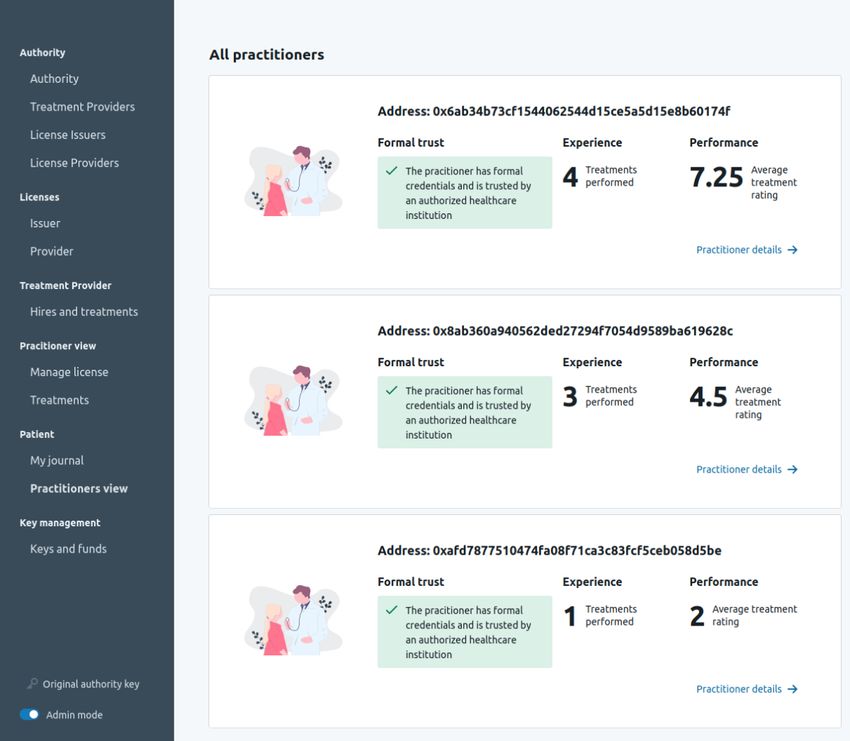
is trusted and valid. Figure 7 illustrates the verification of the
the addition or removal of an authority. The main role of
license, experiences, and skills of health practitioners.
authorities is to provide trust in the defined stakeholders, who
https://www.jmir.org/2021/7/e28496 J Med Internet Res 2021 | vol. 23 | iss. 7 | e28496 | p. 9
(page number not for citation purposes)
XSL• FO
RenderXJOURNAL OF MEDICAL INTERNET RESEARCH Hasselgren et al
Figure 7. Verification overview of health practitioners.
Usage Outside of the Patient and Caregiver Relationship
Evaluation of the Treatment
Although we focus on the patient and caregiver relationship in
Once the treatment is completed, the patient may evaluate the
the context of treatment, we also surface how public data sets
treatment. The patient can do so via the one-time key generated
have many use cases outside of this setting, such as audits,
during the treatment creation and thus create the evaluation
second opinion services, reporting, and evaluation of treatment
without revealing their identity. This evaluation can be linked
providers. Figure 8 shows the user interface for the patients.
implicitly to a treatment provider and an approving practitioner.
Future patients can use this information to enforce or decrease
their trust in a practitioner.
https://www.jmir.org/2021/7/e28496 J Med Internet Res 2021 | vol. 23 | iss. 7 | e28496 | p. 10
(page number not for citation purposes)
XSL• FO
RenderXJOURNAL OF MEDICAL INTERNET RESEARCH Hasselgren et al
Figure 8. Overview of the user interface for patients.
of the system, microcredentialing can be incorporated, making
Discussion it possible to verify specific skills among health care
This work outlines a theoretical basis for the need for a professionals.
blockchain enhanced trust model in a virtual health care setting, Our trust model is justified in real-world governance of health
which contributes to the overall understanding of how the health care. As an environment with heavy regulatory oversight,
care sector transforms into a new era, Healthcare 4.0, and the capturing pre-existing governance relationships on a public
potential problems that could arise along with this blockchain serves as a natural first step for providing trust in
transformation. Following this analysis, we built and virtualized settings. Furthermore, we strengthen our model by
implemented the novel VerifyMed platform that could trust in adding revocation abilities, where the trust of a governance
a virtualized health care environment. entity can be revoked if it acts in bad faith. The result is a trust
We have used design principles from the Industry 4.0 concept model justified in the inherited trust relationship between
to forecast Healthcare 4.0 and address an emerging problem in patients and the currently established health care system.
a future health care system. Our results show that our The VerifyMed platform enables individuals to store their
proof-of-concept implementation can be used to verify the respective credentials in a secure and accessible manner. The
authority of a health care worker, experience, and competence. provenance of these data can be guaranteed using the
The verifier does not have to place any trust in the health care immutability of the blockchain. In theory, this should mitigate
workers themselves. This process can be performed by anyone the need to constantly verify the credentials from the issuing
with access to the Ethereum blockchain network, making the body and potentially speed up recruitment and onboarding
evaluation process fully transparent. In the further development processes in the health care sector.
https://www.jmir.org/2021/7/e28496 J Med Internet Res 2021 | vol. 23 | iss. 7 | e28496 | p. 11
(page number not for citation purposes)
XSL• FO
RenderXJOURNAL OF MEDICAL INTERNET RESEARCH Hasselgren et al
We note that our trust model is extensible. A patient may trace trust rooted in real-world trust relationships on the blockchain.
all trust relationships from any evidence back to a top-level This model contrasts with the fully trustless principles, which
authority. The patient stands free to blindly trust the blockchain are usually applied within public blockchains but are necessary
or use a third-party service to independently verify each of the for the complex system of the health care domain. However,
upstream governance entities. this can open up using a permissioned blockchain instead of
fully public, which could have benefits such as reduced
Health data are inherently sensitive, and thus, demand privacy.
transaction costs and higher scalability. This should be explored
The management, storage, and access rights of health care data
in future studies.
are highly regulated, both through general data protection acts
such as the GDPR, health data specific acts such as the HIPAA, VerifyMed could, with future updates, enrich the current trust
and often national health data laws. In an initial analysis [46], model by including more trust requirements, such as (1) the
VerifyMed complies with the GDPR, although the general caregiver must trust that the patient exists, (2) the caregiver
compliance of blockchain and the GDPR is under investigation; must trust the authenticity of the data that the patient is willing
this work may have to be updated. Future work should include to share, and (3) a third party (eg, an insurance company) must
a comprehensive compliance analysis, and if appropriate, be able to trust the claim of the patient that care provision has
suggest an adaptation to comply with specific national health taken place. The patient cannot really understand the credentials
data laws and the HIPAA. and experience of a caregiver because having a license is not
the same as having credentials and having competency is not
VerifyMed does not cover an identity solution for any of the
the same as having experience. Thus, the system should make
users, and this is obviously an important component for the
the credentials or competency contextually important to the
system to be ready for a real-life setting. As identity
patient.
management is a core function in a health informatics system,
future work must address this issue and develop an identity In the forecasting analysis, experts were consulted based on a
solution fitted to this particular use case. convenience sample. This is not a comprehensive review of the
general opinions of experts but just guidance in the direction
VerifyMed uses the public Ethereum blockchain to host smart
of forecasting. It is not possible to preclude that this sample was
contracts. This choice is incorporated into the architecture, as
not biased. However, a review of the literature supports input
the public nature of the blockchain is considered. Using a public
from expert consulting.
blockchain requires limiting the published data to protect patient
privacy, and access control schemes must be implemented within The trust mechanism that the blockchain enables in this concept
smart contracts. In addition, there is a need to incorporate a provides a more transparent, accountable, and controlled
mechanism to transfer Ether (or smaller fractions of gas; ie, handling of verifying competence and experience. This could
gwei or nanoeth) between accounts, thereby allowing them to also be achieved using a centralized solution. However, in the
submit transactions. The key advantage of using a public transition to Healthcare 4.0, decentralization is of increasing
blockchain for this use case is transparency, no need for importance. This concept is consistent with this development.
interorganizational agreements, and the possibility of interacting
Future research also needs to further validate the use case and
with the underlying cryptocurrency of Ethereum. The
the proof of concept of VerifyMed. Before modifying and
disadvantages of using the Ethereum blockchain are the
updating the proof of concept, a feasibility study with real users
monetary price of transactions and scalability issues related to
should be undertaken to validate the concept and explore the
low throughput. Furthermore, as the platform is governed by a
interface design. The feasibility study could also address the
set of authorities, license issuers, license providers, and
challenge of how a patient interprets the presented verification
treatment providers, this allows the publication of evidence for
of experience and verification of the competence of a caregiver.
Authors' Contributions
AH contributed to the conceptualization, methodology, visualization, writing, and original draft preparation. JAHR contributed
to the data curation, software, and visualization. KK contributed to the writing, reviewing, supervision, and conceptualization.
DG contributed to the writing, reviewing, supervision, visualization, and conceptualization. AF was involved with the
conceptualization, methodology, visualization, writing, reviewing, and supervision.
Conflicts of Interest
None declared.
References
1. Oppers E, Chikada K, Eich F, Imam P, Kiff J, Kisser M, et al. The financial impact of longevity risk. In: Global Financial
Stability Report: The Quest for Lasting Stability. Washington, DC: International monetary fund; Apr 1, 2012:37.
2. Harris RE. Epidemiology of Chronic Disease: Global Perspectives: Global Perspectives. Burlington, Massachusetts, USA:
Jones & Bartlett learning; 2019.
3. Bongaarts J. Global fertility and population trends. Semin Reprod Med 2015 Jan;33(1):5-10. [doi: 10.1055/s-0034-1395272]
[Medline: 25565505]
https://www.jmir.org/2021/7/e28496 J Med Internet Res 2021 | vol. 23 | iss. 7 | e28496 | p. 12
(page number not for citation purposes)
XSL• FO
RenderXJOURNAL OF MEDICAL INTERNET RESEARCH Hasselgren et al
4. Raikwar M, Gligoroski D, Kralevska K. SoK of used cryptography in blockchain. IEEE Access 2019;7:148550-148575.
[doi: 10.1109/access.2019.2946983]
5. Nakamoto S. Bitcoin: A Peer-to-Peer Electronic Cash System. Bitcoin Org. 2019. URL: https://bitcoin.org/bitcoin.pdf
[accessed 2021-07-13]
6. Mohanta BK, Panda SS, Jena D. An Overview of Smart Contract and Use Cases in Blockchain Technology. In: 9th
International Conference on Computing, Communication and Networking Technologies. 2018 Jul 10 Presented at:
ICCCNT'18; July 10-12, 2018; Bengaluru, India p. 1-4. [doi: 10.1109/icccnt.2018.8494045]
7. Hasselgren A, Kralevska K, Gligoroski D, Pedersen SA, Faxvaag A. Blockchain in healthcare and health sciences-a scoping
review. Int J Med Inform 2020 Feb;134:104040 [FREE Full text] [doi: 10.1016/j.ijmedinf.2019.104040] [Medline: 31865055]
8. Buterin V. Blockchain Lab. 2014. URL: https://blockchainlab.com/pdf/
Ethereum_white_paper-a_next_generation_smart_contract_and_decentralized_application_platform-vitalik-buterin.pdf
[accessed 2021-07-13]
9. Rolfe T. Turing Completeness and Smart Contract Security. Medium -Where Good Ideas Find You. 2019 Feb 1. URL:
https://medium.com/kadena-io/turing-completeness-and-smart-contract-security-67e4c41704c [accessed 2021-05-08]
10. Kuo T, Rojas HZ, Ohno-Machado L. Comparison of blockchain platforms: a systematic review and healthcare examples.
J Am Med Inform Assoc 2019 May 1;26(5):462-478 [FREE Full text] [doi: 10.1093/jamia/ocy185] [Medline: 30907419]
11. Zhang M, Walker MA, White J, Schmidt DC, Lenz G. Metrics for Assessing Blockchain-based Healthcare Decentralized
Apps. In: 19th International Conference on e-Health Networking, Applications and Services. 2017 Dec 18 Presented at:
IEEE'17; October 12-15, 2017; Dalian, China. [doi: 10.1109/healthcom.2017.8210842]
12. Schmidt P. Blockcerts - An Open Infrastructure for Academic Credentials on the Blockchain. Medium - Where Good Ideas
Find You. 2016 Oct 24. URL: https://tinyurl.com/6f3jeb5t [accessed 2021-07-13]
13. Baldi M, Chiaraluce F, Kodra K, Spalazzi L. Security Analysis of a Blockchain-based Protocol for the Certification of
Academic Credentials. arXiv.org e-Print archive. 2019. URL: https://arxiv.org/abs/1910.04622 [accessed 2021-07-13]
14. A Digital Exchange for Professional Credentials Data. Hashed Health. 2020. URL: https://hashedhealth.com/
blockchain-healthcare-solutions/professional-credentials-exchange/ [accessed 2021-05-01]
15. Axuall, Inc. and MetroHealth Announce Collaboration to Improve and Streamline Practitioner Credentialing. PR Newswire.
2020. URL: https://www.prnewswire.com/news-releases/
axuall-inc-and-metrohealth-announce-collaboration-to-improve-and-streamline-practitioner-credentialing-300997828.html
[accessed 2021-05-01]
16. Campbell M, Fitzpatrick R, Haines A, Kinmonth AL, Sandercock P, Spiegelhalter D, et al. Framework for design and
evaluation of complex interventions to improve health. Br Med J 2000 Sep 16;321(7262):694-696 [FREE Full text] [doi:
10.1136/bmj.321.7262.694] [Medline: 10987780]
17. Doos L, Packer C, Ward D, Simpson S, Stevens A. Past speculations of the future: a review of the methods used for
forecasting emerging health technologies. BMJ Open 2016 Mar 10;6(3):e010479 [FREE Full text] [doi:
10.1136/bmjopen-2015-010479] [Medline: 26966060]
18. Pohl K. Requirements Engineering Fundamentals, Principles, and Techniques. Berlin/Heidelberg, Germany: Springer
Publishing Company; Jul 23, 2010.
19. Hevner, March, Park, Ram. Design science in information systems research. MIS Quarterly 2004;28(1):75. [doi:
10.2307/25148625]
20. Thuemmler C. In: Thuemmler C, Bai C, editors. Health 4.0: How Virtualization and Big Data are Revolutionizing Healthcare.
Swizerland: Springer International Publishing; 2017.
21. Lasi H, Fettke P, Kemper H, Feld T, Hoffmann M. Industry 4.0. Bus Inf Syst Eng 2014 Jun 19;6(4):239-242. [doi:
10.1007/s12599-014-0334-4]
22. Hermann M, Pentek T, Otto B. Design principles for Industrie 4.0 scenarios. In: 49th Hawaii International Conference on
System Sciences. 2016 Mar 10 Presented at: HICSS'16; January 5-8, 2016; Koloa, HI, USA. [doi: 10.1109/hicss.2016.488]
23. Gregor S. A Theory of Theories in Information Systems. Information Systems Foundations: Building the Theoretical Base.
2002. URL: https://tinyurl.com/ua9ka254 [accessed 2021-07-13]
24. McKnight D, Chervany N. Trust and distrust definitions: one bite at a time. In: Trust in Cyber-societies Integrating the
Human and Artificial Perspectives. Berlin, Heidelberg, Germany: Springer; Dec 20, 2001:27-54.
25. Rousseau DM, Sitkin SB, Burt RS, Camerer C. Not so different after all: a cross-discipline view of trust. Acad Manag Rev
1998 Jul 1;23(3):393-404. [doi: 10.5465/Amr.1998.926617]
26. Coulter A. Patients' views of the good doctor. Br Med J 2002 Sep 28;325(7366):668-669 [FREE Full text] [doi:
10.1136/bmj.325.7366.668] [Medline: 12351342]
27. Mechanic D, Schlesinger M. The impact of managed care on patients' trust in medical care and their physicians. J Am Med
Assoc 1996 Jun 5;275(21):1693-1697. [Medline: 8637148]
28. The duties of a doctor registered with the General Medical Council. General Medical Council. 1998. URL: https://www.
gmc-uk.org/ethical-guidance/ethical-guidance-for-doctors/good-medical-practice/duties-of-a-doctor [accessed 2021-07-13]
29. The Nurse's Code: A Practical Approach to the Code of Professional Conduct for Nurses, Midwives and Health Visitors.
London, UK: The British Psychological Society; 2018.
https://www.jmir.org/2021/7/e28496 J Med Internet Res 2021 | vol. 23 | iss. 7 | e28496 | p. 13
(page number not for citation purposes)
XSL• FO
RenderXJOURNAL OF MEDICAL INTERNET RESEARCH Hasselgren et al
30. Croker JE, Swancutt DR, Roberts MJ, Abel GA, Roland M, Campbell JL. Factors affecting patients' trust and confidence
in GPs: evidence from the English national GP patient survey. BMJ Open 2013 May 28;3(5):- [FREE Full text] [doi:
10.1136/bmjopen-2013-002762] [Medline: 23793686]
31. Sakallaris BR, Miller WL, Saper R, Kreitzer MJ, Jonas W. Meeting the challenge of a more person-centered future for US
healthcare. Glob Adv Health Med 2016 Jan;5(1):51-60 [FREE Full text] [doi: 10.7453/gahmj.2015.085] [Medline: 26937314]
32. Leimeister JM, Ebner W, Krcmar H. Design, implementation, and evaluation of trust-supporting components in virtual
communities for patients. J Manag Inf Syst 2014 Dec 8;21(4):101-131. [doi: 10.1080/07421222.2005.11045825]
33. O´neill O. Intelligent trust in a digital world. New Perspect Q 2017 Oct;34(4):27-31. [doi: 10.1111/npqu.12105]
34. Hall MA, Zheng B, Dugan E, Camacho F, Kidd KE, Mishra A, et al. Measuring patients' trust in their primary care providers.
Med Care Res Rev 2002 Sep;59(3):293-318. [doi: 10.1177/1077558702059003004] [Medline: 12205830]
35. Pearson SD, Raeke LH. Patients' trust in physicians: many theories, few measures, and little data. J Gen Intern Med 2000
Jul;15(7):509-513 [FREE Full text] [doi: 10.1046/j.1525-1497.2000.11002.x] [Medline: 10940139]
36. Frow P, McColl-Kennedy JR, Payne A. Co-creation practices: Their role in shaping a health care ecosystem. Ind Mark
Manag 2016 Jul;56:24-39. [doi: 10.1016/j.indmarman.2016.03.007]
37. Montague EN, Kleiner BM, Winchester WW. Empirically understanding trust in medical technology. Int J Ind Ergon 2009
Jul;39(4):628-634. [doi: 10.1016/j.ergon.2009.01.004]
38. Technical Report. CompData. 2017. URL: https://tinyurl.com/ek2s8pwa [accessed 2021-07-13]
39. Najib M, Abdullah S, Narresh S, Juni MH. Brain-drain phenomenon among healthcare workers. Int J Public Health Clin
Sci 2019 Jun 1;6(3):90-103. [doi: 10.32827/ijphcs.6.3.90]
40. Sabesan S, Kelly J, Evans R, Larkins S. A tele-oncology model replacing face-to-face specialist cancer care: perspectives
of patients in North Queensland. J Telemed Telecare 2014 Jun;20(4):207-211. [doi: 10.1177/1357633X14529237] [Medline:
24643950]
41. Andreassen HK, Trondsen M, Kummervold PE, Gammon D, Hjortdahl P. Patients who use e-mediated communication
with their doctor: new constructions of trust in the patient-doctor relationship. Qual Health Res 2006 Feb;16(2):238-248.
[doi: 10.1177/1049732305284667] [Medline: 16394212]
42. Rensaa H. Verifymed - Application of Blockchain Technology to Improve Trust in Virtualized Healthcare Services.
ResearchGate. Trondheim: Norwegian University of Science and Technology (NTNU); 2020 Jun 1. URL: https://www.
researchgate.net/publication/
349251550_VerifyMed_-_Application_of_blockchain_technology_to_improve_trust_in_virtualized_healthcare_services
[accessed 2021-07-13]
43. Rensaa H, Gligoroski D, Kralevska K, Hasselgren A, Faxvaag A. Verifymed-a Blockchain Platform for Transparent Trust
in Virtualized Healthcare: Proof-of-concept. In: Proceedings of the 2020 2nd International Electronics Communication
Conference. 2020 Jul Presented at: IECC'20; July 8-10, 2020; Singapore p. 73-80. [doi: 10.1145/3409934.3409946]
44. Rensaa J. Transparent healthcare. GitHub. 2020. URL: https://github.com/jarensaa/transparent-healthcare [accessed
2021-05-01]
45. van Eecke P, Haie A. Practitioner’s corner ∙ blockchain and the GDPR: the EU blockchain observatory report. Eur Data
Prot L Rev 2018;4(4):531-534. [doi: 10.21552/edpl/2018/4/18]
46. Hasselgren A, Wan P, Horn M, Kralevska K, Gligoroski D, Faxvaag A. GDPR Compliance for Blockchain Applications
in Healthcare. In: International Conference on Big Data, IoT and Blockchain. 2020 Oct Presented at: BIBC'20; October
24-25, 2020; Dubai, UAE URL: https://app.cristin.no/projects/show.jsf?id=2041854 [doi: 10.5121/csit.2020.101303]
Abbreviations
dApps: decentralized applications
GDPR: General Data Protection Regulation
HIPAA: American Health Insurance Portability and Accountability Act
PROM: patient-reported outcome measure
Edited by R Kukafka; submitted 04.03.21; peer-reviewed by R El-Gazzzar, D Cabrera, T Ueno, C Reis, TT Kuo; comments to author
26.04.21; revised version received 19.05.21; accepted 14.06.21; published 30.07.21
Please cite as:
Hasselgren A, Hanssen Rensaa JA, Kralevska K, Gligoroski D, Faxvaag A
Blockchain for Increased Trust in Virtual Health Care: Proof-of-Concept Study
J Med Internet Res 2021;23(7):e28496
URL: https://www.jmir.org/2021/7/e28496
doi: 10.2196/28496
PMID: 34328437
https://www.jmir.org/2021/7/e28496 J Med Internet Res 2021 | vol. 23 | iss. 7 | e28496 | p. 14
(page number not for citation purposes)
XSL• FO
RenderXYou can also read


