California Hospital COVID-19 Reporting Guidance
←
→
Page content transcription
If your browser does not render page correctly, please read the page content below
California Hospital COVID-19 Reporting Guidance

Table of Contents
California Hospital COVID-19 Reporting Guidance                   1
  Updates                                                         3
  Executive Summary                                               4
  Reporting Overview: Why Data Reporting is Vitally Important     5
  How to Successfully Complete Reporting: A Step-by-Step Guide    6
    How and When to Report                                        6
    Entering Data into the CHA COVID-19 Tracking Tool             7
    Entering Data into the HHS TeleTracking Portal               11
  Additional Guidance for General Reporting                      12
  Appendix                                                       16
    Data Dictionary – Additional Clarifications                  16
    CMS Enforcement Process for Non-Compliance                   37
    CDPH GACH Data Validation Process                            38
    TeleTracking Upload Process                                  40
    SmartSheet to HHS (TeleTracking) Crosswalk                   41
    Other Resources                                              46

                                                                  2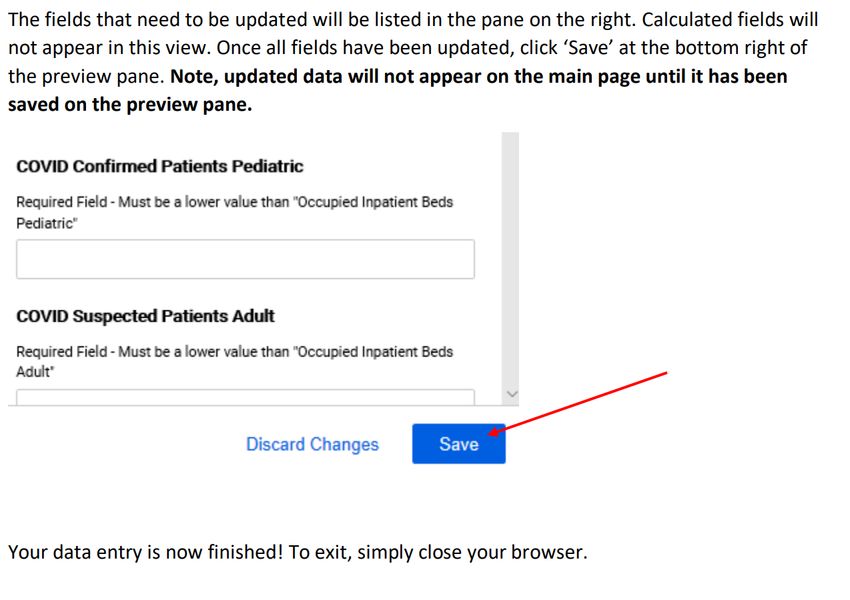
Updates
May 27, 2021:
In this update the six influenza fields are now optional. The two Bamlanivimab-only fields are also
now optional. These fields are optional starting June 10th, 2021. However, HHS/CMS is allowing
this change to be implemented early without any penalties.
March 31, 2021:
This update includes additional guidance for two new fields to capture the combination therapy of two
monoclonal antibodies Bamlanivimab / Etesevimab. It also updates guidance on vaccination fields which
now include single-dose vaccines, PPE re-use/extended use fields, and fields related to COVID among staff
members. The additional guidance on these fields have been added to the Additional Clarifications
section.
January 26, 2021:
Given the reporting variability of the newly added CHA variable “ICU Surge Beds,” we have updated the
data dictionary definition and provided clarification about which beds should be included in this category.

Clarification for the ED and Overflow (EDOF) categories has been added as well. Double-counting is
permitted for COVID-19-confirmed or suspected EDOF patients with admission orders in order to
appropriately capture the operational impact that these patients have in both the ED and inpatient (ICU
or non-ICU) departments.

Clarifications for vaccinations categories have been added as well.
January 8, 2021:
With hospitals overwhelmed by the COVID-19 surge, it is crucial to understand the multiple factors
contributing to ICU capacity, such as non-surge vs. surge beds and staffed vs. unstaffed beds. By updating
some reporting requirements, we will be able to make more precise assessments of how and when a
health care facility is stressed beyond capacity.

To achieve complete data for ICU beds and patients, this update adds a new variable for “ICU Surge
Beds” (see variable definition on pages 18-19).
    - If your facility has been combining reporting of ICU surge beds and ICU non-surge beds, please
        begin reporting them separately.
    - Do not double count ICU surge beds as ICU non-surge beds.
    - If your facility has not been reporting ICU surge beds, please begin doing so.

This update should rectify the issue with hospitals reporting more ICU patients than ICU beds.

                                                                                                         3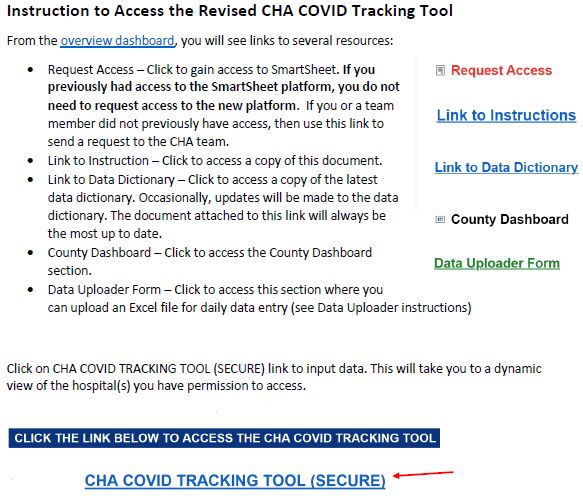
Executive Summary
California is committed to collecting accurate and complete hospital data, as this information
is crucial to managing the COVID-19 public health emergency (PHE). These data are also of vital
importance to the U.S. Department of Health and Human Services (HHS), which is using it to make
resource allocation decisions at the federal level. To emphasize the importance of complete
COVID-19 data reporting, on September 2, 2020, HHS announced that it would be implementing
stricter enforcement of hospital reporting. Failure to comply with required reporting triggers a
federal multi-step process of enforcement for non-compliance, which can result in the
termination of the Medicare provider agreement. Termination of the Medicare provider
agreement enacts the regulatory requirements at 42 CFR 455.416, which directs state Medicaid
agencies to deny or terminate enrollment of any Medicaid or Children’s Health Insurance
Program (CHIP) provider who is terminated from the Medicare program.
Recognizing the importance of this reporting and with the desire to make compliance as simple
as possible for hospitals, California convened an interdisciplinary workgroup to provide feedback
on the reporting process. Together, the workgroup developed this guidance document, which
includes in-depth information on the data reporting process. In this document, you will be
provided with information on why reporting COVID-19 data is important, how to successfully
report data, clarification of specific data dictionary variables, and other additional information
that may be needed for complete and accurate data reporting.
Ensuring that all hospitals report each variable uniformly is necessary to ensure the accuracy and
integrity of the data. This document is meant to be used as a reporting companion guide to help
ensure California’s hospitals remain in compliance with state and federal reporting
requirements.

                                                                                                4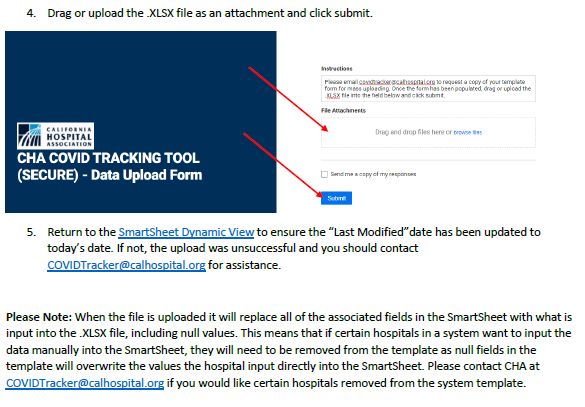
Reporting Overview: Why Data Reporting is Vitally Important
Data reporting is critical to the COVID-19 response to facilitate planning, monitoring, and
resource allocation during the COVID-19 PHE. The data are used to inform decisions at the
federal, state, and local levels. Allocations of supplies, treatments, and other resources are
informed by the data reported by hospitals. This reporting is the only data available to state and
federal governments for resource allocation purposes.
Failure to report complete data may lead to serious consequences. The Centers for Medicare &
Medicaid Services (CMS) will issue two warnings and three enforcement letters before
terminating a hospital’s Medicare provider agreement. Regulatory requirements at 42 CFR
455.416 direct state Medicaid agencies to deny or terminate enrollment of any Medicaid or
CHIP provider who is terminated from the Medicare program.
Policy makers rely on the analysis of the data reporting to make critical management decisions
during the COVID-19 pandemic. Our strategy for protecting the public health and welfare of all
Californians relies upon ensuring accurate and high-quality reporting from California’s hospitals.
We cannot achieve the shared goal of keeping Californians healthy without your continued
efforts, and we greatly appreciate your hard work.

                                                                                                5
How to Successfully Complete Reporting: A Step-by-Step Guide
How and When to Report
Exactly how and for which days a hospital must report data to the state and federal government
are dictated by two elements. The first is the hospital type. General acute care hospitals (GACHs),
rehabilitation hospitals, and long-term care facilities must report their data to the CHA COVID-19
Tracking Tool by noon (PT). Psychiatric hospitals must report their data directly to HHS via the
TeleTracking portal. While GACHs and long-term care facilities report data daily, rehabilitation
and psychiatric hospitals report only on Wednesdays.
The second element that dictates how data will be reported is based on a hospital’s preference.
A GACH, rehabilitation hospital, or long-term care facility can opt out of having the state submit
data to HHS on its behalf by sending an e-mail to CDPH at COVID-19-CHCQData@cdph.ca.gov.
After informing CDPH of its desire to opt out, the hospital must report to both the CHA COVID-
19 Tracking Tool and the HHS TeleTracking portal (note, this is not applicable to psychiatric
hospitals that must report their data directly to HHS).
Facility Type Reporting To Frequency
General Acute • CHA COVID-19 Tracking Tool – Required Daily
Care • HHS TeleTracking Portal – Optional. GACHs must notify
Hospitals CDPH if they choose to opt out of having the state
(GACHs) submit data on their behalf.
Psychiatric • HHS TeleTracking - Required Weekly:
Hospitals Wednesdays
Rehabilitation • CHA COVID-19 Tracking Tool – Required Weekly:
Hospitals • HHS TeleTracking – Optional. Rehabilitation hospitals Wednesdays
must notify CDPH if they choose to opt out of having
the state submit data on their behalf.
Long-Term • CHA COVID-19 Tracking Tool – Required Daily
Care Facilities • HHS TeleTracking – Optional. Long-term care facilities
must notify CDPH if they choose to opt out of having
the state submit data on their behalf.
6Entering Data into the CHA COVID-19 Tracking Tool
There are two options for uploading data into the CHA COVID-19 Tracking Tool (detailed steps
given below). For the current day, a hospital can enter its data manually or it can upload a
spreadsheet with one or multiple hospitals’ data for that day. It is important to note that both
options require the user to first set up a SmartSheet account using their work e-mail address and
a password of their choice. Once the account is verified by SmartSheet, the user can access the
CHA COVID-19 Tracking Tool Overview Dashboard using a Chrome browser to request access to
the tool.
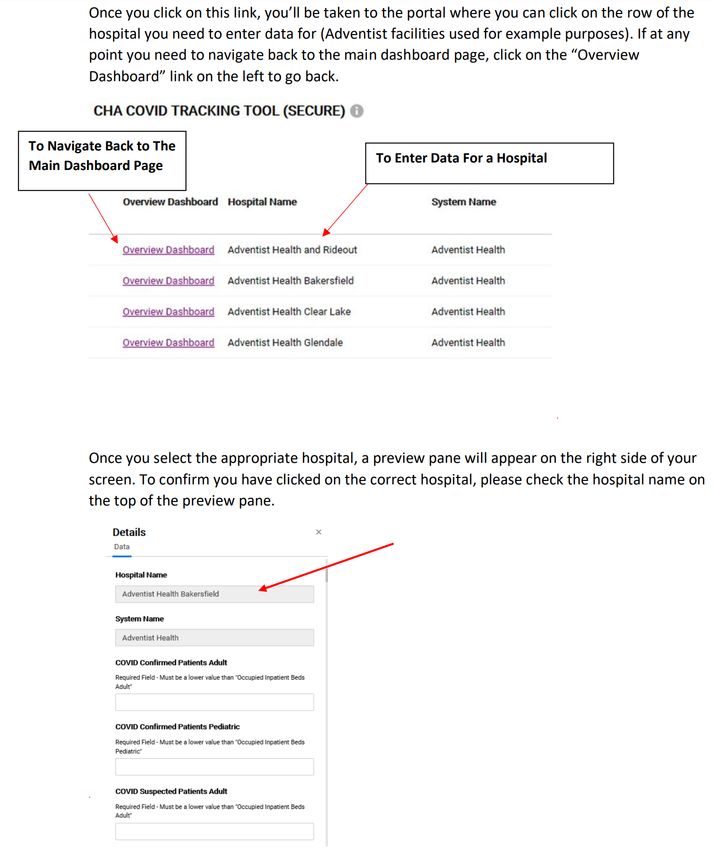
Instructions for Uploading Manual Entry for Single Hospital
78
9
Instructions for Data Uploading via Excel Spreadsheet

                                                        10
When Data Won’t Upload Using the Data Upload Function
If the “Last Modified” date doesn’t reflect today’s date, this means the data upload was not
successfully completed. This is typically caused by one of two reasons:
o When multiple hospitals attempt to upload the Excel template at the same time,
the SmartSheet platform will not allow the files to go through simultaneously; it
can only accept one file at a time. The user should wait a couple of minutes and
try again.
o If the above does not work, check the format of the data in the Excel upload
template. The data must be in a very specific format for the upload to be
successful. For example, the upload will be rejected if a letter is input where a
number is required or vice-versa.
Entering Data into the HHS TeleTracking Portal
Instructions on how to enter data directly into the HHS TeleTracking portal can be found on the
TeleTracking website. Users can submit data for the current day or the last four days using the
data upload feature. Any questions or issues with reporting should be directed to TeleTracking
Support or by calling TeleTracking at 877-570-6903, press 7.
11Additional Guidance for General Reporting
Additional guidance that may aid in the reporting process includes:
- Blank Cells:
If there is a variable with a value of zero, it is very important to input zero and not
leave the field blank. If the hospital doesn’t have a specific unit (e.g., emergency
department, adult beds, intensive care unit), enter a zero for the related field but do
not leave it blank. The exception is for fields that are only required to be reported on
Wednesday (e.g., personal protective equipment). These fields may be left blank on
the other six days of the week or the value from the previous Wednesday can be
caried over until the next Wednesday.
- Correcting Erroneous Data Submissions from a Prior Day:
Hospitals that need to correct erroneous data from a prior day’s submission should
do two things:
o Email the corrections to CDPH at COVID-19-CHCQData@cdph.ca.gov, notifying
them of the erroneous submission and the correction.
o Correct the data in TeleTracking. For corrections prior to the last seven days,
contact TeleTracking support at hhs-protect@teletracking.com or 877-570-6903,
press 7.
- Retroactive Reporting (reporting the weekend’s data on a Monday):
For state reporting, hospitals need to report data every day. The CHA COVID-19
Tracking Tool utilizes the SmartSheet platform, which is unable to process retroactive
reporting.
For federal reporting, the HHS TeleTracking portal will accept data retroactively.
Hospitals should report missed days' data by entering the data directly into the
TeleTracking portal. NOTE: This does not change the state requirement to report to
the CHA COVID-19 Tracking Tool daily. Hospitals that have opted out of the state
reporting to HHS will still be required to submit daily data to the CHA COVID-19
Tracking Tool even if they are retroactively reporting to HHS.
- Common Input Errors:
o Do not input any text or special characters (e.g., N/A, Unknown, 13-NICU) into
numeric fields.
o Do not input decimals into whole number fields (e.g., 6376.00000, 168.3)
12o Do not combine multiple days’ data.
o Do not add leading or trailing zeros (e.g., 000555, 7876830000000)
- Adult vs. Pediatric Beds:
Pediatric beds are designated for patients < 18 years old. If an inpatient or ICU bed is
designated for non-pediatric and non-neonatal use, this bed should be reported as an
adult bed. Any patient ≥ 18 years should be reported as “adult,” whether they are
occupying a med/surge or ICU bed.
- Surge variables:
o Clarifying defined terminology:
A Surge Event is a significant event or circumstances that impact the health
care delivery system and result in excess demand over capacity and/or
capability in hospitals, community care clinics, public health departments,
other primary and secondary care providers, resources, and/or emergency
medical services. This definition does not take into consideration the scope
of the event or the time between the onset of the surge and a local or
statewide proclamation of a disaster and/or issuance of gubernatorial
Executive Orders waiving specific licensing and scope of practice
requirements.
Surge includes policies, procedures, beds, and medical and staffing
resources specified in the Emergency Operations Plan or hospital’s
individualized surge plan. These variables refer to additional/alternate
operations and resources that allow the hospital to continue providing
patient care while functioning above routine capacity during non-surge
times.
Surge Beds are the number of additional or converted inpatient beds not
available during routine non-surge operations that the hospital could add
or has added if/when all available space were used for patient care. This is
a process allowed under the terms of the temporary California Department
of Public Health waiver. This number should include all beds in spaces not
routinely available or used for patient care (e.g., mothballed wards, gift
shops, outdoor tents, hallways, etc.). If the bed is not currently staffed and
equipped but is usable and has the potential to be staffed and equipped
under the hospital's established surge plan, it should be counted.
o Reporting bed totals:
Beds should be categorized as either non-surge or surge, and not double
counted. For example, if a floor telemetry bed is converted into a surge
13ICU bed, it should be counted in the surge bed category only.
- ED and Overflow (EDOF) Patients with Confirmed or Suspected COVID-19:
o General Description: EDOF patients are those awaiting an inpatient bed. These
patients may be in the ED or any overflow location and may or may not have
admission orders. This category will capture overall ED burden by including all ED
and overflow patients pending admission.
o Surge vs. Non-Surge Inpatient: If a patient has an admission order for an
inpatient bed and is being held in the ED or another overflow location until an
inpatient bed becomes available, the patient should be counted in the “Surge”
category for the corresponding unit (ICU or non-ICU) by default. These
admitted EDOF patients are counted in the Surge categories because they are
boarding in (ED and overflow) locations that are not routinely used for inpatient
care. These admitted EDOF patients should be counted in the Surge categories
unless it is known at the time of admission that they will occupy a non-surge
bed (e.g., a non-surge bed will be readily available before a surge bed, the
patient is destined for a non-surge bed as part of a COVID cohort, etc.),
o Double Counting: If a COVID-19-confirmed or suspected patient has an
admission order for an inpatient bed and is being held in the ED or another
overflow location until an inpatient bed becomes available, that patient should
be counted in both the “ED and Overflow” and the corresponding surge (“ICU”
or “Non-ICU”) categories. Double-counting is permitted and important in this
circumstance given the operational impact of these admitted EDOF patients. For
instance, if a COVID-confirmed or suspected EDOF patient has ICU admission
orders, the patient requires ICU level of care while boarding in the ED and should
be counted as such. Because the patient is occupying limited ED space and
requiring ED resources and staff, they should be reported in the EDOF fields as
well.
- Vaccine Administration:
o Health Care Personnel: Health care personnel includes all paid and unpaid
persons serving in health care settings who have the potential for direct or
indirect exposure to patients or infectious materials. This includes volunteers,
physicians, per diem employees, etc. If personnel regularly work at multiple
facilities, count them for each facility.
Hospitals should be tracking the vaccination status of those employees
who serve in health care settings with direct or indirect exposure to
patients or infectious materials. A facility should count all vaccinated
healthcare personnel, regardless of where those healthcare personnel
14received their vaccination – at the facility or another location, e.g.
another healthcare facility, a local health department, etc.
o Patients: For fields “Previous Week's First/Last COVID Vaccine Doses,” patients
include anyone provided a vaccination, not just inpatient or admitted patients. It
includes any individual who is not a healthcare worker at your facility that is
vaccinated in any setting in your facility, including inpatient, outpatient, and ED
settings, and patients vaccinated in any other care setting in your facility.
o Multiple Campuses: If two campuses share the same CCN and the staff move
interchangeably between the two, the vaccines and staff can be reported under
one of the facilities. If the facilities have different CCNs, then the staff under
each facility should be double-counted.
o HHS Vaccination Fields FAQ: HHS released a Frequently Asked Questions with
guidance on vaccination related fields. It can be found here.
15Appendix
Data Dictionary – Additional Clarifications
Variable Data Dictionary Definition Additional Clarification
The number of observation
patients and inpatients in the A positive test does not need to be
hospital who have laboratory- confirmed by the CDC for the
COVID Confirmed confirmed COVID-19. Once a patient to be categorized as a
Patients patient has laboratory-confirmed COVID-19 confirmed case.
COVID-19, the patient should be Include patients co-infected with
included in this field until both COVID-19 and influenza.
discharge.
The number of observation
patients and inpatients in adult A positive test does not need to be
beds in the hospital who have confirmed by the CDC for the
COVID Confirmed laboratory-confirmed COVID-19. patient to be categorized as a
Patients Adult Once a patient has laboratory- COVID-19 confirmed case.
confirmed COVID-19, the patient Include patients co-infected with
should be included in this field both COVID-19 and influenza.
until discharge.
The number of observation
patients and inpatients in pediatric A positive test does not need to be
beds (including NICU) in the confirmed by the CDC for the
hospital who have laboratory- patient to be categorized as a
COVID Confirmed
confirmed COVID-19. Once a COVID-19 confirmed case.
Patients Pediatric
patient has laboratory-confirmed
COVID-19, the patient should be Include patients co-infected with
included in this field until both COVID-19 and influenza.
discharge.
The total number of mechanical This number is meant to represent
Total Ventilators ventilators in use for patients with the total number of ventilators in
in Hospital in Use any diagnosis at the time the data your hospital of any type and
Any Dx are collected, including adult, matches the definition provided in
pediatric, neonatal ventilators, the HHS guidance.
16anesthesia machines and
portable/transport ventilators.
Include BiPAP machines if the
hospital uses BiPAP to deliver
positive pressure ventilation via
artificial airways.
Patients with suspected or
confirmed COVID-19 who are
COVID ED and
currently using ventilators but not
Overflow Patients assigned to a hospital bed. These This is a calculated field.
Using Ventilation patients may be in the ED or any
overflow location awaiting an
inpatient bed.
ED and Overflow patients may or
may not have admission orders.
If a COVID-19 suspected patient
Patients with laboratory has an admission order for an
COVID ED and confirmed COVID-19 who are inpatient bed and is being held in
Overflow Patients currently using a ventilator but not the ED or another overflow
Using Ventilation assigned to an adult hospital bed. location until an inpatient bed
These adult patients may be in the
Adult becomes available, that patient
ED or any overflow location
awaiting an inpatient adult bed. should be counted in both the “ED
and Overflow” and the
corresponding surge or non-surge
categories.
ED and Overflow patients may or
may not have admission orders.
Patients with laboratory
If a COVID-19 confirmed patient
confirmed COVID-19 who are
COVID ED and
currently using a ventilator but not has an admission order for an
Overflow Patients assigned to a pediatric hospital inpatient bed and is being held in
Using Ventilation bed. These pediatric patients may the ED or another overflow
Pediatric be in the ED or any overflow location until an inpatient bed
location awaiting an inpatient becomes available, that patient
pediatric bed.
should be counted in both the “ED
and Overflow” and the
17corresponding surge or non-surge
categories.
Patients with laboratory
ED and Overflow confirmed COVID-19 who are
Confirmed currently not assigned to a This is a calculated field.
Patients hospital bed. These patients may
be in the ED or any overflow
location awaiting an inpatient bed.
ED and Overflow patients may or
may not have admission orders.
If a COVID-19-confirmed patient
Patients with laboratory
has an admission order for an
confirmed COVID-19 who are
inpatient bed and is being held in
ED and Overflow currently not assigned to an adult
the ED or another overflow
Confirmed hospital bed. These patients may
location until an inpatient bed
Patients Adult be in the ED or any overflow
becomes available, that patient
location awaiting an inpatient
should be counted in both the “ED
adult bed.
and Overflow” and the
corresponding surge or non-surge
categories
ED and Overflow patients may or
may not have admission orders.
If a COVID-19-confirmed patient
Patients with laboratory
has an admission order for an
confirmed COVID-19 who are
ED and Overflow inpatient bed and is being held in
currently not assigned to a
Confirmed the ED or another overflow
pediatric hospital bed. These
Patients location until an inpatient bed
patients may be in the ED or any
Pediatrics becomes available, that patient
overflow location awaiting an
should be counted in both the “ED
inpatient pediatric bed.
and Overflow” and the
corresponding surge or non-surge
categories
ED and Overflow Patients with suspected COVID-19
Suspected who are currently not assigned to This is a calculated field.
Patients a hospital bed. These patients may
18be in the ED or any overflow
location awaiting an inpatient bed.
ED and Overflow patients may or
may not have admission orders.
If a COVID-19-suspected patient
Patients with suspected COVID-19 has an admission order for an
who are currently not assigned to inpatient bed and is being held in
ED and Overflow
an adult hospital bed. These adult the ED or another overflow
Suspected
patients may be in the ED or any location until an inpatient bed
Patients Adult
overflow location awaiting an becomes available, that patient
inpatient adult bed. should be counted in both the “ED
and Overflow” and the
corresponding surge or non-surge
categories.
ED and Overflow patients may or
may not have admission orders.
If a COVID-19-suspected patient
Patients with suspected COVID-19 has an admission order for an
who are currently not assigned to inpatient bed and is being held in
ED and Overflow
a pediatric hospital bed. These the ED or another overflow
Suspected
patients may be in the ED or any location until an inpatient bed
Patients Pediatric
overflow location awaiting an becomes available, that patient
inpatient pediatric bed. should be counted in both the “ED
and Overflow” and the
corresponding surge or non-surge
categories.
Enter the number of COVID-19 This weekly field is currently
vaccination doses administered in optional.
the previous week (regardless of
whether it is a first, second, or Enter vaccination doses
Previous Week's
final dose in a series or single-dose administered to health care
COVID Vaccine
vaccine) to any healthcare personnel. Health care personnel
Doses
personnel (serving your facility or include all paid and unpaid persons
elsewhere). For the first week of
serving in health care settings who
reporting, include all doses given
up to that date. have the potential for direct or
19indirect exposure to patients or
infectious materials.
This field should include all doses
administered by a site, regardless
of whether the healthcare
personnel work for that particular
site.
This weekly field is currently
optional.
This field is meant to represent
Enter the number of healthcare
Unvaccinated personnel serving your facility who
personnel who have not yet
Personnel have not had a single vaccine dose yet
received any vaccine dose.
regardless of where the vaccine is
administered (your facility or
elsewhere).
This weekly field is currently
Enter the current total number of
optional.
health care personnel who have
received at least one dose of A facility should count all
COVID-19 vaccination that is vaccinated healthcare personnel
Personnel administered in a multi-dose serving your facility, regardless of
Receiving a series. This field is meant to
where those healthcare personnel
Partial Series represent those who have begun
but not completed the received their vaccination – at the
vaccination process. Do not facility or another location, e.g.
include those who received a another healthcare facility, a local
single-dose vaccine in this field. health department, etc.
Enter the current total number of This weekly field is currently
health care personnel who have optional.
received a complete series of a Count all vaccinated healthcare
COVID-19 vaccination. Include
personnel serving your facility,
those who have received all doses
Personnel regardless of where those
in a multi-dose series as well as
Receiving a healthcare personnel received
those who received a single-dose
Complete Series
vaccine. their vaccination – at the facility or
another location, e.g. another
20healthcare facility, a local health
department, etc.
This weekly field is currently
optional.
Enter the current total number of Health care personnel include all
health care personnel for the paid and unpaid persons serving
Total Personnel
facility. your facility in health care settings
who have the potential for direct
or indirect exposure to patients or
infectious materials
This weekly field is currently
Enter the number of patients in optional.
the previous week who received “Patients” include any patients,
the first dose of a COVID-19
defined as any person who is not a
vaccine that is administered in a
Previous Week's healthcare worker at your facility,
multi-dose series. Do not include
First COVID who are vaccinated. Include
those who received the second or
Vaccine Doses
final dose in a series or single-dose inpatient or outpatient,
vaccines. For the first week of observation, ED, or other
reporting, include all doses given treatment areas.
up to that date.
This weekly field is currently
optional.
Enter the number of patients in “Patients” include any patients,
Previous Week's the previous week who received defined as any person who is not a
Final COVID the final dose in a COVID-19 healthcare worker at your facility,
Vaccine Doses vaccination multi-dose series or who are vaccinated. Include
received a single dose vaccine. inpatient or outpatient,
observation, ED, or other
treatment areas.
The total number of all staffed
Total Non-Surge inpatient and outpatient beds in Psychiatric, maternity, and L&D
Beds your hospital used for inpatients beds should be included.
(includes ICU) and outpatients
21(includes observation beds). If the
bed is not currently staffed or
equipped but is usable and has the
potential to be staffed and
equipped using routine available
hospital resources and staffing, it
should be counted. This number
should exclude surge beds.
The total number of all staffed
adult (as defined by room
designation) inpatient (includes
ICU) and outpatient (includes
observation) beds in your hospital.
Total Non-Surge If the bed is not currently staffed Psychiatric, maternity, and L&D
Beds Adult or equipped but is usable and has beds should be included.
the potential to be staffed and
equipped using routine available
hospital resources and staffing, it
should be counted. This number
should exclude surge beds.
The number of beds currently
occupied with patients. This
includes any patients who may be
Occupied Non- located in an outpatient area Psychiatric, maternity, and L&D
Surge Inpatient within the facility (e.g., ED or beds should be included.
Beds PACU bays) who have an inpatient
or observation order. This number
should exclude occupied surge
beds.
The number of adult beds
occupied with a patient. This
includes any patients who may be
Occupied Non- located in an outpatient area Psychiatric, maternity, and L&D
Surge Inpatient within the facility (e.g., ED or beds should be included.
Beds Adult PACU bays) who have an inpatient
or observation order. This number
should exclude occupied surge
beds.
22The total number of all staffed
inpatient beds in your hospital
(including all ICU beds). If the bed
is not currently staffed or
equipped but is usable and has the
potential to be staffed and Psychiatric, maternity, and L&D
Total Non-Surge
equipped using routine available beds should be included.
Inpatient Beds
hospital resources and staffing, it
should be counted. This number
should also include outpatient
beds that are holding inpatients
who are boarding and should
exclude surge beds.
The total number of all staffed
inpatient adult beds in your
hospital (including all ICU beds). If
the bed is not currently staffed or
equipped but is usable and has the
Total Non-Surge potential to be staffed and Psychiatric, maternity, and L&D
Inpatient Beds equipped using routine available beds should be included.
Adult hospital resources and staffing, it
should be counted. This number
should also include outpatient
beds that are holding inpatients
who are boarding and should
exclude surge beds.
The number of additional
inpatient beds that the hospital Surge beds are all beds allocated
could add if all available space from Surge resources. Beds should
were used for patient care, a be categorized as either non-surge
process allowed under the terms or surge, and not double counted.
of the temporary Department of For example, if a floor telemetry
Surge Beds bed is converted into a surge ICU
Public Health waiver. This number
bed, it should be counted in the
should include any and all beds in
surge fields only. This is the total
spaces not routinely used for number of ALL surge beds (i.e., the
patient care (e.g., gift shop, sum of ICU surge beds + non-ICU
outdoor tents, hallways, etc.). If surge beds).
the bed is not currently staffed
and equipped but is usable and
23has the potential to be staffed and
equipped under the hospital's
established surge plan, it should
be counted.
The number of patients occupying
Surge Bed Non- Surge beds are all beds allocated
non-ICU surge beds at the
ICU Patients from Surge resources.
hospital.
Surge beds are all beds allocated
from Surge resources. This is the
Surge Bed ICU The number of patients occupying
number of ICU surge beds that are
Patients ICU surge beds at the hospital.
occupied. This is a subset of ICU
Surge Beds.
The current number of additional
physical, staffed adult ICU beds
that the hospital has added or
could add if all ICU appropriate
and available space were used for
patient care (occupied and
unoccupied), a process allowed
under the terms of the temporary
Department of Public Health This variable has been newly
added. This is the Total ICU Staffed
waiver. This number should
or Staffable Surge Beds; this is a
ICU Surge Beds include any and all ICU beds in subset of Total Surge Beds. Surge
spaces not routinely used for ICU beds are all beds allocated from
level care but that have the Surge resources.
capacity to accommodate
standard ICU equipment and
functions (e.g. PACU, operating
rooms, telemetry units, step-down
units, placing additional ICU beds
in one ICU room, etc.). If the bed is
not currently in use but can be
readily staffed and equipped for
ICU level care under the hospital’s
24established surge plan, it should
be counted.
Surge Bed The percent of available surge Surge beds are all beds allocated
Occupancy Rate beds in use. from Surge resources.
ICU Non-Surge The current number of adult ICU
Adult patients in ICU beds staffed
Occupied Beds beds occupied by a patient,
using routine resources.
Adult excluding surge beds.
Variable has been renamed from
ICU Non-Surge The current number of pediatric “ICU Non-Surge Occupied Beds
Occupied Beds ICU beds occupied by a patient, Pediatric.” Pediatric patients in
PICU excluding surge beds and NICU. pediatric ICU beds staffed using
routine resources.
ICU Non-Surge The current number of neonatal Neonatal patients in Neonatal ICU
Occupied Beds ICU beds occupied by a patient, beds staffed using routine
NICU excluding surge beds. resources.
The current number of physical,
staffed adult intensive care beds
in the facility. If the intensive care
bed is not currently staffed and Total Staffed or Staffable using
equipped but is usable and has the routine resources for Non-Surge
potential to be staffed and ICU Beds.
equipped using routine available
ICU Non-Surge
hospital resources and staffing it
Total Beds Adult
should be counted. The same
would apply to a blocked intensive
care bed. If the intensive care bed
is currently blocked, but is a
usable bed, it should be counted.
This number should exclude surge
beds.
The current number of physical,
ICU Non-Surge staffed inpatient pediatric Variable has been renamed from
Total Beds PICU intensive care beds in the facility. “ICU Non-Surge Total Beds
25If the intensive care bed is not Pediatric.” Total Pediatric Staffed
currently staffed and equipped or Staffable using routine resources
but is usable and has the potential for Non-Surge ICU Beds.
to be staffed and equipped using
routine available hospital
resources and staffing, using
available hospital resources and
staffing, it should be counted. The
same would apply to a blocked
intensive care bed. If the intensive
care bed is currently blocked, but
is a usable bed, it should be
counted. This number should
exclude surge beds and NICU.
The current number of physical,
staffed inpatient neonatal
intensive care beds in the facility.
If the intensive care bed is not
currently staffed and equipped
but is usable and has the potential
to be staffed and equipped using
routine available hospital Total Neonatal Staffed or Staffable
ICU Non-Surge
resources and staffing, using using routine resources for Non-
Total Beds NICU
available hospital resources and Surge ICU Beds.
staffing, it should be counted. The
same would apply to a blocked
intensive care bed. If the intensive
care bed is currently blocked, but
is a usable bed, it should be
counted. This number should
exclude surge beds.
Admits in The total number of patients who
were admitted to an inpatient bed This variable is not the same as the
Previous Day
on the previous calendar day (12 previous day’s census.
Confirmed
a.m. - 11:59 p.m.) and who had
26confirmed COVID-19 at the time of
admission.
The total number of patients who
were admitted to an inpatient bed
Admits in
on the previous calendar day (12 This variable is not the same as the
Previous Day
a.m. - 11:59 p.m.) and who had previous day’s census.
Suspected
suspected COVID-19 at the time of
admission.
The data fields are seeking to
capture the status of those
admitted the previous day at the
time of admission. So, if someone
Confirmed - The total number of was admitted at 1 p.m. and you
patients who were admitted to an knew the patient was COVID-19
inpatient bed on the previous positive, then this would be in the
calendar day (12 a.m. - 11:59 p.m.) previous day's confirmed counts. If
Admits in and who had confirmed COVID-19 the patient was symptomatic at 1
at the time of admission. p.m. but you did not yet have a
Previous Day
positive test in hand (or a result
Confirmed vs. Suspected - The total number of coming in the very near future
Suspected patients who were admitted to an from a rapid test), then this patient
inpatient bed on the previous would be included in the previous
calendar day (12 a.m. - 11:59 p.m.) day's suspected counts (even if you
and who had suspected COVID-19 learn later in the day that the
at the time of admission. patient was COVID-19 positive). If a
patient was admitted for non-
COVID-19 reasons, but you learn
later they are positive, then this
patient would not be included.
The calculated days of supply in Base response on the item that has
Ventilator stock for ventilator supplies. the lowest stock on hand. If an
Supplies Days On Calculation may be provided by item has multiple parts, a shortage
Hand your hospital's ERP system or by of one part indicates a shortage of
utilizing the CDC's PPE burn rate that item.
calculator assumptions. For supply
27categories such as this that may Only consider ventilator supplies
have varying quantities, days on that the hospital is able to maintain
hand, or ability to obtain and using internal resources.
maintain, reply for the item that
has the lowest stock on hand.
Base response on the item that has
the lowest stock on hand. If an
Select "Yes" if your facility is able item has multiple parts, a shortage
Ventilator to order and obtain ventilator of one part indicates a shortage of
Supplies Able to supplies. Select "No" if your that item.
Obtain facility is not able to order and
obtain ventilator supplies. Only consider ventilator supplies
that the hospital is able to maintain
using internal resources.
Base response on the item that has
Select "Yes" if you are able to the lowest stock on hand. If an
Ventilator maintain at least a 3-day supply item has multiple parts, a shortage
Supplies: Can for ventilator supplies. Select "No" of one part indicates a shortage of
Maintain 3-Day if you are not able to maintain at that item.
Supply? least a 3-day supply for ventilator Only consider ventilator supplies
supplies. that the hospital is able to maintain
using internal resources.
Select "Yes" if your facility is able
to order and obtain ventilator Base response on the item that has
medications. Select "No" if your the lowest stock on hand. If an
facility is not able to order and item has multiple parts, a shortage
Ventilator obtain ventilator medications. of one part indicates a shortage of
Medications Able Ventilator medications include that item.
to Obtain Propofol, Midazolam,
Dexmedetomidine,
Hydromorphone, Fentanyl,
Cisatracurium, and Rocuronium.
Select "Yes" if you are able to Base response on the item that has
maintain at least a 3-day supply the lowest stock on hand. If an
for ventilator medications. Select item has multiple parts, a shortage
28Ventilator "No" if you are not able to of one part indicates a shortage of
Medications: Can maintain at least a 3-day supply that item.
Maintain 3-Day for ventilator medications.
Supply? Ventilator medications include
Propofol, Midazolam,
Dexmedetomidine,
Hydromorphone, Fentanyl,
Cisatracurium, and Rocuronium.
The current number of N95 masks
Report this variable once a week
ready for use. This field is optional
Total N95 Masks on Wednesday and only if it is
and should be provided only if
feasible.
feasible.
Report this variable once a week
on Wednesday and only if it is
The current number of surgical feasible.
and procedure masks ready for
Total Surgical and Base response on the item that has
use. This field is optional and
Procedure Masks the lowest stock on hand. If an
should be provided only if
feasible. item has multiple parts, a shortage
of one part indicates a shortage of
that item.
The calculated days of supply in
stock for surgical and procedure
masks. Calculation may be
provided by your hospital's ERP Base response on the item that has
system or by utilizing the CDC's the lowest stock on hand. If an
PPE burn rate calculator item has multiple parts, a shortage
Surgical and
assumptions. For supply of one part indicates a shortage of
Procedure Mask
categories such as this that may that item.
Days On Hand
have varying quantities, days on
hand, or ability to obtain and
maintain, reply for the item that
has the lowest stock on hand.
29Select "Yes" if your facility is able Base response on the item that has
to order and obtain surgical and the lowest stock on hand. If an
Surgical and
procedure masks. Select "No" if item has multiple parts, a shortage
Procedure Masks
your facility is not able to order of one part indicates a shortage of
Able to Obtain
and obtain surgical and procedure that item.
masks.
Select "Yes" if you are able to Base response on the item that has
Surgical and maintain at least a 3-day supply the lowest stock on hand. If an
Procedure Masks: for surgical and procedure masks. item has multiple parts, a shortage
Can Maintain 3- Select "No" if you are not able to of one part indicates a shortage of
Day Supply? maintain at least a 3-day supply that item.
for surgical and procedure masks.
The current number of eye
protection pieces (including face Report this variable once a week
shields and goggles) ready for use. on Wednesday and only if it is
For supply categories such as this feasible.
Total Eye that may have varying quantities, Base response on the item that has
Protection days on hand, or ability to obtain the lowest stock on hand. If an
and maintain, reply for the item item has multiple parts, a shortage
that has the lowest stock on hand. of one part indicates a shortage of
This field is optional and should be that item.
provided only if feasible.
The calculated days of supply in
stock for eye protection pieces Base response on the item that has
(including face shields and
the lowest stock on hand. If an
Eye Protection goggles). Calculation may be item has multiple parts, a shortage
Days On Hand provided by your hospital's ERP of one part indicates a shortage of
system or by utilizing the CDC's that item.
PPE burn rate calculator
assumptions.
Eye Protection Select "Yes" if your facility is able
to order and obtain eye Base response on the item that has
Able to Obtain
protection. Select "No" if your the lowest stock on hand. If an
item has multiple parts, a shortage
30facility is not able to order and of one part indicates a shortage of
obtain eye protection. that item.
Select "Yes" if you are able to
maintain at least a 3-day supply Base response on the item that has
Eye Protection: for eye protection pieces the lowest stock on hand. If an
Can Maintain 3- (including face shields and item has multiple parts, a shortage
Day Supply? goggles). Select "No" if you are not of one part indicates a shortage of
able to maintain at least a 3-day that item.
supply for eye protection.
The current number of exam
Report this variable once a week
Total Exam gloves ready for use. This field is
on Wednesday and only if it is
Gloves optional and should be provided
feasible.
only if feasible.
The current number of single use
Report this variable once a week
Total Single Use gowns ready for use. This field is
on Wednesday and only if it is
Gowns optional and should be provided
feasible.
only if feasible.
The current number of PAPR ready
Report this variable once a week
for use. This field is optional and
Total PAPR on Wednesday and only if it is
should be provided only if
feasible.
feasible.
PAPR
Reusing/Extended These fields are now optional. Base
Use Enter YES if your facility re-uses or
response on the item that has the
extends the use of this supply.
Launderable lowest stock on hand. If an item
Gowns Enter NO if your facility does not
has multiple parts, a shortage of
Reusing/Extended re-use or extend the use of this one part indicates a shortage of
Use supply. Enter N/A if the item is not
that item.
applicable for your facility.
N95
Reusing/Extended
Use
PAPR Able to Base response on the item that has
Select "Yes" if your facility is able
Obtain the lowest stock on hand. If an
to order and obtain PAPR. Select
item has multiple parts, a shortage
31"No" if your facility is not able to of one part indicates a shortage of
order and obtain PAPR. that item.
Select "Yes" if you are able to Base response on the item that has
PAPR: Can maintain at least a 3-day supply the lowest stock on hand. If an
Maintain 3-Day for PAPR. Select "No" if you are item has multiple parts, a shortage
Supply? not able to maintain at least a 3- of one part indicates a shortage of
day supply for PAPR. that item.
Report this variable once a week
Total Launderable The current number of
on Wednesday and only if it is
Gowns launderable gowns ready for use.
feasible.
The number of patients of any age Include patients co-infected with
currently hospitalized in an both COVID-19 and influenza.
Total Hospitalized
inpatient bed who have
Influenza
laboratory-confirmed influenza.
Include those in observation beds. This field is optional.
The number of patients of any age
Admits in who were admitted to an Include patients co-infected with
Previous Day inpatient bed on the previous both COVID-19 and influenza.
Influenza calendar day who had laboratory-
confirmed influenza at the time of
admission. Include those in This field is optional.
observation beds.
The number of patients of any age
currently hospitalized in the ICU Include patients co-infected with
Total ICU both COVID-19 and influenza.
(of any type) with laboratory-
Influenza
confirmed influenza. Include those This field is optional.
in observation beds.
Count patients co-infected with
The number of patients of any age
both COVID-19 and influenza.
Total Hospitalized currently hospitalized in an
Influenza AND inpatient bed who have
COVID laboratory-confirmed COVID-19 Do not include patients who only
and laboratory-confirmed have COVID-19.
32influenza. Include those in Do not include patients who only
observation beds. have influenza.
This field is optional.
The number of patients with Include patients co-infected with
laboratory-confirmed influenza both COVID-19 and influenza.
Previous Day’s
who died on the previous calendar
Influenza Deaths
day in the hospital, ED, or any
overflow location. This field is optional.
The number of patients with
Count patients co-infected with
laboratory-confirmed influenza
Previous Day’s
AND laboratory-confirmed COVID- both COVID-19 and influenza.
Influenza AND
19 who died on the previous
COVID Deaths
calendar day in the hospital, ED, or This field is optional.
any overflow location.
Enter the number of single Bamlanivimab-only courses should
therapeutic courses of be counted separately from
Bamlanivimab currently in Bamlanivimab/Etesevimab
Bamlanivimab inventory. Do not count
combination courses.
Current Inventory Bamlanivimab courses that are
part of the combination
Bamlanivimab/Etesevimab
This field is optional
therapy.
Enter the number of Bamlanivimab-only courses should
Bamlanivimab therapeutic courses be counted separately from
used in the previous calendar Bamlanivimab/Etesevimab
week in an inpatient, ED,
Bamlanivimab combination courses.
overflow, or outpatient location,
Used in Last such as an urgent care, infusion
Week center, or outpatient clinic. Do not
This field is optional.
count courses that are part of the
combination Bamlanivimab/
Etesevimab therapy.
Enter the number of therapeutic Count Bamlanivimab/Etesevimab
Bamlanivimab/ courses of Bamlanivimab/ combination courses only.
Etesevimab Etesevimab courses currently in
Current Inventory inventory.
33This field is not a subset of
Bamlanivimab Current Inventory.
Enter the number of Count Bamlanivimab/Etesevimab
Bamlanivimab/ Bamlanivimab/Etesevimab combination courses only.
Etesevimab Used therapeutic courses used in the
in Last Week previous calendar week in an
inpatient, ED, overflow, or This field is not a subset of
outpatient location, such as an
Bamlanivimab Used in Last Week.
urgent care, infusion center, or
outpatient clinic.
The total number of staff and facility
personnel since 1/1/2020 who have
tested positive for COVID-19 This field should be reported on
(laboratory confirmed or clinically weekly on Wednesdays.
diagnosed). Staff and facility
Total COVID Staff
personnel include anyone working or
volunteering in the facility, which
This field was previously reported
includes, but is not limited to,
contractors, temporary staff, resident on daily.
care givers, shared staff, etc.
The number of staff and facility
personnel routinely scheduled to
This field should be reported on
work at the hospital but not
necessarily present in the facility weekly on Wednesdays.
This Week's in the last week (from last
COVID Staff Wednesday to this Tuesday) who
have a laboratory positive COVID- This field was previously reported
19 test result. Staff and facility on daily.
personnel include anyone working
or volunteering in the facility,
which includes, but is not limited
to contractors, temporary staff,
resident care givers, shared staff,
etc. Do not count staff who have
had a confirmed positive COVID
test result, recovered, and have
met the criteria to return to work.
The number of staff and facility This field should be reported on
personnel routinely scheduled to weekly on Wednesdays.
work at the hospital but not
34Newly Confirmed necessarily present in the facility
Staff in the last week (from last
This field was previously reported
Wednesday to this Tuesday)
identified as having a laboratory on daily.
positive COVID-19 test . Staff and
facility personnel include anyone
working or volunteering in the
facility, which includes, but is not
limited to contractors, temporary
staff, resident care givers, shared
staff, etc.
The number of staff and facility
personnel routinely scheduled to
work at the hospital but not
necessarily present in the facility
in the last week (from last
Wednesday to this Tuesday) who This field should be reported on
are being managed as though they weekly on Wednesdays.
Newly Suspected have COVID-19 (but do not have a
Staff laboratory positive COVID-19 test
result). This field was previously reported
Suspected is defined as staff and on daily.
facility personnel being managed
or treated with the same
precautions as those with a
laboratory positive COVID-19 test
result but have not been tested or
have pending test results.
Staff and facility personnel with a
laboratory negative COVID-19 test
result, but whom continue to be
managed or treated with the same
precautions as laboratory positive
COVID-19 staff and facility
personnel because of exposure
and/or suggestive signs and
symptoms should be included in
this count.
Staff and facility personnel include
anyone working or volunteering in
the facility, which includes, but is
35not limited to contractors,
temporary staff, resident care
givers, shared staff, etc.
The number of deaths for staff
and facility personnel routinely
scheduled to work at the hospital
with suspected or laboratory
positive COVID-19 that occurred in
the last week (from last
Wednesday to this Tuesday). This field should be reported on
Suspected is defined as staff and weekly on Wednesdays.
Staff New COVID facility personnel being managed
Deaths or treated with the same
precautions as those with a
This field was previously reported
laboratory positive COVID-19 test
result but have not been tested or on daily.
have pending test results. Staff
and facility personnel with a
laboratory negative COVID-19 test
result, but whom continued to be
managed or treated with the same
precautions as laboratory positive
COVID-19 staff and facility
personnel because of exposure
and/or suggestive signs and
symptoms should be included in
this count.
Staff and facility personnel include
anyone working or volunteering in
the facility, which includes, but is
not limited to contractors,
temporary staff, resident care
givers, shared staff, etc.
36CMS Enforcement Process for Non-Compliance
CMS has established a multi-step approach to enforcement of non-compliance with the hospital
reporting requirements implemented in the September 2, 2020 interim final rule. Hospitals that
fail to report the specified data elements will receive a notification from CMS. Any further
noncompliance with CMS’ reporting requirements may result in the following enforcement
actions.
1. Hospitals that do not meet the reporting requirements completely will receive an initial
notification from CMS. This notification of non-compliance will also serve as a reminder
of the reporting requirements.
2. Three weeks after receiving an initial notification of noncompliance with reporting
requirements, hospitals that continue not to submit the specified information daily and
completely will receive a second reminder notification of their failure to meet the
reporting requirements and that future enforcement actions will be taken for continued
noncompliance, which may result in termination of the Medicare provider agreement.
3. Hospitals that have continually failed to meet the reporting requirements for a period of
six weeks after receiving an initial notification will receive the first in a series of
enforcement notification letters. At this point, the enforcement actions are now in
process, and hospitals will have one calendar week to demonstrate compliance.
4. Hospitals failing to meet the reporting requirements within one calendar week following
the first enforcement notification letter will receive a second enforcement notification
letter. This notification will indicate that that the hospital will have one calendar week to
demonstrate compliance with the reporting requirements; otherwise, the hospital will
receive the third and final enforcement notification letter, as noted in step 5.
5. Hospitals that have failed to meet the reporting requirements within one week following
the second enforcement notification letter will receive a third and final enforcement
notification letter. This notification will include a notice of termination to become
effective within 30 days from the date of the notification. Failure to meet the reporting
requirements within this 30-day time frame may result in termination of the Medicare
hospital agreement.
37CDPH GACH Data Validation Process
Step 1: CDPH receives Smartsheet data at 13:00 hours (1 p.m.) every day from the California
Hospital Association (CHA)
Step 2: The Smartsheet data is subject to the following:
• Automated Data Quality Checking Process (Quality, Field names, Field calculations, etc.)
o Scan through all the numeric fields and delete all letters. For example, “NA” ->
null, “78 nurses” -> 78, “o” -> null, etc.
o Compare the license number, CCN, NHSN_ID, Licensed Beds, Licensed ICU Beds,
County, Hospital Name, System, and Address with the CDPH records and change
the values to match the CDPH records if they are different.
o Identify hospitals as “Today’s Reporter” if the Smartsheet data was modified
after 1 p.m. on the previous day. If hospitals reported in a consolidated group, all
hospitals in the group will be identified as “Today’s Reporter” if the main
reporting facility is Today’s Reporter.
o Change the previous day’s fields to zero for facilities that are not “Today’s
Reporter”, if their previous day’s (24 hours) fields are not missing, to avoid
Smartsheet carrying out the last reported value.
o Check all the calculated fields based on the data dictionary and change the value
if it is calculated incorrectly.
o Scan through all the numeric fields and flag the fields that are negative and rates
greater than 100%.
o Flag all records if there is a logical error. For example, Total Hospital Beds < Total
Non-Surge Inpatient Beds, etc.
• Outreach to Hospitals for Data Corrections
o Send emails to hospitals that are flagged to have a logical error or report
negative values in selected fields such as Confirmed Patients, calculated ICU
Available Beds, Routine Ventilators Available, etc.
o Compare the current day’s value with the previous day’s value and send emails
to hospitals that have a change greater than 10 or less than -10 in the following
fields: Confirmed Patients, Suspect Patients, ICU Confirmed Patients, ICU Suspect
Patients.
Step 3: CDPH daily data correction process
CDPH will wait until 3 p.m. for email responses from hospitals.
o Due to the recent surge in COVID-19 patients and to relieve hospital reporting
burden, if a facility reported correct data but still received CDPH’s email for
confirming changes greater than 10 or less than -10, it does not need to confirm
the data with CDPH.
38You can also read


