CONFERENCE PROGRAMME 22-24 June 2018 - Birchwood Hotel & OR Tambo Conference Centre, Boksburg - MM3 Admin
←
→
Page content transcription
If your browser does not render page correctly, please read the page content below
CONFERENCE
           PROGRAMME

                    22-24 June 2018
Birchwood Hotel & OR Tambo Conference Centre, Boksburg

                          1
Message from the President

Friends and colleagues in pharmacy, with this I would like to welcome you to the 2018 Conference
of the Pharmaceutical Society of South Africa. The theme this year is ‘Failure to Prepare is Preparing
to Fail’ and the focus is thus on the planning and preparations necessary for pharmacy to succeed and
reach new heights in the practice of our profession in the changing South African health environment.
At the 2017 conference there was a strong focus on Universal Access to Health or Universal Health
Coverage and specifically National Health Insurance (NHI). As depicted in the theme of that
conference, ‘Wild Water – Navigating the Next Wave’, the uncertainty in the profession around the
future role of the pharmacist and that of certain spheres of pharmacy were robustly discussed.
These discussions and what followed from the conference and 72nd AGM provided the direction and
approach the profession needed to start looking forward.
Through the hard work and dedication of many people in the profession, task groups and forums
were established and for the first time in my professional life, I now feel that pharmacy has come
together and is working towards a common goal and future as one. Universal Health Coverage and
NHI are being implemented and there is no doubt that pharmacy and pharmaceutical services are
critical to the success thereof. This conference is dedicated to planning and preparing for delivering
pharmaceutical services within this system, working within the financial, legislative and ethical
framework pertaining to it and optimising the utilisation of pharmacists and pharmacy support
personnel to provide effective health and pharmacy services. The key role of the pharmacist in
primary health care and medicine use management, specifically antibiotic stewardship, will also be
addressed in this context.
The aim of this conference is to contribute to a sound foundation on which
the profession can successfully build. However, to be prepared and to
prepare for success, each and every delegate and pharmacist will have to
contribute and we look forward to stimulating discussions and tangible
results that will take pharmacy to new heights. We invite you to participate
and make the difference.

Kind regard
Prof Sarel Malan

Enquiries
Dr Mariet J Eksteen                                                 Ms Karina Nel
Conference Convener                                                 Confpro Conference Organisers
012 470 9560 – profoffice@pharmail.co.za                            084 708 2597 – knel@confpro.co.za
Disclaimer
The organising committee of the event, PSSA, Birchwood Hotel & OR Tambo Conference Centre (hereafter Birchwood) and
Confpro will endeavour as far as possible to ensure that your attendance and exhibition at the conference will be
comfortable and successful. All registrations are accepted on the express condition that PSSA, Birchwood, Confpro and
their staff, suppliers and agents shall not be held responsible for and shall be exempt from all liability in respect of any loss,
damage, accident or death, delay or inconvenience to any person or property. No responsibility can be accepted for any
cancellations, to the programmes, partial or total, without notice. The submission of a registration form is indication of
your acceptance of these conditions.

                                                                2
Your hosts

       This 2018 conference is brought to you by the Pharmaceutical Society of South Africa

PSSA National Executive Committee 2017/2018                     PSSA National Office
Prof Sarel Malan          President                             Executive Director
Mr Stéphan Möller         Deputy President                      Mr Ivan Kotzé
Mr Joe Ravele             Honorary Treasurer                    Conference Convener
Ms Christine Venter       Vice-President: SAACP                 Dr Mariet Eksteen
Mr Joggie Hattingh        Vice-President: SAAHIP                Head: Professional Affairs
Prof Douglas Oliver       Vice-President: SAAPI                 Ms Lorraine Osman
Prof Gareth Killian       Vice-President: APSSA                 Administrative Assistant
Dr Johann Kruger          Past President                        Ms Nitsa Manolis
                                                                Head: Finance and
Mr Morné Adamson           Pretoria Branch                      Administration
Mr Donald Black            Cape Western Province Branch         Ms Antoinette Snyman
Ms Ronel Boshoff           Cape Western Province Branch
Ms Michéle Coleman         Pretoria Branch                      PSSA Branch and Sector Directors
Mr Willem Durand           Vaal Triangle Branch                 Cape Western Province Branch
Mr Blenn Eagar             Free State Branch                    Mr Gary Black
Mr Frans Landman           Southern Gauteng Branch              Southern Gauteng Branch
Mr Evan Lapin              KwaZulu-Natal Coastal Branch         Mr Doug Gordon
Mr Gawie Malan             Cape Western Province Branch         Cape Midlands Branch
Ms Refiloe Mogale          Mpumalanga Branch                    Ms Mellis Moorcroft
Mr Patrick O’Donogue       KwaZulu-Natal Coastal Branch         KwaZulu-Natal Coastal Branch
Mr Sim Pambuka             Border and Eastern Districts         Mr Cedric Pratt
Ms Aadila Patel            Cape Western Province Branch         SAACP Executive Director
Mr Nico Scheepers          North West Branch                    Mr Jan du Toit
Mr Eric Seepe              Limpopo Branch                       SAAPI Executive Director
Dr Sybil Seoka             Southern Gauteng Branch              Ms Tammy Maitland-Stuart
Ms Cheryl Stanton          Cape Midlands Branch                 SAAHIP Executive Director
Mr Hilton Stevens          Southern Gauteng Branch              Ms Boitumelo Ntsoane
Ms Lynette Terblanche      Southern Gauteng Branch              Pretoria Branch Manager
Ms Juané van der Merwe     KwaZulu-Natal Inland Branch          Ms Michelle van der Bend
Mr Francois van der Walt   Mpumalanga Branch
Mr Shawn Zeelie            Northern Cape Branch

                                                3
This 2018 conference is a joint venture with the South African Pharmaceutical Students’ Federation

SAPSF Presidential Committee                                   SAPSF Branch Chairs
Mr Thabang Malatji        President                            PASV
Mr Thulani Motha          Vice President                       Ms Lucia Kotzé
Mr Imtiyaaz Ebrahim       General Secretary                    PEPSA
Ms Hunadi Sefoka          Treasurer                            Ms Nandipha Klaas
Mr Mashao Madiba          Media & Communications Officer       RUPSA
Ms Cazandra da Silva      Public Initiative Officer            Mr Calvin Mohunlal
Mr Samual Cohen           Editor                               SMUAPS
Ms Nomathemba Shivite Student Exchange Officer                 Mr Ntandoyakhe Nxumalo
                                                               TUTAPS
                                                               Ms Slungile Bosoga
                                                               UKNAPS
                                                               Mr Siya Sibaya
                                                               ULAPS
                                                               Mr Innocent Mukhuthu
                                                               UWCAPS
                                                               Ms Nosipho Magoxo
                                                               WPSC
                                                               Ms Shanice van Schalkwyk

     Young Pharmacists’ Group

The 2017/2018 Young Pharmacists’ Group Steering Committee is:
Mr Gawie Malan        Chair
Ms Tendai Mutabeni    Project Coordinator
Mr Shawn Zeelie       Public Relations Officer

                                                4
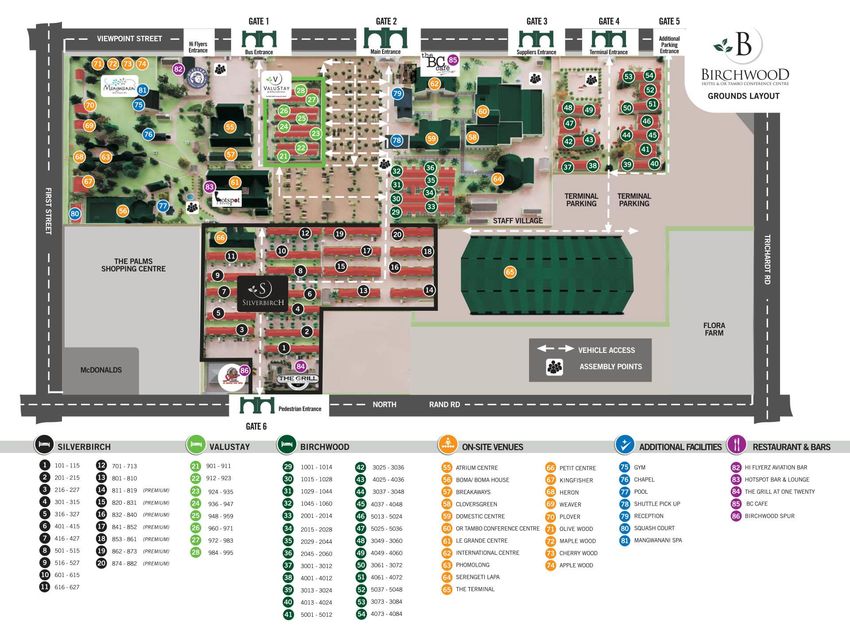
Conference venue

  This 2018 PSSA Conference will take place at Birchwood Hotel & OR Tambo Conference Centre,
                              Boksburg, Johannesburg, Gauteng.

Physical address:
14 View Point Road
Bardene
Boksburg
1456
Website: www.birchwoodhotel.co.za
Contact number: +27 (0) 11 897 0000

Free Airport Shuttle – OR Tambo International Airport
Our free airport shuttle* departs hourly from Birchwood at 30 minutes past every hour (starting at
5:30AM), and OR Tambo International bus terminal at 10 minutes past every hour (last pick up
12:10AM). Enjoy FREE coffee & WiFi while you wait at the airport guest lounge.

Where to find the Birchwood Shuttle:
Exit the doors from Domestic Arrivals. From the greeting area, head right towards International
Arrivals. Passing International Arrivals (on your right), look for the signs to car hire and the bus
terminal. Bearing left, towards the street, exit the terminal building. Cross the road, following the
signs to the bus terminal.
The Birchwood shuttle departs at 10 past the hour from the bus terminal. There is a Birchwood guest
lounge where you enjoy free WiFi and coffee while you wait at our Airport Guest Lounge.
Download the Airport Shuttle timetable at
https://www.birchwoodhotel.co.za/wp-content/uploads/2017/08/Airport-Shuttle-Times.pdf
*subject to availability of seats

Wifi
There is FREE WiFi (1st 500 MB free), throughout the hotel, rooms and conference venues for
browsing purposes and downloading of emails.
Additional packages are available.

                                                 5
6
Registration: Delegates
Registration link: https://confpro.outsystemscloud.com/PSSA2018/Home.aspx?In_ConferenceID=1
Full Conference Registration
PSSA member R2900
Regular fee (non-member) R3400
SAPSF (undergraduate) member R2000
The Full Conference Registration fee for delegates includes:
Admission to all conference sessions
Conference bag with printed conference programme and name tag
Access to the exhibition hall
Coffee/tea breaks
Lunches
Welcome cocktail function (on Friday 22 June 2018)
Gala dinner function (on Saturday 23 June 2018)
Full Conference Registration fee does not include accommodation. This should be booked separately
by each delegate. Please refer to page 9 for special rates and booking information.
Day Registration
Friday 22 June 2018 – 13:00-17:00 R1200
Saturday 23 June 2018 – 08:15-17:30 R1700
Sunday 24 June 2018 – 08:15-14:00 R1200
The Day Registration fee for delegates includes:
Admission to all sessions on the day
Conference bag with printed conference programme and name tag
Access to the exhibition hall on the day
Coffee/tea break(s) on the day
Lunch on the day
Optional:
Young Pharmacists’ Group Evening (optional) R180
Strictly Halaal / Kosher Surcharge* TBC
*Please note a surcharge may apply for strictly halaal and kosher meals. The applicable delegates will be informed of the cost 2 weeks
before the conference.
7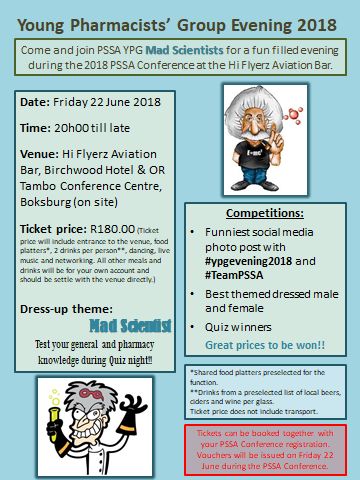
Registration: Accompanying Partner
Accompanying Partner
Full Conference Registration R2600
Welcome cocktail function only R280
Gala dinner function only R595
The Full Conference Registration fee for Accompanying Partners includes:
Name tag
Access to the exhibition hall
Coffee/tea breaks
Lunch
Welcome cocktail function (on Friday 22 June 2018)
Gala dinner function (on Saturday 23 June 2018)
Please note that the Full Conference Registration fee for accompanying partners does not include
admission to the sessions.
Full Conference Registration fee for accompanying partners does not include accommodation. This
should be booked separately by each delegate. Please refer to page 9 for special rates and booking
information.
Accompanying Partner Programme
No formal programme will be organised for the accompanying partners by the conference
committee but the following activities are available for consideration. Please note that each person
will be responsible for his/her own booking and payment.
Mangwanani Boutique Spa
Opening hours: Daily from 07:30 to 21:00
Call 011 897 0005 for bookings and special offers
On-site
Birchwood Fitness Room and Gym & Birchwood Squash Courts
On-site
East Rand Mall
Bentell Road, Boksburg
2,0 km from Conference venue
Birchwood shuttle available hourly
8
Accommodation

A limited number of rooms are pre-booked for Conference attendees at:

Birchwood Hotel

Corporate Single Rooms – R1200.00 for one person per night B&B
(Above fee excludes the Tourism levy of R9.40 per person per night)

Corporate Double Rooms – R1565.00 for two persons sharing per night B&B
(Above fee excludes the Tourism levy of R9.40 per person per night)

ValuStay@Birchwood
Block booking made for SAPSF students only!

Standard Double Room – R1400.00 for two students sharing per night B&B
(Above fee excludes the Tourism levy of R9.40 per person per night)

Bookings:
Please book accommodation directly with Birchwood Hotel & OR Tambo Conference Centre.
Contact number: 011 897 0000
Email address: reservations@birchwoodhotel.co.za
Reference for special booking rates: Pharmaceutical Society of South Africa – BB ID 1708512

Please note that once all the pre-booked rooms are sold-out, normal tariffs may apply. Check in time
is 14h00 and all rooms are to be vacated by 11h00 on the date of vacation. No guests will be entitled
to bring onto the premises any liquor, beverages or food without having obtained the prior written
consent of Birchwood.

               Dietary considerations

We urge all delegates with normal dietary requirements, to ensure they dish-up from the
correct service area and not from the table for special dietary requirements.

Delegates with special dietary requirements pay an additional surcharge for their meals.
The service area for special dietary requests will be marked clearly.

                                                  9
Conference Programmes
PSSA Conference: Overview of sessions
Friday 09:00-13:00 13:00-14:00 14:00-15:30 15:30-16:00 16:00-17:00
22 June Arrival & Registration Lunch Opening Coffee/Tea Practice
session break innovations –
Targeting
special interests
Saturday 08:15-10:15 10:15-11:00 11:00-13:00 13:00-14:00 14:00-15:30 15:30-16:00 16:00-17:30
23 June Antimicrobial Coffee/Tea Pharmaceutical Lunch Hiking the Coffee/Tea Turning the
stewardship – break health care legislative break table –
Failure to prepare delivery under mountain Supporting
is preparing to fail Universal Health pharmacy
Coverage support
personnel
Sunday 08:15-10:15 10:15-11:00 11:00-12:30 13:00-14:00 From 14:00
24 June Primary Health Coffee/Tea Where will the Lunch Departure
Care (PHC) – break money come
Really re- from?
engeneered?
12:30-13:00
Closing remarks
The full PSSA conference programme is available on pages 11 to 18.
Young Pharmacists’ Group Programme: Overview of sessions
Saturday 08:15-10:15 10:15-11:00 11:00-13:00 13:00-14:00 14:00-15:30 15:30- 16:00-17:30
23 June Personal Coffee/Tea Back to the Lunch Transforming 16:00 YPG Annual
development for break future the profession – Coffee/Tea Business
young one innovation break Meeting
pharmacists project at a time
The full YPG programme is available on pages 19 to 21.
SAPSF Conference: Overview of sessions
Friday 08:30-09:00 10:15-11:00 11:00-13:00 13:00- 14:00-15:30 15:30- 16:00-16:30
22 June Registration Coffee/Tea Presco 14:00 Various fields of 16:00 Various fields of
break Reports Lunch pharmacy Coffee/Tea pharmacy
09:00-10:15 continue break
Presco Reports 16:30-18:00
AGM
Saturday 08:15-10:15 10:15-11:00 11:00-13:00 13:00- 14:00-15:30 15:30- 16:00-17:30
23 June Branch Reports Coffee/Tea Clinical skills 14:00 Sponsorship 16:00 Pharmacy
break competition Lunch presentations Coffee/Tea debate &
break interactive peer
session
Sunday 08:00-10:15 10:15-11:00 11:00-13:00 13:00- 14:00-15:30 15:30- Outreach
24 June Sponsorship Coffee/Tea Presco 14:00 Oath-taking 16:00 programme
presentations break nominations Lunch ceremony of new Coffee/Tea
and voting Presco break
The full SAPSF conference programme is available on pages 22 to 24.
10PSSA Conference Programme
Friday 22 June 2018
09:00-13:00 Arrival & Registration Foyer: OR Tambo
Conference Centre
13:00-14:00 Lunch Exhibition Hall 1
14:00-15:30 Session 1: Opening session OR Tambo 2
Session Chair: Mr Ivan Kotzé
14:00-14:15 Conference opening and welcome Mr Ivan Kotzé
Announcement of 2018/2019 PSSA Presco PSSA Executive Director
14:15-14:45 Opening Address and PSSA Annual Report Prof Sarel Malan
PSSA President
14:45-15:10 Update on NHI progress to highlight the role of the Mr Stéphan Möller
pharmacist PSSA Deputy President
15:10-15:30 Conference information Dr Mariet Eksteen
Conference Convener
15:30-16:00 Coffee/Tea break Exhibition Hall 1
16:00-17:00 Session 2: Practice innovations – targeting special OR Tambo 2
interests
Session Chair: TBC
Introduction:
This session will provide the opportunity to target special interests in the different fields of
pharmacy (independent community, corporate community, public institutional, private institutions,
district, regional, academic, training, manufacturing, distribution, etc.). A variety of speakers will
present on innovations and research in their respective practice settings not already included in any
of the other sessions. A number of short oral presentations will enlighten attendees on what’s new
in practice.
Learning objectives:
At the conclusion of this session, attendees will be able to:
Learn more about new innovations in practice in South Africa.
16:00-16:20 Opportunities for pharmacists in delivering value in Prof Praneet Valodia
healthcare Healthcare Consultant
16:20-16:40 The peculiarities of radiopharmaceuticals Ms Judith Wagener
Scientist (Nesco –
Radiochemistry)
16:40-17:00 “Dr Google” – pharmacist’s friend or foe? Prof Nadine Butler
UWC
1118:00-19:30 Welcome cocktail function Exhibition Hall 1
20:00-23:00 Young Pharmacists’ Group Evening Hi Flyerz Aviation Bar
(Optional – tickets available at R180 per person) (on site)
12Saturday 23 June 2018
08:15-10:15 Session 3: Antimicrobial stewardship – Failure to OR Tambo 2
prepare is preparing to fail
Session Chair: TBC
Introduction:
Antibiotic resistance is no longer a prediction for the future – it is happening right now across the
world. This limits the ability to treat common infections. Global organisations such as the World
Health Organization (WHO), United Nations General Assembly (UNGA) and the International
Pharmaceutical Federation (FIP) endorse the ongoing fight against antimicrobial resistance.
At the 2017 PSSA Conference, the Young Pharmacists’ Group (YPG) hosted a session on Antimicrobial
Stewardship (AMS) where the National Department of Health (NDoH) Antimicrobial Resistance
Strategy Framework was presented together with the impact of our collective approach on AMS.
World Antibiotic Awareness Week (WAAW) took place 13 to 19 November 2017, with the theme
handle antibiotics with care. The message was clear: antibiotics are not always the answer therefore
think twice and seek advice. If drastic action is not taken, the world is heading towards a post-
antibiotic era in which common infections and minor injuries, which have been treatable for
decades, can once again kill. Pharmacists around the world are part of AMS programmes.
Pharmacists are ideally placed in the health care system to contribute to the rational use of
antibiotics. Opportunities exist for all to prepare well for the future ahead. In this session new
additions to the well-known concept of AMS will be discussed and delegates will be able to evaluate
their own progress towards responsible antibiotic use.
Learning objectives:
At the conclusion of this session, attendees will be able to:
Understand the global situation of antimicrobial resistance;
Review and evaluate antimicrobial stewardship activities in their specific area of practice;
Discuss strategies to contain antimicrobial resistance in South Africa at all levels of care; and
Advocate for the responsible use of antimicrobials at all levels of society.
08:15-08:25 Introduction Chair
08:25-08:45 Understanding the global situation of antimicrobial TBC
resistance WHO Representative:
South Africa
08:45-09:05 Understanding South Africa’s antimicrobial Dr Ruth Lancaster
consumption NDoH
09:05-09:20 TBC TBC
09:20-09:35 Antimicrobial stewardship activities at public health Ms Lungile Mabuza
facilities in Gauteng Province Charlotte Maxeke
Johannesburg Academic
Hospital
09:35-09:50 The ethics of antibiotics use in animal farming Ms Precious Ncayiyana
SANDF
09:50-10:15 Panel discussion All presenters
10:15-11:00 Coffee/Tea break Exhibition Hall 1
1311:00-13:00 Session 4: Pharmaceutical health care delivery under OR Tambo 2
Universal Health Coverage
Session Chair: TBC
Introduction:
The White Paper on National Health Insurance (NHI) for South Africa describes several shortcomings
currently experienced in the South African health care environment. Health is influenced by the
surroundings in which people are born, grow up, live and work. Factors such as pollution, inadequate
housing and poor sanitation contribute to the challenge. South Africa’s health system is
characterised by the quadruple burden of diseases disproportionately affecting lower social-
economic groups compounded by lower health service utilisation rates. These diseases include
HIV/AIDS and tuberculosis, high maternal neonatal and child morbidity and mortality, rising disease
burden of non-communicable diseases, and high levels of violence and trauma. This increasing
burden of diseases affects the health of the population negatively especially the poorest groups of
the population.
Non-communicable diseases (NCDs) are a key contributor to mortality and morbidity and include
conditions such as high blood pressure, diabetes mellitus, cardiovascular diseases, obesity, cancer,
respiratory diseases such as asthma, and mental health problems. These diseases are lifestyle
related and driven by four key risk factors. They include tobacco use, alcohol abuse, use of
narcoleptic agents, poor diet and eating habits, and lack of physical activity.
The lack of focused health promotion and prevention programme and interventions, poor health
seeking behaviour and the late detection of diseases are some of the major factors contributing to
the high burden of NCDs. This session will investigate current approaches to health promotion and
disease prevention initiatives as well as the reporting on outcomes of these initiatives.
Learning objectives:
At the conclusion of this session, attendees will be able to:
Understand the scope of promotive campaigns and the impact on disease prevention;
Distinguish between different disease profiles in different communities in South Africa;
Identify possible health promotion ideas for their own practices; and
Understanding the importance of the pharmacist’s current role and participation in
documenting and reporting on healthcare initiatives.
11:00-11:10 Introduction Chair
11:10-11:30 Distinguishing between different disease profiles in Ms Candy Day
different communities in South Africa Health Systems Trust
11:30-12:00 Scope of promotive campaigns and the impact on TBC
disease prevention Vitality Wellness
Network
12:00-12:40 Possible health promotion ideas for own practices:
1. National Asthma Education Programme (NAEP) Dr Riaz Khan
NAEP
2. Five-day advanced course in diabetes Mr Michael Brown
CDE Media & Publication
3. Vaccinators Higher Certificate Qualification Prof Hannelie Meyer
SMU
12:40-13:00 Access to appropriate pain relief in palliative care – Mr Andy Gray
developing a suitable indicator UKZN
1413:00-14:00 Lunch Exhibition Hall 1
14:00-15:30 Session 4: Hiking the legislative mountain OR Tambo 2
Session Chair: TBC
Introduction:
In the past year, a mountain of legislation applicable to the pharmaceutical environment was
published. This includes the amended Medicines and Related Substances Act, completely new
General Medicine Regulations, changes to the schedules of medicines and a plethora of GPP
standards. In addition, the NHI White Paper was published, which will have far reaching
consequences for pharmacists. More changes are anticipated as draft competency standards were
published and comment was requested on proposed changes to the Standard Treatment Guidelines
and Essential Medicine List, the dispensing fee and the implementation of GTIN-14 datamatrix
barcodes. In the health care environment where patient lives are at stake and where one small
mistake may have catastrophic repercussions, one can understand that there is a need for precise
legislation. The down side to it is when legislation is published with contradictory or confusing
content which limits the pharmacist’s ability to execute what is expected.
How does a pharmacist function in this legislative environment? It is sometimes difficult to stay up
to date with everything which could result in professional errors and disciplinary action by the South
African Pharmacy Council. This session will focus on recent legislation applicable to the
pharmaceutical environment, the impact on pharmacists and intended purpose thereof.
Learning objectives:
At the conclusion of this session, attendees will be able to:
Understand recent or proposed legislation that will impact the pharmacist in South Africa;
Evaluate the most common reasons for professional complaints of non-adherence to legislation,
and
Assess the adjustments to current practice that they need in order to incorporate new
legislative requirements.
14:00-14:10 Introduction Chair
14:10-14:25 Recent or proposed legislation – overview of PSSA Ms Lorraine Osman
submissions in the past 6 months PSSA Head: Public Affairs
14:25-14:45 The influence of corporatisation on the professional Dr NomaChina Kubashe
identity of community pharmacists NMU
14:45-15:00 The importance of bioethics and health law in a Ms Precious Ncayiyana
pharmacist’s line of duty WITS
15:00-15:30 What to do when receiving a complaint – a how-to Mr Gary Black
guide Executive Director: Cape
Western Province
Branch
15:30-16:00 Coffee/Tea break Exhibition Hall 1
1516:00-17:30 Session 6: Turning the table – Supporting pharmacy OR Tambo 2
support personnel
Session Chair: TBC
Introduction:
Current pharmacy legislation expects pharmacists to supervise the daily activities of pharmacist
interns, pharmacy students and assistants. Supervision of all three requests a unique approach and
focus of training, mentoring and tutoring. Interns have a prescribed programme for the year which
consists of Continuing Professional Development (CPD) submissions, a pre-registration exam and
four progress reports. At present, for pharmacist interns and students, these activities are aligned
with the current Exit Level Outcomes (ELOs) on which the current BPharm curriculum is based. The
pharmacist’s assistant qualification uses specific exit level outcomes for pharmacist’s assistants.
Universities are also required to have a structured approach for pharmacy students when it comes
to Work Integrated Learning (WIL) during the four years of studies. This requires students to perform
certain tasks in practice as part of their learning experience. For this to be successful, the pharmacist
should understand the role of being a preceptor who plays a massive role in shaping the future
health care professionals. The same supervision applies to assistants who are enrolled for
qualifications.
Pharmacy support personnel make a unique contribution to the health care of South African citizens
and the role of a mentoring pharmacist is extremely valuable and irreplaceable. In this session,
delegates will explore ways to support their staff.
Learning objectives:
At the conclusion of this session, attendees will be able to:
Evaluate their current level of support to pharmacy support personnel;
Formulate ways to support pharmacist interns in their internship programme; and
Prepare for the role of a preceptor for pharmacy students.
16:00-16:10 Introduction Chair
16:10-16:25 Evaluating the current level of support to pharmacy TBC
support personnel Pharmacist’s assistant
16:25-16:40 Supporting pharmacist interns during internship TBC
programme Pharmacist intern
16:40-17:00 Design principles for a preceptor-based experiential Dr Lia Kritiotis
learning programme and preparing for the preceptor NMU
role
17:00-17:30 Panel discussion with pharmacy students, pharmacist’s Panellists
assistant, pharmacist intern, lecturer and pharmacist
From 18:30 Gala dinner function Serengeti Lapa
16Sunday 24 June 2018
08:15-10:15 Session 7: Primary Health Care (PHC) – Really re- OR Tambo 2
engeneered?
Session Chair: TBC
Introduction:
Primary Health Care (PHC) will be at the centre of National Health Insurance (NHI) and will include
services such as health promotion, disease prevention, curative services for both acute and chronic
diseases, rehabilitation and palliative services. All patients will access the health system through PHC
level as the first point of contact with any health care professional and will either receive the care
they need at this level or will be referred to the next appropriate level of health care services such as
district health services, including specialists and district hospitals. PHC services under NHI will be
provided in public sector clinics, community health centres (CHCs) and multidisciplinary networks of
practices in the private sector. PHC services will be comprehensive and integrated and will be
supported by a strong feedback referral system and planned patient transportation between the
levels of care where appropriate.
South Africa already has an extensive set of treatment guidelines in the public sector. These
guidelines are called ‘Standard Treatment Guidelines’ and are linked to an Essential Medicine List
(EML). They are available for PHC, Adult Hospital care and Paediatric Hospital care. In this session the
role of PHC in NHI will be debated and delegates will be able to identify their role in PHC and NHI.
Learning objectives:
At the conclusion of this session, attendees will be able to:
Advocate the role of PHC in NHI and the healthcare environment in South Africa;
Understand the concept of multidisciplinary practices; and
Identify areas where a pharmacist can contribute and play a role in PHC.
08:15-08:25 Introduction Chair
08:25-08:45 Translating policy into healthcare delivery Ms Trudy Leong
NDoH, Essential Drugs
Programme
08:45-09:05 Understanding the concept of multidisciplinary Mr Wim Grobbelaar
practices PSSA Free State
09:05-09:25 Delivery of pharmaceutical services and care at Primary Ms Amy Bobbins
Healthcare Clinics with different dispensing models – NMU
where should the pharmacist be?
09:25-09:45 The role of a pharmacist in the analysis of adherence Dr Lucky Norah Katende-
rates and associated factors in HIV-patients registered Kyenda
on Centralized Chronic Medicines Dispensing and WSU
Distribution (CCMDD) programme in the public sector
of South Africa
09:45-10:05 Primary Care Drug Therapy (PCDT) – my passion! Mr Frans Landman
PSSA Southern Gauteng
Branch
10:05-10:15 Conference information Dr Mariet Eksteen
Conference Convener
10:15-11:00 Coffee/Tea break Exhibition Hall 1
1711:00-12:30 Session 8: Where will the money come from? OR Tambo 2
Session Chair: TBC
Introduction:
In South Africa, a variety of reimbursement models exists in the public health sector, private health
sector where third party payers play a significant role, all in addition to out of pocket payments.
From a health systems perspective, these models need to be cost-effective. For pharmacies, they
must also provide adequate compensation to enable sustainable access to medicines and delivery of
comprehensive pharmacy services, including important public health services.
The proposed remuneration model for National Health Insurance (NHI) that will be used to pay
contracted providers at Primary Health Care (PHC) level will be a risk-adjusted capitation system
with an element of performance-based payment. A key issue will be to determine the capitation rate
i.e. the average cost of providing the clinic and community-based services per person. The White
Paper on NHI claims that a fee-for-service (FFS) will not be used in general as a mechanism for
provider payment at PHC level because by its nature, payment is limited to one provider for one
interaction. At hospital level, payment related to services delivered would be determined through a
system of case-mix activity adjusted payments (such as Diagnosis-Related Groups or DRGs). This
session will differentiate between the different remuneration models available and the impact of
each on sustainable health care delivery. In this session, the different payment mechanisms will be
explained to highlight the advantages and disadvantages of each.
Learning objectives:
At the conclusion of this session, attendees will be able to:
Define different mechanisms of payment proposed for NHI;
Challenge the impact of each mechanism on sustainable health care delivery; and
Evaluate potential opportunities for health care delivery in South Africa.
11:00-11:10 Introduction Chair
11:10-11:30 Capitation and fee-for-service models – the difference Mr Joubert Krugel
PWC
11:30-11:50 Sustainable remuneration in UHC TBC
11:50-11:10 Government’s commitment to funding TBC
11:10-11:30 Panel discussion All presenters
12:30-13:00 Closing remarks and conference wrap-up OR Tambo 2
13:00-14:00 Lunch Exhibition Hall 1
18YPG Conference Programme
Saturday 23 June 2018
08:15-10:15 Session 1: Personal development for young pharmacists Cape Town International
Session Chair: Mr Shawn Zeelie Breakaway room
Introduction:
When a pharmacy student graduates from university, it is common to think that you’ve ‘arrived at
your destination’ and that training, studying and learning is a thing of the past. Unfortunately, for
those in professions such as pharmacy, this is far removed from the truth. After a pharmacy student
has accomplished the necessary knowledge and skills as required during the BPharm programme,
another type of ‘training’ appears on the horizon. This time there is a slight difference – you no
longer do it to please a lecturer, now you do this to develop yourself and to become better at what
you do.
Personal development may include a variety of topics such as communication, management,
leadership, interpersonal skills, retirement planning, etc. It is in reality anything that you discover
along the line that you may need to develop into a better version of yourself.
This session will equip the attendees with the necessary knowledge of how professionalism will
enable them to grow in their professional careers. We will also learn how to overcome obstacles
that might be hindering the development of professionals.
Learning objectives:
At the conclusion of this session, attendees will be able to:
Understand the concept of personal development;
List potential areas for personal development;
Identify possible obstacles that may hinder personal development; and
Envision the impact of personal development on their career path.
08:15-08:20 Introduction Chair
08:20-09:20 Developmental milestones for professionals PPS
09:20-10:05 Professionalism: How to, what to and where to Mr Gary Black
Executive Director: Cape
Western Province
Branch
10:05-10:15 Wrap-up Chair
10:15-11:00 Coffee/Tea break Exhibition Hall 1
1911:00-13:00 Session 2: Back to the future Cape Town International
Session Chair: Mr Gawie Malan & Ms Lorraine Osman Breakaway room
Introduction:
The role of the pharmacist is changing regularly. They say we will play a significant role in the NHI
although the White Paper doesn’t echo the same statement. Community pharmacies should be the
entry level in NHI providing primary health care services to every South African citizen but rumour
has it that that will be done by PHC nurses. The same services must be provided by private and
public hospitals under NHI but will the quality and customer satisfaction be the same? Industry is
encouraged to come up with medications for currently untreatable diseases, but generic substitution
is demanded by third party payers.
We are familiar with the current status quo and sometimes mistake this comfort zone for best
practice. However, change creates fear which leads to resistance. This resistance can sometimes be
because we do not believe it is in the organisation’s best interest to change, because we will not be
able to do our tasks as well as we did it before the change, and it creates uncertainty for the future.
In this session, attendees will get a snapshot of how the current status quo will change for
community, hospital and industry pharmacists. Attendees will then debate whether these
anticipated changes are good or bad.
Learning objectives:
At the conclusion of this session, attendees will be able to:
Identify potential changes anticipated in different sectors;
Debate whether these anticipated changes will be to the profession’s advantage or
disadvantage;
Develop plans to overcome the different obstacles by preparing for the changes; and
Learn from experience.
11:00-11:15 Introduction Chairs
11:15-11:30 Community pharmacy for the future Mr Keith Johnson
PSSA Cape Western
Province Branch
11:30-11:45 Hospital pharmacy for the future Ms Refiloe Mogale
SAAHIP Vice President
11:45-12:00 Pharmaceutical industry for the future Dr Sybil Seoka
PSSA Southern Gauteng
Branch
12:00-12:15 Debate preparations Teams
12:15-12:35 Debate
Team A: For change and for the future
Team B: Objection to change
12:35-12:50 New opportunities for young pharmacists TBC
12:50-13:00 Wrap-up Chairs
13:00-14:00 Lunch Exhibition Hall 1
2014:00-15:30 Session 3: Transforming the profession – one innovation Cape Town International
project at a time Breakaway Room
Session Chair: Ms Tendai Mutabeni
Introduction:
The mission of YPG is to promote the goals of PSSA by encouraging the young members of the
Society to participate in PSSA projects and activities. In so doing, YPG aims to develop individuals
who can act as agents of positive change at local, national and international levels, both in the
profession and in society. To achieve its mission, YPG plans to develop projects to stimulate
professional innovation.
With these innovation projects, YPG aims to promote the pharmacy profession through innovation,
to stimulate creative thinking in the profession of pharmacy and pharmaceutical sciences, and to
encourage young pharmacists to think beyond their daily scope of practice and to find pharmacist-
led interventions for issues and/or problems.
In this session, young pharmacists share their innovation projects and ideas to stimulate and
encourage attendees to become creative in contributing to the pharmacy profession.
Learning objectives:
At the conclusion of this session, attendees will be able to:
Differentiate between different innovative ideas in different sectors of pharmacy;
Identify possible innovative endeavors of their own; and
Consider the impact of innovation on the pharmacy profession.
14:00-14:10 Introduction Chair
14:10-14:25 YPG Professional Innovation Project winner 2017 Ms Stephanie de Rapper
STEPPS: Preparing pharmacy students to deliver a WITS
targeted service in diabetes management.
14:25-14:40 Health economics, South Africa vs the World Mr Hilton Stevens
YPG Southern Gauteng
Branch
14:40-14:55 A case for pharmacy business process re-engineered at Mr Mthabisi Ncube
a primary health care centre YPG Cape Western
Province Branch
14:55-15:20 Panel discussion All presenters
15:20-15:30 Wrap-up Chair
15:30-16:00 Coffee/Tea break Exhibition Hall 1
16:00-17:30 Session 4: YPG Annual Business Meeting Cape Town International
Session Chair: Mr Gawie Malan Breakaway room
Introduction:
The agenda of the meeting will be circulated to YPG members.
21SAPSF Conference Programme
Friday 22 June 2018
08:30-09:00 Arrival & Registration Foyer: OR Tambo
09:00-10:15 Session 1: PRESCO annual report Marco Polo Breakaway
Session Chair: Mr Thabang Malatji room
09:00-09:45 SAPSF Conference 2018 welcome & formalities / roll call Mr Thabang Malatji
SAPSF President
09:45-10:00 President report Mr Thabang Malatji
10:00-10:15 Vice-President report Mr Thulani Motha
15:30-16:00 Coffee/Tea break Exhibition Hall 1
11:00-13:00 Session 1 continue Marco Polo Breakaway
room
11:00-11:10 General Secretary report Mr Imtiyaaz Ebrahim
11:10-11:20 Media & Communications Officer report Mr Mashao Madiba
11:20-11:30 Editor report Mr Samuel Cohen
11:30-11:40 Student Exchange Officer report Ms Nomathemba Shivite
11:40-11:50 Public Initiative Officer report Ms Cazandra da Silva
11:50-12:10 Treasurer report Ms Hunadi Sefoka
12:10-13:00 General discussions on reports, Q and A to Presco,
discussion of motions for AGM
13:00-14:00 Lunch Exhibition Hall 1
14:00-15:30 Session 2: Presentations of various fields of pharmacy Marco Polo Breakaway
Session Chair: Mr Thulani Motha room
14:00-14:15 Responsible pharmacist TBC
14:15-14:30 PCDT pharmacist TBC
14:30-14:45 Clinical pharmacist TBC
14:45-15:00 Research pharmacist TBC
15:00-15:15 Quality Assurance pharmacist TBC
15:15-15:30 Regulatory pharmacist TBC
15:30-16:00 Coffee/Tea break Exhibition Hall 1
16:00-16:30 Session 2 continue Marco Polo Breakaway
room
16:00-16:15 Pharmaceutical sales and representative TBC
16:15-16:30 Consulting pharmacist TBC
16:30-18:00 Session 3: AGM meeting
2218:00-19:30 Welcome cocktail function Exhibition Hall 1
20:00-23:00 SAPSF social programme Heathrow Breakaway
room
Saturday 23 June 2018
08:15-10:15 Session 4: Branch annual reports Marco Polo Breakaway
Session Chair: Mr Thabang Owen room
08:15-08:35 Formalities Chair
08:35-08:45 PASV report Ms Lucia Kotzé
08:45-08:55 PEPSA report Ms Nandipha Klaas
08:55-09:05 RUPSA report Mr Calvin Mohunlal
09:05-09:15 SMUAPS report Mr Ntandoyakhe
Nxumalo
09:15-09:25 TUTAPS report Ms Slungile Bosoga
09:25-09:35 UKNAPS reports Mr Siya Sibaya
09:35-09:45 ULAPS report Mr Innocent Makhuthu
09:45-09:55 UWCPAS report Ms Nosipho Magoxo
09:55-10:05 WPSC report Ms Shanice van
Schalkwyk
10:05-10:15 Questions Chair
10:15-11:00 Coffee/Tea break Exhibition Hall 1
11:00-13:00 Session 5: Clinical Skill competition Marco Polo Breakaway
Session Chair: Mr Thulani Motha room
11:00-11:20 Clinical skill competition introduction TBC
Branch pairs work on clinical skill case study
11:20-11:40 Clinical presentation 1 TBC
11:40-12:00 Clinical presentation 2 TBC
12:00-12:20 Clinical presentation 3 TBC
12:20-13:00 Branch pairs present case study
13:00-14:00 Lunch Exhibition Hall 1
14:00-15:30 Session 6: Sponsorship presentations Marco Polo Breakaway
Session Chair: Mr Thabang Owen room
14:00-14:45 Platinum Sponsor: TBC TBC
14:45-15:15 Gold Sponsor: TBC TBC
15:15-15:30 Silver sponsor: TBC TBC
15:30-16:00 Coffee/Tea break Exhibition Hall 1
16:00-17:30 Session 7: Pharmacy debate & interactive peer session Marco Polo Breakaway
Session Chair: Mr Thulani Motha room
Nomination process for Presco (close 10h15 on Sunday 24 June 2018)
From 18:30 Gala dinner function Serengeti Lapa
23Sunday 24 June 2018
08:00-10:15 Session 8: Sponsorship presentations continue Marco Polo Breakaway
Session Chair: Mr Thabang Owen room
08:00-08:15 Formalities Chair
08:15-08:30 Silver sponsor: TBC TBC
08:30-09:00 Gold sponsor: TBC TBC
09:00-09:15 Silver sponsor: TBC TBC
09:15-09:30 Silver sponsor: TBC TBC
09:30-10:00 Gold sponsor: TBC TBC
10:00-10:15 Silver sponsor: TBC TBC
10:15-11:00 Coffee/Tea break Exhibition Hall 1
11:00-13:00 Session 9: Presco elections Marco Polo Breakaway
Session Chair: Mr Thulani Motha room
11:00-11:10 SAPSF Conference photo
11:10-12:20 Motivations for nominations Nominees
12:20-12:40 Explanation of voting process President
12:40-13:00 Voting for Presco positions
13:00-14:00 Lunch Exhibition Hall 1
14:00-17:00 Session 10: Formalities and conclusion Marco Polo Breakaway
Session Chair: Mr Thabang Owen room
14:00-15:00 Formal hand-over & oath-taking ceremony of new
Presco
15:00-15:30 Meeting old Presco & new Presco
15:30-16:00 Conclusion & closing of SAPSF 2018 conference
16:00-17:00 Outreach programme
24You can also read


