CYBERDEFENSE REPORT Japan's National Cybersecurity and Defense Posture - Policy and Organizations
←
→
Page content transcription
If your browser does not render page correctly, please read the page content below
The Syrian cyber-battlefield

CYBERDEFENSE REPORT

Japan’s National Cybersecurity and
Defense Posture
Policy and Organizations

Zürich, September 2020

Cyber Defense Project (CDP)
Center for Security Studies (CSS), ETH Zürich

                           1
Japan’s National Cybersecurity and Defense Posture
Available online at: css.ethz.ch/en/publications/risk-
and-resilience-reports.html
Author: Stefan Soesanto
ETH-CSS project management: Myriam Dunn Cavelty,
Deputy Head for Research and Teaching; Benjamin
Scharte, Head of the Risk and Resilience Research
Group; Andreas Wenger, Director of the CSS.
Editor: Jakob Bund
Layout and graphics: Miriam Dahinden-Ganzoni
© 2020 Center for Security Studies (CSS), ETH Zurich
DOI: 10.3929/ethz-b-000437790
2Japan’s National Cybersecurity and Defense Posture
Table of Contents
1 Introduction 4
2 Policy Areas 4
2.1 Cybersecurity 4
2.2 Cybercrime 5
2.3 Cyber terror (サイバーテロ) 5
2.4 Cyber diplomacy 6
2.5 Cyber defense 6
3 Evolution (trigger events) 8
3.1 Cyber terror 8
3.2 Cyber-espionage 8
3.3 Cybercrime 9
4 Relevant policy documents 12
4.1 Key policy documents 12
4.1.1 2000 Basic Act 12
4.1.2 2000 Special Action Plan 12
4.1.3 1st National Strategy 13
4.1.4 2nd National Strategy 13
4.1.5 Information Security Strategy 13
4.2 National Cybersecurity Strategy 14
4.2.1 1st Cybersecurity Strategy 14
4.2.2 Basic Act on Cybersecurity 14
4.2.3 2nd Cybersecurity Strategy 14
4.2.4 3rd Cybersecurity Strategy 15
4.3 National Cyber Defense Strategy 16
4.3.1 Japan-US Defense Guidelines 16
4.3.2 Nat. Defense Program Guidelines 16
4.3.3 Mid-Term Defense Program 17
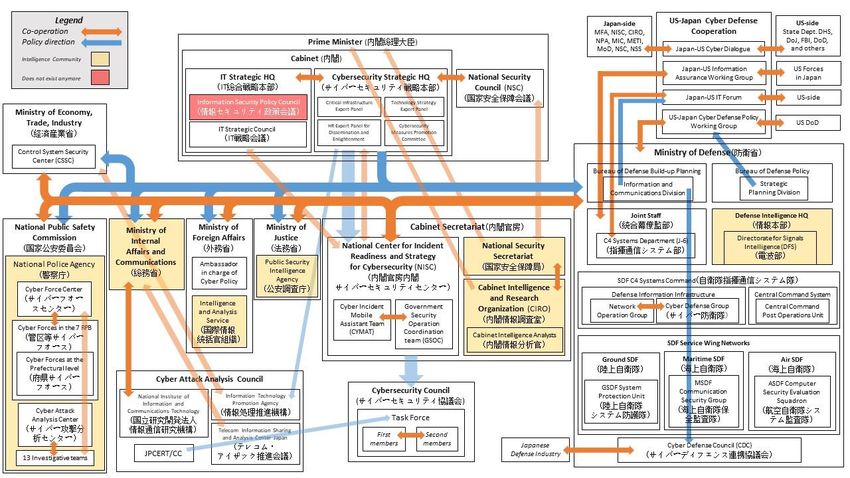
5 Organizational Structures 17
5.1 The Cabinet 19
5.2 The Cabinet Secretariat 20
5.3 Ministry of Defense 22
5.4 US-Japan Cyber Defense Cooperation 24
5.5 National Public Safety Commission 25
5.6 Ministry of Economy, Trade, and Industry 26
5.7 Ministry of Internal Affairs and Communications 27
5.8 Cyber Attack Analysis Council 27
5.9 Ministry of Justice 28
5.10 Ministry of Foreign Affairs 29
6 Conclusion 30
7 Abbreviations 31
8 Bibliography 32
3Japan’s National Cybersecurity and Defense Posture
1 Introduction 2 Policy Areas
The goal of this study is to provide the reader 2.1 Cybersecurity
with a deeper understanding of the evolutionary path
Japan’s national cybersecurity and cyber defense In January 2000, the Japanese government
posture has taken since the year 2000. To do so, the discovered cybersecurity as a policy area and – as a
study explains trigger events, major policy documents, foundational first step – published the “Action Plan to
and outlines the current organizational government Protect Information Systems against Cyber-attacks”
structure. Please note that this study is non-exhaustive, (NISC 2007, p. 37). In mid- to late-2000, the government
meaning, there are numerous sectoral developments, embarked on a dual-pronged policy approach to
specialized regulations, and smaller governmental strategically tackle cybersecurity in more detail. The first
organizations that this study does not specifically touch policy arrow was dedicated to ensure IT security within
upon. the government itself, while the second arrow was
exclusively aimed at critical infrastructure protection.
Following this introduction, section two Throughout the decade, this dual-pronged strategy was
contextualizes the cyber-relevant policy areas that the continuously refined with the creation of new
Japanese government is currently working on. Section institutions, new information sharing pathways, and
three expands on this by explaining the trigger events underpinned by new information security strategies and
that have spurred the necessity for government regulations.
involvement. Section four analyzes the main policy
documents that have been and are still shaping Japan’s In 2014, The “Basic Act on Cybersecurity” for the
behavior and thinking pertaining to cyberspace. And first time legally defined the term “cybersecurity” in
section five takes a deep dive into the organizational Japan. According to the Basic Act – which as the name
structure by outlining and connecting more than 45 implies is a basic law – cybersecurity encompasses: “the
Japanese government and government-affiliated necessary measures that are needed to be taken to
organizations that make up the nation’s cybersecurity safely manage information, such as prevention against
and defense posture (ministries, agencies, councils, the leak, disappearance, or damage of information
units etc.). which is stored, sent, in transmission, or received by
Please note that this study only looks at electronic, magnetic, or other means unrecognizable by
organizations and instruments the Japanese natural perceptive functions […]; and to guarantee the
government is involved in. It does not comprehensively safety and reliability of information systems and
touch upon the evolution and dynamics within the information and telecommunications networks
private sector in Japan. (including necessary preventive measures against
malicious activities toward electronic computers
through information network or storage media for
information created by electronic or magnetic means
[…], and that those states are appropriately maintained”
(Japanese Government, 2014).
To achieve these goals, the Basic Act lays out
several foundational responsibilities for the Japanese
government, local authorities, critical information
infrastructure providers (initially spanning ten sectors,
currently consisting of 14 sectors), cyber-related
business operators, and educational and research
institutions.1
While government ministries, agencies, and
organizations are responsible for their own
cybersecurity posture, they do closely cooperate with
the National Center for Incident Readiness and Strategy
for Cybersecurity (NISC). For this purpose, the NISC
maintains two operational components: The
Government Security Operation Coordination Team
1 On May 19, 2014, the Basic Policy for Critical Information On July 25, 2018, revisions to the 4 th edition of the Basic Policy for
Infrastructure Protection (3rd edition), added chemical, credit card, Critical Information Infrastructure Protection (CIIP) added airports as
and petroleum industries as critical information infrastructure sectors. the 14th CIIP sector.
4Japan’s National Cybersecurity and Defense Posture
(GSOC) and the Cyber Incident Mobile Assistant Team (Council of Europe, n.d.). Its main objective is to “pursue
(CYMAT). a common criminal policy aimed at the protection of
society against cybercrime, especially by adopting
Public-private cooperation is practiced on all appropriate legislation and fostering international co-
levels of government. On the cabinet level the IT operation” (Council of Europe, n.d.). Between 2004 and
Strategic Council (within the IT Strategic HQ) and the 2006, the Japanese government submitted three bills to
four committees within the Cybersecurity Strategic HQ, the Diet to ratify the Convention, but eventually
are the most prominent elements. On the ministerial dropped all three in the process. In 2011 – ten years
level, the Cyber Defense Council of the Ministry of after the government’s initial signature – a bill was
Defense (MoD), the Cyber Attack Analysis Council co-led finally submitted to and passed by the Diet, leading to
by the Ministry of Economy, Trade and Industry (METI) the ratification of the Convention on 3 July 2012.2
and the Ministry of Internal Affairs and Communications Operationally, Japan’s National Police Agency
(MIC), as well as the National Police Agency’s numerous (NPA), in conjunction with the Ministry of Justice, is
Cyber Terrorism Countermeasure Councils, play crucial primarily responsible for combatting cybercrime in
roles in advancing Japan’s cybersecurity posture down Japan. In the maritime arena, the Ministry of Land,
to the prefecture level. Similarly, as its newest addition Infrastructure, Transport, and Tourism adds to the mix
since April 2019, the Cybersecurity Council facilitates as it oversees the Japan Coast Guard – which is also in
public-private cooperation in a unique voluntary way. the business of data forensics in the context of fighting
maritime crime.
By definition, cybersecurity in Japan is
inseparable from the protection of personally 2.3 Cyber Terror (サイバーテロ)
identifiable information (PII). The Act on Protection of
Personal Information of May 2003 (APPI) forms the legal Spurred by a combination of cyber-related
backbone for safeguarding PII in Japan. Going through incidents, caused by Japanese left-wing extremists,
substantial revisions over the past 16 years, the APPI Chinese nationalistic hacktivist, and the Aum Shinrikyo
now encompasses fines – similar to the EU’s General doomsday sect, the Japanese government embarked on
Data Protection Regulation (GDPR) – and even a mission to combat what it termed ”cyber terror.”
imprisonment for up to six months for ignoring an order In December 2000, the “Special Action Plan for
by Japan’s Personal Information Protection Commission. Cyber Terrorism Countermeasures for Critical
On 23 January 2019, the EU Commission adopted its Infrastructure” defined cyber terror as “any attacks
adequacy decision on Japan, allowing “personal data to using information and communication networks and
flow freely between the two economies on the basis of information systems that could have a significant impact
strong protection guarantees” (EU Commission, 2019). on people's lives and socio-economic activities” (ISMPO,
Věra Jourová, then Commissioner for Justice, 2000).
Consumers and Gender Equality, noted that “this In practice, cyber terrorism thus includes
adequacy decision creates the world's largest area of everything from denial-of-service (DDoS) attacks and
safe data flows. Europeans' data will benefit from high defacements of websites, to the deployment of highly
privacy standards when their data is transferred to advanced sabotage tooling like Stuxnet. The NPA
Japan” (EU Commission, 2019). Apart from Japan, only literally uses these three categories to officially explain
Argentina, Canada (commercial organizations), Israel, cyber terror (NPA, n.d.). Interestingly enough, Google
Switzerland, Uruguay, and five smaller countries provide Trends shows two significant spikes for the search term
adequate privacy protections as recognized by the “サイバーテロ” in 2010 (Google Trends, n.d.). The first
European Commission (EU Commission, n.d.). spike occurred in March and relates to the online
conflict between the Japanese image board 2channel
2.2 Cybercrime (2ch) and the Terror Action Association (TAA) – a loose
alliance of various South Korean online communities.
In November 2001, the Japanese government signed the The confrontation commenced on 1 May, when 2ch
“Convention on Cybercrime of the Council of Europe” users insulted South Korea’s Olympic ice-skating queen
(better known as the Budapest Convention). The Kim Yuna and celebrated the death of Kang Byung Kil –
Convention is the first and most important international a Korean student who was lynched by Russian skinheads
treaty on “crimes committed via the Internet and other on February 19, 2010 (Kim, 2010). TAA’s actions
computer networks, dealing particularly with included DDoS attacks and defacements of 2ch, and
infringements of copyright, computer-related fraud, even the Blue House (South Korea’s presidential
child pornography and violations of network security” residence) took precautionary measures by blocking all
2Note: Two amendments were included: (1) Revisions to Japan’s Penal
Code and (2) Revisions to Japan’s Criminal Procedure Law. See: Tsuboi,
n.d.
5Japan’s National Cybersecurity and Defense Posture
Japanese internet protocol (IP) addresses from GGE) on Advancing responsible State behavior in
connecting to its website. Overall, 2ch was unable to cyberspace in the context of international security.
successfully retaliate against TAA and the stand-off In May 2016, Japan hosted the G7 Ise-Shima
ended after a mere nine hours (Kim, 2010). The second Summit, which produced the declaration of the “G7
spike occurred in September 2010 and is most likely Principles and Actions on Cyber” and the Ise-Shima
related to the heightened media coverage surrounding Cyber Group – a G7 working group exclusively focused
Stuxnet. on “how to promote international law, norms,
confidence building measures and capacity building in
Over the years, the cyber terror narrative has order to increase stability and security in cyberspace”
naturally crumbled as more precise definitions, (G7, 2016; MOFA, 2016a).
distinctions, and insights negated the terrorism aspect On 12 July 2016, MOFA eventually established a
as a targeted outcome in most cyber incidents. dedicated Cyber Security Policy Division within the
Notwithstanding these developments, the term cyber Foreign Policy Bureau to “lead international discussions
terror is still widely used in Japan, and has practical on how to ensure a safe and secure cyberspace, [and]
implications for public-private cooperation. For strengthening coordination with other countries (MOFA
example, the NPA’s “Cyber Terrorism Countermeasure 2016b).”
Councils” facilitate public-private partnerships on the
prefecture level, while the Cyber Terrorism While it is often said that Japan’s (and the EU’s)
Countermeasures Council maintained by the Tokyo cyber diplomacy efforts are predominately a normative
Metropolitan Police is a coordinating hub to secure all project, this holds true for almost the entire field of
big events in Japan – such as the 2021 Tokyo Olympics cyber diplomacy. What makes Japan stand apart from
and Paralympics. the normative narrative is the Japan-US Cyber Dialogue
– which is led by MOFA and was created as a vehicle for
Note: The terror aspect of cyberattacks – e.g. closer alliance cooperation with the US in cyberspace
psychological aftermath effects – has slowly been (see p. 24).
gaining traction as medical health is increasingly being
discussed within the cybersecurity community. It might 2.5 Cyber Defense
well be that Japan’s terror narrative got it right for the
past 20 years, and terror is turning into an adversary’s While there is no official Japanese definition as to
primary/secondary tactical objective for campaigns what the term “cyber defense” actually entails, it is
running below the threshold of the use of force. primarily used in reference to cyber-related activities
conducted by the MOD, the Self-Defense Forces (SDF),
2.4 Cyber Diplomacy and the Japanese intelligence community.
Since September 1951, Japan maintains a military
The Ministry of Foreign Affairs (MOFA) leads alliance with the United States.3Prior to 2010, none of
Japan’s cyber diplomacy efforts. Japan’s annual defense white papers contained any
Back in the year 2000, MOFA was primarily references to cyberspace in general or cyber warfare in
tasked with fostering international cooperation in the specific. Spurred by the cyberattacks against Georgia in
area of internet governance (standards and rules) and 2008 and the establishment of US Cyber Command in
protecting critical infrastructure (combatting cyber June 2009, the 2010 Japanese defense white paper
terror). The government’s second “National Strategy on eventually raised the issue upfront with a dedicated
Information Security” of 2009 expanded on that mission, section on “trends concerning cyber warfare
and by 2013 MOFA was in charge of a whole-of- capabilities” (MoD, 2010).
government approach to turn Japan into a “world- In the aftermath of Stuxnet, cooperation in
leading” part of cyberspace. The Strategy specifically put cyberspace was raised in the joint declaration of the US-
MOFA in charge of (a) promoting the rule of law in Japan Security Consultative Committee (2+2) in 2011.
cyberspace, (b) developing confidence-building And by 2015, the alliance agreed to: (a) “share
measures, and (c) facilitating cooperation on capacity information on threats and vulnerabilities in cyberspace
building for developing countries. in a timely and routine manner, as appropriate,” to
In February 2012, the post of Ambassador in ensure the safe and stable use of cyberspace, (b) “share,
charge of Cyber Policy was created, and in June a as appropriate, information on the development of
Japanese government delegation led by the Ambassador various capabilities in cyberspace, including the
embarked on its first bilateral cyber dialogue. Since exchange of best practices on training and education,”
2012/13 Japan has also been an avid member of every and (c) “cooperate to protect critical infrastructure and
United Nations Group of Governmental Experts (UN the services upon which the Self-Defense Forces and the
3 In force since April 28, 1952
6Japan’s National Cybersecurity and Defense Posture
United States Armed Forces depend to accomplish their On 15 January 2018, Prime Minister Abe Shinzo
missions, including through information sharing with the announced Japan’s intention to become a contributing
private sector, as appropriate” (MOFA, 2015). participant at the NATO Cooperative Cyber Defence
In April 2019, the US and Japan eventually agreed Centre of Excellence (CCDCOE) in Tallinn. As of this
and officially proclaimed that “a cyber-attack could, in writing, Japan still maintains observer status.7
certain circumstances, constitute an armed attack for
the purposes of Article 5 of the Japan-U.S. Security Apart from the intelligence cooperation within
Treaty” (MoD, 2019a). The US-Japan Cyber Defense the context of the US-Japan alliance, Tokyo is closely
Cooperation framework is the primary vehicle for policy exchanging information with the Five Eyes (US, UK, AUS,
coordination and information exchanges between the NZ, CAN) on Chinese influence operations, cyber
two allies. espionage, foreign investments, and Beijing’s growing
military muscle. It also reportedly tackles North Korea’s
In terms of cyber defense operations, the SDF are ballistic missile and nuclear program, Pyongyang’s illicit
primarily tasked with monitoring and protecting their trade activities, and the regime’s cyberattacks and
own information systems, and – in case of an armed cybercriminal campaigns across the globe (Japan Times,
attack – are allowed to “block and eliminate the attack 2020; Barking, 2018). As of 2020, Tokyo is considered a
by leveraging capabilities in space, cyber, and “sixth eye” under the expanded “Five Eyes plus”
electromagnetic domains” (MoD 2018a, p. 12). For this framework (JP, ROK, GER/FRA) (Ryall, 2020).
purpose, the MoD has outsourced the development of
offensive cyber capabilities in 2019 to one or several
unnamed private Japanese companies – mirroring the
MoD’s cooperation with Fujitsu in 2012.4 According to
the Japan Times, the delivery date for this offensive
cyber capability was set for March 2020 (Japan Times,
2019).
The conceptual idea behind the move is that the
SDF will utilize these offensive cyber capabilities for
defensive purposes during wartime and deterrence
purposes during peacetime. Yet, how this will actually
work in practice is currently unclear
In terms of major cyber defense exercises, Japan
has sent several representatives to observe the US
Department of Homeland Security’s Cyber Storm III and
IV exercises in 2010 and 2013 (CISA, n.d.). In 2016,
Japan’s National Information Center (NISC) and Japan
Computer Emergency Response Team/Coordination
Center (JPCERT/CC) actively participated in Cyber Storm
V (US DHS 2016, p. 21).5
In 2015, Japan also for the first time participated
in NATO’s annual Cyber Coalition exercise.6 Run
remotely and at NATO’s cyber range in Tartu, Estonia,
Cyber Coalition is the alliance’s largest cyber exercise
since November 2008. In 2019 it brought together 900
participants from 28 NATO member states and three
partner nations (Japan, the Ukraine, and Georgia) for a
period of five days (SHAPE, 2019).
4 Note: Back in 2012, the MoD outsource the development of a ‘seek 6 Spurred by the 2007 DDoS attacks against Estonia, NATO commenced
and destroy’ malware to Fujitsu (Leyden, 2012). Open source reporting the first Cyber Coalition exercise in November 2008.
is not entirely clear as to whether the Fujitsu malware failed to 7Note: The NATO CCDCOE is not directly funded by the alliance and is
produce the expected results or why exactly the product was shelved not part of NATO’s command structure (NATO 2019, Role of Centres
in end. of Excellence).
5Note: It is unclear from the data available whether Japan
participated in Cyber Storm VI in 2018.
7Japan’s National Cybersecurity and Defense Posture
3 Evolution (Trigger attack on Tokyo's subway system that killed 12, injured
5,000 and stunned the nation” (Wehrfritz, 2000). Calvin
Events) Sims at the New York Times aptly explains the
significance of this revelation by noting that
3.1 Cyber Terror “underscoring the immense fear that the sect provokes
in Japan, the Defense [Agency] and the Nippon
30 November 1985 – The roughly 300-member Telegraph and Telephone Corporation, the country’s
strong Japan Revolutionary Communist League – also main provider of telephone and internet service,
known as the Chukaku-ha or Middle Core Faction – immediately suspended the use of all computer
simultaneously targets 35 key rail communication and software developed by companies linked to Aum” (Sims,
signal systems in and around Tokyo and Osaka. They 2000).
slash vital cables in gutters along tracks and set fire to
signal boxes at key sections of Japan National Railways September 2012 – The Japanese government
(Haberman, 1985). The group subsequently succeeded purchases the Senkaku/Diayu islands. In reaction,
to knock out numerous switching systems, telephone China’s Honker Union conducts DDoS attacks, doxing
hookups, computerized booking operations, and campaigns, and defacements against 19 Japanese
effectively shut down “23 commuter lines during the websites, including the MoD, the Ministry of Internal
morning rush hour” for approximately 6.5 to 12 million Affairs, and the Japanese Supreme Court (Muncaster,
commuters (Haberman, 1985; Moosa, 1985). According 2012).
to Littleton, the group also “jammed police and rescue
radio frequencies in an attempt to hamper and delay 3.2 Cyberespionage
response by the authorities” (Littleton 1995, p. 77). The
LA Times additionally reported that, “commuters who July 2011 – Servers at the Japanese House of
switched to automobiles in an attempt to get to work Representatives are infected by the Chinese advanced
created traffic jams of as long as 28 miles on persistent threat (APT) group Icefog (Kaspersky Labs
expressways leading into Tokyo,” and that “more than 2013, p. 14). The incident is made public when the Asahi
50 schools in the Tokyo area closed for the day” Shimbun reports on it on October 25, 2011.
(Jameson, 1985).
Although no one was injured and the severed August, 2011 – Japanese defense contractor
cables were repaired within 24 hours, the incident Mitsubishi Heavy Industries (MHI) is breached. Citing
marked the first and to-date only occurrence in Japan of internal MHI documents media outlets report on the
what at the time was coined “techno terrorism.” The de- breach in September. The Japanese government is
facto pinpoint strategy was not aimed at blowing up furious, as MHI did not inform them about the breach.
infrastructure but at severing critical control circuits to On 21 September, Mitsubishi publicly confirmed the
disconnect command and control systems and causing incident but notes that no classified information was
massive real space disruptions.8 leaked (MHI, 2011). Overall, 83 computers in at least 11
locations were infected with eight different malware
23 January 2000 – Tokyo allows the conference products. On 24 October, Asahi reports that the
on “The Verification of the Rape of Nanking: The Biggest attackers “likely netted military data on warplanes and
Lie of the 20th Century” to go ahead. In reaction, information on nuclear power plants” (Kubota, 2011).
Chinese nationalistic hacktivists deface numerous
Japanese government websites, redirect queries to porn June 2015 – The Japanese Pension Service (JPS)
sites, and email bombard government inboxes (BBC announces that it was breached and the personal
2000). information of 1.25 million Japanese citizens was
exfiltrated (JPS, 2015). In the same month, the US Office
2 March 2000 – Japanese police investigators of Personnel Management announces that it was
announce that computer companies affiliated with the breached and the personal information of 22.1 million
Aum Shinrikyo doomsday sect “developed software US government employees was exfiltrated.
programs for at least 10 government agencies, including
the Defense [Agency],” and “more than 80 major November 2016 – The Japanese Business
Japanese companies” (Sims, 2000). According to George Foundation (Keidanren) officially reports that its
Wehrfritz at Newsweek, the investigators also network were breached. According to Kyodo News, the
determined that “the first contracts were awarded in “investigative team found a large amount of suspicious
1996--one year after the cult mounted a nerve-gas
8Note: According to the LA Times, “by noon, 48 people, including the
three top leaders of the Chukaku-ha […] had been arrested” (Jameson,
1985)
8Japan’s National Cybersecurity and Defense Posture
data communications between 10 external servers and Yokohama city website was traced and led to the arrest
23 infected PCs” (Kyodo News, 2019). of a 19-year old student at Meiji University.
In July, postings threating mass killings appeared
December 2018 – MOFA releases a public on the Osaka city website, which were traced back to
attribution statement, noting that “Japan has identified anime creative director Masaki Kitamura, who was
continuous attacks by the group known as APT10 to subsequently indicted although strenuously professing
various domestic targets including private companies his innocence. By September, two more individuals were
and academic institutions and expresses resolute arrested for similar offenses in Mie and Fukuoka.
condemnation of such attacks” (MOFA, 2018). Canada, The cases took a rapid turn when in October, an
Australia, New Zealand, the UK, and the US (Five Eyes) email was sent to a Tokyo-based lawyer and several
coordinate the release of official statements attributing Japanese media outlets which stated that “I am the real
the APT10 campaign to the Chinese Ministry of State culprit” and included numerous details on how the four
Securitys. crimes were committed that only the real culprit could
know. According to the email the four individuals
3.3 Cybercrime arrested were infected with a Trojan horse which
allowed the criminal to remotely control their
2006 – Various versions of the Antinny worm computers and post the death threats. The culprit also
spread through the Japanese peer-to-peer file sharing stated that his motive was not to put innocent people
network Winny and infect numerous systems at Japan’s behind bars, but to solely “entrap the police and
Defense Agency, the SDF, various police departments, prosecutors and expose their shameful status to the
power plants, Internet service providers (ISPs), mobile world” (Adelstein, 2017).
phone companies, Japan Airlines, and even antivirus In reaction to the email, the police reopened the
software manufacturers. Once infected, Antinny investigation and admitted that there might have been
randomly select files from the users’ hard disk and several false arrests. By December, all four individuals
makes them available on the Winny file-sharing network were cleared of all charges against them. As Adelstein
(Gradijan, 2006; Freire, 2006). According to NBC News, explains, “according to NPA sources, the cybercrime
Antinny was “the most talked about in Japan as it squads in each police department had determined the
generate[d] headline after headline, month after IP addresses of the computers that were used to make
month” (Freire, 2006). To combat Antinny, the the threats but hadn’t gone further to see if the
government and the private sector took the unusual computers had been affected by viruses or had
step of banning Winny from work computers and even malicious software installed that would make them
firing employees who refused to comply. Several platforms for cybercrime” (Adelstein, 2017). Even more
organizations “also demanded that staff not take work troubling than this lack of forensic investigative
home and delete Winny from any PCs at home they used standards was the fact that in two cases the arrested
for work” (NBC, 2006). individuals were coerced into making false confessions.
The hunt for the criminal also got the US Federal
Note: Winny was developed by Isamu Kaneko in Bureau of Investigation (FBI) involved as one email was
2002. The then 33-year-old research assistant at the sent through a US server. The FBI eventually found a
University of Tokyo was arrested in 2004 – which copy of the Trojan horse which included information
marked the first arrest in Japan of a suspected developer that would eventually connect it to Yusuke Katayama.
of file-sharing software (Wired, 2004). Initially found Realizing that the police would catch him sooner
guilty and fined 1.5 million Yen, the Osaka High Court rather than later, Katayama announced in December
overturned the ruling in 2009, and two years later the 2012 that he would commit suicide, but then changed
Supreme Court of Japan held up the acquittal (Japan his mind and sent the police on a wild puzzle spree
Times, 2011). whose solution led to a cat on Enoshima Island which
had a micro SD card embedded in its collar (Blaster,
July 2012-February 2013 – After a seven-month 2014). On the card was the source code for the Trojan
investigation, numerous death threats, four false horse. A security camera on Enoshima captured
arrests, and an embarrassing display of Japan’s police, Katayama playing with the cat, which in combination
the most bizarre cybercriminal case Japan has ever with the SD card and the information gained by the FBI,
witnessed ended when 30-year old IT office worker led to the arrest of Katayama. In 2015, Katayama was
Yusuke Katayama was arrested on February 11, 2013. sentenced to eight years in prison (BBC, 2015).
The case began in the summer of 2012, when
numerous death threats were posted on Japanese Note: While the exact fallout of the case is still
websites and send out via email. Eventually an understudied, it is safe to say that it had significant
announcement to commit mass murder posted on the impact on the conduct of the Ministry of Justice and
NPA, and most likely kicked-off a complete overhaul of
the agency’s cybercriminal investigative procedures.
9Japan’s National Cybersecurity and Defense Posture
2014 – Tokyo-based Mt. Gox – the world’s largest
cryptocurrency exchange at the time – announced its
bankruptcy. Leaked corporate documents revealed that
hackers raided Mt. Gox as early as September 2011 and
skimmed 850,000 bitcoins (roughly equivalent to 460
million USD at the time) (McMillan, 2015). In August
2015, Mt. Gox founder – and French national – Mark
Karpelès was arrested and released on bail in July 2016.
In March 2019, the Tokyo District Court found Karpelès
guilty of producing illegal records but also not-guilty of
embezzlement and not-guilty of abuse of his position at
Mt. Gox for personal gain (Dooley, 2019).
The trail of the stolen Mt. Gox bitcoins most
prominently also involved Russian national Alexander
Vinnik. Vinnik was indicted by the US Department of
Justice in January 2017 and arrested in Greece six
months later for running the cryptocurrency exchange
BTC-e and engaging in money laundering at the scale of
4 billion USD – including laundering funds from the Mt.
Gox hack (DoJ, 2017). According to bitcoin security
specialist group WizSec, the wallets the stolen Mt. Gox
bitcoins were transferred to and sold on BTC-e belonged
to Vinnki himself (WizSec, 2017). For more than two
years, Vinnik was detained in Greece as the US, Russia,
and France battled over his extradition. On 24 January
2020, Vinnik was extradited to France on the charges of
extortion, aggravated money laundering, conspiracy,
and harming automatic data-processing systems. Once
Vinnik’s case is completed in France, he will be
extradited back to Greece, then extradited to the US,
and then extradited to Russia (Gaspard, 2020).
Note: Following the Mueller report on Russian
interference in the 2016 US Presidential election – which
identified wallets on the bitcoin exchange platform
CEX.io as a GRU fund to “purchase computer
infrastructure used in hacking operations” – speculation
on a Vinnik connection has been swirling due to
rudimental links between CEX.io and BTC-e wallets (DoJ
2019, p. 36-37; Cotton, 2019).
According to statistics released by the NPA in
September 2019, the number of cybercriminal cases in
Japan (including cases of child pornography and fraud)
have increased from 9014 in 2017 to 9040 in 2018 (NPA
2019, p. 7). In 2016, the number of cases stood at 8324.
The number of solved cases stood at 4251 in 2018 – with
181 arrests made – and 4243 in 2019, with 182 arrests
made.
10Japan’s National Cybersecurity and Defense Posture
11Japan’s National Cybersecurity and Defense Posture
4 Relevant Policy 4.1.2 2000 Special Action Plan
Documents The “Special Action Plan for Cyber Terrorism
Countermeasures for Critical Infrastructure” of 15
This section dives into the various policy December 2000 was created to protect Japan from all
documents that are relevant for tracing and cyber incidents that “could significantly impact people’s
understanding the evolution of Japan’s cybersecurity lives and socio-economic activities” (ISMPO, 2000). The
and defense posture. plan starts by outlining measures to improve the level of
cybersecurity within the critical infrastructure sectors by
4.1 Key Policy Documents stipulating risk analysis, re-examining security
guidelines, and pushing for better information exchange
4.1.1 2000 Basic Act between the government and critical infrastructure
providers. It also instructs government ministries and
The “Basic Act on the Formation of an Advanced agencies to improve their own level of security – within
Information and Telecommunications Network Society” in the context of Japan’s e-government kick-off – and
of 6 December 2000 outlines fundamental strategic directs the technical research teams within the Cabinet
principles and policies for the creation of a society in Secretariat to “conduct technical research and advice on
which creativity and development are enabled by security measures for information systems of each
obtaining, sharing or globally transmitting a variety of ministry and agency” (ibid.).
information and knowledge via the Internet (Japanese Sections 5 and 6 highlight measures to establish
Government, 2000). To achieve this goal, the Act defines and strengthen public-private partnerships. Measures
broad government responsibilities and establishes the IT include the sharing of threat indicators and
Strategic Headquarters (then called the Strategic communicating network breaches through existing
Headquarters for the Promotion of an Advanced communication channels. Setting up procedures to
Information and Telecommunications Network Society). determine whether an incident/failure was actually
Article 3 to 9 stipulate basic principles, which caused by a cyberattack or not, and how to
among others include the promotion of electronic communicate information in an emergency. It also
commerce, the improvement of convenience for pushes for an emergency response plan that will
everyday life, the promotion of diversity of lifestyle, the streamline damage mitigation, forensic evidence
circulation of high-quality information to facilitate preservation, system restoration, and preventing the
independent and rational consumer choices, as well as reoccurrence of the same attack.
improving welfare and re-vitalizing local communities. Section 7 stipulates the promotion of education
Articles 10 to 15 lay out how these principles and training for staffers, raising awareness, promoting
ought to be achieved, by for example allowing local research and development (R&D), and developing
authorities to develop autonomous strategies that Japan’s legal system and criminal law to walk in tandem
reflect distinctive features of their own areas, dictating with the technological revolution.
close cooperation between the national and local Section 8 outlines the need for international
authorities, and stipulating the publication of statistics cooperation to counter cyber terrorism by promoting
and public awareness campaigns. information exchanges and joint training with OECD
Articles 16 to 24 articulate basic development countries, the G8, and security organizations outside of
policies, ranging from the promotion of fair competition Japan.
among business operators, increasing the
informatization of government administration Note: There are several other documents that are
processes, ensuring security and reliability of networks, relevant to fully comprehend Japan’s cybersecurity and
protecting personal information, and actively engaging -defense posture and their evolution. For example, the
in international collaboration efforts to develop “Basic Act on the Advancement of Public and Private
international standards and rules. Sector Data Utilization” (Japanese Government, 2016)
Articles 25 to 36 establish the IT Strategic and the 4th edition of the “Cybersecurity Policy for
Headquarters in the Cabinet, whose purpose it is to Critical Infrastructure Protection” (Cybersecurity
“swiftly and thoroughly pursue strategies to form an Strategic Headquarters, 2017).
advanced information and telecommunications network
society” (ibid.).
12Japan’s National Cybersecurity and Defense Posture
4.1.3 1st National Strategy security awareness relating to the risks of peer-to-peer
software (such as Antinny), risks of information theft,
Japan’s “First National Strategy on Information and risks of system malfunctions leading to the
Security” – subtitled “toward the creation of a suspension of business operations. It also succeeded in
trustworthy society” – was published on 2 February creating a framework for policy promotion, including
2006. The document’s main objective was to draw up a information sharing frameworks between government
systematic mid- and long-term plan for information agencies and critical infrastructure providers, as well as
security in Japan. international information sharing agreements between
In contrast to the Basic Act, the National Strategy Japan and the US, and Japan and ASEAN. While some
acknowledged that the coexistence of convenience and progress was made on preventative measures, the
security is not a natural given. Thus, employing a government acknowledged that new risks arise day after
“rationality-based approach” that can balance the two day and they constantly change – which makes
would be the way to go (ISPC 2006, p. 6). The document preventative measures difficult to implement (NISC,
also highlights several problems that the Basic Act did n.d., p. 4).
not touch upon, including that the “(1) majority of Based on this assessment, the second national
[security] measures against problems detected in recent strategy set out measures that both continue and
years is designed only to solve immediate problems and further develop the policies set out in 2003. The most
(2) each entity of IT society is thoroughly engaged in its important message the document conveys is its
own measures confined in the bureaucratic departure from emphasizing preventative measures and
sectionalism” (ibid. p. 7). embarking toward strengthening the response to an
Given these problems, the Strategy lays out the “accident assumed society” – meaning that the “parties
need for establishing a new public-private partnership concerned must take particular care for post measures
model, in which every entity understands the against accidents such as acknowledgement and
importance of information security and is aware of its analysis of cases, communication, immediate
own responsibilities in the context of protecting the countermeasures and restoration […]” (ISPC 2009, p.
nation. While the document primarily focuses on the 28).
four categories of central/local government, critical
infrastructure, businesses, and individuals, it also 4.1.5 Information Security Strategy
recognizes entities that indirectly support public-private
partnerships through the promotion of understanding On 11 May 2010, the government published the
and discussion input – including the media, non- “Information Security Strategy for Protecting the
governmental organizations, and educational/research Nation”. According to the document, the need for its
institutions. publication emerged when in July 2009, 27 government
For each of these entities, the Strategy sets out and financial institutions in the US and South Korea were
various aims, ranging from preventing the spoofing of hit by a coordinated wave of DDoS attacks, and
government agencies, promoting information security “numerous incidents of large-scale private information
auditing, developing a Capability for Engineering of leaks occurred one after another” (ISPC 2009, p. 1). The
Protection, Technical Operation, Analysis and Response document also references growing underground
(CEPTOAR) for each critical infrastructure sector, and markets for credit card information and highlights the
conducting cross-sectoral exercises, to establishing a “gumblar” attacks that affected numerous Japanese
uniform qualification and certification system for websites in 2009 (ibid. p. 2).9
information security. Apart from re-emphasizing existing information
security policies, the 20-page document set out several
4.1.4 2nd National Strategy concrete measures. Within the context of “preparing for
a potential large-scale cyber attack,” the document
The “Second National Strategy on Information emphasized response drills, closer coordination
Security” – subtitled “aiming for strong ‘Individual’ and between the public and private sector, comprehensively
‘Society’ in IT Age” – was published on 3 February 2009. policing cybercrimes, and reinforcing international
With 76 pages the document is more than twice the alliances (ibid. p. 8-9). The government also set out to
length of the previous national strategy. consolidate the chief information security officer (CISO)
Naturally, the results of the first national strategy functions within the various government agencies,
significantly informed the goals set out in the second. strengthen the coordination with the Government
The government assessed that over the past three years, Security Operation Coordination team (GSOC) team, and
the first strategy succeeded in increasing information – untypically for Japan – “organize the telework
9 Note: Gumblar was a JavaScript Trojan horse that was deployed
against numerous Japanese websites to execute drive-by malware
downloads, tamper with web traffic, and steal FTP credentials.
13Japan’s National Cybersecurity and Defense Posture
environment in government agencies” to promote cloud responsibilities due to Prime Minister Abe stating in the
usage (ibid. p. 10). Interestingly, the strategy also called House of Representatives on 3 March 2013 that “a
for “immediate action to clarify the legality of variety of discussions and debates are still ongoing
downloading or reverse engineering to analyze regarding the relationship between cyber attacks and an
suspected malware samples,” and states that armed attack and others, and it is difficult to provide a
“information concerning vulnerabilities and related categorical answer at this time” (ibid. footnote 97).
remedies must be distributed promptly as a preventive On the diplomacy end, the strategy highlights the
measure against malicious activities” (ibid. p. 13). government’s work toward (a) the application of
The document additionally highlights the need to international law in the cyber domain – specifically the
secure Internet of Things (IoT) devices, ensure UN Charter and International Humanitarian Law , (b) the
information security in the medical and educational continuing efforts to implement confidence-building
fields, and promotes the usage of encryption and even measures, (c) bilateral and regional discussion and
“anonymizing” privacy protection technology (ibid. p. technical support, including within the ASEAN Regional
14). Forum, and (d) ever closer coordination in the context of
the US-Japan military alliance – ranging from joint
Note: It is not entirely clear why the legality of training, sharing threat information, and cooperating on
reverse malware engineering pops-up in the strategy. It international rulemaking (ibid. p. 49-50).
might be connected to the 2010 case of Masato
Nakatsuji (see: page 28). 4.2.2 Basic Act on Cybersecurity
4.2 National Cybersecurity Strategy On 12 November 2014, the Japanese Diet ratified
the “Basic Act on Cybersecurity”. The Act for the first
time legally defines the term “cybersecurity” and lays
4.2.1 1st Cybersecurity Strategy
out (a) the basic responsibilities for the creation of the
On 10 June 2013, Japan’s first Cybersecurity Cybersecurity Strategy, (b) basic policies (echoing the
Strategy – dubbed “towards a world-leading, resilient Basic Act of 2000), and (c) creates the Cybersecurity
and vigorous cyberspace – is published. The 55-page Strategic HQ in the Cabinet – which is responsible for
document summarizes numerous aspects that the 2000 preparing the Cybersecurity Strategy and promoting its
Basic Act, the 2000 Special Act, and the two National implementation (Japanese Government, 2014). In
Information Security Strategies already put in place. essence, the Basic Act forms the rudimentary baseline
What is new, is the emphasis on diplomacy and for Japan’s cybersecurity policy.
defense, which stands in stark contrast to all prior
strategies that treated cybersecurity as a purely In preparation for the 2021 Tokyo Olympics and
technical issue devoid of political and national security Paralympics, the Act was amended in December 2018 to
implications. For the first time ever, the Japanese set up the Cybersecurity Council (サイバーセキュリティ
government clearly articulated that “overseas, cyber 協議会), which consists of national government
attacks aimed at traffic message display signal devices agencies, local governments, critical information
and cyber attacks aimed at systems in critical infrastructure operators, information security
infrastructures like control systems, with a degree of companies, and educational and research institutions. It
complexity and sophistication that raises suspicions also enabled the Cybersecurity Strategic HQ to delegate
about the involvement of government level part of its functions to other government agencies,
organizations, have occurred and the risk of such attacks including “establishing standards for cybersecurity
causing widespread and far-reaching social turmoil has measures for national administrative organs; promoting
become a real issue” (ISPC 2013a, p. 9). Similarly, the the implementation of evaluative measures, including
government points out that “information gathering audits; and coordinating with relevant persons and
activities are actively carried out against Japan, recently entities in Japan and abroad when cybersecurity
methods of using targeted attacks by email to steal breaches and threats occur” (Umeda, 2018).
information from government institutions, etc., have
become more complex and sophisticated, and the risks 4.2.3 2nd Cybersecurity Strategy
of critical information in government institutions being
On 4 September 2015, the government published
leaked is increasing” (ibid. p. 33).
its second Cybersecurity Strategy (or rather the first
To defend Japan against these threats, the SDF
are tasked with the protection of their own systems, cybersecurity strategy since the Basic Act of 2014). In
responding to an armed attack, and providing mutual contrast to previous strategies, the new document is far
support in an emergency, including the sharing of better structured and concise in its messaging. It clearly
articulates Japan’s strategic objective in cyberspace,
classified information (ibid. p. 41-42). The strategy is
very careful in articulating and defining the SDF’s which is defined as to “ensure a free, fair, and secure
cyberspace; and subsequently contribute to improving
14Japan’s National Cybersecurity and Defense Posture
socio-economic vitality and sustainable development, cyberspace are “controlled and managed by some
building a society where the people can live safe and countries from a superior position” (ibid. p. 7).
secure lives, and ensuring peace and stability of the The strategy views the rise of Artificial
international community and national security” Intelligence as a positive development in line with better
(Japanese Government 2015, p. 5). optimization, analysis, increased precision in anomaly
To achieve this objective, the strategy sets out detection, and a move toward autonomous systems
three approaches: (1) “Being Proactive, not Reactive” – (e.g. automation of malware detection). Strangely, the
meaning Japan will conduct analyses on future social report makes no direct reference to adversarial machine
changes and potential risks; (2) ”Acting as a Catalyst, not learning or the introduction of new vulnerabilities by
Just a Passive Player” – stipulating that Japan will relying on machine learning systems. Instead it worries
support private actors in building out cyberspace and about the broader aspect of data authenticity and data
actively contribute to peace and stability in cyberspace; integrity.
and (3) “Envisaging Cyber-Physical Space, not In terms of policy approaches, the strategy re-
Cyberspace Alone” – which recognizes that cyberspace emphasizes the observation that executive
has physical components and that “any event in management still sees cybersecurity as a cost and not a
cyberspace may affect society as a whole, producing a necessary investment. To remediate this situation, the
synergy effect with various events including those in government literally put forward a plan to “discover and
physical space” (ibid. p. 11). train personal who are capable of explaining and
Three foundational pillars stick out from the discussing cybersecurity measures with senior
strategy: first, its emphasis on creating a secure IoT executives” (ibid. p. 16). It also builds out the promotion
industry/ecosystem; second, its notion that senior of supply chain risk management as a vehicle for a global
executive management should think about Japanese footprint, by planning to build a cybersecurity
cybersecurity not as costs but as investments; and third, framework for supply chain risk and creating and
the promotion of supply-chain risks management in an managing a “list of devices and services for which
effort to support Japanese enterprises in improving their trustworthiness has been proven” (ibid. p. 19). To a
global operations (ibid. p. 13-15; 16; 20). degree, this pre-echoed the government’s approach
While the document also connects cyberspace toward excluding Huawei in April 2019 from being
with national security and defense, the MoD and the SDF assigned frequency spectra necessary to build Japan’s
are only mentioned in a few paragraphs. These 5G network.
references dwarf in comparison to the sections on cyber In the context of securing IoT devices, the
diplomacy and international law, which span almost six strategy also explicitly mentions the government’s
pages (ibid. p. 38-44). intention to “steadily improve necessary systems to
survey and identify IoT devices that use flawed
4.2.4 3rd Cybersecurity Strategy passwords and expeditiously warn users thereof by
telecommunication carriers” (ibid. p. 21).
On 27 July 2018, the Japanese government
published the third Cybersecurity Strategy. One of the Note: In preparation for the 2021 Tokyo
most important changes since 2015 is the notion that Olympics and Paralympics, the Japanese National
cyberspace and real space do not anymore exist Institute for Information and Communications
independently, but are “mutually interacting entities, Technology (NICT) was granted permission in February
such that they cannot be considered separate anymore. 2019 to commence the NOTICE project, e.g. executing
Therefore, the two spaces should be seen as a single dictionary attacks against the country’s 200 million IoT
continuously evolving organic entity” (Japanese devices to survey and identify vulnerable devices (MIC &
Government 2018, p. 2). Based on this notion, the “risk NICT, 2019).10
of economic and social loss or damage in real space is
expected to expand and accelerate exponentially” (ibid. Indeed, the protection of critical infrastructure
p. 2). and preparations for the 2021 Tokyo Olympics and
In regard to the threat environment, the third Paralympics encompass a large part of the strategy.
strategy specifically mentions attacks directed at IoT However, many of the items mentioned refine aspects
devices, the fintech sector – including cryptocurrency already outlined in the government’s Cybersecurity
exchanges – critical infrastructure, and supply chains. It Policy for Critical Infrastructure Protection (4th edition).
also raises concerns about the credibility of the global
information infrastructure as a whole if parts of
10 Dictionary attacks:
“a brute-force attack based on selecting potential match. A special type of dictionary attack uses a list of possible
passwords from a pre-prepared list. The attacker creates a password templates and automatically generates a variable
“dictionary” of the most likely sequences of characters and uses a component. For example, based on information about the victim’s
malicious program to check them all in turn in the hope of finding a name, an attacker can test the password denisXXX, substituting XXX
for the numbers 001 to 999” (see: Kaspersky IT Encyclopedia, n.d.)
15Japan’s National Cybersecurity and Defense Posture
Curiously, the third strategy has a much heavier focus on • maintain a posture to monitor their respective
cyber defense than the second strategy. Meaning, it networks and systems;
specifically mentions the need to “increase Japan’s • share expertise and conduct educational
ability to defend the state (defense capabilities), deter exchanges in cybersecurity;
cyberattacks (deterrence capabilities), and be aware of
• ensure resiliency of their respective networks
the situation in cyberspace (situational awareness
and systems to achieve mission assurance;
capabilities)” (Japanese Government 2018, p. 37). It
even includes the statement that “the acquisition of • contribute to whole-of-government efforts to
capabilities to prevent cyber actors from using improve cybersecurity; and
cyberspace may be considered” (ibid. p. 39). This was an • conduct bilateral exercises to ensure effective
immense step up from the mere focus on diplomacy and cooperation for cybersecurity in all situations
enhancing cybersecurity of earlier strategies. from peacetime to contingencies.
The strategy further mentions for the first time
the need to prevent the malicious use of cyberspace by Importantly, the Guidelines also stipulate that in case of
terrorist organizations. Yet, in striking contrast to an armed attack against Japan in and through
Japan’s official cyber terror definition, the strategy only cyberspace – including against critical infrastructure and
calls out: the spread and demonstration of violent services utilized by the SDF and US Armed Forces in
extremism, recruitment, and gathering of funds Japan – Tokyo will have the “primary responsibility to
(Japanese Government 2018, p. 38). respond, and based on close bilateral coordination, the
United States will provide appropriate support to Japan”
(ibid.). In the event of “serious cyber incidents that
4.3 National Cyber Defense Strategy
affect the security of Japan” – meaning most likely either
a coordinated campaign or precursor cyber incidents
The Japanese government has so far not published a
leading up to conventional war – the two governments
dedicated national cyber defense strategy paper.
“will consult closely and take appropriate cooperative
Instead, Tokyo’s cyber defense policy is defined by a
actions to respond” (ibid.).
number of alliance and government guidelines. The
most important of these are discussed below.
4.3.2 National Defense Program Guidelines
4.3.1 Japan-US Defense Guidelines The “National Defense Program Guidelines for FY
2019 and beyond” (NDPG) were published on 18
Back in November 1978, Washington and Tokyo
December 2018, and serve to broadly define the
drafted the “Guidelines for Japan-US Defense
nation’s direction on defense policy and budgeting. The
Cooperation.” Initially, the document served as a vehicle
2018 NDPG are also the first guidelines that were
to counter Japanese concerns that Washington might
published under the auspices of Japan’s newly
abandon Tokyo after President Nixon began normalizing
established National Security Council – calling an end to
relations with China in 1972. The fall of Saigon in April
the blue-ribbon panels consisting of scholars and
1975 additionally spurred Tokyo’s efforts to improve
experts that were previously responsible for developing
public support for its domestic defense policy and
the NDPG and the Mid-Term Defense Program (Schoff &
maintaining a credible US defense commitment to Japan
Romei 2019, p. 1). Political policy consensus was thus
(Green & Murata, n.d.).
now directly driving procurement decisions and vis-a-
With the end of the Cold War, the Guidelines
versa.
were eventually reviewed in 1997 to realign the raison
The NDPG identify the cyber domain as one of
d’être for the US-Japan alliance.
three new domains – including space and the
In 27 April 2015, the Guidelines were reviewed
electromagnetic spectrum – that are “poised to
for a second time as the alliance partners recognized the
fundamentally change the existing paradigm of national
increasingly transnational nature of security threats. The
security” (MoD 2018a, p. 1). To prepare for this change,
new guidelines thus emphasize “seamless, robust,
the NPDG state that “it has become essential that Japan
flexible, and effective” bilateral responses, a whole-of
achieve superiority” in the three new domains. In
government alliance approach, and the global nature of
contrast to US Cyber Command’s 2018 vision of
the US-Japan alliance (MoD, 2015a).
superiority – that emphasizes outward oriented
For the first time, the Guidelines also specifically
persistent engagement wherever the adversary
mention cross-domain operations to repel an armed
maneuvers – the Japanese interpretation of superiority
attack against Japan and identify cyberspace as an area
is almost exclusively inward oriented and defensive as it
of defense cooperation.
emphasizes increased resilience and ever-faster
Specifically, the Guidelines note that the SDF and
remediation and recovery efforts. In essence, Tokyo is
US Armed Forces will:
trying to build a posture under which “doing harm to
Japan would be difficult and consequential” (ibid. p. 8).
16You can also read


