Daylight Robbery Uncovering the true cost of public sector fraud in the age of COVID-19 - Policy Exchange
←
→
Page content transcription
If your browser does not render page correctly, please read the page content below

Daylight Robbery

Uncovering the true cost of public sector fraud in
the age of COVID-19
By Richard Walton, Sophia Falkner and Benjamin Barnard
Daylight Robbery
Uncovering the true cost of public sector fraud in
the age of COVID-19
By Richard Walton, Sophia Falkner and Benjamin Barnard

Policy Exchange is the UK’s leading think tank. We are an independent, non-partisan educational charity whose mission is to develop
and promote new policy ideas that will deliver better public services, a stronger society and a more dynamic economy.

Policy Exchange is committed to an evidence-based approach to policy development and retains copyright and full editorial control
over all its written research. We work in partnership with academics and other experts and commission major studies involving
thorough empirical research of alternative policy outcomes. We believe that the policy experience of other countries offers important
lessons for government in the UK. We also believe that government has much to learn from business and the voluntary sector.

Registered charity no: 1096300.

Trustees
Diana Berry, Alexander Downer, Pamela Dow, Andrew Feldman, David Harding, Patricia Hodgson, Greta Jones, Edward Lee, Charlotte
Metcalf, David Ord, Roger Orf, Andrew Roberts, George Robinson, Robert Rosenkranz, William Salomon, Peter Wall, Simon Wolfson,
Nigel Wright.
Daylight Robbery

                                About the Authors

                                Richard Walton served as a police officer in the Metropolitan Police in
                                London for thirty years (1986-2016). A former Commander at New
                                Scotland Yard, he was Head of the Metropolitan Police Counter Terrorism
                                Command (SO15) between 2011-2016. He is now a Senior Fellow at
                                Policy Exchange and a Distinguished Fellow at the Royal United Services
                                Institute (RUSI). He holds a BSc Hons degree in Policing and Police Studies
                                from Portsmouth University and a MSc in International Relations from the
                                London School of Economics and Political Science (LSE).

                                Sophia Falkner is a Research Fellow at Policy Exchange. As part of the
                                Liveable London unit, her main focus is on developing policy solutions
                                for the everyday challenges faced by those who live and work in our
                                capital city. She joined Policy Exchange in 2019 after graduating from
                                the London School of Economics with a BSc in Economic History with
                                Economics. At Policy Exchange, Sophia has contributed to ‘Rekindling
                                British Policing’ (2019) and ‘The First Hundred Days’ (2019). Sophia has
                                previously worked for a financial advisory firm in London and a think tank
                                in Berlin.

                                Benjamin Barnard is Head of Technology Policy. He leads Policy
                                Exchange’s research into Technology and the Digital Economy. He joined
                                Policy Exchange in July 2019 after graduating from Christ Church, Oxford
                                with a First Class degree in History. He is the author of ‘FinTech For All’
                                (2020), which demonstrated how innovations in financial technology can
                                improve access to banking, credit, insurance and debt advice services.

2   |   policyexchange.org.uk
About the Authors

© Policy Exchange 2020
Published by
Policy Exchange, 8 – 10 Great George Street, Westminster, London SW1P 3AE

www.policyexchange.org.uk

ISBN: 978-1-913459-33-8

                                                                            policyexchange.org.uk   |   3
Daylight Robbery

                           Contents

                           About the Authors                                                      2
                           Foreword                                                               5
                           Executive Summary                                                      7
                               COVID-19 Public Sector Disaster Fraud                              7
                               What is Public Sector Fraud?                                       7
                               What is Disaster Fraud?                                            8
                               Cases of COVID-19 Public Sector Disaster Fraud                     8
                               The Impact of Fraud                                                9
                               UK Government Counter Fraud Measures                              11
                               Using Technology to Prevent and Detect Public Sector Fraud        12
                           Recommendations                                                       13
                           Introduction                                                          16
                           1. What is Fraud?                                                     19
                               UK Definition of Fraud                                            19
                               Public Sector Fraud                                               19
                               Cybercrime and fraud                                              20
                               Disaster Fraud                                                    21
                           2. COVID-19 Public Sector Disaster Fraud                              23
                               Fraud and the National Health Service (NHS)                       24
                               Fraud and COVID-19 Economic Support Schemes                       27
                               International Examples of COVID-Related Fraud                     41
                           3. The Impact Of Fraud                                                43
                               Economic Impact of Fraud                                          43
                               Psychological and Physical Impact of Fraud                        48
                               Societal Impact of Fraud                                          48
                           4. UK Government Counter Fraud Measures                               50
                               How the UK Government Fights Fraud                                50
                               How the UK Government is fighting COVID-19 Public Sector Fraud    54
                               Oversight, Governance and Accountability for Fraud                56
                               Leadership and Criminal Investigation of COVID-19 Related Fraud   57
                               Streamlining reporting of COVID-19 related public sector fraud    59
                           5. Using Technology To Prevent and Detect Public Sector Fraud         61
                               Introduction                                                      61
                               1. How the public sector can make better use of data
                                  analytics and anti-fraud technology                            62
                               2. Identity Assurance and Digital ID                              65
                               3. Impersonating the Government online                            71
                           Conclusion                                                            73
                           Appendix 1                                                            74

4   |   policyexchange.org.uk
Contents

Foreword

The Rt Hon. the Lord Blunkett
Former Home Secretary (2001-5)

This publication is both timely and a reminder that at moments of
great stress, those with evil intent take every opportunity to exploit the
vulnerabilities of organisations and individuals. Historically, this was true
at times of war, as it is today with the Covid pandemic.
    Whilst many preach “sweetness and light”, others dip below the radar in
order to be able to take advantage of unusual and unforeseen circumstance,
and bank on attention and resources being focused elsewhere.
    This paper is of particular interest to me as I became interested in
cybercrime way back when I was Home Secretary between 2001 and 2005.
Both the extent and the potential for fraud online has grown exponentially
over the last 15 years to a point where businesses, but also public services,
need to treat the potential attack and fraud that accompanies it, as one of
their highest priorities.
    It is just at the moment when Government, by necessity, takes the lead
in mobilising the nation that the potential for exploitation reaches its
highest point.
    This research demonstrates the cost to us all: somewhere in excess of
£4.6 billion. But crucially, there is a cost in dislocation, disruption and a
consequent failure to achieve the delivery of services and the saving of life.
    Whilst measures have been put in place since the emergence of
Covid-19 to avoid fraud and exploitation, there are clear lessons to be
learnt and in due course, a thorough review of the nature and extent of
attacks should take place. With a further range of substantial recovery
measures announced by the Chancellor of the Exchequer on 8 July, more
opportunity exists for those willing to defraud the nation as well as services
and individuals, and further steps need to be taken urgently to coordinate
across departments and agencies, concentrating on those areas where
verification is most difficult to achieve and where self-certification opens
opportunity for organised criminal behaviour. A recent exemplification
of the challenge of tackling fraud is the example of the individual from
Solihull who was arrested on suspicion of defrauding the furlough scheme
of almost half a million pounds.
    Policy Exchange’s idea of an Economic Crime Forum, linked to the work
of the National Cyber Security Centre and the National Crime Agency,
is a useful proposal which could join expertise from a whole range of
relevant services and businesses and avoid the danger of duplication, and
‘reinventing the wheel’.

                                                                                 policyexchange.org.uk   |   5
Daylight Robbery
One early step which the Government could take is to ensure that in all
areas where public funding or responsibility for delivery or procurement
is involved, basic cyber security measures are authenticated, including
through the supply chain. Identity assurance is not rocket science but
requires the necessary expertise as well as awareness at policy level, to
ensure that appropriate measures are not only put in place but tested on a
regular basis.
It is clear, not just from the research undertaken for this publication, but
from many recent high-profile incidents over identity theft, that lessons
still need to be learnt and urgent steps to be taken in order to provide
long-term assurance that security is given the priority it deserves.
The Rt Hon. the Lord Blunkett
Former Home Secretary (2001-5)
6 | policyexchange.org.ukExecutive Summary
Executive Summary
COVID-19 Public Sector Disaster Fraud
• Research by Policy Exchange finds that fraud and error during the
COVID-19 crisis will cost the UK Government in the region of
£4.6 billion. The lower bound for the cost of fraud in this crisis
is £1.3 billion and the upper bound is £7.9 billion, in light of
total projected expenditure of £154.3 billion by the Government
(excluding additional expenditure announced in the 8th July 2020
Economic Update).1 The true value may be closer to the upper
bound, due to the higher than usual levels of fraud that normally
accompany disaster management.
• The UK Government response to COVID-19 is particularly
vulnerable to fraud, owing to the novelty and speed with which
new measures have been introduced and the size of the relief
packages. Furthermore, the increased use of digital channels and
third parties raises the opportunities for fraudsters to infiltrate the
system.
• A range of actors, from individuals to public sector workers,
corporations and organised crime networks have been shown to
have participated in COVID-19 related fraud.
What is Public Sector Fraud?
• Fraud is an economic crime that is often associated with other
crimes such as money laundering, bribery, corruption and
collusion.
• Economic crimes encompass a range of activities that involve
illegally gaining an advantage or inflicting a loss that involves
money, finance or assets.2
• Public sector fraud is fraud where the government is the victim.
This can include a range of behaviours, from individuals making
fraudulent Universal Credit applications to opticians overcharging
the NHS for services provided.
• The government has acknowledged that in 2017-18, between
£2.8 billion and £22.6 billion was lost to fraud and error, outside
1. See Appendix 1 for more information
the tax and welfare system.3 regarding these estimates.
2. HM Government & UK Finance, Economic
Crime Plan, 2019-22, July 2019, link
3. Cabinet Office, ‘Cross-Government Fraud
Landscape Annual Report 2019’, February
2020, Link
policyexchange.org.uk | 7Daylight Robbery
What is Disaster Fraud?
• Disaster fraud can be defined as a ‘deliberate act to defraud
individuals or governments after a catastrophe’.4
• Crisis management attracts fraudsters as it involves an outpouring
of government aid, typically accompanied by low levels of due
diligence.
• High levels of fraud have been recorded after a range of disasters,
from Hurricane Katrina in the USA (2005), to Grenfell Tower in
the UK (2017) and the recent Australian bushfires (2019-2020).
Fraud and the National Health Service
• The Department for Health & Social Care and the NHS are especially
vulnerable to an increase in Mandate, Procurement, Recruitment
and Payroll fraud as a result of the COVID-19 crisis.
• Even in normal times, the annual loss to the NHS from fraud is
equivalent to the cost of employing an additional 50,000 fully
qualified nurses, as pledged by the current Government in its
Conservative Party manifesto.5
Cases of COVID-19 Public Sector Disaster Fraud
Fraud and the COVID-19 Economic Relief Schemes
• By leading the economic response to the COVID-19 crisis, HM
Treasury and the Department for Business, Energy & Industrial
Strategy are vulnerable to fraud.
• The speed with which Bounce Back Loans (BBL) are approved (82
per cent of loans approved compared to 50 per cent for CBILS) and
the potential to make multiple applications pose a particular risk.
Poor Companies House data has compounded the risk.
• The speed with which overstretched and underqualified councils
have issued Business Support Grant Funds make these vulnerable
to fraud. Bad practices such as sending cheques in the post have
been reported to Policy Exchange.
• The Coronavirus Business Interruption Loan Scheme (CBILS) is
one of the most secure against fraud, but this has hampered the
effectiveness of the scheme, making BBLs necessary.
• The Coronavirus Job Retention Scheme is the most expensive and
widely used support scheme and is also the most susceptible to
fraud. Although HMRC have attempted to directly tackle fraud in
this area, it is one of the most difficult schemes to monitor and
HMRC had already received 1,868 claims of furlough fraud as of
the end of May 2020.
• The approach taken for the Self-Employment Income Support
Scheme, with HMRC only contacting those who are eligible, has
4. R. Brody & V. Kimball, ‘Natural Catastrophe
and Disaster Fraud’, Fraud Magazine, minimised fraud, however there is a potential opportunity for
December 2006, link individuals to exaggerate claims.
5. Fully qualified nurse on band 5 annual salary
of £24,907.
8 | policyexchange.org.ukExecutive Summary
• Benefit fraud has been a long standing issue, with the amount lost
to fraud in 2019/20 equivalent to each benefit claimant gaining
an additional £140 a year. Universal Credit in particular has been
under scrutiny, as it has the highest rate of fraud at 7.6 per cent of
expenditure and at 17 per cent of total payments. Changes to make
Universal Credit more generous and more accessible to the public
as a result of COVID-19, combined with the sharp increase in the
number of applications, will increase the amount lost to fraud in
this area.
• Public sector fraud is not a problem that is unique to the UK. Many
other countries such as the USA, Australia, Canada, Germany, Italy
and France have all suffered from COVID-19 related public sector
fraud.
• Governments must learn from the experience of the COVID-19
crisis and increase the range of preventative measures and controls
that need to be in place for disaster scenarios, so that they are
better prepared for the next crisis.
• Widespread government awareness campaigns to alert the public
sector to the possibility and risks of fraud and to enlist the assistance
of the public to report fraud are key.
• Governments must investigate and prosecute COVID-19 crimes
to maintain the confidence of the public. To do otherwise will
risk threatening the sense of national unity and purpose that has
emerged during the crisis.
The Impact of Fraud
• As with all crime, fraud has a range of costs. The first is the
economic cost, which occurs directly as a result of the crime. The
second is the psychological and physical cost, borne by victims
and individuals subjected to the crime. The third is specific to
public sector fraud and is the cost to society of trust in public
sector organisations and institutions being eroded by the inability
of the government to protect the public finances.
Economic Cost of Fraud
• Money lost to fraud has an opportunity cost, leaving fewer
resources available for essential services such as the NHS, schools
and law enforcement. Furthermore, pervasive fraud can prevent
governments from offering services in the first place.
• The increase in detected public sector fraud since 2014 should be
seen as a positive development, however it is important that going
forward government department fraud rates are compared to
their overall budgets to allow for accurate analysis. For example,
it appears that the Department for Health and Social Care detected
relatively high levels of fraud in 2018/19 (£7.8m) compared
to the Department for Business, Energy & Industrial Strategy
policyexchange.org.uk | 9Daylight Robbery
(£3.6m). However, in light of the DHSC’s significantly larger
budget (£171bn vs. £7.5bn for BEIS), the DHSC actually has a
relatively low detection rate.
• Fraud is notorious for being one of the most difficult crimes to
gather accurate information on, which is largely due to persistent
underreporting of fraud and issues relating to the recording of
fraud. The Crime Survey for England and Wales revealed that in
2019, 36 per cent of incidents of crime experienced by respondents
was fraud, but only 13 per cent of police recorded crime for the
same period was fraud.6
• Some victims do not report fraud as they believe that it is not worth
their time as they believe that it will not be investigated. Others
are unwilling to report fraud because of the stigma of reporting it,
given the level of co-operation that most acts of fraud require; this
is similar to the stigma which exists around the reporting of rape.
• Fraud cases require difficult judgements to be made as to whether
an overpayment was made as a result of fraud or whether the case
is one of error. Different recording practices can therefore lead to
inconsistent data.
• Civil servants in government departments may be wary of
reporting fraud due to the negative media attention this can attract.
Departments reporting zero fraud may not have the procedures in
place to report and detect fraud.
Psychological and Physical Impact of Fraud
• Research has found that 45 per cent of fraud victims felt that the
financial loss they experienced had an impact on their emotional
wellbeing and 37 per cent reported significant psychological or
emotional impact.7
• The reputational damage for some victims of being involved in
a case of fraud can be severe, especially with regards to their
employment prospects.
• Fraud in the NHS can have a direct impact on people’s physical
health, for example, faulty PPE leaving nurses vulnerable to
contracting COVID-19.
Societal Impact of Fraud
• High levels of public sector fraud implies that the Government
cannot be trusted to handle public sector finances. Fraud therefore
erodes public trust in the Government and has the potential to
create a crisis of confidence in the public sector.
• The erosion of trust in the Government has a range of negative
consequences for society, including reducing participation in
democracy and weakening compliance with the law.
6. ONS, ‘Crime Survey for England and Wales, • Fraud poses a national security risk as large-scale fraud damages
year ending in December 2019’, April 2020,
Link the reputation of Britain as a safe and secure country, thereby
7. Police Foundation, ‘More than just a number reducing the willingness of our allies to cooperate and share
- improving the police response to fraud’,
2018, link
10 | policyexchange.org.ukExecutive Summary
information with us.
• Fraud impacts the integrity and reputation of the UK’s financial
services sector, which will play a vital role in the success of Britain
after its withdrawal from the European Union (EU).
UK Government Counter Fraud Measures
• Responsibility for Government policy on public sector fraud rests
in the Cabinet Office which is responsible for the counter fraud
‘profession’ and its function across the entirety of the public sector.
Additionally, all major Government departments have dedicated
units that investigate fraud related to their functions.
• Responsibility for investigating frauds against individuals and the
private sector rests with the Home Office and myriad of investigative
units in different law enforcement bodies (e.g. NCA, Regional and
Organised Crime Units and individual police forces).
• The plethora of disparate fraud investigative units across
Government and law enforcement means that there is little
consistency or coherence in the overall effort to counter fraud.
Accountability for outcomes is held by different Ministers with
conflicting Ministerial priorities and objectives, resulting in a
dilution of purpose, oversight, focus and accountability.
• The Government launched the counter fraud functional standard
(GovS 013) in October 2018, to encourage the adoption of anti-
fraud measures across Government organisations, however some
of the standards do not go far enough.
Leadership and Criminal Investigation of COVID-19 Related Fraud
• Although the UK Government responded fast to COVID-19 related
fraud, introducing a range of counter fraud and awareness raising
preventative measures, a Minister for Fraud and Economic Crime
should now be appointed to oversee the prevention, detection,
investigation and prosecution of all COVID-19 related economic
crimes against the public and private sector.
• The National Economic Crime Centre (NECC) should undertake a
National Risk Assessment of COVID-19 economic crime and create
a ‘COVID-19 Economic Crime Hub’ to coordinate the prevention,
detection, investigation and prosecution of COVID-19 related
fraud crimes committed against the UK Government.
• The NECC should also establish a COVID-19 Economic Crime
Forum, bringing together all the agencies and Government
investigative bodies dealing with COVID-19 related economic
crimes, sharing best practice and looking to find synergies and
overlaps between investigations.
• A single Fraud Hotline should be created for the public to report
any aspect of fraud.
• HMRC and the Home Office / NCA should also lead a COVID-19
policyexchange.org.uk | 11Daylight Robbery
economic crime / fraud public awareness campaign encouraging
the public to report crime related to COVID-19, specifically
addressing the perception that fraud is victimless.
Using Technology to Prevent and Detect Public Sector
Fraud
• Unless the UK Government makes use of the latest innovations
in anti-fraud technologies, it is unlikely that it will be able to
investigate fraud at the level and scale that the COVID-19 crisis
requires. Furthermore, the crisis has exposed a number of
long-term limitations to the public sector’s digital anti-fraud
infrastructure (particularly in relation to identity assurance and
digital identity).
• The UK Government should deploy the latest anti-fraud
technologies and data analytic techniques. It should also strengthen
identity assurance and digital ID solutions across all government
departments and take greater steps to detect and prevent fraudsters
who are impersonating government departments and agencies.
12 | policyexchange.org.ukRecommendations
Recommendations
Oversight, governance and accountability
• The Home Secretary and Chancellor of the Exchequer should
revisit the recommendations in the Economic Crime Plan 2019-
20228 and reconvene the Economic Crime Strategic Board9 to
agree a co-ordinated response to the monitoring, investigation
and prosecution of COVID-19 economic crimes / frauds across
government.
• The Prime Minister should create a new Minister for Fraud
and Economic Crime (separate from the current portfolios
of the Security Minister) to oversee the prevention, detection,
investigation and prosecution of all fraud crimes, including
COVID-19 related frauds. This Ministerial portfolio should straddle
the Home Office and Cabinet Office.
• A Minister for Fraud and Economic Crime should make a strong
public and political commitment to addressing all public sector
fraud relating to the COVID-19 crisis, seek cross party consensus
and announce how public sector COVID-19 related frauds will be
monitored, investigated and prosecuted.
• The lead Minister for Fraud and Economic Crime should appoint
a single law enforcement lead (Director General of the NECC) to
be responsible and nationally accountable for the prevention,
detection, investigation and prosecution of COVID-19 related
economic crimes across the entirety of the private and public
sector.
• The Home Office should provide substantial additional funding
to resource a new Ministerial post for Fraud and Economic Crime
and to significantly uplift the operational capability of the NECC
within the National Crime Agency so that it can lead operationally
for all types of COVID-19 fraud across the public and private
sector.
• The National Economic Crime Centre (NECC) within the NCA
should create a ‘COVID-19 Fraud Crime Hub’ and COVID-19
Fraud Crime Forum to oversee and coordinate the prevention,
detection, investigation and prosecution of COVID-19 related
economic / fraud crimes across the entirety of the public sector
8. HM Treasury & Home Office, ‘Economic
of Government. Crime Plan 2019-2022’, July 2019, link
• The National Economic Crime Centre (NECC) should undertake a 9. HM Treasury & Home Office, ‘Economic
Crime Strategic Board 2019 agenda and
minutes’, July 2019, link
policyexchange.org.uk | 13Daylight Robbery
National Risk Assessment of COVID-19 economic crimes / frauds.
• The Home Office / NCA should lead a COVID-19 fraud public
awareness campaign encouraging the public to report crime
related to COVID-19 - specifically addressing the perception that
fraud is victimless.
Making COVID-19 fraud crime reporting easier
• The Minister for Fraud and Economic Crime should oversee a
programme of work that examines how ‘Action Fraud’ and the
National Financial Intelligence Bureau (NFIB) could be merged
with the National Economic Crime Centre (NECC) at the NCA,
leading to more effective reporting and monitoring of fraud
allegations and the tasking of resources to investigate fraud.
• The Government should consider streamlining the reporting of
COVID-19 economic crimes / fraud and launch a single Fraud
Hotline for the public.
• A newly created ‘COVID-19 Fraud Crime Hub’ should introduce
common data standards across government for reporting of
COVID-19 related fraud criminality.
• It is recommended that all Government departments reassure
employees that there is strict confidentiality in the reporting of
fraud.
Investigation and prosecution of COVID-19 fraud
• It is recommended that the NHSCFA conduct a review into NHS
fraud during the COVID-19 crisis at the earliest opportunity in
order to capture organisational learning and prevent fraud in the
future.
• All COVID-19 related economic crimes / frauds should be
monitored by the NECC and serious / organised COVID-19
related crimes tasked to teams of skilled investigators by NECC
(e.g. City of London Fraud team, the SFO or Regional Organised
Crime Units (ROCUs)).
• The CPS should be given additional resources to deal with the
increased demands of prosecuting COVID-19 related fraud
allegations.
In the event of another crisis:
• In the future, the government should make full transparency a
condition of receiving state aid and of taking out government
backed loans.
Using Technology To Prevent and Detect Public Sector Fraud
• To encourage the use of data analytics to tackle fraud:
• The UK Government should explore the feasibility of creating
a dedicated anti-fraud AI Lab to accelerate the adoption of AI
to tackle fraud across the public sector.
14 | policyexchange.org.ukRecommendations
• The ‘COVID Fraud Hub’ should be equipped with the latest
innovations in anti-fraud technology (including document
review technologies and AIs).
• The Department for Culture, Media and Sport (DCMS) should
use its National Data Strategy to identify data assets across
both the public and private sector that could support counter-
fraud data analytics.
• The Government should look to increase private sector
participation in the National Fraud Initiative to ensure that a
greater range of private sector data is available to detect and
fight fraud.
• The Counter Fraud Centre of Expertise should run a number
of COVID-specific data sharing pilots in conjunction with
HMRC and other departments.
• To improve identity assurance and verification across Government
Departments, the follow measures should be adopted:
• The Government should accelerate the creation of Confirm My
Identity and provide clarity on the future of GOV.UK Verify.
• Expand the scope and availability of the Government’s
Document Checking Service and increase private sector
participation in the DCS pilot scheme.
• Use Government data resources to improve identity proofing
and verification processes.
• Introduce rigorous identity checks for Companies House
directors as part of the ongoing reform.
• To prevent fraudsters impersonating Government Departments
and Agencies, Policy Exchange recommends that:
• All banks accredited in the Coronavirus Business Interruption
Loan Scheme and NHS Trust should be required to introduce
the highest email authentication protocols to prevent domain
spoofing.
• The Government should further advertise the existence of the
NCSC’s Suspicious Email Service.
policyexchange.org.uk | 15Daylight Robbery
Introduction
Covid-19 - A global bonanza for fraudsters
The emergence of a digitalised interconnected world over the last two
decades has radically affected crime patterns, shrinking opportunities for
some criminals (through the use of CCTV, facial recognition and artificial
intelligence) but providing new ones for many others, most notably in the
areas of cyber and economic crime.
Prior to the COVID-19 crisis, a range of fraud and economic crimes
were proliferating across nation state boundaries, but the pandemic has
produced a once in a generation opportunity for fraudsters (whether
individuals or organised crime groups) to pivot towards and exploit
the new and almost unlimited crime potential that a global health crisis
presents.
This is not an entirely new phenomenon. The rapidity with which
governments have had to respond to the unprecedented challenges
of disasters and crises creates opportunities for fraudsters to disguise
themselves among the needy. Experts in disaster fraud describe catastrophic
events as a:
“beacon for opportunistic predators and a magnet for various forms of deception
for dishonest gain”10
Fraudsters have now seized upon the opportunities that the COVID-19 crisis
presents to mobilise and defraud individuals, businesses and governments
across the world. Interpol issued a warning of ‘financial fraud linked to
COVID-19’ advising the public that criminals are ‘taking advantage of
coronavirus anxiety to defraud victims online’.11 It listed scams linked
to the virus including telephone fraud and ‘phishing emails claiming
to be from national or global health authorities with the aim of tricking
victims to provide personal credentials or payment details or to open an
attachment containing malware’. On 19th March, the UK Medicines and
Healthcare products Regulatory Agency reported on finding 2,000 online
10. R. Brody & V. Kimball, ‘Natural Catastrophe adverts related to coronavirus and seizing over 34,000 fake products, such
and Disaster Fraud’, Fraud Magazine,
December 2006, link
as ‘corona spray’.12 The US Federal Trade Commission reported 27,862
11. Interpol, ‘INTERPOL warns of financial fraud complaints of COVID-19 related fraud between January 1st and May 17th
linked to COVID-19’, March 2020, link
2020, with total fraud losses of $35.34m.13
12. Medicines and Healthcare products
Regulatory Agency, ‘Coronavirus: global At the private level, an increase in fraud has occured in part due to
crackdown sees a rise in unlicensed medical
products related to COVID-19’, GOV.UK national lockdowns, which have forced hundreds of millions of people
[website], March 2020, link and businesses to conduct their lives online by turning to their laptops and
13. Federal Trade Commission, ‘COVID-19
consumer complaint data’, 2020, link
16 | policyexchange.org.ukIntroduction
smartphones as a way of maintaining interconnectivity with their friends
and workplaces. This has increased the opportunities for fraudsters, as
activities that would usually take place face to face have moved online.
Businesses are also more vulnerable, as employees lack suitable IT
infrastructure at home to fend off attacks.
Across the public sector, workplace pressure created in the midst of
a fast moving crisis has meant that normal financial controls and due
diligence have been loosened in the interests of saving lives, operational
delivery and expediency, increasing the risk of large-scale fraud. This is
not a new phenomenon, a fact highlighted in the Cabinet Office paper
Fraud in Emergency Management and Recovery - Principles for Effective Fraud Control,
released at the beginning of 2020:
“In emergency situations, policies, systems and processes have to be put in place
rapidly. This limits the time that is available for reflection on what the criteria
are for payments to be made or services to be delivered. It also limits the time
for processes to be clearly defined, systematically recorded, and analysed.
Inevitably, emergency payments have to be made quickly. This means the
appetite for up-front controls to check eligibility for a payment (which may
delay those payments) is low…
As a result of the above factors, the threat and risk of vulnerabilities to fraud
are inherently much higher in emergency management.”14
A number of government departments have been affected by COVID-19
public sector fraud, not least the Department of Health and Social Care,
Her Majesty’s Revenue and Customs and Department for Work and
Pensions, a problem that has been compounded by fraud specialists within
Government departments being diverted from tackling fraud to delivering
essential services.
The variety in the nature of different types of frauds and other economic
crimes instigated poses an additional challenge to all governments, whose
focus has naturally been on saving lives and the economic well being of
their nations. An unpleasant trade-off has emerged, where governments
have had to balance the need to design relief packages that are accessible
to those in need without giving handouts to criminals and balance the
necessity for speed in the delivery of goods such as PPE without sacrificing
the due diligence that ensures transactions are occurring with legitimate
suppliers.
Faced with this increase in fraud as a result of COVID-19, how should
nation states respond? Governments must ensure that the risks posed by
fraud, to the Treasury and public finances, to health and to society as a
whole are not neglected in the response to this crisis.
In the past, a good deal of fraud has been viewed by some as
an unintended consequence of an increasingly digitised and global
e-commerce and financial sector, a victimless crime and a crime that is
14. International Public Sector Fraud Forum,
too complex to investigate. The scale of COVID-19 fraud is, however, ‘Fraud in Emergency Management and
Recovery: Principles for Effective Fraud
Control’, February 2020, link
policyexchange.org.uk | 17Daylight Robbery
unprecedented, global, and requires a co-ordinated investigative response
or countries will face a public backlash of anger from their populations
who will rightly feel that their taxes have been mishandled.
Detecting and preventing fraud is a key element of sound public finances
and should therefore be a priority for this Government. It is not reasonable
to expect the public to hand over a share of their personal finances month
after month if the government cannot be trusted to responsibly manage
this money. Considering the pressure that will emerge after the COVID-19
crisis to cut costs, reducing fraud will be one of the most equitable and
achievable options available and will be vital to the government’s ability
to achieve other objectives, such as levelling up the North.
This paper focuses in particular on public sector fraud. It explores
what the investigative response has been to date, what it should be going
forward and the likely implications of a lack of action by law enforcement
agencies.
Arguably, the UK is a world leader in many aspects of countering public
sector fraud, not least prevention and policy, but long standing deficiencies
in the investigation and prosecution of fraud need to be rectified if public
confidence in the nation’s ability to detect and combat public sector fraud
is to be retained.
18 | policyexchange.org.uk1. What is Fraud?
1. What is Fraud?
An Introduction to Fraud and Disaster Fraud
Fraud is an economic crime that is often associated with other crimes
such as money laundering, bribery, corruption and collusion. Economic
crimes encompass a range of activities that involve illegally gaining an
advantage or inflicting a loss that involves money, finance or assets.15
Fraud is essentially a form of theft, involving dishonesty.
UK Definition of Fraud
In 2014, the government created the following definition of fraud based
on that set out in the Fraud Act 2006:
“The making of a false representation or failing to disclose relevant information,
or the abuse of position, in order to make a financial gain or misappropriate
assets”.16
Public Sector Fraud
Public Sector fraud refers to fraud where the government is the target
and victim. As there are a wide range of behaviours that fall under the
definition of fraud, public sector fraud can be further broken down into
internal and external fraud. Internal fraud is fraud committed by public
sector workers such as civil servants, whereas external fraud is committed
by suppliers, contractors and the public.17
An example of internal fraud from 2019 includes the case of the
DWP civil servant who defrauded the government of over £40,000, by
using other claimants’ National Insurance numbers to pay benefits into
bank accounts she controlled.18 Another case involved a civil servant at
the Department for Education, who stole £1 million over two years by
siphoning leftover funds into shell companies. Worryingly, had it not
been for his mother who reported him, it is unlikely that the Department 15. HM Government & UK Finance, ‘Economic
Crime Plan, 2019-22’, July 2019, link
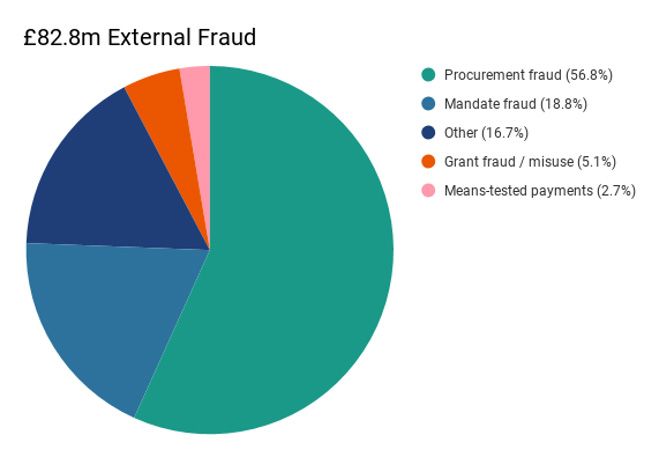
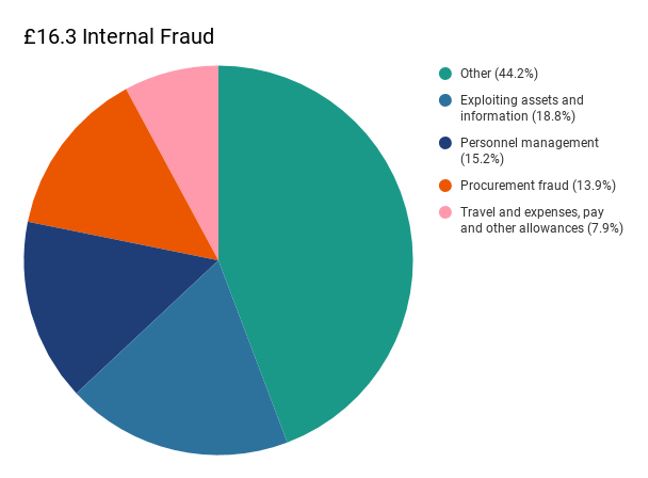
for Education would have discovered this fraud.19 Figures 1 and 2 show 16. Cabinet Office, ‘Cross-Government Fraud
the breakdown of internal and external fraud committed against the Landscape Annual Report 2019’, February
2020, Link
government in 2018-19. In this period 16 per cent of fraud detected by 17. National Audit Office, ‘Cross-government
government departments was internal fraud (£16.3m), and 84 per cent Fraud landscape review’, 2016, link
was external fraud (£82.8m).20 18. BBC, ‘‘Corrupt’ civil servant jailed for
universal credit fraud’, February 2019. Link
19. Sophie Jamieson, ‘Civil servant stole £1m
from Government to buy a luxury flat’, The
Telegraph, June 2016, Link
20. Cabinet Office, ‘Cross-Government Fraud
Landscape Annual Report 2019’, February
2020, Link
policyexchange.org.uk | 19Daylight Robbery
Figure 1 and 2: Internal and external detected fraud broken down
by typology for all government departments and their arm’s-
length bodies, 2018-19.21
Cybercrime and fraud
The Crown Prosecution Service provides the following definition of the
two types of activity that constitute cybercrime:
Cyber-dependent crimes - crimes that can be committed only through
the use of Information and Communications Technology (‘ICT’) devices,
where the devices are both the tool for committing the crime, and the
target of the crime (e.g. developing and propagating malware for financial
gain, hacking to steal, damage, distort or destroy data and/or network or
21. Cabinet Office, ‘Cross-Government Fraud activity).
Landscape Annual Report 2019’, February
2020, Link
20 | policyexchange.org.uk1. What is Fraud?
Cyber-enabled crimes - traditional crimes which can be increased in scale
or reach by the use of computers, computer networks or other forms of
ICT (such as cyber-enabled fraud and data theft).”22
According to the Crown Prosecution Service, cyber-enabled fraud is one of
the most common cybercrime offences.23 Most external fraud would fall
under the category of economic related cyber-enabled crime, due to the
fact that by moving the provision of Government services online, criminals
seeking to target these services must do so online too. Nevertheless,
some fraudulent activities can be classified as cyber-dependent crime,
particularly in cases of internal fraud, where public sector employees use
‘privileged access to computers and networks’ to commit fraud.24
Disaster Fraud
The amount of fraud that occurs in different countries at different times
depends on circumstance and the respective opportunities available.
Disasters and crises are well known as a magnet for fraud. In fact the
links between economic crime / fraud and the emergency management
of disasters or crises are well understood internationally with a body
of literature highlighting the opportunities that emergencies present to
fraudsters.
Disaster fraud has in fact become a specialist research area and is defined
as:
“A deliberate act to defraud individuals or governments after a catastrophe and
can be divided into five primary categories: charitable solicitations, contractor
and vendor fraud, price gouging, property insurance fraud, and forgery”25
Fraudsters are attracted to crisis management, as these situations ordinarily
involve an outpouring of government aid, typically accompanied by low
levels of due diligence as a result of a necessity to ensure that finance
reaches recipients quickly.
An example of this in the UK occured after the Grenfell Tower disaster.
The government rightly stepped in after the tragedy of Grenfell Tower
offering residents emergency accommodation, a minimum £5,500
payment from the Grenfell Tower Residents’ Discretionary Fund and
new housing. However, as with all generous government schemes, some
saw this as an opportunity to commit fraud. Alvin Thomson defrauded 22. The Crown Prosecution Service, ‘Cybercrime
- prosecution guidance’ [website], link,
the state of emergency accommodation costing £90,000 by claiming to (accessed June 2020).
be a squatter in the tower26, while others defrauded the government of 23. The Crown Prosecution Service, ‘Cybercrime
- prosecution guidance’ [website], link,
hundreds of thousands of pounds by claiming to be sharing flats with (accessed June 2020).
24. The Crown Prosecution Service, ‘Cybercrime
residents who did not survive. A finance manager at Kensington and - prosecution guidance’ [website], link,
Chelsea Council was also found to have taken £62,000 from the Grenfell (accessed June 2020).
Tower Fund.27 25. Fraud Magazine, ‘Natural catastrophe and
disaster fraud - Calamity criminals’, 2006,
A more recent international example is fraudulent claims for bushfire link
relief assistance linked to the Australian bush fires in 2019-2020. The 26. BBC News, ‘Grenfell - Man who claimed to be
squatter jailed’, November 2019, link
Australian Red Cross reported receiving ‘computer-generated applications 27. Sky News, ‘The fraudsters who took
for bushfire relief assistance’, which can result in grants up to $20,000.28 advantage of Grenfell’, November 2019, Link
28. The Sydney Morning Herald, ‘Cyber thieves
target charity bushfire grants’, 2020, link
policyexchange.org.uk | 21Daylight Robbery
One of the most infamous examples of disaster fraud is Hurricane
Katrina, when billions of dollars in federal disaster relief poured into the
Gulf Coast region leading to unprecedented levels of fraudulent claims:
“The U.S. Congress originally set aside $62 billion for reconstruction, but the
amount was eventually increased to more that $110 billion...Normal federal
contracting rules had been suspended in the rush to help the displaced and re-
open New Orleans. The sheer speed in which contracts were handed out was
unprecedented. Hurricane Katrina relief money disappeared at a rate of more
than $500 million a day. More than 80 per cent of the $1.5 billion in
contracts was awarded without bidding29”.
The Hurricane Katrina Fraud Task Force (established in September 2005)
subsequently investigated 17,000 complaints and brought federal charges
against 907 individuals in 43 federal judicial districts across the country
between 2005-830. The US Government subsequently acknowledged
that the response to Katrina Fraud had not been adequate and created
the National Center for Disaster Fraud (NCDF)31 in 2005 to address this
challenge in future disasters:
“The NCDF is a national coordinating agency within the Department of
Justice’s criminal Division dedicated to improving the detection, prevention,
investigation and prosecution of criminal conduct related to natural and man-
made disasters and other emergencies, such as coronavirus (COVID-19)”
The creation of the NCDF now puts the USA in a better position to deal
with the onslaught of fraud that is occurring in the COVID-19 crisis.
29. Fraud Magazine, ‘Natural catastrophe and
disaster fraud - Calamity criminals’, 2006,
link
30. Government Technology (gt), ‘Hurricane
Katrina Fraud Task Force Brings Storm of
Justice’, 2008, link
31. The United States Department of Justice,
National Centre for Disaster Fraud,
accessed May 2020, link
22 | policyexchange.org.uk2. COVID-19 Public Sector Disaster Fraud
2. COVID-19 Public Sector
Disaster Fraud
Why COVID-19 poses a particular opportunity for fraudsters
There are a number of elements of the COVID-19 crisis that make the
Government response particularly vulnerable to fraud. The first is the
novelty and speed with which new measures have had to be introduced.
Businesses had just days to prepare for emergency (‘lockdown’) measures
and enforced social distancing, so the Government had to rapidly design
and roll out new assistance schemes in order to prevent financial distress.
The speed with which the Government made aid available to businesses
and individuals provided opportunities for fraudsters to take advantage of
the situation. The sheer size of the Government relief package also acted
as a magnet for fraudsters.
Furthermore, in the 2016 National Audit Office Cross-government Fraud
landscape review, it was specifically highlighted that ‘greater use of third parties
and digital channels’ increases the risk of fraud.32 The UK Government’s
strategy for dealing with the COVID-19 crisis has accelerated these trends,
as enforced social distancing has increased the number of interactions
handled online and led to organisations such as the NHS having to rely
on new third party intermediaries for the provision of goods such as PPE.
These risks are compounded by the fact that there is no single identifiable
threat. A small selection of profiteering individuals, corporations and
organised crime networks are seeking to defraud the system through a
range of mechanisms.
The Government has highlighted two types of fraud that it believes will
pose the greatest threat to the public sector over the course of this crisis:
• First party application fraud (where an applicant for a government
support scheme misrepresents their circumstances to become
eligible e.g. when applying for Universal Credit).
• Third party impersonation fraud (where a third party impersonates
an individual or business to gain access to government financing
options e.g. by impersonating a business and applying for Business
Support Grants). 33
32. National Audit Office, ‘Cross-government
Fraud landscape review’, 2016, link
Four UK Government departments have been particularly susceptible to 33. Government Counter Fraud Function,
‘Fraud Control in Emergency Management:
COVID-19 UK Government Guidance’, Link
policyexchange.org.uk | 23Daylight Robbery
fraud as a result of the COVID-19 crisis. The first is the Department for
Health & Social Care and the NHS, which has had to rapidly shift and
expand its operations to deal with the unique challenges of the COVID-19
crisis. Additionally, Her Majesty’s Revenue and Customs, the Department
for Work and Pensions and the Department for Business, Energy &
Industrial Strategy have all been vulnerable to fraud after instituting a range
of measures to protect the UK economy whilst emergency restrictions in
public life were invoked.
Research by Policy Exchange finds that fraud and error during the
COVID-19 crisis will cost the UK Government around £4.6 billion. The
lower bound for the cost of fraud in this crisis is £1.3 billion and the upper
bound is £7.9 billion, of total projected expenditure of £154.3 billion by
the Government (excluding additional expenditure announced in the 8th
July 2020 Economic Update).34 This range has been calculated by using
a combination of expected fraud rates for different types of Government
expenditure created by the Cabinet Office and the Department for Work
and Pensions. The true value may be closer to the upper bound, due to the
higher than usual levels of fraud that accompany disaster management.
This is a serious squandering of public finances and properly resourced
post event assurance will be required to reassure the public that every
possible step has been taken to reduce this level of fraud.
Fraud and the National Health Service (NHS)
The COVID-19 crisis has been particularly challenging for the NHS, which
has had to rapidly redeploy its operations to tackle COVID-19. Amidst the
backdrop of disruptions to global supply chains and a surge in demand
for ventilators and PPE, the NHS has had to contend with serious supply
and staff shortages, which fraudsters have been keen to take advantage of.
Even in normal times, the vast expenditure of the NHS makes it a target
for economic criminals.
The NHS Counter Fraud Authority (NHSCFA), sponsored by the
Department of Health and Social Care Anti-Fraud Unit, was established
in 2017 to tackle NHS fraud, bribery and corruption (where the NHS is
the victim). In their annual Strategic Intelligence Assessment, the NHSCFA
produces an estimate of the cost of fraud to the NHS, as well as intelligence
regarding the characteristics of emerging fraud threats. It has identified
123 different types of fraud committed against the NHS (by employees,
patients, suppliers or third parties), which costs the NHS £1.27 billion
annually (Figure 3). This is a sum equivalent to employing an additional
50,000 fully qualified nurses (pledged by the current Government in its
Conservative Party manifesto).35
34. See Appendix 1 for more information
regarding these estimates.
35. Fully qualified nurse on band 5 annual salary
of £24,907.
24 | policyexchange.org.uk2. COVID-19 Public Sector Disaster Fraud
Figure 3: Annual cost of NHS Fraud, broken down into 13 Thematic
Fraud Areas. 36
NHS Procurement
NHS procurement refers to the process by which the NHS purchases
goods (e.g. equipment and medicines) and services (e.g. GP services)
from both public and private sector sources. In 2018/19, the
Department for Health and Social Care gross procurement budget
was approximately £70bn, of which around £18.2 billion was spent
on medicine and £6 billion was spent on hospital consumables (e.g.
syringes and gloves).37 Responsibility for NHS procurement is split
between the Department for Health and Social Care, NHS England
and Public Health England.38
There are four key existing types of fraud, which have been identified as
likely to become more problematic as a result of COVID-19. These are:
mandate fraud; procurement fraud; NHS recruitment fraud and payroll
fraud:
• Mandate fraud occurs when an individual impersonates a third
party individual or organisation that regularly supplies goods or
services to the NHS, and urgently requests payment to be made
to a new (their own) bank account. Criminals obtain supplier
details through a variety of means, ranging from ‘corrupt staff,
publicly announced contracts and online logs of supplier contracts’.39 This poses a
particular threat in this crisis, as the urgent nature of such requests
(a technique used to pressure staff into complying without due
diligence) appears more valid. In particular, a tightening of the
requirements to pay suppliers within 7 days, instead of the usual
30 days combined with the lack of training of new staff recruited
as a result of COVID-19 increases the opportunity for mandate
fraud to occur.
• Procurement fraud relates to ‘collusion, bribery and corruption within the
36. NHS Counter Fraud Authority, ‘NHS Fraud
pre-tender stages of the procurement and commissioning process’.40 Fraud in the Reference Guide’, May 2020, link
pre-tender stage of procurement can involve behaviours such as 39. NHS Counter Fraud Authority, ‘Mandate
fraud risks’, accessed May 2020, link
suppliers engaging in price-fixing.41 Given the rapid onset of the 40. NHS Counter Fraud Authority, ‘Procurement
COVID-19 crisis and urgent necessity for supplies in the face of & commissioning fraud’, accessed May 2020,
link
unprecedented global demand, the Government has, since March 41. National Fraud Authority, ‘Procurement
2020, relaxed the rules concerning NHS procurement to increase Fraud in the Public Sector’, October 2011,
Link
the ability of the NHS to rapidly procure the necessary goods and 42. Cabinet Office, ‘Procurement Policy Note -
services to tackle COVID-19.42 This includes the procurement of Responding to COVID-19’, 2020, Link
43. F. Islam, ‘Why a billion items of PPE is not
PPE (with up to 5 different pieces required to treat COVID-19 enough’, BBC, April 2020, Link; HM Treasury,
‘A Plan for Jobs 2020’, GOV.UK [website],
patients and a single trust requiring 72,000 items of PPE a day, the July 2020, link.
Government has already spent £15 billion on PPE43), ventilators 37. NHS Digital, ‘Prescribing Costs in Hospitals
and private sector beds. The fact that face-to-face meetings and the Community, England 2017/18’,
November 2018, Link; Department of
with suppliers are no longer possible has increased the risk of Health and Social Care, ‘The NHS Long Term
Plan’, 2019, Link
procurement fraud. With the UK described as a ‘procurement fraud
38. Institute for Government, ‘Explainers: NHS
procurement’, 2020, Link
policyexchange.org.uk | 25Daylight Robbery
capital’ in 2019, the NHS is particularly vulnerable in this area.44
• NHS Recruitment is another area where the Government has been
forced to relax regulations in order to increase the flexibility of the
NHS to respond to the COVID-19 crisis. For example, in urgent
cases employers may now accept scanned copies of documentary
evidence and photographs of identity. NHSCFA has therefore
raised concerns that a minority of new recruits may provide false
identity documents, or falsely claim to have certain experience or
qualifications.45
• Payroll Fraud. The highly irregular circumstances under which
NHS staff have now had to operate has also increased the risk of
payroll fraud, which occurs when there are fraudulent claims
concerning the hours worked by staff. This can include exaggerated
claims for hours worked and expenses, multiple salary entries
and remaining on the payroll system post COVID-19. The issue
of payroll fraud is exacerbated by the crisis, as the quantity and
complexity of payrolls to be authorised has increased significantly.
Although fraud is often committed by individuals seeking a quick profit, it
is worth noting that those who will be targeting the NHS are often part of
sophisticated Organised Crime Groups (OCGs). For instance, the German
government almost lost €2.4m to fraudsters who tried to sell them 10
million masks that did not exist.46 The payment was eventually blocked
(€500,000 of which was already en route to Nigeria), but the complex
nature of the scam, which involved fake companies and websites in Spain,
Ireland and the Netherlands, highlights the scale of the threat that is being
faced.
It is also noteworthy that a national exercise on the prevention
of procurement fraud in the NHS was initiated in 2019 with the next
phase due to start in May 2020. This phase involves collecting data from
providers but has been postponed due to the COVID-19 health crisis.47
Whilst understandable in light of the immense pressure that the NHS is
facing, the collection of data concerning fraud is critical to understanding
and combating one of the most opaque yet prevalent crimes that exists. It
is recommended therefore, that the NHSCFA conduct a review into NHS
fraud during the COVID-19 crisis at the earliest opportunity in order to
capture organisational learning and prevent fraud in the future.
44. Supply Management, Allen, A.,‘UK a
‘procurement fraud capital’, 2019, Link
45. NHS Counter Fraud Authority, ‘NHS
recruitment fraud risks’. May 2020, link.
46. The Economist, ‘The pandemic is creating
fresh opportunities for organised crime’,
May 2020, Link
47. NHS Counter Fraud Authority, ‘National
exercise on procurement fraud on hold due
to COVID-19’, May 2020, Link
26 | policyexchange.org.ukYou can also read


