DEMENTIA STATE PLAN - Virginia Alzheimer's Disease and Related Disorders Commission AlzPossible.org - Alzheimer's Association
←
→
Page content transcription
If your browser does not render page correctly, please read the page content below
DEMENTIA
STATE PLAN
Building a dementia-capable Virginia

                                       2020-2024
Virginia Alzheimer’s Disease and
Related Disorders Commission

AlzPossible.org
TABLE OF CONTENTS
Letter from the Chair to the Governor and General Assembly 3
Vision 4
The Changing Landscape of Dementia 5
The Issue: Alzheimer’s Disease/Dementia 6
How Dementia Affects Virginia 8
Accomplishments 2015-2019 12
Overview of Goals 14
Goal 1 Coordinate quality dementia services in the 15
Commonwealth to ensure dementia capability
Goal 2 Use dementia-related data to improve public 17
health outcomes
Goal 3 Increase awareness and create dementia-specific 18
training
Goal 4 Provide access to quality coordinated care for 21
individuals living with dementia in the most
integrated setting
Goal 5 Expand resources for dementia-specific 23
translational research and evidence-based practices
Dementia State Plan Development Process 25
Contributions and Acknowledgments 26
Glossary 27
References 30
Commonwealth of Virginia’s Dementia State Plan 2020-2024 2COMMONWEALTH OF VIRGINIA
Alzheimer’s Disease and Related Disorders Commission
October 1, 2019
Lory Phillippo, MPH, OTR/L,
Chair The Honorable Ralph Northam and Members of the Virginia General Assembly:
Laura Bowser, Vice Chair
The Alzheimer’s Disease and Related Disorders Commission is pleased to present the
Vivian Bagby, RN, MS Dementia State Plan 2020-2024: Building a Dementia-Capable Virginia.
L. Karen Darner
Christopher Desimone, Esq. The Commission has revised and updated the Dementia State Plan in collaboration with
Thomas P. Fiztgibbons
researchers and stakeholders, and through a series of public listening sessions held
across the Commonwealth attended by individuals living with dementia, their families
Karen H. Garner
and caregivers, and service providers. Over 100 Virginians attended the public listening
Valerie Hopson-Bell, BA, CMC sessions held in partnership with the four chapters of the Alzheimer’s Association
G. Richard Jackson, MPA, CSA serving Virginia and with Mountain Empire Older Citizens in Big Stone Gap. The
Khurrum H. Khan Commission also accepted comments from the public by telephone, mail and e-mail
Carol Manning, PhD, ABPP-CN
from March 19, 2019 through June 30, 2019.
Charles P. Martino, CSA, AIA
An estimated 150,000 Virginians are now living with Alzheimer’s disease or another
Lana Sargent, PhD, GNP-BC, form of dementia, and this number is forecast to rise to 190,000 by 2025. It is essential
FNP-C
both to plan now for the increased demand for supports and services, and to embrace a
Pamela Teaster, PhD public health approach to dementia in order to mitigate its future impact. The five goals
of the Dementia State Plan offer a comprehensive vision of a dementia-capable Virginia:
1. Coordinate quality dementia services to ensure dementia-capability
2. Use dementia-related data to improve public health outcomes
3. Increase awareness and create dementia-specific training
4. Provide access to quality coordinated care in the most integrated setting
5. Expand resources for translational research and evidence-based practices.
To continue building a dementia-capable Virginia, the Commission has developed
recommendations and strategies that will be overseen by focused workgroups based
within the Commission to facilitate the realization of the five goals. The Commission
alzpossible.org will evaluate and track progress on the recommendations and looks forward to reporting
www.vda.virginia.gov/boardsandco accomplishments under the Plan in the future. Although achieving the vision contained
uncils.htm in the Plan will likely require additional resources, progress toward the goals can also be
made through innovation and collaboration with stakeholders across the Commonwealth.
Department for Aging and We welcome your thoughts and ideas. To share them with the Commission, please
Rehabilitative Services (DARS) contact any of the Commission members or staff at the Virginia Department for Aging
Virginia Division for Community and Rehabilitative Services.
Living/Office for Aging Services
1610 Forest Avenue, Suite 100 Sincerely,
Richmond, Virginia 23229
Email aging@dars.virginia.gov
Tel (804) 662-9333
Fax (804) 662-7035
Lory L. Phillippo, MPH, OTR/L, Chair
Alzheimer’s Disease and Related Disorders CommissionVISION
The Alzheimer’s Disease and Related Disorders Commission,
and its partners, envision a dementia-capable Virginia that
provides ethical, person-centered, evidence-based and high
quality care across the continuum of the disease through a
coordinated system that meets the needs of individuals of
any age living with dementia and their caregivers.
Commonwealth of Virginia’s Dementia State Plan 2020-2024 4CHANGING LANDSCAPE OF DEMENTIA
In 2011, the Alzheimer’s Disease and Related efforts will continue in that direction as identified
Disorders Commission (the Commission) in the Dementia State Plan 2020-2024. But
published the first Dementia State Plan as a dementia capability is only part of the overall
blueprint for achieving dementia capability in the picture of supporting individuals living with
Commonwealth, and updated that Plan in 2015. dementia.
The concept of dementia capability means being
skilled in identifying people with possible dementia In this new Plan, the more recent concept of
and working effectively with them and their care dementia friendly is incorporated as a critical
partners or caregivers through the stages of their element of dementia capability. A dementia-friendly
disease (Alzheimer’s Association, 2016). Guided by community is one that is both accessible to people
the Plan, the Commission has achieved much over living with dementia and their care partners and
the past eight years to improve Virginia’s dementia enables their continued engagement with the
capability. community (Alzheimer’s Association, 2016). Using
the two concepts together ensures that the lived
Virginia now supports a Dementia Services experience of people living with dementia, their
Coordinator (DSC), a recommendation from the caregivers, and families, is supported and enhanced.
first Dementia State Plan. Since 2013, the DSC
has supported the Commission in its efforts, The Commission has also adopted more dementia-
increased grant funding to support new programs friendly terms throughout the Plan. Examples of
helping individuals living with dementia and care this are replacing ‘person with dementia’ with
partners, and spearheaded training and workforce ‘person living with dementia’, recognizing
education efforts on dementia knowledge and that people do live with dementia and that the
related issues. Innovative programs to support individual is more than the disease. Similarly, ‘care
individuals and family caregivers have been devised partner’ is being used interchangeably throughout
and piloted in Virginia using a mix of federal, state, the Plan together with the term ‘caregiver’ in
local and private funding. Workforce training recognition that the language used for people
efforts have helped to increase the awareness and supporting individuals living with dementia is
understanding of dementia-related issues that may shifting.
arise for first responders, healthcare workers and The 2020-2024 Plan contains new
the financial and legal professions. Data sources recommendations to support dementia-friendly
useful for informing policy at a state and local level initiatives by working with the public health
have been identified, and information collected. system and others to promote greater awareness
Support for vital research into treatments and and understanding of dementia, and to reduce the
cures, as well as to support individuals and care stigma surrounding dementia. The Commission
partners in their daily lives, has increased through expects that success in these areas will help
sources like the Alzheimer’s and Related Diseases individuals, families and communities affected by
Research Award Fund (ARDRAF). Alzheimer’s disease and other forms of dementia
These successes have gone a distance towards enjoy an improved quality of life.
making Virginia a dementia-capable state, and
Commonwealth of Virginia’s Dementia State Plan 2020-2024 5THE ISSUE: ALZHEIMER’S DISEASE/DEMENTIA
Dementia is an umbrella term referring to a Alzheimer’s disease. Although there are some
collection of symptoms affecting cognition and indications that the risk of developing dementia at
memory caused by a number of different diseases any given age is declining, possibly due to increased
that damage brain cells and affect daily functioning. educational levels and improved cardiovascular
The symptoms experienced by people living health (Langa et al., 2017), the absolute number of
with dementia vary widely by individual and people living with Alzheimer’s disease continues to
specific disease, but typically include significant rise as the large cohort of baby boomers ages and
impairment of at least two of the following areas: people live longer.
memory, communication and language, ability to
focus and pay attention, reasoning and judgment, Other non-modifiable risk factors include
and visual perception (Alzheimer’s Association, family history, APOE-e4 gene and mild cognitive
2019d). impairment (MCI). Potentially modifiable risk
DEMENTIA DOES NOT JUST AFFECT OLDER AMERICANSTHE ISSUE: ALZHEIMER’S DISEASE/DEMENTIA
People Living with Alzheimer’s Disease
AGE
5.8 million AmericansHOW DEMENTIA AFFECTS VIRGINIA
Estimated Number of People Aged 65 and Older with Alzheimer’s Disease by Age, Virginia
% increase
YEAR 65-74 75-84 85+ TOTAL from 2015
2015 21,000 58,000 53,000 130,000
2019 24,000 64,000 57,000 150,000 15%
2025 29,000 89,000 68,000 190,000 46%
There are an estimated 150,000 adults age 65 or For more information on this data, including
older currently living with Alzheimer’s disease the prevalence rates of Alzheimer’s disease for
in Virginia. This number is expected to rise to Medicare beneficiaries at the county level, please
190,000 by 2025 (Alzheimer’s Association, 2019a). visit AlzPossible.org/data-and-data-sets.
According to the Centers for Medicare and Medicaid
Services (CMS), 92,277 fee-for-service or traditional Subjective Cognitive Decline
Medicare beneficiaries in Virginia had received a
clinical diagnosis of Alzheimer’s disease or a related In 2015, Virginia included the optional Cognitive
dementia in 2015 (US CMS Chronic Conditions, Decline module in the annual Behavioral Risk
2015). Factor Surveillance System (BRFSS), providing a
snapshot of the breadth of cognitive issues reported
The estimated number of people living with by residents. The results, added to those from 2012
Alzheimer’s disease is much higher for several and 2013 when this module was also included, offer
reasons. The increasing numbers of people state health and human resource agencies a deeper
enrolling in Medicare Advantage plans are not perspective of cognitive impairment issues and how
counted in traditional Medicare data. Of equal they may interfere with an individual’s functioning.
concern, less than 50% of people living with
Alzheimer’s disease or a related disease has The most recent data revealed that 8.9% of the
received a clinical diagnosis (National Institute 3.4 million Virginians age 45 or older reported
on Aging, 2017b), and not all of those who have subjective cognitive decline, memory problems
received a clinical diagnosis are enrolled in that have been getting worse over the past year. Of
Medicare. By definition, these numbers exclude these, 29.6% reported needing help with household
individuals with younger-onset Alzheimer’s disease. chores and 35.6% reported giving up day-to-day
activities as a result of their cognitive difficulties.
People Living with Subjective Cognitive Decline
45+ 48%
300,000 Virginians had not talked to a doctor
over age 45 about memory concerns
Source: Alzheimer’s Association (2019a); Alzheimer’s Association (2018)
Commonwealth of Virginia’s Dementia State Plan 2020-2024 8HOW DEMENTIA AFFECTS VIRGINIA
For two out of every five of these people, cognitive disease (Alzheimer’s Association, 2019a).
decline interfered with social activities, work
or volunteering. More worrying, many of those The optional Caregiving module of the 2015
reporting subjective cognitive decline already BRFSS revealed that one in five adult Virginians
have or will eventually develop mild cognitive provided regular care or assistance to a friend or
impairment or dementia, yet nearly half had family member with a health problem or disability.
not spoken with a healthcare provider about it Of these, 8% provided care to someone living
(Alzheimer’s Association, 2018). with dementia (Centers for Disease Control and
Prevention, 2018).
Caring for People Living with Dementia
Providing care for a person living with dementia
Although a wide variety of care options exist, can be both intensive and of long duration: 53% of
the vast majority of care for people living with individuals living with dementia received assistance
dementia is provided by family or other informal from informal care partners with activities of daily
care partners in the home. Supporting these living (bathing, dressing, toileting and similar tasks)
care partners is a vital component of dementia- and 57% of family care partners had provided
capability. In 2017, an estimated 465,000 Virginians care for four or more years (Kaspar et al., 2015).
provided 529 million hours of unpaid care worth Two-thirds of care partners are women, one-
$6.7 billion for people living with Alzheimer’s third are age 65 or older, and one quarter are also
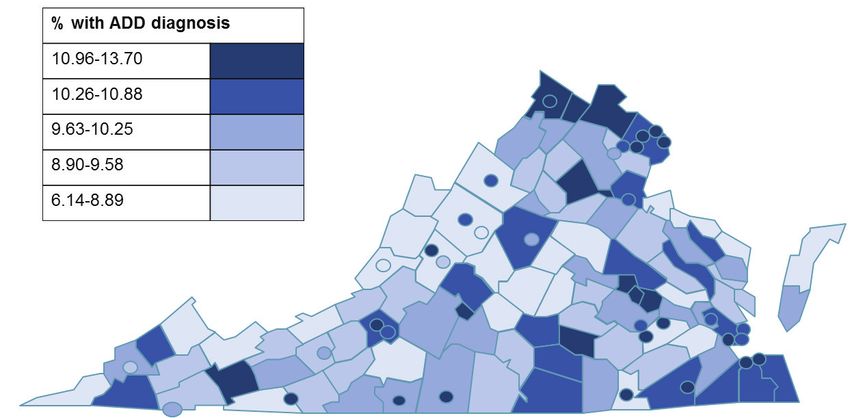
Percentage of Fee-for-Service (Traditional) Medicare beneficiaries diagnosed with
Alzheimer’s disease and dementia (ADD) in 2015
Source: Centers for Medicare and Medicaid Services
Commonwealth of Virginia’s Dementia State Plan 2020-2024 9HOW DEMENTIA AFFECTS VIRGINIA
caring for children age 18 or younger (Alzheimer’s disabilities (DD) are increasingly living longer
Association, 2019a). Many caregivers will provide lives, though life expectancy remains lower
care for more than one person living with dementia than for the general population. Individuals
over their lifetime, for example providing care for a with Down syndrome are at highest risk for
parent and later a spouse. developing Alzheimer’s disease or a related
dementia, and typically develop it in their
The cost of care for people living with dementia is 50s or earlier. For other individuals with DD,
significantly higher than that for others: Medicare prevalence is thought to be higher than for the
costs for beneficiaries living with Alzheimer’s general population, although with a similar age
disease or a related disorder are estimated to be of onset and time course. (Pritchett, 2017)
three times higher than for other beneficiaries in
the same age group. The Alzheimer’s Association Addressing Stigma for Better Outcomes
(2019a) estimates the average lifetime cost of care
Stigma surrounding Alzheimer’s disease and other
for an individual living with dementia at $350,174.
forms of cognitive impairment is widespread
Medicare and Medicaid cover two-thirds of the
and problematic, and does not just affect people
total $290 billion spent in America each year on
living with the disease. The National Plan to
dementia care costs, with personal resources
Address Alzheimer’s Disease (US Department
required to cover a further 22% (Alzheimer’s
of Health and Human Services, 2018) notes that
Association, 2019a).
stigma and misperceptions affect the care and
Varied Prevalence of Dementia degree of social interaction experienced by people
living with dementia and their families and care
The prevalence of dementia varies among partners. Concerns related to stigma may leave
populations for reasons that are not entirely people reluctant to discuss their cognitive health
understood: with providers and delay diagnosis and treatment
• Women make up more than 60% of the total (Alzheimer’s Association, 2019c).
number of people age 65 or over living with This stigma is in part due to a lack of knowledge
dementia, and estimates suggest 16% of women and awareness about dementia. Although
age 71 or over have Alzheimer’s disease or dementia is not a normal part of aging, increasing
another form of dementia compared to 11% of understanding and acceptance of dementia should
men (Alzheimer’s Association, 2019a). improve the quality of life for people living with the
• Older African-Americans are twice as likely to condition and their caregivers.
have Alzheimer’s disease or another form of The Dementia State Plan 2020-2024 contains
dementia than are whites, and older Hispanics several recommendations intended to increase
are one and one-half times as likely to have public awareness and understanding of Alzheimer’s
dementia. Asian-Americans typically have disease and dementia. From public health
the lowest prevalence of dementia. These campaigns to the promotion of dementia-friendly
differences are likely due to differences in communities, these involve educating people
health, lifestyle and socioeconomic risk factors about the disease, its early warning signs and risk
(Alzheimer’s Association, 2019a). prevention, as well as the importance of early
• Individuals living with developmental diagnosis and planning for future needs.
Commonwealth of Virginia’s Dementia State Plan 2020-2024 10HOW DEMENTIA AFFECTS VIRGINIA
Dementia Requires Public Health Approach
Dementia is the sixth leading cause of death in the messaging and education about them to modify
United States, with one person diagnosed roughly behaviors and reduce stigma. The second phase
every sixty seconds. Distressingly, it is the only one focuses on the early diagnosis of those with
of the leading causes of death that has no effective cognitive impairment so co-morbid conditions
treatment or cure. It remains one of the most can be well-managed, and so available and future
stigmatized conditions affecting Americans, with a dementia medications can be used as appropriate.
lack of awareness and understanding contributing Finally, the third phase, for those living with
to low rates of diagnosis, difficulties accessing dementia, involves the earlier implementation of
services and supports when they are needed, and active management strategies to benefit the person
a failure to prepare for the long-term impact on and any caregivers through improved quality of life
individuals and families. and timely use of available resources.
Years of study and research have increased Throughout the Dementia State Plan 2020-2024,
understanding about the mechanisms of diseases goals and recommendations have been reviewed
like Alzheimer’s disease, and awareness and through the lens of this public health approach. The
knowledge of risk factors associated with dementia. Commission has utilized the Healthy Brain Initiative
This has fostered a more systematic approach to the 2018-2023 Road Map (Alzheimer’s Association &
disease. Applying a traditional three-phase public Centers for Disease Control, 2018) as a guide to the
health model to the challenge of dementia offers practical steps that can be taken to achieve better
promise. Phase one involves the identification outcomes.
of risk factors, and community-wide proactive
Dementia Caregiving in Virginia
465,000
caregivers
529 million hours of unpaid care
$6.7 billion value of unpaid care
$317 million higher health care costs for
caregivers than non-caregivers
(Alzheimer’s Association, 2019a)
Commonwealth of Virginia’s Dementia State Plan 2020-2024 11ACCOMPLISHMENTS 2015-2019
Overarching Accomplishments
• In 2018, Virginia passed SB305 to require the Virginia Department of Health to include messaging
about dementia and risk factors for cognitive decline in public health campaigns.
• In 2017, The Virginia Department of Health, supported by the Dementia Services Coordinator,
launched HealthyBrainVA.com, an information site on brain health that is a centerpiece of dementia-
related public health initiatives.
• Over the four years to 2019, Virginia’s General Assembly increased funding for the Public
Guardianship Program to $4.7 million, more than double the $2.1 million available in 2015. This
resulted in a 73% increase in the number of slots available for those needing a public guardian to
1,049.
• A workshop to kick off Dementia Friendly Virginia was held in April 2018 in Richmond. This
workshop has led to the growth of multiple dementia friendly community initiatives across the
state. Going forward, their efforts will be supported by the DSC and LeadingAge Virginia. One of the
key components of Dementia Friendly Communities is workforce training in basic awareness and
understanding of dementia and some of the issues that relate to people living with dementia in the
community.
Data and Research Accomplishments
• In 2015, Virginia included the Cognitive Decline module in the annual BRFSS survey.
• In 2015, Virginia included the Caregiver module in the annual BRFSS survey.
• In 2016, Virginia was awarded $900,000 from the Administration for Community Living to expand
availability of the Chronic Disease Self-Management Education program to the entire state. One goal
of the grant was to expand delivery of the program to include individuals living with early stage
dementia and their caregivers, with the Alzheimer’s Association assisting with referrals and outreach.
• In 2015, Virginia’s General Assembly adopted changes to the legal framework surrounding research to
make it easier for individuals living with dementia to participate in research and clinical trials when
they themselves are not able to provide informed consent.
• The Virginia Neuroscience Initiative (VNI) has come together to help foster links between researchers
and institutions and to promote collaboration on research efforts between five medical centers and
seven research universities. The VNI includes an Alzheimer’s disease interest group.
Coordinated Care Accomplishments
• In 2015, Virginia received a three-year federal Administration for Community Living Alzheimer’s
Disease Initiative—Specialized Supportive Services (ADI-SSS) grant of $970,000 to devise and
implement a model program of care coordination (Care Coordination Program) for individuals living
with dementia, and to adapt and implement a model program for individuals at risk of developing
dementia to learn strategies to maintain independence for a longer period of time. This project also
served as a model collaboration between an Area Agency on Aging and a local health system. The
program served more than 200 individuals living with dementia and their care partners.
• In 2018, the Care Coordination Program received a Commonwealth Council on Aging’s Best-Practice
Award and a National Association of Area Agencies on Aging (n4a) Innovations in Aging Award.
• In 2016, Virginia received an 18-month federal Administration for Community Living Alzheimer’s
Commonwealth of Virginia’s Dementia State Plan 2020-2024 12ACCOMPLISHMENTS 2015-2019
Disease Supportive Services Program (ADSSP) grant to expand the FAMILIES program (supporting
family caregivers) from pilot regions around Charlottesville and Williamsburg to the entire
Commonwealth. This included training additional counselors and offering the program via telehealth.
More than 130 people enrolled, well above the target of 100.
• In 2018, Virginia received funding from the Virginia Center on Aging Geriatric Training and Education
initiative to train an additional 15 counselors for the FAMILIES program of counseling support for
caregivers. This funding will sustain the FAMILIES program across the Commonwealth into the next decade.
• In 2018, three-year Alzheimer’s Disease Program Initiatives grants from the Administration for
Community Living were awarded to UVA’s Memory and Aging Care Clinic and to Riverside Center for
Excellence in Aging and Lifelong Health. Among other goals, both programs will improve and support
care coordination for people living with dementia utilizing the Benjamin Rose Institute (BRI) Care
Consultation program.
• In 2018, Virginia received $281,817 in federal funding to support the Virginia Lifespan Respite Voucher
Program for three years to serve more than 450 family caregivers, including those caring for people
living with dementia.
Training and Workforce Development Accomplishments
• An additional project under the 2015 ADI-SSS grant was Virginia’s Microlearning for Dementia
pilot project. This produced five modules to train the primary care workforce in having difficult
conversations around dementia with their patients. These are now available on AlzPossible.org and
Virginia Navigator.
• Virginia devised and made available dementia capability training modules for Options Counselors,
Care Transitions Coaches, Information and Referral Specialists. Links to these modules are available on
AlzPossible.org.
• The DSC supported training for State Police and EMT personnel. Virginia is allocating $50,000 annually
to train first responders on Alzheimer’s disease and dementia, helping to develop an eight-hour,
dementia-specific training module.
• The DSC supported the training of Dementia Friends Champions by LeadingAge Virginia.
• Virginia has continued an open and informal discussion on dementia services and training needs
through the interdisciplinary, multi-agency Virginia Geriatric Mental Health Partnership (GMHP).
The GMHP has created and disseminated more than 20 webinars to train community-based staff and
providers as well as family caregivers under its Mental Health and Aging Training Initiative.
Commonwealth of Virginia’s Dementia State Plan 2020-2024 13OVERVIEW OF DEMENTIA STATE PLAN
GOAL 1: Coordinate quality dementia services in the Commonwealth to ensure dementia
capability
A. Support and maintain a Dementia Services Coordinator (DSC) who oversees Virginia’s dementia
capability by recommending policy and coordinating statewide data collection, research and
analysis, and training and awareness efforts in conjunction with the Commission.
B. Expand availability and access of dementia-capable Medicaid and other state-level administered
services.
C. Review all state-funded services to ensure dementia-capable approaches and policies based on
principles derived from the Person-Centered Care and Culture Change movements.
GOAL 2: Use dementia-related data to improve public health outcomes
A. Collect and monitor data related to dementia’s impact on the people of the Commonwealth.
B. Collaborate with related public health efforts and encourage possible risk-reduction strategies.
GOAL 3: Increase awareness and create dementia-specific training
A. Provide standardized dementia-specific training to individuals in the medical, health, and social
services fields and require demonstrated competency.
B. Provide dementia-specific training to professional first responders (police, fire, EMS and search
and rescue personnel), financial services personnel, and the legal profession.
C. Support caregivers, family members and people living with dementia by providing educational
information about dementia and available resources and services.
GOAL 4: Provide access to quality coordinated care for individuals living with dementia in
the most integrated setting
A. Create a statewide network of interdisciplinary memory assessment centers with specialized,
dementia-capable services for individuals living with dementia and their care partners from
assessment and diagnosis through end-of-life.
B. Provide a system of services that are integrated, coordinated and diverse to meet the varied
needs of individuals living with dementia and care partners during the disease trajectory.
C. Identify and coordinate supports for informal and family care partners to enhance well-being.
GOAL 5: Expand resources for dementia-specific translational research and evidence-based
practices
A. Support ARDRAF, especially projects that have a specific emphasis on “methods of treatment,
ways that families can cope with the stresses of the disease, and the impact of the disease on the
citizens of the Commonwealth” (§ 51.5-153).
B. Provide support to researchers and interested stakeholders across the Commonwealth through
data sources and networking opportunities.
C. Promote the advancement of translational research, evidence-based practices and research
participation in Virginia.
Commonwealth of Virginia’s Dementia State Plan 2020-2024 14DEMENTIA STATE PLAN
GOAL 1
Coordinate quality dementia services in the Commonwealth to ensure dementia capability.
A. Support and maintain a Dementia Services Coordinator (DSC) who oversees Virginia’s dementia
capability by recommending policy and coordinating statewide data collection, research and
analysis, and training and awareness efforts in conjunction with the Commission.
1. The DSC shall disseminate information on systems, services and related activities for
individuals with Alzheimer’s disease and related dementias to the medical and healthcare
community, the academic community, individuals living with dementia and their family
caregivers, advocacy associations, and the general public.
2. The DSC shall coordinate services and activities of state and local agencies, service providers,
advocacy groups, first responders and law enforcement, as well as other entities throughout
the state that engage the person living with dementia and their care partners, including the
Alzheimer’s Association, the Area Agencies on Aging, and state and local Departments of
Health.
3. The DSC shall coordinate and provide support for Commission activities.
4. The DSC shall continue to identify interdisciplinary memory assessment centers, share
information about them with consumers, and provide professional development opportunities
for center staff.
5. The DSC shall coordinate with LeadingAge Virginia to support and encourage Dementia
Friendly America initiatives in counties and communities across the state.
B. Expand availability and access of dementia-capable Medicaid and other state-level administered
services.
1. Increase respite services for caregivers of people living with dementia.
2. Expand the accessibility and availability of adult day services, the Commonwealth Coordinated
Care Plus (CCC+) waiver, hospice and palliative programs, and Program of the All-inclusive Care
for the Elderly (PACE).
3. Increase funding for home and community based services (HCBS).
4. Increase the payment rate of Auxiliary Grant to cover the actual cost of care in an assisted living
facility or other supported housing.
5. Promote the awareness and use of Virginia’s Long-Term Care Partnership Insurance Program.
6. Increase funding for Virginia’s State Long-term Care Ombudsman Program.
7. Monitor and support the dementia capability of care coordination services provided under the
CCC+ waiver.
8. Continue to evaluate and improve Virginia’s advance directive, emergency custody order (ECO),
temporary detention order (TDO), and commitment laws to more easily allow persons living
with dementia to access needed and appropriate behavioral health services.
Commonwealth of Virginia’s Dementia State Plan 2020-2024 15DEMENTIA STATE PLAN
(Goal 1 cont.)
9. Ensure the demand for public guardians is fully met.
10. Create a student loan forgiveness program or tuition assistance for medical and nursing students
specializing in geriatrics.
11. Review state legislation and regulations for licensing of professions, facilities and providers.
a. Review licensing and survey standards or protocols for long-term facilities and identify
opportunities to improve dementia capability and quality though actions such as acuity-based
staffing.
b. As regulations are open for review, advocate and recommend that expected dementia
care practice components be standard for assessments, service delivery, and training and
oversight of medical and health professionals and paraprofessionals engaged in caregiving.
c. Increase the availability of information on licensed professions, facilities and providers for
consumers, including information on dementia-specific training and programming.
C. Review all state-funded services to ensure dementia-capable approaches and policies based on
principles derived from the Person-Centered Care and Culture Change movements.
1. Integrate the Alzheimer’s Association Dementia Care Practice Recommendations into the
development, delivery and evaluation of services provided in Virginia, including the development
and implementation of the Commonwealth’s Four-Year Plan for Aging Services.
2. Partner with the Department for Aging and Rehabilitative Services (DARS) Adult Protective
Services Division, the Virginia League of Social Service Executives, Virginia’s Area Agencies on
Aging, the Virginia Department of Behavioral Health and Developmental Services (DBHDS),
Community Services Boards, and the Geriatric Mental Health Partnership (GMHP) to identify
solutions and promote best practices for providing crisis stabilization for individuals living with
dementia who are experiencing challenging dementia-related behaviors.
3. Review the overlapping requirements for the licensing of residential facilities, assisted living
facilities, and nursing facilities to further clarify the different levels of services and clarify the
differences in admission disclosure documents.
4. Ensure that Virginia’s No Wrong Door (formerly known as Aging and Disability Resource
Connectors) network is dementia capable, with a specific focus on education and training for
information and referral specialists, options counselors, and care transitions coaches.
5. Incorporate dementia education into developmental disability (DD) services and provider
training, and review waiver regulations and policies to accommodate the growing population
of individuals with DD, including Down syndrome, and dementia who are served through state-
based programs.
6. Conduct veteran-specific outreach efforts in partnership with the Virginia Department of Veterans
Services and through the Virginia Veterans Care Centers.
Commonwealth of Virginia’s Dementia State Plan 2020-2024 16DEMENTIA STATE PLAN
GOAL 2
Use dementia-related data to improve public health outcomes.
A. Collect and monitor data related to dementia’s impact on the people of the Commonwealth.
1. Coordinate statewide data collection and regularly share the findings through AlzPossible.org,
which serves as a clearinghouse of links to state or federal agencies or entities with relevant,
up-to-date, and available data on dementia. Such data findings should include the results of
the BRFSS Caregiver and Cognitive Decline modules, Medicare data on beneficiaries and on
individuals who are dually eligible for Medicare and Medicaid, and data from sources including
No Wrong Door, Adult Protective Services, DBHDS, DMAS and the Virginia Crime Information
Network (VCIN).
2. Coordinate with state licensing agencies to collect data on dementia prevalence, trends, and the
characteristics of professions, facilities and providers.
a. Consider the extent to which internal agency policies could mandate data collection that
captures the presence or absence of Alzheimer’s disease and dementia.
b. Consider potential financial incentives for entities that fully complete forms or assessments.
3. The DSC should collect and monitor data with the following themes in mind:
a. The prevalence of dementia-related diseases across the Commonwealth, including by locality,
across rural and urban communities, gender, ethnic and racial minorities, younger onset,
individuals with DD, and other special populations or unique characteristics.
b. The availability of dementia-related services and supports.
c. The availability of diagnostic and assessment services for Alzheimer’s and dementia.
d. The number and location of Virginians who are currently providing care to a family member
or friend with dementia.
e. The cost of caring for persons with dementia.
f. The prevalence of dementia among incarcerated populations.
4. With collected data, apply the findings to policy development and implementation so that such
policies can target geographic areas and populations with identified unmet or higher needs.
B. Collaborate with related public health efforts and encourage possible risk-reduction strategies.
1. Use the BRFSS to collect health outcomes data for persons with Alzheimer’s disease and dementia
and their care partners in Virginia, and analyze and apply the findings to improve dementia
capability.
2. Collaborate with related public health efforts (e.g. diet, exercise, co-morbid conditions, etc.) to
improve treatment adherence and encourage possible risk-reduction strategies.
a. Promote awareness of the importance of controlling vascular risk factors to reduce dementia risk.
Commonwealth of Virginia’s Dementia State Plan 2020-2024 17DEMENTIA STATE PLAN
(Goal 2 cont.)
b. Promote efforts to improve treatment adherence among those experiencing subjective
cognitive decline (SCD) living with at least one chronic condition.
3. Encourage participation in the Chronic Disease Self-Management Education (CDSME) program by
persons experiencing subjective cognitive decline, persons living with dementia and caregivers.
Continue to expand this program to make it available in all areas of the Commonwealth.
4. In collaboration with the Virginia Department of Health (VDH) and local health departments,
integrate dementia and brain health into public health strategies and reports.
a. Promote awareness of the benefits of consulting health care providers about brain health for
people experiencing subjective cognitive decline.
b. Educate public health and healthcare professionals on sources and uses of reliable
information about brain health and dementia prevalence.
GOAL 3
Increase awareness and create dementia-specific training.
A. Provide standardized dementia-specific training to individuals in the medical, health and social
services fields and require demonstrated competency.
1. Develop or collect and deliver dementia-specific, evidence-based trainings that include an
emphasis on the differences between dementias and their disease trajectories, management
of co-morbid conditions, dementia-related behaviors, referral protocols and resources, non-
pharmacological interventions, care planning and advance directives, and the needs of and
supports for family and informal care partners, among others.
a. Such dementia-specific, evidence-based trainings should be part of regular offerings
and required demonstrated competencies for medical and health professions, including
physicians, physician assistants, nurses of all licensing levels, gerontologists, psychologists,
occupational, physical, and speech therapists, pharmacists, rehabilitation counselors, and
social workers, and other health and social services professionals across all professional care
settings including emergency room, other acute care and home-care settings.
b. Integrate the dementia-specific, evidence-based training modules into the existing trainings
offered through VDH, Virginia Department of Social Services (DSS), DARS, DBHDS, and their
local entities and contractors, including Area Agencies on Aging, Community Services Boards,
local health departments and local departments of social services.
c. Integrate the dementia-specific, evidence-based training modules into the curriculums and
training strategies for long-term care facilities and HCBS providers.
d. Promote the integration of dementia-specific, evidence-based training modules into the
curriculums and training strategies for care coordinators in the CCC+ network.
2. Promote the continued and expanded use of the Advanced Nurse Aide Certification and encourage
employers to reward such additional education with increased salaries.
Commonwealth of Virginia’s Dementia State Plan 2020-2024 18DEMENTIA STATE PLAN
(Goal 3 cont.)
3. Develop or catalog and deliver a portable certification program for direct-care staff with
standardized content designed to enhance their understanding of memory impairment and their
performance in caring for individuals living with Alzheimer’s disease or related dementias. This
content should include evidence-based, non-pharmacological strategies for addressing dementia-
related behaviors.
4. Coordinate training opportunities with the GMHP, particularly with regard to overlapping issues
such as cognitive impairment and mental health, substance use, and polypharmacy.
B. Provide dementia specific training to professional first responders (police, fire, EMS and search and
rescue personnel), financial services personnel, and the legal profession.
1. Develop or catalog and deliver dementia-specific, professionally-endorsed trainings with
dedicated funding that include an emphasis on challenging dementia-related behaviors, detention
orders, driving safety, wandering issues and resources, advance directives and other legal tools,
and risks and signs for abuse, neglect, and financial exploitation, among others.
a. In partnership with the Virginia Department of Criminal Justice Services (DCJS), Virginia
State Police (VSP), Virginia Department for Emergency Management, (VDEM) and Virginia
Department of Corrections, continue to develop relationships and implement coordinated,
dementia-specific, evidence-based trainings with state and local first responders (police, fire,
EMS, and search and rescue personnel). emergency and disaster response personnel, and
correctional personnel.
b. In partnership with DCJS, VSP and VDEM, continue work with first responders (police,
fire, EMS and Search & Rescue personnel) to ensure a coordinated protocol for swift and
appropriate action upon report of a missing adult with dementia, to include the appropriate
use of Senior Alert, Project Lifesaver, and other wandering prevention and response tools.
c. In partnership with statewide and local legal organizations and associations, implement
dementia-specific, professionally-endorsed trainings for general practice attorneys,
prosecutors, judges, magistrates, victim advocates, and court clerks.
d. In partnership with the VSP, Virginia State Corporation Commission and industry
representatives, implement dementia-specific, professionally-endorsed trainings for financial
services personnel, including bank tellers, accountants, financial advisers, loan officers and
collectors.
2. Coordinate dementia-specific outreach and training efforts with the Virginia Office of the
Attorney General and its Senior-focused Triad and SALT (Seniors and Law Enforcement Together)
initiatives.
C. Support care partners, family members and people living with dementia by providing educational
information about dementia and available resources and services.
1. Expand AlzPossible.org resources and its library of free, quality trainings and online materials
available to address dementia care and research needs in Virginia, to include:
a. Dementia and caregiving data for tracking trends in the Commonwealth.
Commonwealth of Virginia’s Dementia State Plan 2020-2024 19DEMENTIA STATE PLAN
(Goal 3 cont.)
b. Interdisciplinary memory assessment centers.
c. Best practices for dementia assessment and diagnosis, care and caregiving support and a
clearinghouse of evidence-based and evidence-informed dementia care interventions and
therapies not involving medications.
d. Cognitive assessment instruments.
e. A comprehensive listing of available, evidence-based and evidence-informed trainings for
professional care staff.
f. A listing and explanation of services provided by state agencies related to dementia and
caregiving.
g. The stages of Alzheimer’s disease and common services associated with each.
h. Train-the-trainer outreach program for faith-based and other organizations to assist families
with a member living with dementia in legal and financial awareness.
2. In partnership with the Alzheimer’s Association and other state agencies and their contractors,
train and link informal or family care partners to information and education about dementia
and the caregiving process, including staying healthy, coordinating legal and financial issues, and
locating and using respite care services, among other topics.
3. Develop or collect and deliver a statewide, culturally-appropriate awareness strategy that has
tailored components for the unique needs of rural communities, racial and ethnic minorities,
non-English speaking individuals, veterans, individuals with younger-onset Alzheimer’s disease,
individuals with developmental disabilities, members of the LGBT community, and individuals
with traumatic brain injuries (TBI). As appropriate, such a strategy could be in partnership with
faith-based communities and the Alzheimer’s Association to increase the availability and use of
education materials tailored to these groups.
4. With appropriate stakeholders, develop or collect and implement an evidence-based protocol
for appropriate interaction with individuals living with dementia, with specific information on
dementia-related behaviors.
5. Develop or collect and deliver person-centered training for family care partners that incorporates
evidence-based strategies for addressing dementia-related behaviors. These strategies often
include understanding that the behavior is an attempt at communication, identifying the cause of
the behavior, and using knowledge of the person to deliver individualized support.
6. Advocate for and increase awareness and inclusion of advance directives and end-of-life planning,
including knowledge of Virginia-specific laws governing such practices, in routine care for all
older adults, with particular emphasis on individuals with Alzheimer’s disease and dementia and
caregivers.
7. Increase awareness of the Annual Wellness Visit, which includes an assessment of cognitive
function, offered to Medicare beneficiaries.
8. Incorporate dementia awareness and information about resources into the Commonwealth of
Virginia employee wellness program.
Commonwealth of Virginia’s Dementia State Plan 2020-2024 20DEMENTIA STATE PLAN
GOAL 4
Provide access to quality coordinated care for individuals living with dementia in
the most integrated setting.
A. Create a statewide network of interdisciplinary memory assessment centers with specialized,
dementia-capable services for individuals living with dementia and their care partners from
assessment and diagnosis through end-of-life.
1. Promote a statewide network of memory assessment centers that use an interdisciplinary team
approach to assess and treat persons with dementia.
2. Identify the typical pathways to assistance for individuals living with dementia, possibly
through a study, and develop a system of entry based on coordinated memory assessment
centers for individuals living with dementia and their care partners.
3. Within the interdisciplinary memory assessment centers and community partners, establish
and fund dementia coordination centers that are staffed by credentialed patient navigators who
can help persons living with dementia and their care partners and offer such services as:
a. Assessing and developing care plans in conjunction with the person living with dementia,
their care partners and family.
b. Identifying and making referrals or arranging appropriate clinical care.
c. Identifying and making referrals or arranging long-term care services and programs,
including home and community based supports, PACE programs, long-term care facilities,
and hospice and palliative programs.
d. Identifying and making referrals or arranging supportive services, such as transportation,
meals, home modifications, respite care, counseling, and support groups.
e. Educating the persons living with dementia and their care partners about their disease,
interactions with other chronic conditions, care options, driving assessments, and legal and
financial issues including end-of-life wishes and advance directives.
f. Accessing public and private benefit programs and assisting with insurance claims.
4. Integrate data collection and track health outcomes and service utilization of persons living
with dementia and care partners in the memory assessment center network to analyze
prevalence and trends, effectiveness, and cost, including money saved through coordinated
care.
B. Provide a system of services that are integrated, coordinated and diverse to meet the varied needs
of individuals living with dementia and care partners during the disease trajectory.
1. Standardize the protocol followed after an individual receives a diagnosis of Alzheimer’s
disease or a related disorder, to include referrals for further evaluation by an interdisciplinary
team with expertise in cognitive impairment and dementia at a memory assessment center,
and referrals to appropriate services including the Alzheimer’s Association and the local Area
Agency on Aging.
Commonwealth of Virginia’s Dementia State Plan 2020-2024 21DEMENTIA STATE PLAN
(Goal 4 cont.)
2. Track health outcomes and service utilization of persons living with dementia and care partners
to assess and analyze effectiveness and cost, including money saved through coordinated care.
3. With appropriate stakeholders, identify current protocols, and develop and implement improved
protocols for appropriate placement options and available community resources based on the
stages of Alzheimer’s disease and related disorders.
4. Support systems that promote integrated care between primary, acute and long-term care
settings and the transitions between them, with an emphasis on minimizing transitions, repeat
hospitalizations, and emergency department visits, and on improving medication reconciliation.
5. Identify and remove barriers for community integration for persons living with dementia in part
by promoting and supporting dementia friendly communities.
6. In coordination with Area Agencies on Aging and Community Services Boards, establish cross-
setting teams and provide supports to long-term care facilities and family care partners to
respond to changed behaviors in a safe and appropriate manner.
7. Promote research participation and university-community partnerships to address community
needs and promote mutually beneficial participatory research opportunities in diagnosis,
treatment, long-term services and supports, and caregiver supports.
8. Promote geriatric emergency departments in hospitals that include trained staff and a thorough
evaluation of adults presenting with possible delirium or dementia to assure safety and best
outcomes for individuals.
9. Advocate for accessible and innovative transportation systems including new models of transport
options.
10. Promote and advocate for long-term care services modeled after Culture Change (including Green
Houses, Eden Alternatives, Household Models, etc.) and other related initiatives that establish
person-centered, home-like environments.
11. Increase opportunities and reduce barriers to the widespread and successful use of telemedicine
and telehealth services that meet the needs of individuals living with dementia and caregivers,
particularly in rural areas.
C. Identify and coordinate supports for informal and family care partners to enhance well-being.
1. Identify, promote awareness and work to enhance the sustainability of successful, evidence-
based programs (e.g., FAMILIES) that support family care partners through education, counseling,
referrals, respite, and other related supports.
2. Offer business and individual tax incentives to support family care partners with the purchase of
locator devices, respite care services, and other related expenses.
3. Encourage the development and implementation of employee assistance programs identify the
needs of care partners and resources available to support them, which may include educational
materials, onsite respite care and support groups.
4. Provide information about long-term care insurance policies and other related programs that help
offset the financial costs associated with long-term care.
Commonwealth of Virginia’s Dementia State Plan 2020-2024 22DEMENTIA STATE PLAN
GOAL 5
Expand resources for dementia-specific translational research and evidence-based practices.
A. Support ARDRAF, especially projects that have a specific emphasis on “methods of treatment, ways
that families can cope with the stresses of the disease, and the impact of the disease on the citizens of
the Commonwealth” (§ 51.5-153).
1. Support an increased focus and balance on translational projects, to include those that:
a. Utilize epidemiological methods.
b. Advance translational or clinical methods that identify evidence-based practices for service
delivery and take them from bench to bedside.
c. Identify costs associated with the delivery of programs and services to individuals living with
dementia and care partners.
d. Develop both high-tech and low-tech assistive devices that adapt everyday environments for
people living with dementia.
e. Assess the quality of services and facilities for individuals living with dementia and their care
partners.
2. Explore projects that attempt to better understand Alzheimer’s disease and dementias in rural
communities, racial and ethnic minorities, non-English speaking individuals, veterans, individuals
with younger-onset Alzheimer’s disease, individuals with developmental disabilities, members
of the LGBT community, individuals with TBI, and individuals experiencing dementia-related
behaviors and co-occurring serious mental illness.
3. Disseminate research findings, especially translational research findings, on AlzPossible.org.
B. Provide support to researchers and interested stakeholders across the Commonwealth through data
sources and networking opportunities.
1. Develop a research consortium network and provide networking opportunities for researchers
and interested stakeholders in Virginia.
a. Periodically disseminate information about studies in need of participants and funding
opportunities, which may include federal grant opportunities from the US National Institutes
of Health as well as from the Alzheimer’s Disease Programs Initiative (ADPI) within the
Administration for Community Living and the US Centers for Medicare and Medicaid Services
Innovation grants, Civil Money Penalty funding and pilot demonstrations.
b. Use AlzPossible.org and the International Alzheimer’s Disease Research Portfolio (IADRP) on
iadrp.nia/nih.gov to link researchers interested in dementia research.
2. Direct researchers to dementia and caregiving-related data sources so that they can better write
research funding applications.
Commonwealth of Virginia’s Dementia State Plan 2020-2024 23DEMENTIA STATE PLAN
(Goal 5 cont.)
C. Promote the advancement of translational research, evidence-based practices and research
participation in Virginia.
1. Promote training for gatekeepers (primary care providers, physicians, nurses, office managers,
and other health professionals) on dementia and the value of research participation.
2. Develop incentives, such as research partnering and communication of study results, for medical
and health professionals who encourage research participation in the community.
a. Explore options to further support participant recruitment and participation in research
studies in Virginia, specifically with populations marked by higher risk of dementia such as
ethnic and racial minority populations and individuals with intellectual and developmental
disabilities, and with rural and underserved communities, individuals with younger onset
Alzheimer’s disease, and other special populations or unique characteristics.
b. Foster university-community partnerships to further research and development, address
community needs, and promote mutually beneficial participatory research opportunities.
c. Develop and share resources to support Review Boards in developing consistent methods for
assessing and approving dementia and caregiving research studies, to include information on
understanding and confirming with informed consent allowances as outlined in § 32.1-162.16
through § 32.1-162.20.
d. Use AlzPossible.org to link to additional resources related to research.
e. Promote awareness and use of existing mechanisms to link potential participants with
research opportunities (e.g., ClinicalTrials.gov and TrialMatch).
3. Further dementia capability with the use of evidence-based practices, and use AlzPossible.org as
a resource to evaluate and share dementia-capable services, evidence-based practices, and risk-
reduction strategies.
a. With additional study and subsequent positive outcomes, identify opportunities for continued
and expanded use of evidence-informed programs in Virginia, including the shift of quality
evidence-informed programs into evidence-based programs.
b. Examine the effectiveness of common methods used to disseminate and translate evidence-
based practices, and apply the results in Virginia.
c. Implement promising practices and programs statewide and promote the incorporation of
evidence-based practices into existing programs that are merely evidence-informed at the
present time.
Commonwealth of Virginia’s Dementia State Plan 2020-2024 24You can also read


