Digitising the Environmental Impact Assessment (EIA) Process - A user-centred approach to designing an EIA process for the future - Digital EIA
←
→
Page content transcription
If your browser does not render page correctly, please read the page content below
DISCOVERY REPORT

Digitising the
Environmental
Impact Assessment
(EIA) Process
A user-centred approach to designing
an EIA process for the future.

© Digital EIA Project Partners, March 2020
1                                                     Digitising the EIA Process
Project partners:                      Project funded by:   If you have any questions regarding
                                                            the content of this report, or would
                                                            like to get involved, contact Kate
                                                            Taylor – Digital Planning Team Lead,
                    Connected Places                        or Liam Dargan – Service Designer
                                                            at Connected Places Catapult:
                                                            plantech@cp.catapult.org.uk

                                                            Or get in touch via our website:
                                                            www.digitaleia.co.uk

                                                            We’ve also created a
                                                            #cpc_digital_eia channel on our
                                                            public Plantech Slack workspace.
                                                            This is a free online space to
                                                            exchange ideas and learnings, hear
                                                            about events, opportunities and to
                                                            collaborate with others in the Digital
                                                            Planning sector. Sign up and join in
                                                            the conversation.
                                                            plan-tech.slack.com

2                                                                                   Digitising the EIA Process
3 Digitising the EIA Process
The Digital EIA project explores how the
Environmental Impact Assessment (EIA)
process could be transformed. Using a
human-centred design approach, we’ve
explored what a more designed, digital
and data-informed future for EIA could
hold. We’ve identified key challenges
within the process, developed some
initial concept ideas and explored the
feasibility of a new vision for EIA.

4                                          Digitising the EIA Process
Contents
Who we are							06              Understanding the current user
                                 journey and technologies available			               15
What is an EIA?							07
                                 Identifying challenges and opportunities			         22
Why it matters							09
                                 Designing and testing potential solutions		         31
Our aims and objectives					11
                                 Early exploration concepts 					38
Our opproach							13
                                 Detailed exploration concepts 				                  48

5                                                                          Digitising the EIA Process
Who we are

    Funded by Innovate UK,                               Connected Places Catapult is a government
                                                         backed technology and innovation centre with a
    The Digital EIA project is a      Connected Places
                                                         track-record in developing digital tools for planning
                                                         and transport.
    collaboration between Connected
    Places Catapult (led by their                        Quod is a renowned planning consultancy offering
                                                         Environmental Impact Assessment services and are
    Digitising Planning Programme),                      known for leading cutting-edge technology solutions
                                                         on development projects.
    Quod, Temple, ODI Leeds and
    Liquorice Marketing.                                 Temple is a leading independent infrastructure and
                                                         property consultancy specialising in environment,
                                                         planning and sustainability.

                                                         ODI Leeds are a pioneer node of the Open Data
                                                         Institute, created to explore and deliver the potential
                                                         of open innovation with data at city-scale.

                                                         Liquorice are a communications and marketing agency
                                                         working across a variety of platforms and sectors
                                                         including the built environment.

6                                                                                                Digitising the EIA Process
What is an EIA?

Environmental Impact Assessments (EIAs) are
regulated by EU/UK legislation and are a crucial
part of the design evolution and approval
process for development, infrastructure,
forestry, agriculture and other projects. Their
purpose is to ensure that the environmental
and social effects of proposals are understood
prior to decisions being taken and to aid public
participation in decision-making. Consultation
with the public is a key part of an EIA.

7                                                  Digitising the EIA Process

An EIA is comprised of several key stages:

    Screening               Scoping and               Assessment              Submission and          Decision and
                            Baselining                and Prediction          Consultation            Monitoring

1 2 3 4 5
    This stage determines
    whether a proposed
    development falls
    within the remit of
    the Regulations
    and whether it is
    likely to have a
                            This stage determines
                            the significant
                            environmental issues
                            that need to be
                            considered. It involves
                            the collection and
                            analysis of current
                                                      Once existing
                                                      conditions are
                                                      understood, likely
                                                      environmental effects
                                                      are predicted using a
                                                      variety of assessment
                                                      methods and tools.
                                                                              The ES is submitted
                                                                              to the relevant Local
                                                                              Planning Authority
                                                                              who examine and
                                                                              consult upon the
                                                                              information provided.
                                                                              This includes
                                                                                                      In combination
                                                                                                      with other planning
                                                                                                      application
                                                                                                      documents, the Local
                                                                                                      Planning Authority
                                                                                                      either approves or
                                                                                                      refuses planning
    significant effect on   environmental             This information is     consultation with       permission based
    the environment and     data to inform the        reported on within      the general public.     on the information
    therefore requires      judgement on which        an Environmental                                provided. If approved,
    an assessment. For      environmental topics      Statement (ES).                                 they can impose
    example, a new road     are to be included                                                        certain requirements
    with a continuous       and assessed further                                                      (e.g. environmental
    length beyond 10km      through an EIA.                                                           mitigation monitoring
    and four or more                                                                                  measures).
    lanes would require
    an EIA.

8                                                                                                          Digitising the EIA Process
Why it matters

In the context of rapid urbanization     But today’s Environmental Statements
and rising uncertainty surrounding       (ESs) are often criticised for being an
climate change, the increasing rate      administrative burden, ending with a
of natural habitat loss, and wider       bloated, inconsistent and inaccessible
social and cultural inequalities, EIAs   report replete with technical jargon
are of increasingly crucial importance   that is difficult to navigate, understand
to safeguard our environment and         and even simply to read. Furthermore,
inform good design.                      digital technology is not being
                                         exploited to capture data or deliver
                                         more efficient and effective ways of
                                         producing ESs – which means EIAs are
                                         falling behind other already industries
                                         harnessing technology to drive
                                         productivity (e.g. FinTech, PropTech).

9
Today’s average ES (for                               The process can have the        The procedure becomes
           a 500-dwelling housing                               equivalent carbon footprint     excessively burdensome,
            development) is 4,350                               to making 1,050 lattes, or a    to the extent it could lose
          pages long and may even                              return flight from London to    its audience and therefore
           be delivered in stacked                                       Iceland.**            even risks redundancy. For
           boxes to local planning                                                             High Speed 2 Phase 1, the
                 authorities.*                                                                  final ES was estimated to
                                                                                                be approximately 49,000
                                                                                                      pages long.***

                                                                                                                *Source: surveys and interviews
                                                                                                            **Source: Greengage Environmental
                                                                                                                            ***Source: City A.M.

Digitising the Environmental Impact Assessment (EIA) Process                                                                                   10
Our aims and objectives
• Carry out user-research to understand • Explore the potential economic
the pain points and challenges of the impact and benefits case for a new
current system digital approach to EIA, and
• Explore relevant changes needed to • To drive forward industry discussion
transform the process around opportunities for innovation
in this area.
• Develop ideas for potential concepts
to overcome the challenges
identified, and develop prototypes
to bring them to life
• Consult with key national and
regulatory stakeholders to develop
a roadmap for the next steps required
to bring forward a Digital EIA platform
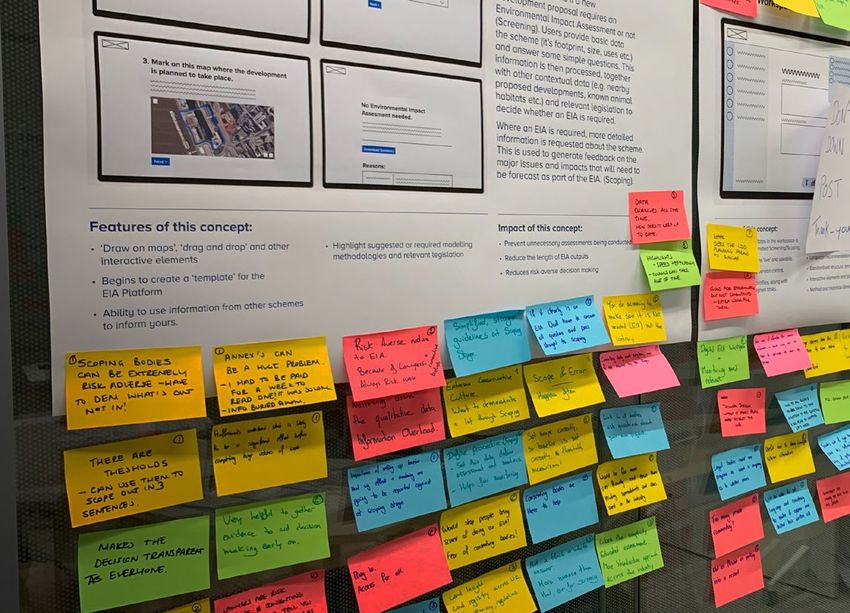
11 Digitising the EIA ProcessA snapshot from our
collaborative session to
cluster insights on challenges
and opportunities
12 Digitising the EIA ProcessOur approach
Human Centred Design techniques We have:
are at the heart of this project. • Interviewed 45 people from organisations including:
By conducting user-research and – The Ministry of Housing
workshops with relevant stakeholders, – Communities and Local Government
– The Geospatial Commission
an in-depth understanding of existing – High Speed Rail 2
EIA processes, challenges and pain – Transport for London (TfL)
points has been established. – City of Bradford Metropolitan
District Council
– London Borough of Southwark
Our human-centred approach ensures – Historic England
that our insights are based on evidence – The Institute of Environmental Management
and the ideas we develop and prioritise & Assessment (IEMA)
– Scottish Power Renewables
are grounded and impactful. – and many more.
• Held three collaborative workshops
• Defined six key challenge areas
• Developed seven idea groups and taken a closer
look at three of them, designing user interface (UI)
prototypes and developing roadmaps for each.
13 Digitising the EIA ProcessWhat we did:
Understanding
the current user Identifying Designing and Early Detailed
journey and challenges and testing potential exploration exploration
technologies opportunities solutions concepts concepts
available
• A kick-off discovery • Collaborative working • Collaborative workshop • Synthesised stakeholder • Synthesised stakeholder
workshop session with partners feedback feedback
• Stakeholder interviews • Interviews • Concept testing • Developed high-level • Developed more detailed
interviews wireframes user interface screens
• Collaborative working • Desk research
sessions • Design iterations • Tested with • Tested with
potential users potential users
• Surveys • Roadmap interviews
• Explored technical,
• User journey mapping financial and
regulatory barriers to
• Desk research implementation
• Designed a roadmap
informed by interviews
14 Digitising the EIA ProcessUnderstanding the current user journey and technologies available 15 Digitising the EIA Process
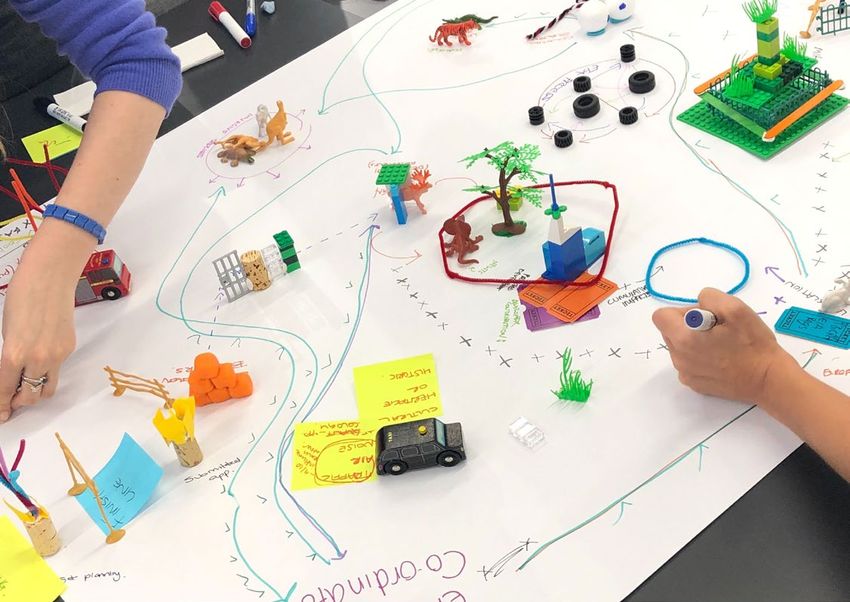
A snapshot from our
     scoping workshop
     – understanding the
16    Digitising the EIA Process
     existing process.
Understanding the current user journey and technologies available
Our methodology
Hosted an exploratory Conducted expert Validated the journey Reviewed the current
scoping workshop with interviews with our own through a series of expert state-of-the-art in digital
a range of experts to domain experts (Quod and interviews with a diverse EIA and planning tools.
determine areas of focus Temple) to use their existing group of stakeholders.
and a framework for the knowledge to map and
next stages of research. outline user-journeys and
their networks to identify
the right interviewees.
17 Digitising the EIA ProcessThere are three key
stakeholder groups
We identified three key stakeholder groups PLANET
throughout the EIA process:
Proposers
he applicants for new proposals such as
T
developers and major infrastructure providers
PRODUCER
Reviewers
Such as local authorities (the deciding body), statutory
consultees and the general public
Producers
Such as EIA consultants and their specialists
that produce EIA data
REVIEWER PROPOSER
18 Digitising the EIA ProcessThe journey is complex
and chaotic
Following the scoping workshop, user research interviews and a mapping
workshop, we were able to visualise a typical existing EIA process journey
for the three stakeholder groups. From here, we were able to highlight the
pain points in the process which went on to inform our ideas.
Identify Project Screening Scoping & Baselining Assesment & Prediction
EIA end
Meeting with Share brief Recruit Receive Screening Receive Receive Scoping Receive design changes Make design Finalise Share final
Reviewer about with Producer specialists Report & Opinion Scoping Report Report Opinion advice based on changes and design freeze design
scheme significant impact data
PROPOSER
(e.g. Developers, planning
agents and architects)
Request either Screening or Scoping Opinion (rarely both)
EIA end
? ?
Review brief Sense check Request Screening Receive Screening Start collecting Begin scoping Produce Scoping Request Baseline Receive Scoping Iteration Finish collecting Consult Model impact Start collating Propose design changes Receive new Model impact Collate/write full
from Proposer Opinion on behalf Report & Opinion Baseline Data (based on data, Report & Share Scoping Opinion Assessment Report Opinion based on Baseline Data specialists about of scheme based ES chapters advice based on significant design proposal of development Environmental
PRODUCER of Proposer previous reports and
the project brief)
Scoping Opinion modelling on data and brief (written by specialists) impact measures based on data Statement
(e.g. EIA coordinators
& specialists)
(Repeat) (Re
? ?
Meeting with Receive request Produce and share Share their Baseline Receive Receive request Work with expert Provide Kept informed and
Proposer about for Screening EIA Screening Data (if requested) Scoping Report for Scoping stakeholders on opinion involved throughout
REVIEWER scheme Opinion Opinion Opinion response (some LAs this iterative design process
(e.g. Local Authority) also publish scoping (pre-app discussions)
request)
© Digital EIA Project Partners, March 2020
19 Digitising the EIA ProcessExisting EIA process journey
Submission & Consultation Decision & Monitoring
(May repeat)
Yes with
conditions Negotoiate Make Begin construction Monitor impacts Complete Continued monitoring
? conditions
& mitigations
amendments/
detailed plans
and share construction and sharing (Doesn’t
happen very often)
No
Receive final Planning Agent submits Receive mitigations Review and make Share with Producer Receive Share updated Receive decision
Environmental ES to Reviewer (as and questions design changes based updated plans and information
Statement part of the wider on suggestions ES
Planning Application)
Appeal or cancel EIA end
development
Review with specialists, Share final Model impact Replace ES chapters, Support
legal and client Environmental of changes add an addendum or monitoring
Statement a statement of conformity
and share
epeat)
Statutory Review Responses shared
& review by
specialists (if
required).
?
Receive final Validation of Publish ES Request further Receive updated Share update Review consultation Issue their decision Monitor Receive
ES (as part the Planning information and information with consultees responses (with mitigations compliance monitoring and operations
of the wider Application suggest mitigations (including statutory and conditions) – throughout outcome
Planning Application) and specialist Also share with construction (word doc)
experts) Secretary of State
(May repeat)
Public consultation Review & consolidate
launched public consultation data
20 Digitising the EIA ProcessTechnology review
A technology review was carried out to
consider the potential advantages and D E TA I L E D R E V I E W S
disadvantages of existing or emerging DATA PORTALS These examples illustrate a suite of data portals THINGFUL
In general, it is fair to say, most Digital EIA projects that bring together a variety of open source data to https://www.thingful.
tools in the planning/environmental sector tend to use standard Office and desktop publishing
tooling to create their results. We have excluded
these from our review.
create visual spatial archives. These have multiple
functions, ranging from spatial planning tools to
acting as visual portals for open and received data.
net/?lat=53.2693196420690
3&z=9&what=flood&lng=-1.24420166015625
A search engine for the internet of things (IoT).
and elsewhere (as applicable). Platforms This section provides a summary of the existing
digital tools and platforms that we have reviewed.
This is based primarily on a review of UK practices
Overall takeaways:
The most successful data portals have clear user
centred designs.
Takeaway points:
This page (and other similar ones) could provide
additional information for data baselining, or
and tools were considered where they as well as a search of worldwide practice, including
North America, Australasia and Europe. There is
precedent of a number of regional spatial planning
Enabling the ability to locate and access data
sources of interest is key. Presenting data (even
if open) in a closed format may be useful when
initial exploratory work. If sensors for a particular
data set happen to be available in a given area,
they would provide a useful reference.
were designed for or had applicable use
tools from other countries including examples from interacting with the site, but enabling users As buildings become more instrumented, it is
Singapore and Australia and these are also reviewed to explore then download data for their own likely that more such data is available, assuming
below. purposes will be beneficial. the building owners can be persuaded to publish
the data openly. If not, it will remain in a walled
in supporting a digital EIA process such as Tools assessed fall broadly into one (or more)
of two categories:
garden.
One would have to question the veracity of the
data – and some appear outdated, so it may not
digital planning platforms, portals, toolsets
Data portals and mapping tools be a reliable source. There is also a question
Analysis tools: mark about quality – the calibration of the
- Technical assessment tools that provide sensors may not be reliable.
input to the EIA process; and
and/or reporting functions. - Analysis/automation of spatial data.
DEFRA MAGIC MAP
https://magic.defra.gov.uk
Consolidated map of Government-collated
These were reviewed against criteria THE MOST SUCCESSFUL DATA PORTALS
open environmental data that is maintained by
Defra. Linked to open data sources for layers
at Defra open data: https://data.gov.uk/
to understand their analytical/reporting
HAVE CLEAR USER CENTRED DESIGNS search?filters%5Btopic%5D=Environment
Takeaway points:
Inclusion of all data in one location/platform.
capabilities, domain alignment and usability. Search function.
No raw data export function. Imported data will
not remain on map portal after use.
The review was also used to help inspire
stakeholders in the art of the possible, as 17 Digital EIA: A Review Of The Current Technology Digital EIA: A Review Of The Current Technology 18
well as identify gaps in existing technologies
To see more in-depth review of our
findings around data and technology,
please get in touch.
21 Digitising the EIA Process
Digitising the Environmental Impact Assessment (EIA) Process 22Identifying challenges and opportunities 22 Digitising the EIA Process
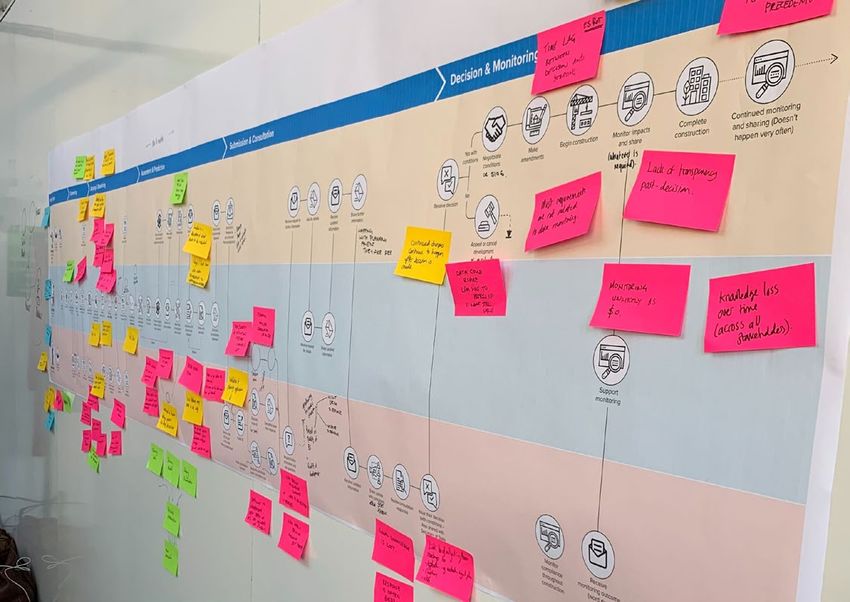
A snapshot from our journey
mapping workshop –
understanding the existing
process and challenges.

23                                                                 Digitising the EIA Process
  23                          Digitising the Environmental Impact Assessment (EIA) Process
Identifying challenges and opportunities

Our methodology

Mapped the EIA process         Conducted in-depth user      Surveyed stakeholders to     Synthesised our findings
and its key stakeholders       research interviews with a   understand the cost and      and clustered key insights
to identify pain points and    wide range of stakeholders   effort expended on the EIA   around the current
opportunities.                 across the EIA process.      process today.               challenges and hopes
                                                                                         for the EIA process.

Following our identification of
pain points across the process
map, we were able to identify
six key challenge areas.

24                                                                                                       Digitising the EIA Process
1 Self-regulation
is leading to an
‘obesity crisis’
2
Current Environmental
Statement formats do
not enable high quality
community engagement
• Fear of challenge and reliance on best practice • Navigating through an ES can be difficult.
rather than regulation has driven the industry to The level of unnecessary information in the
the over-production and over-scoping of EIAs document makes recommendations and
impacts hard to find
• This leads to a disproportionate production of
data, analysis and information in the EIA process • Users often have to cross reference and
consult several versions of a document, making
• This makes EIA reporting impenetrable and them impenetrable even for a specialist
difficult for local communities to understand
the real impact of a development. This lack of • The language of the ES is often technical and
understanding creates further challenges and full of acronyms, which can be challenging and
thereby exacerbates the ‘obesity’ circle. inaccessible to the general public.
25 Digitising the EIA Process3 Access to valid
data is restricted 4
Today’s EIA is
undervalued as a key
tool to inform design
• Data Standards for collecting, presenting and • ES’s have become today’s symbol of the EIA
storing data are often inconsistent process, despite them being only the write up
of the outcome of this process
• Where data is available online, access to the
underlying data itself is rarely provided. When new • Instead of being recognised as an iterative
primary data is captured within the EIA process, process to inform design and development,
it is locked away in PDF’s or on consultants’ EIA’s and the mitigations are often
inaccessible storage systems miscommunicated and misunderstood
• Inaccessibility (due to ownership and Intellectual • Architects and developers do recognize the
Property) and low searchability discourage impact of this process on design, but often see
stakeholders from relying on the data that already it as burdensome and costly.
exists and prompts the need for further primary
data to be gathered
• Data has a lifespan which varies by specialist
topic area. Once ‘expired’, its validity is questioned
resulting in repeat surveys.
26 Digitising the EIA Process5 A lack of post-
application evaluation
and monitoring
6
Data is often
scattered across
several locations
• Post construction, data about the actual impact • Data from different developments, past and
of the development is rarely collected, making present, even though available to the public,
it difficult to ascertain whether the predicted is often scattered between project-specific
significant effects were correct and the domains, or buried in council websites
proposed mitigations successful. This makes
it hard to learn from previous estimations and • There are no legal requirements as to what
improve the overall EIA process in the future data from the process should be held and
stored for inspection or future research,
• Monitoring analysis is rarely shared to inform and even nationally accessible data isn’t
future developments or to scope out impacts. centrally located.
Currently, each EIA starts from scratch and
there is little learning from previous applications
• This is driven by a lack of clarity around who is
responsible for the (often costly) monitoring and
little guidance around methodology.
27 Digitising the EIA ProcessEIA in numbers
Based on an average EIA for a 500-dwelling housing development (source: survey and interviews)
0.2–3 FTE
£150,000 to 8-18 months
Coordinating an EIA
£250,000 Average duration
on average, plus
Average cost to a from EIA initiation to
6 to 10 technical
developer determination
specialists
Almost 55 days
of effort on average
4350 pages long £5,000 – £15,000 per are spent by each firm
and 14–17 chapters chapter on average, on areas with potential
of content on average depending on the topic inefficiencies across
data, modelling and
reworking content
28 Digitising the EIA ProcessOpportunities for improvement and innovation Following synthesis of our findings above, we prioritised a number of key opportunity areas for transformation to guide our concept development. These were founded on better data, data sharing and more collaborative tools. We focused most of our effort on opportunities to improve the assessment and prediction stage, following our finding that 64% of effort is focused on this area. 29 Digitising the EIA Process
The identification of key challenge clusters facilitated collaborative
development of a number of opportunity areas for transformation:

          Data digitisation                     Improved communication
          The process needs to                  The Environmental Statement
          systematically collect, feed, store   needs to explore new technologies
          and access data in a standardised     and visualisation to communicate
          machine readable format, to allow     the impacts in an accessible,
          recouping and recycling within and    interactive, transparent and
          across assessments.                   personalised way.

          Streamlined processes                 Feedback-based iterative
          The EIA process needs to be           evolution
          streamlined, where previous           The whole assessment needs to
          stages inform and build               be reviewed by post-development
          subsequent ones, e.g. the             monitoring to re-configure
          Scoping process should                mitigation, environmental baseline
          automatically generate the            and re-assess methodologies.
          EIA chapters template.

          Real-time collaboration
          A digital EIA should allow
          multiple stakeholders to write,
          collate, model, and assess impacts
          simultaneously, while managing,
          visualising and tracking overall
          progression.

30                                                                                   Digitising the EIA Process
Designing and testing
potential solutions
31 Digitising the EIA ProcessA snapshot from feedback capture and cluster sessions following stakeholder interviews. 32 Digitising the EIA Process
Designing and testing potential solutions

Our methodology

Prioritised and          Ran a collaborative     Clustered these ideas   Tested these high-        Prioritised three
converted our            co-design workshop      into seven concept      level concepts in a       concepts to develop
identified challenges    with project partners   areas, each of which    series of interviews      further, which were
into opportunities by    (and additional EIA     aimed to tackle the     with potential users      further tested and
turning them into a      experts from Quod       challenges identified   and stakeholders,         iterated, informed
series of ‘How might     and Temple) where       in our research         and identified priority   by another round
we...?’ questions        a number of different                           features and needs        of user testing.
                         ideas were formed
                         in response to these
                         questions

33                                                                                                         Digitising the EIA Process
Our seven ideas
Following our research and a series of idea generation workshops, we were
able to cluster our ideas into seven concept areas which aim to solve the
challenges identified earlier in our design process.
National Environmental Datahub Impact Modelling
One open and accessible hub for all environmental data A plug-in tool to test and model different impacts and
scenarios within a digital environment
Automated Screening
An automated tool that helps the applicant understand
Interactive & Accessible
if they need to undertake an EIA or not Environmental Statement
A digital and interactive output of the EIA process
that allows users to easily discover and understand
information relevant to them
Assisted Scoping
A digital tool that generates scoping recommendations
and builds a custom EIA Workspace structure
Post-Application Monitoring
A ‘must-do’ process that will improve the quality
of mitigation and data.
Digital EIA Workspace
A standardised collaboration space for coordinating the
EIA and writing the Environmental Statement
34 Digitising the EIA ProcessHow the seven concepts sit across EIA process:
Screening Scoping & Baselining Assesment & Prediction Submission & Consultation Decision & Monitoring
Model impact
Repeat
Collect and Make design
add data changes
What kind
Is EIA of things do Publish & receive Final decision
we need to Final design Monitoring
needed? feedback received
measure?
Repeat
Automated Assisted
Digital EIA Workspace
Screening Scoping
Impact Modelling
National Environmental Datahub
Interactive & Accessible ES
Post-Application Monitoring
35 Digitising the EIA ProcessHow they could build over time and work
together to create a Digital EIA Framework
Digital EIA Workspace
Automated Assisted Interactive
Screening Informs &
builds this Scoping Informs &
builds this
Informs &
builds this & Accessible
ES
Impact Modelling
Feeds into Feeds into Feeds into Feeds into
this this this this
National Environmental Datahub
Feeds into
this
Post-Application Monitoring
36 Digitising the EIA ProcessThe ideas create opportunities
for open innovation by others
The following concepts form part of a wider
‘Open Innovation’ strategy that will accelerate
innovation and open new alternative markets.
“Open innovation is
Closed Innovation Open Innovation the use of purposive
inflows and outflows of
knowledge to accelerate
internal innovation, and
expand the markets
for external use of
innovation, respectively.”
Henry Chesbrough (American organisational
theorist known for coining the term ‘open
innovation’)
37 Digitising the EIA Process
37Early exploration concepts 38 Digitising the EIA Process
Early exploration concepts

A series of concept-testing sessions with     For each of these concepts we:              Early exploration
relevant stakeholders and experts were
undertaken to gain feedback on our high-      • Synthesised stakeholder feedback
level ideas.                                    and used this to update and build each
                                                                                          Automated Screening
                                                concept
Whilst all the concepts were identified
as having value across the process, the       • Developed a high-level wireframe to
                                                visualise what the idea could look like   Assisted Scoping
following four were de-prioritised to allow
us to take a more in-depth look at the
remaining concepts.                           • Documented our findings
                                                                                          Impact Modelling
The Interactive & Accessible Environmental
Statement was often chosen as one of
the most important to the transformation.                                                 Interactive & Accessible
However, we identified that work on similar                                               Environmental Statement
solutions is already being delivered by
the market.

The remaining concepts were identified as
having less impact on the overall process,
or as needing further refinement before
being taken further.

39                                                                                                      Digitising the EIA Process
Early exploration
Automated Screening
A semi-automated tool that helps developers to understand if they
need to undertake an EIA or not
What is it? Who is it for? Feedback
An online platform that enables users to test and Developers and EIA consultants would be the • Building trust amongst users is key for
confirm if a new development proposal will require main users. LPAs would also be secondary successful application of this tool. This means
an Environmental Impact Assessment (Screening). beneficiaries. it needs to be clear what is a regulatory
requirement and what is advisory, where
The tool asks those proposing a new development specialist recommendations would still need to
to provide basic information and data on the Benefits be sought for ‘grey areas’
scheme (footprint, size, uses etc) as well as answer • Reduces unnecessary screening requests and
a series of standardised questions about their therefore local authority time and resource • Allows learning from other projects: however,
specific development proposal. This information is they may have set bad precedents and
then processed, together with other contextual data • Increased transparency of decision-making and therefore poor quality practice is included within
(e.g. nearby proposed developments, protected EIA screening requirements the process
species, flooding, etc) and checked against
thresholds set out within national legislation and • Increased certainty for applicants • Seen as one of the easier concepts to
guidance, generating an automatic response as to implement, but it felt the efficiencies and savings
whether an EIA is required. • Reduces risk-averse decision-making were less significant than transforming other
parts of the EIA process.
Specialist and technical advice (human • Ensures direct alignment between proposals
intervention) may be required for some ‘grey- and the EIA Regulations and Government
area’ decisions. Where this is the case, the tool guidance.
will create an EIA Screening Request, to seek
additional advice, and automatically compile
this request to the deciding body (e.g the local
authority). Over time, machine-learning will seek
to reduce the requirement for human intervention
for ‘grey-area’ decisions.
40 Digitising the EIA ProcessAutomated Screening example screens Early exploration 41 Digitising the EIA Process
Early exploration

Assisted Scoping
A digital tool that generates scoping recommendations, consolidates scoping
feedback and builds a custom Digital EIA Workspace structure.

What is it?                                            Users will be able to geolocate all comments,            Benefits
                                                       for example highlighting potential environmental
A digital tool to improve the efficiency and           impacts spatially on a map. There will be a              • Efficiencies and cost savings for LPA’s through
transparency of the EIA Scoping process for            clear dialogue between the applicants and the              automation of low value, resource intensive
both public and private sectors.                       consultees for each specific impact to demonstrate         tasks such as collation of consultee responses
                                                       how they have been actioned and/or where further
Applicants input scheme details and can choose to                                                               • Increased transparency and efficiency of
                                                       correspondence is required.
automatically collate baseline data and relevant                                                                  scoping reports through standardised templates
legislation as well as policy and assessment           There is potential to link with the Digital EIA
methodology. It also allows them to identify                                                                    • Reduced over-scoping and inclusion of topics
                                                       Workspace and Interactive and Accessible ES so
potential surveys required, highlight likely impacts                                                              that do not need to be assessed.
                                                       that topics ‘scoped-in’ are automatically populated
and make recommendations for appropriate               in these tools. Machine-learning could also be
mitigation. The tool would enable users to explore     incorporated through a link to the Post-Application
and select previous precedents to understand                                                                    Feedback
                                                       Monitoring platform to create a feedback loop that
the methodology and mitigations applied to             helps the tool become more intelligent over time.        • Due to the complexity of the scoping
similar proposals and use this to populate a                                                                      process and the number of consultees, a
semi-automated, standardised EIA scoping report.                                                                  standardised and digital process would be
                                                       Who is it for?                                             very difficult to achieve
When a Local Planning Authority (LPA) receives the
scoping opinion request, the tool automates the        Applicants and their consultants will use the tool to    • The digital scoping dashboard makes managing
distribution of the report to the relevant statutory   submit a scoping request to LPAs who will in turn          and observing the progress of the scoping
consultees. Once they have provided feedback, it       use this tool to streamline the consultation process,      process more interpretable and user-friendly
automatically consolidates consultee responses         through greater efficiency in the collation and review
into one report for review by planning officers.       by statutory consultees.                                 • The tool needs to be 100% reliable in order for
                                                                                                                  people to trust and use it.

42                                                                                                                                                Digitising the EIA Process
Assisted Scoping example screen Early exploration 43 Digitising the EIA Process
Early exploration

Impact Modelling
A plug-in tool to test and model different impacts and
scenarios within a digital environment.

What is it?                                         Benefits:                                              Feedback:
This plug-in within the Digital EIA workspace       • By working in real-time, the Impact Modelling        • The functionality of the tool is reliant on the
application enables different impacts and             plugin will facilitate immediate and direct impact     emergence of the Datahub as well as the
scenarios of a development to be tested.              reporting from a scheme from the early stages          breadth of the data contained within. Similarly,
                                                      of development, effectively making the ‘design         as a plug-in, delivery of the tool will be
The tool will demonstrate, in real-time, how          freeze’ process more streamlined and simpler           dependent on the Workspace application
a design will impact various parts of the
environment (flooding, noise and air pollution,     • The application will utilise and integrate with      • As scheme designs evolve there is a certain
habitats, etc.) by measuring the proposal against     Building Information Modelling (BIM) or other          level of confidentiality that may be required.
data in the Datahub application.                      simulation software, which is already commonly         Given the tool is reliant on open and transparent
                                                      used amongst built environment consultants.            information about a scheme at any point in time,
As project partners make real-time changes to a       BIM will also allow users to track design              there are likely to be issues with confidentiality
scheme, impact data will respond accordingly and      changes as they are made, so that alternative
highlight where potential issues lie.                 options can be explored                              • There are issues around the types of data that
                                                                                                             are collected for EIA, of which, some data are
                                                    • Environmental experts will be able to easily           qualitative. Qualitative measurements
Who is it for?                                        demonstrate to designers how various changes           frequently require human assessment and
Environmental consultants, together with project      will impact the environment                            consideration, which may make immediate
partners such as engineers and architects.                                                                   responsive testing difficult.
                                                    • Data in the Datahub will not only be used for
                                                      responsive impact testing, but will also link to     • This was seen as being most useful if included
                                                      other EIAs in the area and provide a library           as part of the Digital EIA Workspace concept
                                                      of previous scheme designs, demonstrating
                                                      management and mitigation solutions.

44                                                                                                                                           Digitising the EIA Process
Impact Modelling example screen – (Forms part of the Digital EIA Workspace following feedback) Early exploration Digital EIA WS Modelling 45 Digitising the EIA Process
Early exploration

Interactive & Accessible
Environmental Statement
A digital and interactive output of the EIA process that allows users to easily
locate and understand information relevant to them.

What is it?                                          Who is it for?                                       Feedback
An interactive ES platform that can be               The local community and any interested parties.
                                                                                                          • Today there is still a regulatory requirement for
personalised by the user. It provides a concise      A variation of this tool could be created for LPAs
                                                                                                            a paper ES. Unless regulatory requirements are
digital format that will allow the user to easily    and statutory consultees.
                                                                                                            updated, the interactive platform would need an
navigate the ES, and provide them with interactive
                                                                                                            export tool to PDF or similar
and easily understable environmental information.
Users will have the ability to use filters to see    Benefits                                             • Digital literacy and access are barriers to
the information relevant to them, and translate      • Impacts can be translated into easily relatable      some members of the public which will need
technical jargon at the click of a button.             concepts (e.g. hear examples of what noise           to be overcome to ensure effective public
                                                       impacts might sound like)                            engagement for all
As a fully integrated ES platform, it allows users
to leave feedback and ask questions. Users can       • Increased transparency and inclusiveness           • Protecting sensitive information (such as
interact with the information to understand the        by involving, more effectively, the public and       drinking water extraction, the location of certain
proposed development and its impacts in ways           other stakeholders throughout the process,           protected species etc.) would need to be
that are relatable to them, through features like      in particular harder to reach members of the         considered carefully
Virtual Reality, 3D modelling, fly throughs and        community
aural simulations of impacts.                                                                             • An ES could also communicate the positive
                                                     • Reduced lengths and complexities of an ES            impact of the EIA process and the ‘trade-offs’
With further research and development, the                                                                  that had been made
concept of an interactive ES could also be used to   • Increased accessibility and potential savings on
support the decision maker (e.g. LPA) with making      printing costs and resources.                      • This is starting to happen across the UK with
a more informed conclusion on the potential                                                                 most environmental consultancies developing
environmental effects of a development.                                                                     basic digital ES reporting tools. Therefore, this
                                                                                                            concept was not seen as a priority to develop in
                                                                                                            more detail during this project.
46                                                                                                                                          Digitising the EIA Process
Interactive & Accessible ES example screen Early exploration
Insert paper prototype here
How will the Seven Hills
housing development impact you? Attend Event Stay informed Share
1 Customise 2 Understand 3 Feedback
Introduction
You are a:
What are your first impressions?
Resident Business owner Future Now We are building 503 two to
Other five bedroom houses 0.8 miles
away from your address. Add comments
Your postcode is: per suscipit lobortis nisl ut aliquip ex ea commodo conse-
quat. Duis autem vel eum iriure dolor in hendrerit in vul-
putate velit esse molestie consequat, vel illum dolore eu
BB3 2JE feugiat nulla facilisis at vero eros et accumsan et iusto
odio dignissim qui blandit prased diam nonuad minim
veniam, quis nostrud exerci tation ullamcorper.
or search for areas of interest:
Read more FAQs
Market Ha|
Find on map Noise
How do you feel about the developments
The level of noise once the development effects on local noise levels?
Topics of interest:
is complete is expected to be 10dB higher
Air quality
Current noise levels Noise levels during construction Expected noise levels post-completion
Ecology
Noise Lorem ipsum dolor sit amet, consectetuer Lorem ipsum dolor sit amet, consectetuer Lorem ipsum dolor sit amet, consectetuer
I am impressed with the measures
adipiscing elit, sed diam nonummy nibh adipiscing elit, sed diam nonummy nibh adipiscing elit, sed diam nonummy nibh
Water euismod tincidunt ut laoreet dolore euismod tincidunt ut laoreet dolore euismod tincidunt ut laoreet dolore you have taken to avoid having a
magna aliquam erat volutpat. Ut wisi magna aliquam erat volutpat. Ut wisi magna aliquam erat volutpat. Ut wisi
negative effect on|
Heritage & Archaeology enim ad minim veniam, quis nostrud enim ad minim veniam, quis nostrud enim ad minim veniam, quis nostrud
Traffic
Compare noise Compare noise Compare noise
+ More comments
47 Digitising the EIA ProcessDetailed exploration concepts 48 Digitising the EIA Process
Detailed exploration concepts

Following feedback, the following three         For each of these concepts we:            Detailed exploration
concept areas were prioritised for further
development.                                    • Synthesised stakeholder feedback
                                                  and used this to update and build
                                                                                          National Environmental
These were identified as the concepts that        each concept
                                                                                          Datahub
could have the largest positive effect on the
EIA process and industry.                       • Used imagined scenarios for how
                                                  they might be used to develop more      Digital EIA Workspace
                                                  detailed user interface screens

                                                • Have thought in more-depth about        Post-Application Monitoring
                                                  the user experience and features

                                                • Explored technical, financial and
                                                  regulatory barriers to implementation

                                                • Consulted with national and
                                                  regulatory stakeholders

                                                • Designed a roadmap which explains
                                                  how the idea could be implemented
                                                  over time

49                                                                                                      Digitising the EIA Process
Detailed exploration
National Environmental Datahub
One open and accessible hub for all environmental data.
What is it? Who is it for? What did we learn?
A central and standardised open data portal EIA consultants, developers, councils and • This was seen as the most transformational
where users can discover, access, analyse potentially the public concept by participants
and contribute raw data for use and in the
Environmental Impact Assessment process. • A distributed access model, which provides a
Impact: portal for users to access data held in different
The future vision for the Datahub would be • Drives efficiencies in the process, reducing the places rather than a centralised database would
that innovative digital data solutions such as time to locate and access data, and enabling be the most technically feasible approach
sensors, citizen science and predictive analytics the re-use of data by others
and learning would be used to improve the • It will be crucial to show the source of data,
quantity and quality of data and the frequency • Opens up opportunities for SMEs and who it was generated by, as well as how and
of data collection. other businesses to develop new tools and when it was collected for users to build trust and
innovations from the data that has been consider it reliable
Whilst promoting an open data approach where opened up
possible, the Datahub concept incorporates • Starting with a minimal viable version of the
different levels of data access to protect sensitive • Gives greater transparency to the data used in Datahub to prove its value and feasibility is
data, and various business models options decision making. key – many users suggested starting with data
have been developed to incentivise private for one environmental topic area, or a test
organisations to share their data. project first
• Central Government were viewed as the key
partner needed to drive this concept forward
• Identifying where this would be mandatory
or incentive-led to promote use would be a
key next step.
50 Digitising the EIA ProcessDetailed exploration Some early ideas that informed this concept 51 Digitising the EIA Process
Detailed exploration
National Environmental Datahub

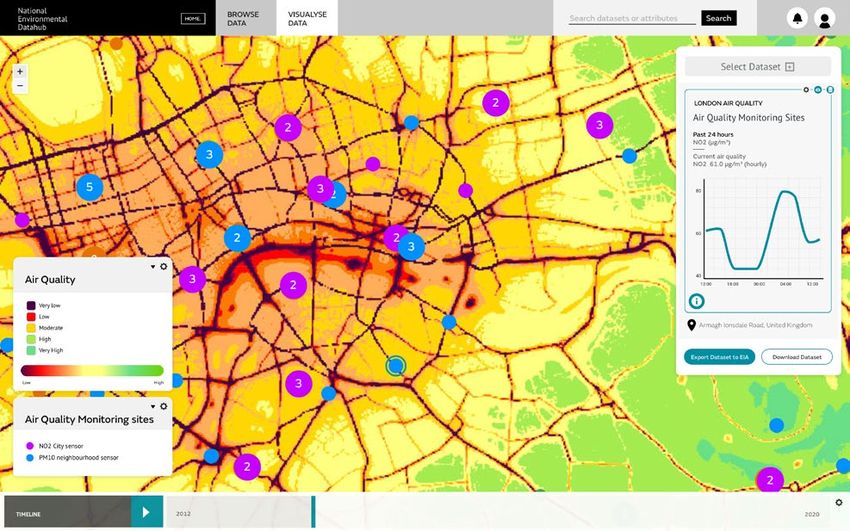
Example screen 1:
Locate datasets (Map view)
Enables users to search for different   1
                                            Scroll through a timeline to see how data has
                                            changed over time
datasets on a map. This screen uses
Air Quality as an example:              2
                                            Add multiple data-sets or categories to be visualised
                                            on the same map

                                            Export datasets to the Digital EIA Workspace for use
                                        3   on Impact Modelling analysis.

52                                                                                  Digitising the EIA Process
National
Digital EIAEnvironmental Datahub – Example screen 1: Locate datasets (Map view) Detailed exploration
DATASTORE – Map View
2
3
1
53 Digitising the EIA Process
InVision / Prototyping, Collaboration & Workflow for Designers. Exported on 03/18/2020 at 6:23pm 6 of 38Detailed exploration
National Environmental Datahub
Example screen 2:
Locate datasets (List tab)
Enables users to search for different 1
Easily search for and filter data
datasets relevant to the EIA process
and view and filter as a list. 2
Metadata tags enable users to see key information
such as data licensing
‘Timestamps’ show when the data was added or
3 last modified
User-generated ratings to see how useful and
4 reliable a dataset has been to others. This is key to
building trust around data sets, and for the Datahub
to learn about users’ needs for data
Data has different levels of accessibility relating to
5 its sensitivity, and any ownership restrictions.
54 Digitising the EIA ProcessNational Environmental Datahub – Example screen 2: Locate datasets (List tab) Detailed exploration
Digital EIA DATASTORE – List View
1
2
3
5
4
55 Digitising the EIA Process
InVision / Prototyping, Collaboration & Workflow for Designers. Exported on 03/18/2020 at 6:23pm 7 of 38Detailed exploration
National Environmental Datahub
Key Barriers
Issues of data trust and perceptions Liability Outdated data
of bias regarding data sources A lack of clear and transparent information about Some data becomes outdated quickly, therefore a
collected by the public the ownership of data can create confusion due mechanism would need to be in place for allowing
to fears of using somebody else’s IP without information to be kept up-to-date and accurate
Despite a positive increase in the variety of
permission. The repercussions associated with this and to ensure data is time-stamped.
information available, there is a perception that data
may cause users to be nervous about using data
uploaded by members of the public is at risk of being
collected by others.
of low quality and/or biased. Key concerns were that Multiple data formats
it may be:
There is still a lack of clarity regarding how
Standards and trust in data information can be consolidated into a uniform
• in favour of local issues that affect the
community personally or have a strong Data and the methods by which it is collected format and system that supports all different types
emotional resonance and processed isn’t always in accordance with of uploads. Currently, datasets aren’t captured
any standards or independently checked and and held in compatible formats to facilitate
• at risk of being invalidated or misinterpreted due validated. This can mean it’s not always reliable. consolidation of information. This applies to both
to the lack of appropriate tools and/or context. Any omissions or errors can undermine its validity. the structure (a.k.a. schema) and format of the
data (e.g. CSV, GeoJSON). Both are important,
although a common schema to enable datasets to
Commercial value of data GDPR and sensitive data be effectively linked is the most pressing concern,
Private companies and consultants often monetise Some data used in the EIA process is sensitive as format transformation is possible in code.
data, creating licenced data hubs that sees and cannot be made publicly available. This
information locked under IP laws. Some data might include government data about strategic
is privately owned (e.g. data relating to private zones, protected species or high-security sites and
land) and is therefore not publicly accessible. assets. There are also GDPR concerns over some
Due to the commercial earning potential of data. Both of these cases require a qualified body
data and the revenue potential that it provides, to assess and advise.
convincing stakeholders to buy-in and contribute
to the Datahub would require a carrot-and-stick
approach, with clearly defined incentives, and
consequences for non-participation.
56 Digitising the EIA ProcessDetailed exploration
National Environmental Datahub
Roadmap
Now Next Future
Identify and prioritise data sets to create a MVP prototype Building on findings from the Datahub MVP, develop the Explore how emerging and advanced technologies could be
GOAL
of the Datahub and explore the key requirements for a understanding needed for delivery of a pilot. Key to this will applied to introduce new data types to the Datahub.
common data standard and schema. be gap analysis of data.This will also be the right stage to
begin to think about funding or monetisation streams.
• User needs identification • Federated data platform • New technologies
Conduct research to identify specific future users of the Analyse learnings from the prototype and establish Explore potential use of AI and
service and their needs. requirements to build a “meta database” (platform that machine learning innovations.
allows access to data sets from different locations).
• Data discovery and prioritisation
Focus on data sets required under relevant legislation and • Gap analysis of data
regulations and those most commonly used. Conduct a gap analysis of the data already featured in the
Datahub to identify what is missing or could benefit from
• Data review improvement or added complexity.
Segment data based on its sensitivity, openness
and propriety. • Incorporated monitoring
ACTIONS
Research the impact of incorporation of the monitoring
• Market sizing data into the Datahub. • Government
Understand the value and price of open and privately Key
– LocalStakeholders
Planning Authorities
held data and the frequency of EIAs for different types • Pilot Datahub – Defra
of developments. Create and test a pilot of the Datahub. – MHCLG
– Geospatial Comission
• Development of Data Standards • Funding and business models • IT and Data specialists
Adjust and/or develop key standards for collection and Establish a business model and funding models
• Product and Service designers
provision of data. of the Datahub.
• Academia
• Prototype development and testing • IEMA
Create and make available the first version of the project.
57 Digitising the EIA ProcessDetailed exploration
Digital EIA Workspace
A standardised collaboration space for coordinating
the EIA and writing the Environmental Statement
What is it? Who is it for? What did we learn?
The Digital EIA Workspace can be used when The prototype we have developed focuses • It’s already starting to happen in large, multi-
completing an EIA for a project. It enables users on the view and journey for EIA consultants. disciplinary firms and for major projects
in various locations and organisations to access However the vision for this concept would be but these are often bespoke and based on
standard templates and methods, use pre- that the LPA and statutory stakeholders would individual best practice
populated policy and legislation text, collate also have access.
and assess information and data. It acts as a • There was a strong desire for a customisable
centralised place for collaboration between structure with plug-in capacity
project teams and stakeholders, where they can Impact:
manage tasks and overlaps, visualise data and • Differing levels of digital literacy across
• Provides transparency of working and promotes
work together on outputs. stakeholders, means that this idea may need to
a culture of collaboration between specialists
be accompanied by a programme of skills and
Over time the vision for the workspace is that it • Reduces ‘obesity’ in reporting through training
will grow to enable users to access and retrieve standardised methods, and restricted word
data, interact with live modeling and assess • Users thought the concept would have a greater
counts and formats
impacts in one project space. impact if it could synchronise the writing process
• Reduces hours currently spent on tracking with data sourcing and impact modelling
This can be interfaced with the Impact Modelling changes and consolidating comments.
concept, whereby semi-automated modelling can • Taking a UX approach to future development
interact and influence the emerging outputs in the of the workspace is key, to encourage EIA
workspace. teams to use it and in turn make the process
more efficient.
At the end of the process, the Digital EIA
Workspace could be ‘published’ and presented
as an Interactive & Accessible Environmental
Statement for use in consultation and stakeholder
engagement.
58 Digitising the EIA ProcessDetailed exploration Some early ideas that informed this concept 59 Digitising the EIA Process
Detailed exploration
Digital EIA Workspace

Example screen 1:
Collaborate and write in the Editor
Enables all involved in the         1
                                        Precise writing locations are presented with word
                                        limits to avoid lengthy chapters
coordination of an EIA to log
                                        Select pre-populated text and hyperlinks to
in and work in a shared and         2   relevant policy legislation to avoid repetitive and
transparent working area to write       lengthy chapters
the Environmental Statement.            Add visualisations of project data, images, maps
                                    3   and tables directly to the editing space

                                        Track version history and review changes
                                    4
                                        A ‘jargon buster’ automatically identifies
                                    5   unnecessarily technical language and recommends
                                        simpler text

                                        See the current completion status of each chapter
                                    6

60                                                                                Digitising the EIA Process
l EIA Digital EIA Workspace – Example screen 1: Collaborate and write in the Editor Detailed exploration
Workspace E
6
3
2
5
1 4
61 Digitising the EIA ProcessDetailed exploration
Digital EIA Workspace
Example screen 2:
Search the directory to coordinate
large project teams
Enables users to see who else is 1
Filter by location, specialism and experience
collaborating in the EIA workspace,
Ability to add new users to the project workspace
search and add new contributors and 2 and set access levels
set access levels.
Profile information for each contributor, such as
3 responsibilities, tasks, and actions, plus job titles,
contact details and past projects.
62 Digitising the EIA ProcessDigital EIA Workspace – Example screen 2: Search the directory to coordinate large project teams Detailed exploration
Digital EIA WS Directory
1 3
2
63 Digitising the EIA Process
InVision / Prototyping, Collaboration & Workflow for Designers. Exported on 03/18/2020 at 6:23pm 3 of 38You can also read


