EHealth Network Multiannual Work Programme 2018-2021 - "eHealth in support for better health"
←
→
Page content transcription
If your browser does not render page correctly, please read the page content below
eHealth Network

Multiannual Work Programme
             2018-2021

  "eHealth in support for better health"
eHealth Network
The eHealth Network is a voluntary network created under article 14 of Directive
2011/24/EU. It provides a platform for Member States' competent authorities responsible
for eHealth and is scientifically and technically supported by a Joint Action.
-Adopted by consensus on 28 November 2017, Brussels-
2/19
eHealth Network Multiannual Work Programme 2018-2021eHealth Network
Table of content
1. EXECUTIVE SUMMARY ........................................................................................................... 4
2. PREAMBLE ............................................................................................................................. 5
3. BACKGROUND ....................................................................................................................... 5
A. MAJOR REFERENCES ............................................................................................................... 5
B. PREVIOUS MULTIANNUAL WORK PROGRAMMES ........................................................................... 6
4. SCOPE .................................................................................................................................... 7
5. STAKEHOLDER INTERACTION .................................................................................................. 7
6. EU EHEALTH STRATEGIC ROADMAP ........................................................................................ 7
7. MAIN PRIORITY AREAS ........................................................................................................... 8
A. EMPOWERING PEOPLE ...................................................................................................... 9
B. INNOVATIVE USE OF HEALTH DATA ..................................................................................... 12
C. ENHANCING CONTINUITY OF CARE ...................................................................................... 14
D. OVERCOMING IMPLEMENTATION CHALLENGES ...................................................................... 16
8. ALIGNING THE MWP WITH FUTURE DEVELOPMENTS IN EHEALTH AND DIGITAL HEALTH ........ 18
9. LIST OF ABBREVIATIONS....................................................................................................... 19
3/19
eHealth Network Multiannual Work Programme 2018-2021eHealth Network
1. Executive Summary
During the 10th eHealth Network Meeting on 21 November 2016, the Members agreed
to set up a sub-group that worked on developing a new Multiannual Work Programme
(MWP) for the years 2018-2021. The sub-group kicked off on 27 January 2017 and
submitted a first draft of the MWP to the eHealth Network for discussion at the 11 th
eHealth Network Meeting on 9 May 2018. On XX November 2017 the final version of
the MWP was submitted to the eHealth Network as an attachment to the personal
invitation. The eHealth Network will decide on the adoption of the MWP at its 12 th
Meeting on 28 November 2017.
The MWP identified four main priority areas on which the eHealth Network's activities
for the coming years will be focussed. Each priority area contains topics that are
relevant to current and upcoming policy developments. These topics will be further
concretised in specific actions and initiatives. The main priority areas and the related
topics are the following:
A. Empowering people
1. mHealth and apps reliability
2. Patient access and use of data
3. Digital health literacy of patients
4. Telehealth
B. Innovative use of health data
1. Awareness raising of using Big Data in healthcare
2. Develop common vision of innovative use of data on healthcare
3. Governance and methodologies for Big Data
C. Enhancing continuity of care
1. Stimulating and supporting the adoption of CBeHIS
2. New use cases and sustainability for eHDSI
3. Legal Challenges
4. European Reference Network eHealth Services
D. Overcoming implementation challenges
1. Interoperability
2. eSkills for professionals
3. Data protection and data security
4. Evaluation of eHealth
The eHealth and digital health sector is continuously evolving at a rapid pace. At the
same time policy on digital health is taking shape at EU and national level. Therefore,
the MWP allows flexibility for amendments in order to accommodate these future
developments in eHealth and digital health policy.
4/19
eHealth Network Multiannual Work Programme 2018-2021eHealth Network
2. Preamble
In accordance with article 6(1) of Commission Implementing Decision 2011/890/EU,
the eHealth Network decided at its 10th meeting to set up a sub-group for drafting its
new Multiannual Work Programme (MWP) for the period 2018-2021. The eHealth
Network discussed the first draft of the MWP during its 11 th meeting in Malta.
The eHealth Network, in accordance with article 6(2) of Commission Implementing
Decision 2011/890/EU, will decide on the adoption of the MWP at its 12th meeting on
28 November 2017. After adoption, the MWP will come into effect as of 1st January
2018.
The following eHealth Network Members volunteered to contribute to this sub-group:
Portugal, The Netherlands, Estonia, Greece, Finland, France, Germany, Croatia, and
Poland. The sub-group meetings were accompanied by a JAseHN1 observer to ensure
the link between of the work of the Joint Action and the eHealth Network.
Furthermore, the sub-group meetings were chaired by the European Commission and
supported by the eHealth Network Secretariat.
The sub-group commenced with a kick-off on 27 January 2017 and held four meetings
on 7 March 2017, 12 April 2017, 14 June 2017, and 13 September 2017.
3. Background
The MWP is based on the main EU policy documents related to eHealth and builds on
the results of work undertaken under the previous MWPs, as well as relevant JAseHN
deliverables.
a. Major references
The eHealth Action Plan 2012-2020: Innovative healthcare for the 21st century2.
The Digital Single Market Strategy: eHealth (Telemedicine) is mentioned under
the section Boosting competitiveness through interoperability and
standardisation3.
The communications under the Digital Single Market Strategy: there were four
European Commission Communications published on 19 April 2016 of which in
particular the last two included actions on eHealth:
o Digitizing European Industry4
o The European Cloud Initiative5
o The EU e-Government Action Plan 2016-20206
1
Joint Action supporting the eHealth Network: http://jasehn.eu/
2
https://ec.europa.eu/digital-single-market/en/news/ehealth-action-plan-2012-2020-innovative-healthcare-21st-century
3
http://eur-lex.europa.eu/legal-content/EN/TXT/?qid=1447773803386&uri=CELEX:52015DC0192
4
https://ec.europa.eu/digital-single-market/en/news/communication-digitising-european-industry-reaping-full-benefits-digital-
single-market
5
https://ec.europa.eu/digital-single-market/en/news/communication-european-cloud-initiative-building-competitive-data-and-
knowledge-economy-europe
6
https://ec.europa.eu/digital-single-market/en/news/communication-eu-egovernment-action-plan-2016-2020-accelerating-
digital-transformation
5/19
eHealth Network Multiannual Work Programme 2018-2021eHealth Network
o Priorities of ICT standardisation for the Digital Single Market7
Recommendations of the Commission’s study on Big Data in Public Health,
Telemedicine and Healthcare8.
eHealth Network mHealth sub-group report on suggestions for future work9.
Other documents used as input for defining the priorities and topics in the MWP:
Recommendations of the Commission’s study on Big Data in Public Health,
Telemedicine and Healthcare10.
eHealth Network mHealth subgroup report on suggestions for future work11.
b. Previous Multiannual Work Programmes
Since its inception in May 2012, the eHealth Network had worked under two
Multiannual Work Programmes:
1st MWP 2012-2014: the priority of the first MWP was set on the
implementation of article 14(b) of Directive 2011/24 regarding de development
of guidelines. The eHealth Network, with the support of the eHealth
Governance Initiative had adopted the Patient Summary guideline in November
2013 and the ePrescription guideline in November 2014. Furthermore, it had
set the agenda for further developments on i.e. eID and the data protection.
2nd MWP 2015-2018: the second MWP built forth on the achievements of the
first MWP. The second MWP identified 4 main priority areas: 1) Interoperability
and standardisation, 2) Exchange of knowledge, 3) Monitoring and assessment
of implementation, 4) Global cooperation and positioning. The eHealth
Network adopted new releases of the Patient Summary and ePrescription
guidelines as well as making progress in the context of building an eHDSI.
7
https://ec.europa.eu/digital-single-market/en/news/communication-ict-standardisation-priorities-digital-single-market
8
https://publications.europa.eu/en/publication-detail/-/publication/5db46b33-c67f-11e6-a6db-01aa75ed71a1
9
https://ec.europa.eu/health/sites/health/files/ehealth/docs/ev_20161121_co22_en.pdf
10
https://publications.europa.eu/en/publication-detail/-/publication/5db46b33-c67f-11e6-a6db-01aa75ed71a1
11
https://ec.europa.eu/health/sites/health/files/ehealth/docs/ev_20161121_co22_en.pdf
6/19
eHealth Network Multiannual Work Programme 2018-2021eHealth Network
4. Scope
The scope of the MWP is in conformity with the objectives of the eHealth Network as
outlined in article 14 of the Cross-Border Healthcare Directive 2011/24/EU12.
The objectives of the eHealth network shall be to:
(a) work towards delivering sustainable economic and social benefits of European
eHealth systems and services and interoperable applications, with a view to
achieving a high level of trust and security, enhancing continuity of care and
ensuring access to safe and high-quality healthcare;
(b) draw up guidelines on:
(i) a non-exhaustive list of data that are to be included in patients’ summaries and
that can be shared between health professionals to enable continuity of care and
patient safety across borders; and
(ii) effective methods for enabling the use of medical information for public health
and research;
(c) support Member States in developing common identification and authentication
measures to facilitate transferability of data in cross-border healthcare.
5. Stakeholder interaction
A close cooperation with different stakeholders is essential in achieving the objectives
of the eHealth Network. The eHealth Stakeholder Group https://ec.europa.eu/digital-
single-market/en/ehealth-experts, the advisory expert group to the European
Commission, had been consulted to provide input in the MWP.
The first draft of the MWP was sent to the Members of the eHealth Stakeholder Group
in preparation for their meeting on 29th April 2017 where it was presented. The
Members of the eHealth Stakeholder Group were given until mid-May 2017 to provide
the sub-group with comments. To standardise the input from the eHealth Stakeholder
Group, a commenting form was provided. The stakeholders' feedback was received
and proper analysed and brought into the discussions of the subgroup.
6. EU eHealth strategic roadmap
The objective of MWP is to give strategic direction to the activities of the eHN, pointing
to concrete outcomes to be achieved in the period 2018-2021. Those outcomes would
result from multiple actions to be driven by several actors and supported by different
instruments.
12
http://eur-lex.europa.eu/LexUriServ/LexUriServ.do?uri=OJ:L:2011:088:0045:0065:en:PDF
7/19
eHealth Network Multiannual Work Programme 2018-2021eHealth Network
Illustration 1: eHealth in support for better health
7. Main priority areas
The MWP has four priority areas on which the eHealth Network will focus its efforts:
A. Empowering people: enabling citizens to take an active role in the management of
their health;
B. Innovative use of health data: exploring the use of health data to develop
knowledge for healthcare policy and other purposes;
C. Enhancing continuity of care: improving the uptake of cross-border eHealth
services;
D. Overcoming implementation challenges: addressing transversal enabler issues
crossing the abovementioned categories.
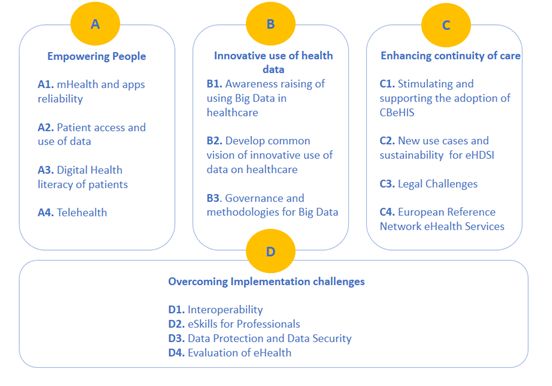
The following schematic overview aims to illustrate in the agreed four priority areas.
Each of the priority areas will be contain specific topics.
8/19
eHealth Network Multiannual Work Programme 2018-2021eHealth Network
Illustration 2: schematic overview of the priority areas and their included topics
A. Empowering people
eHealth/ mHealth can be a means for better integrated and personalised health care,
with greater focus on disease prevention and on the promotion of health and
wellbeing. ICT can promote patient empowerment through the use of mHealth apps,
patient access to and control over sharing of his/her own health data between
healthcare providers. On the other hand, digital tools can also be used to manage
chronic conditions and improve access to healthcare through telemedicine services,
including remote and self- monitoring. However, the concerns related to the quality
and reliability of those tools and to the readiness of patients and health systems to
adopt them, need to be addressed properly.
Empowering Patients as a priority area:
Many EU Member States are facing the same challenges of an ageing population and
rising numbers of people with one or more chronic diseases. In the future, more
people will require care or support.
One of the key elements of a sustainable healthcare system is that patients take an
active part in their healthcare process. For this, they need to be informed and provided
with the right (digital) means. Moreover, they need to possess adequate digital
(health) skills.
9/19
eHealth Network Multiannual Work Programme 2018-2021eHealth Network
Expected achievements:
The strategic goal is to work towards the implementation of patient-centred health
information solutions in all EU Member States. This means that:
People are better informed and have better guidance and access to high quality
mobile health applications which they can trust, use, and recommend;
People are better supported in accessing healthcare through the use of high
quality telehealth/telemedicine services regardless of whether they live in
remote or urban areas;
People have easy and secure access to their health data and they are enabled
to enter data to their personal health record(s);
People are better equipped to control and manage the use of their health data,
including the possibility to allow the sharing of their health data between
service providers as well as for research and innovation purposes in a secure
and protected way.
Topics under this priority area and expected outcome:
A.1 mHealth and health apps reliability
Expected outcome: Develop a common framework and principles for facilitating safe
and reliable use mHealth apps.
There are a large number of lifestyle and wellbeing apps (mHealth apps) available with
no clear evidence on their quality and reliability. This raises the concerns about the
ability of patients to properly assess the effectiveness of mHealth apps. In several
countries, initiatives are ongoing to set up schemes and criteria for mHealth apps
assessment, to provide guidance to professionals and consumers on “good apps”, or to
integrate them into mainstream healthcare provisions by linking them to health
information systems. Given the rapid developments and the need for a coordinated
approach, it is important to closely follow the deployment of mHealth solutions in
healthcare and to reinforce the cooperation among Member States, with the support
of the European Commission, in order to achieve a common (flexible) framework for
app quality and security assessment.
A.2 Patient access and use of data
Expected outcome: Synergetic and coherent approach to patient access, sharing, and
reuse of health data in the EU.
Giving patients' insight in their own medical history (electronic health records) will
allow them to better manage their own health. Since the added value of
eHealth/mHealth solutions correlate with the availability of health data, it is
indispensable that the data flow between patients and healthcare professionals is
stimulated, under the condition that data sources are trusted and data protection and
10/19
eHealth Network Multiannual Work Programme 2018-2021eHealth Network
security requirements are met. The challenges on how patient generated data could be
linked to clinical data should be addressed. Furthermore, patients need to be in control
over their own health data and it is essential to provide them transparency on its
collection and use. They should also be given the possibility to decide on sharing their
data between different service providers to potentially benefit from a holistic
approach of their healthcare. A synergetic and coherent approach to patient access,
share, and reuse of health data is the aim in the EU, taking the Member States'
competencies and room for manoeuvre into consideration.
A.3 Digital health literacy of patients
Expected outcome: Increase digital health literacy for EU-citizens by sharing best
practices and tools
For the appropriate use of eHealth/mHealth it is also important to improve digital
health skills and to raise public awareness about the benefits and risks related to the
use of these solutions, assuring useful usage of digital data from patients. Digital
literacy refers to the skills required to achieve digital competence. For citizens to
benefit from digital tools it is essential to be sufficiently digitally literate, by sharing
best practices among Member States.
A.4 Telehealth
Expected outcome: Facilitate the adoption of telehealth taking available evidence into
consideration.
Telemedicine services allow patients to interact with health professionals remotely for
consultation or diagnostic purposes. It improves the access to healthcare not only for
people with reduced mobility but also for those living in remote areas. Telemedicine
services allow self-monitoring and remote monitoring by health professionals,
potentially preventing further escalation of existing chronic conditions through early
detection. This reduces unnecessary visits to doctors and potentially lower healthcare
costs, positively contributing to the sustainability of health systems.
11/19
eHealth Network Multiannual Work Programme 2018-2021eHealth Network
B. Innovative use of health data
The healthcare sector is a data-intensive industry generating large volumes of data.
There has been tremendous growth in the range of information that is being collected,
such as clinical, genetic, behavioural and environmental data from an array of devices
including electronic health records, genome sequencing machines, patient registries,
social networks and smartphone applications that monitor patient health.
The use of large volumes of health data could unlock great potential in the healthcare
sector. Powerful data analytics can discover patterns that will lead to new prevention,
diagnostic and therapeutic avenues; can help remove inefficiencies in care processes
and reduce waste; and help make better management and clinical decisions that will
improve the performance of health systems (e.g. in terms of procedures, quality of
care, patient safety and patient outcomes).
The phenomenon of big data is still new and there is much uncertainty on how to go
forward on benefiting from big data on the practical level. On the policy level it is
important to strengthen the awareness of the possibilities and to highlight the
potentially beneficial impacts of big data in health.
Innovative use of health data as a priority area:
Secondary use of data and big data can provide value for research, teaching, managing
and planning healthcare systems. It can also be a great opportunity for the
development of personalised medicine, the improvement of the effectiveness of
medicine, efficiency of health systems, and continuity of care.
However, an EU approach for sharing expertise but also raising the awareness of the
potential benefits of the secondary use of health data is lacking.
Expected achievements:
Strengthen the awareness of the possibilities and potentially beneficial impact
of big data in health by identifying best practices;
Develop frameworks and common principles for realising the added value of
big data in health;
Support the creation of good governance principles, practices and methods in
handling use of health data, including big data.
12/19
eHealth Network Multiannual Work Programme 2018-2021eHealth Network
Topics under this priority area and expected outcome:
B.1 Awareness raising of using Big Data in healthcare
Expected outcome: Increase awareness on the possible impacts, challenges, risks and
directions of Big Data in healthcare.
The focus should be on raising awareness with patients and policy makers on the use
of Big Data in healthcare. It needs to be transparent to patients on how, when and for
which purpose their data is being used and to the healthcare professionals as well.
B.2 Develop common vision of innovative use of data in healthcare
Expected outcome: Common vision and priorities for innovative use of data in
healthcare.
Study prospective use-cases concerning the potential diverse and innovative use of
data in order to evaluate the benefits and constrains, and define common priorities to
plan and develop further actions and competences. There are many good examples of
Big Data use in healthcare. In the study on Big Data in Public Health, Telemedicine and
Healthcare13 commissioned by DG SANTE in 2016, a mapping exercise was done on
examples of Big Data use in healthcare. However, clear criteria are needed to define
which use cases of Big Data use in healthcare have the best potential to improve the
sustainability of healthcare system and provide examples for benchmarking.
B.3 Governance and methodologies for innovative use of health data, including big
data
Expected outcome: Common principles to facilitate the development of innovative use
of data projects at European Level.
The use of big data with best practices of good governance on handling big data
complying to current regulations and at the same time bringing patients at the centre
of the digital health should be promoted. Common approaches are needed to create
enabling conditions for data integration and analysis in a secure environment, as well
as to achieve necessary scale for advanced data analytics, for example in the field of
genomics and personalised medicine. Another field for common work should be
improving data infrastructure, analytics and decision support to predict, prevent and
control serious cross-border health threats. The sharing of best practices on how
issues concerning privacy, protection and security, transparency around criteria and
automatic processes/algorithms in the use of Big Data in healthcare – technical and
governance – are being addressed nationally or at European level is necessary. The
focus will be about facilitating the innovative use by designing and testing appropriate
methods and governance.
13
https://publications.europa.eu/en/publication-detail/-/publication/5db46b33-c67f-11e6-a6db-01aa75ed71a1
13/19
eHealth Network Multiannual Work Programme 2018-2021eHealth Network
C. Enhancing continuity of care
The cross-border exchange of data supports cross-border healthcare and with that
supports the continuity of care and the right of Europeans citizens to choose your own
healthcare provider. In the last years efforts, have been made to define and pilot
services that enable this paperless and secured data exchange. At this moment, the
first eHealth Cross Border eHealth Information Services (CBeHIS) are being prepared to
go live in three waves from 2018 through 2020.
There is still a lot of work to be done to grant adoption at national, regional and local
levels, namely assuring the establishment of necessary legal agreements, enhancing
uniform and effective communication plans, promoting change management, defining
adequate IT service management procedures and monitoring/evaluating the CBeHIS
services implementation, operation and benefits realization.
Other objectives under this topic are the clarification of common criteria and the
priorities for new services, and to study at a strategic level what should be the next
services to implement in CBeHIS. Also, it is important to ensure the deployment of a
stable and secure legal environment for cross-border data exchange, with an optimal
implementation at each level (national, regional, local). The promotion of the
definition of a European eHealth Architecture Vision and the clarification on the
relation between eHealth services and correspondent building block (e.g. eDelivery,
eID, eSignature) at national and regional implementation are needed.
Finally, ensure the proper alignment between CBeHIS and European Reference
Network based on adopted framework and guidelines, based on agreed standards,
avoiding divergent parallel unnecessary or inconsistent development and optimising
the resources.
Enhancing continuity of care as a priority area:
It is crucial to ensure that the conditions that are needed to provide and expand
eHealth services are met. The implementation of the services can only be fully
achieved if all stakeholders (local, regional and national) become aware and are ready
pick up their role in the overall process.
Expected achievements:
Wide adoption of CBeHIS services, including overcoming the current difficulties
on achieving legal interoperability;
Financial and operational Sustainability of CBeHIS;
Clear view on how to proceed on the development of other CBeHIS.
Aligned architectures between eHDSI, ERNs and the future use-cases
14/19
eHealth Network Multiannual Work Programme 2018-2021eHealth Network
Topics under this priority area and expected outcome:
C.1 Stimulating and supporting the adoption of CBeHIS
Expected outcome: Full exploitation of the CBeHIS services.
Stimulate and support the Member States to connect their National Contact Points to
CBeHIS allowing the exchange of building blocks, guaranteeing interoperability
between countries and at national level, widening services and enhancing the
continuity of care.
C.2 Explore the need and conditions for the new use-cases, aligned with the eHDSI
principles
Expected outcome: Identifying and developing new use cases and the sustainability of
eHDSI.
In the coming years, based on clear documented need, new use-cases for the CBeHIS
should be identified and discussed. Furthermore, Member States should be supported
in the process of adopting these new use-cases in the CBeHIS at national, regional and
local levels (communication, prioritization, change management), on the promotion of
IT management services and service legal agreements. Also, the implementation of
new use-cases will be monitored to assure the smooth operation of the CBeHIS and its
sustainability.
C.3 Legal challenges
Expected outcome: Stable and reliable implementation of the provisions of a common
legal framework.
Ensure the deployment of a stable and secure legal environment for cross-border data
exchange, with optimum implementation and smooth evolution at each level
(national, regional and local) over time.
C.4 European Reference Network eHealth services
Expected outcome: Consistency between the eHealth services and the European
Reference Networks architecture and improved interoperability.
Ensure that the architecture of ERNs is interoperable and consistent with the
architecture deployed for the eHDSI.
15/19
eHealth Network Multiannual Work Programme 2018-2021eHealth Network
D. Overcoming Implementation challenges
This topic is about developing, implementing and deploying consistent eHealth
enablers based on as interoperability, security, competencies and evaluation agreed
common frameworks.
The EU faces challenges in providing interoperable eHealth services. One objective
under this topic is to improve interoperability by promoting the use of common
standards to facilitate the exchange data at European Level and develop a strategy on
European Semantic Interoperability.
A high level of data protection and data security is another precondition for eHealth
promotion. The GDPR raises challenges from an organisational, legal and technical
point of view, which should be addressed through proper coordination and
collaboration initiatives.
Another major issue is to address the lack of appropriate skills to implement the digital
transformation in health sector. Besides, it is crucial to define a framework for the
proper evaluation of eHealth and, the support the exchange of knowledge on the
development on new health business models supported by innovative technologies of
eHealth.
Overcoming implementation challenges as a priority area:
Interoperability of eHealth services remains an important topic in the EU. Despite the
fact that much work has been done to improve interoperability, challenges remain in
terms of practical application and reinforcing the compliance to common European
and international standards. Continued work is needed on all four aspects of
interoperability: 1) technical, 2) semantic, 3) organizational, and 4) legal.
Furthermore, upcoming EU legislation e.g. GDPR, NIS Directive, eIDAS Regulation, will
have an impact on the implementation of cross-border eHealth services. Clarity on the
ramifications of these EU legislations are needed to ensure legal interoperability and to
take into account specific needs and requirements in the health sector
Expected achievements:
This category will contribute to:
Build confidence in the wider adoption of eHealth services and solutions and
encourage the uptake of new technologies;
Enable the authentication of the parties concerned and the secure exchange of
trusted health data among diverse systems;
Promote the use and consistent operationalization of appropriate frameworks
for eHealth;
Increase the strategic coordination of ICT standardization, foster the
collaboration among all interested parties;
16/19
eHealth Network Multiannual Work Programme 2018-2021eHealth Network
Overcome obstacles in the consistent application of existing eHealth standards
and promote the EU-wide adoption and use of appropriate methods to
increase the semantic interoperability across borders;
Promote data protection and data security;
Promote e-competencies among health care professionals;
Promote evaluation eHealth services best practices.
Topics under this priority area and expected outcome:
D.1 Interoperability of digital healthcare infrastructure
Expected outcome: Interoperable digital infrastructure (software and hardware) of
healthcare providers using a common format for cross-border exchange of health data.
Current work on eHealth standards and the interoperability of the digital infrastructure
in healthcare systems will be continued. Moreover, in order to foster the cross-border
exchange of health data, the eHealth Network should investigate the development of a
common standard/format that builds forth on existing guidelines. Also, it is necessary
to exchange information and best practices of governance models.
Furthermore, the eHealth Network will provide guidance to support healthcare
providers in keeping their digital healthcare infrastructure up-to-date enabling them to
exchange health data. A first exercise would be to investigate the needs of healthcare
providers and align existing and forthcoming policy with them.
D.2 eSkills for Professionals
Expected outcome: Equip healthcare professionals with eSkills for eHealth services.
In order to better equip healthcare professionals with the necessary eSkill, an eHealth
skills framework should be operationalised through the design and reuse of common
training content and tools at the EU level. This should be based on common agreed
principles, and collaboration working towards bringing together national and European
healthcare professional organisations and medical specialists, and reduce profile and
competency gaps through multiple initiatives, namely awareness campaigns, academy
cooperation, eLearning tools, MOOC, among others.
17/19
eHealth Network Multiannual Work Programme 2018-2021eHealth Network
D.3 Data Protection and Data Security
Expected outcome: Increase trust in eHealth by overcoming the implementation
challenges of the relevant EU legal frameworks on data protection, security,
authentication of the actors, and privacy.
The key objective is to provide transparency and clarity on the effects of relevant EU
legislations, such as GDPR, eIDAS Regulation, and the NIS Directive, on the
implementation of eHealth services and to align the implementation approaches in
different Member States. Communication between the eHealth Network and the
Article 29 Working Party (later the European Data Protection Board) and the
Commission towards and EU-wide coordinated implementation of the GDPR are
needed.
Furthermore, it is essential to monitor the possible amendments to the Agreement
between National Authorities or National Organisations responsible for National
Contact Points for eHealth.
D.4 Evaluation of e-Health
Expected outcome: Improved transparency and evidence-based evaluation on the
progress, results and impact of eHealth adoption.
It is essential to define a framework for the proper evaluation of the impact of eHealth
adoption (quantitative and qualitative, at patient and system level, with external and
internal assessments) and to agree on common criteria and indicators to monitor the
progress in the adoption of digital health services. Knowledge exchange on the
development of new or reengineered health business models will support the
application of innovative technologies and methodologies.
8. Aligning the MWP with future developments in eHealth and digital health
In order to maintain its relevance by ensuring that it is in line with the most recent
developments in eHealth and digital health policy at EU and national level, the MWP
allows flexibility for amendments after adoption.
Proposals to amendment the MWP can be initiated - with the approval of the eHealth
Network co-chairs - by Members of the eHealth Network, sub-groups of the eHealth
Network, Joint Action that supports the eHealth Network, or the eHealth Network
Secretariat and should be submitted to the eHealth Network for adoption.
18/19
eHealth Network Multiannual Work Programme 2018-2021eHealth Network
9. List of abbreviations
Description
Acronym
CEF Connecting Europe Facility
CBeHIS Cross-Border eHealth Information Services
GDPR General Data Protection Regulation
DSM Digital Single Market
EC European Commission
eD eDispensation
eHDSI eHealth Digital Service Infrastructure
eHN eHealth Network
EHR Electronic Health Records
eID Electronic Identity
eIDM Electronic Identity Management
eP ePrescription
EU European Union
ICT Information and Communication Technology
JA Joint Action
MS Member State
MWP Multiannual Work Programme
NCP National Contact Point
19/19
eHealth Network Multiannual Work Programme 2018-2021You can also read


