GERMANY DIGITAL VIDEO 2019 - Global Services Lead the Market as Broadcasters Adapt - TVSquared
←
→
Page content transcription
If your browser does not render page correctly, please read the page content below
GERMANY
DIGITAL
VIDEO 2019
Global Services Lead the Market
as Broadcasters Adapt
SEPTEMBER 2019
Bill Fisher & Alina Brentnall
Contributors: Ross Benes, Paul Verna, Karin von Abrams, Angela Kim, Jennifer Jhun
GERMANY DIGITAL VIDEO 2019: GLOBAL SERVICES LEAD THE MARKET AS
 BROADCASTERS ADAPT
Germany’s digital video market is growing. We forecast that 58.1% of the population will watch digital video in
2019. While Germany has slightly higher digital video viewer penetration than France, it is still behind the Western
European average, and far behind the UK.

How many digital video viewers are there
in Germany?
In Germany, there will be more than 47 million digital
video viewers in 2019. This number will climb to close
to 50 million by 2022, resulting in over 60% of the
population watching digital video.

Which devices are video viewers in Germany using?
While TV is still one of the most popular devices, the
number of mobile phone video viewers is increasing.
Germany will have more than 29 million mobile phone
video viewers in 2019, and that figure is expected to
increase by 1.3 million in 2022. Other devices such
as connected TV devices and smart TVs are also
used increasingly.

How many subscription OTT video viewers does
Germany have?
Close to 26 million people in Germany use subscription
over-the-top (OTT) video services in 2019. This number                                  KEY STAT: This year, 58.1% of the population in Germany
is expected to increase to more than 30 million by 2022,                                will watch digital video, or 47.6 million viewers. By 2022,
resulting in more than one-third of the population using                                there will be 49.7 million digital video viewers, which is
subscription OTT video services.                                                        60.7% of the population or 72.8% of internet users.

What’s driving video growth in Germany?
Digital video is driven by global services, such as YouTube,
Netflix and Amazon Prime Video. But local broadcasters                                      CONTENTS
introducing OTT services are gaining importance in the
market. While consumers for a large part still watch                                    2    Germany Digital Video 2019: Global Services Lead the
free-to-air TV, pay TV and other digital video services are                                  Market as Broadcasters Adapt
increasingly used as well.                                                              4    Overview of Our Video Viewer Numbers for Germany

WHAT’S IN THIS REPORT? This report examines the digital                                 6    What’s Driving Digital Video Trends in Germany?
video and TV market in Germany, based on our most                                       16 Key Takeaways
recent digital video viewer forecasts. It looks at who’s
                                                                                        16 eMarketer Interviews
watching, how and where they’re watching, the major
players and what it all means for marketers.                                            16 Read Next
                                                                                        17 Sources
                                                                                        17 Editorial and Production Contributors

    GERMANY DIGITAL VIDEO 2019: GLOBAL SERVICES LEAD THE MARKET AS BROADCASTERS ADAPT                        ©2019 EMARKETER INC. ALL RIGHTS RESERVED   2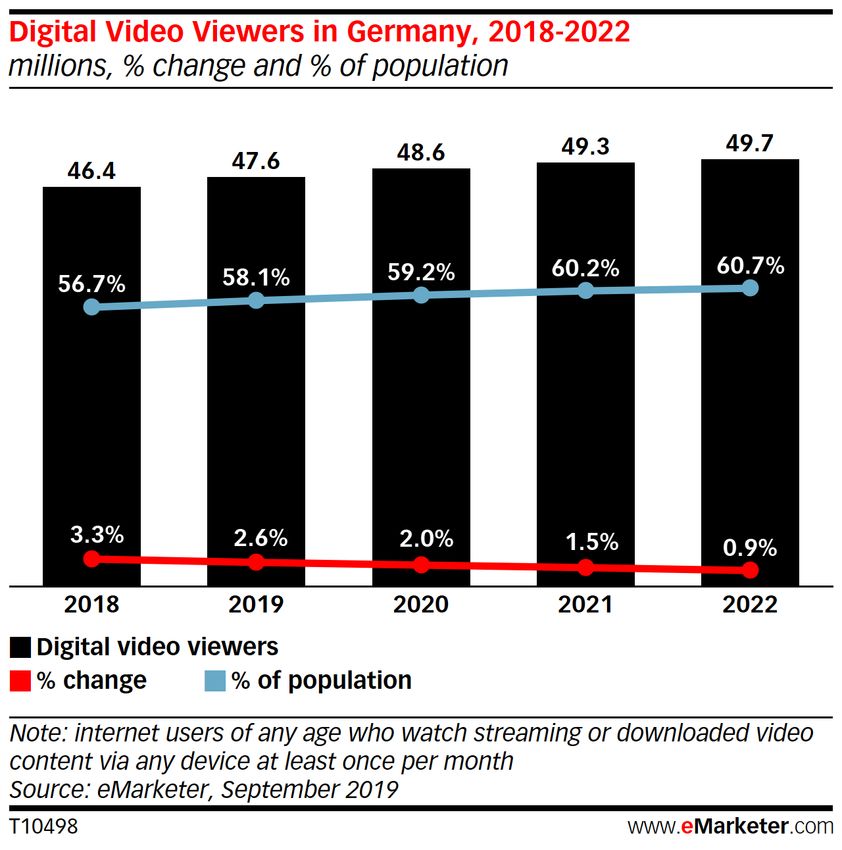
Behind the Numbers                                                                      Linear OTT: An OTT service that delivers content from
                                                                                        multiple TV, cable or satellite channels in real time. Also
The methodology for our Germany digital video viewer
                                                                                        referred to as a virtual multichannel video programming
and over-the-top (OTT) subscription video user forecast is
                                                                                        distributor (vMVPD) or skinny bundle.
based on an analysis of 544 metrics from 65 sources. This
analysis involves the collection of data from third-party                               Linear TV: Television programming distributed through
research sources, online and mobile video activity tracking                             cable, satellite or broadcast networks; includes VOD.
services, data as reported by major digital video and OTT                               Multichannel video programming distributor (MVPD): A
video companies, and industry sources.                                                  service provider that delivers programming over cable,
We also incorporate relevant consumer viewing trends and                                satellite, or wireline or wireless networks.
device adoption, which play a large role in the uptake of                               Over-the-top (OTT): Any app or website that provides
digital video and OTT video subscriptions. These forecasts                              streaming video content over the internet and bypasses
are updated on an annual basis in order to continually                                  traditional distribution; examples include HBO Now, Hulu,
incorporate the latest changes and developments in                                      Netflix and YouTube. Traditional distribution includes
the market.                                                                             internet protocol TV (IPTV), cable, satellite, wireless carriers
                                                                                        and fiber operators, multiple system operators (MSOs),
                                                                                        MVPDs, and major TV broadcast and cable networks.
Our complete estimates for digital video in Germany can
be found in this report’s accompanying spreadsheet.                                     Pay TV: A service that requires a subscription to a
                                                                                        traditional pay TV provider; excludes IPTV and pure-play
                                                                                        digital video services (e.g., Hulu, Netflix, YouTube, Sling TV,
Glossary                                                                                etc.). Traditional pay TV providers include cable, satellite,
Addressable TV: Targeted TV ads delivered on a                                          telco and fiber operators, MSOs, MVPDs, and major TV
home-by-home basis via cable, satellite and telco boxes.                                broadcast and cable networks.
It includes both linear and video-on-demand (VOD)                                       Programmatic: Ads transacted via an application
delivered in this way, but excludes connected TV, smart TV                              program interface (API), including everything from
and OTT.                                                                                publisher-erected APIs to more standardized real-time
Ad-supported video-on-demand (AVOD): These services                                     bidding (RTB) technology.
include free platforms like YouTube as well as those,                                   Programmatic TV: The use of software platforms to
like Hulu, that charge a subscription fee in addition to                                automate the buying or selling of TV advertising distributed
serving ads.                                                                            through cable, satellite or broadcast networks
Advanced TV: Television paired with technology that allows                              Smart TV: A TV with built-in internet capability.
for new features, components or uses. Addressable,
                                                                                        Subscription video-on-demand (SVOD): Defined by
programmatic, OTT and interactive are all subsets of
                                                                                        Technopedia as “a service that gives users unlimited
advanced TV.
                                                                                        access to a wide range of programs for a monthly flat rate.”
Connected TV: A TV set connected to the internet through
                                                                                        TV Everywhere (TVE): A streaming service operated by
built-in internet capability or through another device such
                                                                                        a TV, cable or satellite network—or by an MVPD—that
as a Blu-ray player, game console or set-top box (e.g.,
                                                                                        requires users to authenticate their pay TV subscriptions in
Apple TV, Google Chromecast, Roku).
                                                                                        order to access the content.
Cord-cutter: Someone who once had but then canceled a
                                                                                        Upfront: Digital video ad spending committed in advance,
pay TV service.
                                                                                        including spending resulting from the TV upfronts events,
Cord-never: Someone who never subscribed to pay TV in                                   the Interactive Advertising Bureau (IAB) Digital Content
the first place.                                                                        NewFronts, and other meetings throughout the year.
Cord-trimmer: Someone who cut back on their pay TV                                      Virtual multichannel video programming distributor
service level but still subscribes.                                                     (vMVPD): An MVPD that delivers service via the internet;
Esports: Organized gaming competitions among                                            interchangeable with “linear OTT.”
professional players and teams.

    GERMANY DIGITAL VIDEO 2019: GLOBAL SERVICES LEAD THE MARKET AS BROADCASTERS ADAPT                        ©2019 EMARKETER INC. ALL RIGHTS RESERVED   3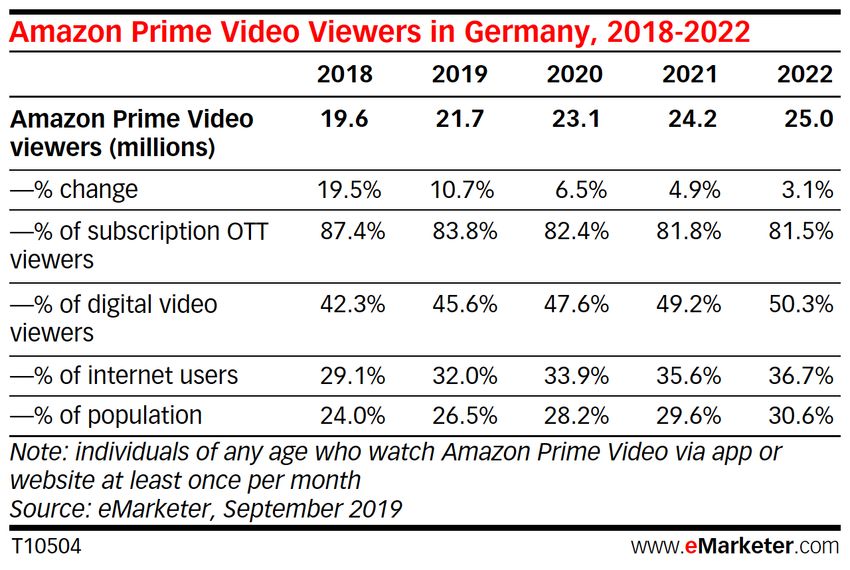
OVERVIEW OF OUR VIDEO VIEWER                                                           Breaking down digital video viewers by age puts this
                                                                                        trend in stark contrast. The majority of digital video
 NUMBERS FOR GERMANY                                                                    viewers this year will, unsurprisingly, be teens and
                                                                                        millennials. However, penetration rates remain lower
Germany, like France, has lagged behind some of                                         among consumers ages 45 and older. Just 58.6% of
its neighbors in digital video viewership. A more                                       people ages 45 to 54 will watch digital video this year,
conservative audience that skews slightly older and                                     with that proportion dropping to well below half among
is more wedded to traditional media is largely behind                                   55- to 64-year-olds and less than 30% for those 65
                                                                                        and older.
this lag. However, digital video is beginning to get a
foothold, particularly among younger age groups.

DIGITAL VIDEO VIEWERS
There will be 47.6 million digital video viewers in Germany
in 2019, representing 58.1% of the population. This figure
places Germany on par with France (57.4%), but below
Western Europe as a whole (59.2%) and well behind the
UK (68.3%).

                                                                                        MOBILE VIDEO VIEWERS
                                                                                        Similar to the digital video totals, mobile phone video
                                                                                        viewership in Germany lags behind some of the more
                                                                                        digitally developed countries we track, with 35.3% of
                                                                                        the population—29.0 million people—tuning in to such
                                                                                        content monthly this year. Even among digital video
                                                                                        viewers, fewer than two-thirds will be mobile phone video
                                                                                        viewers throughout our forecast period.

This is a nation of video viewers who are wedded to
traditional forms of consumption, with broadcast TV still
accounting for the majority share of viewership among
certain demographics.

    GERMANY DIGITAL VIDEO 2019: GLOBAL SERVICES LEAD THE MARKET AS BROADCASTERS ADAPT                      ©2019 EMARKETER INC. ALL RIGHTS RESERVED   4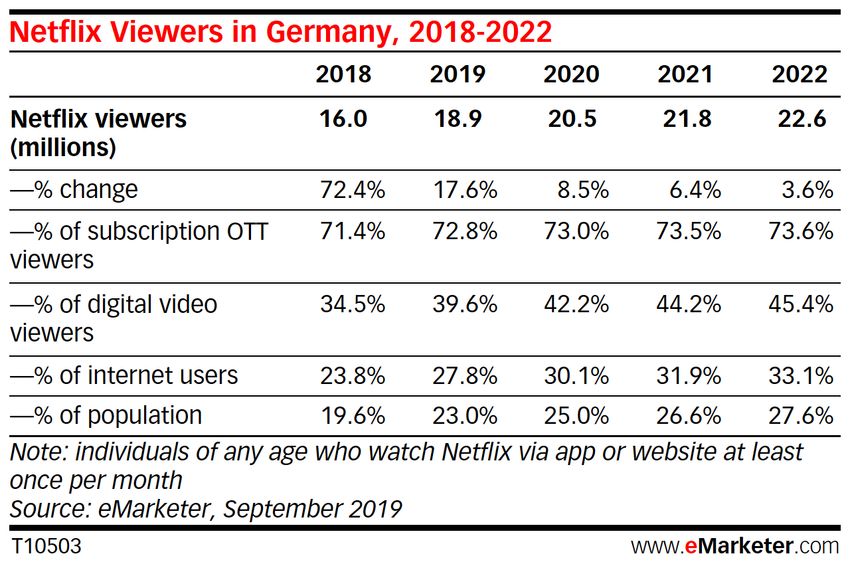
Younger consumers are driving much of the growth in
mobile video viewership in Germany, something that we’ll
explore in more detail later in this report. TV still remains
an important medium for digital video consumption for
the population of Germany.

SUBSCRIPTION OVER-THE-TOP (OTT)
VIDEO VIEWERS
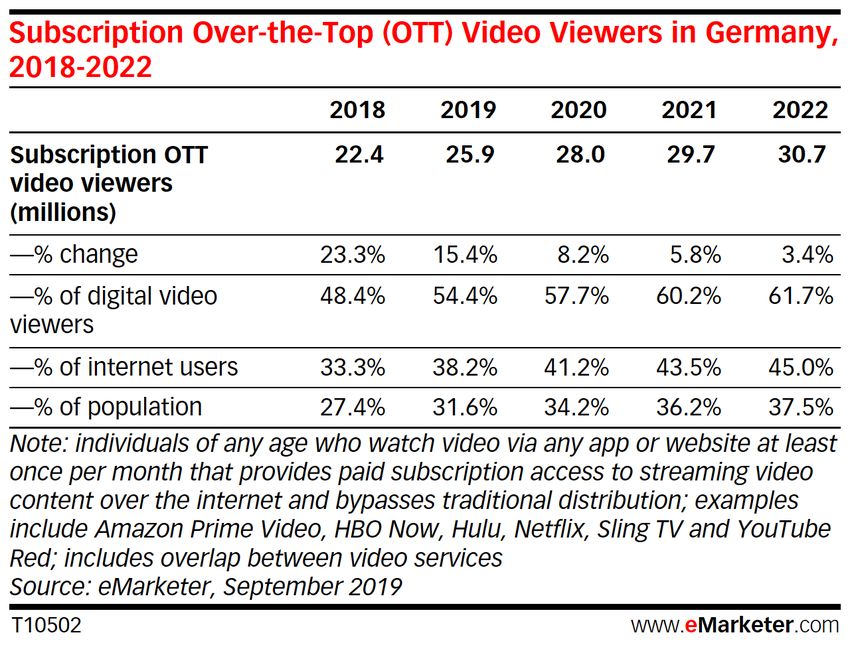
Germany is seeing strong growth in subscription OTT
video viewers. This year, the amount of subscription
viewers will grow 15.4% to reach 25.9 million. By 2022,
that figure will climb further to 30.7 million only slightly                            What’s causing this decline? Strong growth in the number
less than the total number of mobile video viewers.                                     of Netflix users: This year, the number of viewers will
                                                                                        grow 17.6% to reach 18.9 million, in Germany. By 2022,
                                                                                        that figure is projected to reach 22.6 million.

Select OTT Platform Forecasts                                                           Combined, Prime Video and Netflix will have 40.6 million
                                                                                        viewers this year and 47.6 million by 2022 (of course,
Thanks to its early-mover advantage, Amazon dominates                                   many consumers will subscribe to both services, which
Germany’s subscription OTT landscape. This year, the                                    explains why the subscription OTT viewer total is lower).
service will have 21.7 million viewers with strong                                      When compared with the near-ubiquity and largely free
year-over-year growth of 10.7%. And that growth will                                    nature of YouTube, these are impressive user numbers.
continue throughout the forecast period. However,
Amazon’s share of the subscription OTT market will
decline slightly—from 83.8% this year to 81.5% in 2022.

    GERMANY DIGITAL VIDEO 2019: GLOBAL SERVICES LEAD THE MARKET AS BROADCASTERS ADAPT                      ©2019 EMARKETER INC. ALL RIGHTS RESERVED   5
This year, YouTube will have 43.5 million users, accounting
for 91.4% of digital video viewers. Marginal growth will
continue through the forecast, but total viewership of
45.2 million in 2022 will be overtaken by the combined
Netflix/Prime Video total.

TIME SPENT WITH DIGITAL VIDEO
In terms of how much time adults in Germany spend
with traditional TV vs. digital video, the trend is for slight
changes, but nothing particularly substantial.

Between 2017 and 2021, time spent with TV will                                           WHAT’S DRIVING DIGITAL VIDEO
have fallen only slightly from 3 hours, 41 minutes to 3                                  TRENDS IN GERMANY?
hours, 29 minutes—a loss of just 22 minutes. Digital
video gains, meanwhile, will also be relatively small,
albeit proportionally large given they’re coming from a
small base. In 2017, adults in Germany consumed just
                                                                                        MARKET OVERVIEW
29 minutes of digital video. By 2021, that will reach                                   A variety of services and providers, ranging from global
52 minutes.                                                                             players such as Netflix and Prime Video to small local
                                                                                        players and pay TV providers such as Sky or Magenta
                                                                                        TV, have shaped Germany’s digital video market. While
                                                                                        new global players have been and are planning to enter
                                                                                        the market, pay TV providers are offering their own
                                                                                        on-demand and streaming services. In addition, smaller
                                                                                        local players are also introducing their own services.

    GERMANY DIGITAL VIDEO 2019: GLOBAL SERVICES LEAD THE MARKET AS BROADCASTERS ADAPT                      ©2019 EMARKETER INC. ALL RIGHTS RESERVED   6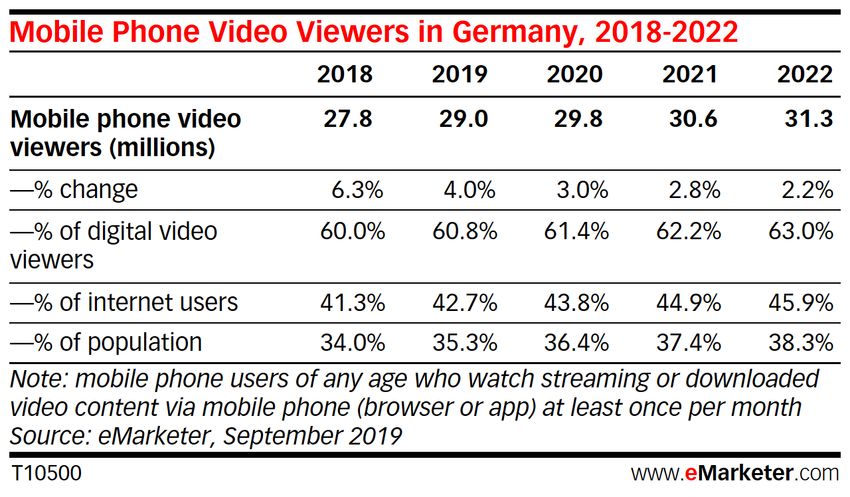
SELECT OTT SERVICES IN GERMANY, AUGUST 2019
  Service Owner                     Monthly Cost (1) Revenue Model                               Subscribers                   Content/Description
  Netflix       Netflix             €7.99-€15.99               Subscription video-on-demand Subscribers: 5.1 million           Movies and TV series, including original content
                                    ($9.43-$18.87)             (SVOD)                       (Q3 2018); estimated
                                                                                            monthly viewers in 2019:
                                                                                            18.9 million
  Amazon        Amazon              No additional cost with    SVOD                              Subscribers: 9.9 million      Movies and TV series, including original content
  Prime Video                       Prime membership,                                            (Q3 2018); estimated
                                    which is €7.99 ($9.43)                                       monthly viewers in 2019:
                                                                                                 21.7 million
  Sky           Sky                 Streaming only (Sky      SVOD with ads depending             5.2 million (2018) (2)        Varies by subscription; movies and TV series,
                                    Ticket): €9.99-€29.99    on subscription                                                   including original content, live TV, sports
                                    ($11.79-$35.39); pay TV                                                                    (e.g., soccer, golf, handball, and more)
                                    package (Sky Q): €57.99-
                                    €79.99 ($68.43-$94.39)

  Joyn          ProSiebenSat.1      Free                       Ad-based video-on-demand          3.8 million users             Live stream content from more than 50 channels,
                and Discovery                                  (AVOD)                            (Aug 2019)                    on-demand series and original content
  YouTube       Google              Free or €11.99 ($14.15)    AVOD/SVOD                         Estimated monthly viewers Live TV, original content, TV shows and series,
                                                                                                 in 2019: 43.5 million     movies, sports and more

  Magenta TV    Deutsche            Streaming: €7.95 ($9.38); SVOD with ads                      3.4 million (Q1 2019)         Varies by subscription; content from over
                Telekom             pay TV package: €39.95-                                                                    75 channels, movies and TV series, live TV,
                                    €64.95 ($47.14-$76.64)                                                                     originals and exclusives, international series and
                                                                                                                               live concerts

  TVNow          Mediengruppe       Free to €4.99 ($5.89)      AVOD, SVOD with limited           Unique users: 4.53 million    Live stream RTL Mediengruppe channels;
                 RTL                                           pre-roll ads                      (July 2019)                   on-demand movies and series, original content
 Note: All services are available on iOS, Android and other connected devices; cost conversions calculated using $1=€0.847471 exchange rate;
 (1) cost does not take into account trial periods, introductory offers, special promotions, or pricing plans for longer than one month; (2) includes pay
 TV and OTT users.
 Source: Netflix, Amazon Prime Video and YouTube viewers based on eMarketer forecast, Aug 2019; Amazon Prime Video and Netflix subscriber
 information from Cirkus and Ampere Analysis as cited by Broadband TV News, Oct 15, 2018; Sky subscriber information from Sky as cited by DWDL,
 July 26, 2018; Joyn viewer information from Joyn as cited by Broadband TV News, Aug 6, 2019; Magenta TV subscriber information based on
 Deutsche Telekom as cited by Digital TV Europe, May 9, 2019; TVNow user information from AGOF, Aug 1, 2019; Pricing information for Amazon
 Prime Video, Sky, Joyn, YouTube, Magenta TV and TVNow as cited on respective company websites; pricing information for Netflix as cited by
 kino.de.

Global Streaming Services Are the Market Leaders
YouTube launched in Germany in 2007. Originally, the video sharing platform offered free short-form content from
content creators, but it now offers live TV, original content, TV series, movies and sports depending on the subscription.
In that respect, YouTube is different from the other platforms which are not content sharing platforms focused on
short-form content.

Amazon’s SVOD service Prime Video launched in Germany in 2014. Included as part of a Prime membership, the service
now offers more than 15,000 movies and series including original content.

Netflix was introduced in Germany about seven months after Prime Video. After having huge success with some of its
local German language productions, Netflix has been investing heavily in local content and productions, which will be a
valuable step toward complying with the soon-to-be-introduced European Commission Content Quota. This quota, taking
effect in September 2020, requires video-streaming companies in the EU to ensure that 30% of their offering is made up
of European content. While clarifications on that are still to come, many providers, including Netflix and Amazon, along with
other local providers, have already started to invest in creating local and original content.

     GERMANY DIGITAL VIDEO 2019: GLOBAL SERVICES LEAD THE MARKET AS BROADCASTERS ADAPT                                      ©2019 EMARKETER INC. ALL RIGHTS RESERVED           7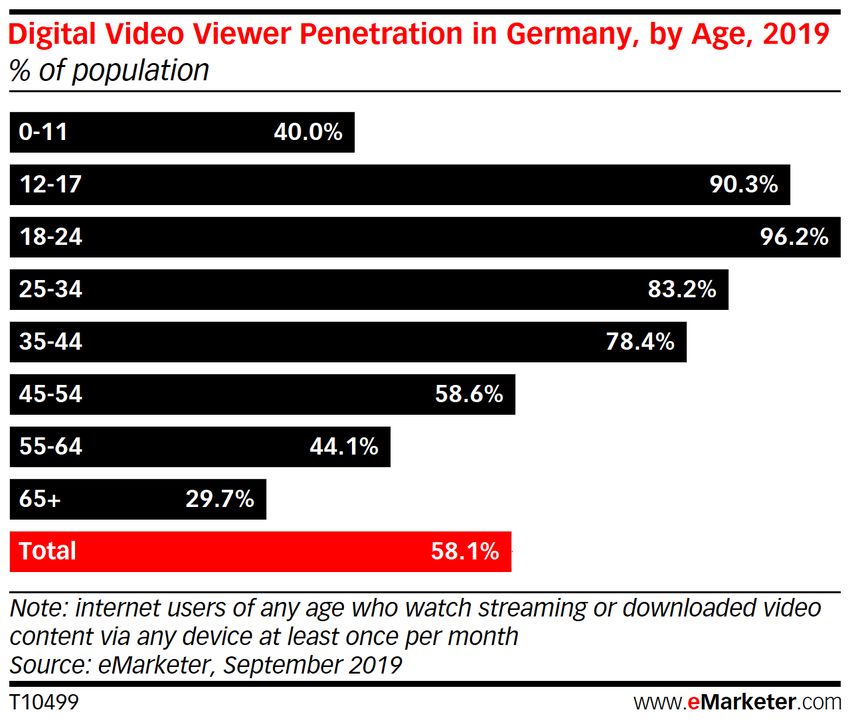
Several local players now offer streaming services as well.                             Users of Digital TV*, Free-to-Air and Pay TV Among TV
Founded in 2007 by German broadcaster Mediengruppe                                      Viewers in Germany, Sweden and the UK, March 2019
                                                                                        % of respondents
RTL Deutschland, TV Now is an SVOD service offering
live and on-demand content of several of RTL group’s                                    Germany
channels, as well as original content.                                                                                                                     79%
                                                                                                                          39%
                                                                                                                      35%
Joyn, a joint venture by ProSiebenSat.1 and Discovery,
                                                                                        Sweden
launched in Germany in June 2019. By August 2019, it
                                                                                                                                  47%
was reported to have 3.8 million users taking advantage
                                                                                                                                         54%
of its offerings consisting of live streams of more than                                                                                            65%
55 free-to-air channels as well as on-demand content,                                   UK
including originals. This service is currently free to users                                                                      47%
and financed by advertising, with paid premium options                                                                                  52%
planned for the end of 2019. According to Joyn as cited                                                                                             65%
by Broadband TV News, Joyn’s user numbers are already                                     Free-to-air                   Digital TV*                       Pay TV
380% higher than those from its predecessor platform
                                                                                        Note: n=500 in each country; ages 18+; *free and paid digital video
7TV, with over 61% of Joyn’s content being watched                                      services
on mobile.                                                                              Source: nScreen Media, "TV Universe—UK, Germany, Sweden: How People
                                                                                        Watch Television Today" sponsored by Gracenote, May 15, 2019
                                                                                        247451                                                 www.eMarketer.com
Other global players are planning to make in-roads in
Germany’s streaming market as well. While Apple TV+                                     Among younger age groups however, the shift toward
and IMDb TV, Amazon’s free streaming service, are                                       digital TV is more prevalent. Almost half of respondents
planning to enter the market in 2019, Disney’s streaming                                ages 18 to 24 in Germany use digital TV as their primary
service Disney+ will launch in 2020.                                                    way to watch TV. One-quarter watched free-to-air and pay
                                                                                        TV, per nScreen Media and Gracenote.
Smaller local players in Germany are Maxdome (which
will eventually be replaced by Joyn), Zattoo, the media                                 Looking at digital video, global players such as Prime
libraries of local channels (such as ARD/ZDF), DAZN and                                 Video and Netflix dominate the streaming market
Eurosport, as well as telecoms and pay TV providers                                     in Germany. According to a Q4 2018 survey by
Vodafone with GigaTV and Unitymedia.                                                    AudienceProject, most digital video viewers in Germany
                                                                                        ages 15 and older use Netflix (57%), Prime Video (55%)
                                                                                        and YouTube (53%) to download or stream video.
Broadcasters Are Adapting to Digital Video
While Germany’s TV consumption is still driven by                                       In response to increased competition from these global
free-to-air TV, pay TV and digital TV have become popular                               and local players, many of the pay TV providers, such
as well. Nearly eight in 10 TV viewers in Germany,                                      as telecom company Deutsche Telekom with Magenta
Sweden and the UK watched TV via free-to-air services,                                  TV, and Sky, now also offer additional streaming or
according to March 2019 research from nScreen Media                                     on-demand services. For example, both offer users the
and Gracenote. The use of digital TV, including free and                                option to watch their pay TV programs online or through
paid video services, was slightly ahead of pay TV, at 39%                               an app, as well as via standalone subscription services.
and 35%, respectively.                                                                  Vodafone and 1&1 have similar models as well. Pay TV
                                                                                        providers have adjusted to the point of developing their
                                                                                        own, sometimes standalone, VOD/OTT services.

    GERMANY DIGITAL VIDEO 2019: GLOBAL SERVICES LEAD THE MARKET AS BROADCASTERS ADAPT                         ©2019 EMARKETER INC. ALL RIGHTS RESERVED     8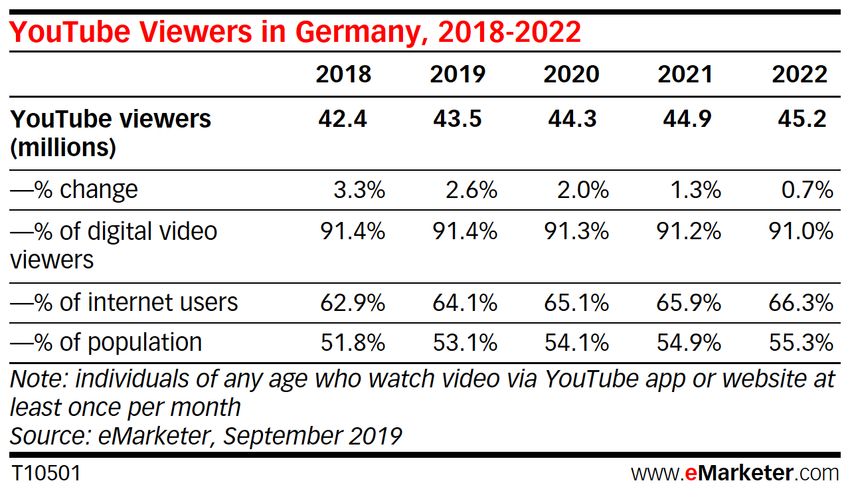
“TV is now a connected platform that is frequently                                      Nearly eight in 10 internet users in Germany watched
watched on the move,” said Blair Robertson, CTO of                                      videos online, an increase of 3 percentage points from
TVSquared. “Broadcasters are adapting to this behaviour                                 2018, according to a July 2019 Bitkom study. Nearly
and considering how to develop their own BVOD offering.                                 two-thirds of respondents watched videos using sites
In France, this is already a reality. For Germany, the                                  such as YouTube or Vimeo, while 42% watched movies
majority of households use BVOD or SVOD services.”                                      and TV shows via on-demand services such as Netflix,
                                                                                        Prime Video and Joyn.
“Pay TV providers have further expanded their offerings
and are focusing more than ever on linear and nonlinear                                 In 2018, 65% of internet users in Germany ages 16
availability,” said Katharina Behrends, managing director of                            to 74 watched digital video content from sharing sites
central and eastern Europe at NBCUniversal International                                such as YouTube, according to a Eurostat survey. And
Networks and chairwoman of the VAUNET Pay-TV                                            48% of respondents viewed internet-streamed TV from
Working Group as cited by Verband Privater Medien                                       broadcasters, and 31% used commercial VOD services.
(VAUNET). Outstanding video content thus reaches more                                   By that last measure, Germany was substantially ahead of
and more people on all platforms.” This allows consumers                                most other EU-5 countries, including Italy and France.
to switch seamlessly between linear and nonlinear
content. The variety of programs and the number of pay                                  Digital Video Viewer Penetration in the EU-5, by
TV channels available in Germany has never been this                                    Country and Service Type, 2018
large, Behrends said in a comment cited by Frankfurter                                  % of internet users
Allgemeine Zeitung (FAZ).                                                                               Internet-         Video-on-demand        Content from
                                                                                                  streamed TV (live or        (VOD) from       sharing services
                                                                                                     catch-up) from      commercial services    (e.g., YouTube)
The smaller and local pay TV, broadcaster and streaming                                               broadcasters        (e.g., Netflix, HBO)

services are aiming to compete with the global players,                                 UK                64%                     53%                       71%
                                                                                        Germany           48%                     31%                       65%
some even by working together. “There has to be that
                                                                                        Spain             45%                     39%                       76%
level of consolidation between content holders,” said
                                                                                        France            36%                     23%                       51%
Thomas Bremond, general manager international at
                                                                                        Italy             28%                     23%                       68%
FreeWheel, a Comcast Company. “By now you have                                          Note: ages 16-74 who used the internet in the past 3 months
ProSieben and Discovery that have joined forces.                                        Source: Eurostat, "ICT Usage in Households and by Individuals 2018," Dec
                                                                                        20, 2018
The future—it’s clearly one of consolidation of various
                                                                                        249429                                                   www.eMarketer.com
premium broadcaster platforms because they know they
need scale in order to compete with some of these other                                 Despite increasing digital video and OTT uptake,
subscriber-funded platforms.”                                                           Germany’s TV landscape is not expected to be disrupted
                                                                                        in the short term. Linear TV and digital video are typically
                                                                                        used together, according to a July 2019 Deloitte survey.

CONSUMER HABITS                                                                         The importance of SVOD within the market can also
                                                                                        be seen when looking at video revenues. While pay
What Consumers Are Watching: Traditional                                                TV revenues in Germany have been relatively constant
Consumption Remains Strong                                                              between 2015 and 2019—growing by 4.4%—SVOD
                                                                                        will drive these revenue gains, with an estimated
Consumers in Germany still spend most of their time                                     22% increase in 2019, according to VAUNET, GfK and
watching TV. They spent 218 minutes per day watching                                    Filmförderungsanstalt (FFA). TVOD and EST revenues will
broadcast TV in Q2 2019, compared with 25 minutes of                                    remain small compared with pay TV and SVOD. SVOD’s
free online video and 19 minutes of pay VOD, according to                               share of the VOD market in Germany grew from 22% in
a report from SevenOne Media and forsa. However, time                                   2013 to 74% in 2018, per Goldmedia.
spent with TV has been slowly decreasing over the years
(from 228 minutes/day in Q1 2017), while time spent with
free online video and pay VOD has been increasing.

    GERMANY DIGITAL VIDEO 2019: GLOBAL SERVICES LEAD THE MARKET AS BROADCASTERS ADAPT                            ©2019 EMARKETER INC. ALL RIGHTS RESERVED         9
Pay TV* and Video-on-Demand (VOD)** Revenues in                                          How Do Households in Select Countries Watch Paid
Germany, 2015-2019                                                                       TV Content?
billions of €                                                                            % of respondents, Q1 2017-Q3 2018
                                                                  €4.0                                         Q1 2017        Q3 2017        Q1 2018         Q3 2018
                                                                  €0.3
                                                   €3.5           €0.2                   US
                                                           €0.1
                                                   €0.2                                  Pay TV only              20%            22%            22%            16%
                                   €3.0
                                   €0.2    €0.1                   €1.1                   SVOD only                16%            22%            23%            25%
                    €2.7   €0.1                    €0.9
    €2.5   €0.1                                                                          Pay TV & SVOD            64%            56%            55%            59%
                                   €0.5
                    €0.3   €0.1                                                          UK
    €0.2    €0.1
                                                                                         Pay TV only              31%            31%            27%            21%
                                                                                         SVOD only                21%            20%            22%            24%
                                                                                         Pay TV & SVOD            48%            49%            51%            55%
                    €2.2           €2.3            €2.3            €2.4
    €2.1
                                                                                         Spain
                                                                                         Pay TV only              37%            31%            26%            21%
                                                                                         SVOD only                14%            16%            23%            25%
                                                                                         Pay TV & SVOD            49%            53%            50%            54%
   2015           2016          2017               2018           2019
  Pay TV and pay TV-on-demand                                                            Germany
  Subscription video-on-demand (SVOD)                                                    Pay TV only              35%            34%            34%            26%
  Transactional video-on-demand (TVOD)                                                   SVOD only                23%            21%            23%            28%
  Electronic sell-through (EST)
                                                                                         Pay TV & SVOD            42%            45%            43%            46%
Note: *pay TV and pay TV-on-demand is from VAUNET; **EST, TVoD and                       Denmark
SVoD is from GfK/FFA
Source: Verband Privater Medien (VAUNET), GfK and Filmförderungsanstalt                  Pay TV only              29%            23%            21%            24%
(FFA) as cited in Verband Privater Medien (VAUNET) "Pay-TV in Deutschland                SVOD only                22%            24%            25%            23%
2019," July 25, 2019
248803                                                    www.eMarketer.com              Pay TV & SVOD            48%            54%            54%            53%
                                                                                         Worldwide*
With the increase in available content, consumer                                         Pay TV only              32%            30%            26%            21%
willingness to pay for on-demand content is increasing as                                SVOD only                18%            21%            24%            26%
well. “Total video usage is rising and people are willing                                Pay TV & SVOD            49%            49%            50%            53%
to pay for high-quality programs. We therefore expect                                    Note: *Australia, Brazil, Denmark, France, Germany, Italy, Japan, Mexico,
                                                                                         Netherlands, Poland, Saudi Arabia, Spain, Sweden, Turkey, UK and US
further growth for Pay TV and streaming.,” said Frank                                    Source: Ampere Analysis as cited in company blog, Oct 24, 2018
Giersberg, member of the board of directors of VAUNET,                                   242824                                                   www.eMarketer.com

in a press release.
                                                                                         Netflix is the market leader in the UK, France and
                                                                                         Sweden, according to a survey by nScreen Media. But
The VOD market is already near saturation in Germany,
                                                                                         in Germany, Prime Video is slightly ahead with 56% of
according to Deloitte and FAZ. Between 2015 and 2017,
                                                                                         respondents subscribing to the service, while 51% said
annual VOD user penetration increased by more than
                                                                                         they subscribe to Netflix.
20 percentage points, while in 2019, growth was only 5
percentage points, per Deloitte. “After a few turbulent
                                                                                         Amazon did have first-mover advantage when it launched
years, our data suggest a certain amount of calm in the
                                                                                         in Germany, in addition to taking over and rebranding
moving-image market,” said Klaus Böhm, head of media
                                                                                         Lovefilm, which had been in Germany since 2010.
and entertainment at Deloitte, in a company statement.
                                                                                         Moreover, Amazon Channels (enabling users to book
                                                                                         other third-party streaming services through Amazon
Between Q1 2017 and Q3 2018, the number of
                                                                                         Prime) has been available in Germany since May 2017,
households in Germany using only pay TV decreased
                                                                                         with Germany being one of only a few markets besides
from 35% to 26%, according to research from Ampere
                                                                                         the US with this offering. Netflix, however, is slowly
Analysis. The number using only SVOD increased to 28%,
                                                                                         gaining market share, thanks to successful local content.
surpassing pay TV. However, more than 46% claimed to
use both pay TV and SVOD, showing the trend of using
several services.

     GERMANY DIGITAL VIDEO 2019: GLOBAL SERVICES LEAD THE MARKET AS BROADCASTERS ADAPT                            ©2019 EMARKETER INC. ALL RIGHTS RESERVED     10
To Which Subscription Video-on-Demand (SVOD) According to AudienceProject, desktops/laptops and
Services and Broadcaster Apps Do TV Viewers in TVs were used most often by internet users in Germany
Germany Subscribe?
to download/stream digital video in Q4 2018, closely
% of respondents, March 2019
followed by smartphones, used by more than a third of
SVOD services
Amazon Prime Video 56% internet users. About one-quarter of respondents used
connected TV devices.
Netflix 51%
Sky Ticket 12%
What Devices Do Internet Users in Select Countries
DAZN 6% Use to Download/Stream Digital Video*?
2% Eurosport % of respondents, Q4 2018
Desktop/ TV Mobile Tablet Connected Video game
Broadcaster apps
laptop TV devices** console
ZDF 41%
Finland 49% 45% 34% 26% 20% 9%
ARD 37% Sweden 46% 38% 38% 28% 31% 7%
RTL TV Now 18% Norway 46% 47% 35% 26% 34% 9%
US 44% 46% 39% 30% 37% 17%
7TV 10%
Germany 43% 42% 36% 33% 25% 10%
1% Other Denmark 42% 45% 30% 31% 21% 7%
Note: n=198 ages 18+; top 5 SVOD services and broadcaster apps UK 39% 42% 35% 32% 28% 17%
Source: nScreen Media, "TV Universe—UK, Germany, Sweden: How People Note: ages 15+; *includes TV series or movies; **e.g., Amazon Fire TV,
Watch Television Today" sponsored by Gracenote, May 15, 2019 Apple TV, Google Chromecast
249435 www.eMarketer.com Source: AudienceProject, "Insights 2019: Traditional TV, online video &
streaming," Jan 17, 2019
Besides SVOD services, broadcaster apps are also 245385 www.eMarketer.com
popular among TV viewers in Germany. These include
Looking at connected TV devices, it’s worth noting
media library apps of free-to-air broadcasters such as
that the Amazon Fire TV dominated Germany’s market
ZDF and ARD, as well as paid streaming services from
in March 2019, with a share of 61%, followed by
broadcasters such as RTL TV Now. Among these, ZDF
Apple TV (17%) and Google Chromecast (14%), per
and ARD are the top applications, per nScreen Media;
nScreen Media.
41% and 37%, respectively, use these to watch TV in
March 2019.
Connected TV Devices Used by TV Viewers in
Germany, Sweden and the UK to Watch Streaming
Device Trends: TV Is Still Strong, but Mobile Is Digital Video, March 2019
% of respondents
Catching Up Germany
61% 17% 14% 8%
In Germany, the devices used for watching video vary to
some degree by the type of content viewed. According to UK
39% 18% 17% 20% 6%
May 2019 survey by Gesellschaft für Unterhaltungs- und
Sweden
Kommunikationselektronik (gfu), content accessed via
34% 60% 5%
VOD and broadcasters’ media libraries is primarily viewed
Amazon Fire TV Google Chromecast Other
on a TV, whereas content from video portals is primarily
Apple TV Now TV
viewed on a smartphone.
Note: Germany n=303; Sweden n=429; UK n=411; ages 18+; numbers may
not add up to 100% due to rounding
This is in line with findings from SevenOne Media and Source: nScreen Media, "TV Universe—UK, Germany, Sweden: How People
Watch Television Today" sponsored by Gracenote, May 15, 2019
forsa. For paid content, consumers tend to prefer a larger 247453 www.eMarketer.com
screen. For example, more than half of the time spent
viewing paid VOD services in Q2 2019 was with TV. Smart TV ownership and usage is increasing in Germany,
Almost half (47%) of the time devoted to media library as well. Some 51% of households in Germany will own a
content was spent on TV as well. smart TV this year, up from 42% in 2017, per gfu. Usage
itself has increased steadily over the past two years,
reaching penetration of over 67% (80% of those ages 16
to 39 and 56% of those ages 60 and older).
GERMANY DIGITAL VIDEO 2019: GLOBAL SERVICES LEAD THE MARKET AS BROADCASTERS ADAPT ©2019 EMARKETER INC. ALL RIGHTS RESERVED 11Despite the continued prevalence of the TV set and larger How Often Do Internet Users in Select Countries in
PC screens, the smartphone is becoming increasingly Europe Stream TV Shows/Movies on Their Mobile
Devices?
important for digital video. Among devices other than TV
% of respondents, by country, Oct 2018
used for watching video, the smartphone has continually
Daily Weekly Monthly Occasionally Don't use
increased its share among internet users ages 14 to 69,
France 31.0% 30.0% 4.3% 12.7% 22.0%
from 26% in Q2 2018 to 33% in Q2 2019, according to Germany 33.0% 27.3% 8.0% 11.3% 20.3%
SevenOne Media and forsa. During the same period, Italy 46.7% 27.7% 1.7% 11.3% 12.7%
the laptop’s share dropped from 30% to 23%. The tablet Netherlands 34.3% 26.3% 7.0% 15.3% 17.0%
viewing share has remained relatively constant. Desktops Spain 51.0% 23.3% 2.7% 11.3% 11.7%
gained a 1 percentage point share, but remained UK 36.7% 35.0% 6.3% 11.0% 11.0%
below smartphones. Total 38.8% 28.3% 5.0% 12.2% 15.8%
Note: n=1,800 ages 18-50; numbers may not add up to 100% due to
rounding
According to gfu, video portals like YouTube, which Source: Penthera, "International Mobile Streaming Behavior Survey: Q4
offer primarily short-form video, are most often used 2018" conducted by EMI Research Solutions, Dec 6, 2018
244383 www.eMarketer.com
on smartphone.
Among the paid subscription services internet users in
“Short-form content is accessible and social,” said Brian Germany accessed, 17% used Netflix on their phone
Kline, chief product officer at Penthera. “But as you’re and 14% used Prime Video, according to a Q3 2018
thinking about making premium content more accessible Deloitte survey.
on mobile devices, which is what all the major companies
are doing … long-form is probably going to take a larger However, internet users have some problems with
role overall in the marketplace than it used to.” mobile streaming. According to Penthera and EMI
Research Solutions, the main frustrations when streaming
SevenOne Media and forsa data tends to confirm that from a mobile device were buffering issues (41.0%)
mobile video viewing is driven by free online video and videos that took too long to start up (38.0%).
because most of these videos are short and easily Annoying advertising was also a major issue for four in
accessible. Their study found that internet users watched 10 respondents.
an average of 14 minutes of video on a smartphone per
day in Q3 2018. Of those, 7.5 minutes were attributed
What Frustrations Do Internet Users in France and
to free online video, 3.9 to live streaming and 2.6 to Germany Experience When Streaming Mobile Video?
pay VOD; just 0.1 minutes were spent on recorded % of respondents, Oct 2018
TV programs. Germany France
The video buffered, making it hard to enjoy 41.0% 47.3%
According to the same study, smartphones accounted The advertisements were annoying 40.0% 42.0%
for 14% of time spent with paid VOD services, as well as The video took too long to start up 38.0% 46.3%
over 23% of media library usage in Q2 2019. It increased my monthly data costs 12.3% 8.0%
When I use public Wi-Fi 7.7% 6.0%
Mobile video viewers use their devices frequently. I have never experienced frustrations when 19.0% 17.0%
streaming video
According to Penthera and EMI Research Solutions, Other 2.7% 2.0%
one-third of internet users in Germany ages 18 to 50 Note: n=600 ages 18-50
streamed movies and TV shows via mobile daily in Source: Penthera, "International Mobile Streaming Behavior Survey: Q4
2018" conducted by EMI Research Solutions, Dec 6, 2018
October 2018. Another 27.3% did so weekly, meaning 249104 www.eMarketer.com
that more than six in 10 internet users in Germany used
their mobile device for video streaming at least weekly.
GERMANY DIGITAL VIDEO 2019: GLOBAL SERVICES LEAD THE MARKET AS BROADCASTERS ADAPT ©2019 EMARKETER INC. ALL RIGHTS RESERVED 12When experiencing frustrations with streaming mobile There’s no real debate about these key requirements
video, 31.7% of internet users in Germany gave up and for efficient video delivery, especially to mobile phones.
tried again later, according to an October 2018 survey The SevenOne Media and forsa study also pointed to
from Penthera and EMI Research Solutions. However, unlimited mobile data plans, stream-on options and
most (32.7%) respondents accepted that streaming can public Wi-Fi as crucial mobile video drivers from a user
be a frustrating activity. The top reasons for downloading perspective in Q3 2018.
from a streaming service are the ability to watch
whenever and wherever they want (43.3%), not having Looking at internet speeds and connections, 5G is
to worry about using Wi-Fi (30.3%) and to avoid buffering “certainly going to increase the adoption of video
(23%). In fact, 57% of respondents said they are willing content and consumption across different devices and
to pay for the ability to download. Close to one-quarter the accessibility to it,” said Bill Swanson, vice president
of respondents said they would be willing to pay $3 to of EMEA at Telaria. “France and Germany, and … other
$4 a month, while close to 20% would pay $1 to $2 a regions, [will] be dependent also on the type of streaming
month, giving video providers an indication of how much speeds outside of someone’s own home and their smart
consumers in Germany would be willing to pay for an TV and capabilities they have there. But the adoption will
enhanced mobile viewing experience. continue to grow at a faster and faster rate.”
Internet connections are a major factor for mobile
video viewing. Coming at this trend from a different
Demographic Differences: Among an Aging
perspective, a May 2019 survey from Goldmedia, Population, Teens Drive Digital Video Use
Bayerische Landeszentrale für neue Medien (BLM) and
Within Germany’s video landscape, there are differences
Landesanstalt für Kommunikation Baden-Württemberg
in the types of content that different age groups watch
(LFK) found that video creators were equally reliant
and also in the ways they watch. Among younger viewers,
on mobile connections. Some 59% of respondents
the shift from linear TV to digital content, especially
said it was important for consumers to have higher
short-form and on-demand video, is more prevalent.
bandwidth/gigabit internet at home. Almost as many
(57%) cited flat rate pricing for video viewed on mobile “Germany has a vast aging population that is less inclined
devices as a key driver, and 45% of respondents to move away from more traditional viewing on the TV
mentioned the availability of public Wi-Fi. set in the living room,” said Lisa Menaldo, co-founder
of The Advisory Collective. “Even though the younger
Top 5 Digital Video Drivers According to Digital Video generation are avid consumers of video providers such
Content Creators in Germany, May 2019 as YouTube, proportionally as a market, they are behind in
% of respondents
terms of adoption rates for SVOD services, with growth
1. Higher bandwidth/gigabit internet at home 59% opportunities for providers remaining high.”
2. Interactivity with users 59%
Watching video is among the top media activities
3. Mobile flatrates for videos (zero rating*) 57%
of teens, only surpassed by using the internet, their
4. Innovative formats 51%
smartphone and listening to music. According to
5. Public Wi-Fi 45% an August 2018 survey by Medienpädagogischer
Note: n=134; *offers of mobile network operators where specific services Forschungsverbund Südwest (MPFS) and GfK, 65% of
are not counted against customer's data volume teens ages 12 to 19 said they watched digital videos
Source: Goldmedia, "Web-TV-Monitor 2019" commissioned by Bayerische
Landeszentrale für Neue Medien (BLM) and Landesanstalt für daily, 42% watched TV daily and 28% used a streaming
Kommunikation Baden-Württemberg (LFK) , June 24, 2019
service every day. While more teens tended to watch
248661 www.eMarketer.com
digital video and TV daily than weekly, more teens used a
streaming service several times a week (34%) than every
day (28%).
GERMANY DIGITAL VIDEO 2019: GLOBAL SERVICES LEAD THE MARKET AS BROADCASTERS ADAPT ©2019 EMARKETER INC. ALL RIGHTS RESERVED 13Media Activities of Teens in Germany, by Frequency, Which Digital Video Platforms Do Teens in Germany
August 2018 Use*?
% of respondents % of respondents, 2016-2018
Every day Several times 2016 2017 2018
per week
YouTube 42% 52% 60%
Access the internet 91% 6%
Netflix 16% 26% 47%
Use smartphone 94% 3%
Amazon Prime Video 7% 15% 22%
Listen to music 84% 11%
Media libraries 7% 8% 8%
Watch digital videos 65% 25%
Sky - - 7%
Watch TV 42% 31%
Telekom Entertain 2% 2% 2%
Listen to the radio 48% 22%
maxdome 2% 2% 1%
Use a streaming service 28% 34%
iTunes 1% 2% 1%
Digital games 30% 28%
Vimeo 1% 1% 1%
Books 19% 20%
Note: n=1,200 ages 12-19; *daily/several times a week
Watch DVDs/Blu-rays/videos 6% 20% Source: Medienpädagogischer Forschungsverbund Südwest (MPFS),
"JIM-Studie 2018: Jugend, Information, Medien" conducted by GfK, Nov 28,
Tablets 13% 11% 2018
Read daily newspapers 10% 11% 243628 www.eMarketer.com
Magazines 4% 10%
Audiobooks 8% 6%
Among children, the use of digital video and streaming
Read daily newspapers digitally 5% 8% services is also on the rise. According to the
Magazines (online) 5% 6% Kindermedienstudie by Blue Ocean Entertainment AG,
Read ebooks 3% 4% Egmont Ehapa Media GmbH, Gruner+Jahr, Panini Verlags
Note: n=1,200 ages 12-19 GmbH, Spiegel, Die Zeit, Krämer Marktforschung and
Source: Medienpädagogischer Forschungsverbund Südwest (MPFS),
"JIM-Studie 2018: Jugend, Information, Medien" conducted by GfK, Nov 28, forsa, 36% of children ages 4 to 13 in Germany watched
2018 YouTube at least several times a week in April 2018. That
243600 www.eMarketer.com
figure climbed to 44% in April 2019.
Among teens in Germany, short-form video content and
VOD are driving usage. Six in 10 teens ages 14 to 18 in The use of video streaming services has increased across
Germany watched short-form content, according to a all younger age groups as well, the same study reported.
summer 2018 Deloitte survey. In 2019, 15% of 4- to 5-year-olds use video streaming
services as well as 24% of 6- to 9-year-olds. Among 10- to
YouTube remained the most used video platform among 13-year-olds, over 50% will use video streaming services
teens in Germany, with penetration steadily increasing in 2019.
between 2016 and 2018, per MPFS and GfK. Interestingly,
among this age group, Netflix seems to always have
been more popular than Prime Video. While both grew
steadily, Netflix registered user growth of more than 20
OPPORTUNITIES FOR MARKETERS
percentage points last year. In 2017, barely one-quarter of With the variety of OTT services available in Germany,
teens in Germany used Netflix, but that number reached many offer marketers the opportunity to place
close to half in 2018. advertising. In particular, some on-demand services from
broadcasters include advertising with a basic subscription;
only viewers with a premium subscription won’t see
ads when viewing certain content. Additionally, ad-
supported video-on-demand (AVOD) services are very
popular among consumers in Germany and will provide
advertising opportunities.
GERMANY DIGITAL VIDEO 2019: GLOBAL SERVICES LEAD THE MARKET AS BROADCASTERS ADAPT ©2019 EMARKETER INC. ALL RIGHTS RESERVED 14This trend will be clearly reflected in the digital video Yet, some streaming services are starting to allow ads
advertising market. This year, digital video ad spending in on their platforms; boosting revenues via ads is hard to
Germany will increase 17.2% year over year, according to resist. One example is sports streaming service DAZN,
Netzwerk Reklame. which decided after years of providing ad-free content to
introduce ads in early 2019—in the form of clips before
Not only is digital video ad spending overall expected to and after content, so as to not interrupt live events.
increase, but in-stream ad revenues are projected to jump While consumers were not happy about this at first, they
20.0% in 2019, per VAUNET. accepted it as long as it did not interrupt live content.
In Germany, video ads “remain a particularly attention- According to several industry observers, it’s inevitable
grabbing format,” according to Integral Ad Science’s that other streaming services will follow the same route.
Media Quality Report. Not only is video ad spending “We expect these channels to open up to advertising
expected to grow, but so is video traffic in general. over the next few years to reach the appropriate
According to Cisco, global internet video traffic was audiences,” said Klaus-Peter Schulz from Organisation der
expected to grow fourfold between 2017 and 2022 and Mediaagenturen (OMG) as cited by Deutschlandrundfunk.
live video 15-fold in that same time period, with live “Of course, one thing is important from our point of view:
digital video accounting for 17% of all internet video that not too much advertising is broadcast here—but
traffic in 2022. In countries with a better-developed always to a degree that the viewer also accepts.”
communications infrastructure (like Germany), one can
expect this share to be even higher. Additionally, the Another important aspect is relevancy, and ad content
introduction of 5G and improved internet connectivity that is appealing to consumers. Blocking ads is already
is expected to increase the digital video audience even widespread in Germany; 34% of internet users ages 16
further, increasing the potential for video advertising. to 24 and more than 31% of those ages 35 to 64 used an
ad blocker to avoid having to see ads before watching a
While the digital video market is growing along with its digital video or show, according to a 2019 GlobalWebIndex
advertising opportunities, most internet users in Germany study. More than half of all respondents ages 16 to 64
are not well-disposed to video advertising. Four in 10 said they used an ad blocker because too many ads were
internet users in Germany ages 18 to 50 found ads annoying or irrelevant.
annoying when streaming mobile video, according to an
October 2018 survey by Penthera.
Reasons that Ad Blocking Users in Germany Use an
Ad Blocker, by Age, Q1 2019
One reason for this irritation is that many newer options % of respondents in each group
for watching TV and video content enable viewers to 16-24 25-34 35-44 45-54 55-64
see that content ad-free, or to skip ads. “People got Too many ads are annoying or irrelevant 56% 56% 54% 69% 76%
used to being able to watch TV without advertising,” said There are too many ads on the internet 53% 53% 57% 60% 66%
Florian Kerkau, Goldmedia Custom Research as cited by Ads are too intrusive 52% 51% 46% 56% 65%
Deutschlandfunk. “And even today, you can see that in Ads take up too much screen space 41% 38% 32% 35% 41%
I try to avoid all ads wherever, whether 34% 31% 37% 48% 50%
the media libraries of private TV broadcasters, there is on TV or online
less advertising than on linear TV.” To avoid having to see video ads before 34% 31% 22% 24% 23%
watching clips/shows
A Q4 2019 survey by AudienceProject asked Netflix users To speed up page loading times 33% 25% 23% 22% 20%
Ads sometimes contain viruses or bugs 32% 31% 29% 28% 31%
in Germany about what they would do if Netflix started to
To stop ads being personalized based 27% 20% 20% 30% 33%
introduce ads. More than half (58%) of respondents said on my browsing history
they would stop watching Netflix if commercials were I want to stop my data allowance from 23% 26% 20% 17% 18%
introduced. Even if Netflix lowered their subscription being used up
To stop my device's battery life being 19% 22% 18% 21% 21%
prices in conjunction with rolling out ads, 41% of drained
respondents said they would still stop watching Netflix. Ads might compromise my online privacy 17% 18% 17% 18% 17%
This will continue to be a major issue for many advertisers Other 8% 2% 4% 4% 2%
and media owners: If consumers are paying for premium Note: n=1,920
Source: GlobalWebIndex, June 25, 2019
content, they generally don’t want ads.
248201 www.eMarketer.com
GERMANY DIGITAL VIDEO 2019: GLOBAL SERVICES LEAD THE MARKET AS BROADCASTERS ADAPT ©2019 EMARKETER INC. ALL RIGHTS RESERVED 15Connected TV—also known as advanced TV—will likely be ■■ Local competitors in Germany are adjusting to
key to improving video ad response rates. “Consumers compete with global rivals. Subscription OTT is
are tolerant of advertising when it’s relevant, which is becoming increasingly popular, and Prime Video, Netflix
where advanced TV is particularly useful for brands,” and YouTube are the top services. Other global and
TVSquared’s Robertson said. “The real-time insights especially national competitors including providers of
now available enable advertisers to execute campaigns SVOD, BVOD and AVOD are trying to enter the market.
effectively, by making the ad experience both personal
and creative.” ■■ Consumers are not keen on video advertising, but
new digital devices and types of content provide
Broadcasters have also begun to develop platforms that new advertising opportunities. The increasing
will allow for automatization for addressable TV and online popularity of smart TVs and other connected TV devices
video, such as d-force by Mediengruppe RTL Deutschland will also provide further opportunities for marketers and
and ProSiebenSat.1. targeted advertising to provide relevant ads, of which
consumers seem to be more accepting.
“The data exists for advertisers to make informed creative
decisions based on these business objectives,” Robertson
said. “Whether boosting brand awareness over time EMARKETER INTERVIEWS
through 6-second video ads, or maximizing engagement
through 30-second spots, brands can create tailored ad
Thomas Bremond
campaigns to meet the needs of their business. Despite
General Manager International
the growing opportunities, advertisers should adopt the
FreeWheel
same approach to all new developments—look at the
Interviewed July 23, 2019
results, the consumer data and utilize these insights
at the media-planning stage to ensure ads create the
Brian Kline
desired impact.”
Chief Product Officer
Penthera
More than half of consumers in Germany ages 14
Interviewed August 22, 2019
to 69 used a connected TV in 2018, according to
SevenOne Media and forsa. Connected TV usage has
Lisa Menaldo
been continually increasing since 2015 across all age
Co-Founder
groups, which gives ample opportunity for personalized
The Advisory Collective
advertising in the near future. Interviewed August 21, 2019
Blair Robertson
KEY TAKEAWAYS CTO
TVSquared
Interviewed August 21, 2019
■■ Traditional TV consumption remains strong, but
digital video is increasing. TV viewing, especially
free-to-air TV, is still very popular, but consumers in Bill Swanson
Germany are increasingly interested in digital video, Vice President, EMEA
Telaria
too. They’re also becoming more comfortable with
Interviewed July 21, 2019
video subscription services and are willing to pay for
premium content.
■■ A traditional TV is still the most used device for
watching video, but mobile devices are catching up.
READ NEXT
TV is especially popular for long-form content, whereas
Germany Time Spent with Media 2019: Plateau in
mobile devices are becoming the device of choice for
Sight as Daily Total Nears 10 Hours
short-form video. Short-form content is especially driven
by younger generations, but older generations are also
warming to new services and devices.
GERMANY DIGITAL VIDEO 2019: GLOBAL SERVICES LEAD THE MARKET AS BROADCASTERS ADAPT ©2019 EMARKETER INC. ALL RIGHTS RESERVED 16SOURCES EDITORIAL AND
PRODUCTION CONTRIBUTORS
Ampere Analysis
AudienceProject Anam Baig Senior Editor
Joanne DiCamillo Senior Production Artist
Bayerische Landeszentrale für neue Medien (BLM)
Donte Gibson Chart Editor
Bitkom Research Katie Hamblin Chart Editorial Manager
Blue Ocean Entertainment AG Dana Hill Director of Production
Broadband TV News Erika Huber Copy Editor
Ann Marie Kerwin Executive Editor, Content Strategy
Cisco Systems Stephanie Meyer Senior Production Artist
Deloitte Heather Price Deputy Editor
Deutschlandfunk Magenta Ranero Senior Chart Editor
Amanda Silvestri Senior Copy Editor
Die Zeit
Egmont Ehapa Media GmbH
EMI Research Solutions
Eurostat
FAZ
Filmförderungsanstalt (FFA)
forsa
Gfk
gfu
GlobalWebIndex
Goldmedia
Gracenote
Gruner+Jahr
Integral Ad Science
Krämer Marktforschung
Landesanstalt für Kommunikation
Baden-Württemberg (LFK)
Medienpädagogischer Forschungsverbund
Südwest (mpfs)
Netzwerk Reklame
nScreen Media
Panini Publishing GmbH
Penthera
SevenOne Media
Spiegel-Verlag
Verband Privater Medien (VAUNET)
GERMANY DIGITAL VIDEO 2019: GLOBAL SERVICES LEAD THE MARKET AS BROADCASTERS ADAPT ©2019 EMARKETER INC. ALL RIGHTS RESERVED 17The leading research firm for marketing in a digital world.
Coverage of a Digital World
eMarketer data and insights address how consumers
spend time and money, and what marketers are doing to
reach them in today’s digital world. Get a deeper look at
eMarketer coverage, including our reports, benchmarks and
forecasts, and charts.
Confidence in the Numbers
Our unique approach of analyzing data from multiple
research sources provides our customers with the most
definitive answers available about the marketplace.
Learn why.
Customer Stories
The world’s top companies across every industry look to
eMarketer first for information on digital marketing, media
and commerce. Read more about how our clients use
eMarketer to make smarter decisions.
Your account team is here to help:
Email research_requests@emarketer.com to submit a request for research support, or contact
accounts@emarketer.com or 866-345-3864 to discuss any details related to your account.
To learn more about eMarketer advertising and sponsorship opportunities, contact
advertising@emarketer.com.You can also read


