Googling Musculoskeletal-Related Pain and Ranking of Medical Associations' Patient Information Pages: Google Ads Keyword Planner Analysis - JMIR
←
→
Page content transcription
If your browser does not render page correctly, please read the page content below
JOURNAL OF MEDICAL INTERNET RESEARCH                                                                                               Yamaguchi et al

     Original Paper

     Googling Musculoskeletal-Related Pain and Ranking of Medical
     Associations’ Patient Information Pages: Google Ads Keyword
     Planner Analysis

     Yoichiro Yamaguchi, MD; Deokcheol Lee, MD, PhD; Takuya Nagai, MD; Taro Funamoto, MD, PhD; Takuya Tajima,
     MD, PhD; Etsuo Chosa, MD, PhD
     Department of Orthopaedic Surgery, Faculty of Medicine, University of Miyazaki, Miyazaki, Japan

     Corresponding Author:
     Yoichiro Yamaguchi, MD
     Department of Orthopaedic Surgery
     Faculty of Medicine
     University of Miyazaki
     5200 Kihara
     Kiyotake
     Miyazaki, 889-1692
     Japan
     Phone: 81 0985 85 0986
     Email: yoichiroh_yamaguchi@med.miyazaki-u.ac.jp

     Abstract
     Background: Most people currently use the internet to obtain information about many subjects, including health information.
     Thus, medical associations need to provide accurate medical information websites. Although medical associations have their own
     patient education pages, it is not clear if these websites actually show up in search results.
     Objective: The aim of this study was to evaluate how well medical associations function as online information providers by
     searching for information about musculoskeletal-related pain online and determining the ranking of the websites of medical
     associations.
     Methods: We conducted a Google search for frequently searched keywords. Keywords were extracted using Google Ads
     Keyword Planner associated with “pain” relevant to the musculoskeletal system from June 2016 to December 2019. The top 20
     search queries were extracted and searched using the Google search engine in Japan and the United States.
     Results: The number of suggested queries for “pain” provided by Google Ads Keyword Planner was 930 in the United States
     and 2400 in Japan. Among the top 20 musculoskeletal-related pain queries chosen, the probability that the medical associations’
     websites would appear in the top 10 results was 30% in the United States and 45% in Japan. In five queries each, the associations’
     websites did not appear among the top 100 results. No significant difference was found in the rank of the associations’ website
     search results (P=.28).
     Conclusions: To provide accurate medical information to patients, it is essential to undertake effective measures for search
     engine optimization. For orthopedic associations, it is necessary that their websites should appear among the top search results.

     (J Med Internet Res 2020;22(8):e18684) doi: 10.2196/18684

     KEYWORDS
     Google; ad words; infodemiology; musculoskeletal-related pain; patient education; medical information

                                                                              searching for medical information on the internet [1]. Various
     Introduction                                                             studies have investigated the reliability and accuracy of medical
     Justification                                                            information acquired on the internet [2-4]. However, there has
                                                                              been no research to specifically examine the extent to which
     Searching for information on the internet is now common                  medical information from websites supervised by medical
     practice. Medical information is no exception, and the term              associations is acquired from search results.
     “consulting Dr. Google” has been popularized to represent

     https://www.jmir.org/2020/8/e18684                                                                J Med Internet Res 2020 | vol. 22 | iss. 8 | e18684 | p. 1
                                                                                                                     (page number not for citation purposes)
XSL• FO
RenderX
JOURNAL OF MEDICAL INTERNET RESEARCH Yamaguchi et al
Background were collected in June 2020 and Google was used for all
As of 2018, more than 100 million people in Japan (79.8% of searches. The planner generated a list of proposed terms
the total population) used the internet with various devices, associated with “pain” and expressed the search volume for
including half the population aged 65-79 years [5]. Japan is an every month. The monthly search volumes for all keywords
increasingly aging society, and many older people suffer from were extracted from June 2016 to December 2019. Total search
locomotive disorders [6]; thus, it can be assumed that these volumes for the 4 years were calculated by population ratio and
individuals use the internet to obtain information about their sorted in descending order. Among the generated keywords,
conditions. According to one survey, 21.2% of patients referred two orthopedic doctors chose musculoskeletal pain–related
to medical information from a medical institution on the internet, keywords independently. The final list was refined by the senior
and 12.1% of patients referred to the social networking services author (EC). From this list, the top 20 search keywords were
of a medical institution or the government before going to the selected. Google searches were performed with the top 20
hospital [7]. keywords and total hit websites were recorded. We employed
Google Chrome without logging in to a Google account; we
Among all currently available search engines, Google has an blocked location information and did not use the autocomplete
overwhelming market share in Japan, accounting for 91.2% of function. We conducted the search in incognito mode. When
searches on computers and 99.1% of searches on mobile devices searching, a proxy server was used. The search was performed
[8]. Many people with musculoskeletal pain such as lower back through servers in Japan and the United States for each language.
pain and sciatica use Google to obtain information about their The Japanese Orthopedic Association (JOA) patient information
conditions. In such situations, it is valuable to know the type of pages [13] and the American Academy of Orthopedic Surgeons
information that people actually obtain from internet searches. (AAOS) patient education pages [14] were selected as the
Many hospitals, companies, public interest groups, bloggers, association websites. The results of the searches were checked
and celebrities have posted medical information on websites. for the top 100 sites and those not displayed within the top 100
Accordingly, a substantial amount of inaccurate information were ranked as over 100.
about medical health has been posted globally [9]. We work in
the orthopedic surgery department of a hospital and encounter Statistical Analysis
many patients who are misled by inaccurate medical information All pain-related suggested searches in a 4-year period in both
about musculoskeletal-related pain. The Japan Medical Japan and the United States were collected, and the number of
Association states that it will support the health and cultural searches per 100 people in each country was calculated. The
well-being of the Japanese population. Providing accurate monthly average number of musculoskeletal-related pain
medical information to patients is one of the missions of such searches from June 2016 to December 2019 was also calculated.
medical associations, and orthopedic associations play a key Among the keywords ranked within the top 20, those common
role in the provision of online information about to the United States and Japan were compared with seasonal
musculoskeletal-related pain. variations. The Kruskal-Wallis test, Mann-Whitney U test, and
Spearman rank correlation coefficient were used for statistical
Orthopedic associations have their own websites with patient
analysis of the search results. P values ofJOURNAL OF MEDICAL INTERNET RESEARCH Yamaguchi et al
the top 10 for 30% (6/20) of queries in the United States and in the United States and Japan were “sciatica,” “lower back
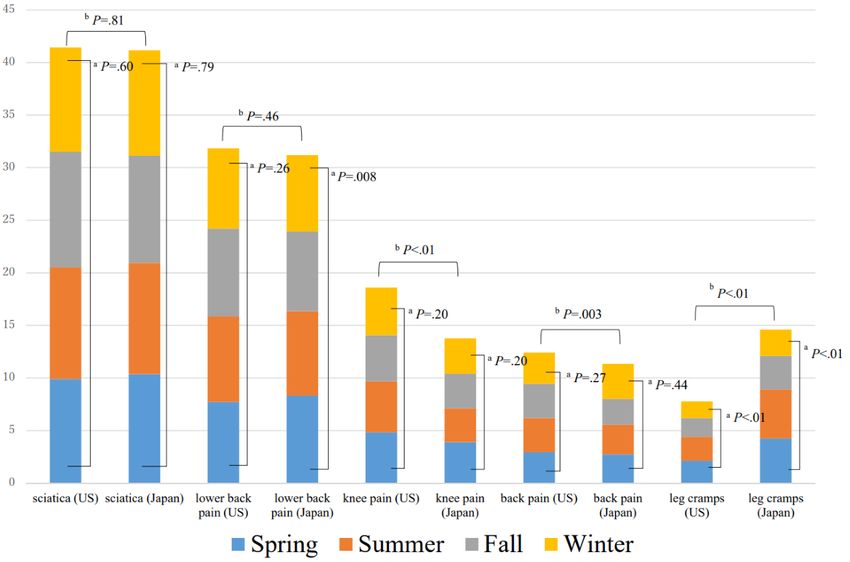
for 45% (9/20) of queries in Japan. No significant difference pain,” “back pain,” “knee pain,” and “leg cramps” (Figure 2).
was found between the number of ranked websites within the Seasonal variation in the number of searches was found for “leg
top 10 (Mann-Whitney U test P=.28). The total search volume cramps,” which was significantly higher in the summer in both
of the top 20 queries was 0.75 per 100 people in the United the United States and Japan. No significant difference was found
States and was 0.73 per 100 people in Japan (Table 1 and Table between search volume and the number of total hit websites for
2). As shown in Figure 1, the total search volume increased year the top 20 queries (Figure 3).
after year. In the top 20 queries, the most common search queries
Table 1. Top 20 search queries in the United States.
Search queries Average search volume per Four-year total search vol- Total hit websites Association website rank
month ume (per 100 people)
sciatica 301,000 15,491,000 (4.99) 35,400,000 35
lower back pain 246,000 11,862,000 (3.82) 664,000,000 28
herniated disc 165,000 7,957,500 (2.56) 5,010,000 7
bursitis 165,000 7,687,000 (2.48) 5,610,000 8
knee pain 135,000 6,926,000 (2.23) 278,000,000 12
shoulder pain 135,000 5,941,000 (1.91) 302,000,000 7
carpal tunnel syndrome 110,000 5,594,000 (1.80) 13,400,000 1
muscle relaxers 110,000 5,043,500 (1.62) 1,370,000 >100
heel pain 110,000 4,869,000 (1.57) 143,000,000 6
back pain 90,500 4,624,000 (1.49) 1,510,000,000 27
neck pain 90,500 4,044,000 (1.30) 364,000,000 19
muscle spasm 90,500 4,038,000 (1.30) 11,400,000 25
hip pain 74,000 3,918,000 (1.26) 432,000,000 17
sciatic nerve pain 74,000 3,910,400 (1.26) 6,680,000 >100
piriformis syndrome 74,000 3,680,000 (1.19) 1,800,000 >100
heel spur 74,000 3,676,500 (1.18) 15,500,000 7
foot pain 60,500 3,237,000 (1.04) 1,440,000,000 >100
myalgia 60,500 3,062,500 (0.99) 3,240,000 >100
leg cramps 60,500 2,892,500 (0.93) 31,700,000 23
hip bursitis 60,500 2,639,600 (0.85) 5,910,000 25
https://www.jmir.org/2020/8/e18684 J Med Internet Res 2020 | vol. 22 | iss. 8 | e18684 | p. 3
(page number not for citation purposes)
XSL• FO
RenderXJOURNAL OF MEDICAL INTERNET RESEARCH Yamaguchi et al
Table 2. Top 20 search queries in Japan.
Search queries (English translation) Average search volume Four-year total search volume Total hit websites Association website
per month (per 100 people) rank
zakotsushinkeitu (sciatica) 135,000 6,250,000 (4.94) 5,870,000 13
youtuu (lower back pain) 90,500 4,737,000 (3.74) 83,300,000 2
rokkanshinkeitsu (intercostal neuralgia) 74,000 3,724,500 (2.94) 577,000 >100
kensyouen (tendosynovitis) 74,000 3,307,000 (2.61) 8,660,000 3
komuragaeri (leg cramps) 49,500 2,217,300 (1.75) 995,000 >100
senaka no itami (back pain) 40,500 2,120,800 (1.68) 26,600,000 91
koshi ga itai (my lower back aches) 40,500 2,103,600 (1.66) 35,900,000 88
hiza no itami (knee pain) 40,500 2,090,900 (1.65) 25,000,000 7
ashi no ura itai (sole pain) 40,500 2,081,400 (1.64) 26,800,000 95
senaka ga itai (my back aches) 33,100 1,721,300 (1.36) 28,000,000 >100
hiza ga itai (my knee aches) 33,100 1,670,600 (1.32) 19,000,000 23
senaka itai (back, pain) 33,100 1,635,300 (1.29) 30,100,000 >100
kubi ga itai (my neck aches) 33,100 1,580,000 (1.25) 38,800,000 7
gojukata (painful shoulder at age 50s) 33,100 1,476,200 (1.17) 8,650,000 2
henkeiseihizakansetsusho (osteoarthritis 33,100 1,413,600 (1.12) 4,860,000 2
of the knee)
kokansetsu itami (hip, pain) 27,100 1,310,700 (1.04) 7,360,000 5
shinkeitsu (neuralgia) 27,100 1,224,600 (0.97) 7,660,000 17
fukurahagi itai (calf, pain) 22,200 1,163,900 (0.92) 1,900,000 8
hiza itami (knee, pain) 22,200 1,139,400 (0.90) 26,600,000 4
shijukata (painful shoulder at age 40s) 22,200 1,115,300 (0.88) 253,000,000 >100
Figure 1. Total number of musculoskeletal-related searches in the United States and Japan (total monthly search volume of the top 20 search queries).
Vertical axis: Searches per 100 people.
https://www.jmir.org/2020/8/e18684 J Med Internet Res 2020 | vol. 22 | iss. 8 | e18684 | p. 4
(page number not for citation purposes)
XSL• FO
RenderXJOURNAL OF MEDICAL INTERNET RESEARCH Yamaguchi et al
Figure 2. Comparison of musculoskeletal pain–related searches per month for each season (2016-2019) Vertical axis: Monthly searches per 10,000
people. aDifferences between seasons (Kruskal–Wallis test); bDifferences between the United States and Japan (Mann–Whitney U test).
Figure 3. Search volumes and number of total hit websites. Vertical axis: Number of total hit websites (logarithmic scale). Horizontal axis: Four-year
search volume per 100 people. No significant difference was observed in the relationship between the search volume and the number of total hit websites
(Spearman rank correlation coefficient=0.13).
https://www.jmir.org/2020/8/e18684 J Med Internet Res 2020 | vol. 22 | iss. 8 | e18684 | p. 5
(page number not for citation purposes)
XSL• FO
RenderXJOURNAL OF MEDICAL INTERNET RESEARCH Yamaguchi et al
Japan. The common query “leg cramps” was searched much
Discussion more often in Japan per 100 people and was searched more
This study is the first to examine how frequently the patient often in the summer in both the United States and Japan (Figure
information pages of orthopedic associations appear when search 2). The predominance in summer suggests a link to climate.
terms related to musculoskeletal pain are entered. Based on the Indeed, in the United Kingdom and Australia, the volume of
results of this study, we believe that there is a need for searches related to leg cramps increased in summer [25].
orthopedic associations to do more to provide medical Another study found that searches related to ankle swelling also
information on the internet by optimizing their position in the increased in midsummer [26]. Heartburn-related searches
search results for frequently searched symptom and increased during winter, as did heart failure hospitalizations
disease-related terms. [10,27]. These studies indicate that an increase in the search
volume for a particular condition reflects an actual increase in
The click-through rate for the first position in Google was the number of patients affected with that condition. Thus, when
21.12%, followed by 10.65% and 7.57%. If the search result the search volume increases, it may be effective for medical
ranked 11th, the click-through rate became only 1.46% [15]. In associations to provide medical information to patients who
a German study, when 289 patients searched for medical need accurate information using social networking sites such
information on the internet, only 5 clicked a link on the second as Facebook and Twitter. The act of conducting medical
or subsequent search result pages [16]. interventions via social media (ie, social media intervention) is
In the early 2000s, over 60% of people in the United States and reported to be an effective tool for enhancing public health [28].
Australia reported that they had used the internet to search for In the future, it will be important to increase interventions in
medical information and were satisfied with the resulting health addition to disseminating medical information via social
information and services [17-19]. More recently, 96% of people networking sites. The AAOS has a Twitter account, whereas
in Australia reported searching for medical information online; the JOA currently does not (as of June 2020).
of those, 63% searched using smartphones [20]. Over time, it On December 6, 2017, Google made an official announcement
has become increasingly common for individuals to use online about improving the quality of search results for medical and
search engines when they need medical or health information. health matters [29]. After this statement was made, information
According to many reports, inaccurate websites often appear from health professionals, specialists, and medical institutions
among the top 10 results and provide erroneous information should have become more readily available, and information
[21,22]. In the United Kingdom, Wikipedia sometimes appears sources such as blogs and websites dealing with folk medicine
more often in the search results than the National Health should have been excluded from searches. However, the
Service’s website [23]. If members of the general public websites of the two associations we focused on rarely appeared
encounter websites containing incorrect information, it is among the top 10 results, indicating that no dramatic change
difficult for them to assess its accuracy. In a US study, high has in fact taken place. In that announcement, Google stated
school students with a science-focused education had difficulty that health experts should make their websites appropriate for
distinguishing between reliable and unreliable medical sites, general users by avoiding the use of technical terms. Fortunately,
even though most of the information produced in the searches personal blogs and unofficial websites that may have posted
was inaccurate [24]. To solve health problems, government incorrect medical information tended not to appear in the search
organizations need to work together to provide more accurate results owing to Google’s corporate efforts.
medical information on the web [9]. The findings of our study suggest that better SEO is required
The algorithm used for Google searches is confidential; thus, to boost the ranking of medical associations’ websites. If their
many websites try to increase the quantity and quality of their websites were to achieve the highest ranking, ordinary patients
traffic using organic search engine results. This practice is could more readily obtain appropriate medical information. Of
termed search engine optimization (SEO). At present, if items course, it is also necessary to include accurate medical
do not appear among search engine results, they are practically information on the associations’ patient information pages. An
nonexistent. SEO strategy comprises two categories: on-page and off-page
SEO. Details about this may be found in the Google Search
In this study, we surveyed the search rankings of the patient Engine Optimization Starter Guide [30] and the Google
information pages of two orthopedic associations and found Webmaster Guidelines [31]. Unfortunately, development of an
that these pages are not likely to be viewed by patients seeking SEO takes time. Daily updates and accurate articles need to be
medical information with frequently searched queries. There posted online to raise the rankings of the medical associations.
was no significant difference in the number of searches per 100 In the future, a dual approach may be necessary, involving
people between the United States and Japan in the top 20 pages passive information transmission through companies such as
retrieved for musculoskeletal-related pain. Symptoms and Google, and active information transmission using social
illnesses are searched differently between the United States and networking services such as Twitter and Facebook.
Acknowledgments
We thank Edanz Group for editing a draft of this manuscript.
https://www.jmir.org/2020/8/e18684 J Med Internet Res 2020 | vol. 22 | iss. 8 | e18684 | p. 6
(page number not for citation purposes)
XSL• FO
RenderXJOURNAL OF MEDICAL INTERNET RESEARCH Yamaguchi et al
Conflicts of Interest
None declared.
References
1. Burke E, Harkins P, Saeed M, Salama M, Ahmed I. "Dr. Google" Will See You Now-Assessing the Quality of Information
on Oesophageal Cancer on the Internet. J Gastrointest Surg 2019 Nov 25:Epub ahead of print. [doi:
10.1007/s11605-019-04416-5] [Medline: 31768833]
2. Murphy EP, Fenelon C, Murphy F, Baig MN, Murphy RP, Diack M, et al. Does Google™ Have the Answers? The
Internet-based Information on Pelvic and Acetabular Fractures. Cureus 2019 Oct 21;11(10):e5952 [FREE Full text] [doi:
10.7759/cureus.5952] [Medline: 31799093]
3. Okuhara T, Ishikawa H, Kato M, Okada M, Kiuchi T. A qualitative analysis of the beliefs of Japanese anti-influenza
vaccination website authors. Heliyon 2018 Apr;4(4):e00609 [FREE Full text] [doi: 10.1016/j.heliyon.2018.e00609] [Medline:
29862370]
4. Pehora C, Gajaria N, Stoute M, Fracassa S, Serebale-O'Sullivan R, Matava CT. Are Parents Getting it Right? A Survey of
Parents' Internet Use for Children's Health Care Information. Interact J Med Res 2015 Jun 22;4(2):e12 [FREE Full text]
[doi: 10.2196/ijmr.3790] [Medline: 26099207]
5. Ministry of Internal Affairs and Communications Japan. Looking Back at the History of the Digital Economy in the Heisei
Era. WHITE PAPER Information and Communications in Japan. Tokyo: The Ministry of Internal Affairs and Communications
Japan; 2019. URL: https://www.soumu.go.jp/johotsusintokei/whitepaper/ja/r01/pdf/01honpen.pdf [accessed 2020-02-28]
6. Chosa E. [Locomotive syndrome and frailty. Locomotive syndrome due to the underlying disease of degenerative arthritis].
Clin Calcium 2012 Apr;22(4):49-57. [Medline: 22460511]
7. Director-General for Statistics and Information Policy HSO. Patient's Behavior Survey 2017 (Final Report). Tokyo: Ministry
of Health, Labour and Welfare; 2019 Mar 15. URL: https://www.mhlw.go.jp/toukei/saikin/hw/jyuryo/17/kakutei.html
[accessed 2020-07-13]
8. StatCounter. Search Engine Share Worldwide. URL: http://gs.statcounter.com/search-engine-market-share [accessed
2020-03-09]
9. King C, Judge C, Byrne A, Conlon N. Googling Allergy in Ireland: Content Analysis. J Med Internet Res 2020 May
13;22(5):e16763 [FREE Full text] [doi: 10.2196/16763] [Medline: 32401220]
10. Ssendikaddiwa J, Lavergne R. Access to Primary Care and Internet Searches for Walk-In Clinics and Emergency Departments
in Canada: Observational Study Using Google Trends and Population Health Survey Data. JMIR Public Health Surveill
2019 Nov 18;5(4):e13130 [FREE Full text] [doi: 10.2196/13130] [Medline: 31738175]
11. Kamiński M, Łoniewski I, Misera A, Marlicz W. Heartburn-Related Internet Searches and Trends of Interest across Six
Western Countries: A Four-Year Retrospective Analysis Using Google Ads Keyword Planner. Int J Environ Res Public
Health 2019 Nov 20;16(23):4591. [doi: 10.3390/ijerph16234591] [Medline: 31756947]
12. Seo D, Shin S. Methods Using Social Media and Search Queries to Predict Infectious Disease Outbreaks. Healthc Inform
Res 2017 Oct;23(4):343-348 [FREE Full text] [doi: 10.4258/hir.2017.23.4.343] [Medline: 29181246]
13. The Japanese Orthopaedic Association. Patient Information. 2019. URL: https://www.joa.or.jp/public/index.html [accessed
2020-03-09]
14. The American Academy of Orthopaedic Surgeons. OrthiInfo. 2020. URL: https://orthoinfo.aaos.org [accessed 2020-03-09]
15. Internet Marketing Ninjas. Google Organic Clickthrough Study: Comparison of Google’s CTR by position, industry, and
query type. 2017. URL: https://www.internetmarketingninjas.com/additional-resources/google-ctr-white-paper.htm [accessed
2020-03-09]
16. Scullard P, Peacock C, Davies P. Googling children's health: reliability of medical advice on the internet. Arch Dis Child
2010 Aug;95(8):580-582. [doi: 10.1136/adc.2009.168856] [Medline: 20371593]
17. Wainstein BK, Sterling-Levis K, Baker SA, Taitz J, Brydon M. Use of the Internet by parents of paediatric patients. J
Paediatr Child Health 2006 Sep;42(9):528-532. [doi: 10.1111/j.1440-1754.2006.00916.x] [Medline: 16925539]
18. Pew Internet & American Life Project. Health Information Online. 2005 May 17. URL: https://www.pewresearch.org/
internet/2005/05/17/health-information-online/ [accessed 2020-03-09]
19. Pew Internet & American Life Project. Wired for Health: How Californians Compare to the Rest of the Nation. 2003 Dec
15. URL: https://www.chcf.org/publication/wired-for-health-how-californians-compare-to-the-rest-of-the-nation/ [accessed
2020-07-13]
20. Yardi S, Caldwell PH, Barnes EH, Scott KM. Determining parents' patterns of behaviour when searching for online
information on their child's health. J Paediatr Child Health 2018 Nov;54(11):1246-1254. [doi: 10.1111/jpc.14068] [Medline:
29864197]
21. Okuhara T, Ishikawa H, Kato M, Okada M, Kiuchi T. A qualitative analysis of the beliefs of Japanese anti-influenza
vaccination website authors. Heliyon 2018 Apr;4(4):e00609 [FREE Full text] [doi: 10.1016/j.heliyon.2018.e00609] [Medline:
29862370]
https://www.jmir.org/2020/8/e18684 J Med Internet Res 2020 | vol. 22 | iss. 8 | e18684 | p. 7
(page number not for citation purposes)
XSL• FO
RenderXJOURNAL OF MEDICAL INTERNET RESEARCH Yamaguchi et al
22. Downs JS, de Bruin WB, Fischhoff B. Parents' vaccination comprehension and decisions. Vaccine 2008 Mar
17;26(12):1595-1607. [doi: 10.1016/j.vaccine.2008.01.011] [Medline: 18295940]
23. Laurent MR, Vickers TJ. Seeking health information online: does Wikipedia matter? J Am Med Inform Assoc
2009;16(4):471-479 [FREE Full text] [doi: 10.1197/jamia.M3059] [Medline: 19390105]
24. Kortum P, Edwards C, Richards-Kortum R. The impact of inaccurate Internet health information in a secondary school
learning environment. J Med Internet Res 2008 Jun 30;10(2):e17 [FREE Full text] [doi: 10.2196/jmir.986] [Medline:
18653441]
25. O'Keeffe ST. Summertime blues? A re-examination of the seasonality of web searches for restless legs and leg cramps.
Sleep Med 2017 Sep;37:119-123. [doi: 10.1016/j.sleep.2017.06.017] [Medline: 28899521]
26. Liu F, Allan GM, Korownyk C, Kolber M, Flook N, Sternberg H, et al. Seasonality of Ankle Swelling: Population Symptom
Reporting Using Google Trends. Ann Fam Med 2016 Jul;14(4):356-358 [FREE Full text] [doi: 10.1370/afm.1953] [Medline:
27401424]
27. Patel NJ, Nalluri N, Deshmukh A, Pant S, Shah N, Badheka AO, et al. Seasonal trends of heart failure hospitalizations in
the United States: a national perspective from 2000 to 2011. Int J Cardiol 2014 May 15;173(3):562-563. [doi:
10.1016/j.ijcard.2014.03.122] [Medline: 24713458]
28. Bonar EE, Schneeberger DM, Bourque C, Bauermeister JA, Young SD, Blow FC, et al. Social Media Interventions for
Risky Drinking Among Adolescents and Emerging Adults: Protocol for a Randomized Controlled Trial. JMIR Res Protoc
2020 May 13;9(5):e16688 [FREE Full text] [doi: 10.2196/16688] [Medline: 32401225]
29. Shin N. Improvement of search results quality about medical and health contents Internet: Google. 2017 Dec 6. URL: https:/
/webmaster-ja.googleblog.com/2017/12/for-more-reliable-health-search.html [accessed 2020-03-09]
30. The Google Search Quality team. Search Engine Optimization (SEO) Starter Guide. URL: https://support.google.com/
webmasters/answer/7451184?hl=en [accessed 2020-03-09]
31. The Google Search Quality team. Webmaster Guidelines. URL: https://support.google.com/webmasters/answer/35769?hl=en
[accessed 2020-03-09]
Abbreviations
AAOS: American Academy of Orthopedic Surgeons
JOA: Japanese Orthopedic Association
SEO: search engine optimization
Edited by G Eysenbach; submitted 18.03.20; peer-reviewed by T Cruvinel, V Gianfredi; comments to author 20.04.20; revised version
received 04.06.20; accepted 11.06.20; published 14.08.20
Please cite as:
Yamaguchi Y, Lee D, Nagai T, Funamoto T, Tajima T, Chosa E
Googling Musculoskeletal-Related Pain and Ranking of Medical Associations’ Patient Information Pages: Google Ads Keyword
Planner Analysis
J Med Internet Res 2020;22(8):e18684
URL: https://www.jmir.org/2020/8/e18684
doi: 10.2196/18684
PMID:
©Yoichiro Yamaguchi, Deokcheol Lee, Takuya Nagai, Taro Funamoto, Takuya Tajima, Etsuo Chosa. Originally published in
the Journal of Medical Internet Research (http://www.jmir.org), 14.08.2020. This is an open-access article distributed under the
terms of the Creative Commons Attribution License (https://creativecommons.org/licenses/by/4.0/), which permits unrestricted
use, distribution, and reproduction in any medium, provided the original work, first published in the Journal of Medical Internet
Research, is properly cited. The complete bibliographic information, a link to the original publication on http://www.jmir.org/,
as well as this copyright and license information must be included.
https://www.jmir.org/2020/8/e18684 J Med Internet Res 2020 | vol. 22 | iss. 8 | e18684 | p. 8
(page number not for citation purposes)
XSL• FO
RenderXYou can also read


