Guidance for Museums Reopening After Closure due to - COVID-19
←
→
Page content transcription
If your browser does not render page correctly, please read the page content below
Guidance for
Museums
Reopening After
Closure due to
COVID-19
Guidance for Museums Reopening After
Closure due to COVID-19
Contents
Introduction .................................................................................................................................................. 3
Disclaimer..................................................................................................................................................... 3
Public Health and Provincial Reopening Guidelines .................................................................................. 4
   Reopening Requirements for Museums, Attractions and Heritage Institutions ................................... 4
Considerations for Re-entry and Re-opening ............................................................................................. 7
   Create Your Reopening and Recovery Plan............................................................................................ 7
       Plan Templates and Resources .......................................................................................................... 7
       Create a Reopening and Recovery Team ........................................................................................... 7
       Create a plan with a phased timeline ................................................................................................. 7
       Maintain Clear and Consistent Internal and External Communications .......................................... 7
   Determine the Minimum Requirements that Need to be in Place for Museum Staff and Volunteers
   to Re-enter the Museum Before it is Open to the Public ...................................................................... 8
       Questions and Considerations ............................................................................................................ 8
       Resources ............................................................................................................................................. 9
   Ontario Guidelines for Workplaces ......................................................................................................... 9
   Recommended Considerations ............................................................................................................... 9
       Update your policies .......................................................................................................................... 11
       Cleaning protocols ............................................................................................................................. 12
       Collections Management Protocols .................................................................................................. 12
   Determine the minimum requirements that need to be in place for the museum to re-open to the
   public ...................................................................................................................................................... 13
       Questions and Considerations .......................................................................................................... 13

Version 1: June 17, 2020

                                                                                                                                                                2
Introduction
In A Framework for Reopening our Province, the Government of Ontario has laid out a three-
phase plan to responsibly reopen businesses, services and public spaces while keeping
health and safety of Ontarians as the top priority.
As of the writing of this document (June 17, 2020) Stage 2 of Phase 2 of the Province’s
reopening plan has begun on June 12, 2020 for certain regions of Ontario. Museums may
open in these regions if they follow specific restrictions (see page 3). Regions not included
on the list must remain in Stage 1 and therefore museums in those regions must remain
closed until further notice.
Since March 2020, the Ontario Museum Association has been updating the dedicated
COVID-19 Resources page on our website and organizing webinars to give members the
information they need to operate during closure and prepare to reopen. Please visit this
page regularly to access compiled resources from organizations in Ontario and around the
world.
The OMA has created this document to provide information that will help Ontario museums
to make decisions about whether to reopen, when to reopen, and how to reopen responsibly
and safely. That all museums will reopen to the public in the near future is not a foregone
conclusion. The decision to reopen any museum will be based on government and scientific
guidance, but the financial and operational considerations that directors, funders and policy-
makers must take into account mean that reopening will be a difficult process for many
museums.
The OMA is working to support museums to operate safely and with the resources they need
to be sustainable in a new and uncertain reality. Whether museums are able to welcome
visitors into their buildings or whether they engage with their communities in other ways, the
OMA is and will be a staunch advocate and champion of the value of museums to all
communities in Ontario.
This is a living document that will be updated as new information becomes available.
Disclaimer
This resource is intended to serve as a guide to help museums to make informed decisions
as they plan to reopen sites to staff, volunteers, and the public. Wherever possible this
document points to Ontario Government resources and guidelines, and to Ontario-specific
guidance from trusted sources. This document is not meant to supersede any regulations or
guidance from provincial, federal or local governments or public health authorities, and
where any discrepancies exist, guidance from these authorities must take precedence.
The Ontario Museum Association encourages museums to consult with their local
government and public health authorities as they develop their reopening plans, and to seek
legal advice and consult their insurance companies regarding their specific circumstances
as needed.
Version 1: June 17, 2020
3Public Health and Provincial Reopening Guidelines
Museums must base decisions on the most current public health guidance and provincial
reopening guidelines available.
Health Canada
Public Health Ontario
Province of Ontario COVID-19 Information
Framework for Reopening Our Province
We encourage museums to monitor all announcements from the above organizations and
modify their plans accordingly.
In consultation with the Ministry of Heritage, Sport, Tourism and Cultural Industries, the
following provincial requirements for museums have been compiled.
Reopening Requirements for Museums, Attractions and Heritage Institutions
Overview
Museums, galleries, aquariums, zoos, science centres, landmarks, historic sites, botanical
gardens and similar attractions may reopen during Stage 2 if they comply with Reg.
263/20 under the Emergency Management and Civil Protection Act, as well as the
requirements provided in the Framework for Reopening our Province: Stage 2.
Reg. 263/20 under the Emergency Management and Civil Protection Act can be found
here.
A Framework for Reopening our Province: Stage 2 can be found here.
Reg. 263/20 Under the Emergency Management and Civil Protection Act
Museums need to comply with two sections of the regulation - general compliance for
businesses and specific instructions for museums:
General Compliance
4. (1) The person responsible for a business or organization that is open shall ensure that
the business or organization operates in accordance with all applicable laws, including
the Occupational Health and Safety Act and the regulations made under it.
(2) The person responsible for a business or organization that is open shall operate the
business or organization in compliance with the advice, recommendations and
instructions of public health officials, including any advice, recommendations or
instructions on physical distancing, cleaning or disinfecting.
(3) The person responsible for a business that is open to the public, or an organization
responsible for a facility that is open to the public, shall ensure that the place of business
or facility is operated to enable members of the public in the place of business or facility
Version 1: June 17, 2020
4to, to the fullest extent possible, maintain a physical distance of at least two metres from
other persons.
(4) Subsection (3) does not require the business or facility to be operated in such a way as
to enable physical distancing of persons who have arrived at the business or facility
together.
(5) The person responsible for a business or place that is open shall ensure that any
washrooms made available to the public are cleaned and disinfected as frequently as is
necessary to maintain a sanitary environment.
Information on cleaning and safety can be found here.
Museums, etc.
23. Museums, galleries, aquariums, zoos, science centres, landmarks, historic sites,
botanical gardens and similar attractions may open if they comply with the following
conditions:
1. No member of the public may be permitted access to interactive exhibits or exhibits
that would create a high risk of personal contact.
2. Lockers must not be provided to members of the public.
3. Any equipment that is rented or provided to patrons must be cleaned and disinfected
between each use.
Information on cleaning and safety can be found here.
A Framework for Reopening our Province: Stage 2
In addition to the provisions in Reg. 263/20, museums must also comply with the
requirements laid out in A Framework for Reopening our Province: Stage 2:
Museums, galleries, aquariums, zoos outdoor heritage institutions (for example,
landmarks, outdoor historic sites, botanical gardens), and other establishments primarily
engaged in preserving and exhibiting objects, sites and natural wonders of historical,
cultural and educational value are permitted to reopen with restrictions.
Interactive and high-contact exhibits, amusement parks, water parks and
conference centres will remain closed in Stage 2.
Lockers will remain closed.
The opening of commercial areas (for example, restaurant, cafe, bookshop,
giftshop) are subject to the related guidelines and restrictions.
Persons in the place of business shall maintain physical distancing of at least two
Version 1: June 17, 2020
5metres from each other at all times by:
o Timed entry
o A Limited number of visitors allowed in a place at one time
o Managed visitor flow (for example, one-way flow)
Establishments should consider operating by appointment and/or record each
patron’s name and contact information for the purpose of contact tracing.
Museums must also comply with requirements around retail and food services if relevant
to their institutions.
Existing Provincial Guidance Material
Any guidance provided to museums, attractions and heritage institutions on how to safely
reopen must align with existing provincial guidance. A few relevant examples are provided
below:
Workplace Safety & Prevention Services: Guidance on Health and Safety for
Tourism and Hospitality Sector during COVID-19
Public Services Health & Safety Association: Health and Safety Guidance During
COVID-19 For Library Employers
Workplace Safety & Prevention Services: Guidance on Health and Safety for Retail
Sector during COVID-19
Workplace Safety & Prevention Services: Guidance on Health and Safety for Office
Sector during COVID-19
Version 1: June 17, 2020
6Considerations for Re-entry and Re-opening
Ontario museums always strive to achieve best practices and to meet the Standards for
Community Museums in Ontario and consult with heritage and museum advisory staff at the
Ministry of Heritage, Tourism, Sport and Cultural Industries. At this time more than ever,
museums are finding creative ways to meet standards and fulfil their mandates while
keeping people safe.
The following are topics and links to resources to help museums to create their own plans
for reopening both to staff and volunteers and to the public. Every museum’s situation will
be unique and will need to take into account direction from local public health authorities
and the specific context of the physical site and the individuals, organizations, and
communities involved.
Create Your Reopening and Recovery Plan
Plan Templates and Resources
The Government of Ontario has provided information on how to develop your COVID-
19 workplace safety plan that includes a template you can use to create your own.
Create a Reopening and Recovery Team
Create a team within your museum if possible. This group could include Board
members, staff, and volunteers, and members of your Joint Health and Safety
Committee.
o The Alberta Museums Association Membership Advisory Part 1 includes
helpful information and resources for creating an Emergency Response Team
(ERT) which can act as a Reopening and Recovery Team.
If your organization is very small, consider creating a Reopening and Recovery Team
with other small organizations within your Regional Museum Network. Contact the
OMA to find your local Regional Museum Network.
Create a plan with a phased timeline
Ontario’s Framework for Reopening Our Province identifies three phases for
reopening and recovery. Consider using a similar approach for your museum that
identifies what steps need to happen and what conditions need to be met before the
next phase can begin.
Allow for flexible timelines as shifts will be necessary and timelines may be longer
than anticipated.
Maintain Clear and Consistent Internal and External Communications
It is important to maintain clear and consistent messaging about your reopening
plans both internally (with board, staff and volunteers) and externally.
o Provide regular updates to all staff and volunteers, including those on
temporary leave.
o Update your website and social media channels to keep your community
informed.
Version 1: June 17, 2020
7o Keep suppliers, community partners, funders, and insurers informed about
changes to your operations.
Consider sharing and reviewing your reopening plan with other museums and
community organizations in your area, as well as your local government public health
unit, and tourism partners.
Sharing with other organizations may highlight opportunities for collaboration, such
as bulk ordering of supplies.
o Workplace PPE Supplier Directory
Keep your members and audience informed about your plans and find out what they
need.
o Consider reaching out to your local community to find out what measures
need to be in place for people to be comfortable visiting your site when it
reopens. Some examples include:
Lang Pioneer Village
The Diefenbunker
Pickering Museum Village
Determine the Minimum Requirements that Need to be in Place for Museum Staff
and Volunteers to Re-enter the Museum Before it is Open to the Public
Questions and Considerations
Consider the following within the timelines laid out in your plan.
Financial
o What resources does the museum need to meet all normal financial
commitments (e.g. rent, utilities, internet, wages, etc.) as well as additional
costs such as cleaning supplies and personal protective equipment?
o What grants or subsidies need to be confirmed or received?
Staffing
o Many museums have laid off or furloughed staff or postponed seasonal hiring.
Consider how long it will take to hire or bring staff back and to train them in
new cleaning protocols, emergency procedures, etc.
o Be aware that some individuals may need to remain on leave or may need to
continue working from home to care for family members.
o Consider the needs of individuals who may be more at risk than others e.g.
elderly volunteers, those with underlying conditions, those whose roles put
them in closer contact with others.
o Build in time to review policies and to train staff in new visitation patterns,
customer service protocols, and dealing with non-compliant visitors.
Facility
o If the museum has been inaccessible while closed – has it been inspected to
ensure that buildings and grounds are safe for staff and volunteers to return
to work?
o Do work areas need to be rearranged to ensure physical distancing?
o Who has had access to the museum and has the space been thoroughly
cleaned and disinfected or quarantined?
Version 1: June 17, 2020
8 Safety equipment and supplies
o Does the museum have an adequate supply of products and materials to
properly clean and disinfect all work areas?
o Does the museum have an adequate supply of personal protective equipment
(e.g. masks, gloves) for staff and volunteers if needed?
o Does the museum have a reliable source for restocking supplies as needed?
Resources
Post Pandemic Business Resumption Checklist
Risk-informed decision-making guidelines for workplaces and businesses during the
COVID-19 pandemic
Post-Pandemic Business Playbook: A guide for COVID-19 Pandemic Preparedness
and Response
Ontario Guidelines for Workplaces
Working at your museum after COVID-19 will not be the same as it was before the
pandemic. The Ministry of Labour, Training and Skills Development and Provincial health
and safety associations have created guidance documents for different kinds of workplaces.
As museum work incorporates a wide variety of roles, several different guides may apply and
the OMA encourages consultation of the following:
Government of Ontario - Resources to prevent COVID-19 in the workplace
Government of Ontario - COVID-19 (coronavirus) and workplace health and safety
Government of Ontario - Develop your COVID-19 workplace safety plan
Ontario Ministry of Health - COVID-19 Guidance: Essential Workplaces
Workplace Safety and Prevention Services - COVID-19 Resources for Business still
operating, for businesses operating remotely, and for businesses preparing to reopen
Public Service Health and Safety Association - Novel Coronavirus (COVID-19)
Resource Centre: Links & Resources for Workers & Employers
Recommended Considerations
The Hierarchy of Controls
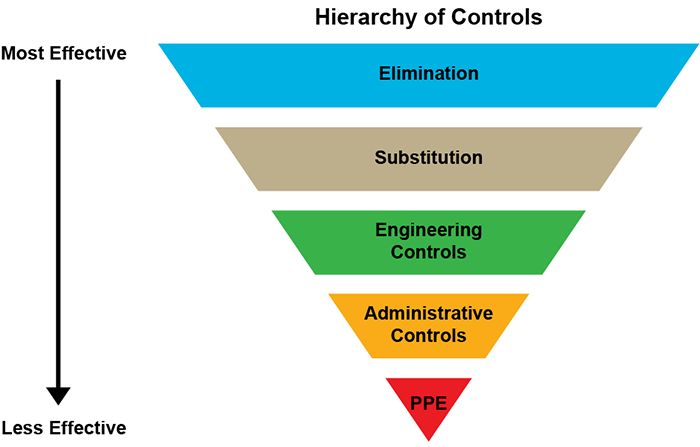
“The hierarchy of controls (image and description below) can help you choose the
right controls for your workplace. This applies to all workplace hazards, not just
COVID-19.
The levels in the hierarchy of controls, in order from most effective to least effective,
are:
o elimination
o substitution
o engineering controls
o administrative controls
o personal protective equipment (PPE)”1
1
Quoted from: https://www.ontario.ca/page/develop-your-covid-19-workplace-safety-plan. More details
descriptions of controls can be found at this page.
Version 1: June 17, 2020
91 Hierarchy of Controls - https://www.ontario.ca/page/develop-your-covid-19-workplace-safety-plan
Physical Distancing
o Ensure that staff and volunteers are able to maintain 2 metres of distance
while at work, including during breaks.
Public Health Ontario – Physical Distancing
Handwashing and Hand Sanitizer
o Ensure that handwashing facilities are available or where that is impossible
that hand sanitizer is available and determine appropriate placement
throughout the site.
Public Health Ontario – How to Wash Your Hands and How to Use Hand
Sanitizer
o Provide non-touch, lined waste disposal receptacles throughout the
workplace.
Protective Equipment
o Where physical distancing is not possible, create physical barriers or ensure
that staff and volunteers have access to personal protective equipment and
that they are trained on how to use it.
Mask Use for Non-Healthcare Workers
When and How to Wear a Mask
Non-medical Masks and Face Coverings
Staggered Shifts
o If necessary, stagger shifts so that staff and volunteers are able to maintain
physical distance while at work and while entering and leaving the site.
Version 1: June 17, 2020
10 Screening
o Encourage staff and volunteers to perform daily self-screening at home prior
to coming to work using the self-assessment tool online. Communicate that it
is not permitted for anyone to enter the premises if they are sick or have
symptoms of COVID-19.
Procedures for People who are Sick
o If staff or volunteers become ill while at work, they should be sent home,
instructed to do a self-assessment and to follow the recommended next steps.
Signage
o Post signage informing staff and volunteers of symptoms of COVID-19 and to
reinforce safe work practices such as screening, hand washing, physical
distancing, and what to do if they become sick.
Posters for Employers and Employees
Accessibility
o In keeping with the Accessibility for Ontarians with Disabilities Act, ensure that
all information is available to employees in accessible formats on request.
How to Make Information Accessible
Update your policies
Many organizations will require workers to work in new ways and your HR and other policy
documents must reflect changes to your workplace.
Find out about your responsibilities as an employer and recent amendments to the
Employment Standards Act in response to COVID-19
o COVID-19 (coronavirus) and your employment standards protections
Remote work policies – while museums are closed, as they begin to reopen, and in
the case that museums must close again, there will be individuals who need to
continue to work remotely. Make sure that you have policies in place that outline your
approach to remote work.
Working alone on-site – it is not uncommon for museum employees to be sole
employees and for museum workers to be spread out on large museum sites.
However, as museums modify their operations to ensure physical distancing it may
be more common for individuals to work alone or physically removed from their
colleagues. Ensure that your protocols and training for working alone are in place to
ensure the safety and security of staff and volunteers.
o Public Services Health and Safety Association: Protecting Workers Who Work
Alone
o Canadian Centre for Occupational Health and Safety – Working Alone -
General
o Ensure that sign-in and sign-out protocols are in place to ensure accurate
headcounts in case of emergency. This may be particularly important with
individuals working on staggered or modified schedules.
Mental health supports – the COVID-19 pandemic and its effects will continue to
impact people as they resume their work at museums and as they reintegrate into
the workplace.
o Canadian Mental Health Association - COVID-19 and mental health
o Government of Ontario - Mental health, wellness and addictions support
Version 1: June 17, 2020
11o Workplace Safety and Prevention Services has created a COVID-19 Mental
Health Resources list of tools to help employees, including leaders, during the
pandemic and in the returning to the workplace.
o Workplace Safety & Prevention Services (WSPS) and HowattHR have launched
the Psychological Safety Blog as a source for information, tools and resources
to help leaders protect the health, safety and wellness of their people.
Cleaning protocols
Review and update all cleaning protocols to ensure that they are consistent with public
health direction.
Government of Canada: Cleaning and disinfecting public spaces during COVID-19
Public Health Ontario: Cleaning and Disinfection for Public Settings
Workplace Safety and Prevention Services: Pathogen Decontamination Checklist
o Train staff on cleaning procedures and safe use of all products and
equipment.
o Ensure that staffing levels are adequate to complete required cleaning (hire
additional cleaning staff if necessary) and ensure that time for new cleaning
processes is reflected in workplans.
o Equipment and supplies – ensure that cleaning equipment and supplies are
stocked and that reliable sources are available to restock.
Government of Canada: Hard-surface disinfectants and hand sanitizers
(COVID-19): List of disinfectants with evidence for use against COVID-
19
Collections Management Protocols
In most cases, it will not be possible to disinfect museum collection objects with chemical
processes without the risking permanent damage. The Canadian Conservation Institute has
provided guidance on Caring for Collections During the COVID-19 Pandemic. Update
procedures and train staff to ensure that staff and volunteers are protected, and that
collections are not damaged.
The OMA presented a webinar with CCI to elaborate on the advice in the above
publication, the recording is available online.
Version 1: June 17, 2020
12Determine the minimum requirements that need to be in place for the museum to re-
open to the public
As of the writing of this document, museums in certain regions of the Province are permitted
to reopen to the public. The following considerations are intended to help museums to plan
for reopening when it is permitted by the Government of Ontario. This document will be
updated as specific directives for safe operation of museums are released.
Questions and Considerations
Financial
o What resources does the museum need to meet all normal financial
commitments (e.g. rent, utilities, internet, wages, etc.) as well as additional
costs such as cleaning supplies and personal protective equipment?
o What grants or subsidies need to be confirmed or received?
o What additional equipment needs to be purchased (e.g. Plexiglas shields for
reception desks, additional tools and equipment to avoid sharing among
staff)?
Staffing
o Many museums have laid off or furloughed staff or postponed seasonal hiring.
Consider how long it will take to hire or bring staff back and to train them in
new cleaning protocols, emergency procedures, new ticketing software, etc.
o Be aware that some individuals may need to remain on leave or may need to
continue working from home to care for family members.
o Consider the needs of individuals who may be more at risk than others e.g.
elderly volunteers, those with underlying conditions, those whose roles put
them in closer contact with others.
o Build in time to review policies and to train staff in new visitation patterns,
customer service protocols, and dealing with non-compliant visitors.
Safety Equipment and Supplies
o Does the museum have an adequate supply of products and materials to
properly clean and disinfect all work areas?
o Does the museum have an adequate supply of personal protective equipment
(e.g. masks, gloves) for staff and volunteers if needed?
o Does the museum have a reliable source for restocking supplies as needed?
Physical Distancing
o Physical distance of 2 metres must be maintained between groups of visitors,
between staff members, and between visitors and staff members.
o Physical barriers (e.g. Plexiglas shields) or personal protective equipment (e.g.
masks) should be used where 2 metre distance is not possible (e.g. admission
desks)
o How can outdoor spaces be used to provide physical distancing?
Capacity, Access, and Flow
o Consider using a single public entrance to the building to control the number
of people who enter.
o What areas must remain inaccessible to visitors to prevent crowding or access
to high-touch interactives e.g. touch screens, buttons, dress-up clothes.
o What interactives must be removed or covered?
Version 1: June 17, 2020
13o How will visitors move through the museum while maintaining physical
distance of 2 metres?
o How will designated routes be indicated in the space to ensure that visitors do
not cross paths or encounter bottlenecks? Apply markers to the floor to
indicate 2 metre distance and direction of travel.
Ticketing
o When museums reopen it may be necessary or recommended to implement
timed entry to the museum to control capacity and ensure physical distancing.
Does your existing point of sale software include timed ticketing
capabilities?
Can you proceed with a phone-based reservation system for booking
visits?
Does your website allow for online payment or will visitors pay on-site?
What online tools do you have available to you that can manage online
bookings?
o Consider cashless or no-touch options for payment of admission fees or
donations.
Interpretation
o How will your interpretation be impacted by physical distancing, no-touch
requirements, or staff shortages?
o How can signage, audio, video, or apps be used to communicate interpretive
messages to visitors?
Communication
o What updates need to be made to your website and other communication
vehicles to let the public know how they can visit your site?
o What signage must be created to communicate new policies and protocols for
visitors? Post all policies and reminders about hygiene and physical distancing
practices at entrances.
Ontario Public Health COVID-19 Symptoms Poster for Visitors
o What training must staff and volunteers receive to ensure that they are
delivering consistent messaging to visitors?
Accessibility
o How will signage, directions, and interpretation be made accessible to people
with disabilities?
o How will changes to how people access your site be communicated?
Handwashing and Hand Sanitizer
o Ensure that handwashing facilities are available or where that is impossible
that hand sanitizer is available and determine appropriate placement
throughout the site.
Public Health Ontario – How to Wash Your Hands and How to Use Hand
Sanitizer
o Provide non-touch, lined waste disposal receptacles throughout the museum.
Cleaning Protocols
o Review and update all cleaning protocols to ensure that they are consistent
with public health direction.
Government of Canada: Cleaning and disinfecting public spaces during
COVID-19
Version 1: June 17, 2020
14 Public Health Ontario: Cleaning and Disinfection for Public Settings
Workplace Safety and Prevention Services: Pathogen Decontamination
Checklist
o Train staff on cleaning procedures and safe use of all products and
equipment.
o Ensure that staffing levels are adequate to complete required cleaning (hire
additional cleaning staff if necessary) and ensure that time for new cleaning
processes is reflected in workplans.
o Equipment and supplies – ensure that cleaning equipment and supplies are
stocked and that reliable sources are available to restock.
Government of Canada: Hard-surface disinfectants and hand sanitizers
(COVID-19): List of disinfectants with evidence for use against COVID-
19
Update Emergency Plans
o Ensure that emergency plans are updated to reflect new work patterns and
protocols.
o Ensure that emergency plans include pandemic response protocols in case
the museum must close again in future.
The Alberta Museums Association Membership Advisory Managing
Your Museum’s Pandemic Response PART1: Activating Your
Emergency Response provides some guidance and links to resources
from HELP! An Emergency Preparedness Manual for Museums.
Canadian Centre for Occupational Health and Safety - Flu and
Infectious Disease Outbreaks Business Continuity Plan
Ontario Ministry of Health COVID-19 Guidance: Workplace Outbreaks
provides information intended for Public Health Units, but it also
includes useful information for employers.
Canadian Conservation Institute Risk management for heritage
collections
The Canadian Conservation Institute CCI Note Closing a Museum for
the Winter is a good resource in case of future closure.
Version 1: June 17, 2020
15You can also read


