Human Resources Strategic Plan - V1.6 - January 2018 - Network Rail
←
→
Page content transcription
If your browser does not render page correctly, please read the page content below
Human Resources
Strategic Plan

V1.6 - January 2018
HR Strategic Plan

Contents ........................................................................................................................................................................................................................................... 2
1.       Purpose, role & vision .............................................................................................................................................................................................................. 3
     1.1 Purpose ................................................................................................................................................................................................................................. 3
     1.2 Role ........................................................................................................................................................................................................................................ 3
     1.3 Vision ...................................................................................................................................................................................................................................... 4
2.       Objectives and Stakeholder Priorities ...................................................................................................................................................................................... 5
     2.1 Stakeholders and Priorities .................................................................................................................................................................................................... 5
3.       What HR is ............................................................................................................................................................................................................................. 11
     3.1 Structure ............................................................................................................................................................................................................................... 11
     3.2 Operating model – present & future ..................................................................................................................................................................................... 11
4.       Risks, opportunities, constraints & assumptions .................................................................................................................................................................... 13
4.       Expenditure & Efficiency ........................................................................................................................................................................................................ 15
     5.1 Cost and volume summary ................................................................................................................................................................................................... 15
     5.3 Cost drivers, headwinds and efficiency ................................................................................................................................................................................ 18
     5.4 Risk and uncertainty in the CP6 plan ................................................................................................................................................................................... 22
     5.5. Uncertainty ranges for CP6 ................................................................................................................................................................................................. 23
5.       Sign-off ................................................................................................................................................................................................................................... 24
Appendix A              N/A ......................................................................................................................................................................................................................... 25
Appendix B              Key assumptions .................................................................................................................................................................................................... 25
Appendix C              N/A ......................................................................................................................................................................................................................... 28
Appendix D              Scenario planning................................................................................................................................................................................................... 28
Appendix E              HR efficiencies and devolution journey .................................................................................................................................................................. 31
Appendix F              Glossary of terms ................................................................................................................................................................................................... 32

Network Rail                                                                                                                                                                                                                                         2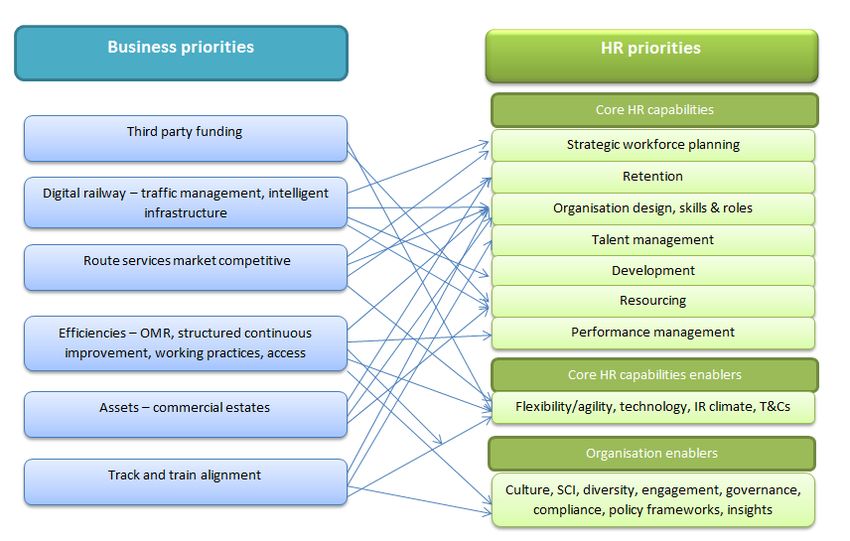
HR Strategic Plan
1. Purpose, role & vision
1.1 Purpose
The purpose of the HR function is to support the business to
meet objectives through our people.
1.2 Role
The HR function supports the business to:
Deliver high performance
Have great people
Be a great place to work.
This is delivered through a range of services to support these
three areas.
The function is a centre of expertise on people and
employment as well as having business based HR support as
part of leadership teams delivering the services within each
business area.
The services and CP6 strategy are underpinned by a plan to
deliver against these three key areas during CP6.
Network Rail 3HR Strategic Plan
1.3 Vision Potential employees – in a highly competitive recruitment market,
NR needs to be attractive to potential employees to be able to fill
The vision for HR is to contribute to a better railway for a better roles with suitably skilled people. The reputation of NR as an
Britain with great people, great place to work and delivering high employer has an influence on broader perception of NR as a
performance. provider of key transport infrastructure services to the UK.
Customer focus Government/shareholder – As shareholder and funder the
Government is a key stakeholder.
The HR function provides services directly to customers internally
to support the delivery of high NR performance through people. Executive committee – key decisions on people related policies
The key customer groups are: and processes are made by the ExCom, so their engagement and
support is essential to obtain approval for changes.
Routes and other business areas – the management teams want
an HR service that supports improvement of overall business Board – the HR function is accountable to the board for
performance. The specific areas where these customers want maintaining the appropriate governance structures and providing
improvements are around strategic workforce planning/talent assurance to the board.
management, resourcing and workforce development.
Employees – having an engaged workforce increases productivity,
safety and performance. Having the right culture and environment
that is diverse and inclusive to harness talent and innovate is
important.
Network Rail 4HR Strategic Plan
2. Objectives and
Stakeholder Priorities
• Benchmarking (Hackett)
Refine/validate • Use outputs from customer
• HR strategy group engagement to define 'to
• External trends/practice • Engage with customers to be' future
2.1 Stakeholders and Priorities refine to next level of detail • Baseline current
The key stakeholders are the managers and employees across • Journey/plan to bridge gap
between
Network Rail, so they can have the people resources in place to
deliver for passengers, the public and taxpayers. Identify
Delivery plan
Through working with each of the client groups and using the
priorities
outputs from the Hackett benchmarking process, the collective
priorities were captured and distilled into key areas of focus for the
HR function. The highest priorities areas to support delivering the
business agenda are around strategic workforce planning,
talent/maximising potential, equipping managers to do the Stakeholders
people related aspects of their roles well, creating a more
agile organisation to meet changing customer needs and Other key stakeholders include:
creating the right culture for all people to flourish. Government – as an arms-length body, NR operates
within the public sector. Some decisions need either
The diagram below outlines the engagement process: government engagement or approval.
Trade unions – the industrial relations (IR) climate and our
relationship with trade unions is important so organisation
can evolve to meet changing needs of customers and
employees
Professional heads – this group have responsibility for
their professional area including development, roles, skills
and understanding how the profession fits into the wider
industry/labour market.
NSAR – on industry skills issues.
Stakeholder engagement
Engagement with stakeholders is a continuous process, both
formally and informally. They formal engagement approach for
each of the key stakeholders is summarised below:
Network Rail 5HR Strategic Plan
Stakeholder Frequency Approach
Discuss key priorities
Government (DfT) Monthly Government changes/requirements
Decisions that need approval
Consultation on changes
Trade Unions Quarterly and as needed Negotiation (pay, terms, conditions)
Information
Prioritise activities
Professional heads Quarterly steering group
Consider careers in profession and progression
NSAR Industry skills strategy
Network Rail 6HR Strategic Plan
HR priorities
The specific activities that will deliver the benefits associated with
the priority areas are being finalised and will be agreed with client
areas for the strategy delivery plan to be developed.
The diagram below summarises the key areas of focus for the HR
function in CP6 based on the priorities identified through customer
engagement, benchmarking and review by the senior HR team:
The HR priority areas are explained in more detail below and on
the following pages.
The objectives have been split into the key areas of focus, core
HR capabilities, enablers for those core capabilities and broader
HR function enablers/dependencies.
The HR function already delivers support and services within each
of the priority areas identified. For CP6 the focus for the function
is to improve the services to better support the delivery of key
business objectives.
The chart opposite illustrates how the HR priority areas directly link
to the business priorities during CP6.
Network Rail 7HR Strategic Plan
1. Core HR capabilities which includes: needed.
a. Organisation – strategic workforce planning and
organisation design
b. People – workforce development, resourcing, talent & 3. Organisation enablers/dependencies. To support the overall
succession planning, performance management and contribution of the HR function there are a range of enablers and
retention dependencies including culture, safety, structured continuous
These are the core areas for the NR HR function to focus on to improvement (SCI), diversity and inclusion (D&I) as well as
support delivery of the business objectives. The services largely compliance and good governance.
already exist and the review of requirements so far from the HR team,
customers and through external benchmarking have all identified that In any business a high performing HR function will deliver a range of
they need to be improved to deliver what is needed for the business. ‘business as usual’ services
2. Enablers for core HR capabilities. To support the delivery of the These three areas of focus are underpinned by:
core HR capabilities, the organisation needs the agility to react to Planning – know what business needs are and plan accordingly –
changing business needs and the flexibility changing employee with focus and resource on the priority areas.
expectations of employers. This will be supported by having Cost consciousness – recruitment, replacement (retention),
appropriate terms and conditions of employment, constructive filling vacancies more quickly, clarity on which roles need to be
trade union relationships and data/insights from optimised filled and how to source suitable candidates. Adoption of SCI
technology. methodology to eliminate waste and un-necessary costs.
These enablers will be the foundation of making the improvements
Network Rail 8HR Strategic Plan
Core HR capabilities Enablers for core HR capabilities
These have been split into two areas, frameworks, policies and The successful delivery of the organisation and people capabilities
processes that support the organisation and those that support will be enabled by having the right level of flexibility and agility
the individual people within the organisation. with working arrangements fit for employees and business needs
to meet changing demands including hours, location, [role]
Organisation
employment models:
Strategic workforce planning – understanding the people and role
Flexibility built into work/roles to attract and retain a diverse and
requirements for the future – skills, volumes, roles and then
inclusive workforce
translating this into plans which will:
Agility of the company to react to changing business and customer
Match supply to demand
needs – mobility of skills across the business, control of costs
Increase retention and increase the opportunity to redeploy
[associated with re-orgs], policies and processes to support
people/skills
mobility and agility
Best use of people’s ability/capability – maximising
Having an industrial relations climate that enables changes to be
performance through development and career opportunities
made including appropriate terms and conditions
Plan effectively for future needs – early entrant programmes.
Harnessing of technology to support both flexibility for employees
Design the optimal organisation, future proofed and flexible and agility for the company
enough to avoid the need to regularly re-organise
Better cost control – reduction in unnecessary employment costs
through reviewing and understanding the need for costs to be
People
incurred
The core processes to support people filling roles and their
development to progress further and/or improve performance:
Organisation enablers and dependencies
Resourcing – being able to source people to fill roles now and As a function, HR is supporting the wider business in creating the
into the future, minimising the loss of productivity through right environment for people to be engaged and productive. This
vacancies includes:
Retention – keeping people in the business rather than
needing to incur cost, disruption and time of recruiting A culture that is safe, caring and open
replacements. o Being safe – everyone home every day. Safety leadership
Talent/succession – getting the best out of people to improve demonstrated in every part of the business so passengers
performance and support people to deliver their best and members of the public are safe on our assets.
Development – including supporting managers to deliver their o Caring – our people will know the business cares for them
people related accountabilities well. Supporting people to and their wellbeing by the way we engage with and
develop new skills to meet the changing roles in the business develop them. This will mean people taking better care of
Performance management – linking individual contribution to each other and the public will see more obviously that we
overall business performance care about their safety and journeys.
o Open and inclusive – we will be a truly open, transparent
and diverse organisation, with high ethical standards and
a working environment that allows people to perform of
Network Rail 9HR Strategic Plan
their best all of the time. quality people management/leadership and preventing/pre-
SCI – an environment where there is a focus on making empting issues and resolving them before they escalate
improvements and reducing waste Reduce overall employment costs through lower reliance on
Engagement contractors and third party labour, reduce recruitment advertising
Policy frameworks and compliance – we fully understand our legal costs through better effective planning for roles/skills, ROI on
obligations and risks, they are met to the required standards with training/investment in people/skills
minimum impact on cost
Governance – clear and transparent decision making, clear
responsibilities accompanied by simple processes. Scorecard
A HR scorecard is currently being developed to measure HR
By delivering in these areas we will:
performance and delivery.
Improve productivity – having people with the right skills to fill The proposed scorecard measures include:
roles when needed, less productivity loss through vacant roles,
have skilled resources available to meet customer demands, Safety – including close calls, safety visits, volunteering
supporting people to be their best through the culture (safe, open, Financial performance
inclusive) and meeting flexibility needs
HR milestones
Improve performance – through an engaged workforce
HR measures such as completion of mandatory training,
Improve our reputation as an employer customer satisfaction and engagement
Reduce legal risks/ be legally compliant Team measures
Improve retention – avoid the cost of training and recruitment,
retain key knowledge and skills through fewer people leaving [key .
roles] voluntarily or reducing the need for redundancies through
more agility and flexibility
Reduce the time [and delays] for people managers in dealing with
issues such as disciplinaries and grievances through better
Network Rail 10HR Strategic Plan
3. What HR is
3.1 Structure improvements and two way dialogues to further develop or adapt services
needed.
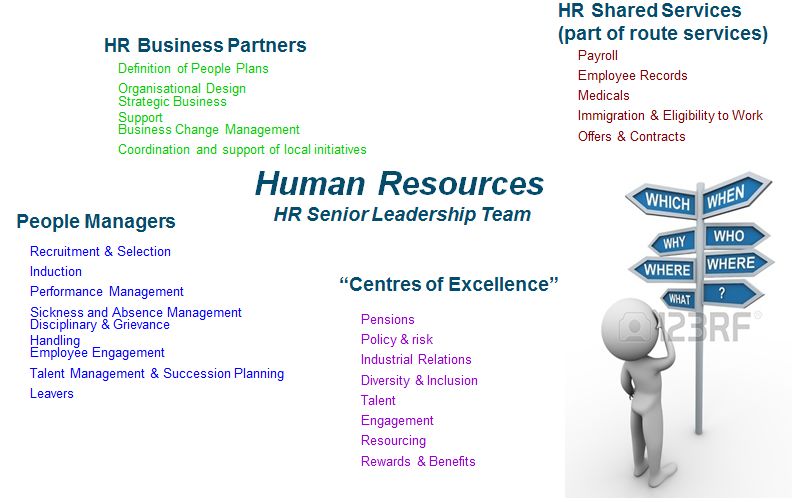
The function is structured into three core areas based on the Ulrich model.
The delivery of day to day transactional/ HR processes is through the
Client facing HR teams to deliver HR support and advice to Route Services team. The service schedule for Route Services is being
business areas – this is primarily devolved into each business. defined with SLAs being defined.
The route and IP HR teams are directly embedded within the
business areas. The delivery of training is through Network Rail Training, part of Route
Services.
Centres of expertise providing a core of frameworks, policies
advice and assurance across To make sure the HR function operating model is optimal; a review is
o D&I being undertaken as part of the planning for the delivery of the HR strategy
o IR for CP6. The first stage of the review will be completed by the end of FY
o Reward, benefits & engagement (including perf mgmt.) 2017/18.
o Talent, succession, resourcing, strategic workforce
planning and learning and development
o Pensions
o Operations including ER advice framework
A shared services function within Route Services to deliver
volume and transactional/process support.
Some key services have been outsourced to provide a tailored, expert,
business support. The primary one is employee relations advice for
managers, as well as an employee assistance program (EAP) and
employee benefits provision.
3.2 Operating model – present & future
Client facing HR teams are embedded in each business area and provide
the direct service to business leaders and employees.
Services and descriptions from the centre of expertise (COE) functions are
documented. Engagement on services with routes/business areas is
continuous – providing the services, obtaining feedback on them, making
Network Rail 11HR Strategic Plan
Identify what will make the biggest difference/impact for our
Delivery Strategy customers and deliver the benefits needed, then focus work on
those key areas. Filter work being done so focus on key areas
and don’t get distracted.
The approach to deliver this strategy will include the following elements: Create clear line of sight between work being done in HR and
business strategy. If no line of sight, then will not be a priority or
Adopting a structured approach, running as a business change
focus.
programme using MSP4NR
Good governance structure to regulate/decide on priority focus for
Engage with customers to understand needs – translate into
HR.
strategic priorities with clear benefits and then re-test with
Longer term view on technology requirements – more holistic and
customers.
less tactical, but needs to be part of the overall company IT
Collaborate across HR function rather than working in separate
strategy
business areas on the same issues – harness collective expertise
and experience
Network Rail 12HR Strategic Plan
4. Risks, opportunities, constraints & assumptions
Summary of objectives Organisations achieve success through the quality of their people and our people are committed to delivering a Better Railway for
a Better Britain. HR’s role is to support and enable Network Rail to continue to have great people, be a great place to work and
deliver high performance being an employer of choice. The risks below are from the HR ERRs.
No. Key constraints, risks What we plan to do Owner Timescale (start/
and opportunities finish)
1 R: Skill shortages Develop and deliver a Talent & Succession strategy Head of Talent, &
o Focus on succession plans for key roles and career progression for Resourcing
individuals at all levels
Develop, deliver and embed Strategic Workforce Planning
Develop Line Manager capability
Develop and roll out a plan to attract, recruit and retain employees
2 R: Inability to attract and retain top Develop and roll out a plan to attract, recruit and retain employees Head of Talent and
talent Develop and deliver a Talent & Succession strategy Resourcing
3 R: Industrial relations disputes Develop, deliver and engage constructively and in a progressive way in Head of Industrial
Industrial relations with our recognised Trade Unions Relations
Evolve the contractual landscape
4 R: D&I – Not being an open, Deliver a D&I strategy and programme of activities Director of Diversity
inclusive and diverse organisation Company & reputational and Inclusion
Deliver 20/20 programme to increase number of women in the organisation
5 R: Impact of deteriorating Educate and develop Line Manager Capability to identify, support and intervene TBC
employee wellbeing appropriately. Impact of lost time.
6 R: Impact of Government policy on Individuals will be managed and assessed against their personal objectives, Head of Reward
Pay and Reward, reducing ability which will relate directly to scorecard and in turn, pay increases and and Benefit
to attract and retain staff performance related pay will be directly related to the achievement of these
objectives.
7 O: Greater efficiency of process; HR Lean and Continuous improvement programme Head of HR
lean; better every day. Develop and deliver processes and procedures that are fit for purpose and Operations
drive the achievement of HR’s people strategy
8 O: Benefits of diversity strategy Deliver and embed NR’s Diversity &Inclusion Programme - “Everyone” Director of Diversity
attracting new talent. • Our vision is to be an open, diverse and inclusive organisation. & Inclusion
9 O: Improved flexibilities from more Develop, deliver and engage constructively and in a progressive way in Head of Industrial
modern industrial relations and Industrial relations with our recognised Trade Unions Relations
Network Rail 13HR Strategic Plan
employment contracts. Evolve the contractual landscape
Work with the business on contingency arrangements
10 O: Identify and evolve the Consider technology as part of delivering HR’s Lean and Continuous TBC
opportunity technology provides improvement programme
for HR
Network Rail 14HR Strategic Plan
4. Expenditure & Efficiency
5.1 Cost and volume summary
Expenditure (post headwinds and efficiencies in 17/18 prices)
CP5 CP6 CP7
Unit of measure
14/15 15/16 16/17 17/18 18/19 CP5 19/20 20/21 21/22 22/23 23/24 CP6 24/25
Renewals £m
Controllable opex £m £19.7M £18.1M £16.8M £18.6M £18.5M £91.6M £17.8M £17.8M £17.8M £17.8M £17.8M £89M £17.8M
Non-controllable industry costs £m
Total £m £19.7M £18.1M £16.8M £18.6M £18.5M £91.6M £17.8M £17.8M £17.8M £17.8M £17.8M £89M £17.8M
Permanent Headcount 96 120 147 166 168 168 168 168 168 168 168 168 168
Agency 10 10 5 5 3 3 3 3 3 3 3 3 3
Total headcount 106 130 152 171 171 171 171 171 171 171 171 171 171
Basis for costs
89% of HR costs are pure head count related, 11% of
costs are non-wage costs. We have completed a full
review at RF6 of our base and core requirements before
efficiencies and risks and reviewing current staffing level.
Our CP5 £92M closing position is CP5 compliant as is our
FY19 entry point to CP6. We expect to remain compliant
in CP5 this will mean we will have achieved circa £4M of
additional efficiencies in the CP, significantly challenging
our operation. This will be achieved through reviewing
ways of working, making changes to be more efficient,
including the delivery of new, value add services.
Efficiencies drive reduction in spend through CP6 £4.5M.
Network Rail 15HR Strategic Plan
Summary of costs by team or activity within the function
Activity/team CP6 total (£m) Comments
Development of frameworks and policies (including pay,benefits,
Reward, benefits & performance management and engagement) – consistent polices which
£12.6M
engagement mitigate risks, aligned to labour market and support attraction and
retention
Director £3.5M
Managing Industrial Relations and legal risk - developing collaborative
working to secure TU support through working groups to mitigate risk
Industrial Relations £5.1M
and disruption to the business. Support business agility through
developing appropriate terms and conditions of employment.
Subject Matter Expertise/Consultancy - for employees, people
Diversity & Inclusion £4.8M managers, ERR, HR Business Partners and policy makers. Culture and
Behaviour Change. Inclusive Design Strategy and Framework
GDR&STE £8.8M Business support
Strategic workforce planning, talent, and succession planning and
Talent & resourcing £5.1M
resourcing strategy,
Management of employee relations advice contract, national HR
HR Operations £10.9M
policies and HR risk management.
Corporate Functions £17.1M Business support
Central Recruitment £10.9M NR Group emerging talent recruitment strategy and programme delivery
Route Teams £4.9M Business support
Pensions £5.3M Management of all pension schemes and risks within the business
Total £89M
Network Rail 16HR Strategic Plan
5.2 Route Business Scotland Costs
CP5 Year CP6 Year CP6
total
16/17 17/18 18/19 19/20 20/21 21/22 22/23 23/24
National Cost (£m) 17.8 17.8 17.8 17.8 17.8 89.1
Scotland Cost (£m) 1.7 1.7 1.6 1.6 1.7 8.3
Scotland (%) 9% 9% 9% 9% 9% 9%
Basis for allocation to Route Business Scotland Head count supporting Scotland teams, and central teams split by head count
Reward & Benefits, Industrial Relations, Diversity & Inclusion, GDR & STE, Talent and resourcing, Strategic
Activity
workforce Planning, Central recruitment, Corporate HR Route, Teams & Pensions.
Network Rail 17HR Strategic Plan
5.3 Cost drivers, headwinds and efficiency
Summary of cost changes between CP5 and CP6. CP5 base at £96M, scope increase cost (£3.1M) impacted by the introduction of new
services such as strategic workforce planning and improvements in talent and succession. The increase in costs will be offset through
efficiencies across the overall HR function to deliver better overall value for money, without increasing costs. The offset will include items
such as review of other services, realignment of resources, and review of existing contracts. The list is not exhaustive and further work is
being undertaken.
The combination of specific efficiencies result in a £4.5M reduction in CP6 spend, with further strategic efficiencies offsetting the £3.1M to
deliver more/better services.
Costs sit at £89M a 4.3% reduction in line with Business targets.
96
94 3.1
5
0
92
3.1
90
96
88
0
89
86
92
84
82
80
Network Rail 18HR Strategic Plan
Summary of HR efficiency
Year Year
Total (O,M,R) CP6 total
16/17 17/18 18/19 19/20 20/21 21/22 22/23 23/24
Pre-efficient plan[1] (£m) £16.8M £20.4M £20M £18.5M £18.5M £18.5M £18.5M £18.5M £92.4M
Activity/scope efficiencies (%) £0.0M £0.3M £0.5M £0.6M £0.6M £0.6M £0.6M £0.6M £3.1M
Core plan (£m) £16.8M £20.7M £20.5M £19.1M £19.1M £19.1M £19.1M £19.1M £95.7M
Head winds (%) 0% 0% 0% 0% 0% 0% 0% 0% 0%
Efficiency (%) 0% (10.6%) (9.8%) (6.9%) (6.9%) (6.9%) (6.9%) (6.9%) (6.9%)
Tailwinds (%) 0% 0% 0% 0% 0% 0% 0% 0% 0%
Inefficiency (%) 0% 0% 0% 0% 0% 0% 0% 0% 0%
Post-HW, post-Eff spend (£m) £16.8M £18.6M £18.5M £17.8M £17.8M £17.8M £17.8M £17.8M £89.1M
Efficiencies made in CP5 total £4M, FY18 to achieve £1.9M and FY19 target £1.5M, main efficiencies achieved by consolidating
work, trying to be more efficient and challenge way of spending overhead costs. FY18 & 19 also impacted by increased of
strategic workforce planning and talent & resourcing, circa £0.8M, cost offset by additional efficiencies through review/alignment
of resources, reviews of services and efficiencies through a focus on SCI. These efficiencies in CP6 give £3.1M to offset costs of
additional scope/services being delivered.
[1]
Note that pre-efficient plan is equivalent to core CP6 plan + 2a (activity/scope efficiencies) in the waterfall
Network Rail 19HR Strategic Plan
Headwinds and efficiency by theme
Theme Area Description Net % change
CP5 has seen HR deliver circa £4M efficiencies including additional CP challenges, with £1.5M
efficiencies already embedded in FY19, this makes our CP6 starting position challenging.
Full review of all teams, accountabilities, span of control, responsibilities & stakeholders will be
undertaken. It is early days & more work is needed over the next year but this benefit is expected
to be circa £3.1M and cover the additional costs of improving strategic workforce planning, talent
and succession. The wider benefits of increased/new services in these areas will impact on the
broader business, with less time to fill key vacancies, a reduction in loss of productivity with
vacancies and quality improvements.
Using technology to reduce duplication, process & value for money is also within scope. This will
predominantly impact the rest of the business, through less manual intervention, lower
duplication; increased compliance and increased ability for add value activity.
Efficiency (9a) 7% reduction including
Other (9) Investment in Lean, reviewing process & controls, aim to reduce overheads and process time
headwinds & efficiencies
Reviewing activity contracts that are currently outsourced and bringing them in house will save
cost over CP6, as well as increase capacity to do additional activity.
Other Red & Amber within overhead opportunities create savings over CP6.
We have considered further head count reduction, but believed this would impact services levels
at this point. This can be revisited at some stage in CP6, must remember HR is CP5 compliant
and within CP5 will have achieved circa £4M of efficiencies including the recent RF2 challenge.
£0M. Most head count is about right people in the right place.
View that no risk holds enough certainty that it warrants a headwind status. More elements fall
into risk range on our base. We have spent a long time assessing all risks and have built them
into our risk range within our submission. This holds items like further government changes that
Headwind (9d) drive increased levels of apprentices or graduate, Government legislation changes (gender pay
reporting, holiday/pension changes, IR35) that force increased activity driving up our people
costs and No National disputes or HR direct changes. It is felt these are best fit risk status
opposed to headwinds.
Network Rail 20HR Strategic Plan
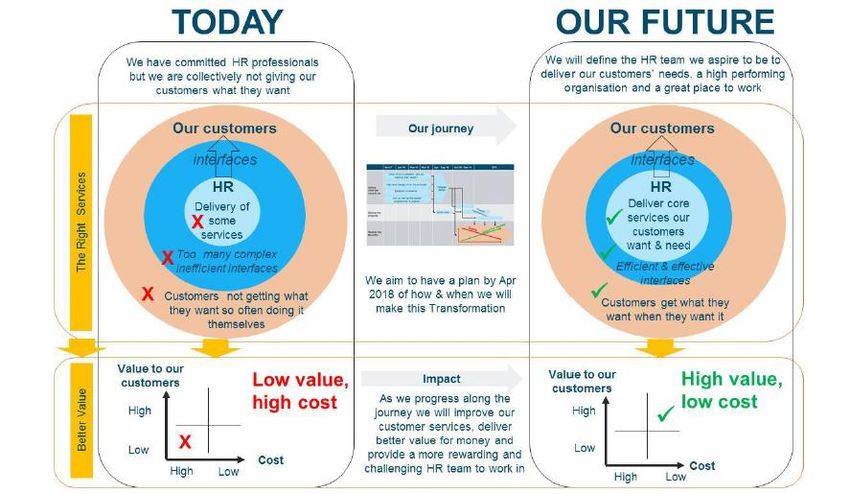
Relevant benchmarks:- Cost Competitiveness Stakeholder’s perceptions show a clear demand for HR
business partnering, but we have some way to go to be
seen as strategic and a valued HR Business Partner.
The HR function is based on the Ulrich model with client
facing teams, centres of expertise and a Shared Service
The diagram below highlights areas that are highest priority to
centre. A number of activities are currently outsourced
improve from the customer feedback:
including first line employee relations advice and guidance
and occupational Health.
HR undertook external benchmarking exercises undertaken
by The Hackett Group in 2010, 2012 and most recently in
2017. The Hackett Group benchmark report compares where
we were in 2012 to where the HR function is currently in 2017
and includes the end to end process, including HR Shared
Services. The analysis incorporates performance
measurement across the HR community, stakeholder
feedback gathered via a Stakeholder questionnaire (response
rate 32%) and capability maturity assessment across HR
processes undertaken by members of the HR leadership
team.
Key findings of the 2017 Hackett Benchmarking report:
The HR function in 2017 is more efficient but slightly less
The report identified two service delivery components:
effective than in 2012.
1. Communicate the HR Strategy
We are less cost per FTE v World Class which is 2. Leverage technology more effectively; and
reflected in a higher proportion of more junior/lower paid
roles which would support an opportunity for automation.
The FTE allocations by operating model show lower use The results of the Hackett benchmarking exercise is informing
of shared services and centres of excellence than our HR strategy to focus on the above in our current and CP6
external organisations with a potential to refocus FTE activities.
allocation towards higher value processes.
There might be some roles where we might use The HR function uses salary benchmarking and engagement
economies of knowledge i.e. Strategic Workforce benchmarking. Other benchmarking information for key
Planning activities is gathered from ONS, CIPD HR’s professional body
Capability maturity: Across all service delivery and other rail and non-rail companies that we collaborate
components “information management” and “technology” with.
represent the largest gaps to target.
Network Rail 21HR Strategic Plan
5.4 Risk and uncertainty in the CP6 plan CP6. The content of our plans reflect the funding that we
understand to be available in CP6. We consider this plan
This section provides an explanation of how we have built to be realistic and, therefore, deliverable in CP6.
up our overall plan and sets out our estimate of the degree
of financial uncertainty within this plan. Current unit rates are likely to include some risks that were
not originally included in CP5 plans but that have
Pre-efficient costs in our plan are based on ‘current rates’ materialised during the current control period. As a result
we do not believe additional scope is needed to deliver the of this approach, it is likely that some risk and uncertainty
outputs in the plan. We have used 2016/17 unit rates to is already be included in our core CP6 plan, as we have
develop our opex expenditure forecasts and CP5 exit not sought to remove the impact of these unplanned
rates for support, operations and maintenance expenditure events from our unit rate estimates.
forecasts. We have no capital request within our
submission, normal technology improvements are held Whilst it is difficult to precisely estimate the likelihood of
with RS plan. delivering our plan in CP6, it seems reasonable to suggest
that, overall, there is a 80% to 95% likelihood of the
Drivers of rate increases (headwinds/inefficiencies), or outputs in the plan being delivered for the forecast cost in
rate reductions (efficiencies/tailwinds), where there is a our CP6 plan. This means that there is significant
reasonable expectation they will occur, have been confidence, we will be able to deliver our plan for the
identified separately from the core CP6 plan. forecast cost. However, this uncertainty varies between
expenditure categories. For example, we consider that
The combination of our core CP6 plan, there is significantly more uncertainty in our operations
headwinds/tailwinds and efficiencies/inefficiencies is our and maintenance plans in CP6. The main drivers of
‘submission’ and represents the ‘most likely outcome’ for uncertainty in our plan are identified in the table below.
Network Rail 22HR Strategic Plan
5.5. Uncertainty ranges for CP6
The information in the table below, presents our estimate of the overall range of uncertainty across our expenditure and income for CP6. We
have also identified the main drivers of the uncertainty ranges. The information in this table is based on the detailed inputs provided in our opex,
renewals and income submissions. Headwinds/tailwinds and efficiencies/inefficiencies are included in the spot estimates.
[
Area
(S, O, M, R, Potential range (low – spot – high)
Summary of key drivers of the uncertainty range
Driver of range % of range
Income)
I Low Spot High
f
Support and
operations
(-£7.6m) (£89.1m) (+£9.4m)
Low figure reflects optimistic view of efficiencies to be achieved during both CP5 and CP6, and is
a Low
Spot High
very uncertain if additional efficiencies are possible.
Low figure also represents a 5% difference to our core assumptions.
Total (-£7.6m)
(£89.1m) (+£9.4m) High figure reflects risk in achieving level of efficiency built into both CP5 and CP6 forecasts.
n
expenditure High figure represents a possible 10% movement from our base for changes in medium/high risk
core assumptions.
y
Network Rail 23HR Strategic Plan
5. Sign-off
This document and accompanying templates are owned by Alison Rumsey Group HR Director.
Submission of this document indicates confirmation that:
all appropriate level 1 assurance activities have been undertaken (see separate advice on definition of level 1 assurance);
the is satisfied with the quality, currency and appropriateness of the content of this document as well
as the cost, volume and activity projections to which it refers;
The signatories are satisfied that the plan has been assessed as deliverable, subject to the assumptions articulated in Appendix B.
Authorised by:
Alison Rumsey 01/12/2017
Group HR director
James Coowar 01/12/2017
Financial Controller
Corporate Services &
System Operator
Network Rail 24HR Strategic Plan
Appendix A N/A
Appendix B Key assumptions
[It is vital that the assumptions provide a clear description of what costs or activity are assumed to be in route or other central functions’ plans, and
therefore excluded from the plan of this central function.]
[If highly material, the assumption should also be articulated in section 4.1 above for greater visibility]
Topic (e.g.
Areas of spend impacted
dependency, Is this a change of
Ref no. Assumption (e.g. all opex, single team,
deliverability, climate assumption for CP6?
all spend etc.)
etc.)
HRSS delivers HR processes and volume activity including: Opex –HRSS cannot deal
recruitment offers, payroll and payment services to employees, with volume of work,
1 No Change vs CP5
process, transaction and payroll helpdesk/query handling, benefits process / letters HR have
administration (excluding pensions), to pick up. Comp&Ben
Opex – data not
Data integrity on people data will be maintained and kept up to date by
maintained by HR, but
managers/employees with assurance activity on payroll data through
2 used to make decisions. No Change vs CP5
the payroll team and local assurance in each business area for other
Cost to business if
people data.
information not correct.
Opex – clear separation of
HRSS is accountable for payroll systems and processing including payroll (RS) & HR system
3 No Change vs CP5
obtaining and responding to customer requirements. :- risk not reflective
business needs
Opex – if HR had to do
Network Rail training in Business Services is accountable for learning
4 both, resource costs No Change vs CP5
delivery and HR is accountable for training policy.
would increase.
Apprenticeships and funding continue as planned. (As industry leader Opex – Government
5 No Change vs CP5
we have to change with government decisions) change in policy drive
Network Rail 25HR Strategic Plan
Topic (e.g.
Areas of spend impacted
dependency, Is this a change of
Ref no. Assumption (e.g. all opex, single team,
deliverability, climate assumption for CP6?
all spend etc.)
etc.)
increase business costs &
HR rec, adv, employee
costs.
Opex – if training was to
Training costs are funded through the relevant business area’s (STE, be charged to HR we do
6 No Change vs CP5
Finance, DR etc) funding devolved (Skills, Prof, Leadership etc.) in CP5 not hold budget except for
HR
Opex – if additional
Training budget is the correct level to deliver training HR needs to training required, policy
7 No Change vs CP5
function successfully through CP6. changes would be a direct
increase.
National company with national T&Cs. Contracts of employment co- Opex – assuming that we
ordinated on company wide basis. Core contractual benefits provided are not separate
8 No Change vs CP5
on a company wide basis, with costs met on a proportional companies with different
(headcount) basis across the company. T&C – as is.
Opex – all these events
No additional legislative changes in relation to employment, skills or
have happened in CP5,
9 apprenticeships, IR35, Gender pay reporting, Holiday pay ruling, No Change vs CP5
they take time drive
pension/tax rulings, auto enrolments, another Shaw review
increased costs.
Opex – if something in
Outsourced HR services continue including HR direct, pensions
insources or out sourced
10 administration, engagement survey. Not actively looking to outsource No Change vs CP5
beyond this our labour
anything further. Same as current state.
would have to flex.
Opex – without investment
Change vs CP5 (service
Technology/automation can be funded by RS and implemented, we would struggle to
11 the same, delivery more
improving speed of service and reducing duplication. reduce core head count
efficient)
and be more efficient.
Network Rail 26HR Strategic Plan
Topic (e.g.
Areas of spend impacted
dependency, Is this a change of
Ref no. Assumption (e.g. all opex, single team,
deliverability, climate assumption for CP6?
all spend etc.)
etc.)
Opex – reclassification in
NR status as an ALB doesn’t change and the current flexibilities CP5 , changing this would
12 No Change vs CP5
remain in place. Assuming as is state. drive increased labour
costs.
Opex – increased labour
Assuming we receive the same level of services in CP6 from the rest of
13 costs if we have to do No Change vs CP5
the business as in CP5.
more
Opex – devolution could
No Change assumed vs
14 Assuming no further devolution of the HR function during CP6 cost more or less, change
CP5
shape service.
Opex – if core business
Assume resource levels needed by the business remain the same as structural decision was
15 No Change vs CP5
CP5 made - capacity to deliver
would be different
Opex – Increased pay out,
16 Assuming no national industrial disputes No change vs CP5
HR time & effort.
Opex – no expected
Assume continued level of local disputes in CP6 as seen in CP6.
17 change, public sector pay No Change vs CP5
(Route specific and normally operational)
gap if enforced drive cost.
Assuming core location of HR staff remains the same, no large Opex/Capex costs to
18 No change vs CP5
relocation. (happened in CP4 London – MK) relocate people.
Assuming HR direct retender is in line with current spend and KPI
19 Opex £0-£2M No change vs CP5
reporting does not drive higher charge. Factored into risk
Network Rail 27HR Strategic Plan
Appendix C N/A
Appendix D Scenario planning
Part (1): Tactical scenario planning for CP5
Provide information on the impacts on CP5 of each of the following scenarios:
Scenario 1: 20% increase in total remaining expenditure
Details and benefits of additional expenditure in CP5
Yr 4-5 outstanding Potential investment
Area of spend Comment on benefits
spend (£m) increase (£m)
Accelerate the delivery of core HR capabilities (e.g.
Talent management, succession planning, performance
management, resourcing, retention, strategic
Human Recourses £30.7M £6.1M workforce planning) in an integrated way, using
technology to automate and integrate. Potentially
provide better service to customers (higher spec)
Total £30.7M £6.1M
Network Rail 28HR Strategic Plan
Scenario 2: 20% decrease in total remaining expenditure
Details and impacts of reduced expenditure in CP5
Yr 4-5 outstanding Maximum potential
Area of saving Comment on impacts/issues
spend (£m) saving (£m)
20% less - de-scope capabilities above, take longer to
Human Resources £30.7M (£6.1M) deliver and with less technology/automation to
support.
Total £30.7M (£6.1M)
Network Rail 29HR Strategic Plan
Part 2: CP6 scenario planning: investment options (No directly HR owned investment)
Given the type of function HR are there is limited scope for capital investment. Some improvement has been identified within the technology
space. This is already captured within the RSIT CP6 Submission, and is within the core plan.
The key benefits from this investment in technology/automation are below:
Time saving for managers – less time on transactional HR activities (recruiting, A2CO, data changes etc.), more time on value add activities –
coaching, developing, succession planning etc.
Simpler, easier to use – better levels of ‘compliance’ rather than people creating work arounds or just avoiding doing things – more customer centric
processes
Less manual intervention so reduce likelihood and opportunity for errors – right first time
HR spend more time doing value add activities (strategic workforce planning, resourcing, talent management) and less either doing or helping
managers with transactional activities.
Most of the benefits do not drive a direct saving but allow increased governance, improved use of time and resource.
Network Rail 30HR Strategic Plan
Appendix E HR efficiencies and devolution journey
Network Rail 31HR Strategic Plan
Appendix F Glossary of terms
[This appendix is optional; please change top “N/A” if
not required.]
Network Rail 32You can also read


