Increased Participation and Decreased Performance in Recreational Master Athletes in "Berlin Marathon" 1974-2019 - Frontiers
←
→
Page content transcription
If your browser does not render page correctly, please read the page content below
ORIGINAL RESEARCH
                                                                                                                                                   published: 28 June 2021
                                                                                                                                          doi: 10.3389/fphys.2021.631237

                                                Increased Participation and
                                                Decreased Performance in
                                                Recreational Master Athletes in
                                                “Berlin Marathon” 1974–2019
                                                Marlen Reusser 1 , Caio Victor Sousa 2 , Elias Villiger 1 , José Ramón Alvero Cruz 3 , Lee Hill 4 ,
                                                Thomas Rosemann 1 , Pantelis T. Nikolaidis 5 and Beat Knechtle 1,6*
                                                1
                                                 Institute of Primary Care, University of Zurich, Zurich, Switzerland, 2 Bouvé College of Health Sciences, Northeastern
                                                University, Boston, MA, United States, 3 Dpto de Fisiología Humana, Histología, Anatomia, Patológica y Educación Física y
                                                Deportiva Universidad de Málaga, Málaga, Spain, 4 Division of Gastroenterology & Nutrition, Department of Pediatrics,
                                                McMaster University, Hamilton, ON, Canada, 5 Exercise Physiology Laboratory, Nikaia, Greece, 6 Medbase St. Gallen Am
                                                Vadianplatz, St. Gallen, Switzerland

                                                The aspect of participation and performance trends in marathon running has been
                                                investigated mainly in marathons held in the United States of America (e.g., “New York
                                                City Marathon,” “Boston Marathon”), but not for the fastest course in the world, the
                            Edited by:          “Berlin Marathon” held in Berlin, Germany. This study aimed to examine trends in
                      Martin Burtscher,
                                                participation and performance in the “Berlin Marathon” on all its previous 46 editions
       University of Innsbruck, Austria
                                                from 1974 to 2019, the largest dataset ever studied in this event with 696,225 finishers
                       Reviewed by:
         Carlos Hernando Domingo,               (after data cleaning). Athletes in all age groups increased their participation, except
            Jaume I University, Spain           for male athletes aged 20–49 years and athletes of both sexes above 79 years of
           Christian Arthur Clermont,
        University of Calgary, Canada
                                                age. This overall increase in participation was more pronounced in women, but still,
                  *Correspondence:
                                                there are more men than women participating in “Berlin Marathon” nowadays. All age
                        Beat Knechtle           group athletes decreased their performance across years overall, whereas the top ten
            beat.knechtle@hispeed.ch
                                                recreational athletes improved their performance over the years. Our findings improved
                   Specialty section:
                                                the knowledge about the evolution of male and female marathoners across calendar
         This article was submitted to          years, especially for the fastest marathon race in the world, the “Berlin Marathon.”
                   Exercise Physiology,
               a section of the journal         Keywords: marathon, running, participation, performance, age of peak performance, performance decline, sex
               Frontiers in Physiology          differences in endurance

       Received: 19 November 2020
           Accepted: 14 May 2021                INTRODUCTION
          Published: 28 June 2021
                              Citation:         The inaugural modern marathon event was first held during the 1896 Summer Olympic
      Reusser M, Sousa CV, Villiger E,          games and was refined to the official distance of 42.195 km for the 1908 Olympic Games
  Alvero Cruz JR, Hill L, Rosemann T,           in London (Burfoot, 2007; Wilcock, 2008). However, these races were only for men. The
  Nikolaidis PT and Knechtle B (2021)           women’s marathon event was added to the official program nearly 99 years later, during
                Increased Participation
                                                the 1984 Los Angeles Olympic Games (Burfoot, 2007). In the 1970s and 80s – in line
          and Decreased Performance
       in Recreational Master Athletes
                                                with the upcoming fitness trend – a skyrocketing boom of these marathon events occurred
     in “Berlin Marathon” 1974–2019.            (Valentine, 1982; Maffetone et al., 2017; Knechtle et al., 2018) and marathon races have become
            Front. Physiol. 12:631237.          more and more popular all over the world (Vitti et al., 2020). The largest participation
     doi: 10.3389/fphys.2021.631237             numbers so far were reached in 2016, with approximately nine million runners crossing

Frontiers in Physiology | www.frontiersin.org                                          1                                           June 2021 | Volume 12 | Article 631237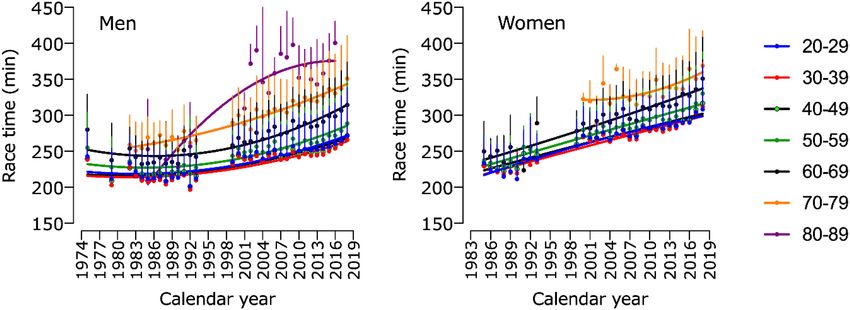
Reusser et al.                                                                            Participation and Performance in “Berlin Marathon” 1974–2019

finish lines all over the world (The State of Running, 2019).             Mathews et al., 2012; Nikolaidis et al., 2018; Knechtle et al.,
A total of 12% of those finishers were marathoners (The State of          2020). Even though the “Berlin-Marathon” is one of the fastest
Running, 2019), and most of them were age group athletes (Rüst            and most popular marathon events in the world, there has not
et al., 2013; Lara et al., 2014).                                         been any complete analysis of participation and performance
    With such participation numbers and demographic diversity,            trends on all its 46 previous editions. Therefore, it is interesting
marathon running provides scientifically interesting samples              to see whether the above-mentioned consensus about the
for research in endurance sport (Stones and Baker, 2020).                 development of participation rates and running times found
Further analyses of these data can contribute to, e.g., a                 in American marathon events would also be applicable for
better understanding of aging processes and consecutively age-            European Marathon races such as the “Berlin Marathon.”
related performance declines (Leyk et al., 2007; Reaburn and                  Much of the current research on participation and
Dascombe, 2008; Tayrose et al., 2015), differences between the            performance in marathon racing also was done with regard
sexes regarding physiology and performance (Rüst et al., 2013;            only at a short period of time or limited participation group.
Knechtle and Nikolaidis, 2018; Nikolaidis et al., 2018, 2019c),           For example, Ahmadyar et al. (2015, 2016) studied elderly
the influence of lifestyle (Leyk et al., 2009, 2010), environmental       marathoners (>75 years of age) in the four largest marathon
(Nielsen, 1996; El Helou et al., 2012; Maffetone et al., 2017;            events nowadays in the time period from 1990 to 2014 and
Knechtle et al., 2019) and demographic factors (Knechtle et al.,          2004 to 2011. Knechtle et al. (2018) analyzed participation and
2017; Maffetone et al., 2017; Nikolaidis et al., 2017; Knechtle and       performance for all editions of “Boston Marathon” from 1879 to
Nikolaidis, 2018) on performance and a better understanding of            2017, but only in male runners. Jokl et al. (2004) included runners
motivational factors for running of different cohorts and decades         of all age groups and both sexes in their analysis of the “New York
(Krouse et al., 2011; Nikolaidis et al., 2019b).                          City Marathon,” but only analyzed the time period between 1983
    The “Berlin-Marathon,” for the first time in 2019, marked             and 1999 (Jokl et al., 2004). Mathews et al. (2012) studied the
the final race of the “World Marathon Majors,” a series of six            mortality among marathon runners in the United States, and
of the largest and most renowned marathons in the world and               thereby analyzed a variety of events throughout the United States
popularly known as the “Marathon’s Champion’s League” (World              but could only include data from 2000 to 2009 in their study.
Marathon Majors, 2021). This may be a deserved position as                More recently, an interesting perspective that investigated the
today, the “Berlin Marathon” ranks third in the world regarding           motivation for running in the “Athens Classic Marathon” was
the size of the runner field and is the fastest course among              done by Nikolaidis et al. but only focused on the 2017 edition
the city marathons worldwide in men’s racing and third fastest            (Nikolaidis et al., 2019b). Therefore, by analyzing the full data of
in women’s (Berlin Marathon, 2021). Seven of the ten fastest              the “Berlin Marathon” since its inaugural event in 1974, we hope
men’s marathon times and numerous world records were set                  to provide valuable new information to the above-mentioned
during the “Berlin-Marathon” (Berlin Marathon, 2021). Among               ongoing research.
those records is the current men’s world record, achieved in                  Furthermore, the current study aims to contribute to the
2018 by the Kenyan Eliud Kipchoge in a time of 2:01:39 (World             growing literature on women’s participation in endurance sports.
Athletic Records, 2021). The current course record for women in           Previously, women were barred from participating in sporting
“Berlin-Marathon” was set by Kipchoge’s countrywomen Gladys               events primarily based on Victorian area myths about endurance
Cherono in 2018 (2:18:11 h) (BMW Berlin Marathon, 0000). This             exercise and the fragility of the female body (Wrynn, 2014; Hill,
running time is close to the current world record for “women              2017). It has taken several decades for women to be permitted the
only marathon” (as is also “Berlin Marathon” since 2011) set by           same sporting opportunities as their male counterparts, and even
Mary Jepkosgei in 2017 in the “London Marathon” with a time of            still, equity has not been achieved (Capranica et al., 2013). The
2:17:011 .                                                                first time women were permitted to officially run a marathon race
    More recently, research has tended to focus primarily on              occurred during the 1972 “Boston Marathon” (Thibault et al.,
marathon races held in the United States, with the “New York              2010; Knechtle et al., 2020). In 2018, for the first time in history,
City Marathon, 2021” – the largest marathon race nowadays –               equal participation between men and women in running events
being one of the most investigated (Jokl et al., 2004; Santos-            was achieved with women representing 50.24% of runners at
Lozano et al., 2015; Zavorsky et al., 2017; Nikolaidis et al.,            events all around the world (The State of Running, 2019). Race
2018). Alongside the “New York City Marathon, 2021” is the                organizers at the “Berlin-Marathon” in its 46th edition (2019) set
“Boston Marathon, 2021” generating the next most scientific               its focus for the first time officially on the women’s race (Berlin
interest (Maffetone et al., 2017; Knechtle et al., 2018, 2020).           Marathon, 2021).
Most studies conducted on those two marathon events (the                      Although progress toward equal opportunity has been
“New York City Marathon, 2021” and the “Boston Marathon,                  consistent for female athletes, sports science research focusing on
2021”) have demonstrated increasing participation rates over              women is still sorely lacking. Only 4% of the present research
the last two decades (more pronounced in women than in                    in sport sciences is conducted exclusively on female athletes,
men) and a concomitant increase in mean race times (i.e.,                 whereas 27% of those studies are conducted exclusively on
decreased performance) across calendar years (Jokl et al., 2004;          male athletes (Women in Sports are Often Underrepresented
                                                                          in Science, 2016; Costello et al., 2014). Further, an analysis of
1
 www.worldathletics.org/records/by-discipline/road-                       1,382 articles published from 2011 to 2013 showed that female
running/marathon/outdoor/women                                            participation rate per article was around 36 percent (added up

Frontiers in Physiology | www.frontiersin.org                         2                                         June 2021 | Volume 12 | Article 631237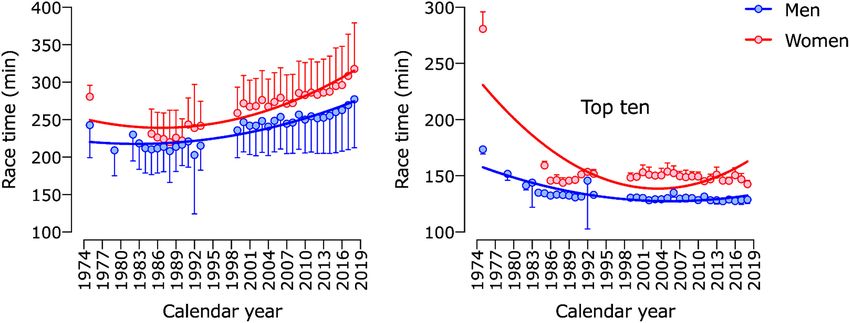
Reusser et al.                                                                             Participation and Performance in “Berlin Marathon” 1974–2019

in this analysis was a total of more than six million participants)        or older but must not meet specific time standards (BMW Berlin
(Women in Sports are Often Underrepresented in Science, 2016).             Marathon, 0000). Starting places are limited and assigned via
As physiology and biomechanics properties differ between the               raffle. Initially, 884,927 finishers were considered in our analysis.
sexes, it is not applicable to transfer study results found in a
predominantly male population to a female population, which –              The Race
as mentioned – accounts for more than half of the athletic                 The “Berlin-Marathon” takes place from mid to end of
population currently competing in running (Women in Sports                 September, depending on several logistical factors. The course
are Often Underrepresented in Science, 2016; Lewis et al., 1986).          builds one large loop through the historic city of Berlin, with
To optimize female performances and health in sport, we need               the finish line lying almost under the “Brandenburger Tor.”
to include women in our analyses in order to better understand             Berlin lies 34 meters above sea-level, the average temperature in
the peculiarities that may exist in physiology. Therefore, we are          September is about 14.9◦ Celsius and average humidity about 75%
happy to enrich the existing pool of knowledge with more data              (Klimatabelle, 2021) and the total elevation of the course is only
on female participation and performance in marathon racing.                50 meters (Berlin Marathon, 2021).
    Taken together, our understanding of the characteristics of
participation and performance are well known for only a handful            Data Analysis
of important marathon events (Jokl et al., 2004; Mathews et al.,           First and last name, sex, age, calendar year, and running time on
2012; Santos-Lozano et al., 2015; Maffetone et al., 2017; Zavorsky         all successful female and male finishers in the “Berlin-Marathon”
et al., 2017; Nikolaidis et al., 2018, 2019c; Knechtle et al., 2020)       from 1974 to 2019 were obtained from the official race website
and/or limited periods or participation groups (Jokl et al., 2004;         (BMW Berlin Marathon, 0000). We cleaned the dataset removing
Mathews et al., 2012; Ahmadyar et al., 2015, 2016; Nikolaidis              runners with missing or questionable (unreliable) information on
et al., 2019b). Drawing general conclusions out of these limited           race time, i.e., race time under 2 h or over 6 h. With respect to
data, which can be important for the above-mentioned research              age stratification, finishers were classified in 10-year age groups
fields in sport, epidemiological and medical sciences, should be           (e.g., 20–29 years to 70–79 years) to analyze performance and
done cautiously.                                                           participation. We compared top ten age group runners to the age
    The aims of the present study were, therefore, (i) to analyze          group average in order to highlight differences in performance
the changes in participation and performance trends of age group           over calendar years between those groups and both sexes. Further,
marathon runners in the “Berlin-Marathon” for all its previous             we compared top five age group runners of each age-category to
editions, (ii) to compare the sex differences in performance as            average age group runners of the same age category to examine
a function of age across the years, and (iii) by this to provide           performance declines during aging.
one more complete analysis on participation and performance
of female athletes in the history of a significant event in                Statistical Analysis
order to allow best possible future findings of particularities            All statistical procedures were carried out using the Statistical
in female sports physiology. Based upon existing evidence, we              Package for the Social Sciences (SPSS version 26. IMB, IL,
hypothesized that for “Berlin-Marathon” between 1974 and 2019,             United States) and GraphPad Prism (version 8.4.2. GraphPad
the participation of all age groups would grow, with more                  Software LLC, CA, United States). The Shapiro-Wilk and Levene’s
substantial growth in female participation and, therefore, a               tests were applied for normality and homogeneity, respectively.
narrowing sex gap in participation. Further, we hypothesized               Six General Linear Models (two-way ANOVA) were used as
the performance of top age group athletes would improve over               follows: model 1 – all participants by sex and calendar year;
calendar years, whereas the performance of the average age                 model 2 – top ten athletes in each race by sex and calendar
groupers would decrease.                                                   year; model 3 – all participants by age group and sex; model
                                                                           4 – top five athletes in each age group in each race by age
                                                                           group and sex; model 5 – all men participants by age group and
MATERIALS AND METHODS                                                      calendar year; model 6 – all women participants by age group
                                                                           and calendar year. When interactions were found (p < 0.05),
Ethics Approval                                                            pairwise comparisons were applied to identify the differences
The institutional review board of St Gallen, Switzerland,                  more accurately. Calendar years without sex or age information
approved this study (EKSG 01/06/2010). Since the study involved            were removed from the analysis. For performance analysis,
the analysis of publicly available data, the requirement for               age groups, or calendar years with less than five participants
informed consent was waived.                                               were removed. Applying those criteria, the calendar years 1976
                                                                           to 1984, 1994 to 1998, and 2019 had to be removed from
Participants                                                               the performance × years for men and women analysis, the
To test our hypothesis, data (i.e., first and last name, sex,              calendar years 1976 to 1978, 1980 to 1981, 1994 to 1998 and
age, calendar year, and running time) on all successful female             2019 had to be removed from the performance × years × age
and male finishers in the “Berlin-Marathon” since 1974, the                group analysis for men and the calendar years 1974 to
inauguration year of the “Berliner Volksmarathon,” was obtained            1984, 1994 to 1998 and 2019 had to be removed from the
from the official race website (BMW Berlin Marathon, 0000). To             performance × years × age group analysis for women. For the
compete in the “Berlin-Marathon,” athletes must be 18 years old            participation × year analysis for both sexes (total participants)

Frontiers in Physiology | www.frontiersin.org                          3                                         June 2021 | Volume 12 | Article 631237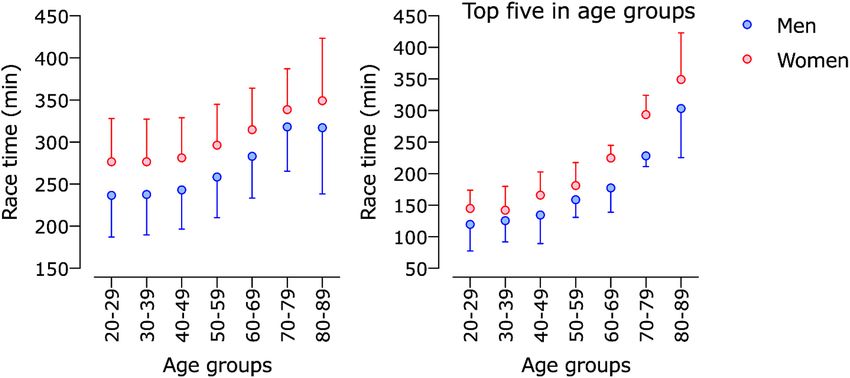
Reusser et al.                                                                                      Participation and Performance in “Berlin Marathon” 1974–2019

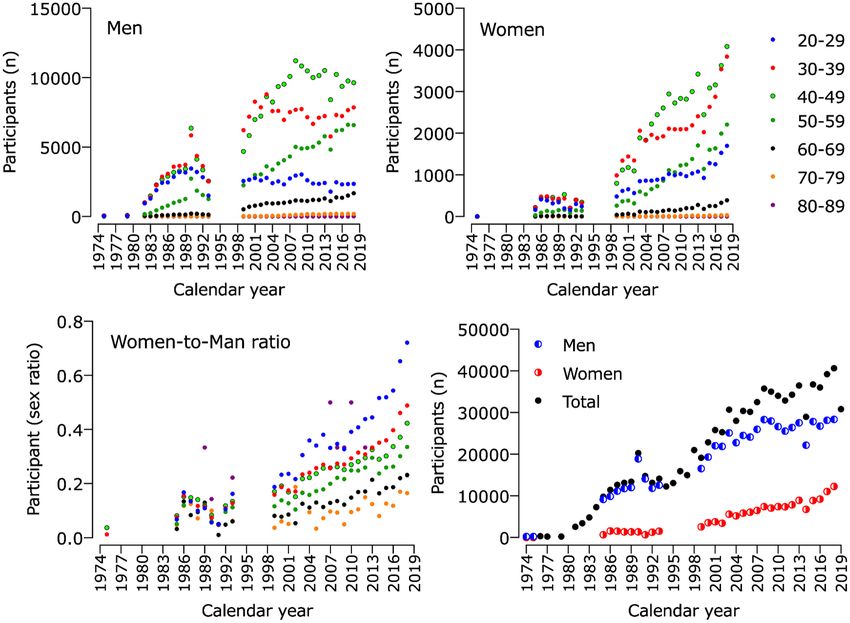
  FIGURE 1 | Number of participants in “Berlin Marathon” from 1974 to 2019 by sex and age groups.

we had to remove the years 1976 to 1984, 1994 to 1998 and                          included the top ten athletes in each race, race time has a
2019, for the participation × sex × age analysis, we had to                        decreasing trend across calendar years (Figure 2).
remove the years 1974, 1976 to 1978, 1980 to 1981, 1994 to                            Models 3 and 4 showed significant effects on sex, age group,
1998 and 2019 for men and the years 1974, 1976 to 1984, 1994                       and interaction sex × age group (Table 1). Both models showed
to 1998 and 2019 for women. The level of significance utilized                     similar performance trends across age groups, with the lowest
was p ≤ 0.05.                                                                      race times between 20 and 39 years old, and slight increases across
                                                                                   each next age group (Figure 3).
                                                                                      Models 5 and 6 showed significant effects for age group, year,
RESULTS                                                                            and an interaction age group × year (Table 1). Both men and
                                                                                   women showed similar performance trends among all age groups,
The total number of athletes ever registered in the 46 editions                    with increasing race time across calendar years (Figure 4).
of the “Berlin-Marathon” between 1974 and 2019 was 884,927
finishers. After filtering out invalid data regarding our criteria,
696,225 finishers were included for the final analysis. The number                 DISCUSSION
of athletes participating in the “Berlin-Marathon” increased
from only 236 men and 8 women in 1974 to 28,373 men                                The main aims of this study were (i) to analyze the changes in
and 12,268 women in 2018 (Figure 1). Moreover, all age                             participation and performance trends of age group marathon
groups increased their participation, except for male athletes                     runners in the “Berlin-Marathon” for all its previous editions,
aged 20–49 years and athletes of both sexes above 79 years                         (ii) to compare the sex differences in performance as a function
old (Figure 1).                                                                    of age across the years, and (iii) by this to provide one
   The first two ANOVA models (model 1 and 2) to analyze                           more complete analysis on participation and performance of
performance showed a significant effect on sex, year, and                          female athletes in the history of a significant event in order
interaction sex × year (Table 1). However, pairwise comparisons                    to allow best possible future findings of particularities in
and the linear trend show that model 1 tends to increase race                      female sports physiology. The main findings were that (i)
time across calendar years. In contrast, in model 2, which only                    the number of finishers increased for both women and men

Frontiers in Physiology | www.frontiersin.org                                  4                                          June 2021 | Volume 12 | Article 631237
Reusser et al. Participation and Performance in “Berlin Marathon” 1974–2019
TABLE 1 | ANOVA results of performance analysis in “Berlin marathon” in different models.
Factor F p-value
Model 1 Sex 294.5Reusser et al. Participation and Performance in “Berlin Marathon” 1974–2019
FIGURE 3 | Race time of men and women in “Berlin Marathon” across age groups.
FIGURE 4 | Race time of men and women in “Berlin Marathon” in age groups across calendar years.
The analysis by Andersen and colleagues covered 96% of US- explained through the existence of historical and social barriers
based running race results, 91% of the race results from the (Vitti et al., 2020). Pointing in the same direction are the findings
EU, Canada, and Australia and a “big portion” from Asian, of Andersen et al., who – by comparing sex participation rates
Africa, and South America. Andersen et al. analyzed not only for running events between different countries – found a clear
marathon races, but all types of running events. This may correlation between “general gender equality” and equality in
be the crucial point: Women seemed to be more engaged participation rates (The State of Running, 2019). When taking
in shorter running events. Moreover, it was noted that the into account the historical perspective of women’s competitive
longer events were, women were less likely to participate sports, female athletes have been subjected to a variety of
showing a decreased number of starters in relation to men. discriminatory practices and gender-based social barriers, many
However, further investigation in worldwide participation in of which are still ongoing (Costello et al., 2014). The 2012
running events of different distances considering demographical Summer Olympic Games were an important milestone, whereby
conditions of the participants is required. However, also an every participating country’s delegation included at least one
analysis of running races from one single country would female competitor (Costello et al., 2014), albeit a positive step,
be of interest. but far from what is required for a true closing of the gender gap.
A significant observation described previously by Nikolaidis However, it must be noted that some countries have been
et al. (2018) found that women, in general, start and stop racing at successful in improving women’s participation rates and some
a younger age than men. That men-to-women-ratio in the older have even tipped the scales completely. Higher participation
age groups compared to their younger counterparts could be rates in running events for women than for men have been
Frontiers in Physiology | www.frontiersin.org 6 June 2021 | Volume 12 | Article 631237Reusser et al. Participation and Performance in “Berlin Marathon” 1974–2019
observed with Iceland on the top of the board (59%), followed Therefore, improvements in “running economy” seem to be
by the United States (58%) and Canada (57%) (The State of crucial for the constantly dropping running times. This is also
Running, 2019). Switzerland (16%) and Italy (19%) are among seen in analyses of East-African runners, who comprise most
the countries with the least female participation in running of today’s elite in big-city-marathons (World Athletic Records,
events (The State of Running, 2019). In the case of Switzerland, 2021). Those runners, who originate from specific regions in
this participation rate seems to contradict to the fact that 49% Kenya and Ethiopia (Scott et al., 2003; Onywera, 2009), show
of the regularly running population in Switzerland (which is a profile that allows them to run with an exceptional high
about one-third of the Swiss population) are women (Sport running economy (Weston et al., 2000; Lucia et al., 2006;
Schweiz 2020, 2020). This finding may be quite surprising, Kong and De Heer, 2008; Mooses and Hackney, 2017). This
given the mentioned country’s apparent progressiveness, but outstanding running economy is seen as one of the important
not so, if one considers the repeated international criticism on factors for the dominance of East-African runners (Weston
Switzerland’s gender policy (Human Rights Switzerland, 2021). et al., 2000; Kong and De Heer, 2008; Mooses and Hackney,
When examining sports such as road cycling, the gender gap 2017). Still, even if the reasons for Kenyan and Ethiopian
in Switzerland seems even more prominent (in 2019, only apparent dominance in endurance running races have been
14% of the licensed road cyclists in Switzerland were women) deeply analyzed, there remains no clear consensus on what
(personal and unpublished written communication with Stefania contributes to their dominance (Hamilton, 2000). So, one part
Ratano, the responsible for members and licenses at the Swiss of the explanation why the “faster” become faster, could be a
national cycling federation “Swiss Cycling,” mid of June 2020). This growing participation rate of mentioned African ethnicities in
possible correlation between actual and effective “general gender the big city marathons during the last decades (Vitti et al., 2020).
equality” and participation rates in endurance events could be an Still, extensive research about worldwide participation rates in
interesting subject for future research. marathon running for the last decades split up in ethnicities or
countries of origins are missing.
Performance Trends Not all studies conducted on a large population of endurance
As expected, performance in all age group athletes decreased, athletes find improving race times of the “fast athletes” and
whereas the top ten age group athletes improved their finishing slowing race times of recreational athletes in the past though.
times across calendar years. This tendency was found for the Research conducted on elite and master Ironman triathletes
“Boston Marathon” already (Maffetone et al., 2017; Knechtle e.g., showed improving race times for both these groups of
et al., 2019, 2020). Vitti et al. (2020) analyzed 1.2 Million runs athletes during the last decades while also the average age of
“during half a century” in the “New York City Marathon” and the athletes augmented (Lepers et al., 2013; Gallmann et al.,
described the phenomenon of “the faster get faster and the 2014). Regarding at these results, the importance of interaction
slower get slower.” They stated that nowadays, more women, of age of a certain study population and age of peak performance
more recreational and more elderly runners participate in most in endurance sport has to be underlined. Future studies need
of the marathons worldwide, while in the 1970s, participation to take into consideration the current ideas about age of peak
was limited to mainly elite male runners (Vitti et al., 2020). performance (see below) in a certain discipline and changing age
Knechtle et al. (2018) who analyzed men’s participation and of participations over decades of analysis.
performance in the Boston Marathon from 1897 to 2017 Athletes in the age groups 20–29 years and 30–39 years
commentated the same way: There is more variability on showed the fastest race times in the “Berlin-Marathon” for both
performance introduced by the increased number of age group sexes, as well as the top five were the fastest in those two age
runners in marathon running. We also see these changes in the groups. For the following older age groups, we constated slight
marathoners’ community over the years as an important factor increases in race times. Above the age of 60 years, the increase in
that explains why “the slower get slower.” average race time was more pronounced, with a greater decline of
The factors that influence the improvement in running times performance for top five age group athletes than for the average
of the already fast marathoners seem to be more complex and age group. All those findings account for both sexes, with only
multi-factorial. Historically, marathon running training, pre-race minor differences in-between.
preparation, nutrition, fluids and equipment were significantly There is no consensus about the precise age of peak
different than what is available today (Ineos 1:59 Running performance and the dynamics of the age-related performance
Challenge, 2019; Joyner et al., 2020). Special attention should decline in endurance sport in the current scientific literature
be given to recent advancements in running shoe technology (Lara et al., 2014; Zavorsky et al., 2017; Nikolaidis et al.,
and as a result, improved running times by professional runners, 2018, 2019a; Jäckel et al., 2020). Depending on the discipline
who primarily wear them (Carbon Fiber Racing Shoe Battle, (“locomotion models”) (Jäckel et al., 2020), the study population
2020). In 2017 “Nike” released the first carbon fiber shoe, (recreational athletes versus top age group athletes (Lepers and
triggering a technology advancement race between commercial Cattagni, 2012; Zavorsky et al., 2017) versus top professional
shoe companies (Carbon Fiber Racing Shoe Battle, 2020). athletes (Knechtle et al., 2018, 2019) and other factors like
Independent tests showed significantly lower oxygen uptake by research period (Leyk et al., 2007; Lara et al., 2014; Knechtle et al.,
runners at higher running speeds wearing carbon sole “Nike” 2018), the outcomes are different. For example, Jäckel et al. (2020)
shoes (Carbon Fiber Racing Shoe Battle, 2020; Hoogkamer et al., stated a progressive running performance decline for recreational
2018; Hunter et al., 2019). half-ironman triathletes after the age of 50 years. The same was
Frontiers in Physiology | www.frontiersin.org 7 June 2021 | Volume 12 | Article 631237Reusser et al. Participation and Performance in “Berlin Marathon” 1974–2019
constated for age group marathoners by Zavorsky et al. (2017) footnote 2)”. By this, we cannot exclude to actually report more
who examined data from the New York City, Boston and on the ability of participants to make it to the finish line within the
Chicago marathons, in addition to Leyk et al. (2007) who limit of 6 h, than on the actual trend to participate and register
examined 69 marathons and 65 half-marathons performed for the “Berlin Marathon.” We do not expect the latter to differ
between 2003 and 2005 in Germany. At the same time, Käch by much, still those analyses would be needed to confirm our
et al. (2018), who investigated recreational Ironman triathletes, findings. Third, sex and age data are unavailable for the years 1976
reported a much earlier decline in running performance starting to 1984, 1994 to 1998 and 2019. For those years, the analyses are
at about 30–34 years in women and 35–39 years in men. missing between sexes, age groups, and sex ratio. Therefore, our
Reaburn et al. summarized the same for recreational runners analysis on that subject is not fully complete. Nevertheless, the
(Reaburn and Dascombe, 2008). Their review reported that the available data allows us to see trends and make statistically reliable
declines in performance are curvilinear from age 35 years until statements on sex ratios. Further, the way the platform of “Berlin
approximately the age of 60–70 years (Reaburn and Dascombe, Marathon” displays the data about participants has changed
2008). Additionally, Lepers et al. (2010) showed that elite throughout the years, so as how they store data (BMW Berlin
triathletes maintained their performance up to the fourth or fifth Marathon, 0000). For some years, we suspect that they calculated
decade of life, i.e., a curvilinear decline from 50 years onward the age of each participant as “current year – year of birth.”
in Olympic Triathlon World Championships and from 45 years This can generate a problem with participants with missing data
onward in the “Ironman Hawaii.” because they would enter as 90 + years old, and we excluded this
Also, there is the question of sex and age of peak performance, age group from our analysis. Finally, in order to make statements
which is important for athletes and coaches to plan a career (Allen about age of peak performance and the dynamics of age-related
and Hopkins, 2015). In contrast to existing findings reporting a performance declines in marathon running, data should be split
higher age of peak marathon performance in women compared to up into rather small age group fragments. The present work
men (Nikolaidis et al., 2018), it was found that women achieved analyzed age groups in 10-year intervals, which doesn’t allow us
their best marathon race time ∼5 years earlier in life than men to draw conclusions regarding this issue.
by analyzing all finishers of the “New York City Marathon”
between 2006 and 2016 (Nikolaidis et al., 2018). More data from
big events over large periods of time is needed to discuss those CONCLUSION
questions and find consensus about the age of peak performance
and the dynamics of the age-related performance decline in This study tested the hypothesis that for “Berlin-Marathon” over
endurance sport. all its previous 46 editions (1974–2019), participation of age
group athletes would increase, the over-all performance of age
Limitations group athletes would decrease and top age-group performances
Several limitations of this study should be noted. First, the would improve over calendar years. Participation for female
data obtained for the “Berlin Marathon” database only included and male runners increased, with a stronger increase in female
finishing times, gender and age of the participants. Other factors, participation and thereby narrowing sex gap in participation,
such as training volume and intensity, previous experience, the fastest age group women and men became faster across
ethnicity and physiological variables (VO2 max, lactate threshold, years and average age group performance decreased. This is the
and running economy) were not recorded. Still, those other largest dataset ever studied in this event and provides valuable
factors are known to affect endurance running performance, and information in the ongoing research about characteristics in
therefore some part of the variance in endurance performance participation and performance in large city marathons. Future
explained by age may actually be related to those (Lara et al., studies might investigate the influence of other parameters
2014). For this reason, the outcomes found in this investigation such as country of origin, training volume, training years and
should be reinforced by collecting experimental data. Second, motivation of athletes to understand how training and life of
there are limited participation places for the “Berlin Marathon,” athletes can be planned best to achieve maximal performance.
which are allocated by raffle. Information about the year of
installment of the raffle and places distributed per year and sex
since then are not available2 . If there had been a distribution DATA AVAILABILITY STATEMENT
key respecting the sex of participants, it consecutively must
have had an influence on sex ratios found in finisher reports The raw data supporting the conclusions of this article will be
and thereby on our results. At the same time, drawing lots made available by the authors, without undue reservation.
shouldn’t influence mean running times because the sample
sizes in “Berlin Marathon” are large enough to ensure an evenly
distributed composition of the runners. In the present study, we AUTHOR CONTRIBUTIONS
only considered finishing numbers but neither registration nor
starting numbers, which are not accessible to public “(see text MR and BK designed the study. EV collected the data.
CS performed the statistical analyses. JA, LH, TR, and PN
2
www.bmw-berlin-marathon.com/en/your-registration/registration- contributed by writing and editing a part of the manuscript. All
information/general/ authors read and approved the final manuscript.
Frontiers in Physiology | www.frontiersin.org 8 June 2021 | Volume 12 | Article 631237Reusser et al. Participation and Performance in “Berlin Marathon” 1974–2019
REFERENCES Knechtle, B., and Nikolaidis, P. T. (2018). Sex- and age-related differences in
half-marathon performance and competitiveness in the world’s largest half-
Ahmadyar, B., Rosemann, T., Rüst, C. A., and Knechtle, B. (2016). Improved race marathon – the GöteborgsVarvet. Res. Sports Med. (Print) 26, 75–85. doi: 10.
times in marathoners older than 75 years in the last 25 years in the world’s 1080/15438627.2017.1393749
largest marathons. Chin. J. Physiol. 59, 139–147. doi: 10.4077/CJP.2016.BAE382 Knechtle, B., Aschmann, A., Onywera, V., Nikolaidis, P. T., Rosemann, T., and
Ahmadyar, B., Rüst, C. A., Rosemann, T., and Knechtle, B. (2015). Participation Rüst, C. A. (2017). Performance and age of African and non-African runners
and performance trends in elderly marathoners in four of the world’s largest in World Marathon Majors races 2000–2014. J. Sports Sci. 35, 1012–1024. doi:
marathons during 2004–2011. SpringerPlus 4:1254. doi: 10.1186/s40064-015- 10.1080/02640414.2016.1209302
1254-6 Knechtle, B., Di Gangi, S., Rüst, C. A., and Nikolaidis, P. T. (2020). Performance
Allen, S. V., and Hopkins, W. G. (2015). Age of peak competitive performance differences between the sexes in the boston marathon from 1972 to
of elite athletes: a systematic review. Sports Med. 45, 1431–1441. doi: 10.1007/ 2017. J. Strength Condit. Res. 34, 566–576. doi: 10.1519/JSC.000000000000
s40279-015-0354-3 2760
Berlin Marathon (2021). Available online at: https://www.scc-events.com/files/ Knechtle, B., Di Gangi, S., Rüst, C. A., Rosemann, T., and Nikolaidis, P. T. (2018).
events/berlin-marathon/assets/pdf/scc_bm_mg_180919_lr.pdf (accessed May Men’s participation and performance in the boston marathon from 1897 to
24, 2021). 2017. Int. J. Sports Med. 39, 1018–1027. doi: 10.1055/a-0660-0061
BMW Berlin Marathon (0000). Available online at: https://www.bmw-berlin- Knechtle, B., Gangi, S. D., Rust, C. A., Villiger, E., Rosemann, T., and Nikolaidis,
marathon.com/impressionen/statistik-und-geschichte/zahlen-und-rekorde/ P. T. (2019). The role of weather conditions on running performance in the
Boston Marathon (2021). Available online at: https://www.baa.org/races/boston- boston marathon from 1972 to 2018. PLoS One 14:e0212797. doi: 10.1371/
marathon (accessed May 24, 2021). journal.pone.0212797
Burfoot, A. (2007). The history of the marathon: 1976-Present. Sports Med. 37, Kong, P. W., and De Heer, H. (2008). Anthropometric, gait and strength
284–287. doi: 10.2165/00007256-200737040-00003 characteristics of Kenyan distance runners. J. Sports Sci. Med. 7,
Capranica, L., Piacentini, M. F., Halson, S., Myburgh, K. H., Ogasawara, E., and 499–504.
Millard-Stafford, M. (2013). The gender gap in sport performance: Equity Krouse, R. Z., Ransdell, L. B., Lucas, S. M., and Pritchard, M. E. (2011). Motivation,
influences equality. Int. J. Sports Physiol. Perform. 8, 99–103. doi: 10.1123/ijspp. goal orientation, coaching, and training habits of women ultrarunners.
8.1.99 J. Strength Condit. Res. 25, 2835–2842. doi: 10.1519/jsc.0b013e318207e964
Carbon Fiber Racing Shoe Battle (2020). Available online at: https: Lara, B., Salinero, J. J., and Del Coso, J. (2014). The relationship between age
//blog.runningcoach.me/en/2020/08/18/carbon-fiber-racing-shoe-battle/ and running time in elite marathoners is U-shaped. Age 36, 1003–1008. doi:
(accessed May 24, 2021). 10.1007/s11357-013-9614-z
Costello, J. T., Bieuzen, F., and Bleakley, C. M. (2014). Where are all the female Lepers, R., and Cattagni, T. (2012). Do older athletes reach limits in their
participants in Sports and exercise medicine research? Eur. J. Sport Sci. 14, performance during marathon running? Age 34, 773–781. doi: 10.1007/s11357-
847–851. doi: 10.1080/17461391.2014.911354 011-9271-z
El Helou, N., Tafflet, M., Berthelot, G., Tolaini, J., Marc, A., Guillaume, M., Lepers, R., Rüst, C. A., Stapley, P. J., and Knechtle, B. (2013). Relative
et al. (2012). Impact of environmental parameters on Marathon running improvements in endurance performance with age: evidence from 25 years of
performance. PLoS One 7:e0037407. doi: 10.1371/journal.pone.0037407 Hawaii Ironman racing. Age 35, 953–962. doi: 10.1007/s11357-012-9392-z
Gallmann, D., Knechtle, B., Rüst, C. A., Rosemann, T., and Lepers, R. (2014). Lepers, R., Sultana, F., Bernard, T., Hausswirth, C., and Brisswalter, J. (2010).
Elite triathletes in ‘Ironman Hawaii’ get older but faster. Age 36, 407–416. Age-related changes in triathlon performances. Int. J. Sports Med. 31, 251–256.
doi: 10.1007/s11357-013-9534-y doi: 10.1055/s-0029-1243647
Hamilton, B. (2000). East African running dominance: what is behind it? Br. J. Lewis, D. A., Kamon, E., and Hodgson, J. L. (1986). Physiological differences
Sports Med. 34, 391–394. doi: 10.1136/bjsm.34.5.391 between genders. Implications for sports conditioning. Sports Med. 5, 357–369.
Hill, L. G. (2017). Swimming, South Africa and the olympics: history of women’s doi: 10.2165/00007256-198603050-00005
participation. Olympika XXVI, 36–52. Leyk, D., Erley, O., Gorges, W., Ridder, D., Rüther, T., Wunderlich, M., et al.
Hoogkamer, W., Kipp, S., Frank, J. H., Farina, E. M., Luo, G., and Kram, R. (2018). (2009). Performance, training and lifestyle parameters of marathon runners
A comparison of the energetic cost of running in marathon racing shoes. Sports aged 2080 years: results of the PACE-study. Int. J. Sports Med. 30, 360–365.
Med. 48, 1009–1019. doi: 10.1007/s40279-017-0811-2 doi: 10.1055/s-0028-1105935
Human Rights Switzerland (2021). Available online at: http://humanrights.ch/ Leyk, D., Erley, O., Ridder, D., Leurs, M., Rüther, T., Wunderlich, M., et al.
(accessed May 24, 2021). (2007). Age-related changes in marathon and half-marathon performances. Int.
Hunter, I., McLeod, A., Valentine, D., Low, T., Ward, J., and Hager, R. (2019). J. Sports Med. 28, 513–517. doi: 10.1055/s-2006-924658
Running economy, mechanics, and marathon racing shoes. J. Sports Sci. 37, Leyk, D., Rüther, T., Wunderlich, M., Sievert, A., Eßfeld, D., Witzki, A., et al. (2010).
2367–2373. doi: 10.1080/02640414.2019.1633837 Physical performance in middle age and old age: good news for our sedentary
Hunter, S. K., and Stevens, A. A. (2013). Sex differences in marathon running with and aging society. Deutsches Arzteblatt 107, 809–816. doi: 10.3238/arztebl.2010.
advanced age: Physiology or participation? Med. Sci. Sports Exerc. 45, 148–156. 0809
doi: 10.1249/MSS.0b013e31826900f6 Lucia, A., Esteve-Lanao, J., Oliván, J., Gómez-Gallego, F., San Juan, A. F., Santiago,
Ineos 1:59 Running Challenge (2019). Available online at: https://www. C., et al. (2006). Physiological characteristics of the best Eritrean runners –
ineos159challenge.com/ (accessed May 24, 2021). Exceptional running economy. Appl. Physiol. Nutr. Metabol. 31, 530–540. doi:
Jäckel, K., Sousa, C. V., Villiger, E., Nikolaidis, P. T., and Knechtle, B. (2020). The 10.1139/H06-029
age-related performance decline in ironman 70.3. Int. J. Environ. Res. Public Maffetone, P. B., Malcata, R., Rivera, I., and Laursen, P. B. (2017). The boston
Health 17:148. doi: 10.3390/ijerph17062148 marathon versus the world marathon majors. PLoS One 12:e0184024. doi: 10.
Jokl, P., Sethi, P. M., and Cooper, A. J. (2004). Master’s performance in the 1371/journal.pone.0184024
New York City Marathon 1983–1999. Br. J. Sports Med. 38, 408–412. doi: Mathews, S. C., Narotsky, D. L., Bernholt, D. L., Vogt, M., Hsieh, Y. H.,
10.1136/bjsm.2002.003566 Pronovost, P. J., et al. (2012). Mortality among marathon runners in the
Joyner, M. J., Hunter, S. K., Lucia, A., and Jones, A. M. (2020). Physiology and United States, 2000-2009. Am. J. Sports Med. 40, 1495–1500. doi: 10.1177/
fast marathons. J. Appl. Physiol. (Bethesda Md. 1985) 128, 1065–1068. doi: 0363546512444555
10.1152/japplphysiol.00793.2019 Mooses, M., and Hackney, A. C. (2017). Anthropometrics and body composition
Käch, I. W., Rüst, C. A., Nikolaidis, P. T., Rosemann, T., and Knechtle, B. (2018). in east african runners: potential impact on performance. Int. J. Sports Physiol.
The age-related performance decline in ironman triathlon starts earlier in Perform. 12, 422–430. doi: 10.1123/ijspp.2016-0408
swimming than in cycling and running. J. Strength Condit. Res. 32, 379–395. New York City Marathon (2021). Available online at: https://www.nyrr.org/
doi: 10.1519/JSC.0000000000001796 tcsnycmarathon (accessed May 24, 2021).
Klimatabelle (2021). Available online at: https://www.klimatabelle.info/ (accessed Nielsen, B. (1996). Olympics in Atlanta: a fight against physics. Med. Sci. Sports
May 24, 2021). Exerc. 28, 665–668. doi: 10.1097/00005768-199606000-00004
Frontiers in Physiology | www.frontiersin.org 9 June 2021 | Volume 12 | Article 631237Reusser et al. Participation and Performance in “Berlin Marathon” 1974–2019 Nikolaidis, P. T., Alvero-Cruz, J. R., Villiger, E., Rosemann, T., and Knechtle, Tayrose, G. A., Beutel, B. G., Cardone, D. A., and Sherman, O. H. (2015). The B. (2019a). The age-related performance decline in marathon running: masters athlete: a review of current exercise and treatment recommendations. the paradigm of the berlin marathon. Int. J. Environ. Res. Public Health Sports Health 7, 270–276. doi: 10.1177/1941738114548999 16:16112022. doi: 10.3390/ijerph16112022 The State of Running (2019). Available online at: https://runrepeat.com/state-of- Nikolaidis, P. T., Chalabaev, A., Rosemann, T., and Knechtle, B. (2019b). running (accessed May 24, 2021). Motivation in the athens classic marathon: the role of sex, age, and performance Thibault, V., Guillaume, M., Berthelot, G., El Helou, N., Schaal, K., Quinquis, L., level in Greek recreational marathon runners. Int. J. Environ. Res. Public Health et al. (2010). Women and men in sport performance: the gender gap has not 16:549. doi: 10.3390/ijerph16142549 evolved since 1983. J. Sports Sci. Med. 9, 214–223. Nikolaidis, P. T., Di Gangi, S., Chtourou, H., Rüst, C. A., Rosemann, T., and Valentine, A. S. (1982). The middle-aged marathon runner. Can. Fam. Phys. 28, Knechtle, B. (2019c). The role of environmental conditions on marathon 941–945. running performance in men competing in boston marathon from 1897 Vitti, A., Nikolaidis, P. T., Villiger, E., Onywera, V., and Knechtle, B. (2020). to 2018. Int. J. Environ. Res. Public Health 16:614. doi: 10.3390/ijerph1604 The “New York City Marathon”: participation and performance trends of 0614 1.2M runners during half-century. Res. Sports Med. 28, 121–137. doi: 10.1080/ Nikolaidis, P. T., Onywera, V. O., and Knechtle, B. (2017). Running performance, 15438627.2019.1586705 nationality, sex, and age in the 10-km, half-marathon marathon, and the 100- Weston, A. R., Mbambo, Z., and Myburgh, K. H. (2000). Running economy of km ultramarathon IAAF 1999-2015. J. Strength Condit. Res. 31, 2189–2207. African and Caucasian distance runners. Med. Sci. Sports Exerc. 32, 1130–1134. doi: 10.1519/jsc.0000000000001687 doi: 10.1097/00005768-200006000-00015 Nikolaidis, P. T., Rosemann, T., and Knechtle, B. (2018). Sex differences in the age Wilcock, B. (2008). The 1908 Olympic marathon. J. Olympic History 16, 31–47. of peak marathon race time. Chin. J. Physiol. 61, 85–91. doi: 10.4077/CJP.2018. Women in Sports are Often Underrepresented in Science (2016). Available online BAG535 at: https://www.sciencenews.org/blog/scicurious/women-sports-are-often- Onywera, V. O. (2009). East African runners: their genetics, lifestyle and athletic underrepresented-science (accessed May 24, 2021). prowess. Med. Sport Sci. 54, 102–109. doi: 10.1159/000235699 World Athletic Records (2021). Available online at: https://www.worldathletics. Reaburn, P., and Dascombe, B. (2008). Endurance performance in masters org/records/by-category/world-records (accessed May 24, 2021). athletes. Eur. Rev. Aging Phys. Activ. 5, 31–42. doi: 10.1007/s11556-008- World Marathon Majors (2021). Available online at: https://www. 0029-2 worldmarathonmajors.com/ (accessed May 24, 2021). Rüst, C. A., Knechtle, B., Eichenberger, E., Rosemann, T., and Lepers, R. Wrynn, A. S. (2014). History of Gender and Gender Equality in the Olympics and (2013). Finisher and performance trends in female and male mountain Paralympics. Brighton: Routledge. ultramarathoners by age group. Int. J. Gen. Med. 6, 707–718. doi: 10.2147/IJGM. Zavorsky, G. S., Tomko, K. A., and Smoliga, J. M. (2017). Declines in marathon S46984 performance: sex differences in elite and recreational athletes. PLoS One 12:121. Santos-Lozano, A., Angulo, A. M., Collado, P. S., Sanchis-Gomar, F., Pareja- doi: 10.1371/journal.pone.0172121 Galeano, H., Fiuza-Luces, C., et al. (2015). Aging’s effects on marathon performance: insights from the New York City race. Int. J. Sports Physiol. Conflict of Interest: The authors declare that the research was conducted in the Perform. 10, 840–847. doi: 10.1123/ijspp.2014-0366 absence of any commercial or financial relationships that could be construed as a Scott, R. A., Georgiades, E., Wilson, R. H., Goodwin, W. H., Wolde, B., potential conflict of interest. and Pitsiladis, Y. P. (2003). Demographic characteristics of elite Ethiopian endurance runners. Med. Sci. Sports Exerc. 35, 1727–1732. doi: 10.1249/01.MSS. Copyright © 2021 Reusser, Sousa, Villiger, Alvero Cruz, Hill, Rosemann, Nikolaidis 0000089335.85254.89 and Knechtle. This is an open-access article distributed under the terms of Sport Schweiz 2020 (2020). Bundesamt für Sport Schweiz. Available online the Creative Commons Attribution License (CC BY). The use, distribution or at: https://www.sportobs.ch/inhalte/Downloads/Bro_Sport_Schweiz_2020_d_ reproduction in other forums is permitted, provided the original author(s) and the WEB.pdf (accessed May 24, 2021). copyright owner(s) are credited and that the original publication in this journal Stones, M. J., and Baker, J. (2020). Editorial: modeling human potential across the is cited, in accordance with accepted academic practice. No use, distribution or lifespan. Front. Psychol. 11:106. doi: 10.3389/fpsyg.2020.00106 reproduction is permitted which does not comply with these terms. Frontiers in Physiology | www.frontiersin.org 10 June 2021 | Volume 12 | Article 631237
You can also read


