INFLUENZA SURVEILLANCE PROTOCOL FOR ONTARIO HOSPITALS - Ontario Hospital Association
←
→
Page content transcription
If your browser does not render page correctly, please read the page content below
INFLUENZA SURVEILLANCE PROTOCOL
      FOR ONTARIO HOSPITALS

         Developed by the Ontario Hospital Association and
                   the Ontario Medical Association
 Joint Communicable Diseases Surveillance Protocols Committee
  In collaboration with the Ministry of Health and Long-Term Care

                           Approved by
           The OHA and The OMA Board of Directors
          The Ministry of Health and Long-Term Care –
           The Minister of Health and Long-Term Care

  Published and Distributed by the Ontario Hospital Association
                    Published August 2000
          Last Date Reviewed and Revised June 2018
Influenza Surveillance Protocol
for Ontario Hospitals
Published August 2000
Reviewed & Revised June 2018
This protocol was developed jointly by the Ontario Hospital Association and the Ontario
Medical Association to meet the requirements of the Public Hospitals Act 1990, Revised
Statutes of Ontario, Regulation 965. This regulation requires each hospital to have
bylaws that establish and provide for the operation of a health surveillance program
including a communicable disease surveillance program in respect of all persons
carrying on activities in the hospital. The communicable disease program is to include
the tests and examinations set out in any applicable communicable disease surveillance
protocol. The regulation states that the communicable disease surveillance protocols
that hospitals must adopt are those "published jointly by the Ontario Hospital
Association (OHA) and the Ontario Medical Association (OMA) and approved by the
Minister (of Health and Long-Term Care)."
This Protocol has been reviewed since the previous version; changes have been
highlighted in yellow for easy identification. Protocols are reviewed on a regular basis,
every two years or as required.
The protocol reflects clinical knowledge, current data and experience, and a desire to
ensure maximum cost effectiveness of programs, while protecting health care workers
and patients. It is intended as a minimum standard that is practical to apply in most
Ontario hospital settings. It does not preclude hospitals from adopting additional
strategies that may be indicated by local conditions.
OHA/OMA Communicable Disease Surveillance Protocols Page 2
Influenza Revised June 2018Members of the Joint OHA/OMA Communicable Disease Surveillance
Protocols Committee
Representing the Ontario Hospital Association
Dr. Kathryn Suh (Co-chair) Kathleen Poole, MScN, COHN(C) CIC
Medical Director, Infection Prevention and Infection Control Practitioner,
Control Program Providence Care, Kingston
The Ottawa Hospital, Ottawa
Suzanne Pelletier RN BScN CIC
Representing the Ontario Medical Association
Dr. Maureen Cividino (Co-chair) Dr. Irene Armstrong
IPAC Physician, Public Health Ontario Associate Medical Officer of Health
Occupational Health Physician Communicable Disease Control
St. Joseph’s Healthcare, Hamilton Toronto Public Health, Toronto
Katherine Patterson
Senior Advisor, Health Policy and Promotion
Ontario Medical Association
Representing the Ministry of Health and Long-Term Care
Melissa Helferty, MIPH
Manager, Infectious Disease Policy & Programs
Disease Prevention Policy & Programs Branch
Population and Public Health Division
Ontario Occupational Health Nurses Public Health Ontario
Susan Ann McIntyre RN, COHN(C),CRSP Sandra Callery, RN MHSc CIC
Director, Corporate Health & Safety Services Director, Infection Prevention and Control
St. Michael's Hospital, Toronto
Ontario Hospital Association
Laurie Cabanas Amanda Martens
Acting Director, Policy Policy Advisor
EX-OFFICIO
Dr. Nikhil Rajaram Henrietta Van hulle, BN, MHSM, COHN(c), CRSP,
Medical Consultant CDMP
Health Care Unit, Executive Director,
Occupational Health and Safety Branch Health and Community Services
Ministry of Labour Public Services Health and Safety Association
OHA/OMA Communicable Disease Surveillance Protocols Page 3
Influenza Revised June 2018Rationale for Influenza Surveillance Protocol
This protocol was developed because health care workers (HCWs) have the potential for
acquiring and transmitting influenza to those under their care during seasonal community
activity of influenza virus.
Hospitals should have policies and implementation strategies for annual influenza
vaccination of HCWs. Hospitals should also have an influenza outbreak control plan
outlining how outbreaks of influenza will be managed.
Influenza
Influenza is an acute respiratory infection caused by influenza A and B viruses and
typically characterized by the sudden onset of fever, cough, and myalgia.1 Other common
symptoms include headache, chills, loss of appetite, fatigue and sore throat.1 Influenza
derives its importance from the rapidity with which seasonal epidemics evolve, the
widespread morbidity, and the seriousness of complications, notably viral and bacterial
pneumonias. During seasonal epidemics, hospitalization and deaths occur. Mortality is
highest among people 65 years of age and older; children younger than two years of age
and the elderly have the highest hospitalization rates.2 Clinical attack rates during
seasonal epidemics range from 5% to 10% in adults, 20% to 30% in children1 and to >50%
when introduced into closed populations, such as long-term care homes.3 During some
influenza seasons there may be two waves of influenza activity, one due to influenza A
and the other due to influenza B.
Current Recommendations
The most effective measures for reducing the impact of influenza are to:
• Vaccinate persons at high risk for influenza-related complications
• Vaccinate people who are potentially capable of transmitting influenza to
those at high risk, including HCWs
Studies have shown a reduction in nosocomial influenza-like infections and decrease in
total mortality rates among nursing home patients after large-scale vaccination of
HCWs.4-7 A 1999 study of HCWs concluded that influenza vaccination is effective in
preventing infection by influenza A and B and may also reduce reported days of absence
and febrile respiratory illness.8 A more recent study suggests that HCW absenteeism
decreases as rates of HCW influenza immunization increase.9 Despite this, immunization
levels in HCWs remain well below levels needed to provide protection for patients. In
Ontario, the median HCW influenza immunization rate for hospitals peaked at 60.5% for
the 2014-2015 influenza season and was 53 – 54% for the 2016-2017 and 2017-2018
influenza seasons.10,11
Protection from influenza A and B is dependent on the match between the strains
included in the vaccine and the strain(s) of influenza circulating in the community.
OHA/OMA Communicable Disease Surveillance Protocols Page 4
Influenza Revised June 2018Vaccine effectiveness varies by year depending on the degree of vaccine match/mismatch with circulating strains, and the vaccine preparation used. Overall, the influenza vaccine is reported to be ~ 50% to 60% effective in healthy adults.1 A 2016 systematic review and meta-analysis of vaccine effectiveness studies using the test negative design reported pooled vaccine effectiveness as follows: 33% for influenza A(H3N2), 54% for influenza B, 61% for influenza A(H1N1pdm09), and 67% for influenza A(H1N1).12 In Canada in 2016-17, the estimated interim adjusted vaccine effectiveness of influenza A(H3N2), the dominant circulating strain, was 42% overall;13 in 2017-18, this dropped to 17% for influenza A(H3N2), while estimated vaccine effectiveness for influenza B(Yamagata) was 55%.14 However, influenza vaccine remains the most effective prevention measure available.1 Annual immunization is required because the vaccine is updated each year in response to changes in the influenza virus. Protection from the vaccine generally begins about two weeks after immunization and usually lasts less than one year in healthy individuals.1 There is no conclusive evidence that receiving repeated influenza immunizations reduces vaccine-induced protection, although the results of individual studies are heterogeneous.15,16 Influenza vaccine should be offered as soon as it becomes available in the fall.1 Vaccinating after the first week of December potentially misses the opportunity to prevent 10% of cases.17 However, decisions regarding the exact time of vaccination could be modified by local epidemiology.1 Influenza vaccine is safe and well-tolerated. Influenza vaccine cannot cause influenza illness because the inactivated influenza vaccines do not contain live virus, and the viruses in live attenuated influenza vaccines are weakened so that they cannot cause influenza.1 There are several vaccine preparations available in Canada. Trivalent inactivated influenza vaccines (TIV) contain three viruses: two influenza A viruses and one influenza B virus. TIVs used for HCWs are administered intramuscularly. Quadrivalent influenza vaccines contain four viruses: two influenza A viruses and two influenza B viruses. The inactivated (injectable) quadrivalent influenza vaccines (QIV) are administered intramuscularly, and a live attenuated influenza vaccine (LAIV) is administered by intranasal spray. At present in Ontario, quadrivalent vaccines are publically funded only for children (6 months to 17 years of age). NACI recommends that HCWs be immunized with TIV or QIV, instead of LAIV:1 “…most comparative studies in persons 18 to 59 years of age have found that TIV was more efficacious than LAIV. Secondly….LAIV recipients should avoid close association with persons with severe immune compromising conditions (e.g., bone marrow transplant recipients requiring isolation) for at least two weeks following vaccination, because of the theoretical risk for transmitting a vaccine virus and causing infection.” NACI recommends that high-dose TIV rather than standard-dose TIV be offered to individuals over age 65, although high-dose TIV is not currently publically funded.1 OHA/OMA Communicable Disease Surveillance Protocols Page 5 Influenza Revised June 2018
According to the National Advisory Committee on Immunization (NACI),1 “influenza
vaccination provides benefits to HCWs and to the patients for whom they care. NACI
considers the provision of influenza vaccination to be an essential component of the
standard of care for all HCWs for the protection of their patients…..HCWs should
consider annual influenza vaccination included in their responsibility to provide the
highest standard of care. In the absence of contraindications, refusal of HCWs to be
immunized against influenza implies failure in their duty of care to patients.”

This protocol is only one component of an infection prevention and control program;
HCWs must consistently adhere to Routine Practices (e.g., prompt institution of
Droplet/Contact Precautions for patients with acute respiratory infection) and remain off
work if they have symptoms of acute respiratory infection.

OHA/OMA Communicable Disease Surveillance Protocols                               Page 6
Influenza                                                              Revised June 2018
Influenza Surveillance Protocol for Ontario
                         Hospitals
                                        Developed by
             The Ontario Hospital Association and the Ontario Medical Association
                               Reviewed & Revised June 2018

I.     Purpose
       The purposes of this protocol are to:

       i)      provide direction to hospitals for preventing and managing influenza
               virus infections among health care workers (HCWs), and

       ii)     prevent the transmission of influenza virus among HCWs.

II.    Applicability
       This protocol applies to all persons carrying on activities in the hospital,
       including but not limited to employees, physicians, nurses, contract workers,
       students, post-graduate medical trainees, researchers and volunteers. The term
       HCW is used in this protocol to describe these individuals. This protocol does not
       apply to patients or residents of the facility or to visitors.

       When training students or hiring contract workers, the hospital must inform the
       school/supplying agency that the school/agency is responsible for ensuring that their
       students/contractors are managed according to this protocol.

       This protocol is for the use of the Occupational Health Service (OHS) in
       hospitals. It is expected that OHS collaborate with Infection Prevention and
       Control and other departments, as appropriate.

III.   Pre-placement
       At the time of pre-placement health review, information must be provided to all
       HCWs about the need for annual influenza vaccination, and possible work
       restrictions of unimmunized HCWs in the event of an institutional outbreak.

       Additionally, if the pre-placement health review falls during the influenza season
       (from November to April), the OHS should obtain documented evidence of
       immunization with the current year’s influenza vaccine.

OHA/OMA Communicable Disease Surveillance Protocols                                   Page 7
Influenza                                                                  Revised June 2018
If documentation is not available, the OHS must offer influenza immunization to the
HCW.
NACI considers pregnant women as a high priority group and recommends
immunization. There is further benefit in protection of infants born to immunized
mothers during influenza season through passive transfer of antibody across the
placenta and through breast milk. In a Canadian study, receipt of seasonal influenza
vaccine was associated with lower rates of preterm birth and low birth weight. 18
Pregnancy and breast-feeding are not considered contraindications to
influenza vaccination given by injection.1 Pregnant women, both healthy
pregnant women and those with chronic health conditions, are at increased risk of
influenza related complications and hospitalization. Influenza vaccine by injection is
considered safe for use in pregnant women at all stages of pregnancy and for
breastfeeding women.
IV. Continuing Surveillance
The hospital should have an annual influenza program including measures
and procedures for surveillance, immunization and outbreak control.
The influenza vaccination program established by the hospital should recommend
vaccine annually early in the fall to all HCWs. The OHS must ensure that vaccination
clinics are accessible to HCWs. On-site vaccination clinics are recommended,
including mobile programs, covering all shifts and all sites. Vaccine coverage rates
should be reported to the hospital Infection Prevention and Control Committee and
Joint Health and Safety Committee, and to the Medical Officer of Health in
December, annually.
The program should also annually remind all HCWs of the hospital’s policy on
antiviral use and possible work restrictions for those who are not immunized in the
event of an outbreak.
During every influenza season, documentation of each HCW’s status must be kept
current and available in the OHS file. Refusal of vaccination should also be
documented by the OHS.
The influenza vaccine consent form should include consent to release of
immunization status in the event of an outbreak.
V. Valid Medical Exemption to Influenza Vaccination
Medical contraindication to influenza vaccine should be documented in the HCW’s
OHS file.
OHA/OMA Communicable Disease Surveillance Protocols Page 8
Influenza Revised June 2018Influenza vaccine should not be given to persons who have developed:
• Guillain-Barré syndrome (GBS) within six weeks of a previous influenza
vaccination.
• An anaphylactic reaction to a previous dose of influenza vaccine or any
component of the vaccine, excluding eggs.
Egg-allergic individuals may be immunized against influenza (with any product)
without a prior influenza vaccine skin test and with the full dose, irrespective of a
past severe reaction to egg.1 However, TIV and QIV, instead of LAIV are
recommended for HCWs.1
HCWs administering vaccine should be prepared for and have the necessary
equipment to respond to a vaccine emergency at all times.1
Pregnancy and breast-feeding are not considered contraindications to
influenza vaccination by injection.1
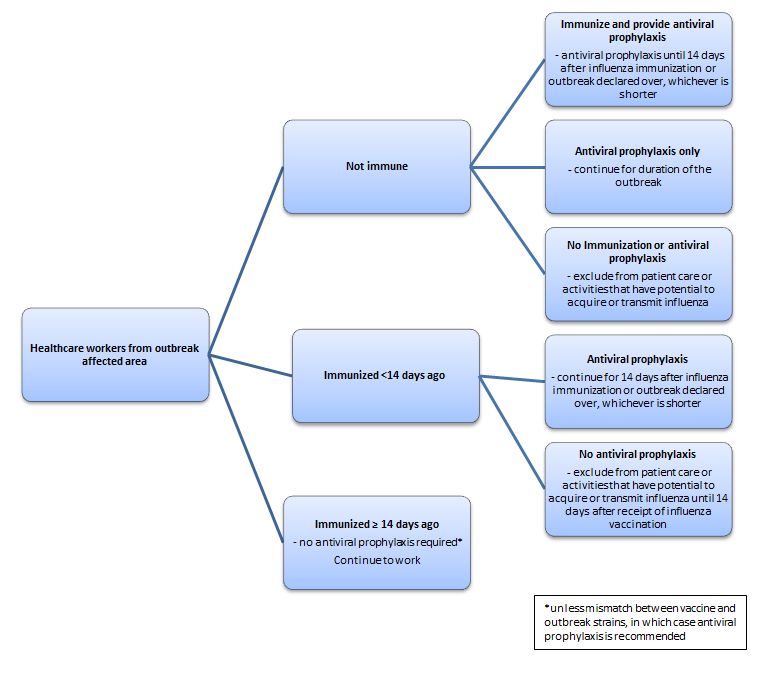
VI. Management of Health Care Workers during an Influenza Outbreak
(see Algorithm)
Immunized HCWs (with documented vaccination at least two weeks prior) may
continue to work.
Unimmunized HCWs have the potential to acquire or transmit influenza within the
hospital setting. Therefore, during an outbreak caused by influenza A or B virus,
antiviral prophylaxis must be offered to unimmunized HCWs working in the area or
unit affected by the outbreak. The HCW may resume work as soon as antiviral
prophylaxis is started. Unless vaccination is medically contraindicated, vaccine
should be provided and chemoprophylaxis continued for 2 weeks after
immunization, i.e., until immunity develops, or until the outbreak is declared over,
whichever is shorter.14
Recommended duration of chemoprophylaxis for unimmunized HCWs in an
outbreak situation is until the outbreak is declared over.19,20 In years where there is
a mismatch between the vaccine strain and the outbreak strain of influenza, antiviral
prophylaxis must be offered to all HCWs working in the outbreak area or unit,
regardless of their vaccination status.
Work Restrictions
Unimmunized HCWs who accept immunization but refuse chemoprophylaxis during
an outbreak must not work in the outbreak area / unit until 14 days following receipt
of the vaccine or until the outbreak is declared over, whichever is shorter.
Unimmunized HCWs who refuse both immunization and chemoprophylaxis during
an outbreak must not work in the outbreak area / unit until the outbreak is declared
OHA/OMA Communicable Disease Surveillance Protocols Page 9
Influenza Revised June 2018over.
VII. Acute Disease
Work Restrictions
If influenza is suspected (see Glossary) or diagnosed, the HCW must remain off
work until the period of peak symptoms and the period of communicability (five days
from onset) has passed. HCWs should report to OHS prior to return to work.
VIII. Reporting
Suspect and confirmed outbreaks must be reported to the local Medical Officer of
Health.21
Suspect or confirmed reportable diseases (as per the Ontario Regs 559/91 and
amendments under the Health Protection and Promotion Act), such as influenza,
must be reported to the local Medical Officer of Health.
In accordance with the Occupational Health and Safety Act and its regulations, an
employer must provide written notice within 4 days of being advised that a worker
has an occupational illness, including an occupationally-acquired infection, and/or a
Workplace Safety and Insurance Board (WSIB) claim has been filed by or on behalf
of the worker with respect to an occupational illness, including an occupational
infection, to the:
• Ministry of Labour,
• Joint Health and Safety Committee (or health and safety representative), and
• trade union, if any.
Occupationally-acquired infections and illnesses are reportable to the WSIB.
IX. Evaluation
Protecting patients from influenza is a patient safety issue. Therefore,
• HCW influenza immunization rates should be reported to the Infection
Prevention and Control Committee and the Joint Health and Safety
Committee, and to the local Medical Officer of Health in December, annually.
• Hospitals should consider making the HCW influenza immunization rate a
corporate patient safety indicator.
OHA/OMA Communicable Disease Surveillance Protocols Page 10
Influenza Revised June 2018X. Glossary
Adults at High Risk of Influenza-related Complications or
Hospitalization1
• All pregnant women*.
• Adults with the following chronic health conditions: cardiac or pulmonary disorders
(including bronchopulmonary dysplasia, cystic fibrosis and asthma); diabetes
mellitus and other metabolic diseases; cancer, immune compromising conditions
(due to underlying disease, therapy or both); renal disease; anemia or
hemoglobinopathy; neurologic or neurodevelopment conditions**; morbid obesity
(BMI ≥ 40).
• People of any age who are residents of nursing homes and other chronic care
facilities.
• People ≥65 years of age.
• Indigenous peoples.
From the Canadian Immunization Guide on Influenza and Statement on Seasonal Influenza Vaccine
for 2018-2019.1
*The risk of influenza-related hospitalization increases with length of gestation, i.e., it is higher in the
third than in the second trimester.
** These include neuromuscular, neurovascular, neurodegenerative, neurodevelopmental conditions
and seizure disorders, but exclude migraines and psychiatric conditions without neurological
conditions.
Ontario MOHLTC Surveillance Case Definition for Influenza22
Confirmed Case
Clinically compatible signs and symptoms with:
• Laboratory confirmation by detection or isolation of influenza virus from appropriate
clinical specimen(s) (e.g., nasopharyngeal/throat swabs) OR
• Demonstration of a significant (i.e., fourfold or greater) rise in antibody titres to
influenza between acute and convalescent sera OR
• An epidemiologic link to a laboratory-confirmed case OR
• Detection of influenza-specific ribonucleic acid (RNA)
Clinical Evidence
Clinically compatible signs and symptoms are defined as influenza-like illness and are
characterized as having a temperature > 38 degrees Celsius and cough and one or
more of the following: sore throat, arthralgia, myalgia or prostration. In patients >65
years fever may not be prominent.
OHA/OMA Communicable Disease Surveillance Protocols Page 11
Influenza Revised June 2018Respiratory Outbreak Definition21
Confirmed Outbreak
• Two cases of acute respiratory infections (ARI) within 48 hours with any common
epidemiological link (e.g. unit, floor), at least one of which must be laboratory
confirmed; OR
• Three cases of ARI (laboratory confirmation not necessary) occurring within 48
hours with any common epidemiological link (e.g. unit, floor)
Suspected Outbreak
• Two cases of ARI within 48 hours with any common epidemiological link (e.g. unit,
floor); OR
• One laboratory-confirmed case of influenza.
Caveats (for public hospitals):
• Cases refer to health care-associated cases
• If rapid testing is conducted on all cases, the confirmed outbreak definition would
apply if two cases have the same respiratory pathogen
OHA/OMA Communicable Disease Surveillance Protocols Page 12
Influenza Revised June 2018Algorithm: Management of HCWs during an Influenza Outbreak OHA/OMA Communicable Disease Surveillance Protocols Page 13 Influenza Revised June 2018
References
   1. Public Health Agency of Canada. An advisory committee statement, National Advisory
      Committee on Immunization – Canadian immunization guide chapter on influenza and
      statement on seasonal influenza vaccine for 2018-2019.
      https://www.canada.ca/en/public-health/services/publications/healthy-living/canadian-
      immunization-guide-statement-seasonal-influenza-vaccine-2018-2019.html

   2. Wolters Kluwer/Lippincott Williams & Wilkins. Orthomyxoviruses. In Knipe DM,
      Howley PM (eds), Field's Virology, 6th edition. 2013. pp1186-1243.

   3. American Public Health Association. Influenza. In: Heymann DL (ed), Control of
      Communicable Diseases Manual, 20th Edition. 2015. pp 315-322.

   4. Potter J, Stott DJ, Robert MA et al. Influenza vaccination of health care workers in
      long-term care hospitals reduces the mortality of elderly patients. J Infect Dis
      1997;175:1-6.

   5. Carman WF, Elder AG, Wallace LA et al. Effects of influenza vaccination of health-
      care workers on mortality of elderly people in long-term care: a randomized controlled
      trial. Lancet 2000;355: 93-7.

   6. Hayward AC, Harling R, Wetten S et al. Effectiveness of an influenza vaccine
      program for care home staff to prevent death, morbidity and health service use among
      residents: cluster randomized controlled trial. BMJ 2006;333:1241-47.

   7. Lemaitre M, Meret T, Rothan-Tondeur M et al. Effect of influenza vaccination of
      nursing home staff on mortality of residents: a cluster-randomized trial. J Am Geriatr
      Soc 2009;57:1580-6.

   8. Wilde JA, McMillan JA, Serwint J et al. Effectiveness of influenza vaccine in health
      care professionals. JAMA 1999; 281:908-13.

   9. Frederick J, Brown AC, Cummings DA et al. Protecting healthcare personnel in
      outpatient settings: the influence of mandatory versus nonmandatory influenza
      vaccination policies on workplace absenteeism during multiple respiratory virus
      seasons. Infect Control Hosp Epidemiol 2018;39:452-61.

   10. Public Health Ontario. Ontario Respiratory Pathogen Bulletin, 2016-2017.
       Surveillance Week 16 (April 16, 2017 – April 22, 2017). Median influenza
       immunization coverage rates among hospital and long-term care staff, 2016-2017
       influenza season, Ontario.
       http://www.publichealthontario.ca/en/DataAndAnalytics//Documents/Ontario%20Respi
       ratory%20Pathogen%20Bulletin%20-%20Week%2016_2017.pdf

   11. Public Health Ontario. Ontario Respiratory Pathogen Bulletin, 2017-2018.
       Surveillance Week 14 (April 1, 2018 – April 7, 2018). Median influenza immunization

  OHA/OMA Communicable Disease Surveillance Protocols                                 Page 14
  Influenza                                                                 Revised June 2018
coverage rates among hospital and long-term care staff, 2016-2017 influenza season,
Ontario.
https://www.publichealthontario.ca/en/DataAndAnalytics//Documents/Ontario%20Respira
tory%20Pathogen%20Bulletin%20-%20Week%2014_2017-2018.pdf, p. 5.
12. Belongia EA, Simpson MD, King JP, et al. Variable influenza vaccine effectiveness by
subtype: a systematic review and meta-analysis of test-negative design studies.
Lancet Infect Dis 2016;16:942-51.
13. Skowronski DM, Chambers C, Sabaiduc S, et al. Interim estimates of 2016/17 vaccine
effectiveness against influenza A(H3N2), Canada January 2017. Euro Surveill. 2017;
22(6): pii=30460. doi: http://dx.doi.org/10.2807/1560-7917.ES.2017.22.6.30460
14. Skowronski DM, Chambers C, De Serres G, et al. Early season co-circulation of
influenza A(H3N2) and B(Yamagata): interim estimates of 2017/18 vaccine
effectiveness, Canada, January 2018. Euro Surveill 2018;23(5).
15. Belongia EA, Skowronski DM, McLean HQ, Chambers C, Sundaram ME, De Serres
G. Repeated annual influenza vaccination and vaccine effectiveness: review of
evidence. Expert Rev Vaccines 2017;16:723-36.
16. Bartoszko JJ, McNamara IF, Aras OAZ, et al. Does consecutive influenza vaccination
reduce protection against influenza: a systematic review and meta-analysis. Vaccine
2018;36:3434-44.
17. Public Health Ontario. Influenza Immunization Timing. Technical Report. March 2017.
https://www.publichealthontario.ca/en/eRepository/Technical_report_Influenza_immun
ization_timing.pdf
18. Legg A, Dodds L, MacDonald MD, Scoo J, McNeil S. Rates and determinants of
seasonal influenza vaccination in pregnancy and association with neonatal outcomes.
CMAJ 2014;186: 268.
19. Ontario Ministry of Health and Long-Term Care. A guide to the control of respiratory
infection outbreaks in long-term care homes. March 2018.
http://www.health.gov.on.ca/en/pro/programs/publichealth/oph_standards/docs/protoc
ols_guidelines/RESP_Infectn_ctrl_guide_LTC_2018_en.pdf
20. Public Health Ontario. Antiviral medications for influenza: Information for health care
providers. Updated November 2017.
https://www.publichealthontario.ca/en/eRepository/Antiviral_Medication_Influenza_Fa
ct_Sheet.pdf
21. Ontario Ministry of Health and Long-Term Care. Infectious Diseases Protocol.
Appendix B: Provincial Case Definitions for Diseases of Public Health Significance –
Respiratory Infection Outbreaks in Institutions and Public Hospitals. May 2018.
OHA/OMA Communicable Disease Surveillance Protocols Page 15
Influenza Revised June 201822. Ontario Ministry of Health and Long-Term Care. Infectious Diseases Protocol.
Appendix B: Provincial Case Definitions for Reportable Diseases – Influenza. Revised
December 2014.
http://www.health.gov.on.ca/en/pro/programs/publichealth/oph_standards/docs/influen
za_cd.pdf
OHA/OMA Communicable Disease Surveillance Protocols Page 16
Influenza Revised June 2018You can also read


