International Tax and Transfer Pricing for Corporate Treasurers - Tuesday 3 March 2020 - Irish ...
←
→
Page content transcription
If your browser does not render page correctly, please read the page content below

International Tax and Transfer Pricing for
Corporate Treasurers

Tuesday 3 March 2020

Chairperson – Pieter Berger, Deloitte

Slido.com
#internationaltax

Please switch off/silence your mobile phone

                      Divider page title style goes here
                      Helvetica bold 24pt

Slido.com
#internationaltax
Opening Remarks

    Kevin Daly, President, Irish Association of Corporate Treasurers

Slido.com
#internationaltax
To ask questions during the Q&A session, please use details below.

                         1. Go to slido.com

          2. Enter the event code #internationaltax
Anti-hybrid Rules
Ireland
Harry Harrison, PwC

Tuesday 3 March 2020

Background

 • ATAD - Anti-hybrid rules required to be introduced in Ireland with effect from 1 January 2020

 • Finance Act 2019 now signed into Irish law

 • Applies to payments arising on or after 1 January 2020

 • Very complex provisions which need to be considered for all tax deductible payments

 • Particularly complex in a US MNC context

Slido.com
#internationaltax
Background

 Three main tests which need to be assessed independently in respect of each tax deductible payment:

       1. Deduction without inclusion outcome, which arises due to a specific hybrid mismatch,
       2. Double Deduction outcome (where not utilised against dual inclusion income),
       3. Imported Mismatch outcome - i.e. outcome 1 or 2 above which is funded by Ireland.

Slido.com
#internationaltax
Key Concepts/Definitions

Slido.com
#internationaltax
New Concepts and Definitions

 Inclusion
 ‘inclusion’ in respect of a payment means –
  (a) payment is treated as arising or accruing to the payee, which:

      (i) is chargeable to domestic tax or foreign tax (excluding remittance basis taxation)
      (ii) is a pension fund, govt body or other entity that, under the laws of the territory in which it is established, is exempt
      from tax,
      (iii) is established in a territory, or part of a territory, that does not impose tax (established can include place of
      effective management), or
      (iv) is established in a territory that does not impose a tax on profits derived from payments receivable from sources
      outside that territory (i.e. deemed inclusion for payments to territorial systems),
 Or
   (b) that is subject to a CFC charge similar to an Irish CFC charge.

Slido.com
#internationaltax
New Concepts and Definitions
• Deduction
– Any “payment” (revenue or capital in nature) which is taken into account when calculating the tax payable (e.g. royalty
payment, S291A TCA 1997 IP deduction, etc.)
– Also includes CGT deductions, as well as income tax deductions
• Payments
– Money or “money’s worth” – exceptionally broad
– Deemed payments in the same entity - allocation of profits from a Head Office to a PE, or from one PE to another PE
• Foreign Tax
– Foreign taxes which can give rise to “inclusion” (and also a second or “double deduction”) specifically includes foreign
CFC charges “similar to” Irish CFC, and similar to Irish corporation tax more generally
Slido.com
#internationaltaxTest 1 – Deduction without Inclusion Hybrid Mismatch Slido.com #internationaltax
Deduction without Inclusion – three key components

   The following three components need to be present for the transaction to fall within the deduction without inclusion test:

   1.   Deduction without inclusion in the payee territory, AND

         •   This outcome is attributable to,
         •   A specific hybrid mismatch

 These three components would need to be carefully worked through in all scenarios.

Slido.com
#internationaltax
What is a hybrid mismatch? Basic Examples
Hybrid entity
Hybrid instrument
UK Co
1. UK Co sees US LLC
Equity –
as opaque and does Lux Co dividend
not tax payment
2. US LLC – transparent
US LLC for US tax law when
checked Hybrid
Instrument
(Loan/Equity)
Irish Co
Loan -
interest
Irish Co
Slido.com
#internationaltaxSpecific Types of Hybrid Mismatch transaction
1. Payee Hybrid Entity - Payment to an entity that is viewed differently in the country it is established, compared to the
country of its parent(s) (e.g. transparent vs. opaque)
2. Payment under a Hybrid Instrument - Payment under an instrument that is characterised differently in the payee
jurisdiction (e.g. interest vs dividend, debt vs. equity)
3. Disregarded PE - Payment to a PE that is not recognised/taxed under the laws of the PE jurisdiction, but the PE profits
are exempt in the Head Office jurisdiction
4. PE/Head Office allocation mismatch - Payment to an entity that has a PE/PEs, and there is a mismatch in how the
profits are allocated between Head Office/PEs
Slido.com
#internationaltaxSpecific Types of Hybrid Mismatch transaction
5. Payor Hybrid Entity * - Payment to an entity that is viewed differently in the country it is established, compared to the
country of its parent(s)
6. PE/Head Office deemed payment mismatch * - Deemed payment within an entity that has a PE/PEs, which results in
a mismatch in how the profits are allocated between Head Office/PEs
* Note that hybrids 5 and 6 will not operate to deny a tax deduction, if the tax deduction is being offset/utilised in Ireland
against income that is “dual inclusion income” (the particular income is taxed in the countries where the mismatch has arisen).
Slido.com
#internationaltax(1) Payment to a Hybrid Entity
Corporate
Foreign Corporate parent of US LLC
views US LLC as opaque and does not
tax the payment. Opaque/Transparent
UK LLP US LLC is checked open and not taxed
hybridity
UK LLP
or or in the US on the payment.
US
US LLC
LLC
Payment
Deduction denied if
no inclusion
Irish Co
Slido.com
#internationaltax(2) Payment under a Hybrid Instrument
No
Dividend Receipt
Lux Co inclusion,
due to
hybridity
Hybrid
Instrument
(Loan/Equity)
Deny
Irish Co Interest Payment Deduction
Slido.com
#internationaltax(3) Payment to a disregarded PE – deduction denied
Income not currently
taxed due to branch
Lux Co exemption, and PE
not taxed in local
territory
Payment
Non-taxed Deny deduction
Ire Co
PE
Slido.com
#internationaltax(3) Payment to a disregarded PE – income now taxed
Income not currently
Lux Co taxed in Ireland as
non-trading branch
Irish non- Payment Tax income, if
trading Foreign Co payment deduction
PE not denied in payee
Slido.com
#internationaltax(4) HO/PE allocation mismatches
Income not fully
Lux Co included as a result of
profit attribution
Deny deduction for
PE PE amount not included
Country B Country C anywhere
Payment Ire Co
Slido.com
#internationaltax(5) Payment by an Irish Hybrid Entity
Payment ignored as
US Co Irish Co is checked as
a branch of US Co for
US tax purposes
Co.
checked as Payment
a branch Deduction denied,
unless it is being
utilised/ offset against
dual inclusion income
Irish Sub in Ireland
(checked)
Slido.com
#internationaltax(6) Deemed payments HO/PE mismatches
Deemed payment to
Lux Co HO / other PE is not
included
Deemed payment
Deduction denied
PE PE unless it is being
Country B Country C utilised/ offset against
dual inclusion income
Deemed payment
in Ireland
Slido.com
#internationaltaxTest 2 – Double Deduction Mismatch Outcome Slido.com #internationaltax
Double deduction which is not offset/utilised against “dual
inclusion income”

Question: Are two deductions being taken for a single payment?

•   Does not necessarily need hybrid payments or entities
•   Just that there is a deduction in Ireland, and also a deduction of an “associated enterprise” in a foreign territory in respect
    of the same payment (deduction in foreign territory could be due to the operation of a CFC taxation regime)

•   Includes tax deductions in respect of third party payments

•   Problem arises to the extent these deductions are not being utilised/offset in Ireland against “Dual Inclusion
    Income”

•   This test therefore requires detailed analysis and consideration of foreign CFC provisions (including US CTB elections,
    Subpart F and GILTI)

Slido.com
#internationaltax
Double Deduction – An Example
Overview
US Co
• Payment from Ireland to a third party
• A “check the box” election is made for all subsidiaries below Foreign
IHC
• IreCo’s income includes intercompany income which is disregarded
Foreign IHC from a US tax perspective
• Is there “dual inclusion income”?
Deductible payment
to third party,
or other regarded
payment
IrCo Ireland
Interco Income
Foreign DRE Third Party Income
Slido.com
#internationaltaxTest 3 – Imported Mismatch Slido.com #internationaltax
Imported mismatch

Imported mismatch transactions
•   Payments to an EU established payee are outside the scope of the Irish imported mismatch provisions.
•   A hybrid mismatch which Ireland is not a party to can be imported to Ireland, and an intercompany tax deduction denied
    where:
       – it would be “reasonable to consider” that

       – a payment by Irish co to a payee established outside the EU

       – “directly or indirectly funds” a hybrid mismatch outcome (i.e. either a double deduction hybrid mismatch outcome or
        one of the deduction without inclusion hybrid mismatch outcomes) in another entity.
•   A tax deduction is denied “for so much of the payment” as corresponds to the mismatch outcome as has not already been
    neutralised by similar foreign anti-hybrid provisions (so full amount may not always be denied).

Slido.com
#internationaltax
Imported mismatch
No inclusion due to
Foreign Parent
a hybrid mismatch
Co transaction
Hybrid Payment
Payment from
Non-EU Co Ireland to Non-EU
co funds the Hybrid
payment
Payment
Mismatch imported
Irish Co to Ireland and
deduction denied
Slido.com
#internationaltaxRecap and summary of areas of focus Slido.com #internationaltax
Proposed next steps

 •    Consider group review now to identify key risk areas, in particular in relation to:

       – Any obvious specific hybrid arrangements,

       – Whether the double deduction mismatch rules give rise to a restriction, and in particular whether

         the income of Irish companies would all represent “dual inclusion income”

       – Reviewing the most material intercompany tax deductions

 •    All payments are in scope

 •    US MNC analysis is more complex

Slido.com
#internationaltax
DAC 6 Ireland Fiona Carney, PwC Tuesday 3 March 2020
Goals and levels of reporting
 EU Directive 2018/822 of 25 May 2018 (known as “DAC 6”)
 Stated Goals:

 • Improve transparency

 • Provide tax authorities with earlier access to information on
   potentially aggressive tax-planning arrangements

 • Transposed into Irish legislation as part of Finance Act 2019

 • Provisions require an “Intermediary” (or taxpayer in some
   circumstances) to report details of any “Cross-border
   Arrangement” that contains at least one of the “Hallmarks” listed
   in Annex IV to the Directive

Slido.com
#internationaltax
Timeline

                                                                                                        31 October
                                         31 December 2019                                               First automatic
                                         Deadline for                                                   exchange of
                                         transposition into                                             information with
                                         national law                                                   European tax
                                                                                                        authorities

  25 May 2018
  DAC 6 is adopted
                                                                              31 August 2020
                                                                              Deadline for
                                                                              retrospective
                                                              February 2020   reporting

                                                                              1 July 2020
                                                                              Cut-off retroactive
                                                                              application of national
                     25 June 2018                                             law and onset of
                     DAC 6 enters into                                        reporting obligation
                     force

Slido.com
#internationaltax
Relevant roles and activities
Intermediary Expanded intermediary Relevant taxpayer
1 2 3 4
Resident for tax Permanent Incorporated in or Registered with a
Reporting obligation rests with Relevant
purposes in an EU establishment in an EU governed by the laws of professional association
Taxpayer where:
Member State Member State an EU Member State in an EU Member State
could reasonably be
designs markets organises knows
expected to know
directly through other persons
makes available for manages the
aid assistance advice Legal
implementation implementation of
No Professional
No external Intermediary Privilege
or or
designing | marketing | organising | making available Intermediary with EU applies to any
for implementation | managing implementation of nexus EU-based
Intermediaries
a reportable cross-border arrangement, a reportable cross-border arrangement,
if any hallmarks are relevant if any hallmarks are relevant
Expanded Intermediary: can provide evidence that they
did not know and could not reasonably be expected to
know of involvement in reportable arrangement.
Slido.com Based on relevant facts and circumstances/available
information/relevant experience and understanding
#internationaltaxCross-border arrangement
A Cross-border arrangement is an arrangement that concerns either more than one Member State or a Member State
and a third country where at least one of the following conditions is met:
The participants…
• not all of the participants are resident for tax purposes in the same jurisdiction
• one or more participant is resident for tax purposes in more than one jurisdiction
EU + EU • one or more participant has a permanent establishment in another jurisdiction that is of relevance for
the arrangement
• one or more participant carries on an activity in another jurisdiction without being resident for tax
purposes or creating a permanent establishment in that jurisdiction.
The arrangement…
EU + non-EU • has a possible impact on the automatic exchange of information, or
• has a possible impact on the identification of beneficial ownership.
Non-EU + non-EU Arrangements not within the scope of application…
• No cross-border tax arrangement without EU connection.
Slido.com
#internationaltax Note: An arrangement shall also include a series of arrangements. An arrangement may comprise more than one step or part.EU DAC6
Hallmarks
Hallmarks subject to the Main Benefit Test Hallmarks not subject to the Main Benefit Test
A Generic hallmarks C Specific hallmarks of cross-border transactions
1. Confidentiality clause that would prevent the disclosure of a potential 1. Deductible cross-border payments made between associated enterprises,
tax advantage if the recipient:
2. Contingency fees/success fees based on tax advantage obtained • is not resident for tax purposes in any tax jurisdiction, or
3. Standardised documentation and/or structure • is tax resident in a country which the EU or OECD have assessed as
non-cooperative
B Specific hallmarks
2. Deductions for same depreciation claimed on asset in multiple jurisdiction
1. Acquisition of loss-making company, discontinuation of its main activity
and use of its losses in order to reduce tax liability 3. Relief from double taxation on same income/capital claimed in multiple
jurisdictions
2. Conversion of income into capital, gifts or other categories of revenue
taxed at a lower level or exempt from tax 4. Asset transfers where there is a material difference in the amount treated
payable in consideration for the asset in the jurisdictions involved
3. Circular transactions resulting in the round-tripping of funds
D Specific hallmarks for AEOI and beneficial ownership
C Specific hallmarks of cross-border transactions
1. Undermining the CRS reporting obligation by, e.g. use of products,
1. Deductible cross-border payments made between associated jurisdictions, or legal entities, not subject to reporting (among others)
enterprises, where in the jurisdiction of tax residency of the recipient:
2. Use of jurisdictions with weak anti-money-laundering legislation
• no or almost no corporate tax is imposed,
3. Use of non-transparent legal or beneficial ownership chain
• the payment benefits from a full exemption from tax, or
E Specific hallmarks for transfer pricing
• the payment benefits from a preferential tax regime
1. Use of unilateral safe harbor rules
Main Benefit Test 2. Transfer of hard-to-value intangibles between associated enterprises
That test will be satisfied if it can be established that the main benefit or 3. Intragroup cross-border transfers of assets/functions/risks where the
one of the main benefits which, having regard to all relevant facts and projected annual EBIT of the transferor(s) for the following three years falls
circumstances, a person may reasonably expect to derive from an by more than 50% as a result of the transfer
arrangement is the obtaining of a tax advantage.
Slido.com
#internationaltaxCompliance and administration
• Electronic reporting of “specified information” listed
• Revenue will assign a reference number to a cross-border
arrangement that has been reported
• Five-day window for:
– intermediary to share reference number with taxpayer/any other
intermediaries
– taxpayer to share reference number with other taxpayers involved
in same arrangement
• Taxpayer must disclose reference number on tax return for any
chargeable period in which they:
– enter into arrangement, or
– obtain/seek to obtain a tax advantage from the arrangement.
• Can claim exemption from reporting with proof that same
information has been reported by another person
Slido.com
#internationaltaxPenalties
• Penalties to be determined by the courts having regard to:
– in the case of an intermediary, their fee or likely fee in connection
with the arrangement
– in all other cases, the amount of any tax advantage gained or
sought from the arrangement
• Upper limits - arrangements reportable after 1 July 2020:
– penalty of up to €500 per day for failure by intermediary/taxpayer
to report within 30 days
– penalty of up to €500 per day for failure by intermediary to share
reference number within five days
• Upper limit - arrangements reportable under transitional measures
– penalty of up to €4,000 for failure by intermediary/taxpayer to
report by 31 August 2020
Slido.com
#internationaltaxRevenue guidance
Rules are currently live
Broad scope of hallmarks and other definitions
giving rise to many interpretation difficulties
Many practical issues likely to arise in light of
tight timeframes
Several submissions have been made to Revenue
on matters for consideration in guidance
TALC sub-group on DAC 6 to meet on 11 March
Slido.com
#internationaltaxTransfer Pricing Update Kevin Norton, Deloitte Tuesday 3 March 2020
Agenda

  •   Irish rule changes
  •   New content in the OECD Transfer Pricing Guidelines
  •   Some practical implications

Slido.com
#internationaltax
Irish rule changes

Slido.com
#internationaltax
New legislation introduced
 For accounting periods on or after 1 Jan 2020

                    • Irish TP rules            Adopts 2017 OECD          • Master File >€250m             Removes           • Capital transactions of         Extends TP
                      broadened to cover           Guidelines             • Local File >€50m            grandfathering         +€25m are subject to             to SMEs
                      non-trading                                         • Specific Irish TP                                  TP rules (with some
                      arrangements,                                         documentation is now                               exceptions) from
                      excluding certain                                     mandatory.                                         1/1/2020
                      domestic                                                                                               • Greater
                      arrangements                                        ! Penalties from €4k to                              documentation will be
                    • Review all                                          €25k for non-compliance                              required to support
                      transactions that may   • Brings latest OECD        including daily time-     • Pre-July 2010            the values in capital     • Documentation
                      previously been           Guidance into Irish       based penalties for         arrangements are         transactions. This will     requirement:
                      outside of Irish TP       legislation (including    continued non-              now within the scope     be an important area         − Small=Exempt
                      rules, e.g., IFLs,        HTVI and profit splits)   compliance.                 of TP rules              of focus for Irish           − Medium=Simplified
                      licence agreements,       Legislation also                                    • Check if any             Revenue.
                      rents, etc.               emphasises                                            transactions were                                  ! Subject to ministerial
                                                substance over form                                   treated as                                         order
                                              • Historical analyses                                   grandfathered. A TP
                                                likely to require                                     analysis will now be
                                                updates to ensure                                     required
                                                compliance with latest
                                                guidance (DEMPE,
                                                control of risk, etc.)
                                              • Test substance of
                                                arrangements
                         Extends to                                            Enhanced TP                                      Extends to capital
                     non-trading income                                       documentation                                   transactions > €25m

Slido.com
#internationaltax
New content in the
OECD Transfer Pricing Guidelines
Slido.com
#internationaltaxNew content in the OECD Transfer Pricing Guidelines
Structure of the new guidance
A Introduction
B Accurate delineation of
financial transactions
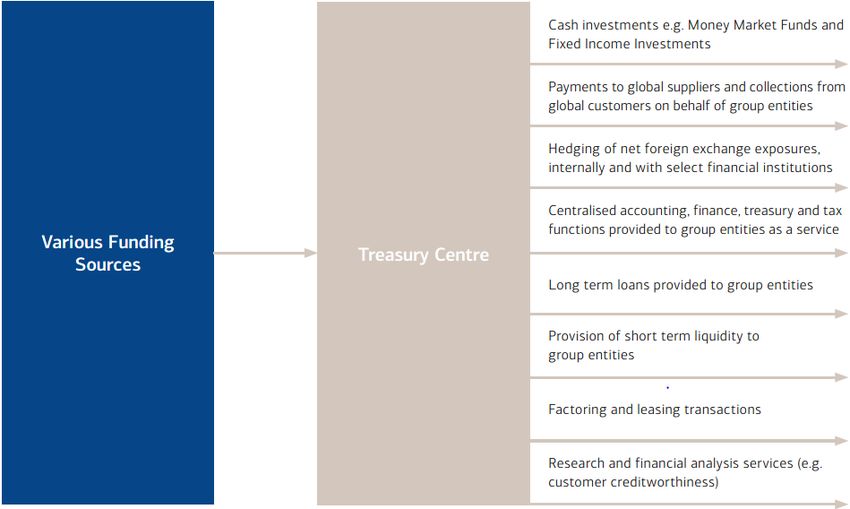
C Treasury function:
– Treasury centre services
– Intra-group loans
New Chapter X
OECD Transfer
– Passive association Pricing Guidelines
– Cash pooling
– Hedging
D Guarantees
E Captive insurance
Added to Chapter I
Risk-free and risk-adjusted
F OECD Transfer
Slido.com rates of return
#internationaltax Pricing GuidelinesAccurate delineation of financial transactions Slido.com #internationaltax
Accurate delineation of financial transactions
 Balance of debt and equity funding

                                                                         Example:
         Accurate delineation of the balance of debt and
                         equity funding:
                                                                               Company C
                                       Not intended to prevent other
        Not the only approach to
                                          approaches to address                                       10 year
         determine whether debt
                                       debt/equity balance or interest                                loan
       should be respected as debt
                                        deductibility under domestic
       for transfer pricing purposes
                                                legislation

                                                                               Company B

                                                                         To consider:
       Debt / equity distinction:
                                                                         • Financial projections
                                                                         • Ability to service/repay
         – Should (part of) a loan be regarded as e.g. a                 • Options available
           contribution to equity capital?                               • Two sided perspective
                                                                         • Not ‘all or nothing’

Slido.com
#internationaltax
Accurate delineation of financial transactions
The actual transaction
• Identify the commercial or financial relations
– Industry-, entity- and transaction-specific matters
– Regulated entities: due regard to regulatory constraints + footnote reference
“... The regulatory approach to risk allocation for regulated entities should be taken into account and
reference made as appropriate to the transfer pricing guidance specific to financial services businesses in
the Report on the Attribution of Profits to Permanent Establishments (OECD, 2010).”
Footnote to D1.2.1
• Consider all other options realistically available to the parties
• Consideration of the economically relevant characteristics:
– Contractual terms
– Functional analysis (functions performed, assets used, risks assumed)
– Specific terms of financial instruments (repayment, security, currency etc.)
– Economic circumstances
– Business strategies
Slido.com
#internationaltaxTreasury function Slido.com #internationaltax
Treasury function
    • Different degrees of treasury centralisation, autonomy and functionality.
    • Often, treasury is a support-service to the main value-creating operation:
       – Remunerated through a service fee
    • Higher strategic decisions may be the result of group-level policy

Slido.com
#internationaltax
Risk-free and risk-adjusted rates of return
Extracts from Actions 8-10 Final Report
“If [the enterprise] does not in fact control the financial risks associated with its
funding (for example because it just provides the money when it is asked to do so,
without any assessment of whether the party receiving the money is creditworthy),
then it will not be allocated the profits associated with the financial risks and will be
entitled to no more than a risk-free return…”
“capital without functionality will generate no more than a risk-free return,
assuring that no premium returns will be allocated to cash boxes without relevant
substance…”
“[…] would not be entitled to any more than a risk-free return as an appropriate measure
of the profits it is entitled to retain, since it lacks the capability to control the risk associated
with investing in a riskier financial asset”
Slido.com
#internationaltaxIntra-group loans Slido.com #internationaltax
Intra-group loans
 Determining an arm’s length rate of interest

                    Consideration of both the lender’s and borrower’s perspectives

                      Use of credit ratings to measure creditworthiness and identify potential
                      comparables

                         The effects of group membership and any associated implicit support

                         Evaluation of covenants

                      Summary of the transfer pricing approaches to determine arm’s length rates,
                      including: comparable uncontrolled price (CUP), internal CUPs, consideration
                      of loan fees and charges,

                ... the cost of funds incurred by the lender in raising the funds to lender, the use of
                credit default swap prices, economic modelling, and relevance (or otherwise) of
                written opinions from independent banks.
Slido.com
#internationaltax
Intra-group loans
Credit ratings and passive association
• Depending on the level of passive association, it may be appropriate for an entity to have a credit rating closely
linked to that of the multinational group
• Conversely, where there is evidence that no support would be provided, it may be appropriate for an entity to be
considered on the basis of its stand-alone credit rating only
• Passive association – factors to consider:
– legal and regulatory obligations
– relative strategic importance of the entity to the group (e.g. core, highly strategic)
– operational significance
– potential reputational impacts
– stated policy
– history of support
• Fact-based approach, taking account of quantitative and qualitative factors
– ‘rebuttable presumptions’ in 2018 consultation question not taken forward
Slido.com
#internationaltaxCash pooling Slido.com #internationaltax
Cash pooling
 Accurate delineation of cash pool transactions

   “The accurate delineation of the cash pooling transactions will depend on the particular facts and
   circumstances of each case. As cash pooling is not undertaken regularly, if at all, by independent
   enterprises, the application of transfer pricing principles requires careful consideration”

 • The wider context should be considered – not just the balance amounts

 • Participation of cash pool members includes being part of a collective strategy seeking to benefit
   all cash pool participants

 • No cash pool member would expect to participate if it made them any worse off than their
   next best option

   • Cash pool arrangements are short-term liquidity arrangements.

   • Longer term positions should be treated as something else (e.g. term deposits/loans)

   • Year on year patterns, as well as financial management policies, could be indicators
     for whether a balance remains part of the cash pool

Slido.com
#internationaltax
Cash pooling
Pricing of cash pool transactions
Rewarding the cash pool leader:
Merely performing a Additional functions undertaken
co-ordination function • controls and bears financial risks
agency, low level of functionality • has financial capacity
Service provider remuneration Enhanced reward
Rewarding the cash pool participants:
- No prescriptive approach
- Consider realistically available alternatives to participating in the cash pool arrangement as well as
evaluating risks borne by the cash pool leader, the presence of cross-guarantees, and the
contribution of other participants to the cash pool.
Cross guarantees and rights of set off that may be required in the cash pool
– to the extent represents credit enhancement due to the implicit support of other group members:
- No guarantee fee due, and
- Support in the event of a default regarded as a capital contribution
Slido.com
#internationaltaxGuarantees Slido.com #internationaltax
Guarantees
 Effect of group membership
  • An appropriate benefit - lower cost of debt funding - for the borrower is needed for it to be willing to
    remunerate the guarantor with a commensurate fee
  • Different types of intra-group credit support – depends on facts and circumstances:

      Explicit guarantee                                  Implicit support

      • Legally binding                                   • Includes a ‘letter of comfort’ and
      • Usually provides relevant rights to                 other lesser forms of support
        creditor to enforce commitment                    • Attributable to borrower’s group member
                                                            status/passive association

  Where guarantee leads to access to a larger amount of borrowing, need to ask:
     1.   Whether a portion of loan should be accurately delineated as a loan to guarantor (followed by equity contribution to
          borrower)?
     2.   Whether guarantee fee in respect of remaining portion of loan is arm’s length?

Slido.com
#internationaltax
Guarantees
Example – Implicit support
Standalone basis Group synergies
Baa Aaa
Subsidiary Parent
(S) (P)
Baa
Subsidiary
(S)
Loan Interest rate based Subsidiary credit rating enhanced to
on ‘Baa’ “A” due to group membership
Loan Interest rate
based on ‘A’
Independent Independent
lenders lenders
Benefit of implicit support attributable to passive association:
Slido.com
“not from the provision of a service for which a fee would be payable”
#internationaltaxGuarantees
Example – Explicit guarantee
Group synergies
Aaa
Parent
(P)
Legal
guarantee
Baa
Subsidiary Guarantee fee from S to P
(S) Explicit guarantee will be based on
of subsidiary’s enhancement of S’s credit
Subsidiary credit rating enhanced to
obligation rating from A to Aaa and
“A” due to
provided by a not based on
group membership
parent
enhancement of S’s credit
Interest rate rating from Baa to Aaa.
Loan
based on ‘Aaa’
Independent
lenders
Baa A Aaa
Slido.com
Due to implicit support Due to explicit guarantee
#internationaltaxSome practical implications Slido.com #internationaltax
Transfer pricing aspects of financial transactions
 Practical implications

 • Documentation and visibility of financial transactions

 • Tax authority experience

 • Double taxation

     – Treaties and Mutual Agreement Procedure

Slido.com
#internationaltax
Panel Discussion Slido.com #internationaltax
Questions and Answers

Slido.com
#internationaltax
You can also read


