Investment in Mongolia - KPMG in Mongolia 2016 Edition - assets.kpmg
←
→
Page content transcription
If your browser does not render page correctly, please read the page content below

Investment in
Mongolia
KPMG in Mongolia

2016 Edition

CONTENTS
1         COUNTRY OUTLINE                                                                                            6
1.1 Introduction                                                                                                     6
1.2 Geography and climate                                                                                            6
1.3 History                                                                                                          6
1.4 Political system                                                                                                 7
1.5 Population, language and religion                                                                                7
1.6 Currency                                                                                                         8
1.7 Public holidays                                                                                                  8
2         BUSINESS ENVIRONMENT                                                                                       10
2.1 Mongolian economy overview                                                                                       10
2.2 Economic trading partners                                                                                        11
    Exports                                                                                                          11
    Imports                                                                                                          11
2.3 Business culture                                                                                                 11
2.4 Free trade zones                                                                                                 12
2.5 Foreign exchange controls                                                                                        12
3         INVESTMENT CLIMATE FOR FOREIGN DIRECT INVESTMENT                                                           14
3.1 Foreign investment opportunities                                                                                 14
3.2 Foreign investment legislation                                                                                   14
3.3 Commencing business in Mongolia                                                                                  15
    Practical considerations                                                                                         15
    Registration                                                                                                     15
    Mergers, acquisitions and restructurings                                                                         16
    Exit strategy                                                                                                    16
3.4 Financing                                                                                                        17
3.5 Intellectual property                                                                                            17
          Copyright                                                                                                  17
          Trademarks and trade names                                                                                 17
          Patents                                                                                                    18
4         REPORTING, AUDITING AND THE REGULATORY ENVIRONMENT                                                         20
4.1 Financial reporting                                                                                              20
4.2 Auditing                                                                                                         21
4.3 Regulatory environment                                                                                           21
          Competition law                                                                                            21

© 2016 KPMG Audit LLC, the Mongolian member firm of the KPMG network of independent member
firms affiliated with KPMG International Cooperative (“KPMG International”), a Swiss entity.   2 / Investment in Mongolia
Corporate governance                                                                                       22
          Land ownership and use                                                                                     22
          Anti-corruption law                                                                                        23
          Arbitration                                                                                                23
5         TAXATION                                                                                                   25
5.1 General tax law                                                                                                  25
    Overview                                                                                                         25
    Rights and duties – taxpayers and tax authorities                                                                26
    Tax reporting and payments                                                                                       26
    Tax audits                                                                                                       26
    Debt collection                                                                                                  27
5.2 Corporate tax                                                                                                    27
    Overview of the corporate tax system                                                                             27
    Taxable income                                                                                                   28
    Losses                                                                                                           28
5.3 Transfer pricing                                                                                                 29
5.4 Double tax agreements                                                                                            29
5.5 Tax incentives                                                                                                   29
5.6 VAT                                                                                                              30
    Overview                                                                                                         30
    Registration                                                                                                     30
    VAT returns and payment                                                                                          30
    Zero Rated VAT application                                                                                       31
    Exemptions                                                                                                       31
    VAT on Fixed Assets                                                                                              31
    VAT on Exploration                                                                                               31
    Integrated system                                                                                                31
5.7 Immovable property tax                                                                                           31
5.8 Excise taxes                                                                                                     31
5.9 Customs duty                                                                                                     32
     Imports                                                                                                         32
     Exports                                                                                                         32
5.10 Mining royalties                                                                                                32
5.11 Personal income tax                                                                                             32
          Taxpayers                                                                                                  32
          Tax rates                                                                                                  33
          Exemptions                                                                                                 33
6         IMMIGRATION AND EMPLOYMENT                                                                                 35

© 2016 KPMG Audit LLC, the Mongolian member firm of the KPMG network of independent member
firms affiliated with KPMG International Cooperative (“KPMG International”), a Swiss entity.   3 / Investment in Mongolia
6.1 Immigration                                                                                                      35
    Visas                                                                                                            35
    Residence permits                                                                                                35
    Work permits                                                                                                     35
    Fees and quotas for employing foreign workers                                                                    35
6.2 Employment regulations                                                                                           36
    Labour contracts                                                                                                 36
    Severance pay                                                                                                    36
    Working hours                                                                                                    36
    Salary                                                                                                           37
    Paid vacation                                                                                                    37
    Maternity leave                                                                                                  37
6.3 Social security                                                                                                  37
          Rates                                                                                                      37
          Social security benefits                                                                                   37
APPENDIX 1: DOUBLE TAX AGREEMENTS                                                                                    38
Currently in force:                                                                                                  38
APPENDIX 2: GLOSSARY                                                                                                 39
CONTACT US                                                                                                           40

© 2016 KPMG Audit LLC, the Mongolian member firm of the KPMG network of independent member
firms affiliated with KPMG International Cooperative (“KPMG International”), a Swiss entity.   4 / Investment in Mongolia
COUNTRY OUTLINE

© 2016 KPMG Audit LLC, the Mongolian member firm of the KPMG network of independent member
firms affiliated with KPMG International Cooperative (“KPMG International”), a Swiss entity.         5 / Investment in Mongolia
1 COUNTRY OUTLINE
1.1   Introduction
      Mongolia has recently topped lists as one of the world’s fastest growing economies, holding a
      massive wealth of mineral resources. With an outward-looking professional business community,
      democratic government and rapidly improving living conditions, many international investors are
      turning their attention to this previously overlooked corner of Asia.

      Landlocked between Russia and China, Mongolia is a country of extremes. Despite having the coldest
      capital city in the world 1, summer temperatures can exceed forty degrees Celsius. The climate is arid,
      but when it does rain, it can be torrential. Although very thinly populated, with approximately three
      million people in an area the size of Western Europe 2, city housing stock is in short supply and the
      cosmopolitan atmosphere of central Ulaanbaatar contrasts with the remote existences of smaller
      communities.

1.2   Geography and climate
      Bordered on the north by Russia and on the east, south and west by China, Mongolia has a total area
      of one point five million square kilometers, making it the nineteenth largest country in the world and
      the second largest landlocked country. 3 For administrative purposes, the territory is divided into three
      cities and twenty-one provinces (aimags). The most significant population centre is the capital
      Ulaanbaatar, home to approximately 1.3 million people. 4

      Mongolia is situated on a plateau far from any oceans, with average elevation of one and a half
      kilometers. 5 This gives it an extreme continental climate which varies considerably across the country
      and between the seasons. Broadly speaking, elevation is lowest in the east of the country, rising to
      the Altai mountain range in the west. Mongolia’s highest point is a mountain peak marking the
      western border between Mongolia, Russia and China. Travelling from north to south, one would go
      from Siberian forests and lakes, pass through open steppe grassland and mountains, and ultimately
      reach the Gobi desert.

      The country has long cold winters and short warm summers. Winters are dry and summer rainfall
      rarely exceeds three hundred and eighty millimeters in the mountains and is less than fifty millimeters
      in the desert areas. 6 Temperatures in Ulaanbaatar can regularly exceed thirty degrees celsius from
      mid-June to mid-August, but are also often below minus thirty degrees celsius in winter. Spring and
      autumn are unpredictable and snow can be seen in early June or late August. However, spells of
      warm weather also occur at early as April and as late as October.

1.3   History
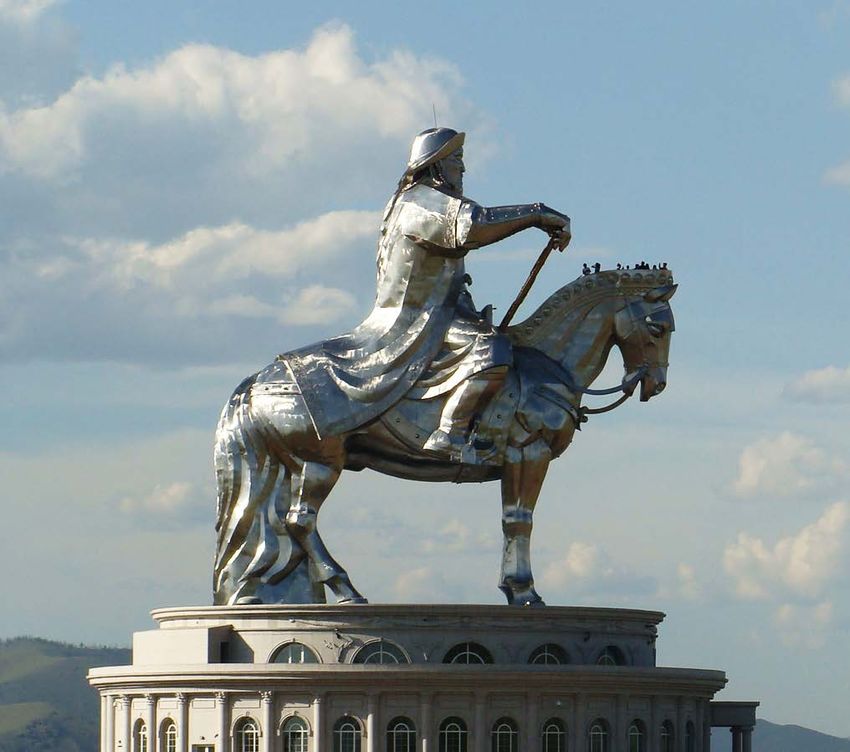
      The concept of the Mongolian state was founded by Genghis Khan (Chinggis Khaan) when he unified
      disparate nomadic tribes in 1206. By the time he died, the Mongol Empire stretched from Manchuria
      to the Caspian Sea. His descendants continued to rule the empire and extended the territory to create
      the largest land empire ever to exist. Gradually this fragmented until in the seventeenth century, the
      power of the Mongolian kings was weakened and became vulnerable to invasion. In 1636, Inner
      Mongolia came under the power of the Qing (Manchu’s), followed by Outer Mongolia in 1691.

      1
        Information Mongolia
      2
        CIA, World Factbook
      3
        CIA, World Factbook
      4
        1212.mn, Mongolian Statistical Information Service
      5
        National Geographic, Mongolia Facts
      6
        S. Chuluunkhuyag, The Impact of Climate Change and Human Activity on Mongolian Water Resources
      © 2016 KPMG Audit LLC, the Mongolian member firm of the KPMG network of independent member
      firms affiliated with KPMG International Cooperative (“KPMG International”), a Swiss entity.   6 / Investment in Mongolia
When China was experiencing political turmoil in the early twentieth century, Mongolian nationalists
took the opportunity to ally themselves with the Soviet Union. In 1924, Outer Mongolia formally
announced full independence as the Mongolian People’s Republic (MPR), the world’s second
Communist state. The MPR was effectively a client state of the Soviet Union, which heavily
influenced internal politics. This included negative impacts such as religious purges in the 1930s and
forced collectivization. However, with investment from the Soviet Union, significant infrastructure
was put in place and levels of education, healthcare and the economic growth improved. Inner
Mongolia remains a province of China today.
Mongolia underwent a peaceful transition to democracy, electing the first democratic parliament
members in July 1990. The new constitution was established in 1992 and the first president elected
in 1993.
1.4 Political system
Mongolia is a parliamentary democracy, with key positions held by the President, Prime Minister and
Government Ministers. The main chamber of parliament, consisting of 76 members elected on a first-
past-the-post system, is called the State Great Khural. Parliamentary elections are held every four
years and presidential elections the following year.
Since the early 1990s, the main government parties have been the Mongolian People’s Party (MPP)
and the Democratic Party (DP). The MPP was formerly called the Mongolian People’s Revolutionary
Party (MPRP) and was the ruling party throughout the socialist era. The party now calling itself the
MPRP is a splinter group, created after the original party changed its name in 2010.
Parliamentary election was held on 29 June 2016 and 72.1 percent of Mongolian voters participated
in the election nationwide. Mongolians have sent an undeniably clear message to the former
government by voting 65 members of the MPP, a massive 85 percent of the seats in the Parliament.
There were fears of violence following riots that had occurred after the 2008 elections which left five
people dead, but 2016 passed off peacefully and orderly. However, less than two months before the
election, on 5 May 2016, the electoral law was amended to remove the party list system and return
the election system back to a full majority. The public and international independent observers have
criticized this last minute fundamental changes to the legislation. The law also withdrew the voting
rights of an estimated 150,000 Mongolian citizens living abroad including diplomats.
The election was closely followed by the Asia-Europe Meeting 2016 (ASEM) on 15-16 of July, with
over 50 heads of state gathering in the country. At the 20th anniversary of ASEM, leaders also
reviewed the progress made and committed to taking ASEM forward, promoting greater connectivity
and more focused cooperation between Asia and Europe 7.
1.5 Population, language and religion
The National Statistical Office has reported that Mongolia's total population reached 3,061.6 thousand
at the end of 2015. 8 43% of the population lives in Ulaanbaatar. The rest of the population lives in
smaller towns and villages or are nomadic/semi-nomadic. Mongolians belong predominantly to the
Khalkh ethnic group (eighty to 82% of the population, 2010 est.) and there is a significant Kazakh
minority of approximately 3.8% of the population 9 , with a very distinct language and culture. The
remaining ethnic groups are mostly quite closely related to the Khalkh.
The official language of Mongolia and first language of the vast majority of Mongolian nationals is
Khalkh Mongolian (written in the Russian Cyrillic alphabet). However there are other languages and
dialects spoken by minority groups, most notably in the province of Bayan-Ulgii, where the Kazakhs
are in the majority, and Tuvans also form a significant group. During the socialist period, the first
foreign language taught was Russian. However, English is now widely taught and often a requirement
7 Council of the European Union, 16 July 2016
8
MONTSAME “Mongolian News Agency”, 18 January 2016
9
CIA, Factbook
© 2016 KPMG Audit LLC, the Mongolian member firm of the KPMG network of independent member
firms affiliated with KPMG International Cooperative (“KPMG International”), a Swiss entity. 7 / Investment in Mongoliato work for international companies. Chinese, Korean, Japanese and German are also popular
languages.
It should be noted that Mongolians rarely use their family names, identifying themselves instead by
a given name and a patronymic. In Mongolian, the patronymic precedes the given name and is often
shown only as an initial – thus Batbold’s son Tumur would be called Batboldin Tumur or B. Tumur.
However, many Mongolians working in international environments now put their given name first on
English language business cards (i.e. Tumur Batbold). The convention is identical for men and women,
and women do not change their names on marriage.
Shamanism is the oldest religious tradition in Mongolia and was replaced by Buddhism from the
sixteenth century onwards. Under Communism, all religion was suppressed and most temples and
monasteries were destroyed. The majority of the population now identifies as Buddhist, with small
Shamanist, Christian and Muslim minorities.
1.6 Currency
The official currency of Mongolia is the Mongolian tugrik or tögrög (MNT). During the three year period
to August 2016, the exchange rate fluctuated from 1,390-2,150 MNT:USD 11 and 2,208-3,160
MNT:GBP. 12
Currency is issued by the Central Bank of Mongolia, and the official daily foreign exchange rates can
be found at: https://www.mongolbank.mn/eng/dblistofficialdailyrate.aspx
1.7 Public holidays
There are seven celebrations in Mongolia for which public holidays are observed. Holidays are
generally observed on the actual date but if a holiday falls on the weekend, the government may at
its discretion declare an additional day off. Similarly, where there is only one day between a public
holiday and a weekend, there have been instances where a Saturday has been turned into a working
day in lieu of the Monday or Friday, allowing employees to take a longer holiday. Typically, there is
very short notice of such decisions, so as an employer or business visitor, one should be aware that
working hours around holidays may change as little as a week prior.
Public holidays may also be granted for events such as general elections.
Figure 1: Public holidays observed in Mongolia
Public Holidays in Mongolia
Holiday observed Date observed
New Year’s Day 1 January
Tsagaan Sar (Lunar New Year) Three days in late January/early February
International Women’s Day 8 March
Children’s Day 1 June
Naadam 11 – 15 July
On the first day of first month of winter according
Chinggis Khaan’s birth date
to Lunisolar Calendar
Reclaimed independence and national freedom day 29 December
11
XE, Currency Chart
12
XE, Currency Chart
© 2016 KPMG Audit LLC, the Mongolian member firm of the KPMG network of independent member
firms affiliated with KPMG International Cooperative (“KPMG International”), a Swiss entity. 8 / Investment in MongoliaBUSINESS ENVIRONMENT © 2016 KPMG Audit LLC, the Mongolian member firm of the KPMG network of independent member firms affiliated with KPMG International Cooperative (“KPMG International”), a Swiss entity. 9 / Investment in Mongolia
2 BUSINESS ENVIRONMENT
2.1   Mongolian economy overview
      The Mongolian economy has been growing steadily since 2004, apart from the slowdown in 2009, as
      a result of the global financial crisis. In 2011, Mongolia had the fastest growing gross domestic
      product (GDP) in the world at 17.3%. GDP growth since then has been declining and stands at 3.2%
      in Q1 2016. Performance is attributed to poorer foreign investment confidence and uncompetitive
      exports, particularly from mining.

      Figure 2: Mongolia’s GDP growth (percentage) from 2004 – Q1 2016

                                      20                                                                17.3
                Real GDP Growth (%)

                                      15                                                                        12.3    11.6
                                            10.6                    10.2
                                      10                     8.6             8.9
                                                     7.3                                                                         7.8
                                                                                                 6.4
                                      5                                                                                                  2.3     3.2

                                      0
                                                                                     -1.3
                                      -5   2004    2005    2006    2007    2008    2009 2010           2011    2012    2013    2014    2015     Q1
                                                                                                                                               2016
                                                                                        Year

      Source: World Bank Data 13

      Historically, economic growth in Mongolia has been driven predominantly by the mining sector, which
      contributed approximately 24.7% of GDP in 2015, according to the National Registration and Statistics
      Office (NRSO). Wholesale and retail trade is the second largest industry contributing to 13.3% of GDP
      in 2015. 14

      Foreign investment into Mongolia has been increasing significantly up until 2011 when it reached its
      highest of USD 4.7 billion. However, FDI flow into Mongolia has decreased drastically since 2011.
      Foreign investment into Mongolia for 2015 was USD 147.9 million, the lowest in six years. Foreign
      direct investment (FDI) is heavily skewed towards mining.

      13
           The World Bank, Mongolia GDP Growth 2004–2015 Data
      14
           National Registration and Statistics Office, Social and Economic Situation in Mongolia
      © 2016 KPMG Audit LLC, the Mongolian member firm of the KPMG network of independent member
      firms affiliated with KPMG International Cooperative (“KPMG International”), a Swiss entity.                             10 / Investment in Mongolia
Figure 3: Mongolia’s FDI by industry
2014 June 2015
Finance others Finance others
5% 7% Construction 5% 6%
Construction
6% 5%
Geology
Geology 9%
10%
Refinery
Refinery 11%
Mining
12% Mining
41%
44%
Foreign Foreign
trade trade
19% 20%
Source: Bank of Mongolia, Monetary Policy and Research department 15
2.2 Economic trading partners
Mongolia is heavily dependent on trade with its immediate neighbors, both for imports and exports.
Exports
According to the NRSO, 83.7% of the export balance for 2015 was with China alone, versus just 1.6%
with Russia. This has swung considerably from the situation in 1990, when 81% of exports were to
Russia and only 0.7% to China, as a result of the altered political landscape. 16
Mongolia’s main export commodities are; copper, coal, iron ore, crude oil and raw cashmere.
Imports
With respect to imports, over 90% of Mongolia’s petroleum comes from Russia. 17 Although Mongolia
has oil and gas resources, it does not yet have a refinery and therefore is reliant on importing
petroleum.
Overall, Mongolia’s other imports are more balanced and largely consist of industrial equipment
(particularly for mining), food and consumer goods. For the year 2015, 26.9% and 36.6% of the import
balance was held against Russia and China respectively. 18 Mongolia’s other main import partners are
Japan, South Korea, the USA and Germany.
2.3 Business culture
Mongolia has a very small population and business is overwhelmingly based out of Ulaanbaatar. As
such, Mongolia has a small business community in which everyone knows everyone, resulting in
reputation and relationships being very important.
In recent years, as more foreign companies have established offices in Mongolia and Mongolians
who have studied and worked overseas have been attracted back home, international business
practices have begun to have more influence and a lot of meetings and work with international
partners is conducted in English. However, you should be prepared for some translation to be
required, particularly when dealing with older Mongolians for whom English was not part of their early
15
Bank of Mongolia Contact Information
16
Bank of Mongolia, Monthly Statistical Bulletin, Sept. 2015
17
Reuters, Mongolia’s Energy Reliance on Russia, China a Key Risk
18 National Statistical Office, Monthly Statistical Bulletin, Dec. 2015
© 2016 KPMG Audit LLC, the Mongolian member firm of the KPMG network of independent member
firms affiliated with KPMG International Cooperative (“KPMG International”), a Swiss entity. 11 / Investment in Mongoliaeducation. Most companies have employees who are able to translate in meetings and professional
translators can also be hired.
There is a strong demand for skilled employees with any international qualifications, experience or
language skills. With significant opportunities for the better educated, as more international
businesses enter the market and compete for staff, and little in the way of loyalty incentives such as
pension plans, employee turnover in many businesses is high.
Dress tends to be smart and it is advisable to err on the side of being too smart rather than appearing
too casual, as appearances are taken quite seriously. Punctuality is also generally expected, although
attitudes vary. Meeting times may be changed at short notice. Business cards are exchanged at the
start of meetings and it is a good idea to have plenty available, ideally in both English and Mongolian.
Getting to know each other informally over drinks or a meal is common practice and a good way to
establish relationships. At celebrations, such as marking the conclusion of a business deal, vodka
normally plays a role and you are very likely to be asked to join in with toasts. While it is appreciated
if you participate fully, taking a token sip is usually acceptable.
Standard business hours in most offices are 9am–6pm Monday-Friday, with an hour for lunch. Many
government offices operate from 8am-5pm.
2.4 Free trade zones
The first legislation to create free trade zones on the Mongolian border was passed in 1995, with
subsequent amendments also being made. However, implementation to provide the requisite
infrastructure has stalled repeatedly. In April 2012, ground was broken to begin construction on the
Zamyn-Uud Free Economic Zone (by the main crossing on the Chinese border).
On 22 June 2014, Altanbulag free trade zone officially started operating on the Russian border, and
there are plans for similar zones in Choir (a town on the railway line south of Ulaanbaatar) and
Tsagaannuur (on the western border with Russia).
2.5 Foreign exchange controls
All business transactions between Mongolian registered entities are legislatively required to be
settled in MNT. However, it is not unusual for prices to be quoted in other currencies (predominantly
USD), particularly in international trade and the tourism industry.
Apart from the taxes discussed in section five of this guide, there are no restrictions on the
repatriation of capital.
© 2016 KPMG Audit LLC, the Mongolian member firm of the KPMG network of independent member
firms affiliated with KPMG International Cooperative (“KPMG International”), a Swiss entity. 12 / Investment in MongoliaINVESTMENT CLIMATE FOR
FOREIGN DIRECT INVESTMENT
© 2016 KPMG Audit LLC, the Mongolian member firm of the KPMG network of independent member
firms affiliated with KPMG International Cooperative (“KPMG International”), a Swiss entity. 13 / Investment in Mongolia3 INVESTMENT CLIMATE FOR FOREIGN
DIRECT INVESTMENT
3.1 Foreign investment opportunities
Foreign investment into Mongolia has fallen since its peak of USD 4.7 billion in 2011. Drastic growth
between 2010 and 2012 was overwhelmingly based on mining although many other sectors also
proved attractive, as demand grows for services which directly and indirectly are required to support
the mining companies. Falling global coal and copper prices, unstable legislation towards foreign
investment and costs of transporting coal to China, the country’s largest export market, have
discourged foreign investors’ interest in the country.
However, recent developments made on major mining and transport infrastructure projects are very
important steps to renew investors’ confidence. Progress in those infrastructure and mining mega
projects, particularly Oyu Tolgoi, should increase the inflow of foreign investments and reignite
economic growth.
3.2 Foreign investment legislation
Another positive step towards stable investment climate is new Investment Law of Mongolia passed
on 30 October 2013. The law replaced Foreign Investment Law (1993) and Law of Foreign Investment
in Business entities in Strategic Sectors (2012). It also resolved certain problems encountered by
investors which arose following the legislation on strategic sector investment passed in 2012.
Since the adoption of the new Investment Law, foreign investors have been given the same rights
as domestic investors, and provided with a legal framework to protect their investment. To further
encourage foreign investment, the Investment Law sets out tax stabilization incentives and other non-
tax incentives to promote investment in Mongolia. The new Law also aims to simplify the registration
process for setting up a business which only needs to be registered with Intellectual Property and
State Registration Office (IPSRO). As a result, the length of time to open a business from entry to
operation is shortened by 30 days.
The Law also includes a provision for an ‘Invest Mongolia Agency’, which will focus on promoting,
supporting, and regulating investment activities and is in charge of issuing stabilisation certificates to
the investors and monitoring whether such certificate holders are operating in compliance with
Mongolian laws and regulations. The applicable rates of the following taxes, fees and duties can be
stabilised under stabilisation certificates for period up to 18 years, and may be extended to 27 years
for qualifying projects:
a. Corporate income tax;
b. Customs duty;
c. Value added tax; and
d. Minerals royalty
The definition of a foreign investment entity in Mongolia (as defined in the Investment Law) is an
entity established under the laws of Mongolia of which not less than twenty-five percent of the equity
is held by a foreign investor (including Mongolian citizens permanently residing overseas). A minimum
initial investment of one hundred thousand US dollars (US$ 100,000) is required for each foreign
investor to register a foreign investment entity.
© 2016 KPMG Audit LLC, the Mongolian member firm of the KPMG network of independent member
firms affiliated with KPMG International Cooperative (“KPMG International”), a Swiss entity. 14 / Investment in Mongolia3.3 Commencing business in Mongolia
Practical considerations
Business in Mongolia starts and ends in Ulaanbaatar, so any business which is serious about operating
in the country needs permanent representation in the city.
Central office locations are convenient for many people, as the city centre is compact and most places
are within walking distance. However, there is a corresponding cost premium and limited space
available, as well as congestion in the centre having the potential to put off some commuters – though
relative to many Asian cities, Ulaanbaatar’s traffic is not particularly heavy. Other factors to consider
are:
■ Where your employees live and how they will commute to work (as public transport can be
limited in some areas)
■ Proximity to the airport
■ Price and quality of hotel accommodation nearby
■ Other amenities such as catering facilities
Most Mongolians eat at canteens for lunch, with some workplaces providing food for their employees.
Likewise, some companies located out of town may provide free buses for their employees. When
considering amenities and perks, it is also worth bearing in mind that many expatriates regard
Mongolia as a hardship posting and anything that can be done to reduce this perception will help with
recruitment and retention of valuable knowledge and experience.
Local knowledge is essential and professional business and legal advice should be a priority. Good
contacts can also help you to find premises and staff as well as assist with administrative matters
such as opening bank accounts. The large banks have English speaking staff in their major branches,
and some branches are specifically dedicated to serving foreign private and commercial customers.
Recruitment in the private sector is becoming more transparent and open to newcomers with the
establishment of recruitment agencies. These can be particularly helpful when seeking Mongolians
with specific experience and qualifications. However, the continuing importance of personal contacts
and recommendations should not be underestimated either.
Registration
Mongolian Company Law (Company Law) defines a company as a legal entity whose capital is divided
into shares, has its own separate property and has the primary purpose of making a profit. Two types
of company structures are permitted under Company Law – Joint Stock Company and Limited Liability
Company.
Figure 4: Key differences between the two types of company structures permitted in Mongolia
Mongolian Company Law
Joint Stock Company Limited Liability Company
(JSC/XK) (LLC/XXK)
Freely traded, unless otherwise
Right to trade shares Limited by the Company’s charter
agreed by its shareholders
Maximum of 50 shareholders at
Number of shareholders Unlimited
foundation; unlimited thereafter
No minimum requirement for local
Minimum equity at registration MNT 10 million
company
© 2016 KPMG Audit LLC, the Mongolian member firm of the KPMG network of independent member
firms affiliated with KPMG International Cooperative (“KPMG International”), a Swiss entity. 15 / Investment in MongoliaEstablishing a legal entity in Mongolia will involve the following Government offices:
■ Intellectual Property and State Registration Office (IPSRO)
■ Mongolian Tax Authority (MTA)
■ Ministry of Finance (MOF)
■ Invest Mongolia Agency (IMA)
In terms of the process, permission must first be requested from the IPSRO for the proposed
company name. Once obtained, an application (along with the required supporting documentation) is
submitted to IPSRO and a registration certificate is issued for the company. Upon completion of
registration, the IPSRO publicly announces the establishment of the company. Finally, the company
should be registered at MTA and MOF for compliance purposes.
If foreign state-owned legal entities (FSLE) holding 33 percentage or more interest in Mongolian
incorporated entity operate in following sectors must go through an approval process at IMA:
■ Mining;
■ Banking and finance; and
■ Media and telecommunications.
We note that a number of documents are required to support the application to the IMA including a
business plan or feasibility study for each proposed business activity and details of investors. IMA
makes decision within 45 days of the receipt of the application. In addition, a minimum start-up
investment of USD one-hundred thousand is required.
Mergers, acquisitions and restructurings
Company Law recognizes that a company may be established through the reorganization of another
entity, which may take the form of merger, consolidation, division, separation or transformation. We
discuss the requirements for each type of restructuring below, however any such restructuring must
be authorized through the approval of a resolution at a shareholders’ meeting and the reorganized
company must then be registered with the relevant authorities. In addition, the company must inform
its creditors (and others that it does business with) of the decision within fifteen days of the
reorganization resolution being adopted.
Consolidation refers to the termination of two or more companies and the transfer of the rights,
obligations and liabilities of those companies to a newly established company, versus merger, which
involves the termination of one company only. In either case, the consolidation or merger must be
approved by an ‘overwhelming majority’ (sixty-six point six percent or greater) of the shareholder
votes at the shareholders meeting of each company involved.
Division involves the termination of the activities of a company in order to form two or more new
companies, while separation refers to the splitting off of some of the assets, rights and obligations of
a company to a newly established company, without terminating the original company. Again, the
approval of an overwhelming majority of shareholder votes is required in both cases.
In contrast, transformation does not strictly involve the creation of a new company, as it is the
transformation of a public company to a limited liability company or vice versa. Shareholder approval
(by overwhelming majority) is also required.
Exit strategy
A company may be liquidated with agreement of the shareholders or by a judgment in accordance
with the Civil Code and other related legislation. Grounds for compulsory liquidation include
bankruptcy and the non-existence of shareholders. With respect to voluntary liquidation, the Board of
Directors must prepare a liquidation plan for the approval of the shareholders that includes the
appointment of a liquidation commissioner to represent the company, settlement of debts and
liabilities and distribution of any remaining assets to the shareholders. Liquidation is a complex
procedure and professional advice is recommended.
© 2016 KPMG Audit LLC, the Mongolian member firm of the KPMG network of independent member
firms affiliated with KPMG International Cooperative (“KPMG International”), a Swiss entity. 16 / Investment in Mongolia3.4 Financing
Foreign invested companies are free to seek local financing, either by entering into business jointly
with Mongolian investors or directly from Mongolian financial institutions.
Since Mongolia’s first private bank opened in 1990, the banking and financial services industry has
developed rapidly and now offers a wide choice of products. Currently, there are fourteen commercial
banks, of which Khan Bank, Golomt Bank and the Trade and Development Bank dominate in terms of
lending. No foreign banks are currently fully licensed in Mongolia. Commercial interest rates are high
− as an example; the Khan Bank (at the time of publication) was offering interest rates in the range of
19.2% to 27.6% per annum on MNT loans to businesses, or 12% to 20.4% in USD.
Subsidiaries of non-Mongolian companies commonly receive financing from their overseas parents,
either through intercompany loans or capital contributions. Clearly, tax implications should be carefully
considered when planning such arrangements, as well as consideration of the thin capitalization rules
which limit interest-bearing loans to three times the equity contribution for Mongolian companies.
The Mongolian Stock Exchange (MSE) established a partnership with the London Stock Exchange
Group (LSEG) in 2011, and the two exchanges continue to cooperate to build in the MSE’s capabilities.
As of July 2016, MSE has a total of 332 member companies listed 19.
3.5 Intellectual property
Mongolia is a member of the World Intellectual Property Organization. The key laws protecting
Intellectual Property (IP) in Mongolia are:
■ Copyright Law
■ Law of Mongolia on Trade Names and Trademarks (Trade Names and Trademarks Law)
■ Patent Law
The Intellectual Property Office of Mongolia (IPOM) is responsible for policy implementation.
Copyright
Copyright Law in Mongolia encompasses all creative and artistic work, including architectural designs,
scientific and technical plans and models, computer programs and dictionaries. However, it does not
protect official legal documents, political speeches, statistics, instructions or mathematical concepts.
The author should register their work at the IPOM to ensure copyright protection from date of creation
until fifty years after the author’s death. Reproduction for educational purposes, private use or public
benefit is permitted, provided it is not profit-making.
Trademarks and trade names
Trademarks and trade names must be registered with the IPOM and will be protected from the date
of registration under the Trade Names and Trademarks Law. Broadly, any trademark can be used as
long as it is not offensive and does not closely resemble a common image, national symbol or another
protected image or trademark. Trade names must be written in the Cyrillic alphabet but can be
registered alongside a trade name in the Latin alphabet.
In order to register a trade name, a copy of the State registration certificate for the entity is required.
On acceptance, the IPOM enters the trade name or trademark into the State register, issues a
certificate and stores the application form in the database of trademarks and trade names. Certificates
are valid for ten years and can subsequently be extended.
To register a trademark, an application form and ten copies of a graphical representation of the
trademark is required to be submitted to the IPOM.
19 Mongolian Stock Exchange (MSE)
© 2016 KPMG Audit LLC, the Mongolian member firm of the KPMG network of independent member
firms affiliated with KPMG International Cooperative (“KPMG International”), a Swiss entity. 17 / Investment in MongoliaPatents In order to be eligible for a patent, an invention must involve an “inventive step” which has technological advantages over the existing technology available as well as being industrially applicable. If granted by the IPOM, protection is valid from the date it is granted. The length of validity depends on the type of patent or certificate obtained. Figure 5: Validity of patents Patent Law Type of patent/certificate Validity Patent for invention 20 years Patent for industrial design 10 years Innovation certificate 7 years © 2016 KPMG Audit LLC, the Mongolian member firm of the KPMG network of independent member firms affiliated with KPMG International Cooperative (“KPMG International”), a Swiss entity. 18 / Investment in Mongolia
REPORTING, AUDITING AND THE
                                 REGULATORY ENVIRONMENT
© 2016 KPMG Audit LLC, the Mongolian member firm of the KPMG network of independent member
firms affiliated with KPMG International Cooperative (“KPMG International”), a Swiss entity.   19 / Investment in Mongolia
4 REPORTING, AUDITING AND THE REGULATORY
ENVIRONMENT
4.1 Financial reporting
Mongolia has had to catch up rapidly in respect of its financial reporting requirements since making
the transition to the market economy. Mongolia passed its first Accounting Law in 1997, with
subsequent amendments in 2001, 2003, 2005, 2006, 2011 and 2012 and a full replacement in 2015.
International Financial Reporting Standards (IFRS) or IFRS for Small and Medium Enterprises (SMEs)
have been theoretically adopted for all private entities, although in practice, many enterprises do not
comply due to the cost and difficulty of converting.
Listed companies, companies operating in exploration or mining, and companies classified as large
by the Ministry of Finance are among those required to apply IFRS in full. On 4 February 2016, the
Ministry of Finance issued a regulation stating that companies with total assets greater than MNT 0.5
billion or revenues over MNT 1.5 billion would be classified as large entities required to apply full IFRS
for their reporting.
It should be noted that certain other provisions within the Accounting Law may create conflicts
between IFRS and other legal requirements for some companies. In particular, the Accounting Law
requires that all entities registered in Mongolia maintain their accounting records in Mongolian
language and currency. For some entities, particularly those operating internationally, functional
currency under IFRS may not be the MNT, a scenario which should be identified and dealt with at the
earliest opportunity in order to mitigate against later complications with the authorities. Theoretically,
the Law does allow for a company to request permission to apply a different currency in their record-
keeping; however, to date the Ministry of Finance has appeared reluctant to grant such permission.
Any company concerned that this may apply to them is recommended to obtain professional advice
locally.
A second requirement which deviates somewhat from IFRS is the requirement to consolidate. Under
the 2015 Accounting Law, any entity with a subsidiary is required to prepare consolidated financial
statements, unless it is itself included in a larger consolidation under a Mongolian parent company.
Depending upon the group structure, this may differ from the requirement under IFRS and therefore
should be assessed with care.
By law, the financial year is from 1 January to 31 December. Financial statements are required to be
submitted to the Ministry of Finance, as outlined in Figure 6 below.
Figure 6: Financial reporting deadlines
Accounting Law
Period Applicable to Submission date
Half-year ended 30 June Companies applying IFRS 20 July
Year ended 31 December All companies 10 February
Parent companies with requirement
Year ended 31 December (consolidated) 1 March
to consolidate
Under Company Law, the financial statements required to be lodged include a balance sheet, income
statement, cash flow statement, changes in equity statement, a detailed list of all conflict of interest
transactions and notes to the accounts.
© 2016 KPMG Audit LLC, the Mongolian member firm of the KPMG network of independent member
firms affiliated with KPMG International Cooperative (“KPMG International”), a Swiss entity. 20 / Investment in MongoliaAll the above-listed reports are now required to be submitted electronically through the Ministry of
Finance’s on-line system. Paper filings are still accepted if a company choses to make them in addition
to electronic submissions, but are not mandatory and cannot be used to in place of an electronic
version.
4.2 Auditing
The 2015 Auditing Law, effective from 1 January 2016, lists six categories of entities which require
annual statutory audits:
■ All entities required under the Accounting Law to apply full IFRS to their financial statements
(see above)
■ Entities presenting consolidated financial statements
■ Entities that are being restructured, liquidated or planning to sell all their assets at auction
■ Entities with foreign investment
■ Not-for-profit foundations operating for the public benefit, as defined under Article 36.2 of the
Civil Code
■ Any other entities or organizations required to be audited under an international treaty to
which Mongolia is a party
The Auditing Law requires mandatory five-yearly rotation of auditors, with a minimum three year
window before the previous auditor can be re-engaged. This has been increased in the new Law from
the previous three-year rotation requirement. Audit and non-audit services cannot be obtained from
the same provider at the same time, and in order for a statutory audit opinion to be recognized in
Mongolia, the auditing firm must hold a local audit license.
Among private enterprises, the strictest audit deadlines apply for banks, insurance companies and
non-banking financial institutions (NBFIs), which must have their annual financial statements audited
and published by 31 March. The Auditing Law states a deadline of 30 April for other private entities;
however, interpretation advice from the Ministry of Finance to audit firms has been that in order to
be consistent with the timeframe permitted for changes to tax filings, entities may instead submit
unaudited financial statement by 30 April together with a ‘progress letter’ from the auditor stating that
the auditor has been engaged and the audit is in progress. It is expected that audited financial
statements will then be accepted until 31 December.
Other than the annual statutory audit, audited financial statements may also be required to comply
with requirements for fundraising or restructuring activities − for example, prior to an initial public
offering (IPO) or disposal of the business.
4.3 Regulatory environment
Competition law
The Competition Law of Mongolia (Competition Law) is enforced through the Authority for Fair
Competition and Consumer Protection (AFCCP). Its key provisions prohibit activities by any entity
involving the dissemination of false information about its own products, concealing quality
deficiencies and carrying out or encouraging activities harmful to competitors.
In addition, there is a specific provision within the legislation relating to activities of ‘dominant entities’
which are defined as any entity or group of entities, with a market share exceeding one-third. The
provision covers matters such as price manipulation, abuse of a dominant position, cartels and unfair
practices against competitors.
© 2016 KPMG Audit LLC, the Mongolian member firm of the KPMG network of independent member
firms affiliated with KPMG International Cooperative (“KPMG International”), a Swiss entity. 21 / Investment in MongoliaCorporate governance
Company Law establishes the responsibilities and liabilities of governing persons of a company, who
include the Board of Directors and the Executive Team. Corporate governance duties include:
■ Acting in the best interests of the company
■ Avoiding conflicts of interest
■ Maintaining confidentiality
Governing persons can be held personally liable for damage arising from their failure for meeting
these requirements.
The company charter sets out the powers of the shareholders and the Board of Directors where these
are not dictated by law.
Shareholders
Shareholders have the highest governing authority of a company, by voting on resolutions at the
shareholder meeting. The shareholder meeting has exclusive authority over matters including:
■ Amendments to the company charter
■ Company restructuring such as mergers, consolidations, divisions and liquidations
■ Equity transactions
■ Board of Directors appointments and terminations
■ Approval of Directors’ reports with respect to annual performance and financial statements
■ Signing a contract with the appointed external auditor
Shareholder meetings must be held annually by the Board of Directors and within four months of the
financial year end. Further, Company Law prescribes the process to be followed in organizing the
meeting. Special shareholder meetings may be called for a range of circumstances and are required
under certain situations, such as where the company is making significant losses or has substantial
debt. Over fifty percent of the eligible voting shares must be represented for quorum to be met at a
shareholder meeting. However, the company charter may set the threshold higher.
Board of Directors
The role of the Board of Directors is to govern the company between shareholders’ meetings. Joint
Stock companies are required to have a Board of Directors. However, limited liability companies may
opt out of this requirement. Public companies and joint stock companies must have a minimum of
nine members on its Board of Directors and one-third of these must be independent.
The Board has authority over matters such as:
■ Company activities and policies
■ Issuance of securities and authorized shares
■ Appointment of the external auditor
■ Preparation of the annual report and financial statements
■ Appointing the executive body to conduct the daily business of the company
By default, Board of Director meetings should be held monthly, unless otherwise stated in the
company charter and minutes must be kept of all meetings.
Land ownership and use
The right to own land in Mongolia is granted exclusively to citizens of Mongolia. If a piece of land is
not owned by a Mongolian citizen, it is considered to be the property of the Government.
In accordance with the Law on Land, foreign business entities, organizations and nationals can use
Mongolian land for a specific purpose, time and condition. A fee is payable for the use of Mongolian
© 2016 KPMG Audit LLC, the Mongolian member firm of the KPMG network of independent member
firms affiliated with KPMG International Cooperative (“KPMG International”), a Swiss entity. 22 / Investment in Mongolialand which is determined and approved by the Government based on several factors, including size and location of the land. Special legislative provisions exist for regulating subsoil and mining activities. Anti-corruption law The Anti-corruption Law of Mongolia (Anti-corruption Law) was ratified in 2006. To help prevent public officials from using their positions for personal gain, the Anti-corruption Law established an independent agency for preventing, detecting and investigating corruption cases. Further, business entities, organizations and private citizens have a legislative right to report corruption cases to the independent agency. Based on its review, the independent agency is responsible for taking appropriate further action, including opening formal inquiries and investigations. Arbitration Legal persons or entities can agree to resolve civil disputes through arbitration, in accordance with the Arbitration Law of Mongolia. The decision made by an arbitrator is binding in nature and generally cannot be subjected to judicial review and/or appeal. It is noted that, although the legal framework for arbitration exists, the system is not widely used in Mongolia. Mongolia is a signatory of the Convention of New York of June 10, 1958 and as such, Mongolia recognizes and enforces foreign arbitration decisions. Similarly, arbitration decisions made in Mongolia should be recognized and enforced abroad. © 2016 KPMG Audit LLC, the Mongolian member firm of the KPMG network of independent member firms affiliated with KPMG International Cooperative (“KPMG International”), a Swiss entity. 23 / Investment in Mongolia
TAXATION
© 2016 KPMG Audit LLC, the Mongolian member firm of the KPMG network of independent member
firms affiliated with KPMG International Cooperative (“KPMG International”), a Swiss entity.   24 / Investment in Mongolia
5 TAXATION
      This section is intended to be a useful indication of the types of taxes and rates imposed on
      businesses operating in Mongolia. It should be noted that this information is not comprehensive and
      is subject to change. Local advice should be obtained to ensure that your information is complete and
      current.

5.1   General tax law
      Overview
      The purpose of the General Tax Law (the Tax Law) in Mongolia is to:
             ■     Establish legal grounds for the introduction, establishment, imposition, reporting, payment,
                   control and collection of taxes in Mongolia
             ■     Define the rights, duties and liabilities of taxpayers and tax authorities
             ■     Regulate relations arising between taxpayers and tax authorities

      All other laws and regulations relating to taxation in Mongolia should be read in conjunction with the
      Tax Law.

      The Mongolian tax system comprises of taxes, fees and payments and are categorizes as either state
      or local taxes. There are twelve types of state taxes and fourteen types of local taxes, controlled by
      regional Government.

      Figure 7: State and local taxes in Mongolia

        General Tax Law
        State taxes                                                                         Local taxes
        Economic entities income tax (i.e. corporate income
                                                                                            Individual income tax
        tax)
                                                                                            Income tax on individuals engaged in work and
        Value-added tax (VAT)                                                               services, income which cannot be immediately
                                                                                            determined
        Customs duty                                                                        Immovable property tax
        Excise tax                                                                          State stamp duty (Others)
        Stamp duty (Article 11.2 of the Stamp Duty Law of
                                                                                            Tax on auto and self-propelling vehicles
        Mongolia)
                                                                                            Charges on permit to use natural resources other
        Royalty tax
                                                                                            than minerals
        Tax on petroleum and diesel fuel                                                    Charges on use of commonly occurring minerals
        Fees for mineral exploration and mining licenses                                    Land charges
        Air pollution payment                                                               Gun duty
        Water pollution payment                                                             Charges on use of natural resources
        Tax on petroleum oil reserve usage                                                  Capital city tax (newly approved)
        Fees for petroleum oil exploration and licenses                                     Tax on dogs
                                                                                            Tax on inheritance and gifts
                                                                                            Charges on waste services

      © 2016 KPMG Audit LLC, the Mongolian member firm of the KPMG network of independent member
      firms affiliated with KPMG International Cooperative (“KPMG International”), a Swiss entity.                         25 / Investment in Mongolia
Rights and duties – taxpayers and tax authorities
The Tax Law sets out the responsibilities of taxpayers which include:
■ Registration with the tax authority
■ Providing required information and documentation to the tax authority
■ Accurately maintaining records
■ Withhold taxes
■ Timely payments and filings
In addition to the above, there are a number of specific requirements which a good Mongolian
accountant should be aware of, such as the need to use a cash register that meets certain standards.
The Tax Law also confers on taxpayers the right to carry out their activities without undue interference
from the authorities and to have their confidentiality respected. However, information may be
published by the tax authority in relation to taxpayers proven to have evaded taxes, violated tax
legislation or who are being sought after in relation to such offences. Further, taxpayers have the right
to:
■ Obtain information and advice from the tax authority
■ Demand refunds or deductions on overpaid taxes
■ Make complaints and obtain explanations from the authorities
■ Demand compliance from the authorities
■ Obtain advice and assistance from legal tax consultants
The tax authority and state tax inspectors are required under the Tax Law to assist taxpayers in their
duties by providing services such as public information, instructions and training. The time limit for
the tax office to impose taxes in arrears, fines and penalties is five years (however, this varies
depending on the type of tax and when the return or payment was due).
Tax reporting and payments
The tax year is from 1 January to 31 December. Corporate income tax reporting deadlines are detailed
in Figure 8. A taxpayer must accurately determine and self-assess its income and tax due based on
quarter-to-date and year-to-date tax statements prepared under accrual accounting and make
payments to the Mongolian Tax Authority (MTA).
Figure 8: Tax reporting
Corporate income tax
Quarter ending Submission date
31 March 20 April
30 June 20 July
30 September 20 October
31 December (annual return) 10 February
For taxes other than corporate tax, specific reporting and payment requirements are established in
the applicable legislation governing that tax type.
Tax audits
Once tax reports are submitted to the tax authority, they are reviewed for factors such as internal
consistency, calculation errors, timely payments and compliance. Additionally, audits are conducted
by the tax authority to test the accuracy and completeness of reporting. At least ten days’ notice
should be given ahead of an audit.
Taxpayers are required to grant tax inspectors full access during these audits. The owner of the
property or business should also be present or represented.
© 2016 KPMG Audit LLC, the Mongolian member firm of the KPMG network of independent member
firms affiliated with KPMG International Cooperative (“KPMG International”), a Swiss entity. 26 / Investment in MongoliaDebt collection
Tax Law also prescribes tax registration and settlement, collection of overdue taxes and penalties for
non-compliance. Essentially, the tax authority is responsible for registering all income and refunds
due. Any late tax payments, penalties and fines are classified as ‘tax debts’ (which are required to be
settled in a particular order). Fines are imposed on late tax payments, as well as overpayments made
through the fault of the tax authorities. The fine rates are approved by the Government of Mongolia
on an annual basis.
To settle ‘tax debts’ the tax authority may recover the amount owing from the taxpayer’s bank
account, deduct from the taxpayer’s income or sell the taxpayer’s assets (or use them as collateral).
Ultimately, the tax authority may file a claim with the courts.
The penalty for late payment is currently 0.1% of the outstanding balance per day. The penalty for
concealing taxable income through negligence or fraud (where criminal charges are not brought) is
30% of the tax payable.
5.2 Corporate tax
Overview of the corporate tax system
Taxpayers in Mongolia are separated into two separate classifications − resident and non-resident
taxpayers, with different rates applying to various revenue streams depending on whether the entity
is a tax resident in Mongolia.
■ A resident taxpayer is an entity that resides in Mongolia on a permanent basis and comprises
of entities established under Mongolian law and foreign entities that have their headquarters
in Mongolia.
■ A non-resident taxpayer is an entity that undertakes business activities in Mongolia through
a permanent establishment (PE) or foreign entities that earn income sourced in Mongolia.
We outline the applicable tax rates for taxpayers considered Mongolian tax residents below.
The payment date requirements vary depending on the type of income. Local advice should be sought
to ensure that you comply with the various payment date requirements.
Figure 9: Taxpayer that resides in Mongolia on a permanent basis – tax rates for common income
sources
Corporate income tax
Type of income Tax rate
Annual taxable income between MNT 0 – 3 billion 10%
1
MNT 300 million plus 25% of income
Annual taxable income greater than MNT 3 billion
exceeding MNT 3 billion
2 Income from interest 10%
3 Income from dividends 10%
4 Income from royalties 10%
5 Income from the sale of rights 30%
6 Income from the sale of immovable property 2%
For non-resident taxpayers, income which has Mongolian source is taxed at 20%. Examples of non-
resident income are outlined on the following page. These non-resident tax rates may be reduced if
a double taxation agreement (DTA) is in place between Mongolia and the corresponding state.
© 2016 KPMG Audit LLC, the Mongolian member firm of the KPMG network of independent member
firms affiliated with KPMG International Cooperative (“KPMG International”), a Swiss entity. 27 / Investment in MongoliaFurther, non-residents are obliged to register for tax purposes within 30 days commencing business
in Mongolia if the PE is created unless otherwise provided in relevant DTA.
Figure 10: Taxpayer that does not reside in Mongolia on a permanent basis – tax rates for common
income sources
Corporate income tax
Type of income Tax rate
Income from dividends 20%
Income from interest and payment for issuing a
20%
guarantee
Income from royalties 20%
Income from leases, including tangible/intangible
assets, financial lease interest and payment of 20%
administrative expenses
Income from goods sold, work performed and
20%
services provided in Mongolia
Income earned from service provided, work
performed directly or electronically sourced from 20%
Mongolia
Permanent Establishment profit repatriation
20%
(withholding tax)
Income from interest of bonds that were issued by
10%
commercial banks of Mongolia
Taxable income
Taxable income in Mongolia is derived by determining gross taxable income and subtracting
deductible expenditure and tax exempt income.
Gross taxable income includes income from business activities, income from property (i.e. dividends
and royalties) and income from the sale of property.
Deductible expenses are only permitted for resident taxpayers and include expenditure such as:
■ Inventory
■ Depreciation
■ Staff expenditure
■ Insurance premiums
■ Loan interest
Certain income is considered tax exempt for resident taxpayers under the Tax Law. For non-resident
taxpayers certain income may be tax exempt if it is derived from a product-sharing contract in the oil
industry.
Losses
Losses can generally only be deducted from taxable income for up to two years following the tax year
in which the losses were incurred. However, for the infrastructure and mining industries, losses may
be deducted from taxable income for four to eight years following the tax year in which the losses
were incurred.
In addition, the annual amount of loss deductible from taxable income is not permitted to exceed
50% of taxable income in the tax year. The exception to this is infrastructure and mining industries,
© 2016 KPMG Audit LLC, the Mongolian member firm of the KPMG network of independent member
firms affiliated with KPMG International Cooperative (“KPMG International”), a Swiss entity. 28 / Investment in MongoliaYou can also read


