Ireland's customer contact sector: Engaging talent in a changing environment - Deloitte
←
→
Page content transcription
If your browser does not render page correctly, please read the page content below
Ireland's customer contact
  sector: Engaging talent in a
  changing environment

                                                          LEARNING
                                                        OPPORTUNITIES
                                             CAREER
                                          ADVANCEMENT               WORK LIFE
                                                                    BALANCE

Second line optional lorem ipsum
B Subhead lorem ipsum, date quatueriure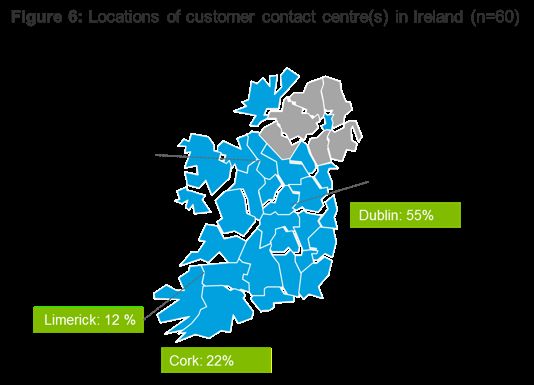
From our research, it’s clear that
    Ireland’s customer contact sector is
    important in terms of employment,
    regional development and providing
    a platform for participation in
    multiple industries.

2
CONTENTS
FOREWORD 3
Research approach 4
Research respondent profile 4
Market context 6
KEY FINDINGS 8
Ireland is an important global hub for customer service talent 8
Requirement for language and technical skills drives use of external
recruiters 10
Traditional resources models remain in play 12
Reward is a pull factor impacting retention 13
The role of the customer contact centre is changing 15
Emphasis on cultivating talent and a distinctive culture 17
BPOs supporting flexibility and cost reduction in the sector 20
CONCLUSION 21
APPENDIX 23
Index of survey questions 23
Contacts 26
IRELAND'S CUSTOMER CONTACT SECTOR: ENGAGING TALENT IN A CHANGING ENVIRONMENT 1The ob
report jective of this
i
benchms to provide a
talent m ark of lead in
practic anagement g
e
unders s and develo
t p
of the and ing of so an
k m
are sha ey factors th e
ping th a
e secto t
r.
2FOREWORD Ireland’s Customer Contact Management Association (CCMA) has partnered with Deloitte Consulting to develop a point of view on talent management in Ireland’s customer contact sector. We are pleased to share with you the key findings from our research and executive discussions. Irish business leaders are facing changes and unique challenges in the talent landscape. Talent is a key strategic and competitive pillar for most customer contact and shared services organisations, and therefore the processes and infrastructure that enable the attraction, development, and retention of talent are critical to long-term success. The objective of this report is to provide a benchmark of leading talent management practices and develop an understanding of some of the key factors that are shaping the sector. From our research, it’s clear that Ireland’s customer contact sector is important in terms of employment, regional development and providing a platform for participation in multiple industries. There is a strong focus on improving talent management practices, in the context of business change and the competitive market for talent. A number of challenges are apparent, relevant to operators and policy makers, including a need for better retention, career development and workplace engagement. There are constraints in staff availability, particularly for certain language coverage as well as over concentration of activity in certain urban locations. This report details the findings of our research. Thank you to the organisations and executives that contributed to the research - your insights were instrumental in developing the report. We hope you find this report useful in your work, and we look forward to engaging with you around the findings to help you understand the implications to your business. Cormac Hughes Partner, Human Capital, Deloitte Dorothy O'Byrne Managing Director, CCMA Ireland IRELAND'S CUSTOMER CONTACT SECTOR: ENGAGING TALENT IN A CHANGING ENVIRONMENT 3
Research respondent
Research approach                                              profile

                                                               The majority of the survey respondents are CCMA

    ...Deloitte conducted                                      members and were highly responsive to the research
                                                               request (98% response rate, n=60). The 15 executives
    in-depth quantitative                                      interviewed for the research study were carefully
                                                               selected to provide a comprehensive view of the sector
    and qualitative                                            and are all from organisations that participated in the
                                                               survey. All the responses have been anonymised and
    research gathering                                         aggregated to provide key trends and themes related to

    data and insights                                          talent management and sector trends.
                                                               • Company type: The majority of respondents (62%)
    from business leaders                                        represent multinational subsidiaries, followed by Irish
                                                                 owned private companies (30%), and then by Irish
    with customer                                                owned public companies (8%) (Figure 1), highlighting

    contact operations in
                                                                 the strong presence of Foreign Direct Investment (FDI)
                                                                 in the Irish market.

    Ireland.                                                   • Primary industry: The leading industry represented
                                                                 in the survey responses is Technology/ Media/
                                                                 Telecommunications (TMT) (20%) (Figure 2),
    To develop this report, Deloitte conducted in-depth          which also has the highest use of Business Process
    quantitative and qualitative research gathering data and     Outsourcers (BPOs). Insurance (15%), Financial
    insights from business leaders with customer contact         Services (15%), and BPOs (15%) are also strongly
    operations in Ireland. Deloitte followed a three pronged     represented in the survey respondents. Of the BPOs,
    research approach:                                           the leading sectors those organisations serve include
                                                                 TMT (89%), Public Sector (44%), and Energy Utilities
    • Sector survey: Designed and fielded a survey to 60
                                                                 (44%).
      organisations to gather benchmarks and leading
      practices across a number of talent management           • Company size and scale: Survey respondent scale
      dimensions, including recruitment, training,               in terms of overall FTE numbers show representation
      development, performance, and reward practices.            between large multinationals with over 5,000
                                                                 employees to smaller Irish owned private companies
    • Executive interviews: Conducted interviews with 15
                                                                 (Figure 3). The large majority of respondents (60%)
      executives from a range of organisations in the sector
                                                                 have customer contact operations of less than 250
      to gain a perspective on the strategic priorities and
                                                                 FTEs.
      challenges shaping the customer contact sector in
      Ireland.
    • Market data and insights: Analysed recent published
      research and reports on related topics such as, global
      human capital trends, global customer contact trends,
      and Ireland’s economic and talent landscape in order
      to understand the macro factors influencing talent
      management in Ireland.

4
Figure 1: Survey respondent company type (n=60) Figure 2: Survey respondent primary industry (n=60)
TMT 20%
62% Insurance 15%
Financial Services 15%
BPO 15%
Other 13%
Retail / Consumer Products 8%
30% Travel / Hospitality 3%
Logistics / Transport 3%
Life Sciences 2%
8% Professional Services 2%
Manufacturing 2%
Energy / Utilities 2%
Multinational Irish Owned Private Irish Owned Public
Figure 3: Survey respondent size of company and Irish contact centre
operations (n=60)
Ireland Customer Contact Operations
Entire Organisation
> 5,000 5%
22%
3,001 - 5,000 0%
5%
Number of FTEs
1,001 - 3,000 3%
22%
501 - 1,000 7%
12%
251 - 500
25%
20%
< 250
60%
20%
IRELAND'S CUSTOMER CONTACT SECTOR: ENGAGING TALENT IN A CHANGING ENVIRONMENT 5Market context
Our research has been conducted against the backdrop of US companies with overseas parent companies to
of a changing environment in terms of global economic avoid paying taxes in the US.2 The proposed change
instability, volatile financial markets, and technological in regulation will force US companies to reassess
advances which disrupts the way in which organisations their overseas location strategies, which could have
do business. This environment directly impacts Ireland’s a direct impact on Ireland. This may place a greater
customer contact sector in a number of ways. onus on Ireland’s talent market to be a differentiator
for US companies in selecting where they would like
• Talent management trends: Deloitte’s 2016 Human
to do business. In addition, the European Court of
Capital Study identified three key trends which are
Justice recently ruled that insurance companies must
relevant to Ireland’s customer contact sector.1
pay value-added-tax (VAT) on the value of work that
–– Organisational design: Organisations are moving
has been outsourced this includes activities such as
away from functional models and turning their focus
handling claims and other back-office functions.3 This
to interconnected and agile teams. In our customer
new ruling may impact the decisions of insurance
contact research talent management study, this
companies intending to outsource back-office
trend was highlighted in the development of "super
functions.
agents", with the ability to work across multiple
areas. In the BPO sub-sector, agents are working • Changes in consumer behaviour: Consumers’
across different customers to meet seasonality expectations for improved customer experience
requirements for their clients. and increased company engagement through
–– Leadership: The Deloitte Global Human Capital new channels (e.g. social, mobile) is reshaping
Trends report describes a “leadership gap”, customer contact operations. The shift from phone
identifying challenges with the development of to digital channels is continuing at pace. Deloitte
future leaders and the quality of the leadership Global predicts that in 2016 26% of smartphone
pipeline. “The traditional pyramid-shaped leadership users in developed markets will not make any
development model is simply not producing traditional phone calls in a given week. We call these
leaders fast enough to keep up with the demands individuals “data exclusives”. They have not stopped
of business and the pace of change.” This can be communicating, but rather are replacing traditional
a particular challenge in the customer contact voice calls with a combination of messaging, voice
environment where leadership opportunities for and video services. The data exclusive contingent was
team lead or manager positions may be limited 22% of all smartphone users in 2015, and 11% in
where there is a large span of control and multiple 2012.4
successors.
• Advancements in technology: Globally, customer
–– Engagement: The world of culture and employee
contact organisations are investing in new
engagement is here and has become one of the
technologies such as web chat, video chat, virtual
most important trends to address. Fast and frequent
assistants, and collaborative browsing. This shift in
employee feedback surveys are being introduced
technology and channels is having a slowing impact
(e.g. pulse surveys), as well as anonymous social
on the growth of voice-based interactions.5 There is
tools and regular feedback check-ins by managers.
a growing emphasis on customer data and analytics
In our study, the executive interviews found that
to monitor and optimise business operations and
daily stand-ups with the team, 1-on-1 feedback
customer interactions. Automation through new
sessions, and call listening are important connection
technology such as Robotic Process Automation (RPA),
points for the team. We also heard of “community
is a strategic priority for shared services and global
of practice” sessions, run by team leads or agents in
business services leaders.6 This technology may be
a lunch and learn style environment.
used to process particular transactions, manipulate
• Changes in regulation: In April 2016, the United data or even to mimic conversations through chat-bot
States (US) Treasury Department announced that it is technology.
taking action to curb inversions by limiting the ability
Deloitte Global Human Capital Trends Report; 2016 (7,000 survey responses across 130
1
countries)
2
US Treasury Press Release, Treasury Announces Additional Action to Curb Inversions, Address
Earnings Stripping; April 2016 https://www.treasury.gov/press-center/press-releases/Pages/
6 jl0405.aspx• Economic factors: Economic recovery experienced more than 20%. Those respondents which expect to
in Ireland has been focused in urban locations with decrease FTE numbers (13% of respondents) reported
slower recovery in the rest of the country. The arrival a potential decline of 1-9%. Collectively, respondents
of top global technology companies has raised the reported an expected increase of 1,000-1,200 jobs
profile of Dublin as a prime location to establish in the next 2 years, it is important to note that this
business operations. While this is a positive story, it projection is based solely on survey responses. This
does bring challenges for the supply of talent and for represents a portion of the sector and therefore it is
policy makers to share this growth beyond Dublin. not unreasonable to assume that this is a conservative
This growth has impacted the access to affordable estimate.
housing in Ireland. Currently, there is a lack of access
• Implications for Ireland’s customer contact
to affordable rental accommodation, analysis by the
sector: As a sector now, more than ever, there is a
Economic Social Research Institute has indicated
need for a collaborative approach in addressing the
that it could be 2018 or possibly 2019 before Ireland
demands of the market, the economy, technology and
reaches its desired supply of 25,000 units in the rental
regulation. As we see in this report, there is much to
market. In the meantime, prices for rental properties
be positive about as a sector; however, risk mitigation
will rise. This will serve to challenge the labour market
at the macro level will be difficult to manage for one
in certain cities in Ireland and may have a knock on
organisation alone. Organisations will benefit if they
effect of driving wage inflation.7
invest in their people and allow them to develop in
• Growing number of jobs in the sector: Of the 60 line with advances in technology as well as advances
organisations that responded to our survey, 55% in the role of the customer contact centre. For
of respondents expect full-time-equivalent (FTE) example, moving towards more value added services
numbers in their Irish customer contact operation enabled by leading edge technology and executed by
centres to increase in the next 2 years (Figure 4). 70% top talent.
of Irish owned private companies will increase FTEs
in the next two years. There is strong FTE growth
predicted in Ireland’s BPO organisations, with 70%
of BPOs surveyed expect to increase FTE numbers by
Figure 4: Expected change in number of Ireland FTEs in the next 2 years (% of respondents) (n=60)
7%
13%
Expected change in FTEs % of respondents
Increase 1-9% 25%
55%
Increase 10-20% 17%
25%
Increase by more than 20% 13%
Increase No Change Decrease Don't Know
3
Irish Times Article, Borrowed Time Running out for Insurers; April 2016
http://www.irishtimes.com/business/financial-services/
cantillon-borrowed-time-runnning-out-for-insurers-1.2595586
4
Deloitte Technology, Media & Telecommunication Predictions Report; 2016
5
Gartner Market Trends in Customer Management Report; 2015
6
Deloitte ‘The Robots are Coming’; 2015
7
Kieran McQuinn, ESRI; 2016 IRELAND'S CUSTOMER CONTACT SECTOR: ENGAGING TALENT IN A CHANGING ENVIRONMENT 7KEY FINDINGS
Ireland is an
important global hub
for customer service 22%
talent US & Canada
Talent in Ireland’s customer contact centres are serving
customers across the globe. As the sector grows and
more career opportunities in Ireland become available,
additional challenges and complexities emerge for the
sector with regard to talent management. Organisations
are establishing operations in new Irish locations,
competition for talent is increasing in certain areas, and
new talent is coming to Ireland from across the world.8
• Serving the global market: The survey reaffirmed
that customer contact centres in Ireland are serving
customers globally. The leading regions served
by Ireland’s customer contact operations include
Ireland (92%), the UK (52%), Western Europe (37%),
Eastern Europe (27%), and the US & Canada (22%).
Respondents indicate that there are customers served
in Asia Pacific, Africa, and Latin America as well
(Figure 5). This wide global reach places demands
on customer contact operations to deliver a diverse
range of languages as well as customer and regional
understanding. While the majority of respondents
reported their agents are of Irish nationality (64%)
there is a notable diversity of talent coming from
different areas of the world—other European
countries (27%), Americas (4%), Asia Pacific (3%), and
Africa (1%). The most common languages supported
ecosystem has been developed where multinationals
according to survey respondents include English
and indigenous companies co-exist and support the
(100% of respondents), French (34%), Spanish (32%),
development of talent at a regional level. For example,
German (29%), Italian (27%), Polish (24%), and Dutch
the South East has developed a strong reputation
(22%). Other languages supported include Swedish,
in the Financial Services and Insurance industries for
Portuguese, Russian, Irish, Chinese, Korean, Japanese,
developing and delivering best in class customer sales
Taiwanese, Arabic, Turkish, Hungarian, Finnish, Flemish,
and service.
Danish and Norwegian.
• Talent supply in main urban locations is
• Customer contact operations in Ireland have
challenged: The executive interviews highlighted that
broad geographical reach: The customer contact
the available talent pool in the Dublin and Cork areas
sector reaches all areas of Ireland. The majority of
is particularly challenged. Business leaders suggest
survey respondents have customer contact operations
that there are many organisations seeking talent
in Dublin (55%), followed by Cork (22%) and Limerick
“from the same pool” and competition for resources is
(12%); however, there are operations present across
high. Dublin has attracted some of the world’s largest
the country (Figure 6). There is a concentration of
TMT companies. However, this needs to be managed
operations in urban locations, providing high demand
to ensure there is an adequate supply of talent to
on talent pools in those areas. In the context of
meet the needs of the market. This issue has seen FDI
overall industrial planning, the sector offers a unique
companies look outside of the main urban areas in
opportunity to create employment and support
order to obtain talent and manage office space and
the growth of member organisations beyond the
labour costs.
main urban locations. In certain locations a strong
8
CSO figures from August 2015 highlighting that net inward migration among non-Irish
nationals grew for the third year in a row, from 7,900 to 11,600. Ireland’s Central
Statistics Office; August 2015 http://www.cso.ie/en/releasesandpublications/er/pme/
8 populationandmigrationestimatesapril2015/52% 37%
UK
Western
Europe
92%
Ireland
27%
Eastern
Europe
17%
Asia Pacific
15%
9% Africa
Latin
America
Figure 5: Region(s) served by Irish customer contact centre(s) (n=60)
• Access to housing is beginning to influence
location strategy: Access to housing is an issue for
2 DONEGAL
talent and this has been well documented in the
2 SLIGO
media and is reinforced by the study. One executive
2 LEITRIM
stated “the housing crisis is a big problem in Dublin
2 CLARE
and Cork as we’re bringing [talent] in from Europe.”
2 KILDARE
Senior executives in the two main urban locations of
2 LOUTH
Dublin and Cork highlighted that they are investing
4 GALWAY resources into the acquisition of suitable housing
4 KERRY arrangements for their staff. This comes in the form
4 KILKENNY of house sharing initiatives as well as purchasing
properties in some cases. Although not one of the key
5 WESTMEATH
reasons, 4% of survey respondents indicated access to
6.5 NORTHERN IRELAND affordable housing as an issue for attrition.
7 WATERFORD
12 LIMERICK
22 CORK
55 DUBLIN
IRELAND'S CUSTOMER CONTACT SECTOR: ENGAGING TALENT IN A CHANGING ENVIRONMENT 9Requirement for language
and technical skills drives
use of external recruiters
Recruiting practices in the sector are a main topic for • Recruitment agencies provide access to skills
discussion as requirements for talent continue to evolve, and flexibility: Over half of the survey respondents
competition for customer contact talent rises, and (55%) indicated that their organisations use external
the desire to reduce recruiting lead times is apparent. recruiting agencies for customer contact talent
Respondents reported the majority of employee recruitment in some capacity. The survey highlighted
recruitment occurs in house, with increasingly emphasis that respondents use recruitment agencies for a
on internal promotions and referrals. Recruitment diverse set of reasons – access to specific technical
agencies are used in cases to provide access to certain skills, increased flexibility and access to a recruitment
skill sets (e.g. technical, language), access to recruitment infrastructure were the leading drivers (Figure 8).
infrastructure, and increase flexibility. The executive interviews suggested that recruitment
agencies are commonly used for Manager or Senior
• Direct hiring the preferred channel: Through the
Manager level hires as well as to quickly scale select
survey, we examined the various recruitment methods
language skills. For organisations that serve multiple
adopted by respondents. Our survey revealed that
languages in their contact centres, access to talent
FTEs were most frequently hired through direct
with the required language was the leading reason for
channels (47%), followed by internal promotions
leveraging an external recruiting agency.
(20%) (Figure 7). A number of the executives
interviewed highlighted that internal promotion was
“central to their culture of personal development and
career advancement.”
Figure 7: Breakdown of employee recruitment channels (n=58) Figure 8: Reasons for using an external recruiting agency (n=33)
Aggregate of total survey respondent employees Respondents were asked to rank top 3 reasons
47% Access to specific technical skills 9 6 7
Increased flexibility 5 7 8
Access to infrastructure (e.g. recruiters) 4 6 7
Risk reduction 1 8 7
20%
16% 15% Access to specific language skills 11 2 1
Shorter recruitment lead time 2 2 1
2%
Cost reduction 2 1
Direct hiring Internal Employee Recruitment Other
promotions referrals agency Other 1 1
Priority 1 Priority 2 Priority 3
10• Access to language skills an acute issue for • Average hiring lead time by process area is broadly
some respondents: Our discussions with executives consistent: The average hiring lead time did not vary
highlighted that where multi-lingual skills are required, by more than one week across the various process
this is an acute recruitment issue. One executive areas examined by the survey. Front office – technical
states that their “single biggest challenge is language roles require the longest average lead in time at 5.2
skills– the demand higher than supply.” Over half of weeks (Figure 10).
the survey respondents (55%) only required English
speaking agents to serve their customer contact
Figure 10: Average lead time in weeks by service (n=60)
requirements. As one would expect, the lead time for
recruiting multi-lingual staff is longer than that for
5.2
English only speakers. Figure 9 illustrates that German 5 5
4.7
and Dutch, on average, take the longest average 4.2
time to recruit with approximately 7 weeks lead time.
With recruiting efforts bringing talent from all over
the world, comes unique challenges with managing
the complexities of immigration to Ireland. Executives
describe the challenges in hiring lead times “work
permit processing [time] is the single biggest problem,
which can take up to 12-14 weeks.”
Front office - technical Front office - sales Internal / back office Front office - customer Collections
service
Figure 9: Average lead time in weeks by language (n=60)
8.0 70
6.9 6.7
7.0 60 60
6.0
6.0 5.6
5.3 50
5.0
5.0 4.6
40
4.0
30
3.0
20 19 20
2.0 17 16
Recruitment
13 14
1.0 10
agencies are used
0.0 0
German Dutch French Italian Polish Spanish English
Average lead time by language
Number of organisations that support language
in cases to provide
access to certain skill
sets (e.g. technical,
language), access
to recruitment
infrastructure, and
increase flexibility.
IRELAND'S CUSTOMER CONTACT SECTOR: ENGAGING TALENT IN A CHANGING ENVIRONMENT 11Traditional resources
models remain in
play
In order to understand the typical agent profile in
Ireland’s customer contact sector, survey respondents
were asked to provide a breakdown of their employees
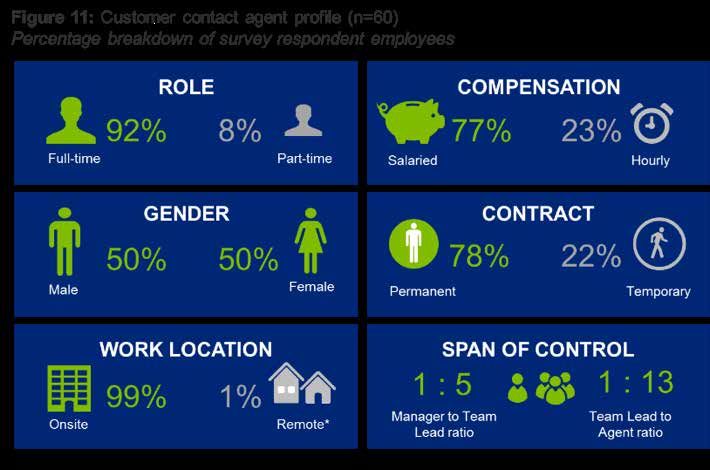
across several dimensions (Figure 11). Approximately
60% of survey respondents reported that their average ROLE
agent is under the age of 29 years old. With Millennials
making up more than half the workforce, these
employees bring new expectations for their career roles,
92 %
FULL-TIME
work location, and compensation. 8 %
PART-TIME
• Full-time / permanent roles prevail: The research
highlights that traditional resource models remain GENDER
in play. Organisations rely mostly on full-time (92%),
50
permanent (78%) employees. The focus on full-time
permanent employees allows organisations to further %
invest in its talent which can lead to increased
employee satisfaction. From the executive interviews,
a theme emerged for certain industries—during
50
MALE
%
FEMALE
Ireland’s economic crisis, some organisations had to
increase the number of temporary contracts offered WORK LOCATION
to employees. An executive described the company’s
recent transition to permanent contracts—“last year, % %
we got permission to convert 20% of our fixed term
contract to permanent. We issued a [satisfaction]
99 1
ONSITE OFFSITE
survey [to employees] and ranked high.”
• Work from home yet to take hold: Interestingly,
the figures for employees working remotely /
from home are quite low. One of our respondents
explained that working from home is a key part of COMPENSATION
their strategy—“we want to make it easier for people
to stay with us and be happy to work with us. We
think [working from home] really drives retention
and satisfaction for our team”. In the context of the
issues outlined previously around house prices, the
work from home option represents an opportunity for
77 % 23 %
Irish customer contact operations to explore further,
SALARY HOURLY
however, this becomes more difficult to support at CONTRACT
the Team Lead / Manager level. In our interviews,
executives highlighted the large infrastructural
investments required as well as regulatory and
78 %
PERMANENT
compliance issues – this is a particular concern for
Financial Services organisations and BPOs responsible
for sensitive customer data. However, work at-home
22 %
TEMPORARY
models have existed in the UK and the US for ten
years or more, particularly amongst some BPOs SPAN OF CONTROL
offering a flexible work solution to employees as well RATIOS
as a low cost base to pass on to clients. 1:5
MANAGER TO
1:13
TEAM LEAD TEAM LEAD
TO AGENT
12Reward is a 'pull
factor' impacting
retention
Reward is a hot topic in most professions and Figure 12: Change in starting salary and annual bonus for
particularly in a post-recession environment, the survey customer contact agents from 2014 to today (n=58)
responses highlight that there has been some correction
Bonus
in base pay with modest salary increases in line with Decreased by more than 5%
the market. There is an expectation that a competitive 2% Salary
package in line with the market will be offered,
5%
however it is clear from the executive interviews and the Decreased by 1-5%
2%
responses on reasons for attrition that reward is one of
a number of factors to be considered in attracting and 65%
No noticeable change
retaining talent. 36%
• Salary shifts in line with market: Figure 12 20%
Increased by 1-5%
highlights that the sector has seen modest increases 57%
in starting salaries since 2014. 57% of respondents
indicated that there has been an increase of 1-5% 5%
Increased by more than 5%
5%
which is in line with expected market increases (from
2014 to 2016 expected) on hourly labour costs
of circa 2.5%.9 It is noticeable that in the case of • Average salary benchmarks: Survey respondents
bonuses there has been less movement, with 65% were asked to report the average salaries for the
of respondents reporting no noticeable change since customer contact operations talent by particular skill
2014. sets and years of experience. Multi-lingual agents
• Reward is a talent “pull” factor: Some executives with more than 3 years of experience will typically
highlighted that base salary in particular is being used command salaries in the higher range (average of
as a pull factor to attract talent. Wage inflation in the €25.2k); however, there is a wide range of salaries
Dublin market has seen some movement between for this cohort ranging from €19k to €34k and above
organisations, this is backed up by the reasons for (Figure 13). It was noted by one of the executives
attrition, where reward is ranked as the second that “international hires do not wish to be hired for
highest reason for attrition by respondents. However, language skills alone and they are keen to develop
there was a belief amongst the executives interviewed technical and industry specific skills which we are
that attrition related to reward in particular can mindful of.” The results for English only speakers with
be mitigated through robust career planning. This less than 3 years of experience is more concentrated
demonstrates a commitment to employees that your around the €19k to €24k bracket, the variability
organisation is investing in their future through skills will arise due to geographic location or the level of
advancement and a focus on internal promotion. technical skill required for the role.
Figure 13: Average starting salary by experience and language skills
Figure 13: Average starting salary by experience and language skills
25 Average salary n
25 English speakingAverage
only salary
agent, n
€22.5k 59
less than 3 years of experience
English speaking only agent,
€22.5k 59
20
less than
English 3 years
speaking of experience
only agent, 3
€24.0k 57
20 years or more of experience
English speaking only agent, 3
€24.0k 57
years or more
Multi-lingual agent,ofless
experience
than 3
15
€23.8k 27
years of experience
Multi-lingual agent, less than 3
15
€23.8k 27
years agent,
Multi-lingual of experience
more than
€25.2k 27
3 years of experience
10
Multi-lingual agent, more than
€25.2k 27
10 3 years of experience
5
5
0
18k and 19k - 21k 22k - 24k 25k - 27k 28k - 30k 31k - 33k 34k and
0
below above
18k and 19k - 21k 22k - 24k 25k - 27k 28k - 30k 31k - 33k 34k and
9 below
Economist Intelligence Unit, Wage and Price Inflation; March 2016 above
IRELAND'S CUSTOMER CONTACT SECTOR: ENGAGING TALENT IN A CHANGING ENVIRONMENT 13• Bonus measures predominantly based on Figure 14: Bonus / performance payment methods for front office
individual targets: Our research also focused on sales agents (n = 51)
methods of bonus / performance related payments
Fixed commission on set individual targets 37%
offered to front office sales agents specifically.
Figure 14 highlights that there is a strong focus on Percentage commission on individual sales 31%
individual targets with 31% of respondents offering No bonus / performance payment offered 24%
fixed commission on individual targets and 32% of
respondents offering a percentage commission on Perfomance related pay / bonus 10%
individual sales. Percentage commission on sub-team targets 6%
• Traditional recognition items deemed most Fixed commission on set sub-team targets 6%
effective: The data highlights that traditional Cash Bonus 4%
recognition methods such as team parties, gift cards /
prizes and cash incentives are perceived as the most Meeting indivudial targets 4%
effective forms of acknowledgement. The executive
interviews also highlighted new developments in
recognition programmes, such as trips to international
sites and sponsorship of specific training, which have
been very popular amongst employees.
Figure 15: Reward and recognition methods for employees (n=60)
100% 2
8 6
90%
15 18 3
80% 25 27
1
70% 2 41
60%
6 2
50%
49 52
40%
41
40
30%
29 31
20%
19
10%
0%
Cash or bonus Catered meals Flexible work Gamification Gift cards or Parties / Personal time
incentives environment (e.g. social prizes celebrations off (PTO)
challenges,
badges)
Effective Ineffective Not used
14The role of the
customer contact
centre is changing
In today’s world, consumers are driving the buying • Digital channels driving efficiencies: An emerging
process and organisations strongly focus on fostering theme through our conversations with executive
and maintaining customer relationships. Customer leadership, is the move for organisations to “retain
service in a digital age has driven organisations to customers in a more cost effective way” and one
change how they interact and engage with customers.10 way this will be accomplished is through the use
Digital disruption continues to transform the role of of digital channels. Some executives agree that
Ireland’s customer contact centres and its agents, “[customers] want to exhaust all of their options
directly impacting the skillsets and the technology before they use the phone” and these organisations
required for agents to perform their changing are refocusing their strategy around digital channels.
role. There is a clear shift in how customer contact However, certain industries such as financial services
centres are branded in their organisations and in the and business process outsourcing, still heavily rely
marketplace, with some now known as “Centres of on phone interactions due to the nature of the
Excellence” in customer experience and service. A major activities conducted and regulatory constraints. Survey
challenge for executives is striking the right balance of respondents reported approximately 48% of total
providing superior omni-channel customer experience customer contact volumes in 2015 were supported
while keeping an eye on the bottom line. by phone. Email and Interactive Voice Response (IVR)
were reported as the second and third most frequently
used channels, representing 17% and 15% of total
customer contact volumes in 2015, respectively.
A major challenge (Figure 16). The move to self-service channels is
for executives is gradual, but now more than ever before, “customers
want to do things themselves”. 16% of survey
striking the right respondents will introduce IVR and 5% of respondents
balance of providing will introduce other self-service channels in the next
12 months. Several executives interviewed indicated
superior omni- their organisations are “looking to deflect [customer
contacts] to self-service channels in coming years” and
channel customer reduce the number of phone interactions.
experience while
keeping an eye on
the bottom line.
Figure 16: Percentage of respondents 2015 total contact volume by channel (n=60)
Figure 16: Percentage of 2015 total contact volume by channel (n=60)
2% 2%
4%
2% 2%5% Video
4% Multimedia Messaging Services (MMS)
7%
5% Short Message Services (SMS)
Video
Social Media (e.g.
Multimedia Twitter, Facebook)
Messaging Services (MMS)
48% 7% Mail/Fax
Short Message Services (SMS)
WebSocial
Chat Media (e.g. Twitter, Facebook)
48% 15% Online
Mail/Fax
Interactive
Web ChatVoice Response (IVR)
15% Email
Online
Phone
Interactive Voice Response (IVR)
17% Email
Phone
17%
10
Deloitte Delivering the Digital Contact Centre; 2015
IRELAND'S CUSTOMER CONTACT SECTOR: ENGAGING TALENT IN A CHANGING ENVIRONMENT 15• Web chat is gaining traction: While web chat • Agent roles are becoming increasingly complex: As
represents a small percentage (5%) of survey transactional enquiries move to self-service or outsourced
respondents’ 2015 customer contact volume, 50% channels, customer contact centre agents have
of respondents plan to introduce web chat in the additional time to provide more valuable and complex
next 12 months. Globally, leading organisations have services to customers. Survey respondents indicated
found ways to effectively manage the cost of web that the top three skill sets required of customer contact
chat interactions, reducing cost per contact while agents are verbal communication skills, the ability to
maintaining CSAT as compared to phone.11 In some work on a team, and relevant prior work experience
instances for Irish customer contact centres, web chat (Figure 17). As customer contact roles become more
is replacing email interactions. As web chat volumes multifaceted, additional training is required for talent.
continue to grow, organisations will need to consider Some organisations are changing their recruitment criteria
key operational improvements to increase efficiency as a result, moving away from hiring for technical skill
and quickly assess the skills required (e.g. standardise set, and focusing on candidates with communication
chat processes, match staff to demand, improve and “customer service skills.” Some views the executives
performance management) as well as prepare for expressed is that it is “easy to train the technical skills, but
the future evolution of chat interaction models (e.g. we are looking for emotional intelligence.”
unified omni-channel experience, digital personas for
advisors, customer advisor, etc.).
• Limited engagement through social media Figure 17: Importance of skills when recruiting agents (n=60)
channels: Survey respondents reported that social Respondents were asked to rank top 3 skills for agents
media channels accounted for less than 2% of
Verbal communication skills 22 20 8
2015 volumes (Figure 16). 20% claimed they will
be introducing engagement through social media Ability to work in a team 11 16 20
channels in the next 12 months. Executives realise the
importance social media plays when understanding >2 years relevant prior experience 7 6 10
and interacting with customers; however, the impact Written communication skills 8 8
on customer contact centres has been gradual. As one
executive stated, “I think [the customer contact sector] Technology skills 3 5 8
still has a way to go in terms of customer service via
Language skills 10 3 3
social media.” Most organisations are still navigating
what role social media should play in their customer Customer service / emotional intelligence 6 2 2
service strategy. A number of Irish organisations are
Other 11
cultivating small specialised teams focused on this
channel, which often work closely with marketing Priority 1 Priority 2 Priority 3
teams.
16 Deloitte Digital Survey. Usage and Operation of Click-to-Chat for Customer Interactions; February 2016
11Emphasis on
cultivating talent
and a distinctive
culture
It’s growing increasingly important for employees to feel
connected to the business and its customers. Globally,
business leaders are focused on understanding and
creating a shared culture, designing a work environment
Training and development
that engages talent, and constructing a new model of
career development. Deloitte’s 2016 Human Capital
of employees can be a key
Global Trends report states “executives are embracing differentiator in attracting
digital technologies to reinvent the workplace, focusing
on diversity and inclusion as a business strategy, and
and retaining talent for
realising that without a strong learning culture, they Ireland’s customer contact
will not succeed.” Increased competition for skilled
talent in Ireland’s customer contact sector is also driving
organisations.
organisations to focus on training, development, and
culture.
• Investing in training and development: Training
Figure 18: Required learning hours per agent per year (n=60)
and development of employees can be a key
differentiator in attracting and retaining talent for 26% 26%
Ireland’s customer contact organisations. Most multi-
national organisations have access to global learning
programmes and teams and some organisations in 17% 17%
Ireland are investing in local learning and development
teams. One executive stated “I have a big training 11%
budget this year, and we’re providing agents with
opportunities to gain certifications. [The certifications]
4%
are hugely rewarding for their career.” 43% of survey
respondents reported that their organisations have
at least 40 hours of required training for its agents No required Less than 10 10-19 hours 20-39 hours 40-59 hours Greater than 60
learning hours hours hours
(Figure 18). Another executive describes their
organisation having “a big culture of performance
coaching. We are heavily invested in this. It takes a lot
Figure 19: Methods for ongoing training of customer contact agents (n=60)
of effort to maintain—providing 7 weeks’ worth of
training before [agents] can talk to a customer.” Some
100% 2 2
executives expressed that investment in developing 1
90% 6 11
and up skilling talent will have a positive effect on
20
employee engagement in the organisation. When 80%
32 11
it comes to the methods of training used (Figure 70%
19), the most frequently used and effective training 60%
5
methods are internal instructor led programmes
50% 58
and instructional guides / reference materials. 8 52
40%
18% of respondents question the effectiveness of
38
unstructured informal training. 89% of BPOs provide 30% 35
28
their agents with formal client training, which 20%
demonstrates the attempt to be closely integrated into 10%
their clients’ business and provide high value customer
0%
service. Client Training External, Internal, Instructional Unstructured / Virtual / Online
(BPO Only) Instructor-led Instructor-led Guides / Informal Training Training
Training Training Reference Programmes
Programmes Programmes Materials
Effective Ineffective Not used
IRELAND'S CUSTOMER CONTACT SECTOR: ENGAGING TALENT IN A CHANGING ENVIRONMENT 17• Lack of career advancement is the leading reason Figure 20: Leading reasons for employee attrition (n=60)
for attrition: Creating opportunities for advancement Respondents were asked to rank the top 3 reasons
in the organisation has emerged as key initiative for
Lack of career advancement 19 16 12
many of Ireland’s customer contact organisations.
Figure 21: Leading reasons for outsourcing (n=13)
As stated in Deloitte’s 2016 Global Human Capital Inadequate salary / wage 17 8
Respondents were asked to rank the top 3 reasons
8
Trends report, “a new social contract is developing
Return to full-time studies 5 8 12
between companies and workers…the days when Increased flexibility 2 9 1
a majority of workers could expect to spend a Work / life balance 6 Cost reduction
10 4 6 2 2
career moving up the ladder at one company are
Lack of flexibility 1 1 7 reduction
Risk 1 3
over. Young people anticipate working for many
employers and demand an enriching experience Unable to access affordable Access
housingto 1
specific
4 technical
1 skills 3 1
at every stage.” An Irish executive describes their Access to infrastructure (e.g. resources, facilities, etc.)
Management issues 4 1
1 3
internal development efforts—“we need to help To rapidly increase scale 2
talent on two fronts. Help them plan their career Lack of mentoring / career planning 1 3
Access to specific language skills 2
and help them realise that they own their career.” Retired 10 2
2015 attrition rates for survey respondents varied— To be closer to the market 1
Poor co-worker dynamics 10
the majority (56%) of respondents reported 30%. The leading
reason for talent attrition reported is lack of career
advancement, followed by inadequate salary /wage,
and return to full-time studies (Figure 20). It’s clear
that progression in role and salary is important to
employees. For organisations where a clear career
path isn’t apparent or advancement opportunities
are limited, it’s common for employees to seek
alternative employment options or return to school
to help develop or change their career. Through the
executive interviews, it’s clear that the Irish customer
contact organisations are modifying how the contact
centre “career” is perceived by employees. One CEO
describes the organisation’s hiring point of view “if
you’re looking for a job go somewhere else, if you’re
looking for a career, come to us.”
• Distinctive culture as a selling point and tool An Irish executive
for retention: This new social contract between
employers and employees leads to expectations
describes their
for rapid career growth, an exciting and flexible internal development
workplace, and a sense of purpose in the workplace.
This is driving many organisations to modify their HR
efforts—“we need
practices, culture, or leadership support to manage to help talent on two
this new workforce. A distinctive culture is another
way for Ireland’s customer contact organisations to fronts. Help them plan
brand in the marketplace and engage talent. One
Irish executive states “our company prides itself on
their career and help
human interaction and human relationships. Our them realise that they
absenteeism was shocking at the start… but now the
culture has improved and everyone has got everyone’s
own their career.”
18back. It happens naturally, the team will cover days Figure 21: Key metrics to measure talent performance (n=60)
for each other. We have built up a team who [will]
stay here.” This year’s Deloitte Global Human Capital
Average handling time 82%
Survey, executives were asked about culture and
Customer satisfaction 75%
engagement separately—and both placed near the
top of the importance list, with 86% citing culture as
First call resolution 65%
an important or very important issue. Sales volume 58%
Customer interactions handled 57%
• Key Performance Indicators (KPIs) link talent
Response time within target 52%
performance to company mission: The most
Net Promoter Score (NPS) 50%
frequently used KPIs reported by survey respondents
include average handling time (82%), customer
Customer Effort 25%
satisfaction (75%), and first call resolution (65%) Quality 8%
(Figure 21). Several executives discussed aligning Regulatory Compliance 7%
agent KPIs to their overall strategy, mission, and Attedence 2%
customer behaviours. “Every team has metrics that Productivity 2%
directly tie into the [company] mission.” There were
several discussions regarding the effectiveness of
providing individual targets for transactional metrics
such as average handling time and quality scores.
“What we used to report to in the past is not what
we are reporting on now. We don’t do quality scores
now, don’t have agent targets for average handling
time. Net Promoter Score has never been higher and
first call resolution is 15% higher than it was last year.”
Effectiveness of display boards that show relevant
metrics for agents in real-time is disputed among
executives. There are examples of where display
boards have been removed where management This year’s Deloitte
felt “agents were defeated as they walked in the
door”, but they remain an important management
Global Human Capital
information tool in certain environments. Survey, executives were
asked about culture and
engagement separately—
and both placed near the
top of the importance list,
with 86% citing culture
as an important or very
important issue.
IRELAND'S CUSTOMER CONTACT SECTOR: ENGAGING TALENT IN A CHANGING ENVIRONMENT 19BPOs supporting
flexibility and cost
reduction in the
sector
Outsourcing of customer contact operations provides Figure 22: Leading reasons for outsourcing (n=13)
flexibility and cost reduction for organisations. The Respondents were asked to rank the top 3 reasons
majority of respondents that outsource identified that Increased flexibility 2 9 1
their organisations outsource certain non-core activities
Cost reduction 6 2 2
and look to BPOs for support when they no longer
have the capacity in their internal operations. 70% Risk reduction 1 3
BPOs surveyed indicated that they experiencing positive Access to specific technical skills 3 1
growth (increasing FTEs by more than 20% in the next 2
Access to infrastructure (e.g. resources, facilities, etc.) 1 3
years), several of which discussed opening operations in
new international markets. To rapidly increase scale 2
Access to specific language skills 2
• Cost reduction and increased flexibility are the
leading reasons for outsourcing: 22% of survey To be closer to the market 1
respondents leverage BPOs to support their customer
contact operations, indicating the leading reasons Priority 1 Priority 2 Priority 3
as increased flexibility in their organisation and cost
reduction (Figure 21). Several FDI organisations cited
outsourcing as a way to rapidly scale in the right
labour markets. The leading industry for Ireland’s
BPOs is TMT, with over 90% of BPOs surveyed serving
this market. Figure 23: Non-BPO in-house vs. outsourced services (%) (n=51)
• Outsourcing low risk transactional services: A
recurring theme that emerged from the executive Collections 37 4
interviews is that the type of work that Ireland’s
customer contact organisations seek to outsource are
non-core activities that are low-risk. One executive Internal / back office 39 3
states “we don’t outsource high risk work. [The work
we do outsource] is relatively repetitive, non-sensitive
Front office – sales 40 6
tasks.” For the organisations that currently do not
outsource, one of the main reasons cited during
the executive interviews is that they “don’t want to Front office – technical / specialised customer service 44 3
lose touch with customers.” However, some BPOs
indicated they are pushing the boundaries in providing
value-added services and integrating closely with their Front office – general customer service 47 9
clients.
10% 20% 30% 40% 50% 60% 70% 80% 90% 100%
• Respondents plan to outsource less in the next
Figure 24: Outsourcing strategy of customer contact operations in the next
12 months: In the next 12 months, only 10% of 12 months (n=51)
survey respondents plan to increase the number of Figure 24: Outsourcing strategy of customer contact operations in the next
outsourced FTEs. While 20% of respondents plan to 12 months (n=51)
decrease the number of FTEs outsourced and 60% 60%
plan to not outsource at all. Despite these reported
60%
strategies, several BPOs included in this study are
experiencing growth in their business, expanding to
new markets, and identifying areas for cross selling.
20%
20% 10% 10%
10% 10%
No outsourcing of FTEs Decreasing the number of Increasing the number of I don't know
FTEs outsourced FTEs outsourced
No outsourcing of FTEs Decreasing the number of Increasing the number of I don't know
20 FTEs outsourced FTEs outsourcedCONCLUSION
During the course of the
research we spoke with
executives and discussed
their strategic priorities
over the next 12 months -
growth, focus on customer,
cost management,
cybersecurity and regulation
were consistently on the
agenda.
Invariably, these priorities were underpinned by a
strategic pillar of talent and without the right people
their strategic priorities will not be met.
In the meantime, the way in which organisations
engage with customers is evolving and new technology
is rapidly coming on stream. This will change how
organisations configure and how they cultivate the skills
required to serve their customers.
GROWTH FOCUS ON COST CYBERSECURITY
CUSTOMER MANAGEMENT
At a strategic level, the customer contact sector has an
opportunity now to move towards more value added
services, leveraging artificial intelligence technology and
predictive analytics which will provide greater customer
service and better insights for the business while also
reducing costs. For example, some of the world’s larger
outsource organisations are piloting robotic process
automation for certain back office processes – these
changes are happening now.
IRELAND'S CUSTOMER CONTACT SECTOR: ENGAGING TALENT IN A CHANGING ENVIRONMENT 21Conclusion continued.....
This change is forcing organisation and sector leadership
to consider how they can influence at a macro level in
three key ways:
• Informing the skills development of the future
talent pool through internal investment and
planning, cooperation with the third level sector and
government bodies
• Attracting talent to the sector from Ireland and
abroad through partnership programmes, global
mobility schemes and cooperation with state bodies
• Influencing location strategy to ensure an
adequate supply of talent with an appropriate
infrastructure and cost base for businesses and
employees (e.g. access to affordable housing)
The results in this survey highlight that career
advancement and investing in people are central to
attracting and retaining talent. On the ground, business
leaders are working together to develop a holistic
employee proposition which goes beyond reward to
include career development and planning, work life
balance, learning opportunities and tailored recognition
programmes aligned to organisation culture and
employee development goals. One executive noted that,
“the customer services team has the most privileged
position in our business, they know everything about
our customers and have the most detailed insight into
how our business works. They are perfectly placed to
move into management roles in our business and add
significant value,” – the challenge now is to harness this
opportunity and deliver for the business and its people.
22APPENDIX
Index of survey
questions
1. Which of the following categories best describes − On average, 1 manager directly supervises the
your company? following number of team leads.
2. What is the size of your entire company in the − On average, 1 team lead directly supervises the
number of full time equivalents (FTEs)? following number of agents.
3. Which primary industry segment does your 18. What are the key roles / responsibilities of the
company fall under? Team Leads for your customer contact / shared
services centre(s)?
4. As a BPO, which industry segment(s) does your
organisation serve? 19. Please indicate the percentage breakdown of your
employees (full time vs. part time, male vs. female,
5. Please indicate the current size of your Irish
onsite vs. remote, salaried vs. hourly, temporary
customer contact / shared services business in
vs. permanent, internal vs. outsourced, outsourced
number of FTEs.
in Ireland vs. outsourced offshore)
6. In the next two years, will there be an increase,
20. Please rank the top 3 reasons as to why your
decrease, or no change in the number of FTEs in
organisation currently outsources.
Ireland?
21. If any, please select the language skills that are
7. For your Irish operations, please outline how the
outsourced in your organisation.
following services (front office – customer service,
front office – technical / specialised, front office – 22. Please select the answer that best describes
sales, internal / back office, collections) are your organisation's planned strategy for outsourcing
delivered. customer contact / shared services operations in the
next 12 months.
8. Please indicate the locations of your customer
contact / shared services centre(s) in Ireland. 23. What is the average lead time (in number of weeks)
for hiring customer contact / shared service agents
9. Please select the region(s) served by your Irish
in the following service areas?
customer contact / shared services centre(s).
24. Please rank the following skills in order of
10. For each contact type supported, what volume of
importance when recruiting agents for your
contacts did your organisation handle in 2015?
organisations customer contact / shared services
11. In the next 12 months, what additional centre(s).
types of contact channels will be introduced to your
25. Please indicate how your organisation currently fills
organisation's Irish operations?
vacant roles.
12. Please indicate the language(s) supported by your
26. Please select the reasons for using an external
organisation's Irish customer contact / shared
recruiting agency.
services centre(s).
27. Please mark the following methods for ongoing
13. Please indicate the average age of your agents.
training of customer contact / shared services centre
14. Please indicate the minimum education requirement agents as effective, ineffective or not used.
for an entry level agent role in your organisation.
28. Please indicate the number of required training /
15. Please indicate the minimum education requirement learning hours per agent per year.
for an entry level agent role in your organisation.
29. Please indicate the average onboarding time (in
16. Please indicate the percentage breakdown of your number of weeks) for new agents.
agents' nationality by geographical region.
30. What was the average starting annual salary in
17. Please answer the following questions regarding 2015 (excluding bonuses / performance payments)
span of control in your organisation's customer for each of the following roles in your organisation?
contact / shared services operations.
IRELAND'S CUSTOMER CONTACT SECTOR: ENGAGING TALENT IN A CHANGING ENVIRONMENT 23You can also read


