Kansas Suicide
Prevention Plan

2021-2025
←
→
Page content transcription
If your browser does not render page correctly, please read the page content below
Kansas Suicide Prevention Plan 2021-2025

Table of Contents

03 / Introduction and Purpose

04 / Dedication and In Memoriam

05 / Statement of Need: Suicide in U.S. & Kansas

12 / Methods & Means

13 / Understanding Suicide

13 / Strategic Plan Background

18 / Goals and Objectives Summary Table

32 / 5 Year Timeline At-A-Glance Table

34 / Appendix 1: Additional Resources

35 / Appendix 2: Service Members, Veterans, and
     Families Subcommittee and Governor’s Challenge
     Team Action Plan

39 / Appendix 3: Training Resources and Protocols

40 / Appendix 4: Data Considerations

49 / Appendix 5: References

50 / Appendix 6: Contributors
Introduction /
Suicide is a preventable public health concern and requires a public, behavioral
health approach to prevention efforts. Individuals, families, and whole communities
are affected when someone dies by suicide. Suicide is complex, multi-faceted, and
emotionally and financially costly. Everyone has a role to play in suicide prevention.
Work must be done to consider and change factors that are known to contribute
to suicide risk, such as adverse childhood experiences, lack of connectedness and
healthy relationships in communities, socioeconomic factors, history of suicide
attempts and ideation, access to lethal means, and lack of access to appropriate
and adequate behavioral healthcare. Partners in the State of Kansas are committed
to addressing suicide prevention using a comprehensive public health approach to
lead efforts toward reducing suicide morbidity and mortality, with special attention
to vulnerable populations with suicide rates greater than the general population.
This comprehensive approach includes elements such as:

  -          Multi-sector partnerships working within a variety of settings
  -          Continued and improved data collection to identify and prioritize
		           vulnerable populations as well as risk and protective factors that
		           impact those populations
  -          Use of evidence-based initiatives to address suicide prevention
  -          Evaluation of approaches and activities to support continuous
		           improvement and sustained impact
  -          Effective communications

Behavioral Health Services, housed under the Kansas Department for Aging and
Disability Services (KDADS), has made significant strides in building public-private
partnerships to develop and accomplish its suicide prevention goals and objectives,
and to more adequately respond to the rising crisis of suicide in the state.
Additionally, KDADS supports the Prevention Subcommittee of the Governor’s
Behavioral Health Services Planning Council in its role of contributing to, advising,
connecting, and guiding suicide prevention efforts around the state. Key partners in
suicide prevention include:

  -          Kansas Department of Health and Environment
  -          Kansas Suicide Prevention HQ
  -          Keys for Networking
  -          Office of the Kansas Attorney General
  -          Kansas Prevention Collaborative
  -          Kansas Consumer Advisory Council
  -          Kansas State Department of Education
  -          NAMI Kansas
  -          Kansas Department of Agriculture
  -          Kansas Department for Children and Families
  -          Kansas Commission on Veteran Affairs
  -          Association of Community Mental Health Centers of Kansas
  -          Individuals and families with lived experience including those with
		           suicidal ideation, suicide attempt survivors, and suicide loss survivors
  -          Local suicide prevention coalitions

The Kansas Suicide Prevention Plan (2021-2025) outlines the activities and
responsibilities necessary to accomplish suicide prevention goals and objectives
across the lifespan. The primary purpose of this State Suicide Prevention Plan is
to reduce death by suicide in Kansas. This plan will be renewed every 5 years,
with reviews occurring at least annually, as needed, and based on any significant
changes in data or resources. Annual reports will be submitted to the Governor’s
Behavioral Health Services Planning Council and the State Legislature or
Governor, providing updates on the state of suicide and prevention efforts, the
extent and effectiveness of any statute or rule related to suicide, and
emerging needs. The plan is a guide for future priorities and decisions for the
State of Kansas during the years 2021-2025. The plan addresses four strategic
directions and related goals and objectives:

      -      Healthy and Empowered Individuals, Families and Communities
      -      Clinical and Community Preventive Services
      -      Treatment and Support Services
      -      Surveillance, Research, and Evaluation

Dedication and In Memoriam /
Many people in Kansas are living with the effects of suicide every day. We think it
is important to acknowledge the pain of those who have lost someone to suicide
and the hard work of those recovering from suicide crises. All Kansans have
benefited from a diverse group of suicide prevention advocates, professionals,
first responders, clinicians and others who work passionately each day. This
document is dedicated to all of you.

This plan is also dedicated in memory of Eric Harkness and Chris Ellis for their
service to the Governor’s Behavioral Health Services Planning Council in support
of suicide prevention and behavioral health advocacy in Kansas.
“No matter where we live or what we do every day, each of us has a role
     in preventing suicide. Our actions can make a difference… We have no
                                 time to waste.”

                          -2012 National Strategy for Suicide Prevention

Statement of Need /
Suicide is a serious personal and public health problem that has far reaching
medical, economic, and psychosocial implications for Kansans. From 2015 to
2017, Kansas resident suicides cost an estimated $2.24 billion (2017 US dollars)
in medical expenses and work loss, and 46,837 years of potential life lost (YPLL) if
people die before age 751. The rate of suicide in Kansas increased by 70%
between 2000 (12.02 per 100,000 persons) and 2018 (18.6 per 100,000 persons)2.
(See Figure 1)

    Figure 1:
                         100,000

                                                                           1

The 2018 suicide rate was the highest in the last 20 years and is higher than the
national rate (14.2 per 100,000 persons), which increased 35% during the same
time period.3 In 2018, suicide was the 9th leading cause of death among all ages
and the 2nd leading cause of death following unintentional injuries for those age
15-34 years in Kansas.4 In addition, from 2015 to 2017 there were 2,055 violent
deaths (cases) among Kansas residents captured in the Kansas Violent Death
Reporting System (KSVDRS). About three quarters (73.9%) of cases were suicide
deaths (n=1,518).

1
 Kansas Violent Death Reporting System. (2019). 2015-2017 Death Circumstances Data. Kansas Department of Health and
Environment Internal Data request.
2
 Centers for Disease Control and Prevention. Web-based Injury Statistics Query and Reporting System (WISQARS) [Online]. (2003). National
Center for Injury Prevention and Control, Centers for Disease Control and Prevention (producer). Available from: URL: www.cdc.gov/ncipc/wisqars.
3
 Kansas Information for Communities (2020). 1999 and 2018 Vital Statistics Data, Bureau of Epidemiology and Public Health Informatics, KDHE.
4
  Kansas Information for Communities (2020). 2013-2017 Vital Statistics Data, Bureau of Epidemiology and Public Health
Informatics KDHE. Retrieved from http://kic.kdheks.gov/death_new.php
In addition to suicide deaths, it is also relevant to consider the number of people
who are seeking help from healthcare providers for suicide attempts and ideation.
From 2016 to 2018, emergency department visits and hospitalization rates
increased for suicide ideation related injuries. More than 17,000 Kansans sought
help in Emergency Departments for suicide attempts and/or ideation in 2018. To
deliver comprehensive suicide prevention, plans must include strategies that target
the whole population, including those people who have never experienced suicide
(universal), those at an increased risk for suicide due to heightened risk factors
(targeted), those who have thought about or planned for suicide (treatment), and
those who have experienced a suicide loss. Figure 2 indicates the relationship
between suicide thoughts, plans, and attempts among Kansas youth; this
underscores the opportunity for intervention at a variety of stages in the
contemplation process. The amount of time necessary to formulate a plan for
suicide also provides time for successful intervention.

Figure 2:

                                                        (10.75%)

Geographic Variation: Kansas is a predominantly rural state, with one-third of the
population living in two-thirds of its land mass. Suicide rates vary in different areas
of Kansas due to the size and rural nature of our state. While the highest count of
suicide deaths occurs in the urban counties of Kansas, the highest suicide rates are
found in counties with population densities low enough to be classified as
Frontier. In the map below, the Kansas Department of Health and Environment
(KDHE) has values available for counties in Kansas by population density. The
lowest rate of death by suicide per 100,000 is 0, the highest value is 57.4/100,000
(Woodson County), half of the values are between 13.9 and 23.9, and the median
value is 18. High suicide rates and low population density present a unique problem
to delivering healthcare, a barrier faced by 99 Kansas counties that are designated
mental health professional shortage areas. Only the state’s six urban counties are
exceptions from this trend1 (See Figure 3). To best meet the needs of all Kansans,
the National Suicide Prevention Lifeline provides a responsive resource that is not
dependent on proximity to brick and mortar location.

4
 Kansas Information for Communities (2020). 2013-2017 Vital Statistics Data, Bureau of Epidemiology and Public Health
Informatics KDHE. Retrieved from http://kic.kdheks.gov/death_new.php
Figure 3:

Kansans have been reaching out to suicide prevention resources, including the
National Suicide Prevention Lifeline, in increasing numbers (See Figure 4). In
addition to the National Suicide Prevention Lifeline, there are many hotlines and
crisis text lines that provide services directed toward a specific population, such
as Trans Lifeline, Trevor Project Lifeline, and Crisis Text Line. Though these crucial
resources are too plentiful to list, a subset is found in Appendix 1.

Figure 4:

Number of calls to the Suicide Prevention Lifeline by Kansas Region, 2015-2019
Race and Ethnicity: Race and ethnicity are important factors for considering
approaches to suicide prevention. There are racial and ethnic disparities present in
all aspects of suicide data, including deaths, plans for suicide, attempts, and
suicide ideation (See Figure 5).

Figure 5:

Of youth, those who identify as Multi-Racial report the highest frequency of serious
thoughts of suicide, plans for suicide, and suicide attempts5 (See Figure 5).

An average of 27% of white youth self-reported depression from 2016-2020, while
37% of Native American/Alaska Native and 38% of Multi-Racial youth reported
depression for the same time period5. Given the small number of youth suicides, it
is not possible to report on suicide death rates for the same group surveyed above.
It is important that group-specific risk and protective factors be explored and
leveraged in planning of state and local suicide prevention efforts.

Kansas data reflects a low number of suicides among Native American individuals,
although this is because the size of this population group in Kansas is too small to
produce reliable estimates. National trends suggest suicide rates tend to be higher
among Native American and indigenous populations, which may hold true for
Kansas and should be considered in discussions on suicide prevention in our state.

Non-Hispanic White people have the highest suicide rate at 19.9 per 100,000
(2016-2018)6, as presented in Figure 6.

5
  Kansas Communities That Care Student Survey. (2016-2020). Suicide Indicators by Race and Ethncity [Data]. Learning Tree
Institute at Greenbush on behalf of the Kansas Department for Aging and Disability Services]. Girard KS: Survey Publisher.
6
 Kansas Health Matters [Internet]. Topeka (KS): Kansas Partnership for Improving Community Health [cited Feb 2020], Avail-
able from www.kansashealthmatters.org
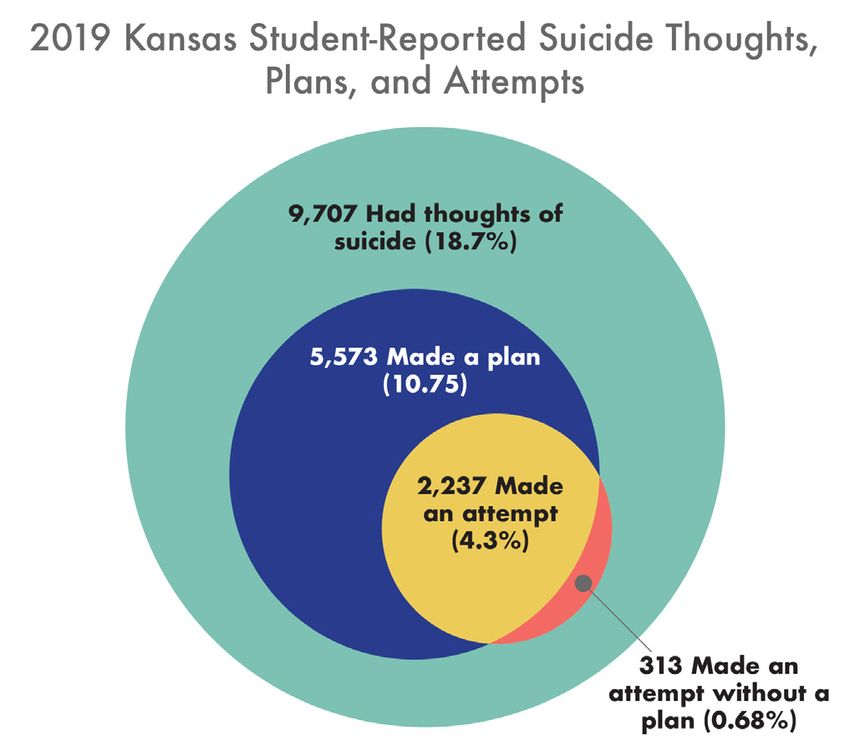
Figure 6:

Age, Sex, and Gender: Suicide prevention efforts are often siloed by age groups. It
is important to understand how Kansans of different ages are being affected by
suicide and related risk factors as this helps with prevention and intervention
planning. However, it is also important to note suicide prevention must occur across
the lifespan to make a lasting impact on this public health problem.

State level data reflects the need for a lifespan approach. Kansans aged 25-44 and
45-64 had the highest suicide rates, i.e., 25.7 and 24.9 per 100,000 respectively,
compared to other age groups. Middle-aged adults also report the highest rates of
depression, approximately 20% of 45-64 year olds. While the suicide rate for those
ages 15-24 is not as high nor has it been increasing as quickly as the age groups
previously discussed, suicide was the second-leading cause of death in this age
group in 20171. Syndromic Surveillance Data also shows that Kansas young people
visit Emergency Departments for suicide ideation and attempts the most frequently.
This trend may reflect differences in prevalence or may be indicative of the ability of
older Kansans to access a wider variety of resources for support.

Suicide affects the lives of men and women in Kansas differently. From 2015-2017,
the age-adjusted mortality rate of males (27.5 per 100,000) was 3.6 times the suicide
rate of females (7.7 per 100,000). Males make up over three quarters (78.3 percent)
of all suicide deaths in Kansas; however, suicides rates for both men and women
have been increasing at the State and National levels7 (See Figure 7).

7
    Centers for Disease Control. (2019). 2013-2017 Behavior Risk Factor Surveillance System (BRFSS) Data.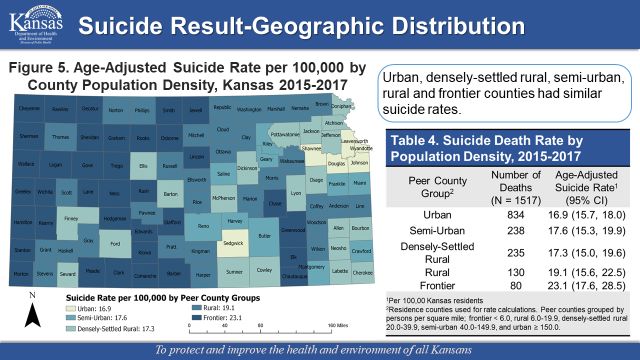
Figure 7:

    )
    (Per 1

                                                                        1
This difference in suicide by gender may suggest a need to approach prevention,
screening, and treatment in ways that address gender differences in suicide, as
supported by other statistics and research studies. Disparities in suicide ideation,
behaviors, means-utilized, and access of treatment are also observed along gender
lines. More female youth (6-12th grade) report feeling depressed (33.1%; 19.4%),
suicide ideation (17.5%; 10%), suicide plans (11.3%; 6.7%) and attempts (5.5%;
2.5%) than their male peers. In fact, more than twice the number of female
students reported attempts than male students from 2013-20174 (See Figure 7).
From KDHE’s Role of Public Health in Suicide Prevention, across age groups, more
females seek treatment in Emergency Departments than males7 (See Figure 8).

Figure 8:
                                                                                           2013-2017

9
 Kansas Violent Death Reporting System. (2019). 2015-2017 Death Circumstances Data. Kansas Department of Health and
Environment. Internal Data request.
Groups with Elevated Suicide Risk:
Effective communication and prevention efforts required targeted messaging and
promotion to historically under-resourced populations who have faced factors
leading to increased risk. Data shows that veterans, some occupational groups, and
the LGBTQ+ population are disproportionately affected by suicide. According to the
U.S. Department of Veterans Affairs, after accounting for differences in age and sex,
risk for suicide among veterans was 22% higher than the general U.S. civilian
population. In Kansas, there is an increasing trend in suicide deaths for veterans
aged 18-34 rising from 1.1 to 3.4 deaths per 100,000 from 2005 to 2017. Gulf War
Era veterans accounted for 45.9% of all veteran suicides from 2014-2019.8
According to the Kansas Violent Death Reporting System (KSVDRS), among Kansas
residents 16 or older who died by suicide the most common 6 occupations were:
• Unpaid: 13% (e.g. housewives, homemakers, students, disabled, volunteers,
patients, inmates, and those without work)
• Construction and Extraction: 11% (e.g. earth drillers, oil, gas, mining, explo-
sives, rock splitters, etc.)
• Transportation and Material Moving: 10%
• Production: 8%
• Management: 7%
• Sales: 7%
Occupation groups varied between males and females. About 30% of females who
died by suicide did not have a paying job compared to 9% of males. Males in farm,
forest, or fishing groups had highest suicide rate (158.4 per 100,000). Among
females, the highest mortality rate of workers was in healthcare support, 21.0 per
100,0001, followed by the healthcare practitioners and technical group, 13.8 per
100,000. It is important to offer occupation groups suicide prevention and
postvention resources specific to needs.
The Trevor Project recently completed a nation-wide survey of 34,000 LGBTQ+
youth. Results show that 71% of respondents reported symptoms of depression,
39% had considered suicide, and 18% had attempted suicide9. Because sexual
orientation and gender identity are not systematically recorded at time of death in
Kansas, it is difficult to understand what disparities may exist in this state. This is an
important area for research and data collection.
Kansas Veteran Administration Database exported March 6,2019
8
The Trevor Project. (2019). National survey on LGBTQ youth mental health. Retrieved from https://www.thetrevorproject.org/
9
wp-content/uploas/2019/06/The-Trevor-Project-National-Survey-Results-2019.pdfMethods & Means / The KSVDRS gives some insight into the circumstances surrounding suicide deaths. Learning about circumstances and methods used in suicides provides valuable information in targeting suicide prevention efforts, including means-access reduction strategies. For example, firearms were utilized in the majority of suicide deaths from 2015-2017, and data shows that this method is most commonly chosen by men. In addition to addressing safe storage of firearms, planning for the storage and access to intoxicating substances and medications is important as toxicology reports show that alcohol is a factor in 35% of suicides and opiates were responsible for 28% of suicide poisoning deaths. For most suicide deaths, loved ones report a number of different life stressors, mental health factors and other circumstances that could have contributed to their deaths. From 2015-2017, it was reported that 25% of suicide decedents disclosed thoughts of suicide and only 34% were reported to have a history of suicide thoughts. The vast majority of suicide disclosures happened to family members or intimate partners (69%)1. Mental health concerns and services are an important component of addressing the suicide crisis in Kansas. While not all people who died by suicide had a known mental health condition at the time of their death, 42% did report a current mental health condition, with depression being the most common condition reported1. Given that only 18% were reportedly in treatment and that family was the most commonly reported person to know about thoughts of suicide, this plan will place an emphasis on preparing whole communities, not just healthcare providers, to recognize suicide risk. Suicide prevention must become everyone’s business.
Understanding Suicide /
A common question to suicide is, “Why?” There is no easy answer to this
question. Suicide research is a growing field, helping to increase our understanding
and to recognize the empirically supported interventions in our communities.
Suicide attempt and suicide loss survivors offer a bold and crucial voice in
explaining why individuals in crisis might turn to suicide, as well as identifying
necessary approaches and resources to assist individuals and their support
systems during that time.

Many people feel negative or uncomfortable about suicide and those who have
personal experience with it; this is stigma. Stigma limits our abilities to prevent
suicide. Cultural and religious traditions can also cause discomfort in discussing
suicide, as well as fear of worsening the problem and the shame, guilt and isolation
felt by many who have experienced loss or suicide risk. Effective suicide prevention
efforts will recognize and work to dismantle the stigma held against both youth and
adult consumers of mental health services and survivors of suicide crisis.

Strategic Direction #1 – Healthy and Empowered
Individuals, Families, and Communities
Goal #1: Integrate and coordinate suicide prevention activities across multiple
sectors and settings.

      •To  truly impact
      •In order    to truly the   livesthe
                             impact      of Kansans          and improve
                                              lives of Kansans                supportsupport
                                                                       and improve       availableavailable
                                                                                                      to
      those    affected   by   suicide,    it  is  necessary       for this plan
      to those affected by suicide, it is necessary for this plan to identify a   to  identify   a life
      course,
      lifespan,multifaceted,
                  multifaceted,comprehensive
                                      comprehensiveapproach    approachtotosuicide
                                                                                suicideprevention.
                                                                                          prevention.AA
      strong
      strong infrastructure needs to be built in the state of Kansas to
                infrastructure      needs    to   be  built   in  the  state  of Kansas     to support
                                                                                                support this
                                                                                                           this
      approach.      Building     a statewide       suicide     prevention     coalition
      approach. Building a statewide suicide prevention coalition that represents         that   represents
      both    public and
      both public     and private
                             private sectors
                                       sectors will will provide
                                                           provide opportunities
                                                                      opportunities for for these
                                                                                             these partners
                                                                                                     partners
      to  align  their  suicide     prevention      efforts    and   implement
      to align their suicide prevention efforts and implement best practices. 		   empirically
      supported
      Multiple state interventions.
                         agencies have   Multiple      state agencies
                                                responsibilities       and have    responsibilities
                                                                             opportunities     to        and
      opportunities      to  advance     suicide      prevention       efforts
      advance suicide prevention efforts through their regulatory and service   through    their
      regulatory
      provision work.and service
                            Increased provision      work. Increased
                                           collaboration                     collaboration
                                                                 is key to achieving           is key
                                                                                          suicide       to
                                                                                                     safer
      achieving
      care for the  suicide
                       people  safer   care forSome
                                  of Kansas.        the people
                                                             of theof   Kansas.
                                                                      most         Somevoices
                                                                             important      of the inmost
      important     voices    in  shaping      suicide      prevention    efforts
      shaping suicide prevention efforts should be people with lived experience    should     be  people
      with   lived experience
      of suicide                     of suicideand
                    attempts, thoughts,             attempts,       thoughts,
                                                          loss. These            and loss.
                                                                          individuals    must These
                                                                                                be
      individuals
      included in all levels of suicide prevention planning to ensure that the to
                      must   be   included      in  all  levels   of suicide   prevention     planning
      ensure
      work is that    the by
                 guided    work     is wisdom
                                their  guided by    and their  wisdom their
                                                            addresses      and addresses
                                                                                 needs.        their needs.
      •Establishing
      •Establishing a   a statewide
                           statewide suicide
                                          suicide prevention
                                                      prevention coalition
                                                                       coalition will
                                                                                  will empower
                                                                                        empower
      Kansans
      Kansans to connect suicide efforts currently underway and to
                   to connect      suicide     efforts     currently   underway     and   to support
                                                                                              support the the
      fact
      fact that
            that bringing
                  bringing people
                               people whowho represent
                                                  represent multiple
                                                                 multiple sectors
                                                                            sectors from
                                                                                       from communities
                                                                                              communities
      together
      together with
                  with people
                         people fromfrom other
                                           other communities
                                                     communities in     in Kansas
                                                                            Kansas will
                                                                                     will improve
                                                                                           improve
      prevention.
      prevention.
      •Suicide
      •Suicide prevention
                  prevention coalitions
                                  coalitions and  and organizations
                                                         organizations across
                                                                            across Kansas
                                                                                     Kansas bringbring
      passionate      people     together     to   discuss     suicide   and
      passionate people together to discuss suicide and take action. Other 		  take  action.    Other
coalitions make suicide a priority (such as those with a mental health, public
health, early childhood, problem gambling, and substance abuse prevention
focus). These are parts of communities formally engaging in suicide
prevention, alongside families, religious communities, and workplaces.
•Input from diverse sectors including health, education, social services,
justice, policy, and the private sector can help address suicide. Building
partnerships and effective collaborations impacting each level of society are
important to prevention. An Interagency Group of statewide partners
assures effective use of resources, consistent and comprehensive
messaging, and shared vision and initiatives. The Interagency Group
consists of:
Agency Role
Leads State suicide prevention efforts
Kansas Department for Aging and houses the State Suicide
and Disability Services Prevention Coordinator
Kansas
Office ofAttorney Generals
the Kansas Attorney Houses the Kansas Youth Suicide
Office
General Prevention Coordinator
Kansas Department for Children Works with, and provides resources for,
and Families some of the states most vulnerable
populations
Kansas State Department of Provides recommendations and
Education supports training, planning, and policy
for suicide prevention in schools
Kansas Department of Health Facilitates the Interagency Group,
and Environment collects data, and integrates suicide
prevention into public health programs
Headquarters,
Kansas SuicideInc.
Prevention HQ Hosts the Suicide Prevention Lifeline
and the State Suicide Prevention
Resource CenterGoal #2: Strengthen and broaden public communication efforts about risk and
protective factors for suicide.
•Communication efforts play an important role in suicide prevention. These
efforts can change attitudes and behaviors among specific segments of the
population, which in turn can promote changes in the environment that
support suicide prevention. Communication efforts should be
research-based and reflect safe messaging recommendations specific to
suicide. Given that there are many organizations already doing the hard
work of social and media messaging, it is important that they have access
to high quality information to help them to identify their audiences.
•Additionally, policy makers at the state and local levels have an important
part to play in supporting suicide prevention efforts with resources and
policies.
•One function of the state suicide prevention coalition should be to provide
information to advocates and policy makers about how to advance the
work of suicide prevention in our state.
Strategic Direction #2 – Clinical and Community
Preventive Services
Goal #1: Target suicide prevention efforts by learning about and providing
populations with heightened risk and/or behavioral health disparities with services
and resources.
•Research and public health data have shown some groups are at a higher
risk for dying by suicide. These groups include but are not limited to
suicide loss survivors, justice or child welfare system involved individuals,
those who engage in non-suicidal self-injury (NSSI), suicide attempt
survivors, and those with mental health and/or substance use disorders.
•There are also a variety of demographic groups who are known to be
at a higher risk. Some of these groups can be identified through Kansas
data. For example, surveys of Kansas residents show that those of
multiracial backgrounds have higher instances of suicidal thoughts and
depression symptoms compared to the rest of the population, which may
in part be explained by the unique stressors racial and ethnic minorities
experience in our society. For some groups there is a gap in data that
makes it difficult to plan effective interventions, such as LGBTQ+
individuals in Kansas. Efforts must be undertaken to not only improve the
inclusivity of data collection, but also to use available data to adapt and
target prevention and intervention efforts for groups with an increased risk
of suicide.
Goal #2: Support local efforts to reduce access to lethal means.
•Reducing access to lethal means for suicide (e.g., bridge barriers, safe
storage for firearms and medications) has been shown to save lives from
suicide. It is incumbent on local suicide prevention advocates, firearms
owners and advocates to work together towards a common goal of
increasing safety from suicide during times of crisis. This can be
accomplished through education and safety storage efforts. Considering
the elevated risk of death by suicide involving a firearm, this objective is an
extremely important one to gain local and state support, coordination, and
clear communication. Additionally, parents,medical professionals and
advocates can work together to limit prescriptions and access to over-the
counter medications that present a risk to safety for those who are
considering suicide.Strategic Direction #3 – Treatment and Support Services
Goal #1: Promote a standard for suicide related behavioral care to improve access
to services.
•In order to save lives, it is crucial that those experiencing suicide risk and
their loved ones have access to effective support. Healthcare and
behavioral health care providers should work with state agencies and
regulators to implement robust workforce development initiatives to prepare
providers to address suicide risk, adopt research backed screening and
assessment tools, and provide treatments that are targeted at reducing
suicide risk. Emphasis across providers on prioritizing suicide care will not
only save lives, but will help to reduce stigma related to seeking help for
suicide. This is achieved by normalizing suicide care as a part of health and
behavioral health care.
Goal #2: Increase access to crisis services.
•It is too often the case that families and individuals are confused about
how to navigate social service and mental health systems when they need
to find help right away. Crisis systems often vary from community to
community which can make seeking advice or knowing what to expect
difficult. It is critical that statewide resources like crisis lines be adequately
funded to help in times of imminent crisis.
•Crisis services also need to incorporate new technologies that increase
access for adolescents. It must be acknowledged that no single technology
or crisis line is a substitute for a comprehensive continuum of crisis
services. Kansas should move toward a continuum that includes a
technologically advanced and integrated crisis line, mobile crisis response
teams, regional crisis stabilization beds, and advocacy groups so that
Kansans, youth and adults alike, can receive services in their, or close to
their, homes and support systems.
Efforts in this goal are intended to:
-Reduce the need for individuals accessing inpatient hospitalization
-Increase access to services post-discharge
-Increase services for preventative care, including outpatient mental
health treatment
•Based on feedback from youth and adult consumers, their parents or
caregivers, and their families, the State could recognize exemplary
programs, services and individual providers as they are identified. Kansas
could also encourage high-quality services by capturing the stories and
experiences of those participating in improvement planning for services
across the continuum of care.
Goal #3: Support Postvention.
•Individuals who have experienced a suicide loss can become at greater
risk for suicide themselves. As such, it is important that supports be built to
help those who have lost someone to suicide address their grief and
possible risk. These supports should start at a policy level in organizations
and communities. Individual level supports can be made available by
supporting grief support groups and complicated grief mental health
treatment. Special attention should be paid to those who respond to
suicides in their communities.Strategic Direction #4 – Surveillance, Research,
and Evaluation
Goal #1: Improve data collection related to suicide morbidity and mortality.
•Suicide prevention efforts are most efficient and effective when they are
guided by data. Much progress has been made in Kansas to improve the
quality of data available to suicide prevention activity planners, such as
participation in the Violent Death Reporting System and inclusion of suicide
related questions on the Kansas Communities that Care Survey.
•However, further standardization of data collection across the state,
through coroners and law enforcement agencies, could improve
prevention efforts. It is imperative that all data be made available to the
public at regular and predictable intervals and be utilized by relevant state
agencies in making decisions about resource allocation and service
provision support.
•Deaths by suicide are not currently included as reportable conditions.
Therefore, there is no standardization for how information is reported to
KDHE. Kansas does not have a Coroner’s Association to guide efforts
encouraging shared vision and protocols among coroners for consistency
in death investigations, documentation, and ordering an autopsy. In
addition, law enforcement agencies have differing methods for reporting and
providing information on deaths by suicide. Standardization would support
consistent and improved data collection across the state.
Goal #2: Annually review and report on State Suicide Prevention Plan.
•Suicide is a serious public health problem that can be reduced through
dedicated resources and efforts on the parts of many partners.
Accountability and flexibility are key components to this plan being effective.
An annual review will allow partners to update and refocus efforts as needed
as well as keeping key stakeholders abreast of progress and roadblocks to
progress.
•To provide the best opportunity for this State Plan to have measurable
success, evaluation of the recommended activities and the overall plan is
built from the beginning, culminating in reports to the State Suicide
Prevention Plan Workgroup at least once per year.
Goal #3: Evaluate the impact and effectiveness of suicide prevention interventions
and systems and synthesize and disseminate findings.
•One difficulty with suicide prevention is that it can take a long time to see
reductions in suicide deaths due to the relatively small numbers of death
compared to rates of suicidal ideation and suicide attempts. In order
to ensure that suicide prevention efforts are having the intended effect and
provided with an appropriate investment of time and resources, process
measures must be identified and tracked.
•To provide the best opportunity for this State Plan to have measurable
success, reports on the evaluation results of this plan will be provided by the
State Suicide Prevention Plan Workgroup at least once per year to the
Governor of the State of Kansas.Goals & Objectives Summary Table /
The following Strategic Directions, Goals, Objectives, and Actions/Activities
represent identified gaps in the State’s comprehensive approach to suicide
prevention. These components will require a need for dedicated resources from the
State of Kansas for implementation. This plan is a set of recommendations for the
State of Kansas, public, and private partners to support by allocating the necessary
human, fiscal, and organizational resources to suicide prevention. All of the following
goals and objectives are intended to benefit all Kansas youth and adult consumers,
parents, and family members.
For the timeline sections, the following parameters describe the
terms suggested:
Short-term: Within 12-14 months
Medium-term: 14-36 months
Long-term: 3+ years
across sectors1.1.2 Sustain and strenghthen collaborations across state agencies to
advacne suicide prevention.
Opportunity for submission and distribution of partnerships and
effective collaborations that impact each level of society.
KSPHQ, NAMI KansasGoal 2:
Strengthen
and broaden
public com-
municatio
efforts about
risk and
protective
factors for
suicide Establish the State Epidemiological Outcomes Workgroup (SEOW) as
a statewide partner in creating an accessible suicide data report.
Medium-term
youth, people withPrevention Coalition, media partners, local crisis
rescources
1.2.4 Reach policymakers with dedicated communication efforts.
Coalition, media partners, local crisis rescources,s
KSPHQ, KPC, Office of the Attorney
                    General, Kansas Board of Regents, KSDE,

                g

                    a

Goal 2:
Support local
efforts to
reduce
access to
lethal means

                                             Veterans Adiminstration
a. Promote DCCCA’s Safe Medication Disposal ToolKit
Family members, local prevention coalitions,
Individuals, law enforcement, pharmacies
Goal 1:
Promote a high
standard for
suicide
related
behavioral
healthcare to
improve
access to
servicesKansas Suicide Prevention Coalition, Board of Regents, CMHCs, clinicians, BSRB
.
by creating connections between crisis services,
.
.
Publicize local, state and national lines including text, voice, Spanish
language, and specialized lines for those with visual or hearing
impairments.
5. Engage media in social compaigns that demonstrate what happens
when they call or text these lines –– what to expect.
KSPHQ, COMCARE,3.2.2 Make an app available statewide to facilitate communication with youth
and allow youth in crisis, or those concerned about others, to readily connect
with mental health providers.
AG Staff, KSPHQ, Mental Health Centers, Keys for
Networking, KDADS, families
AG Staff, KSPHQ, Mental Health Centers, Keys
e3.3.1 Support the ability of public and private sector stakeholders’
response to suicide deaths and provide grief support to suicide loss survivors.
activitiesShort-term and ongoing
State Suicide Prevention Coordinator.
access to
Coalitions, CMHCs, KDADS, KDHE, law enforcement
associations, Kansas Emergency Medical Services
Association, human resources (SHRM at State level),
USDs, youth and adult consumers, parents, and family
members.
4.1.1 Support increased suicide data quality through standardization of
suicide terminology and definitions as well as improved collection of reporting
on demographics and other data gaps (identified in 2.1.1) through designation
of suicide as a reportable condition.Statewide Suicide Prevention Coalition, legislators, KDADS, KDHE, law enforcement associations, CMHCs, county health departments KDHE; law enforcement associations; coroners and medical examiners; hospitals
Appendix 1: Additional Resources
Potential Resource Appendix

      1.    Suicide Prevention Program for Retailers and Ranges • NSSF
      2.    Safe Medication Disposal Toolkit
      3.    Pharmacy Disposal Locations
      4.    Support Groups in Kansas
      5.    RAND Suicide Prevention Program Evaluation Toolkit
      6.    Media Reporting Recommendations
      7.    Zero Suicide
      8.    Joint Commission National Patient Safety Goals 2020
      9.    Military Veterans: Suicide Prevention - Mental Health - VA
      10.   Racial and Ethnic Groups | Suicide Prevention Resource Center
      11.   Suicide and Lesbian, Gay, Bisexual and/or Transgender People
      12.   Resources for Kansas Farmers
      13.   Kansas Rural Health Resources

Suicide Prevention Hotline Resources

      1.    National Suicide Prevention Lifeline Chat
      2.    Crisis Text Line
      3.    SAMHSA Treatment Referral Hotline (Substance Abuse)
      4.    National Sexual Assault Hotline
      5.    National Teen Dating Abuse Hotline

Outside Sources/Links to Stakeholders

      1.    Kansas Behavioral Health Services
      2.    Kansas Prevention Collaborative
      3.    Keys for Networking, Inc.
      4.    Office of the Kansas Attorney General
      5.    NAMI Kansas, Inc.
      6.    Kansas Consumer Advocacy Council
      7.    Association of Community Mental Health Centers of Kansas
      8.    Kansas Department for Aging and Disability Services (KDADS)
      9.    KSPHQ: Kansas Suicide Prevention HQ
      10.   Kansas Department for Children and Families
      11.   Kansas Department of Agriculture
      12.   Kansas State Department of Education
      13.   Kansas Commission on Veterans Affairs
      14.   Kansas Department of Health and Environment
Appendix 2: Service Members, Veterans, and Families Subcommittee and Kansas Governor’s Challenge Combined Action Plan (8/2020) Service Members, Veterans, and Families (SMVF) Action Plan The following Strategic Directions, Goals, Objectives, and Actions/Activities represent identified gaps in the State’s approach to suicide prevention specifically for Service Members, Veterans, and Families (SMVF). These components will require dedicated resources from the State of Kansas for implementation. These recommendations follow a similar format to the comprehensive State Suicide Prevention Plan. All the following goals and action items are intended to benefit Kansas SMVF. Not all of the goals proposed in the national guidance to the Governor’s Challenge State Teams were prioritized for inclusion in the Kansas Action Plan. For the Timeline sections, the following parameters describe the terms suggested: Short-term: Within 12-14 months completed, in-process, and within the next year Medium-term: 14-36 months Long-term: 3+ years 2. Develop the LiveConnectedKS message (resilience-focused). July, 11-12 2019.
part of Kansas State

(LiveConnectedKS message)

 3
B-E
Appendix 3: Training Resources and Protocols
School-Based Programs and Training Resources

- Suicide in Schools - Training offered by Kansas Suicide Prevention HQ based on
book for schools by Terri A. Erbacher, Jonathan B. Singer, and Scott Poland
- Talking Together and Suicide Prevention - Evidence-based training offered by
Kansas Suicide Prevention HQ
- Yellow Ribbon - National Best Practices Program gatekeeper training for
teachers and administrators
- More Than Sad - High School program supported by American Foundation for
Suicide Prevention with training provided by Kansas Suicide Prevention HQ
- Sources of Strength - Peer-to-peer training for youth (elementary through high
school) focusing on suicide, substance use, violence and bullying prevention

Intervention Strategy Training

- ASIST (Applied Suicide Intervention Skills Training) - Workshop for identifying
suicide risk and safety planning provided by many Kansas organizations
- C.A.L.M. (Counseling Access to Lethal Means) - Training for parents or
counselors focusing on skill-building to restrict access to lethal means
- Managing Suicide Risk in Substance Use Treatment Settings - Presentation
for substance use treatment professionals provided by Kansas Suicide
Prevention HQ
- QPR (Question. Persuade. Refer) - Training offered by many in Kansas on
emergency response to a person in crisis
- Suicide Risk Assessment: The Columbia Suicide Severity Rating Scale -
Implementation trainings offered by Kansas Suicide Prevention HQ
- Zero Suicide - Effective framework involving organizations committing to
system-wide safer suicide care in health and behavioral health care systems
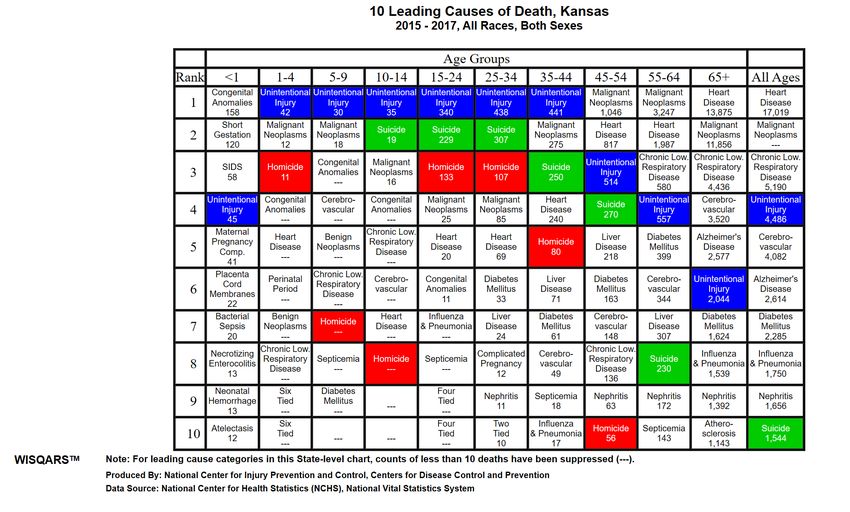
Appendix 4: Data Considerations The Centers for Disease Control and Prevention’s WISQARS™ is an interactive, online database that provides fatal and nonfatal injury, violent death, and cost of injury data. Researchers, the media, public health professionals, and the public can use WISQARS™ data to learn more about the public health and economic burden associated with unintentional and violence-related injury in the United States. Additionally, data from the State Suicide Prevention Plan Workgroup includes information the following data considered by the State Suicide Prevention Plan Workgroup includes information from the Kansas Violent Death Reporting System (KSVDRS). KSVDRS, a program of Kansas Department of Health and Environment, is a state-based surveillance system that compiles information on violent deaths, including suicides, from multiple sources –– deathcertificates, coroner and medical examiner reports including toxicology, and law enforcement reports –– into a usable, anonymous database. KSVDRS increases our knowledge about where violent deaths occur, who is most at risk, the factors that contribute to violent deaths, and it allows us to track trends over time. For more information visit https://www.kdheks.gov/idp/KsVDRS.htm. Suicide deaths are the top 10 leading cause of death for all ages. For those ages 10-34 years, it is the second leading cause of death following unintentional injury. (Data table 1) Data Table 1:
Suicides are the most common type of violent death among Kansas residents. From
2015-2017, 1518 suicide deaths occurred among Kansas residents. Suicides
comprised almost three quarters (73.9%) of the violent deaths with age-adjusted
rate of 17.4 per 100,000 persons (Data table 2).

I. Socio-demographics
Adults ages 20 years or older had higher suicide rate than younger population 10-19
years old (Data Table 3). Young adults (20-30yrs old) and older adults (35-64yrs old
had comparable suicide rates.
About three quarters (78%) of suicide deaths were males who had 3.6 times the
suicide rate of females (27.5 versus 7.7) (Data table 4). Out of every 100,000
Kansas residents, about 28 males and 8 females died of suicide (Data table 5).
White, non-Hispanic people had the highest suicide rate of 18.5 per 100,000
among all races and ethnicities except for American Indian or Alaska Native
people. Black, Asian or Pacific Island, and Hispanic races and ethnicities had
similar suicide rates.
Among Kansas residents who died by suicide 16 years or older from 2015 to 2017,
the most common occupation groups were unpaid (housewife, homemaker,
student, disabled, volunteer, patient, inmate, those who did not work), construction
and extraction (e.g. earth drillers, oil, gas, and mining, explosive worker, rock
splitters, and others), transportation and material moving, production,
management, and sales. Occupation groups varied differently between males and
females (Data Table 6). About 3 out of 10 females who died by suicide did not have
paid jobs compared to the 9% of males.
Unpaid and Military groups were excluded for male calculation due to the lack of
denominators. Among Kansas civilian population 16 years and older, males in
the farm, forest or fishing group had the highest suicide rate (164.0 per 100,000),
except for males in the protective service group with a suicide rate of 92.0 per
100,000 (Data Table 7). For females, the suicide rate was the highest in healthcare
support, 21.7 per 100,000, but it was not statistically different from others, except
for the office and administrative support group, 5.9 per 100,000 (Data Table 8).
II. Cause of Death

The common mechanisms of suicide were firearms, suffocation or hanging, and
poisoning or drug overdose. Firearms were more predominately used by males
(58% versus 29%, p
III. Circumstances

Circumstances were known for 92.0% of suicide deaths (n=1,397) among
Kansas residents from 2015-2017. The suicide circumstances are shown below
by mental health and substance abuse, interpersonal, life stressor, and
suicide-specific circumstances (Data Tables 11-14).

        11.

About 2 in 5 had current depressed mood or mental health problems. About 1 in
5 of those who died by suicide had substance abuse, alcohol problems, or never
received mental health treatment. Among people diagnosed with mental health
problems, most (75%) had depression or dysthymia, and 12% had bipolar or
anxiety disorder.

              12.

Among those who died by suicide, about 29% had intimate partner problems.
Approximately 15% of suicide deaths was preceded by argument or conflict.
Almost one on ten (9%) of suicide deaths had known family relationship
problems. Among those preceded by argument or conflict, most (73%) were
injured within 24 hours of but not during the argument.
13.
Physical health problems appeared to contribute to 30% of suicide death. About 1
in 10 suicide deaths was perpetrated by other crimes, 39% were related to assault
or homicide, and 14% were related to rape or sexual assault.
14.
About 1 in 3 Kansas residents who died by suicide had thought about
suicide in the past or left a suicide note, 25% had disclosed suicide intent
recently, and 18% had previously attempted suicide.
Among those who disclosed suicide intent, 37% disclosed to a previous partner,
32% told other family members, 17% told friends or colleagues, 3% disclosed to
their health care worker, neighbors, or healthcare worker and other person, and
10% informed other persons.IV. Toxicology
Toxicology reports were available for 77.9% of Kansas residents who died by
suicide. Among those with toxicology screens, different substances were tested
based on each situation. Because multiple substances usually contribute to suicide
poisoning deaths, results from table 5 are not mutually exclusive.
More than 60% of those who died by suicide with toxicology reports were tested
for alcohol, Marijuana, Opiates, Benzodiazepine, Amphetamine, Cocaine, and
Barbiturates. Among this population (Data Table 15):
- Alcohol was present in 35% of those tested for alcohol.
- Among those tested for marijuana, Opiate, or Benzodiazepine, about 1 in 5 (20%)
tested positive.
- Amphetamine was present in 14% of those tested for Amphetamine.
- Cocaine was present in 4% of those tested for cocaine.
- Barbiturates was present in 2% of those tested for Barbiturates.
Among suicide deaths tested for anticonvulsant or antipsychotic, about 45% tested
positive, and as for antidepressant, more than half (56%) were tested positive.
Muscle relaxant was present in 36% of those tested for muscle relaxant.
15.The following map and table report data on suicide deaths among Kansas residents from 2015-2017. The age-adjusted suicide death rate is presented per 100,000, by community mental health center coverage areas (Data Table 16). Data Table 16: https://www.kdheks.gov/idp/download/Suicide_by_MHC_FA.pdf
Appendix 5: References
Centers for Disease Control. (2019). 2013-2017 Behavior Risk Factor Surveillance
System (BRFSS) Data.

Centers for Disease Control and Prevention. Web-based Injury Statistics Query
and Reporting System (WISQARS) [Online]. (2003). National Center for Injury
Prevention and Control, Centers for Disease Control and Prevention (producer).
Available from: URL: www.cdc.gov/ncipc/wisqars.

Kansas Communities That Care Student Survey. (2020). Depression/Suicide
Indicators [Data]. Learning Tree Institute at Greenbush on behalf of the Kansas
Department for Aging and Disability Services. Retrieved from http://kctcdata.
org/Home/StudentSurvey?SurveyType=KCTC&CodeSelection=CTY&County-
Id=30120-0&categoryId=17

Kansas Communities That Care Student Survey. (2016-2020). Suicide Indicators
by Race and Ethnicity [Data]. Learning Tree Institute at Greenbush on behalf of the
Kansas Department for Aging and Disability Services]. Girard KS: Survey Publisher.

Kansas Department of Health and Environment. (2020). The role of public health in
addressing suicide prevention. Bureau of Community Health Systems, Bureau of
Epidemiology and Public Health Informatics, Bureau of Family Health, and Bureau
of Health Promotion.

Kansas Health Matters [Internet]. Topeka (KS): Kansas Partnership for Improving
Community Health [cited Feb 2020], Available from www.kansashealthmatters.org

Kansas Information for Communities (2020). 2013-2017 Vital Statistics Data,
Bureau of Epidemiology and Public Health Informatics, KDHE. Retrieved from
http://kic.kdheks.gov/death_new.php

Kansas Veteran Administration Database exported March 6,2019

Kansas Violent Death Reporting System. (2019). 2015-2017 Death Circumstances
Data. Kansas Department of Health and Environment. Internal Data request.

The Trevor Project. (2019). National survey on LGBTQ+ youth mental health.
Retrieved from https://www.thetrevorproject.org/wp-content/uploads/2019/06/
The-Trevor-Project-National-Survey-Results-2019.pdf
Appendix 6: Contributors
You can also read


