Kildare Children and Young People's Services Committee Children and Young People's Plan 2019- 2021 - March 2019
←
→
Page content transcription
If your browser does not render page correctly, please read the page content below
Kildare
Children and Young People’s
Services Committee

Children and Young People’s Plan
2019- 2021

March 2019
Contact
The Kildare Children and Young People’s Services Committee welcomes comments, views and opinions about
our Children and Young People’s Plan.

Please contact: Emma Berney, Kildare CYPSC Coordinator emma.berney@tusla.ie 086-4178220
Copies of this plan are available on: www.cypsc.ie

                                                                                                         2
Contents
Foreword .......................................................................................................................................................................... 4
Section 1: Introduction ..................................................................................................................................................... 5
Background to Children and Young People’s Services Committees ...................................................................................... 6
Who we are .......................................................................................................................................................................... 7
Achievements to date/Review of previous plan ................................................................................................................... 9
Section 2: Socio-Demographic Profile of Co. Kildare ....................................................................................................... 19
Section 3: Overview of Services to Children and Families in Co. Kildare.......................................................................... 32
Section 4: Local Needs Analysis in Co. Kildare ................................................................................................................. 42
Section 5: Summary of Children and Young People’s Plan for Co. Kildare ....................................................................... 55
Section 6: Action Plan for Co. Kildare Children and Young People’s Services Committee ................................................ 56
Section 7: Monitoring and Review .................................................................................................................................. 69
Section 8: Appendices..................................................................................................................................................... 70
3Foreword
The development of Kildare Children and Young People’s Services Committee (KCYPSC) third 3-Year Plan is the
culmination of the efforts of many individuals and organisations in Co. Kildare.
It is heartening to experience the continued commitment of member organisations to the work of KCYPSC in
the context of increasing demands and an ever-changing environment.
The new Plan is built on a solid foundation of inter-agency collaborative working that has further grown and
developed over the last 6 years.
The Plan reflects the growing realisation by KCYPSC of the value of our collective voice in achieving our shared
goal of improving outcomes for children, young people and families in our county by highlighting their needs
and accessing the necessary resources from national level to respond appropriately.
The Kildare CYPSC Plan (2019-2021) is a vital tool to assist us with this important task.
I would like to thank all who contributed to the development of the Kildare Children and Young People’s Plan
and who remain committed to its implementation.
Patricia Finlay
Tusla Service Director, Dublin Mid Leinster
Chair, Kildare Children and Young People’s Services Committee
March 2019
4Section 1: Introduction
The purpose of the Children and Young People’s Services Committees is to secure better outcomes for children
and young people through more effective co-operation and collaboration by existing services and through
interventions at local level.
CYPSCs work towards the five national outcomes for children and young people in Ireland. These are that
children and young people
1. Are active and healthy, with positive physical and mental wellbeing
2. Are achieving full potential in all areas of learning and development
3. Are safe and protected from harm
4. Have economic security and opportunity
5. Are connected, respected and contributing to their world
5Background to Children and Young People’s Services Committees
Children and Young People’s Services Committees in Ireland
The Office of the Minister for Children and Youth Affairs (OMCYA), now the Department of Children and Youth
Affairs, established the Children and Young People’s Services Committees (formerly Children’s Services
Committees) in 2007 with the purpose of improving outcomes for children and families at local and
community level. Since then CYPSCs have increased incrementally in number and are a key structure
identified by Government to plan and co-ordinate services for children and young people, aged 0 – 24 years, in
every county in Ireland.
CYPSCs bring a diverse group of agencies across the statutory, community and voluntary sectors in local county
areas together to engage in joint planning of services for children and young people. All major organisations
and agencies working locally on behalf of children and young people are represented. These committees work
to improve the lives of children, young people and families at local and community level through collaborative
planning and improved service delivery.
Better Outcomes, Brighter Futures: the National Policy Framework for Children and Young People 2014 – 20201
underscores the necessity of interagency working and tasks Children and Young People’s Services Committees
with a key role in this regard.
Children and Young People’s Services Committee in Co. Kildare
Kildare joined Phase II of the initiative, along with 5 other areas, in 2009. Following the establishment stage,
the inaugural meeting of the Kildare Children and Young People’s Services Committee took place in June 2010.
In March 2011, a Coordinator was appointed to support the work of the Committee.
In September 2011, the Committee’s first 3 –Year Plan was submitted to the Department of Children and
Youth Affairs.
In June 2014, the Children’s Services Committee became the Children and Young People’s Services Committee,
reflecting policy change at national level, which expanded the age remit of the work of the Committee from 0-
18years to 0-24 years.
A second 3-Year Children and Young People’s Plan (CYPP) for Co. Kildare was submitted in 2015.
This is the third CYPP for Kildare CYPSC.
1
Better Outcomes, Brighter Futures: The national policy framework for children and young people 2014-2020, Department of Children
and Youth Affairs
6Who we are
The membership of Kildare Children and Young People’s Services Committee is as follows:
Organisation Member Role
Co. Kildare LEADER Partnership Pat Leogue General and Social Inclusion
Manager
Family Resource Centres Angela Morrissey Kenny Manager, Curragh Family Resource
Centre
Garda Siochána Ciara McCormack Sergeant
HSE Geraldine Peelo Manager, Primary Care
Irish Primary Principals Network Gerry Breslin Principal, Kildare Town Educate
Together Primary School
Kildare and Wicklow Education and Lorraine Flynn Youth Officer
Training Board
Kildare County Childcare Committee Julie McNamara Manager
Kildare County Council Sonya Kavanagh Director of Service
(Vice Chair)
Kildare Youth Services Tom Dunne CEO
Maynooth University Catriona O’Toole Lecturer in Psychology of
Education and Course Leader of the
Masters in Education (M.Ed.)
National Educational Psychological Annette Corkery/Brenda Senior Educational Psychologist
Service Hughes
Probation Service Deirdre Matthews Senior Probation Officer
South West Regional Drugs and Alcohol Lisa Baggott Coordinator
Task Force
Teach Tearmainn Lorraine Rowan Manager
Tusla, Child and Family Agency Patricia Finlay (Chair) Service Director
Caroline Sheehan Senior Manager Prevention
Partnership & Family Support
Tusla, Educational Welfare Service Jean Rafter Regional Manager
In addition to the main Committee, Kildare CYPSC has a number of Sub Groups to support the implementation
of the Children and Young People’s Plan.
Kildare CYPSC is in the process of transition from themed Sub Groups that were formed as part of the
implementation of the previous plan (which pre-dated the Blueprint) to alignment with the structures outlined
in the Blueprint for the Development of Children and Young People’s Services Committees. 2
The implementation of the Kildare Children and Young People’s Plan 2019-2021 will be supported by the
following structure:
2
Blueprint for the Development of Children and Young People’s Services Committees, Department of Children and Youth Affairs (June
2015)
7Children and
Young People’s
Services
Committee
Sub-Group Sub-Group Sub-Group Sub-Group Sub-Group
Outcome 1: Outcome 2: Outcome 3: Outcome 4: Outcome 5:
Active and healthy, Achieving full Safe and protected Economic security Connected, respected
potential in learning and contributing to
physical and from harm and opportunity
and development their world
mental wellbeing
Actions will be grouped under outcomes. Lead agencies and partners under each action will be invited to
identify the link person for the action. The relevant personnel will be invited to become members of the
applicable Sub Group. The Safe and Protected from harm Sub Group will comprise the Prevention, Partnership
and Family Support (PPFS) Advisory Group.
The role of the Sub Groups will be to support the implementation of the actions in the Plan; provide progress
updates to the main Committee and highlight issues, concerns and gaps emerging from the work to CYPSC.
In addition to the CYPSC Sub Groups, the implementation of specific actions will be supported by a number of
defined task groups, themed Steering Groups and linked inter-agency structures such as the local Parenting
Forum.
Formal links exist with the Tusla Prevention, Partnership and Family Support Steering Committee via the Sub
Group structure, as well as through the local Child and Family Support Networks throughout the county.
Strategic Partnership
Kildare Children & Young People’s Services Committee has a Memorandum of Understanding with Kildare
Local Community Development Committee (LCDC) which guides the positive collaborative relationship
between the two structures. This is a mutually valued strategic partnership working towards the shared goal of
enhancing the lives of children, young people and families in Co. Kildare.
8Achievements to date/Review of previous plan
Review Process
The Children and Young People’s Plan (CYPP) 2015-2017 review contained 3 main elements:
An externally facilitated review session with CYPSC members and Coordinator
An online consultation with Sub Group members
A Literature Review of the regular Action Plan progress reports to CYPSC Main Committee
The information below also includes a reflection on 2018, as the implementation of the 2015-2017 CYPP
extended into 2018, while the 2019-2021 plan was being developed.
The table below outlines some of the key achievements of the past 4 years and the related impact.
Achievement Example Impact
Establishment of new services 2 additional Family Resource Teach Dara Family Resource
and infrastructure for children, Centres – in Athy and Kildare Centre in Kildare Town, which
young people and families in Town has been operating in the
the county absence of core funding since
it’s inception, has now secured
mainstream funding to ensure
the continued support to
children and families in the
area.
Athy, a recognised area of
significant disadvantage, now
has resources available to
respond to the needs of
children and families.
The Family Resource Centres
are available to operate as hubs
from which to promote a range
of existing supports e.g.
Meitheal, and to leverage in
new or additional supports for
families e.g. Preparing for Life,
Strengthening Families
Programme.
The HIVE Youth Hub in Kildare A dedicated youth space is now
Town available in Kildare Town from
which a number of supports
and initiatives are provided for
local young people.
2 new iScoil e-learning hubs for Alternative education options
young early school leavers are now available in Athy and
Kildare Town for young people
aged 13-16 who are not in
mainstream education.
iScoil provides recognised
9Achievement Example Impact
Establishment of new services 2 new iScoil e-learning hubs for Establishment of new services
and infrastructure for children, young early school leavers and infrastructure for children,
young people and families in young people and families in
the county the county accredited learning
QQI Level 3 and can act as a
bridge back to school or on to
Youthreach or other education
options.
Youth Officer post in Kildare The establishment of a
Wicklow Education and dedicated post for Co. Kildare
Training Board has increased the capacity for
supporting existing youth work
provision in the county and
developing new provision in
response to identified need.
The KWETB Youth Work
Committee has been
established and work has
commenced on the
development of the Youth
Work Plan.
Leveraging additional resources Healthy Ireland Fund (Round 1 In partnership with LCDC,
into the county and Round 2) funding secured from 2 rounds
of the Healthy Ireland Fund led
to the delivery of several
initiatives in Co. Kildare, with in
excess of 5000 participants i.e.
healthy communities initiative,
health and wellbeing
symposium,
Sports inclusion programme for
children with special needs;
social farming project; dance
and movement for people with
chronic conditions and their
carers; cannabis and you
website; sofa to summit
project; community-based
mental health and wellbeing
programme for young men.
QCBI Fund This funding supported the
delivery of the Heads Up
mental health and wellbeing
programme for young men
aged 18-24 years in Athy and
Kildare Town.
Tusla Parental Participation Funding secured from this fund
Funding contributed towards the costs
10Achievement Example Impact
Leveraging additional resources of the Parenting Research and
into the county the social media initiative for
parents.
Tusla Children and Young Funding secured from this fund
People’s Participation Funding contributed towards the costs
of youth work programme with
young refugees living in the
Emergency Reception and
Orientation Centre in
Monasterevin.
Improved Coordination of inter- Inter-agency group established A range of supports were
agency response to respond to needs of provided to families living in
Programme Refugee families the EROC in a planned and
resident in the Emergency coordinated way i.e. youth
Reception and Orientation work programme, Learning
Centre (EROC). through Play sessions,
developmental activities for
school age children, summer
activities.
Development of new practice Development of the I CAN Book The I CAN Book was included in
tools and resources – a resource to support the a national audit of transition
transition from pre-school to tools conducted by NCCA
primary school (National Council for
Curriculum and Assessment) to
inform development of national
standardised tool.
Aha! Alcohol Campaign This online and poster
campaign and related activities
encouraged people to consider
their consumption of alcohol,
to reduce any excesses and to
use the extra time, money and
energy for activities that
improve health, wellbeing and
quality of life.
Parentingsupport.ie website Parents and professionals who
work with them have greater
access to information about
available supports in Co.
Kildare.
Cannabis and You website A youth-friendly, interactive
online resource is available to
young people, parents and
professionals to encourage
young cannabis users to
consider their use and make
positive changes. The website
has information, assessment
11Achievement Example Impact
Development of new practice and brief intervention
tools and resources elements.
Kildare CYPSC Promotional A resource is available to
Animated Short promote Kildare CYPSC and its
work in an easily accessible and
digestible format.
Strengthening of relationship Participation on the Comhairle The views of young people have
with Comhairle na nÓg na nÓg Steering Group. informed the work of Kildare
Ongoing support of CNN AGM. CYPSC. The work of Kildare
Ongoing 2-way communication CYPSC has complemented the
and consultation. work of CNN.
Contributing to Evidence base: The collation and analysis of There is a clearer picture of the
Research and Data data from post-primary schools number of young people who
in relation to destination of do not progress to further
students on leaving school education, training or
employment from post-primary
school.
The data has been used to
support the case for the
development of alternative
education provision e.g. iScoil.
The methodology has been
adopted by CYPSCs in other
areas of the country.
Parenting Research The needs and concerns of
parents have been sought and
documented.
The research is available for
organisations to use as a
resource in planning and
developing services and
supports.
3 task groups have been
formed to develop actions that
respond directly to the research
findings. Actions developed
include the social media
initiative (talks and resources
for parents) and the positive
messaging campaign for
parents (online and outdoor
billboard campaign).
Co. Kildare Play Strategy Following an extensive
consultation with parents and
children the first Co. Kildare
Play Strategy was developed,
which will guide the work of
12Achievement Example Impact
Contributing to Evidence base: CYPSC and others in relation to
Research and Data play and recreation in the
county.
Evaluation of the Strengthening An evidence base was provided
Families Programme for the value and positive
impact of the Strengthening
Families Programme which
supports the case for
mainstream funding of the
programme, which is a target of
this CYPP.
Provision of targeted inter- Delivery of the Strengthening Over 130 children, young
agency interventions Families Programme on an people and parents have
annual basis participated in the
Strengthened Families
Programme in Co. Kildare over
the last four years. The positive
outcomes from participation in
the programme were
evidenced in the external
evaluation.
Initiation and facilitation of key Hosting and facilitation of 3 Staff from across the range of
inter-agency discussions themed inter-agency services for children and
discussions: domestic violence, families were provided with an
youth unemployment and opportunity to share their
disability. experiences; highlight issues of
concern; service gaps and
suggested solutions/responses.
The issues and
recommendations emerging
from the discussion guide the
work of CYPSC (individual
member organisations and
CYPSC collectively).
Screening of “Resilience” film Personnel from across the
range of services for children
and families were introduced to
the professional discourse and
research in relation to ACES
(Adverse Childhood
Experiences) and invited to
consider what this may mean
for their practice.
Developing Strategic Memorandum of The relationship with the Local
Collaborations Understanding with Kildare Committee Development
Local Community Development Committee has supported
Committee (LCDC) CYPSC in achieving its
objectives.
13Achievement Example Impact
Developing Strategic Memorandum of Adopting a collective approach
Collaborations Understanding with Kildare to shared priorities has resulted
Local Community Development in greater coherence of
Committee (LCDC) message; putting the needs of
children, young people and
families in Co. Kildare on the
agenda locally, regionally and
nationally; enhanced service
levels; leveraging of additional
funds and optimum use of
existing resources.
Collaboration with Kildare A range of free talks and
County Council Library and Arts workshops for parents are
Services in relation to the Let’s provided in the 7 branch
Talk About Parenting initiative. libraries throughout Co. Kildare.
Innovative responses to need Youth Employment Programme 2 programmes for unemployed
young people were delivered in
Athy following an initial pilot
programme in Kildare Town. A
dedicated Youth Employment
Support Worker post was
developed as part of SICAP
(Social Inclusion Community
Activation Programme).
Young Person’s Support 2 groups of young people
Programme affected by the substance
misuse of a family member
participated in the Young
Person’s Support Programme.
Positive Messaging campaign The positive messages from the
for Parents locally-developed online and
outdoor billboard campaign
reached in excess of 50,000
people.
Social media talks and Parents received practical
information for parents at Play information, advice and tips in
Day relation to social media safety
for children and young people.
Domestic violence workshop Inter-agency relationships have
been strengthened via the
process of planning and
developing the workshop.
A locally-developed workshop
will be delivered to personnel
from Tusla, An Garda Síochána,
Probation Service and Teach
Tearmainn in 2019.
Greater understanding and Specific inputs about the work Local Councillors have greater
14Achievement Example Impact
awareness at local, regional and of CYPSC and the needs of awareness of the key issues and
national level of the particular children, young people and priorities for our county from a
challenges faced by children, families in our county at County CYPSC perspective.
young people and families in Council Municipal District
Co. Kildare meetings. Enhanced consistency of
message being conveyed in
relation to needs and priorities
for Co. Kildare.
Meeting and communication Local TDs have greater
with local TDs awareness of the key issues and
priorities for our county from a
CYPSC perspective.
Enhanced consistency of
message being conveyed in
relation to needs and priorities
for Co. Kildare.
Needs and issues in Co. Kildare
being discussed at national
level e.g. in Dáil discussions.
Meetings and communication Minister and Department
with Minister for Children and officials have greater
Department officials awareness of the key issues,
needs and priorities for our
county from a CYPSC
perspective.
Needs and issues in Co. Kildare
being discussed at national
level.
OVERALL IMPACT
Increased awareness at all levels – local, regional and national - of the particular needs and challenges
in Co. Kildare.
Inter-agency coherence: Greater coherence of “message” across agencies and structures as to needs
of Co. Kildare i.e. collective priorities of CYPSC, shared priorities with LCDC.
Strengthening of inter-agency relationships and creation of increasingly supportive environment for
inter-agency working in the county.
Increased level of resourcing into the county e.g. Healthy Ireland Fund, Tusla Family Resource Centre
programme.
Enhanced service levels in the county i.e. new services established such as Family Resource Centres,
iScoil hubs, Youth Officer Post, the Hive Youth hub.
15CHALLENGES
CHALLENGE Effecting positive change at local level when systems change is required at national
policy level.
Influencing change at national level.
The absence of basic essential service infrastructure means that leveraging in new
additional supports – programmes and funding – is challenging
Low service levels affect capacity to avail of resourcing opportunities when they
become available i.e. identifying an appropriate applicant; identifying an
appropriate implementer.
Securing core mainstream funding for proven initiatives is a challenge.
Restrictive and unfeasible timeframes and processes for some national funding
streams.
Ensuring ongoing meaningful participation of children, young people and parents in
guiding the work of CYPSC.
Keeping abreast of new strategy, policy and practice developments in the sector.
Ongoing promotion and awareness-raising in relation to CYPSC and its work.
Ever-growing and competing demands on CYPSC structure from local, regional and
national levels.
The physical scale of Co. Kildare is a challenge for service planning and delivery.
The perception of affluence in relation to Co. Kildare, which obscures the true
picture of need in the county.
Measuring the overall impact of the work of Kildare CYPSC.
Balancing alignment with agency plans and supporting other interagency plans
while ensuring that CYPSC has a unique contribution and body of work.
Achieving a mandate and “top down” recognition of their role on CYPSC is a
challenge for some member organisations.
16LEARNING
LEARNING Collective strength in championing shared priorities can bring about positive
change.
A clear, strong, shared case, underpinned by evidence, is difficult to discount.
It is important to strike a balance between the strategic focus of the work of the
CYPSC and the action focus of the work – both elements are required to maintain
commitment, momentum and to facilitate positive change.
It is important to establish key service infrastructure hubs around which to build
community and family supports.
Maintaining a strong focus on the needs of children, young people and parents, as
opposed to service or organisational needs, supports constructive engagement and
productive inter-agency partnership.
Building and maintaining positive inter-agency relationships is essential to the work
of the Committee.
Alignment of CYPSC and member organisation plans in terms of objectives and
actions is key to clearly demonstrating to members their contribution and
relevance to the work of CYPSC.
Real change takes time.
In order for actions from the plan to be implemented, it is essential that a sole lead
agency is identified to drive the initiative forward.
In order for collaborative actions to be implemented, it is important that they
appear in individual organisational work plans, to reaffirm that they are a priority
for the organisation that will be taken into account when allocating resources
(financial and human).
17How the Children and Young People’s Plan was developed
Please go to Appendix 2 for full details of how the Plan was developed
The development of the Children and Young People’s Plan comprised a number of different elements and
stages:
Agreeing the “plan for the plan”
Review of previous plan
Literature Review
Consultation
Data Collection
Analysis
Agreeing the “plan for the plan”
A proposed methodology was presented to the CYPSC and was agreed following discussion.
Review of previous plan
This comprised of a Literature Review, an externally facilitated session with CYPSC members and
Coordinator and online consultation with Sub Group members.
Literature Review
The literature review element of the planning process was extensive. A review was undertaken of
local, regional and national documents – meeting Minutes, Strategies, Annual Reports, strategic plans,
thematic reports, evaluations, research reports and work plans.
Consultation
Consultation was undertaken with young people, CYPSC members, service providers and Public
Representatives.
In addition to the above, data from local consultations recently completed with parents, children and
young people informed the plan.
Data Collection
Relevant data was gathered via the literature review, consultation, directly from CYPSC member
organisations and from online sources, including national databases.
Analysis
The process of local needs analysis and the identification of priority areas and related actions took
place on a phased basis.
An initial analysis identified key messages emerging from the literature review, data collection and
consultation.
This was presented to the main Committee for discussion, comment and feedback over the course of
the 4 facilitated group sessions.
When priority actions were identified, CYPSC members were invited to consider each action and
identify if their organisation would be a lead or partner.
Actions without an identified lead organisation were not included in the plan.
Actions without at least one partner, in addition to the lead organisation, were not included in the
plan.
Indicators were chosen on the basis of relevance and feasibility as a means of measuring if the
outcome was achieved.
18Section 2: Socio-Demographic Profile of Co. Kildare
Introduction
The relevant socio-demographic information for Co. Kildare is presented below under a number of headings.
The figures are drawn from the 2016 Census figures unless otherwise stated. County and sub-county
information has been included where available. Where possible the Co. Kildare figures are compared to the
national context. The section commences with a summary of the notable findings from the socio-demographic
profile, which highlight the key features and characteristics of the county.
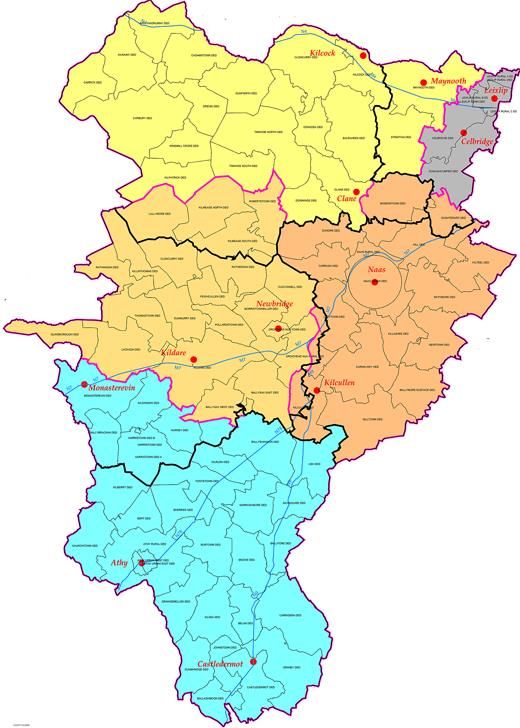
Map of Co. Kildare
Notable Characteristics and Features of Co. Kildare
Kildare is a significant population base within the State (4.7% of the total). As a county, it has the fifth highest
population, with only Dublin City, Cork County, Fingal and South Dublin with higher populations.
Kildare has a rapidly growing population. From 1996-2016, the growth rate is second highest in the State.
19Notable Characteristics and Features of Co. Kildare
Kildare has the highest rate of young people aged 0-24 years in the State (81, 517/36.6%).
The birth rate in Co. Kildare exceeds the national birth rate.
Kildare is a diverse county in terms of population density, with a clear rural/urban mix. Approx. 72% of the
county’s population live on 5% of the county’s total land area.
There are a high number of lone parent families with children under 15 in Co. Kildare. The 5th highest number
in the State.
Co. Kildare has lower than national and regional rates of Travellers. Most Travellers in the county live in urban
areas, with highest rates in the towns of Newbridge and Athy.
Co. Kildare has the 6th highest number of people with a disability in the State. This represents an increase of
13% since 2011.
Polish nationals represent by far the largest non-national community living in Co. Kildare. (30% of all non-
nationals/3.3% of total population).
There are 2 Asylum Seeker Direct Provision Centres in Co. Kildare
Co. Kildare has a well educated population, with 36.3% of the population with a third level degree or higher.
However, there is clear geographical disparity in education attainment across the county. The west and south
west of the county have much lower rates, with Athy Municipal District having a rate of 24.9%.
A rate of progression to third level education by students from Co. Kildare has been recorded as 78%. This is
the 11th lowest rate in the State.
The number of young people aged 16-25 years old who are not engaged in education, training or employment
in the county is estimated to be 1100.
Kildare is a commuter county. A significant proportion of the workforce travel outside the county for work.
(39.1%/37340).
Co. Kildare has the 8th highest number of U25 year olds on the Live Register in the country after Dublin, Cork,
Donegal, Wexford, Galway, Limerick and Louth. The rate of U25s on the Live Register in both the Athy and
Newbridge offices substantially exceed the national average.
Kildare has an active property market, with increasing prices for rents and sales.
Since 2011, the total number of Private Rented households in Co. Kildare has increased by 3.7%. A sizeable
proportion of Private rented housing is supported via State intervention funding schemes such as the Rental
Accommodation Scheme (RAS), the Housing Assistance Payment (HAP) and Rent Supplement.
There is a high level of mortgage indebtedness in the county. Kildare has the 5th highest number of Owner
Occupiers with a Mortgage in the country and the 3rd highest rate.
The number of recorded suicides in Co. Kildare in 2017 is the 3rd highest in the State.
20Notable Characteristics and Features of Co. Kildare
Over 1000 1-2-1 support sessions were provided to women by the local Domestic Violence support service in
2018. 38 women and 83 children were accommodated in the refuge. The service was unable to meet refuge
requests for 150 women and 243 children.
The total number of children in care in Kildare/West Wicklow Tusla area in 2018 was 148. The 2 most common
primary reasons for admission were child welfare concerns and neglect. The total number of child protection
and welfare cases in the area as of Dec 2018 is 742.
There are 20,592 people in Co. Kildare living in small areas deemed to be disadvantaged, very disadvantaged
or extremely disadvantaged, which represents 9.25% of the total population.
KEY DATA SUMMARY
Indicator Measure Co. Kildare National
Child and Youth The number of children and young people under 25 81517 1583004
Population
The percentage of total population under 25 36.6 33.2
Child Population The number of children under 18 62914 1190502
The percentage of total population under 18 28.3 25
Young Adult Population 18604 392502
The number of young people aged 18 – 24 years
The percentage of total population aged 18-24 years 8.4 8.2
The number of non-Irish nationals 23297 535475
Nationality The percentage of total population who are non-Irish
nationals. 10.6 11.4
The number of lone parent families with children 4795 107047
under 15
Family structure
The percentage of families with children under 15 16.9 20
who are lone parent families
The number of people aged 15 years+ with no 13718 386498
formal/Primary Education only
The percentage of people aged 15 years+ with no 10 12.5
formal/Primary Education only
Educational Attainment
The number of people aged 15 years+ with Higher 26837 573643
Secondary only
The percentage of people aged 15 years+ with Higher 19.5 18.5
Secondary only
The number of people in the Travelling community 739 30987
Travelling Community
The percentage of the total population that come 0.3% 0.7%
from the Travelling Community
21KEY DATA SUMMARY
Indicator Measure Co. Kildare National
The number of people with a disability 27768 643131
People with a disability
The percentage of the total population with a 12.5 13.5
disability
Acronyms
MD = Municipal District LA = Local Authority
ED = Electoral Division Kil-Nwb = Kildare-Newbridge Municipal District
Cel-Lxp = Celbridge-Leixlip Municipal District
Population
The population of Co. Kildare is 222,504 (2016).
This is the 5th highest population of all 31 Local Authority areas in the country.
Over a 20 year period (1996 to 2016) Kildare experienced a 64.8% (+87,512) increase in its population
base – the second highest rate in the State.
Co. Kildare has the 3rd highest population growth rate between the 2011 and 2016 Census: 5.8%,
which significantly exceeds the national figure of 3.8%.
Of the 89 EDs in Co. Kildare, the highest increases in population from 2011 to 2016 were recorded in
Naas Rural (+16.3%), Maynooth (+16.8%), Straffan (+19.3%) and Oldconnell (+22.7%). A total of 13 EDs
experienced population decline over this period.
Population density (population per km2) varies across the county. Highest density levels are in the
towns of Sallins, Celbridge, Kilcock, Leixlip and Kill. At Municipal District level, the Celbridge/Leixlip MD
has by far the highest density levels at 702.9 persons per sq. Km and is more than five times more
densely populated than the county average.
Age Profile of Population
Age No. No./31 % of %/31 % +/- Highest Highest % MD
Range LAs Co. LAs State State no. MD
pop.
th
0-4 17314 5 7.8 3rd 7 + Maynooth Maynooth
5-12 29453 5th 13.2 4th 11.5 + Kil-Nwb Athy
th
13-17 16147 5 7.3 3rd 6.5 + Kil-Nwb Athy/Maynooth/Naas
18-24 18604 6th 8.4 6th 8.2 + Maynooth Maynooth
th
0-18 62914 5 28.3 3rd 25 + Kil-Nwb Athy
0-24 81517 5th 36.6 1st 33.2 + Maynooth Maynooth
Births
There were 3182 births to Co. Kildare residents in 2017. The 5th highest number out of 34 Local
Authority areas.
The birth rate in the county in 2017 was 14.1 births per 1,000 population.
This exceeds the national birth rate of 12.9.
Age of mother
Age of Mother Under 20 20-24 25-29 30-34 35-39 40+
years
No. of births 62 234 497 1155 1013 221
22Deaths
There were 1029 deaths of Co. Kildare residents in 2017.
This is a rate of 4.5 per year per 1,000 population and is less than the national rate of 6.4.
Lone Parent Families (children Under 15)
According to 2016 Census, the total number of Lone Parent families with children under 15 years is 4795 and
represents 16.9% of all the families with children under 15. This rate is lower than the State average of 20%.
Since 2011, the total number of Lone Parent families residing in Co. Kildare has decreased by 259 which
represents 5.1%.
Although the proportion of lone parents in the county is below the national average, the number of lone
parents in the county is high – 5th highest of the 31 Local Authority areas in the country.
The proportion of lone parent families in Athy Municipal District (22.4%) exceeds the national figure.
Newbridge has the highest number of lone parent families with children under 15 (635), followed by Athy
(424), Celbridge (414), Naas (377) and Kildare Town (299).
Family Type No. No./31 % of all %/31 % +/- Highest Highest
LAs families LAs State State no. MD % MD
Lone Parent 4795 5th 16.9 23rd 20 - Kil-Nwb Athy
(children under
15 years)
Travelling Community
According to the 2016 Census, the total number of people from the Travelling community in Co.
Kildare is 739, which is 0.3% of the total population. This rate is lower than the State average of 0.7%.
Co. Kildare has the 10th lowest number of people from the Travelling community, relative to other
local authorities and the 3rd lowest rate.
Since 2011, the total number of people from the Travelling community in Co. Kildare has decreased
from a total of 874 (-15.4%), when the rate was 0.42%. Over the same period, the population from the
Travelling community in Ireland has increased by +5.1%.
Highest number of Travellers live in the Kildare-Newbridge MD (238)
Highest rate (as a proportion of the total population) is in Athy MD (0.5%of the total population are
Travellers) and Kildare-Newbridge MD (0.5%).
Disability
There are 27768 people in Kildare with a disability, being the 6th highest number in the State.
Since 2011, there has been an increase of 13% or 3399.
This increasing trend is also evident at State level where numbers have also increased by 13%.
Of those with a disability, the most common were ‘chronic illness’ (17.1%), ‘substantial physical
limitation’ (13.1%) and ‘difficulty in participating in activities’ (12.4%).
The least common reported disability was ‘blindness/impaired vision’ (2.9%).
No. in No./31 % of %/31 % +/- Highest Highest % MD
county LAs Co. LAs State State no. MD
(2016) pop.
27768 6th 12.5 28th 13.5 - Kil-Nwb Athy
A disabled person is someone who responded “Yes” to any of the 7 categories in Q.16 on long-lasting conditions or “yes” to any of
the 4 categories in Q.17 on difficulties on the Census 2016 form.
23New Communities
According to the 2016 Census, the population identifying as non-Irish nationals residing in Co.
Kildare is 23297.
This represents 10.6% of the total population, which is lower than the State average.
The 2 largest groups are from Poland and the UK.
Polish people represent 3.3% of the non-Irish national population in Co. Kildare, which exceeds the
State average of 2.6%.
Co. Kildare State + or - State
No. identifying as 23297 535475
non-Irish nationals
% of total Population 10.6 11.4 -
No./rate of Polish 7199/3.3% 122515/2.6% +
nationals
No./rate of UK 3789/1.7%
nationals
Rate of EU27 2.5%
nationals
Rate of Rest of World 2.2%
nationals
Rate of Lithuanian 0.8%
nationals
Kildare has the 11th highest number of non-Irish nationals in the State and the 13th highest rate (out
of 31 Local Authority areas).
At Municipal District level, Naas MD has the highest number and rate of non-Irish national residents
(5624/11.5%). Athy MD has the lowest number and rate (2470, 7.7%)
Asylum seekers
There are 2 Asylum Seeker Direct Provision Centres in Co. Kildare: the Eyre Powell in Newbridge and
the Hazel Hotel in Monasterevin. The combined capacity of both centres is: 233 people.
Educational Attainment
240 students from the 2010 Cohort in State-aided schools in Co. Kildare did not complete the Leaving
Certificate. Of these, 67 did not complete the Junior Certificate.
There is a slightly higher proportion of primary students absent for 20 days or more in Co. Kildare than
the State average.
36.8% of the population aged 15 years+ have attained a Third Level education. However, there is
significant variation at Municipal District level, with the lowest rates in Athy MD (24.9%) and Kildare-
Newbridge MD (28.2%).
Co. Kildare State + or –
State
No. aged 15 years+ with No Formal/Primary 13718 386498
Education only (2016)
% aged 15 years+ with No Formal/Primary Education 10 12.5 -
only (2016)
No. aged 15 years+ with Lower Secondary only 18958 449766
(2016)
24Co. Kildare State + or –
State
% aged 15 years+ with Lower Secondary only (2016) 13.8 14.5 -
No. aged 15 years+ with Higher Secondary only 26837 573643
(2016)
% aged 15 years+ with Higher Secondary only (2016) 19.5 18.5 +
Average % of children absent for 20 days or more at 11.7 11.4 +
primary level (2015/2016)
Average % of children absent for 20 days or more at 15.6 16.1 -
post-primary level (2015/2016)
Leaving Certificate Retention Rate (2010 cohort) 91.8 91.2 +
Junior Certificate Retention Rate (2010 cohort) 97.7 97.36 +
Progression/Destination of 3rd Level students
According to Irish Times figures (2017) Kildare recorded a progression rate to Third Level (Universities and
Institutes of Technology) of 78%. This excludes progression to Further Education institutions, apprenticeships, UK or
overseas destinations.
This is the 11th lowest rate in the country. In comparison, Meath has a rate of 81.8% and Louth
87.1%.
According to Department of Education statistics, a total of 7279 normally resident Kildare students
were attending 3rd level education in 2017. This figure represents an increase of 1069 since 2014.
The vast majority of these students are attending 3rd level institutes in Dublin (52.5%),
Kildare/Maynooth (23%) and Carlow (10%).
NEETS: Young people not in education, training or employment
A recent report (2018, unpublished)3 estimates the figure for NEETS aged 16-24 years in Co. Kildare
as 1100.
Commuting to Work
Kildare has the 6th highest rate of outbound commuters in the State.
Of the 95,345 workers residing in Kildare, 39.1% or 37340 commute to local authorities outside the
county.
The top employment destinations for Kildare workers are: Dublin City (15481), South Dublin
(10593), Fingal (3324), Dun Laoghaire Rathdown (2810) and Meath (969).
Employment and Social Protection
Number of Recipients of Child Related Payments 2017
Child Benefit Family Income Supplement Back to School Clothing
and Footwear Allowance
Recipients Children
32885 63237 2443 6481
3rd highest 6th highest after Dublin, Cork, 5th highest after Dublin,
after Dublin Galway, Donegal and Limerick Cork, Donegal and
and Cork Galway
3
Study on Rural Youth in County Kildare, Ann Clarke, Anne Eustace & Tom Martin (December 2018) [Unpublished]
25Number of recipients of Illness, Disability and Caring Payments 2017
Disability Allowance 4702 Injury Benefit 62
Carer’s benefit 113 Interim Illness 20
Benefit
Carer’s Allowance 2686 Invalidity Pension 2418
Domiciliary Care 1666 Illness Benefit 2564
Allowance
Working Age Income Supports
Number of recipients of Working Age on Income Supports 2017
Jobseekers Allowance 6844 Jobseeker’s Benefit 1654
One Parent Family Payment 1588 Pre-Retirement 4
Allowance
Basic Supplementary Welfare 725 Health and Safety 2
Allowance Benefit
Farm Assist 21 Maternity Benefit 1150
Live Register
Number of Persons Under 25 years old on Live Register
Dec 2015 Dec 2016 Dec 2017 Dec 2018 No. on Live U25s as % of
Register All total on Live
Ages Dec Register Dec
2018 2018
State 38688 30285 24675 19921 199669 9.98
Kildare 1671 1221 1021 780 8083 9.65
County
Athy Office 366 264 203 156 1409 11.07
Maynooth 461 294 284 178 2590 6.87
office
Newbridge 844 663 534 446 4084 10.92
Office
Co. Kildare has the 8th highest number of U25 year olds on the Live Register (December 2018) in the
country after Dublin, Cork, Donegal, Wexford, Galway, Limerick and Louth.
Under 25 year olds as a proportion of all persons on the Live Register in Co. Kildare is 9.65%, which
is below the State average of 9.98%. However, at sub-county level the rate in both the Athy office
and the Newbridge office substantially exceed the national average at 11.07% and 10.92%
respectively.
26Number of recipients of Working Age Employment Supports 2017
Community 756 Back to Work 337
Employment Enterprise Allowance
Rural Social Scheme 26 Back to Education 352
Allowance
TÚS 194 Partial Capacity 107
Benefit
Gateway 3 Part Time Job 9
Incentive
Housing
There is a high level of mortgage indebtedness in the county.
5th highest number of Owner Occupiers with a Mortgage in the country and the 3rd highest rate.
Kildare-Newbridge MD highest number (7073)
Celbridge-Leixlip MD highest rate (44.2%)
Co. Kildare State + or - State
No. of households who are owner 30295
occupied with mortgage
% of households who are owner 41.3% 31.6% +
occupied with mortgage
No. of households in private rented 12629 309728
accommodation
% of households in private rented 17.2 18.2 -
accommodation
No. of renting households who rent 5239 159943
from Local Authority or voluntary
% of renting households who rent 7.1 9.4 -
from Local Authority or voluntary
body
The highest number and rate of households in private rented accommodation is in Maynooth MD
(3203/19.8%). Since 2011, the total number of Private Rented households in Co. Kildare has
increased by 3.7% (+451). A sizeable proportion of Private rented housing is supported via schemes
such as RAS, HAP and Rent Supplement.
The highest number of households renting from Local Authority or voluntary body is in
Kildare-Newbridge MD (1577), with the highest rate in Athy MD (10.6%).
Housing Assistance Payment
According to Department of Housing, Planning & Local Government (Q2, 2017), there are a total of
1193 Housing Assistance Payment tenancies in Co. Kildare. This is the 11th highest number in the
State.
Rental Accommodation Scheme (RAS)
According to the latest Department of Housing, Planning & Local Government statistics on the
Rental Accommodation Scheme there were 717 RAS tenancies in Kildare in 2016.
27Short-Term and Long-Term Recipients of Rent Supplement by County, 2017
Short term cases recipients 144
Short term cases as % of all cases in Co. Kildare 8.4%
Long term cases recipients 1,573
Long term cases as % of all cases in Co. Kildare 91.6%
All cases 1717
County total as % of national total 5.4%
We have 4.7% of total population of Ireland living in Co. Kildare but 5.4% of all rent supplement
received in the State.
There were 1717 recipients of rent supplement in Co. Kildare in 2017. This is the 3rd highest number
in the country after Dublin and Cork.
Rental Costs
Average Rent Price Q3 2017 Source: Residential Tenancies Board
Co. Kildare recorded the 6th highest average rent in the State at €1023 per month.
Within Co. Kildare the highest average rents were recorded in Leixlip (€1235 p/m), Maynooth
€1223 p/m) and Celbridge (€1166 p/m). Athy recorded the lowest average rent of €705 p/m.
Child Welfare and Protection
The figures available from Tusla at present relate to the combined area of Co. Kildare and West Wicklow (as
opposed to Co. Kildare alone).Therefore figures below include West Wicklow.
Child Protection and Welfare Referrals
The total number of new child protection and welfare referrals received by Tusla in December 2018 was 144
for the Kildare/West Wicklow area. According to the Tusla Measuring the Pressure reports (MTP)4 Dec 2018,
there are 243 open cases with an allocated social worker, with a further 128 awaiting allocation. In terms of
geographic area, the figures for the area covered by the Athy team are 80 and 83, the Naas team 102 and 11
and the Celbridge team 61 and 34. The total number of cases (allocated and awaiting allocation) in
Kildare/West Wicklow is 742.
Children in Care
38 young people were admitted into care in 2018. 21 males and 17 females. 16 of which are first
time admissions.
59 young people were discharged from care in 2018. 37 returned to home/family, 18 remained
with foster/relative carer, 1 independent living, 3 other (this relates to those in residential care and
got an extension to remain there for about a month after they turned 18).
22 young people in care in 2018 were turning 18 and were assessed as needing aftercare.
All 22 were offered an aftercare service. 22 accepted.
4
Available on www.tusla.ie
28Young people in care in Kildare/West Wicklow on 31/12/2018
Total no. 148
Gender Male Female
73 75
Age 0-4 years 5-9 years 10-12 13-15 16-17 years
years years
14 38 26 36 34
Total Less than a 1-5 years 5 years +
Length of year
Time in
Care
35 52 80
Type of Residential Residential Foster Care Foster Other Care
care Special Care General Care with Placements
Care General Relatives
1 16 92 36 3
Primary Physical Emotional Sexual Neglect Child Welfare
Reason for Abuse Abuse Abuse Concern
Admission
9 3 3 66 67
Legal Emergency Interim Court Detention Another Voluntary
Reason for Care Order Care Order Order Order of Court Order admission
Admission the High
Court
0 12 80 0 0 56
Suicide
In 2017 there were a total of 19 suicides in Co. Kildare. 13 Males and 6 Females.
The suicide rate in Co. Kildare in 2017 (8.4 deaths per year per 100,000 population) marginally
exceeds the State rate of 8.2.
The female suicide rate of 5.3 deaths per 100,000 population exceeds the national rate of 3.3.
There are only 2 Local Authority areas (out of 34) in the country that exceed the Kildare figure for
death by suicide in 2017 – Cork City (22) and Cork County (47).
Deliberate Self Harm
Kildare/West Wicklow has the 2nd highest rate of women presenting at hospital due to deliberate
self-harm (no. of persons = 246, rate per 100,000 population 434) from all LHO (Local Health Office)
areas nationally (2017).
Kildare/West Wicklow has the 5th highest rate for men (no. of persons = 163, rate per 100,000
population 293).
29Substance Misuse
Drug/Alcohol Treatment
The data refers to episodes of treatment in a calendar year, rather than on the individual person treated. This
means individuals may appear in the figures more than once if they receive treatment at more than one centre
or at the same centre more than once per year.
Total (all Alcohol Cannabis
drugs incl.
Alcohol)
Under 18 47 - 37
18 - 24 47 7 10
Recent findings from the recent NACDA (National Advisory Committee on Drugs and Alcohol, 2019)
national drug prevalence survey indicated that among people who used cannabis in the last year,
19.7% fulfilled the criteria for cannabis dependence. The rate was higher for males (22.8%) than for
females (11.8%) and higher for young adults (15-34 years) (22.3%) than for older respondents (10.4%).
In the general population, 1.5% of those aged 15+ were classed as cannabis dependent. This rate was
found to be significantly higher in males (2.5%) than females (0.5%), and also significantly higher in
young adults (15-34years) (3.6%) than older subjects (0.4%).
Local research conducted as part of the development of the Cannabis and You website found that 32
of the 41 (78%) young people (13-21 years)who responded had used cannabis. 30% indicated their age
at first use as 14 years.
Domestic Violence
274 women accessed the Teach Tearmainn Information and Support Service in 2018.
1800 helpline calls were received. Over 1000 1-2-1 support sessions were provided.
38 women and 83 children were accommodated in the refuge.
Teach Tearmainn was unable to meet refuge request for 150 women and 243 children.
Disadvantage
Kildare was affected by the economic downturn
Co. Kildare has dropped from the 3rd to the 5th most affluent local authority area in Ireland since 2006.
Co. Kildare has a HP Deprivation Index Relative Score of 3.2 (marginally above average).
Although the county Deprivation score is marginally above average, the number of people living in
areas of disadvantage is high. There are 20,592 people living in small areas deemed to be
disadvantaged, very disadvantaged or extremely disadvantaged, which represents 9.25% of the total
population.
Number Population
Disadvantaged Small Areas in Co. Kildare 54 16435
Very Disadvantaged Small Areas in Co. Kildare 16 3860
Extremely Disadvantaged Small Areas in Co. 1 297
Kildare
Disadvantaged, Very Disadvantaged and 71 20592
Extremely Disadvantaged Small Areas
30 % of Total Population living in Disadvantaged, Very Disadvantaged and Extremely Disadvantaged Small
Areas is 9.25%.
ED No. of No. of Very No. of Total
Disadvantaged Disadvantaged Extremely
SAs SAs Disadvantaged
SAs
Athy Rural 2 0 0 2
Athy East Urban 2 2 0 4
Athy West Urban 5 3 1 9
Ballitore 1 0 0 1
Ballysax West 1 0 0 1
Bodenstown 1 0 0 1
Carbury 1 1 0 2
Castledermot 2 0 0 2
Celbridge 4 0 0 4
Clane 1 0 0 1
Downings 0 1 0 1
Newbridge Urban 5 4 0 9
Grangemellon 1 0 0 1
Kilberry 1 0 0 1
Kilcock 2 0 0 2
Kilcullen 2 0 0 2
Kildare 3 3 0 6
Kilmeage North 1 0 0 1
Kilmeage South 1 0 0 1
Kilpatrick 1 0 0 1
Leixlip 2 0 0 2
Maynooth 1 0 0 1
Monasterevin 1 1 0 2
Morristownbillar 4 0 0 4
Naas Urban 4 0 0 4
Rathangan 1 1 0 2
Robertstown 3 0 0 3
Skerries 1 0 0 1
54 16 1 71
31Section 3: Overview of Services to Children and Families in Co. Kildare
The table below provides an overview of the main services provided to children, young people aged 0-24 years
and their parents by the Kildare CYPSC member organisations and partners in alphabetical order.
Services are listed under Provider Organisation and then categorised as universal, targeted or both and Level
of Need based on Hardiker scale. (Please see Appendix 3 for explanation of Hardiker scale).
Universal or
Statutory or
Organisation/Agency Service Targeted or
Voluntary
Both
Garda stations x 15 Universal
and
Statutory Targeted,
Hardiker
Level 1,2 & 3
Community Policing e.g. Universal,
neighbourhood watch, community Statutory Hardiker
alert Level 1 & 2
An Garda Síochana Schools Programme Universal,
Statutory Hardiker
Level 1
Targeted,
Juvenile Liaison Officers x 4 Statutory Hardiker
Level 2 & 3
Specialist Officers e.g. Immigration, Targeted,
Diversity, Crime Prevention, Family Statutory Hardiker
Liaison Level 2 & 3
Targeted,
Barrettstown Gang Camp Palliative/Respite Care for children. Voluntary Hardiker
Level 2 & 3
Targeted,
Delivery of Social Inclusion
Voluntary Hardiker
Activation Programme (SICAP)
Level 2 & 3
Enterprise and employment Targeted,
supports: 1-2-1 and group Voluntary Hardiker
programme Level 2
Targeted,
Community development supports Voluntary Hardiker
Level 2
Co. Kildare LEADER Ability programme for 16-19 year
Targeted,
Partnership olds with a disability who are
Voluntary Hardiker
interested in education, training and
Level 2
employment
Targeted,
Youth Employment Programme for
Voluntary Hardiker
18-25 years old
Level 2
Targeted,
Employment Support for Roma
Voluntary Hardiker
Community
Level 2
Heads Up Mental Health and Voluntary Targeted,
32Universal or
Statutory or
Organisation/Agency Service Targeted or
Voluntary
Both
Co. Kildare LEADER wellbeing programme for men Hardiker
Partnership Level 2
Targeted,
TUS and Rural Social Scheme Voluntary Hardiker
Level 2
Targeted,
Dara Project: specialist CE Scheme
Voluntary Hardiker
for people in recovery
Level 2
Targeted,
Integration Worker to support
Voluntary Hardiker
refugees
Level 2
Co. Kildare Primary Outreach visits, health promotion Targeted,
Health Care Project for information, advocacy, assistance Voluntary Hardiker
Travellers with literacy issues Level 2
140 bed residential treatment and Targeted,
Cuan Mhuire rehabilitation centre in Athy for Voluntary Hardiker
adults with addiction issues. Level 3 & 4
Intreo offices x 3: Athy, Newbridge
Targeted,
and Maynooth – single point of
Statutory Hardiker
contact for all employment and
Level 2
Department of income supports.
Employment and Social Targeted,
Local Employment Service:
Protection Statutory Hardiker
Newbridge
Level 2
Central Rent Unit: assessment of Targeted,
applications from Co. Kildare for rent Statutory Hardiker
supplement. Level 2
Early Years Care and Education: 192
Universal,
ECCE services, 4 stand-alone after Private and
Hardiker
schools; 97 childminders (on KCCC Community
Level 1
database)
100 Primary schools Universal,
7 DEIS Primary schools – Curragh, Statutory Hardiker
Kildare Town, Newbridge, Athy Level 1
28 Post Primary schools
Education 7 DEIS Post primary schools – Universal,
Rathangan, Prosperous, Naas, Statutory Hardiker
Monasterevin, the Curragh, Athy, Level 1
Newbridge
4 Special Schools – Celbridge, Targeted,
Curragh, Newbridge, Naas Statutory Hardiker
Level 2 & 3
NUI Maynooth: third level university Universal,
Statutory Hardiker
Level 1
Garda Youth Diversion Projects x 2 in Targeted,
Extern Naas and Athy Voluntary Hardiker
Janus Programme Level 2 & 3
33You can also read


