PROSPECTUS 2019-20 - Marino Institute of Education
←
→
Page content transcription
If your browser does not render page correctly, please read the page content below
PROS PE C TU S 2 0 1 9 –2 0
"MIE was most definitely my first
choice. It was a case of falling in
love at the open day and it’s been
a decision I’d make again in a
heartbeat."

Contents

  Life at Marino Institute of Education                                  1
  Bachelor in Education (Primary Teaching)                               2
  Bachelor in Education through the Medium of Irish (Primary Teaching    6
  Baitsiléir san Oideachas trí Mheán na Gaeilge (Bunmhúinteorieacht)    10
  Bachelor in Science (Education Studies)                               14
  Bachelor in Science (Early Childhood Education)                       18
  Trinity International Foundation Programme                            22
  Professional Master of Education (Primary Teaching)                   26
  Professional Diploma in Education (Further Education)                 30
  Master in Education Studies (Intercultural Education)                 34
  Master in Education Studies (Early Childhood Education)               38
  Master in Education Studies (Visual Arts)                             42
  Master in Education Studies (Inquiry-Based Learning)                  46
  Master in Education Studies (Leadership in Christian Education)       50
  How to Apply                                                          54
  Map                                                                   57
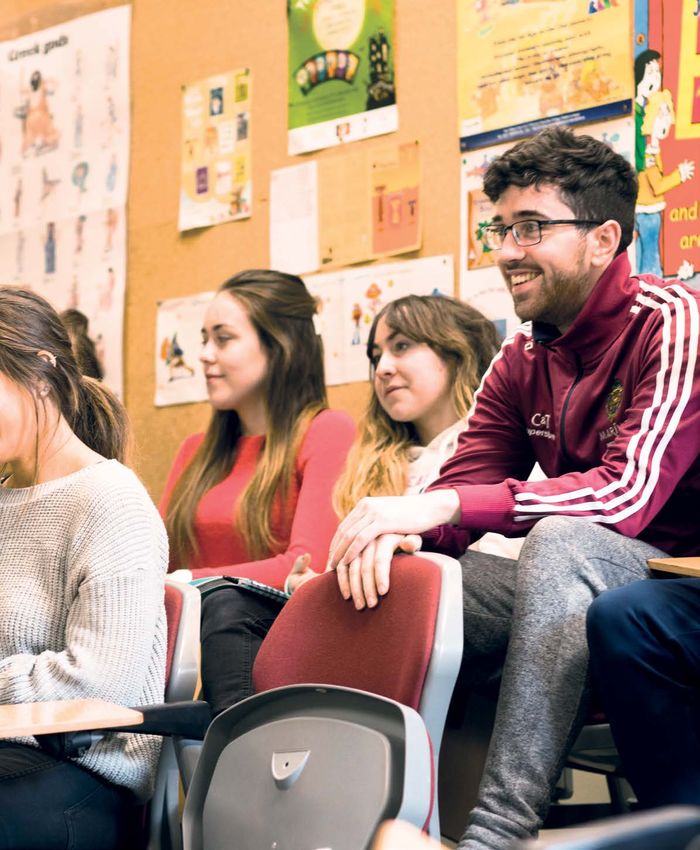
At Marino Institute of Education you can...

               Exercise in
              the gym and
              fitness room
                              Labhair Gaeilge           Care for yourself
                             nuair is toil leat é         through the
                                                          Counselling,
 Learn with                                              Disability and
a dedicated                                             Medical Services
  focus on
 education

                                                            Live in the
 Reflect on faith,
                             Experience                      modern
   values and                a sense of                    on-campus
     service                                             accommodation
                             community

                                                                        Immerse
                                                                       yourself in
                                                                       culture and
       Study in the                                                      the Arts
    specialised library        Relax on the
    and resource room
                               beautiful and
                             tranquil campus           Enjoy the
                                                    lively, friendly
                                                      atmosphere

                                                     ★ MIE PROSPECTUS 2019 –20       1
Bachelor in Education
(Primary Teaching)
CAO codes: CM001/CM002

Helping young people learn has to be one of the most
satisfying and rewarding careers of all. By choosing the
Bachelor in Education (Primary Teaching) course you
embark on a four year course that will prepare you for
working in primary schools in Ireland.

What is the Bachelor in                    to experience placements in urban
Education (Primary Teaching)?              and rural schools, single sex and
During this four year degree you will      co-educational schools, multi-grade
find out how children aged 4–12 learn      and single class situations, DEIS
to read, write, count and calculate;       schools and scoileanna lán-Ghaeilge
you’ll learn how to introduce them to      nó Scoileanna Gaeltachta. You will
the arts, the magic and mysteries of       also engage in a Special Educational
the world around them and how to           placement in the second year of your
grow and develop in a healthy way.         course. This provides you with the
                                           opportunity to experience school life
What will I study?                         in a variety of contexts.
In the foundation studies you will
study how children learn, what factors     Gaeltacht
influence their learning and how our       As part of the Bachelor in Education
understanding of this has changed          (Primary Teaching) course you must
over time. Advance your own                spend time, typically two two-week
knowledge of curriculum subjects and       periods, in the Gaeltacht to develop
learn specific methods for teaching all    your knowledge of the Irish language
primary school subjects.                   and culture. Students pay this fee
                                           directly to the Gaeltacht College.
You will have the opportunity to study
for a certificate in Catholic Religious    What are my career options?
Education in preparation for teaching      Most graduates of the Bachelor
in schools under the patronage of the      in Education (Primary Teaching)
Catholic Church and/or a certificate       course become primary teachers in
in Multi-belief and Ethical curricula in   schools in the Republic of Ireland.
Diverse School Contexts.                   Some travel abroad to teach English
                                           as an additional language or to
School placement                           teach in primary schools elsewhere.
During the four years of the Bachelor      Occasionally graduates work in areas
in Education (Primary Teaching)            other than education such as in the
course, you will have opportunities        media or in research.

 2       ★ MIE PROSPECTUS 2019 –20
★ MIE PROSPECTUS 2019 –20 3
Module Listing

Year 1                                                       Year 3

School Placement & School Placement Studies                  School Placement & School Placement Studies
• Middle Classes                                             • Early Years Education

Foundation Studies                                           Foundation Studies
• Philosophical & Historical Understandings of Education 1   • Early Childhood Education
• Psychology in Education                                    • Sociology

Curriculum Studies/Methodologies                             Curriculum Studies/Methodologies
• English Methods/Múineadh na Gaeilge                        • English Methods/Múineadh na Gaeilge
• Mathematics Methods/Social Environmental                   • Mathematics Methods
  & Scientific Education (SESE)                              • Social, Environmental & Scientific Education (SESE)
• Physical Education                                         • Arts Education (Music)
• Social Personal & Health Education (SPHE)
• Arts Education (Visual Arts)                               Professional Studies/The Practice of Teaching
• Religious Education                                        • Teaching & Learning 2
                                                             • Communicative Competence in Irish & English for
Professional Studies/The Practice of Teaching                  School & Community
• Teaching & Learning 1 (Approximations of Practice)
• Classroom Communication, Organisation                      Subject Knowledge/Content Knowledge
  & Management                                               Mathematics

Subject Knowledge/Content Knowledge
English/Irish Language, Literacy & Literature                Year 4

                                                             School Placement & School Placement Studies
Year 2                                                       • Linked to research dissertation

School Placement & School Placement Studies                  Foundation Studies
• Senior Classes                                             • Philosophical & Historical Understandings of Education 2
                                                             • Children’s Literature Studies
Foundation Studies
• Language Study                                             Professional Studies/The Practice of Teaching
• Curriculum & Assessment/Psychology in Education            • Teacher as Knowledgeable Professional (Mathematics)
• Inclusive Education
                                                             Specialism
Curriculum Studies/Methodologies                             • Research Specialism & Dissertation
• English Methods/Múineadh na Gaeilge
• Physical Education
• Social Personal & Health Education (SPHE)
• Social, Environmental & Scientific Education (SESE)/
  Mathematics Methods
• Arts Education (Drama)

Professional Studies/The Practice of Teaching
• Creative Technologies and Inquiry-Based Learning
• Integration, Imagination & Innovation

Subject Knowledge/Content Knowledge
• English/Irish Language, Literacy & Literature

 4       ★ MIE PROSPECTUS 2019 –20
"The B.Ed. course is engaging at
every level with reminders of what
you’re working towards every day."

                  GENERAL INFORMATION
                  • CAO codes: CM001/CM002
                  • Duration: 4 years full-time
                  • Award level: NFQ 8
                  • ECTS Credits: 240
                  • Awarding body: Trinity College Dublin,
                    The University of Dublin

                  MINIMUM ENTRY REQUIREMENTS
                  • No. of Leaving Cert subjects: 6
                  • Min no. of higher level subjects: 3
                    (Min Grade H5)
                  • Min no. of ordinary level subjects: 3
                    (Min Grade O6)
                  • Minimum grades: Maths – H7/O4,
                    English – H7/O4, Irish – H4

                  NOTE FOR CM002 APPLICANTS
                  Applicant details are forwarded to the
                  Department of Arts, Heritage and the
                  Gaeltacht to determine eligibility for this
                  entry route.

                  ★ MIE PROSPECTUS 2019 –20               5
Bachelor in Education through
the Medium of Irish
(Primary Teaching)
CAO codes: CM003/CM004

The Bachelor in Education through the Medium of Irish is a degree which
suits in particular students who wish to teach in the Irish-medium sector i.e.
in Gaeltacht and All-Irish schools. There is a strong demand for teachers
in Gaeltacht and All-Irish schools and a teaching qualification obtained
through the medium of Irish will set those students apart from others who
wish to teach in those schools.

What is the Bachelor in                    Catholic Church and/or a certificate     Teaching), you must spend two
Education through the Medium               in Multi-belief and Ethical curricula    two-week periods in the Gaeltacht in
of Irish (Primary Teaching)?               in Diverse School Contexts, which        First Year and Second Year. Students
In this four year degree you will learn    prepares you to teach in Educate         pay this fee directly to the Gaeltacht
about immersion education, about           Together and Community National          College. In Third Year you will spend a
how children acquire language, about       Schools. Every effort will be made to    week in the Gaeltacht taking parts of
how children aged 4–12 learn to read,      deliver those lectures through Irish.    some of your course modules and in
write, count and calculate. You will                                                Fourth Year, for the Advanced School
learn how to introduce children to         School Placement                         Placement (10 weeks), all students
the arts and Gaelic culture, as well as    All school placements will be            will be based in the Gaeltacht. The
the magic and mysteries of the world       undertaken in Irish medium settings      accommodation costs of those Third
around them and you will help them to      during this programme. You will          Year and Fourth Year Gaeltacht
grow and develop in a healthy way.         get opportunities to obtain a wide       courses will be covered by Marino
                                           range of experience in the all-          Institute of Education.
What will I study?                         Irish education sector. You will
In the foundation studies you will         have opportunities to experience         What are my career options?
study immersion education, early           placements in urban and rural schools,   The Bachelor in Education through
childhood education, how children          single sex and co-educational            the Medium of Irish (Primary Teaching)
learn, Psychology and Sociolinguistics.    schools, DEIS schools, and multigrade    is a degree which suits in particular
You will advance your own knowledge        and single class settings. For Special   students who wish to teach in the
of Irish and of the different curriculum   Education you will undertake School      Irish-medium sector i.e. in Gaeltacht
subjects, and learn specific methods       Placement in an all-Irish situation in   and All-Irish schools. The programme
for teaching all primary school            Second Year and in your Final Year       is fully recognised by the Teaching
subjects and about the advantages of       you will take your School Placement      Council and graduates will also be
teaching through the medium of Irish.      in a Gaeltacht school.                   eligible to apply for positions in a
You will have the opportunity to study                                              school in which Irish is the second
for a certificate in Catholic Religious    Gaeltacht                                language. Graduates could also work
Education in preparation for teaching      As part of the Bachelor in Education     in areas other than education such as
in schools under the patronage of the      through the Medium of Irish (Primary     in the media or research.

 6       ★ MIE PROSPECTUS 2019 –20
★ MIE PROSPECTUS 2019 –20 7
Module Listing

Year 1 Learning Period in Gaeltacht                          Year 3 Delivery of some modules in Gaeltacht

School Placement                                             School Placement
• School Placement I/Professional Studies, Middle Classes    • School Placement III/Professional Studies, Infant/Early
                                                               Years Education
Foundation Studies
• Historical Understandings of Education                     Foundation Studies
• Psychology in Education                                    • Early Childhood Education
Curriculum Studies/Methodologies                             • Curriculum & Assessment & Sociolinguistics
(Content and Language Integrated Learning)
• English Methods & Irish Methods                            Curriculum Studies/Methodologies
• Social Environmental & Scientific Education (SESE) 1       (Content and Language Integrated Learning)
  and Maths Methods 1                                        • English Methods & Irish Methods
• Physical Education/Social, Personal & Health               • Maths Methods 3/Social, Environmental & Scientific
  Education                                                    Education (SESE) 3
• Visual Arts and the Arts                                   • Music and the Arts
• Religious Education
                                                             Professional Studies/The Practice of Teaching
Professional Studies/the Practice of Teaching                • Teaching & Learning 2 (Microteaching 2)/Behaviour
• Teaching & Learning 1 (Microteaching)                        Management
• Classroom Communication, Organisation                      • Communicative Competence in Irish & English for
  and Management                                               School and Community/Information & Communication
                                                               Technology
Subject Knowledge/Pedagogy/Content Knowledge/
Competence                                                   Subject Knowledge/Pedagogy/Content Knowledge/
• English & Irish (Language Literacy and Literature)         Competence
                                                             • Maths

Year 2 Learning period in Gaeltacht
                                                             Year 4 Advanced School Placement in Gaeltacht
School Placement
• School Placement II/Professional Studies, Senior Classes   School Placement
                                                             • School Placement IV/Professional Studies
Foundation Studies                                           • 10 Weeks Extended Placement in Gaeltacht
• Language Study/Acquiring and Learning Additional
  Languages                                                  Foundation Studies
• Teaching through the Medium of Irish                       • Philosophical Understandings of Education
• Sociology/Psychology in Education                          • Irish-Language Children’s Literature Studies
• Inclusive Education
                                                             Professional Studies/The Practice of Teaching
Curriculum Studies/Methodologies                             • Teacher as Knowledgeable Professional (Mathematics)
(Content and Language Integrated Learning)                   • Reflection on Professional Practice (eportfolio –
• English Methods & Irish Methods                              part of school placement module)
• Physical Education (& the cultural context)/Social         • Dissertation (e.g., Irish Medium Education, Immersion
  Personal & Health Education (SPHE)                           Education, Bilingualism, Gaeltacht Education, Early
• Social, Environmental & Scientific Education (SESE) 2/       Childhood Education through the Medium of Irish,
  Maths Methods 2                                              Irish Literature)
• Drama and the Arts

Professional Studies/the Practice of Teaching
• Creative Technologies and Inquiry-Based Learning
• Cross-Curricular Integration, Imagination & Innovation
  including Irish Cultural Arts

 8      ★ MIE PROSPECTUS 2019 –20
"I was always interested in Irish and as a teacher
I would like to teach through the medium of Irish.
I am delighted that the course is entirely in Irish.
It’s great that the ten week School Placement in
Fourth Year will be in the Gaeltacht and that the
accommodation costs will be covered by Marino."
GENERAL INFORMATION Mature applicants must be 23 years of
• CAO codes: CM003/CM004 age or over on 1 January on the year of
• Duration: 4 years full-time the course in which they are seeking
• Award Level: NFQ 8 a place. Mature applicants must return
• ECTS Credits: 240 completed the application form, “Foirm
• Awarding body: Trinity College Dublin, Iarratais Bhreise do Mhic Léinn Aibí don
The University of Dublin Bhaitsiléir san Oideachas trí Mheán
na Gaeilge” to The Registrar’s Office,
The Administrator of Mature Applicants
MINIMUM ENTRY REQUIREMENTS
for the Bachelor in Education through
• No. of Leaving Cert. subjects: 6
the Medium of Irish, Marino Institute of
• Minimum no. of higher level subjects:
Education, Griffith Avenue, Dublin 9 by
3 (H4 at least but see also below
31 January, 2019. The Registrar’s Office
specific minimum requirements for
will inform the CAO if the minimum
Irish, English and Mathematics)
entry requirements are being met or
• Specific Minimum Requirements –
not. If they are, invitations will be issued
Irish: H3 and TEG*: B1, English: H7/O4,
to mature applicants to undertake a
Mathematics: H7/O4
general interview and an Irish interview
• *TEG (Teastas Eorpach na Gaeilge)
in Marino institute of Education.
Level B1 (Pass 50%) to be obtained
by every student. The examinations
will be held on Saturday, 23 February, NOTE FOR CM004 APPLICANTS
2019. Marino Institute of Education Applicant details are forwarded to the
will reimburse students the TEG fee Department of Arts, Heritage and the
who successfully complete the TEG Gaeltacht to determine eligibility for this
examinations and who register on the entry route.
Bachelor in Education through the
Medium of Irish in Marino Institute of
Education. For more information on the
TEG examinations see www.teg.ie/oid
★ MIE PROSPECTUS 2019 –20 9Baitsiléir san Oideachas trí Mheán
na Gaeilge (Bunmhúinteoireacht)
Cóid Lár-Oifig Iontrála (CAO): CM003/CM004
Is céim ar leith é an Baitsiléir san Oideachas trí Mheán na Gaeilge
(Bunmhúinteoireacht) a oireann go speisialta do mhic léinn a dteastaíonn uathu
múineadh san earnáil oideachais Lán-Ghaeilge i.e. i scoileanna Gaeltachta nó i
scoileanna Lán-Ghaeilge. Tá géarghá le múinteoirí do scoileanna Gaeltachta agus
do scoileanna Lán-Ghaeilge agus tá cáilíocht mhúinteoireachta trí mheán na Gaeilge
ina buntáiste ag mic léinn atá ag iarraidh múineadh sna scoileanna sin.
Céard é an Baitsiléir san phátrúnacht na hEaglaise Caitlicí. mac léinn Tréimhsí Foghlama coicíse
Oideachas trí Mheán na Ta deis ann chomh maith staidéar a a dhéanamh sa Ghaeltacht sa Chéad
Gaeilge (Bunmhúinteoireacht)? dhéanamh chun teastas a fháil sna Bhliain agus sa Dara Bliain. Íocfaidh
Sa chéim cheithre bliana seo Curaclaim Ilchreidmheacha agus na mic léinn na táillí do na Tréimhsí
foghlaimeoidh tú faoin tumoideachas, Eitice i gComhthéacsanna Scoileanna Foghlama sa Ghaeltacht díreach
faoi na bealaí ina bhfoghlaimíonn Éagsúla, rud a ullmhaíonn tú múineadh chuig an gColáiste Gaeltachta. Sa
na páistí teanga, faoi na bealaí ina i scoileanna Ag Foghlaim Le Chéile Tríú Bliain, caithfidh tú seachtain sa
bhfoghlaimíonn siad conas léamh, agus i bPobalscoileanna Náisiúnta. Ghaeltacht ag tógáil codanna de
scríobh, comhaireamh agus áireamh. Déanfar gach iarracht na léachtaí sin a mhodúil a bhainfidh leis an gcéim.
Foghlaimeoidh tú conas na healaíona thabhairt trí mheán na Gaeilge. Clúdóidh Institiúid Oideachais
a chur ar shúile na bpáistí, faoin Marino costas iomlán an lóistín a
tábhacht a bhaineann leis an gcultúr Socruchán Scoile bhaineann leis sin. Sa Cheathrú Bliain
Gaelach mar aon leis an draíocht Is trí mheán na Gaeilge amháin a don Ardsocrúchán Scoile (deich
agus na mistéir mórthimpeall orthu, dhéanfaidh tú na Socrúcháin Scoile seachtaine), beidh mic léinn ag cur
agus na bealaí chun fás agus forbairt ar fad i rith na gceithre bliana den fúthu sa Ghaeltacht agus ag obair
ar bhealach sláintiúil. chéim. Gheobhaidh tú deiseanna i scoileanna Gaeltachta. Clúdóidh
réimse leathan de thaithí a fháil san Institiúid Oideachais Marino costas
Céard air a ndéanfaidh earnáil oideachais Lán-Ghaeilge. iomlán an lóistín a bhaineann leis sin.
mé staidéar? Beidh deiseanna agat Socrúcháin a
Sa bhonnstaidéar beidh staidéar á dhéanamh i scoileanna tuaithe agus Céard iad na roghanna a
dhéanamh agat ar an tumoideachas, i scoileanna uirbeacha, i scoileanna bheidh agam mar mhúinteoir?
ar an Oideachas Luath-Óige, ar aon ghnéis agus i scoileanna Oireann an Baitsiléir san
an mbealach ina bhfoghlaimíonn comhoideachais, i scoileanna DEIS, Oideachas trí Mheán na Gaeilge
páistí, ar an tSíceolaíocht agus ar i scoileanna ina bhfuil suíomhanna (Bunmhúinteoireacht) go speisialta
an tSochtheangeolaíocht. Cuirfidh aon ghrád agus i scoileanna ina bhfuil do mhic léinn a dteastaíonn uathu
tú le d’eolas ar an nGaeilge suíomhanna ilghrád. Don Oideachas múineadh san earnáil oideachais
agus ar na hábhair churaclaim Speisialta déanfaidh tú Socrúchán Lán-Ghaeilge i.e. i scoileanna
éagsúla, foghlaimeoidh tú faoi na Scoile i suíomh Lán-Ghaeilge sa Gaeltachta nó i scoileanna Lán-
modhanna chun na hábhair sin a Dara Bliain agus sa Cheathrú Bliain Ghaeilge. Tá an chéim aitheanta
mhúineadh agus faoi na buntáistí déanfaidh tú do Shocrúchán Scoile i go hiomlán ag an gComhairle
a bhaineann lena múineadh trí scoil Ghaeltachta. Mhúinteoireachta agus beidh céimithe
mheán na Gaeilge. Beidh deis leis an gcéim i dteideal freisin post a
agat staidéar a dhéanamh chun Gaeltacht lorg i scoil ina bhfuil an Ghaeilge mar
teastas san Oideachas Reiligiúnach Mar chuid den Bhaitsiléir san dhara teanga. D’fhéadfadh céimithe
Caitliceach a bhaint a amach le tú a Oideachas trí Mheán na Gaeilge obair sna meáin chomh maith nó
ullmhú múineadh i scoileanna faoi (Bunmhúinteoireacht) beidh ar gach taighde a dhéanamh.
10 ★ MIE PROSPECTUS 2019 –20★ MIE PROSPECTUS 2019 –20 11
Liosta na Modúl

Bliain 1 Tréimhse Foghlama sa Ghaeltacht                      Bliain 3 Roinnt modúl sa Ghaeltacht

Socrúchán Scoile                                              Socrúchán Scoile
• Meánranganna                                                • Oideachas Luath-Óige

Bonnstaidéar                                                  Bonnstaidéar
• Tuiscintí Stairiúla ar an Oideachas                         • Oideachas Luath-Óige
• An tSíceolaíocht san Oideachas                              • Curaclam agus Measúnú/Sochtheangeolaíocht

Léann an Churaclaim/Modheolaíocht                             Léann an Churaclaim/Modheolaíocht
(Foghlaim Chomhtháite Ábhar agus Teangacha)                   (Foghlaim Chomhtháite Ábhar agus Teangacha)
• Múineadh an Bhéarla/Múineadh na Gaeilge                     • Múineadh an Bhéarla/Múineadh na Gaeilge
• Múineadh na Matamaitice/Oideachas Sóisialta Imshaoil        • Oideachas Sóisialta Imshaoil agus Eolaíochta (OSIE)/
  agus Eolaíochta (OSIE)                                        Múineadh na Matamaitice
• Corpoideachas                                               • Oideachas na nEalaíon (Ceol)
• Oideachas Sóisialta Pearsanta agus Sláinte (OSPS)
• Oideachas na nEalaíon (Na hAmharcealaíona)                  Léann Gairmiúil/Cleachtas Múinteoireachta
• Oideachas Reiligiúnach                                      • Teagasc & Foghlaim (Garchleachtas)/
                                                                Bainisteoireacht Iompair
Léann Gairmiúil/Cleachtas Múinteoireachta                     • Cumas Cumarsáideach sa Ghaeilge agus sa Bhéarla
• Teagasc & Foghlaim 1 (Garchleachtas)                          don Scoil agus do Phobal na Scoile/Teicneolaíocht an
• Cumarsáid, Eagrúchán agus Bainisteoireacht an                 Eolais agus na Cumarsáide
  tSeomra Ranga (Tumoideachas, Suíomhanna Ilghrád)
                                                              Eolas ar Ábhar
Eolas ar Ábhar                                                • Matamaitic
• Teanga, Litearthacht agus Litríocht an Bhéarla/na Gaeilge

                                                              Bliain 4 Socrúchán Scoile sa Ghaeltacht
Bliain 2 Tréimhse Foghlama sa Ghaeltacht
                                                              Socrúchán Scoile
Socrúchán Scoile                                              • Ardsocrúchán Scoile (10 seachtaine sa Ghaeltacht)
• Ranganna Sinsearacha
                                                              Bonnstaidéar
Bonnstaidéar                                                  • Tuiscintí Fealsúnacha ar an Oideachas
• Léann na Teanga/Ag Foghlaim Teangacha Breise/Ag             • Litríocht Ghaeilge na nÓg
  Múineadh trí Mheán na Gaeilge
• Socheolaíocht/Síceolaíocht san Oideachas                    Léann Gairmiúil/Cleachtas Múinteoireachta
• Oideachas Uileghabhálach (Oid. Speis. i suíomh              • Machnamh ar Chleachtas Gairmiúil (Matamaitic)
  Lán-Ghaeilge)                                               • Miontráchtas (Oideachas trí Mheán na Gaeilge/
                                                                Litríocht na Gaeilge)
Léann an Churaclaim/Modheolaíocht
(Foghlaim Chomhtháite Ábhar agus Teangacha)
• Múineadh an Bhéarla/Múineadh na Gaeilge
• Corpoideachas
• Oideachas Sóisialta Pearsanta agus Sláinte (OSPS)
• Oideachas Sóisialta Imshaoil agus Eolaíochta (OSIE)/
  Múineadh na Matamaitice
• Drámaíocht

Léann Gairmiúil/Cleachtas Múinteoireachta
• Teicneolaíochtaí Cruthaitheacha & Foghlaim ar
  Bhonn Fiosraithe
• Comhtháthú, Samhlaíocht agus Nuálaíocht
  Thraschuraclaim & Ealaíona an Chultúir Ghaelaigh

12      ★ MIE PROSPECTUS 2019 –20
"Bhí spéis agam i gcónaí sa Ghaeilge agus mar
mhúinteoir ba mhaith liom múineadh trí mheán na
Gaeilge. Is aoibhinn liom go bhfuil an cúrsa ar fad trí
Ghaeilge. Tá sé go hiontach go mbeidh Socrúchán
Scoile deich seachtaine á dhéanamh agam sa
Ghaeltacht sa Cheathrú Bliain agus go mbeidh
an Institiúid ag íoc as costas an lóistín."
EOLAS GINEARÁLTA Caithfidh mic léinn aibí a bheith 23
• Cóid CAO: CM003/CM004 bliana nó os a chionn ar 1 Eanáir
• Fad an Chúrsa: 4 bliana lánaimseartha bhliain an chúrsa ina bhfuil sé / sí ag
• Leibhéal Gradaim: 8 de réir an iarraidh áit a fháil. Caithfidh mic léinn
Chreata Náisiúnta Cáilíochtaí aibí foirm iarratais chomhlánaithe i.e.
• An Córas Eorpach Aistrithe Creidiúna “Foirm Iarratais Bhreise do Mhic Léinn
(ECTS): 240 creidmheas Aibí don Bhaitsiléir san Oideachas trí
• Foras cáiliúcháin: Coláiste na Mheán na Gaeilge” a chur chuig Oifig an
Tríonóide, Ollscoil Bhaile Átha Cliath Chláraitheora, Riarthóir na nIarratasóirí
Aibí don Bhaitsiléir san Oideachas trí
Mheán na Gaeilge, Institiúid Oideachais
ÍOSRIACHTANAIS IONTRÁLA
Marino, Ascaill Uí Ghríofa, Baile Átha
• Líon na n-ábhar Ardteistiméireachta: 6
Cliath 9 faoi 31 Eanáir, 2019. Cuirfidh Oifig
• Íosmhéid ábhair ardleibhéil: 3 (H4 ar
an Chláraitheora an Lár-Oifig Iontrála
a laghad ach féach íosriachtanais ar
ar an eolas an bhfuil / nach bhfuil na
leith thíos don Ghaeilge, don Bhéarla
híosriachtanais iontrála á gcomhlíonadh
agus don Mhatamaitic)
acu. Má tá, tabharfar cuireadh
• Íosghráid ar Leith – Gaeilge: H3 agus
d’iarratasóirí aibí agallamh ginearálta
TEG*: B1 Béarla: H7/O4, Matamaitic:
agus agallamh Gaeilge a dhéanamh in
H7/O4
Institiúid Oideachais Marino.
• *TEG (Teastas Eorpach na Gaeilge)
Leibhéal B1 (Pas 50%) le bheith ag
gach mac léinn. Beidh na scrúduithe NÓTA D’IARRTHÓIRÍ CM004
seo ar siúl ar an Satharn, 23 Feabhra, Cuirtear sonraí gach iarrthóra ar aghaidh
2019. Íocfaidh Institiúid Oideachais chuig an Roinn Cultúir, Oidhreachta agus
Marino an táille TEG ar ais do Gaeltachta le dearbhú gur féidir úsáid a
scoláirí rathúla sna scrúduithe TEG bhaint as an mbealach iontrála seo.
a chláraíonn ar an mBaitsiléir san
Oideachas trí Mheán na Gaeilge in
Institiúid Oideachais Marino. Chun
níos mó eolais a fháil faoi sin féach
www.teg.ie/oid
★ MIE PROSPECTUS 2019 –20 13Bachelor in Science
(Education Studies)
CAO code: CM010
Education happens in all kinds of places and throughout
our lives – not just in school buildings and not just in our
early years. If you choose the B.Sc. in Education Studies,
you learn about the many ways, times and places in which
people learn, and how these have changed over time.
What is the B.Sc. in Work placement
Education Studies? A work placement is integral to each
While studying the B.Sc. in Education year of the course. This can take place
Studies you will come to appreciate in locations such as education centres,
how education can enhance people’s non-governmental organisations
lives and how different approaches (NGOs), arts/culture and media
benefit different people at different organisations, community education
times of their lives, depending on programmes, programmes run by
what they need to learn. Learn about the Department of Education and
the formal and informal educational Skills as well as in formal educational
opportunities available to people, institutions from pre-school to third
whether it is their first or second level and further education. All
chance to experience for themselves students undertake an internship
the benefits of education. in the final year of the course in an
education setting of their choice.
What will I study?
During the course you will What are my career options?
learn about adult, adolescent The degree of B.Sc. in Education
and early childhood education Studies provides skills and
through attendance at classes, competencies that are useful in
hands-on learning, reading and a wide range of careers. Many
skill development. The modules opportunities exist in the area of
delivered on the course encompass education and training. On completion
the themes of life-long learning, of the course you could work as
ethics and social justice, education an adult educator, an instructional
and culture, and education policies designer, an education officer, or an
and practices. The modules cover education advisor.
technology, the arts, curriculum and
programme design, policy analysis What other options do I have?
and much more. In addition to the Due to the diverse nature of this level
core modules you will select optional 8 course, upon successful completion,
modules in a variety of areas related students can continue to further study
to education studies. in the areas of training, development
and education. Students who meet
the minimum requirements may
apply for the Professional Master of
Education (Primary Teaching) course
in MIE or elsewhere.
14 ★ MIE PROSPECTUS 2019 –20★ MIE PROSPECTUS 2019 –20 15
Module Listing                                         *Optional modules are chosen from:
                                                       • Oideachas trí Mhéan na Gaeilge
                                                       • Language of Education
Year 1                                                 • The Law and Education
                                                       • Barriers to Education
                                                       • Understanding Educational
•   How People Learn
                                                         Organisations
•   What is Education?
                                                       • Early Childhood Studies
•   Adult Education
                                                       • Financial Management in Education
•   Education & the Arts 1
                                                       • Instructional Design
•   Communication for Education
                                                       • Self Care and Wellness in the
•   Technology for Teaching & Learning
                                                         Workplace
•   2 Optional Modules*
                                                       • Gaeilge I, II, III
                                                       • Second Language Teaching and
                                                         Learning
Year 2
                                                       • Education for Transformation
                                                       • An Introduction to Educational
•   Contemporary Issues & Controversies in Education     Leadership and Management
•   Curriculum & Programme Design & Development        • Special Education
•   Adolescent Education
•   Education & the Arts 2                             NOTE: Not all elective options are
•   Development Education                              offered every year
•   Intercultural Education
•   2 Optional Modules*

Year 3

•   Understanding Irish Education Policy & Practice
•   Studying Teaching
•   Childhood
•   Evidence in Education
•   Assessment & Evaluation
•   Education as Liberation or Oppression
•   2 Optional Modules*

Year 4

•   Organisation and Learning Skills
•   Internship
•   Research Methods
•   Dissertation

    16    ★ MIE PROSPECTUS 2019 –20
"The B.Sc. in Education Studies is
a brilliant course for students to
learn about all aspects of education
and to experience a different work
placement in each year. It provides
an ideal foundation for many career
opportunities in education."
GENERAL INFORMATION FETAC REQUIREMENTS
• CAO code: CM010 Full Level 5 Major award in one of the
• Duration: 4 years full-time following areas, with distinctions in at
• Award level: NFQ 8 least 5 modules: Art, Craft and Design,
• ECTS Credits: 240 Creative Craft, Design, Graphic Design,
• Awarding body: Trinity College Dublin, Administration, Office Administration,
The University of Dublin Applied Social Studies, Multimedia
Production, Business Studies, Education
and Training, Information Processing,
MINIMUM ENTRY REQUIREMENTS
Cultural and Heritage Studies, Language
• No. of Leaving Cert subjects: 6
and European Studies, General
• Min no. of higher level subjects: 2
Studies, Early Childhood Care and
(Min Grade H5)
Education, Community Care, Community
• Min no. of ordinary level subjects: 4
Development, Health Service Skills,
(Min Grade O6)
Journalism, Music.
• Minimum grades: Maths – H7/O6,
English – H7/O6, Language – H7/O6
• Minimum CAO Points Requirement:
ADVANCED ENTRY
315
Students who have successfully
• IELTS: Level 6.5 (or equivalent)
completed one or more years in a
similar full-time course at degree level
may apply for advanced entry to the
B.Sc. in Education Studies course. Such
places are limited and applicants must
meet all the minimum requirements
of the course and attend an interview.
Contact admissions@mie.ie for
information.
★ MIE PROSPECTUS 2019 –20 17Bachelor in Science
(Early Childhood
Education)
CAO code: CM020
The quality of education and care that children receive in
the earliest years of their lives has a huge influence on their
subsequent education and happiness. In order to enhance
existing provision of courses for preparing early childhood
practitioners, Marino Institute of Education is delighted
to offer this level 8 degree which is accredited by Trinity
College Dublin, The University of Dublin.
What will I study? Field Placement
Students will study a wide range During your four years of study, you
of modules to help them become will participate in a minimum of seven
knowledgeable, dedicated early hundred hours of field placement in
childhood practitioners. These a variety of early childhood settings.
include child psychology, play, Field Placement will begin with serial
language and literacy, inquiry-based observation days and one week
learning, child care and protection, block placement in the first year
arts and the early years. and culminate in an ten-week block
placement in fourth year in which you
You will learn about educators who have the opportunity to carry out a
have influenced the education of research project.
young children, including Montessori,
Froebel and Vygotsky. You will What career options do I have?
learn about the Aistear curriculum Graduates will typically work in a
framework, the Síolta Quality variety of early childhood education
framework and will take education and care settings. Some may choose
placements in a variety of early to become entrepreneurs, leaders,
childhood settings. or managers in the field of Early
Childhood Education. Others may
continue to further study in education
or complete a degree at masters
level in Early Childhood education.
Graduates could apply to become a
Síolta mentor, a training coordinator
or an early years inspector. Students
who meet the minimum requirements
may apply for the Professional Master
of Education (Primary Teaching) in
MIE or elsewhere.
18 ★ MIE PROSPECTUS 2019 –20★ MIE PROSPECTUS 2019 –20 19
*Elective modules are chosen from:
Module Listing                                               • Communication for Education
                                                             • Financial Management in Education
                                                             • Early Childhood Education through
Year 1
                                                               the medium of Irish
                                                             • Leadership: Theory & Practice
• Psychology and the Developing Child                        • Nutrition and Healthy Eating
• Curriculum & Pedagogical Perspectives:                     • Creative Technologies in Early
  Dispositions and Play                                        Childhood Education
• International Best Practice in Early Childhood Education
• Developing Movement Skills through                         NOTE: Not all elective options are
  Activity and Play                                          offered every year
• Awakening the Senses: Creativity and the Visual Arts
• A Nurturing Pedagogy: Care Skills in the Early Years
• Literacies in Early Years: Language Acquisition
• Elective*

Year 2

• Understanding Childhood in Context
• Curriculum & Pedagogical Perspectives:
  Models of Curriculum & Assessment
• Early Childhood Education: Policy and Practice
• Well-being and Health Education in Early Childhood
• Inquiry-Based Learning and Environmental Care
• Inclusion and Diversity in the Early Years
• Early Mathematical Awareness
• Elective*

Year 3

• Constructions of Childhood
• Curriculum & Pedagogical Perspectives:
  Interactions & Relationships
• Legal Context of Early Childhood Education
• The Inner Landscape of the Child
• Music, Drama and Integrated Arts
• Culture Identity and the Self
• Early Literacies
• Elective*

Year 4

• Organisation Learning Skills
• Field Placement
• Research Methods & Dissertation

20       ★ MIE PROSPECTUS 2019 –20
"Having come to MIE by myself
it did seem daunting at first
but you settle into life here so
quickly and you’ll make friends
with staff and students alike,
which will make you feel at
home in no time!"
GENERAL INFORMATION FETAC REQUIREMENTS
• CAO code: CM020 Full Level 5 Major award in one of the
• Duration: 4 years full-time following areas, with distinctions in at
• Award level: NFQ 8 least 5 modules: Art, Craft and Design,
• ECTS Credits: 240 Creative Craft, Design, Graphic Design,
• Awarding body: Trinity College Dublin, Administration, Office Administration,
The University of Dublin Applied Social Studies, Business
Studies, Education and Training,
Information Processing, Cultural and
MINIMUM ENTRY REQUIREMENTS
Heritage Studies, Language and
• No. of Leaving Cert subjects: 6
European Studies, General Studies,
• Min no. of higher level subjects: 2
Early Childhood, Community Care,
(Min Grade H5)
Community Development, Health
• Min no. of ordinary level subjects: 4
Service Skills, Music.
(Min Grade O6)
• Minimum grades: Maths – H7/O6,
English – H7/O6, Language – H7/O6 ADVANCED ENTRY
• Minimum CAO Points Requirement: Students who have successfully
315 completed one or more years in a
• IELTS: Level 6.5 (or equivalent) similar full-time course at degree level
may apply for advanced entry to the
B.Sc.in Early Childhood Education
course. Such places are limited and
applicants must meet all the minimum
requirements of the course and attend
an interview. Contact admissions@mie.ie
for information.
★ MIE PROSPECTUS 2019 –20 21Trinity International
Foundation Programme
The Trinity International Foundation Programme is a
year-long course designed to allow students to develop
the skills required to succeed and excel in a competitive
university environment.
What is the Trinity International Who is the course for?
Foundation Programme? The Trinity International Foundation
The Trinity International Foundation Programme is aimed at students who
Programme is delivered at the have the drive and ambition to attend
campus of Trinity’s associated college, a world-class educational institute,
Marino Institute of Education, where but cannot begin an international
excellent student facilities and on-site undergraduate degree directly.
accommodation are available. On
successful completion of the course, What are my options?
students who meet the relevant entry On successful completion, you will
requirements will be guaranteed a have a wide range of degree options:
place on a variety of undergraduate
degrees in both Trinity College Dublin Pathway A: 4-Year Degrees
and Marino Institute of Education. • Trinity Specialist Business Degree
• Business Economics and Social
What will I study? Studies (BESS)
During the Foundation year students • Philosophy, Political Science,
study English language, mathematics, Economics
critical thinking, communication skills, as & Sociology (PPES)
well as subject-specific modules related • Education Studies (Marino)
to their chosen degree pathway. • Early Childhood Education (Marino)
Students who successfully complete Pathway B: 4-Year Degrees
the Trinity International Foundation • Computer Science
Programme, and receive the required • Earth Sciences
final grades, are guaranteed entry • Engineering
into their chosen degree stream the • Engineering with Management
following academic year. Applicants • Human Genetics
to the Trinity International Foundation • Maths
Programme can choose between • Medicinal Chemistry
two distinct pathways Business, • Management Science and
Economics and Social Science Information Systems Studies (MSISS)
(Pathway A) and Engineering and • Nanoscience, Physics & Chemistry of
Science (Pathway B). Advanced Materials
• Pharmacy
• Science
• Theoretical Physics
• Human Health and Disease
• Chemistry with Molecular Modelling
22 ★ MIE PROSPECTUS 2019 –20★ MIE PROSPECTUS 2019 –20 23
Pathway A Modules

Core Modules

• English for Academic Purposes
• Mathematics

Elective Modules

Students will take two of these modules. The choice of elective
modules determines which undergraduate courses students
progress to:
• Business
• Economics
• Sociology
• Political Science

Pathway B Modules

Core Modules

• English for Academic Purposes
• Mathematics

Elective Modules

Students will take two of these modules. The choice of elective
modules determines which undergraduate courses students
progress to:
• Physics
• Chemistry
• Biology

24      ★ MIE PROSPECTUS 2019 –20
"I thoroughly enjoyed my college
experience, both academically
and socially."

                  GENERAL INFORMATION
                  • Duration: 1 year full-time
                  • Award level: NFQ Level 6
                  • ECTS credits: 70
                  • Awarding body: Trinity College Dublin,
                    The University of Dublin

                  MINIMUM ENTRY REQUIREMENTS
                  IELTS (or equivalent) 5.0 overall (5.0 in
                  writing with no element below 4.5) and
                  good high school graduation grades or
                  equivalent. Full details at www.mie.ie/IFP

                  ★ MIE PROSPECTUS 2019 –20              25
Professional Master of
Education (Primary Teaching)
The Professional Master of Education (Primary Teaching) prepares
graduates to enter the teaching profession. The course emphasises
the acquisition of key teaching practices and students are expected to
develop a wide range of practical teaching skills both during their time in
MIE and on school placement.
What is the Professional You will have the opportunity to study Gaeltacht
Master of Education for a certificate in Catholic Religious As part of the Professional Master
(Primary Teaching)? Education in preparation for teaching of Education (Primary Teaching)
The Professional Master of Education in schools under the patronage of course students must spend time,
(Primary Teaching) is designed to the Catholic Church and/or in Multi- typically two two-week periods, in the
prepare teachers who are eligible belief and Ethical Curricula in Diverse Gaeltacht. The fee is paid by students
to apply for registration as primary School Contexts. directly to the Gaeltacht College.
teachers with the Teaching Council.
The course has a significant Who is the course for? What are my career options?
academic dimension; students are The course is for graduates who Most graduates of the Professional
required to develop competency in already have a level 8 degree Master of Education (Primary
educational research and to complete at grade II.2 or higher. Some Teaching) course become primary
a dissertation on a relevant research students transfer directly from teachers in schools in the Republic of
area of their choice. an undergraduate course to the Ireland. Some travel abroad to teach
Professional Masters of Education English as an additional language or
What will I study? (Primary Teaching). Other students to teach in primary schools elsewhere.
The course includes foundation have spent time travelling, or working
studies, which integrate language in another field before deciding to What other options do I have?
study, history of education, pursue a career as a primary teacher. In time some graduates will pursue
philosophy of education, sociology of further postgraduate studies in
education, educational psychology School placement education at diploma, research
and curriculum and assessment. In Students undertake an extended masters or doctoral level. Such
addition you will take modules in school placement during both years additional qualifications open up
content knowledge and integrated of the course. Each placement takes the possibilities of careers as a
methodologies for all subjects of the place over a minimum of four weeks curriculum leader in a school, a
primary school curriculum. You will and involves initial pupil observation, principal teacher, a teacher educator,
also conduct research in an area of assisting the classroom teacher, an educational psychologist or as
special interest. Theory and practice and preparation for and classroom an inspector with the Department of
are closely linked through a variety of teaching of all subjects. Students are Education and Skills.
cross-curricular teaching, learning and required to complete one placement
assessment approaches. in a special education setting.
26 ★ MIE PROSPECTUS 2019 –20★ MIE PROSPECTUS 2019 –20 27
Module Listing

Year 1 Teaching/Learning

School Placement/Professional Studies
• School Placement (including School Placement Studies)
• Teaching and Learning (Approximations of Practice)

Foundation Studies
• Psychology/Early Childhood Education
• Inclusive Education (including Special Education, Educational
  Disadvantage & Intercultural Education)

Curriculum Studies/Subject Knowledge
• English Methods/Subject Knowledge
• Irish Methods/Subject Knowledge
• Mathematics Methods/Subject Knowledge
• Physical Education/Social Personal & Health Education
• Religious Education
• Social, Environmental & Scientific Education
• Arts Education (Visual Arts, Drama)

Year 2 Theory/Practice

School Placement/Professional Studies
• Advanced School Placement (including Advanced School
  Placement Studies)
• Creative Technologies for Teaching and Learning

Foundation Studies
• Educational Theory & Practice (including History of Education/
  Philosophy, Psychology/Sociology, Teacher as Researcher/
  Reflective Practitioner)
• Dissertation

Curriculum Studies/Subject Knowledge
• Arts Education (Music & Integrated Arts)
• Literacy & Literature
• Teaching in Irish Medium Contexts

28      ★ MIE PROSPECTUS 2019 –20
"Everyone is really open and
welcoming and you get to know
people so well."

                 GENERAL INFORMATION
                 • Duration: 2 years full-time
                 • Award level: NFQ 9
                 • ECTS Credits: 120
                 • Awarding body: Trinity College Dublin,
                   The University of Dublin

                 MINIMUM ENTRY REQUIREMENTS
                 An honours degree (level 8 with
                 honours II.2 result or higher) or a major
                 award at level 9 or 10 and the following
                 Leaving Certificate Grades (or equivalent)
                 Maths – O4/H7, English – O4/H7,
                 Irish – H4.

                 ★ MIE PROSPECTUS 2019 –20             29
Professional Diploma
in Education (Further
Education)
This flexible learning course is intended to equip
students with a range of knowledge and skills related
to the profession of teaching in Further Education and
Training settings.
What is the Professional What will I study?
Diploma in Education The curriculum includes foundation
(Further Education)? studies, professional studies and a
The Professional Diploma in Education practical teaching programme. The
(Further Education) prepares practical teaching programme includes
teachers for the Further Education two distinct educational placements
sector. It combines blended learning involving both observation and six
and educational placements. The weeks of assessed teaching practice.
face-to-face classes take place on
the campus at Marino Institute of How is the course assessed?
Education on Friday evenings and A variety of assessment modes such
Saturdays. The Professional Diploma as reflective journals, presentations,
is accredited by Trinity College research projects and portfolios,
Dublin, The University of Dublin and written examinations and assignments,
the award is placed at Level 8 on the is used on the course.
National Framework of Qualifications.
This course can be completed flexibly What are my career
over one year or part-time over two opportunities?
years and carries 60 credits. The Professional Diploma in
Education (Further Education) meets
Who is the course for? the professional requirements of
This course meets the academic and regulation five (further education) of
professional requirements of teachers the Teaching Council Regulations
working in Further Education and (2011). Graduates can apply for
Training. It is designed to be attractive teaching jobs within the the Post
to those already working in the Leaving Cert (PLC) and Further
Further Education sector, or those Education (FE) sectors. Graduates will
wishing to enter it. also be qualified to teach in SOLAS
training centres, Youthreach centres,
adult education programmes &
community education programmes.
30 ★ MIE PROSPECTUS 2019 –20★ MIE PROSPECTUS 2019 –20 31
Module Listing

Year 1

• Historical and Philosophical Understandings of Education
• How Adolescents and Adults Learn
• Approaches to Teaching & Learning and Inclusive & Special
  Needs Education
• Communication and Technology in Education
• Educational Placement I

Year 2

•   Group Management and Organisation for Learning
•   Contemporary Issues in Education
•   Module and Programme Design and Evaluation
•   Development of a Reflective Stance in a Specialised Area
•   Educational Placement II

32        ★ MIE PROSPECTUS 2019 –20
"The classes were very interactive
which made it enjoyable and
fulfilling. My various teaching
placements during the course were
an invaluable experience due to the
backup given to us."

                   GENERAL INFORMATION
                   • Duration: 1 year flexible learning or 2
                     years part-time
                   • Award level: NFQ 8
                   • ECTS credits: 60
                   • Awarding body: Trinity College Dublin,
                     The University of Dublin

                   MINIMUM ENTRY REQUIREMENTS
                   An honours degree (level 8) OR an
                   ordinary degree (level 7) plus an
                   appropriate additional qualification
                   or a certified accreditation of prior
                   learning based on a minimum of
                   3 years experience in a setting
                   which is relevant to the candidate’s
                   qualifications. The selection process
                   will include attending an interview.
                   English Language Requirement: IELTS
                   Level 6.5 (or equivalent).

                   OTHER INFORMATION
                   Financial support through SUSI may be
                   available to eligible candidates taking
                   the 1-year flexible learning option.

                   ★ MIE PROSPECTUS 2019 –20             33
Master in Education
Studies (Intercultural
Education)
The Master in Education Studies (Intercultural Education)
is for educators who want to examine the complexities
of teaching in a diverse and globalised world. Through
engaging in this programme, participants will be
prepared to take on leadership roles in their schools and
workplaces, bringing the skills of a critical intercultural
educator to support learners in achieving their potential.
Who is the course for? How is the course assessed?
This course is for educators who Assessment is linked to the modular
want to better understand the role of nature of the course. It consists of
education in a diverse society. assignments, essays, case studies,
The Master in Education Studies a discussion forum and a literature
(Intercultural Education) is rooted in review in year 1, followed by a research
principles of social justice and equality, proposal and dissertation in year 2.
and is relevant for all educators.
What are my career options?
What will I study? Graduates of the course would be
Students on this course will study four well prepared for many leadership
discrete modules in first year; namely, and management roles in schools,
schools and diversity, inclusion and including principalships. Graduates
intercultural education; teaching would be well placed to offer
English as an additional language; professional development for teachers
religious diversity and intercultural or to work with pre-service teachers
education; and human rights, human on the topic of intercultural education.
rights education, and interculturalism. Furthermore, graduates could
In year two, students have the contribute to the field of intercultural
opportunity to focus on one of these education by presenting conference
areas in greater depth. They will papers and writing journal articles.
develop research skills and prepare
a dissertation of 20,000 words
on a topic relevant to Intercultural
Education.
34 ★ MIE PROSPECTUS 2019 –20★ MIE PROSPECTUS 2019 –20 35
Module Listing

Year 1

Module 1
Schools and Diversity, Inclusion and Intercultural Education
• Aspects of culture and individual cultural backgrounds
• Approaches to understanding diversity in society and education
• Policy, legislation and literature impacting on culture and education
• Effective teaching and learning strategies for the diverse classroom
• The inclusive school: building a shared sense of community

Module 2
Teaching English as an Additional Language: An Intercultural
Approach
• Linguistic diversity in the context of intercultural education
• The role of oral language in the development of English
  language proficiency
• Literacy: supporting the development of English language proficiency
• Developing a whole-school and community approach to teaching
  English as an additional language
• Assessment & evaluation

Module 3
Religious Diversity and Intercultural Education
• Religious diversity in the context of intercultural education
• Key pedagogical principles underpinning the religious dimension of
  intercultural education
• Encounters with the ‘other’; entering into interreligious dialogue
• Learning from the experience of others
• Developing a whole-class and whole-school approach to religious
  diversity and intercultural education

Module 4
Human Rights, Human Rights Education and Interculturalism
• Introduction to human rights and human rights education
• Human rights education in schools
• Human rights and multiculturalism
• Human rights and interculturalism
• Global human rights and the intercultural classroom

Year 2

Dissertation Module
Research methodologies and research ethics
The research design process
• Research proposal
• Dissertation

36       ★ MIE PROSPECTUS 2019 –20
You can also read


