National Council for Curriculum and Assessment Strategic Plan 2019 2021 - NCCA
←
→
Page content transcription
If your browser does not render page correctly, please read the page content below
National Council for Curriculum and Assessment
Strategic Plan 2019 – 2021

                      1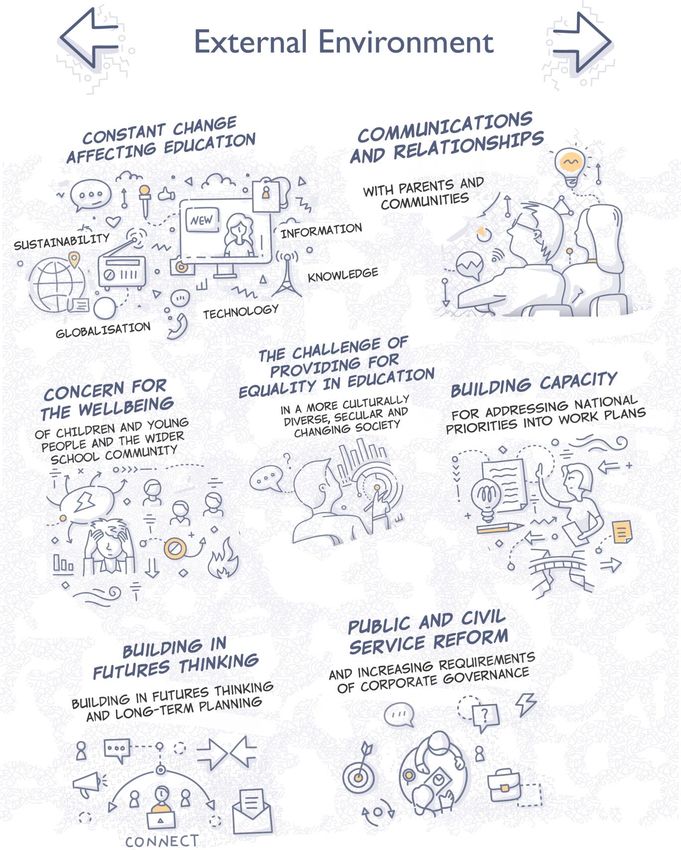
2
    December 2018
3
Contents
1.     Introduction                                      6

2.     Context                                           7

     The Organisation                                    7

     External and Internal Environment                   8

3.     Strategic planning 2019 - 2021                   11

     Vision                                             11

     Mission                                            11

     Strategic goals                                    11

     Cross-cutting themes in the work of the NCCA       12

4.     Achieving the strategic goals                    13

       1.     Curriculum and Assessment                 13

       2.     Engagement and collaboration              18

       3.     Knowledge and research                    23

       4.     Communications                            26

       5.     Governance and corporate services         28

5.     Monitoring and reporting                         32

                                                    4
5
1.          Introduction
This Strategic Plan builds on the increased alignment of curriculum developments across sectors in
Council’s work to date and supports the further development and articulation of a shared vision for
learning and development from birth through the period of post-primary education. This alignment is
important in how we work to prepare curriculum and assessment advice, but it is also important in
how we work with other stakeholders in the education system.

Reaching towards our vision of Leading innovation in education for learning, living and working in a
changing world involves many layers of innovation, engagement, challenge and learning. These are
reflected in the themes identified, which cut across the five strategic goals and the four sectors of the
Council’s remit: early childhood, primary, junior cycle and senior cycle. The themes are described as
cross-cutting because they reflect a shift from ‘sectoral’ to more ‘systemic’ ideas in Council’s work,
and in education developments generally. In and of themselves, the six themes overlap and intersect.
They are not exhaustive, but they are particularly significant in the context of the actions outlined for
each strategic goal.

While great care has been taken to develop a strategy that combines creativity and realism, any
strategy agreed upon must be flexible and allow for change over time. The Strategic Plan is therefore
a live document and may change as developments are progressed, new opportunities to innovate
arise or new national policy priorities are set. Its implementation is premised on the availability of
sufficient resources, and significant new areas of work such as the developments at primary and senior
cycle will require extensive resourcing.

Key to implementing our strategy is the expertise, dedicated work and commitment of the staff of the
NCCA and the members of our boards and development groups. I appreciate their contribution to the
work of the Council over the lifetime of the previous plan and NCCA looks forward to working with
them in implementing this plan and in innovating for an exciting future for all learners in our schools
and settings.

The current Council was appointed and commenced its work in early 2019 and will continue until
December 2021 and this strategic plan sets out the work of the Council within that timeframe. Ongoing
progress will be monitored and reported through general updates to the Council, through published
annual reports and through an annual output statement.

Brigid McManus, Chairperson

                                                   6
2. Context
The Organisation
The National Council for Curriculum and Assessment was established in November 1987 as a successor
to the Curriculum and Examinations Board and was reconstituted as a statutory body in July 2001.
The brief of the statutory Council as outlined in the Education Act (1998), is to advise the Minister for
Education and Skills on matters relating to:
…the curriculum for early childhood education, primary and post-primary schools
and the assessment procedures employed in schools and examinations on subjects
which are part of the curriculum. (41.1 a, b)
The Council is responsible for the development and determination of its advice on matters relating to
curriculum and assessment. The Council is a representative structure, the membership of which is
determined by the Minister for Education and Skills. It has 25 members, all of whom are appointed for
a three-year term. The members represent teachers, school managers, parents, business interests,
trade unions, and other educational interests. Other members include representatives of the
Department of Education and Skills, the State Examinations Commission, a nominee of the Minister
for Education and Skills and of the Minister for Children and Youth Affairs. The Minister appoints the
Chairperson.
The NCCA has a full-time executive staff, led by a Chief Executive. Funding for the NCCA is by way of a
grant from the Department of Education and Skills. The current Council was appointed and
commenced its work in early 2019 and will continue until December 31st 2021. This strategic plan sets
out the work of the Council over that timeframe.
7External and Internal Environment
Over the period of its last strategic plan 2015-2018, the NCCA conducted its work in a social and
economic environment where Ireland was emerging from a previous period of austerity. At its
broadest, the aim of the NCCA’s work, along with its stakeholders and partners, continued to be – to
contribute to children and young people living a full life, creating potential for their future lives and
employment chances, and in the process supporting social cohesion and advancing Ireland's global
competitiveness through the quality of its education system. Now, as Ireland fully emerges from
austerity, the challenge is to continue to lead developments in curriculum and assessment that can
contribute meaningfully to addressing the challenges faced by Ireland's society and economy,
particularly the challenges faced by families, young people and children.
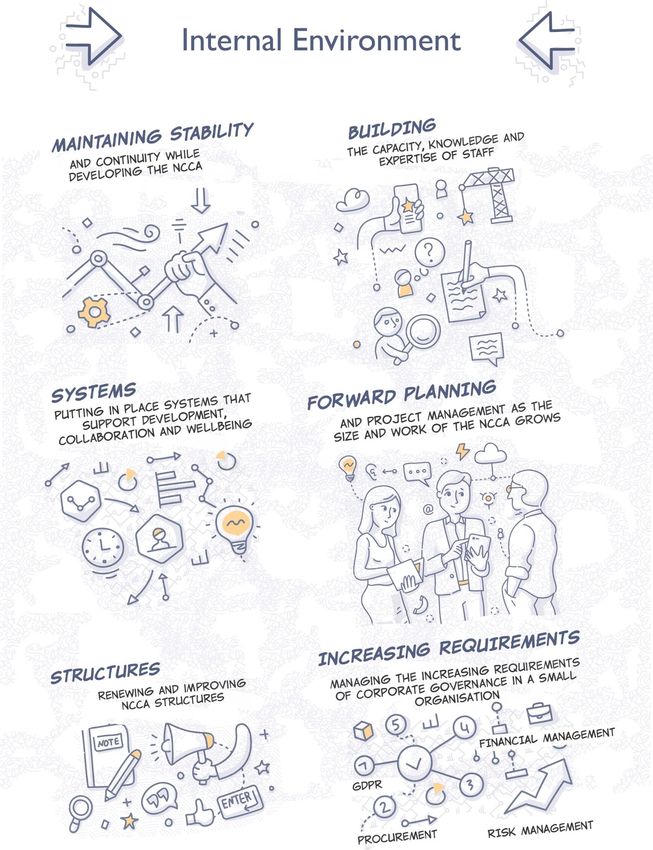
Some of the main environmental factors, external and internal, that will influence the work of the
NCCA over the period of its Strategic Plan and beyond are set out on the following page in graphical
form.
89
10
3.          Strategic planning 2019 - 2021

Vision
Leading innovation in education for learning, living and working in a changing world.

Mission
The Mission of the National Council for Curriculum and Assessment is to:

▪   advise the Minister for Education and Skills on curriculum and assessment from early childhood
    to the end of second level

▪   engage with learners, teachers, practitioners, parents and others to support innovation in schools
    and other educational settings

▪   undertake, use and share research as a basis for advice and debate on education.

Strategic goals
The 2019-2021 Strategic Plan sets out important actions in Council’s work across five strategic goals:

1. Curriculum and Assessment

    To develop innovative curriculum and assessment for engagement, progression, quality, inclusion
    and continuity across sectors and across educational transitions

2. Engagement and Collaboration

    To work with and support all teachers, practitioners, learners and our partners in education to
    build capacity for change, model ways of working, and inform curriculum and assessment
    development and implementation

3. Knowledge and Research

    To generate, use and share knowledge and research to support the development of curriculum and
    assessment advice and practice in all educational settings

                                                  11
4. Communications
To communicate, present and share the work and achievements of the NCCA effectively, to
improve its capacity to engage with others in leading and supporting educational change
5. Governance and Corporate Affairs
To develop NCCA governance and organisational structures, processes, skills and competences
effectively to achieve the vision of the organisation
Cross-cutting themes in the work of the NCCA
In the NCCA’s work in recent years, a number of themes have been identified which cut across the five
goals of the organisation and the four sectors within the Council’s remit - early childhood, primary,
junior cycle and senior cycle. The themes are described as cross-cutting because they reflect a shift
from ‘sectoral’ to more ‘systemic’ ideas in Council’s work, and in education developments generally.
This Strategic Plan builds on the increased alignment of curriculum developments across sectors in
Council’s work to-date and supports further developing and articulating a shared vision for learning
and development from birth through post-primary education. The six cross-cutting themes are evident
in Council’s programme of work for learners from birth through to the end of second-level:
1. Focusing on dispositions, competencies and skills when developing curricula
2. Including the voice of learners in the process of curriculum development
3. Contributing to greater autonomy and support for practitioners and teachers
4. Establishing the focus on the impact of teaching on learning as the focal point of educational
change
5. Designing and developing curricula to include ALL Learners
6. Paying attention to questions of continuity/progression across sectors and times of transition.
These six themes overlap and intersect. They both inform and are shaped by the emphasis NCCA
places on research in education. They are not exhaustive, but they are particularly significant in the
context of the actions outlined for each strategic goal.
124. Achieving the strategic goals
1. Curriculum and Assessment
To develop innovative curriculum and assessment for engagement, progression, quality, inclusion and continuity across
sectors and across educational transitions
We will deliver on this goal through the following planned outcomes:
Outcomes To achieve this we will Target
completion date
1.1 Aistear is providing the basis for curriculum planning and commence a review of the evidence base for early childhood 2020
implementation in early education settings and informing the care and education to inform future developments of the
pedagogical approaches in the early years of primary Aistear Framework
schooling. Aistear’s guidance for the 0-3 age group is
informing developments for this age group through the contribute to work planning for, and the development and 2019 and ongoing
National Síolta Aistear Initiative. quality assurance of, professional development content and
training resources for the National Síolta Aistear Initiative,
(NSAI) including a focus on STEM and arts experiences
maintenance and development of the Aistear/Síolta Practice 2019 and ongoing
Guide
131.2 In primary schools, new curricula are introduced for language support the implementation of the primary language 2019 and ongoing
(English and Gaeilge) and mathematics. curriculum, third to sixth class, through the development of
support material and examples of children’s learning,
including home languages other than English and Irish
publish and support the implementation of the primary
maths curriculum from infants to sixth class through the
development of support material and examples of children’s
learning
support schools’ work with STEM through examples of STEM
learning experiences
support schools’ work with content and language integrated
learning (CLIL) of Irish in English-medium schools
support schools’ work with home languages
1.3 An overview of a redeveloped primary curriculum has been complete a review of the primary curriculum
agreed and provides the basis for an extensive programme of
curriculum development. publish and consult on a draft overview of a redeveloped 2019
primary curriculum
14continue work on ERB and Ethics, and coding and feed the 2019
outcomes of this work into the review of the primary
curriculum
consider including foreign languages in senior classes as part 2019
of the review of the primary curriculum
agree a timeline for redeveloping the primary curriculum and 2019 and ongoing
proceed with the development work
1.4 In junior cycle, new curricula continue to be developed and continue review and development, as needed, of revised and 2019 and ongoing
introduced as part of the junior cycle developments. Post- new junior cycle curriculum specifications and assessment
primary schools are using the Framework for Junior Cycle as guidelines for ongoing development of short courses,
the basis for planning and implementing their junior cycle programmes and subjects
programmes.
1.5 A review of senior cycle education is underway and an continued development of, and implementation support for, 2019 and ongoing
extensive plan of development and reform in educational revised and new Leaving Certificate subject specifications
15programmes, curriculum, assessment, reporting and and programme specifications e.g. new modern foreign
certification is under way. language specifications
conduct an extensive review of senior cycle 2019
publish and consult on proposals for the development of 2019
senior cycle
agree a timeline, following consultation, and commence 2020
development work on the development of senior cycle
1.6 New approaches to assessment and reporting are being continue development of assessment and reporting capacity 2019
introduced and capacity to introduce developments in these and support material for new programme, subject and short
areas in schools and other settings is being supported. course specifications at junior cycle
1.7 Curriculum and assessment specifications continue to feature continue development of examples of student work for 2019 and ongoing
quality-assured examples of children’s/student’s work that ongoing development of programmes, subjects and short
illustrate the expectations for learners and contribute to courses
shared understanding of standards across the education
system.
161.8 A strong line of continuity, a sensitivity to key stages of continue development, informed by Aistear, of transition 2019 and ongoing
transition, and a focus on common features and elements, is and reporting capacity through the provision of support
evident across curriculum and assessment developments at material and examples of good practice in the preschool to
early childhood, primary and post-primary levels. primary school transition
complete a cross-sectoral review of Relationships and 2019
Sexuality Education in the curriculum and in schools
1.9 A model of cyclical, systematic curriculum review, publish and consult on a paper outlining a model for cyclical, 2019
encompassing all sectors and building on the current systematic, curriculum review and development in Ireland
curriculum development process, has been developed and and its relationship to the implementation of educational
agreed and its introduction has commenced. change
commence implementation of any outcomes of the process 2020
review, following their implementation in schools by two 2019 and ongoing
cohorts of students, of junior cycle specifications and
learning programmes (L1 and L2), and new/revised Leaving
Certificate subjects
172. Engagement and collaboration
To work with and support all teachers, practitioners, learners and our partners in education to build capacity for change,
model ways of working, and inform curriculum and assessment development and implementation
We will deliver on this goal through the following planned outcomes:
Outcomes To achieve this we will Target
completion date
2.1 NCCA is working with practitioners, groups and networks on convene and work with a network of early childhood settings 2019 and ongoing
ideas, material and initiatives to support their own capacity to develop and publish examples of high quality practice
and that of schools and other settings in curriculum with children in the 0-3 age group
development, assessment practice, and broader educational
change. through a Schools’ Forum, work with schools to pilot key
aspects of the redeveloped primary curriculum
convene and work with a Primary Maths Network to 2019
contribute to the development of the new Primary
Mathematics Curriculum and to gather and publish examples
of children’s learning and development in maths
18continue to work with a School Network to explore
approaches to integrating coding in the redeveloped primary
curriculum
continue to support the implementation and full realisation 2019 and ongoing
of the junior cycle developments as they are introduced and
embed in schools
work directly with a school network on consultation and 2019
development of proposals for the development of senior
cycle
work with teachers and schools to prepare for and facilitate 2019 and ongoing
the introduction of new and revised Leaving Certificate
subjects such as Computer Science and Physical Education
2.2 NCCA is supporting the work of education partners and support the development and activity of partner networks 2019 and ongoing
networks in curriculum and assessment development and in established by other organisations to inform curriculum and
supporting teaching and learning. assessment developments in early childhood, primary and
post-primary education
19work directly with education partners to support the
implementation and full realisation of the junior cycle
developments as they are introduced and embedded in
schools
2.3 The voice and experience of learners is part of discussions continue to develop materials and models to support the 2019 and ongoing
and consultations on developments in curriculum and inclusion of the learner’s voice in curriculum and assessment
assessment. development across all sectors
incorporate learner involvement in NCCA curriculum and
assessment development processes, including marginalised
learners and those outside the formal education system
develop, and provide access to, an online bank of materials
and models related to capturing the voice of learners in
curriculum development and school development
2.4 Liaison and collaborative relationships with a range of collaborate with agencies and organisations, linked to 2019 and ongoing
organisations and government departments are improving specific aspects or areas of the NCCA’s work and to other
the understanding and quality of curriculum and assessment areas of mutual interest
developments and the model for, or approach taken to, their
implementation.
20collaborate with the Department of Education and Skills, the
Department of Children and Youth Affairs and other
government departments linked to specific aspects or areas
of the NCCA’s work
collaborate with initial teacher education institutions,
support teams, services and other organisations to align
curriculum and assessment developments with teacher
professional development
collaborate with the Teaching Council on alignment between
curriculum developments and the development of subject
criteria for teaching
continue engagement on the transition from second level to
higher education through the Transitions Reform Group
2.5 Curriculum and assessment developments north and south collaborate with the curriculum and assessment 2019 and ongoing
of the border and in Europe have been supported by development agency in Northern Ireland on areas of
strategic collaboration between NCCA and other curriculum common interest
development agencies.
21engage and collaborate with curriculum and assessment
development agencies and other development agencies in
Europe and internationally on matters of mutual interest
engage and collaborate with international networks such as
the Consortium of Institutes for Development and Research
in Education in Europe (CIDREE) and the Atlantic Rim
Collaborative on areas of common interest
223. Knowledge and research
To generate, use and share knowledge and research to support the development of curriculum and assessment advice and
practice in all educational settings
We will deliver on this goal through the following planned outcomes
Outcomes To achieve this we will Target completion
date
3.1 Curriculum and assessment developments are informed prepare, agree and regularly review an NCCA research 2019
by evidence and research. strategy
draw on the findings of the primary longitudinal study to 2019 and ongoing
inform primary curriculum review and all work across early
childhood and primary level
publish background papers and consultation reports related Ongoing
to the development of programme, subject and short course
specifications in junior and senior cycle
initiate, commission and use research, as needed, to inform Ongoing
the development of practice with children aged from birth to
three years
23initiate, commission and use research, as needed, to inform Ongoing
and underpin the redevelopment of the primary curriculum,
junior cycle developments and senior cycle review and
development
initiate and commission research to inform the curriculum Ongoing
and assessment development process undertaken by the
NCCA e.g. the focus on Learning Outcomes and assessment of
key skills
3.2 Curriculum and assessment developments are informed work with the Research Alive Group (the Teaching Council, 2020
through engagement with and participation in research the Centre for Effective Services and the NCCA) to develop the
networks. Teachers’ Research Expertise Exchange, in the process
supporting teachers and other professionals to engage with
research/researchers to inform practice and build system
capacity
collaborate with the Research in Early Childhood Education 2019 and ongoing
Collaborative (RECEC) and other organisations/networks to
explore the contribution of research in early childhood to
developments in early childhood and primary education
24hold an international conference highlighting NCCA’s 2020
contribution to the research knowledge base in the education
system in Ireland
3.3 The outcomes and findings of research are available, ensure that boards, development groups, partner 2019 ongoing
accessible and disseminated to those with an interest in organisations and networks have access to evidence from
education, policy making and evaluation. research and from all educational settings
publish findings from research in easily accessible formats 2019 ongoing
including full reports, executive summaries, presentations,
podcasts and interviews
3.4 Research findings and new knowledge are shared and provide regular opportunities for NCCA staff to discuss current 2019 ongoing
interrogated by NCCA staff as an integral part of their research in relevant fields
work.
invite researchers and external experts to present and discuss 2019 ongoing
relevant areas of research and expertise with NCCA staff
provide opportunities for staff to write and present
conference papers and findings from research and work with
all educational settings 2019 ongoing
254. Communications
To communicate, present and share the work and achievements of the NCCA effectively, to improve its capacity to engage
with others in leading and supporting educational change
We will deliver on this goal through the following planned outcomes:
Outcomes To achieve this we will Target
completion date
4.1 Using an effective media strategy and process, key messages on prepare, agree and regularly review an NCCA media 2019 ongoing
educational change are shared internally and externally. NCCA and communications strategy
responses and contributions are informed and timely.
Communications awareness is built into all areas of the NCCA’s employ a range of media to ensure key messages 2019 ongoing
work. are effectively communicated to schools and the
general public
continue to develop use of social media to share key 2019 ongoing
messages about the work of NCCA and to engage
teachers, practitioners, learners and others
4.2 NCCA websites are updated and maintained in response to system continue to develop, maintain and analyse/evaluate 2019 ongoing
need, customer feedback, statistics on web usage, and the use of the NCCA corporate and other websites
developments in online and social media.
26develop video and podcast material for the website 2019/2020
highlighting the NCCA’s role, work, curriculum
development processes and structures
continue development of curriculumonline.ie and 2019 ongoing
continually review and renew the examples of
learning, teaching and children’s/student’s work it
includes
further develop electronic planning tools for Ongoing
teachers and school management that support
aspects of curriculum changes underway
4.3 The work of the NCCA on curriculum and assessment and on have an NCCA presence at relevant national and Ongoing
practice in schools is shared with national and international international events and showcase the NCCA’s work
audiences and feedback informs ongoing developments. in a strategic way at conferences, seminars, and
through publications
275. Governance and corporate services
To develop NCCA governance and organisational structures, processes, skills and competences effectively to achieve the
vision of the organisation
We will deliver on this goal through the following planned outcomes:
Outcomes To achieve this we will Target
completion date
5.1 Organisation structures and processes are supporting innovative implement the findings of the internal Review of 2019/2020
curriculum and assessment development and collaborative work NCCA structures and curriculum development
practices. processes, 2018
commission an external review of the NCCA and its 2020
effectiveness
conduct a self-assessment by Council and its sub- 2019 and ongoing
committees on an annual basis
build collaboration across teams and other 2019 and ongoing
structures to improve continuity across sectors and
improve workflow
28develop approaches and media to extend internal 2019 and ongoing
communications among staff, stakeholders and
NCCA structures and committees
5.2 NCCA staff has developed the knowledge and competences continue to provide professional development 2019 and ongoing
required to develop innovative curriculum and assessment advice related to competences identified through the
and to support its introduction in schools and other settings. Performance Management Development System
(PMDS)
encourage and support staff to develop their
knowledge and competences through higher
education studies and research and other forms of
professional development
5.3 There is a performance culture focused on positive values, co- continue to implement the PMDS 2019 and ongoing
operation, support, empowerment and wellbeing of staff across
the organisation. prepare, agree and regularly review an NCCA
human resources strategy and workforce plan
5.4 There is a robust financial management system in place. monitor and review revised financial management 2019
systems and procedures introduced in 2017
29maintain relevant accounting standards in line with 2019 and ongoing
government guidelines
provide all necessary documentation for internal 2019 and ongoing
and external audit
5.5 There is full compliance with the governance requirements of, and ensure compliance with the requirements of good 2019 and ongoing
code of practice for, state bodies. governance generally, with the Code of Practice for
the Governance of State Bodies 2016 and the
General Data Protection Regulations 2018 (GDPR)
support the work of the Audit and Risk and the
Governance committees of the NCCA and develop
and implement programmes of work for internal
audit and for developments in governance
meet all reporting requirements of the
Departments of Education and Skills and the
Department of Public Expenditure and Reform
adhere to public procurement guidelines
30maintain and update a risk register and risk
management system
5.6 Customer service standards are developed and improved. review the customer service charter address any 2019 and ongoing
improvements needed in service delivery
5.7 The NCCA has complied with all relevant public sector agreements implement measures to comply with the 2019 and ongoing
and development plans. requirements of public service reform and civil
service renewal
315. Monitoring and reporting
This strategic plan sets out the strategic goals, outcomes and targets that will direct the work of the
NCCA over the period of the Council from 2019 to 2021. In broad terms, the strategy will be evaluated
on the basis of how it contributes to the vision and mission of the organisation, how, for example, the
advice of the NCCA on curriculum and assessmnet developments is attended to, used and
implemented over the period in question. Ongoing progress on more specific aspects of the Strategic
Plan will be monitored and reported through general updates to the Council and through published
annual reports.
The preparation and implementation of an annual Plan of Work and the implementation of the
Performance Management and Development System (PMDS) are central to guiding and monitoring
progress at organisational and individual level.
Progress reports and presentations on the various areas of work will be presented to Council over the
course of the strategy. An Annual Report detailing progress made in implementing the strategy will be
published each year.
An annual Performance Delivery Agreement (PDA) with the Department of Education and Skills and
regular Governance meetings with its Curriculum and Assessment Policy Unit, will provide a
framework for reporting to the Department and improve clarity with regards to roles and
responsibilities. The Office of the Comptroller and Auditor General conducts audits of receipts and
expenditure and of procedures and practices. The outcomes of these audits are published in the C and
AG’s Annual Report.
3233
You can also read


