Network transformation outlook 2019-2024 - 2020 update
←
→
Page content transcription
If your browser does not render page correctly, please read the page content below
Network transformation outlook
2019-2024

Date          17/02/2020
Sensitivity   Unrestricted

                             Sensitivity: Confidential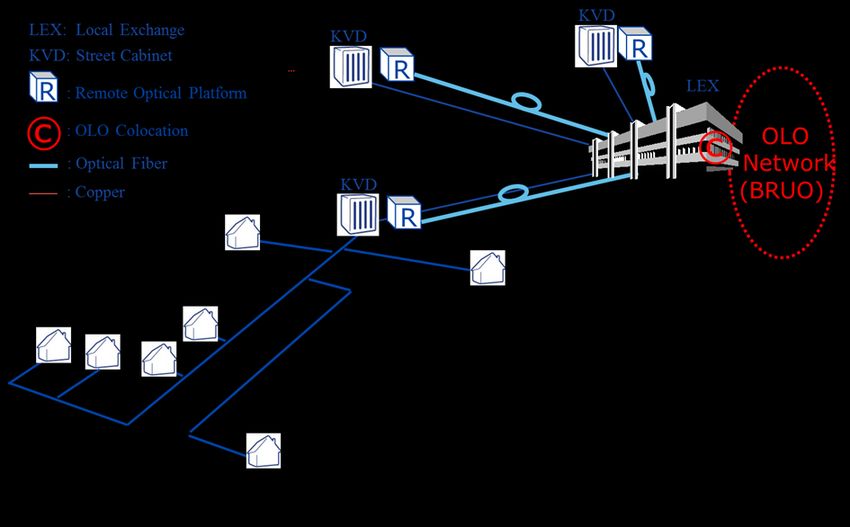
Table of contents
Table of contents...................................................................................................... 2

1.     Background and Scope of the present document ............................... 3

2. The Proximus Mantra program ................................................................... 4

3. Broadband Access Evolution ........................................................................7
       3.1 Broadway ................................................................................................................................ 7
       3.2 Physical Access Network Evolution ............................................................................. 9
       3.3 Wholesale Broadband VDSL2 ..................................................................................... 10
       3.4 ATM Outphasing ................................................................................................................ 11
       3.5 ROP-based ADSL(2+) ..................................................................................................... 11
       3.6 Fiber To The Home ...........................................................................................................12

4. Data and Capacity Services ........................................................................14

5. Voice Interconnect Evolution ..................................................................... 15

6. Building Outphasing ......................................................................................18

7.     Copper outphasing........................................................................................ 25

Proximus public limited company of Belgian Public Law, exercising its activities under the commercial name Proximus, located in
Bd. du Roi Albert II 27, B-1030 Brussels, Belgium,VAT BE 0202.239.951, Brussels Register of Legal Entities, Giro BE50 0001 7100 3118                     Page 2 of 27

                                                                               Sensitivity: Confidential
1. Background and Scope of the present document
This document is an update of the document “Network transformation outlook 2018-2023” and has been
elaborated to answer the request for information of the BIPT as formulated in “het besluit van de
conferentie van regulatoren voor de elektronische communicatiesector van 29 juni 2018 met betrekking
tot de analyse van de markten voor breedband en televisieomroep”.
The present document has been constituted to Proximus’ best knowledge at present of the future
evolutions of its fixed networks taken into account that several matters discussed in the present document
are not covered by detailed or final decisions of the management and/or Board of Directors.
The present document contains the relevant information to what transformations in Proximus’ fixed
network will take place in the coming 5 years that will or might have an impact on the existing wholesale
services and wholesale access points.
Most statements in the present document constitute forward-looking statements. These statements may
include, without limitation, statements concerning future technological evolutions, decisions and timelines,
and statements preceded by, followed by or including the words “believes”, “expects”, “anticipates” or
similar expressions. These forward-looking statements rely on a number of assumptions concerning
future events and evolutions and are subject to uncertainties and other factors, many of which are outside
our control that could cause actual evolutions to differ materially from such statements.
Data and information in the present document may be subject to re-evaluation, evolution and changes.
Proximus cannot guarantee that this information is complete or that no new information will become
available with an impact in the coming 5 years.
Proximus cannot be held liable for any mistake, omission or any other short coming of the present
information, which has been provided based on our best knowledge and in good faith.
This document doesn’t constitute any binding offer from Proximus and doesn’t contain any commitment
from Proximus.
This document and the information within are made independently of any form of appeal, present and
future, against a decision or a regulatory requirement imposed to Proximus.
Proximus public limited company of Belgian Public Law, exercising its activities under the commercial name Proximus, located in
Bd. du Roi Albert II 27, B-1030 Brussels, Belgium,VAT BE 0202.239.951, Brussels Register of Legal Entities, Giro BE50 0001 7100 3118 Page 3 of 27
Sensitivity: Confidential2. The Proximus Mantra program
Proximus’ Mantra program (called “Move to All IP program” in previous years), in this document referred to
as “Mantra”, aims at adapting and transforming the fixed network of Proximus to the global technological
evolution:
• Evolution of the Fixed Voice network and Voice Service Platforms.
• Evolution of network technologies (ATM/SDH, Ethernet) and anticipation of the end of life of
multiple legacy technologies.
• Invest in network simplification to reduce OPEX and increase operational efficiency.
The Mantra network transformation process is being carried out in two phases:
• The first phase concerned the building of an MPLS & IP-based network and the
porting/implementation of the Proximus product portfolio (retail and wholesale) on this
infrastructure.
• In the second phase, the legacy network technologies are subject to consolidation and phasing out
in view of optimizing the network infrastructure and deal with the fact that legacy technologies
have become obsolete and without vendor support.
The first phase was divided into four steps:
• Deployment of an IP-based access infrastructure based on FTTC and VDSL2.
• Deployment of an MPLS & IP-based aggregation and core network. The current deployed MPLS &
IP-based aggregation/core network supports bandwidths up to 10 Gbps and provides the
reliability needed for future proof services. The current aggregation/core networks are being
renewed to cope with the continuously increasing bandwidth needs up to 100 Gbps and whose
roll-out started mid 2018 with the target to have finished it by end 2021/beginning of 2022.
• Deployment of the IMS platform for voice services.
• Porting most of the Proximus service portfolio on the MPLS & IP network. This entails both the
retail and the wholesale portfolio of Proximus.
In line with our present expectations, the second phase includes all initiatives aimed at consolidating the
customer installed base on the MPLS & IP infrastructure and at reducing the operational complexity of
managing several network infrastructures in parallel (one per service).
• Phasing out of access legacy technologies (Leased Lines in all different flavours, X.25, PDH & SDH)
and traffic transition to the MPLS & IP-based infrastructure.
• Phasing out of core legacy technologies (ATM, PDH & SDH, PSTN, ISDN, …) and traffic transition to
the MPLS & IP-based infrastructure.
Proximus public limited company of Belgian Public Law, exercising its activities under the commercial name Proximus, located in
Bd. du Roi Albert II 27, B-1030 Brussels, Belgium,VAT BE 0202.239.951, Brussels Register of Legal Entities, Giro BE50 0001 7100 3118 Page 4 of 27
Sensitivity: ConfidentialFig. 1 below gives an overview of “the” Network Simplification program from which parts are already started
or even already finalized.
Mantra Program :
implement and deliver “the” network simplification!
Need for a thorough network simplification program as critical enabler of future efficiency
Mantra encloses the Building out
phasing program
transformation part of
MAIP in order to deliver Switching ATM out
out phasing phasing
the Network Simplification. program program
MANTRA
Migrations and
network
ISDN transformation Migrations
The program replacement Coordination
is supported by Center
complementary efficiency (MCC)
Alternatives to
initiatives to ease copper legacy
the delivery of the transformation services
MANTRA
Mantra program-Sept
September Engineering
2015 - Proximus
2015 - Proximus confidential
Confidential Pre-rollout Rollout Migrations
1
Figure 1: Network Simplification
The Mantra program has impact on the Wholesale services currently offered by Proximus. Below we
summarize the most important impacts:
• Broadband Access services: The ATM-based Bitstream ADSL(2+) and SDSL services have been
transformed to Ethernet-based Bitstream ADSL(2+) and SDSL services in order to meet the global
technological evolution towards Ethernet.
• ATM is now fully phased out and replaced by Ethernet as uniform medium for access technologies
such as ADSL, ADSL2+, VDSL2 and SDSL.
• Data and Capacity services: migration from BILAN and Leased Lines to Ethernet based services.
• Voice Interconnect: as the complete voice network (except remaining legacy ISDN-BAs) has now
been migrated to an IMS based infrastructure, the current TDM interconnection model between
Proximus and third party operators is evolving to an IP Interconnect model.
• Local Loop Unbundling services: as additional LEX buildings will be closed, the colocation and
services delivered in and from these buildings will have to be terminated and/or migrated to
alternative offers.
Proximus public limited company of Belgian Public Law, exercising its activities under the commercial name Proximus, located in
Bd. du Roi Albert II 27, B-1030 Brussels, Belgium,VAT BE 0202.239.951, Brussels Register of Legal Entities, Giro BE50 0001 7100 3118 Page 5 of 27
Sensitivity: ConfidentialThe Mantra program has a different impact on each of the wholesale customers. In that perspective,
Proximus holds, since 2010, recurrent meetings with the wholesale customers in order to:
• Inform the wholesale customers about the products that will be out-phased and about the future
products.
• Give them guidance on possibilities for evolution scenarios.
• Discuss with them the lists of impacted lines and create migration plans for these.
The removal of the older data networks (ATM) and the legacy telephone exchanges (Nokia 1 and Siemens)
were key enablers to sell off a number of large technical buildings in city centres as described in chapter 6
“Building Outphasing”.
However the long term ambition of Proximus is to cover the centre of cities and communes with fiber (see
chapter 3), to make in the non-fiberized areas great parts of the copper (feeder) network redundant and to
further dispose parts of the total technical surface area mainly located in smaller buildings from mid-2019
onwards. This resulted in the decision to start the related works for “Mantra+” from 2017 onwards with a
pilot of 10 buildings, for which the outphasing has been finalized, and the notification of 64 Mantra+
buildings (see chapter 6). At that stage, the technology will be located mainly in existing street cabinets,
supplemented with newly designed small containers called Optimus containers. Some local nets will not
be equipped with an Optimus container but with an OVD (Optische Verdeler), a passive street cabinet that
patches the optical fibers to 1 or more neighbouring LEXes.
1
Nokia acquired Alcatel-Lucent in April 2015.
Proximus public limited company of Belgian Public Law, exercising its activities under the commercial name Proximus, located in
Bd. du Roi Albert II 27, B-1030 Brussels, Belgium,VAT BE 0202.239.951, Brussels Register of Legal Entities, Giro BE50 0001 7100 3118 Page 6 of 27
Sensitivity: Confidential3. Broadband Access Evolution
Preliminary statements in this chapter concern the technologies and services in general in Belgium. Specific
circumstances may exist in outphased buildings as described in Chapter 6.
Proximus continues to deploy Fibre-to-the-Curb in selected areas allowing to extend the VDSL2 service
coverage.
The impact of this evolution on wholesale access services is twofold:
1. The LEX based unbundling model becomes obsolete (which is confirmed by the fact that certain
MDF sites are already closed down or are notified for closure).
2. The Bitstream ADSL(2+)/SDSL over ATM reference offer became obsolete and evolved to:
a. either a Bitstream access service for VDSL2 connectivity which is always Ethernet based,
b. or a Bitstream over Ethernet service for ADSL(2+) and SDSL connectivity.
ADSL(2+) will be gradually outphased in the copper distribution areas served by ROPs with all Living Units
connectable in VDSL2 as an enabler to activate vectoring also in the downstream frequency bands
between 552 kHz and 2,2 MHz. The opening of the VDSL2 zones 6 and 7 will trigger a list of additional
homogenizable ROPs.
On 14 July 2017, SDSL has been notified aiming for a “stop sell” from 1/7/2018 and a full “stop service”
by end 2019. In 2019, Proximus decided to shift the “stop service” date to mid 2020. On June 3rd 2019,
the BIPT approved the “stop sell” and “stop service” of SDSL based on Proximus’ proposal to offer a lower
priced EFM solution as an alternative for SDSL lines complying with certain conditions. The “stop sell” has
been activated on July 1st 2019 and the “stop service” has been communicated for July 1st 2020.
3.1 Broadway
VDSL2 coverage
Proximus announced its Broadway plans publicly in 2004 with an initial target coverage for VDSL2 of 46%.
This coverage target was progressively increased, so that Proximus has reached by end 2019 an effective
service coverage for VDSL2 of 95,4%(2).
Information on a more detailed basis regarding availability is provided if, where and to the extent relevant
in the context of the existing wholesale access services.
2
The current VDSL2 provisioning speeds range from 70 Mbps (vectoring zone 1) downstream to 8 Mbps (vectoring zone 7) and can
increase through the DLM-process from up to 16,5 Mbps (in legacy zones 4 and 5), 30 Mbps in vectoring zones 6 & 7 to up to
100 Mbps (in vectoring zone 1).
Proximus public limited company of Belgian Public Law, exercising its activities under the commercial name Proximus, located in
Bd. du Roi Albert II 27, B-1030 Brussels, Belgium,VAT BE 0202.239.951, Brussels Register of Legal Entities, Giro BE50 0001 7100 3118 Page 7 of 27
Sensitivity: ConfidentialThe coverage as well as the attainable speeds with VDSL2 depend on attenuation and distance. For the
current attenuation- and distance limits, please refer to the Bitstream xDSL offer published on Proximus’
web site.
VDSL2 speeds
In 2010, the use of spectrum for VDSL2 has been increased to 17 MHz allowing attainable provisioning
speed up to 30 Mbps downstream & up to 10 Mbps upstream on legacy and vector-friendly VDSL2 lines.
Since 2012, Proximus also applies the DLM (Dynamic Line Management) process to the VDSL2 lines,
boosting part of its park of legacy and vector-friendly VDSL2-lines to up to 70 Mbps downstream speeds.
The DLM allows part of the legacy and vector-friendly VDSL2 lines to benefit from higher bit rates than
expected according to the provisioning rules based on loop length and attenuation, without increasing
significantly the risk for transmission errors or instabilities.
Since 2014, Proximus also applies the DLM process to increase upstream speeds up to 10 Mbps on legacy
and vector-friendly VDSL2-lines.
In collaboration with its VDSL2 equipment manufacturers Proximus has now upgraded its VDSL2 network
with the roll-out of a new technology called vectoring. Based on new VDSL2 ISAM cards, downstream
vectoring allows internet speeds up to 70 Mbps by neutralizing interferences between copper pairs lying in
the same cable. DLM further boosts part of this park of vectored VDSL2 lines to up to 100 Mbps.
Since 2015, Proximus also implemented upstream vectoring which increases the upstream speed on
vectored VDSL2-lines to up to 20 Mbps. The upstream speed was further increased to up to 40 Mbps in
2017.
From mid-2017 onwards, Proximus started gradually with the activation of vectoring in the frequency band
from 1,1 MHz to 2,2 MHz on notified ROPs without ADSL2+ services to achieve further downstream speed
increases for many of the subscribers which are connected to homogenizable ROPs, meaning they serve a
copper distribution area that allows all Living Units to be connected in VDSL2. Such homogenizable ROPs
are being gradually closed for ADSL2+ services.
In 2018, Proximus also started gradually with the activation of vectoring in the frequency band from 552
kHz to 1,1 MHz on these notified ROPs after the removal of ADSL1 services.
On 22 November 2018, Proximus extended the VDSL2 coverage by having added the new vectoring zones
6 & 7 for ROPs on which ADSL from ROP has been activated. This allows the homogenization of additional
ROPs.
As of mid 2020 newly installed ROPs will be equipped with new DSLAM equipment (7363 MX-6). This new
equipment contains a new line card, i.e. the RDLT-G card of Nokia and will consolidate all DSLAM
functionalities (logic, processing, management functionalities) completely in the ROP. It will also support
the future 35Mhz technology (see below). The introduction of this new DSLAM equipment is considered as
a major network upgrade with the associated OLO CPE operators’ roles and responsibilities. The gradual
migration of the current DSLAM equipment in the existing ROPs, implying a short service interruption, is
only foreseen as of 2022 at the earliest. The planning of these migrations will be communicated timely.
In the coming years, Proximus could implement solutions to further upgrade its VDSL2 network. In this
respect, the following solutions might be investigated:
Proximus public limited company of Belgian Public Law, exercising its activities under the commercial name Proximus, located in
Bd. du Roi Albert II 27, B-1030 Brussels, Belgium,VAT BE 0202.239.951, Brussels Register of Legal Entities, Giro BE50 0001 7100 3118 Page 8 of 27
Sensitivity: Confidential• Solutions that further increase downstream- and upstream speeds.
• The potential of the new “Long Reach” VDSL2 standard will be analysed.
• VDSL2 35 MHz, currently being tested with field trials, to further increase downstream speed
through the use of the spectrum to 35 MHz. VDSL2 35 MHz would be enabled on the new VDSL2
platform as described above. The large scale activation of 35 MHz is not foreseen before 2022.
Proximus will timely adapt the Bitstream xDSL reference offer with new 35 MHz VDSL2 line
profiles, the impact on the UNI specification and an update of the OLO-CPE test plan in order to
make sure that alternative operators can also benefit from this new 35 MHz VDSL2 technology
when launched. Operators using an existing OLO CPE that may be 35 MHz compatible will have
to recertify these CPEs conform the OLO-CPE test plan (that will be updated for 35 MHz VDSL2).
It is important to note that the existing 17,6 MHz capable CPEs are expected to still function in
17,6 MHz VDSL2 profiles with the new MX-6 platform.
• VDSL2 Boost Box (VBB), to reduce the copper distance between the ROP and the customers.
• Pair bonding, to allow the use of several copper pairs to further increase downstream and
upstream speeds is no longer envisaged to be developed for residential end-user oriented
services.
• FTTdp (G.fast), currently being tested with field trials. Although being a DSL solution on copper,
it will be deployed in the framework of FTTH to avoid the hassle of fiber civil works in private
property and to deliver higher downstream and upstream speeds.
3.2 Physical Access Network Evolution
As Proximus deployed a fibre network to the vicinity of the Street Cabinet (KVD, Borne), by installing
Remote Optical Platform units (ROPs) next to those Street Cabinets from which broadband- and voice
services are provided, the MDF functionality in the Local Exchange (LEX) will be lesser and lesser used.
Therefore, as part of its roll-out, Proximus is able to dismantle a number of the local exchange buildings.
Hence the current colocation and unbundling services at the LEX will be terminated or largely reduced,
pursuant the regulatory framework as defined in the relevant regulated reference offers and the respective
contracts.
In order to support the long-term target of the disappearance of the MDF functionality in the Local
Exchange building (LEX), Proximus might reduce renewal investments in the copper feeder network by
gradually outphasing copper feeder cables if and where they must be renewed (e.g. triggered by roadworks
or cable damage).
The figure below gives an overview of the most important elements in the new access network, as well as
the respective elements.
Proximus public limited company of Belgian Public Law, exercising its activities under the commercial name Proximus, located in
Bd. du Roi Albert II 27, B-1030 Brussels, Belgium,VAT BE 0202.239.951, Brussels Register of Legal Entities, Giro BE50 0001 7100 3118 Page 9 of 27
Sensitivity: Confidential3.3 Wholesale Broadband VDSL2
The Bitstream VDSL2 service allows the alternative player to connect its end-users onto the Proximus
network at a Proximus Service PoP using VDSL2 technology. The end-to-end transport between the end-
user and the beneficiary is based on Ethernet.
Impacts of the vectoring technology on the Bitstream VDSL2service
The application of vectoring on the VDSL2 lines is not compatible with the delivery of ISDN services on
VDSL2 lines. As a result, since 2013:
• Ordering of new Bitstream VDSL2 products on end-user lines with ISDN service is not possible
anymore. Ordering Bitstream VDSL2 on another pair will remain possible: Bitstream VDSL2
without Voice or Bitstream VDSL2 with Voice on PSTN.
• Proximus finished the uncoupling of all existing configurations where both Bitstream VDSL2 and
an ISDN service were offered on the same copper pair. The ISDN service is moved on another
pair, without impact on the Bitstream VDSL2 service of the end-user.
(Please refer to the Bitstream VDSL2 offer for further details)
The extension of vectoring on VDSL2 lines in the frequency bands between 552 kHz and 2,2 MHz is not
compatible with the delivery of ADSL1 and ADSL2+ services from those ROPs. As a result, from
01/07/2017 for ADSL2+ and from 01/02/2018 for ADSL1 :
• Ordering of new ADSL1 or ADSL2+ products is not possible anymore for endpoints which are
located in copper distribution areas in which all Living Units can be connected in VDSL2.
Proximus public limited company of Belgian Public Law, exercising its activities under the commercial name Proximus, located in
Bd. du Roi Albert II 27, B-1030 Brussels, Belgium,VAT BE 0202.239.951, Brussels Register of Legal Entities, Giro BE50 0001 7100 3118 Page 10 of 27
Sensitivity: ConfidentialReach Extended ADSL2 services are opened on all ROPs which support “ADSL from ROP” or which have
been homogenized (meaning sub 2,2 MHz vectoring has been activated).
The speed of VDSL2 lines which are not equipped with a VDSL2 CPE which is at least “vector-friendly” at
the moment of the activation of vectoring on the ROP concerned will be reduced to a Fall-back speed as
defined in the Bitstream VDSL2 reference offer.
The Ethernet backbone investments project (introduced in chapter 2) - which aims at gradually replacing
the current Ethernet aggregation/core networks - will add a third option to the current Bitstream VDSL2
and Bitstream Fiber GPON reference offers on top of the existing options “Shared VLAN” and “Dedicated
VLAN”. No plans to outphase these existing options have been developed yet. The addendum of this new
third option is now planned to be submitted to the BIPT in 2020.
3.4 ATM Outphasing
At the transport network level, Proximus consolidated the traffic on a common MPLS & IP-based
infrastructure. Hence ATM outphasing was the most cost-effective path for the future. Proximus
implemented the following strategy to accomplish this technological transformation:
• Nokia R5 Gigabit Ethernet NT cards have been installed in the R5 DSLAMs, and cover the whole
of Belgium since mid-2011.
• ADSL(2+)- & SDSL traffic was mapped from ATM to the Ethernet backbone.
• Extension of Bitstream ADSL(2+) and SDSL to Ethernet transport.
• The Wholesale interconnection points on ATM level were closed and replaced by the 10 Ethernet
Service Nodes.
Proximus performed with its customers the migration from ATM-based services to Ethernet-based
services. Migrations have started in 2010 and Proximus now finished off-loading the ATM-network.
3.5 ROP-based ADSL(2+)
The ADSL(2+) and SDSL traffic can be transported on the Ethernet backbone thanks to the solution based
on the Gigabit Ethernet NT cards installed in the ATM-DSLAMs hosted in every central office.
In the central office of buildings to be outphased and in copper distribution areas (these are the endpoints
served by one street cabinet – see figure 2) for which the copper feeder will be cut, the LEX-based
ADSL(2+) solution is not sustainable. Therefore Proximus developed ROP-based ADSL(2+) solutions,
based on the Nokia NDLT-G vectoring cards (which also support multi DSL) installed in the ROPs. This
allows to deliver ReADSL, ADSL1 and ADSL2+ solutions, but are not adequate for SDSL, nor for ADSL(2+)
lines delivered with ISDN on the same copper pair. In this context, a stop sell of ADSL-services over legacy
ISDN from 2017, February 1st onwards was notified and approved.
The ROP-based ADSL(2+) solution is applied for the different flavours of retail- and wholesale ADSL(2+)
services (Fast Internet Access, Explore, Carrier and Bitstream) and Proximus launched it for building
outphasing nets since end 2013.
Proximus public limited company of Belgian Public Law, exercising its activities under the commercial name Proximus, located in
Bd. du Roi Albert II 27, B-1030 Brussels, Belgium,VAT BE 0202.239.951, Brussels Register of Legal Entities, Giro BE50 0001 7100 3118 Page 11 of 27
Sensitivity: ConfidentialProximus extended the usage of the ROP-based ADSL(2+) solution in all local nets from late 2015
onwards to solve issues such as saturated or damaged feeder cables, improve ADSL(2+) access speeds
and for the gradual outphasing of the current ATM-DSLAM-platform.
The ROP-based ADSL(2+) solution is only compatible with LEX-based SDSL-signals so all LEX-based
ADSL(2+) services (including ADSL(2+) on BRUO-lines) must be moved to the ROP upon activation of
ROP-based ADSL(2+) for that ROP. The impact on the BRUO reference offer has been covered with the
creation of a new BRUO-service “Raw Copper Type 3” for SDSL-services on BRUO-lines.
The decision to gradually activate vectoring in frequency bands below 2,2 MHz also triggered the necessity
of a further roll-out of ROP-based ADSL(2+) services as a preparatory step towards it.
(Please refer to the BRUO and Bitstream xDSL offers for further details)
The LEX- and ROP-based ADSL(2+) solutions based on the Nokia NDLT-G vectoring cards are also an
enabler for the upcoming End-of-life outphasing of the current ATM-DSLAM-platform which also implies
a “Stop sell” activated on July 1st 2019 and a future “Stop service” on July 1st 2020 of the Proximus SDSL-
services.
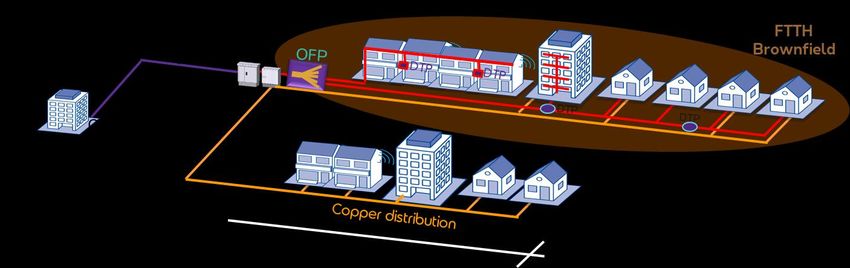
3.6 Fiber To The Home
At the end of 2016, Proximus announced an investment of € 3 billion in the coming 10 years to accelerate
the roll-out of Fiber in Belgium aiming at covering the centres of cities and communes, through deployment
both on the façade of buildings and in certain sections in underground ducts.
Figure 3: FTTH network
In the coming years, Proximus will fully fiberize dense city areas, starting with a progressive roll-out.
Proximus started in the cities Antwerp, Brussels, Charleroi, Ghent, Namur, Liège, Hasselt, Roeselare, Evere,
Leuven, Aalst, Vilvoorde, Knokke-Heist and Kortrijk. In such areas, migrations from copper to fiber will take
place progressively following the full fiber coverage of the relevant geographic areas which will be notified
for the copper plant outphasing (see also Chapter 7).
Proximus public limited company of Belgian Public Law, exercising its activities under the commercial name Proximus, located in
Bd. du Roi Albert II 27, B-1030 Brussels, Belgium,VAT BE 0202.239.951, Brussels Register of Legal Entities, Giro BE50 0001 7100 3118 Page 12 of 27
Sensitivity: ConfidentialProximus also continues to deploy FTTH in new residential zonings.
In 2014, Proximus presented its first commercial wholesale FTTH offer. In November 2018, a Bitstream
Fiber GPON offer was presented in line with the Broadband market decision of 29 June 2018.
Proximus notifies its wholesale fiber customers and the BIPT on the planned network extensions of the
fiber deployment progressively along the project:
• Twice a year, Proximus communicates the Fiberhoods for which the construction started to the
BIPT and the wholesale customers.
• A stop service of all copper based services in these Fiberhoods is communicated to the BIPT and
the wholesale customers conform the timings as defined by the BIPT. An overview of all
Fiberhoods for which copper outphasing is planned can be found in Chapter 7.
With the exception of high-speed digital services such as LAN Extension Solutions (BLES), Optical Network
Services (ONS) and a set of bitstream services, only IP-based services will remain available in FTTH areas.
Proximus currently expects to deploy XGSPON (10Gbps) in (part of) its Fiber GPON coverage area before
2026, in function of market evolutions to high bandwidths.
Proximus public limited company of Belgian Public Law, exercising its activities under the commercial name Proximus, located in
Bd. du Roi Albert II 27, B-1030 Brussels, Belgium,VAT BE 0202.239.951, Brussels Register of Legal Entities, Giro BE50 0001 7100 3118 Page 13 of 27
Sensitivity: Confidential4. Data and Capacity Services
Preliminary, statements in this chapter concern the technologies and services in general in Belgium. Specific
scenarios may exist in outphased buildings as described in chapter 6.
Bandwidth demand is ever increasing in today’s data networks and these same networks are evolving more
and more towards Ethernet. Therefore, in the long term, Proximus anticipates the Leased Lines services
based on SDH to become obsolete, as data needs will be fulfilled by another type of supply, which forms
part of a different market for data services.
The following planning was established:
• Analogue Leased Lines and digital Leased Lines lower than 2 Mbps are no longer sold since
1 January 2017 (“Stop sell”) with a progressive “Stop service” afterwards for existing lines. The
“Stop service” milestones have been notified with an end of service date of end-2019.
• Higher or equal to 2 Mbps Leased Lines, including partial circuits, backhaul and half links, will no
longer be sold as of 31 December 2020 (“Stop sell”)3 with a progressive “Stop service”
afterwards. Current expectations are having outphased them all by end 2023 as a prerequisite
for SDH outphasing.
• The BROTSoLL offer has been extended in 2014 with a Next Generation Leased Line service.
NGLL is an Ethernet (Layer2) connectivity service; based on Ethernet over MPLS technology and
it can be accessed via Ethernet over copper (Ethernet in the First Mile = EFM) and Ethernet over
fiber. (Please refer to the updated BROTSoLL offer for further details).
• Ethernet services (10 Mbps) and Fast Ethernet services (100 Mbps) are currently implemented
on top of the SDH-network which is planned to be outphased. Fast Ethernet services (100 Mbps)
are planned to be developed on the Ethernet backbone but the 10 Mbps Ethernet services will
no longer be sold as of 31 December 2020 and are planned to be outphased by end 2023 as a
prerequisite for the SDH-outphasing.
• For Ethernet over copper (EFM), “Stop Sell” and “Stop Service” plans are still under evaluation as
it is not a future proof technology but a target date to have them all outphased is not yet decided.
• BILAN ATM/FR services were migrated to MPLS Ethernet and the public X.25 service was
stopped in 2013.
3
Except for TDM voice interconnect, see chapter 5.
Proximus public limited company of Belgian Public Law, exercising its activities under the commercial name Proximus, located in
Bd. du Roi Albert II 27, B-1030 Brussels, Belgium,VAT BE 0202.239.951, Brussels Register of Legal Entities, Giro BE50 0001 7100 3118 Page 14 of 27
Sensitivity: Confidential5. Voice Interconnect Evolution
The legacy voice network was a 2-layer network which included about 180 Local Exchanges (LEX) for
which hardware was installed in over 1.000 buildings which was fully phased out and replaced by IP-based
solutions for PSTN-lines and PRA-lines by end 2017.
The technical solutions for this migration are based on the following elements:
• PSTN emulation via Access Gateway (AGW) as replacement for traditional PSTN services. AGWs
are installed in the ROP (Remote Optical Platform) or in the central office and are controlled by
an IMS platform. Figure 4 shows how it is built. PSTN lines are emulated via the voice access
gateway.
Central Office Street cabinet
Traditional
PSTN voice
LEX
Street cabinet
Emulated voice
IMS ROP
IP backbone
IP
AGW
Figure 4: PSTN AGW solution
• ISDN emulation via IAD (Integrated Access Device), as a replacement for traditional ISDN-BA
services. IADs are installed at the end-user & connected between the xDSL modem and the end-
user ISDN device as shown in figure 5 and are controlled by an IMS platform. This solution needs
a technical intervention at the customer’s premises.
• An ISDN BA “Nokia S12 extend End-of-life” solution has been implemented on which ±75% of
the remaining ISDN BA subscriptions have been migrated without any technical intervention at
the customer’s premises. A limited number of Nokia S12 Local Exchanges (LEX) remains active
and S12 ISDN remote unit hardware has been installed in all central offices (except BO-nets) on
which these remaining ISDN-BA lines are concentrated. A “Stop Sell” ISDN-BA from 1 January
2017 onwards (with some exceptions) has been notified to the market aiming at a gradual
emptying of these platforms by end 2021. In this context, Proximus communicated on December
12th 2019 to the BIPT a stop service of xDSL services on ISDN-BA as from December 31st 2021,
which was approved by the BIPT on February 6th 2020.
Proximus public limited company of Belgian Public Law, exercising its activities under the commercial name Proximus, located in
Bd. du Roi Albert II 27, B-1030 Brussels, Belgium,VAT BE 0202.239.951, Brussels Register of Legal Entities, Giro BE50 0001 7100 3118 Page 15 of 27
Sensitivity: ConfidentialCentral Office Street cabinet
ISDN/BA
NT-1 (S)
(U)
LEX
Street cabinet
Emulated ISDN/BA
IAD (S)
xDSL modem
IMS ROP
IP backbone
IP
Figure 5: ISDN over IAD solution
Central Office Street cabinet
ISDN/BA NT-1
LEX
Central Office Central Office Street cabinet
ISDN/BA NT-1
S12 ISDN host RSU
Figure 6: ISDN/BA on S12 ISDN host via Remote Switching Unit
• ISDN-PRAs that were not replaced timely with another commercial offering have been migrated
without needing a technical intervention at the customer’s premises to a MGW-solution (Media
Gateway) which is controlled by an IMS platform and became available in 2015.
Central Office
ISDN/PRA LTE
LEX
PABX
IMS
Central Office
Emulated
IP backbone SDH backbone LTE
ISDN/PRA
IP
MGW PABX
Figure 7: ISDN/PRA via Media Gateway
• ISDN emulation via IAD (Integrated Access Device) as a replacement for traditional ISDN-PRA
services is under development and is planned to be available in the course of 2020. These
IAD-30s are installed at the end-user & connected between the Ethernet interface of a
broadband service and the end-user ISDN-PABX and are controlled by an IMS platform. This
solution must be implemented for ISDN-PRAs that cannot be replaced timely with another
commercial offering as a prerequisite for the SDH outphasing.
• Proximus undertakes to keep CPS and CS available to alternative operators for the above-
mentioned solutions. In case the underlying classic PSTN, ISDN and PRA technology disappears
for the end-user because of the evolution of the Proximus network infrastructure or because of
Proximus public limited company of Belgian Public Law, exercising its activities under the commercial name Proximus, located in
Bd. du Roi Albert II 27, B-1030 Brussels, Belgium,VAT BE 0202.239.951, Brussels Register of Legal Entities, Giro BE50 0001 7100 3118 Page 16 of 27
Sensitivity: Confidentialthe Proximus-initiated migration to Voice over Broadband technology, CPS and CS are not
supported anymore. Proximus plans to completely stop the CS and CPS services at 31 December
2022 at the latest and will inform the alternative operators 6 months in advance of the final stop
service date. The conditions determining a potential earlier stop of CS and CPS are described in
the reference offer.
A gradual migration towards voice over broadband services will further reduce the use of PSTN services
emulated via Access Gateway (AGW) and the long term replacement strategy of the Access Gateway will
require forced migrations of remaining PSTN services as probably from 2020 onwards. Proximus started
therefore in 2017 with the delivery in its packs with voice of IP Phone lines instead of emulated PSTN. Note
that CPS and CS services are not supported on IP Phone lines.
Impact on BRIO and BROTSoLL IC links:
BRIO local voice services (local Terminating and local Collecting) have been fully outphased since end
2017.
A TDM MGW solution (Media Gateway) was launched in 2015.
BRIO aggregated voice services (aggregated interconnect level) have been fully migrated in 2016 and
2017 without changes of the interconnect links (OIT) as Proximus reconnected the existing interconnect
links on the TDM MGW solution.
As – except remaining legacy ISDN-BA-lines - the complete legacy voice network has been migrated to
an IMS based infrastructure since end-2017, the current TDM interconnection model between Proximus
and third party operators is evolving to an IP Interconnect model.
Therefore an IP interconnection solution has been developed. The gradual migration from TDM to IP
interconnection started in 2018 aiming at closing the TDM interconnection afterwards. Proximus foresees
to have TDM interconnection outphased in the course of 2022 in order to enable the SDH outphasing by
the end of 2023. Voice TDM interconnection lines will at least be sold until end of 2021.
Proximus public limited company of Belgian Public Law, exercising its activities under the commercial name Proximus, located in
Bd. du Roi Albert II 27, B-1030 Brussels, Belgium,VAT BE 0202.239.951, Brussels Register of Legal Entities, Giro BE50 0001 7100 3118 Page 17 of 27
Sensitivity: Confidential6. Building Outphasing
The Building Outphasing is an essential component of the Proximus Mantra Program. A list of 65 buildings
was initially identified for closure between 2012 and 2021, and communicated to the market. In this initial
plan, some large buildings were excluded, due to their technical complexity. The building outphasing plan
has now evolved to a lower number of buildings, but puts more focus on the large buildings.
The table 2 below summarizes the current building outphasing planning of the “Mantra” program in the
period 2012-2020. This planning is only indicative and still subject to changes. Upon OLO request, we have
added a column giving the information whether – according to current planning and expectations - a mini-
MDF will be present or not.
The table 3 below summarizes the current building outphasing planning of the first phase of the “Mantra+”
program which includes a pilot of 10 local nets and phase 1 with 64 local nets from which the main building
will be emptied and includes the changes notified on 19 December 2018 4. The “Mantra+” concept does
not accommodate for a mini-MDF solution so the column which indicates the presence of it has been
removed.
Table 2: building outphasing planning of the Mantra program
Phase
End of Service Out Mini
Local Net Address Nr City
Delivery MDF
Year
30/06/2012 02EUR0 2012 Y
30/06/2014 02BRC0 2014 N
30/06/2014 03WES0 2014 N
30/06/2014 83CIN0 2014 Y
30/06/2015 02BOS0 2015 Y
30/06/2015 02HAL0 2015 N
30/06/2015 55RON0 2015 N
30/06/2015 87VER0 2015 Y
16/12/2016 51ROE0 2016 N
16/12/2016 67NIV0 2016 N
30/06/2017 11HAS0 2017 N
09/10/2017 54NIN0 2017 N
09/10/2017 56KOR0 2017 N
4
Early January 2019 an erratum was sent to the BIPT and the wholesale customers to correct the End of Service Delivery date
of 03DEU0, being 30/06/2021.
Proximus public limited company of Belgian Public Law, exercising its activities under the commercial name Proximus, located in
Bd. du Roi Albert II 27, B-1030 Brussels, Belgium,VAT BE 0202.239.951, Brussels Register of Legal Entities, Giro BE50 0001 7100 3118 Page 18 of 27
Sensitivity: ConfidentialPhase
End of Service Out Mini
Local Net Address Nr City
Delivery MDF
Year
31/07/2018 14HER0 2018 N
31/07/2018 80ST10 2018 N
31/07/2018 03SIL0 2018 N
30/06/2019 65MON0 2019 N
30/06/2019 02STR0 2019 N
30/06/2019 03CEN0 2019 N
30/06/2020 91GKK 2020 5
Keizer Karelstraat 1 GENT
30/06/2020 03BER0 2020 N Uitbreidingsstraat 325 BERCHEM
30/06/2021 03DEU0 2021 N Terheydelaan 221-223 DEURNE
Table 3: building outphasing planning of the Mantra+ program
End of Service Local Net Phase Out Address, Nr City
Delivery Year
30/06/2019 02KOR0 2019
30/06/2019 03KIE0 2019
30/06/2019 53HAA0 2019
30/06/2019 71ACO0 2019
30/06/2019 71MOU0 2019
30/06/2019 71WAL0 2019
30/06/2019 81FLO0 2019
30/06/2019 91BAS0 2019
30/06/2019 91LAN0 2019
31/12/2019 02HOE0 2019
30/06/2020 11HEL0 2020 Kleine Heresteeg, 83 HOUTHALEN
30/06/2021 13LUM0 2021 Past. Frederickxstraat, 13 LUMMEN
5
Not applicable: the building 91GKK is a Service Node.
Proximus public limited company of Belgian Public Law, exercising its activities under the commercial name Proximus, located in
Bd. du Roi Albert II 27, B-1030 Brussels, Belgium,VAT BE 0202.239.951, Brussels Register of Legal Entities, Giro BE50 0001 7100 3118 Page 19 of 27
Sensitivity: ConfidentialEnd of Service Local Net Phase Out Address, Nr City
Delivery Year
30/06/2020 53LED0 2020 Ommeganglaan, 79 LEDE
30/06/2020 81CHA0 2020 Chaussée de Louvain, 544 CHAMPION
31/03/2023 10JOD0 2023 Avenue des Combattants, 18 JODOIGNE
30/06/2021 60CHI0 2021 Rue Reine Astrid, 5 CHIMAY
30/06/2021 91GAV0 2021 Stationsstraat 180 ASPER
30/12/2022 11ZOU0 2022 Nieuwstraat, 32 ZOUTLEEUW
30/09/2021 12RIE0 2021 Tongersesteenweg, 15 RIEMST
30/09/2021 16VER0 2021 Stationstraat, 87 VERTRIJK
31/12/2022 11GEL0 2022 Steenweg, 81 KLEIN GELMEN
30/12/2022 50DUD0 2022 Herdersbruggestraat 2 DUDZELE
31/12/2022 55MUN0 2022 Heufkensstraat, 143 MUNKZWALM
31/12/2021 59EER0 2021 Westkerkestraat 30A EERNEGEM
31/12/2021 57IEP0 2021 Vooruitgangsstraat, 1 IEPER
31/12/2022 87NES0 2022 Rue Franklin Roosevelt FRAIPONT
28/02/2022 02GRI0 2022 Wolvertemsesteenweg 279 GRIMBERGEN
28/02/2022 03BOO0 2022 Antwerpsestraat, 97 BOOM
28/02/2022 84MAR0 2022 Rue des Brasseurs, 8 MARCHE-EN-FAMENNE
31/03/2023 03JOB0 2023 Brugstraat, 137 ST JOB IN'T GOOR
31/03/2023 84REN0 2023 Route de Laroche, 1 RENDEUX
31/12/2023 81JAM0 2023 Rue d'Enhaive, 20 JAMBES
30/06/2022 52DEN0 2022 Noordlaan, 25 DENDERMONDE
30/06/2023 10COU0 2023 Av. des Prisonniers de Guerre, 4 COURT SAINT ETIENNE
31/12/2023 02ROD0 2023 Zoniënwoudlaan, 340 RHODE ST GENESE
30/09/2023 55KLU0 2023 Kontrijnstraat 44 BERCHEM
31/12/2023 65HAU0 2023 Place d'Hautrage, 7 HAUTRAGE
01/10/2023 69BLE0 2023 Rue Wilbaut Bouchart, 2 BLEHARIES
30/09/2023 87JAL0 2023 Chafour (route d'état n°629) JALHAY
Proximus public limited company of Belgian Public Law, exercising its activities under the commercial name Proximus, located in
Bd. du Roi Albert II 27, B-1030 Brussels, Belgium,VAT BE 0202.239.951, Brussels Register of Legal Entities, Giro BE50 0001 7100 3118 Page 20 of 27
Sensitivity: ConfidentialEnd of Service Local Net Phase Out Address, Nr City
Delivery Year
30/09/2023 89ASS0 2023 Kerkhofstraat, 2 AS
31/12/2023 03BOE0 2023 Boechoutsesteenweg, 171-173 HOVE
30/06/2023 82DIN0 2023 Rue Bribosia, 9 DINANT
31/12/2023 16WMB0 2023 Steenweg op Ramsel, 25 WESTMEERBEEK
30/06/2023 68BRU0 2023 Rue Notre Dame CAMBRON-CASTEAU
31/12/2023 81FAU0 2023 Rue de Croquet, 187 FAULX-LES-TOMBES
31/12/2023 81GRL0 2023 Rue de la Converterie, 10 GRAND-LEEZ
30/06/2023 41ANS0 2023 Rue Delvaux, 22-26 ANS
31/12/2023 69TOU0 2023 Rue Tête d'Or, 9-11 TOURNAI
30/09/2023 03SHO0 2023 Villerslei, 107 SCHOTEN
31/03/2024 03WOM0 2024 Jacobsveldweg, 15 WOMMELGEM
31/03/2024 65GIV0 2024 Ch. de Beaumont (entre 61 et 65) GIVRY
31/03/2024 84ORT0 2024 Ortho, 23 ORTHO
31/03/2024 91WON0 2024 Zeeschipstraat 209 WONDELGEM
31/05/2024 03HOO0 2024 Gammel, 110 RIJKEVORSEL
30/06/2023 64LAL0 2023 Rue de la Concorde, 17 LA LOUVIERE
30/06/2023 58KOK0 2023 Koninklijke Baan 81 KOKSIJDE
30/06/2023 91DEU0 2023 Kortrijksesteenweg 285 ST.-MARTENS LATEM
30/06/2024 71NAL0 2024 Rue du Dépôt, 51 NALINNES
30/06/2023 91ZOT0 2023 Meerlaan 54 ZOTTEGEM
30/06/2024 41ENG0 2024 Rue Maréchal Foch, 2 ENGIS
30/09/2023 50TOR0 2023 Aartrijkestraat 4 TORHOUT
30/09/2023 68GHI0 2023 Pavé d'Ath 144 HELLEBECQ
30/09/2023 71SOL0 2023 Rue Emile Vandervelde, 2A SOLRE SUR SAMBRE
30/09/2023 80VIE0 2023 Rue de l'Hôtel de Ville, 7 VIELSALM
31/03/2024 11LOM0 2024 Einderpad, 43 LOMMEL
31/12/2023 14TIE0 2023 Tielendorp, 58 TIELEN
Proximus public limited company of Belgian Public Law, exercising its activities under the commercial name Proximus, located in
Bd. du Roi Albert II 27, B-1030 Brussels, Belgium,VAT BE 0202.239.951, Brussels Register of Legal Entities, Giro BE50 0001 7100 3118 Page 21 of 27
Sensitivity: ConfidentialEnd of Service Local Net Phase Out Address, Nr City
Delivery Year
31/12/2023 15RYM0 2023 Kruisstraat, 22 RIJMENAM
31/12/2023 54GER0 2023 Lessensestraat 105 GERAARDSBERGEN
31/12/2023 59MID0 2023 Koninginnelaan 125 MIDDELKERKE
30/06/2022 81GEM0 2022 Rue Monseigneur Heylen, 9 GEMBLOUX
28/02/2024 41JUP0 2024 Rue de Visé, 360 JUPILLE
28/02/2024 71CHT0 2024 Allée de la Sambre, 2 CHATELINEAU
30/06/2024 91AAL0 2024 Brug-Zuid 2 AALTER
30/06/2024 91EEK0 2024 Euerardstraat 39 EEKLO
Note that those dates are end of services delivery dates for all lines; which of course requires a progressive
migration to get them all migrated in due time. Building outphasing automatically implies that the
outphasing of legacy ISDN lines is performed simultaneously or beforehand.
Impact on co-location and LLU services:
• The first general rule is that the MDF and the copper feeding network are out-phased completely.
In this standard case, co-location (including co-mingling) and LLU services are no more possible.
• In four local nets 6 a new Mini-MDF function was created to serve a limited number of customers
who remain connected on copper pairs. For this limited number of lines, LLU remains possible.
Proximus communicated to the Operators the list of Street Cabinets (KVDs) and Direct Feeds
eligible for connection to the Mini-MDF in these specific LEXs.
In all cases the MDF of the current buildings, that are or will be sold, will have to be freed up completely.
Impact of the outphasing of the Ethernet Service PoPs 03CEN0 and 91GKK0
• These Service PoPs serve as a connection point for Proximus sited OLO Access Lines to collect
Bitstream xDSL traffic and Proximus sited Aggregation Point Access Lines to collect NGLL traffic.
• These Service Nodes moved to neighbouring villages:
o 03CEN (“Antwerpen-Centrum”) moved to 03WOM (“Wommelgem”);
o 91GKK (“Gent – Keizer Karel”) moved to 91WON (“Wondelgem”).
Colocation is available in both new Service Nodes and Proximus developed in 2017 the “Distant Intro offer”
which allows to reconnect Proximus sited OLO Access Lines and Aggregation Point Access Lines (OAL &
6
For current status: see column “Mini-MDF” in Table 2. The Mini-MDF function will not be created for Mantra+-buildings.
Proximus public limited company of Belgian Public Law, exercising its activities under the commercial name Proximus, located in
Bd. du Roi Albert II 27, B-1030 Brussels, Belgium,VAT BE 0202.239.951, Brussels Register of Legal Entities, Giro BE50 0001 7100 3118 Page 22 of 27
Sensitivity: ConfidentialAPAL) from these moved Service PoPs for OLOs who had not yet the possibility to order Proximus sited
OAL/APAL ports from 03WOM and/or 91WON due to the absence of OLO-fiber there.
Impact of the outphasing of the building in the local net 02STR0
• The Ethernet Service PoP 02STR remains in service.
Impact of the outphasing of buildings with an Area Access Point (AAP)
• Operators who want to keep the TDM voice interconnection solution will be offered the possibility
to introduce the impacted interconnection links via an Area Access Point in a different Area.
Impact on other OLO services:
• The following services will have to be migrated to alternative solutions before the end of service
delivery date of the outphased building where they are currently in service:
Table 4: Services to be migrated to alternative solutions.
Product type
Co-location and co-mingling in current buildings
Explore EFM (or E-line EFM or NGLL EFM)
Explore ISDN back-up (a)
Analogue Leased Lines (b)
Digital Leased Lines less than 2 Mbit/s (b)
BRIO extra area half links (analogue and less than 2 Mbit/s) (b)
BrotsoLL Digital Leased Lines (less than 2 Mbit/s) (b)
BRUO (RC and SP) (c)
BROBA ADSL(2+) with voice ISDN (d)
BROBA Re-ADSL (possible from the ROP from 1/2/2018 onwards)
BROBA SDSL (e)
Carrier ADSL(2+) with voice ISDN (d)
Carrier Re-ADSL (possible from the ROP from 1/2/2018 onwards)
Carrier SDSL (e)
Explore ADSL(2+) with voice ISDN (d)
Proximus public limited company of Belgian Public Law, exercising its activities under the commercial name Proximus, located in
Bd. du Roi Albert II 27, B-1030 Brussels, Belgium,VAT BE 0202.239.951, Brussels Register of Legal Entities, Giro BE50 0001 7100 3118 Page 23 of 27
Sensitivity: ConfidentialExplore SDSL (e)
(a) A gradual “Stop Service” by end 2021 is planned for legacy ISDN-2 subscriber lines.
(b) Analogue- and less than 2 Mbit/s Leased Lines are in Stop service since end 2019.
(c) Not applicable in copper zones for OLOs with a valid contract for co-mingling in the new Atropos room.
(d) The ISDN-part of ADSL(2+) with voice ISDN services will be migrated to ISDN over IP by March 2020 at the latest.
(e) A gradual “Stop Service” by 1 July 2020 is planned for the SDSL services.
• As mentioned in different chapters higher in this document and in the footnotes of Table 4, certain
Product types are or will be the subject of a global outphasing with “Stop service” dates that might
precede notified “end of service delivery dates” of outphased buildings.
• For services with ADSL and ADSL2+ access, like Bitstream ADSL & ADSL2+, Carrier ADSL &
ADSL2+, and Explore ADSL & ADSL2+ a new technical solution is available (see above section 3.5
“ROP-based ADSL(2+)”) but it is recommended to migrate to VDSL2 where possible and
mandatory to migrate to VDSL2 for homogenizable ROPs.
• The technological migration of current ISDN-BA services to ISDN via IAD services will change the
configuration of an OLO Broadband7 with ISDN-BA voice service to OLO Broadband without voice.
In order to avoid newly installed services to be migrated shortly later, Proximus sends yearly to each
Wholesale customer a notice of “Stop sell” pursuant to the information delays contractually specified.
Similarly, for each outphased building, Proximus will send to each Wholesale customer present in the
concerned local net a notice of service suspension (“Stop Service”) pursuant to the information delays
contractually specified for each impacted service, as well as a list of circuits impacted and of possible service
alternatives.
7
OLO Broadband = Carrier xDSL, BRUO, Bitstream xDSL service.
Proximus public limited company of Belgian Public Law, exercising its activities under the commercial name Proximus, located in
Bd. du Roi Albert II 27, B-1030 Brussels, Belgium,VAT BE 0202.239.951, Brussels Register of Legal Entities, Giro BE50 0001 7100 3118 Page 24 of 27
Sensitivity: Confidential7. Copper outphasing
Proximus’ goal is to fully outphase the copper network (feeding and distribution) in the areas (fiberhoods)
where FTTH is deployed. All services provisioned on copper will have to be migrated to alternative solutions
(cfr. table 5) before the end of service delivery date of the fiberhood where they are currently in service.
The table 6 summarizes the current copper outphasing planning until 2024. This planning is only
indicative and still subject to changes. Note that no copper outphasing is foreseen in FTTB 8 zones.
Table 5: Services to be migrated to alternative solutions mainly include:
Product type
Explore EFM (or E-line EFM or NGLL EFM)
Explore ISDN back-up (a)
Analogue Leased Lines (b)
Digital Leased Lines (b)
BRIO extra area half links (analogue and less than 2 Mbit/s) ( b)
BROTSoLL Digital Leased Lines (b)
BRUO (RC and SP)
Bitstream ADSL(2+)
Bitstream Re-ADSL
Bitstream SDSL (c)
Bitstream VDSL2
Carrier ADSL(2+)
Carrier Re-ADSL
Carrier SDSL (c)
Carrier VDSL2
8
FTTB = Fiber to the Business: industrial zones and buildings with a high concentration of business customers.
Proximus public limited company of Belgian Public Law, exercising its activities under the commercial name Proximus, located in
Bd. du Roi Albert II 27, B-1030 Brussels, Belgium,VAT BE 0202.239.951, Brussels Register of Legal Entities, Giro BE50 0001 7100 3118 Page 25 of 27
Sensitivity: ConfidentialWholesale Internet VDSL2
Explore ADSL(2+)
Explore SDSL (c)
Explore VDSL
PSTN on AGW
Legacy ISDN BA (a)
Legacy ISDN-30
(a) A gradual “Stop Service” by end 2021 is planned for legacy ISDN-2 subscriber lines.
(b) Analogue- and less than 2 Mbit/s Leased Lines are in Stop service since end 2019.
(c) A gradual “Stop Service” by 1 July 2020 is planned for the SDSL services.
Table 6: Copper outphasing planning
End of Service Delivery Fiberhood
31/03/2022 W00-C-Anspach-FH01
31/03/2022 W00-C-Anspach-FH02
31/03/2022 W00-C-Anspach-FH03
30/06/2022 W01-C-Deurne-FH04
30/06/2022 W01-C-Gent-FH03
30/06/2022 W01-C-Charleroi-FH01
31/12/2022 W01-C-Deurne-FH03
31/12/2022 W01-C-Gent-FH04
31/12/2022 W01-C-Gent-FH07
31/12/2022 W01-C-Charleroi-FH03
31/12/2022 W01-C-Namur-FH06
31/12/2022 W02-D-Diamant-FH01
31/12/2022 W02-D-Liege-FH02
31/12/2022 W02-D-Hasselt-FH03
30/06/2023 W01-C-Gent-FH06
30/06/2023 W01-C-Gent-FH09
30/06/2023 W01-C-Gent-FH11
30/06/2023 W02-D-Liege-FH01
31/12/2023 W01-C-Deurne-FH06
31/12/2023 W01-C-Deurne-FH07
31/12/2023 W01-C-Deurne-FH08
31/12/2023 W01-C-Deurne-FH09
31/12/2023 W01-C-Gent-FH08
Proximus public limited company of Belgian Public Law, exercising its activities under the commercial name Proximus, located in
Bd. du Roi Albert II 27, B-1030 Brussels, Belgium,VAT BE 0202.239.951, Brussels Register of Legal Entities, Giro BE50 0001 7100 3118 Page 26 of 27
Sensitivity: Confidential31/12/2023 W01-C-Gent-FH10
31/12/2023 W01-C-Gent-FH12
31/12/2023 W01-C-Roeselare-FH04
31/12/2023 W01-C-Charleroi-FH04
31/12/2023 W01-C-Charleroi-FH05
31/12/2023 W01-C-Namur-FH07
31/12/2023 W02-D-Liege-FH03
31/12/2023 W02-D-Hasselt-FH01
30/06/2024 W01-C-Deurne-FH10
30/06/2024 W01-C-Deurne-FH11
30/06/2024 W01-C-Gent-FH14
30/06/2024 W01-C-Gent-FH15
30/06/2024 W01-C-Roeselare-FH05
30/06/2024 W02-D-Evere-FH01
30/06/2024 W02-D-Leuven-FH01
30/06/2024 W03-C-Liege-FH04
30/06/2024 W03-C-Aalst-FH01
As mentioned in different chapters higher in this document and in the footnotes of Table 5, certain product
types are or will be the subject of a global outphasing with “Stop service” dates that might precede notified
“end of service delivery dates” in fiberhoods.
In order to avoid newly installed services to be migrated shortly later, Proximus sends yearly to each
Wholesale customer a notice of “Stop sell” pursuant to the information delays contractually specified. A
change of this “Stop sell” approach is currently under investigation and will be communicated timely when
decided. Similarly, for each fiberhood, Proximus will send to each Wholesale customer present in the
concerned fiberhood a notice of service suspension (“Stop Service”) pursuant to the information delays
contractually specified for each impacted service, as well as a list of circuits impacted and of possible service
alternatives.
--- end of document ---
Proximus public limited company of Belgian Public Law, exercising its activities under the commercial name Proximus, located in
Bd. du Roi Albert II 27, B-1030 Brussels, Belgium,VAT BE 0202.239.951, Brussels Register of Legal Entities, Giro BE50 0001 7100 3118 Page 27 of 27
Sensitivity: ConfidentialYou can also read


