Offshore Cape Three Points Environmental and Social Monitoring - Review of 2019 AMR, Q1 2020 QMR and Q2 2020 QMR - Reference: Vitol Upstream Ghana ...
←
→
Page content transcription
If your browser does not render page correctly, please read the page content below
Offshore Cape Three Points
Environmental and Social Monitoring
– Review of 2019 AMR, Q1 2020
QMR and Q2 2020 QMR
Reference: Vitol Upstream Ghana Ltd
Date: 22 December 2020

REPORTING
Intended for
Vitol Upstream Ghana Limited and the International Finance Corporation

Date
December 2020

Project Number
1620010598

OFFSHORE CAPE THREE
POINTS
ENVIRONMENTAL AND
SOCIAL MONITORING –
REVIEW OF 2019 AMR,
Q1 2020 QMR AND Q2
2020 QMR
OFFSHORE CAPE THREE POINTS
ENVIRONMENTAL AND SOCIAL MONITORING –
REVIEW OF 2019 AMR, Q1 2020 QMR AND Q2 2020
QMR

Project No.    1620010598
Issue No.      1 (Final)
Date           22 December 2020
Made by        R Bisset, S Coey and C Halliwell
Checked by     C Halliwell
Approved by    C Halliwell

 Made by:                              R Bisset, S Coey and C Halliwell

 Checked/Approved by:

This report is produced by Ramboll at the request of the client for the purposes
detailed herein. This report and accompanying documents are intended solely for the
use and benefit of the client for this purpose only and may not be used by or disclosed
to, in whole or in part, any other person without the express written consent of
Ramboll. Ramboll neither owes nor accepts any duty to any third party and shall not
be liable for any loss, damage or expense of whatsoever nature which is caused by
their reliance on the information contained in this report.

Version Control Log

 Revision     Date         Made by       Checked by   Approved by   Description

 Issue 1      23/10/2020   CMH/RB/SC     CMH/RB       CMH           Draft for Client Review

 Issue 1      23/11/20     CMH/RB/SC     CMH/RB       CMH           Final Draft post Lender and
                                                                    Company comments

 Issue 1      22/12/20     CMH/RB/SC     CMH/RB       CMH           Final - FOR PUBLIC DISCLOSURE

Ramboll
2nd Floor
Bewley House
Chippenham
SN15 1JW
United Kingdom
T +44 1225 748 420
www.ramboll.co.uk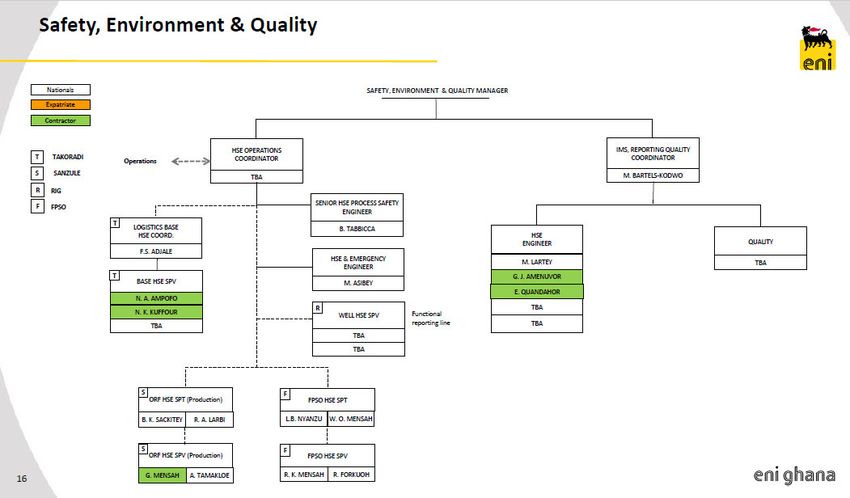
ENVIRONMENTAL AND SOCIAL MONITORING – REVIEW OF 2019 AMR, Q1 2020 QMR AND Q2 2020 QMR

       OFFSHORE CAPE THREE POINTS

       CONTENTS

       GLOSSARY OF TERMS/ ACRONYMS                                   I
       EXECUTIVE SUMMARY                                             I
       1.      INTRODUCTION                                          1
       2.      SCOPE AND STRUCTURE OF THE REPORT                     3
       2.1     Project Standards                                     3
       2.2     Structure of the Report                               3
       2.3     Limitations                                           4
       3.      PROJECT STATUS UPDATE                                 5
       3.1     Project Description                                   5
       3.2     Status of the Project at the end in Q2, 2020          6
       4.      SIGNIFICANCE ASSESSMENT                               9
       4.1     Introduction                                          9
       4.2     Interpretation of the Consolidated Table              9
       5.      PERFORMANCE STANDARD 1: ASSESSMENT AND
               MANAGEMENT OF ENVIRONMENTAL AND SOCIAL
               RISKS AND IMPACTS                                    11
       5.1     Status update for previously identified issues       11
       5.2     New PS1 findings in Q2, 2020                         11
       5.3     Community Investment Strategy (CIS)                  14
       5.4     Community Investment Strategy: Quick Impact Projects 15
       6.      PERFORMANCE STANDARD 2: LABOR AND WORKING
               CONDITIONS                                           23
       6.1     Status update for previously identified issues       23
       6.2     New PS2 findings in Q2 QMR 2020                      23
       7.      PERFORMANCE STANDARD 3: RESOURCE EFFICIENCY
               AND POLLUTION PREVENTION                             24
       7.1     Air emission and air quality monitoring              24
       7.2     Greenhouse gas emissions and flaring                 26
       7.3     Noise                                                27
       7.4     Wastewater discharges from offshore facilities       28
       7.5     Wastewater discharges from onshore facilities        29
       7.6     Solid waste management                               29
       7.7     Offshore Environmental Monitoring                    30
       8.      PERFORMANCE STANDARD 4: COMMUNITY HEALTH,
               SAFETY, AND SECURITY                                 31
       8.1     Status update for previously identified issues       31
       8.2     New PS4 findings in Q2 2020                          31
       9.      PERFORMANCE STANDARD 5: LAND ACQUISITION AND
               INVOLUNTARY RESETTLEMENT                             33
       9.1     Status update for previously identified issues       33
       9.2     New PS5 findings in Q2, 2020                         33
       10.     PERFORMANCE STANDARD 6: BIODIVERSITY
               CONSERVATION AND SUSTAINABLE MANAGEMENT OF
               LIVING NATURAL RESOURCES                             40
       10.1    Status update for previously identified issues       40
       10.2    New PS6 findings in Q2, 2020                         40
       11.     PERFORMANCE STANDARD 8: CULTURAL HERITAGE 47
       11.1    Status update for previously identified issues       47
       11.2    New PS8 findings in Q2, 2020                         47

1620010598_2019 AMR, Q1 and Q2 2020 QMR Review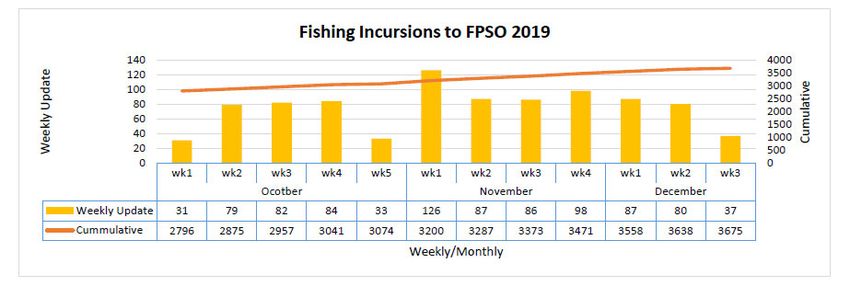
ENVIRONMENTAL AND SOCIAL MONITORING – REVIEW OF 2019 AMR, Q1 2020 QMR AND Q2 2020 QMR

       OFFSHORE CAPE THREE POINTS

       Appendix 1
       Environmental and Social Action Plan

       Appendix 2
       Status of ‘Open’ Issues (End Q2, 2020)

1620010598_2019 AMR, Q1 and Q2 2020 QMR Review
ENVIRONMENTAL AND SOCIAL MONITORING – REVIEW OF 2019 AMR, Q1 2020 QMR AND Q2 2020 QMR OFFSHORE CAPE THREE POINTS GLOSSARY OF TERMS/ ACRONYMS Acronym Abbreviation ACA Additional Conservation Action AG Associated Gas AoI Area of Influence AMR Annual Monitoring Report BAP Biodiversity Action Plan BMP Biodiversity Management Plan DAoI Direct Area of Influence E&S Environmental and Social ESAP Environmental and Social Action Plan ESDD Environmental and Social Due Diligence EHS Environmental, Health and Safety EPA Environmental Protection Agency ESMS Environmental and Social Management System DEQ DEQ Change Foundation ESL ESL Consulting FMCC Fisheries Management Coordination Committee FMP Fisheries Management Plan FPSO Floating Production Storage and Offloading Vessel GNGC Ghana National Gas Company GNPC Ghana National Petroleum Corporation GWS Ghana Wildlife Society HSE Health, Safety and Environment IBA International Bird and Biodiversity Area IDA International Development Association (World Bank) IESC Independent Environmental and Social Consultant IFC International Finance Corporation LRP Livelihood Restoration Plan LTI Lost time incident MIGA Multilateral Investment Guarantee Agency mmscf Million standard cubic feet MMSTPPP Marine Mammal and Sea Turtle Protection Policy and Plan MoC Management of Change MoU Memorandum of Understanding NAG Non-Associated Gas O&G Oil and Gas OCTP Offshore Cape Three Points ORF Onshore Receiving Facility PAPs Project-Affected Persons (by land acquisition) PS Performance Standard QRA Quantitative Risk Assessment QMR Quarterly Monitoring Report SEQ Safety, Environment and Quality SLC Sustainability & Local Content STP Sewage Treatment Plant TNS TechnoServe 1620010598_2019 AMR, Q1 and Q2 2020 QMR Review
ENVIRONMENTAL AND SOCIAL MONITORING – REVIEW OF 2019 AMR, Q1 2020 QMR AND Q2 2020 QMR

OFFSHORE CAPE THREE POINTS

  TPH                    Total Petroleum Hydrocarbon
  TTIP                   Takoradi to Tema Interconnection Project
  TSP                    Total Suspended Particulates
  Vitol                  Vitol Exploration and Production Limited
  VUGL                   Vitol Upstream Ghana Limited
  WAPCo                  West African Pipeline Company
  WB                     World Bank
  WBG                    World Bank Group

1620010598_2019 AMR, Q1 and Q2 2020 QMR Review
ENVIRONMENTAL AND SOCIAL MONITORING – REVIEW OF 2019 AMR, Q1 2020 QMR AND Q2 2020 QMR                                                         i

OFFSHORE CAPE THREE POINTS

EXECUTIVE SUMMARY
Ramboll Environment and Health UK Limited (Ramboll) was commissioned in January 2017 by Vitol
Upstream Ghana Limited (VUGL) to undertake environmental and social monitoring of the Offshore Cape
Three Points (OCTP) project (the ‘Project’), Republic of Ghana. The Project is operated by Eni Ghana
Exploration and Production Ltd (Eni Ghana). VUGL, an affiliate of Vitol Exploration and Production
Limited (Vitol), and Ghana National Petroleum Corporation are JV non-operating partners. Ramboll has a
duty of care towards the World Bank Group (WBG).

Ramboll’s scope of work requires periodic site visits to assess the Project’s compliance with agreed
environmental and social requirements. However, a monitoring trip originally planned for early 2020
was initially delayed in anticipation of Project Completion1, to allow for issuance of a completion
certificate. More latterly, as a consequence of travel restrictions resulting from the global COVID-19
pandemic, the Ramboll team has been unable to travel from the UK to Ghana. The team intends to
travel to Ghana once travel restrictions are lifted but in the interim, it has been agreed that a desk-
based review will be conducted. This report therefore presents findings from Ramboll, acting in the role
of Independent Environmental and Social Consultant (IESC) for the Project, following a review of the
Project’s: i) 2019 Annual Monitoring Report (AMR); the Q1 2020 Quarterly Monitoring Report (QMR);
and the Q2 2020 QMR and additional documents embedded within each of these documents.

The findings presented in this report are based largely on a desk-top review of the afore-mentioned
reports produced by the Project, plus a number of conference calls and exchanges with Eni Ghana
Safety, Environment and Quality (SEQ) and Sustainability & Local Content (SLC) representatives
intended to augment the IESC’s understanding of the Project’s current status. Additionally, these calls
prompted requests for further information and subsequent provision of additional documentation not
previously embedded within the AMR and QMRs.

The IESC’s previous monitoring report was for the period up to Q2 2019, thus this report covers the
period since the last report (Q2 2019) through to end of Q2 2020. Within this report, the IESC provides
status updates against the ‘open’ issues identified in the IESC’s preceding report, in this case the Q2
2019 QMR monitoring report (itself based on the findings from an earlier May 2019 site visit report and
findings carried over from other earlier reports). The IESC has provided updates, where possible, for
issues previously identified within the previous reports.

In previous reports the IESC has reported on a broad range of issues, reflecting the complexity of a
large-scale construction project. With a progressive transition to the production phase, involving
completion of all construction and demobilisation of the drill ship, emphasis is placed on ongoing
production-related impacts including longer-term livelihood restoration for land-affected people and
biodiversity monitoring/mitigation/offsetting efforts.

In several areas, progress against management plans has been delayed in 2020 as a result of the
COVID-19 pandemic. Such instances, including environmental (including biodiversity) monitoring,
restoration/revegetation of disturbed areas, livelihood restoration and community investment initiatives,
are described within the report.

Key findings from this review are provided below.

Annual reporting/AMR content

As a general finding, there should be stricter adherence to the AMR template and additional commentary
in certain sections. Additional information would have been particularly helpful during the preparation of
this report because of the extra reliance placed on the AMR/QMRs resulting from the current travel

       1 The IESC is required to issue a completion certificate confirming the Project has been constructed and is operating in compliance with

       the ESAP and applicable standards. The intention is to issue the Completion Certificate following an on-site inspection. Following
       issuance of the Completion Certificate, the frequency of monitoring will be reduced to annual site visits.

1620010598_2019 AMR, Q1 and Q2 2020 QMR Review
ENVIRONMENTAL AND SOCIAL MONITORING – REVIEW OF 2019 AMR, Q1 2020 QMR AND Q2 2020 QMR ii OFFSHORE CAPE THREE POINTS restrictions imposed as a result of the COVID-19 pandemic (see GHG emissions, wastewater effluent and biodiversity below). The IESC also recommends a review of the reporting template’s content, noting the changed nature of the Project and a shift in priority areas following the full transition away from construction and drilling activities. SEQ/SLC resources The HSE and SLC teams were restructured following full transition to Production. Several positions are vacant within the Safety, Environment and Quality team, including the HSE Operations Coordinator. The vacant HSE Operations Coordinator post is a result of a recent departure and a replacement is expected by earlier 2021. This post, in particular, would appear to be important for HSE performance; the WBG and the IESC should be informed of any interim measures in place whilst the post is vacant in addition to actions being undertaken to fill this and other posts. Formally, as per the SLC organogram the number of LRP Delivery Officers has been reduced from 3 to 2. However, Eni Ghana clarified that, since the beginning of 2020, the Fisheries Management Plan Delivery Officer has supported the LRP Delivery Officers. Cumulative impacts An Inception Report was prepared in accordance with a Term of Reference developed by the IFC, to facilitate agreement on the design of a Cumulative Impact Co-management Platform. Fundamental issues, relating to: i) Steering Committee disagreement regarding which entities should be party to the platform; and ii) funding of the platform and any substantive mitigation activities remain unresolved, are hampering the efforts of key public and private stakeholders to co-manage cumulative impacts. The IESC has been informed that Eni Ghana remains committed in its support the co-management platform pending resolution of the afore mentioned issues by the Steering Committee. ESAP deliverables Certain plans are still to be finalised, including revision/development of the following biodiversity related plans: the updated Avian Biodiversity Action Plan; the updated Sea Turtle Biodiversity Action Plan; and the Wetlands No Net Loss Strategy. The IESC considers such plans to form part of the ESHMP and for this reason considers item 1e) of the ESAP to remain ‘open’. Surface water quality Closer attention should be given to the information requested in the AMR reporting template, noting that data provided to the Environmental Protection Agency (EPA) is requested and therefore should be included in future AMRs. Community Grievances LRP-related documents embedded in the 2019 AMR and the Q1 and Q2 QMRs 2020 provide information on the grievances managed by Eni Ghana and those managed by TechnoServe (TNS), the LRP Support Services implementing partner. Previously, data on grievances managed by TNS (restricted to LRP- related grievances) were not supplied in AMRs/QMRs. It is recommended that Eni Ghana record, in AMRs/QMRs, all grievances received by the Project (either by Eni Ghana or any of its contractors) - whether escalated by contractors or not - in the same manner that grievances received by Eni Ghana are recorded currently. Four fishery-related grievances appear still to be unresolved and therefore are open (one has been open for a long time – just over 1 year). It is recommended that, if agreement has not been reached on an action to resolve the grievance by end 2020, Eni Ghana proposes to the FMCC that an independent external party be involved to assess the grievance and propose a way forward. 1620010598_2019 AMR, Q1 and Q2 2020 QMR Review
ENVIRONMENTAL AND SOCIAL MONITORING – REVIEW OF 2019 AMR, Q1 2020 QMR AND Q2 2020 QMR                                                   iii

OFFSHORE CAPE THREE POINTS

Community Investment Strategy: Quick Impact Projects

With respect to the educational project; there have been delays to a) the capacity-building component
and b) the infrastructure component has not yet started. Recommendations are:

a) Lead for Ghana (LfG), the implementing partner for the capacity-building component, updates
regularly, its COVID-19 Plan in line with new government measures/restrictions to enable the project to
minimize adverse educational impacts from COVID-19. Once, all measures/restrictions are removed
then Eni Ghana and LfG should evaluate and then agree actions, as necessary, to facilitate a ‘catch up’
in the shortest possible time period; and

b) Eni Ghana work closely with the selected contractor to reduce any delays related to acquiring the
requisite permissions for managing the necessary removal of asbestos during building works.

Fishery-based Incursions into FPSO Offshore Exclusion Zone

Cumulative totals of incursions for Q3 and Q4 2019 and the totals to date for end June 2020 (with
extrapolation for the year 2020) highlight the continuing challenge posed by fishing boat incursions into
the FPSO offshore exclusion zone2 and the need for Eni Ghana to continue its efforts to reduce the
number of incursions. Eni Ghana should continue its monitoring efforts and it is recommended that it
extends its analysis and reporting, in both QMRs and AMRs, to encompass trends in the number of
incursions (taking seasonal effects into account), data on the origin of vessels entering the FPSO
exclusion zone (including ownership details), in addition to presenting cumulative totals for defined time
periods. In addition, the IESC reiterates its previous recommendations that Eni Ghana continues to seek
effective means of reducing incursions and documents their efforts in the QMRs and AMRs.

Tema Regulating Metering Station (RMS)

The Tema RMS was redesigned, with lower gas pressure relative to an initial design, to address earlier
concerns about potential fire and explosion risk to neighbouring residents. A Quantitative Risk
Assessment study confirmed that no residential properties were located within in the ‘intolerable risk’
zone. The study recommended a number of good practice measure to further reduce risk, but does not
recommend the resettlement of nearby residents.

Livelihood Restoration

There are significant challenges facing Eni Ghana’s efforts to restore livelihoods, prior to the ending of
the LRP Support Services component of LRP implementation, in February 2021. Given the uncertainty
created by COVID-19 and the reliance on third parties such as the electricity provider, it is
recommended that Eni Ghana reinforce its efforts to assist those PAPs not generating any revenues and,
also, consider preparing an LRP Exit Strategy, for ensuring livelihood restoration for PAPs if future
monitoring and evaluation results show that the objective of livelihood restoration cannot be achieved
by end January 20213.

Ambient Air Quality

The QMR summarises ambient air quality results for NO2, SO2, PM10 and Total Suspended Particulates.
Monitoring results typically show ambient air quality to be below Ghanaian and WBG standards with
some exceptions for PM10 and SO2 in the vicinity of the Onshore Receiving facility (ORF). As previously
reported, the SO2 exceedances are marginal, with the more significant exceedances tending to be in the
villages of Sanzule and Anwolakrom. This is consistent with earlier observations and Eni Ghana’s earlier
explanation that the ongoing high concentrations are likely due to localised biomass burning and
community vehicles’ exhausts.

       2 Incursion data in the 2019 AMR and the 2020 QMRs refer only to the FPSO exclusion zone.
       3 The Environmental and Social Action Plan indicates that an independent Completion Implementation Audit will be undertaken 1 year

       following completion of LRP implementation (See Appendix 1).

1620010598_2019 AMR, Q1 and Q2 2020 QMR Review
ENVIRONMENTAL AND SOCIAL MONITORING – REVIEW OF 2019 AMR, Q1 2020 QMR AND Q2 2020 QMR iv OFFSHORE CAPE THREE POINTS Air emissions The current AMR and QMR reporting templates require the reporting of significant emission from all facilities. The IESC has previously reported that emissions are not reported in a manner that allows comparison with WBG emission guidelines. Furthermore, emissions sources reported for the ORF site are the same as for construction. Eni Ghana should review major emission sources for the Production Phase, including power generation and compressor system emissions at the ORF, and report these in the format specified in AMR and QMR templates. Eni Ghana should also demonstrate that emissions from significant emission sources are in alignment with applicable limits specified in the WBG EHS Guidelines. In order to demonstrate emissions are aligned with WBG EHS guidelines, stack emissions sampling is likely to be required. Biodiversity The 2019 AMR and 2020 QMRs do not provide information that allows the status of the seven biodiversity issues identified in the previous site visit report to be changed. The Avian and Sea Turtle Biodiversity Action Plans (BAPs) for the Production Phase are in the process of being finalised and the actions therein may differ from the existing BAP actions which have informed the current review. For this reason, no new issues have been opened relating to BAP actions at this time. Although not reported in the AMR or QMRs, it is understood that an initial strategy of achieving No Net Loss (NNL) of wetlands through on-site habitat restoration, and potentially averted loss or restoration off-site offsets, has been developed and it is apparent from conversations with Eni Ghana that further refinement of the strategy is ongoing. When this strategy is available for review the IESC will seek confirmation that areas affected by Livelihood Restoration are considered in the calculations. The 2019 AMR reports that the plant nursery at the ORF was managed effectively, which is supported by the IESC’s earlier visits to the nursery. Although not reported in the 2019 AMR or 2020 QMRs, monitoring of girth and height for ten representative nursery transplants in the ORF revegetation plots has been conducted in the reporting period, as indicated in a Revegetation and Alien Invasive Species report (November 2020) provided by Eni Ghana. The results generally indicate that transplanted seedlings are establishing well and growing as expected. The Revegetation and Alien Invasive Species report provides this limited information for the 2019 and Q1 2020 period; instead, it principally focuses upon the Q2 2020 monitoring which was postponed until September 2020 due to the COVID-19 pandemic. Eni Ghana have indicated that quarterly monitoring of flora including alien invasive species will be conducted going forward. The status of some marine biodiversity monitoring actions, including those from the Marine Mammal and Sea Turtle Protection Policy and Plan (MMSTPPP), as referenced in the Production Phase Biodiversity Management Plan, requires clarification. The 2019 AMR and 2020 QMRs do not currently include reporting against the management measures relating to sightings and incident reporting for marine mammals and sea turtles at sea from supply vessels, though it is understood from Eni Ghana that incidental sightings were made and that marine biodiversity monitoring, including sighting and incident reporting for marine mammals and sea turtles at sea, will continue into 2021. 1620010598_2019 AMR, Q1 and Q2 2020 QMR Review
ENVIRONMENTAL AND SOCIAL MONITORING – REVIEW OF 2019 AMR, Q1 2020 QMR AND Q2 2020 QMR                                                        1

OFFSHORE CAPE THREE POINTS

1.     INTRODUCTION
       Ramboll Environment and Health UK Limited (Ramboll) was commissioned in January 2017 by
       Vitol Upstream Ghana Limited (VUGL) to undertake environmental and social monitoring of the
       Offshore Cape Three Points (OCTP) project (the ‘Project’), Republic of Ghana. The Project is
       operated by Eni Ghana Exploration and Production Ltd (Eni Ghana). VUGL, an affiliate of Vitol
       Exploration and Production Limited (Vitol), and Ghana National Petroleum Corporation (GNPC)
       are JV non-operating partners.

       In fulfilling the role of Lenders’ Independent Environmental and Social Consultant (IESC),
       Ramboll has a duty of care to a consortium of lenders (the ‘Lenders’) to the Project, including the
       International Finance Corporation4 (IFC), World Bank5 (International Development Association)
       and the Multilateral Investment Guarantee Agency6 (MIGA) which is also a member of the World
       Bank Group (WBG).

       In carrying out its duties as the IESC, Ramboll is required to participate in monitoring site visits
       and undertake desk-top review of the Project’s Annual and Quarterly Environmental and Social
       Monitoring reports, submitted by VUGL and Eni Ghana to the Lenders.

       Ramboll’s scope of work requires periodic site visits to assess the Project’s compliance with
       agreed environmental and social requirements. However, a monitoring trip originally planned for
       early 2020 was initially delayed in anticipation of Project Completion7 to allow for issuance of a
       completion certificate. More latterly, as a consequence of travel restrictions resulting from the
       global COVID-19 pandemic, the Ramboll team has been unable to travel from the UK to Ghana
       during this reporting period. The team intends to travel to Ghana once travel restrictions are
       lifted. In the interim, it has been agreed that a desk-based review will be conducted in place of
       the planned site visit. This report therefore presents findings from Ramboll, acting in the role of
       Independent Environmental and Social Consultant (IESC) for the Project, following a review of
       the Project’s: i) 2019 Annual Monitoring Report (AMR); the Q1 2020 Quarterly Monitoring Report
       (QMR); and the Q2 2020 QMR and additional documents embedded within each of these
       documents.

       This report covers the period since the last report (Q2 2019) through to end of Q2 2020. Within
       this report, the IESC provides status updates against the ‘open’ issues identified in the IESC’s
       preceding report, in this case the Q2 2019 QMR monitoring report (itself based on the findings
       from an earlier May 2019 site visit report and findings carried over from other earlier reports).

       This desk-top review is one of a series of reports written by the IESC and has three primary
       objectives:

       1. Provision of a status update on issues identified in the previous reports, listed in the table
            below;
       2. Highlighting any significant new findings resulting from the Project’s operations since the
            previous report; and
       3. Updating the status of Environmental and Social Action Plan (ESAP) compliance, for example,
            where an ESAP delivery date coincides with the reporting period.

       Previous reports produced by the IESC are listed below.

       4 Lender to VUGL debt financing package.
       5 Guarantor to support the gas development.
       6 Insurer for commercial lenders to VUGL.
       7 The IESC is required to issue a completion certificate confirming the Project has been constructed and is operating in compliance with

       the ESAP and applicable standards. The intention is to issue the Completion Certificate following an on-site inspection. Following
       issuance of the Completion Certificate, the frequency of monitoring will be reduced to annual site visits.

1620010598_2019 AMR, Q1 and Q2 2020 QMR Review
ENVIRONMENTAL AND SOCIAL MONITORING – REVIEW OF 2019 AMR, Q1 2020 QMR AND Q2 2020 QMR 2
OFFSHORE CAPE THREE POINTS
Table 1: List of IESC monitoring reports
Report title Site Reporting period Date of
visit/desk- Issue
top review
Offshore Cape Three Points Environmental and Desk-top 1st April to 30th June November
Social Monitoring Report – Q2, 2019 QMR 2019 2019
Offshore Cape Three Points Environmental and Site visit 19 May to 23 May 2019 July 2019
Social Monitoring Report (status in May 2019)
Offshore Cape Three Points Environmental and Desk-top 1st October to 31st April 2109
Social Monitoring – Q4, 2018 QMR December 2018
Offshore Cape Three Points Environmental and Desk-top July 2018 to February
Social Monitoring – Q3, 2018 QMR September 2018 2019
Offshore Cape Three Points Environmental and Site visit 17 September to 21 December
Social Monitoring Report (status in September September 2018 2018
2018)
Offshore Cape Three Points Environmental and Desk-top January 2018 to October
Social Monitoring – Q1 and Q2, 2018 QMR June 2018 2018
Offshore Cape Three Points Environmental and Site visit 16 September to 16 July 2018
Social Monitoring Report (status in March 2018) March 2018
Offshore Cape Three Points Environmental and Desk-top June 2017 to December
Social Monitoring – Q3, 2017 QMR September 2017 2017
Offshore Cape Three Points Environmental and Site visit 21 February 2017to November
Social Monitoring Report (status in September 15 September 2017 2017
2017)
Offshore Cape Three Points Environmental and Desk-top January 2017 to June 2017
Social Monitoring – Q1, 2017 QMR March 2017
Offshore Cape Three Points Environmental and Site Visit Period up to 20th May 2017
Social Monitoring Report (status in February February 2017
2017)
1620010598_2019 AMR, Q1 and Q2 2020 QMR ReviewENVIRONMENTAL AND SOCIAL MONITORING – REVIEW OF 2019 AMR, Q1 2020 QMR AND Q2 2020 QMR 3
OFFSHORE CAPE THREE POINTS
2. SCOPE AND STRUCTURE OF THE REPORT
This report follows a similar format to that used for the previous IESC monitoring reports.
Project performance is assessed against the Project’s environmental and social management
system (ESMS), including a suite of Project-specific management plans, as amended, that were
developed to satisfy agreed Project Standards. The findings presented in this report are based on
review of the Eni Ghana 2019 AMR, Q1 2020 QMR and Q2 2020 QMR, all of which are based on
reporting templates provided by the WBG.
2.1 Project Standards
In accordance with the IESC’s Terms of Reference, the Project is being assessed against the
following standards and guidelines:
Applicable laws and regulations of Ghana;
WBG Performance Standards (2012) including:
PS1: Assessment & Management of Environmental & Social Risks & Impacts;
PS2: Labour and Working Conditions;
PS3: Resource Efficiency and Pollution Prevention;
PS4: Community Health, Safety, and Security;
PS5: Land Acquisition and Involuntary Resettlement; and
PS6: Biodiversity Conservation and Sustainable Management of Living Natural Resources;
and
WBG Environmental Health & Safety (EHS) Guidelines applicable to the Project including:
EHS Guidelines for Offshore Oil and Gas Development (2015); and
EHS Guidelines for Onshore Oil and Gas Development (2007).
PS7 (Indigenous Peoples) was excluded from the scope of the IESC’s work on the basis that the
Environmental and Social Due Diligence8 performed prior to financial close concluded that no
Indigenous Peoples are affected by the Project.
PS8 (Cultural Heritage) was excluded from the IESC’s scope, however Cultural Heritage is
included in so far as it relates to specific issues such as shrines and chance finds.
Given the mature stage of the Project, and incorporation of the above standards during the
development of the Project’s ESMS, the Project is assessed, essentially, against its own ESMS
and associated management plans.
2.2 Structure of the Report
Following this section on the report structure, Section 3 provides a brief Project status update at
the end of Q2 2020 based on information provided by Eni Ghana, for example, completion of key
milestones that have relevance to the IESC’s scope of work. It is intended only to provide
context to the report and is not intended to be comprehensive.
Section 4 includes Significance Criteria used primarily in the more comprehensive site visit
reports to categorise issues as High/Moderate/Minor significance. The criteria are relevant to
Appendix 2 of this report.
8 An environmental and social due diligence (ESDD) exercise was performed by KBC Process Technology Ltd on behalf of potential
lenders [Ref: Environmental and Social Review OCTP Project, Ghana September 2016]. The ESDD Report identified a number of issues
and made recommendations that were transposed into an Environmental and Social Action Plan (ESAP). The ESAP provided in the
ESDD report is consistent with the final agreed ESAP developed by the WBG and included in Appendix 1 of this report.
1620010598_2019 AMR, Q1 and Q2 2020 QMR ReviewENVIRONMENTAL AND SOCIAL MONITORING – REVIEW OF 2019 AMR, Q1 2020 QMR AND Q2 2020 QMR 4
OFFSHORE CAPE THREE POINTS
Sections 5 to 11 provide new findings and updates on issues raised in the IESC’s preceding Q2
2019 QMR monitoring report, which itself includes findings carried over from earlier reports,
organized by the applicable Performance Standards. Reporting is by exception only; no
commentary is provided where the status/categorisation of significance is unchanged. In
Appendix 2, the ‘Summary of Findings’ tables, for each of the applicable Performance Standards,
are consolidated and the status confirmed, for example, stated as ‘closed’ where applicable or
otherwise left as ‘open’. Where findings raised by the IESC, notably in its earlier site visit reports,
are not necessarily addressed in subsequent AMR/QMRs because information was not available or
issues require on-site verification, such issues will be highlighted for further consideration during
the next IESC site visit.
2.3 Limitations
The findings expressed in this report are based on a desk-top review of material provided and
supplemented by several targeted teleconference calls with representatives from Eni Ghana’s
Safety & Environment & Quality (SEQ) and Sustainability & Local Content (SLC) teams. The IESC
has not fully engaged in discussion with all Project staff on the understanding that detailed
discussions will take place during the next site visit.
The IESC has not duplicated all information provided in previous reports. As necessary, to obtain
background information/context in relation to this report, this report should be read in
conjunction with previous IESC reports listed in the Table 1.
1620010598_2019 AMR, Q1 and Q2 2020 QMR ReviewENVIRONMENTAL AND SOCIAL MONITORING – REVIEW OF 2019 AMR, Q1 2020 QMR AND Q2 2020 QMR 5
OFFSHORE CAPE THREE POINTS
3. PROJECT STATUS UPDATE
A brief description of the overall Project is provided in Section 3.1 with the current status
provided in Section 3.2. Neither can be considered comprehensive, but instead are intended only
to provide context to later sections of this report.
3.1 Project Description
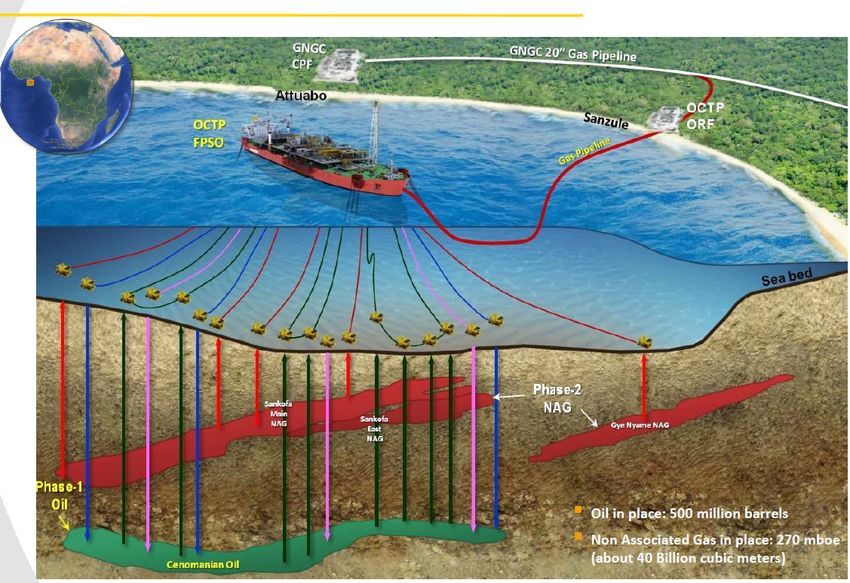
The Project, as described in the ESIA Report, involves the development of the Sankofa East oil
field and non-associated gas in the Sankofa and Gye Nyame Gas Fields, which are located
offshore, 55 to 60 km from the coastline of the Western Region of the Republic of Ghana (Figure
1). The operator, Eni Ghana, is developing these fields as an integrated oil and gas development
Project utilising a newly converted double-hulled Floating Production Storage and Offloading
Vessel (FPSO). Other key components of the Project include:
Fourteen wells for oil exploitation (producing and injection wells); oil is transferred to tankers
for direct export to market;
Five wells for non-associated gas exploitation;
A 63 km subsea gas pipeline from the FPSO to shore;
A 1.5 km onshore gas pipeline from the shore to the ORF;
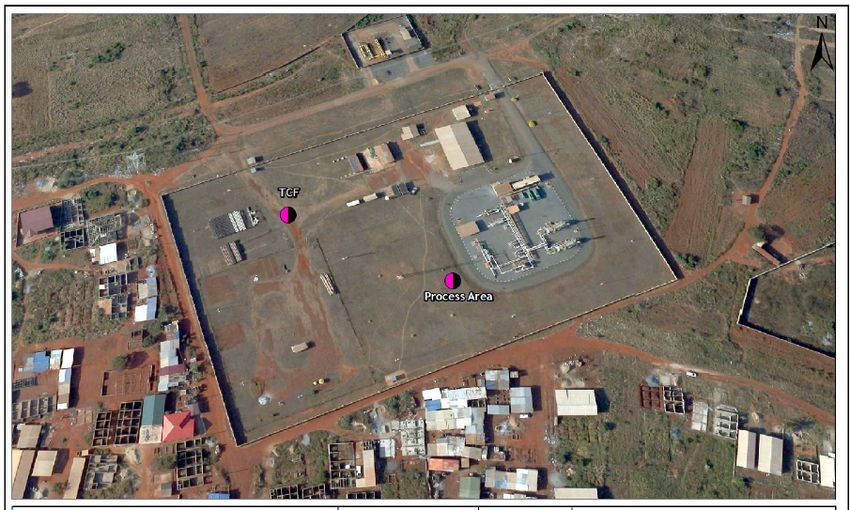
The Onshore Receiving Facility (ORF) (Figure 2), including a gas compressor station, pilot and
permanent accommodation camps, firefighting station, helipad and medical facility; and a tie-
in to the existing Ghana National Gas Company (GNGC) 20-inch gas pipeline; and
A logistics base in Takoradi and a quay within the port of Takoradi.
The Project is split into two phases:
Phase 1: Oil Development Project. This phase consists of the 14 subsea wells (8 oil
producers, 3 water injectors and 3 associated gas injectors), subsea facilities, and the FPSO
located approximately 60 km offshore south of Sanzule; and
Phase 2: Gas Development Project. This phase will consist of 5 subsea wells, subsea facilities,
gas-treating facilities on the FPSO, a 63 km subsea gas pipeline (gas export sealine (GES)),
the ORF, and tie-in with the GNGC sales gas pipeline.
1620010598_2019 AMR, Q1 and Q2 2020 QMR ReviewENVIRONMENTAL AND SOCIAL MONITORING – REVIEW OF 2019 AMR, Q1 2020 QMR AND Q2 2020 QMR 6
OFFSHORE CAPE THREE POINTS
Figure 1: Schematic of the OCTP Project
Material Project design/scope changes since the ESIA Report was prepared include 3 infilling
wells, the upgrade of regulating and metering stations with a short interconnecting pipeline in
Takoradi associated with the West Africa Gas Pipeline and a revised approach to nearshore
pipeline installation/beach crossing. These changes are described in previous reports and are not
duplicated here.
3.2 Status of the Project at the end in Q2, 2020
The Project is in its Production Phase with first oil achieved in Q2, 2017 and first gas Q3, 2018.
At the time of the last site visit in May 2019, construction was largely complete with the following
exceptions:
minor works and construction of the permanent accommodation camp; and
construction activities were ongoing at the downstream WAPCO Tema site (a part of the
Takoradi - Tema interconnection project.
As of the end of Q2, 2020, works at the permanent accommodation camp were complete
(October 2019) and the Tema site works were completed in Q2 2020. The implementation and
monitoring of land restoration and works have been ongoing throughout the reporting period.
Other key milestones achieved in 2019 and 2020 include:
Subsea Umbilicals, Risers & Flowlines Transportation and Installation (SURF T&I):
Installation and start-up of for OP-9 and OP-10 infilling wells occurred in Q2 2019 (outside
the scope of this report).
Onshore Receiving Facilities (ORF): Last works related to Permanent Accommodation
Camp were completed by Q3 2019. Restoration and revegetation activities were initiated on
those areas of ORF where construction and contractor activities were finished, for example,
the construction workshops.
1620010598_2019 AMR, Q1 and Q2 2020 QMR ReviewENVIRONMENTAL AND SOCIAL MONITORING – REVIEW OF 2019 AMR, Q1 2020 QMR AND Q2 2020 QMR 7
OFFSHORE CAPE THREE POINTS
Takoradi - Tema interconnection project (TTIP): In 2019, construction works occurred
in all the TTIP sites. The WAPCO and GNGC Takoradi sites were completed and start-up
respectively achieved on the 28th of February and 5th of April 2019 (thus outside scope of
this report). Restoration work has also been completed. The scope of works for the WAPCO
Tema site was put on hold and a new optimized scope of work was defined and agreed
among all the stakeholders in 2019. Construction was ongoing at WAPCO Tema site through
to Q2 2020.
Land Terminal End
Onshore Receiving Facility
Water well
Permanent accommodation
Pilot camp
Helipad
Figure 2: Aerial photograph of the Onshore Receiving Facility (October 2019)
Construction Phase permits have now been replaced by the Production Phase permit. A Phase 2
Production Operations Environmental Certificate (Reference no. CE0021780607) was issued on
18th December 2019 by the Environmental Protection Agency (EPA) which authorises Eni Ghana
to continue the operations of Non-Associated Gas processing on the FPSO, export of gas through
offshore and onshore pipelines and the operation of the Onshore Receiving Facility at Sanzule in
the Ellembelle District of the Western Region as part of the OCTP Phase 2 production.
In Q3 2019, Eni Ghana also received a permit from the EPA for acid stimulation and scale
inhibitor treatment of 5 wells.
3.2.1 Employment data
An analysis of employment data presented in the AMR and the Q1 and Q2 QMRs was undertaken
and the results are presented in Table 2. The presentation of the data in the AMR and the Q1 and
Q2 QMRs differs from previous similar earlier reports. The new presentation of data makes it
difficult to compare employment data with earlier time periods (of note, it is difficult now to track
the numbers of female and DAoI9 workers). Within the constraints of the data, an attempt is
made to give an overview for the two main operational project sites (ORF and FPSO) and to
identify noteworthy changes over the reporting period. It is recommended that consistency in
employment data presentation, in AMRs/QMRs, is maintained to the extent that is practical and
that the reasons for changes are explained briefly.
9 DAoI is the Direct Area of Influence (of the OCTP Project), consisting of four nearby villages.
1620010598_2019 AMR, Q1 and Q2 2020 QMR ReviewENVIRONMENTAL AND SOCIAL MONITORING – REVIEW OF 2019 AMR, Q1 2020 QMR AND Q2 2020 QMR 8
OFFSHORE CAPE THREE POINTS
Both Eni Ghana direct employees plus contracted workers are present at the 2 operational sites,
as shown in the Table 2 (data as of end 2019 and end June 2020).
Table 2: ORF and FPSO Employment Breakdown
Location Year # Total Workers #Females # Ghanaian # DAoI # Expatriates
(Direct:
contracted)
ORF 12/2019 154 (38:116) 4 148 21 6
06/2020 112 (36:76) 3 107 4 5
FPSO 12/2029 209 (15:194) 1 130 0 79
06/2020 195 (13:182) 1 126 0 69
Key changes, comparing worker numbers between end 2019 and end June 2020, are:
Minor reduction (7%)10 in the total number of FPSO workers with smaller reduction in
Ghanaian (3%) and larger reduction in expatriate (13%) personnel respectively;
Reduction (27%) in total number of ORF workers; due mostly to reduction of contracted
workers. The number of Ghanaian workers declined from 148 to 107 including the loss of 17
DAoI workers (although as there are 67 security guards, it is likely that some of them are
from the DAoI villages – unfortunately, no breakdown of the security guards in terms of
origin or gender is provided11); and
The number of expatriate workers at the ORF declined from 6 to 5.
10 Percentages are rounded up or down.
11 This figure does not include those security guards that may be based in the DAoI as no data are presented in the AMR/QMRs on the
number of security guards from the DAoI area; however, the IESC understands, from Eni Ghana that ~40 of these guards are from
the DAoI.
1620010598_2019 AMR, Q1 and Q2 2020 QMR ReviewENVIRONMENTAL AND SOCIAL MONITORING – REVIEW OF 2019 AMR, Q1 2020 QMR AND Q2 2020 QMR 9
OFFSHORE CAPE THREE POINTS
4. SIGNIFICANCE ASSESSMENT
4.1 Introduction
Within this report, the IESC provides status updates, including significance, against the issues
(identified in the IESC’s May 2019 site visit report), as amended following a review of the
Project’s Q2 2019 Quarterly Monitoring Report, where evidence in the 2019 AMR and the Q1 and
Q2 2020 QMRs allows for an update of the status of such issues. Appendix 2, Table 1 presents
these previously identified issues with a status update, when possible, arising from this review.
Open issues identified in all other earlier monitoring reports, prior to the May 2019 monitoring
report, are presented in a further table (Table 2) in Appendix 2. Changes to these earlier issues,
arising from the 2019 AMR and the Q1 and Q2 2020 QMR review findings, are recorded in this
table.
4.2 Interpretation of the Consolidated Table
To assist interpretation of the consolidated table in Appendix 2, the following brief description is
provided.
For each issue, the following information is presented:
The aspect;
A description of the issue, for example deficiencies or omissions;
The phase(s) to which an issue relates;
Identification of the standard(s) against which the deficiency or omission has been identified;
IESC’s recommendation, where applicable, to resolve/manage the deficiency or omission; and
The significance of the issue: on a three-point scale (see below for criteria).
A ranking system has been used to indicate the relative significance, based on the level of non-
compliance, of an issue. As well as highlighting key areas requiring attention, it can also be used
to aid the tracking and rectification of specific issues requiring improvement.
Identified issues have been placed into one of the following four categories:
Minor: Minor non-compliance, risk or minor technical breach of Applicable Standards and
commitments with no material, actual or likely potential: environmental or social
consequences; or significant human injury or harm.
Moderate: Moderate non-compliance or risk with actual or likely potential: localised and short-
term environmental or social consequences; minor human injury or harm; or
material short-term breach of Applicable Standards and commitments.
High: Major non-compliance or risk with actual or likely potential: spatially extensive
and/or long-term environmental or social consequences; serious human
injury/death or harm; or material and extensive breach of Applicable Standards
and commitments.
Not Issue is noteworthy, but it is not an issue of non-compliance.
Applicable
Where time-critical recommendations for specific actions are presented, a timeframe linked to
Construction/Operational phase milestones is indicated in the IESC recommendations column.
Time-critical issues can lead to a higher classification of significance.
1620010598_2019 AMR, Q1 and Q2 2020 QMR ReviewENVIRONMENTAL AND SOCIAL MONITORING – REVIEW OF 2019 AMR, Q1 2020 QMR AND Q2 2020 QMR 10
OFFSHORE CAPE THREE POINTS
Table 3: Example of the summary table format
ID Aspect Issue Phase12 Standard IESC Significance
Description Recommendations
00 Storm The ESAP Ops WBG EHS Company X shall
water run- requires Guidelines expedite
off – Company X procurement of
monitoring monitors the monitoring
ESAP
quality of equipment with the
surface water support of senior Moderate
run-off from management.
facilities.
To date the
Company has
been unable to
procure
monitoring
equipment – no
monitoring has
been
undertaken.
12 Phases can include: construction; operations; decommissioning or; any combination of these phases.
1620010598_2019 AMR, Q1 and Q2 2020 QMR ReviewENVIRONMENTAL AND SOCIAL MONITORING – REVIEW OF 2019 AMR, Q1 2020 QMR AND Q2 2020 QMR 11
OFFSHORE CAPE THREE POINTS
5. PERFORMANCE STANDARD 1: ASSESSMENT AND
MANAGEMENT OF ENVIRONMENTAL AND SOCIAL RISKS
AND IMPACTS
5.1 Status update for previously identified issues
See Appendix 2.
5.2 New PS1 findings in Q2, 2020
5.2.1 Management of Change
Two Management of Change (MoC) notifications were raised with the WBG in 2019, of which one
was in the second half of the year (within the reporting period of this report). The MoC case,
dated October 2019, relates to extension of the implementation of the Community Investment
Strategy (CIS) from three years to four years, in part due to delays experience in defining actions
with an implementation plan (Section 5.3). Further baseline survey data were collected in Q1
2020 for the implementation of the Local Development Project.
In Q1 2020, no Management of Change actions were initiated.
In Q2 2020, a further MoC case was raised notifying of disruptions to livelihood restoration and
community investment initiatives as a result of government-imposed COVID-19 related social
distancing requirements (Section 5.3).
For the two MoC cases described above, both are concerned with delays in implementation of
agreed actions, rather than a material change to the scope. The delays are not envisaged to
result in additional adverse HSE impacts; however, it is anticipated that there will be an adverse,
but temporary effect on receipt by some beneficiaries of certain benefit flows arising from the
slowdown in LRP activities. Given the continuation of COVID-19 restrictions, these actions are not
capable of being ‘fast tracked’ and, also, will not be mitigated by an extension to the LRP Support
Services delivery period (Section 5.3 and 9.2.3).
5.2.2 SEQ and SLC resources
The SEQ and SLC teams have been restructured following full transition to Production. The
current SEQ organogram is shown in 2 parts (Figures 3a and 3b): Figure 3a shows the key
‘functional’ posts based in Accra and Figure 3b shows the site/facility-based personnel devoted to
supporting two of these posts. Of particular note, the SEQ Manager has been replaced and a
number of positions within the team, including the HSE Operations Coordinator, remain vacant.
This post, in particular, would appear to be important for HSE performance. The IESC has been
informed the vacant post results from a recent departure13 and a replacement is expected in
early 2021. The WBG and the IESC should be informed of any interim measures put in place
whilst this and other posts are vacant in addition to actions being undertaken to fill the posts.
The IESC notes the additional SEQ and SLC support to Eni Ghana currently being provided by Eni
Headquarters (HQ), Milan. In particular, the IESC welcomes the increased level of support from
PS6 biodiversity specialists based in Milan. See also section below relating to the Eni HQ
Sustainability function.
13 In this case ‘recent’ means shortly before drafting of this report in October 2020.
1620010598_2019 AMR, Q1 and Q2 2020 QMR ReviewENVIRONMENTAL AND SOCIAL MONITORING – REVIEW OF 2019 AMR, Q1 2020 QMR AND Q2 2020 QMR 12
OFFSHORE CAPE THREE POINTS
Figure 3a: Safety, Environment and Quality Organogram (Production Phase), Sept 2020
Figure 3b: Safety, Environment and Quality Organogram (Detailed), Sept 2020
The current SLC organogram is shown in 2 parts (Figures 4a and 4b): Figure 4a shows the key
‘functional’ posts and Figure 4b shows the personnel devoted to supporting two of these posts:
‘Stakeholder Management’ and ‘Local Sustainable Development’. The current SLC Organogram
was introduced in the second half of 2019 and is almost identical in its structure and set of
functional units to the organogram recorded in the IESC’s May 2019 monitoring report. There is a
new post entitled ‘Local Content’ (a temporary role which was filled for the required duration and
the post is no longer needed) and there have been a few changes in personnel and
reductions/additions of personnel to certain units; for example, the team of Community Liaison
1620010598_2019 AMR, Q1 and Q2 2020 QMR ReviewENVIRONMENTAL AND SOCIAL MONITORING – REVIEW OF 2019 AMR, Q1 2020 QMR AND Q2 2020 QMR 13
OFFSHORE CAPE THREE POINTS
Officers has increased from 4 to 5 while the team of LRP Delivery Officers has declined from 3 to
2. However, towards the end of 2019 on of the LRP Delivery Officers resigned and, since this
resignation, the Fishery Management Plan Delivery Officer supports the 2 LRP Delivery Officers.
The Fishery Management Plan Delivery Officer can provide this support as the workload related to
implementing the Fishery Management Plan has declined since mid-2019. Effectively, the
complement of staff focusing on LRP delivery has not changed. Of note, the new ‘5th’ member of
the Community Liaison Officers is also the Community Stakeholders Engagement Officer (Figure
4b). Eni Ghana consider the two posts to have similar roles.
There are 16 personnel based in Sanzule (excluding the Civil Engineer Supervisor) which is
similar to the number of Sanzule-based personnel listed in the May 2019 version of the
organogram. The SLC team continues to be supported by the Eni HQ Sustainability function,
which is based in Milan (see ‘box’ in the organogram entitled ‘Social Projects Implementation
Support’).
Figure 4a: Sustainability and Local Content Organogram (Production Phase), Sept 2020
Ghana has indicated, also, that the focus of work for the LRP Delivery Officers has shifted away
from LRP delivery to monitoring and evaluation activities reflecting the situation where the LRP
Support Services will cease at the end of January 2021 and the resulting need for Eni Ghana to
determine the effectiveness of the LRP Support Services, in restoring livelihoods, in the final
stages of its implementation.
1620010598_2019 AMR, Q1 and Q2 2020 QMR ReviewENVIRONMENTAL AND SOCIAL MONITORING – REVIEW OF 2019 AMR, Q1 2020 QMR AND Q2 2020 QMR 14
OFFSHORE CAPE THREE POINTS
Figure 4b: Sustainability and Local Content Organogram (Detailed), Sept 2020
5.3 Community Investment Strategy (CIS)
In October 2019, Eni Ghana issued an MoC Notification concerning a decision to extend the life of
the CIS by 1 year (see below). In this Notification the CIS is referred to as the Local
Development Project-CIS (LDPj-CIS). The aim of the LDPj-CIS is to promote inclusive economic
growth and well-being for the 10 coastal communities in the Ellembelle District (which includes
those in the DAoI). There are four main components/sectors of the LDPj-CIS:
Water and Sanitation;
Education;
Access to Energy; and
Economic Diversification (Livelihood and Building Business activities).
Key LDPj – CIS actions in Q3 and Q4 2019 included:
Finalizing the LDPj-CIS Implementation Plan – identifying near-term priority actions;
Issue of MoC Notification regarding extension of the CIS by 1 year to a duration of remaining
4 years making the implementation period 2019 to 2022 instead of 2019 to 2021. Two
reasons are given to justify the change:
Mitigation of the unforeseen additional time taken to prepare the CIS Implementation
Plan which resulted in postponement of certain planned actions in 2019; and
Maintaining public support for and community ownership of the CIS by demonstrating
that there would be no loss of benefit streams arising from CIS implementation;
Development of a cooperation agreement with the National Board for Small Scale Industries
(NBSSI) to implement the ‘Building Businesses’ initiative under the LDPj – CIS Economic
Diversification component and finalization of proposals for actions to be implemented under
this initiative;
Development of a cooperation agreement with TechnoServe (TNS) to implement the
Livelihood initiative under the LDPj – CIS Economic Diversification component;
1620010598_2019 AMR, Q1 and Q2 2020 QMR ReviewENVIRONMENTAL AND SOCIAL MONITORING – REVIEW OF 2019 AMR, Q1 2020 QMR AND Q2 2020 QMR 15
OFFSHORE CAPE THREE POINTS
Preparation of a Concept Note for a Rural Clean Cooking Project (to be implemented in
conjunction with the World Bank, United Nations Development Program, the Energy
Commission and Ministry of Energy), for the 10 communities;
Sign-off of the LDPj-CIS on 21 November 2019; and
Launch of the LDPj-CIS in December 2019, following the signing of two Memoranda of
Understanding (MoUs) between Eni Ghana and Ellembelle District Assembly and the Eastern
Nzema Traditional Authority respectively.
In Quarters 1 and 2 2020, key LDPj – CIS actions included:
In March 2020, a baseline household survey in all 10 communities was undertaken
successfully. The aim is to obtain primary community-level data, for the period before LDPj –
CIS activity implementation starts, to be used later to assist monitoring of performance in
terms of household- and community-level changes in incomes/livelihoods and other key
parameters. Later, in Q2 2020, work started to obtain secondary data to complement the
primary survey data;
Developing the Building Businesses’ and Livelihood components of the overall CIS Economic
Diversification programme; Rural Clean Cook Stove Initiative: Signing of MoU with the World
Bank and drafting of a cooperation agreement with the Ghana Alliance for Clean Cook Stoves
to develop clean cooking initiatives. There will be a 3 phased pilot project up to December
2022. The key overall aims are to reduce fuelwood use and create cleaner cooking
environments (benefitting vulnerable people plus women and children). Two important early
tasks are to select the type of cook stove to be used and then to investigate the feasibility for
local production of the stoves. Initial distribution is estimated as being 600 cook stoves. The
‘kick off’ workshop, in partnership with the World Bank, was held on 5 March 2020; and
Analysis of the LDPj - CIS undertaken to integrate the specific sectors with initiatives aimed
at preventing COVID 19, ensuring hygiene best practice awareness and, where possible,
identify innovative ways of implementing the initiatives, considering COVID-19 limitations.
In May 2020, Eni Ghana issued another MoC Notification concerning the ‘slowdown’ in both LDPj -
CIS and the LRP activities due to government-imposed restrictions in relation to the COVID-19
pandemic. For those communities benefitting from both the LDPj - CIS and the LRP, the
cumulative result is an increase in the time period before the combined benefits are accruing/will
accrue to the inhabitants. The addition of another year to the LDPj - CIS will help to mitigate the
adverse impacts; however as of July 2020, there is no Eni Ghana intention to extend the LRP
Support Services to compensate for delays in implementation post May 2020 (see Section 9.2.3).
With respect to the ‘Quick Impact Projects’ component of the Community Investment Strategy
CIS), the 2019 AMR and the Q1 and Q2 QMRs record the progress, in monthly reports, on both
the water supply (villages of Sanzule [including Anwolakrom]; Krisan and Bakanta) and the
educational project (all identified government schools of Eikwe, Krisan, Sanzule, and Bakanta).
Both these two ‘Quick Impact Projects’ are considered in detail in the sections immediately
below.
5.4 Community Investment Strategy: Quick Impact Projects
5.4.1 Water Supply Project
The IESC’s May 2019 site visit report and the subsequent Q2 2019 monitoring report highlight
several difficulties/challenges being faced by this project and the community-based Water Board
Committee (the ‘Committee’) which is responsible for managing the project. The IESC’s Q2 2019
monitoring report highlighted the key problem as being revenue collection and inability to
1620010598_2019 AMR, Q1 and Q2 2020 QMR ReviewENVIRONMENTAL AND SOCIAL MONITORING – REVIEW OF 2019 AMR, Q1 2020 QMR AND Q2 2020 QMR 16
OFFSHORE CAPE THREE POINTS
generate a sustainable level of cash flow and further presented the measure put into place to try
to rectify the situation.
A review of the LDPj-CIS monthly reports for the 1-year period from end Q2 2019 to end Q2
2020 indicate that there have been continuing difficulties/challenges in managing the water
project. The main difficulties/challenges (some of which are inter-related) and the additional
remedial measures taken during this period and, also, proposed for the future, are listed below:
Main difficulties/challenges:
Ineffective management by the Committee;
Inadequate maintenance regime (on one occasion causing a water quality problem);
Poor revenue collection;
Inadequate cash flow;
Inability to repair the solar power unit (even though under guarantee); and
Unexpected significant expenditure on purchase of electricity from the grid; and
Additional remedial measures taken:
Continual provision of Eni Ghana support to the Committee into Q3 2020;
Decision made to ‘reconstitute’ the Committee by end Q3 2019 with Eni Ghana support
continuing into the first half of 2020;
Using the opportunity provided by a community health awareness campaign in Sanzule,
Krisan, Bakanta and Eikwe (late July to early August 2019) to encourage community
members to use the water, as it met World Health Organization (WHO) standards for
potable water, thus, helping to protect users against water-borne diseases;
Initiation of discussion with DeSimone Ltd for the Krisan school canteen (supported by
DeSimone Ltd) to purchase water and thus increase revenues;
Active consideration (early discussions in Q2 2020) with Ellembelle District Assembly
concerning a possible hand-over of the water project to the Assembly. Such a handover
is not now under discussion and, instead, a decision has been made to reform the
Committee, thus retaining the management of the project under community leadership
(but with continuing Eni Ghana support); and
Contracting of STEPP PRYME Engineering Ltd (March 2020) to construct the extension of
the project into all areas of Sanzule (extending distribution network and installing
additional fetching points). The extension into Sanzule is expected to boost the number
of users and, therefore, increase revenues. Work has been affected by COVID-19
restrictions, but Eni Ghana expects that the extension project will be able to deliver water
to its new customers by mid October 2020.
Managing the water project has proved to be challenging for the Committee and for Eni Ghana in
terms of oversight and, crucially maintenance; both at the ‘everyday’ level and when there are
equipment failures, such as the solar power unit with structural longer-lasting implications. The
solar power unit was not working in June 2019 and as of June 2020 it had not been repaired or
replaced. Since June 2019, the water supply project has been dependent upon the national grid
for electricity; thus adding to the project costs and, in fact, contributing to the inability of the
Committee to pay its utility bills and, overall, to a chronic problem of financial management. As
part of its Scope of Work for the extension of the Eni Ghana funded water supply project, STEPP
PRYME is refurbishing the entire project including the solar power unit.
In June 2019, a water quality sample was taken, and the results reported to Eni Ghana 7 days
later. The analysis was against the national ‘Specification for drinking water FDGS 175-1:2013’.
The results of this analysis state that, “The pH of the analyzed water sample doesn’t meet the
1620010598_2019 AMR, Q1 and Q2 2020 QMR ReviewYou can also read


