Post-Brussels conference - Supporting Syria and the region: financial tracking - Consilium ...
←
→
Page content transcription
If your browser does not render page correctly, please read the page content below
Supporting Syria
 and the region:
   Post-Brussels
      conference

financial tracking
             Report Ten
September 2020

FUNDED BY THE
EUROPEAN UNION

2
Supporting Syria and the region: Post-Brussels
     conference financial tracking September 2020
On 30 June 2020, representatives of 84                          as of 31 August 20202. It summarises the progress
delegations - 57 States, 10 regional organisations              of contributions to respond in Syria and in the
and International Financial Institutions (IFI) as well          neighbouring refugee-hosting countries – Jordan,
as 17 United Nations (UN) agencies – came                       Lebanon, Turkey, Iraq, and Egypt.
together to renew political, humanitarian and
                                                                It also provides a breakdown of grant pledges and
financial commitments for supporting the future of
                                                                contributions and loan pledges to Syria and the
Syria and the region at the Brussels IV conference.
                                                                region. Information was gathered directly from all
Hosted by the European Union (EU) and co-
                                                                participating donors and multi-lateral development
chaired by the UN, the eighth pledging conference
                                                                banks and supplemented by Brussels conference
announced a total funding pledge of US$5.5 billion
                                                                documentation and triangulated with data from the
(€4.9 billion) for 2020 and multi-year pledges of
                                                                Office for the Coordination Affairs (OCHA)
close to US$2.2 billion (€2 billion) for 2021 and
                                                                Financial Tracking Service (FTS). A glossary of the
beyond, In addition, IFIs and donors also
                                                                terms used throughout is given at the end of the
announced US$6.1 billion (€5.5 billion) in loans1
                                                                report, as are details of the data sources and
for 2020 and beyond.
                                                                methodology employed.
This is the tenth financial tracking report in a series
                                                                Throughout the report, the term “contribution”
that tracks financial contributions against pledges
                                                                refers to the sum of all assistance reported at each
made in response to the Syrian crisis. This report
                                                                mutually exclusive stage of the funding process –
was commissioned by the European Commission
                                                                committed, contracted and disbursed (see Annex
and it presents the contributions of donors against
                                                                A: Glossary).
their pledges made at the Brussels IV conference,

       This publication was produced with the financial support of the European Union. Its contents are the sole
    responsibility of Particip GmbH and Cardno Emerging Markets Belgium and do not necessarily reflect the views
                                                of the European Union.

1 Loan pledges refer to lending targets, which depend on the    2 Throughout the report, the data used is valid as of 31 August
debtor’s willingness and ability to comply with the terms and   2020 but is referred to as of August 2020.
guarantee requirements of the lender.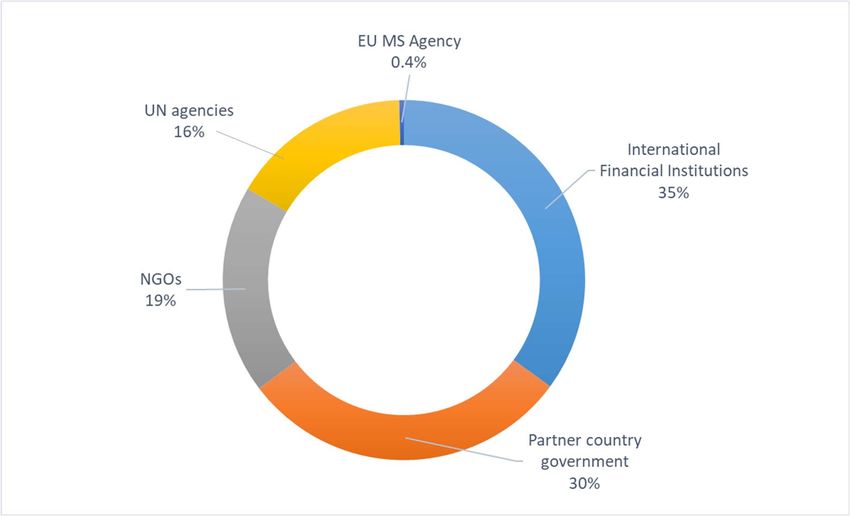
SUPPORTING SYRIA AND THE REGION
POST-BRUSSELS CONFERENCE FINANCIAL TRACKING: REPORT TEN

Contents
1. Key results ............................................................................................................................ 3

2. Overview ............................................................................................................................... 4

3. Progress by Donor ............................................................................................................... 5
    Grant Contributions ............................................................................................................................... 5
    Loan Pledges and Contributions ......................................................................................................... 9

4. Progress by Country .......................................................................................................... 10
    Grant Contributions ............................................................................................................................. 10
    Loan Contributions .............................................................................................................................. 12

5. In focus: Contributions to Jordan, Lebanon, Turkey and Syria ..................................... 13
    Jordan            ........................................................................................................................................... 13
    Lebanon           ........................................................................................................................................... 15
    Beirut Explosion................................................................................................................................... 16
    Turkey            ........................................................................................................................................... 16
    EU Facility for Refugees in Turkey ................................................................................................... 17
    Syria             ........................................................................................................................................... 18

6. Sectors ............................................................................................................................... 19
    COVID-19 Pandemic .......................................................................................................................... 20

7. Channels of Delivery ......................................................................................................... 21

8. Regional Multi-Donor Mechanisms ................................................................................. 22
    UN Coordinated Response Plans ..................................................................................................... 22

Annexes           ............................................................................................................................... 24
    Annex A: Glossary ................................................................................................................................. 24
    Annex B: Methodology .......................................................................................................................... 26

2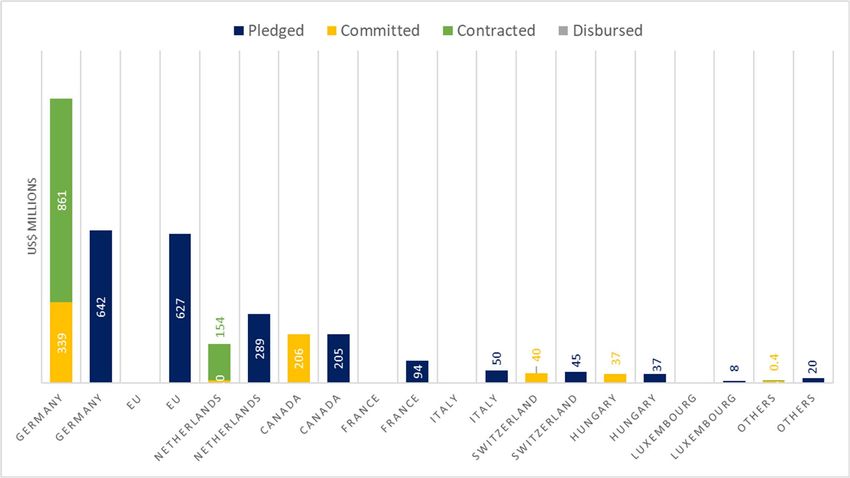
SUPPORTING SYRIA AND THE REGION
POST-BRUSSELS CONFERENCE FINANCIAL TRACKING: REPORT TEN

     1. Key results
At the fourth Brussels conference on Supporting the                     humanitarian, development and stabilisation
Future of Syria and the Region held on 30 June                          activities in 2020 in Syria and the region3. Of these,
2020,     the    international    community     and                     sixteen made forward-looking pledges of
governments of refugee-hosting countries came                           US$2 billion (€1.8 billion) for 2021 and beyond. The
together to reaffirm their commitments to                               IFIs, donor countries and the EU also announced
helping millions of affected civilians in Syria and                     US$6.9 billion (€6.2 billion) in loans. The purpose of
Syrian refugees and the communities generously                          this tracking mechanism is to provide an update on
hosting them.                                                           the funding delivered in the region and to ensure
                                                                        accountability of donors for the delivery of funding
Thirty-seven donor countries and the EU pledged
                                                                        against the pledges made at the Brussels IV
US$4.9 billion (€4.4 billion) in grants to support
                                                                        conference.
    The report published today reports that, as of August            As of August 2020, Turkey is the second largest
    2020:                                                            recipient of grant contributions among the neighbouring
    • US$5 billion (€4.5 billion) in grants was contributed by       countries, receiving US$806 million (€720 million) in
      donors for the year 2020 (up to August) for Syria and          grant contributions for 2020. For 2021 and beyond,
      countries in the region most affected by the Syrian            grant contributions of US$73 million (€65 million) were
      crisis (Jordan, Lebanon, Turkey, Iraq and Egypt),              already committed or contracted for Turkey. Loan
      already exceeding by 2% the original conference                contributions for Turkey for 2020 and beyond, amounted
      pledge of US$4.9 billion (€4.4 billion).                       to US$43 million (€38 million), of the pledged new loans
                                                                     of US$56 million (€50 million).
    • For 2021 and beyond, as of August 2020, donors
      have already made available US$1.7 billion                     As of August 2020, Jordan received US$631 million
      (€1.5 billion), 85% of the conference pledge of                (€563 million) in grant contributions for 2020. For 2021
      US$2 billion (€1.8 billion).                                   and beyond, grant contributions of US$726 million
                                                                     (€649 million) were already committed or contracted for
     • US$6.9 billion (€6.2 billion) of loans were pledged at        Jordan. Loan contributions for Jordan for 2020 and
       the conference to the governments of refugee-hosting          beyond, amounted to US$888 million (€793 million), of
       countries for 2020 and beyond.                                the pledged new loans of US$2.5 billion (€2.3 billion).
    EU member states and EU institutions pledged US$3                As of August 2020, Iraq and Egypt received grant
    billion (€2.7 billion), 61% of the 2020 pledge made at the       contributions of US$378 million (€337 million) and
    Brussels IV conference, and contributed US$3.2 billion           US$52 million (€46 million), respectively. For 2021 and
    (€2.8 billion) in 2020, as of August 2020 already                beyond grant contributions for Iraq and Egypt that are
    exceeding by 2% their original conference pledge. The            already      committed      or     contracted,      totalled
    three largest donors were the EU, Germany, and the               US$213 million (€190 million) and US$20 million (€18
    USA, accounting for 70% of total grant contributions             million), respectively.
    provided up August 2020.
                                                                     As of August 2020, the funding requirements of the
    As of August 2020, the largest grant contribution has            Syria Humanitarian Response Plan and the Syria
    been for Syria, US$1.7 billion (€1.5 billion). The five          Regional Refugee and Resilience Plan are covered by
    largest donors, accounted for 75% of total grant                 38% and 22%, respectively. The co-chairs urged donors
    contributions for Syria in 2020, as follows: Germany             to step up their efforts and renew their financial
    US$427 million (€381 million), USA US$384 million                commitments in support of the continued delivery of
    (€343 million), EU US$270 million (€241 million), UK             lifesaving, protection and resilience support in the region
    US$103 million (€92 million), and Japan US$76 million            in 2020 and beyond, wherever possible on a multi-
    (€68 million). For 2021 and beyond, US$104 million               annual basis.
    (€93 million) of grant contributions were already made
                                                                     The region is facing new challenges from the impacts of
    available for Syria.
                                                                     the COVID-19 pandemic, and Lebanon is facing the new
    As of August 2020, Lebanon has received the second               challenge of responding to the impacts of the 4 August
    largest amount of grant contributions, US$944 million            2020 Beirut port explosion. These impacts are being felt
    (€842 million). The three largest donors contributed 67%         both by the Syrian people and their host communities.
    of the total: EU (US$231 million, €206 million), USA             Donors are reorienting existing funding and pledging
    (US$229 million, €204 million), and Germany (US$169              new funding to contribute to meeting these new needs.
    million, €151 million). For 2021 and beyond, grant
    contributions of US$317 million (€283 million) were
    already committed or contracted for Lebanon. New loan
    pledges for Lebanon for 2020 and beyond, amounted to
    US$500 million (€446 million).

3 For the purposes of the financial tracking, the official pledges      B: Methodology, for more information on the Financial Annex to
made at the Brussels conference are broken down slightly                the Co-chair statement
differently in this report between grants and loans provided by
IFIs and the EU Macro-Financial Assistance (MFA). See Annex
3
SUPPORTING SYRIA AND THE REGION
POST-BRUSSELS CONFERENCE FINANCIAL TRACKING: REPORT TEN

    2. Overview
At the Brussels IV conference on 30 June 2020,                     (US$0.9 billion) of the new loan pledges made at
donors pledged a total of US$6.9 billion in grants                 the conference.
for 2020 and beyond: thirty-eight donors publicly
                                                                   Since the conference, several donors have
pledged US$4.9 billion in grants for 20204 and
                                                                   increased their confirmed pledge6. There is a clear
sixteen donors pledged a further US$2 billion for
                                                                   trend of contributions (committed, contracted, and
2021 and beyond5.
                                                                   disbursed amounts), exceeding pledges made at
As of August 2020, donors reported grant                           conferences. This trend has been consistent each
contributions for 2020 at the time of data collection              year since the data series was first collected in
of US$5 billion, already exceeding by 2% their                     2016. The realisation of further increases in
original conference pledge. Of the 38 donors who                   contributions during 2020 is particularly critical as
pledged for 2020, 20 donors have met or exceeded                   Syria and the region face new challenges in 2020,
their pledges.                                                     which will undoubtedly require additional new
                                                                   funding. To address the needs and impacts caused
For 2021 and beyond, donors reported grant
                                                                   by the outbreak of the COVID-19 pandemic, is
contributions for 2021 and beyond totalling
                                                                   estimated to require an additional US$1.2 billion in
US$1.7 billion, the equivalent of 82% of the grants
                                                                   new funding7. The full extent of the new funding
pledged for this period.
                                                                   requirements to respond to the Beirut port explosion
For loans for 2020 and beyond, a total pledge was                  are not yet fully known, but clearly it will also require
made of US$6.9 million for new loans, with IFIs                    new funding. Many donors are already responding
pledging US$5.2 billion, donor governments                         to these new challenges, including the provision of
pledging US$0.9 billion and the European Union                     new funding.
pledging US$0.8 billion. As of August 2020, loan
contributions have been realised for 14%

4
   Two countries pledged grants for 2020 at the Brussels III       US$0.8 billion in grants for 2020, US$1.1 billion in grants for 2021
Conference in 2019, which were inadvertently excluded from the     and beyond, and US$32 million in loans for 2020 and beyond.
updated 2020 grant pledge at the Brussels IV Conference:           Germany reported that this increase was because these funds
Slovenia (US$55,991) and Malta (US$5,599). Pledges for FRIT        were only approved after the conference, and this includes
in 2019 to be disbursed in 2020 were not included in the 2019      additional new funds for the COVID response and the response
Pledge Statement from the Brussels III Conference for two          to the Beirut port explosion on 4 August 2020. The USA also
countries: Finland (US$1.394,177) and Ireland (US$5,218,420).      increased their planned contribution for grants for 2020, by an
These were included in the Brussels IV Conference statement        additional US$87 million, as did the Netherlands by an additional
as new pledges.                                                    US$2 million.
5
  The detailed list of all pledges can be found in the Financial   7 According to the Brussels IV conference co-chairs
Annex to the Brussels IV conference co-chairs declaration:         declaration: https://www.consilium.europa.eu/en/press/press-
https://www.consilium.europa.eu/media/44897/syria-2020-            releases/2020/06/30/brussels-iv-conference-on-supporting-the-
pledging-statement_v03072020.pdf                                   future-of-syria-and-the-region-co-chairs-declaration/
6
  The planned contribution of Germany has increased since the
conference pledge by an additional US$2 billion, made up of:
4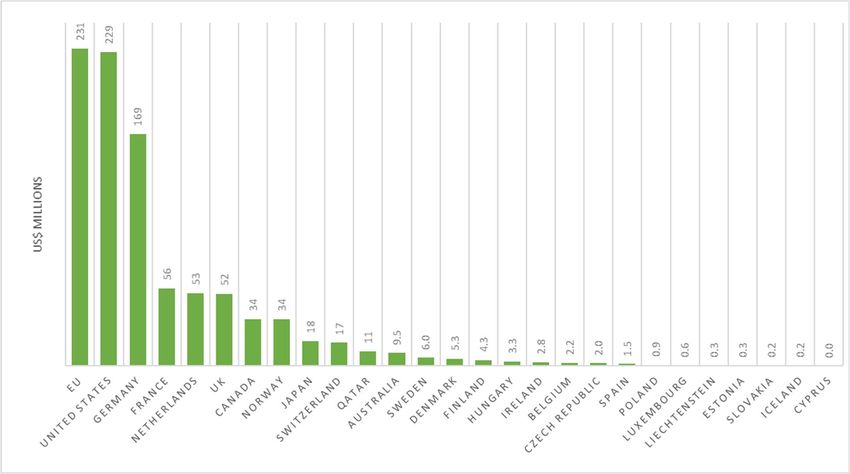
SUPPORTING SYRIA AND THE REGION
POST-BRUSSELS CONFERENCE FINANCIAL TRACKING: REPORT TEN

                               Figure 1:   Grant contributions against pledges, by year

    3. Progress by Donor
Grant Contributions
As of August 2020, donors have contributed a total                   reported as committed, contracted and disbursed.
of US$5 billion in grants to Syria and the region                    Of the 38 donors who pledged for 2020, 23 donors
against their grant pledges of US$4.9 billion for                    have made contributions that meet or exceeded
2020. This amounts to 102% of the total pledge for                   their pledges. Yet several donors reported that
2020 grants being firmly committed to a country,                     COVID-19 was causing some significant delays in
sector, and delivery channel8. This includes funds                   pledges transitioning to contributions9.

8 At the same time in 2019, only 90% of pledges had materialised     demonstrated clearly by the data reported with only a very small
as contributions (see Financial Tracking Report Number 8,            proportion of their 2020 grant pledges having being realized as
September 2019).                                                     contributions by August 2020.
9
  Whilst several donors reported this as an issue, the Republic of
Korea and Italy reported this as a major challenge, that was
5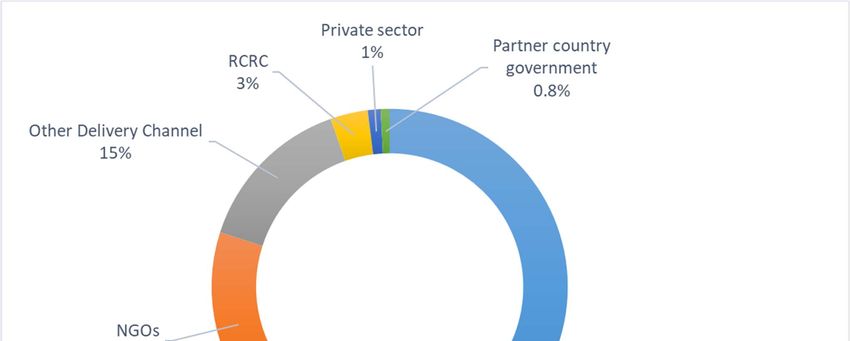
SUPPORTING SYRIA AND THE REGION
POST-BRUSSELS CONFERENCE FINANCIAL TRACKING: REPORT TEN

                 Figure 2:   Grant contributions against pledges by donor 2020

6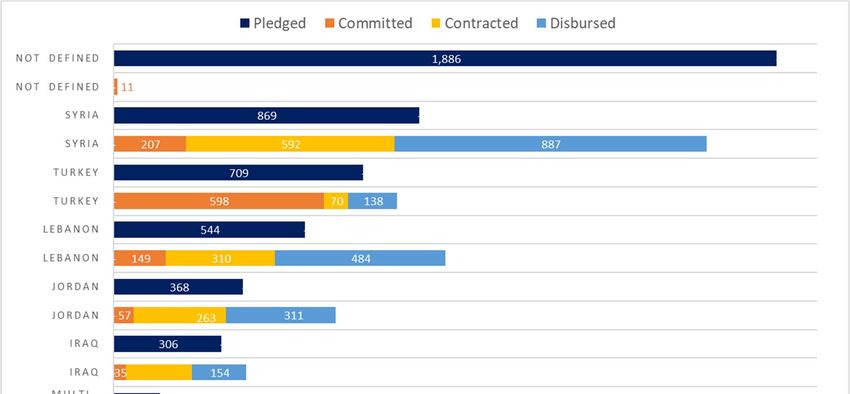
SUPPORTING SYRIA AND THE REGION
POST-BRUSSELS CONFERENCE FINANCIAL TRACKING: REPORT TEN

                           Table 2:   Grant contributions and pledges (USD$), 202010
             Donor              Pledged           Contributions     ● Committed       ● Contracted      ● Disbursed
             EU                   1,170,212,766     1,356,416,573       771,041,433       164,918,253       420,456,887
             Germany              1,132,138,858     1,232,004,479        29,328,108       882,956,327       319,720,045
             United States          696,011,752       900,141,366        54,952,716       450,384,605       394,804,045
             UK                     370,828,183       204,857,094                                           204,857,094
             Canada                 247,489,429       247,489,430        23,074,107                         224,415,322
             Japan                  189,093,752       189,093,752                                           189,093,752
             Norway                 180,022,631       120,152,248                                           120,152,248
             Netherlands            175,027,996       149,944,009        39,305,711       110,638,298
             France                 138,969,765       108,824,188        54,143,337                          54,680,851
             Denmark                105,967,233        86,427,176        86,427,176
             Qatar                  100,000,000        92,023,836                                            92,023,836
             Sweden                  95,913,642        68,490,841                                            68,490,841
             Switzerland             64,278,188        64,278,188        22,233,930           790,306        41,253,952
             Italy                   50,391,937         2,239,642                                             2,239,642
             Hungary                 36,095,925        36,097,333         8,628,323        25,123,606         2,345,404
             Finland                 27,995,521        26,881,299         7,172,452                          19,708,847
             Ireland                 27,995,521        22,861,467                                            22,861,467
             Belgium                 27,760,147        27,760,147         4,479,283                          23,280,863
             Australia               23,989,034        23,989,034                                            23,989,034
             Austria                 18,917,133        13,597,984                           2,975,588        10,622,396
             Korea                   13,450,000
             Luxembourg               8,398,656         8,048,314            89,586                           7,958,728
             Czech Republic           7,521,939         9,297,952         1,671,542         2,381,947         5,244,463
             Spain                    6,490,587         6,175,386         4,387,225           765,746         1,022,415
             Poland                   4,294,529         4,294,529         1,428,930                           2,865,600
             Iceland                  2,031,076         2,031,076                                             2,031,076
             Liechtenstein            1,022,129         1,022,129                                             1,022,129
             Estonia                    987,682           987,682                                               987,682
             Slovakia                   750,077           750,077                             145,554           604,523
             Croatia                    223,964           223,964           223,964
             Bulgaria                   190,370           190,370            83,987                             106,383
             Greece                     111,982
             Portugal                   111,982           111,982           111,982
             Lithuania                  111,982           111,982                                               111,982
             Malta                       83,987            83,987                                                83,987
             Brazil                      75,000            75,000            75,000
             Cyprus                      55,991            55,991                                                 55,991
             Slovenia                    33,595            89,586                                                 89,586

             Grand Total          4,925,044,941     5,007,120,091     1,108,858,792     1,641,080,230     2,257,181,069

Of the same thirty-eight grant donors, sixteen                          Germany has provided 73% (US$1.2 billion) of the
donors have made forward-looking pledges for                            forward-looking contributions, including 85% of the
grants for 2021 and beyond, totalling US$2 billion.                     already contracted contributions. Most of the
As of August 2020, these sixteen donors have                            remaining contributions were provided by Canada
contributed a total of US$1.7 billion in grants to                      (US$205         million),     the       Netherlands
Syria and the region against their 2021 and beyond                      (US$164 million), Switzerland (US$41 million) and
pledge. This amounts to 82% of the total pledge for                     Hungary (US$37 million). Some donors, such as
grants for 2021 and beyond being firmly committed                       the EU and Ireland, were not yet able to report their
to a country, sector, and delivery channel. Of which,                   contributions for 2021 and beyond, due to internal
50% of the total pledge is already contracted.                          annual budget approval processes.

10
  The 2020 grant contributions for all donors do not include contributions to FRIT, as all commitments to FRIT were made before the end
of 2019. The EU Trust Fund (MADAD) is a pooled fund with approximately 90% of contributions to MADAD coming from the EU and the
remaining 10% from other donors. Contributions made from MADAD in 2020 are included in the EU total 2020 grant contributions.
7
SUPPORTING SYRIA AND THE REGION
POST-BRUSSELS CONFERENCE FINANCIAL TRACKING: REPORT TEN

          Figure 3:   Grant contributions against pledges, by donor 2021 and beyond

              Table 4:   Grant contributions and pledges (USD$), 2021 and beyond
                       Donor            Pledged         Contributions   Committed     Contracted
                       Germany            641,657,335   1,203,169,093 339,619,261       863,549,832
                       EU                 627,099,664
                       Netherlands        288,689,810     164,155,277 10,190,370        153,964,907
                       Canada             205,131,015     205,131,015 205,131,015
                       Italy               50,391,937
                       France              94,064,950
                       Switzerland         45,310,853      40,463,646    40,463,646
                       Hungary             37,428,364      37,428,365    37,428,365
                       Luxembourg           8,398,656
                       Sweden               6,886,419
                       Spain                5,599,104       1,903,695     1,903,695
                       Czech Republic       4,178,855       3,343,084     3,343,084
                       Iceland              2,009,944       2,009,944     2,009,944
                       Slovakia               559,910
                       Estonia                475,924         475,924      111,982          363,942
                       Slovenia                44,793

                         Totals         2,017,927,533   1,658,080,043 640,201,362     1,017,878,681

8
SUPPORTING SYRIA AND THE REGION
POST-BRUSSELS CONFERENCE FINANCIAL TRACKING: REPORT TEN
Loan Pledges and Contributions
Unlike grants, loans are usually multi-year funding loan pledge for 2020 and beyond has already been
arrangements, that can take time to contract and committed as loan contributions. The three largest
then the disbursements are often phased over new loan pledges for 2020 and beyond have been
multiple years, for sound financial management made by the European Investment Bank (US$2.8
reasons. Rapid in-year disbursements of new loan billion), the World Bank (US$ 2.2 billion) and the EU
pledges should not be anticipated in the same way (US$0.8 billion), which account for 83% of the total
as grants. At the Brussels IV Conference, a total of new loan pledge made at the Brussels IV
US$6.9 billion of new loan funding was pledged for conference. Germany has already exceeded their
2020 and beyond, which is on top of substantial pre- pledge, with a loan contribution of US$32 million,
2020 loan pledges and contributions that have been against a pledge of US$5.6 million.
made11. A total of US$0.9 billion (14%) of the total
Figure 4: Loan contributions against pledges, by lender 2020 and beyond
A key component of the tracking of loan funding, is December 2014. Of the total loan pledge for 2020
to track the concessional status of the loan and beyond of US$6.9 billion, the concessional
financing, with concessional loans offering a further status of the loan pledge has been declared at the
means to support the region. Loan financing to the point of pledging for US$6.8 billion, and of this 75%
region is ideally made on concessional terms either has already been declared to be concessional
on IDA-equivalent terms or consistent with the based loan financing.
revised OECD DAC principles agreed on 16
11
For example, to date EBRD has committed €7.8 billion in loan to the region by extending the implementation period of the
financing over 3 years (2017, 2018, 2019) covering Turkey, Municipal Resilience Refugee Response Programme until 2025
Jordan, Lebanon, and Egypt. To date, EBRD has invested for Turkey and Jordan and expect to mobilise and implement
€8.267 billion in Turkey, Egypt, Jordan, and Lebanon by the end projects worth €226 million (made up of €137 million from
of 2019. EBRD had announced its support to Turkey, Jordan and EBRD’s own resources and €97 million from grant funds).
Lebanon and their hosting of Syrian refugees through the €900
million Refugee Response Programme, launched in 2016. EBRD
remains committed to this programme, and will continue support
9SUPPORTING SYRIA AND THE REGION
POST-BRUSSELS CONFERENCE FINANCIAL TRACKING: REPORT TEN
Figure 5: Loan pledges for 2020 and beyond, by donor and concessional status
4. Progress by Recipient Country
Grant Contributions
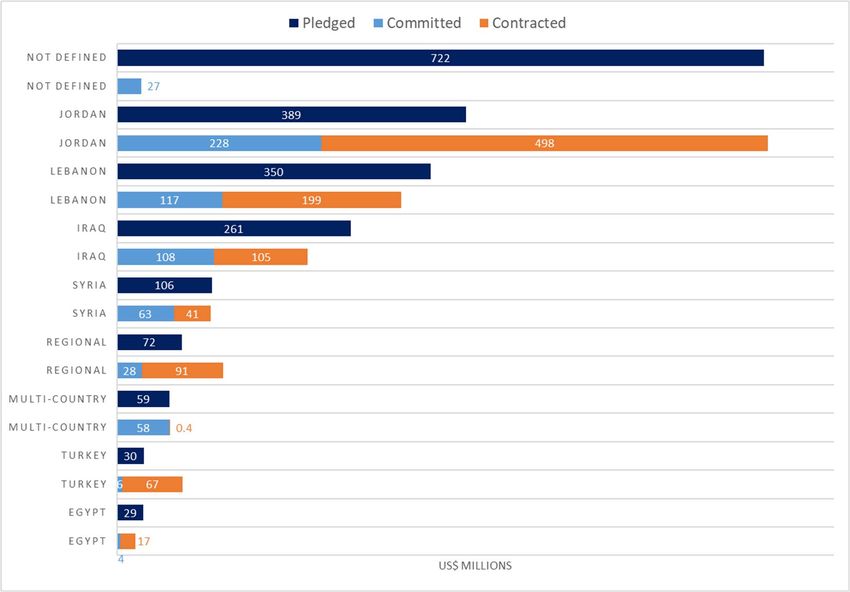
The support to Syria and the region, is being already realised 44% of the geographically defined
provided in Syria, and to five neighbouring countries contributions have been contributed to Jordan.
that are hosting Syrian refugees (Lebanon, Turkey,
Many donors do not breakdown their pledge by
Jordan, Iraq, and Egypt). This includes support that
country at the point of making the pledge at the
is being provided through regional or multiple-
annual conference. This accounts for the high
country frameworks covering all or several of these
proportion of pledges recorded as not
countries. Of the total 2020 grant contribution of
geographically defined. Furthermore, several
US$5 billion, 34% has been allocated to Syria.
donors confirm additional pledges after the
Whilst only sixteen of the thirty-eight donors have
conference. These two factors contribute to the fact
pledged and contributed forward-looking grant
that contributions at the country level often exceed
funding for 2021 and beyond, of the contributions
the country level pledge made at the conference.
10SUPPORTING SYRIA AND THE REGION
POST-BRUSSELS CONFERENCE FINANCIAL TRACKING: REPORT TEN
Figure 6: Grant contributions against pledges by country, 2020
11SUPPORTING SYRIA AND THE REGION
POST-BRUSSELS CONFERENCE FINANCIAL TRACKING: REPORT TEN
Figure 4: Grant contributions against pledges by country 2021 and beyond
Loan Contributions
As of August 2020, only 14% (US$0.9 billion) of the and therefore analysis of loans for 2020 and beyond
total 2020 and beyond loan pledge of US$6.9 billion at the country level is restricted to analysis of the
has materialised as contributions for a specific pledge rather than contribution. Jordan accounts for
country. Therefore, it is not appropriate at this stage 36% (US$2.5 billion) of the total loan pledge for
to analyse loan contributions against 2020 and 2020 and beyond, and 94% (US$0.9 billion) of the
beyond loan pledges in a meaningful way at the total contributions already realised against the new
country level. Analysis of loan contributions can loan pledge for 2020 and beyond.
only be meaningful over a longer multi-year period,
12SUPPORTING SYRIA AND THE REGION
POST-BRUSSELS CONFERENCE FINANCIAL TRACKING: REPORT TEN
Figure 8: Loans against pledges by recipient country 2020 and beyond
5. In focus: Contributions to Jordan,
Lebanon, Turkey and Syria
Jordan
As of August 2020, total grant contributions for million), of all 2020 grant contributions for Jordan,
Jordan are US$1.4 billion. This is made up of made up of: Germany 29% (US$187 million), USA
US$631 million of grants for 2020, and US$726 22% (US$142 million), EU 15% (US$91 million), UK
million of grants for 2021 and beyond. 7% (US$45 million), and the Netherlands 6%
(US$36 million).
The five largest-grant contributing donors combined
provided more than three quarters, at 79% (US$501
13SUPPORTING SYRIA AND THE REGION
POST-BRUSSELS CONFERENCE FINANCIAL TRACKING: REPORT TEN
Figure 9: 2020 Grant contributions for Jordan by donor
At the Brussels IV conference, Jordan received by contributions under GCFF for Jordan have been
far the largest pledge for loan financing, with a total included as an integral component of the World
loan pledge of US$2.5 billion, of the total loan Bank concessional loan financing for Jordan. The
pledge of US$6.9 billion for 2020 and beyond. The next three largest loan pledges together with the
World Bank is by far the largest lender to Jordan, World Bank make up for the bulk of the loan pledges
providing 49% (US$ 1.3 billion) of the pledged loan for Jordan, and these are: the EU (US$0.8 billion),
financing for Jordan. The World Bank has France (US$0.2 billion) and the European Bank for
structured most of the loan financing to Jordan on Reconstruction and Development (US$0.2
concessional terms using the Global Concessional billion)12.
Financing Facility (GCFF). The pledges and
12
Germany has recently confirmed an increase in their pledge of
loan funding for Jordan for 2020 and beyond to a new total of
US$22.4 million.
14SUPPORTING SYRIA AND THE REGION
POST-BRUSSELS CONFERENCE FINANCIAL TRACKING: REPORT TEN
Figure 10: Loan pledges for Jordan, 2020 and beyond
Lebanon
As of August 2020, Lebanon has received total France 6% (US$56 million), and the Netherlands
grant contributions of US$1.3 billion, made up of 5% (US$53 million).
US$944 million in grants for 2020 and US$317
The World Bank is by far the largest pledger of loan
million for grants for 2021 and beyond.
financing for Lebanon, with a total new loan pledge
The five largest-grant contributing donors combined of US$450 million for Lebanon for 2020 and
provided almost three quarters at 78% (US$738 beyond, and the only other pledger of loan financing
million) of all 2020 grant contributions, which are to Lebanon is Italy with a total loan pledge of US$50
made up of: EU 25% (US$231 million), USA 24% million for 2020 and beyond.
(US$229 million), Germany 18% (US$169 million),
Figure 11: 2020 Grant contributions for Lebanon by donor
15SUPPORTING SYRIA AND THE REGION
POST-BRUSSELS CONFERENCE FINANCIAL TRACKING: REPORT TEN
Figure 12: Loan pledges for Lebanon 2020 and beyond
Beirut Explosion
The deadly explosion at the Beirut port on 4 August Following the deadly explosion in Beirut on 4
2020 impacted both the Lebanese and Syrian August 2020, the EU mobilised over €64 million14
refugee populations, with approximatively one for emergency and recovery needs, including
quarter of the causalities being Syrian refugees13. medical support, equipment, and protection of
The capacity of Lebanon to meet the basic needs of critical infrastructure. This comes in addition to the
vulnerable groups including refugees from Syria will deployment of three hundred European search and
continue to be affected by the consequences of the rescue, chemical and medical experts to Beirut,
explosion for some time to come. The request for three EU Humanitarian Air Bridge flights delivering
information from donors for this financial tracking medical aid and equipment sent through the EU
exercise was sent before this incident, but several Civil Protection Mechanism. The EU has stated it is
donors did provide information on their response to ready to provide further support based on emerging
the Beirut port explosion. identified needs and has co-authored the Rapid
Damage and Needs Assessment led by the World
Donors have adopted a slightly different approach Bank and UN.
to whether the funding for the response to the
deadly explosion is separate to or partly included in Based on the available information from donors it
the pledges and contributions of the ongoing appears that most of the emergency assistance
support to Syria and the region. For example, USA provided in response to the deadly explosion in
has not included the response to the deadly Beirut is not included within the wider support to
explosion in Beirut as part of the wider support for Syria and the region. Germany has pledged €20
Syria and the region. Whereas the EU and million for emergency assistance to Beirut, and only
Germany have included part of the response to the €3.1 million of that total amount to date is included
deadly explosion in Beirut within the wider support within the pledge for Lebanon for the wider support
for Syria and the region, and partly as a separate to Syria and the region that is covered by this
new stream of funding. financial tracking exercise.
Turkey
As of August 2020, total grant contributions have contributions for Turkey were provided by USA
been made for Turkey of US$0.9 billion, made up of (US$88 million) and Germany (US$41 million).
US$806 million of grant contributions in 2020 and
Turkey received a total new loan pledge for 2020
US$73 million in grant contributions for 2021 and
and beyond, of US$56 million, from the European
beyond. Most of the total grant contributions for
Bank for Reconstruction and Development
2020 was provided by the EU, totalling US$637
(EBRD)15.
million (79%) of the total grant contribution for 2020
of US$806 million. Most of the remaining 2020 grant
13 15
EU reporting. Germany has recently confirmed a new loan pledge for Turkey
14
The EU announced EUR 63 M on 9 August 2020, with some for 2020 and beyond of US$14.9 million.
additional funding having been mobilized since.
16SUPPORTING SYRIA AND THE REGION
POST-BRUSSELS CONFERENCE FINANCIAL TRACKING: REPORT TEN
Figure 13: 2020 Grant contributions for Turkey by donor
EU Facility for Refugees in Turkey
The Facility for Refugees in Turkey (FRIT)16 mechanism, designed to ensure that the needs of
mobilised €6 billion for 2016-2019 from donors. By refugees and host communities in Turkey are
the end 2019, the entire operational budget had addressed in a comprehensive and coordinated
been committed, of which €4.7 billion is already manner. The Facility focuses on humanitarian
contracted and €3.4 billion disbursed. This support assistance, education, protection, health, municipal
is project-based, with activities continuing until infrastructure, and socio-economic support.
2025. The conference welcomed the work already The Facility continues to utilise these funds in 2020
done and the continuation of effective delivery of to meet the needs of refugees and host
assistance under the Facility for Refugees in communities in Turkey. Of the total second tranche
Turkey. funds (€3 billion or US$3.3 billion) available to the
The EU Facility for Refugees in Turkey manages a Facility, the full operational envelope was
total of €6 billion in two tranches: €3 billion for 2016 committed by the end of 2019. Therefore, any
and 2017 (first tranche) and €3 billion for 2018 and contributions to FRIT by donors are not included in
2019 (second tranche). Of that total, €3 billion the preceding analysis of 2020 contributions. But to
(€2 billion from the first tranche and €1 billion from provide an update on the progress of FRIT
the second tranche) comes from EU member states contributions pre-2020, as of August 2020, out of
as external assigned revenue, and €3 billion the total of €3 billion (US$3.4 billion) of the second
(€1 billion and €2 billion to the first and second tranche, €1.78 billion (US$2 billion) has been
tranches, respectively) comes from the EU budget. contracted, out of which €1 billion (US$1.1 billion)
The Facility represents a joint coordination has been disbursed.
16
For more information on the FRIT please see the EU website:
https://ec.europa.eu/neighbourhood-
enlargement/news_corner/migration_en
17SUPPORTING SYRIA AND THE REGION
POST-BRUSSELS CONFERENCE FINANCIAL TRACKING: REPORT TEN
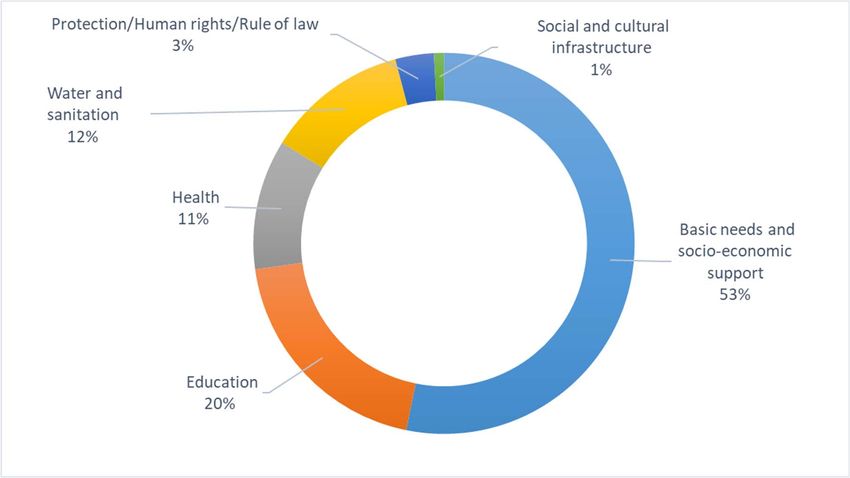
Figure 14: Grant contributions for Turkey from the EU Facility for Refugees in Turkey, by
sector
The FRIT contributions are notably investing more sanitation and health. The most utilised delivery
than half of the second tranche in basic needs and channels for FRIT contributions from the second
socio-economic support. The other notable tranche are the International Financial Institutions
investments being in education, water and and partner country governments.
Figure 15: Grant Contributions from the EU Facility for Refugees in Turkey, by Channel of
Delivery
18SUPPORTING SYRIA AND THE REGION
POST-BRUSSELS CONFERENCE FINANCIAL TRACKING: REPORT TEN
Syria
The total 2020 grant contributions for Syria amounts Germany contributing 25% (US$427 million), USA
to US$1.7 billion, which is provided by thirty-four of providing 23% (US$384 million), EU 16% (US$270
the total thirty-eight donors. The five largest million), UK 6% (US$103 million) and Japan 5%
contributing donors account for 75% (US$1.3 (US$76 million).
billion) of the total contribution, made up of
Figure 16: 2020 Grant contributions for Syria by donor
6. Sectors
Of the total 2020 grant pledge of US$4.9 billion for Aside from the 27% of reported sectoral
Syria and the region, a total of US$5 billion has contributions that have been allocated to multi-
been realised as contributions in 2020. Not all sectoral activities, the largest grant investments in
contributions can be broken down by sectors. Some 2020, have been in food, health, education, and
donors were unable to report on the sectoral economic recovery and infrastructure. Compared to
breakdown of their contributions at this point in 2019, the most notable change has been the
2020. This sectoral analysis is therefore based on a increased allocation to the food sector, which has
breakdown of $4.3 billion of the total US$5 billion increased almost four-fold from 6.1% in 2019 to
confirmed contributions, provided by thirty-five of 18% in 2020. As the sectoral analysis conducted
the thirty-eight donors. was at the regional level, this will hide significant
variations in the sectoral breakdown at the national
level.
19SUPPORTING SYRIA AND THE REGION
POST-BRUSSELS CONFERENCE FINANCIAL TRACKING: REPORT TEN
Figure 17: 2020 Grant contributions by sector
COVID-19 Pandemic
The impact of the COVID-19 pandemic is assistance as well as to support host countries’
dramatically impacting Syria and the region. Whilst national systems and recovery plans, vulnerable
not a specific topic in the original plan for data families and host communities”17.
collection, several donors volunteered insights on
The EU, UK, USA, Canada and Germany are all,
the challenges posed by the COVID-19 pandemic,
both re-orientating existing funding (pledges and
which are analysed below. It is important to note
contributions), and pledging new funding, to
that this evidence was not formally requested from
address the public health and economic impacts of
all donors, and so the analysis is anecdotal rather
the COVID-19 pandemic in Syria and the region. All
than representative, but it still adds value and
five donors stated that some of the funding included
highlights areas that could be addressed with
in this report is being used towards the COVID-19
subsequent data collection and analysis.
pandemic response in Syria and the region. The
The declaration of the co-chairs at the Brussels IV emerging needs resulting from the COVID-19
conference highlighted the additional challenge that pandemic was noted by several other donors as a
Syria and the region faces resulting from the public key issue, and therefore it is likely that many other
health and economic impacts of the COVID donors are replicating this approach, whilst there is
pandemic: “The worsening economic context in insufficient evidence or data available to definitively
Syria and the region and the protracted nature of conclude if other donors are adopting the same
the crisis warrants further support. US$384 million approach.
are required to address the public health and socio-
Several other donors noted that the COVID-19
economic consequences of the COVID-19 crisis in
pandemic presented new challenges for pledges to
Syria, with an additional US$806 million needed
be realised into contributions, and that some delays
across the region, in particular to provide immediate
17
This is a direct quotation from the co-chair’s declaration at https://www.consilium.europa.eu/en/press/press-
the conclusion of the Brussels Four Conference. The full releases/2020/06/30/brussels-iv-conference-on-supporting-the-
declaration can be found at: future-of-syria-and-the-region-co-chairs-declaration/
20SUPPORTING SYRIA AND THE REGION
POST-BRUSSELS CONFERENCE FINANCIAL TRACKING: REPORT TEN
in partners receiving funding have been The grant pledges from Germany, have
experienced. substantially increased since the Brussels IV
Conference. The total pledges from Germany
The EU has reoriented more than €80 million to
include €411.3 million specifically for the response
address the emergency needs, health and socio-
to the COVID-19 pandemic, which is made up of
economic challenges related to the Covid-19
€375.5 million pledged for grants in 2020, and €35.8
pandemic inside Syria.
million pledged for grants in 2021 and beyond.
The EU Regional Trust Fund (MADAD) has
The UK has disbursed a total of US$17 million
redirected activities within ongoing programmes,
specifically to assist in the response to the COVID-
involving more than €91.5 million mostly in the
19 pandemic, from the total disbursements reported
health and WASH sectors, and on 9 June 2020 has
under this financial tracking report. Canada also
adopted an additional €54.7 million package for
reported that US$7 million of the existing pledge for
refugees from Syria and vulnerable persons in
2020 grants was being directed to country based
Jordan and Lebanon to fight the COVID-19
pooled funds and NGO partners to respond to
pandemic.
growing COVID-19 pandemic specific needs.
7. Channels of Delivery
Of the total 2020 grant pledge of US$4.9 billion for agencies, with 62% (US$2.7 billion) of the total
Syria and the region, $5 billion has been realised as grant contributions with a breakdown by channel of
contributions in 2020. Not all contributions can be delivery (US$4.3 billion). This is a significant
broken down by channel of delivery. Some donors increase since 2019 where the UN was relied on for
were unable to report on the channel of delivery of the delivery of 44% of grant contributions. As the
their contributions at this point in 2020. This delivery channel analysis conducted was at the
analysis of channels of delivery is therefore based regional level, this will hide significant variations in
on a breakdown of $4.3 billion of the total US$5 the breakdown of delivery channels at the national
billion confirmed contributions, provided by thirty- level.
five of the thirty-eight donors.
The most popular channel of delivery that is being
utilised for 2020 grant contributions are the UN
Figure 18: 2020 Grant contributions by delivery channel
21SUPPORTING SYRIA AND THE REGION
POST-BRUSSELS CONFERENCE FINANCIAL TRACKING: REPORT TEN
8. Regional Multi-Donor Mechanisms
There are two multi-donor mechanisms being Beyond these two multi-donor mechanisms
utilised for support at the national level that are operating at the national level, there are three
included in the scope of this financial tracking additional major multi-donor mechanisms that
report18: the Global Concessional Financing Facility operate at the regional level to support Syria and
(utilised only in Jordan), and the EU Facility for the region. These three regional multi-donor
Refugees in Turkey (utilised only in Turkey). mechanisms are: the EU Regional Trust Fund
(MADAD); the UN Syria Humanitarian Response
The Global Concessional Financing Facility (GCFF)
Plan (HRP); and the UN Regional Refugee
helps to bridge the humanitarian-development gap
Resilience Plan (3RP). The EU Regional Trust Fund
by providing an affordable and sustainable means
(MADAD) is reported on in the preceding sections
of coping with the long-term development costs of
of this report as an integral component of the EU
hosting large numbers of refugees. In this region,
2020 grant contributions. The two remaining UN
Jordan is presently the only country to benefit from
multi-donor mechanisms are reported on separately
this mechanism of concessional loan funding.
below.
UN Coordinated Response Plans
The UN Syria Humanitarian Response Plan (HRP) The combined funding requirements to deliver all
responds to humanitarian needs within Syria, while components of these two UN coordinated plans is
the UN Regional Refugee and Resilience Plan US$9.8 billion for 2020. At present these plans are
(3RP) covers protection and humanitarian needs as only partly funded with a total confirmed funding of
well as resilience in the countries hosting refugees US$2.8 billion19. Interestingly, the total grant
(Egypt, Iraq, Jordan, Lebanon, and Turkey). The contributions reported by donors as being
UN multi-donor coordinated response plans channelled through the UN agencies under this
represent the largest combined and coordinated financial tracking exercise was US$2.7 billion,
pillar of the humanitarian aid response architecture. which is very close to the figure reported separately
These UN coordinated response plans bring by the UN through their own reporting mechanisms.
together national governments, UN and non- It would have been possible to analyse further, and
governmental agencies to assess needs, develop potentially attempt to reconcile the data from both
strategic plans, deliver programmes and mobilise reporting mechanisms, if all donors had been able
international donor support for addressing the to provide a breakdown of 2020 grant contributions
priority humanitarian and protection needs of by channel of delivery during this financial tracking
Syrians in Syria and Syrian refugees and host exercise20.
communities in neighbouring countries.
18 19
The Global Concessional Financing Facility (GCFF) that Data sourced from the UN Financial Tracking System
supports concessional loan financing for Jordan is reported on website: https://fts.unocha.org/appeals/943/summary
20
under Section 5, in relation to the World Bank loan financing for Data on channels of delivery was only available for US$4.3
Jordan. The EU Facility for Refugees in Turkey is reported on in billion of the total US$5 billion reported for 2020 grant
relation to progress with pre-2020 grant pledges and contributions under this financial tracking exercise.
contributions for Turkey under Section 5, in relation to FRIT
grants for Turkey.
22SUPPORTING SYRIA AND THE REGION
POST-BRUSSELS CONFERENCE FINANCIAL TRACKING: REPORT TEN
Figure 8: Requirements and contributions for Syria-related UN-coordinated response plans,
2020
7,000 100%
6,000 90%
6,000
80%
5,000 70%
60%
US$ millions
4,000 3,820
Coverage
4,690 50%
3,000 38% 40%
2,000 2,350 30%
22%
20%
1,000
1,470 10%
1,310
0 0%
Syria HRP 3RP
Requirements met Unmet requirements % of requirements met
23SUPPORTING SYRIA AND THE REGION
POST-BRUSSELS CONFERENCE FINANCIAL TRACKING: REPORT TEN
Annexes
Annex A: Glossary
Term Definition
Commitment A firm plan expressed in writing and backed by the necessary funds, carried out by an
official donor to provide specified assistance to a recipient country government,
organisation or implementing agency. In the context of the tracking reports,
commitments refer to those funds which have been committed but not yet contracted
or disbursed.
In the case of loans, the amount committed by financial institutions should be
understood as the amount of loans formally approved by their institutions.
Contract A binding agreement signed between a donor and a recipient implementing institution,
organisation, or agency to implement an action. Funds can then be disbursed on this
basis. In the context of the tracking reports, contracted funding refers to those funds
which have been contracted but not yet disbursed.
In the case of loans, the amount contracted by financial institutions refers to the
amount of loans formally signed with the borrower.
Contribution For the purpose of the tracking reports, ‘contributions’ is used as a general term to
refer to the sum of all funds reported as committed, contracted and disbursed.
Disbursement Outgoing funds that are transferred to a recipient institution, organisation or agency,
following a commitment and/or a contract. In the context of the tracking report,
disbursements refer to funds disbursed from the donor to the first-level recipient, not to
the funds which are ultimately spent at the project level. Disbursements may depend
on the progress of the respective projects and that achieved by respective
implementing partners.
In the case of loans, the disbursed amount by financial institutions refers to the
amount transferred to the borrower.
Grant Funding for which no repayment is required.
Lending All institutions that pledged and/or contributed loans as part of the Syria response.
institutions This includes multilateral development banks and government institutions.
Loans Funding for which the recipient incurs a legal debt.
Loans – The concessional status of a loan reflects the benefit to the borrower compared with a
concessional loan at market rate.
status Concessional loans’ benefits can include a lower interest rate, a longer period in which
the loan must be repaid and a delay to when the repayment must begin.
Multi-country Pledges and funding labelled as ‘multi-country’ in the reports refer to instances where
funding is directed (or will be directed) to two or more (but not all) specified countries
in the Syria region. This differs from pledges and funding labelled as going to the
‘region’, which is specified as funding for the regional response by donors and may go
to all countries in the region; as well as ‘not defined’, which refers to pledges and
funding where no country or regional detail has been provided.
Multi-sector In the context of sectoral disaggregation of grants and for the purposes of the tracking
reports, multi-sector refers primarily to projects and activities with no one dominant
sector and often applies to assistance for refugees provided and/or coordinated by the
UN High Commissioner for Refugees (UNHCR). This definition is in line with the Inter-
Agency Standing Committee’s sectoral definitions.
Multilateral Multilateral development banks are supranational institutions established by a group of
development countries with the common task of fostering economic and social progress in
banks developing countries by financing projects (in the form of loans or grants), supporting
investment, generating capital and providing technical expertise.
Pledge In the case of grants, this refers to a non-binding announcement of an intended
contribution or allocation by donors.
24SUPPORTING SYRIA AND THE REGION
POST-BRUSSELS CONFERENCE FINANCIAL TRACKING: REPORT TEN
Term Definition
In the case of loans, this represents a non-binding announcement of a lending target.
Achieving set lending targets depends on the ability and willingness of the borrowing
party to take out a loan.
Recipient The reports include analysis of pledges and funding by recipient country. This includes
country direct funding to the governments of recipient countries, as well as funding channelled
through organisations working in the country, such as the UN, NGOs, the International
Committee of the Red Cross (ICRC) and the International Federation of Red Cross
and Red Crescent Societies (IFRC) and the private sector.
Region In the context of the Brussels Conference, ‘region’ refers to Egypt, Iraq, Jordan,
Lebanon, and Turkey.
Unearmarked In the context of the tracking reports, unearmarked refers to funding that is deliberately
not directed to any particular sector by the donor. This differs from ‘sector not
specified’ where details of sector-specific allocation are not available from the reports
provided by the donors.
25SUPPORTING SYRIA AND THE REGION
POST-BRUSSELS CONFERENCE FINANCIAL TRACKING: REPORT TEN
Annex B: Methodology
The pledges made by the international community The definitions of contributions have been applied
at the fourth Brussels conference in support of rigorously throughout the data collection process
Syria and the region are detailed in the Financial and in the report. A non-binding pledge only
Annex to the Co-Chairs’ Statement21. The becomes a contribution once it is committed, which
statement confirms that donors made a total is defined as: “a firm plan expressed in writing and
funding pledge of USD 5.5 billion (EUR 4.9 billion) backed by the necessary funds, carried out by an
for 2020, USD 2.2 billion (EUR 2 billion) for 2021 official donor to provide specified assistance to a
and beyond, and USD 6.1 billion (EUR 5.5 billion) recipient country government, organisation or
in loans. implementing agency”. The definition of a
contribution also includes committed funds that
For the purposes of the financial tracking, the
have subsequently been contracted and then
official pledges made at the Brussels conference
disbursed. This financial tracking report has
are broken down slightly differently in this report
applied the existing definitions of these terms
between grants and loans provided by IFIs and the
comprehensively and consistently. The strict
EU Macro-Financial Assistance. The conference
application of these definitions is critical to the
pledge was for grant support amounting to US$4.9
achievement of all four of the objectives of this
billion (€4.4 billion) in grants for 2020, and multi-
financial tracking, and a crystal clear distinction
year pledges of US$2 billion (€1.8 billion) for 2021
between non-binding pledges and actual funds
and beyond. The EU announced Macro Financial
being realised is essential to meet the overall
Assistance (MFA) loans amounting to €500 million
purpose of mutual accountability.
(US$560 million) for 2020 and €200 million
(US$224 million) for 2021. IFIs and governments The definition of terms (Annex A: Glossary),
also announced US$6.1 billion (€5.5 billion) in approach and methodology followed for this round
loans for 2020 and beyond. For the purposes of this of financial tracking has replicated the stated
report this equates to a total loan pledge of US$6.9 approach and methodology from the previous
billion (€6.2 billion) for 2020 and beyond. rounds of financial tracking, which encompass the
following steps in the process:
The overall purpose of the ongoing financial
tracking of the support to Syria and the region, is to 1. The intended pledges of the donors and multi-
contribute towards the strengthening of the lateral development banks were collected prior
adherence to the Organisation for Economic to the Brussels IV Conference, with the
Cooperation and Development (OECD) principles submission of Pledge Forms. Twenty-four
of aid effectiveness, specifically: national donors (of the thirty-eight donors that made a
ownership; alignment; harmonisation; managing pledge at the conference), and two banks (of the
for results and mutual accountability22. The specific three banks that made a pledge at the
objectives of this financial tracking that contribute conference), submitted a completed Pledge
to the achievement of the overall purpose, is the Form prior to the Brussels IV Conference.
transparent monitoring of the following
2. During the Brussels IV Conference (30 June
components of financial support to Syria and the
2020) donors and banks publicly confirmed their
region:
pledges, which were recorded in real time,
1. Realisation of non-binding donor grant and loan rapidly verified, and then the total pledge was
pledges into firm funding (grant or loan) released at the end of the conference in the
contributions23 (committed, contracted, and Financial Annex to the Co-chairs Declaration.
disbursed).
3. On 20 July 2020, a detailed financial tracking
2. Realisation of grant and loan contributions by
form was sent for completion by all thirty-eight
country, sector, and delivery channel.
donors and three banks that made a pledge at
3. Concessional status of loans at each stage from
the Brussels IV conference, with clear
pledge and each progressive stage in the
instructions on how to complete the forms. The
progress of loan contributions (committed,
donors and banks were requested to return
contracted, and disbursed).
completed forms with all the required data by 31
4. Realisation of grant and loan funding
July, to complete the financial tracking exercise
contributions (committed, contracted, and
in time to publish the report ahead of the UN
disbursed) from regional and country-specific
General Assembly meeting in September.
multi-donor mechanisms.
21 23
https://www.consilium.europa.eu/media/44897/syria-2020- See Annex A – Glossary for detailed definition of all terms
pledging-statement_v03072020.pdf used.
22
This financial tracking is being conducted in parallel to
monitoring of policy commitments in Jordan and Lebanon.
26SUPPORTING SYRIA AND THE REGION
POST-BRUSSELS CONFERENCE FINANCIAL TRACKING: REPORT TEN
4. As soon as data was received it went through a rates used in the statement are the UN Operational
robust validation process before being entered Exchange Rates25 for the day of the conference (30
on to the financial tracking database. The June 2020). For contributions in the years 2016,
pledge data was verified with the pledges made 2017, 2018 and 2019, the average UN Operational
at the Brussels IV Conference, with any Exchange Rate for the respective year is used. For
differences being confirmed with the requisite contributions in 2020 and beyond the average UN
donor or bank. The contribution data was then Operational Rate for the day of the conference (30
validated on the basis that firm commitments June 2020) is also used, to ensure comparability of
require written confirmations and requisite pledge and contribution data.
resources available, committed to specific
The UN appeal information has been sourced from
countries, sectors, and delivery channels.
the UN Office Coordination of Humanitarian Affairs
Donors and banks are not asked to provide total
(OCHA) Financial Tracking System (FTS). Funding
contribution data, and a key step in the
figures for the Syria 3RP in FTS are gross figures
validation process was to total the mutually
and might differ from the net figures provided in
exclusive constituent components of the
UNHCR funding snapshots.
contribution (committed, contracted and
disbursed funds), which was then compared to The sectoral analysis of grants in the report uses
the total contribution at the level of country, sector classifications that are specific to this
sector and delivery channel. Any discrepancies tracking project and are consistent with previous
were then interrogated to determine if there reports to enable longitudinal analysis. The
were errors in any of the data and the reasons classification of sectors is informed by the OECD
then confirmed with the respective donor or DAC sectors and purpose codes, and the Inter-
bank. Agency Standing Committee26 standard sectors.
The sectors used for this analysis of grants include
5. Once the data was validated, it was entered on
the following:
to the database24, and then analysed and • education
graphed, and finally included in the report. • health
The robust data collection and validation process • water and sanitation
has enabled any gaps or deficiencies in data to be • governance and civil society
identified and assessed in detail to determine how • social and cultural infrastructure
to resolve the deficiency. All remaining gaps or • economic recovery and infrastructure
anomalies in data are noted in the respective (including agriculture, mine action and
section of the report, with the full details of the livelihoods) • food • coordination and
anomaly being noted in footnotes throughout the support services
report. This full disclosure on the strength of the • protection/human rights/rule of law
data presented allows any independent reader to • shelter and non-food items
interrogate the analysis and draw conclusions with • multi-sector
a full knowledge of the strength of the data • unearmarked
presented. • not yet specified
• other
The collection of a universal set of data from all Funding that does not fall under any of these sector
donors and banks has enabled the analysis to rely categories are combined into ‘other’, with additional
solely on the universal primary data collected, with detail provided by each institution in their data
external secondary data sources from the UN only submission reports.
being used to compare and triangulate the data
collected on the UN delivery channel.
The US$ and Euro amounts for pledges are taken
from the Financial Annex to the Co-chairs
statement from the conference. The exchange
24
The information management system designed and used for Not all donors completed all data sheets and so the Grants
this financial tracking exercise was as follows: Macros and Database for 2020 and 2021 and beyond contained 16,875
other extract, transform and load (ELT) functions were used rows of which 1,346 rows contained reported data. The final
to automatically extract input cells from each of the data Loans Database contained 2,961 rows, of which 37 contained
reports regardless of whether or not they contained data. EDtaa tables were joined using the vertical concatenation
reported data. function in JMP v14.2 and were then analysed with the
• 225 cells potentially containing numerical data from each tabulate function and graph builder.
25
Grant form 2020 (Tables 1, 3 & 4) See UN Operational Rates of Exchange for the rates used in
the financial tracking:
• 225 cells potentially containing numerical data from each https://treasury.un.org/operationalrates/OperationalRates.php
Grant form 2021 onwards (Tables 1, 3 & 4) 26
The Inter-Agency Standing Committee is the primary
• 423 cells potentially containing numerical data from each mechanism for inter-agency coordination of humanitarian
Loans form 2020 onwards (Tables 1-4) assistance involving key UN and non-UN humanitarian
partners.
27You can also read


