Preparing for Family First Prevention Services Act Implementation: What you need to know - A presentation to the Council for Health and Human ...
←
→
Page content transcription
If your browser does not render page correctly, please read the page content below
Preparing for Family First Prevention
Services Act Implementation:
What you need to know
A presentation to the
Council for Health and Human Services Ministries
Of the United Church of Christ Annual Gathering Tuesday, March 5, 2019
1. The Facts of FFPSA
Funds for Prevention Services
Changes to Congregate Care
Additional Opportunities & Considerations
Presentation Resources
Agenda
2. Timeline for Implementation
3. An Example of Regional Partnership Grants
4. QuestionsThe Facts of the FFPSA
Prevention Services
Families First Allows Title IV-E funding to be spent on services to prevent
Prevention children and youth who are “candidates for foster care”
from coming into care, and allow them to remain with
Services Act of their families.
2018 Services can be provided for up to 12 months.
States must develop a written, trauma-informed plan to
Prevention provide evidence-based services.
Services The Federal government will reimburse states for 50% of
eligible prevention services.Families First
Eligible Populations for Prevention Services
Prevention “Candidates for foster care” must be defined by each state;
Services Act of the Federal government will not be supplying a legal
2018 definition for this term
Pregnant or parenting foster youth are also eligible
Prevention Children under the guardianship of a kin caregiver are also
eligible
Services Eligible Prevention Services
In-home parent skill-based programs
Families First Mental health services
Prevention Substance abuse prevention and treatment services
Services Act of Services Must:
2018 Be included in the state’s written plan
Have a manual
Prevention Services Show a clear benefit
Fall on the continuum of evidence-based services Evidence-Based Services
Families First Promising Practice = Created from an independently
reviewed study that uses a control group and shows
Prevention statistically significant results
Services Act of Supported Practice = A random control trial or rigorous
2018 quasi-experimental design that shows sustained results for
at least 6 months post-treatment
Well-Supported Practice = At least two random control
Prevention Services trials or rigorous quasi-experimental design studies that
show success beyond a year after treatment. Challenges For EBP Implementation
Families First At least 50% of the expenditures eligible for Federal
Prevention reimbursement must be well-supported practices.
Services Act of Contractor selected to establish a national
database/clearinghouse of “approved” evidence-based
2018 services; 11 services are currently being reviewed
Timeframes and funding to grow this list
Prevention Services Opportunities for innovation and experimentation going
forward Reduces Federal Reimbursement for Congregate
Care to 14 Days
Foster homes of more than 6 children
Families First Child care institutions of more than 25 children
Prevention Exceptions are for:
Services Act of Juvenile justice settings
2018 Qualified Residential Treatment Programs,
Prenatal, postpartum, or parenting support for young
Congregate Care mothers
Supervised independent living programs for youth 18
and older, or
Youth who are victims or at risk of human trafficking Qualified Residential Treatment Program
Families First (QRTP)
Prevention Accredited by CARF, COA, or the Joint Commission
Services Act of Uses a trauma-informed treatment model
Staffed by registered or licensed nursing staff, onsite
2018 according to the treatment model, and available 24/7
Includes family members in the treatment and documents
Congregate Care family involvement
Provides 6 months post-discharge support Use of a QRTP
Independent assessment* within 30 days of placement to
determine whether placement is appropriate with no
Families First exceptions (no Federal funds will be disbursed if this
requirement is not met)
Prevention
Court review at 60 days
Services Act of
Head of state child welfare agency must submit to HHS
2018 approval for continued placement after 12 consecutive
months or 18 nonconsecutive months
Congregate Care
* Assessor must not be an employee of the Title IV-E agency
or the QRTP, although this can be waived. Other Considerations on Congregate Care
Families First Use of licensed residential family-based treatment facility
Prevention for substance abuse treatment
Services Act of States must develop a plan to prevent increases in the
juvenile justice population
2018 States must train judges and court staff on the appropriate
use of QRTPs and need to place youth in foster families
Congregate Care By 2020, the U.S. DHHS will conduct an assessment of best
practices Other Considerations on Congregate Care
States have flexibility to further define exceptions to
congregate care limitations, such as approving students
Families First living in a dormitory at college as a supervised
Prevention independent living arrangement for youth over 18
ACF is also not further defining high-quality residential
Services Act of programs for youth who are victims of or at risk of human
2018 trafficking
States can delay implementation of the congregate
care rules for up to two years, but they also must delay
Congregate Care claiming on prevention services during that same
time period
No Federal funds may be used for non-approved
congregate care settings beginning in the 3rd week
(day 15) Expansion of the Regional Partnership Grants
Families First Program
Prevention Regional Partnership Grants are targeted to improve the
Services Act of safety, permanency, and wellbeing of children in
substance-abuse affected families, and to prevent or reduce
2018 their involvement in foster care
Extends the RPG program for another 5 years
Other Allows RPG funding to be used on a statewide basis
Opportunities & Allows organizations other than the state child welfare
Considerations agency to apply
https://ncsacw.samhsa.gov/technical/rpg.aspxFamilies First
One Time, $8 Million Competitive Grant to
Prevention
Recruit Foster Families
Services Act of
2018 Extend Chaffee Foster Care Independence
Programs to Age 23
If the state has extended services to age 23
Other
Education and training vouchers may go to age 26
Opportunities & No more than five years total
Considerations Resources
Families First Children’s Bureau Information Memorandum April
Prevention 12, 2018
https://www.acf.hhs.gov/sites/default/files/cb/im1802.pdf
Services Act of
Children’s Bureau Program Instruction May 31, 2018
2018
https://www.acf.hhs.gov/cb/resource/pi1806
Children’s Bureau Program Instruction July 9, 2018
Resources https://www.acf.hhs.gov/sites/default/files/cb/pi1807.pdf
National Conference of State Legislators
http://www.ncsl.org/research/human-services/family-first-
prevention-services-act-ffpsa.aspx#PART%20I Resources
Programs for Review by the FFPSA Clearinghouse
https://www.eiseverywhere.com/file_uploads/52a3a3a96b6b
Families First 197a2c1ca5fb7f6bb139_InterventionsUnderreviewbyFPSACle
aringhouse_1-15-19.pdf
Prevention
CARF International FFPSA Microsite
Services Act of http://www.carf.org/ffpsa/
2018 Casey Family Programs FFPSA Resources
https://www.casey.org/tag/family-first-prevention-services-
Resources act/
And
https://www.eiseverywhere.com/file_uploads/e69996313ed5
8e500982d736fa405de3_ExecutiveSummary_Interventions_f
ortheFamilyFirstPreventionServicesAct_SecondEdition_10.31
.18.pdfTimeline for Implementation
Several Deadlines Have Already Occurred
October 1, 2018 - Criminal history and child abuse and
neglect background checks on any adult working in a child
care institution
Timeline for October 1, 2018 - States must document steps taken to
Implementation track and prevent child maltreatment fatalities
State Licensing Standards Align with HHS Model
April 1, 2019 - States must submit a plan showing
alignment with Feds The Crucial Decision Every State Must Make
Implement FFPSA beginning on October 1, 2019 to claim
new prevention funding and comply with congregate care
restrictions OR
Delay implementation of FFPSA for up to two years, with
no funding for prevention services
Timeline for All IV-E Waivers are current set to sunset prior to October
1, 2019
Implementation
Potential for Federal Delay on Waiver Expiration
https://www.childrensdefense.org/wp-
content/uploads/2018/08/ffpsa-
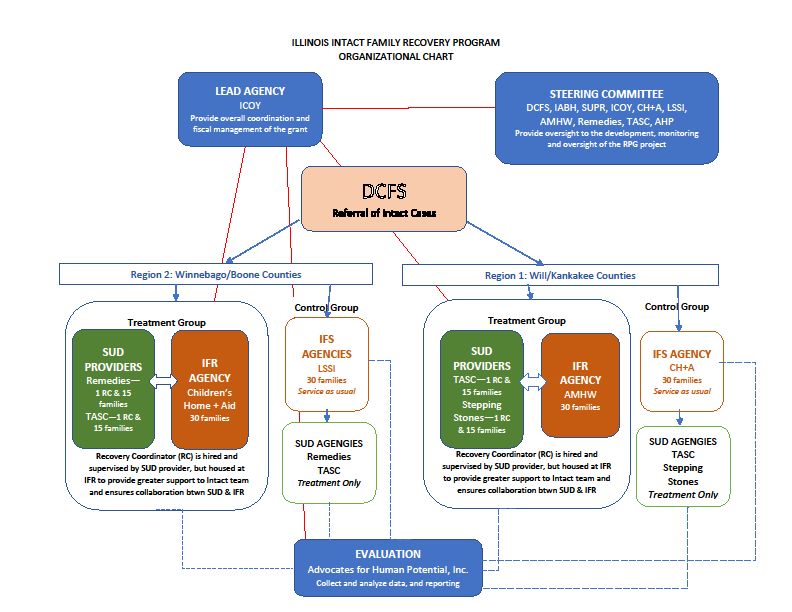
implementation.pdfIntact Family Recovery Program: Illinois Regional Partnership Grant Program
5 year project funded by the Administration for
Children & Families (ACF) under its Regional
Planning Grant (RPG) initiative
All ACF RPG projects must:
Illinois Intact Provide services that increase the well-being, permanency
Family and safety of children affected by substance use and
Recovery improve family recovery and stability
Increase system-level capacity and effectiveness
Program Evaluate project outcomes using a local evaluation and
participate in the national cross-site evaluation
Notice of RPG Funding Availability Expected
Spring 2019 Illinois RPG Program
Focused in 4 counties that include urban, rural, and suburban
communities (Boone, Kankakee, Will, and Winnebago
counties)
Illinois Intact Pairs a substance abuse disorder (SUD) treatment provider
with a child welfare provider serving intact families
Family Embeds a recovery coordinator employed by the SUD agency
Recovery into the child welfare agency
Program Child welfare agency retains legal case management
responsibility but the case is otherwise co-case managed
Recovery coordinator focuses on helping the parent to access
substance abuse treatment services and maintain recovery
Child welfare case worker focuses on other aspects of the case Illinois RPG Program
6 months planning period
4.5 years of implementation
Substantial matching requirement that grows over time
Independent Evaluation
Illinois Intact Process evaluation documents program implementation and
Family system outcomes around communication, collaboration, and
service efficacy
Recovery Outcome evaluation assesses child, parent, and family
Program outcomes
Child well-being, permanency, and safety
Parent substance use, treatment, and recovery
Family stability
Service use Random Control Trial
Testing the effectiveness of integrated child welfare and
recovery coordinator services in improving child and family
outcomes
Randomized at the agency/provider level
Illinois Intact Blind assignment by DCFS to provider agency
Family Sample: 480 substance-involved DCFS families
Recovery receiving Intact Services
240 families will receive Intact Family services plus
Program specialized substance use case management provided by a
recovery coordinator (intervention group)
240 families will receive Intact Family services only
(“treatment as usual”/comparison group)Evaluation Hypothesis – Parents
Illinois Intact Intervention group parents will show greater improvements in
recovery and family stability compared to comparison group
Family parents
Recovery Decreased substance use
Decreased mental health symptoms
Program Decreased parenting stress
Improved family relationshipsEvaluation Hypothesis -- Children
Intervention group children will show greater improvements in
Illinois Intact well-being, safety, and permanency compared to comparison
group children
Family Improved adaptive functioning and social/emotional well-
being
Recovery Decreased problem behaviors
Program Decreased trauma and mental health symptoms
Fewer substantiated maltreatment recurrences
Fewer out-of-home placementsIllinois Intact Family Recovery Program
Questions
Contact:
For More          Andrea Durbin
Information       ADurbin@ICOYouth.org
                  312-861-6600
You can also read


