Public transport - A guide for older and disabled people - VisitEngland
←
→
Page content transcription
If your browser does not render page correctly, please read the page content below
RICA C=77 M=7 Y=39 K=

                                                RICA C=41 M=0 Y=89 K=

Public transport

 A guide for older and disabled people
                                         2013
The information contained in this guide is correct at the time of
going to print (April 2013). It will be reviewed every two years.
See our website for any changes since printing.

Rica is a charity that researches and publishes independent
information on products and services for older and disabled people.

Unit G03 The Wenlock
50–52 Wharf Road
London N1 7EU
Tel: 020 7427 2460
Fax: 020 7427 2468
Textphone: 020 7427 2469
Email: mail@rica.org.uk
www.rica.org.uk
Public transport
A guide for older and disabled people
Public transport in the UK is becoming Contents
more accessible but to make your journey
go as smoothly as possible it is best to
Legal rights 4
plan and prepare. In this guide, we give
an overview of bus, coach, community Getting going 6
transport, ferry, plane, taxi, train and tram,
travel with information about access,
Journey planning 6
journey planning, concessions, assistance, Assistance 6
announcements and communication,
accessible toilets, loop systems, parking Concessions 7
and how to report back or complain. There Travel route information 7
are travel tips and advice from experienced
travellers and a list of useful contacts. Toilets 8
Layout and orientation 8
The following symbols are used in the guide:
Assistance dogs 8
Access for wheelchair and Reporting back and complaining 9
scooter users
Travel tips and advice 9
Apps on your mobile device Buses 10
to help
Community transport 13
For people who are blind or Coaches 14
partially sighted
Ferries 16
For people who are deaf or are
London 17
hard of hearing
Planes 20
For people who need simple
Taxis 23
information
Trains 25
Warning: note for your safety
and security
Trams, metros and light railways 29
Safety 30
Useful contacts 32
3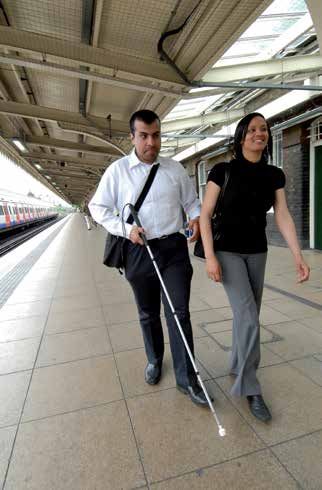
Legal rights
    Equality Act 2010                             n may refuse disabled people for valid
    The Equality Act 2010 replaced all               safety reasons
    previous equality legislation including the   n must provide free travel to an assistant
    Disability Discrimination Act 2005 (DDA)         with a disabled traveller if they need to
    and protects disabled people in all areas        be there for safety reasons
    including transport.                          n must guarantee to accommodate a
        Under the Act, transport providers            disabled traveller if notice is given and
    have the duty to provide an accessible            must make every effort to help if no
    service and make ‘reasonable                      notice is given
    adjustments’ to offer the same standard       n must provide help with moving around
    of service to disabled people as non-             the station or terminal, getting on and
    disabled people. In practice this means           off and loading and unloading luggage
    providers have to provide accessible          n must provide information in
    facilities, accessible information and            accessible formats
    simple procedures for booking assistance      n must train their staff in disability
    where required.                                   awareness and specifics like handling
                                                      equipment
    The regulations mean that transport           n must provide adequate compensation
    providers:                                        for any lost or damaged equipment
    n cannot refuse someone or charge            n must allow registered assistance
       them extra because of their disability         dogs to travel on buses and coaches.

      House of Commons Transport Select Committee

      In April 2013, the House of Commons Committee held an inquiry into access
      to transport for people with disabilities. It heard evidence from public bodies
      and voluntary organisations including those representing older and disabled
      people. A common theme from the evidence is the need for consistency and
      reliability between the different types of transport and there was concern
      over the lack of spontaneity of travel for older and disabled people.
      Some points raised:
      n For people with learning difficulties a pilot project called safe haven helped
          people who became confused get help and support at train stations.
      n For deaf or hard of hearing people or those with sight loss, information
          about changes to services was a key concern.
      n Some staff were helpful but staff attitudes vary widely.
      n In London, it seems the Paralympics improved access and attitudes.

4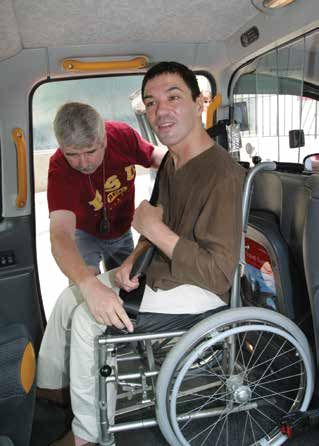
legal rights

For travel by seas and waterways:           n height of footrest above floor 150mm.
n Assistance dogs should be allowed,       The reference wheelchair is bigger than
    but with regard to national rules.      most wheelchairs to ensure that enough
n If equipment is lost or damaged, the     room is provided for most wheelchair
    operator should provide temporary       users. However, many mobility scooters
    replacement.                            and some powered wheelchairs are
n Large operators must develop             bigger than the reference wheelchair and
    and publish quality standards for       may not necessarily fit.
    assistance.
                                            Size
Transport vehicles are covered in a         If your wheelchair is no bigger than
different way. The Equality Act 2010        the reference wheelchair you should,
gave the Government powers to set           in theory, be able to use all new public
standards of accessibility for different    transport vehicles. If your wheelchair
means of transport and regulations exist    is bigger, get in touch with the relevant
for trains, buses, coaches and taxis.       transport operator. Although they are
                                            not legally obliged to take you in a larger
Travelling in your                          wheelchair, many companies will make
wheelchair                                  every effort to help.
Wheelchair accessibility regulations for
access to public transport use a specific
reference wheelchair (see below).

                                            Travelling with your
                                            mobility scooter
                                            All transport operators will accept
                                            mobility scooters that can be folded
The reference wheelchair has:               down and carried on as luggage. People
n total length of 1200mm including         who have small scooter models can ride
   extra-long footplates                    on them on some buses, some trains and
n total width of 700mm                     some trams. See the appropriate section
n sitting height (from ground to top of    for details of the size limits and various
   head) of 1350mm                          permit schemes.

                                                                                           5
Getting going
Journey Planning
Transport Direct lets you plan
journeys all over the UK using public
transport and has live transport
information but not details of access.
www.transportdirect.info
Traveline
(England, Scotland and Wales) provides
timetables for local and national journeys
on buses, coaches and trains and has
details on access.
Tel 0871 200 2233 (8am–8pm,
calls are charged at national rates)
www.traveline.org.uk
Translink (see page 34)
(Northern Ireland) has an online journey
planner for train, bus and metro services.
Tel 028 9066 6630 Assistance
(Monday– Friday 7am–8pm, Contact the relevant transport operator
Saturday & Sunday 8am –6pm) to find what help their staff can provide.
www.translink.co.uk/Journey-Planner/ You usually have to give at least 24
hours notice. It is best to phone to check
People with learning every part of your journey eg for trains
disabilities there is Passenger Assistance which is a
Mencap (see page 33) has Easy centralised planning and booking service
Read factsheets on accessible transport for (see page 25).
eg bus, train concessions and Taxicard
www.mencap.org.uk/campaigns
follow links to independent living.
In Northern Ireland, there is a guide:
Travel safe: a guide about community
safety for people with learning
disabilities. www.drdni.gov.uk and
follow the links to people with learning
disabilities.
6
getting going

Concessions                                   Toilets
Many transport operators offer                The National Key Scheme,
concessions for disabled and older people     formerly the RADAR Key Scheme,
to travel. Contact the relevant transport     provides people in the UK with access
provider. All local authorities are obliged   to over 9,000 locked accessible public
by law to offer concessionary bus travel      toilets. The scheme is operated by the
to older passenger (see page 10).             national charity, Disability Rights UK
                                              (see page 32), which sells keys for £2.25
Facilities                                    has a map of the location of the toilets.
The Equality Act 2010 mean that               There is an app for smartphone users.
transport operators have to provide               Contact your local council or local
good access, accessible toilets and well-     disability organisation who also often sell
lit, clearly signed stations with tactile     national key scheme keys.
markers, for example, at platform edges.
                                              Changing Places is a coalition of
Travel route information                      organisations including Mencap (see
Clear and audible announcements on            page 33) that campaigns for toilets to be
public transport are becoming more            provided that have extra room and more
common, including information on delays       facilities than standard accessible toilets:
or changes to travel routes. Transport
companies are obliged to communicate          England, Wales and Northern Ireland
with all passengers equally including         Tel 020 7696 6019
disabled passengers.                          Email: changingplaces@mencap.org.uk
                                              Scotland
                                              Tel 01382 385 154
                                              Email
                                              pamischangingplaces@dundee.ac.uk
                                              www.changing-places.org

  For blind or partially sighted travellers

  n RNIB React
  The RNIB React talking sign system provides audio information about your
  location. You carry a small portable device which you can use to trigger
  speaker units along your route. You can often get detailed, real-time travel
  information such as when buses are due.
  RNIB React has been installed in locations across the UK including Birmingham,
  Leeds and Belfast. To find out if it’s installed in your area, contact the RNIB
  (see page 33).

                                                                                             7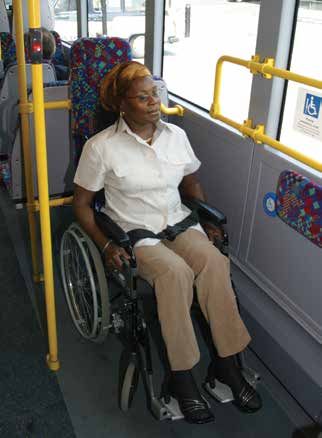
Layout and orientation
    Knowing the layout of transport
    facilities is vital for blind and partially
    sighted people. www.describe-online.com
    provides text descriptions of the layout of
    public spaces and Directory Enquiries can
    connect you to local transport operators
    and is a free service if you are registered
    blind or partially sighted. The RNIB has
    useful travel advice
    www.rnib.org.uk/livingwithsightloss/
    travel/Pages/travel.aspx and a guide called
    On the Move available in print and online.
       There are also travel sections in the
    RNIB guides Your Guide to Getting Great
    Service (what transport operators should
    provide) and Living Safely and specific
    online advice on travelling by rail, London
    Underground, bus, taxis and minicabs.
    Contact the RNIB (see page 33).
                                                  Going abroad
    Assistance dogs                               The Pet Travel Scheme lets you take
    Travelling in the UK                          your assistance dog abroad without
    Travel providers usually allow your           the need for quarantine. The dog must
    working dog to travel with you providing      be vaccinated against rabies, fitted
    that it’s registered with Assistance          with a microchip and given the right
    Dogs UK which includes Guide Dogs,            documentation. What needs doing
    Hearing Dogs for Deaf People, Dogs for        when varies depending on where
    the Disabled, Support Dogs and Canine         you’re travelling to and from. For more
    Partners for Independence.                    information, contact:
       Bus, coach and train companies carry
    registered assistance dogs. National          The Department for Environment,
    Express also carry ‘buddy dogs’, a scheme     Food and Rural Affairs (Defra)
    for children and young people from Guide      Tel 0870 241 1710
    Dogs (see page 33). Black cabs and private    Textphone 0845 300 1998
    hire vehicles must carry assistance dogs at   Email pettravel@ahvla.gsi.gov.uk
    no extra cost to the passenger under the      www.gov.uk/take-pet-abroad
    2010 Equality Act. Drivers who have a
    medical condition that means they can’t       If travelling by plane, check the airline’s
    be near dogs will have a ‘Notice of           policy on assistance dogs in advance.
    Exemption’ on their vehicle windscreen.       You’ll always need to prove that your dog

8
getting going

is registered with Assistance Dogs UK,          Travel tips and advice
and let the airline know in advance.            n Plan your trip: check websites, phone
Assistance dogs can normally travel free           your transport provider, talk to other
of charge in the passenger cabin with you,         people.
but on some airlines they have to travel        n Ask the transport operator if they
in the hold of the plane. Always carry             offer assistance or travel training.
identification for your dog, plus a safety      n Some transport companies can give
harness suitable for securing your dog             you a ‘Safe Journey’ card which is
at take-off, landing and whenever else it          a card with details of your needs
is needed.                                         written on it so you show it to the
                                                   driver or staff to privately ask for help,
Reporting back and                                 eg www.firstgroup.com/safejourney.
complaining                                     n If you’re not feeling confident, take a
It is important to complain about poor             friend or relative with you.
service so things improve.                      n Book assistance with the transport
                                                   operator in advance (most need 24
Smartphone users                                   hours notice).
Now people can complain on the                  n Plan for each step of the journey,
spot via social media eg via Facebook              think about food, drink, any
or Twitter and send a message or photo             medication needed.
to www.fixmytransport.co.uk which               n Check there will be accessible toilets
is a website where you register your               and facilities.
complaint. FixMyTransport sends your            n www.parkingforbluebadges.com
message direct to the Customer Services            has location information on parking
department of the transport operator and           spaces for blue badge holders at bus
also it will be online for others to read and      stations, ferry terminals and airports.
comment on.                                     n Make sure your mobile phone is
                                                   charged before you set out. Take
England, Scotland and Wales                        emergency contact details, phone
Always contact the local transport                 number of the transport provider and
provider first. If you’re not satisfied            other contacts.
with their response, then take the steps
recommended in the relevant sections
below.

Northern Ireland
First contact Translink (see page 34) with
complaints about their train, metro or bus
services. If you’re not satisfied with their
response, contact the Consumer Council
for Northern Ireland (see page 32).

                                                                                                9
Buses
     Legal Rights and                               Concessions
     Regulations                                    The national bus concession scheme for
     Public Service Vehicle Accessibility           disabled people is run by local councils
     Regulations 2000 (PSVAR) mean that             and operates differently in different parts
     all single-decker buses will be accessible     of the UK.
     by 2016 and all double-deckers will be            Contact your local authority in England
     accessible by 2017.                            and Wales, Transport Scotland (see page
                                                    34) in Scotland or Translink (see page 34)
     journey planning                               in Northern Ireland.
     Timetables, maps and information on
     board vary from bus to bus and area to area.   access
     Online and telephone journey planning is       Bus access has improved with most
     available from Traveline (see page 6). Bus     buses having lower steps, easy-to-grip
     companies offer journey planning and most      handholds, non-slip floors, improved
     provide information in alternative formats     lighting, easy-to-use bell pushes,
     e.g. large print timetables. If in doubt,      clear stopping signs and easy-to-read
     contact the bus operator.                      destination signs. There are priority seats
                                                    for older and disabled people. Since 2000,
     Assistance                                     all low floor buses meet the requirements
     Drivers will often help you get on or          of the PSVAR and have a designated space
     off the bus. A few bus companies have          for wheelchair users.
     helping hand schemes where volunteers
     help you on and off or even travel with        Doors and ramps
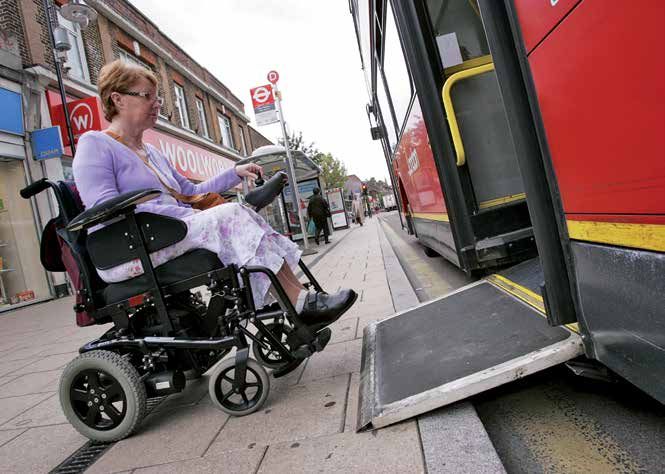
     you for the journey. Contact your local        Low-floor buses have ramps. In London,
     bus company to see if they can help.           the driver operates the powered ramps
        Some people use a bus hail card on          from the cab and wheelchair users board
     the street. It is a card with the word         through the centre door but in other
     ‘BUS’ on it available from the RNIB            parts of the country, ramps are usually
     (see page 33). If you have complex             unfolded by hand by the driver. Ramps
     needs, you can get a ‘Safe Journey’ card       slope no more than 8° when resting on
     or similar from your local authority or        the pavement. Doors are at least 800mm
     Passenger Transport Executive. There is        wide, and gangways at least 750mm wide.
     a section you can fill in which allows         Floors inside will be flat or the slope will be
     you to give details of your journey to         no more than 5° in the doorway area
     the driver.                                    and 3° elsewhere.

10
buses
Space inside wheelchair users
There is at least one space for a On most buses, the wheelchair
wheelchair or mobility scooter user or user sits facing backwards against a
parent with a buggy. The space is: padded backrest to stop tipping. You
n at least 1300mm long by 750mm don’t have to secure the chair or wear a
wide, with headroom of at least seat belt. You need to put your brakes on.
1500mm
n 1200mm long and 700mm wide for
London buses.
Often you will need to manoeuvre your
wheelchair or mobility scooter back and
forwards to get into the space. It has a
vertical pole and other grab rails that you
can use to steady yourself while travelling.
The wheelchair space may have a folding
seat for other passengers to use. The seat
will be easy to fold up.
11mobility scooter Travel route
users information
You can now travel on a small mobility Route and destination are shown on the
scooter on low-floor buses providing: front, side and back of the bus. The route
numbers are at least 200mm high and
n your local bus company is running a destinations are shown in letters at least
scooter permit scheme 125mm high in front and 70mm high on
n your scooter is a Class 2 type and the side of the bus.
meets certain size limits (1000mm There is an innovative talking sign
length; 600mm width; 1200mm system, RNIB React that gives real-time
turning radius and 300kg weight, information at some bus stops (see page
including user), and 7). The RNIB (see page 33) also has useful
n the bus company has assessed you videos on its website and a leaflet Bus
in safely using your scooter on travel explained. Guide Dogs (see page 33)
the bus. is campaigning for a change in the law to
make audio and visual information,
The national scooter permit scheme including audible announcements of the
was developed by the Confederation for current stop, next stop and final
Passenger Transport (CPT see page 32) destination, available on board bus and
and has been adopted by over 20 bus coach services across the UK.
companies. You get assessed by your
local bus company who issues you with Smartphone users
a credit card-sized permit (similar to the Some apps (applications) are
picture below) to show to the driver to available which tell you when the
confirm that you are allowed to travel on bus is coming – some use voice output.
your mobility scooter. In London there Check if they work in your area.
is a similar mobility aid recognition
scheme developed by Transport for reporting back and
London (see page 17). complaining
Rica has a list of mobility scooters If you have a complaint about any bus service
that meet the CPT criteria for bus travel or regular coach service, always first contact
and of companies operating permit the bus or coach operator that provides
schemes which you can find on our the service. Tell the company about your
website www.rica.org.uk. To apply for a complaint in as much detail as possible:
permit contact your local bus company. n the exact date and time you were
travelling
n where you were travelling to and from
and the bus or coach number
n the bus registration number, the
driver’s name or description – helpful
but not essential.
12buses
E nclose your ticket if you can and keep a
copy of the letter or email and ticket. Give Community transport
the company time to get back to you. Community transport is a local door-
Secondly, if you don’t get a reply or to-door transport service which:
you are not happy with the reply you get, n is often called ‘Dial a ride’ or
then contact the following organisations ‘Ring and ride’ service
depending on where your journey was: n can carry you in your wheelchair
or if you are unable to use public
n England: contact Bus Users UK transport
Tel 0300 111 0001 n you book in advance and is not
Email enquiries@bususers.org free but is far cheaper than taxis
n Wales: contact Bus Users UK n generally cannot be used for
Tel 029 2022 1370 journeys for which there is
Email wales@bususers.org alternative transport
www.bususers.org n cannot be used for trips you have
to do every day, such as getting
n London: contact London Travelwatch to work
(see page 19) n is usually run by your local
n Scotland: contact Transport Scotland council or transport authority.
Tel 0141 272 7100
Email To find your local community
info@transportscotland.gsi.gov.uk transport service:
www.transportscotland.gov.uk n search online www.ctonline.org.uk
n Northern Ireland: contact n check the community pages in
The Consumer Council for Northern your phone book or phone your
Ireland (see page 32) local council
Tel 0800 121 6022 n contact the Community Transport
Association UK (see page 32)
travel tips and advice
n The bus driver is often under pressure
to keep to timetable and sometimes
is unable to operate the lift, leave
the cab or intervene to force other
passengers to vacate the wheelchair
space for you.
n See travel tips and advice on page 9.
n For wheelchair or mobility scooter
users, position yourself in front of the
bus stop, so the driver has plenty of
time to see you as they approach
the stop.
13Coaches
Coach services with the docking system on the coach.
Accessible coaches are operated by several National Express has a code of practice for
companies: National Express, Oxford Tube, disabled customers to ensure a common
Megabus, Gold Line (Northern Ireland) and high standard of service and a
City Link (Scotland). telephone helpline.
National Express Disabled Persons Travel Helpline
The largest UK operator has Tel 08717 818179 (10p/minute from a
wheelchair access on all of its coaches landline or extra your mobile network
(not to the toilet). There are only a very charge, 7 days/week 8am –8pm)
small number of coach stops that are Textphone 0121 455 0086
not accessible for wheelchair users and Email DPTH@nationalexpress.com
alternative arrangements are made to www.nationalexpress.com
provide accessible coach travel. National
Express aims to list accessible stops on its Coach facilities
website by the end of 2013. On the National Express website,
there is a list of facilities at the main UK
coach stations which includes information
on accessible toilets, help points or staff
available, accessible public telephones,
induction loops for people who use hearing
aids, manual wheelchairs available,
clipboards and magnifying glasses, disabled
parking and baby changing facilities.
Megabus
n If you are able to climb the steps, the
driver will store your wheelchair or
Journey planning and booking mobility scooter in the luggage hold
Online you can find service information and and help you to your seat.
details of coach access and coach station n If you can’t climb the steps, don’t buy a
access. Wheelchair users need to phone 36 ticket in the usual way. Instead, call
hours in advance to check their wheelchair 0141 332 9841 (calls charged at
fits in the space safely and securely and that standard rate, local or international
the stops are accessible and to book any call charges may apply depending on
assistance. When you book they will ask location) at least 48 hours in advance.
for details of the make and model of your They will allocate a wheelchair
wheelchair to make sure it is compatible accessible vehicle to your trip, if possible.
14coaches
n In Scotland, only Scottish concessions
Concessionary Entitlement There is not a national concessions scheme
Cards apply. at present. Ask your coach operator if they
offer any discounts. For example, National
Oxford Tube Express offers a Senior Coachcard for
n All coaches have a wheelchair space. people who are 60 or over and a Disabled
The driver will provide assistance with Coachcard. They cost £10 and offer 1/3 off
getting in and out. You can just turn your travel throughout the year.
up and travel.
n Discounts are available for over-60s. Access
All new coaches on scheduled services
Goldline (Northern Ireland) that carry more than 22 passengers are
n No mobility scooters are allowed but now built to be wheelchair accessible. For
they will take any wheelchair. wheelchair users, coaches are different to
n Book 24 hours in advance to make buses in that:
sure you get an accessible coach.
There is one wheelchair space but if n you access via a platform lift
two people want to travel they will n the wheelchair space faces forward
normally send another coach. and has an anchoring system for the
n The driver will usually help wheelchair and a seatbelt for the
with boarding. wheelchair passenger
n Northern Ireland residents over 60 n entrances, exits and gangway floors
can use their concessionary pass to do not slope more than 5°.
get free travel. If you have a visual
impairment, a learning disability, Lightweight mobility scooters can be
or receive a mobility component of stowed in the luggage hold providing that
DLA or PIP then you are entitled to a they can be dismantled and the heaviest
Concessionary Smart Pass. part weighs less than 20kg. Mobility
scooter users cannot get on coaches on
City Link (Scotland) their scooter.
n The driver will assist passengers with
mobility difficulties. If you don’t need Travel route information
to stay in your wheelchair, they will If you need extra information, for example
help you to a seat. alerting you to which stop to get off,
n If you need to travel in your then talk to the driver who is able to give
wheelchair, call 0141 332 9841 at announcements on the journey to keep
least 48 hours in advance. If it’s you informed.
possible on your route, City Link will
provide a bus with a wheelchair lift. Reporting back and
n In Scotland, only Scottish complaining
Concessionary Entitlement See Reporting back and complaining in the
Cards apply. buses section (see page 12).
15Ferries
Legal rights and and disembarking. The port of Dover
regulations advertises a trained escort service for
The European Passenger Rights passengers with visual impairments.
Regulations 1177/2010 – sea and inland Check what is available at other ports.
waterway, implemented in December Crew will assist with getting on and
2012, concerns the rights of passengers some orientation but it is advisable to
when travelling by sea and inland travel with a companion if you need more
waterway. The European regulations help during the journey.
state that ships and ferries must carry
any disabled person that wishes to Concessions
travel on them, as long as it is safe to Disabled Motoring UK (see page 33)
do so. Assistance must be provided for offer concessions to their members with
free, including help with boarding and selected companies on specific routes.
accessible information. If your equipment Check with ferry companies if they offer
gets lost or damaged, they must discounts for blue badge holders.
compensate you and find a replacement In Scotland, visually impaired people are
at the time. These rules apply to all eligible for free bus, train and ferry travel:
services except sightseeing tours and www.transportscotland.gov.uk/public-
very short-distance ferries. transport/concessionary-travel/
visually-impaired (see page 34).
Access
Some ferries have wheelchair accessible Journey Planning
toilets and some supply wheelchairs at Journey information for UK ferries is
terminals while a few have special cabins online or phone the ferry company.
for disabled people and offer discounts.
Check access at ports online: Practical Tips
www.tourismforall.org.uk n Phone the ferry company to check
If you are driving, provide the ferry details especially if you are
company with details of your disability at travelling overnight.
the time of booking and also let them n Be aware – sea travel can be
know when you check in. distressing for some dogs.
Loading and unloading depends on
the circumstances on the day. reporting back and
Complaining
Assistance Contact the ferry company.
At the time of booking , explain your
needs and then again when you check
in. Staff will assist you when boarding
16London
London
Journey Planning
Travelling in London can seem confusing,
so start with two organisations: Transport
for London and Transport for All and also
check out the London Oyster card.
Transport for London (TfL)
is the public body responsible for transport
services in London.
Tel 0843 222 1234 for travel Information
and journey planning (24 hours, costs less
than 5p per minute from a BT landline,
charges from mobiles or other landline
providers may vary)
Textphone 020 7918 3015 for travel
information
Textphone 020 7027 8511 for Oyster
information
www.tfl.gov.uk
TfL’s online journey planner
provides access details; select
‘More options’. It is accessible for people step-free access and gaps between trains
using screen readers such as JAWS. The TfL and platforms, a toilet map, an audio
website has useful live travel updates. tube map, a map in simple language
For people with learning called Out and about in London and
difficulties or with hidden
impairments, the Travel Support
useful information online and in print.
Go to www.tfl.gov.uk and search for
Card can make it easier to get help from accessibility guides.
transport staff. The card has a blank
space inside to write down information Transport for All
about your journey and any help you is a voluntary organisation that provides
may need. Show the card to staff if you specialist advice to disabled and older
need help. people using transport in London.
Tel 020 7737 2339
London Underground Textphone 07793 879643
TfL has useful information including Email contactus@transportforall.org.uk
large print maps, maps showing www.transportforall.org.uk
17Transport for All can provide specialist advice Assistance
over the phone and they have a free booklet On London Underground, TfL staff can
called Get Moving which has details of assist you to platforms and onto trains.
travelling in London which includes access If you need someone to help you get off
information on: buses, the Underground, at the other end, staff can call ahead
Docklands Light Railway (DLR), overground to arrange this. All trains have priority
trains, London river services and taxis. seating next to the doors and voice
announcements with drivers announcing
Oyster card any disruptions. Tactile warning surfaces
is a plastic credit card-sized smartcard are installed as platforms are refurbished.
that you use instead of tickets on buses, TfL has a travel mentoring scheme which
the Underground, trams, rail, DLR and gives free advice on journey planning and
some river services. To get one, you pay it can provide a mentor to accompany you
a refundable deposit of £5 then pay to on your first few journeys:
add credit. You tap the card in and out www.tfl.gov.uk/tfl/gettingaround/
on the automatic ticket gates and the dialaride/travelassistance.asp.
system works to make sure you are not
overcharged. For visitors to London, an Concessions
Oyster card can save you time and money. For London residents – Freedom
www.oyster.tfl.gov.uk Pass and 60 plus Oyster card
You can use your Disabled Persons The Freedom Pass offers concessions in
Railcard with a pre-paid Oyster card but England for registered blind and partially
the registration process is not accessible sighted people who live in the London
for blind people: the form has to be Boroughs. It entitles the holder to 24-hour
completed at the booking office. free travel across Transport for London’s
18london
networks, except for some river boats London Buses
where travel is half price. Train travel is All London buses (except Heritage buses
free for Freedom Pass holders but not on routes 9 and 15) have ramps, are low-
all rail services in London are part of the floor and can be lowered to pavement
London Overground network and you level when the bus stops. Every bus has a
may not be able to travel before 9.30am. space for one wheelchair no bigger than
To check which services accept Freedom 700mm in width and 1200mm in length.
Passes contact TfL or Transport for All Many buses have audio announcements
(see page 17). with next stop information.
Disabled Persons Freedom Pass For mobility scooter users
If you live in London and have an eligible Contact Transport for London (see page
disability, you can apply for a Disabled 17), their website lists mobility scooters
Persons Freedom Pass. To find out more you can ride onto London buses.
contact your local council.
London taxis
For visitors to London All licensed London taxis (black cabs) now
People coming in from outside London have to be wheelchair accessible and for
can use their Freedom Pass only on buses Londoners there is the London Taxicard
not on the underground. Scheme (see page 23).
Railcards Reporting back and
Give you discounts on some off-peak complaining
London services. First contact Transport for London (TfL)
(see page 17). If still dissatisfied contact:
Access London TravelWatch
Information and signs are clear to Tel 0207 505 9000 (Monday to Friday,
help you find stops or platforms. 9.30am–5pm)
All lines except for the Metropolitan line Fax 0207 505 9003
have audible announcements. There www.londontravelwatch.org.uk
are tactile maps available at Old Street,
Westminster and Earls Court stations. Travel tips and advice
RNIB recommend a For wheelchair users:
Smartphone app, Tube Exits n The Underground map has
which tells you which carriage to board two colours for the wheelchair
in order to be nearest station exits, and symbol. One shows access to
which side the doors open on. platform only ie for carers, the other
shows access to platform and train.
Announcements and n Note personal assistants do not travel
communication free on the tube.
For Deaf and hard of hearing people, all n You can get help with manual ramps
ticket offices have induction loops. on overground & underground trains.
19Planes Journey Planning
Even when you book online and tick the
box to tell the airline about your needs,
never rely on this: always phone to check
Legal Rights and that they have all your correct details.
regulations
The European Regulation 1107/2006 Assistance
concerns the rights of ‘persons with Airports are responsible for help in the
reduced mobility’ when travelling by air. airport, airlines for help on the plane. You
The guidelines cover before and after book assistance with the airline which
booking and at the airport. Disabled passes this on to the airport. Before you
people can receive free assistance when fly, consider the assistance you need and
they fly to and from Europe including check the airline’s safety rules.
domestic flights.
Disabled people are protected from
discrimination during reservation and
boarding. Under regulations in force
since 2008, airports not airlines are
responsible for training staff in disability
awareness and providing accessible
information. Airport managing bodies
are required to organise the services
necessary to enable disabled passengers
to board, disembark and transit
between flights.
Airlines have to:
n provide certain assistance on board
the aircraft eg help only as far as the
toilet
n carry passengers’ medical equipment
and two items of mobility equipment
free of charge
n carry assistance dogs free of charge Pre Book Assistance
(on permitted routes).
Always tell your airline, travel
An airline can demand that a passenger agent or tour operator at least
travels with a companion if the 48 hours in advance if you need
passenger is not self-reliant, meaning assistance. Confirm as well when
unable to reach an exit unaided in an you check in.
emergency.
20planes
Sometimes manual wheelchair users
go to the plane before transferring into
a transit chair. Powered wheelchairs or
mobility scooters are specially packed,
so you transfer into a transit chair at the
check-in desk. The British Healthcare
Trades Association (BHTA, see page 32)
has free information Air Transport Advice:
the safe carriage of powered wheelchairs
and scooters by air. It has the weight and
dimensions of some electric mobility
equipment and how to make them safe
for air travel.
Air travel for disabled children
For blind or partially
sighted people at airports
You can ask for someone to meet
you from the point where you arrive at
the airport eg a car park or train station
and guide you through check-in, baggage
check and customs controls, someone
to tell you personally when your plane
is boarding if you are in a ‘silent airport’
and someone to help you board the
plane and stow your luggage. TravelChair aircraft seat
MERU, a charity that designs and
Access manufactures specialised equipment
Major airports are accessible but check for disabled children, has designed the
facilities at your chosen airport in TravelChair for disabled children between
advance. Disabled passengers will usually 3 –11 years old (dependent on size) for
be called for boarding first. Airlines must use in an aircraft seat. It is important to
make all reasonable efforts to arrange get an assessment. You can try out four
suitable seating for you. support seating systems in part of a real
plane fuselage in Carshalton, Surrey.
Wheelchair or mobility The TravelChair is also available for hire.
scooter users For more information about Try b4u Fly
When you book your flight, check with contact: QEF Mobility Services
the airline that they can carry your Tel 020 8770 1151
wheelchair or mobility scooter. www.tryb4ufly.org.uk
21Authority (CAA) deals with complaints:
Civil Aviation Authority Passenger Advice
and Complaints Team
Consumer advice line 020 7453 6888
(Monday to Friday: 9.00am to 2.30pm)
Fax 020 7453 6754
Email passengercomplaints@caa.co.uk
www.caa.co.uk
For complaints about flights departing
from or arriving into Northern Ireland
Travel information contact The Consumer Council of Northern
Most public address systems in Ireland (see page 32).
airports have induction loop facilities,
which amplify sound for people with a travel tips and advice
‘T’ switch on their hearing aids. n Before your flight, get a doctor’s letter
explaining your medication needs.
On the plane n Tell the airline if you will be carrying
Many airlines offer a personal syringes in any of your luggage.
safety demonstration to blind and n In Europe assistance is generally good;
partially sighted passengers on the plane. many countries have similar laws in
Sometimes safety information videos are place but some do not.
subtitled and announcements may be n Be prepared for intrusive questions,
picked up via induction loops. Cabin crew having your wheelchair damaged
can tell you about services, describe the and in the worst cases being refused
layout of your food tray, open awkward permission to fly.
packaging or help you find your way to n If you need to be carried to board the
the toilet. It’s a good idea to explain your aircraft, be prepared for some indignity
disability to cabin crew so that they can in the transfer process.
keep you fully informed. n Consider what arrangements you may
need to make if you cannot get out of
Reporting back and your seat and reach and use the toilet.
Complaining
First contact the airline or the airport. If Download Your rights to fly –what you
you are not satisfied with their response, need to know a step-by-step guide for
contact the national enforcement disabled and less mobile passengers
body of the country where the incident available from the Equality and
took place. For flights departing from Human Rights Commission,
England, Scotland and Wales and the www.equalityhumanrights.com/
assistance provided by airlines on flights advice-and-guidance/service-users-
from outside the EU to the UK with an guidance/air-travel
EU registered carrier, the Civil Aviation (Not available in print)
22taxis
Taxis
There are two kinds of taxi: Assistance
n London-style ‘black cabs’ are licensed Drivers of accessible taxis (of both
by the local authority and can be kinds) have to provide their passengers
hailed in the street or at a taxi rank with a reasonable amount of mobility
n Private hire vehicles (PHVs), often assistance. This means that if you use
called minicabs, are operated by a wheelchair, the driver must help you
companies and have to be booked in in and out of the vehicle either in the
advance. wheelchair or transferring to a seat. They
must also load the wheelchair into the
Access vehicle and offer to load and unload their
In London, all black cabs must be passengers’ luggage.
accessible as part of their ‘conditions of Drivers who are not physically able to
fitness’. They must have anchorage for a assist in this way will display an
wheelchair to be safely carried or stowed, exemption certificate. If the taxi isn’t
have grab handles in a contrasting colour accessible, the driver doesn’t have the
and have an induction loop fitted. The same requirement to help.
taxi door must be at least 750mm wide
and 1200mm high and open at least 90°. Concessions
Not all black cabs are equally accessible In London, the Taxicard scheme provides
for wheelchair users. Ramps which are subsidised transport for disabled
steep and channel ramps can be difficult. people who have difficulty using public
Outside of London, some local transport. It is run by local councils and
authorities only issue licenses to taxis that only for people living in London.
have room for wheelchair users. In many
cases, taxis in these areas will be the same London Taxicard Scheme
as in London. There are now adapted Tel 020 7934 9791
people carriers or vans and while there are Fax 020 7934 9699
no minimum standards for these, they are Email taxicard@londoncouncils.gov.uk
likely to have at least the same amount of www.taxicard.org.
room for wheelchair users as London cabs.
Some van conversions may be bigger and Some other areas have similar
can take two wheelchair users. To find out concessions in place. Contact your local
what is available in a particular area, authority to find out what applies in
contact your local taxi licensing office. your area.
23Reporting back and
complaining
Your local council will have a taxi
licensing office. Contact them if you
want to complain or give feedback.
If you can, note down the driver’s
badge number or the taxi’s license
plate number.
For complaints about London taxis,
contact:
the Public Carriage Office
Tel 0845 300 7000
Fax 020 7027 9914
www.tfl.gov.uk/pco
Travel tips and advice
n If you’re sitting in a
wheelchair, make sure you
travel in the right position,
secure the chair and wear a seatbelt; n In London, the Hailo app for
never sit sideways. smartphones lets you order
n Some drivers might drive past if black cabs and make payments
they see you in a wheelchair or with (useful if you can’t read the meter,
a guide dog (even though this is an or if handling money is difficult). You
offence) so get someone else or a can also let drivers know in advance if
friend to hail the taxi. you’re a wheelchair user.
n Booking taxis at certain times of n www.traintaxi.co.uk is a website
day may be a problem, eg. from that lets you know whether there’s
8.30–9.30am, and 3–6pm as they a taxi rank at any train station and
may be pre-booked for work or school gives the numbers of local firms with
journeys. wheelchair accessible vehicles.
n RNIB (see page 34) can n Let a licensed minicab company know
provide taxi hailing cards for that you have a visual impairment.
blind or partially sighted people Ask the driver to tell you exactly
which are cards with ‘TAXI’ printed where they’ve parked and describe
on them that you can hold up. the surroundings.
24trains
Trains
Legal Rights and Tel 0871 200 49 50 (10p/min from
regulations landline, mobile charges vary)
The Rail Vehicle Accessibility Regulations Text messaging 84950 (network rate
(RVAR) are the mandatory standards for to send, 25p for each answer)
the accessibility of rail vehicles. Currently
over 7,600 rail vehicles in service meet the Rail Travel Made Easy
standards, while older trains are improved www.rail-accessibility.co.uk
when they’re refurbished. All vehicles must is a website aimed at helping disabled
meet the standard by 2020. people access rail travel. It has
information about booking passenger
Journey Planning assistance as well as useful travel tips.
National Rail
For details of train timetables, phone Try a Train Day
National Rail Enquiries: Some train operators run Try a Train days,
where you can try out a train journey with
Tel 08457 48 49 50 (open 24 hours) a staff member and familiarise yourself
Textphone 0845 60 50 600 with the stations, trains and facilities.
www.nationalrail.co.uk Contact your local train operator or
National Rail Enquiries (see above).
The National Rail website has information
about stations: a map and photos and RNIB recommend UK
summaries of parking, staff hours Train Times app
and accessibility.
www.nationalrail.co.uk/stations_ Assistance
destinations You can book free travel Passenger
Assistance through National Rail
There is also live travel information using Enquiries (see above) or through your
two services to help you keep track of train operating company, or in person at
your train: your local station or online at
www.disabledpersons-railcard.co.uk.
Alert Me will send text messages Once you’ve booked Passenger
or emails when your train is delayed. Assistance, it’s treated like a reservation.
Sign up at the national rail website. You and staff at the relevant stations
each get an email record of what
TrainTracker is an automated phone assistance you’ve booked and when.
service that gives audio arrival and Train companies ask for at least 24
departure times. It’s as up-to-date as hours notice so that arrangements can
the boards in the station. be made.
25Staff can meet blind and partially access
sighted travellers and offer Access at most large stations has been
guidance around the station. Staff are not improved; usually there are ramps, low-
allowed to lift you or help with personal counter windows and induction loops for
assistance. people using hearing aids. Handrails have
been fitted on walkways and tactile strips
Concessions installed on platform edges. Blue badge
Having a railcard will get you a third off parking is often available.
most journeys. You may be eligible for
a Disabled Persons Railcard or a Senior Boarding
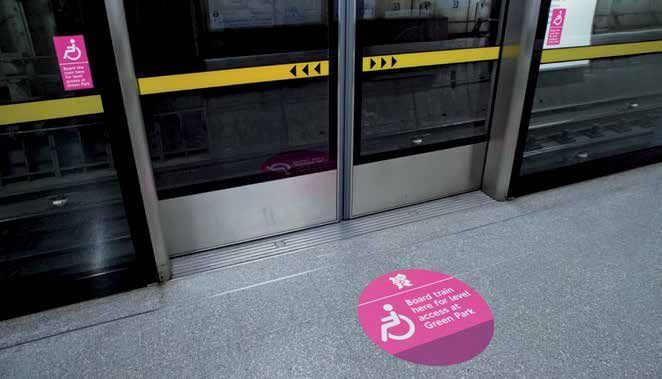
Persons Railcard. 16 –25 and Family Some trains and trams have doors level
& Friends railcards are also available. with the platform. If not, trains will use
Railcards are valid in Great Britain only. ramps or other boarding devices. Most
In Northern Ireland, Translink operate are portable and fitted by station staff –
their own concession scheme for book assistance in advance (see above)
travellers (see page 34). to make sure someone does this. The
maximum combined weight of you and
Disabled Persons Railcard your wheelchair or mobility scooter
This also gives a discount to any adult must be under the stated safe load of
companion. It costs £20 for a one-year the ramp (normally 230 –300kg).
railcard and £54 for a three-year railcard. Doors which are large
You can download large print leaflets and enough for wheelchair
application forms from their website, or users are marked with a
contact them for Braille or audio versions. wheelchair symbol:
Tel 0845 605 0525 Work is being done to provide better
Textphone 0845 601 0132 ramped access to platforms and more
www.disabledpersons-railcard.co.uk automatic doors and portable ramps.
Senior Persons Railcard Inside the train
This is available to anyone over 60. It RVAR-compliant trains are designed to be
costs £28 for one year and £65 for three accessible to the ‘reference wheelchair’
years. Buy online or at a station and for (see page 5). There are usually at least
more information: two wheelchair spaces on every train with
Tel 08448 714036 multiple carriages. Longer trains have
www.senior-railcard.co.uk more: trains with 12 or more carriages
must have at least 4 spaces. The space is
not shared with buggies and pushchairs,
TIP but see below for details on
Some train operating companies mobility scooters.
may offer their own concession The passage from the door to the
scheme eg for wheelchair users. wheelchair space will usually be at least
850mm wide, and the wheelchair area
26trains
will be at least 1300mm long by 750mm
wide with a backrest to park against.
Other features include:
n automatic, light-touch internal doors
n handrails in contrasting colours
n accessible toilets near
wheelchair space
n a way to attract attention in
an emergency
n service in your seat if you can’t
access the buffet.
Pre-RVAR train Travelling on your
Not all trains meet the standards mobility scooter
described above. Many now have wide Some train companies allow you to
exterior doors and automatic interior travel on your mobility scooter if it meets
doors. Some have accessible toilets but certain criteria. The size of allowable
others do not. Space may be tight. Check mobility scooters varies between
details of individual services with the operators, normally because of different
train operating company. carriage designs, but it must be able to fit
in the wheelchair space.
Substitute transport If you want to use your mobility
Any replacement transport will be scooter on trains then:
accessible unless it has to be provided at
short notice. If so, the train company will n Contact the train company concerned
provide an accessible taxi to take you to for details of their policy. If you’re
your destination at no extra cost to you. changing trains, check for each part of
the journey.
Mobility scooter users n Consider the scooter’s weight and
Train operators are not required to carry climbing capability because of the
mobility scooters but most of them will. ramps.
n You’ll also need to manoeuvre your
Folded-up mobility scooters scooter within the carriage and
All train companies apart from Island position it in the wheelchair space.
Line will let you carry a folded-up scooter
onto the train as luggage. Some train Mobility scooter permits
companies say their staff will help you Some companies run permit schemes
carry the scooter on board, but others for scooters. When you apply, you’ll be
can’t guarantee this assistance. Check in asked for details about the size and other
advance and think about what you’ll be features of your scooter so that the train
able to manage. company can check it’s suitable. They
27might also ask for a copy of the owner’s travel route information
manual as proof and photos of you or the Trains show their destination on the
scooter. Once you’ve got a permit, you outside and inside of the carriages, and
can show it to staff as proof. If you get a each station is announced. Staff can
new scooter you’ll need a new permit. provide information about accessible
connecting services.
Which scooter on which trains?
We publish details of mobility scooters reporting back and
and their dimensions on our website: complaining
www.rica.org.uk. In England, Wales and Scotland contact
National Rail has details of train Passenger Focus (see page 33).
operators’ policies on mobility scooters
(see page 25). For Northern Ireland contact Translink
(see page 34) or the Consumer Council
Who gets priority for the for Northern Ireland (see page 32)
wheelchair space?
Most train companies don’t travel tips and advice
distinguish between wheelchairs and n Always book assistance at least 24
mobility scooters when a booking is hours in advance.
made, although some give priority to n Contact the train company to find out
wheelchair users. what arrangements there are if you
need assistance after 5–6pm.
n Check whether the lifts are working if
you’re returning late.
n Book at least 24 hours before you
travel: someone has to set out a ramp
for you get on the train plus you need
to reserve the wheelchair space; like
booking a seat.
n In case of problems, take the National
Rail Enquiries contact details with
you especially the phone number. The
phone line is open 24 hours a day and
will have a record of your passenger
assistance booking.
Tel 08457 48 49 50
Textphone 0845 60 50 600
www.nationalrail.co.uk
28trams
Trams, metros, light railways
Legal rights and n London DLR
regulations n Manchester Metrolink
Light railways and trams come under the n Midland Metro
Rail Vehicle Accessibility (Non Interoperable n Nottingham Express Transport
Rail System) Regulations 2010 (RVAR n Sheffield Super Tram
2010). This sets the standards for access for n Tyne and Wear Metro
wheelchair users, the size and location of
handrails, handholds and control devices Access for
as well as providing passenger information wheelchair users
systems and other equipment. All services have wheelchair accessible
platforms and importantly level access
Journey planning between the platform and carriage, so you
Contact the individual operators for don’t need ramps.
service information. All have online and
telephone service information, including Access for mobility
details of fares, access and any scooter users
assistance offered. You can now also travel on your scooter on
the majority of tram and light rail services
Concessions if your scooter is a Class 2 type and meets
Concessionary and discounted fares certain size criteria (length 1000mm;
are available for older and disabled width 600mm; turning radius 1200mm ;
passengers on all services. Contact weight 300kg including user). On some
your operator or local authority for services you need to apply for a permit and
details. Disabled Persons Railcards and be assessed to ensure you can manoeuvre
Older Persons Railcards can be used on safely. For further information, including
the London Underground, Docklands a list of which scooters fit these criteria,
Light Railway (DLR) and contact your service operator or look at
Merseyrail Underground. our website: www.rica.org.uk.
Access Travel route information
The vast majority of light railway and Audible and visual announcements are
tram services are modern, newly developed available on all trams, metros and light
services and have high levels of access. rail providing information about final
destination and next stop.
Tram services are:
n Birmingham Midland Metro Reporting back and
n Blackpool Trams complaining
n Croydon Tramlink Contact the operator.
29Safety for wheelchair users
Safety in buses, coaches Maintenance
and trains A transport operator can refuse to carry
n An upright pad or partition is fixed at you if they think your wheelchair may be a
one end of the wheelchair area. Place safety risk to other passengers. So before
the back of your wheelchair against it. you travel, it’s a good idea to make sure that:
n The backrest of your wheelchair
should be in the upright position so n tyres are at the right pressure
that it fits securely against this pad n the back of the chair is not loaded with
or partition. bags which could cause it to tip
n Put on your brakes once in the n batteries are secure
travelling position. n kerb climbers are adjusted so that they
n Turn off the power when in place. do not catch on ramps.
n Take care on the ramp when it’s wet
or icy. Stability on ramps
n Never travel facing sideways. Most wheelchair users have few problems
n Powered wheelchairs or mobility negotiating slopes. But wheelchairs
scooters must have sealed or can tip on slopes that are too steep.
gel-type batteries. The Medicines and Healthcare products
Regulatory Agency (MHRA) have a report,
DB2004(02) Guidance on the Stability of
Wheelchairs www.mhra.gov.uk.
Although most tips are backwards, it is
possible to tip forwards or sideways. Things
that can affect stability include:
n the shape and size of cushions and seats
n your weight and shape, the way you sit,
and the movements you make
n attachments such as trays and leg-
rests, shopping and other things
you carry
n sudden changes of speed or direction
when the wheelchair is near its
tipping point
n steep ramps, particularly when going
down and in wet or icy conditions
n surface features such as thresholds,
gaps, ledges and other obstructions.
30safety
To minimize risk, know the limits of
your wheelchair and how to control it
safely. If in doubt, check manufacturer’s
instructions. Be aware of how stable you
are on different ramps and slopes. Check
if anything has changed before travelling
which may affect your stability eg if your
wheelchair has a new accessory added to
it. Know your weight in your wheelchair
and check it is within the safe working
load for ramps or lifting equipment.
Things you can do:
n Do not carry things on the front, rear
or side of the wheelchair.
n Adjust the wheelchair for optimum
stability. On some wheelchairs,
the castors or rear wheels can be
moved. However, some people n Only go straight up/down the slope.
adjust their wheelchairs to get better Do not attempt to cross the line of
manoeuverability at the expense of the slope.
stability. If you are in doubt about this
compromise, consult your wheelchair Many wheelchair users are familiar
service, a manufacturer or a enough with their chair to know how
mobility centre. stable it is. If in any doubt, and if you
n Fit an anti-tipping device. have a NHS wheelchair, your local
n Be careful how you sit in situations wheelchair service should be able to
where there might be a danger of assess your stability. If you bought your
tipping. Avoid moving or stretching in chair privately, ask the manufacturer if
ways that might increase the risk. they can make this assessment.
n If you make involuntary movements, If you travel with an assistant or you
attachments like posture support, get help when getting into public
calf straps or heel loops may help. If transport always make sure that they
needed, get advice. know what to do and how to do it safely
n Make sure electronic controls and are strong enough to help. Your
including accelerator and brakes are assistant should never attempt to lift you
set to minimise risk. and your wheelchair.
31You can also read


