Reconfiguration-Assisted Charging in Large-Scale Lithium-ion Battery Systems
←
→
Page content transcription
If your browser does not render page correctly, please read the page content below
Reconfiguration-Assisted Charging
                      in Large-Scale Lithium-ion Battery Systems

            Liang He1 , Linghe Kong1 , Siyu Lin1 , Shaodong Ying1 , Yu Gu1 , Tian He2 , Cong Liu3
                        1
                          Singapore University of Technology and Design, Singapore
                              2
                                University of Minnesota, Minneapolis, MN, USA
                                3
                                  University of Texas at Dallas, Dallas, TX, USA

ABSTRACT                                                                             tric vehicles [19, 22, 23, 25, 40], residential power backup
Large-scale Lithium-ion batteries are widely adopted                                 systems [3], airplane electrical systems [1, 5], etc. While
in many systems such as electric vehicles and energy                                 such large-scale systems are able to provide powerful
backup in power grids. Due to factors such as manu-                                  energy supply, it also introduces new challenges, among
facturing difference and heterogeneous discharging con-                              which, the cell unbalance issue in the system is one of
ditions, cells in the battery system may have differ-                                the most critical problems [28, 31, 32].
ent statuses such as diverse voltage levels. This cell                                  Ideally, cells in a battery system are desired to have
diversity is commonly known as the cell unbalance is-                                similar capacity and characteristics [21]. However, due
sue, which becomes more critical as the system scale in-                             to various reasons such as manufacturing difference, cell
creases. The cell unbalance issue not only significantly                             aging, operational conditions, and chemical property
degrades the system performance in many aspects, but                                 variations, the cells’ characteristics demonstrate signif-
may also cause system safety issues such as the burning                              icant dynamics during the operating cycles over an ex-
of battery cells and thus increase system vulnerability.                             tended time [34]. The cell unbalance issue becomes
In this paper, based on the advancement in reconfig-                                 even more severe for large-scale battery systems, be-
urable battery systems, we demonstrate how to utilize                                cause many such systems can simultaneously support
system reconfiguration flexibility for achieving an effi-                            multiple loads with different energy requirements [24].
cient charging process for the battery system. With the                              This implies that cells in the system may have very dif-
proposed reconfiguration-assisted charging, the cells in                             ferent discharge profiles.
the system are categorized according to their voltages,                                 In battery systems with unbalanced cells, to avoid the
and the charging process is evolutionarily carried out                               cell overheating and the thermal runaway issue, the sys-
in a category-by-category manner. For the charging of                                tem operation is fundamentally limited by the weakest
cells in a given category, a graph-based algorithm is pre-                           cell [21, 33]. This is especially critical in a serial config-
sented to obtain the desired system configuration. We                                uration of cells which is only as strong as the weakest
extensively evaluate the reconfiguration-assisted charg-                             link. As a result, the imbalance among a set series con-
ing through small-scale implementation and large-scale                               nected cells, which is commonly (but not only) reflected
trace-driven simulations. The results demonstrate that                               by the difference among their voltages, prevents them to
our proposed techniques can achieve a 25% increase on                                supply their capacities fully or being charged fully, and
average on charged capacities of individual cells while                              consequently degrades the cell operation time, state of
yielding a dramatically reduced variance.                                            health, life cycles [7, 36]. The cell unbalance issue may
                                                                                     even cause severe system safety issues such as the burn-
1.     INTRODUCTION                                                                  ing of battery cells [5].
  Large-scale battery systems consisting of hundreds or                                 Exploring the system reconfiguration flexibility is a
thousands of battery cells are widely adopted in elec-                               new dimension to improve the battery system perfor-
                                                                                     mance [11, 28], in which the system can adaptively ad-
                                                                                     just the cells configuration (e.g., connected in series, in
                                                                                     parallel, or in a hybrid manner) based on the real-time
Permission to make digital or hard copies of all or part of this work for
personal or classroom use is granted without fee provided that copies are            system conditions such as cell voltages [37], cell tem-
not made or distributed for profit or commercial advantage and that copies           perature [31], and load requirements [28]. Many ex-
bear this notice and the full citation on the first page. To copy otherwise, to      isting investigations focus on the discharging scenario
republish, to post on servers or to redistribute to lists, requires prior specific
permission and/or a fee.                                                             of the battery system with the objective of maximizing
ICCPS’14, April 14–17, 2014, Berlin, Germany. Copyright 2013 ACM                     the system energy utilization efficiency [24, 32]. Com-
978-1-4503-1996-6/13/04. . . $15.00.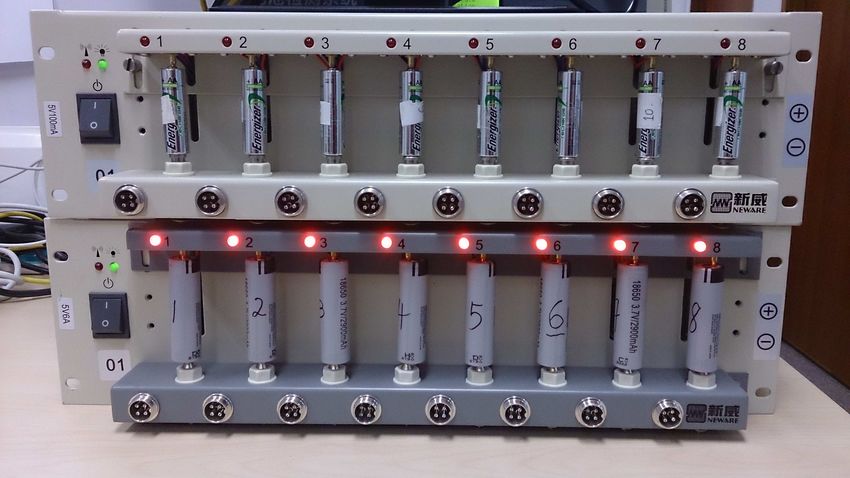
Typical charge characteristics
plementary to these existing works, in this paper we                                5.0
                                                                                             CHARGE CONDITION:
explore how the reconfiguration flexibility can assist the                          4.5
                                                                                             CVCC 4.2V Max.0.3It (825mA), 50mA cut-off at 25deg.C                   3000

charging scenario of the widely utilized Lithium-ion bat-                                                                                                           2500
                                                                                    4.0

                                                                                                                                                                           CAPACITY[mAh]
tery systems. Different from the system discharging sce-                                                 VOLTAGE

                                                                                                                                                                           CURRENT [mA]
                                                                      VOLTAGE [V]
                                                                                                                                                                    2000

nario where the discharging current of individual cells                             3.5
                                                                                                                                   CAPACITY                         1500

is desired to be small due to the rate-capacity effect of                           3.0
                                                                                                                                                                    1000
battery cells [29], the desired current when charging bat-                                                                                            CURRENT
                                                                                    2.5                                                                             500
tery cells is determined by the cell’s voltage level [21].
Furthermore, with a fixed charging voltage as in many                               2.0
                                                                                       0.0       0.5       1.0      1.5      2.0      2.5       3.0   3.5   4.0
                                                                                                                                                                    0
                                                                                                                                                                  4.5

off-the-shelf battery chargers [8], the cell voltage also di-                                                                TIME [hour]

rectly affects the actual charging current, as we will see
                                                                Figure 1: The desired charging process for the
in Section 3.
                                                                Panasonic NCR18650 Lithium-ion battery [11].
   Our basic idea in the design of the reconfiguration-
assisted charging is the following: by adjusting the sys-         The paper is organized as follows. The preliminar-
tem configuration, we can control the charging currents         ies is presented in Section 2. The basic principle of
for individual cells in the system to match them with           our design is introduced in in Section 3. The proposed
the desired current levels, so that the cells in the sys-       reconfiguration-assisted charging process is presented in
tem can be efficiently charged to their maximal capacity.       Section 4 and Section 5. Our experiment and simulation
Our main contributions in this work include:                    are presented in Section 6 and Section 7, respectively.
                                                                Section 8 reviews the literature, and Section 9 concludes
   • To the best of our knowledge, our work is the first
                                                                the paper.
     attempt to explore the system reconfiguration flex-
     ibility to achieve the optimal charging process in
                                                                2. PRELIMINARIES
     large-scale battery systems.
   • Observing the facts that cells with different volt-        2.1 Problem Statement
     ages may desire different charging currents and               The cell unbalance issue makes the efficient charging
     that only cells with similar voltages should be con-       of the large-scale battery systems challenging. This is
     nected in series, we propose a novel cell catego-          due to the facts that the charging of series connected
     rization method based on their individual voltages         cells has to be terminated when any of the cells reaches
     and the system hardware constraints, with which            its voltage upper boundary [31] and cells with differ-
     the cells with similar voltages (and thus desiring         ent voltage levels may desire different charging cur-
     similar charging currents) are organized into the          rents [21]. As an example, the desired charging pro-
     same category. Then the system charging is evo-            cess of the Panasonic NCR18650 Lithium-ion battery
     lutionarily carried out in a category-by-category          cell [10] is shown in Fig. 1. We can see that during the
     manner.                                                    early phase of the charging process, the cell is desired
   • For the charging of cells in a given category, we          to be charged with a relatively large constant current
     transform the problem of identifying the optimal           (e.g., about 0.825 A). This is referred to as the Constant
     system configuration for the charging process to a         Current Charging (CC-Chg) phase. Then when the cell
     path selection problem in the abstracted cell graph.       voltage reaches a certain level (e.g., about 4.19 volt),
     We prove the problem is NP-hard, and propose an            the charging process is changed to a Constant Volt-
     algorithm to obtain the near-optimal system con-           age Charging (CV-Chg) phase, during which the cell is
     figuration. Moreover, to facilitate our control over       charged with a constant voltage and the charging cur-
     the charging currents of cells at finer granularity, a     rent decreases to a small value (e.g., about 50 mA) till
     set of adjustable resistor arrays is introduced into       the cell is fully charged (e.g., the cell voltage reaches
     the design while the additional energy loss on them        about 4.20 volts). Note although the specific current
     is minimized.                                              and voltage voltages (e.g., 0.825 A and 4.19 V) are only
                                                                for the NCR18650 Lithium-ion battery cells, the CC-
   • We evaluate the proposed reconfiguration-assisted          Chg and CV-Chg phases are shared by all Lithium-ion
     charging process through both small-scale experi-          batteries. The detailed explanation on the charging pro-
     ments and large-scale trace-driven simulations. The        cess of Lithium-ion cells can be found in [21].
     results show the reconfiguration-assisted charging            This voltage-dependent charging currents indicate
     process can improve the average charged capacities         that with the cell unbalance issue, individual cells in the
     of individual cells by about 25% and dramatically          system may require different charging currents. How-
     reduce their variance among cells.                         ever, most off-the-shelf multi-cell chargers treat the cells
identically, e.g., the LP2952-based 3-cell charger from terminals can be directed connected to any cells through
Texas Instruments always charges the cells with the the backbone buses [33]. In the following, we assume
same current [8]. Clearly, this homogeneous charging this full connectivity of the charging terminals.
current causes deviation between the actual charging To facilitate the charging current control at finer gran-
currents and the desired charging currents for individ- ularity, we introduce a set of adjustable resistor arrays
ual cells. (with unit resistor r0 ) into the system, as shown in
A charging current different from the desired level sig- Fig. 4. The relays equipped on the resistors allow us to
nificantly degrades the charging process [29]. When the control the number of resistors included in the charging
charging current is too large, not all the provided energy process and thus control the charging current. Clearly,
can be effectively accepted by the cell, and thus reduces an additional questions with regard to these resistor ar-
the energy efficiency of the charging process. Further- rays is how much energy will be lost on them and how
more, an over-large charging current also easily leads to to minimize it, which we will elaborate in Section 5.
the cell overheating and thus the thermal runaway is-
sue [21]. The thermal runaway issue is especially critical
Charger
for Lithium-ion battery cells because of their high en-
ergy density, which have caused serious accidents, e.g.,
the Boeing 787 Dreamliner battery incidents [5]. On
the other hand, a too small charging current unneces-
sarily prolongs the charging time [39], increases the cell
internal resistance [35], and even prevents the cell from
being charged [7].
Battery Pack
In this paper, we tackle the efficient charging of large-
scale Lithium-ion battery systems by exploring the sys-
tem reconfiguration flexibility. With the offered recon- Figure 2: Overview of the system model.
figuration flexibility, we can organize the cells with sim-
ilar voltages together, and then charge them with their
desired charging current. However, as the configuration
flexibility offered by the system is normally constrained,
we need to identify the optimal system configuration to
achieve a high charging performance, and adaptively ad-
just it according to the real-time cell voltages.
2.2 System Model
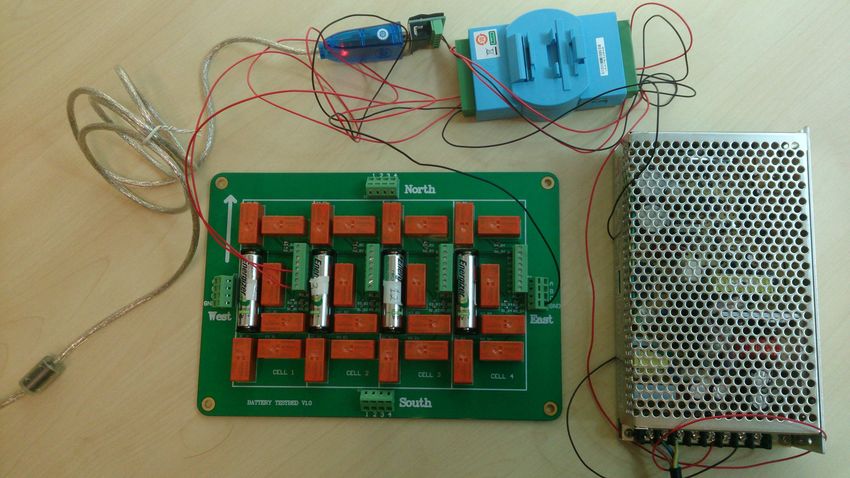
The system model overview for the reconfiguration- Figure 3: Our 4-cell reconfigurable testbed.
assisted charging process is presented in Fig. 2, in which
the charger imposes a constant DC charging voltage
V to the N -cell reconfigurable battery pack1 , and the
r0 r0 r0
cell voltages can be monitored by the voltage sensors
=
equipped on them. Note that many research efforts
conceptual implementation
have been devoted to achieve high system reconfigura-
tion flexibility with low system complexity [13,26] (e.g.,
Figure 3 shows our implementation of a 4-cell recon- Figure 4: Design of the resistor arrays.
figurable testbed based on the circuit design proposed
in [31]), and our aim in this work is to demonstrate how
this offered reconfiguration flexibility can be utilized to 2.3 Graph Representation
improve the system charging process. As proposed in our previous work [24], the cells in the
The system determines its optimal configuration to system can be represented by a weighted directed graph
accept the charging voltage (and power) to achieve the G = {V, E, W}, where 1) each vertex in V represents
optimal charging processes for individual cells. Note a cell in the system, and thus |V| = N ; 2) E reflects
that for many existing battery systems, the charging how these cells can be connected to each other and thus
captures the system configuration flexibility: an edge
1
Here we assume the charger power is high enough for the vi → vj ∈ E if and only if the current can flow from vi
charging process under consideration. This is feasible in
practice because the capable charger is always selected ac- to vj without passing any other cells; 3) the weight set
cording to the corresponding battery system. W on the vertices captures the cell voltages.+ − 0.1
Resistance (ohm)
V Cell-1
I 0.08
Cell-2
0.06
+
+
+
< v1 , r 1 > < v2 , r 2 > 0.04
R < vn , r n >
0.02
3.3 3.5 3.7 3.9 4.1
Voltage (volt)
Figure 5: Charging cells connected in series.
Figure 6: Resistance of NCR18650 cell.
This graph representation facilitates our design by
bridging the gap between the desired system configu-
From Eq. (1), we can see that the charging current of
ration for the charging process and the advancements
these series connected cells can be controlled by jointly
in graph theory, as will be seen in Section 5. Before de-
considering
scribe our design on the reconfiguration-assisted charg-
ing process in detail, in the next section, we first inves- • how many (and which) cells should be Pnadopted
tigate how to control the charging current of individ- to
Pn compose the string (i.e., controlling 1 vi and
ual cells by adjusting the system configuration and the 1 ri ),
amount of adopted resistors.
• the amount of additional resistance connected
along the string (i.e., controlling R).
3. DESIGN PRINCIPLE
Motivated by these observations, we first identify the
For a set of cells connected in series (i.e., a cell
optimal system configuration for the charging process
string), the voltage they provide is the sum of their in-
(i.e., identifying how the cell strings should be formed),
dividual voltages and each cell has the same discharg-
and then involve a proper amount of resistors to achieve
ing/charging current [4]. This simple fact motivates us
the optimal charging process based on the system con-
the design principle of the proposed charging algorithm.
figuration.
Let us consider the example shown in Fig. 5. If certain
The proposed reconfiguration-assisted charging algo-
subset of n cells in the system are connected in series
rithm consists of two steps. We first categorize the cells
along with a resistor R, then with a charging voltage V ,
according to their voltage levels, and then with the as-
the charging current for these cells can be calculated as
Pn sistance of system reconfiguration, the charging process
V − vi is carried out in a category-by-category manner. In the
I = Pn 1 , (1)
1 ri + R next two sections, we introduce the two steps in detail
respectively.
where is the voltage
Pn and internal resistance of
the ith cell, and (V − 1 vi ) is the effective charging 4. VOLTAGE-BASED CLASSIFICATION
voltage imposedP on the cell string. Clearly, the condi-
tion that V > n As mentioned in Section 3, the cells involved in the
1 vi must be satisfied to charge the
cells. same string have the same charging current, and thus
For many types of battery cells, their internal resis- it is intuitive to compose a cell string only with cells of
tances increase as the cells are being discharged [29,39]. similar voltages (and thus desire similar charging cur-
For the charging process, this indicates a smaller ri as rents). This also agrees with the fact that connecting
vi increases. However, for Lithium-ion battery cells cells with quite different voltages in series is not desired
widely adopted in large battery systems such as elec- in battery systems, which makes the cell unbalance is-
tric vehicles and airplanes [1,30], the internal resistance sue even more critical [4, 12]. In the first step of our
is relatively stable during the charging/discharging pro- design, we categorize the cells with similar voltages into
cess [7]. Fig. 6 shows our measurement results on the the same category, based on which the charging process
internal resistance of a Panasonic NCR18650 Lithium- is performed afterwards.
ion battery cell during the charging process. We can see 4.1 Basic Classification Idea
that the resistance is stable (about 0.06 ohm) through-
out the charging process. As a result, we simplify the We discretize the range of cell voltages into a set
presentation by assuming a stable cell internal resistance of voltage intervals and categorize cells accordingly.
(denoted as r) during the charging process in the rest of Specifically, the range of all possible cell voltages is di-
the paper. However, this simplification is not required in vided into M intervals
our design, as the real-time cell resistance can be easily
measured (as shown in Fig. 6) and adopted in Eq. (1). {[vc0 , vc1 ), [vc1 , vc2 ), · · · , [vcM−1 , vcM ]},where vc0 = vcutoff (i.e., the voltage defines the empty feasible for the charging process if this string can be
state of the cell) and vcM = vfull (i.e., the fully charged charged with a voltage V . From Eq. (1), we know
cell voltage). For example, for most Lithium-ion bat-
tery cells, vcutoff ≈ 3.20 volt and vfull ≈ 4.20 volt. Then V − x · v̂
xmax = arg max{ ˆ
= I} (4)
a total number of M cell categories are formed accord- x x · r + y · r0
ing to these voltage intervals. Denote the voltages of
s.t. ˆ > 0,
{r, r0 , v̂, V, I}
individual cells as {v1 , v2 , · · · , vN }, then cell i is classi-
+
fied into the jth category if and only if vi ∈ [vcj−1 , vcj ). {x, y} ∈ Z .
For the ease of description, we refer the interval (cate-
From Eq. (3) and (4), we can see that by adjusting
gory) with voltages [vcj−1 , vcj ) as the jth voltage interval
the additionally included resistors, the smallest voltage
(category).
increase that a system can differentiate from v̂ is
After this classification, cells in the same category
have similar voltage levels and desire similar charging
currents. We use the mean of the voltages of these cells r0 · Iˆ
v̂ ′ = v̂ + . (5)
to approximate the voltages of cells in the jth category, xmax
denoted as v̂cj , and use the corresponding desired charg- As a result, starting from the cutoff voltage vc0 =
ing current at v̂cj as their desired charging current. vcutoff , we iteratively discretize the voltage intervals dur-
Clearly, with the proposed approximation, the more ing the CC-Chg phase according to Eq. (5), and achieves
voltage intervals we discretize, the higher the accuracy the highest accuracy the adopted hardware can provide.
in achieving the desired charging current. However, due
to the constraints of hardware components such as the Example.
unit resistor r0 and the voltage sensor on each cell, an Let us consider the charging chart of the NCR18650
excessively high discretization degree may not be nec- battery shown in Fig. 1 as an example, where
essary. Next we explain how to discretize the voltage vcutoff ≈ 3.30 volt and the maximal voltage
range with given hardware constraints for the CC-Chg vcc−max ≈ 4.19 volt for the CC-Chg phase. When a
and CV-Chg phases, respectively. unit resistor of 1 ohm is adopted, the battery voltage
during the CC-Chg phase is divided into 8 intervals
4.2 Discretization during CC-Chg Phase
(i.e., [3.300, 3.414), [3.414, 3.517), [3.517, 3.620),
The unit resistor r0 determines the minimum volt- [3.620, 3.723), [3.723, 3.841), [3.841, 3.959),
age changes we can differentiate by adjusting the addi- [3.959, 4.077), [4.077, 4.190)), and thus 8 corre-
tionally included resistors. To show this clearly, let us sponding cell categories are formed. The number
consider an x-cell string with cell voltage v̂. We will of voltage intervals (and thus the cell categories) is
calculate the smallest v̂ ′ (v̂ ′ > v̂) that the system can reduced to 4 when the unit resistance increases to
accurately differentiate from v̂ with a given r0 . From 2 ohm (i.e., [3.30, 3.517), [3.517, 3.723), [3.723, 3.959),
Eq. (1), we know [3.959, 4.190)).
ˆ
V −x·r·I−y·r ˆ
0 ·I
4.3 Discretization during CV-Chg Phase
v̂ =
x Different from the CC-Chg phase where the cell volt-
, (2)
ˆ ′ ·r0 ·Iˆ
V −x·r·I−y
′
v̂ = age increases relatively fast, during the CV-Chg phase,
x
the increase of the cell voltage is slow. For example,
where Iˆ is the desired charging current, which is con- for the NCR18950 battery cell shown in Fig. 1, the CV-
stant during the CC-Chg phase, and y and y ′ are the Chg phase starts when the cell voltage reaches about
numbers of unit resistors involved in the cell string when 4.19 volt, and the entire charging process terminates
the cell voltages are v̂ and v̂ ′ , respectively. Since v̂ ′ > v̂, when the cell voltage reaches about 4.20 volt, indicat-
it is clear that y ′ < y. From Eq. (2), we can see that ing a total voltage increase of only 0.01 volt during the
CV-Chg phase lasting about 1 hour. On the other hand,
the desired charging current decreases dramatically dur-
(y − y ′ ) · r0 · Iˆ
v̂ ′ − v̂ = . (3) ing this phase, indicating that a relatively large number
x of voltage intervals are needed to achieve a good match-
Because y, y ′ , and x can only take positive integer ing with the desired currents. Therefore, we discretize
values (i.e., y, y ′ , x ∈ Z + ), the minimal voltage increase the voltage intervals during the CV-Chg phase based
is achieved when 1) y − y ′ = 1, and 2) x reaches the on the highest measurement accuracy of the adopted
maximal number of cells that can be connected in series voltage sensor, e.g., 0.002 volt in our testbed shown in
in a feasible cell string. We refer a cell string to be Fig. 3.5. CHARGING FOR EACH CATEGORY • each vertex in the graph is involved in one and
After the cell categorization, the reconfiguration- only one path, indicating the paths are disjoint
assisted charging process is evolutionarily carried out in and cover the vertex set Vj (and thus it is pos-
a category-by-category manner with the ascending order sible to achieve the desired charging current for all
of their corresponding voltages. Specifically, the cells in the cells);
the 1st category are charged first until their voltages • each path involves no more than xmax vertices (and
evolve into the 2nd interval, and thus these category-1 thus the cell string can be charged with voltage V ).
cells becomes category-2 cells. Then the cells in the 2nd
category are charged until their voltages increase to the Denote z as the number of identified disjoint paths,
3rd interval. This process continues until the all the i.e., P athj1 , P athj2 , · · · , P athjz . Denote xk and yk (k =
cells in the system are fully charged. 1, 2, · · · , z) as the number of vertices in P athjk and the
With the proposed classification method, cells in the number of unit resistors along P athjk , respec-
same category have similar voltage levels and desire sim- Pincluded
z
tively. It is clear that k=1 xi = Nj . For each cell Bi
ilar charging currents, which facilitates us to achieve the and P athjk , we define indicator variable
optimal charging process by connecting them in series.
if Bi ∈ Cj and Bi ∈ P athjk
Next we describe how to identify the desired configura- j 1
bik = .
tion to perform the charging process for the cells in a 0 otherwise
given category.
Incorporating the objective in minimizing the added
5.1 Graph-based Problem Transformation additional resistors, our problem can be mathematically
formulated as
Let us consider the case where we are trying to iden- z
tify the configuration for the Nj cells in the jth category, X
min yk · r0
each with an approximated voltage v̂cj . Denote the cells
k=1
in the system as {B1 , B2 , · · · , BN }, and the cell cate-
V − xk · v̂cj
gories as {C1 , C2 , · · · , CM }. s.t. ∀k, = Iˆj
To charge these Nj cells in the jth category with the xk · r + yk · r0
z
desired charging current, our approach is to identify a X
∀i, bjik = 1.
desired series configuration of these cells, and then by
k=1
controlling the additional resistance along the string,
∀k, 1 ≤ xk ≤ xmax .
these cells can be optimally charged. In practice, It is
very likely that not all of these cells can be charged where Iˆj is the desired charging current. The first con-
with a single cell string, because of either the limitation straint guarantees the desired charging current on each
of their configuration flexibilities (i.e., not all these Nj cell string, and the second constraint guarantees each
cells can be connected in series) or the requirement on a cell is included in only one identified cell string. With
feasible string (i.e., the voltage sum of these cells is too rearrangements, we have
high for them to be charged in series with voltage V ).
As a result, we may need to identify multiple cell strings, z z
X X V − xk · v̂cj − xk · r · Iˆj
as well as the proper amount of additional resistance for min yk · r0 ⇔ min
each string, and then connect them in parallel to per- k=1 k=1
Iˆj
form the charging.2 Since adding additional resistance ⇔ min{z · V − v̂cj · Nj − r · Iˆj · Nj }
to the cell strings introduces additional energy loss, we
⇔ min z.
aim to minimize the amount of resistance involved in
these identified cell strings. As a result, the objective of minimizing the addi-
As mentioned in Section 2, for the jth category, its tional resistance can be transformed to minimize the
Nj cells and their configuration flexibilities can be rep- number of cell strings that involve each cell only once.
resented by a directed graph Gj =, which This is similar to the Minimum Path Cover (MPC)
is a subgraph for the N -cell system: Gj ⊆ G. With problem [42, 43], with the additional requirement that
this graph representation, any cell string in the bat- xk ≤ xmax .
tery system can be captured by a simple path in the
graph. Thus our objective in identifying cell strings can Theorem 1. The problem of finding the minimum
be transformed to identify a set of paths such that number of cell strings that 1) conforming to the con-
2 straint on the maximal number of cells involved in each
Note the feasibility of charging these cell strings in parallel
can be guaranteed with the fully connected charging termi- string, and 2) involving each cell once and only once, is
nals. NP-hard.This theorem can be easily proved by contradiction: Clearly, for any vertex pair (i, j) with αxijmax > 0, we
if a polynomial time algorithm exists for our problem, can identify these (xmax + 1)-vertex paths by checking
the MPC problem can be solved in polynomial time as the neighbours of i and A(xmax −1) in a recursive manner.
well. This contradicts with the NP-hard property of the The time complexity to identify all these (xmax + 1)-
MPC problem [43]. vertex paths from i to j is O(dxmax ), where d is the out-
degree of vertex i. As a result, a time of O(dxmax · Nj2 )
5.2 Algorithm Design is needed to identify all the (xmax + 1)-vertex paths in
Gj . Note that for battery systems, the vertex out-degree
5.2.1 Observation d will not be large due to the consideration of system
The MPC problem not only helps us to show that implementation complexity [6, 24].
identifying the optimal charging configuration is NP- As an example, let us consider the battery subgraph
hard, but also inspires us to design a near optimal so- (i.e., Gj ) shown in Fig. 7(a), and assume any feasible cell
lution. The key observation is the following: for di- string can involve at most xmax = 3 cells. The adjacent
rected acyclic graphs, the MPC problem can be solved matrix A for the graph is shown in Fig. 7(b). Since each
in polynomial time. For example, Dilworth et al. have feasible path can involve at most 3 vertices, we calculate
shown that by duplicating the vertex set of the given A3 as shown in Fig. 7(c). Because α31,6 = 1, we know
directed acyclic graph, the MPC problem can be trans- there is one 4-vertex path from vertex 1 to vertex 6
formed to a maximum matching problem [20], which can (i.e., 1 → 2 → 3 → 6 as shown in Fig. 7(a)). Similarly,
be √solved by the famous Hopcroft-Karp algorithm with because α32,5 = 1 and α34,5 = 1, we know another two
O( VE) [27]. 4-vertex paths exists from vertex 2 to vertex 5 and from
Observing the existence of polynomial time algo- vertex 4 to vertex 5 respectively.
rithms for this special case, our approach therefore is After identifying these (xmax + 1)-vertex paths, by re-
to prune Gj such that we can leverage the existing al- moving at most one edge from each of them, we can
gorithms to identify the desired system configuration. break each of these paths into two shorter paths each
The pruning of Gj needs to achieve two goals: first, we involving at most xmax vertices (note it is possible for
need to prune Gj to be acyclic, and second, we need these shorter paths to involve only a single vertex). The
to guarantee the obtained paths involve no more than pruned graph after breaking these (xmax + 1)-vertex
xmax vertices. paths is denoted as Gj′ .
As we will show shortly, we want to minimize the
5.2.2 Pruning the Graph number of removed edges when breaking the (xmax + 1)-
In our design, we achieve the above mentioned ob- vertex paths. To achieve this, for each edge ei ∈ Ej , we
jectives by identifying and breaking all paths involving use the following indicator variable to describe whether
(xmax + 1) vertices in Gj . For the ease of description, it is involved in the kth path
denote the resultant graph after pruning as Gj′ . Then
we show that Gj′ is acyclic and does not contain any
1 if ei is on P athk
path that involves more than xmax vertices. Therefore, gik = ,
0 otherwise
we can apply existing algorithms to Gj′ to obtain the
desired battery configuration. and further define another indicator to denote whether
Denote A = {αij } (i, j = 1, 2, · · · , Nj ) as the adjacent edge ei is removed when breaking the (xmax + 1)-vertex
matrix of Gj , i.e., αij = 1 if there is an edge from vertex paths
i to vertex j in Ej , and αij = 0 otherwise. Such adjacent
matrix has the following important property.
1 ei ∈ Ej and ei 6∈ Ej′
hi = .
Property 1. For any given graph G, the element αkij 0 otherwise
in the k-th power of its adjacent matrix (i.e., Ak ) is the The problem of removing the minimum number of
number of paths from vertex i to j in G involving (k + 1) edges from Gj to break all the (xmax + 1)-vertex paths
vertices. can be formulated as
|Ej | |Ej |
This property holds for general graphs no matter X X
whether it is cyclic or acyclic [42]. min hi s.t. ∀k, hi · gik > 0.
i=1 i=1
Thus if we multiply A with itself for (xmax − 1) times
(i.e, Axmax ), then the value of αxijmax indicates the num- The constraint ensures each of the (xmax + 1)-vertex
ber of paths involving (xmax + 1) vertices from vertex i paths is broken after removing the edges. This is a clas-
to j. The time complexity for this matrix multiplication sic 0-1 integer programming problem and can be near-
is O(xmax · Nj2.37 ) [18]. optimally solved [14].6
0 1 0 0 0 0 0 0 0 0 0 1
paths with 4 vertices 0 0 1 0 0 0 0 0 0 0 1 0
1 0 0 0 0 0 1 0 0 0 0 0 0
3 5 3
1 --> 2 --> 3 --> 6 A= A =
0 0 1 0 0 0 0 0 0 0 1 0
2 --> 3 --> 6 --> 5 0 0 0 0 0 0 0 0 0 0 0 0
4 4 --> 3 --> 6 --> 5 0 0 0 0 1 0 0 0 0 0 0 0
2
(a) (b) (c)
Figure 7: Demonstration on the identification of cell strings.
5.2.3 Identifying the Optimal Configuration these returned paths into one longer path (this connected
longer path may not be feasible anymore). Again, let us
Theorem 2. The obtained graph Gj′ after breaking all take the graph shown in Fig. 7 as an example, where
the (xmax + 1)-vertex paths in Gj is acyclic and has no edge 3 → 6 is removed from the graph, and the mini-
path involving more than xmax vertices. mum path set obtained by Hopcroft-Karp algorithm is
1 → 2 → 3, 4, and 6 → 5. We can see if we add
Proof. This theorem can be proved by contradic- edge 3 → 6 to the three paths, then a longer path
tion. Let us start with the property that Gj′ has no path 1 → 2 → 3 → 6 → 5 is formed by connecting 1 → 2 → 3
involving more than xmax vertices. If there is a path and 6 → 5. As a result, if we add all these u removed
in Gj′ involving x′ vertices and x′ ≥ xmax + 1, then we paths back to Gj′ , the minimum path cover number can
can find at least one of its sub-path involving (xmax + 1) be reduced by at most by u, and thus the theorem fol-
vertices. This contradicts with our previous operation lows.
which breaks all the (xmax + 1)-vertex paths in Gj . Next From theorem 3, we can see that the number of re-
we consider the acyclic property of Gj′ . If Gj′ is not moved edges bounds the gap between our result and the
acyclic, there would be a cycle in Gj′ involving at least optimal solution. This is also the reason why we want
two vertices. Then we can obtain a path involving an to break all the (xmax + 1)-vertex paths by removing the
arbitrary number of vertices by consecutively traversing fewest number of edges, as mentioned in Section 5.2.2.
along the cycle. Again, this contradicts with the fact
that all (xmax + 1)-vertex paths have been broken in the 5.2.4 Amount of Additional Resistors
previous operation.
After identifying the set of cell strings, we need to
For the example shown in Fig. 7, we remove edge 3 → determine the amount of resistance (i.e., the number of
6 (which is shared by all the three paths) from Gj . The unit resistors in the associated resistor array) to be con-
resultant graph Gj′ has no path involving more than 3 nected along each of them to achieve the desired charg-
vertices and is acyclic. ing current Iˆj . For a P athi with xi vertices, we want
As a result, we can apply Hopcroft-Karp algorithm to add a proper amount of unit resistors to make the
to Gj′ to obtain a set of feasible disjoint paths based achieved charging current I as close as possible to the
on which the battery charging can be performed, e.g., desired level Iˆj
{1 → 2 → 3}, {4}, and {6 → 5} in the example shown min{|I − Iˆj |}. (6)
in Fig. 7. Furthermore, we have the following theorem
on the near-optimality of the returned configuration in By substituting Eq. (1) into (6), we can easily identify
terms of the number of cell strings. the number of added unit resistors by
V − xi · v̂cj
Theorem 3. Denote z and z ∗ as the number of paths arg min{| − Iˆj |}.
obtained by our algorithm and those in the optimal so-
yi xi · r + yi · r0
lution, respectively. Further denote u as the number of
6. EXPERIMENT EVALUATION
edges removed from Gj when breaking the (xmax + 1)-
vertex paths (i.e., |Vj | − |Vj′ | = u), we have We present our experiment results on the proposed
reconfiguration-assisted charging in this section.
z ≤ z ∗ + u.
6.1 Experiment Methodology
In our experiment, we explore the charging perfor-
This theorem is based on the following observation. mance of a system consisting of 8 NCR18650 Lithium-
For any removed edge, it can at most connect two of ion battery cells, each with a nominal capacity of As a baseline, we also explore a non-reconfigurable
0 0 1 0 1 1 0 0
8-cell system with the configuration of 4S2P : two cell
1 0 0 1 0 0 1 0
strings (i.e., B1 → B2 → B3 → B4 and B5 → B6 →
0 1 0 0 1 0 0 1
B7 → B8 ) are connected in parallel. With this fixed
1 0 1 0 0 1 0 0
configuration, for system safety, the charging current on
1 1 0 0 0 0 0 1
each string is determined by the smallest desired charg-
0 1 0 0 1 0 1 0
ing current of the 4 cells in the string, and the charging
1 0 0 1 0 0 0 1
process has to be terminated when any of these 4 cells
0 0 1 0 0 1 1 0
reaches its full voltage (i.e, 4.20 volt) [31, 33].
After the charging process finishes, we discharge the
Figure 8: Conf. flexibility of the 8-cell system. cells with a constant current of 0.2 A till they are dis-
charged to the cutoff voltage 3.30 volt, and the delivered
capacities of these 8 cells are recorded as the metric to
2900 mAh. The randomly generated configuration flex- evaluate the proposed charging algorithm.
ibility of the 8-cell system, represented by its adjacent
matrix, is shown in Fig. 8. 6.2 Experiment Results
We introduce a control parameter φ to capture the
We explore 5 cases with φ varying from 0.1 to 0.9,
unbalance degree on the voltages of these 8 cells: the
and the initial voltages of individual cells are shown
initial voltages of these cells are randomly generated
in Table 1. The individual cells delivered capacities
from the interval
with both the proposed charging algorithm and the non-
[vcutoff , vcutoff + φ(vmax − vcutoff )] (φ ∈ [0, 1]), (7) reconfigurable baseline are shown in Table 2, and the
overall performance of the 5 explored cases are shown
where vcutoff and vmax are set to 3.30 volt and 4.20 volt in Fig. 10.
according to the charging chart of the NCR18650 bat- We can see that with the assistance of system recon-
tery shown in Fig. 1. In this way, a larger φ indicates figuration, about 2600 mAh capacity can be delivered
higher unbalanced cells. for each of the cells in all the explored cases. The deliv-
With a unit resistance of 2 ohm and a 0.002 volt ered capacities are stable in terms of both average and
voltage sensor granularity, the entire voltage range standard deviations. Although variance does exist in
[3.30, 4.20] during the charging process is divided into the delivered capacities, this variance is much smaller
7 intervals: [3.30, 3.517), [3.517, 3.723), [3.723, 3.956), when compared with the non-reconfigurable baseline.
[3.956, 4.193), [4.193, 4.195), [4.195, 4.197), and We also tested the delivered capacity (with 0.2 A dis-
[4.197, 4.20]. The first 4 intervals are for the CC- charge current) after charging the cells by the off-the-
Chg phase and the latter 3 intervals are for the CV-Chg shelf-charger, similar results (about 2600 mAh) are ob-
phase. The 8 cells are then categorized based on their tained as with the proposed charging algorithm. Note
initial voltages. According to the charging chart shown that the charge of these cells with the commercial
in Fig. 1, the corresponding desired charging currents charger is performed individually rather than in-batch
for cells in these categories are 0.825 A, 0.825 A, as a battery pack.
0.825 A, 0.825 A, 0.398 A, 0.177 A, and 0.084 A. On the other hand, the delivered capacities show
We then apply the proposed reconfiguration-assisted clearly decreasing trend as φ increases with the non-
charging on the battery system to obtain the detailed reconfigurable baseline, e.g., from an average delivered
charging profile for each of these cells. The NEWARE capacity of 2597.2 mAh with φ = 0.1 decreased to
Battery Testing System [9] is adopted to carry out the 2118.4 mAh with φ = 0.9, indicating the cells are only
charging process based on these charging profiles, as charged to about 73% of their nominal capacity on av-
shown in Fig. 9. erage. This is caused by two major reasons. First, the
charging process has to be terminated when any cell in
the string reaches its full capacity for system safety con-
sideration, indicating other cells may not be able to be
fully charged. Second, the charging current on a cell
string is determined by the smallest desired current of
the 4 batteries, and thus reduces the charging efficiency
of other cells when different charging currents are de-
sired. These also explain the significant increase of the
standard deviation of the delivered capacities as φ in-
Figure 9: NEWARE Battery Testing System. creases. These reasonings are also supported by the factTable 1: Initial Voltages (volt).
Cell #1 #2 #3 #4 #5 #6 #7 #8
φ = 0.1 3.353 3.306 3.377 3.370 3.352 3.356 3.331 3.361
φ = 0.3 3.473 3.439 3.456 3.372 3.394 3.437 3.533 3.336
φ = 0.5 3.560 3.548 3.520 3.360 3.460 3.432 3.556 3.580
φ = 0.7 3.812 3.596 3.214 3.639 3.618 3.920 3.862 3.805
φ = 0.9 3.710 4.044 3.960 4.072 3.862 3.428 3.995 4.058
Table 2: Delivered Capacities (mAh).
φ Battery #1 #2 #3 #4 #5 #6 #7 #8
Reconf. 2619.5 2636.8 2617.6 2670.5 2706.3 2582.0 2657.9 2621.9
0.1
Non-Reconf. 2508.5 2607.7 2613.7 2660.7 2611.6 2575.6 2593.6 2606.5
Reconf. 2607.6 2560.6 2608.6 2660.0 2694.5 2567.7 2644.4 2609.6
0.3
Non-Reconf. 2597.3 627.8 2576.8 2459.0 2432.7 2458.2 2647.7 2276.7
Reconf. 2616.4 2628.5 2611.1 2665.2 2704.2 2577.6 2650.8 2611.8
0.5
Non-Reconf. 2622.3 2510.3 2492.6 2304.3 2364.4 2222.4 2526.6 2610.6
Reconf. 2606.5 2614.8 2595.6 2646.3 2682.0 2555.1 2632.6 2593.6
0.7
Non-Reconf. 2597.9 2046.1 857.7 2253.8 1821.6 2553.6 2499.8 2300.0
Reconf. 2617.9 2633.0 2610.9 2670.2 2714.4 2579.4 2649.9 2606.7
0.9
Non-Reconf. 1566.4 2580.1 2340.3 2663.3 2140.1 541.3 2501.5 2614.3
that in each of the explored cases, the cell with the high- 7.2 Simulation Results
est initial voltage in each string (e.g., battery #1 and Intuitively, the cell unbalance issue becomes more crit-
#6 with φ = 0.7) delivers similar capacity as in the ical when the system scale increases. To verify this,
reconfiguration-assisted charging process. we vary the system scale from 20 to 100 cells with a
reconfiguration flexibility of 3 and φ = 0.5, and ap-
7. SIMULATION EVALUATION ply the reconfiguration-assisted charging to the sys-
tem. The cell capacities after the charging processes
We have evaluated the performance of the proposed terminated (with the reconfiguration-assisted charging
reconfiguration-assisted charging algorithm with small- and the non-reconfigurable system, respectively) are
scale experiment in the previous section. In this section, shown in Fig. 11. We can see that in terms of the
we further evaluate the system performance through charged capacity, the reconfiguration-assisted charging
large-scale trace-driven simulations. achieves stable and competitive performance for all of
the explored cases. On the other hand, in the non-
7.1 Simulation Settings reconfigurable system, the charged cell capacities de-
We simulate a battery system consisting of 20 to 100 crease as the system scale increases. This is because the
NCR18650 cells. The system reconfiguration flexibility, charging process in this case has to be terminated when
described by the average vertex out-degree d in the ab- any of these cells reaches its full voltage, leaving other
stracted graph representation, varies from 1 to 5. For cells insufficiently charged. This is also supported by the
a specific cell, its neighbors are randomly selected from fact that the variance in the charged capacities with the
other cells in the system. Same as in the experiment non-reconfigurable system dramatically increases with
section, the cell initial voltages are generated according larger system scales.
to (7), and with a unit resistor of 2 ohm and voltage As proved in Section 5, the number of cell strings
sensor accuracy of 0.002 volt, the entire voltage range adopted to perform the charging process should be min-
[3.30, 4.20] is divided into 7 intervals. We also simulate imized to reduce the energy loss on the additional re-
non-reconfigurable battery systems with the configura- sistors. To gain more insights on the charging pro-
tion of N4 S4P as baselines (i.e., 4 parallel connected cell cess, we record the number of cell strings when charg-
strings each consisting of N4 cells). The desired charging ing the cells in each of the 7 categories with N = 100
currents and corresponding voltages are obtained from and φ = 0.8. Four cases of the system reconfigura-
the NCR18650 data sheet as shown in Fig. 1. The re- tion flexibility from 2 to 5 are explored. The average
sults presented are based on a total number of 50 runs. paths number during the charging process are shownAve. Num. of Battery Strings
Delivered Capacity (mAh) 3500 3200 40
Delivered Capacity (mAh)
Reconfigurable Reconfigurable
3000 Non-Reconfigurable 3000
Non-Reconfigurable 30
2500 2800
2000 2600 20
vertex degree = 2
1500 2400 vertex degree = 3
10
vertex degree = 4
1000 2200
vertex degree = 5
500 2000 0
0.1 0.3 0.5 0.7 0.9 20 40 60 80 100 1 2 3 4 5 6 7
φ Number of Cells Battery Category
Figure 10: Summary of exper- Figure 11: Charged capacity Figure 12: Number of cell
iment results. with N . strings with d.
in Fig. 12. We can see the number of cell strings in- all the cells to be discharged in the same manner, and
creases as the charging process evolving from the 1st thus many works on the discharge management of the
to the 7th category, as more cells need to be consid- cells in the system have been reported [16, 17, 36, 44].
ered in this category-by-category charging process. The The discharge management is especially important to
string number converges to its maximal value when the achieve a high system energy efficiency when consider-
charging process reaches the 4th category, since all of ing the recovery [32, 45] and rate-capacity [24] effects of
the cells have to be included into the charging consider- batteries. The real-time system states are needed for the
ation. Specifically, in our simulation, the average num- discharge management to be applied. However, the sys-
bers of cells involved in the charging of each category tem monitoring also introduces additional energy cost
are {27.9, 57.7, 91.3, 99.8, 100, 100, 100}. and system complexity. Kim et al. have explored how
Furthermore, a higher reconfiguration flexibility re- to effectively achieve the real-time system monitoring
duces the number of cell strings, which meets our ex- in [34]. Jin et al. have also explored how to improve the
pectations. However, compared with the reduction in reliability of the battery system based on the reconfig-
the string number when increasing d from 2 to 3 (i.e., uration flexibility [28].
from about 30.4 to 26.2 strings), further increasing d However, to the best of our knowledge, no work on ex-
from 4 to 5 has a much smaller effect in reducing the ploring how to utilize the reconfiguration flexibility to
number of strings (i.e., from about 24.5 to 23.7 strings), improve the charging process of the battery system has
indicating the effect of the reconfiguration flexibility in been reported yet, and our work is the first attempt
reducing the number of cell strings approaches its upper to demonstrate how the system reconfiguration flexi-
bound. This observation is of significant practical value bility can assist when charging the system. Note that
because a higher reconfiguration flexibility also imposes although the charging schedule of cells has been thor-
higher system implementation complexity and cost. oughly investigated in [32], this schedule is only based
on the cell states and does not consider the offered sys-
8. RELATED WORK tem reconfiguration flexibility directly.
Large-scale battery systems are commonly adopted
in practice [1, 3, 40]. However, besides providing power-
ful energy supply, the large-scale battery systems also 9. CONCLUSIONS
make the cell unbalance issue more critical [21] and thus In this paper, we have demonstrated the effective-
makes the design of efficient battery management sys- ness of utilizing the system reconfiguration flexibility
tem challenging [15, 38, 41]. to achieve a high-efficient charging process for large-
Exploring the system reconfiguration flexibility is a scale Lithium-ion battery systems. By categorizing the
new dimension to improve the large-scale battery sys- cells according to their voltages, the reconfiguration-
tem, and has attracted a lot of research attentions and assisted charging process is evolutionarily carried out
funding opportunities [2, 11]. Additional supplemen- in a category-by-category manner. A graph-based algo-
tary components such as switches and relays are needed rithm has been designed to identify the desired system
to make the battery system reconfigurable, and many configuration to charge cells in a given category. The
works investigating how to offer the maximal reconfig- performance of the reconfiguration-assisted charging has
uration flexibility with the fewest supplementary com- been verified through both small-scale experiment and
ponents have been reported [13, 28, 31]. In large-scale large-scale trace-driven simulations. Our future work
battery systems, it may not be desirable nor feasible for focus on prototyping with moderate scales.Acknowledgment: This research was sup- Exploring adaptive reconfiguration to optimize energy
ported in part by iTrust IGDSi1301013, SUTD- efficiency in large-scale battery systems. In RTSS’13,
2013.
ZJU/RES/03/2011, CNS-0845994, and NSFC grant [25] L. He, Y. Gu, J. Pan, and T. Zhu. On-demand
No. 61303202. charging in wireless sensor networks: Theories and
applications. In IEEE MASS’13, 2013.
[26] L. He, S. Ying, and Y. Gu. Reconfiguration-based
10. REFERENCES energy optimization in battery systems: a testbed
[1] Aircraft Electrical Systems.
prototype. In IEEE RTSS’13@Work, 2013.
http://www.pilotfriend.com/training/flight_training/tech/elec.htm.
[2] ARPA-E. [27] J. E. Hopcroft and R. M. Karp. An n5/2 algorithm for
http://www.greencarcongress.com/2012/08/arpae-20120802.html.maximum matchings in bipartite graphs. SIAM
[3] The Basics of Backup Power. Journal on Computing, 2(4):225–231, 1973.
http://www.smps.us/backuppower.html. [28] F. Jin and K. G. Shin. Pack sizing and reconfiguration
[4] Battery Charging Tutorial. for management of large-scale batteries. In ICCPS’12,
http://www.chargingchargers.com/tutorials/charging.html. 2012.
[5] Boeing 787 Dreamliner battery problems. [29] H. Kiehne. Battery Technology Handbook. Marcel
Dekker, 2003.
http://en.wikipedia.org/wiki/Boeing_787_Dreamliner_battery_problems.
[6] Elithion Battery Pack. [30] E. Kim, J. Lee, and K. G. Shin. Real-time prediction
http://elithion.com/battery_packs.php. of battery power requirements for electric vehicles. In
[7] Lithium-ion Rechargeable Batteries Technical ICCPS’13, 2013.
Handbook. [31] H. Kim and K. G. Shin. On dynamic reconfiguration
http://www.sony.com.cn/products/ed/battery/download.pdf. of a large-scale battery system. In RTAS’09, 2009.
[8] LM2576, LM3420, LP2951, LP2952. [32] H. Kim and K. G. Shin. Scheduling of battery charge,
http://www.ti.com/lit/an/snva557/snva557.pdf. discharge, and rest. In RTSS’09, 2009.
[9] Neware Battery Testing System. [33] H. Kim and K. G. Shin. Dependable, efficient, scalable
http://www.batteryspace.com/prod-specs/V-BTS8-MA.pdf. architecture for management of large-scale batteries.
[10] Panasonic NCR18650 Li-ion Battery. In ICCPS’10, 2010.
[34] H. Kim and K. G. Shin. Efficient sensing matters a lot
http://industrial.panasonic.com/www-data/pdf2/ACA4000/ACA4000CE240.pdf.
[11] Reconfigurable Battery Packs. for large-scale batteries. In ICCPS’11, 2011.
[35] T. Kim. A hybrid battery model capable of capturing
http://arpa-e.energy.gov/q=arpa-e-projects/reconfigurable-battery-packs.
[12] Serial and Parallel Battery Configurations. dynamic circuit characteristics and nonlinear capacity
effects. Master Thesis, University of
http://batteryuniversity.com/learn/article/serial_and_parallel_battery_configurations.
[13] M. Alahmad, H. Hess, M. Mojarradi, W. West, and Nebraska-Lincolns, 2012.
J. Whitacre. Battery switch array system with [36] T. Kim, W. Qiao, and L. Qu. Series-connected
application for JPL’s rechargeable micro-scale self-reconfigurable multicell battery. In APEC’11,
batteries. Journal of Power Sources, 177(2):566 – 578, 2011.
2008. [37] T. Kim, W. Qiao, and L. Qu. A series-connected
[14] S. Boyd and L. Vandenberghe. Convex Optimization. self-reconfigurable multicell battery capable of safe
Cambridge University Press, 2004. and effective charging/discharging and balancing
[15] C. F. Chiasserini and R. Rao. Energy efficient battery operations. In APEC’12, 2012.
management. IEEE Journal on Selected Areas in [38] D. Lim and A. Anbuky. A distributed industrial
Communications, 19(7):1235–1245, 2001. battery management network. ACM Trans. on Indus.
[16] S. Ci, J. Zhang, H. Sharif, and M. Alahmad. Dynamic Elec., 51(6):1181–1193, 2004.
reconfigurable multi-cell battery: A novel approach to [39] D. Linden and T. B. Reddy. Handbook of Baterries
improve battery performance. In APEC’12, 2012. (3rd ed.). McGraw-Hill, 2001.
[17] S. Ci, J. Zhang, H. Sharif, and M. Alahmadu. A novel [40] J. Markoff. Pursuing a battery so electric vehicles can
design of adaptive reconfigurable multiple battery for go the extra miles.
power-aware embedded networked sensing systems. In http://www.nytimes.com/2009/09/15/science/15batt.html.
GLOBECOM’12, 2012. [41] D. Rakhmatov and S. Vrudhula. Energy management
[18] T. H. Cormen, C. E. Leiserson, R. L. Rivest, and for battery-powered embedded systems. ACM
C. Stein. Introduction to Algorithms. MIT Press, 2001. Transactions on Embedded Computing Systems,
[19] S. Diaz, H. Jain, Y. Pant, W. Price, and 2:277–324, 2003.
R. Mangharam. Protodrive: An experimental platform [42] D. Reinhard. Graph Theory (3rd ed.). Springer, 2005.
for electric vehicle energy scheduling and control. In [43] S.C.Ntafos and S. L. Hakimi. On path cover problems
IEEE RTSS’12@Work, 2012. in digraphs and applications to program testing. IEEE
[20] L. R. Ford and D. R. Fulkerson. Flows in networks. Transactions on Software Engineering, 5(5):520–529,
Princeton University Press, 1962. 1979.
[21] R. Garcia-Valle and J. P. L. (eds.). Electric vehicle [44] H. Visairo and P. Kumar. A reconfigurable battery
integration into modern power networks. Power pack for improving power conversion efficiency in
Electronics and Power Systems, 2013. portable devices. In ICCDCS’08, 2008.
[22] Y. Gu, L. He, T. Zhu, and T. He. Achieving energy [45] F. Zhang and Z. Shi. Optimal and adaptive battery
synchronized communication in energy-harvesting discharge strategies for cyber-physical systems. In
wireless sensor networks. ACM Transactions on IEEE CDC’09, 2009.
Embedded Computing Systems, 2014.
[23] L. He, P. Cheng, Y. Gu, J. Pan, T. Zhu, and C. Liu.
Mobile-to-mobile energy replenishment in
mission-critical robotic sensor networks. In IEEE
INFOCOM’14, 2014.
[24] L. He, L. Gu, L. Kong, Y. Gu, C. Liu, and T. He.You can also read


