Roadmap to Renewables - Northern Territory Fifty per cent by 2030 - Northern Territory Government
←
→
Page content transcription
If your browser does not render page correctly, please read the page content below

Northern Territory

Roadmap to Renewables

Fifty per cent by 2030

                         September 2017
Alan Langworthy, Chair - Expert Panel
Greg Bourne, Lyndon Frearson, Katherine Howard, Amanda McKenzie, Owen Peake
Contents
02   Summary                                 35   Renewable Energy as a Supporter
                                                  of Economic Development
03   Letter from the Chair
                                             37   Finance and investment
04   Executive summary
                                             41   Governance and regulation
06   Outcomes
                                             45   Technology, security and reliability
07   Principles
                                             50   Engaging the Community
10   Recommendations list
                                             52   Acronyms
12   Introduction
                                             53   Glossary of Terms
12   Report Context

13   The global context
                                             55   Appendices
14   The national context

17   The National Renewable Energy Target
     (RET)

18   The economic debate

21   The Northern Territory Context

25   The Role of Government Owned Corporations

29   Market Arrangements

30   Emerging Technologies

31   Community Support for Adopting
     Renewable Energy

32   Leveraging the Northern Territory’s
     Existing Advantage

33   The Structure of the Roadmap

                                                                      Roadmap to Renewables   1
Summary

                   NT POPULATION

                   245,048
                                                    RENEWABLE ENERGY TARGET

                                                    4% 50%       TO

                               CURRENT
                               GENERATION MIX
          2030
                                                                      96%
     FORECAST:                             4%
                                           Renewable
                                                                      Gas and Diesel

                           50%
                                      CONTRIBUTION BY 2030
                                      EQUATES TO 900GWH WITHIN
                                      THE REGULATED NETWORKS

       ELECTRICITY PROCESS

                                                       Distribution

              Generation

                                     Transmission                      Retail

2   Roadmap to Renewables Energy
Letter from the Chair
Dear Chief Minister and Cabinet
It is with pleasure that I present the Roadmap to Renewables report for the Northern Territory.
This report, provides a roadmap to achieve the 50 per cent renewable energy target for the
Northern Territory, over the next decade, whilst maintaining the affordability of energy supply
and without compromising network reliability and security. In preparing the Roadmap, we
consulted widely with government agencies, community groups, developers, financiers and
industry. It quickly became evident that there is considerable support for affordable and reliable
renewable energy electricity generation.
The Northern Territory electricity system consists of several relatively small networks with
low inertia. As the generation mix inevitably changes, with the progressive incorporation of
renewables, these networks will require a variety of specific technical and legislative actions by
Government to preserve security and reliability.
Private investment and supply competition is desirable to encourage downward pressure on
wholesale electricity costs. The proposed energy and capacity market design, currently being
developed by the Northern Territory Government, which is based on competitive bidding for
long term supply contracts, is endorsed. This could ultimately deliver the most affordable
energy for Territorians. However, a number of market stimulus actions may be required to kick
start the rollout of renewable energy as the Territory transitions from the predominantly single
supply gas turbine power generation to the mixed regime. This is considered consistent with
the building of a competitive market framework.
I was ably assisted in the development of this report by an excellent advisory panel and
secretarial support from the government. Significant input and advice came from the Northern
Territory Government owned electricity entities and departments.
The Roadmap has been developed across five themes which broadly encapsulate the key issues
that will be faced in the Northern Territory as the rollout commences: ’renewable energy as a
supporter of economic development’, ‘finance and investment’, ‘governance and regulation’,
‘technology, security and reliability’ and ‘engaging the community’. The report includes eleven
Recommendations that the Panel considers will put the Northern Territory on a sustainable,
reliable, and least cost path towards achieving the 50 per cent renewable energy target. The
Panel has also provided some suggested Enabling Actions that detail specific actions and
measures that will support the implementation of the Recommendations.
By capitalising on the Northern Territory’s natural endowment of abundant renewable resource,
there is an exciting opportunity to drive economic development by using competitively priced
renewable energy to underpin energy intensive industrial development, thus potentially creating
significant job opportunities for Territorians.
Yours sincerely,

Alan Langworthy
Expert Panel Chair

                                                                               Roadmap to Renewables   3
Executive summary
    Rapid disruptive change to energy systems                             The regulated electricity networks in the
    is occurring globally. New innovations in                             Northern Territory are relatively small and
    renewable energy are altering the way energy                          isolated. The Darwin-Katherine system is
    is generated, distributed and consumed.                               powered by gas turbines and they have low
                                                                          inertia which can result in outages, due to
    The panel’s role was to provide a roadmap
                                                                          sudden fluctuations in generation or demand,
    to achieve the 50 per cent renewable energy
                                                                          if not well managed. Specific solutions are
    target for the Northern Territory, whilst
                                                                          required as the Northern Territory transitions
    maintaining the affordability of energy supply
                                                                          to renewable energy. System Control, within
    and without compromising network reliability
                                                                          Power and Water Corporation (PWC), manages
    and security. It was not possible in the allotted
                                                                          the system to avoid outages by maintaining the
    time and with the limited data available
                                                                          correct levels of support (ancillary services).
    to complete comprehensive quantitative
    modelling leading to comparative options                              We support completion of the validated
    (such as that completed by NYSERDA1) so                               dynamic system model, currently held by
    we focussed on practical actions that the                             System Control, which could enable more
    Government could take.                                                effective evaluation of the way the Northern
                                                                          Territory system works. This will provide
    The Northern Territory Government’s
                                                                          design information to ensure the injection of
    50 per cent renewable energy target is
                                                                          significant amounts of new renewable energy
    defined, in this report, to be 50 per cent of
                                                                          will not negatively affect reliability and security.
    the electricity consumed in 2030 inclusive
                                                                          To this end, it is concluded that all generators,
    of behind-the-meter generation, future self-
                                                                          including renewable energy generators,
    generating enterprises and new large industrial
                                                                          should be required to supply, or contract third
    consumers. With careful planning, appropriate
                                                                          parties to supply, the required network support
    governance, effective regulation, and policies
                                                                          (ancillary services) to maintain electricity
    to encourage investment, an increase from the
                                                                          network security and reliability.
    current renewable energy penetration of four
    per cent, to the Northern Territory’s target of                       Collectively, the technical code and rules
    50 per cent by 2030, is considered achievable.                        should ensure a level playing field can be
    This presupposes an installed renewable                               established for all generators, promoting fair
    energy capacity of approximately 450MWp                               competition within the market.
    would be required for the regulated networks,
                                                                          The recent report by Energy Networks
    occupying some 700 hectares of land.
                                                                          Australia and CSIRO3 strongly supports a
    Renewable energy generation is expected                               transformation in Australia’s networks towards
    to place downward pressure on wholesale                               a future, customer oriented, decentralised
    electricity prices2, which could stimulate                            system incorporating significant renewable
    significant economic development,                                     energy plant which is in line with the Northern
    job creation, industry growth and new                                 Territory Government’s 50 per cent target.
    investment in the Northern Territory. With
                                                                          The Northern Territory Government is
    the government’s recent release of the
                                                                          considering the design of a new energy and
    ‘Economic Development Framework’ (EDF),
                                                                          capacity market structure which aims to
    its commitment to the target of 50 per cent
                                                                          promote competition. This energy market,
    renewables, and existing knowledge and
                                                                          if built on reverse auctions for long term
    capability around renewable energy, the
                                                                          contracted Power Purchase Agreements (PPAs)
    Northern Territory community could
                                                                          including provision for ancillary services by
    benefit significantly from the rollout of
                                                                          each generator, is supported.
    renewable energy.

    1
        Large Scale Renewable Energy Development in Ney York: Options and Assessment. New York State Energy Research and Development
        Authority (NYSERDA), Report 15-12 June 2015.
    2
        Clean Energy Australia Roadmap, Clean Energy Council, 2016.
    3
        Electricity Network Transformation Roadmap, April 2017.

4   Roadmap to Renewables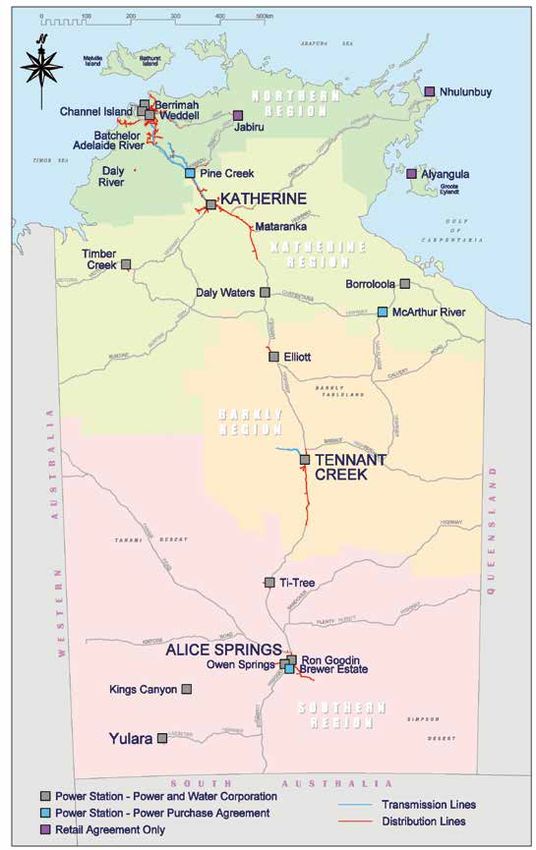
The Northern Territory has not yet completed                             The Government should use its ownership of
all the requirements associated with the partial                         the three Government Owned Corporations
roll out of the National Electricity Rules that                          (GOCs) to ensure an open and fair investment
is planned. This gives the Northern Territory                            environment. Replacement of aged prime or
an opportunity to apply only those Rules and                             base load gas turbine plant should not be like
regulations that will support the integration of                         for like. Instead, the capacity could be filled
significant renewable energy generation.                                 by renewable energy plant funded by
                                                                         private investment.
In wholesale cost terms, renewable energy
electricity generation is increasingly                                   Currently, most remote communities rely on
competitive with fossil fuel generation in                               diesel generators for their electricity. To reduce
many parts of Australia4. While we appreciate                            the reliance on diesel, PWC, in partnership
the concerns of some, that new renewable                                 with the Australian Renewable Energy Agency
technologies could result in the stranding of                            (ARENA), is rolling out the Solar SETuP program
existing gas turbine assets, it is our view that                         to some 30 Northern Territory communities5.
the Northern Territory has an ideal generation                           There is considerable scope, building on the
opportunity, in its aged gas turbine assets,                             learning developed through this program, to
to provide fast start supply to fill the gaps                            create high penetration renewable energy
of intermittent renewable energy. Far from                               systems in these communities utilising battery
stranding these generator assets, the onset of                           storage technology.
renewable energy generation may enable cost
                                                                         Alice Springs has often led the way in
effective replacement and extended utilisation.
                                                                         renewable energy, through programs such
To encourage rooftop photovoltaics (PV)                                  as the Solar City, as well as through research,
and behind the meter energy storage, it is                               studies, and technical solutions developed
proposed that the Feed In Tariff (FIT) be altered                        by a range of agencies, such as the Centre
to reflect electricity demand at different times                         for Appropriate Technology (CAT), Desert
of the day (a time-of-day structure). These                              Knowledge Australia (DKA), the CSIRO, the City
initiatives may encourage greater uptake of                              of Alice Springs, private interest groups and
rooftop PV and battery storage systems and                               Charles Darwin University (CDU). Building on
could enable consumers to reduce their                                   this important work, it is recommended that
electricity costs during the most expensive                              Alice Springs be supported as a hub for solar
times of the day, promote energy efficiency,                             energy research and development.
and increase reliability and security by reducing
                                                                         The Northern Territory Government should
demand pressure on the system at times of
                                                                         also ensure support is provided for the required
high demand.
                                                                         service industries, including training, education
In order to kick start the roll out of renewable                         and accreditation.
energy generation, it is proposed that
government uses its purchasing power to
create initial demand through purchasing
electricity from renewable energy suppliers,
meeting its existing large-scale generation
certificate (LGC) obligations from Territory
based renewable energy installations and
installing roof top PV systems to government
housing.

4
    Australian Renewable Energy Agency, Large-scale solar in Australia: Past, present and future, 2016.
5
    Australian Renewable Energy Agency, An introduction to ARENA’s remote and regional projects, March 2017.

                                                                                                           Roadmap to Renewables   5
Outcomes

      RENEWABLE ENERGY      Assurance of electricity    DOWNWARD PRESSURE
      as an agent for       system SECURITY             on wholesale
      ECONOMIC              and RELIABILITY             ELECTRICITY PRICES
      DEVELOPMENT

                                                                $

      Ongoing future
      AFFORDABILITY and
      SUSTAINABILITY of
      electricity supply

                            EFFECTIVE
                            GOVERNANCE                  GREATER USE of
                            of disruptive changes       RENEWABLE ENERGY
                            in the system               generation sources

                                                                   $

                            IMPROVED PLANNING
                            of the Northern Territory   Greater INVESTOR
      LOWERED EMISSIONS     ENERGY SYSTEM               CERTAINTY

6   Roadmap to Renewables
Principles

          SECURE                            RELIABLE                           STABLE
 The Northern Territory must        The Northern Territory must      The Northern Territory must
 maintain a secure supply of        maintain the energy supply       not compromise the stability
electricity to support business       without compromising           of the current network as the
 and community at all times.            network reliability.           generation mix changes.

FLEXIBLE AND ADAPTIVE                    TRANSPARENT                        COMPETITIVE
   The Northern Territory            The Northern Territory must      The Northern Territory must
 must retain the flexibility to     support an open, transparent      support a competitive, open
respond quickly to the rapid          and accountable market.         market in which all investors
 and changing nature of the                                               are treated equally.
 modern electricity system.

        PRACTICAL                       COST EFFECTIVE                       EFFICIENT
It is important the Northern         Decisions about the future        To achieve the 50 per cent
Territory take a practical and        electricity system and its      renewable energy target by
 pragmatic approach when              sources should consider         2030, the Northern Territory
adopting new technologies.                   lowest cost.            must ensure the most efficient
                                                                        use of the current energy
                                                                    sources, infrastructure and plant
                                                                      when integrating renewable
                                                                         energy into the system.

                                              CLEAN
                              It is important that the Northern Territory
                             government, stakeholders and the broader
                                community protects and maintains its
                               unique natural environment by ensuring
                            environmental impacts are considered as part
                                          of decision making.

                                                                             Roadmap to Renewables      7
Renewable energy as an enabler
               of economic development
                                                    Technology,
          Finance             Governance            Security and
                                                     reliability

                                                    Validate network
                               Build industry
         Align Policy                             capabilities ensuring
         Objectives
                              and community
                                                    system security       Short Term
                                confidence
                                                     and reliability

           Certainty           Support a             Future system
         for investors      competitive market         planning           Medium Term

           Asset            Adaptive Regulatory     Implementation
        Optimisation            Framework            of future grid       Longer Term

                    Enabling the Community

8   Roadmap to Renewables
Predicted cost of solar energy from solar PV
Short Term Medium Term Long Term
60%
Projected cost of Solar Energy from Solar PV $
50%
40%
% Renewable Energy
30%
20%
10%
0%
2017 2019 2021 2023 2025 2027 2029 2030
Cost of solar energy % of renewable energy
Land area comparison - how much space is taken by solar power?
VRD Cattle Station 0.08% OF VRD
(8900km2) CATTLE STATION (7kM2)
= AREA REQUIRED FOR
450MW SOLAR
GENERATION TO
ACHIEVE 50%
Roadmap to Renewables 9Recommendations list
OVERARCHING
Recommendation 1 – Renewable Energy-Enabling of Economic Development: To ensure long-term
benefits for all Territorians, the Northern Territory Government should include renewable energy
as a central pillar of economic policy, maximising benefits of forthcoming disruptive change in the
electricity sector caused by the global transition to competitively priced renewable energy.
FINANCIAL
Recommendation 2 – Align Policy Objectives: The Northern Territory Government should align its
policy objectives, departmental activity and government programs toward the development and
purchase of renewable energy-generated electricity.
Recommendation 3 – Certainty for Investors: The Northern Territory Government should actively
create an environment that has policy certainty that attracts long term renewable energy investment
and financing.
Recommendation 4 – Asset Optimisation: The Northern Territory Government should publicise an
asset retirement/replacement optimisation strategy for existing gas-fired generators to facilitate the
adoption of new, competitively priced renewable energy generation alternatives.
REGULATORY
Recommendation 5 – Build Industry and Community Confidence: The Northern Territory
Government should align regulatory and energy system reform to ensure congruence with the
50 per cent renewable energy target and reposition current technical, legislative and social
parameters to build community and industry confidence in the renewable energy industry.
Recommendation 6 – Support a Competitive Market: The Northern Territory Government
should endorse a competitive energy and capacity market framework for renewable energy
in the Northern Territory.
Recommendation 7 – Adaptive Regulatory Framework: The Northern Territory Government
should develop a consolidated governance and regulatory framework that is able to adapt to
new and emerging technologies.
10 Roadmap to RenewablesRecommendations list
TECHNICAL
Recommendation 8 – Validate Network Capabilities Ensuring System Security and Reliability: The
Northern Territory Government should immediately improve knowledge of the existing capability
and capacity of the entire power system, including its ability to accommodate new renewable
energy generation. Where possible, the government should take immediate action to kick-start the
rollout of renewable energy projects.
Recommendation 9 – Future System Planning: The Northern Territory Government should support
the development of a detailed technical plan for the future power system, including reviewing the
nature and requirement of demand, supply and transmission in the context of new technical and
business models, while ensuring security and reliability as the nature of the system changes.
Recommendation 10 – Implementation of the Future Grid: The Northern Territory Government
should optimise the implementation of existing plans for progressive network upgrades to facilitate
the future grid required to support the transition to higher per cent of renewable energy.
SOCIAL
Recommendation 11 – Engaging the Community: The Northern Territory Government should
undertake a variety of community engagement measures to ensure inclusion of disadvantaged
customers, training of the workforce, and education of the public regarding renewable energy.
Roadmap to Renewables 11Introduction
The Northern Territory Government has committed to a target of 50 per cent renewable energy
by 2030, up from an estimated four per cent currently in 2017. To achieve this target, the Northern
Territory Government commissioned the renewable energy Expert Panel to develop a roadmap
and make recommendations for a reliable, secure and sustainable transition (Appendix 1).
In compiling the roadmap, we reviewed a range of relevant local, national and international
reports and briefs. We met with many stakeholders: government departments and industry
representatives, community interest groups, commercial entities, financiers and individuals
and considered 17 submissions from interested parties (Appendix 2).
Report Context enterprises rely on either diesel or gas, and
as such renewables provide an increasingly
viable and lower cost, alternative. It was
also determined that major industry should
The renewable energy target was defined as be included in the definition of consumers
50 per cent of the actual electricity consumed because, as large users of electricity, failure
in the Northern Territory in 2030 (Appendix 3). to include these groups would reduce the
Consumers were defined as: effectiveness of the 50 per cent target and
effectively make it only a domestic customer
• All classes of electricity supply customers in target. However, it is important to recognise
the three major systems within the Northern the impact that inclusion of the existing
Territory (Darwin/Katherine, Tennant Creek large self-generating projects such as INPEX
and Alice Springs). would have on the 50 percent calculation.
• All classes of electricity supply customers The proposal to include large projects and
in smaller community systems (such as self-generating enterprises is not intended
Ti Tree, Elliott/Newcastle Waters, Daly to overburden the Target calculation but to
Waters, Borroloola and Timber Creek). recognise the importance of encouraging
• All Aboriginal communities with their own future large enterprises to use renewable
power stations (Aboriginal communities energy generation.
whose electricity is supplied from one Following the conclusions of the Northern
of the categories above are counted in Territory’s Green Energy Taskforce6,7 in 2010,
those categories). and noting that the situation has not altered
• Energy generated by self-generating significantly since this time (Appendix 4),
commercial enterprises (primarily mines we focused on PV as the most prospective
and tourist facilities, including Yulara, Jabiru, renewable energy technology for the Northern
Nhulunbuy, Groote Eylandt, McArthur River, Territory8. This conclusion has been reinforced
Pine Gap, Tanami Gold and Seven Spirit by the very significant cost reductions the PV
Bay). But not existing large projects such as industry has achieved in recent years.
ERA, Ranger, Gove Aluminium Finance Ltd
at Nhulunbuy, GEMCO at Groote Eylandt, It is noted that the Territory has extensive
Tanami Gold NL, ConocoPhillips LNG plant, reserves of gas that can be utilised for backup
Wickham Point and the INPEX LNG plant, generation and to fuel new precursor chemical
Bladin Point. gas intensive industries. Along with the
downward pressure on wholesale electricity
The inclusion of self-generating enterprises costs by renewable energy, this may offer
in the target recognises that many of these, significant economic growth opportunities for
particularly mining, are already active or the Northern Territory.
showing strong interest in renewable energy
generation. All of these self-generating
6
Green Energy Taskforce, Roadmap to Renewable and Low Emissions Energy in Remote Communities Roadmap, 2010.
7
Green Energy Taskforce, An evaluation of the relative merits, feasibility, and likely costs of the potentially available renewable energy
technologies to be used in the NT, including geo-thermal, solar, biomass and tidal, 2010.
8
Climatecouncil.org.au/solar-report.
12 Roadmap to RenewablesPrice evolution of PV Panels and Systems
$14
$13
$12
$11
$10
$9
$/W pre-subsidy
$8
$7
$6
$5
$4
$3
$2
$1
$0
2003
2004
2005
2006
2007
2008
2009
2010
2011
2012
2013
2014
2015
2016
Typical PV module price Lowest module price
Source: National Survey Report of PV Power Applications in Australia, 2016
The global context
Over the last decade, there has been a Globally, state and territory governments have
significant acceleration in the global approach played a key role in driving this change, with
to renewable energy electricity generation, many adopting stronger and more innovative
transmission and consumption. This can be policies than their national counterparts. In
attributed to a global drive to address climate the United States (US), a majority of state
change and rising electricity costs, coupled governments have had renewable energy goals
with the broad desire of governments to create in place for a decade10. This played a major
new economic opportunities and industries in role in the US placing second in the world for
the wake of disruptive changes in renewable renewable energy capacity8.
energy technology9. This disruptive change
By banding together, sub-national jurisdictions
will see innovations not only in how electricity
are creating significant economic and political
is generated but also how it is distributed
momentum for change. In November 2015,
and managed over time, such that the entire
more than 1000 mayors and governors from
electricity system may be completely different
150 countries committed to switching to
from its current form.
100 per cent renewable power11.
8
Climatecouncil.org.au/solar-report.
9
IRENA, REthinking Energy: Renewable Energy and Climate Change, 2015.
10
Climate Council of Australia , State of Solar 2016, Globally and in Australia by Petra Stock, Andrew Stock and Greg Bourne.
11
Climate Council of Australia, Game on: The Australian Renewable Energy Race heats up by Andrew Stock
and Petra Stock, 2016.
Roadmap to Renewables 13The national context
In 2015, within the United Nations Framework
Convention on Climate Change, 196 parties
The NT is vulnerable to climate change.
negotiated the Paris Agreement. 153 parties
Some of the impacts include:
have subsequently ratified this agreement with
the core aim of limiting the increase in the Heat: In Darwin, the number of days over
average temperature to well below 2 degrees 35 degrees Celsius is expected to increase
and endeavouring to limit the increase to from 11 to 43 per year by 2030, and to 265
1.5 degrees, which would help to significantly per year by 2070 at current rates of global
reduce the risks and impacts associated with warming (CSIRO and BoM 2015). Heatwaves
climate change12. are the most significant natural hazard in
Australia in terms of loss of life.
In line with this agreement, the Australian
Government committed to reducing Australia’s Sea Level Rise: Darwin is expected to
greenhouse gas emissions by 26 to 28 per cent experience a mean sea-level rise of up to
(based on 2005 levels) by 2030. To achieve this 0.25 m by 2050 relative to 1986-2005 levels
target, there has been considerable focus on (McInnes et al. 2015). A present-day 1-in-100
reducing emissions from the electricity sector year flooding event would likely occur every
and many state and territory governments day or so by 2100 at current rates of emissions
have adopted renewable energy targets. (Hunter 2012).
Queensland, South Australia and the Northern
Extreme Rainfall: Rainfall patterns are
Territory now have targets to grow renewable
expected to change and extreme rainfall
energy to 50 per cent by 2030 and Victoria
events are expected to worsen. Maximum
has a target of 40 per cent by 202513. The
one-day rainfall is expected to increase by
Australian Capital Territory has a target of
up to 18per cent for the NT by the end of
100 per cent renewable electricity by 2020,
the century for a high emissions scenario,
which it is on track to meet through a reverse
relative to 1986-2005 CLIMATE (CSIRO and
auction scheme.
BoM 2015).
Electricity emission factors by jurisdiction
(kg/kWh) Source: National Greenhouse accounts, 2011/2012
1600
1400 1600
1200
1000
1000 930
830
800 750 780
600
400
230
200
0
TAS SA NT WA (SWIS) QLD NSW/ACT VIC
12
Unfcc.int/paris_agreement/items/9485.php
13
Climate Council of Australia, Game on: The Australian Renewable Energy Race heats up by Andrew Stock and Petra Stock, 2016.
14 Roadmap to RenewablesClimateWorks report14 considered what action Recently, a major report on the National
Australia could take to do its fair share of Electricity Market (NEM) has been completed
the global effort. All scenarios demonstrated by the Chief Scientist, Alan Finkel AO and
achieving at least 50 renewable electricity his Expert Panel18. The key outcomes of this
generation by 2030 is both critical and national report are; Increased Security,
achievable (ClimateWorks 2015). After 2030, Future Reliability, Rewarding Consumers
renewable energy would be further increased and Lower Emissions, and these parallel
leading to net zero emissions before 2050. closely the proposed outcomes of this report.
In addition, the Chief Scientist’s report strongly
Over the last decade, many jurisdictions
supported renewable energy generation, as
introduced a solar feed in tariff (FIT), which
does this report.
is the rate paid for electricity fed back into
the electricity network from a designated The challenges facing the NEM differ in many
renewable energy generation source, such ways from the issues facing the Northern
as a rooftop solar panel array. These tariffs Territory, however, the goals of security,
aimed to encourage the uptake of solar reliability, emissions reduction, downward
rooftop panels. In some jurisdictions, these pressure on the wholesale cost of energy
tariffs have been reduced (from 60 cents, remain the same.
25 cents, 44 cents15) to between 5 and
The Territory is in a favourable position
12 cents per kilowatt hour. The Northern
compared to other jurisdictions, because it
Territory currently has a flat feed in tariff of
is still in the process of applying the National
25.67 cents per kilowatt hour for domestic
Electricity Rules and may ensure it only applies
and 29.87 cents per kilowatt hour for
the Rules in a manner that is fit-for-purpose
commercial consumers (Appendix 5).
for the Territory.
Nationally, large scale solar and wind
Building on the Chief Scientist’s work, and the
generation plants mainly feed energy directly
Recommendations of this roadmap report,
into the electricity network at points in the
the Northern Territory Government has the
transmission system and generally contract
opportunity to achieve a successful transition
a wholesale supply price (quoted as dollars
to a reliable electricity system powered largely
per megawatt-hour (MWh)) within the
by renewable energy.
National Electricity Market (NEM). This price
has network and retail charges added to
determine the consumer tariff. Wholesale
prices for electricity from medium and large-
scale solar PV installations are now proving
competitive with conventional fossil fuel
generation, and prices continue to fall16. In
remote areas where generation is by diesel
plant, the high costs of delivery and storage
of fossil fuels mean solar PV generation
costs can be significantly lower than fossil
fuel generation even when energy storage
is included17.
14
ClimateWorks (2014) Pathways to Deep Decarbonisation in 2050: How Australia can prosper in a low carbon world.
Technical Report. Accessed at: http://climateworksaustralia.org/sites/default/files/documents/publications/climateworks_pdd2050_
technicalreport_20140923.pdf
15
https://mozo.com.au/energy/articles/2-17-changes-to-australia-s-solar-feed-in-tariffs-what-they-mean-for-you
16
Clean Energy Australia Roadmap, Clean Energy Council, 2016.
17
Green Energy Taskforce, Roadmap to Renewable and Low Emissions Energy in Remote Communities Roadmap, 2010
18
Independent Review into the Future Security of the National Electricity Market. June 2017
Roadmap to Renewables 15Through the reverse auction process
(a competitive bidding process between
government and commercial entities),
the ACT Government has achieved the
cheapest wind power ever contracted, at
$73 / megawatt-hour (MWh) at Neoen’s
Hornsdale 3 Wind Farm. The recent sale of
the Stockyard Hill Wind Farm in Victoria led to
Origin Energy contracting renewable energy
from the project for less than $60 / MWh.
Indicative modelling provided by industry
representatives indicates that it is realistic
to expect that, after taking into account the
remoteness premium of the NT, as well as
the additional costs associated with building
in our challenging environment, contracted
prices for energy from renewables plants will
be in the order of $80-100 / MWH, and likely
to reduce.
Darwin Trailer Boat Club - Country Solar, 2017
16 Roadmap to RenewablesThe National Renewable Energy Target (RET)
The national Renewable Energy Target (RET)
is an Australian Government scheme designed
to reduce emissions of greenhouse gases in South Australia sources over 36 per cent
the electricity sector and encourage electricity of its electricity from renewable sources,
generation from sustainable and renewable with 25 per cent of homes having solar
sources. Previously known as the ‘Mandatory PV panels. South Australia has installed
Renewable Energy Target’, the scheme’s more large-scale renewable capacity than
initial aim was to source two per cent any other state since 2001.
of Australia’s electricity generation from Ref: Climate Council of Australia, The
renewable energy sources, which was later Australian Renewable Energy Race: Which
increased to 20 per cent. states are winning or losing? 2014.
In 2011, the RET was split into two parts: the
Large-scale Renewable Energy Target and
the Small-scale Renewable Energy Scheme.
It works by allowing both large-scale power
stations and the owners of small-scale systems
to create large-scale generation certificates
(LGCs) and small-scale technology certificates
(STCs) for every megawatt hour of power
they generate. These certificates are then
purchased by electricity retailers and submitted
to the Clean Energy Regulator to meet
legal obligations under the RET, creating a
marketplace that provides a financial incentive.
The Large-scale RET is designed to deliver the
majority of the 2020 target, while the Small-
scale Renewable Energy Scheme supports the
installation of small-scale renewables, such as
household solar rooftop panels and solar hot
water systems.
More recently, in 2015, the Australian
Government passed the Renewable Energy
(Electricity) Amendment Bill 2015, reducing
the Large-scale Renewable Energy Target
from 41 000 GWh by 2020 to 33 000 GWh
by 2020 with interim and post-2020 targets.
Rolls Royce Gas Turbine at Channel Island - Owen Peake
Roadmap to Renewables 17The Economic Debate
It has historically been assumed that the
principal financial barrier to new renewable
energy investment was the high capital cost. According to IRENA (2016), doubling the
This was offset to some extent by the lower share of renewable energy within the energy
cost of operation, generation and maintenance mix by 2030 would increase global GDP by
that could be realised from renewables19. up to 1.1 per cent, improve welfare by up to
3.7 per cent and support more than 24 million
The cost of producing renewable energy jobs in the sector.
electricity has declined significantly over
recent years and is still on a rapid downward
trajectory. For example, the average
investment cost of both wind and solar power
has decreased by more than 50 per cent
since 199020. It is anticipated that the cost of
renewable energy will decline even further as
markets mature and companies increasingly
take advantage of economies of scale.
The annual average daily solar exposure
Bureau of Meteorology, Licence: https://creativecommons.org/licenses/by/3.0/au/
19
IRENA, The Power to Change: Solar and Wind Cost Reduction Potential to 2025, 2016.
20
IRENA, Renewable Power Generation Costs in 2012: An Overview, 2012
18 Roadmap to RenewablesAustralia has a substantial renewable energy
resource potentially capable of providing
500 times the electricity currently used in In the Northern Territory, the real potential
Australia21. It has been estimated that growth for job creation is in the energy intensive
in renewables worldwide would see a industries that lower cost renewable energy
corresponding growth in Australia’s economy may attract. It is a central conclusion that
of 1.7 per cent above ‘business as usual’, even renewable energy electricity generation may
when factoring in a decline in coal exports22. well be a driver for economic development
and as such a source of jobs growth.
Critical to considering the economic benefits
of renewable energy is to what extent solar
power with storage technologies will continue
to develop and whether the cost of solar
energy production will continue to decline23,24. Many countries are investing significantly in
renewable energy to reduce their emissions
Many argue renewable energy brings
and their reliance on fossil fuels, with over
significant opportunity for job growth.
170 countries implementing renewable
In the United States of America in 2016, energy targets27. Given today’s considerable
electricity generation and fuels technology disruptive change as a result of technology
directly employed 1.9 million workers. Of developments across generation, storage
these, 55 per cent, or 1.1 million, worked in and control in electricity systems, many
traditional coal, oil and gas, while almost governments are aware of the potential
800 000 were employed in low carbon significant opportunity costs if they do not
emission generation technologies, including transition to renewable energy sources28.
renewables, nuclear and low-emission natural
In the Northern Territory, ongoing oversight,
gas25. In the Australian context, modelling has
analysis and road-mapping will be required
shown that a national policy of moving to
to determine the extent of the benefits of
50 per cent renewable energy would create
renewable energy for jobs, and investment
28,000 nett jobs26.
in new and emerging technologies as they
become available.
In 2009, the Union of Concerned Scientists
conducted an analysis of the economic
benefits of a 25 per cent renewable energy
standard by 2025; it found that such a policy
would create more than three times as many
jobs as producing an equivalent amount of
electricity from fossil fuels—resulting in a
benefit of 202 000 new jobs in 2025.
http://www.ucsusa.org/clean-energy/
renewable-energy/public-benefits-of-
renewable-power#.WVRhtmcUkis
21
Commonwealth of Australia 2014; AEMO 2013.
22
IRENA, Renewable Energy Benefits: Measuring the Economics, Abu Dhabi, 2016.
23
Refer to Lazards Levalized Cost Of Energy analysis – Version 10.0 December 2016
24
Fraunhofer ISE (2015): Current and Future Cost of Photovoltaics. Long-term Scenarios for Market Development, System Prices
and LCOE of Utility-Scale PV Systems. Study on behalf of Agora Energiewende. 2015
25
US Energy and Employment Roadmap, January 2017
26
http://www.climatecouncil.org.au/renewablesreport
27
http://www.climatecouncil.org.au/towards-morocco-report
28
Institute for Sustainable Futures, 100 per cent renewable energy for Australia: Decarbonising Australia’s energy sector within one
Generation, 2016.
Roadmap to Renewables 19Generation capital costs 2015 and 2030
Summary of capital costs, inflation adjusted
2015 2030
9000
8000
7000
6000
5000
A$/kW
4000
3000
2000
1000
0
Brown coal Brown coal Black coal Black coal Black coal Solar Solar PV Large- Wind
IGCC with CCS puverised IGCC with CCS Thermal Scale Solar
Source: CO2CRC, 2015, p 252
20 Roadmap to RenewablesThe Northern Territory Context
Building a Secure Grid in Australia of both household batteries and
utility scale technologies are limited at present
for the Future but are increasing. Victoria and South Australia
Providing secure, reliable power is a key are implementing relatively small grid scale
objective for both National and Territory batteries, while the ACT initiated the largest
Governments which has gathered significant roll out of household batteries in the world
public debate. To maintain reliable supply, (outside of Germany) in 2016.32
electricity systems need to keep supply and The Northern Territory already has experience
demand in balance. Electrical systems are and expertise in integrating renewables and
dynamic, and rapid changes can adversely managing variability and intermittency.33
affect key elements such as voltage and
frequency. Generators and control systems
need to act quickly to maintain the balance Policy Settings
or system protection devices may operate
to avoid catastrophic failure (their operation In 2016, the Northern Territory Government
may result in systems wide blackouts). A adopted a 50 per cent renewable energy target
robust network has significant inertia to by 2030, (Appendix 1). A formal, whole-of-
buffer against instability. Power plants with government renewable energy policy will help
large rotating engines provide inertia and agencies make informed decisions to achieve
maintain power stability. An inverter the target. The secondary benefit will be to
connected renewable energy plant usually increase investor certainty.
lacks inertia and can increase instability if Community and stakeholder consultation
not well managed. A range of technologies showed broad support for this renewable
other than large rotating engines can provide energy target. However, some restrictions
inertia and the term “ancillary services” is used were identified that could impede the uptake
in this report to refer to these types of system of renewable energy, including:
support services.
• Financing options and arrangements,
Given the very high levels of solar radiation which are usually not flexible for use by
in the NT, the relatively low average wind government agencies or government-owned
speeds and other environmental constraints, corporations or are not permissible under
the primary source of renewable electricity existing Northern Territory legislation
for the Northern Territory will likely be • Procuring large-scale generation certificates
solar photovoltaics (PV)29,30 and as solar mainly from interstate renewable energy
power is intermittent (varying with changing generators, which limits investment in
solar availability) this will require energy renewable energy in the Northern Territory
storage, particularly batteries, to maintain
reliable supply. • Insufficient transparency in procurement,
evaluation and tendering processes, which
Global benchmarking completed by firms such is important for facilitating a pathway for
as Lazard has highlighted significant progress investors to enter the Northern Territory
in the application and implementation of large- market
scale storage, with cost dramatically reducing • A lack of transparency in the cost of ancillary
in some areas31. Coupling low-cost renewable services, which makes it difficult for investors
generation capacity like solar PV with batteries, to assess the true cost of energy generation
at both household and grid scale, may become in the Northern Territory and to make
increasingly the norm in Australia in the next appropriate contractual arrangements
decade as costs continue to fall. Experience
29
All the latest LCOE work (Lazards, Bloomberg, Finkel etc validate previous reports findings (detailed in Appendix 4).
Solar thermal may play an economic role in the medium term if CAPEX can be reduced.
30
Green Energy Task Force Report
31
https://www.lazard.com/media/438042/lazard-levelized-cost-of-storage-v20.pdf
32
http://www.environment.act.gov.au/energy/cleaner-energy/next-generation-renewables
33
Please refer to Appendix 9 and 10 for further discussion.
Roadmap to Renewables 21• A lack of transparent and appropriate Territory. We are confident that this Roadmap
tools, maps, price data, and demand and to Renewables report supports the delivery of
forecasting data for proponents to use in the government’s EDF.
making investment plans and decisions
• Insufficient information on investment
opportunities and available investment
The Legislative Framework
processes, such as the reverse auction On 1 July 2015, the National Electricity
process used in the ACT, an expression of (NT) (National Uniform Legislation) Act
investment process or competitive long term commenced. Among other things, it
power purchase agreements transferred the economic regulation of the
• Lack of an accreditation system aimed Territory’s regulated electricity networks
at reducing the financial and regulatory (Darwin–Katherine, Alice Springs and Tennant
requirements of obtaining a building permit Creek) from the Utilities Commission to the
for every new installation of rooftop solar PV. Australian Energy Regulator (AER). The Utilities
Commission will continue to regulate under
• Insufficient education and training programs,
the Northern Territory’s existing electricity
which will be required to meet the growing
legislative framework until 1 July 2019. The
requirement for technical expertise and
future framework will need to be carefully
engineers as a result of the increase from
crafted to ensure a consistent and trusted
four per cent to 50 per cent renewable
environment is in place for investors looking
energy penetration.
beyond 2019.
• The need for targeted education and
engagement to ensure all components of the Under the Northern Territory Government’s
Northern Territory community can contribute electricity networks regulatory reforms,
to the renewable energy target. jurisdictional regulation by the Utilities
Commission under the Electricity Networks
The recommendations and supporting (Third Party Access) Act transferred to the
enabling actions detailed in this report aim to Australian Energy Regulator (AER) on 1 July
address these barriers. 2015. The AER will continue to regulate
The renewable energy target should be under existing Territory legislation while
supported by the Energy Policy for the simultaneously preparing the 2019-24 Network
Northern Territory, which is currently in Price Determination under the National
development. The Energy Policy should Electricity Law and National Electricity Rules to
outline government’s policy position for commence on 1 July 2019. It is important that
energy in the Northern Territory and help the Northern Territory arrangements and national
government to establish goals around energy obligations, such as those associated with
generation, distribution and consumption; the Renewable Energy Target, NER and NEM,
make informed decisions; prioritise actions, are aligned to minimise compliance costs,
and adopt an appropriate legislative and confusion and barriers to entry by requiring
regulatory framework. proponents established in other jurisdictions
to be able to adapt to the requirements of
The Economic Development Framework (EDF), the Northern Territory. Derogations from
released by the Northern Territory Government the national rules that are being adopted are
in June 2017, confirms the importance of required to improve the arrangements for the
renewable energy in growing the economy. Northern Territory electricity market with the
The EDF particularly highlighted the benefits onset of renewable energy generation. Under
from integrating best-practice technology the electricity networks reform program,
in solar power generation, storage and the Electricity Networks (Third Party Access)
management and the potential for Northern Act will fall away on 1 July 2019 with
Territory businesses to earn income from the transition to the national regulatory
selling this expertise outside the Northern
22 Roadmap to Renewablesarrangements for electricity networks. 650.3 megawatts (MW). However, the average
This will affect (at least) the: energy demand for the Northern Territory is
212.3 MW, with a maximum aggregate demand
• Network Technical Code
of 353.7 MW (Appendix 8).
• Connections processes
There are also minor grid systems at Yulara,
Currently, there is overlap and unclear content Timber Creek, Borroloola, Nhulunbuy and
in the Electricity Networks (Third Party Ti Tree, which are primarily powered by gas,
Access) Code, Network Technical Code (NTC), diesel or a mixture of the two. Other areas
Network Planning Criteria and System Control of the Northern Territory are categorised
Technical Code. This can create confusion for as unregulated systems, where generation
new market participants. The generator and is generally provided by diesel or gas fired
load notifications and requirements must also generators. Increasing portions of renewable
be clarified, including for when generators do energy are being injected throughout the
not meet the automatic access standards. Northern Territory, including within outstations
and remote communities.
Grid System These smaller communities offer significant
opportunity for high penetration solar and
The Northern Territory is made up of
battery systems as the renewable energy
three regulated electricity grid networks:
replaces expensive diesel fuel.
Darwin–Katherine, Tennant Creek and Alice
Springs (Appendix 7). These regulated systems
are powered by gas-fired generators. These
grids provide a total electricity capacity of
Summary of installed capacity generation in NT
Power System Capacity (MW)
Darwin-Katherine 501
DLNG (Conoco Phillips) 180
Tennant Creek 17
Alice Springs (inc Uterne) 93
Yulara and Kings Canyon 12
Remote communities / IES 80
Remote mining operations 165
Operating total 1,048
Ichthys LNG (not commissioned yet) 500
TOTAL 1,548
Roadmap to Renewables 23Figure 3: NT power system (Power and Water Corporation, 2017)
Power and Water Corporation Annual Report, 2009
24 Roadmap to RenewablesThe Role of Government Owned Corporations
The three Government Owned Corporations PWC also generates electricity in some
(GOCs), Power and Water Corporation (PWC), minor centres and communities serviced
Territory Generation (TGen) and Jacana by Indigenous Essential Services Pty Ltd
Energy operate in the Northern Territory through contracts with PWC. PWC is currently
electricity system. delivering the Solar Energy Transformation
Program (SETuP) that will see the installation of
The generation sector is dominated by TGen
9MW of ‘medium penetration solar’ (renewable
which operates and maintains a fleet of
energy systems established to supplement
gas powered generation assets. As well as
the diesel generated system but without back
supplying the Northern Territory with most
up storage) across about 30 communities
of its electricity, these gas generation assets
to achieve approximately 15 per cent diesel
also provide the necessary support services,
fuel saving annually. These renewable energy
including ancillary (back up) services, voltage
systems are of simple low-cost design, using
control, frequency control and inertia (the
tried and tested renewable energy technology,
ability of the system to recover quickly from
to maximise diesel fuel savings for minimal
sudden equipment outage)34.
cost. A 1MW ‘high penetration’ (differs from the
PWC has an independent System Control medium penetration renewable energy system
unit which functions to regulate the power because it also includes storage capacity)
systems. This includes managing the system’s renewable energy system has been built at
reliability by ensuring the right support services Daly River. This uses storage technology to
are always available (including real-time achieve approximately 50 per cent diesel fuel
operations, managing system risk, demand saving annually. Once SETuP is completed,
side management, outage coordination, over 13GWh per annum will be provided by
power system technical assessments and renewable energy in remote communities. This
long-term system planning, according to represents over 10 per cent of total generation
the requirements of the System Control in remote communities.
Technical Code, NTC and Electricity Ring
Fencing Code (RFC).
System Control manages the electricity
system by instructing generators such as
TGen to operate in certain ways in the system.
The electricity networks in the Northern
Territory are largely Northern Territory
Government owned, and operated by
the PWC.
Power Networks is an independent unit in the
PWC and is responsible for planning, building
and maintaining distribution and transmission
networks for the regulated DKIS, Tennant
Creek and Alice Springs networks according
to the requirements of the Electricity Networks
(Third Party Access) Act, NTC and RFC until
1 July 2019, and under the requirements of the
NER thereafter.
Bathurst Island remote community power station
typical diesel generator
34
http://www.mjbradley.com/sites/default/files/MJBA%20NG%20and%20Renewable%20Discussion%20Paper%20FINAL_10Dec2012.pdf
Roadmap to Renewables 25Map of IES centres in the Northern Territory
Melville
Island
Arafura Sea
Minjilang
Pirlangimpi
Milikapiti Warruwi
Bathurst Galiwin’ku
Island Milingimbi
Wurrumiyanga Maningrida Gunyangara
Nhulunbuy
Yathalamarra
Darwin Yirrkala
. Gunbalanya
m Hwy Ramingining
e
Arnh Jabiru Gapuwiyak
Belyuen Acacia Larrakia
.
wy
uH
Batchelor
Timor Sea Adelaide River
d
ka Weemol Groote
Ka
Rd Bulman Eylandt
m
he
Pine Creek Ar
n Milyakburra
Nauiyu ra
l Umbakumba
nt
Kybrook Farm Ce
Wadeye Manyallaluk Numbulwar Angurugu
Peppimenarti Katherine
Beswick
Nganmaryanga Barunga Rittarangu Gulf
y.
Binjari Mataranka
of
Hw
Ngukurr
ria
Carpentaria
to
Jilkminggan
c
Vi
Timber Creek Larrimah
Minyerri
wy.
oria H
Vict Bulla Borroloola
Victoria River
Downs Daly Waters
Carp
entari
Yarralin Top Springs a Hwy.
Dunmarra McArthur River
Amanbidji Pigeon Hole
Tablelands Hwy.
Robinson River
Mistake Newcastle Waters
Creek Wollogorang
Daguragu Elliott
w y. Kalkarindji
Inverway eH d.
n ert R
nti Calv
Bu
Anthony Lagoon
Renner Springs
barkly
Stu
tableland
art
Lajamanu
Hw
y.
wy.
Barkly H
Three Ways
Tennant Creek
Western Australia
Barkly Hwy.
Tanami
Queensland
Wutunugurra
Canteen Creek
Alpurrurulam
Ali-Curung
Imangara
Ta
Willowra y.
n
am
Tara Hw
er
iH
ov
wy
nd
tanami Sa
.
Nturiya Wilora Ampilatwatja
desert Ti-Tree Tobermorey
Yuelamu Pmara Jutunta
Yuendumu
Engawala y.
Hw
Nyirripi Laramba nty
Ple
Papunya
Rd.
Atitjere
Kintore
Mount Liebig Ikuntji
Kintore Alice Springs
Amoonguna
Hermannsburg
Kings Canyon Santa Teresa
Wallace
Areyonga Rockhole simpson
Titjikala desert
Stuart Hwy.
Lasseter Hwy.
Kaltukatjara Yulara Imanpa
Curtain
Springs Finke
Kulgera
Mulga Park
South Australia
Power and Water Corporation, 2017
26 Roadmap to RenewablesChannel Island Control Desk - Owen Peake
There are six licenced electricity retailers be important to ensure the renewable energy
in the Northern Territory, which includes systems can provide a reliable supply and have
the government owned Jacana Energy and the necessary system support services, to
PWC. The market reform initiatives, currently maintain the system’s security and reliability.
being rolled out in the Northern Territory This may include dispatchable or scheduled
have Jacana Energy facing increasing retail power supply in which proponents are
competition across its customer portfolio. required to provide the back up and ancillary
However, Jacana Energy remains the services irrespective of whether the conditions
dominant electricity retailer across both are optimal for renewable energy generation
the regulated residential and small business (such as through storage, backup generators,
customer market and the commercial and etc.), The existing gas generation assets, or
industrial customer market. their components, could be used in a different
way to support the growing system renewable
While there is considerable opportunity for
energy plant. This approach could also extend
renewable energy to replace the TGen gas
the TGen asset’s life.
generation assets as they retire, planning will
Darwin/Katherine Supply
200
160
120
MW
80
40
0
2016
2017
2018
2019
2020
2021
2022
2023
2024
2025
2026
2027
2028
2029
2030
2031
2032
2033
2034
2035
2036
2037
2038
2039
2040
2041
2042
2043
2044
2045
2046
2047
2048
2049
2050
Supply Replacement Opportunity
Territory Generation, 2017
Roadmap to Renewables 27Power Products Purpose (dispatch) Desired Attributes
Base Load Provide continuous (or near-continuous) • High efficiency
power (>6000h/y) • Lowest $/MWh
Cyclic Cover real-time fluctuations between • High efficiency
demand and supply from intermittent • Operating flexibility
renewables (1500-6000 h/y)
• Low $/MWh
Peaking Supply intermittent power for seasonal • Low $/MWh
peak hour demands (100-1500 h/y) • Low NOx emissions
• High start reliability
Stand-by Back-up power for reliability (Market Arrangements
The Northern Territory’s electricity market creating investor certainty, transparency and
currently relies on ‘bilateral contracting’ competition. The following actions are being
arrangement rather than a spot market undertaken in consultation with industry
(electricity is purchased every 30 minutes stakeholders:40
from generators offering the lowest cost).
• Designing the roles and responsibilities of
Under a bilateral contracting arrangement,
the key market bodies to ensure the NTEM
a new generator company entering the
operates efficiently and delivers its intended
Territory market is required to secure customer
market outcomes
contracts up front through a licenced retailer
and then to generate a set volume of electricity • Designing a managed investment regime
on a half-hourly basis. The bilateral contracting and a central dispatch process to facilitate
arrangement lacks pricing transparency and efficient short-term dispatch, including
is considered a significant barrier to private unbundling the cost of back up ancillary
investment in the Territory’s generation sector37. services from the cost of generating
electricity
In September 2013, the Utilities Commission
reviewed the wholesale electricity market • Developing a reliability standard to ensure
arrangements for the Territory and adequate generation capacity is built to meet
recommended developing market design and customer demand
rules suitable for the Territory’s circumstances38. • Establishing an appropriate legislative and
The Commission’s report recommended a regulatory framework.
market design called the Northern Territory
Capacity plus energy markets are used in
Electricity Market (NTEM), which comprises
many countries and in the Western Australian
an energy and capacity component, meaning
Wholesale Energy Market that operates around
that the market is designed to encourage
Perth. The NTEM design has similarities to the
investment to ensure there is adequate capacity
National Electricity Market (NEM) that operates
of electricity generation to meet forecasted
in the much larger interconnected power
demand and to achieve the reliability targets
system of eastern and south-eastern states but
specified in the Rules.The Commission’s
differs because the NEM uses a single price and
analysis suggested that a spot market would
revenue stream for both energy and capacity
not be appropriate for the Northern Territory
(an energy-only design) supported by external
situation because of the small size of the
contracts. In the Northern Territory, it will be
market39. The interim form of the NTEM
important to assure investor certainty. It is
(the I NTEM) has been operating since
proposed that long term off-take agreements
May 2015. The I-NTEM does not include the
(also called Power Purchase Agreements or
investment mechanism or reliability mechanism
PPAs) should be offered through a reverse
that will be included in the full NTEM
auction process. This process has proven very
design. These components will be critical to
successful in the Australian Capital Territory’s
competition in the Northern Territory market
move to 100 per cent renewable energy
in the future.
electricity consumption and is in line with the
The Department of Treasury and Finance, on broader capacity and energy market design.
behalf of the Northern Territory Government,
It is expected that by mid-2018, a competitive
has commenced work on the transition
wholesale electricity market will be in operation
from I NTEM to NTEM. This will see bilateral
in the DKIS network to allow generators and
contracting replaced with this energy and
retailers to trade electricity on commercial
capacity market, which will create a cost-
terms and under competitive conditions,
effective and secure supply of electricity while
37
Northern Territory Department of Treasury and Finance, Strategy for the Northern Territory Utilities, 2016.
38
Utilities Commission, Review of the wholesale electricity generation market arrangement for the Northern Territory, February 2014.
39
Oakley Greenwood, Wholesale Electricity Generation Market Review, 2013.
40
Northern Territory Department of Treasury and Finance, Strategy for the Northern Territory Utilities, 2016.
Roadmap to Renewables 29You can also read


