Short Term Airport Access Improvements (STAAI) Single Stage Business Case (SSBC) and Upcoming Engagement
←
→
Page content transcription
If your browser does not render page correctly, please read the page content below
Board Meeting| 22 October 2019
                                                                                                                                   Agenda item no.9.4
                                                                                                                                       Closed Session
CONFIDENTIAL

Short Term Airport Access Improvements (STAAI) Single Stage
Business Case (SSBC) and Upcoming Engagement
Recommendations
That the Board:
  i.    Receives the Short-Term Airport Access Improvements (STAAI) Single Stage Business Case (SSBC), as summarised in this report.
 ii.    Approves the recommended priority elements of the STAAI programme of investments to improve access to/from Auckland Airport by
        2020/2021, which can be delivered within the $67.8M budget.
 iii.   Notes that the proposed new Puhinui Station Interchange forms part of this business case. Board endorsement of the preferred Concept
        Design for the station and approval to progress with the project’s more detailed phases was received at the October 2018 Board meeting,
        in advance of the full completion of the STAAI business case. This approach was adopted to ensure the new station could be operational
        by end of 2020 thus meeting the expected programme timeframes.
 iv.    Notes that the current capital budget will not enable delivery of the full recommended programme. As a consequence, the recommended
        improved cycle connections between Māngere and the airport cannot be funded at this point, and that this carries some reputational risk.
        An Independent Quality Assurance (IQA) review has commenced which will identify lessons to be learned in relation to budget estimates
        for the STAAI project.
 v.     Notes that in the interim, the project team will progress with the detail design phase of the Māngere-Airport cycle schemes to obtain more
        robust cost estimates. This also ensures that AT maintains on-going co-ordination on active mode facility requirements with HLC, which is
        actively progressing residential intensification in the Māngere area.
 vi.    Notes that the operational budget provides for the proposed new frequent Airport–Puhinui–Manukau Bus Service and its supportive local
        bus network from 2020/21. Implementing the proposed new regional express connection between the Airport and New Lynn (in 2021/22) is
        not provided for within the current envelope and will need to be addressed through subsequent funding processes.
vii.    Notes that the Southwest Gateway Programme will commence the next round of public engagement and communications in November
        2019. This will encompass general public engagement on the overall programme, as well as more targeted engagement with the local
        community on the proposed Puhinui Road / Lambie Drive bus priority project.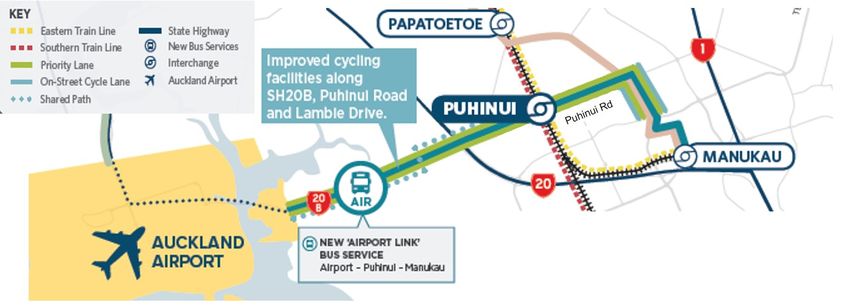
Board Meeting| 22 October 2019
                                                                                                                                   Agenda item no.9.4
                                                                                                                                       Closed Session
CONFIDENTIAL

Executive summary
1. The RLTP (June 2018) allocates $67.8M towards improving airport access over its first three years. Of this:
      i. $51.9M is allocated to the first phase of the Puhinui Station Interchange which is to be completed by end of 2020/early 2021 in advance
         of AC36 and APEC. The Regional Fuel Tax (RFT) funds $26M of this; and
     ii. $15.9M is allocated to a range of other improvement measures including localised bus priority and walking/cycling improvements - minor
         to moderate measures that can be implemented within the 2020/21 timeframe.
2. In early 2018, professional advisors were procured to develop a business case to identify the recommended short-term airport access
   improvements (STAAI) to progress, including a preferred bus/rail interchange option at Puhinui Station to be delivered by 2020/21.
3. The Short-Term Airport Access Improvements (STAAI) Business Case is now complete. It recommends AT deliver five measures by 2020/2021
   to immediately improve travel choices for customers travelling to/from the airport area. These are: upgrade Puhinui Station to allow bus/rail
   connections; provide new or improved bus services to/from the airport; provide priority measures along Puhinui Road/Lambie Drive to support
   a new direct and frequent bus service between the Airport-Puhinui-Manukau; provide new cycle facilities to improve cycle connections between
   Māngere and its neighbouring airport employment zone; and support the successful uptake of these by encouraging behaviour change.
4. Total cost of the full STAAI programme is estimated at $79M (P50) to $87.9M (P95), with a Benefit Cost Ratio (BCR) of 1.4. Sensitivity tests
   indicated that the programme BCR will reduce to 1.1 without the Māngere-Airport cycle schemes.
5. The recommended programme has a High Results Alignment (with the 2018–2028 Government Policy Statement on Land Transport); and a
   Cost Benefit Appraisal of Low, as it lies between 1.0 and 2.0.
6. The current capital expenditure budget enables the delivery of the priority elements of the programme, being the upgrade of Puhinui Station;
   new or improved bus services to/from the airport; and priority measures along Puhinui Road/Lambie Drive.
7. The recommended improved cycle connections between Māngere and the airport cannot be funded at this point, however the project team will
   proceed with the detailed design phase of this project to obtain more robust cost estimates and help inform future programme funding decisions.
8. Both the Puhinui Station Interchange project and Puhinui Road /Lambie Drive bus priority projects are well underway and on track to being
   operational by end of 2020/early 2021.
9. The next round of public engagement will commence in November 2019. This will include targeted engagement with the local community along
   the Puhinui Road and Lambie Drive bus priority corridor where approximately 30 native trees will need to be removed. In addition, approximately
   150 on-street parking spaces will not be available during the operating hours of the priority lanes.
10. Detailed design and associated local community engagement of the Māngere–Airport cycle schemes will commence in early 2020.
   Construction will be subject to funding and community feedback.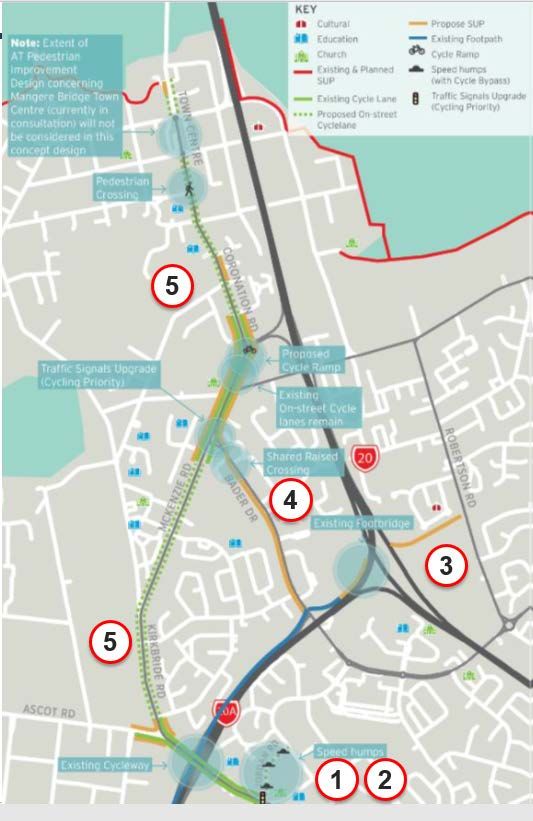
Board Meeting| 22 October 2019
                                                                                                                                     Agenda item no.9.4
                                                                                                                                         Closed Session
CONFIDENTIAL

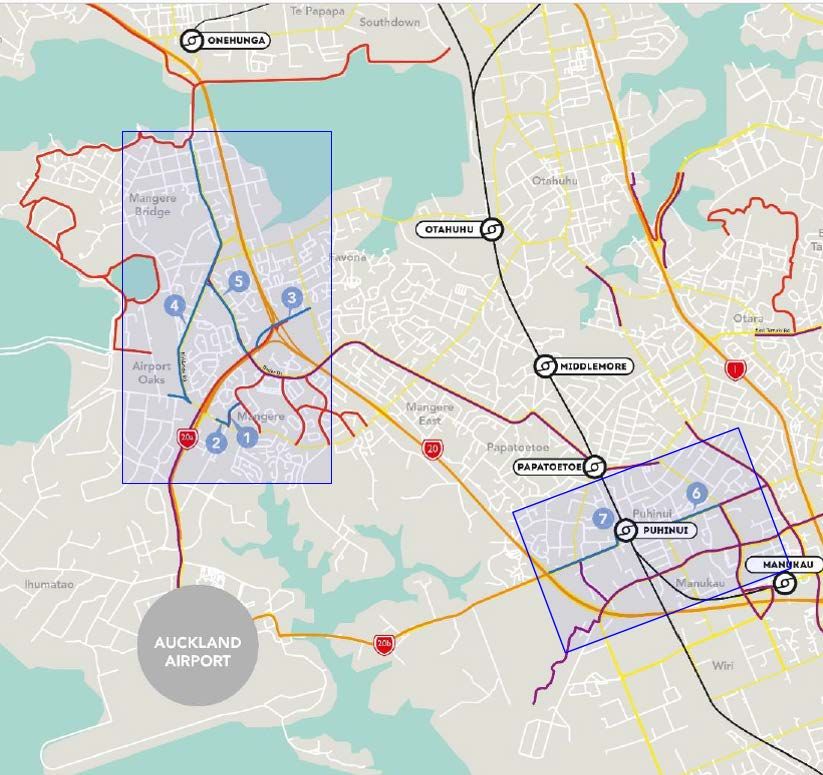
Previous deliberations                                                                          Figure 1 – Southwest Gateway Programme –
                                                                                                            Medium to Long Term
11. In May 2017, the Board received the Airport Access Programme Business Case
    and approved progressing the programme of activities it recommended. This
    included developing two business cases: one for the Airport to Botany rapid
    transit line and the other for a range of immediate (short-term) airport access
    improvements.
12. In May 2018, the Customer Focus Committee received a report summarising key
    findings of extensive customer research undertaken by AT to better understand
    customer behaviours to/from the airport.
13. In June 2018, the RLTP allocated $68 M towards improving airport access over
    its first three years. Of this:
        i.    $51.9M is allocated to the first phase of the Puhinui Station Interchange.
              The RFT funds $26 M of this; and
       ii.    $15.9M is allocated to other improvements including bus priority and
              walking/cycling improvements.
                                                                                           Figure 2 – Short-Term / Early Improvements (by 2020/21)
14. The RLTP also allocates $10M to progress the medium to longer-term work
    (implemented post 2021). This encompasses completing the business case and
    route protection for Airport to Botany Rapid Transit via Manukau.
15. In June 2018, the Capital Review Committee received an update on the Airport
    to Botany Rapid Transit and STAAI projects. Further, that the projects form part
    of the Southwest Gateway Programme, which covers three transport projects
    being progressed in the area by AT, the NZ Transport Agency (the Transport
    Agency) and Auckland Airport; and which will be delivered in stages (Figure 1
    and 2).
16. In October 2018, the Board received a report seeking endorsement for the
    preferred concept option for the Puhinui Station Interchange and approval to
    progress with the next, more detailed phases of the project. This decision was
    sought in advance of the full STAAI programme business case being completed due to the need to ensure the station could be operational by
    end of 2020.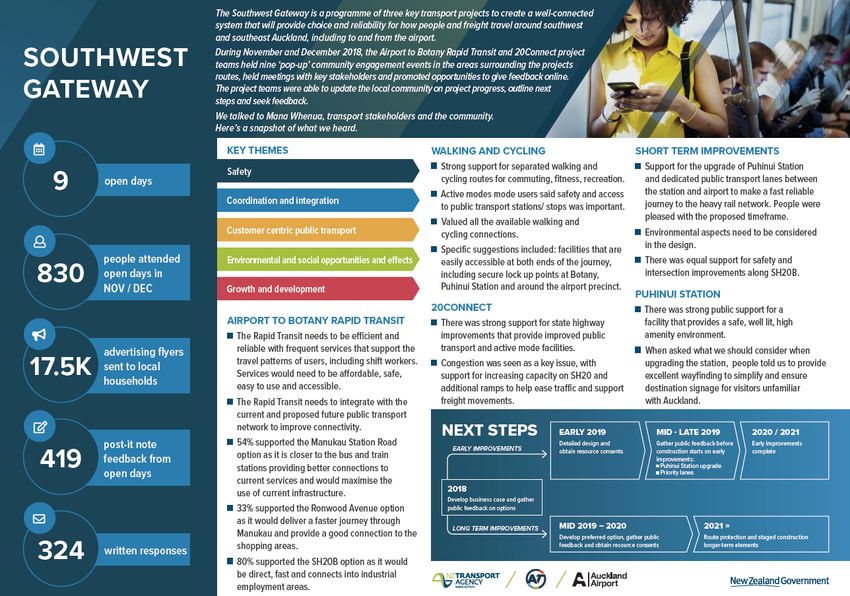
Board Meeting| 22 October 2019
                                                                                                                                          Agenda item no.9.4
                                                                                                                                              Closed Session
CONFIDENTIAL

Strategic Context and Background
17. Auckland Airport and the surrounding commercial area plays an important role in the economy of both the Auckland region and New Zealand.
    The airport is the main gateway to New Zealand, accounting for 72% of all international arrivals in 20131. It is also a key freight destination,
    particularly for high value and time sensitive goods.
18. These functions and activities make the airport and its surrounding area a major and growing regional employment hub attracting employees
    from the entire region. There are currently 30,000 people employed in the area. This is projected to grow to approximately 90,000 by 2044 in
    line with planned growth in airport activities to cater for forecast increasing passenger numbers (Figure 3). In turn, it is forecast that this will
    increase daily trips to/from the area from 63,000 currently to around 140,000 in the next 30 years.
19. The strong growth related to travel and employment has been impacting on the areas transport network and in early 2017 there was growing
    concern with the traffic congestion experienced in and around the Auckland Airport area.
20. To support the continued success of the airport and surrounding area and maintain access to employment, the Transport Agency, AT and
    Auckland Airport developed a Programme Business Case (PBC) focussed on improving airport access. It was endorsed by all three
    organisations in May 2017. Through the Airport Access PBC (2017) the three organisations agreed that:
    •    Reliable and timely access to the area is limited by lack of travel choices; and that without any intervention, this will get significantly worse.
     •   It is not possible to accommodate forecast future demand with road capacity alone and there was an urgent need to offer more travel
         choices.
21. The programme’s main recommendation was to offer better travel choices to/from the area by combining behaviour change with improved
    network management and increased capacity provision. The majority of the recommended increase in (people) capacity is to be provided via
    two new rapid transit connections between the Airport and Auckland City Centre; and between the Airport, Manukau and Botany.
22. Acknowledging that these rapid transit options will not be operational for some time, the PBC recommended immediately delivering better travel
    choices by progressing with measures that could be operational within a short-term period. The 2020/2021 improvements programme is
    particularly aimed at enabling and encouraging employees to use public transport, walking or cycling more to access the area.
23. The range of recommended improvements traverse across the three organisations road controlling areas and need to be progressed by all
    three organisations in an integrated and co-ordinated manner to successfully achieve the strategic outcomes sought.

1
    https://corporate.aucklandairport.co.nz/airport-of-the-future/our-vision.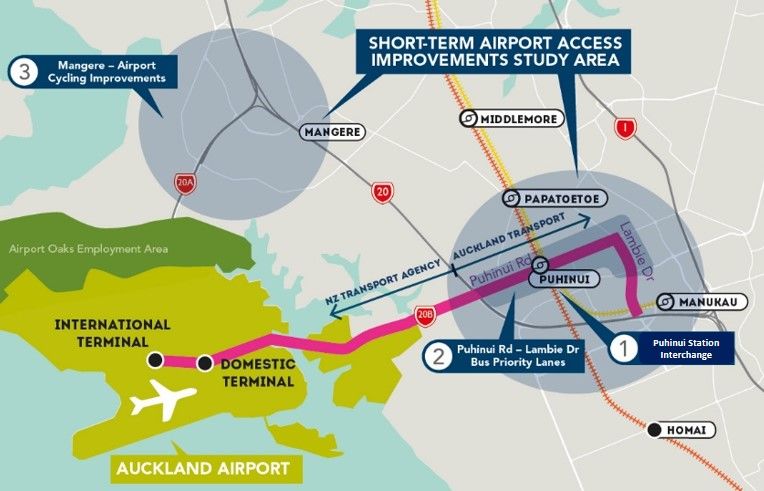
Board Meeting| 22 October 2019
                                                                                                                     Agenda item no.9.4
                                                                                                                         Closed Session
CONFIDENTIAL

                 Figure 3 – Overview of Airport Access Programme Business Case Findings and Some Customer Insights

                                                                  Travel time variability to / from
                                                                     Auckland Airport by bus

Currently 84% of employees use private vehicles to travel to
       work, whilst less than 2% use public transport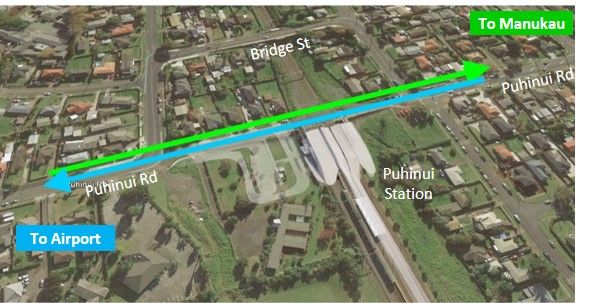
Board Meeting| 22 October 2019
                                                                                                                                   Agenda item no.9.4
                                                                                                                                       Closed Session
CONFIDENTIAL

The recommended Short-Term (2020/21) Airport Access Improvements (STAAI) Programme
24. The STAAI SSBC was initiated in early 2018 and developed the Airport Access Programme Business Case recommendations for its 2020/2021
    programme into more detail, within AT’s area of influence.
25. In parallel, the Transport Agency initiated its own complementary business case to investigate the feasibility of widening SH20B/Puhinui Road
    to provide two new lanes. This is the main corridor to/from the airport from the east and within their control. Auckland Airport also pursued
    more detailed investigations into possible improvements on its own transport network.
26. The STAAI Programme investment objectives are shown in Figure 4 and have shaped the recommended programme.
27. The STAAI SSBC is now complete. It recommends AT deliver five measures by
   2020/2021 to immediately improve travel choices for customers travelling to/from the        Figure 4 – Short-Term Airport Access Improvements –
   airport area. These are (see Figure 5):                                                           Investment Objectives (Outcomes Sought)

      i.    Upgrade Puhinui Station to create a new interchange to allow bus/rail
            connections;
     ii.    Provide new or improved bus services to and from the airport, including a new
            direct and frequent service between the Airport, Puhinui and Manukau;
     iii.   Provide bus priority measures and walking and cycling improvements along
            Puhinui Road and Lambie Drive to enable a reliable 10-12 minute bus journey
            between the Airport and Puhinui, and 22-26 minute bus journey between the
            Airport and Manukau;
     iv.    Provide new cycle facilities in the Māngere area, building on the existing cycle
            network, to provide improved cycle connections between the Māngere
            residential area and its neighbouring Airport Precinct employment zones; and
     v.     Support the successful uptake of the above by encouraging and enabling behaviour change.
28. The recommendations of the STAAI SSBC align with priority outcomes identified in strategy documents such as Government Policy Statement
    on Land Transport (2018-2028) and the RLTP (2018-2028).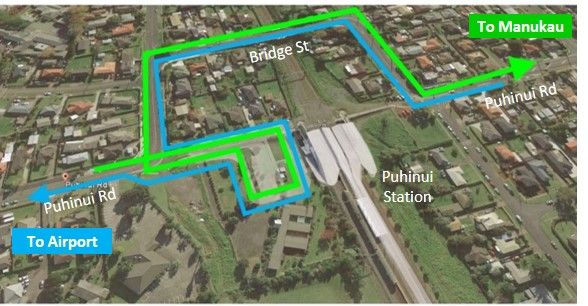
Board Meeting| 22 October 2019
                                                                                                                                                    Agenda item no.9.4
                                                                                                                                                        Closed Session
CONFIDENTIAL

A brief project description of the recommended STAAI programme                    Figure 5 – The recommended STAAI business case programme (capital
components is provided and illustrated in Attachment 1.                                                     expenditure)

Economics
29. Total cost of the recommended STAAI programme is
    estimated at $79M (P50) to $87.9M (P95), with a Benefit Cost
    Ratio (BCR) of 1.4. Sensitivity tests resulted in a range of
    BCRs between 1.3 and 2.0, indicating the economics of the
    recommended STAAI programme is robust.
30. The programme BCR will reduce to 1.1 without the Māngere-
    Airport cycle schemes.
31. Cost estimates are based on Developed Design for Puhinui
    Station Interchange and Concept Design of preferred options
    for Puhinui Road/Lambie Drive Bus priority and Māngere
    Cycling components. Individual parallel cost estimates have
    been developed and an estimate reconciliation exercise has
    been undertaken for all programme components. A detailed
    breakdown of the STAAI programme cost is shown in Table 1.
32. The recommended programme has a High Results Alignment
    (with the 2018–2028 Government Policy Statement on Land
    Transport); and a Cost Benefit Appraisal of Low, as it lies
    between 1.0 and 2.02.

2   Assessment done in accordance with the latest Transport Agency Investment Assessment Framework (IAF) for the 2018-21 National Land Transport Programme.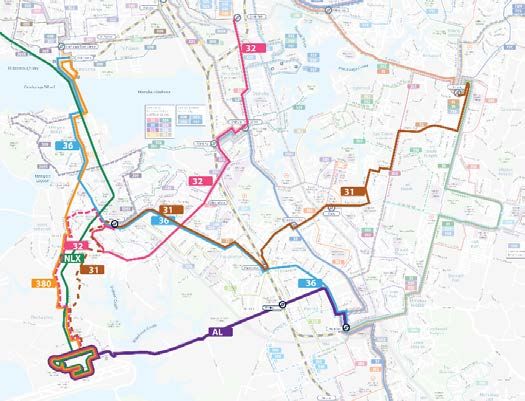
Board Meeting| 22 October 2019
                                                                                                                                                              Agenda item no.9.4
                                                                                                                                                                  Closed Session
CONFIDENTIAL

Financial and Programme Implications
33. The RLTP allocates a budget of $67.8M to the STAAI programme. The total cost of the full STAAI programme is estimated at $79M (P50) to
    $87.9M (P95). A more robust estimate of the cycling improvements will be developed post detailed design in order to inform decisions on its
    funding and implementation – Table 1.

            Table 1 - Short-term Airport Access Improvements Programme - Funding and Financial Implications Overview (Million\M)

34. The programme identifies the highest priority projects to be those on the eastern SH20B Puhinui Road to Manukau corridor as it has the most
    deficiencies in both public transport and active mode access3. This includes the Puhinui Station Interchange, the new Airport-Puhinui-Manukau
    bus service and the priority measures required to support this service.
35. To help inform future programme budget discussions, the project team will proceed with the detailed design phase of the Māngere-Airport cycle
    schemes as this will enable more robust costs estimates to be obtained. This is programmed to occur in early 2020. It is possible to progress

3
    The northern corridor is currently served by Skybus – a premium privately run public transport service, and already has high quality cycle facilities alongside SH20A and within
    parts of the Airport precinct.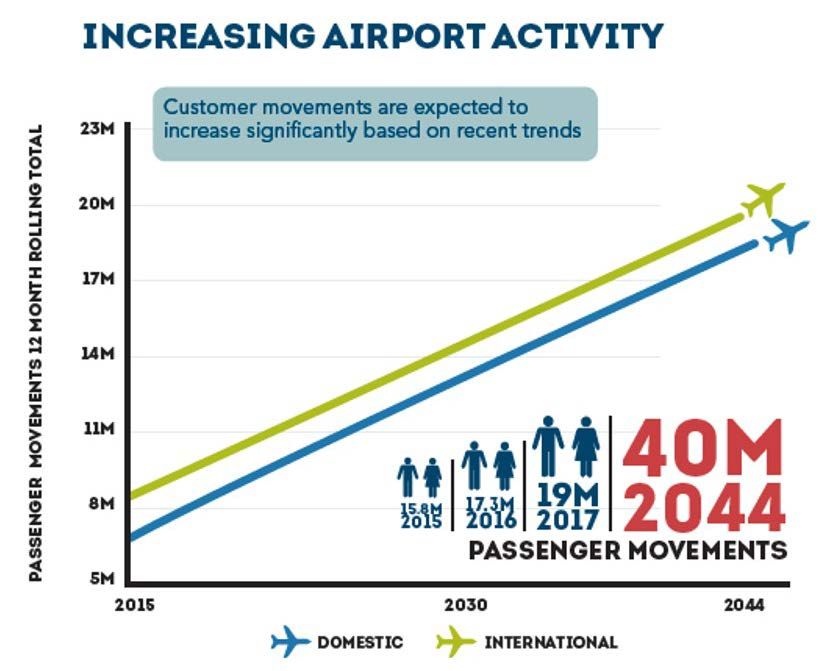
Board Meeting| 22 October 2019
                                                                                                                                                          Agenda item no.9.4
                                                                                                                                                              Closed Session
CONFIDENTIAL

    construction at a later date as there are no associated dependencies with the proposed new Airport–Puhinui Station-Manukau bus service, the
    priority facility to have operational by end of 2020/early 2021.
36. The operational budget for the proposed new frequent Airport–Puhinui–Manukau Bus Service and its supportive local bus network changes is
    confirmed for 2020/21.
37. Implementing the proposed new regional express connection between the Airport and New Lynn (in 2021/22) is not provided for within the
    current envelope and will need to be addressed through subsequent funding processes. The same applies for the recommended proposed
    extension of local bus routes 31 and 32 (outlined in Attachment 1).

Overview of NZ Transport Agency funding and endorsement for this programme
38. In December 2018, the Transport Agency Board approved funding for pre-implementation phase of Puhinui Station Interchange. On 8 May
    2019, the Transport Agency Board delegated future decisions and endorsement of the STAAI business case to the Transport Agency Chief
    Executive (CE), provided the programme remains within the P95 cap of $92M provided at the time4. The STAAI P95 programme cost is $87.9
    M and therefore the business case is within the Transport Agency’s CE’s delegation to endorse.

Timeframes
39. Timeframes for the recommended STAAI programme investments - both capital and operational expenditure - is shown in Figure 6. The
    Māngere-Airport cycle schemes will only proceed to construction phase subject to outcomes of the detailed design phase, community feedback
    and funding availability.

4
    This report lists a P95 programme cost of $87.9 million (July’19) whereas the P95 programme cost provided to NZTA (in May’19) was $92 million. The reasons for this are:
    •   The STAAI P95 Programme cost of $92 million endorsed by NZTA in May 2019 consisted of concept design estimates.
    •   Developed design has since been completed for Puhinui Station Interchange and the new developed design P95 estimate is $63 million as opposed to the P95 concept
        design estimate of $62.3 million.
        Further, the NZTA approved P95 cap includes a 5.7% AT internal admin cost that is only required for NZTA reporting purposes. The P95 Programme cost in this report
        ($87.9 million) does not include that 5.7% admin cost.
    •   The P95 programme figure in this report ($87.9 million) is based on recent, and final SSBC cost estimates (July 2019).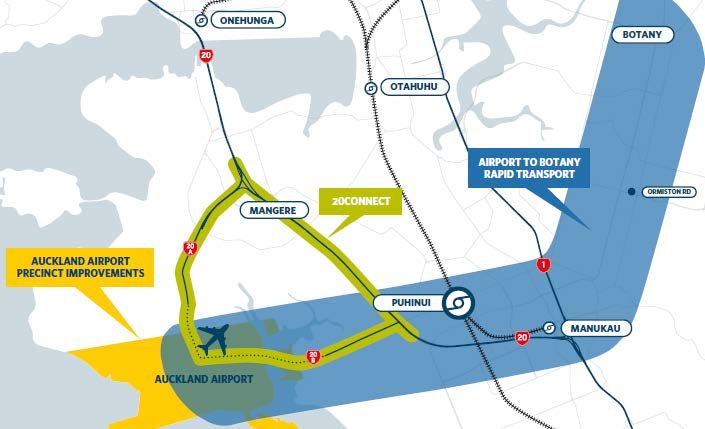
Board Meeting| 22 October 2019
                                                                                                                                   Agenda item no.9.4
                                                                                                                                       Closed Session
CONFIDENTIAL

                  Figure 6 – Timeframes for the STAAI Programme (capital and operational expenditure recommendations)

Risks
Funding Approval Timescale Risks
40. To progress the Puhinui Station Interchange into its next stage of construction AT needs to secure Implementation/Construction Funding from
    the Transport Agency by November/December 2019 at the latest. Delay in obtaining this will negate benefits of the adopted ECI contract
    approach and risk delay to project programme.
41. Similarly, to progress the Puhinui Road/Lambie Drive bus priority project and the Māngere-Airport cycle schemes, AT needs to secure Pre-
    Implementation/Detailed Design funding; and – for the bus priority project - Implementation/Construction funding from the Transport Agency as
    soon as possible to maintain programme target of operational by end of 2020/early 2021.
42. The project team plan to submit these funding applications to the Transport Agency in early November 2019. A critical document that is required
    to support this is the completed STAAI business case which this report is outlining and seeking Board endorsement on.
Board Meeting| 22 October 2019
Agenda item no.9.4
Closed Session
CONFIDENTIAL
Cost Risks
43. The majority of the capital expenditure costs recommended by the business case is in the Puhinui Station Interchange (70%). This is also the
most developed with costs estimates based on Developed Design, therefore the cost risk associated with this component is considered low.
44. The remainder elements - the Puhinui Bus priority and Māngere–Airport cycle schemes - are based on Concept Design level of detail and there
is risk of under or over estimating costs due to still unknown factors. This has been mitigated by completing parallel cost estimate peer reviews
and documenting risks. It is also being mitigated by using the 50th percentile ‘expected estimate’ (P50) and 95th percentile ‘funding estimate’
(P95) range in reporting.
Property Risk
45. The property risk of the STAAI programme is considered low as one of the main drivers of the programme is to have all recommended
improvements operational by 2020/21. This essentially discounts any schemes that would require additional property or land requirements.
46. Phase 1 of the Puhinui Station Interchange can be largely accommodated on land holdings currently owned by AT and KiwiRail. The land
located to the east of the station is currently held by Land Information New Zealand (LINZ) for rail purposes and KiwiRail is negotiating to
acquire this land to provide for future third and fourth rail lines on the North Island Main Trunk.
47. AT requires part of this land for the new station footprint as well as for access to the station from the eastern side. In the interim, KiwiRail has
taken a lease of this land from LINZ and has agreed to sublease the land to AT for construction of the station and ongoing access and
maintenance.
Consent Risks
48. The consenting risk of the STAAI programme is considered low. The Puhinui Station project has already obtained the necessary statutory
approvals. The planning assessment of the Puhinui Road/Lambie Drive Bus Priority project indicates that resource consent could be processed
on a non-notified basis provided the adverse effects of the proposed removal of native trees along this corridor (~30 trees) can be appropriately
mitigated. Based on current Concept Design, no major consenting risks have been identified for the Māngere-Airport cycle schemes.
Project Partner and Mana Whenua Engagement Risks
49. Auckland Airport and the Transport Agency support AT’s recommended STAAI package of works. Regular co-ordination meetings occur
between the Project Partners and AT to ensure good integration between the various projects and to manage risks.
50. All Mana Whenua partners with an interest in the STAAI programme area have been engaged with on a regular basis since the beginning of
the business case development in early 2018. Engagement is on-going and feedback received has informed the development of the
programme, particularly in the development of the Puhinui Station Interchange.Board Meeting| 22 October 2019
Agenda item no.9.4
Closed Session
CONFIDENTIAL
Programme, Reputational and Interdependency Risks
51. The Puhinui Station Interchange construction is planned to occur faster than any recent similar facilities AT has undertaken, for example
Manukau Bus Station and Ōtāhuhu Interchange. The mitigation approaches to this has been the adoption of an ECI process and station closure
during construction, however, there are still delivery risks that cannot be fully mitigated, such as cancellation of planned rail possessions (block
of lines or night electrical isolations), extreme weather events and unexpected ground conditions.
52. The Puhinui Road/Lambie Drive bus priority project impacts on currently available on-street parking spaces (approximately 150 spaces) and
presents a potential reputational risk to AT if the local community strongly object to this proposal.
53. The public transport reliability, travel time benefits and forecast increase in public transport uptake on the Airport’s eastern corridor (via SH20B
and Puhinui Road) is reliant on the corridor-wide improvements being delivered in a timely manner by the three Project Partners. Delay or
failure to deliver one or more components of this programme will delay achieving the full benefits sought and present reputational risk.
54. This risk is considered low as the Project Partners are committed to the programme and well advanced in progressing their components.
Implementation and operational timeframes still present some risk. Full clarity on this will only be achieved once the various projects go into
their respective construction phases.
55. Proceeding with the detailed design phase of the Māngere-Airport cycle schemes without certainty of construction funding also presents some
reputational risk to AT as the community will have some expectations for outcomes. This will be mitigated by ensuring the engagement narrative
clearly states that proposed schemes are subject to funding and public feedback, including local community and key stakeholder support.
Communication and Engagement
56. The emerging proposed short-term improvements was first presented to the public in November 2018 as part of public consultation on the
Southwest Gateway Programme. Feedback was largely supportive and is summarised in Attachment 2.
57. The next round of public engagement will commence in November 2019. Relevant local boards, councillors and other key stakeholders will be
informed of material prior to public engagement commencing. A Summary Report of the November 2018 engagement will also be made
available to the public via AT website as part of the November 2019 consultation phase. Engagement with Mana Whenua will continue to
inform the development of detailed design for the programme.
58. Public engagement on the Māngere cycle schemes is planned to occur in early 2020.Board Meeting| 22 October 2019
Agenda item no.9.4
Closed Session
CONFIDENTIAL
Next steps
59. Subject to the Board approving the recommendations in this report, the expected next steps for the project are to:
1) Submit and seek endorsement of the final STAAI business case to the Transport Agency via the Transport Agency’s Chief Executive
(as per the May 2019 Transport Agency Board decision).
2) Submit funding applications to the Transport Agency to secure:
i. Pre-Implementation/Detailed Design funding for the Puhinui Road/Lambie Drive bus priority and Māngere-Airport cycle projects;
and
ii. Implementation/Construction Funding for the Puhinui Station Interchange and Puhinui Road/Lambie Drive bus priority projects.
3) Commence public and key stakeholder consultation and engagement on the Southwest Gateway Programme in November 2019,
including more targeted consultation and engagement with the local community in the Puhinui Road/Lambie Drive bus priority corridor.
4) Complete detailed design phase of Puhinui Road/Lambie Drive Bus Priority project by December 2019 taking into account public and
local community feedback. Seek consents and proceed to procure, award and begin enabling and construction phase.
5) Commence detail design phase of the Māngere-Airport cycle schemes in early 2020 and confirm scope and detailed design cost
estimates to inform further discussions on overall programme funding shortfall and next steps on this project.
Attachments
Attachment Number Description
1 The recommended STAAI programme elements
2 Summary of Southwest Gateway Programme November 2018 EngagementBoard Meeting| 22 October 2019
Agenda item no.9.4
Closed Session
CONFIDENTIAL
Glossary
Acronym Description
AC36 and APEC Americas Cup and Asia-Pacific Economic Cooperation Forum, both events to be held in Auckland in 2021.
AT Auckland Transport
ECI Early Contractor Involvement
HLC Homes Land Community (previously Hobsonville Land Company)
LINZ Land Information New Zealand
P50 and P95 50th percentile ‘expected estimate’ range and 95th percentile ‘funding estimate’ range
RFT Regional Fuel Tax
RLTP Regional Land Transport Plan
SSBC Single Stage Business Case
T3 Transit lane priority for three or more persons in a vehicleBoard Meeting| 22 October 2019
Agenda item no.9.4
Closed Session
CONFIDENTIAL
Document ownership
Submitted by Renata Smit
Manager Strategic Projects South & East,
Planning and Investment
Chris Morgan
Group Manager Strategic Projects,
Planning and Investment
Mark Laing
Executive General Manager Finance
Recommended by Jenny Chetwynd
Executive General Manager Planning and Investment
Approved for submission Shane Ellison
Chief ExecutiveBoard Meeting| 22 October 2019
Agenda item no.9.4
Closed Session
CONFIDENTIAL
Attachment 1 – The recommended STAAI programme elements
Figure A.1 – Upgrade of Puhinui Station to allow seamless bus / rail connections for customers and designed for future rapid transit bridge
Stage 1 – New station by 2020/21, with buses to/from Airport and Manukau Stage 2 – Station with proposed new Airport to Botany rapid transit bridge
using existing Bridge St to cross Southern and Eastern rail lines (implementation timing beyond 2020/21 due to need for additional land)Board Meeting| 22 October 2019
Agenda item no.9.4
Closed Session
CONFIDENTIAL
Figure A.2 – Recommended public transport network improvements to enhance public transport accessibility to/from the airport area
Existing (AT) Public Transport Network to Airport Recommended STAAI Public Transport Network: Recommended bus network confirmed to be
Area operational by 2020/21:
1) New more frequent and direct Airport–Puhinui–
Manukau Bus Service, branded as “AirportLink”, • All services listed under (1).
with some local bus network changes to address
coverage gaps created by modifying the existing New AirportLink service will operate from 4:30am to
Airport Service (i.e. new truncated route 380 and 1:30am to meet the needs of airport shift workers.
new route 36). Per annum operating expenditure programmed for
2) New Airport-New Lynn Express (NLX) Bus Service. 2020/21 and operational budget ring fenced.
3) Extension of two existing local bus routes (31 and
32) to continue onwards to the Airport to provide a Operational elements of recommended STAAI
more direct, single seat journey for Māngere business case subject to funding (beyond 2020/21):
residents in particular.
• Remaining recommended bus services listed under
(2) and (3) potentially implemented in 2021/22 or
beyond, subject to next round of RLTP / Transport
Agency operational funding availability.Board Meeting| 22 October 2019
Agenda item no.9.4
Closed Session
CONFIDENTIAL
Figure A.3 – Recommended bus priority lanes along Puhinui Road and Lambie Drive and associated walking and cycling improvements
Bus priority lanes on Puhinui Road and Lambie Drive, together with the priority lanes (high occupancy T3 lanes) being delivered by the Transport Agency and Auckland Airport
along SH20B and within the Airport precinct, will enable a reliable 10-12 minute bus travel time between the Airport and Puhinui Station; and a 22-26 minutes bus travel time
between the Airport and Manukau.
The priority lanes will impact on approximately 150 available on-street parking spaces during the proposed peak hour priority lane operating times (subject to November /
December 2019 public consultation) and approximately 30 native trees will need to be removed to allow for bus vehicle clearances.
Walking and cycling improvements are also proposed on Puhinui Road and Lambie Drive.Board Meeting| 22 October 2019
Agenda item no.9.4
Closed Session
CONFIDENTIAL
Figure A.4 – Recommended cycle connections between Māngere and the airport area
1) Jordan Rd Speed Management
(minor works - $115K)
2) Jordan/Kirkbride intersection
improvements, cyclist priority
signals (minor works - $120k)
3) Moyle Park/Māngere Centre Park
upgrade of the existing Shared Use
Path (moderate works - $1.8M)
4) Bader Drive new Shared Use Path –
(moderate works - $1.2M)
5) Coronation/Kirkbride/McKenzie new
on road cycle path and some
Shared Use Path – (major works
$6.2M)
The business case identified five discrete cycle schemes, ranging from minor to moderate in scale. The facilities will provide improved cycle connectivity between the Māngere
residential area (a significant airport employee origin) and its neighbouring airport employment zone.
The proposals integrate with existing and planned cycle infrastructure in the area. This includes the Māngere Future Streets project – which implemented high quality cycle
improvements in a portion of Māngere - and the proposed replacement of the Old Māngere Bridge by the Transport Agency with a new high-quality walking and cycling bridge
by 2022/23. Demand modelling suggests the proposed cycling infrastructure will significantly contribute to achieving desired mode shift with approximately 400 new estimated
daily cycling trips.
HLC and Housing New Zealand (HNZ) are delivering a range of neighbourhood developments in the Māngere area which will interface with some of the proposed STAAI
Māngere cycle schemes. Given that there needs to be a high level of alignment between AT, HLC and HNZ in this area further co-ordination with HLC will be undertaken during
the detailed design phase.Board Meeting| 22 October 2019
Agenda item no.9.4
Closed Session
CONFIDENTIAL
Attachment 2 – Summary of Southwest Gateway Programme November 2018 EngagementYou can also read


