Sleep Hygiene Program for Night Shift Workers - Digital ...
←
→
Page content transcription
If your browser does not render page correctly, please read the page content below
Gardner-Webb University
Digital Commons @ Gardner-Webb University
Nursing Theses and Capstone Projects                                                                                Hunt School of Nursing

5-2016

Sleep Hygiene Program for Night Shift Workers
Dale Wicker
Gardner-Webb University

Follow this and additional works at: https://digitalcommons.gardner-webb.edu/nursing_etd
     Part of the Psychiatric and Mental Health Nursing Commons

Recommended Citation
Wicker, Dale, "Sleep Hygiene Program for Night Shift Workers" (2016). Nursing Theses and Capstone Projects. 255.
https://digitalcommons.gardner-webb.edu/nursing_etd/255

This Capstone is brought to you for free and open access by the Hunt School of Nursing at Digital Commons @ Gardner-Webb University. It has been
accepted for inclusion in Nursing Theses and Capstone Projects by an authorized administrator of Digital Commons @ Gardner-Webb University. For
more information, please see Copyright and Publishing Info.
Sleep Hygiene Program for Night Shift Workers
by
Dale Wicker
A capstone project submitted to the faculty of
Gardner-Webb University Hunt School of Nursing
in partial fulfillment of the requirements for the degree of
Doctor of Nursing Practice
Boiling Springs
2016
Submitted by: Approved by:
______________________________ ________________________
Dale Wicker Dr. Sharon Starr
______________________________ ________________________
Date DateApproval Page
This capstone project has been approved by the following committee members:
Approved by:
____________________________________ __________________________________
Cassaundra Hefner, DNP, FNP-BC Date
Committee Member
____________________________________ __________________________________
Steve Mooney, DNP, RN Date
Committee Member
____________________________________ __________________________________
Cindy Miller, PhD, RN Date
Graduate Program Chair
iiAbstract
Sleep is vital to health and wellbeing. Service professionals such as nurses, firefighters,
and police officers, historically have worked in shifts requiring around the clock
coverage. Now, many companies are following similar strategies with working
employees in 12 hour or 8 hour shifts including night shift. Night shift workers must
adjust to sleeping during the daytime by combating their normal circadian regulatory
system. Maladaptation to daytime sleep can affect overall sleep time and poorer sleep
quality. Shift Work Disorder is a medical condition where employees struggle with
chronic sleep deprivation that can lead to other health problems. Employee health clinics
offer an excellent resource to implement evidence-based strategies to assist night shift
employees with methods to improve daytime sleep.
Keywords: sleep deprivation, shift work disorder, blue-light therapy, sleep-
hygiene
iiiAcknowledgments
I would like to thank Sharon Starr, PhD, RN, Dean of Hunt School of Nursing,
Janie Carlton, Ed.D, RN, former faculty member of Hunt School of Nursing, Cassaundra
Hefner, DNP, FNP-BC, and Steve Mooney, DNP, RN for their encouragement and
mentoring with this Capstone Project.
iv© Dale Wicker 2016
All Rights Reserved
vTABLE OF CONTENTS
Background ..........................................................................................................................1
Problem Recognition ...........................................................................................................2
Needs Assessment ................................................................................................................3
Population ................................................................................................................7
Stakeholders .............................................................................................................7
SWOT Analysis ...................................................................................................................8
Strengths ..................................................................................................................8
Weakness .................................................................................................................8
Opportunities............................................................................................................8
Threats......................................................................................................................9
Theoretical Framework ........................................................................................................9
Secondary Prevention ............................................................................................10
Literature Review...............................................................................................................11
Consequences of Sleep Deprivation ......................................................................11
Shift Work Disorder ...........................................................................................................13
Essential Features of Shift Work Disorder ............................................................14
Influencing and precipitation Factors of Shift Work Disorder ..............................14
Onset and Complications of Shift Work Disorder .................................................14
Objective Findings of Shift Work Disorder ...........................................................15
Goal of Project ...................................................................................................................17
Project Design ....................................................................................................................20
Population ..............................................................................................................20
Team Selection.......................................................................................................20
viBest Practices Development ..................................................................................20
Timeline .............................................................................................................................24
Outcome Measurements.....................................................................................................25
Cost/Benefit Analysis ............................................................................................26
Ethical Considerations ...........................................................................................28
Project Implementation ......................................................................................................28
Process of Project ...................................................................................................29
Results ....................................................................................................................35
Project Evaluation ..............................................................................................................52
Comparison to Literature .......................................................................................52
Theoretical Framework ..........................................................................................53
Interpretation of Process ........................................................................................53
Conclusion .........................................................................................................................56
References ..........................................................................................................................57
viiList of Figures
Figure 1: Number of Night Shift Employees and Years of Service ....................................3
Figure 2: Project Variables using Neuman Systems Model ..............................................10
Figure 3: Source: ActiGraph Sleep Log.............................................................................16
Figure 4: Group with Pre-Test Total PSQI < 10% Post-Test Improvement ......................49
Figure 5: Pittsburgh Sleep Quality Index (PSQI) ..............................................................55
viiiList of Tables
Table 1: Results from the Two Section Questionnaire ........................................................6
Table 2: Sleep Time Night Shift Employees Receive .........................................................7
Table 3: International Classification for Sleep Disorders (ICSD-3) ..................................13
Table 4: Neuman Systems Conceptual Model ...................................................................19
Table 5: An Appropriate Environment for Restorative Sleep ...........................................22
Table 6: TimeLine..............................................................................................................24
Table 7: Estimated Costs of Interventions .........................................................................27
Table 8: Criteria for use of Melatonin ...............................................................................30
Table 9: Criteria for use of Light Therapy .........................................................................30
Table 10: Baseline Results .................................................................................................32
Table 11: Participant 1 .......................................................................................................35
Table 12: Participant 2 .......................................................................................................36
Table 13: Participant 3 .......................................................................................................37
Table 14: Participant 4 .......................................................................................................38
Table 15: Participant 5 .......................................................................................................39
Table 16: Participant 6 .......................................................................................................40
Table 17: Participant 7 .......................................................................................................41
Table 18: Participant 8 .......................................................................................................42
Table 19: Participant 9 .......................................................................................................43
Table 20: Participant 10 .....................................................................................................44
Table 21: Participant 11 .....................................................................................................45
Table 22: Overall Results of All Participants ....................................................................46
ixTable 23: Total All Participants with Baseline PSQI > 10 ................................................47
Table 24: All Participants with Baseline PSQI < 10..........................................................48
Table 25: Average Sleep Time Improvement in Group with Baseline PSQI < 10 ............51
x1
Background
Sleep is as essential as food and water. Humans spend about a third of their lives
asleep (Karagozoglu & Bingol, 2008). According to Healthy People 2020 (2015), sleep
is a critical determinant of health and well-being. Adequate sleep supports immunity,
blood sugar metabolism, work performance, and work safety (Healthy People 2020,
2015). Man’s basic physical activities begin with the first hour of the day and decreases
towards night (Karagozoglu & Bingol, 2008). The circadian rhythm is man’s 24 hour
night and day (sleep and awake) regulatory system or man’s biological clock
(Karagozoglu & Bingol, 2008). One of the main functions of the circadian rhythm is
preparing the body for sleep (Karagozoglu & Bingol, 2008). Over the last 30 years, there
has been a significant increase in the number of individuals sleeping less than six hours in
a 24-hour period (Healthy People 2020, 2015). These individuals have been categorized
as “short sleepers” (Healthy People 2020, 2015). An example of this is demonstrated in a
recent study looking specifically at the sleep habits of nurses working 12 hour shifts. The
results showed that both day and night 12 hour shift nurses slept less than six hours when
working consecutive shifts (Geiger-Brown et al., 2012). The average total sleep time
(TST) after the first 12 hour shift was 5.7 hours for nurses working on the day shift and
was 5.2 hours for nurses working on the night shift (Geiger-Brown et al., 2012). On
average, intershift sleep was two hours shorter than the day prior to the first shift (Geiger-
Brown et al., 2012). After the third consecutive 12 hour shift, the TST averaged 7.3
hours for nurses working on the day shift and 5.1 hours for nurses working on the night
shift (Geiger-Brown et al., 2012). It has been illustrated through research that night shift2
workers sleep an estimated 10 hours less per week than those working evening or
dayshift (Akerstedt, 2003).
Problem Recognition
In observing employees of a manufacturing company in the western portion of a
mid-Atlantic state, sleep deprivation and sleep quality appeared to be a concern with
individuals working night shift. When interviewing employees, the vast majority felt
they did not get enough sleep and felt chronically fatigued. Many of these employees
verbalized that they have some displeasure for their job because of inadequate sleep. The
bulk of the employees interviewed slept six hours or less, citing difficulties with getting
to sleep and staying asleep as the main reasons for their sleep deprivation. In discussing
the problem with the Human Resource department, the majority of job turnover was with
the night shift employees. Most employees on night shift had been working with the
company for less than three years (see Figure 1.). As of 2014, night shift employee
retention appeared to be low possibly related to sleep deprivation resulting in job
dissatisfaction. Also in 2014, there were 60 recordable accidents, 45 of the accidents
were on night shift.3
Note. As of 2014, the majority of night shift employees had worked less than 3 years. Temporary
Employees were not known and not listed in graph.
Figure 1. Number of Night Shift Employees and Years of Service.
Needs Assessment
Information gained from interviews with night shift employees indicated that lack
of sleep was a factor in job satisfaction. Human Resource records demonstrated that the
majority of night shift workers have been employed less than three years (see Figure 1.).
Sleep deprivation resulting in poor job satisfaction could be a contributing factor to job
turnover on night shift. Performing a needs assessment was deemed to be necessary.
Sleep disorders affect day and night shift workers. Shift Work Disorder is a
condition were employees have difficulty with daytime sleep and exhibit excessive
sleepiness secondary to working night shift. In performing the needs assessment, the
following questionnaires were handed out to night shift workers at the July, 20154
quarterly employee meetings to identify common causes for sleep deprivation. The
questionnaire had two sections. The first three questions were used to assess for
symptoms of Shift Work Disorder.
Do you experience difficulties with sleeping or excessive sleepiness?
(yes/no)
Is the sleep or sleepiness problem related to a work schedule where you
have to work when you normally sleep? (yes/no)
Has this sleep or sleepiness problem related to your work schedule
persisted for a least at least one month? (yes/no)
These questions follow the International Classification of Sleep Disorders (ICSD-2) for
diagnosing Shift Work Disorder (Waage et al., 2009). For the first set of questions, if the
employee answered yes to all questions, the employee scored a “yes” for symptoms of
Shift Work Disorder. The second set of questions used the Global Sleep Assessment
Questionnaire (GSAQ) to help screen for Shift Work Disorder and various other sleep
disorder symptoms that might affect night shift workers (Roth et al., 2002). For the
GSQA, if the employee answered “usually” or “always” then the employee scored a
“yes” for that particular sleep disorder. The answers of “never” or “sometimes” were
scored as a “no”. The following GSAQ questions made up the second section of
questions.
Did you have difficulty falling asleep, staying asleep, or feeling poorly
rested in the morning? (never, sometimes, usually, always)
Did you fall asleep unintentionally or have to fight to stay awake during
the day? (never, sometimes, usually, always)5
Did sleep difficulties or daytime sleepiness interfere with your daily
activities? (never, sometimes, usually, always)
Did work or other activities prevent you from getting enough sleep?
(never, sometimes, usually, always)
Did you snore loudly? (never, sometimes, usually, always)
Did you hold your breath, have breathing pauses, or stop breathing in your
sleep? (never, sometimes, usually, always)
Did you have restless or “crawling” feelings in your legs at night that went
away if you moved your legs? (never, sometimes, usually, always)
Did you have repeated rhythmic leg jerks or leg twitches during your
sleep? (never, sometimes, usually, always)
Did you have nightmares, or did you scream, walk, punch, or kick in your
sleep? (never, sometimes, usually, always)
Did the following things disturb your sleep: pain, other physical
problems, worries, medications, or other? (never, sometimes, usually,
always)
Did you feel sad or anxious? (never, sometimes, usually, always)
Permissions were obtained from the author(s) to use the above three questions (S.
Waage, personal communication, May 4, 2015) and the Global Sleep Assessment
Questionnaire (T. Roth, personal communication, April 1, 2015). Table 1 below
provides the results from the two section questionnaire used in the July 2015 night shift
employee meeting.6
Table 1
Results from the Two Section Questionnaire
Possible Sleep Disorder Causes Prevalence in Night Shift Employees
Shift Work Disorder 39%
Sleep Apnea 20%
Worries 9%
Pain 8%
Restless Legs 6%
Other 4%
Other physical problems 4%
Periodic Limb Movement 4%
Anxiety 3%
Medications 2%
Parasomnias 1%
Note. Prevalence of sleep disorder causes from July 2015 night shift employee meeting.7
The National Institute of Health recommends 7-8 hours of sleep daily. The final
question on the July 2015 employee meeting questionnaire was to see how much sleep
time night shift employees were receiving. Table 2 provides the results.
Table 2
Sleep Time Night Shift Employees Receive
Less than 7 Hours More than 7 Hours Left Blank on
Sleep Sleep Questionnaire
How many hours
Total of 109 Total of 33 Total of 5
do you typically
employees or 74% employees or 23% employees or 3%
sleep after working
of night shift of night shift of night shift
night shift?
Note. The results included full time and temporary night shift employees.
Population
The night shift at the project facility includes manufacturing employees working
eight hour and 12 hour shifts. Respondents included 147 men and women of temporary
and full-time status.
Stakeholders
The Manager of Health and Welfare Benefits was the chief stakeholder for any
assessed problem with employee health. She also was the internal contact person to
assist with any potential project coordination and/or implementation along with the
associated costs. If the project deemed beneficial, the Manager of Health and Welfare8
Benefits would report directly to the Vice President of Human Resources for additional
approval. A sleep hygiene startup capstone project was approved to study sleep
interventions to potentially improve sleep time and sleep quality for night shift workers.
SWOT Analysis
Strengths
The manufacturing company provides a culture of wellness for its employees. By
providing on-site screenings (lab work, mammograms, acute care visits) and health
promotion activities (health coaching, weight loss incentives), employees are provided a
cost-effective and convenient way for improving their health. The employee clinics are
available at opportune times by being open during day and night shift work hours. The
employees are given access to a nurse practitioner for consultation on acute or chronic
conditions. The facility had the resources to implement the project.
Weakness
The company’s employee clinics did not have a sleep program in place for night
shift workers.
Opportunities
In speaking with the company nurse, at the time of the project, there was not a
policy on fatigue or sleep in regards to employee safety and machine operation. If the
nightshift sleep project was deemed to be successful, a policy would be implemented to
screen for sleep deprivation at each required annual wellness visit at employee clinic or at
initial employee clinic visit for new hires on night shift.9
Threats
Potential threats to project that were considered were the cooperation of
employees to be compliant with sleep project interventions. Also, consideration was
given that some employees may have attitudes and prejudices about expectations of night
shift work and sleep which could affect the project (example: “ a person is supposed to
sleep less working nights”).
Theoretical Framework
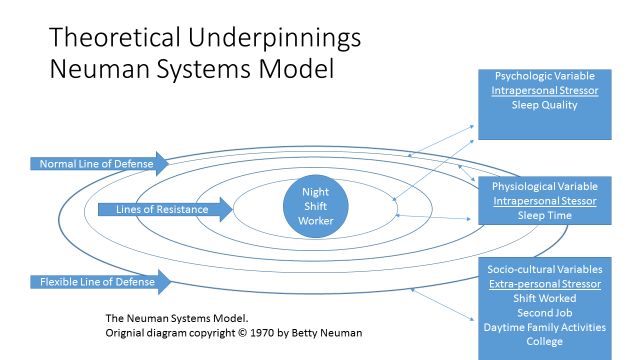
The Neuman Systems Model (NSM) was the conceptual model that was utilized
as a guide for this project. The NSM has been widely used in nursing education and
research. Simply, the NSM looks at the ideal client (patient) as a system that successfully
adjusts to internal and external environmental stressors to maintain normal wellness
stability. It is comprised of a core consisting of several variables: physiological,
psychological, developmental, sociocultural, and spiritual. Concentric circles around the
core (client system) provide varying levels of defense. The normal line of defense is the
systems normal or usual wellness level (Fawcett & Desanto-Madeya, 2013). Expansion
of the normal lines of defense reflects an enhanced wellness state; however, contraction
of the normal lines of defense diminishes the state of wellness (Fawcett &Desanto-
Madeya, 2013). The lines of resistance protect the basic structure and return the client to
wellness at the same or a higher state of wellness (Fawcett & Desanto-Madeya, 2013).
The lines of resistance protect the client system from system instability that could result
from invasion of stressors (Fawcett & Desanto-Madeya, 2013). Stressors make up a
client’s environment. The stressors can be internal or external. The internal environment10
represents the intrapersonal stressors. The external environment represents the
interpersonal and extra personal stressors (Fawcett & Desanto-Madeya, 2013).
Secondary Prevention
Secondary prevention involves identifying an actual risk factor associated from an
environmental stressor. With night shift workers, night shift would be an external
environmental stressor and extra-personal, sociocultural stressor to the client system
(night shift sleep program participant). The stressor’s influence on the client’s normal
line of defense and lines of resistance is measured as sleep quality and total sleep time.
Please see Figure 2 for project variables using Neuman Systems Model.
Figure 2. Project Variables using Neuman Systems Model.11
Literature Review
Consequences of Sleep Deprivation
Employee health. As previously mentioned, adequate sleep is vital to the body.
Chronic sleep deprivation has been linked to hypertension, heart disease, obesity, and
diabetes (Healthy People 2020, 2015). In a recent study, the Harvard School of
Medicine demonstrated that prolonged sleep restriction with concomitant circadian
disruption slowed the metabolic rate and increased postprandial plasma glucose levels
(Buxton et al., 2012). The researchers concluded that chronic sleep deprivation with a
continual alteration in the normal circadian cycle could possibly increase the risk of a
person developing obesity and diabetes (Buxton et al., 2012).
Job satisfaction. Job satisfaction is key to employee retention. In a study
looking at job satisfaction of nurses, as sleep quality increased so did job satisfaction
(Karagozoglu & Bingol, 2008). The researchers concluded that working night shift or
rotating shifts had a negative effect on their sleep quality and thus less job satisfaction.
Day shift nurses have the highest sleep quality and highest job satisfaction scores
(Karagozoglu & Bingol, 2008). A separate study examined the relationship between
shifts length and nurse burnout. It was demonstrated that increases in shift length were
associated with increased odds of job dissatisfaction, burnout and intention to leave the
job (Stimpfel, Sloane, & Aiken, 2012). Job dissatisfaction and burnout were highest
when nurses worked longer than 13 hour shifts (Stimpfel et al., 2012). Employees
working longer, consecutive night shifts can lead to sleep deprivation, job dissatisfaction,
and burnout.12
Employee Safety. A recent study evaluated the sleep habits of 3,345 New York
State workers. Their total sleep time was 6.7 hours in length. Short sleepers (< 6 hrs)
were mostly associated with night shift work (Ohayon, Smolensky, & Roth, 2010). Some
20% of employees demonstrated excessive sleepiness in jobs requiring high attention,
and these individuals were strongly associated with working nights (Ohayon et al., 2010).
Sleep quality. “Sleep quality” can mean different things to different people. For
some it can mean restlessness during the night, movement during sleep, anxiety, tension,
or calmness when trying to sleep (Harvey, Stinson, Whitaker, Moskovitz, & Virk, 2008).
For others, it can mean ease of sleep onset, sleep maintenance, total sleep time, and early
awakening (Harvey et al., 2008). It has been well established that night shift works
against the bodies’ normal circadian rhythm. Night workers are required to be active
when their body rhythms are preparing for inactivity and sleep, and sleep when their
bodily rhythms are preparing them to be active and awake (Waage et al., 2009). A study
of night shift Taiwan nurses demonstrated that the majority of studied night shift workers
(57%) demonstrated poor sleep quality and overall reduction in quality of life measures
(Shao, Chou, Yeh, & Tzeng, 2010). In a similar study of night shift oil rig workers, the
prevalence of poor sleep quality and subjective health complaints were demonstrated
more often in individuals with Shift Work Disorder than night shift workers without this
disorder (Waage et al., 2009). A separate study looking at sleep quality found that night
shift workers were 4.8 times more likely to have difficulty with sleep onset and that night
shift workers were more likely to have chronic sleepiness and insomnia (Walia, Hayes,
Przepyszny, Karumanchi, & Patel, 2012). The study also concluded that individuals
indicating sleep problems related to shiftwork were less likely to be referred to a sleep13
medicine specialist for effective treatment options (Walia et al., 2012). The following
headings will further discuss Shift Work Disorder and how an employee clinic night shift
sleep hygiene program may help with identifying this sleep disorder along with
nonprescription interventions to help manage it.
Shift Work Disorder
It has been estimated that 20% of the workforce in industrialized countries are
night shift workers (Sateia, 2014). The literature review demonstrates that many of these
night shift workers have poor sleep quality. Shift Work Disorder is a medical condition
where individuals display repeated insomnia and/or excessive sleepiness, along with a
decrease in TST. The following table will provide the most recent criteria for identifying
Shift Work Disorder. (Table 3)
Table 3
International Classification of Sleep Disorders (ICSD-3)
A. There is a report of insomnia and/or excessive sleepiness, accompanied by a
reduction of total sleep time, which is associated with a recurring work
schedule that overlaps the usual time for sleep.
B. The symptoms have been present and associated with the shiftwork schedule
for at least three months.
C. Sleep log and actigraphy monitoring (whenever possible) for at least 14 days
(work and free days) demonstrate a disturbed sleep and wake pattern.
D. The sleep and/or wake disturbance are not better explained by another current
sleep disorder, medical or neurological disorder, mental disorder, medication
use, poor hygiene, or substance use disorder.
________________________________________________________________________
Note. Criteria A-D must be met for diagnosis of Shift Work Disorder.14
Essential Features of Shift Work Disorder
Shift Work Disorder is characterized by excessive sleepiness or chronic insomnia
due to a work schedule of being awake when one is typically sleeping (Sateia, 2014).
TST is typically curtailed by 1 to 4 hours and sleep quality is perceived as unsatisfactory
(Sateia, 2014). It is estimated that between 10% and 38% of night shift workers exhibit
signs of Shift Work Disorder (Sateia, 2014).
Influencing and Precipitating Factors of Shift Work Disorder
Individuals adjust to night shift work by circadian preference. “Morning type”
individuals may have a more difficult time sleeping during the day. Whereas, “night
owls” may prefer staying up late and sleeping during the day. Also, persons with
comorbid medical, psychiatric, and other sleep disorders (sleep apnea) may be at
particular risk for working night shift (Sateia, 2014). Many individuals who work nights
feel they have social pressures to stay awake during the day. This may include family
obligations, a second job, school, or leisure activities (Sateia, 2014). All of these
circumstances can reduce the likeliness of circadian adjustment and can deplete much-
needed sleep.
Onset and Complications of Shift Work Disorder
When employees are hired for night shift, coupled with working an extended
shift, fatigue can result. Circadian adaptation many times is offset by exposure to light at
the wrong time of the day (Sateia, 2014). With this exposure to light, there can be a
tendency to resume daytime activities which further diminishes needed restorative sleep
time. This chronic sleep deprivation and circadian misalignment may lead to problems15
with fatigue and excessive sleepiness and can predispose individuals to safety concerns
related to work or with driving a motor vehicle (Sateia, 2014).
Objective Findings of Shift Work Disorder
Shift Work Disorder can usually be diagnosed by history. Sleep logs and
actigraphy are recommended to demonstrate the typical disruption on the sleep wake
pattern in Shift Work Disorder (Sateia, 2014).
Sleep diary. Sleep diaries or logs are used to measure sleep habits in clinical
research and practice (Redeker & McEnany, 2011). Sleep diaries provide estimates of
sleep time, napping, and feelings of sleepiness. Information can also be gained on habits
and activities that can negatively affect sleep, such as medications, stress, alcohol use,
and caffeine use (Redeker & McEnany, 2011). The sleep log below was used in the sleep
hygiene project to study the sleep habits of night shift workers. (Figure 3)16 Figure 3. Source: ActiGraph Sleep Log.
17

       Actigraphy. The actigraphy device is a widely used method for measuring sleep

time (Redeker & McEnany, 2011). Actigraph are small wristwatch-like devices that

measure the frequency of body movements. With Shift Work Disorder, the person wears

the device for two weeks, and the device records sleep patterns. The device records

movement when the person is awake and little to no movement when a person is asleep

(Redeker & McEnany, 2011). Both the sleep diary and the Actigraph monitor would

show a disturbed sleep pattern to assist in the diagnosis of Shift Work Disorder.

                                     Goal of Project

       The magnitude of acute or chronic sleep deprivation for workers has been well

documented. Work injuries or accidents have been linked to workers who are sleep

deprived. Chronic sleep deprivation has been shown to increase the risk of

cardiovascular diseases such as hypertension, stroke and heart disease, as well as obesity

and diabetes (Redeker & McEnany, 2011). Information from interviews with night shift

employees and from questionnaires from the July 2015 night shift meeting indicated

many night shift workers had the symptoms of Shift Work Disorder. This chronic

sleepiness/fatigue could put individuals at risk for health problems, accidents, and job

dissatisfaction. Based on the needs assessment, evidence-based solutions for shift work

disorder were evaluated for effectiveness in starting a sleep hygiene program for night

shift employees. Interventions included: sleep time shifting, light therapy at awakening

from daytime sleep and during night shift, blue-light blocking sunglasses on the way

home from work, melatonin 3 mg prior to daytime sleep and home environmental

changes (darkening room, earplugs, turning off electronics, etc.). Sleep logs and

Actigraph measurements were to be taken for two weeks for baseline information and
18
appropriateness for participation in project. The Pittsburgh Sleep Quality Index (PSQI)
questionnaire was obtained to measure baseline sleep quality. After sleep program
interventions were used for 3-4 weeks, employees would be reassessed using the PSQI
questionnaire to see if sleep quality improved and actigraph wrist devices were to be
downloaded and compared with sleep logs to see if sleep time had improved.
If deemed beneficial, policy implementation would be initiated to start a sleep
hygiene program that would routinely screen all employees working night shift for
problems with excessive sleepiness from poor sleep quality and decreased sleep time.
Individuals demonstrating symptoms of poor sleep quality and decreased sleep time
would then be assessed for appropriateness for the implementation of the various sleep
hygiene interventions.
As previously stated, secondary prevention would be the goal for the initiation of
a sleep hygiene program. Neuman Systems Model would be used as the conceptual
framework for testing the sleep hygiene program interventions to see if there is an
improvement in sleep quality and sleep time. Table 4 provides the CTE diagram
illustrating Neuman Systems Conceptual Model and the internal and external
environmental stressors that effect sleep time and sleep quality of the night shift worker.19
Table 4
Neuman Systems Conceptual Model
Neuman Client System Normal Line of Normal Lines Flexible Line
Systems Defense and of Defense and of Defense
Conceptual Lines of Lines of
Model Resistance Resistance
Psychological Physiological Socio-Cultural
Variable Variable Variables
Shift Work Employee Sleep Quality Sleep Time Night Shift
Effects on Day-Second
Quality of Job
Sleep and Day-College
Total Sleep Day –Family
Time Events
Intrapersonal Intrapersonal Extra-personal
Stressor Stressor Stressors
Empirical Night Shift Pittsburgh Actigraph Self-Reported
Research Worker Sleep Quality Sleep Logs
Methods Index Self-Reported
Questionnaire
Note. C-T-E Diagram20
Project Design
Population
The project took place at a manufacturing company’s employee clinics which
were located in various counties located in the western portion of a mid-Atlantic state.
The intervention group was made up of a randomized group of eight hour and 12 hour
night shift workers demonstrating symptoms of shift work disorder. The night shift
consisted of adult male and female employees. Night workers were predominately
Caucasian but also consisted of African American, Asian, and Hispanic employees.
Insured employees were routinely screened for chronic health conditions through labs
and wellness visits at the employee clinic. As previously stated, sleep was not previously
being addressed as a routine screening component.
Team Selection
The team members consisted of the Manager of Health and Welfare Benefits and
the employee clinic Certified Nursing Assistant. The Manager of Health and Welfare
Benefits helped coordinate a time for project questionnaires to be distributed at a routine
quarterly night shift meeting. The Certified Nursing Assistant helped with data collection
and adjustment in normal clinic schedule to accommodate the sleep project.
Best Practices Development
Sleep timing. Night shift workers usually revert back to dayshift sleep patterns
on nights off. This can lead to their circadian systems becoming dysregulated,
developing poorer sleep throughout the work schedule cycle (Redeker & McEnany,
2011). It has been shown that night shift workers adopt a compromised sleep circadian
system towards night shift alertness, where individuals stay awake longer on days not21
working (going to bed at 3 am) and sleeping later (arising at 11 am) (Redeker &
McEnany, 2011). When finishing the shift, individuals should not spend time socializing,
shopping or performing chores, but rather, should get home and go straight to bed before
the circadian clock starts stimulating the body to wake up (Redeker & McEnany, 2011).
Time light exposure. Timed light exposure is a guideline in an individual
demonstrating symptoms of Shift Work Disorder. Light exposure (2,350 to 12,000 lux)
administered (at 20 minute breaks, at least 50% of the shift, during the first half of the
shift, or as long as possible during the shift) during the night shift has demonstrated to
improve work performance, alertness, and mood compared to ordinary light exposure.
Some studies have demonstrated that nighttime light exposure can also improve daytime
sleep (Morgenthaler et al., 2007).
Blue-light blocking sunglasses. Night shift workers wearing blue light-blocking
sunglasses on the way home can diminish the circadian upswing from bright morning
light (Sasseville, Benhaberou-Brun, Fontaine, Charon, & Hebert, 2009). Research has
demonstrated that blue light-blocking sunglasses appear to improve daytime sleep in
individuals working night shift. Sleep time has been shown to significantly improve with
individuals wearing these type sunglasses on their way home from work until time they
went to bed (Sasseville et al., 2009).
In a separate study, night shift performance was improved when individuals wore
blue light-blocking sunglasses up until 4 pm on days off of work and also after leaving
night shift until going to bed. The researchers believe that shifting the circadian clock
would help to reduce the misalignment with daytime sleep and night work. From the22
results, they concluded that this can be an effective countermeasure to improve alertness
and performance with night shift workers (Smith & Eastman, 2008).
Environment for restorative sleep. The following Table 5 provides steps for
creating an appropriate environment for restorative daytime sleep (Thorpy, 2010).
Table 5
An Appropriate Environment for Restorative Sleep
Steps: Practical advice:
Ensure the room is dark if sleep is required Ensure the room has sufficiently
during the daytime. Install black-out blinds
in all windows.
Ensure a constant temperature in bedroom. Aim for temperature around 68° F
Avoid too many bed clothes.
Reduce noise exposure before and during the Avoid watching TV or listening to
required sleep period. loud music before sleeping.
Use a room at the rear of the house
if near a busy road.
Consider earplugs if the ambient
noise is intrusive.
Put telephones on an answering
machine.
Ask family members to be quiet.
Avoid large meals, caffeine containing drinks, Schedule mealtime so that the main
smoking, and alcohol before the required sleep meal of the day is during
period. or before the work period.
Consider having a warm, milky drink
before the required sleep
period.
Note. From Supplement to The Journal of Family Practice – Jan. 2010/Vol 59, No 123
Melatonin. Timed melatonin is indicated as a guideline for symptoms of shift
work disorder. Compared to placebo, melatonin taken prior to daytime sleep after night
shift work improves daytime sleep quality and duration (Morgenthaler et al., 2007). The
doses of melatonin studied ranged from 0.5 mg to 10mg. Effectiveness did not appear to
correlate with an increase in dose or change in form (Morgenthaler et al., 2007).24
Timeline
Table 6
Timeline
Task A Task B
July Provide and collect
questionnaires at July night
shift meeting.
August 16th week Interview potential project Use Pittsburgh Sleep Quality
participants. Go over Index (PSQI) questionnaire
employee meeting for baseline information on
questionnaire with employee. potential participants.
August 23rd week Group 1
The first group will each be
given actigraph wrist monitor
and sleep diary.
September 6th week After 2 weeks – Computer
Download Group 1 Actigraph
Monitor to see if appropriate
for project (sleeping < 6.5
hours).
September 6th week Group 1 will continue to wear
13th week actigraph monitor and
20th week participants will be started on
27th week sleep project interventions.
At the end of 28 days. PSQI
questionnaire repeated.
October 4th week Group 2 in October, second
group will be given actigraph
wrist monitor and sleep diary.
October 18th week After 2 weeks – Computer
Download Group 2 Actigraph
Monitor to see if appropriate
for project (sleeping < 6.5
hours).
October 18th week Group 2 will continue to wear
25th week actigraph monitor and
November 1st week participants will be started on
8th week sleep project interventions.
At the end of 28 days. PSQI
questionnaire repeated.25
Outcome Measurements
Actigraphy. According to the American Academy of Sleep Medicine (AASM),
for individuals demonstrating symptoms of shift work disorder, sleep diaries, and
actigraphy are considered guidelines for identifying and evaluating the response to
therapy for individuals demonstrating symptoms of shift work disorder (Morgenthaler
et.al, 2007). In the night shift sleep hygiene project, the Actigraph wrist monitor was to
be used as a quantitative measure to demonstrate total sleep time for participating
employees. The Actigraph portable device records limb movement over an extended
period of time and has been extensively used in the study of sleep and circadian rhythms
(Morgenthaler et al., 2007). The lack of limb movement is measured as sleep time
(Morgenthaler et al., 2007). Due to patients underestimating sleep time by sleep diaries,
the Actigraph wrist device can be used to measure sleep time alone or in conjunction with
the sleep diary (Vallieres & Morin, 2003).
Pittsburgh Sleep Quality Index (PSQI). The PSQI includes self-rated items to
measure sleep quality and has been widely used in sleep research (Buysse, Reynolds,
Monk, Berman, & Kupfer, 1989). With the appropriate permission, the questionnaire
was adapted to night shift workers where questions were reworded for daytime sleep.
The PSQI looks at seven components of sleep quality which include: subjective sleep
quality, sleep latency, sleep duration, sleep efficiency, sleep disturbance, use of sleep
medication, and daytime dysfunction (Buysse et al., 1989). The sum of all components
provides the measure for overall sleep quality. Scores > 5 indicate poorer sleep quality.
The questionnaire was given before and after project implementation for comparison.26
Cost/Benefit Analysis
The prevalence of significant sleep disturbance and daytime sleepiness has been
estimated to be around 30% of night shift workers (Drake, Roehrs, Richardson, Walsh, &
Roth 2004). The Epworth Sleepiness Scale is another means for screening for symptoms
of shift work disorder. For individuals scoring high on the Epworth Sleepiness Scale,
there has been an 11% increase in healthcare utilization (Kapur et al., 2002b). The
national projected health cost utilization per employee for 2014 was $11,176 (Society for
Human Resource Management, 2013). There are currently 130 insured night shift
workers at the project facility. If deemed beneficial, the initiation of a sleep hygiene
program could potentially result in an annual decrease of $1,229.36 health cost for each
of the predicted 30% night shift workers suffering from excessive daytime sleepiness.
This would be equivalent to a $47,945.04 predicted savings annually.
130 insured night shift employees x 30% predicted to have significant
sleep problems = 39 employees.
Estimated $11,176 annual healthcare utilization costs per employee x 11%
increase in healthcare utilization cost related to excessive sleepiness =
$1,229.36.
39 estimated employees x $1,229.36 = $47,945.04 total predicted cost
savings.
These cost savings from initiating a sleep hygiene program for night shift workers
are most likely underestimated. Preventing sleepiness/fatigue related accidents could
result in much more substantial savings. Also, there appears to be a large turnover of
night shift employees. Improving daytime sleep may have an added benefit of improved27 job satisfaction and reduced burnout resulting in cost savings from reduced night shift employee turnover. Table 7 provides a detail of the costs in evaluating a sleep hygiene project. Table 7 Estimated Costs of Interventions Actigraph Wrist Devices & Computer Download $3,130 Light Devices and Blue-light Blocking Sunglasses $1,140 Pittsburgh Sleep Quality Questionnaire $0 Developed Screening Questionnaire $0 Melatonin $60 2mm Garbage Bags (Blackout Window Devices) $120 Supplies / Staff Time $100 Total $4550 Note: Cost of sleep program would be less due to being able to reuse Actigraph Devices.
28
Ethical Considerations
At the July, 2015 night shift employee meeting, agency hired temporary night
shift workers were allowed to be screened for daytime sleep problems through the
presented questionnaire but could not participate in actual study due to not being eligible
to visit the employee clinic. Their information was used for data collection purposes
only. If deemed beneficial, the sleep hygiene program could extend to temporary
employees with the approval of the human resource department and hiring agency.
Another possible issue was that many employees did not put their name on the
questionnaire, so if sleep issues were identified there was not a way to contact the
employee for any follow up. If the sleep hygiene program was deemed beneficial, policy
would be implemented to continually screen all night shift employees for sleep
difficulties through their annual wellness visit at the employee clinic.
Project Implementation
After IRB approval, the sleep hygiene project began. Evidence-based sleep
interventions were evaluated in the startup of a night shift sleep hygiene program.
Interventions included the following.
Sleep time shifting (going to bed as soon as possible after leaving night
shift).
Blue-light blocking sunglasses on the way home after night shift.
Melatonin 3mg prior to daytime sleep.
Home environmental changes (darkening room, earplugs, turning off
electronics, etc.)29
Night shift employees were screened for participation in the sleep program by the
questionnaire administered at employee meeting in July, 2015. Those qualified for the
project and who agreed to participate were set up for baseline actigraphy measurements
using Actigraph wrist device and sleep quality measurements using the Pittsburgh Sleep
Quality Index (PSQI) sleep quality questionnaire. Sleep logs and Actigraph
measurements were to be taken for two weeks for baseline information and
appropriateness for participation in project. Due to malfunction of Actigraph equipment,
baseline information continued to include the use of the PSQI for total sleep quality and
total sleep time baseline information used the “duration of sleep” section of PSQI to
estimate sleep time.
Process of Project
Participants were contacted in person and screened for eligibility for project and
also screened for associated risk with each intervention. A dose of 3mg of melatonin
would be utilized prior to daytime sleep. Light therapy, using portable Litebook Edge
device (10,000 lux), would be utilized when awakening from day or night time sleep and
during night shift when needed if feeling sleepy. To reduce participant risk, the following
tables show eligibility requirements for over-the-counter melatonin and light therapy.
(Table 8 and 9)30
Table 8
Criteria for use of Melatonin
Melatonin was not used for the following:
1. Anyone on hypertensive medication.
2. Anyone on diabetes medication.
3. Anyone being on depressive medication.
4. Anyone on anxiety medication.
5. Anyone having a history of severe anxiety.
6. Anyone having a history of depression.
7. Women trying to get pregnant or considering getting pregnant.
8. Anyone younger than age 20.
9. Anyone with a history of glaucoma.
10. Anyone with a history of seizure disorder.
11. Anyone with a history of liver impairment.
12. Anyone using anticoagulants.
13. Anyone showing a drug-to-drug interaction with current medications and
melatonin.
Note. If employee answered “no” to all questions, considered eligible for melatonin 3mg.
Table 9
Criteria for use of Light Therapy
Light Therapy was not used for the following:
1. Anyone having a previous history of eye disease.
2. Anyone having a previous history of macular degeneration.
3. Anyone having previous laser corrective surgery.
4. Anyone having a previous diagnosis of seasonal affective disorder.
5. Anyone having a previous diagnosis of depression.
6. Anyone having a previous diagnosis of bipolar disorder.
7. Anyone that is overly sensitive to light.
8. Anyone who suffers from migraines.
9. Anyone who has a history of diabetes.
10. Anyone who is currently taking antibiotics.
________________________________________________________________________
Note: If employee answered “no” to all questions, considered eligible for light therapy.31
In October and November 2015, a total of nine Actigraph devices were
downloaded for evaluation and demonstrated poor sleep patterns and decreased sleep
time for those wearing Actigraph device. After the first nine employees were evaluated,
the Actigraph program malfunctioned. Attempts were made to download the Actigraph
software again and employees were asked to repeat time wearing Actigraph devices.
Again, information was lost due to unforeseen malfunction of software. Due to time
constraints of project and inconvenience of employees, it was deemed necessary to move
forward with the sleep project using self-reported sleep as measured by “Duration of
Sleep” on PSQI before and after the sleep hygiene project interventions for comparison.
The PSQI questionnaire would continue to be utilized to measure overall sleep quality
before and after sleep hygiene project for comparison. Twenty-six potential participants
were identified. Some individuals did not choose to participate, one individual
demonstrated symptoms of sleep apnea and was not eligible, two individuals reported
sleeping 6-7 hours and were considered not eligible and one individual scored a “5”
(good sleep quality) on baseline PSQI and was not eligible. One employee had an
original score of “7” but was on prescribed sleep medicine and PSQI was recalculated to
“4” as per directions of PSQI. This employee was then not eligible for sleep hygiene
project. Table 10 will show the results of the baseline information.32
Table 10
Baseline Results
Gender & 8 or 12 hour Baseline Pittsburgh Sleep Other information
Year(s) on Night Shift worker Quality Index Questionnaire
(> 5 = poor sleep &
“reported daytime sleep”)
1. Female 8 hour Score 7 “5-6 hours”
3 years
2. Male 8 hour Score 5 “6 ½ hours” Not eligible due to
1 year good sleep quality
3. Male 8 hour No longer employed
3 years
4. Male 8 hour Score 10 “4 hours” College during the day everyday.
0 years Declined.
5. Male 12 hour Score 12 “4-5 hours” Signs of sleep apnea.
Not eligible.
6. Male 8 hour Score 11 “4-5 hours” Online college during the day
along with childcare duties.
7. Male 12 hour Score 8 “6 hours” Picks up son from school some
3 years days.
8. Female 12 hour Score 9 “5 hours” Keeps grandchild during the day.
9. Female 12 hour Score 11 “4-6 hours” College during the day 1 day per
0 years week.
10. Female 12 hour Score 6 “6 hours”
0 years
11. Male 12 hour Score 11 “4 hours” Child care every other week.
4 years
12. Male 12 hour Score 14 “6 hours” Picks up child from school some
4 years days.
13. Female 12 hour Score 13 “6-7 hours” Second job during the day some
0 years days.
Not eligible due to reported sleep
time.
14. Female 12 hour Score 12 “4 ½ -5
3 years hours”
15. Male 8 hour Sleeping better –Declined.
16. Male 8 hour Score 11 “4-5 hours”
4 years
17. Male 12 hour Score 7 “5 hours”
2 years
18. Male 12 hour Score 7 “4-6 hours” Online college during the day and
childcare duties. Declined.
19. Male 12 hour Score 11 “4 hours” Has since moved to Day Shift.
3 years33
20. Female 12 hour Score 9 “6-7 hours” Not eligible due to reported sleep
1 year time.
21. Male 12 hour Sleeping better - Declined.
2 years
22. Male 12 hour Declined.
23. Male 12 hour Score 10 “2-5 hours”
1 year
24. Female 12 hour Score 4 “6 hours” Not eligible due to recalculated
3 years PSQI
25. Male 12 hour Score 9 “6 hours”
26. Male 12 hour Score 9 “6 hours”
4 years
Note. Years of employment information was obtained from human resource records from 2014.34
Sleep Hygiene Participants. Eligible participants were randomized for the
project. Some participants in the sleep hygiene project were not eligible for all
interventions. Participants were given a description of the project and directions on use
of each intervention. The following directions were given to each participant.
Participant was advised to put on blue-light blocking sunglasses on their
way home from night shift until getting into bed.
Participant was advised to take melatonin 3mg prior to daytime sleep.
Participant was encouraged to have a home environment conducive to
sleep (darkening room, wearing ear plugs, turning off electronics, etc.).
Participant was advised to use Light Therapy (10,000 lux) device for 15-
30 minutes upon arising from nighttime or daytime sleep. Light Therapy
use of 15-30 minutes was also encouraged when participant was feeling
sleepy during night shift work. Light Therapy was approved for use
during break times.
Participant was encouraged to go straight home from work and to try to
get to bed as soon as possible so to prevent light exposure allowing the
body to wake up.
A packet was given to each participant showing the previous steps. The packet also
included information on how to properly use each intervention and when to stop an
intervention if there was a problem. The final eleven participants were enrolled in the
sleep hygiene project.You can also read


