Social Housing Funding Model - SUBMISSION - Society of ...
←
→
Page content transcription
If your browser does not render page correctly, please read the page content below
Social Housing
Funding Model
           SUBMISSION
Social Housing Funding Model Submission | 1

Contents

Introduction                                                                                              2

Social Housing Investment Programme                                                                       3

Social Housing Funding Model with Worked Examples                                                         4

Summary and Recommendations                                                                              10

Appendices                                                                                               11

Appendix 1 - PPP Scoring Template                                                                        11

Appendix 2 - Summary of Social Housing Rents 17 June 2013                                                12

                   This report was produced by the Society of Chartered Surveyors Ireland (SCSI) in
                                    conjunction with Cleary McCabe & Associates
2 | Social Housing Funding Model Submission

Introduction
The Society of Chartered Surveyors Ireland (SCSI) has                 Due to the rapid and severe deterioration in the public finances
commissioned this report to focus on potential funding models         since 2007, the capital budget for constructing (or acquiring) units
for social housing as a means of increasing the supply of social      has been significantly reduced. Unsurprisingly, the reduction in the
housing in the context of the estimated 89,000 people in need         capital budget for social housing has resulted in a dramatic decline
of some form of social housing support.                               in the provision of social housing units by local authorities which is
                                                                      evident from Figure 1.
The report examines an existing green field site in the ownership
of Dublin City Council at Cherry Orchard, Dublin 10. The basis
of this report is to assist in addressing the supply issues in
respect of the social housing crisis within the Dublin area.

  Figure 1: Provision of Local Authority Housing 2007-2014

       8000
       7000

       6000
       5000

       4000

       3000

       2000
       1000
       0

                      2007          2008          2009              2010         2011            2012           2013            2014

                                                      Completions               Accquisitions

 Source: Department of the Environment, Community and Local Government
Social Housing Funding Model Submission | 3

Social Housing Investment Programme
The most significant public capital housing investment package         Overall, the large-scale investment in social housing is expected
since 2011 was announced in Budget 2015 and subsequently               to fund the provision of over 35,000 new social housing units by
published in the Social Housing Strategy (SHS) in November             2020. The investment package will involve a combination of new
2014 in an effort to begin to address the crisis in the social         build, acquisitions and leased properties. The projected level of
housing sector. The key issues are the increasing homelessness         delivery over the period to 2020 is set out in the SHS, based
problem, the high number of households on the social housing           on the total spend of €3.8 billion. These units represent units
waiting lists, last estimated at around 90,000 as of May 2013          leased, acquired and newly built over the period, but a detailed
and increasing rents in the private sector, which are crowding         breakdown is not provided. The estimated breakdown on an
out tenants who depend on assistance with their rent payments          annual basis is set out in Table 1.
from the State. The fundamental problem has been the
lack of new building in the public sector since the financial          In addition it is noted that NAMA established a Special Purpose
crisis. Consequently the SHS contains a capital investment             Vehicle to expedite social housing delivery. This Special Purpose
programme of over €2.2 billion for social housing provision            Vehicle, National Asset Residential Property Services Limited
for the next three years. Including the provision for current          (“NARPS”) -operates by acquiring residential units from NAMA
expenditure, the total investment is €3.8 billion by 2020. This        debtors and receivers and leases them directly to approved
investment will comprise the following:                                housing bodies. By end-2014, over 400 units were delivered
                                                                       under this initiative and, on the assumption that local authorities
• Over €1.5 billion of Exchequer investment by 2017, including         and approved housing bodies confirm their intention to buy
  €435 million in 2015, €500 million in 2016 and €600 million          or lease the properties, NAMA expects that a further 600-700
  in 2017.                                                             houses and apartments will be taken up by local authorities and
• Public Private Partnerships (PPP) will be used to invest €300        housing bodies via NARPS in 2015.
  million in the delivery of around 1,500 social housing units
  by 2017.                                                             The Society of Chartered Surveyors Ireland has produced
                                                                       this report to provide an assessment of potential partnership
• An off-balance sheet financial vehicle will provide at least         approaches to the delivery of social housing. A viability
  €400 million from 2015 onwards to approved housing                   assessment and a scoring template which can be used by local
  bodies. The funds are expected to come from the sale of              authorities to evaluate partnership proposals is also provided.
  State assets, which is expected to leverage private finance
  and provide for at least 2,000 housing units over the period         This report focuses on a new build model at Cherry Orchard in
  2016 to 2018.                                                        Dublin as being part of a variety of solutions being proposed.

 Table 1: Total Social Housing Units to be Built, Acquired and Leased to 2020

                                                2015-2020      2015          2016        2017         2018         2019       2020

  Projected Social Housing Units
  Total                                         35,000
  Capital (Table 1 of SHS)                                     2,386         2,386       2,711        2,400        1,145      1,145
  Current (Table 1 of SHS)                                     3,000         4,114       4,286        3,600        4,000      4,400
  Total                                         35,573*        5,386         6,500       6,997        6,000        5,145      5,545

 *The total sums to 35, 573 as per Table 1 of SHS. The annual provisions are DKM estimates.
 Source: Social Housing Strategy to 2020, December 2014.
4 | Social Housing Funding Model Submission

Social Housing Funding Model with
Worked Examples
The purpose of the new funding model is to meet the need              2.   The management of the completed development.
for more social housing through the construction of new                    Certainty around the operation and the management of the
units by way of PPP. The methodology being proposed is to                  completed development is extremely important. The quality
create a structure that will attract professional and institutional        and track record of the housing association or estate
investors into the sector to deliver a quality product while               manager will be a significant factor in the risk profile of any
removing the significant capital funding costs from local                  potential bidder.
authorities. In addition it is envisaged that the funding provided
by professional investors will ensure that quality and standards      3.   Construction quality and track record of delivery. The
are met as with any professional developer operating in an                 track record and capacity of the bidding entity to physically
advanced development market (i.e. meeting the proper building              build and complete the appropriate number of units within
regulations, delivering a good mix and quality scheme, etc.).              the timescale required and to an acceptable level of
                                                                           specification will be a vital element of the project. This will
The proposals being considered are for the local authority to              determine the bidder’s ability to access cheap sources of
partner in a structure with a promoter/developer/contractor.               credit for the period of construction, as short term funding
Under this scenario, the local authority will offer up the land and        costs will reflect the track record and anticipated duration
the developer/promoter will provide the working capital, manage            to complete the scheme.
the design and construction process and deliver a quality fit for
purpose social housing scheme within a set timeframe. The             4.   Land value as an input cost. In the viability analysis
models under consideration should allow the developer/funder               undertaken in this report the site/land is applied at a zero
to then sell the completed investment to a third party such as             value. It should be noted that historically a number of
a REIT or pension fund. The REIT or pension fund will hold the             social housing projects were based on developments
properties for a significant period of time and seek a moderate            where the lands were in the control of institutions or held
level of return based on the difference between the rental income          by trusts. In the majority of cases the land was supplied
achieved on the housing units and the cost of managing same.               at no cost. It may have been that the land remained within
                                                                           that trust, however the actual input cost of the land was not
The concept is not new in that many social housing entities                factored into the viability studies.
and charitable organisations going back over 100 years have
worked to such a model. However, in an Irish scenario there are       The starting point for the worked example in this report is a site
some issues to be considered particularly in terms of:                located at Cherry Orchard, Dublin 10. Plus Architecture were
                                                                      commissioned to carry out a design feasibility study to establish
1.   The source of rental income and long term investor               the quantity of residential accommodation that could be placed
     returns. The more secure and certain the rental income           on this site subject to planning permission. Two financial viability
     the lower the long term funding costs, in that a pension         studies were then undertaken using the Plus Architecture design
     fund will accept a low level of annual return if the rental      and accommodation schedule. The first viability study is based
     income is secure or close to secure as a government bond.        on the market value of the site as a private residential scheme
     Certainty of rental income and certainty of rental duration      and the second study assumes a social housing model where
     will affect the viability of the scheme.                         all the units are rented. The worked examples are high level
                                                                      only and should be used to provide some guidelines for
                                                                      further consideration.
Social Housing Funding Model Submission | 5

Worked Example - Dublin city council site located at Cherry
Orchard, Dublin 10
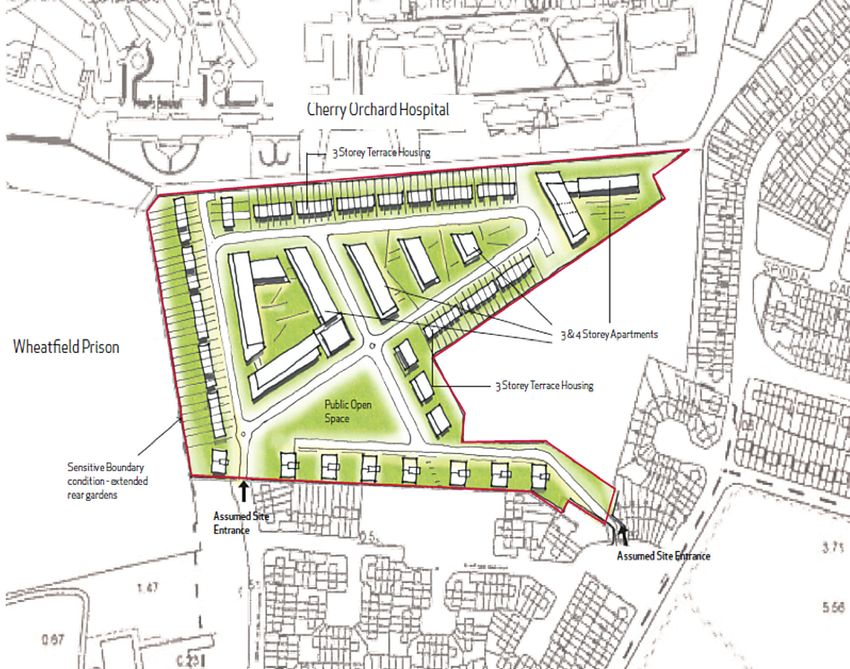
The site is located in Cherry Orchard, Dublin 10. The boundaries of the site are Cherry Orchard Hospital to the north, Wheatfield
Prison to the west and existing local authority housing to the south and east.

The site is approximately 20 acres/8.09 hectares.

Plus Architecture produced an indicative site layout and accommodation schedule based on the site plan below and this equates to
the following indicative schedule.

 Table 2: Accommodation Schedule

 Accomodation type         1-Bed             2-Bed             3-Bed            Semi-D          3 Storey Terraced         Total
 No of units                110               220                16               16                   88                  450

6 | Social Housing Funding Model Submission

Viability Study Methodology

The Plus Architecture accommodation schedule and typical layout is then tested in two viability models:

a. Viability Study 1 as a private development scheme i.e. where the development is constructed, marketed and sold at
   market rates.

b. Viability Study 2 assumes social housing across all of the completed units. When the scheme is completed and occupied it will
   produce an annual rent that can be pre-sold to a REIT or pension fund for a set term, possibly 20/30 years, depending on returns.

  Table 3: Viability Study 1: Market Sale of Units

  1.0   Revenue
        Type                                         Units            Unit Gross SP     Sales Value
        1-Bed Apartment                                         110          €99,000      €9,594,714
        2-Bed Apartment                                         220         €160,000     €31,013,216
        3-Bed Apartment                                          16         €230,000      €3,242,291
        Semi-D                                                   16         €250,000      €3,524,229
        Terraced                                                 88         €240,000     €18,607,930
        Car Parking                                               0                 -             €0

        Gross Developm ent Value                                                         €65,982,380

  2.0   Costs
  2.1   Build Costs
        (Demolition, Site Clearance,
        Landscaping & Planting, Roads, etc.)                                                        -
                                                                                                      KSN Order of Magnitude costs
                                                                                                      currently €67m reduced by 5%
        Build Costs                                                                      €63,650,000 based on value engineering
        Work re Boundaries                                                                          -
        Contingency                                          3.00%                        €1,909,500
        Professional Fees                                    8.00%                        €5,244,760

        Total Build Costs                                                                €70,804,260

  2.2   Disposal Cost/Marketing                      %                Basis                 €329,912

  2.3   Local Authority Contributions                           450           €9,500      €4,275,000

  2.4   Total Costs before funding, land and profit                                      €75,409,172

  2.5   Funding Cost of construction                 Annual Rate:                 5%      £3,540,213

  2.6   Cost including Funding Cost                                                      €78,949,385           f                     f

  3.0   Surplus/(Deficit)                                                               (€12,967,005)

  4.0   Less Profit being % GDV                              13.00%                       €8,577,709

  5.0   Surplus / (Deficit) before site purchase                                        (€21,544,714)

 Cherry Orchard (All figures are exclusive of VAT)
Social Housing Funding Model Submission | 7
Summary of Inputs and Outcomes from Viability Study 1
Inputs 3.0 Developer’s profit at 13% of GDV. Private developers seek
somewhere between 15%-20% of the gross development
1.0 Revenue. This is a summary of the total sales revenue value as a potential profit given the risk exposure.
based on market rates for houses in this location and figures
are net of VAT. The sales prices are based on asking prices 4.0 Surplus/deficit. This is based on a simple viability model
within the area. created in this report. It is apparent that the project
produces a deficit and so there is no market value for
2.0 Costs the residential use.
2.1 Build Costs. The construction costs are based
on Kerrigan Sheanon Newman (KSN), Quantity Outcomes
Surveyor’s Order of Magnitude costs for the Plus
Architecture indicative site layout. It is assumed that The outcome is that the site is not commercially viable as a
it will be possible to achieve a 15% reduction in the private residential site. Other uses may be more appropriate for
order of magnitude costs by way of value engineering. this site (data centre, hospital, etc.) however these are not for
Professional fees and contingencies are standard consideration for the purposes of this report. Therefore in any
within the industry. proposed residential development scenario the land will have to
be inputted at no value/cost. In fact the land may actually have
2.2 Disposal Fees. These are standard within to be subsidised in terms of funding being spent by the local
the industry. authority to provide access to the site and site servicing. As with
all private residential developments the site cost is ultimately a
2.3 Local authority contributions. These are assumed proportion of the completed housing sale price. Therefore based
based on standard local authority levies for similar on the low sales prices for housing units in this location, coupled
schemes. with the anticipated construction costs, the site is not viable for
an open market private residential use.
2.4 Funding costs. It is assumed that funding costs
of 5% can be procured on the market based on short
term loans. However, this may be understated
and higher funding costs may be required. Also
developers must usually provide collateral in the form
of title to the site to be held against the loan.8 | Social Housing Funding Model Submission
Table 4: Viability Study 2: Socially Rented and Acquired to be held by Long Term Fund(s)
1.0 Revenue
Type Units Monthly Annual
1.1 Rent Rent
1-Bed Apartment 110 €750 €990,000
2-Bed Apartment 220 €1,000 €2,640,000
3-Bed Apartment 16 €1,200 €230,400
Semi-D 16 €1,200 €230,400
Terraced 88 €1,200 €1,267,200
Less
1.2 Service Charge 450 €1,000 (€450,000)
1.3 Asset Management Fee 5% €5,358,000 (€267,900)
1.4 Net Annual Rent €4,640,100
2.0 Costs
2.1 Build Costs
(Site Clearance, Landscaping & Planting, Roads,
etc.) -
Build Costs €63,650,000 KSN Order of Magnitude costs
Abnormal Site Conditions - currently €67m reduced by 5% based
Work re Boundaries - on value engineering
Contingency 3.00% €1,909,500
Professional Fees 10.00% €6,555,950
Total Build Costs €72,115,450
2.3 Local Authority Contributions €0
Contributions/Levies -
2.4 Costs Subtotal €72,115,450
2.5 Funding Cost 5% €3,605,773
To be funded €72,115,450 24 €3,605,773
2.6 Cost including Funding Cost €75,721,223
3.0 Add Profit being a % of construction costs 10.00% €72,115,450 €7,211,545
4.0 Land €0
5.0 Total cost of Developm ent €82,932,768
Net Annual Rent €4,640,100
6.0 Annual Return % 5.60%
(Note VAT and all other taxes are excluded from this studySocial Housing Funding Model Submission | 9
Summary of Inputs and Outcomes from Viability Study 2.
Inputs to the site to be held against the loan. The 5% short
term funding costs per annum assumes that 50% of
1.0 Revenue/rents. the construction costs is the extent of what’s being
funded at any stage in that the units will be completed
1.1 Rents. Rents set out in this section are based on and occupied as soon as possible so that there should
the published rates for social housing. It should be no more than half of the entire scheme under
be noted that if rents are guaranteed it will increase construction at any stage.
the attractiveness of the completed investment for any
purchaser/funder. Also note no assumption for voids 3.0 Developer’s profit. It has been assumed in this scenario
has been allowed and this may further reduce the that a profit at a reduced rate of 10% of construction
quantum of rental income by possibly 8% per annum. costs can be applied. This is on the basis that the ultimate
purchaser of the completed scheme is a pension fund or
1.2 Service charges. The service charge is assumed equivalent funder and the precontracted sale therefore
as €1,000 per unit on average. However, this should reduces the risk to the developer.
be examined and assessed in more detail. The amount
of service charges being provided will affect the quality 4.0 Land. The land has been assumed and applied at no cost
of the scheme. Any under allowance of service charges or value.
may affect the long term maintenance and upkeep of
the properties which will affect their value over the 5.0 Total development costs. Total development costs reflect
lifetime of the project. the construction, planning and funding costs required to
bring the scheme to fruition.
1.3 Asset management fee. This is assumed as
5%, however this may be quite low for the purposes of 6.0 Annual returns. A 5.60% net annual return is projected
commercial analysis. Again this will have to be looked to be available to any funder. This figure is arrived at by
at and assessed in greater detail, however this is not expressing the net rental income as a percentage of total
analysed any further in this report. overall development costs (i.e. (€4,640,103/€82,932,768) x
100). The 5.60% return is at levels considered appropriate
1.4 Net annual rent. The net annual rent is the amount by pension funds and some REITs. It is in excess of the
available to service the investment returns of any income stream available for government bonds and a
potential purchaser/funder. For the purposes of this number of investors will view social housing rents as a proxy
simple viability model we have excluded any void for government bonds.
periods, bad debts and taxation issues.
2.0 Costs Outcomes
2.1 Build Costs. The construction costs are based on Viability Study 2 provides a high level financial study as to how
Kerrigan Sheanon Newman (KSN), Quantity Surveyor’s to extract the optimum use for the Cherry Orchard site as a
Order of Magnitude costs for the Plus Architecture social housing location. The most sustainable planning position
indicative site layout. It is assumed that it will be may be to have the location mixed as part social and part
possible to achieve a 15% reduction in the order private rental for key workers. This will require proactive and
of magnitude costs by way of value engineering. ongoing management by a quality housing association. In fact
Professional fees and contingencies are standard such precedents already exist in Dublin. However, while this is
within the industry. preferable from a sustainable planning perspective a mixture of
tenures (i.e. non-social housing rents and therefore no certainty
2.2 Local authority contributions. These are assumed as of income) may affect the funding that will be available for that
zero for social housing schemes. element of the scheme. In addition the local authority has to
consider whether they will convey their interest in the land/site to
2.3 Funding costs. It is assumed that funding costs the chosen PPP partner. This will be an important consideration
of 5% can be procured on the market based on as any return being sought by a REIT or pension fund will
short term loans. However, this may be understated include an interest rate and also pay down on the amount of
and higher funding costs may be required. Again any capital invested.
developer must provide collateral in the form of title10 | Social Housing Funding Model Submission
Summary and Recommendations
Based on the viability analysis undertaken in this report we cost. As we have seen in Viability Study 2, land input costs
have established that the market value for the site as a private are zero and yet the returns are still marginal. It may be
residential project is a negative figure. Therefore it is unlikely to that the local authority will also seek to attribute a value
be considered as an appropriate private residential site in the to the land at the outset but not charge this up front to
short to medium term. the project. This will allow the local authority to possibly
convert the land input cost to a percentage ownership
We have established the potential for development of a funding of the completed development. This ownership may be
model for a socially rented scheme on the site. However this converted back to a monetary sum or ownership at some
social housing model assumes a guaranteed income stream future date. A model for a subsequent buyback option for
and a set quantum of rent. It has also been established that the the completed scheme can also be set in place however
local authority should input the land into the project at no cost. this is not the subject of this report.
In addition it is suggested that the items listed below should
be focused upon by the local authority in determining the most 6. Service charges
appropriate bid for the site on the basis of the PPP process. By The local authority also needs to consider what the
focusing on these key headings this will introduce a consistency appropriate level of service charge to be applied is. This
into the assessment of the various PPP bids. The key points to affects the net rent/income stream and revenue term
note are: certain listed in point 1 above. If the service charge is
understated this may lead to cutting of corners in the estate
1. Income stream/rental income management of the scheme and the ultimate deterioration
How certain is the rental income? Will it be guaranteed for of the units. If overstated this may lead to a transfer of
20/30 years? Will there be a guaranteed rental floor and income to the management company and an erosion of the
also will the rent be linked to the CPI? A sensitivity analysis net return to the long term investor.
can be run in terms of the various rental options and this
will assist in considering the best return. 7. Long term funding returns
This needs to be analysed on the basis of what a long term
2. Construction cost inputs funder is willing to bid for a term certain income of 25-30
This should be focused on specifications, densities and years for a social housing model. As many funders would
building standards appropriate for the site. All of which will effectively view this as a proxy for a government bond and
affect the economic viability of the scheme. given that government bonds are trading at quite a low rate
it may be possible to attract a number of potential bidders.
3. Short term funding costs
The capacity of the proposed bidder to access short term In summary the Cherry Orchard site is likely one of the least
funding costs need to be considered. If the proposed attractive sites given that it has no value as a private residential
bidder has access to lower cost short term funding this is project based on the viability studies undertaken in this report.
of benefit. However if the private sector model can only However there is a potential opportunity for a planning gain
access higher cost short term funding this may negate the by creating a social and private key worker rental model all
benefits of a PPP process. contained within an appropriately managed development.
Again in this scenario it should be stated that the local
4. Developer’s profit authority’s expectations on land should be at a zero value input.
This needs to be considered in terms of what is an
appropriate level of developers profit for the risk being The report also sets out various templates that can be applied
undertaken. A speculative developer seeks up to 25% to the assessment of a PPP project for social housing on the
return on investment, however the profit margin may be site at Cherry Orchard. It allows the local authority to gain a
significantly less if the builder/developer is certain as to the further understanding of the valuation metrics and funding
end users capacity to buy out all the units. If a pension fund methodologies that will be applied by any potential bidder.
has agreed to forward purchase the completed scheme
then the developer’s profit of 8-10% of construction costs In addition a suggested template for scoring the key headings
should be considered appropriate. in the PPP process is attached in Appendix 1. This is offered
as a guide to providing the local authority with a mechanism to
5. Land score and weigh the key points of any potential bid. It is not an
Based on Viability Study 1 the land is at a negative value. exhaustive list but merely a guide as to the prioritising of the key
In Viability Study 2 the land is considered as a zero input inputs for any PPP process for the funding of social housing.Social Housing Funding Model Submission | 11
Appendix 1 - PPP Scoring Template
Entity Income/ Construction Short Term Developer’s Land Service Long Term Total
Revenue Costs Funding Profit Assumptions Charge Funding
Assessment Returns
Scoring Scale : 1 = Not market norm or industry standard - 10 = above industry norms or industry standard12 | Social Housing Funding Model Submission
Appendix 2 - Summary of Social
Housing Rents 17 June 2013
Social Housing
New Maximum Monthly Rent limits (Effective from 17th June 2013)
County Single Couple Single Couple Couple/One Couple/One Couple/One
Shared Shared Parent Family Parent Family Parent Family
1 Child 2 Children 3 Children
Dublin - €300 €350 €520 €700 €850 €900 €950
Fingal
Dublin – €350 €400 €520 €750 €950 €975 €1,000
Not Fingal
Area 1 Bedroom Apt 2 Bedroom Apt 3 Bedroom House
Ballyfermot €750 €1,000 €1,200
Blanchardstown €850 €1,100 €1,350
City Centre €950 €1,200 €1,300
Drimnagh €1,000 €1,200 €1,350
Lucan €1,000 €1,200 €1,300
Tallaght €875 €1,100 €1,375
Examples:
1 Bed/Ballyfermot 2 Bed/Ballyfermot 3 Bed House/Ballyfermot
Cedarbrook Walk - €750 Cherryorchard Apartment - €1,000 Decies Road - €1,200
1 Bed/Blanchardstown 2 Bed/Blanchardstown 3 Bed/Blanchardstown
Villa Blanchard - €€850 Waterville Terrace - €1,100 Warrens Town Drive - €1,350
1 Bed/City Centre 2 Bed/City Centre 3 Bed/City Centre
Gardiner St Upper - €950 Gregg Court - €1,200 St. James Ave - €1,300
1 Bed/Drimnagh 2 Bed/Drimnagh 3 Bed/Drimnagh
Drimnagh Rd - €1,000 Lansdowne Hall - €1,200 Clonmacnoise Road - €1,350
1 Bed/Lucan 2 Bed/Lucan 3 Bed/Lucan
College Gate Way - €1,100 Larkfield Sq - €1,200 Sarsfield Prk - €1,300
1 Bed/Tallaght 2 Bed/Tallaght 3 Bed/Tallaght
Bellevue, Cookstown - €875 Marlfield Lawn - €1,100 ParkhillGreen - €1,375Dating back to 1895, the Society of Chartered Surveyors Society of Chartered
Ireland is the independent professional body for Chartered Surveyors Ireland
Surveyors working and practicing in Ireland. 38 Merrion Square,
Dublin 2, Ireland
Working in partnership with RICS, the pre-eminent Chartered Tel: + 353 (0)1 644 5500
professional body for the construction, land and property sectors Email: info@scsi.ie
www.scsi.ie
around the world, the Society and RICS act in the public interest:
setting and maintaining the highest standards of competence
and integrity among the profession; and providing impartial,
authoritative advice on key issues for business, society and
governments worldwide.
Advancing standards in construction, land and property, the
Chartered Surveyor professional qualification is the world’s leading
qualification when it comes to professional standards. In a world
where more and more people, governments, banks and commercial
organisations demand greater certainty of professional standards and
ethics, attaining the Chartered Surveyor qualification is the recognised
mark of property professionalism.
Members of the profession are typically employed in the construction,
land and property markets through private practice, in central and
local government, in state agencies, in academic institutions, in
business organisations and in non-governmental organisations.
Members’ services are diverse and can include offering strategic
advice on the economics, valuation, law, technology, finance
and management in all aspects of the construction, land and
property industry.
All aspects of the profession, from education through to
qualification and the continuing maintenance of the highest
professional standards are regulated and overseen through the
partnership of the Society of Chartered Surveyors Ireland and RICS,
in the public interest.
This valuable partnership with RICS enables access to a worldwide
network of research, experience and advice.You can also read


