SPA: Harnessing Availability in the AWS Spot Market
←
→
Page content transcription
If your browser does not render page correctly, please read the page content below
SPA: Harnessing Availability in the AWS Spot
                        Market
          Walter Wong∗ , Aleksandr Zavodovski∗ , Lorenzo Corneo† , Nitinder Mohan§ , Jussi Kangasharju∗
                               ∗ Department of Computer Science, University of Helsinki, Finland
                           Email: {walter.wong, aleksandr.zavodovski, jussi.kangasharju}@helsinki.fi
                             † Department of Information Technology, Uppsala University, Sweden

                                                Email: lorenzo.corneo@it.uu.se
                              § Department of Informatics, Technical University Munich, Germany

                                                Email: nitinder.mohan@tum.de

   Abstract—Amazon Web Services (AWS) offers transient virtual      match spot and on-demand instances to trade availability for
servers at a discounted price as a way to sell unused spare         cost reduction [2]. Users need to bid for a transient instance
capacity in its data centers. Although transient servers are        by setting the maximum price that they are willing to pay for
very appealing as some instances have up to 90% discount,
they are not bound to regular availability guarantees as they       that instance and, if the market price of the instance goes over
are opportunistic resources sold on the spot market. In this        the bid price, the instance is evicted from the data center. In
paper, we present SPA, a framework that remarkably increases        order to optimize the bid price, authors in [20], [25] propose
the spot instance reliability over time due to insights gained      algorithms that optimize the bidding price to avoid eviction.
from the analysis of historical data, such as cross-region price
variability and intervals between evictions. We implemented the        In this paper, we propose SPot Availability (SPA) – a frame-
SPA reliability strategy, evaluated them using over one year        work that assists users in selecting the best AWS transient
of historical pricing data from AWS, and found out that we          instance options based on service availability requirements.
can increase the transient instance lifetime by adding a pricing    SPA operation can be summarized in three steps. First, it
overhead of 3.5% in the spot price in the best scenario.            passively analyzes the historical pricing data of the transient
                                                                    instances. Second, it compares the offerings in different AWS
                      I. I NTRODUCTION
                                                                    regions and availability zones based on instant price, price
   Cloud computing is the de facto way of providing large           volatility, and price change interval. Finally, it returns the user
scale Internet services. Large cloud data centers leverage          the best transient resource option that matches their availability
economies of scale and elastic demands, mostly via virtual          requirements at a given time. The pricing data analysis shows
machine offerings on which service providers deploy their own       there is a minimum price update interval for all spot instances,
services. This model presents some benefits as enterprises do       and SPA leverages this to place or migrate instances to regions
not need to make upfront investments in hardware purchases          where they can have a longer lifetime. The major contributions
for their data centers. Cloud providers, such as Amazon,            we make are as follows.
Google, and Microsoft, offer two different classes of virtual
computing instances: on-demand, where users use them until            1) We propose SPA, a software tool that calculates the best
they release the virtual instance; and transient instances, where        spot instances to provide the same reliability as the on-
cloud providers sell their spare capacity to users with some             demand instances but at a fraction of the cost.
availability limitations. These less reliable transient instances     2) We analyze the AWS historical spot pricing data and
attract users due to their cheaper pricing, which can be offered         highlight the main insights in the data, such as best
at up to 90% discount compared to the regular on-demand                  prices and more stable instances across availability
instances [1], [3], [4]. However, these instances do not have            zones.
any availability guarantees, meaning that they can be shut            3) We propose and evaluate one strategy that reduces
down by the cloud operator with a very short notice period.              spot instance failure rates. The results show that our
                                                                         proposed Spot Instance MarketPLace Exploitation (SIM-
   Although transient instances do no offer uptime guarantees,
                                                                         PLE) strategy can achieve the same reliability as on-
many studies in the past have explored the benefit of these
                                                                         demand instances with only 3.5% overhead in cost.
instances. For example, SuperCloud [9] explores how to utilize
transient resources via algorithms that deal with the expected         The rest of the paper is structured as follows. Section II
failures by migrating the instance running state from one vir-      presents related work. Section III presents the background on
tual machine to another. Other approaches include saving the        AWS. Section IV describes the data analysis and insights in the
service data in a shared partition [8], [10], [16], checkpointing   pricing data. Sections VI and VII present the implementation
the job processing at regular time intervals [23], increasing       and evaluation of the SPA framework and the experimental re-
application availability by proactively migrating applications      sults. Section VIII presents the discussion and some takeaways
between spot and on-demand instances [17]–[19] and mix-and-         of the paper. Finally, Section IX concludes the work.
II. R ELATED W ORK
1.0
Cloud economics has attracted the interest of academia,
resulting in attempts to deconstruct AWS price formation
CDF
model [6], infer the optimal bidding strategy using statis- 0.5
tical and optimization tooling [25], predict adaptively price
dynamics [13], and offer a better market model employing 0.0
learning techniques [15]. Abhishek et al. [5] explore trade- 0.2 0.4 0.6 0.8
offs between fixed and spot pricing, whereas [7] analyze the Spot price / On-demand price
problem of fixed and spot market coexistence. Besides pure
economics, there are works addressing other aspects of the Fig. 1: Spot instance price distribution. More than 50% of spot
spot market utilization, such as dynamic resource allocation instances have over 67% off discount over on-demand prices.
and management [14], demand scheduling [12], cost-aware
migration, and checkpointing [24].
Next, we examine practical systems and architectures aimed reclaim the instances back unless the user releases them, while
to exploit the advantages of the spot market. HotSpot [18] the spot instances can be reclaimed at any time as they don’t
uses containers to move between spot instances by periodically have any uptime SLA.
computing the lowest spot pricing and proactively migrates to
AWS spot instances are offered in the spot market and
a new instance to avoid preemption. One benefit of HotSpot is
use a dynamic pricing model, where each spot instance has
it does not require any changes in the application. However, the
a flexible price at each availability zone and its hourly price
migration mechanism only works within the same availability
varies based on the supply and demand of resources in the
zone. SpotOn [19] is a batch computing service running on
data-center. To get a spot instance, users need to bid for it in
top of spot instances, enabling automatic selection of spot
the market. In AWS, instance bidding can be understood as a
instances and implementing fault tolerance mechanisms to
pricing threshold. The bid price will remain valid as long as
mitigate data loss without modifying the application. It uses
it is higher than the market price and, consequently, the user
containers to encapsulate jobs with their dependencies, and it
will get that spot instance. Despite higher price bids for the
may use reactive or proactive container state checkpointing
spot instance, the user only pays for the current market price
on the disk. SpotCheck [17] is a derivative cloud market
of that instance, and the bid amount cannot be changed once
where SpotCheck purchases cloud resources from providers
it has been submitted to AWS. Whenever the market price for
and resell them with customizations to customers. This is
that spot instance goes over the bid price, the owner of the
aimed at customers with demands not supported by the
spot instance will receive a 2-minute eviction notice to save
cloud providers and SPA can again reduce the overhead and
or migrate the spot data, and AWS will reclaim the resources.
costs of SpotCheck. SuperCloud [11] is a cloud architecture
Fig. 1 shows the discount percentage offered in spot in-
running over OpenStack integrating multiple cloud providers
stances compared to on-demand ones with the same specifica-
and allowing for live migration across those providers using
tion. More than 50% of the spot instances have a discount of
Xen virtualization. Supercloud uses nested virtualization to
over 67% compared to the on-demand pricing, thus, users are
enable complete VM migration from one server to another,
able to run up to 3 spot instances (with 3x more resources) at
allowing users to relocate virtual machines from one cloud
the cost of 1 on-demand instance in AWS.
provider to another without disrupting the running application.
Bricklayer [21] optimizes resource composition using Spot There are two main challenges of using spot instances
instances. It uses a variety of attributes such as ECU, volatility, regarding selection and availability. For spot instance selection,
and eviction rate to compose spot instances aiming to optimize users have too many options to select, i.e., AWS has 21
the availability. SPA is different from the previous approaches regions, 39 availability zones, and 292 spot instances, resulting
as it explores the minimum update interval to trigger the in a combination of ≈ 10k individual spot markets. AWS
migration rather than using prediction techniques or redundant recommends looking at AWS spot advisor for 3-month of
instances. The benefit is that SPA is more assertive in the historical data and manually select which is the best instance
migration policy and migrates only when required, reducing at a given time. However, this is unfeasible in practice as users
the overall cost due to the redundant number of instances. would need to analyze too many options and compare each of
them. With regards to availability, AWS recommends creating
III. AWS S POT I NSTANCES BACKGROUND a SpotFleet [2], which is a group of virtual instances where on-
AWS offers virtual instances with two types of availability demand and spot instances can be mixed together to increase
Service Level Agreement (SLA): reserved and on-demand system availability. However, we find through our analysis that
instances have an SLA of 99.95% of guaranteed uptime, and users end up paying for the more expensive instance in the
transient instances (known as spot instances [1] in AWS) that group when using SpotFleet.
do not have any guarantees and are available while AWS has We explore the historical pricing data to find actionable
spare capacity in their data-centers. Both reserved and on- insights on how to use the spot instances on AWS better. Our
demand instances have a higher hourly price, and AWS cannot aim is to achieve the same level of availability as on-demandbut at a fraction of the price. the price update interval for m4.16xlarge instance plotted
hourly. We can observe that there is a pattern of update times
IV. AWS S POT I NSTANCE O BSERVATIONS
over days – ranging between 3 to 5 updates per day. On
We collected and analyzed 15 months of AWS spot pricing average, the price of the instance updates after almost 6 hours.
data (March 2019 – June 2020) across all regions and avail- Therefore, intuitively, we conjecture that there is a recurrent
ability zones – exceeding 2M price entries. We start analyzing policy at AWS that enforces price updates of spot instances at
three configuration parameters (region, availability zone, and regular intervals based on the data usage.
instance type) and three insights found in the pricing data. We Fig. 7 shows price update intervals over one month (specif-
will discuss each of them below. ically September 2019). One can observe from the figure that
A. Spot Instance Attributes most of the price change intervals are clustered around 6
hours (fitted with a red dashed line), further strengthening our
Users select an instance using three configuration parame-
findings above. Another interesting observation from the figure
ters: geographical region, availability zone, and instance type.
is that there is a lower boundary of price updates, indicating
Most of the time, customers select a region due to external
a minimum lifetime for a spot instance.
requirements, i.e., closeness to the customer or availability of
specific instance types such as GPUs. Also, the instance type is Takeaway: Our findings indicate scope for a strategy that picks
selected based on the customer’s workload, i.e., the amount of instances with longer price change intervals, thus guarantee-
CPU and RAM is dependent on the type of application being ing more instance running time before the price update that
deployed. However, the availability zone (AZ) configuration leads to its eviction.
parameter can provide some economical and availability gains Minimum and Percentile of 1% Price Change Interval.
if properly chosen. An AZ is a segmented data center inside We now investigate both minimum and percentile of 1% (or
the same AWS region and is set up to provide both hardware quantile q1) of the price update intervals. By focusing on (q1),
redundancy and scalability. Each AZ works separately and we can observe the top 99% of the price update intervals and
offers different spot instance types and prices. Thus, our remove any outliers that lie in the lower part of the distribution.
interest is to check which AZ offers the best pricing and Fig. 8 shows both the minimum and q1 price update intervals
the lowest eviction rate for the same instance type. Fig. 2 for a given spot instance across different availability zones.
shows region us-east-1 has 6 availability zones, and they have Our analysis reveals that the q1 change interval is always
different volatility. In Fig 3, it can be observed that a given at least 4h35min12sec in all availability zones, while the
instance type can have a different average number of changes minimum update time is the same as the q1 for 35 out of
across the available zones. 39 zones (only 4 zones have lower minimum times).
This finding, along with price change interval, reveals that
B. Spot Instance Insights
AWS has rather a roughly fixed price update interval per day
We performed the exploratory data analysis (EDA) on the (3 to 5 times per day) with a minimum update interval –
historical spot pricing data and found out three insights that indicating space for a strategy that exploits this behavior.
will assist with the spot instance selection.
Takeaway: AWS’s price update policy has a minimum update
Instance Price Volatility. The instance price volatility is the
interval for most availability zones, which can be exploited to
number of price changes a spot instance has over time. This
maximize service availability.
metric is important because a high number of price changes
can result in two main problems: (a) higher price volatility, V. SIMPLE A LGORITHM TO KEEP THE AVAILABILITY
resulting in users paying more than expected, and (b) higher
Driven by our findings from historical spot instance price
eviction rate, as the spot bid price can go over the spot market
data analysis, we develop the Spot Instance MarketPLace Ex-
price. Fig. 4 shows the price volatility of the top 10 instances in
ploitation (SIMPLE) algorithm. SIMPLE’s aim is to maximize
us-east-1 and some prices can increase up to ≈ 8x, reaching
service availability over spot instances by retroactively migrat-
almost the same as that of the on-demand variant. On the
ing it to new instances before potential price updates. SIMPLE
other hand, Fig. 5 shows instances that did not experience
calculates the minimum update interval of all instances and
much change in their price over the 90-day observation period.
updates its historical data whenever there is a change in the
Selecting these instances instead would ensure a certain level
pricing update interval from AWS. A rudimentary workflow
of guarantee in the price a user pays to acquire them and
of SIMPLE is as follows.
reduces the probability of eviction.
First, SIMPLE’s engine fetches the historical pricing data
Takeaway: Not all instances are equal in price volatility, and filtered by the user’s selected region, AZ, and instance type.
an effective selection strategy should focus on those with lower Based on this information, the engine calculates the instance’s
prices and volatility (or higher durability). price volatility, average price update interval, and the minimum
Average Price Change Interval. Monitoring the interval price update time. Then, SIMPLE calculates the remaining
between the price changes allows us to learn the minimum lifetime of all candidate instances by subtracting the last
spot instance lifetime for a given instance type before a price price update time from 4h32m (minimum update interval we
increase that may evict the user of that instance. Fig. 6 shows observed from our analysis). For example, if the last priceus-east-1a us-east-1d
0.08 0.020
2
# changes [∗105 ]
us-east-1b us-east-1e
# changes [∗103 ]
2 us-east-1c
0.06
Cost [USD/h]
0.015
Cost [USD/h]
1 0.04 0.010
1
0.02 0.005
0
0 0.000
eu-central-1a
eu-central-1b
eu-central-1c
eu-north-1a
eu-north-1b
eu-north-1c
eu-west-1a
eu-west-1b
eu-west-1c
eu-west-2a
eu-west-2b
eu-west-2c
eu-west-3a
eu-west-3b
eu-west-3c
us-east-1a
us-east-1b
us-east-1c
us-east-1d
us-east-1e
us-east-1f
us-east-2a
us-east-2b
us-east-2c
us-west-1a
us-west-1b
us-west-1c
us-west-2a
us-west-2b
us-west-2c
us-west-2d
p2 .2x all
p2 6x rge
z1 e.4 arge
d xl e
d x e
z1 .3x arge
d. la e
z16xl rge
la ge
e
.8 ge
.x e
e
e
5d um
al
e
ge
ge
e
ge
x1 .8x arg
z1 .12 arg
d l g
rg
d2 larg
i2 arg
g
i3 arg
r3 arg
z1 .2xlar
d. ar
2 m
et
d2 lar
ar
ar
ar
ar
.1 la
m edi
l
l
m 1.s
.m
l
xl
l
xl
xl
xl
xl
4x
4x
x
.4
.8
12
.4
.2
m
m
n.
.
i3
d2
1.
5.
c5
m
m
AWS availability zone AWS instance type AWS instance type AWS instance type
Fig. 2: Number of changes vs. Fig. 3: Price change variation Fig. 4: Top 10 Volatility Fig. 5: Bottom 6 Volatility
Availability Zones vs. availability zone
16 q1 min
Time delta [hours]
14
12
10
08
06
04
02
00
eu-west-1c
eu-west-2c
ap-northeast-1a
ap-northeast-1c
ap-northeast-1d
ap-northeast-2a
ap-northeast-2c
ap-south-1a
ap-south-1b
ap-southeast-1a
ap-southeast-1b
ap-southeast-1c
ap-southeast-2a
ap-southeast-2b
ap-southeast-2c
ca-central-1b
eu-central-1a
eu-central-1b
eu-central-1c
eu-west-1a
eu-west-1b
eu-west-3a
sa-east-1a
sa-east-1c
us-east-1a
us-east-1b
us-east-1c
us-east-1d
us-east-1e
us-east-1f
us-east-2a
us-east-2b
us-east-2c
us-west-1a
us-west-1b
us-west-1c
us-west-2a
us-west-2b
us-west-2c
Fig. 6: Spot price update time vs. hour Fig. 7: Spot price update interval (the
of day (red line shows the trend over the red dotted line shows the average of 6 AWS availability zone
day) for instance m4.16xlarge. hours) for instance m4.16xlarge. Both
measurements show a sample of a 2- Fig. 8: Comparison between the instance
week period of time. price change in percentile 1% and the
minimum interval.
Algorithm 1: SIMPLE’s Instance Migration Algorithm application deployment roughly takes 10 min to complete.
1 Input: region, availability zone, instance type, and Users can also add buffer time to allow any state transfer
buffer time after the spot instance is deployed. Since our analysis reveals a
2 retrieve historical data(instance type) guaranteed uptime ranging around 4h32m, we conservatively
3 calculate price volatility(instance type) select the 4-hour mark as a trigger to migrate the service to
4 calculate average update time(instance type) a new spot instance, practically guaranteeing a continuously
5 calculate minimum update interval(instance type) running service. One limitation of SIMPLE is that it requires
6 retrieve instance provisioning time(instance type) a transition time for transferring data and application state
7 calculate migration time(instance type) between instances. Therefore, for stateful applications, this can
8 calculate time to migrate() result in unwanted service interruption. In order to prevent any
9 while active do downtime, we use additional redundant spot instances during
10 while current time ≤ time to migrate do the transition period.
11 use spot instance() VI. I MPLEMENTATION
12 provision new spot instance() SPA is implemented using Python for the core components
13 migrate state to new spot instance() and Numpy, Scipy, Pandas for data analytics and feature
14 update last price change() engineering, and the components run in Docker containers
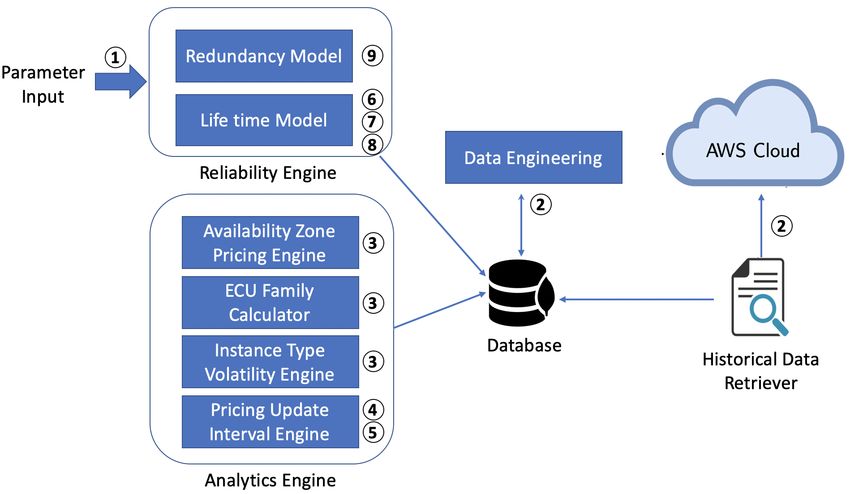
configured in a Docker Swarm setup [22]. Fig. 9 shows the
architecture with its components and correlates to each step
of the algorithm presented in 1.
change time for an instance was 2 hours ago, then the instance In step 1, SPA receives the user parameters such as region,
still has 2h32 of guaranteed uptime. Next, the algorithm availability zone, and instance type. Then, the historical data
calculates the time to bootstrap service on a new spot instance retriever periodically fetches spot pricing from AWS and
(in a different zone or at a different price), deploys a replica of updates the local database (step 2). The main purpose of this
the application, transfers the service’s state to the new instance, scrapper is to keep the last price update for each spot instance,
and kills the older version of the service. to allow the analytics engine to calculate the price change
Our experimental data shows that instance provisioning and interval. The data engineering component parses the raw dataTABLE I: Cost comparison between different strategies. On-
demand instance represents 100% of the price.
Instance Type Spot Price SIMPLE r=1 r=2
m2.xlarge 10.00% 10.35% 20.00% 30.00%
r3.xlarge 19.49% 20.17% 38.98% 58.47%
m5dn.24xlarge 25.00% 25.88% 50.01% 75.01%
c3.4xlarge 32.36% 33.49% 64.71% 97.07%
a1.large 44.31% 45.86% 88.63% 132.94%
m5a.2xlarge 52.50% 54.34% 105.00% 157.50%
r5dn.xlarge 69.10% 71.52% 138.20% 207.31%
13
AWS price update
Time delta [h]
Fig. 9: SPA architectural components. The numbers correlate 11 Migration start
to the steps in Algorithm 1. Migration end
9
7
retrieved from the spot pricing, reshapes it, and performs
feature engineering and data processing for consumption by 5
the other components (step 2). The analytics engine calculates 3
each metric that defines a spot instance in our model, e.g., the 0 2 4 6 8
pricing of the instance in each availability zone, the instance Price change iteration
price volatility, eviction rates, and the pricing update inter-
val (step 3 through 5). The reliability component calculates Fig. 10: Comparison between SIMPLE migration time - start
the minimum update interval for a given instance and it is and end of migration - and the AWS price update time.
responsible for the correct migration to a new spot instance SIMPLE anticipates the price update time in all cases.
(steps 6 through 8). It also runs the SIMPLE algorithm and,
once the component triggers the migration event, it provisions
a new instance on AWS and migrates to it (step 9). that can be used when choosing which strategy to select, e.g.,
spot instances that have a discount of over 67% can have
VII. E VALUATION
up to 2 redundant elements, while other instances with less
We evaluate the SIMPLE algorithm in two different scenar- discount can only use the SIMPLE strategy. Note that in the
ios: first, we compare the cost to run the SIMPLE algorithm case of redundant instances, we don’t need to have an extra
vs. a naive deployment of redundant spot instances; second, overlapping spot instance to migrate given we already have
we evaluate SIMPLE’s efficiency in providing availability on redundancy. Thus, the cost is proportional to the number of
the historical pricing data. redundant elements provisioned in the spot instance set.
For the first evaluation, we calculate the additional cost The second evaluation aims to check if SIMPLE works
incurred by the SIMPLE algorithm, shown in 1. Recall that over the historical data. Fig. 10 compares the spot migration
the SIMPLE algorithm states that we migrate to a new spot events (start and end) and the actual AWS spot price change.
instance every 4h30min. Assuming the spot instance provi- The figure shows that SIMPLE always starts before the price
sioning and state migration takes ≈ 10 minutes, we will have update event and, in some cases, it triggers a migration in
an additional instance running in parallel for 10 minutes, thus, 4h30min, despite the migration only going to happen over
≈ 17% of a 1-hour running time for a redundant spot instance. 12 hours later. Although this scenario can happen, SIMPLE
guarantees that by migrating every 4h30min, it is able to avoid
Cs (t) = (pspot ∗ t) + (0.17 ∗ pspot ) ∗ mspot (t) (1) any eviction. We also evaluated it on all historical data and
where t is the time, pspot the spot instance hourly price, and the experimental results show that SIMPLE can avoid spot
mspot the number of migrations at time t (per instance type). If instance preemption in all cases.
we consider a 24-hour period, the total number of migrations
VIII. D ISCUSSION
is going to be 5. Therefore, the total cost Cs (t = 24) is
24.85 hours (24 hours of running instance plus 50 min for Many research works have tried to figure out the best
the overlapping running machine), representing an overhead strategy to use spot instances, as we discussed in Section II.
of 3.5% for SIMPLE. In this paper, we started analyzing the historical pricing data
Tab. I compares the cost of different approaches for a to find out insights into the AWS price update algorithm.
sample of spot instances. The costs are given as percentages One insight that we found is the minimum update interval,
of the on-demand instance price, i.e., the on-demand price is which is 4 hours and 32 minutes for roughly all availability
100% for reference. The table shows the strategy selection zones. If we take into account the 1% percentile, then thisminimum update interval applies to all availability zones. We R EFERENCES
believe there is a system that periodically polls the number of [1] Amazon EC2 Spot Instances. https://aws.amazon.com/ec2/spot/, 2020.
resources available at each availability zone and updates the Accessed: 2020-06-30.
price accordingly and that polling interval should be around [2] How Spot Fleet Works - Amazon Elastic Compute Cloud. https://
docs.aws.amazon.com/AWSEC2/latest/UserGuide/spot-fleet.html, 2020.
that percentile 1% update time. Based on that, we crafted the Accessed: 2021-01-10.
SIMPLE algorithm that provisions a new spot instance when [3] Low-priority VMs in Batch. https://azure.microsoft.com/en-us/pricing/
the lifetime of the original instance is going to expire. details/batch/, 2020. Accessed: 2021-01-10.
[4] Preemptible VM Instances. https://cloud.google.com/compute/docs/
Despite begin a simple algorithm, it only increases the instances/preemptible, 2020. Accessed: 2021-01-10.
overall instance price by 3.5% due to the overlapping running [5] V. Abhishek, I. Kash, and P. Key. Fixed and market pricing for cloud
time of a parallel instance for the migration. Compared to the services. In 2012 Proceedings IEEE INFOCOM Workshops. IEEE.
[6] Orna Agmon Ben-Yehuda, Muli Ben-Yehuda, Assaf Schuster, and Dan
other approaches discussed in the literature (see Section II), Tsafrir. Deconstructing amazon ec2 spot instance pricing. ACM
SIMPLE is much simpler and more predictable. It only looks Transactions on Economics and Computation (TEAC), 1(3):1–20, 2013.
at the last price update time and plans for a spot instance [7] Ludwig Dierks and Sven Seuken. Cloud pricing: The spot market strikes
back. Available at SSRN 3383420, 2019.
migration when the lifetime is about the expire. This makes [8] A. Harlap, A. Chung, A. Tumanov, G. Ganger, and P. Gibbons. Tribu-
SIMPLE very easy to implement. One limitation of SIMPLE tary: spot-dancing for elastic services with latency slos. In 2018 USENIX
is it requires a transition period in which data is transferred Annual Technical Conference (USENIX ATC 18), July 2018.
[9] Q. Jia, Z. Shen, W. Song, R. van Renesse, and H. Weatherspoon. Smart
from one instance to another, and this may lead to downtime. spot instances for the supercloud. In Proceedings of the 3rd Workshop on
To tackle this issue, we designed a reliability model over spot CrossCloud Infrastructures & Platforms, CrossCloud ’16. ACM, 2016.
instances, allowing for the optimal composition of redundant [10] P. Joaquim, M. Bravo, L. Rodrigues, and M. Matos. Hourglass:
Leveraging transient resources for time-constrained graph processing in
instances to guarantee availability at the cost of an increased the cloud. In Proceedings of the 14th EuroSys 2019, 2019.
hourly price. The redundant instance can work as a hot standby [11] I. Kash, Q. Jia, Z. Shen, W. Song, R. Renesse, and H. Weatherspoon.
or run in parallel, depending on the user’s requirements. Economics of a supercloud. In Proceedings of the 3rd Workshop on
CrossCloud Infrastructures & Platforms, CrossCloud ’16, 2016.
Compared to the on-demand model, which has an SLA of [12] Robert Keller, Lukas Häfner, Thomas Sachs, and Gilbert Fridgen.
99.95% of reliability, the pricing is worth it when the spot Scheduling flexible demand in cloud computing spot markets. Business
instance is at least 70% off. Thus, the user can have 3 spot & Information Systems Engineering, 62(1):25–39, 2020.
[13] M. Khodak, L. Zheng, A. Lan, C. Joe-Wong, and M. Chiang. Learning
instances running in parallel, providing the same reliability but cloud dynamics to optimize spot instance bidding strategies. In IEEE
with 3 times more processing power. Conference on Computer Communications (INFOCOM 2018), 2018.
SPA also can adapt to variations in the AWS pricing model. [14] M. Nagpure, P. Dahiwale, and P. Marbate. An efficient dynamic resource
allocation strategy for vm environment in cloud. In IEEE International
If AWS moves away from the minimum pricing model, SPA Conference on Pervasive Computing (ICPC 2015), 2015.
can detect this change as it recurrently calculates the minimum [15] A. Prasad, M. Arumaithurai, D. Koll, Y. Jiang, and X. Fu. Ofm: An
pricing of each instance and updates the SIMPLE algorithm to online fisher market for cloud computing. In IEEE Conference on
Computer Communications (INFOCOM 2019), 2019.
take into account the new minimum time. Another important [16] P. Sharma, T. Guo, X. He, D. Irwin, and P. Shenoy. Flint: Batch-
aspect is if too many users start to use SPA, the demand for interactive data-intensive processing on transient servers. In the 11th
spot instances will increase and, consequently, the spot prices. European Conference on Computer Systems, EuroSys ’16, 2016.
[17] P. Sharma, S. Lee, T. Guo, D. Irwin, and P. Shenoy. Spotcheck:
However, even if they get more expensive, SPA still will be Designing a derivative iaas cloud on the spot market. In the 10th
able to get savings compared to on-demand instances, as it European Conference on Computer Systems (EuroSys ’15), 2015.
will optimize the use of existing spot instances through the [18] S. Shastri and D. Irwin. Hotspot: Automated server hopping in cloud
spot markets. In Proceedings of the 2017 Symposium on Cloud
SIMPLE algorithm. Computing, 2017.
[19] S. Subramanya, T. Guo, P. Sharma, D. Irwin, and P. Shenoy. Spot-on:
IX. C ONCLUSION A batch computing service for the spot market. In Proceedings of the
Sixth ACM Symposium on Cloud Computing, SoCC ’15, 2015.
In this paper, we presented SPA, a framework that assists [20] S. Tang, J. Yuan, and X. Li. Towards optimal bidding strategy for
users to select the best spot instance across different availabil- amazon ec2 cloud spot instance. In the 2012 IEEE 5th International
ity zones. SPA provides insights based on the historical pricing Conference on Cloud Computing, CLOUD ’12, 2012.
[21] W. Wong, L. Corneo, A. Zavodovski, P. Zhou, N. Mohan, and J. Kan-
data and provides a model in which more stable instances gasharju. Bricklayer: Resource composition on the spot market. In IEEE
(with less price variation) and with larger price update intervals International Conference on Communications (ICC 2020).
are selected. SPA leverages the observation that the minimum [22] W. Wong, L. Corneo, A. Zavodovski, P. Zhou, N. Mohan, and J. Kan-
gasharju. Container deployment strategy for edge networking. MECC
update interval time is 4h32min and proposes the SIMPLE ’19, New York, NY, USA, 2019. Association for Computing Machinery.
algorithm, which exploits the minimum price update interval [23] Y. Yan, Y. Gao, Y. Chen, Z. Guo, B. Chen, and T. Moscibroda. Tr-spark:
and triggers the migration to another spot instance to prevent Transient computing for big data analytics. In Proceedings of the 7th
ACM Symposium on Cloud Computing, SoCC ’16, 2016.
any instance evictions, resulting in the same availability as [24] Sangho Yi, Artur Andrzejak, and Derrick Kondo. Monetary cost-aware
on-demand instances. The experimental evaluation shows the checkpointing and migration on amazon cloud spot instances. IEEE
SIMPLE algorithm only has an overhead of 3.5% over the Transactions on Services Computing, 5(4):512–524, 2011.
[25] L. Zheng, C. Joe-Wong, C. Tan, M. Chiang, and X. Wang. How to
regular spot price and, comparing with the 15-month of bid the cloud. In Proceedings of the 2015 ACM Conference on Special
historical pricing data, SPA is able to anticipate all AWS Interest Group on Data Communication, SIGCOMM ’15, 2015.
price updates and migrate to another spot instance before any
eviction occurs.You can also read


