Summary of Phase 2 preliminary business case - Concept design MENINDEE LAKES WATER SAVING PROJECT
←
→
Page content transcription
If your browser does not render page correctly, please read the page content below
MENINDEE LAKES WATER SAVING PROJECT

Summary of Phase 2 preliminary business case
Concept design
Summary of the Phase 2 preliminary business case—Menindee Lakes Water Saving Project

Published by NSW Department of Industry
Summary of the Phase 2 preliminary business case—Menindee Lakes Water Saving Project
First published June 2018.
INT18/177351
More information
NSW Department of Industry—Lands and Water Division
www.industry.nsw.gov.au
Acknowledgments
Blackwatch Consulting (2017). Menindee Lakes Water Saving Project—Phase 2 Business Case

© State of New South Wales through Department of Industry 2018. You may copy, distribute, display, download and otherwise freely deal with this
publication for any purpose, provided that you attribute the Department of Industry as the owner. However, you must obtain permission if you wish to
charge others for access to the publication (other than at cost); include the publication in advertising or a product for sale; modify the publication; or
republish the publication on a website. You may freely link to the publication on a departmental website.
Disclaimer: The information contained in this publication is based on knowledge and understanding at the time of writing (October 2018) and may not be
accurate, current or complete. The State of New South Wales (including the NSW Department of Industry), the author and the publisher take no
responsibility, and will accept no liability, for the accuracy, currency, reliability or correctness of any information included in the document (including material
provided by third parties). Readers should make their own inquiries and rely on their own advice when making decisions related to material contained in this
publication.

                                                                                                     NSW Department of Industry | INT18/177351 | 2
Summary of the Phase 2 preliminary business case—Menindee Lakes Water Saving Project
Foreword
As part of the broader Murray–Darling Basin Plan (the Basin Plan), the Menindee Lakes Water
Saving Project seeks to ensure that water is shared sustainably across the Murray–Darling Basin
(the Basin) in a way that provides adequate water to both users and the natural environment.
The project aims to do this by reducing evaporative losses, improving the efficiency of the
Menindee storages, providing more water to the environment, improving river management and
creating positive community impacts.
The project comprises a proposed package of five key categories of works and measures. This
summary provides an overview of the proposed works and the rationale for their implementation,
the expected benefits, the project history, further works and studies to be completed, project
oversight, and forward steps, as set out in the preliminary business case. The preliminary business
case confirms that the project is capable of making a valuable contribution to Basin Plan outcomes.
NSW Department of Industry | INT18/177351 | 3Summary of the Phase 2 preliminary business case—Menindee Lakes Water Saving Project
Contents
Project summary ............................................................................................................................... 5
Project background ....................................................................................................................... 5
The Menindee Lakes system ..................................................................................................... 5
Current management and operation of the Menindee Lakes system ........................................ 6
Project context—Murray–Darling Basin Plan ............................................................................. 7
The Menindee Lakes Water Saving Project .................................................................................. 8
Proposed works and measures ..................................................................................................... 9
Preliminary benefits ..................................................................................................................... 11
Environmental benefits ............................................................................................................ 11
Flood protection ....................................................................................................................... 11
Employment opportunities ....................................................................................................... 11
Alternative water supply for Broken Hill ................................................................................... 12
Water savings ............................................................................ Error! Bookmark not defined.
Stakeholder and community engagement ...................................................................................... 12
Environment and heritage ............................................................................................................... 12
Environmental studies ................................................................................................................. 12
Cultural heritage .......................................................................................................................... 13
Project delivery ............................................................................................................................... 14
Project costs ................................................................................................................................... 15
Conclusion ...................................................................................................................................... 15
Tables
Table 1 Summary of proposed works and measures ....................................................................... 9
Table 2 Phased delivery of Menindee Water Saving Project .......................................................... 14
Table 3 Project schedule of estimated milestones .......................................................................... 15
Figures
Figure 1 Schematic diagram showing regulating structures in the Menindee Lakes system ............ 6
NSW Department of Industry | INT18/177351 | 4Summary of the Phase 2 preliminary business case—Menindee Lakes Water Saving Project
Project summary
The Menindee Lakes Water Saving Project presents an opportunity to improve river operations and
the environment, whilst also reducing water loss through evaporation in the Menindee Lakes
system. Expected benefits from the project include; environmental benefits, flood protection,
employment opportunities, water savings and an alternate, secure water supply for Broken Hill.
This is a complex task, which will require a close relationship between government and the
community, and appropriate government investment. Provided that the overall objectives,
timeframes and cost constraints can be met, the NSW Government will work with the community to
design the project in a way that will maximise its benefits.
Under the Basin Plan the project is required to be delivered by 2024.
Project background
Investigations into how to improve the management of water in the Menindee Lakes have been
underway for a number of years. A series of studies were undertaken over the period 2006 to 2013
to assess options to find water savings from the Menindee Lakes, and in 2013 the Commonwealth
and NSW governments agreed to further investigate a scope of infrastructure works and other
potential options to lift recreational amenity and environmental benefits whilst realising savings by
addressing evaporative loss from the Lakes.
The Murray–Darling Basin Ministerial Council agreed to the current proposed project being
included in a package of projects under the Sustainable Diversion Limit Adjustment Mechanism on
16 June 2017.
The Menindee Lakes system
The Menindee Lakes are a naturally occurring series of shallow wetlands located along the Lower
Darling River, approximately 200 kilometres upstream of the junction with the Murray River at
Wentworth. The lakes are naturally ephemeral, which means they would be typically dry but would
fill with water for brief periods following rainfall. The Menindee Lakes were modified in the 1960s to
be able to provide water storage to Broken Hill and other users in the Murray–Darling system, and
to supply towns1 and irrigators along the Lower Darling and Murray rivers.
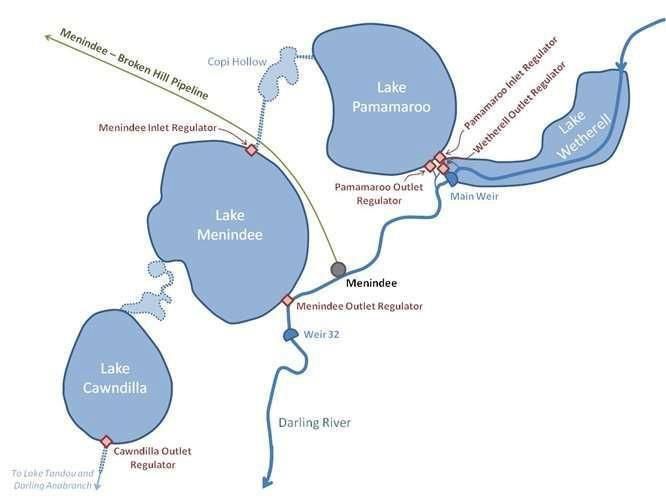
The regulated storage system at Menindee consists of four main interconnected lakes. Of these,
three are modified natural depressions (Lakes Pamamaroo, Menindee and Cawndilla), while the
fourth (Lake Wetherell) is an artificial lake along the main river channel formed by the construction
of Menindee Main Weir. A channel was also built to connect Lakes Pamamaroo and Menindee (via
Copi Hollow), while the other connections between the lakes are modified natural channels. There
are seven main regulating structures in the lakes system as shown in Figure 1.
1
Menindee, Broken Hill, Silverton and Pooncarie
NSW Department of Industry | INT18/177351 | 5Summary of the Phase 2 preliminary business case—Menindee Lakes Water Saving Project
Figure 1 Schematic diagram showing regulating structures in the Menindee Lakes system
As well as being a significant source of water for local towns and users, the lakes are also located
in an area of environmental, social and cultural significance and provide recreational, tourism and
economic opportunities for the towns and surrounding region. The Menindee Lakes system
contains a broad diversity of both terrestrial and aquatic flora and fauna including threatened
species and nationally important wetlands.
Current management and operation of the Menindee Lakes system
Since their modification, the Menindee Lakes have generally been operated to maximise the
storage volumes, water quality, and ability to supply users, and to minimise evaporation and
mitigate floods where possible.
Since the 1990s operations have also focused on providing ecological benefits, managing flood
mitigation for the Lower Darling to provide environmental benefits, controlling foreshore erosion,
and minimising erosion of cultural heritage sites.
The Menindee Lakes storage is owned and operated by New South Wales with a long standing
arrangement under the Murray Darling Basin Agreement. This Agreement requires the Murray
Darling Basin Authority (the MDBA) to include the water held within the lakes as part of the shared
resource of the River Murray System, and use the water in the lakes when the volume is above
640 GL until it next falls below 480 GL.
Once the total volume of the lakes falls below 480GL, the held water is no longer considered a
shared resource of the River Murray System and the water is managed by New South Wales to
meet local demands. Some of the water within the Menindee Lakes system is considered dead
storage and cannot be accessed for release. The dead storage volume within the system is 125
gigalitres.
NSW Department of Industry | INT18/177351 | 6Summary of the Phase 2 preliminary business case—Menindee Lakes Water Saving Project
The construction and commissioning of the “Wentworth to Broken Hill pipeline” will enable town
water supplies for Broken Hill to be provided from the River Murray instead of from the Menindee
Lakes.
To ensure critical water supply needs can be met during periods of low inflows as well as to
minimise evaporative water losses, Lakes Wetherell and Pamamaroo are preferentially used to
store water ahead of Lakes Menindee and Cawndilla. In most instances, water released to meet
immediate consumptive demands comes initially from Lake Menindee, then Lake Cawndilla and
Lake Wetherell.
As in other catchments, water is supplied according to the order of priority of licences, particularly
during periods where water availability is limited and use may need to be restricted to protect water
for critical needs. This protection of stored water can become particularly crucial as water volumes
drop, as evaporative losses become more significant and water salinity increases.
In an extended period of low inflows, levels of salinity can make the water in the Lakes unsuitable
for irrigation or town water supply regardless of availability. It does however remain an important
refuge habitat for aquatic and terrestrial fauna until the next major inflow.
During periods of flood, the Lakes are operated to maintain the structural integrity of existing
infrastructure, to maintain the security of existing water entitlements, and to minimise damage to
downstream properties where possible.
Inflows are managed based on a series of considerations including water quality, levee bank
stability and pre-releases to mimic a more natural flow pattern. Water can also be transferred from
Lake Menindee to Lake Victoria in the Lower Murray under a ‘harmony operation’ if flows in the
Lower Murray are not meeting consumptive and environmental demands for water. Water for
additional dilution flow procedures can also be called from the Lakes during periods of storage
excess.
Project context—Murray–Darling Basin Plan
The Menindee Lakes Water Saving Project is being developed as one of the sustainable diversion
limit (SDL) adjustment mechanism projects under the Murray-Darling Basin Plan (the Basin Plan),
which seeks to ensure that water is shared sustainably across the Murray-Darling Basin (the
Basin) in a way that provides adequate water to both users and the natural environment.
In developing the Basin Plan, the MDBA assessed the volume of water that could be taken from
the Basin for consumptive use while maintaining the health of the Basin. This volume is called the
long-term average SDL and is equal to 10,873 gigalitres per year. In order to reach this level of
water take, the MDBA determined that an additional 2,750 gigalitres of surface water would need
to be recovered from the existing level of use through a combination of efficiency projects and
licence buy-backs.
The Menindee Lakes Water Saving Project has been put forward as a supply measure proposal
under the SDL adjustment mechanism. A supply measure is a project which will offset the amount
of water required to be recovered under the Basin Plan, by providing equivalent or improved
environmental outcomes using less water.
The Menindee Lakes are located in a semi – arid area and are shallow in nature with a large
surface area, resulting in a significant loss of water to evaporation. On average the Menindee
Lakes lose 426 gigalitres of water annually to evaporation. Up to 700 gigalitres can be lost to
evaporation annually when the lakes are full.
Each lake also contains a percentage of ‘dead storage’ that cannot be accessed for consumptive
use, and may therefore also be lost to evaporation. This “dead storage” is estimated at 125
gigalitres for the four main lakes.
If evaporative water loss from the Menindee Leakes could be reduced, significantly more water
could be made available for the environment.
NSW Department of Industry | INT18/177351 | 7Summary of the Phase 2 preliminary business case—Menindee Lakes Water Saving Project
Regulation of the lakes has increased sedimentation, reducing accessibility of water, and has also
altered the flow regime in the Lower Darling, reducing the frequency of overbank flow events and
freshes.
There are a range of ecological targets associated with the flow regime for the Lower Darling
floodplain that are currently difficult to meet because of existing operational constraints including
regulator capacities and operational policy, and the need to ensure reliability of local town water
supply.
Altering the existing operational strategies and creating new or modified infrastructure has the
potential to address many of these issues, while providing water savings to meet NSW’s
commitments under the Basin Plan.
The Menindee Lakes Water Saving Project
The Menindee Lakes Water Saving Project is a package of proposed works and measures that
together present an opportunity to deliver better river operations, and improved environmental and
socio-economic outcomes and water efficiencies.
Modelling of the SDL package of projects by the MDBA in October 2017 found that their
implementation would result in the equivalent of 605 gigalitres of water being made available for
the environment, with the Menindee Lakes Water Saving Project an important component of this
total by improving the management and efficiency of the Menindee Lakes.
The project seeks to achieve significant water savings by:
● allowing the operation of Lake Menindee independently of Lake Cawndilla, and ceasing to
use Lake Cawndilla for water storage in all but the wettest years
● potentially considering alternative options for water security in the Lower Darling
● potentially permitting faster drawdown of water in Lake Menindee, including providing
access to residual water
● enlarging the outlet structure and constructing a drainage channel in the bed of Lake
Menindee
● increasing flexibility of supply by preferentially retaining water in the more efficient Lakes
Wetherell and Pamamaroo
● accommodating higher managed flows in the Lower Darling through works to:
o limit breakouts onto the floodplain and into dry lakes and anabranches
o protect private infrastructure from being impacted by higher flows, including
changed operational rules to complement structural works.
Through the proposed works and measures, the project will also make significant contributions to
overcoming system constraints and improve the ability for operators to achieve higher flow events
in the Lower Murray.
The detailed plan for design and implementation of these changes has not been confirmed as the
project is still in concept stage. Input from stakeholders and community members will be critical to
the successful delivery of the project as it works through design and implementation stages.
NSW Department of Industry | INT18/177351 | 8Summary of the Phase 2 preliminary business case—Menindee Lakes Water Saving Project
Proposed works and measures
Table 1 provides a summary of five categories of works and measures proposed as part of the
Menindee Lakes Water Saving Project. While each carries costs and benefits, the works are
intended to interact collectively as a single package and should be considered as such.
Table 1 Summary of proposed works and measures
Type Measure Known as Feature Basin Plan
outcomes
Infrastructure Measure 1 Enlarged Capacity increased from 5,000ML/day up to SDL adjustment
works Menindee 14,000ML/day to enable more efficient supply measure
Outlet drawdown. Constraints
Regulator management
Measure 2 Lake Construction of drainage channel to feed SDL adjustment
Menindee outlet and improve discharge up to supply measure
Drainage 14,000ML/day. Also allows access to
Channel residual water.
Measure 3 Morton-Boolka New regulator to control releases to and from SDL adjustment
Regulator Lake Menindee and Lake Cawndilla up to supply measure
14,000ML/day. Allows Lake Menindee to be
operated independently of Lake Cawndilla.
Measure 4 Old Menindee Removal of redundant weir to improve SDL adjustment
Town Weir Menindee Outlet Regulator flows. constraints measure
removal
Measure 5 Lower Darling Increased flows up to 14,000ML/day in SDL adjustment
Channel Darling channel from higher Menindee supply measure and
Capacity – discharge – offtake regulator prevent escape constraints measure
Emu Lake flow into Emu Lake.
Offtake
Regulator
Measure 6 Lower Darling Increased flows up to 14,000ML/day in SDL adjustment
Channel Darling channel from higher Menindee supply measure and
Capacity – discharge – offtake regulator prevent escape constraints measure
Yartla Lake flow into Yartla Lake.
Offtake
Regulator
Measure 7 Cawndilla Enable isolation of Cawndilla Creek when Environmental
Creek Lake Menindee draining. Regulator up to mitigation
Regulator 14,000ML/day. Enables managed use of
Lake Cawndilla as a storage option and to
reduce evaporative losses.
Measure 8 Anabranch Update existing upstream Anabranch offtake SDL adjustment
Offtake regulator to supply regulated flow when supply measure and
Regulator needed up to 14,000ML/day and reduce high constraints measure
flow losses when regulator is closed.
Measure 9 Anabranch E- Update existing downstream Anabranch Environmental
flow Regulator environmental offtake regulator to control up mitigation
and Road to 1,000ML/day.
Bridge
Measure Menindee Works to facilitate fish passage at Menindee SDL adjustment
10 Main Weir Fish Main Weir. supply measure
Passage
Measure 183 Dam Increased flows up to 14,000ML/day in SDL adjustment
11 Regulator, Darling channel from higher Menindee supply measure and
Road Bridge discharge – new regulator, existing road constraints measure
and Fishway bridge, new fish passage.
Measure Menindee Construction of Menindee town high flow SDL adjustment
12 Flood levee bank as flood protection measure for constraints measure
Protection residents.
Measure Lower Darling Works to existing pumps and infrastructure SDL adjustment
13 Constraints to allow continued stock and domestic constraints measure
Mitigation access and some irrigation access.
Works
NSW Department of Industry | INT18/177351 | 9Summary of the Phase 2 preliminary business case—Menindee Lakes Water Saving Project
Type Measure Known as Feature Basin Plan
outcomes
Structural Measure Acquisition of Reduce high security irrigation demand from SDL adjustment
Adjustment 14 Lower Darling the Lakes through acquisition of remaining supply measure
measure & Webster Ltd high security water access licences in the
(Tandou) Lower Darling.
entitlements
Update on Business Case information
The Commonwealth purchased the Webster
Ltd entitlements of almost 2.2 GL on 21 June
2017
Further work on potential options to reduce
high security demand (irrigation, town water
supply and stock and domestic) has been
undertaken and provided to the
Commonwealth. Additional analysis of
infrastructure options is being commissioned
by NSW. Discussions with affected
landholders on these options will commence
shortly.
Changes to Measure Menindee Lake Wetherell drawdown to establish water SDL adjustment
institutional 15 System reserve for riparian use in Lower Darling for supply measure
arrangements Control up to 12 months. MDBA to assume full
Transfer and control of Lakes from NSW pending
Storage confirmation of volume reserved, how
Drawdown released and by whom. Proposed storage
reserve 80 GL.
Measure Broken Hill Town Water Supply entitlement shifted to SDL adjustment
16 Entitlement River Murray at Wentworth. supply measure
The Wentworth to Broken Hill Pipeline and
associated plant are currently in testing and
road reinstatement stage, with expected
completion to be April 2019.
Measure Cawndilla Lake Cawndilla retired for water storage but Environmental
17 Additional E- will periodically fill during natural high flow mitigation
flows events for short periods to retain
environmental values.
The operating strategy for Lake Cawndilla
will be designed to improve environmental
outcomes. Environmental Water portfolios
will only be required if the environmental
watering differs from the final agreed
operating strategy for Lake Cawndilla, e.g.
Retention of water for longer periods or
slower drawdown of the lake.
Measure River Murray Recalibration of modelling to capture full SDL adjustment
18 Improved extent of SDL supply benefits from the supply measure
Operations project and confirm changes to River Murray
Operations Framework.
Measure Lake Wetherell Restore natural hydrologic profile through Environmental
19 (floodplain) reinstatement of drying cycles. mitigation
drying cycle
Concurrent Measure Broken Hill Long-term water supply to Broken Hill will be SDL adjustment
measures 20 Town Water secured with a pipeline from the River supply measure
Supply Murray at Wentworth.
Alternate The Wentworth to Broken Hill Pipeline and
Supply associated plant are currently in testing and
road reinstatement stage, with expected
completion to be April 2019.
Other Measure Northern Basin Recognition of additional Northern basin SDL adjustment
measures 21 Inflows inflows to Menindee Lakes from Basin Plan supply measure
environmental recovery.
NSW Department of Industry | INT18/177351 | 10Summary of the Phase 2 preliminary business case—Menindee Lakes Water Saving Project
Type Measure Known as Feature Basin Plan
outcomes
Measure Lower Darling Limited temporary general security trade to Dealing rule
22 Temporary the Lower Darling subject to resource
Trade assessment.
Preliminary benefits
The Menindee Lakes Water Saving Project presents an opportunity to save a substantial amount
of water otherwise lost to evaporation while contributing to improvements in river operations, the
environment and consequently passing on benefits to the community.
Water Savings
The Murray–Darling Basin Authority’s detailed hydrological modelling of the project suggests there
will be average, long-term water savings of around 106 gigalitres per year, made up of around 93
gigalitres in evaporative savings, and 14 gigalitres in Lower Darling delivery losses due to the
reduction of high security water demand in this river. The evaporative savings are in part owing to
the Cawndilla Creek Regulator allowing the managed use of Lake Cawndilla for environmental
outcomes and separate operations for the rest of the Menindee Lakes system.
These savings will make more water available to achieve environmental outcomes without the
need to recover additional water from productive uses, avoiding socioeconomic drawbacks.
Environmental benefits
The Menindee Lakes Water Saving Project is expected to result in environmental benefits due to
infrastructure works, which will allow the lakes system to be operated in ways that support
environmental outcomes. These include:
● The enlarged size of the Lake Menindee outlet regulator, the new Emu and Yartla lakes
offtake regulators, and the increased capacity of the Anabranch offtake regulator will
increase the frequency and duration of small overbank flows to sustain and improve
floodplain health.
● These works will also allow increased river flows into the Lower Darling, potentially
contributing to increased flows in the River Murray and helping to deliver environmental
benefits for a range of ecosystems.
● The construction of new fishways will allow upstream and downstream movement for native
fish and other biota, which will allow them to access a wider range of habitat over a larger
area and contribute to the distribution and abundance of the species.
● The proposed changes in operation strategies will reinstate the natural drying cycles of the
Lake Wetherell floodplain and restore more natural conditions.
Flood protection
High-flow levee banks will be constructed to protect Menindee residences located close to the
Darling River, such as those at Sunset Strip. The levee banks will reduce the need to evacuate
during times of flooding and provide greater flexibility in managing flood events as they pass
through the Menindee Lakes system, improving flood mitigation capacity.
Employment opportunities
The Menindee Lakes Water Saving Project will provide employment opportunities in the Menindee
Lakes region during the period of delivery, particularly during the detailed design and construction
phases. In particular, the project will support the NSW Government policy of seeking greater
participation by Aboriginal people in government construction projects.
NSW Department of Industry | INT18/177351 | 11Summary of the Phase 2 preliminary business case—Menindee Lakes Water Saving Project
Alternative water supply for Broken Hill
As part of a parallel project, the NSW Government has committed to providing an alternative town
water supply for Broken Hill. The selected solution to provide long-term water security for Broken
Hill is the construction of the Wentworth to Broken Hill Pipeline, which will transfer water from the
Murray River to Broken Hill via a route paralleling the Silvery City Highway. The pipeline is
currently under construction. Further information on the Broken Hill pipeline can be found on the
WaterNSW website at www.waternsw.com.au/projects/murray-to-broken-hill-pipeline
Stakeholder and community engagement
Early consultation with stakeholders and the community continues and has raised a number of
concerns, which will be addressed as part of the ongoing development of the Menindee Lakes
Water Saving Project.
Issues and concerns have been put forward by entitlement holders, Lower Darling irrigators,
landholders on the Great Darling Anabranch, community members, local Indigenous people and
Traditional Owners. In summary, these concerns broadly relate (but are not limited) to:
● risks to security of supply
● impacts on the ecology of the Lower Darling and Darling Anabranch
● impacts on environmental values arising from the current operation of the lakes
● loss of amenity at the lakes due to reduced water levels and perceived impacts on local
employment
● impacts on the condition of surrounding recreation areas, including Copi Hollow, Sunset
Strip and Kinchega National Park
● undervaluing of the local environment relative to downstream environments
● unequal treatment of evaporation at Menindee Lakes as opposed to other areas
● damage to cultural heritage and specials areas for local indigenous people and Traditional
Owners, including through environmental damage.
Stakeholder input on these and other issues will be sought throughout the detailed design of the
project. This includes governance, regulatory and targeted engagement through activities such as
stakeholder advisory panels, public information sessions and formal submission processes for the
development of the EIS, the final business case and any amendments to relevant water sharing
plans.
Stakeholders and riparian landholders directly impacted by the proposed relaxation of flow
constraints will be asked to participate in property level agreements to manage impacts.
Commercial negotiations regarding structural adjustment will take place directly with affected
parties.
Environment and heritage
The Menindee Lakes Water Saving Project design to date has been informed by earlier
environmental and cultural heritage studies, which are outlined in the following sections. Further
studies will be completed before the project is implemented.
Environmental studies
There have been several large-scale environmental investigations into the Menindee Lakes
system, including assessment of potential impacts to the Lakes, Lower Darling River and Great
Darling Anabranch from proposed water savings measures. These studies include:
the Ecologically Sustainable Development Project, 2000
an environmental impact statement, 2005
the Menindee Water Savings Project, Ecological Status and Scoping, 2014.
NSW Department of Industry | INT18/177351 | 12Summary of the Phase 2 preliminary business case—Menindee Lakes Water Saving Project
A further study on the ecological effects of changed hydrology in the Darling Anabranch, known as
The Darling Anabranch Adaptive Management Monitoring Program 2014–19, is currently
underway. It will provide additional information on the ecology of the study area particularly in the
Great Darling Anabranch.
In addition, in conjunction with stakeholders, the Department is currently developing a water
resource plan (WRP) for the NSW Murray and Lower Darling, as required by the Basin Plan. This
WRP will incorporate the current Water Sharing Plan for the NSW Murray and Lower Darling
Regulated Rivers Water Sources, an environmental watering plan and a range of other resources.
The plan will be consistent with the sustainable diversion limit and include tools and mechanisms
to manage environmental risks.
Information from all of these previous studies and projects will be used to inform the proposed
project at Menindee Lakes. However, as the exact nature of the proposed changes at Menindee
have changed over time, further work will need to be completed to ensure that all risks are
adequately considered. In addition, as the Menindee Lakes Water Saving Project will consist of
state significant Infrastructure it will need to be approved by the Minister for Planning.
To avoid duplicating earlier work and to ensure that the works fulfil the statutory obligations for
environmental and heritage impact assessment under NSW planning legislation, a two stage
process for initiating further work is proposed to be followed:
1. A scoping study will be completed to collate all existing information, confirm the proposed
operating regime of the new scheme configuration, complete a preliminary qualitative
assessment of benefits and impacts, and establish the extent of general and specialist
studies required.
2. An environmental impact statement (EIS) will be guided by the scoping study and planning
requirements set out by the Director-General of the Department of Planning and
Environment.
The final EIS will then be used to inform the detailed design of the project.
Cultural heritage
The Menindee Lakes and surrounding floodplains have been occupied by Aboriginal people in the
region for at least 47,000 years. The area is part of the Aboriginal cultural landscape and contains
many sites of Aboriginal cultural heritage significance. A total of 442 registered Aboriginal sites are
located within the proposed project area and are protected under Section 90 of the NSW National
Parks and Wildlife Act 1974.
The proposed project will impact the lakes and the surrounding floodplains and will potentially
impact Aboriginal cultural heritage values. Lake Cawndilla is the most affected area of the
proposed project and includes the largest number of registered Aboriginal sites.
Although many sites are likely located above the current full supply level and unlikely to be affected
by reducing the water volume present in Lake Cawndilla, there are noted to be a range of potential
impacts (both positive and negative) on cultural heritage items and sites within the area:
● A decrease in water levels may lead to further unearthing and destruction of archaeological
material through wind erosion.
● Lower water levels may be beneficial to scarred trees.
● A marked decrease in total inundation may have a beneficial effect on Aboriginal cultural
heritage located within the shoreline by reducing shoreline erosion.
● A recurring increase in artificially raised water levels may create inundation and further
impact archaeological deposits through shoreline erosion from inundation.
● Wave erosion created by increasing and decreasing water levels may further damage and
reposition archaeological deposits around the lunettes, lake margins and banks.
● The high density of burials and artefact scatters surrounding the lake will be particularly
impacted by an increase in water levels.
NSW Department of Industry | INT18/177351 | 13Summary of the Phase 2 preliminary business case—Menindee Lakes Water Saving Project
Appropriate means of managing these potential impacts will need to be determined as part of the
detailed design of the project.
Project delivery
The Menindee Lakes Water Saving Project is expected to be completed in mid-2024. The broad
timeframes for the phased delivery of the project, including earlier stages, are shown in Table 2.
Note that these dates have been updated since the preliminary business case was completed in
June 2017.
Table 2 Phased delivery of Menindee Water Saving Project
Project Description Estimated completion
phase date
Phase 1 Draft business case—options report August 2016
Phase 2a Interim project proposal (modelling instructions) April 2017
Phase 2b Preliminary business case—Phase 2 submission June 2017
Phase 3 Establish governance, confirm project staging and secure initial funding June 2019
Phase 4a Planning and approvals—all activities required to take the project to the May 2021
point of construction/implementation— EIS(s), further studies, property
level negotiations for constraints relaxation, structural adjustment,
basis for design
This will also include NSW Treasury approval for significant
infrastructure under their “gateway” process.
Phase 4b Detailed design and construction—implementation of all construction June 2024
works and other measures through to commissioning and handover
NOTE: Dates and description of what is covered in some project phases have been updated from the preliminary
business case.
The implementation timeframe is primarily influenced by the environmental planning and approvals
processes including stakeholder engagement, and the conditions at the time of construction, that is
whether the Lakes are dry or inundated. A conservative approach has been used to estimate
completion timeframes in order to accommodate these possibilities.
The Menindee Lakes Water Saving Project schedule in Table 3 lists milestones for the project
along with an estimated completion timeframe. These dates have also been updated since the
June 2017 Phase 2 business case.
NSW Department of Industry | INT18/177351 | 14Summary of the Phase 2 preliminary business case—Menindee Lakes Water Saving Project
Table 3 Project schedule of estimated milestones
Milestone Estimated completion date
Phase 4a—Planning and approvals
● Detailed project plan
June 2019
● Concept design
March 2020
● Planning approvals
May 2021
● Expression of interest
October 2021
● ECI and finalise tender documentation
January 2022
● Request for tender and award contract to successful proponent
May 2022
Phase 4b—Detailed design and construction
● Detailed design
December 2022
● Construction and testing
May 2024
● Commissioning and handover
June 2024
Project costs
In total, the cost of the Menindee Lakes Water Saving Project (excluding structural adjustments) is
currently estimated to be $151.8 million, with the main components being direct infrastructure
costs, non-construction project costs and contingencies.
Conclusion
This document provides a summary of the Phase 2 preliminary business case for the Menindee
Lakes Water Saving Project. This summary is designed as a living document for further
stakeholder input and for the documenting of project progress and will be further updated when
additional data becomes available.
The proposed Menindee Lakes Water Saving Sustainable Diversion Limit Adjustment Mechanism
Project Intergovernmental Working Group will continue to provide the necessary governance
framework for the agreement on those elements of the proposal which have the potential to affect
the Murray–Darling Basin Agreement and other jurisdictions.
The preliminary business case confirms that Menindee Lakes is capable of making a valuable
contribution to Basin Plan outcomes.
NSW Department of Industry | INT18/177351 | 15You can also read


