Tertiary education institutions - Results of the 2018 audits Briefing for the Education and Workforce Committee November 2019 - Office of the ...
←
→
Page content transcription
If your browser does not render page correctly, please read the page content below
Tertiary education
           institutions
   Results of the 2018 audits

Briefing for the Education and Workforce
                              Committee
                        November 2019

                                           1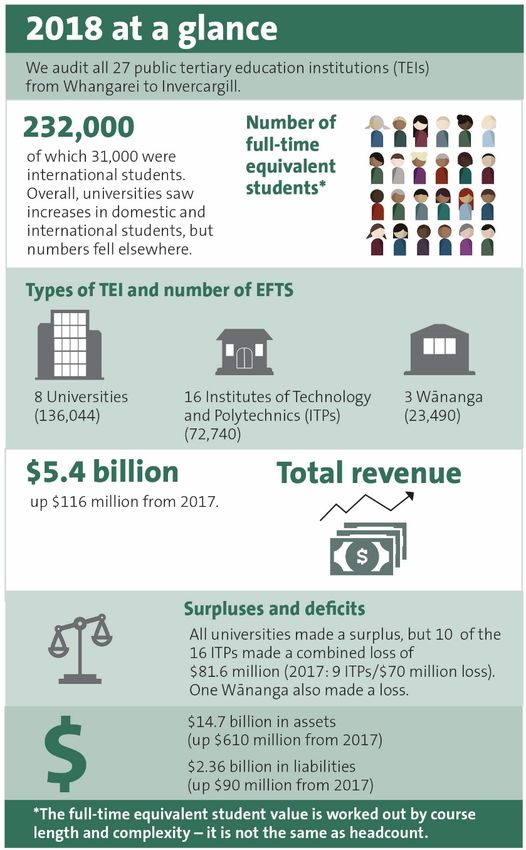
Tertiary education institutions – briefing on the 2018 audit results

For further explanation of this briefing, please contact Pat Johnson, Sector Manager,
Parliamentary Group on 04 917 1500 or email patricia.johnson@oag.govt.nz

                                                                                        2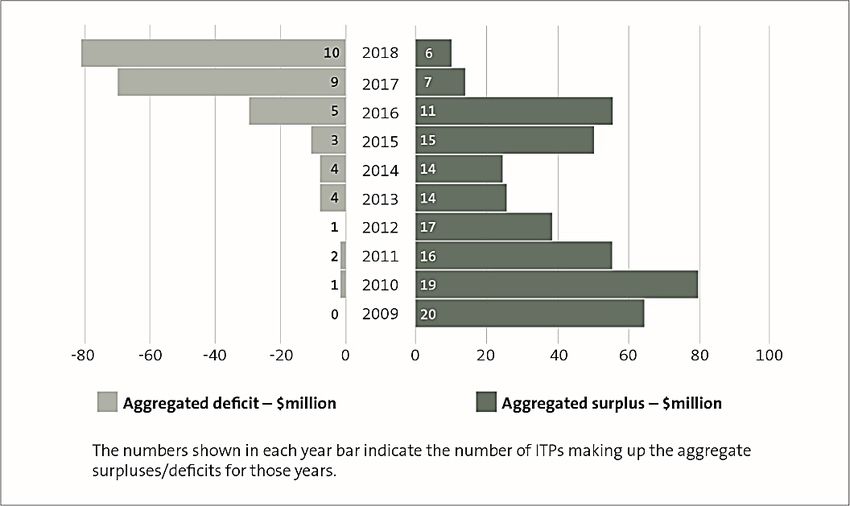
Tertiary education institutions – briefing on the 2018 audit results

Key issues in this briefing (Ctrl + click to navigate, or page up/page
down)

Headlines from the audits .............................................................................4
   Audit opinions ...........................................................................................4
   Additional assurance work at Wintec .......................................................4
   Timeliness of reporting .............................................................................5
   Preparation for audit .................................................................................5
   Our assessment of the effectiveness of systems and controls .................6
Financial sustainability of the institutes of technology and polytechnics ....8
Medium-term financial stability of universities ..........................................13

                                                                                                                 3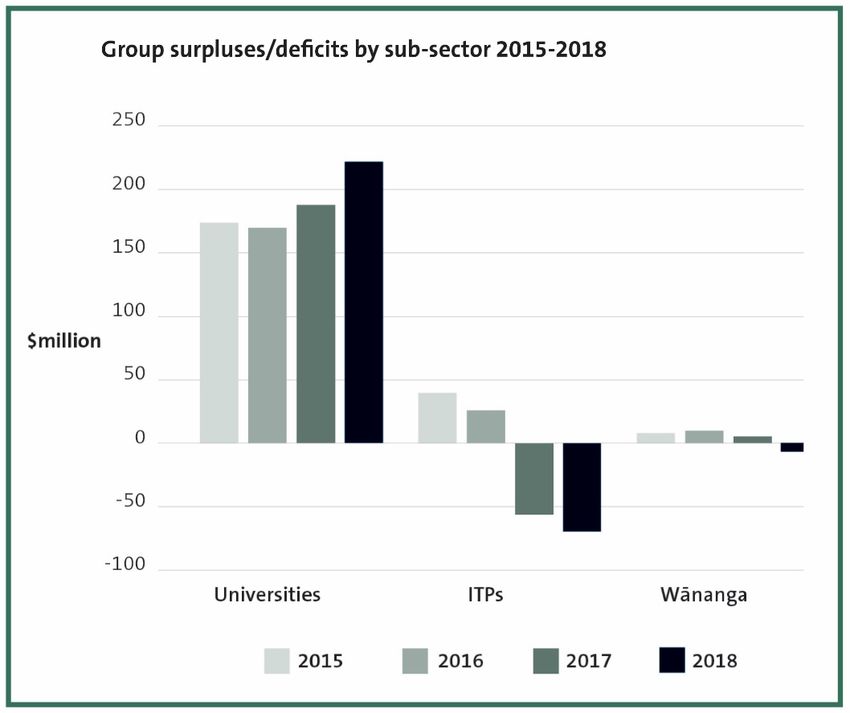
Tertiary education institutions – briefing on the 2018 audit results

Headlines from the audits                                                         WelTec was in a stronger position, but it was potentially
                                                                                  exposed if Whitireia could not make loan repayments or
                                                                                  realise its share of cost savings.
Audit opinions                                                             1.6    As at 25 November 2019, the Government had not confirmed
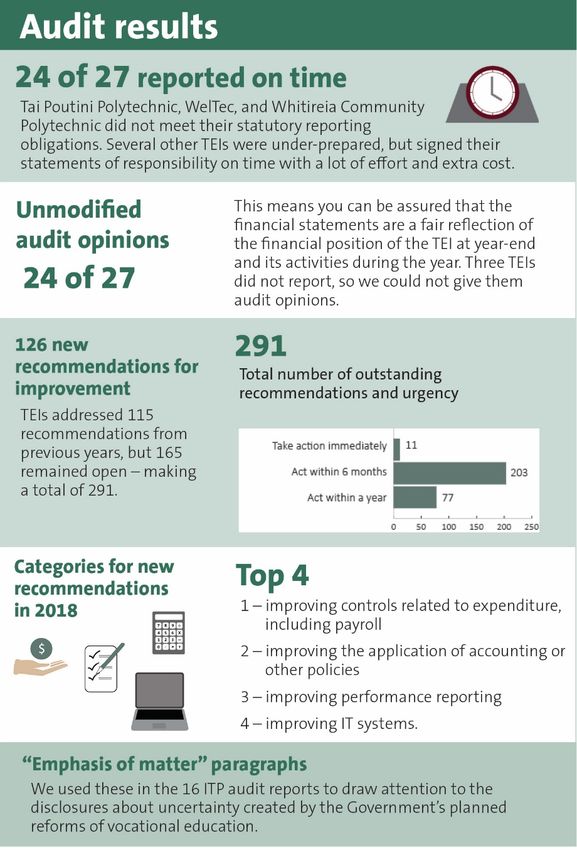
1.1   We issued 24 unmodified audit opinions, which means that                    extra funding for WelTec or Whitireia.
      the financial statements are a fair reflection of the position for
                                                                           1.7    Although we issued unmodified audit opinions, we included an
      those 24 tertiary education institutions (TEIs) at year-end and
                                                                                  “emphasis of matter” paragraph in the audit reports of the 13
      of their activities during the year.
                                                                                  institutes of technology and polytechnics (ITPs) that reported.
1.2   We did not issue audit opinions (or audit reports) for Tai                  These paragraphs drew attention to the disclosures in the
      Poutini Polytechnic, Wellington Institute of Technology                     financial statements about the uncertainty arising from the
      (WelTec), and Whitireia Community Polytechnic. This was                     Government’s proposed reforms of vocational education. We
      because Tai Poutini’s Crown Manager, and WelTec and                         discuss those reforms on pages 11-12.
      Whitireia’s Crown Commissioner, could not sign a statement
      of responsibility for the financial statements, which had been       Additional assurance work at Wintec
      prepared on a “going concern” basis. Both were awaiting the
                                                                           1.8    The Chairman of Waikato Institute of Technology (Wintec)
      outcome of a decision by the Government on whether to
                                                                                  asked us to carry out additional assurance work about certain
      provide additional funding.
                                                                                  international travel expenses incurred by the Chief Executive,
1.3   An organisation that is a going concern is assumed to have                  and past and present members of the executive team. We
      enough money to pay its bills as they fall due for the                      also reviewed all redundancy and severance payments made
      “foreseeable future”. As a guideline, this will be for at least a           to former Wintec employees from 2013 to 2017.
      year after the date of the audit opinion.
                                                                           1.9    A public organisation must be able to show what it is spending
1.4   In Tai Poutini’s case, it could not produce cash flow forecasts             money on and that any expenditure is justified, reasonable,
      far enough into the future. After the financial year-end, the               and appropriate in the circumstances. Sensitive expenditure,
      Government provided extra funding of $2.25 million for Tai                  where there is a perceived potential for private benefit, should
      Poutini to meet its obligations until 1 April 2020.                         be conservative and moderate. There also needs to be
                                                                                  transparent and robust processes for approving expenditure.
1.5   Although they are separate institutions, WelTec and Whitireia
      have shared management and governance roles. Their cash              1.10   In both areas we tested, we identified incomplete and
      flow forecasts did not support using the going concern basis.               inaccurate records of the expenditure, and numerous
                                                                                  instances where the expenditure had not been properly

                                                                                                                                                             4
Tertiary education institutions – briefing on the 2018 audit results
approved. As a result, in many cases, Wintec was unable to • auditors not being able to rely on the internal controls,
provide an account of how it had spent public money. This is and the TEIs not having all the required information
unacceptable for a public organisation charged with the available at the start of the process;
stewardship of public resources.
• lack of internal quality review of the annual report
1.11 We were particularly concerned about the processes, patterns (including the financial statements and statements of
of behaviour, and level of documentation that we saw in our service performance), relying on the auditors to find
work on international travel expenditure. Some of these errors;
practices do not meet standards acceptable in the public
• auditors receiving multiple iterations of the financial
sector and provide an increased opportunity for the misuse of
statements; and
public money. You can read our full report here.
• TEIs not including enough disclosures in their reporting
Timeliness of reporting to explain certain figures.
1.12 All 24 TEIs that reported met their statutory reporting 1.16 This year, we approved 11 requests from auditors wanting to
deadline. charge additional costs to TEIs because of delays and rework
caused by the TEIs (and two other requests relating to
Preparation for audit subsidiary company audits).
1.13 Although a high proportion of TEIs meet their statutory 1.17 In 2019 and 2020, we intend to work more closely with the
reporting deadlines, there can be hidden costs in meeting the senior managers, and Audit and Risk Committees, of some
deadlines. These costs are not just financial – they can TEIs to help them understand how their oversight can
include extra stress on TEI staff and on the audit teams. contribute to an improved audit process.
1.14 TEIs can do much to ensure that the audit process runs
smoothly. Robust governance frameworks and internal
controls are vital to good stewardship of organisations and in
maintaining public trust and confidence. When they are
operating effectively, these frameworks and controls can
reduce the amount of work auditors need to carry out.
1.15 Preparation for the audit process is also important. Some
common issues faced by our auditors this year included:
5Tertiary education institutions – briefing on the 2018 audit results
journal transactions independently reviewed. Auckland
Our assessment of the effectiveness of systems
University of Technology, Massey University, Ara Institute of
and controls Canterbury, the Eastern Institute of Technology (EIT), and
Otago Polytechnic had one outstanding urgent
1.18 We have already highlighted the importance of effective recommendation each.
systems of control and good governance. Our auditors add
value to the organisations they audit and strengthen public Figure 1: Open recommendations at 30 April 2019, by relative urgency
accountability by pointing out improvements to increase the for action.
effective operation of those frameworks and controls.
1.19 Our auditors made 126 new recommendations for
improvement resulting from their work on the 2018 audits of
TEIs.
1.20 TEIs addressed 115 recommendations from previous years,
but 165 remained open – making a total of 291 open
recommendations.
Source: Auditors’ reports to the councils of TEIs.
1.21 Figure 1 shows the status of all open recommendations at 30
April 2019. When making recommendations, our auditors 1.23 The top four categories of recommendation our auditors made
indicate the seriousness of the matter by indicating how in 2018 were for TEIs to improve:
quickly TEIs should act. We expect TEIs to have cleared all of • controls related to expenditure, including payroll
the recommendations by the time of the next audit, but some systems;
recommendations will need an urgent response.
• how they applied accounting policies, or adhered with
1.22 Of the 11 “take action immediately” recommendations in the TEI’s own policy framework (such as spending on
Figure 1, 10 were from previous years.1 The University of travel);
Otago had five of these recommendations, including
• how well the TEI’s annual report tells interested
reinstating an internal audit function (in-house or outsourced),
audiences about how it is performing; and
managing conflicts of interest in procurement, and having all
1 We know some TEIs have acted on some of these recommendations, but we will
assess that progress in the 2019 audit.
6Tertiary education institutions – briefing on the 2018 audit results
• information technology systems and controls (such as
security and preventing over-rides of rules).
1.24 In 2020, we intend to engage more frequently with the Audit
and Risk Committees of those TEIs with the highest number
of outstanding recommendations. In our view, those Audit and
Risk Committees should be more rigorous in following up on
progress in addressing our recommendations.
7Tertiary education institutions – briefing on the 2018 audit results
Financial sustainability of the
institutes of technology and
polytechnics
Aggregated surpluses and deficits
Figure 2: Aggregated surpluses and deficits, 2009 to 2018
2.1 In our report on the results of the 2017 audits, we focused
mostly on the financial performance of the ITP sector.
2.2 Although not all ITPs were in financial difficulty, there had
been a significant increase in the number that were, and in
the size of the combined deficit, between 2016 and 2017.
2.3 Figure 2 shows that, by 2018, 10 ITPs returned an
aggregated deficit of $81.6 million. This was an increase of
$11.6 million from 2017, when nine ITPs recorded an almost
$70 million aggregated deficit.
2.4 In 2018, six ITPs returned an aggregated surplus of
$10.1 million. This was a decrease of $3.7 million from 2017,
when seven ITPs recorded a $13.8 million aggregated
surplus.
2.5 The combination of higher deficits and lower surpluses saw
the aggregated overall deficit rise to $71.5 million in 2018,
from $56 million in 2017. Source: Office of the Auditor-General financial statements database.
8Tertiary education institutions – briefing on the 2018 audit results
Individual ITP surpluses and deficits 2017 and 2018 Figure 3: Individual ITP surpluses and deficits for 2017 and 2018
2.6 In 2018, Wintec made a deficit of $991,000, having made a
surplus of slightly more than $2.2 million in 2017. It became
the tenth ITP in a deficit position.
2.7 Figure 3 shows that Toi Ohomai Institute of Technology,
Manukau Institute of Technology (MIT), Western Institute of
Technology at Taranaki (WITT), and Unitec reduced their
deficits in 2018 (although Unitec still had a significant deficit of
$29 million). WelTec, Whitireia, Tai Poutini, NorthTec, and
Nelson Marlborough Institute of Technology (NMIT) all had
larger deficits in 2018 than in 2017.
2.8 The Tertiary Education Commission (TEC) has a framework
to monitor the financial viability of TEIs. One measure the
TEC uses is operating surplus as a percentage of revenue,
with a low-risk threshold at 3% or above.
2.9 Of the six ITPs making a surplus, only Southern Institute of
Technology (SIT) and Otago Polytechnic made a return of
greater than 3% of revenue (at 4.5% and 4.1% respectively).
Otago Polytechnic’s surplus increased by about $1.3 million in
2018, while SIT’s surplus decreased by a similar amount.
2.10 As with last year, the main reason for revenue shortfalls was a
continued decline in the number of equivalent full-time student
(EFTS) enrolments. We discuss this further in the next
section.
Source: Office of the Auditor-General financial statements database.
9Tertiary education institutions – briefing on the 2018 audit results
Student enrolments claiming exemption from one or two years of a three-year
degree based on prior study in the student’s home location.
2.11 Figure 4 shows that, overall, student numbers in the ITP INZ considers that some of these prior learning claims are not
sector continued to decline in 2018. Total domestic EFTS fell easily verifiable. After we discussed this with NZQA, it told us
to 61,079 from 63,289 in 2017, and international EFTS fell to that it will start to look at the systems for accrediting prior
11,661 from 12,590. International EFTS make up about 16% learning of international students in TEIs.
of the student intake, about the same proportion as in 2016.
Figure 4: Equivalent full-time student enrolments (EFTS) at ITPs, 2016
Domestic student enrolments to 2018, including the percentage of international students
2.12 At the individual ITP level, these effects are not felt equally. 90,000
Tai Poutini lost more than half of its domestic students 15.9% 16.6% 16.0%
80,000
between 2017 and 2018 as it restructured its student
12,873
offerings. NorthTec had 664 fewer domestic EFTS and EIT 70,000 12,590
11,661
396 fewer. WITT’s drop in numbers was lower, but it was the
60,000
third highest in percentage terms. Otago Polytechnic, SIT, the
Total EFTS
Open Polytechnic, and the Universal College of Learning 50,000
(UCOL) increased domestic enrolments. 40,000
67,909 63,289
International student enrolments 30,000 61,079
20,000
2.13 Whitireia, Unitec, NorthTec, WelTec, and NMIT saw the
biggest declines in international student enrolments, while 10,000
WITT, EIT, and Otago Polytechnic increased their 0
international EFTS by the most. 2016 2017 2018
2.14 A reorganisation at Immigration New Zealand (INZ) caused Domestic International
some delays in processing international student visas. INZ is
also vetting some applications more rigorously because of the Source: ITP annual reports.
prevalence of fraudulent applications from some overseas
agents. 2.16 On 9 May 2019, INZ and Education New Zealand announced
a joint programme of work to “support the education sector in
2.15 INZ expects ITPs to apply the same rigour in accrediting prior recruiting quality students, communicating key messages, and
learning. INZ noted an increased number of applications navigating visa processing issues as they arise”. We will
10Tertiary education institutions – briefing on the 2018 audit results
monitor this issue through our normal engagement with INZ 2.21 However, the general picture in many of the ITPs is that cost
and others in 2019 and 2020. It is currently unclear to us what reductions, even if implemented to plan, are running behind
proportion of visa delays are related to INZ’s reorganisation further falls in student enrolments.
and what proportion are because of the real or perceived
increased risk of fraud. The Government’s proposed reforms
Summary of ITP sector’s financial performance 2.22 In August 2019, the Government published its decisions on
vocational education and training, and the Education
2.17 SIT and Otago Polytechnic continue to grow their operations. (Vocational Education and Training) Amendment Bill is now at
From 2019, SIT will also operate the Telford Campus of the the select committee stage. The Education and Workforce
former Taratahi Institute of Agriculture. SIT’s 2018 figures Committee is due to report back to the House by February
include: 2020.
• Music and Audio Institute New Zealand, purchased
2.23 If enacted in its current form, the Bill will convert the 16 ITPs
from Tai Poutini; and to 16 Crown entity subsidiaries. These will be 100% owned by
• full ownership of South Lakes English Language a new “parent” organisation with the working name of the New
College in Queenstown. Zealand Institute of Skills and Technology. The Government
appointed an establishment board for the new entity in
2.18 Otago Polytechnic has almost doubled its international EFTS September 2019.
since 2016, with 1116 out of a total of 1436 studying at its
Auckland Campus. Its domestic student numbers have also 2.24 Now that the Bill is progressing through the legislative
increased after a dip last year. process, we are focused on maintaining accountability during
the transition process. Our submission on the proposed
2.19 UCOL achieved a 2.23% return as a percentage of revenue, reforms highlighted several risks that need to be managed
more than doubling its 2017 surplus, and the Open well. Those risks include maintaining good financial controls
Polytechnic’s domestic student intake has recovered to 2016 and governance, while managing a change process at the
levels. Ara and EIT returned small surpluses. same time.
2.20 Some TEIs are mitigating some of the effects of further 2.25 In periods of uncertainty, it is not unusual for staff to leave or
declines in enrolments. WITT is the most notable, having to become disengaged. Loss of staff and goodwill can
reduced its deficit to $920,000 from $3.6 million in 2017. diminish effective safeguards. Basic good practice, such as
maintaining separation of duties (for example, in payroll
administration or procurement), can deteriorate. This creates
11Tertiary education institutions – briefing on the 2018 audit results
the opportunity for fraud, misuse of public money, and
misappropriation of assets from outside and from within the
TEI.
2.26 We are providing support, consistent with our audit role, to the
establishment board for the new institute to help it prepare for
the Bill’s enactment and set up the new organisation. We can
help mitigate some of the transition risks by sharing what we
have learnt from similar major transitions and by answering
any audit questions as they arise.
12Tertiary education institutions – briefing on the 2018 audit results
Medium-term financial stability of 3.6 We looked at data on staffing-to-student ratios to see whether
universities were managing costs by reducing staff. Overall,
universities the ratio of academic staff to EFTS slightly worsened from
2007 to 2018 – from 16.1 students per staff member to 16.5
students per staff member. However, the ratio of all staff to
Financial sustainability students went up in all but one university.
3.1 In our 2017 report on the TEI audit results, we prioritised ITPs 3.7 VUW, AUT, and the University of Otago’s costs ran marginally
because of the sharp decrease in their financial sustainability ahead of revenue in total during 2015-18 (1.9%, 0.8%, and
since 2016. We concluded that universities were in a stronger 1.5% respectively), but all have good net cash flow. This
position, but this year we looked at their results in more detail. indicates some spending to reduce costs in future years,
We were interested in understanding whether the operating
environment that had led to difficulties in ITPs was likely to 3.8 Massey is the only university to have had a downturn in
have a similar effect on the performance of universities. revenue in 2018. However, it increased its net cash flow from
operations, and its equity increased by $13 million.
3.2 Most universities have continued to increase their revenue,
surpluses, assets, and equity. All universities have positive 3.9 Lincoln University returned to a more stable financial position
net cash flows from operations. in 2018, mostly because it received the proceeds of an
earthquake-related insurance claim. However, Lincoln’s small
3.3 Universities have low levels of debt. Auckland University of size, its mix of education programmes, and the condition of its
Technology (AUT) (15%) and Victoria University of Wellington physical campus present significant challenges. It still needs
(VUW) (9%) have the highest debt-to-asset ratio, but all of the to invest heavily in its facilities to attract students.
others have negligible debt (1% or less).
3.10 On 23 November, the Government approved $80 million to
3.4 Universities are also spending more on capital expenditure help Lincoln University rebuild its earthquake-damaged
than the amount their assets are depreciating by. In most science facilities. The investment will take place alongside a
cases, this should mean that universities are improving the modernisation programme covering teaching, research, and
assets available for teaching, learning, and research. partnerships with other agencies.
3.5 Universities have also been managing within their means. 3.11 The financial performance of universities is intrinsically linked
Total revenue increased by 14.1% and costs by 13.3% since to the volume of students they attract. Although most
2015. The universities are engaged in numerous universities have other revenue streams (such as subsidiary
benchmarking groups and collaborative projects to help them companies, research, and charitable giving), the revenue
understand and manage their costs.
13Tertiary education institutions – briefing on the 2018 audit results
stream from students (including government funding for Figure 5: Equivalent full-time student enrolments (EFTS) at
domestic students) dominates their income. universities, 2016 to 2018, including the percentage of international
students
Student enrolments
160,000
3.12 We looked at the change in enrolments from 2016 to 2018,
and in some cases compared the 2018 enrolments to 2007. 12.4% 13.2% 14.2%
140,000
We chose 2007 because this was the year after some 16,474 17,601 19,293
120,000
colleges were merged into universities. It was also the year
before the global financial crisis. A weakened economy is one 100,000
Total EFTS
factor that can have a positive effect on enrolment into tertiary
education. We were also interested to see whether the 80,000
universities’ reliance on revenue from overseas students was 60,000 116,477 115,441 116,751
increasing. Figure 5 shows the total enrolments expressed in
EFTS for 2016 to 2018. 40,000
20,000
Domestic student enrolments
0
3.13 For all universities, domestic enrolments increased by 1.14% 2016 2017 2018
compared to 2017, are slightly higher than in 2016, and are
2% higher than in 2007. Only Massey University and Lincoln Domestic International
University had fewer enrolments compared to 2017 and 2016.
Source: University annual reports.
3.14 Universities have a much more stable flow of domestic
students than other types of tertiary provider. Three out of four International student enrolments
school-leavers entering tertiary education with a qualification
at level 3 choose to go to university. This proportion is not 3.15 International EFTS enrolments were up 9.61% from 2017 (up
changing much over time, although the number of school- 15% since 2007). The proportion of international students has
leavers not entering further education straight after leaving increased to 14.2% from 13.2% last year and 12.4% in 2016.
school increased sharply between 2017 and 2018. However,
the number of school-leavers is expected to start rising again 3.16 However, for most universities, the proportion of revenue from
by 2021, from about 60,000 a year to about 65,000 a year. international students and the proportion of revenue from
domestic students was about the same in 2018 as it was in
2007. This is partly because the number of international
14Tertiary education institutions – briefing on the 2018 audit results
students is much lower than the number of domestic students Conclusion
and partly because universities are increasing their revenue
from other sources. 3.22 Universities are in good financial standing, with low debt and
strong equity. Although future international student enrolment
3.17 The Universities of Canterbury, Otago, and Waikato, and patterns might be more volatile than in the past, universities
VUW have little international EFTS growth as a percentage of should have enough resources to manage any period of
the total student population compared with 2007. However, adjustment.
demand at the University of Canterbury will have been
affected by the 2010 and 2011 earthquakes, and there are 3.23 Several other operating environment factors might have a
signs that demand has started to increase. bearing on the future success of universities.
3.18 Conversely, the University of Auckland has experienced 3.24 For example, government revenue for level 3 and above
significant growth in demand from international students since domestic student tuition increased by 1.6% from 2019, with a
2007 (up 64%), and international students now make up 15% further 1.8% from 2020. Although some costs are rising more
of its total enrolments. Massey University’s international EFTS quickly than this, universities appear to be managing cost
are now 18% of total EFTS, compared to 14% in 2007. pressures.
3.19 Lincoln University has the highest exposure to international 3.25 The numbers of domestic students should also start to rise
student markets (38% of total students are international again in 2021. If historical patterns prevail, then universities
students), compared to 32% in 2007. should see further increases in domestic student enrolments.
3.20 We have become aware of an increasing trend of international 3.26 We are aware that universities are concerned about how their
students enrolling in courses in New Zealand at level 8 and position on various international ranking assessments might
higher on the qualifications framework (such as taught affect their ability to attract academic staff and international
Masters’ degrees). These courses are usually of less than a students. Some universities see this as their major strategic
year’s duration after allowing for prior learning. risk, and this is something the Committee could be interested
in exploring further with Universities New Zealand, Education
3.21 We cannot tell whether the trend is significant enough to New Zealand, and the TEC.
contribute to an overdependence on revenue from some
international markets. We suggest that the Committee ask the
TEC about these trends, as it collects more information than
is contained in the annual reports.
15You can also read


