TOP 50 SPONSORS - RIS News
←
→
Page content transcription
If your browser does not render page correctly, please read the page content below

TOP 50 SPONSORS

Fifty top-performing apparel firms are working feverishly to innovate with
product, win the hearts of the consumer, balance their footprint, and bring
home the profits. Read on for a curated examination of what’s happening
inside the walls of the prestigious 2016 Apparel Top 50.

 #1   Michael Kors
 The global lifestyle brand makes its debut on the Top 50 this year, after issuing an
 IPO in 2012. (The company files under leather and leather goods, which Apparel did
 not previously consider. Had it done so, MK would have debuted at No. 6 in 2013,
 hit the No. 1 spot in 2014 and held steady there through this year. Also, at press
 time, MK had filed for its most recent fiscal year, and while its earnings and profit-
 ability are down, it still churned out a whopping 17.78 profitability). The brand,
 which produces a range of products under Michael Kors Collection, MICHAEL
 Michael Kors and Michael Kors Mens, including accessories, footwear, watches,
 jewelry, ready-to-wear and a full line of fragrance products, operates stores either
 directly or through licensing partners, in 95 countries around the world, and also
 has a large wholesale business. MK has expanded so rapidly in the past few years
 that many have judged it overexposed. Whether true or not, that rapid growth
 combined with decreases in mall traffic, heavy promotional activity and other chal-
 lenges at retail have recently spurred the company to cut back on the number of
 products it sells to wholesalers, as well as to retailers that sell many other brands,
 so as to better control its pricing, protect the Michael Kors brand image — and
 increase demand for full-price product. This year the company continues to expand
 its international markets and e-commerce flagships and is building up its men’s
 business. Also, in the spring it launched Michael Kors ACCESS, a line of wearable
 technology. In May, the company acquired Michael Kors (HK) Limited, the exclu-
 sive licensee of MK in China and other parts of Asia.
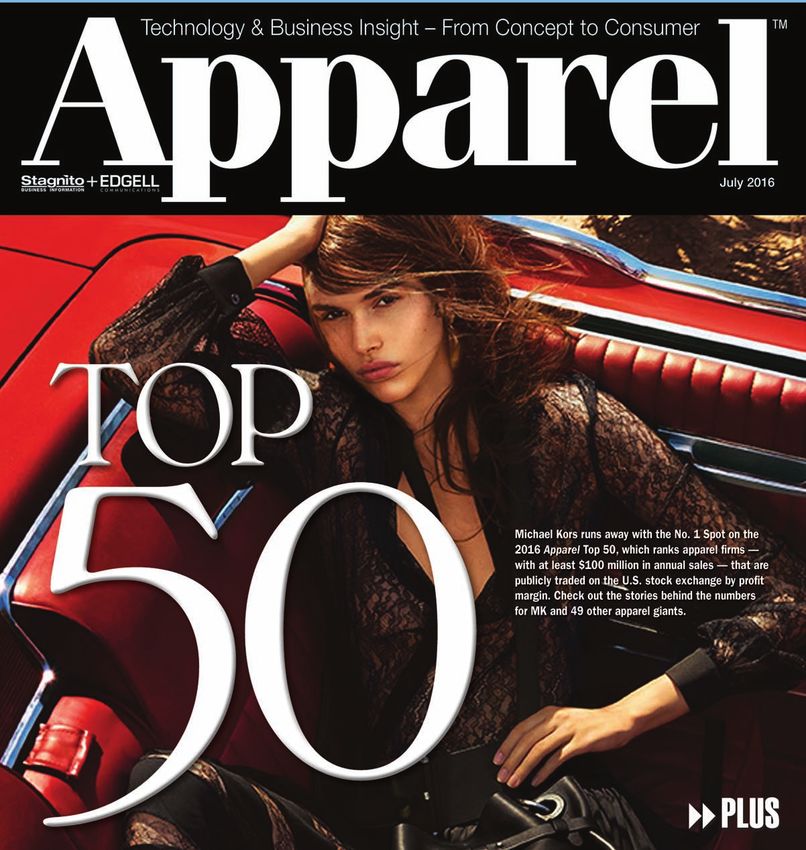
cover sTory

#2   Gildan
It nabbed the No. 1 spot for the second year in a row, just one more demonstration of
how powerful it can be to have the “voice” of five-time CMA Male Vocalist of the Year
Blake Shelton on your team. Then again, maybe it’s a sign of just how powerful it can
be to own your manufacturing base, which Gildan continued to strengthen with $230
million in capital expenditures, including significant investments in yarn-spinning in
2015 that are reducing costs while also enhancing the company’s product offering with
higher-end yarns. Nah. It’s probably Blake, who signed on as a celebrity endorser in
early 2015. To date, Gildan, whose family of brands includes Gildan®, Gold Toe®, Anvil®,
Comfort Colors®, Secret®, Silks®, Powersox®, Kushyfoot® and Therapy Plus™ as well
as licenses for Under Armour® and Mossy Oak®, has sold 7 billion shirts in more than
50 countries and operates more than 25 facilities in North America, Central America,
the Caribbean and Bangladesh that employ more than 42,000 employees. (In March
2015, Gildan received a $3.5 million special grant from the Honduran government in
recognition of its significant job creation there, which it redistributed to educational,
healthcare and housing projects in that country.) It continues to invest in vertical manufacturing and complementary acquisitions, in
2015 purchasing Comfort Colors, and just this past May acquiring Alstyle Apparel LLC, manufacturer of activewear products, which
comes with its own manufacturing operations in Mexico. Gildan is gaining market share across segments: U.S. Printwear is up 12
percent, Branded Apparel sales grew 11 percent; and the Gildan® brand gained 14 percent market share in men’s socks, to reach the
No. 2 brand position in the United States retail market.

                                                             #3   The Buckle
                                                             Since it debuted on the Top 50 at No. 2 in 2009, The Buckle has re-
                                                             mained at the top of the chart with a steady winning formula that puts
                                                             the customer first. Sales, net income and profitability were all slightly
                                                             down in 2015 but the company still turned in an impressive perfor-
                                                             mance, with profitability of 13.16 percent. Online sales were up 11.8
                                                             percent, to $105.5 million. Men’s sales were up approximately 2 percent;
                                                             women’s sales were down approximately 6.5 percent; and the company’s
                                                             private-label business took a slightly larger share at 36 percent of sales.
                                                             The popular denim destination opened nine new stores, completed 44
                                                             remodels and closed one store during the year, closing 2015 with 385 of
                                                             its 468 stores in its newest format. This year it expects to open four new
                                                             stores and complete 18 remodels.

#4   lululemon athletica
Despite its now infamous see-through yoga pants and its founder’s comments about women’s thighs,
lulu has nonetheless remained very profitable, and that is likely because it’s striking at the hearts of its
ideal customers — a “32-year-old professional single woman named Ocean who makes $100,000 a
year” and her counterpart, Duke, a 35-year-old athletic opportunist who enjoys surfing in the summer
and snowboarding in the winter (and also makes more money than Ocean) — focusing on the “experi-
ence” part of the retail experience, expanding its community concept with Hub 17, a unique 5,000-square-
foot space above its Flatiron store in NYC for fitness classes, monthly dinners, concerts, art shows and
more. Also available: a concierge service to help with anything from sending packages home by messenger
(free of charge), making dinner reservations, or booking a spot at an exercise class. Great Q4 top-line mo-
mentum exceeded expectations (global comps were up 11 percent and ecomm was up 33 percent), while
lulu launched “Engineered Sensation” with new tech fabrics and construction techniques, also reorganiz-
ing its “pant wall” to sell its yoga pants by fit or “sensation” instead of silhouette, which contributed to a
19 percent increase in women’s bottoms from September to January. Lulu is turning up the heat on digital
with new CRM capabilities and marketing, opened new locations in London, Seoul and Tokyo, and expects
to open 11 stores this year. International is expected to account for 20 percent to 25 percent of business by 2020, by when it expects
total revenue to double to roughly $4 billion. Men’s business continues to outpace overall growth, and lulu hired Lee Holman to its
first ever creative director position, with a goal of bringing men’s and women’s together under a unified brand vision.

                                                                                                      www.apparelmag.com • JULY 2016 13
THe ToP 50

#5    Nike
In an era when big established companies often find that their processes
are cumbersome and that their businesses are outpaced in innovation
by younger, more flexible startups, Nike has proven that big and nimble
are not mutually exclusive. From its powerful marketing spots such as
last year’s clever “We’re short a guy,” (watch it) to its Sport Research Lab
which continues to develop product to enhance athletic performance, to
its new NIKE+ app that combines on demand coaching, a personal store,
and engaging experiences, Nike is just doing it. One other thing it just did
(perhaps feeling the pressure from Under Armour’s rising roster of star
athletes) was sign LeBron James to a lifetime deal — the largest single-
athlete guarantee in company history. Nike has made more versions of
James’ shoe than it has for any other athlete except Michael Jordan, who
is on his 30th Air Jordan. Since signing James in 2003, Nike has made 13 versions of James’ signature shoe, with annual sales in
2015 for his line estimated to top $400 million. A few of Nike’s many new concepts and innovations include 1) the AntiClog Trac-
tion football cleat, which keeps mud from sticking to the shoe; 2) the Free RN Motion for runners with a new outsole design that
expands in multiple directions when the foot strikes the ground; and 3) the NIKE HyperAdapt 1.0, featuring auto adaptive lacing,
with laces that tighten when your heel hits a sensor in the shoe. In the nine months since its annual filing, Nike has outperformed
last year’s pace, with revenues up 5.7 percent, net income up 21 percent, and profitability at an impressive 12.1 percent.

                                            #6   L Brands
                                            There’s a good chance that men everywhere will no longer bother to check the mail. It’s
                                            the end of an era for the company’s flagship brand: Victoria’s Secret announced that it
                                            is scrapping its famous catalog, which the company says is an outdated concept — and
                                            one that cost $125 million to $150 million annually. Other recent big changes at the
                                            company include job cuts, the elimination of swimwear, shoes and accessories, and the
                                            division of the VS business into Victoria’s Secret Lingerie, PINK and Victoria’s Secret
                                            Beauty, each of which will be managed by separate executives. (Former Spanx CEO Jan
                                            Singer will take over VS Lingerie and former Coach executive Greg Unis will run the VS
                                            Beauty business.) L Brands, whose portfolio also includes Bath & Body Works, La Senza,
                                            PINK and Henri Bendel, will grow this year via: real estate (27 new openings in North
                                            America, including a new Victoria’s Secret flagship store on Fifth Avenue); increasing
                                            store selling payroll in efforts to improve the customer experience; and investments in
                                            international expansion, which grew by 144 new stores in 2015 to reach 531, and will
                                            add about 175 stores this year globally.

#7    vF corp.
You can’t help but be inspired by the stories of The North Face’s Never Stop Exploring®
campaign, the company’s first expansive view of exploration and its first truly global
brand effort. Check out the spots — you’ll be joining a large group. The campaign has
received more than 1 billion impressions. VF’s more than 30 diverse brands include the
iconic Vans®, The North Face®, Timberland, Lee and Wrangler — each of which exceeded
$1 billion in annual revenue. Just a few other highlights from the year: 1) The Vans® and
The North Face® brands came together in 2015 to launch a joint collection of popular
limited-edition shoes and outerwear; 2) Chief Executive magazine named VF to the top
10 in its 2016 Best Companies for Leaders list; 3) VF saw great performance in running
and training apparel driven by Mountain Athletics, which grew more than 40 percent;
4) 36 percent of sales came from outside the United States; 5) VF sourced or produced
more than 550 million units of apparel and footwear, 23 percent at its own locations and
77 percent with contract suppliers, along the way establishing VF’s Responsible Sourcing
program; 6) The North Face received great response to the launch of a new store concept
on London’s Regent Street, which allows athletes to train together in weekly sessions;
and 7) Vans’ PROPELLER skateboarding film was one of iTunes top 10 documentaries of
the year and was named TransWorld SKATEboarding’s film of the year.

14   JULY 2016 • www.apparelmag.com
THe ToP 50

#8   cintas                                                           #9   Duluth Holdings
It turned in a solid performance in fiscal 2015 and for the most      Duluth Trading is the home of Buck Naked Nation — One
recent nine months ending in February, sales are up 9 percent         Nation, Underwear, Indetectable, with Liberty and Comfort
and net income up 72.9 percent with profitability at an impres-       for All. (Hey, don’t look at me, that’s the motto of the na-
sive 15.5 percent over the same period last year. In January,         tion.) And while Buck Naked has clearly taken the nation by
Cintas launched the first national brand campaign in its 87-year      storm with its comfortable undies (12,000 five-star reviews
history,“Ready for the Workday,” which includes TV, radio,            and counting), you can find a lot of other things at the
print and online and aims to show the breadth of products and         casual and work apparel brand, from its bestselling ballroom
services the company provides to a variety of businesses, from        jeans to its no b.s. business wear. It was a whirlwind year for
mom-and-pops to national chains. Already, the campaign has            Duluth, which makes its debut on the Top 50 this year after
resulted in greater brand awareness and assisted in cross-selling     going public last October. In 2015, the Belleville, Wisconsin-
efforts. Recent growth has been driven largely by new business        based company took its fun and quirky marketing to a larger
wins, sales of additional products and services to existing cus-      audience via TV advertising focusing on core problem-
tomers and strong customer retention, yet organic growth has          solving products such as its Fire Hose pants, Flannel Shirts,
continued to be hampered by decreased headcount in the oil,           Longtail T and Buck Naked underwear. (Indeed, Duluth was
gas and coal industries. The company’s conversion to SAP con-         named an Apparel Innovator in 2012 for creating products
tinues as it works to move its largest operating division, Uniform    that address specific needs — the Long-Tail Tee, for example,
Rental and Facility Services to the platform, a capital investment    is the antidote to plumber’s butt.) It also drew new custom-
of approximately $100 million; it plans to extend that SAP foot-      ers to its base via carefully executed promotional activities
print into its distribution network and expand its e-commerce         in Q4, for example, offering sequence discounting to 30
capabilities, which it anticipates will cost $40 million.             percent but avoiding the deep discounting prevalent among
                                                                      other retailers. Because of the evergreen nature of its core
                                                                      products — 70 percent to 75 percent of its products extend
                                                                      to the next season — the company can keep high inventory
                                                                      levels. In 2015, the company opened two new retail stores
                                                                      and one outlet, bringing its total store count to nine, this
                                                                      year expects to open four to five more, and in 2017 another
                                                                      eight, moving closer to the East Coast, where it has its larg-
                                                                      est concentration of customers. It is expanding its Belleville
                                                                      DC this year to accommodate sales expansion and new store
                                                                      openings and to lower labor intensive 3PL costs. It is also
                                                                      leasing another facility located nearby, and implementing a
                                                                      new order management system.

#10   Francesca’s collections                                                              #11    ross stores
In line with its Vision 2020 long-term strategic plan, it improved inventory man-          The owner of Ross Stores and dd Dis-
agement, clearing out slow moving inventory and improving the flow cadence to              counts turned in a strong year, despite a
boutiques, with new merchandise arriving almost daily; enhanced merchandise                highly promotional selling environment
assortments; and elevated the boutique experi-                                             in Q4 and its most challenging sales
ence — efforts that took hold in the second                                                comparisons from the prior year, driven
half of the year with a return to positive comps.                                          by competitive prices on a wide assort-
Its apparel business grew significantly, led by                                            ment of items. Operating margin for the
dresses, which doubled in sales over last year. A                                          year increased to a record 13.6 percent,
few other highlights: 1) Francesca’s DTC channel                                           and the company ended the year with
grew 18 percent over the previous year to $17.1                                            inventories up 3 percent, with packaway
million; 2) it reduced its promotional cadence,                                            levels at 47 percent of total inventories,
which affected comps but which it expects to be                                            compared with 45 percent last year. The
beneficial in the long term; 3) it opened 83 new                                           company plans to add about 70 Ross
stores and closed six, bringing its boutique count                                         and 20 dd’s Discounts locations in 2016.
to 616; and 4) it put a new executive team in                                              Matching Walmart’s moves, Ross raised
place, with a new CFO, chief merchant, SVP of                                              the minimum wage to $10 per hour in
marketing and DTC, VP of IT, VP of real estate,                                            the second quarter of this year in efforts
VP and DMM for product.                                                                    to attract and retain talent.

                                                                                                   www.apparelmag.com • JULY 2016 15
THe ToP 50

#12    UniFirst                                                                #13   carter’s
It was another record year for the company, which hit highs of $1.5            It turned in record sales and earnings in 2015 and its
billion in revenues and $124.3 million in net income, led by its core          27th consecutive year of sales growth, opened more
laundry operations, which make up 90 percent of total business and             than 100 new stores in North America and began
in 2015 achieved record new account sales, continued improvement               e-commerce capabilities in China via the launch of its
in operational and service efficiencies in its hundreds of local service       Carter’s brand on Alibaba’s Tmall, which received more
facilities and positive trends in customer pricing and add-on services.        than 12 million visits last year. Young children’s is the
                                        These gains were achieved de-          fastest-growing apparel segment in China, estimated
                                        spite losses of wearers associat-      at $12 billion and projected to more than double to $25
                                        ed with lower oil prices in ener-      billion by 2025. In the United States, the segment grew
                                        gy and energy related industries,      about 2 percent last year to $20.5 billion, with Carter’s
                                        which reverberated throughout          piece of the pie growing to 17 percent.
                                        the uniform market, as well            The company continues to improve its mobile experi-
                                        as a weaker Canadian dollar            ence, with demand on mobile devices more than
                                        exchange rate that negatively          doubling in 2015. In Q4, the company launched a new
                                        affected both top and bottom           customer loyalty program, called Rewarding Moments,
                                        lines; both are factors that will      which enrolled more than five million shoppers in just
                                        continue to affect the company         the first four months. In the next five years the compa-
                                        in 2016, as will rising labor costs,   ny expects to open 270 Carter’s stores, most in its new
                                        and continuing investments in          side-by-side format, which brings together the Carter’s
                                        IT, including its ongoing CRM          and OshKosh B’gosh brands in one location, a model
                                        project. In 2015, the company          that has kicked up the performance of its OshKosh
                                        made several small acquisitions,       brand. E-commerce sales were up 20 percent in 2015;
                                        primarily in its laundry opera-        even as international demand fell seven percent, due
                                        tions, and continues to look for       to the strong dollar, domestic sales were up 40 percent.
                                        acquisition targets.

#14    columbia sportswear
Record sales of $2.3 billion included 7 percent growth from the Columbia
brand, 26 percent growth from SOREL and 29 percent growth from prAna ( in
its first full year as a member of the company’s portfolio); 21 percent growth
in the United States, balanced across wholesale and direct-to-consumer,
including a 30 percent increase in e-comm sales; and 20 percent growth in its
Europe-direct markets. In 2015: 1) Columbia Sportswear introduced OutDry
Extreme™ rainwear, which it reports is the first in the industry with a mem-
brane-on-the-outside construction; 2) it launched its most global marketing
campaign ever (and largest investment for the year), Tested Tough™, featur-
ing the company’s 92-year-old chairman (and founder) Gert Boyle reprising
her role as the Original Tough Mother; 3) it continued to enhance the brand
through licensing arrangements such as with Manchester United and the Dal-
las Cowboys, and via partnerships such as urban-style influencer KITH, with
which it created an updated version of its 1986 Bugaboo parka.

#15    Hanesbrands
The owner of such iconic brands as Hanes, Champion, Playtex, Bali, Maidenform and Wonderbra turned in a record year, with rev-
enue up 8 percent — driven by acquisitions — even though Q4 was negatively impacted by widespread retail traffic declines. With
the integration of Knights Apparel and Hanes Europe well underway, the company was looking to make additional acquisitions,
and an all-cash deal for Champion Europe, based in Italy, (which also owns the brands rights in the Middle East and Africa), was
expected to close in late June. The acquisition of Australia’s top underwear and intimate apparel company, Pacific Brands Ltd., for
$800 million in cash — Hanesbrands largest ever deal — was expected to close later this month. Hanesbrands projects that it will hit
$2 billion in global Champion sales by 2021 or 2022. The company continues to pursue its Innovate-to-Elevate strategy by expanding
the space of innovation platforms such as X-Temp and working to apply that innovation to core products, such as in Tagless; and to
focus on growth online, which represents 18 percent of apparel sales.

16   JULY 2016 • www.apparelmag.com

THe ToP 50

#16    TJX companies                                              #17    PvH
The off-price model continues to shine, and in 2015 the           In a big marketing win, PVH signed tennis great Rafael Nadal as
company crossed the $30 billion threshold, with comp-             the brand ambassador for Tommy Hilfiger Underwear, Tommy
store sales up (for the 20th consecutive year) 5 percent          Hilfiger Tailored, and the Tommy Hilfiger Bold fragrance, which was
on higher customer traffic across the company’s four              accompanied by a global multimedia advertising campaign in more
divisions: MarMaxx, Home Goods, TJX Canada and TJX                than 40 countries, campaign video that went viral and was one of
International, the latter expanding in Europe and entering        the top 10 videos on Google for the launch period. The campaign
Australia with the acquisition of off-price retailer Trade        had more than 500 million impressions during the second half of
Secret. The company added 219 stores, including ad-               2015 and helped full-price sales of underwear nearly double in
ditional Sierra Trading Post stores, and closed just one,         Europe and in the United States during the second half as well. In
ending the year with 3,614 stores, and 216,000 employ-            February, Tommy Hilfiger Licensing LLC and G-III Apparel Group
ees — 1,000 of which comprise its buying organization,            (No. 27) entered into a multi-year license agreement for the design,
with another 1,000 devoted to merchandising, including            production and distribution of Tommy Hilfiger women’s wear col-
planning and allocation. Calling itself a “global sourc-          lections in the United States and Canada, which includes PVH’s
ing machine, ”TJX has buyers in 11 countries across four          current women’s sportswear business and additional categories to
continents, buying from 18,000 vendors in 100 countries           be licensed, including suit separates, performance and denim —
— a vast reach that gives it flexibility to move quickly to       and it also signed supermodel and millennial icon Gigi Hadid as
capitalize on the best merchandise opportunities. Its sup-        the global brand ambassador for the collection. PVH announced
ply chain and distribution network is designed to process         that it will acquire the remaining 55 percent stake in its Tommy Hil-
buys both small and large, and move them quickly to the           figer China joint venture, which more than doubled from approxi-
right locations. Expect more growth from this crowd fave,         mately $70 million to just over $140 million in revenues in 2015. Its
across its current locations, via the addition of stores, via     Calvin Klein business turned in a strong performance, including a
e-commerce, in its loyalty program, and across all age            U.S. jeans turnaround, which saw soft sales at department stores
brackets and demographics.                                        but strong performance through its new U.S. retail partners includ-
                                                                  ing Urban Outfitters (No. 19) and Amazon.

#18    The cato corp.
In another challenging year, Charlotte, NC-based Cato produced its highest earnings in com-
pany history. The Cato and Versona e-commerce business continues to grow and the company
is driving revenue not only from its website, but also by using its order-from and ship-to store
models to drive additional volume to its stores. Plans to invest $27 million in capital expen-
ditures in 2016 include the opening of 23 new stores and continued investment to enhance
and upgrade its existing systems. At the end of 2015 the company operated 1,092 Cato stores,
214 It’s Fashion and It’s Fashion Metro stores, and 66 Versona stores, each concept targeting a
different customer base, but all focusing on providing fashion and accessories at exceptional
values.

#19    Urban outfitters
Since the shift 10 years ago to the skinny bottom, women have filled their closets with leggings
and jeggings and lots of long tops and sweaters to go over them, which might be why the ap-
parel category at the company, primarily at Anthropologie and Free People, has slumped, even
as other categories have thrived. But UO sniffs fashion excitement in the air, and is hopeful it
can turn things around soon in that category. The company is approaching what it believes is its
maximum store unit potential in North America, and several of the approximately 26 new stores
it plans to open this year will be in Europe. While the company sells and ships to more than 130
                                                                                                                                           The Cato Corp.

countries via the web, it will be looking to expand distribution on the ground globally via a va-
riety of models ranging from self-owned and -operated stores to concessions and wholesale ar-
rangements to licensing. An expanded format for Anthropologie will enable it to serve consum-
ers with broader assortments, especially in categories it has targeted for expansion across the
company, including home, beauty, shoes, and intimates as well as the BHLDN wedding brand and the Terrain outdoor living brand.
(Its new beauty assortment offered online and in 70 concept shop-within-shops in Anthropologie was so successful that it plans to
open an additional 60 shops this year.) And, because you can’t eat wedding dresses or shoes, the company also plans to open two
to three Vetri Pizzerias, which will be standalone locations. On the omnichannel front, efforts to improve functionality around check
out, payments, search, inventory visibility and speed on all of its brands’ web platforms will include the roll out of in-store-pick-up,
ship-through-store, and enhanced mobile application capabilities.

18   JULY 2016 • www.apparelmag.com
THe ToP 50

#20    G&K services                                          #21    superior Uniform Group
It made progress toward the 12+ Plan it introduced           In March, the company acquired Los Angeles, Calif.-based Bamko — a
two years ago, targeting 12 percent operating margin         full-service merchandise sourcing and promotional products company
(it hit 11.9 percent) and 12 percent ROIC (it reached        with a global reach — for approximately $15.8 million, which includes
11 percent), with an additional focus on top-line            the company’s subsidiaries in Hong Kong, China, Brazil and England
growth. Revenue grew to $937 million, with organic           as well as an affiliate in India. Superior views the acquisition as an op-
revenue growth of 5.6 percent, topping the previ-            portunity to strengthen its position in retail, health care, food service,
ous year’s 4.5 percent. The year saw record customer         transportation and other markets that it serves. Two years after its
satisfaction scores and record new accounts sales, and       entrée into direct via its Fashion Seal Healthcare Direct division, it con-
in 2016, the company’s Game Plan to: 1) keep its cus-        tinues to work to drive higher sales and profitability from this channel,
tomer promise; 2) improve how it targets customers;          and is also gaining traction with additional integrated delivery networks
3) drive operational excellence and 4) strengthen its        (IDNs) and additional GPO contracts. In January, the company opened
high-performing team is producing results, as, three         its first company-managed manufacturing facility in almost 20 years
quarters into the current fiscal year, G&K is on pace        after entering a long-term agreement to lease a factory built to spec in
to turn in the highest full-year operating cash flow         Haiti, just on the country’s border with the Dominican Republic. This
in company history, even as it struggles, along with         will provide multiple advantages, not least of which are the duty-free
the rest of its competitors, with a net loss of uniform      benefits of producing there, and access to the country’s highly trainable
wearers at existing accounts, particularly in the oil and    and eager workforce, which is expected to number approximately 150
gas industries, as well as in related manufacturing.         on site by year’s end.

#22    American eagle outfitters
It wasn’t long ago that the moniker “teen retailer” pretty much guaranteed your business was in
the dumps, but though Aeropostale declared bankruptcy and Abercrombie is taking more time to
regain its stride, American Eagle is soaring (pun intended). The company has really made a turn-
around in the past couple of years with better quality, innovation in product, and clever marketing that strikes a chord with consum-
ers. It was a banner year for the company, which saw higher selling prices and higher margins, bigger baskets and traffic increases
both online and in-store. Comp-store sales were up 7 percent and direct was up 20 percent, totaling more than $110 million in sales
growth, aided by omni tools such as ship-from-store (accounting for 20 percent of digital in Q4). Both women’s and men’s collections
were strong performers, while the Aerie brand really took off last year, in no small part to its funny and inclusive Aerie Real ad cam-
paigns that continued to resonate across social media with their focus on #bodyacceptance — models are not airbrushed or retouched
in any way. Media impressions on the campaign rose to 4 billion in 2015! The company took its campaign one step further on April
1 — in what may or may not be a bit of an April Fools’ joke. In a spot that took its #bodyacceptance campaign to the other gender, the
#AerieMan shares “real-life” stories while comfortably lounging in his skivvies. Also in 2015, AEO acquired Tailgate Clothing Co., a
vintage, sports-inspired apparel brand with a college town store concept, and Todd Snyder New York, a premium men’s wear brand,
for $11 million. It also acquired the brand founder and creative director, Todd Snyder, who joined the company as EVP.

#23    Under Armour
If you judge an athletic brand by the successes of the athletes who wear its product, then Under Armour might snag the No. 1 spot.
Call it “The Year of Champions.” UA does. In 2015, the MVPs of the big four U.S. professional leagues were UA brand ambassadors:
Cam Newton (NFL), Stephen Curry (NBA), Bryce Harper (MLB), and Carey Price (NHL). And then there’s Jordan Spieth, PGA Tour
Player of the Year, who regained his No. 1 World Golf ranking. Also: Misty Copeland, who performed as the first African American
principal dancer at the American Ballet Theatre. Lindsey Vonn, who became the most decorated female alpine skier of all time. Not
too shabby. And the list goes on. It was its 10th year as a public company, highlighted by 30 percent top-line growth and 23 consec-
utive quarters of 20 percent growth in revenues — one of just two companies in the S&P500 that can make that claim. Apparel, its
largest category, grew 22 percent. Direct-to-consumer expanded to 25 global websites and nearly 200 Under Armour-owned retail
doors around the world, and represents 30 percent of business. In 2015, UA opened its largest store ever on the Magnificent Mile in
Chicago and its first flagship in China, in Shanghai. Speaking of, international business grew 69 percent to 11 percent of revenues,
up from 6 percent two years prior. Footwear was up 57 percent — driven in large part by the amazing performance of Stephen
Curry — and UA has its eyes set on the $1 billion mark for this category. Connected Fitness (including UA Record, MapMyFitness,
Endomondo and MyFitnessPal) has taken on a life of its own, with 160 million registered users who logged nearly 8 billion meals
and 2 billion activities over the course of the year. An average of more than 100,000 users join the platform each day! It’s turning
that data, via its MATH HOUSE, into a single view of the consumer that it expects to transform its business and the lives of athletes
around the globe.

                                                                                                    www.apparelmag.com • JULY 2016 19
THE TOP A ranking of apparel companies (with at least $100M in annual sales) that are publicly
traded on the U.S. stock exchange by their profit margin for the most recent fiscal year.
SALES NET INCOME % %
1 New
Last
2016 Year’s
RANK Rank Company
Michael Kors
50 FY
March
Most
Recent
FY
4,371.5
Previous
FY
3,310.8
%
Change
Sales
32.0
Most
Recent
FY
881.0
Previous
FY
661.5
%
Change
Net
Income
33.2
Profit
Margin,
Most
Recent FY
20.15
Profit
Margin,
Previous
FY
19.98
2 1 Gildan Sept. 2,568.6 2,299.2 11.7 355.4 281.0 26.5 13.84 12.22
3 2 The Buckle Jan. 1,119.6 1,153.1 (2.9) 147.3 162.6 (9.4) 13.16 14.10
4 4 lululemon athletica Jan. 2,060.5 1,797.2 14.6 266.0 239.0 11.3 12.91 13.30
5 6 Nike May 30,601.0 27,799.0 10.1 3,273.0 2,693.0 21.5 10.70 9.69
6 8 L Brands (formerly Limited Brands) Jan. 12,154.0 11,454.0 6.1 1,253.0 1,042.0 20.2 10.31 9.10
7 10 VF Corp. Jan. 12,376.7 12,282.2 0.8 1,231.6 1,047.5 17.6 9.95 8.53
8 13 Cintas Corp. May 4,476.9 4,469.6 0.2 430.6 374.4 15.0 9.62 8.38
9 New Duluth Holdings (Duluth Trading Co.) Jan. 304.2 231.9 31.2 27.4 23.6 16.1 9.01 10.18
10 11 Francesca’s Collections Jan. 439.4 377.5 16.4 38.2 32.1 19.0 8.69 8.50
11 12 Ross Stores Jan. 11,940.0 11,041.7 8.1 1,020.7 924.7 10.4 8.55 8.37
12 9 UniFirst Aug. 1,456.6 1,394.9 4.4 124.3 119.9 3.7 8.53 8.60
13 19 Carter’s Jan. 3,013.9 2,893.9 4.1 237.8 194.7 22.1 7.89 6.73
14 20 Columbia Sportswear Dec. 2,326.2 2,100.6 10.7 174.3 137.2 27.0 7.49 6.53
15 16 Hanesbrands Jan. 5,731.5 5,324.7 7.6 428.9 404.5 6.0 7.48 7.60
16 15 TJX Companies Jan. 30,944.9 29,078.0 6.4 2,277.7 2,215.0 2.8 7.36 7.62
17 25 PVH Corp. Jan. 8,020.0 8,241.0 (2.7) 572.0 439.0 30.3 7.13 5.33
18 22 The Cato Corp. Jan. 1,011.1 986.9 2.5 66.8 60.5 10.4 6.61 6.13
19 17 Urban Outfitters Jan. 3,445.1 3,323.1 3.7 224.5 232.4 (3.4) 6.52 6.99
20 21 G&K Services June 937.6 900.9 4.1 59.9 56.1 6.8 6.39 6.23
21 23 Superior Uniform Group Dec. 210.3 196.2 7.2 13.1 11.4 15.4 6.23 5.78
22 36 American Eagle Outfitters Jan. 3,521.8 3,282.9 7.3 213.3 88.8 140.2 6.06 2.70
23 18 Under Armour Dec. 3,963.3 3,084.4 28.5 232.6 208.0 11.8 5.87 6.74
24 14 Gap Inc. Jan. 15,797.0 16,435.0 (3.9) 920.0 1,262.0 (27.1) 5.82 7.68
25 7 Polo Ralph Lauren Mar. 7,405.0 7,620.0 (2.8) 396.0 702.0 (43.6) 5.35 9.21
26 33 Express Jan. 2,350.1 2,165.5 8.5 116.5 68.3 70.6 4.96 3.15
27 27 G-III Apparel Group Jan. 2,344.1 2,116.9 10.7 114.3 109.0 4.9 4.88 5.15
28 39 Levi Strauss & Co. Nov. 4,494.5 4,754.0 (5.5) 209.4 106.1 97.4 4.66 2.23
29 24 Nordstrom Inc. Jan. 14,095.0 13,110.0 7.5 600.0 720.0 (16.7) 4.26 5.49
30 30 Guess? Inc. Jan. 2,204.3 2,417.7 (8.8) 81.9 94.6 (13.4) 3.72 3.91
31 26 Zumiez Jan. 804.2 811.6 (0.9) 28.8 43.2 (33.3) 3.58 5.32
32 32 The Children’s Place Jan. 1,725.8 1,761.3 (2.0) 57.9 56.9 1.8 3.35 3.23
33 29 Oxford Industries Jan. 969.3 920.3 5.3 30.6 45.8 (33.2) 3.16 4.98
34 31 Ever Glory Dec. 421.4 460.1 (8.4) 13.3 16.4 (18.9) 3.16 3.56
35 44 Citi Trends Jan. 683.8 670.8 1.9 15.5 9.0 72.2 2.27 1.34
36 47 Delta Apparel Inc. Oct. 449.1 452.9 (0.8) 8.1 (1.0) 910.0 1.80 (0.22)
37 40 Stein Mart Jan. 1,359.9 1,317.7 3.2 23.7 26.9 (11.9) 1.74 2.04
38 New Vince Jan. 302.5 304.4 (0.6) 5.1 35.7 (85.7) 1.69 11.73
39 3 Kate Spade (formerly Fifth and Pacific) Jan. 1,242.7 1,138.6 9.1 17.1 159.2 (89.3) 1.38 13.98
40 35 Tilly’s Jan. 551.0 518.3 6.3 7.5 14.1 (46.8) 1.36 2.72
41 43 Abercrombie & Fitch Co. Jan. 3,518.7 3,744.0 (6.0) 35.6 51.8 (31.3) 1.01 1.38
42 42 Stage Stores Inc. Jan. 1,604.4 1,638.6 (2.1) 3.8 30.9 (87.7) 0.24 1.89
43 38 Chico’s FAS Inc. Jan. 2,642.3 2,675.2 (1.2) 1.9 64.6 (97.1) 0.07 2.41
44 48 Gordman’s Jan. 649.0 634.6 2.3 (4.3) (3.5) (22.9) (0.66) (0.55)
45 Back Perry Ellis International Jan. 899.5 890.0 1.1 (7.3) (37.2) 80.4 (0.81) (4.18)
46 Back Gymboree Jan. 1,247.4 1,228.7 1.5 (10.2) (574.1) 98.2 (0.82) (46.72)
47 41 Destination Maternity Corp. Jan. 498.8 517.0 (3.5) (4.5) 10.5 (142.9) (0.90) 2.03
48 49 New York & Company Jan. 950.1 923.3 2.9 (10.1) (16.9) 40.2 (1.06) (1.83)
49 28 Lands’ End Jan. 1,419.8 1,555.4 (8.7) (19.5) 73.8 (126.4) (1.37) 4.74
50 50 Destination XL Jan. 442.2 414.0 6.8 (8.4) (12.3) 31.7 (1.90) (2.97)
*Notes: Back = The company has been ranked in the Apparel Top 50 in previous years but was not ranked last year because of its performance, because it was not publicly traded, etc.
Dollar amounts are in millions of U.S. dollars. Levi Strauss & Co. is a privately held company that releases financial data publicly.The Exceptional CAD Solution
Inspiring creativity, performance and quality.
Realistic Fabric Simulations
Our virtual fabric and garment samples allow for
a signifigant reduction in traditional sampling.
Robust Functionality
NedGraphics is the clear choice for power users
and CAD gurus across the globe.
Ease of Integration
NedGraphics integrates seamlessly with your
enterprise and is available for PC and MAC®.
Unrivaled Customer Service
U.S.-based application specialists, Ask the Expert webinars
and User Focus Groups.
Call us to book an appointment: 212-921-2727
or email: gtaylor@nedgraphics.com.
www.NedGraphics.com A Division of Friedman Operating GroupTHe ToP 50
#24 Gap Inc.
Gap has continued to struggle, and 2015 saw revenues and net income
decline along with store traffic, which has persisted into Q1 2016, when poor
performance hit all brands except Athleta, which has captured a healthy niche
at the intersection of performance and lifestyle. Some of Gap’s problems
are surely due to an oversaturated retail market in the United States, and
it continues to shutter stores here, but a broader problem seems to lie with
the product itself. Gap Inc. is working to get back on a growth track, trying
to replicate its successful Old Navy business model — although even that
brand saw a 6 percent decline in Q1 2016 — with a focus on product, as well
as experience and talent. At Gap, it’s striving for a fresh take on the brand, in-
cluding a return to its denim roots, while at Banana Republic it’s working on the contemporary classics the brand is known for — all
while working to produce faster and closer to market. To wit: it experimented with a purchase-off-the-runway model with Banana
Republic, offering a few limited-edition pieces immediately after fall 2016 showing at New York Fashion Week in February; it has
moved toward a platform of making fabric buys over multiple seasons and in some cases leaving open-to-buy available in season so
it can respond to what’s selling; and it is now using retail DCs to provide direct fulfillment capacity for its online business. It’s also
bringing together web and mobile on a responsively designed platform, with a focus on thinking digital first and mobile first — the
place where, these days, says CEO Arthur Peck, customer affection is typically won or lost.
#25 ralph Lauren
Revenues were down 2.8 percent and net income was down
43.6 percent (!) and the company is taking a long hard look at
the business to understand the drivers of its faltering perfor-
mance and how to get back on track. In a nutshell, says CEO
and president Stefan Larsson, the company has lost focus on the
things that made it great in product, marketing and the shopping
experience; its underlying business engines are not running at
full speed; it has an inefficient cost structure and an organiza-
tion that’s not nimble enough in the marketplace. Turning things
around will require it to reclaim its classic iconic style, while at
the same time bringing it into alignment with the aspirations
and desires of today’s shopper, and part of that turnaround is ex-
pected to come from new talent at the company, including Valerie
Hermann, brand president of Lauren, Polo Women’s, Chaps and Denim & Supply; Fredrik Hjalmers in the newly created position
of SVP, global expansion and business development; and Holiday Alagos, as head of global sourcing. Also, last month, Larsson an-
nounced a restructuring plan that will include closing at least 50 stores and cutting 8 percent of the full-time workforce (about 1,000
employees), in order to create a leaner business that operates with fewer layers of management.
#26 express
It relied less on key items and introduced more fashion pieces, while flowing new items through
the collections more frequently. It also introduced more merchandise categories, including
One Eleven (soft, casual knit tops) and the Edition capsule collection (elevated pieces for going
out) for women, and introduced men’s soft shirts, among other launches. The results speak for
themselves, with comps up 4 percent, e-commerce up 11 percent (growth that came without
the high number of online only promotions used the previous year, part of an overall reduction
in promotional activity) and profitability up to almost 5 percent from just more than 3 percent
the previous year. It moved closer to its goal of 140 to 150 outlet stores with the addition of 40,
ending the year with 81, and closed 27 retail stores as part of its plan to close 50 by 2017, upon
lease expiration. It has shifted its international strategy to focus on the Americas, with plans to
exit the Middle East and South African markets this year. On the marketing front, the company
made a splash with high profile models and athletes such as Karlie Kloss and Stephen Curry,
respectively, while on the back end the company moved from legacy systems to new order man-
agement, retail management and ERP systems and is moving its e-commerce fulfillment to new
state-of-the-art facilities on its march toward becoming a truly omnichannel enterprise.
22 JULY 2016 • www.apparelmag.comTHe ToP 50
#27 G-III Apparel Group
This is a company with a wide-ranging portfolio, and it’s only getting bigger. As noted previously, G-III expanded its relationship
with Tommy Hilfiger through a new license agreement for Tommy Hilfiger women’s wear in the United States and Canada (adding
to its existing licenses for Tommy Hilfiger dresses, men’s and women’s outerwear and luggage). It also acquired a 49 percent inter-
est in a joint venture that holds brand rights to the Karl Lagerfeld trademarks for consumer products (with certain exceptions) and
apparel in the United States, Canada and Mexico, and is the first licensee of the joint venture, with a license for women’s apparel,
women’s handbags, women’s shoes and outerwear. Although it grew sales at a double-digit pace, and experienced continued mo-
mentum in its non-outerwear categories, the year was challenging, in no small part because of the unseasonably warm weather of
Q4 — a struggle for many retailers, but particularly for G-III, where outwear represents approximately 40 percent of the wholesale
business. G-III has expanded and diversified in categories from dresses to handbags to sportswear and activewear, and its relation-
ship with PVH and the Calvin Klein organization has been the foundation for those growth platforms in each category. In specialty
retail, its G.H. Bass continues to offer great potential; even in a tough environment, full-year comps for Bass stores were up 12.1
percent, and the brand is moving forward with a variety of licensing initiatives to expand both in department stores domestically
and through distribution in international markets.
#28 Levi strauss & co.
It’s turned in three consecutive years of both top- and bottom-line growth
for the first time in 20 years, achieving particular success with the Levi’s
brand, including the new women’s denim collection and the 501 CT® jean;
Docker’s, which celebrates its 30th anniversary this year, represented 10
percent of business, down from 11 percent; and The Denizen® and Sig-
nature® brands represented 5 percent of business, up from the two prior
years. It continued to focus on its direct-to-consumer business, adding 91
new stores during the year and enhancing the online shopping experi-
ence. Globally, Europe and Asia represented 39 percent of revenues, and
growth in those regions help offset declines in the Americas, to the tune of
3 percent. This year kicked off with a strong start, visibility-wise, as Super
Bowl was played at Levi’s® Stadium. That’s 110 million sets of eyeballs in
the United States, plus hundreds of millions of viewers around the world.
A worthwhile deal, says president and CEO Chip Bergh, given that the
Levi’s Stadium partnership is roughly the same cost as two 30-second
Super Bowl spots, and less than 5 percent of its advertising budget.
#29 Nordstrom
It expects that by 2020, one third of its customer experiences will end with a
package arriving on a doorstep, and that’s motivating all sorts of improvements,
from the opening of a new fulfillment center in Elizabethtown, Pennsylvania to
improving its mobile app with enhancement such as linking a customer’s Nor-
dstrom Rewards account to their Nordstrom app and a “shop my store” feature
that allows the customer to filter inventory specific to the store they’re shopping.
Wise investments, as mobile now makes up one-third of online demand, up from
less than 5 percent just five years ago! Overall online demand hit 20 percent of
sales, up from 8 percent five years ago. A few other highlights from the year: 1)
In fall 2015, the company expanded its Trunk Club into a Trunk Club for women;
2) it launched SPACE, a shop for emerging and advanced designers created and
curated by Nordstrom VP of creative projects, Olivia Kim, in five stores as well as
online; 3) it opened its first international flagship store, in Vancouver, which was
the most successful opening in Nordstrom history, and it will follow that with a
flagship opening in Toronto this year and another in Manhattan in 2019; and 4)
Last year it launched Nordstromrack.com and combined it with Hautelook so
customers can shop both sites at once. Those businesses grew 50 percent during
the year, generating a half billion dollars in sales and exceeding expectations.
24 JULY 2016 • www.apparelmag.comE A S Y T O T R Y.
E A S Y T O B U Y.
EASY TO USE.
Three great reasons to check out
YuniquePLM In The Cloud. Get a
cloud-based subscription today.
Our proven PLM solution combines best practices
from the world’s leading brands with the speed,
accessibility and cost-effectiveness of the cloud.
Learn more at
yuniqueplmcloud.comTHe ToP 50
#30 Guess? Inc.
The company expects revenues to grow from $2.2 billion to $3 billion in three years — that
growth fueled by e-commerce, new store openings and comp growth across all concepts —
with $300 million coming from the Americas, with a particular focus on e-commerce, factory
stores and G by GUESS, and a net increase of 60 stores in the region over the three-year pe-
riod; approximately $300 million from Europe, including its new joint venture in Russia, with
a net increase of 140 stores; and approximately $200 million from Asia, where it expects to
generate more than two-thirds of sales growth from Greater China, and where it sees strong
demand and traffic from its newly opened stores. It plans a net increase of 200 stores in Asia
over the three-year period. It expects licensing revenues on its wholesale business to remain
flat. In Q4, Guess completed the purchase of its U.S. DC in Kentucky for $28.8 million.
#31 Zumiez
Guess? Inc.
A challenging year for the company, which in addition to facing the same traffic and FX chal-
lenges as all other retailers, had neither as strong a fashion cycle nor a “hot item” as it did in
2014, which contributed to the drop in revenues and income, and comps down 5.3 percent.
But Zumiez is looking to its heavy investments in omnichannel over the past five years to help
move the needle in the other direction going forward. Its omni investments include an enhanced assortment planning system for
micro-sorting stores; an upgrade of its web platforms in both the United States and Europe; the roll out of its Stash loyalty program;
the 2016 roll out of a new customer engagement suite that will better integrate all sales channels; and the launch of full localization,
enabling nearly 100 percent in-store fulfillment of online orders. In new store openings, including 27 U.S. stores this year, it will put
a big focus on optimizing the footprint of each in its respective geographic trade area, making sure not to have one more store than
necessary. It has plans to open seven stores in Europe this year.
#32 The children’s Place #33 oxford Industries
Its focus on operational excellence is evident: revenues were slightly down yet in- In April, the owner of Lilly Pulitzer, Tommy
come and profitability were up, as it continues to focus on its four strategic pillars Bahama, and Lanier Apparel added to its
of 1) superior products, 2) business transformation through technology, 3) growth portfolio with the acquisition of lifestyle
through alternate channels of distribution and 4) fleet optimization. To wit: TCP apparel brand Southern Tide, for $85 million,
has improved design talent, achieving more consistent product execution and deepening a relationship that goes back to
more frequent fashion deliveries. It replaced every major system at the company 2009 when Oxford began providing sourcing
since 2010, last year implementing a state-of-the-art inventory allocation and and production services to the brand. That
replenishment tool; beginning implementation of a markdown optimization tool acquisition should add approximately $35
to go live in the second half of this year; and implementing a new distributed million to the till for the remainder of 2016.
order management system to provide cross-channel fulfillment capabilities. It As for 2015, it was a good year of solid top-
also enhanced digital, including with organic search and dynamic lifecycle e-mail and bottom-line growth, and it was an ex-
campaigns, and launched e-receipts. TCP now has six international franchise ceptional year for Lilly Pulitzer, whose sales
partners operating in 16 countries with 102 points of distribution and it expects grew 22 percent. This year the company will
to add 40 this year. It is also preparing to enter e-commerce in China. As for fleet work to build on that momentum, increasing
optimization, it is on pace to close 200 stores during the 2013 to 2017 period. investment in marketing to attract new cus-
tomers through traditional advertising and
of course through social media — where it
already commands a leading position. Con-
sider its current #SummerInLilly campaign,
which allows customers to upload photos of
themselves and their friends in Lilly — and
then allows other customers to shop those
looks directly from the photos. Talk about
letting your customers do your work for you.
It must be working. For 2015, Lilly Pulit-
zer’s web business totaled an impressive 30
percent of sales!
26 JULY 2016 • www.apparelmag.comTOP 50
SOME OF THE BIGGEST BRANDS
IN THE TOP 50 APPAREL RETAILERS
ARE STARMOUNT CUSTOMERS
Do they know something you don’t?
Find out what Urban Outfitters, Zumiez,
Abercrombie & Fitch,, and others already know —
whether you’re just looking to try mobile in
the store or completely replace your enterprise
point of sale, Starmount has you covered!
Starmount offers the only point of sale
solution built from the ground up for
omnichannel and backed by an enterprise-
class customer, search, and order
commerce platform.
866.412.9587 | starmount.comTHe ToP 50 #34 ever Glory #35 citi Trends Sales and income were down for Ever Glory, a retailer of fashion wom- Earnings were up 72 percent, and profitability was en’s apparel under its own brands, “La go go,” “Velwin,” “Sea to Sky,” up, although full year comp sales were down 0.1 and “Idole,” which operates more than 1,100 retail locations in China. It percent at this value-priced retailer of urban fashion also manufactures for a number of well-known retail chains and domes- apparel, shoes, accessories and home décor. The tic and global brands, with a focus on middle-to-high-end casual wear, company implemented a new planning and alloca- outerwear and sportswear brands. Although it has its own manufactur- tion system, opened 13 new stores and success- ing capacity, Ever Glory outsources most manufacturing to its strategic fully tested e-commerce. It expects Home to be its long-term contractors as part of its overall business strategy. Outsourcing strongest growth driver this year, with its opportu- allows it to maximize its production capacity and remain flexible while nities for a greater merchandise assortment; it has reducing capital expenditures and the costs of keeping skilled workers added buyers to this division and plans to expand its on production lines during times of seasonally lower sales. Total unit presence in stores. It also sees a growth opportunity output from its manufacturing facilities and outsourced partners totaled in the expansion of shoes and accessories across all more than 19.5 million pieces in 2015. Approximately 54.3 percent of its genders and age categories. This year, it expects to sales for 2015 came from customers in China, 6.8 percent from Germany, open between 15 and 20 new stores, to relocate or 23.2 percent from the United Kingdom and other European countries, 9 expand 10 to 15, and to remodel about 20. percent from the United States, and 6.6 percent from customers in Japan. #36 Delta Apparel The company made progress on several strategic initiatives designed to lower fixed salary cost, de-layer management to speed deci- sion making, improve its manufacturing platform, and exit markets that did not fit the long-term growth and profit goals of the com- pany. Resulting cost savings and improvements in efficiency helped drive improved gross margins in the last half of fiscal year 2015. Delta also sold its collegiate license headwear business under “The Game” label. It made investments in screenprinting equipment to expand capacity, lower cost, and improve quality, and also decided to install open-width finishing equipment in its Ceiba Textile facil- ity to greatly reduce or eliminate externally purchased fabric and provide broader fabric and apparel design flexibility going forward — investments that should save approximately $2 million dollars annually. Digital printing business Art Gun, a start-up just a few years ago, is now its fastest-growing operation, and the company purchased additional equipment during the year to meet demand. #37 stein Mart Sales started strong in 2015 but then softened in the second half, as they did for many retailers, resulting in the company’s first quarterly comp sales de- crease in more than three years. Some 2016 initiatives to drive sales include: expanding its ladies’ boutique assortment with better brands, career and its Peck & Peck private label; continuing to develop women’s special sizes; focusing on the athleisure trend by adding more performance and relaxed wear for men and women; redeveloping its men’s business including adding new tailored clothing brands, growing its key brands and expanding gifts; and refocusing its shoe assortment with more boutique, leisure and men’s brands that better coordinate with its apparel. This summer it launches a newly designed online store that will be easier to shop, with improved search and a simplified checkout. In March, Dawn Robertson joined Stein Mart as CEO. #38 vince Making its debut on the Top 50 after issuing an IPO in late 2013, the contemporary apparel company known in particular for its cashmere sweaters welcomed back its founders Rea Laccone and Christopher LaPolice as consultants to oversee product and merchandising, and the company also added a new artistic director who previously worked with the founders, as part of its efforts to return to growth. It will look to strengthen and grow the brand while taking a prudent approach to inventory, and has also taken a break from its handbag business while it works to find a designer that will bring the category back in line with its brand DNA. This year, Vince is migrating to a new e-comm platform, and then will redesign its website. Overall sales and wholesale channel sales were down for the year, but its direct-to-consumer segment increased 25.1 percent. The company plans to add six stores this year, adding to its total of 49 U.S. stores, which includes 35 full-price and 14 outlets. 28 JULY 2016 • www.apparelmag.com
DrIvInG vIsIbILITY
in a world of
COMPLEXITY
an optimized supply chain doesn’t just happen. It is planned.

with logility’s proven three-
pronged strategy, OUTPLAn,
OUTPACE, OUTPErFOrM,
companies can more profitably
satisfy customer demand—and stay
in the winner’s circle—by getting
the right products at the right cost
to the right place at the right time.

Worldwide Headquarters: 800-762-5207
EMEA Headquarters: +44 (0) 121 629 7866   WWW.LOGILITY.COM
THe ToP 50

#39    Kate spade                                                                        #40    Tilly’s
Its clever marketing, including its #MissAdventure series, continues to drive            A near-term action plan to improve sales
engagement, with its holiday #MissAdventure film debuting at No. 6 on                    will focus on: 1) tighter inventory flows with
Advertising Age’s viral video chart in its first week. A few other highlights from       greater frequency of newness that is unique
2015: 1) The brand launched two new category pillars, children’s and home; 2)            to Tilly’s, and more store-specific micro-mer-
it entered into eight new countries, most recently entering India via a partner-         chandising. The action sports specialty retailer
ship with Reliance Brands Limited; 3) e-comm, which represents 20 percent of             sells more than 600 brands, with 70 percent
business, grew by double digits on its flagship e-comm site in 2015, while traf-         of sales coming from third-party brands, and
fic and conversion on its mobile e-comm site grew at an even faster pace; 4) it          it is working with its key partners on those
saw great success with its buy online, ship from store program; 5) it launched           initiatives; 2) fixing underperforming stores
its new Kate Spade New York collaboration with Everpurse, a new and success-             and adding fewer new stores. Just three new
ful collection of handbags that incorporates wireless iPhone charging technol-           openings are planned this year. Tilly’s will also
ogy; and 6) it expanded into eight additional countries and opened 44 new                develop a more efficient and smaller store
stores. The company also launched its new Broome Street label, a more casual             prototype; and 3) working to grow omnichan-
version of the Kate Spade New York design aesthetic, and purchased the IP                nel with BOPIS, and rebranding and relaunch-
and related business assets of Bag Bar, a system that will allow the company to          ing its customer loyalty program to offer better
develop interchangeable covers for a select number of its handbag silhouettes.           rewards to integrate with its new mobile app.

#41    Abercrombie & Fitch
The teen market has struggled in recent years, and Abercrombie
in particular has taken heat for everything from the exclusionary
remarks of executives to the vibe of its product, stores and market-
ing, which were no longer striking a chord with its target customer.
One of the company’s top priorities has been to clearly define and
convey its brand positioning, and while it has more work to do, it
has made progress. In efforts to improve customer engagement, it
is improving the in-store experience through such changes as im-
proved lighting and shorter lines, and also rolled out a new Hollister
prototype store which is performing well. In digital, it continued
to enhance its mobile capabilities with improved site design and
upgraded apps. Mobile now accounts for more than 60 percent of all
online traffic and nearly 40 percent of direct-to-consumer revenue. On the omni front, it expanded ship-from-store to an additional
290 U.S. stores and is activating click-and-collect and online returns to store in the U.K. In 2015, it opened six new stores in China
— Greater China is now its fourth-largest market by sales volume. It also opened its first refranchise stores in Mexico and grew its
wholesale business with ASOS and Next to $10 million in revenue. In addition, it launched Fierce in Sephora stores and in select
duty-free shops via its partnership with Inter Parfums. At home, it is continuing to right-size its U.S. store fleet with 55 closures dur-
ing the year, bringing its cumulative closures to approximately 340 stores — about a third of the fleet — over the past six years.

#42     stage stores                                           #43    chico’s
The owner of Bealls, Goody’s, Palais Royal, Peebles            In December, Shelley Broader took the helm as CEO and president.
and Stage Stores continues to build on its strategic           Also in Q4, the owner of Chico’s, White House Black Market, and Soma
initiatives by 1) refreshing 122 of its top-volume             sold its fourth nameplate, Boston Proper, to investment firm Brent-
stores and continuing with approximately 90 ad-                wood Associates. It made other efforts to reduce its cost structure by:
ditional stores this year; 2) increasing the breadth of        1) slowing square footage growth, including announcing plans to close
its products, growing centralized fulfillment to more          approximately 170 to 175 stores through 2017; 2) implementing an or-
than 70 percent and adding a great new app — all of            ganizational realignment, which included a 12 percent reduction of HQ
which helped it grow its direct-to-consumer business           and field management employees; and 3) reducing capital expenditures
by 20 percent for the year; 3) using technology to im-         by 40 percent in fiscal 2015 compared to its prior three-year average. In
prove localization and personalization, to include new         efforts to improve customer service, it implemented a new POS system
assortment planning and size optimization programs             to more than 1,500 of its stores, laying the foundation for further
this year; 4) evolving assortments to be more compel-          omnichannel capabilities and developed a new Client Book iPad ap-
ling; and 5) adding cosmetics counters to 30 stores,           plication for its associates, which allows them to access the company’s
with plans for more in 2016.                                   customer purchase history, enabling more personalized service.

30   JULY 2016 • www.apparelmag.com
You can also read


