Towards the South Architectural Identity Politics of Xiamen University Malaysia
←
→
Page content transcription
If your browser does not render page correctly, please read the page content below
UIA 2021 RIO: 27th World Congress of Architects

  Towards the South:
  Architectural Identity Politics of Xiamen University Malaysia

  Luo Jing                                                   Luo Lin
  Central Academy of Fine Arts, China                        Xiamen University, China

  Ke Zhennan
  Xiamen University, China

  Abstract                                                   Research into the functional relationship
  Xiamen University is the first university in               between architecture and identity from a
  China to establish a large-scale branch                    transnational and fluid perspective involves the
  campus abroad. Via a research into the                     dissemination and reshaping of a series of
  design of Xiamen University Malaysia                       architectural forms, the political power
  (XMUM) campus, this article explores the                   dynamics and cultural blending, and the new
  articulation of architecture and identity on               identities continually shaped by architecture
  regional, political and cultural boundaries.               itself. The two entities intertwine across the
  In the Architecture literature, there is an                geographical, political, and cultural boundaries
                                                             of the two countries, leaving themselves in a
  intention to focus only on the physical
                                                             perpetual process of “becoming,” and of
  locality of a place, with the social-spatial
                                                             redefining the boundaries.
  attributes of this place being ignored. This
  traditional approach cannot be applied                     To a considerable extent, reflections on locality
  directly to the architectural construction of              in architecture is bound with specific sites.
  XMUM as well as its parent university                      Issues such as responses to materiality,
  since they are frontier of Chinese ethnicity               constructedness, and spatiality, and imaginings
  and culture, where terms such as "locality"                of history and tradition are often limited to a
  and "self" cannot be understood in                         site with clear boundaries. Such limitations
  themselves anymore. To this end, this                      offer a response to the fundamental problem of
  article sets up a temporal-spatial analytical              the site, but often neglect the social-spatial
  framework, and uses interdisciplinary                      thickness deriving from human and social
  methods as ethnography, depth interview                    mobility in space. However, transnational
  and architectural formal analysis to study                 mobility pushes our research perspective
  the thread of architectural ideas of XMUM                  toward a murky and dynamic zone, and
  in regards to China’s international                        consequently we must confront situations
  relations and associated identity politics                 where the subjects of identity are constantly
  ascending to its parent university.                        placed in the conflicts between the native and
  Furthermore, the article examines how                      the foreign, between the official and the non-
  architecture acts as both result of and                    official, and between spirituality and
  influence on the construction of identities,               materiality. Forms of architecture no longer
                                                             correspond to the historical particularity of a
  and how it establishes a spatial dimension
                                                             specific place, but rather become a component
  of China in a global perspective, arguing
                                                             of the political relationship between the “self”
  that the campus is a tradeoff between the
                                                             and the “other.”
  mimic of cultural tradition and the
  obviously      alternative    local   spatial              Through researching the design of the Malaysia
  condition, and finally concludes that                      campus of Xiamen University, this paper aims
  through no other than challenging the                      to offer a critical account of its relationship to a
  locality that architecture establishes the                 host of issues such as the history of Xiamen
  field of identity politics.                                University’s investment and construction in
                                                             Southeast Asia, the inheritance of architectural

                                              PAPERS: VOLUME II of III                                              1147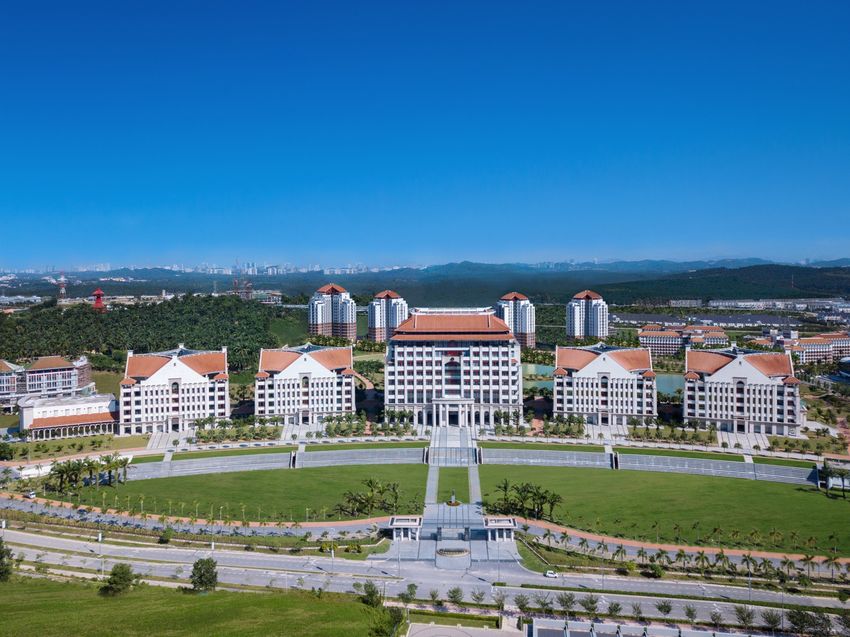
UIA 2021 RIO: 27th World Congress of Architects

         culture, local political and cultural situations in        located on the Floating Island of Xiamen, Tan
         Malaysia, and characteristics of the site. In so           said: “With the nation in grave danger, the only
         doing, this paper reflects on the locality of              resources we could rely on to survive are our
         architecture, and how locality intersects with             emergent educational endeavor and our people’s
         identity politics.                                         morale that refuses to be discouraged. (Chen,
                                                                    1980).” Xiamen University was founded during
         In the framework of the Belt and Road                      the national crisis, bearing the wishes for
         Initiative, Chinese universities have actively             national revival and construction of a national
         pursued overseas expansion in response to                  identity: “We must preserve our nation’s culture
         China’s strategy of “Going Global” designed to             and spirit in their entirety…And we need to
         increase the country’s influence. Against this             devote everything we have to education, which
         background, Xiamen University became the                   is the only hope left for our nation in the days to
         first comprehensive university to establish an             come……If we rely on foreigners to finance
         overseas campus (Guo, 2018). This trend has                China’s education, it would be as shameful and
         added a new orientation of “going out of the               pathetic as asking someone else to pay for your
         country” for research into Chinese architecture            own children’s education. (Tan, 1946:4)”
         and space with a global view. As a case study
         in a global context, Xiamen University accords             This architectural “self” was handed over to
         great depth, because the “transnational”                   Henry Murphy, an American architect adaptive
         process meant not only going out of China and              to China, to construct. Before meeting with Tan
         into Malaysia, but it also must be traced back             Kah Kee in 1919, he had already designed
         to a historical development directly related to            campuses for College of Yale-in-China (1914),
         this act, that of Tan Kah Kee, a Chinese                   Tsinghua College (1914), Private Fudan
         Singaporean who returned to China to found                 University (1918), Ginling College (1919) and
         the university. This thread, dating back to more           Yenching University (1919), etc. Murphy
         than 100 years ago when capital and post-                  brought up the “adaptive architecture” theory
         colonial ideas were imported from Southeast                and boasted an organic integration of traditional
         Asia, connects with the present when an                    Chinese architectural culture and Western
         educational institution is exported to Malaysia,           classical architectural styles. When he was
         and stretches the temporal dimension of this               commissioned to draft a plan for Tsinghua in
         research project.                                          1914, he paid his first visit to the Forbidden
                                                                    City, which he claimed as “the best building
         Xiamen University Campus:                                  complex in the world”. From then on, thick and
         Southeast Asia, Western or Local,                          stately traditional Chinese roofs were
         What is the Identity?                                      transplanted to almost all the Chinese
                                                                    universities he designed. By contrast, public
         Xiamen University was founded and built by                 schools in China mostly adopted western
         Tan Kah Kee. Tan was born in Jimei village in              architectural styles at that period. As for the
         Tung An District, Fujian Province in 1873.                 campus planning, Murphy conceived his own
         When he was seventeen, Tan joined his father in            mission as bringing advanced Western concepts
         the family business in Southeast Asia. He joined           of campus planning to the then underdeveloped
         the Chinese Revolutionary League to support                construction of Chinese universities. His plans
         the Revolution of 1911, and started to fund                for Yale-in-China, Tsinghua and Fudan mostly
         schools in Xiamen in 1913. Before laying his               copied Thomas Jefferson’s model for University
         eyes on the design for Xiamen University, Tan              of Virginia—a U-shaped mall with a wide
         had already established as well as “designed”              rectangle lawn in the center and the main
         the campuses for Jimei School (1913), Jimei                building at one end. The same combination was
         Normal School and Jimei Secondary School                   also used in the master plan and drawings of
         (1918), and Jimei Aquatic, Navigation and                  Qunxian Building submitted by Murphy, which
         Business Colleges (1919—1921). Through all                 is the first building group of Xiamen University.
         the practices of building schools, Tan Kah Kee             Murphy’s mall included a north-south axis with
         the entrepreneur and educator had already made             the same number of buildings symmetrically
         himself a quasi-architect.                                 located on both sides facing east and west and
                                                                    the main building facing south, enclosing a
         The “self” is essential to the Xiamen University           rectangle yard in the middle.
         campus buildings. In the speech Tan Kah Kee
         made on 13 July 1919 in the Tan Ancestral Hall

1148                                                 PAPERS: VOLUME II of III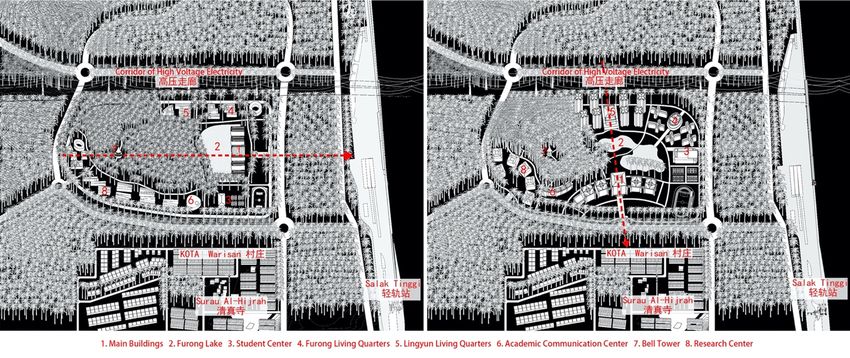
UIA 2021 RIO: 27th World Congress of Architects

  However, On 6 April 1921, the founding day of                 Compassion was the favorite building in
  Xiamen University, Tan Kah Kee perused the                    southern Fujian with authentic Chinese style in
  master plan and drawings of “Qunxian                          the community of foreigners frequenting the
  Building” submitted by Murphy, paid him the                   Xiamen Port since the city was allowed to do
  “astronomical” commission fee of USD 1,500                    international trade (Figure 1). On one hand, as
  and turned down his plan, commenting that “I                  an oversea-Chinese, Tan Kah Kee adored the
  cannot agree with (Murphy’s plan) because it                  western university campuses for they were the
  was a failure in fine arts and messed up again in             place of origin of university education; on the
  terms of orientation. The layout (he designed)                other hand, as a local of Xiamen, he appreciated
  suffers from a strong western exposure and                    local tradition rather than state tradition, and
  misses the benefit of a favorable south wind.                 used the local as a symbol of nation.
  (Tan, 1923).” Then Tan Kah Kee brought up his
  own design: with their back towards the                       In fact, facing south where the ocean is was the
  mountain the buildings would spread out on a                  primary terms when it came to the choice of site
  straight line all facing south where the ocean is.            for Xiamen University. In 1919, together with
  For considerations on usage, the plan spared the              Huang Yuanpei, a fellow member of “Tung
  only piece of comparatively even ground on the                Meng Hui”, Tan Kah Kee selected a piece of
  south, reserving for future sporting or                       land located at the southern end of Xiamen
  ceremonial events and becoming a façade to                    Island which is across the sea from his
  civilians. For considerations on formal                       hometown Jimei, to the south of the Wanshi
  significance of main buildings, the primary was               Mountain and South Putuo Temple at the foot of
  “the gate of Xiamen University shall be an                    the mountain, and to the north of Xiamen Port.
  unavoidable sight for all the ships coming to or              And Yanwu Playground, where Koxinga used to
  leaving Xiamen either from or for Southeast                   train his soldiers, appeared as the “perfect spot”
  Asia, Europe, America and the Northeast Sea of                for Tan. As the saying goes, the residents of
  China (Tan, 1946:23).” It was a manifest of the               southern Fujian have always cast their sight and
  “self”. Besides, Tan’s plan shared the same axis              forged their souls towards the south, where there
  with the millennium-old South Putuo Temple,                   are more sunshine and favorable winds that
  the architectural style was a mixture of western              could blow away the most heat. It has been not
  main body and Chinese roof. Different from                    only a natural choice but also an integral part of
  Murphy’s design, instead of copying the model                 the cultural psychology of the residents of
  of the Forbidden City, the roofs of Tan Kah                   southern Fujian. Tan made sure that all the
  Kee’s Qunxian Complex were an adapted                         buildings he created, including his old
  version of the Hall of Great Compassion in                    residence, the graveyard he built for himself,
  South Putuo Temple, which was built during                    and the series of Jimei Schools and Colleges he
  Emperor Kangxi’s reign with resting hill, double              had started to establish since 1913, were facing
  eaves, and upturned eaves – and the Great                     south where the ocean is (Figure 2). Based on

    Figure 1. Murphy’s plan vs. the layout of Xiamen University in 1952 following Tan’s plan. Xiamen University History
    Museum.

                                              PAPERS: VOLUME II of III                                                    1149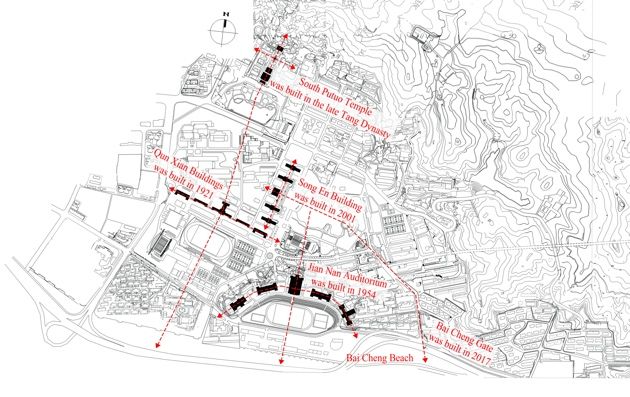
UIA 2021 RIO: 27th World Congress of Architects

                                                                        Before XMUM was founded, the Malaysian
                                                                        government invited three Australian and six
                                                                        British universities to establish branch
                                                                        campuses in various Malaysian states. These
                                                                        initiatives were based on a strategic plan called
                                                                        “the International Education Base of Asia,”
                                                                        which started around 1990. The 1990s were an
                                                                        era during which the Malaysian economy began
                                                                        looking for new pathways rather than selling
                                                                        traditional natural resources. The increase of
                                                                        international student flows into Malaysia over
         Figure 2. The south-north axis of the campus.                  the years has proven the plan’s effectiveness in
         Drawn by the Author.
                                                                        the context of the growing competition of the
         this determining factor, the design for Xiamen                 global education market (Guo, 2018). For
         University was ultimately apart from the                       China, the Malaysian project was part of a wider
         western campus design. When Lu Xun held a                      Chinese push for global influence known as
         faculty job at Xiamen University in 1926, he                   Beijing’s “going global” strategy. By opening
         wrote Xu Guangping a letter (later included in                 campuses abroad, “these universities hope to
         Letters between Two) in which he described the                 enhance their overseas influence and to compete
         campus as “erecting a row of Western-style                     in international higher education. And the
         houses right by the coastline on a desolate                    government thinks it is good way to export
         island”.                                                       Chinese soft power,” said Xiong who was also
                                                                        the vice-president of China’s 21st Century
         Xiamen University Malaysia:                                    Education Research Institute 1 . In a word, the
         Traditional or Local, How to                                   context of building the XMUM was completely
         Identify?                                                      different from – even on the contrary of – the
                                                                        building of the Xiamen University (XMU).
         On 28 February 2012, Xiamen University
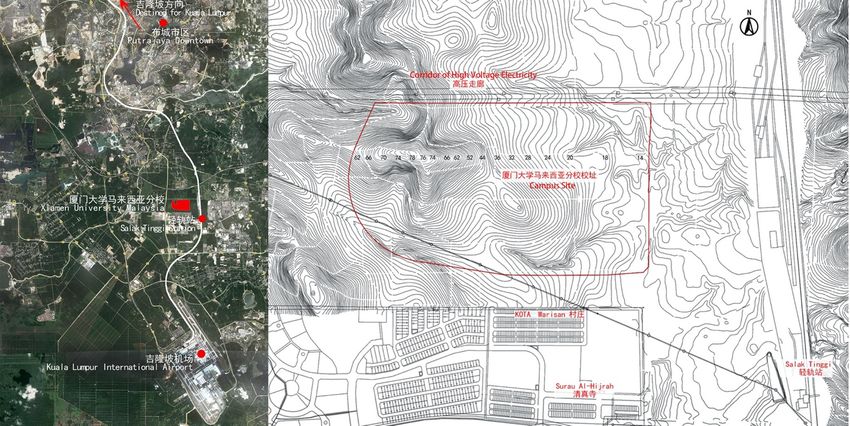
         formally announced that it would establish a                   Kota Warisan was selected as the site to build
         Malaysia Campus in Kuala Lumpur. The then                      the campus that covers 150 acres of land with a
         President Zhu Chongshi believed that “it would                 high voltage corridor (72 m in width and 40 m
         be a historical present in return for Xiamen                   in height) to the north and a planned commercial
         University to establish a branch campus in                     district to the east which is located alongside the
         Malaysia where Mr. Tan Kah Kee made a                          light rail connecting the airport and downtown
         significant part of his fortune.” (Guo, 2018)                  Kuala Lumpur and close to Salak Tinggi

         Figure 3. Site Location and Map. Drawn by the author.

1150                                                     PAPERS: VOLUME II of III
UIA 2021 RIO: 27th World Congress of Architects
Station. To the west of the campus sits a Main Building Complex facing east where the
mountain which creates a 67-meters altitude traffic is oriented. In this way the campus would
difference within the campus. And the piece of run parallel with the densely populated villages
land is also wider across east and west (Figure. to the south and the high voltage corridor to the
3). Based on these facts, the initial plans were all north, thereby reducing sight line interference.
to adopt an east-west axis with a straight line of (Figure 4)
Figure 4. The East-West Plan vs. the North-South Plan. Drawn by the author.
University also include the post-colonial legacy
The Analytical Perspective: The from the West, and the historical convergence of
Space-Time of Architecture Southeast Asian capital and the locally-
nationally oriented mindset of overseas Chinese.
Undoubtedly, the immobility of architecture The Malaysia campus takes the history of the
easily sets a trap for any research into its University home campus across the ocean to a
development and continuation. For the sake of foreign land. By this time, such internalized
argument, let us call it site determinism. The ideas as the West, Southeast Asia, and the native
concept of space is rigidly limited to a site, as land have all become “the self,” and the site of
the social scope is confined to the history of this the architecture itself has in turn become “the
site. In fact, in the cases of architectural design other.” The resistance to the local climate and
for Xiamen University itself and for its Malaysia site conditions offered by the form of the
campus, we can examine an important Malaysia campus’ architecture is, in essence, the
phenomenon: the particular spatial-temporal conflict between the self and the other.
relationship that is formed in the process
wherein the relative fixedness of site as entity Therefore, compared with locality, historicity
merges with the relative mobility of human and regionality provide us with an alternative
beings as dynamic existence. analytical perspective, helping us to see the
multi-faceted subjectivity behind the form of
Architecture can be said to exist in given natural, architecture. To limit time to a fixed space is to
social, and cultural customs. This concept refers deprive time of its own agency. From a global
not only to the physical environment – which is perspective, the analytical framework of space-
often the specific basis of all customs – but time seeks to capture and understand the
rather it emphasizes the effects of mobile dynamic and fluid nature of the interaction
people. On one hand, history combines with between architecture and society. As Bruno
space to constitute tradition; on the other, the Latour reminds us, “Flying is a property of the
history of architecture is not constrained to take association of entities that includes airports and
place only on particular sites. In addition to the planes, launch pads and ticket counters. B-52’s
natural ocean island conditions of Xiamen and do not fly, the U.S. Air Force lies.” (Latour,
the proximity to the South Putuo Temple, the 1999:182) By the same token, the Malaysia
customs of the architecture of Xiamen Campus was not designed by architects or any
PAPERS: VOLUME II of III 1151UIA 2021 RIO: 27th World Congress of Architects
commissioning party, but rather by the local disconnected from the local natural
natural and political conditions, the Chinese environment, and a style that featured official
political circumstances, the home campus, and Chinese architecture, also disconnected from the
all the policymakers involved, an assembly that local culture. As a result, his design was rejected
contains both human and non-human agents. by Tan Kah Kee, who travelled frequently
between the site and Southeast Asia. Tan Kah
Kee, for his part, took advantage of the south-
facing and ocean-facing culture in southern
Fujian province, as well as the plan that shares
the same axis with the South Putuo Temple. At
the same time, he created a hybrid style that had
western architectural elements, based on the
Southeast Asian post-colonial idea that
universities originated in the West. As for the
Malaysia campus, what dominated the local site
was the ideology of the home campus and the
form of “Tan Kah Kee Architecture.”
Therefore, from the angle of material space,
Figure 5. The Completed Main Buildings. architectural forms provide us with a spatial
Photo by Luo Lianbi. avenue to, and means of revealing and
delineating the conflictual relationship between
subjects. We have seen how form challenges the
extant space-time, shapes new space-time, and
Conclusion: The Politics of thereby constructs new identities. Because
Architecture architecture has a fixed, inseparable connection
to its site, it is precisely through challenging
In geography, the prevailing perspective holds locality that architectural forms create a field of
fluid space as a key component in the parallel identity resistance, thus acquiring a political
analysis of urban socio-political conditions. But dimension.
on the other hand, analysis of the individuality
and the separateness of spatial form – that is to
say, its absoluteness – is crucial to improving
our understanding and knowledge of the
physical urban space. Given that spatial
structures can be specific demonstrations of
social structures and relationships, we can then
aruge that social praxis and spatial praxis most
clearly intersect on the level of form, and that
historical momentum and the contents of urban
societies and cultures are engraved in the
Bibliography
physical form and the everyday life of the city
itself. (Banik-Schweitzer and Blau, 2003) 1. 陳嘉庚,南僑回憶錄,新嘉坡南洋印刷社,1946
2. 陳進發,戰前的陳嘉庚言論史料與分析,南洋學會,南
In the case studied in this paper, how, based on 洋印務(私人)有限公司,1980.
the space-time framework, has the architectural
3. 陈嘉庚先生致林文庆·陈延庭函汇集(第二册)1923.2-
form connected with particular identities? The 11,集美校委会资料室藏
home campus of Xiamen University was
4. Banik-Schweitzer, Renate, and Eve Blau. "Urban
founded in a time of national crisis, and the Form." Städtebau in der postfordistischen Gesellschaft,
Malaysia campus entertained hopes of Wien (2003).
“exporting China’s soft power.” Both were 5. Cody, Jeffrey W. Building in China: Henry K.
attempts to interpret the idea of the Chinese Murphy's" adaptive architecture," 1914-1935. Chinese
University Press, 2001.
nation, but each gave rise to a different
6. Jie, Guo. "Xiamen University Malaysia: A Chinese
relationship between architecture and locality Branch Campus." International Higher Education 95
due to different power dynamics: Murphy, (2018): 9-11.
coming from the U.S. as the Western “other,” 7. Latour, Bruno. "On recalling ANT." The Sociological
brought a more “advanced” layout plan Review 47.1_suppl (1999): 15-25.
1152 PAPERS: VOLUME II of IIIYou can also read


