Vision for the future; Australia's most liveable city - City of Casey
←
→
Page content transcription
If your browser does not render page correctly, please read the page content below
Agenda of Council Meeting
      to be held virtually via Zoom and
               Live-streamed.
           Tuesday, 20 July 2021

              Commencing at 4PM

Vision for the future; Australia’s most
             liveable city.

Chairperson: Chair of Administrators, Noelene Duff PSM
          Administrator: Cameron Boardman
             Administrator: Miguel Belmar

       Chief Executive Officer: Glenn Patterson
Order of Business
1. Statement of Acknowledgement ..................................................................................................................3
      1.2. Reading of the Diversity Statement ....................................................................................................3
2. Confirmation of Minutes ...............................................................................................................................3
3. Declarations of Conflict of Interests and Personal Interests ........................................................................3
4. Public Question Time ...................................................................................................................................3
5. Officer's Reports for Consideration ..............................................................................................................4
      5.1. Road Management Plan 2021 ............................................................................................................4
      5.2. s11A Instrument of Authorisation - Planning & Environment Act 1987 ............................................51
      5.3. Disposal of Land - 82i Como Parade, Clyde North...........................................................................57
      5.4. Establishment of native vegetation offsets within the City of Casey.................................................61
6. Consideration of Reports of Committees ...................................................................................................66
      6.2. Record of Discussion........................................................................................................................67
7. Petitions .....................................................................................................................................................68
8. Urgent Business.........................................................................................................................................68
9. Closed Council ...........................................................................................................................................68

 Council Meeting - 20 July 2021                                                                                                                         Page 2
1.    STATEMENT OF ACKNOWLEDGEMENT

1.2. READING OF THE DIVERSITY STATEMENT

2.    CONFIRMATION OF MINUTES

3.    DECLARATIONS OF CONFLICT OF INTERESTS AND PERSONAL INTERESTS

      Declaration by Administrators of any Conflict of Interest pursuant to Section 130 of the Local
      Government Act 2020 (the Act) in any items on the Agenda Paper. (Note that Section
      130(2)(a) of the Act requires Administrators to disclose the nature of a Conflict of Interest
      immediately before the relevant consideration or discussion). Section 130(2)(b) also requires
      that the Administrator declaring a Conflict of Interest exclude themselves from the decision-
      making process in relation to that matter.

4.    PUBLIC QUESTION TIME

 Council Meeting - 20 July 2021                                                               Page 3
5.
5.1.
            OFFICER'S REPORTS FOR CONSIDERATION
            ROAD MANAGEMENT PLAN 2021

       Officers’ Reports
       Road Management Plan 2021                                                                    ITEM: 5.1.
       City Planning and Infrastructure
       City and Asset Planning
       Keri New

       Purpose of Report:               To present the Road Management Plan 2021 for adoption.

       Recommendation

       That Council adopts the Road Management Plan 2021 at Attachment 1.

Officer General or Material Interest

No Council officers involved in the preparation of this report have a general or material interest in matters for
consideration.

Council Plan Reference

1. People Driven
1.3 A City with an accessible and well-connected transport network

3. A High Performing Organisation
3.2 An efficient and effective customer focused Council with sufficient resources to meet priorities

Executive Summary

The Road Management Plan (RMP) documents the standards, policies and management systems used by
the City of Casey to manage and maintain the roads for which it is responsible. The RMP 2017 is due for
review as required by legislation.

In the preparation of this review, officers conducted community engagement through the Casey
Conversations process as well as engagement with key internal stakeholders. The proposed changes strike
a balance between the needs of the community and a minimum standard to which the Council is guaranteed
to meet.

The proposed 2021 Road Management Plan presented for adoption is as per Attachment 1.

       Council Meeting - 20 July 2021                                                                   Page 4
Background
As a designated Road Authority under the Road Management Act 2004, City of Casey uses its Road
Management Plan (RMP) to document the standards, policies and management systems used to discharge
its duty to manage, inspect, repair and maintain the roads for which it is responsible. The current RMP
(August 2017) is now due for review under the requirements of the Road Management Act 2004 and the
Road Management (General) Regulations 2016.
As the purpose of the RMP is to provide Council with a policy defence against civil liability claims associated
with management of the road network, the standards documented within are set on the basis that they are
always complied with rather than an aspirational standard.
Review Process
The review was initiated through a Casey Conversations survey seeking feedback on the current RMP
followed by a series of internal workshops involving staff from City Presentation and City and Asset
Planning Departments. Following the workshops, a Review Panel consisting of the key representatives from
the aforementioned departments as well as Governance, analysed the issues arising, with particular
emphasis on ensuring documented standards represent an effective use of the available resources.
In considering the appropriateness of adopted assessment frequencies and interventions, Council also
compared its proposed service levels with that of nearby councils including:
Cardinia Shire Council
City of Greater Dandenong
Knox City Council
Monash City Council
Whitehorse City Council
Frankston City Council
In general, Council’s service levels appear reasonable when compared with those of neighbouring
municipalities, although a direct comparison is not always accurate due to the differences in processes and
descriptions. In some instances, City of Casey documents a relatively high level of service to respond to
local community need and expectation, but for most part its service levels would be considered consistent
with other Councils.
Recommended Changes
As a result of review the following changes have been made in the draft document for adoption.
Minor changes including:
o Reference to State Government agencies (e.g. VicRoads to DoT)
o Update to figures, km of roads, accident data
o Frequency for auditing and reporting of maintenance programs to change from monthly to
quarterly to align with current reporting cycles
Additional maintenance and inspection standards referring to designated shared paths have been
removed and aligned with the footpath network standards.
Shared Paths previously had its own definition and maintenance frequencies. This presented an
issue as the paths needed to be separately identified or council would risk being not compliant to its
own RMP. This change removes non-compliance risks associated with shared path specific standards
and brings the RMP in line with those of neighbouring councils.
Council Meeting - 20 July 2021 Page 5 Bridge Classification simplified into Road and Pedestrian bridges, with pedestrian bridges further split
into high and low priority.
Previously pedestrian bridges were classified due to function, constructed material and age. New
criteria simplify this without compromising of safety.
Consolidation of Sealed Road line marking into one single category with frequency of “yearly” and
maximum interval of “15 months”
This aligns with maintenance inspections completed on these roads and increases service level for
lower road categories without requiring additional effort.
Road bridge level 1 hazard inspection increased to “24 week” intervals with maximum interval of “28
weeks”
Reduction in frequency by 12 weeks from 2017 RMP. This brings the frequencies in line with what is
recommended from VicRoads Road Structures Inspection Manual 2018.
Removal of the following under reactive maintenance and intervention levels:
o Sealed roads isolated pavement failures (up to 5sq.m of pavement surface area)
o Sealed roads - regulation of wheel ruts and depressions
o Sealed roads - placement of shoulder materials
The items above are incorporated into the more general equivalents under the same section.
Further details of the changes in the proposed 2021 RMP are presented in Attachment 2.
Community Engagement
In line with the requirements of the Local Government Act 2020, the community were engaged to provide
feedback on the current RMP. 940 responses were received with majority of the feedback relating to
congestion on Casey’s main arterial roads. While this is beyond the scope of the RMP, Council has
responded by further increasing its advocacy with the Victorian Government for the duplication of up to eight
kilometres of arterial road as well as a rail extension from Cranbourne to Clyde and increased bus services.
A community engagement insights report has been prepared and can be found in Attachment 3.
The Draft 2021 RMP was placed on public exhibition for 28 days as per the requirements of Road
Management (General) Regulations 2016 with submissions due by 21 June 2021. No submissions that
influence the review of the RMP were received and a summary alongside Council’s response can be found
in Attachment 4.
Financial Implications
The changes to the RMP outlined in this report is not expected to have a net budgetary impact. Savings
associated with changes in frequency will be offset by the increasing asset base.
Council Meeting - 20 July 2021 Page 6Conclusion
The review of the Road Management Plan has been completed in line with required regulations and is ready
for Council adoption.
Attachments
1. Proposed 2021 Road Management Plan [5.1.1 - 26 pages]
2. Road Management Plan Review Summary 2021 [5.1.2 - 5 pages]
3. Community Engagement Report [5.1.3 - 10 pages]
4. Summary of Stakeholder feedback [5.1.4 - 2 pages]
Council Meeting - 20 July 2021 Page 7Attachment 5.1.1
CASEY.VIC.GOV.AU
Road Management Plan
Version: Draft
Date updated:
Responsible Department: City and Asset Planning
1. Purpose
The purpose of this document is to meet the requirements of a Road Management Plan
as defined by the Road Management Act 2004. This plan documents the standards,
policies and management systems used by the City of Casey to discharge its duty to
manage, inspect, repair and maintain the roads for which it is responsible.
2. Definitions
Council Means Casey City Council, being a body corporate constituted
as a municipal Council under the Local Government Act 1989
Councilors Means the individuals holding the office of a member of Casey
City Council
Council officer Means the Chief Executive Officer and staff of Council appointed
by the Chief Executive Officer.
The Act For the purposes of this Policy, The Act refers to the Road Management
Act 2004.
3. Scope
The objective of this document is to clearly define:
• The road assets the Council maintains
• The standards, policies and procedures used to maintain those assets
• The processes used to establish the appropriate standards.
The scope of this Plan is restricted to the specific requirements identified in the Code
of Practice for Road Management Plans.
This Plan covers only the roads and road sections on Council’s Register of Public
Roads that are identified as being the responsibility of the City of Casey.
Council policy documents change from time to time and it is recommended that you consult
the electronic reference copy at www.casey.vic.gov.au/policiesstrategies to ensure that you
have the current version. Alternatively you may contact Customer Service on 9705 5200.
Council Meeting - 20 July 2021 Page 8Attachment 5.1.1
City of Casey - Road Management Plan Page 2 of 26
4. Context
Road Management Act 2004
The purpose of the Road Management Act 2004 (The Act) is to enable the coordinated
management of public roads that will promote safe and efficient State and local public road
networks, and the responsible use of road reserves for other legitimate purposes.
The City of Casey is the ‘coordinating road authority’ as defined by The Act for all roads within
its boundaries, except for the road network maintained by the Department of Transport (DoT).
The Act requires Council to identify on its Register of Public Roads all roads for which it is the
coordinating road authority that Council considers are reasonably required for general public
use. The City of Casey is the responsible road authority for all roads on the register, and road
infrastructure on DoT’s roads for which the Council is identified as having care and
management responsibility.
The Act sets out the powers and duties of the road authority to install, manage and maintain
infrastructure for which it is the responsible authority. The Act also provides a policy
defence for road authorities where they can demonstrate responsible management through
an adopted Road Management Plan.
Council responsibility
The Council has the power to determine the standard to which it will construct, inspect,
maintain and repair roadways as set out in The Act. The Council is responsible for
implementing processes and systems to ensure compliance with those standards.
Road-user responsibilities
Road user obligations are set out in Section 17A of the Road Safety Act 1986 (as
amended by the Road Management Act 2004) and summarised below.
A person who drives a motor vehicle on a highway must drive in a safe manner having
regard to all relevant factors including (but not limited to) the:
• physical characteristics of the road
• prevailing weather conditions
• level of visibility
• condition of the motor vehicle
• prevailing traffic conditions
• relevant road laws and advisory signs
• physical and mental condition of the driver.
A road user other than a person driving a motor vehicle must use a highway in a safe
manner having regard to all the relevant factors.
A road user must have regard to the rights of other road users and the community, taking
reasonable care to avoid conduct that may:
• endanger the safety and welfare of other road users
• damage any infrastructure on the road reserve
• harm the environment of the road reserve.
Council Meeting - 20 July 2021 Page 9Attachment 5.1.1
City of Casey - Road Management Plan Page 3 of 26
5. Policy
The Code of Practice for Road Management Plans1 outlines the contents for a Road
Management Plan. Those contents are included in this document as follows:
Location in this Contents of a RMP as defined by
Heading Document Code of Practice
City of Casey’s Appendix A A description of the types of road
road infrastructure infrastructure for each of the classes of
public roads for which the road authority is
the responsible road authority.
Management Appendix B Details of the management system, which is
System established or is to be established and
implemented by the road authority to
discharge its duty to inspect, maintain and
repair.
Inspections Appendix C A description of the inspections required for
different types of road infrastructure.
Service Standards Appendix D The standard or target condition to be
achieved in the maintenance and repair of
different types of road infrastructure.
In setting these inspections, standards and systems the authority is required to take account
community expectations, utilisation of assets, risk, environmental and cultural factors, and
available resources. These factors are accounted for through Council’s Asset Management
Plans that take a long-term holistic view to managing Council’s assets and are considered in
detail in the four-yearly review of this Road Management Plan.
6. Administrative updates
It is recognised that, from time to time, circumstances may change leading to the need for
minor administrative changes to this document. Where an update does not materially alter
this document, such a change may be made administratively. Examples include a change to
the name of a Council department, a change to the name of a Federal or State Government
department, and a minor update to legislation which does not have a material impact.
However, any change or update which materially alters this document must be by resolution
of Council.
7. Review
This Road Management Plan is required by the Road Management (General) Regulations
2016 to be reviewed within the same period that Council prepares its Council Plan. A
summary of the findings of this review is available with this Plan at
http://www.casey.vic.gov.au/roads-drains/roads/road-management-plan.
.
1Code of Practice for Road Management Plans: Victoria Government Gazette No. S 201 16 Sept 2004. Copy is available
for viewing at www.vicroads.vic.gov.au.
Council Meeting - 20 July 2021 Page 10Attachment 5.1.1
City of Casey - Road Management Plan Page 4 of 26
Appendix A: City of Casey Road Infrastructure
Appendix A: City of Casey’s road infrastructure
Description
The City of Casey is the coordinating road authority and the responsible road authority for
more than 1,800 kilometres of roads within its boundaries. DoT is the coordinating road
authority for the main road network and is responsible for more than 177 kilometres of roads.
Approximately 82 per cent of Casey’s roads are in urban areas and usually include
footpaths and road furniture, and kerb and channel that discharge into a drainage
network. The remaining roads are classified as rural with stormwater usually controlled
by open drains and culverts.
Road hierarchy
Roads within the City of Casey are given a road hierarchy classification based on factors
including traffic volume, traffic type and accessibility, as shown in the table below. These
classifications are recognised and adopted throughout Casey for classifying roads.
Road
Hierarchy Responsibility Primary Function
Freeway DoT A road which has fully controlled access and
provides the principal route for movement of goods
and people from one region to another.
Primary Council/DoT Roads whose main function is to form the
arterial (Shared principal routes for the movement of goods and
responsibilities people, predominantly from one region to
between DoT and
another. Access to abutting properties and
Council as detailed
in the RMA & Code lower order roads is typically controlled or
of Practice) denied.
Secondary Council Roads that supplement the primary arterial roads,
arterial (Major providing through traffic movement to an individually
roads)
determined limit, sensitive to roadway
characteristics and abutting land uses. These roads
provide a direct traffic link from one part of a region
to another. Access to abutting properties and lower
order roads is typically limited.
Trunk Council Roads that provide a specialised form of connection
collector between the local streets and the arterial network
where – due to localised constraints – traffic is
required to be concentrated at a level higher than
desirable for a collector road. Access to abutting
properties is permitted; however, the traffic function
of the road is clearly recognised.
Council Meeting - 20 July 2021 Page 11Attachment 5.1.1
City of Casey - Road Management Plan Page 5 of 26
Appendix A: City of Casey Road Infrastructure
Road
Hierarchy Responsibility Primary Function
Collector Council Collector roads are important local roads whose
function is to distribute traffic between the arterial
roads and the local road system and to provide
access to the abutting property. A reasonable
level of local amenity is maintained by restricting
traffic volumes and vehicle speeds. The collector
street may be used as a bus route.
Local Council Roads or streets not having a significant through
access traffic function. These roads provide access to
abutting property. The local environment is
dominant, traffic is subservient, speed and volume
are low and pedestrian and cycling movements
are facilitated.
Limited Council Access is primarily for abutting properties and/or
access non-vehicular through traffic. Examples include:
laneways; equestrian, bicycle or pedestrian trails;
and some multiple-property access ways.
Car parks Council All off-street car parks maintained by the Council and
listed on its register of public roads.
Path Hierarchy
Paths within the City of Casey are classified as Priority and Non-Priority. Paths around
business shopping/districts, schools and other high visitation community facilities where
displacements between path slabs could present a higher risk may be designated as Priority
and the remainder as Non-Priority. Designated shared paths are maintained to the same
standards as footpaths.
Bridge Hierarchy
Bridges within the City of Casey are broadly classified as road and pedestrian bridges.
Pedestrian bridges are further classified into high and low priority inspection regimes.
Pedestrian bridges of timber structure and those with their age greater than 30 years are in
the high priority inspection regime and the remainder are in the low.
Council Meeting - 20 July 2021 Page 12Attachment 5.1.1
City of Casey - Road Management Plan Page 6 of 26
Appendix A: City of Casey Road Infrastructure
Register of Public Roads
The City of Casey Council’s Register of Public Roads (Register) defines the public roads and
their classifications for all roads for which Council is the coordinating road authority. The
Register is maintained by Council as a controlled document and is available for public
inspection at Council offices in Narre Warren or on Council’s website. Descriptions on the
Register are supported by map information on Council’s geographic information system.
Maps for specific roads showing the extent of the area maintained, can be provided on
request from Council’s Narre Warren offices.
Council’s policy for registering or removing a road on or from the Register is available from
Council’s website or Narre Warren offices.
For each road, the main details the register records are:
• Name of each public road
• Date on the which the road became a public road
• Identification of start and end points
• Locality
• Classification
• Details of changes to the status of the road as required by the Road
Management Act.
Assets covered by this Plan
The assets covered by this plan are confined to those for which Council has statutory
responsibility under the Road Management Act 2004.
These assets are defined in the Road Management Act as:
• Roadway
• Pathway
• Shoulder
• Road-related infrastructure.
In keeping with these definitions, the following assets on roads identified in Council’s
Register are covered by this plan:
• Road surface and supporting pavement
• Constructed pathways (pedestrian, shared and equestrian)
• Car parks within road reserves
• Road shoulders
• Traffic control devices (traffic signals, line marking, speed control devices)
• Bridges and large culverts as part of roads infrastructure
• Kerb and channel
• Signs (regulatory and advisory).
Although Council also carries out inspection and maintenance of roadsides, fire hydrants,
street trees and information signs, the maintenance and inspection of these assets is outside
the scope of this plan. The operation and maintenance of these assets are covered by
separate operational plans.
Council Meeting - 20 July 2021 Page 13Attachment 5.1.1
City of Casey - Road Management Plan Page 7 of 26
Appendix A: City of Casey Road Infrastructure
Council is not responsible for the management and maintenance of utility assets (e.g. water
and sewerage networks, telecommunications, electricity and gas) within the road reserve.
These assets are the responsibility of their respective utility provider.
Streetlights in road reserves provide a service to the community and are funded by the Council
but are owned and maintained by the respective network provider. They are therefore not
covered by this plan. The levels of service relating to these assets are considered through the
Asset Management Plan and arrangements made directly with the appropriate utility.
Roadside vegetation
A road authority does not have a statutory duty or a common law duty to maintain, inspect or
repair land of any public highway that is not a constructed path or roadway (RM Act s.107).
Nature-strips in urban areas are the responsibility of the neighbouring landowner to maintain.
Access to private property
Access to private property is provided by a ‘vehicle crossover’, which is defined as
infrastructure to allow the passage of vehicles between the road formation (or kerb and
channel, where it exists) and the property boundary. Vehicle crossovers may serve several
properties.
Section 107 of the Roads Management Act 2004 provides that Council is under no
statutory duty to inspect, maintain or repair vehicle crossovers on road reserves that
provide access to land adjoining a road. This responsibility rests with the adjoining
landowner. The construction of a vehicle crossover requires a permit and must be
carried out to Council standards. Where modifications to Council assets (e.g. paths and
kerb and channel) are required, these shall be at the landowner’s expense. The
landowner is responsible for ensuring the vehicle crossover and the immediate
surrounds that the crossover impacts on, are maintained in a safe condition. Council’s
responsibility is limited to requiring the landowner to rectify any hazards of which it
becomes aware.
In urban areas, Council has ownership for any footpaths and kerbs and channels. The
landowner has ownership and responsibility for the remainder of the vehicle crossover on
Council property. In rural areas where there is no footpath or kerb and channel, the
landowner is responsible for the entire vehicle crossover, including any culverts that may
be required.
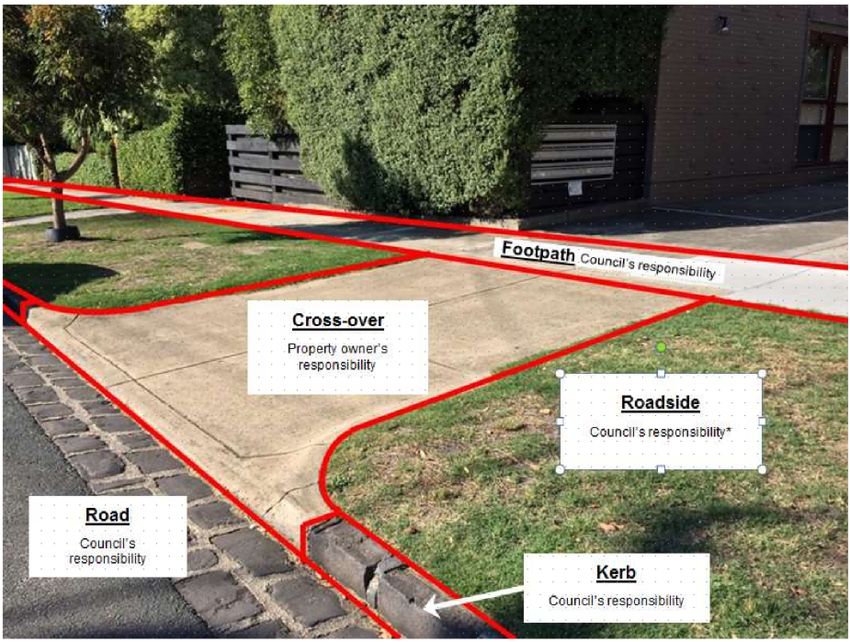
Roadside maintenance responsibilities in urban areas are shown diagrammatically in
Figure 1
Council Meeting - 20 July 2021 Page 14Attachment 5.1.1
City of Casey - Road Management Plan Page 8 of 26
Appendix A: City of Casey Road Infrastructure
Nature Strip
Property owner’s
responsibility
Figure 1: Maintenance Responsibilities for Urban Roadside
Consent to perform works on road reserves
Any person who wants to undertake works in a road reserve must obtain consent from the
relevant road authority unless they are exempted under Roads Management Regulations
2005. For works on Council roads, a permit must be obtained from Council. Residents can
get advice by contacting Council customer service during the normal working hours by phone
(03 9705 5200) or in person at any of the customer service centres.
Demarcation and transfer or responsibility
The City of Casey is bounded by six municipalities: the City of Greater Dandenong,
Frankston City Council, Shire of Mornington Peninsula, Shire of Cardinia, Shire of Yarra
Ranges and the City of Knox.
The municipal boundary is in most instances the centreline of a road or follows a watercourse
over which bridges or culverts have been constructed. Council has agreements with the
neighbouring municipalities for boundary roads to clearly assign maintenance responsibilities
for the whole road or bridge to one or other of the authorities. The agreement also identifies
capital works responsibilities.
Melbourne Water manages the main drainage network and owns a number of bridges and
culverts that support Council roads. The City of Casey ensures that, with respect to the
ability of the bridge to provide a safe crossing for traffic, these structures are inspected and
maintained as for Council owned bridges.
DoT has an agreement with the City of Casey which defines the maintenance
responsibilities on main roads owned by DoT. In general, in urban defined areas DoT
maintains the road pavement and kerb and channel, while the City of Casey maintains
the road reserve and footpath.
Council Meeting - 20 July 2021 Page 15Attachment 5.1.1
City of Casey - Road Management Plan Page 9 of 26
Appendix A: City of Casey Road Infrastructure
The following diagram illustrates a typical example of the relationship between assets
managed by the City of Casey and assets managed by DoT. In this example, the City
of Casey is responsible for the management of footpaths, outer separators (nature
strips), trees, service roads, and the roadside furniture within the road reserve. DoT is
responsible for the main carriageway (including kerb and channel), centre median strip,
lighting, and any additional road-related infrastructure defined in the Road
Management Act 2004.
Figure 2: Cross section showing responsibilities on typical primary arterial Road
The following table details the relationships and agreements between the City of
Casey and adjacent authorities.
Documented
Name Authority Relationship Agreement
City of Local • Maintenance of boundary streets by In place
Greater Government City of Casey and City of Greater
Dandenong Dandenong.
• Maintenance of footbridge by City of
Casey.
Frankston Local • Maintenance of boundary streets by In place
City Government City of Casey and Frankston City.
Mornington Local • Maintenance of boundary streets by In place
Peninsula Government City of Casey and Shire of Mornington
Shire Peninsula.
Shire of Local • Maintenance of boundary streets by In place
Cardinia Government City of Casey and Shire of Cardinia.
• Maintenance of one traffic bridge by
City of Casey.
• Maintenance of one traffic bridge by
City of Cardinia.
Shire of Local • Maintenance of boundary roads by In place
Yarra Government Shire of Yarra Ranges. (City of Casey
Ranges pays an annual maintenance fee.)
Council Meeting - 20 July 2021 Page 16Attachment 5.1.1
City of Casey - Road Management Plan Page 10 of 26
Appendix A: City of Casey Road Infrastructure
Documented
Name Authority Relationship Agreement
City of Local • Maintenance of boundary streets In place
Knox Government by City of Casey and City of
Knox.
DoT Main Roads • DoT owns main roads. In place
Authority • Maintenance of pavement and
kerb and channel by Dot.
• Maintenance of road reserves
and footpaths by City of Casey.
South East Water • South East Water owns and Management of
Water Authority maintains all water mains road utilities
and sewerage system within infrastructure
City of Casey. in road
VicTrack Rail Authority • VicTrack maintains the assets reserves
on rail track reserve
Ausnet Electricity • Ausnet owns and maintains the
Utilities electricity assets
AGL Gas service • AGL owns and maintains the
gas network.
TXU Gas and • TXU owns and maintains gas
Electricity and electricity assets.
ABN Co ABN • Maintains the ABN network
Telstra Tele- • Telstra owns and maintains the
communications telecommunications network in
(incl. cable TV) the City of Casey.
Optus Cable TV • Optus owns and maintains a
portion of the
telecommunications network in
the City of Casey.
Aquasure Desalination • Aquasure maintains the
Pipeline desalination pipes
Utility owners have rights of access to road openings and installation and maintenance
of their assets in accordance with the Code of Practice for the Management of Road
and Utility Infrastructure in Road Reserves.
Council Meeting - 20 July 2021 Page 17Attachment 5.1.1
City of Casey - Road Management Plan Page 11 of 26
Appendix B: Management System
Appendix B: Management System
Managing asset information
The Council’s asset information is stored on an electronic database known as the Asset
Management System (AMS). This system is continually being developed and
enhanced. The AMS is also increasingly being used to manage information on risk
and to model deterioration and replacement scenarios.
Identifying hazards
Hazards or defects in road infrastructure are identified through inspections and
recorded in the Council’s database. Inspections can be initiated either as part of a
scheduled program as set out in Appendix D or by a request for service. Requests
for service (either generated internally or in response to a customer request) are
responded to using the process identified in Figure 3. All inspections are conducted by
vehicle with the exception of paths which are conducted on foot.
Frequencies for routine inspections are developed for each asset group based on
risk and rates of deterioration. For example, if not dealt with promptly, conditions
on unsealed roads and unsealed shoulders of sealed roads can rapidly change
resulting in increased maintenance cost and safety hazards, justifying frequent
inspections. Footpaths adjacent to business districts, schools and facilities are
identified for 6 monthly inspections and higher maintenance activity than other
footpaths that have less use.
The inspection frequency for road pavements (other than unsealed roads) is carried
out according to the road hierarchy. Secondary arterial and Trunk collector roads are
considered to pose a greater risk because of their higher traffic loads, and therefore
have more frequent inspections.
Assessing condition
The purpose of condition inspections is to assess the remaining life of an asset; for
financial purposes (calculation of depreciation); and for planning and prioritisation of
the City of Casey’s capital works program. The condition assessment processes
also have provision for recording hazards and maintenance defects which are
reported separately for action through the maintenance management system.
Roads and bridges are inspected and rated for condition at least every five years.
However, roads that have shown signs of deterioration are inspected more frequently
so that intervention takes place at the most appropriate time. Footpaths are
inspected and assessed every three years to determine their condition and develop
work programs.
All condition inspections are conducted by a vehicle with the exception of paths
condition inspection which is incorporated with the path hazard inspection and is
conducted on foot.
Council Meeting - 20 July 2021 Page 18Attachment 5.1.1
City of Casey - Road Management Plan Page 12 of 26
Appendix B: Management System
Prioritising work
Requests for service and works orders are initially screened and ‘high’ risk situations
are dealt with immediately to manage the risk. If immediate repairs are not
practicable, steps are taken to reduce the risk and the appropriate intervention is then
scheduled. Activities are programmed to meet the response times identified in
Appendix D.
Delivering and auditing maintenance programs
Maintenance activities identified in Appendix D are carried out by a combination of in-
house resources and external staff.
The City of Casey has the following processes in place to ensure that planned
processes and activities are actioned:
• The Contract Supervisor/Team Leader is responsible for monitoring works activities
and reporting results on a quarterly basis.
• Customer Service statistics (response times etc.) are measured and reported
quarterly.
• Appropriate Team Leader/Head carries out monthly spot checks to verify operation
of data collection process.
• Processes from initial request or inspection result, through to work done and
recording are audited externally every second year by Council’s insurer.
The monitoring of work activities is carried out through the Asset Management System
through on-line queries, and standard and custom reports. Non-compliance with
standards will be reported to the Manager City Presentation.
Reactive requests are actioned in accordance with the process shown in Figure 3.
Council Meeting - 20 July 2021 Page 19Attachment 5.1.1
City of Casey - Road Management Plan Page 13 of 26
Appendix B: Management System
Council receives
request for service
Request logged into
Request
Management
System
Transfer to
Transfer to
Is request appropriate
N another Council N
asset related? external
Department?
agency
Y
Request assigned to
relevant Work Y
System category
Activity assessed for
risk: high risk Change
activities phoned request
through category and
forward to
appropriate
department
Task assigned to
appropriate officer
or contractor
Task attended to on
basis of risk
Asset inspected or Task programmed
Inspected Programmed
task actioned? or completed?
Actioned
completed
Details of task
Programmed task
included in Works
completed
System
Request Closed
Figure 3: Process to Manage Request for Service
Council Meeting - 20 July 2021 Page 20Attachment 5.1.1
City of Casey - Road Management Plan Page 14 of 26
Appendix B: Management System
Replacement programs
Pavement resurfacing, rehabilitation and footpath renewals are the main replacement
activities undertaken on City of Casey road assets.
The type and nature of replacement activity undertaken for road pavements depends
on:
• Condition of the asset
• Road classification
• Traffic volumes
• Proportion of commercial vehicles
• Subgrade conditions
• Rural and urban environment
• Economic factors.
In conjunction with inspection data and priority lists, the City of Casey utilises a
pavement management system to model the timing and type of renewal and
replacement activities that are undertaken to remove defects and manage the
overall condition of roads within the municipality.
Spray seal surfaces (comprising a sprayed bitumen layer with stone aggregate
topping) are common in rural areas and are replaced on a seven-year cycle
approximately.
Asphalt (comprising a mix of graded aggregate and bituminous binder) is
predominantly used for urban roads and is replaced when it deteriorates to a minimum
condition level, usually after 25 to 30 years. This surface type is predominant in urban
areas.
Tactics for new and upgraded assets
The City of Casey’s road network is still developing and continued investment is
required to upgrade existing assets and provide new assets.
New residential streets are generally created as a condition of subdivision
developments and the roads vested in the Council.
The Council has a prioritised unsealed road program to construct and seal selected
unsealed roads. Residents may apply to have other roads constructed and sealed on
the basis that such upgrades would be subject to full cost recovery from owners of land
fronting the road through a special charge scheme established for that purpose.
The City of Casey has a number of strategies that provide guidance in regard to the
need and location of new roads. Principally these strategies relate to the future
development of green-field sites and the associated infrastructure required to service
these areas.
The strategies adopted include:
• Integrated Transport Strategy – which provides a policy framework to guide
the detailed planning of transport infrastructure in the municipality.
Council Meeting - 20 July 2021 Page 21Attachment 5.1.1
City of Casey - Road Management Plan Page 15 of 26
Appendix B: Management System
Disposal tactics
As part of the delivery of cost-effective services, Council may consider the disposal of
assets and, in doing so, will take into account risk, costs and benefits, and adverse
effects. Council will dispose of assets only after appropriate notification and full
consultation with affected parties.
Events beyond the control of Council
Council will make every endeavor to meet all aspects of its Road Management Plan.
However, in the case of natural disasters and events (including fires and floods)
as well as human factors (including lack of Council staff or suitably qualified
contractors) Council reserves the right to suspend compliance with its Plan in
accordance with Section 83 of the Victorian Wrongs Act 1958 (as amended).
Pursuant to Section 83 of the said Act, in the event of limited financial resources of
Council and conflicting priorities where the Chief Executive Officer concludes the
Road Management Plan cannot be fully implemented, the Chief Executive Officer
will write to Council’s officer in charge of implementing the plan (Manager City
Presentation) and inform them that some, or all of the timeframes and responses in
Council’s Plan are to be suspended.
Once the events beyond the control of Council have abated, or if the events have partly
abated, Council’s Chief Executive Officer will write to Council’s officer responsible for
implementing the plan and inform them what parts of Council’s Plan are to be
reactivated and when.
Council Meeting - 20 July 2021 Page 22Attachment 5.1.1
City of Casey - Road Management Plan Page 16 of 26
Appendix C: Inspections
Appendix C – Inspections
Reactive inspections
The table below describes reactive inspections carried out on road assets within the City of
Casey in response to a request for service, whether generated externally through a customer
request or internally form incidental observations by Council Staff.
Type Inspection details Person Reporting details
Emergency/safety Defects identified as Council Identify specific
likely to create a representative with defect, time first
danger or serious knowledge of road reported, time
inconvenience. maintenance inspected, by whom,
techniques. subsequent action
Risk reduced by and time of
repair, barricades or Additional expertise completion.
warnings as brought in as Recorded in
appropriate, within 6 required. database.
hours from the time
it’s initiated through
the 24 hours, 7
days a week
Council call out
Reactive service.
Non-urgent (potential Technical officer or As above.
maintenanc risk but no asset inspector with
e immediate danger; knowledge and
e.g. street name experience of road
plate missing) maintenance
inspections carried techniques.
out within 10 working
days. Any work
requirements are
recorded and
prioritised in
conjunction with
results of
programmed
inspections.
Council Meeting - 20 July 2021 Page 23Attachment 5.1.1
City of Casey - Road Management Plan Page 17 of 26
Appendix C: Inspections
Routine inspection Description
The following table describes how routine inspections are carried out.
Type Inspection details Person Reporting details
Condition Routine inspections Carried out under Details recorded
to identify capital direction of qualified electronically against
works requirements engineer or asset or component
to feed into AM experienced technical level (as appropriate)
prioritisation officer with extensive and loaded into asset
processes knowledge and management system
experience in road
construction and
maintenance
practices
Risk/ maintenance Routine inspections Technical officer or Record of each street
specifically to asset inspector with /road detailing person
determine priorities knowledge and completing, date time
and description of
for maintenance experience of road
defects.
works program maintenance
techniques.
Council Meeting - 20 July 2021 Page 24Attachment 5.1.1
City of Casey - Road Management Plan Page 18 of 26
Appendix C: Inspections
Routine Inspections – Condition
The table below sets out the routine condition inspection regime used to estimate
remaining life for establishing capital works programs and calculating depreciation.
Inspection
Asset Classification Frequency
description
Pavement Flexible and rigid Surface inspection for 5 years maximum
sealed pavement defects, cracking, (depending on
roughness, rutting condition of last
inspection)
Pavement Flexible and rigid Structural pavement Selected roads where
sealed pavement testing construction planned
Paths Concrete Visual condition Incorporated into
survey routine inspections
Kerb and channel Visual condition 5 years - in
All survey conjunction with
pavement condition
inspection
Bridges Condition survey 5 years maximum
All (Level 2) (depending on
condition of last
inspection)
Bridges Structural safety and As determined from
All load capacity (Level 3 Level 1 and 2
and 4) inspections
Other assets and classifications are currently not condition rated.
Council Meeting - 20 July 2021 Page 25Attachment 5.1.1
City of Casey - Road Management Plan Page 19 of 26
Appendix C: Inspections
Routine Inspections – Risk / Maintenance
The following tables identify the inspections and frequencies for each asset class.
Maximum
Classification Inspection description Frequency interval between
inspections
Pavement and kerb
Secondary Arterial Maintenance and 3 Months 16 weeks
hazard inspection of road surface
and kerbs
Trunk Collector Maintenance and 6 months 30 weeks
hazard inspection of road surface
and kerbs
Other sealed roads Maintenance and Yearly 60 weeks
(Collector, Local hazard inspection of road surface
Access, Limited and kerbs
Access and all
carparks)
Unsealed Roads, (all Maintenance and Monthly 6 weeks
classifications) hazard inspection of road surface
Unsealed Maintenance and Monthly 6 weeks
shoulders of sealed hazard inspection
roads
Footpath and shared paths
Priority areas – Defect and hazard 6 months 60 weeks
Concrete/asphalt/ inspection of footpath
Pavers
Non priority areas – Defect and hazard inspection of 3 years 4 years
Concrete footpath
Non priority areas – Maintenance and hazard Yearly 60 weeks
Unsealed / gravel inspection of footpath
Non priority areas – Maintenance and hazard Yearly 60 weeks
Asphalt inspection of footpath
Council Meeting - 20 July 2021 Page 26Attachment 5.1.1
City of Casey - Road Management Plan Page 20 of 26
Appendix C: Inspections
Maximum
Classification Inspection description Frequency interval between
inspections
Street furniture/signage (regulatory and advisory)
All Roads Maintenance and Yearly 60 weeks
hazard inspection
Night-time inspection Night-time inspection Yearly 60 weeks
on Secondary Arterial of reflectivity on secondary
Roads arterial and intersecting
roads
Sealed Roads line marking
All Roads Maintenance Inspection of line Yearly 15 months
marking on all relevant roads
(including controlled intersections)
and car parks
Pedestrian and school Maintenance inspection and Yearly 15 months
crossings school and pedestrian crossings
(all roads) painting.
Drainage
Side entry pits on Maintenance 2 yearly 2 years, 3 months
roads inspection and cleanout
Bridges
Road bridges Level 1 hazard and 24 weeks 28 weeks
maintenance inspection
Pedestrian Bridges
High priority Level 1 hazard and 12 weeks 16 weeks
maintenance inspection
Low Priority Level 1 hazard and 24 weeks 28 weeks
maintenance inspection
Horse trails
Constructed (gravel) Maintenance and Yearly 60 weeks
horse-trails hazard inspection
Council Meeting - 20 July 2021 Page 27Attachment 5.1.1
City of Casey - Road Management Plan Page 21 of 26
Appendix D: Service Standards
Appendix D – Service Standards
The development of standards
Through the Council’s Asset Management Plan, key stakeholders are defined and
their expectations identified in terms of accessibility, safety, responsiveness,
quality, cost effectiveness and environmental considerations. Customer
expectations have initially been inferred by Council staff involved in service delivery
for road activities and are modified as information from ongoing research
(customer requests and feedback analysis, focus groups and surveys) becomes
available. Where appropriate, these expectations are translated into standards
which are modified through the Council’s asset management planning process to:
• Achieve Council’s goals and objectives
• Meet minimum legislative requirements
• Reduce overall costs through timely response.
Inspection standards (nature and frequency) are determined to meet the above
requirements and are confirmed through a risk assessment in accordance with
Council’s risk management framework. These standards are tabled in Appendix D.
The technical standards are assessed prior to each review of this plan and the
standards modified to minimise risk and take account of any legislative changes.
Road safety
The number of reported accidents on Council roads has averaged around 183 accidents
annually over the past five years. The average number of fatalities has remained the
same at 2.6 over the past five years despite a significant increase in traffic volume on
Council roads. Road safety is an important focus for Council’s traffic management
section.
Specific sites identified with a recurring accident trend are assessed for suitability for
remedial treatment under a range of Federal, State and Local Government safety
programs.
Construction standards
The standards for new road infrastructure are set out in the Engineering Design and
Construction Manual2 provided by the Victorian Planning Authority. While new
infrastructure is designed and constructed in accordance with these standards, there is
no obligation on Council to upgrade any existing infrastructure which may not be built
according to this standard.
2Engineering Design and Construction Manual (April 2011), available from Victorian Planning Authority website at
https://vpa.vic.gov.au/strategy-guidelines/engineering-standards./
Council Meeting - 20 July 2021 Page 28Attachment 5.1.1
City of Casey - Road Management Plan Page 22 of 26
Appendix D: Service Standards
Council Meeting - 20 July 2021 Page 29Attachment 5.1.1
City of Casey - Road Management Plan Page 23 of 26
Appendix D: Service Standards
Reactive maintenance and intervention levels
Intervention levels define the circumstances under which a defect is no longer tolerable
for a stated level of service. The timeframe in which to address these defects once
they are found is determined from an analysis of risk, benefits and costs. Examples of
these levels and the associated maintenance activities are described in the tables below.
Response
Key Task Intervention levels times Performance standard
Roads and street furniture
Response to • Spill creating slippery or 6 hours Site inspected and risk
emergency other hazardous situation (immediately reduced appropriately as
call outs • Roadwork site unsafe (e.g. after required
signage, plant or initiation, for
materials) 7 days a
• Obstacles on roadway week)
or shoulder
• Potholes, severe
pavement subsidence or
48 hours Assess situation and
surface damage
(immediately determine remedial
• Flooding in road reserve after treatment
• Missing drainage pit lid initiation, for
• Unserviceable guard rail 7 days a
• Structural bridge week)
damage reducing
capacity or significant
bridge surface defect
Sealed roads Repair all potholes greater than 10 working Hole is to be repaired to
pot-hole 300mm diameter and 50mm days provide a smooth, safe
patching depth surface consistent to line
and level of surrounding
pavement
Sealed roads Maintenance is required when: 10 working Provision of a safe
- repair of days trafficable surface which is
shoulders • the drop from the traffic free draining and prolongs
lane to the shoulder the pavement life
exceeds 75mm over any
length, or
• when there are more than
20 potholes per km of single
shoulder of depth greater
than 50mm or
• where corrugations
exceed 30% of the area of
a single road shoulder per
km
Council Meeting - 20 July 2021 Page 30Attachment 5.1.1
City of Casey - Road Management Plan Page 24 of 26
Appendix D: Service Standards
Response
Key Task Intervention levels times Performance standard
Roads and street furniture (Continued)
Kerb and Tripping hazard identified with 20 working Restore the alignment
channel displacement between kerb days and level of the kerb or
displacement sections exceeding 80 mm channel with either
replacement of a sections
or smoothing the
displacement using an
asphalt fillet, concrete
slurry or similar suitable
material. If these repairs
are not practicable, the
defect will be highlighted
with paint until it can be
rectified.
Unsealed When pavement defects (as 20 working Unsealed roads
roads specified) and/or loose material days maintenance
maintenance (greater than 40mm deep)
exceed 20% pavement surface
area per km
Pedestrian and Timber posts to be replaced 5 working All crossings and related
school when damaged or greater days furniture to be in good
crossing than 50% wood rot is evident conditions and highly
visible at all times
maintenance
Road Road signs missing or 20 Clean or replace
regulatory illegible working damaged signs
and days
advisory
signage
Guard rail
maintenan Guard rails in damaged 20 working Guard rails restored to
maintenance
ce condition (other than days provide safety to road
immediate safety hazards) users and protection of
pedestrians and assets.
Guide post Damaged posts/delineators. 20 working Posts/delineators replaced
maintenance days to provide clear
50% of the white face of the delineation of the road
post is noticeably degraded shoulder edge and
or faded. culvert/bridge locations
Sealed Roads When line marking is faded, Program Works programmed for
line marking eroded, worn or non- repainting in the next
reflective. financial year
Council Meeting - 20 July 2021 Page 31Attachment 5.1.1
City of Casey - Road Management Plan Page 25 of 26
Appendix D: Service Standards
Response Performance
Key Task Intervention levels times standard
Footpath and Shared Paths
Response to Surface collapse or obstacle. 6 hours Site inspected and
emergency risk reduced
call outs Other situations on paths appropriately as
assessed by Council Officers required.
as being of immediate priority
Footpath/shared Hazard identified with Priority Grinding, filling with
path - concrete displacement > 20 mm or areas - asphalt or replacing
crack width more the 20mm 10 the slabs. If these
over length of 0.5 m working repairs are not
days practicable, the defect
Non-priority will be highlighted with
areas – 30 paint until it can be
working
rectified.
days
Footpath/shared Whenever the number of 30 Footpaths to be free of
path - asphalt potholes exceed two (2) per working days potholes and surface
100m of footpath or potholes defects including
are greater than 100mm depressions that hold
diameter or 25mm in depth water and cracking in
Whenever cracking exceeds sealed pavements
2m in length and 10mm in greater than 10mm in
width width and 2m in
length.
Wherever pavement shows
significant concentrated levels
of distress
Footpath/shared Whenever pavement shows 30 Footpaths to be free of
path - unsealed significant concentrated levels of working days potholes and surface
distress defects including
depressions that hold
Whenever scours of depth water
greater than 50mm occur at
any location
Council Meeting - 20 July 2021 Page 32Attachment 5.1.1
City of Casey - Road Management Plan Page 26 of 26
Appendix D: Service Standards
Response Performance
Key Task Intervention levels times standard
Horse trails Whenever trail is impassable 30 Trails to be
by horse working accessible and free
days of obstruction or
temporarily closed.
Drainage
Emergency call Flooding of roadway more 6 hours Site inspected and
Outs than 300mm deep risk reduced or
provides appropriate
warnings as
required.
Culvert cleaning Effective pipe area reduced by 5 Culverts under roads
more than 40% working clear of weed, silt
days and debris
Pits/Side entry pits Damaged pit lid; pit 30 working Pit lid/lintel/surrounding
on roads lintel/surrounding damaged; pit days repaired or replaced;
blocked pit cleared of weeds,
silt and debris.
Missing pit lid 10 working Repair/replace pit lid
days
Bridges/structures
All bridges and Visible damage on components 30 working Temporary repair and/or
bridge equivalent likely to affect users or public safety days permanent repair/
structures replacement of the
unsafe/ damaged
components.
If repair is not
applicable, hazard is
mitigated and repair is
programmed for the
next financial year.
Council Meeting - 20 July 2021 Page 33You can also read


