Welcome. Joining Reception September 2021 - The British School of ...
←
→
Page content transcription
If your browser does not render page correctly, please read the page content below

Welcome. Joining Reception September 2021
1

Heads welcome

Dear Parents
We are looking forward to your child                      As parents are currently not able to visit the school
                                                          and we are unable to run our usual transition programme,
joining Reception in September. We want                   we have produced this information booklet. We have
you to know that your children will be                    included as much information as possible but please be
                                                          aware that some aspects of our programme are not able
nurtured and well cared for. Our dedicated                to run at the moment due to Covid-19, this may still be
staff strive to ensure that your children                 the case in September and therefore the programme is
                                                          subject to change. Please take the time to read the
feel happy in their environment and feel                  information provided and, should you have any questions,
part of the school community.                             please do not hesitate to contact me – c.newson@britams.nl
Some children will be transferring from our Nursery
                                                          I look forward to meeting you in September.
department, other children are joining the Early Years
School for the first time. Regardless, we are sure that
                                                          Kind regards,
parents will want to find out more about our Reception
                                                          Claudia van de Laar
department and will want to know how they can
                                                          Head of Early Years
support their child’s transition.
2                                                                                          3

Organisation
Class allocation

Classes are created for the start of each year.
Children are grouped according to the number
of classes in the year group. There are currently
4 Reception classes with a maximum of 24
children in each class. There is a teacher and a
full time support member of staff in each class.
We try to ensure the following:-
An equal number of pupils in each class,
An equal number of boys and girls in each class,
An equal number of children for whom English is an additional language,
An equal number of children requiring learning support in each class.

Many of the children in the Early Years are learning English as an additional language.
Such children often start school speaking little or no English but very soon gain the
confidence and skills to communicate quite freely in English; this being their second
and in some cases their third language. All recent research indicates that a child will
learn English more effectively if they continue to develop their first language at the
same time. Children’s knowledge and skills transfer across languages from their first
language they have learned at home, to the school language. With such evidence in
mind we do not separate children who speak the same language, rather we try to
ensure that there is at least one other child in the class who shares the same language.

All the classes in the Early Years School are named after trees. In Reception
we have Chestnut, Hazel, Maple and Oak Class.

4

Organisation
The First Week – What to Expect

In order to make the transition as smooth as
possible, we stagger the days the children start
school. All children starting Reception, even
those who have attended our Nursery full time
in the previous school year attend part time
during the first week. Children starting
Reception attend just two full days during
the first week.
The class is divided into two; one half will attend on Tuesday 7 and Thursday 9

                                                                                       WEEK 01
September (08.50 – 15.10) and the second half on Wednesday 8 September and
Friday 10 September, (08.50 – 15.10). This ensures that each child receives more
individual attention and the staff can spend more time getting to know your child.
You will be notified before the end of the term which days your child will
be expected to attend.

Prior to starting school, we will arrange a zoom meeting so that staff can introduce
themselves to children starting school for the first time.

From the start of the second week, all children are expected to attend full time.
There is no option for children in Reception to attend part time.
6                                                                                                                                          7

Starting school
Getting prepared

Even children who have been in Nursery or                       You can also help by:
a day care setting can find starting Reception a                Teaching your child to dress and undress independently as children
big step. For some children it will be their first              are required to change for PE. Choose shoes with velcro rather
experience of full time school. Some children                   than laces and clothes with easy fastenings. Please make sure
                                                                EVERYTHING is labelled, this is the only way to track lost
may have never been to school or a similar                      property back to the rightful owner.
setting before. Please help your child prepare
for Reception by talking
                       5 about coming to school.                Encouraging the children’s independence in meeting their own needs.
                                                                Children need to be able to go to the toilet independently and know
                                                                to wash and dry their hands afterwards. Children must be able to
                                                                feed themselves and know to tidy up after themselves.

                                                                Involving your child in choosing items for school, e.g. a lunch box and
                                                                a water bottle so that they are familiar with them and that they have
                                                                things that they like. Please choose a box that can be easily opened.
                                                                Children must have a back pack for their snack box, lunch box and
                                                                water bottle.

                                                                Helping your child to recognize his/her name. Reminder – capital
                                                                letter for the first letter of your child’s name, lower case letters for
                                                     David      the rest. Please do not teach your child to write his/her name in
                                                      not       capital letters.
                                                     DAVID
                                                                Arriving at school in plenty of time for the start of the school
                                                                day and in time for the end of the day. Please be punctual.

                                                             Under our current
                                                             Covid-19 protocol,          School

WEEK 01
                                                              school starts at            ends
                                                                   08.50                15.10
                                                             (children can be dropped
                                                                   off from 08.30)
8                                                                                                                                                                             9

School items
What do I need to provide?                                                               School uniform

Children need a fruit or similar healthy snack                                                       Please be reminded that children are expected to wear school
                                                                                                     uniform at all times. Please support us by ensuring that your child
for snack time every day. This is eaten in the                                                       adheres to the school uniform code. It is very frustrating for parents
classroom after playtime. Snacks should be                                                           and children who always comply with the dress code to see other

packed in a named, plastic box.                                                                      children wearing items of non-school uniform. Denim is NOT
                                                                                                     allowed therefore jeans must not be worn. The School has a
                                                                                                     range of branded uniform items in the school uniform shop.
Children need a water bottle so that they can drink water throughout the day.
                                                                                                     School uniform can also be bought from
Children eat their lunch at school. Parents can either supply the lunch from home
                                                                                                     www.marksandspencer.co.uk, www.johnlewis.co.uk
or can arrange for lunch to be provided by our school catering service Markies.
                                                                                                     and other large UK department stores/supermarkets.

Children need a packed lunch that can be eaten cold. The children have their lunch
in the classroom 12.00 – 12.30 or 12.30 – 13.00. They are supervised by their class
                                                                                                     Children need a white t-shirt and blue shorts for their PE kit.
teachers. Slow eaters are given time to eat again after the lunchtime playtime.
                                                                                                     This is left in school in a school gym bag which will be provided.
Please pack a reasonable amount of lunch – teachers assume that parents expect
                                                                                                     On days children have a gym session with the sports coach, children
their children to eat most of what they have provided.
                                                                                                     may come to school dressed in their PE kit, either blue shorts or
                                                                                                     blue jogging/tracksuit bottoms.
Children need a spare set of clothes to change in to, this does not have to be
school uniform but should include extra underwear.

                                                                                                     Children need a pair of sport shoes/plimsolls for sport and a pair
                                                                                                     of wellington boots waterproof trousers. Children play outside
                        Please note we are a ‘nut free’ school.                                      in all weathers therefore it is important that they have the wet
                        There are a number of children in the school with                            weather gear.
                        a severe nut allergy. No snack or lunch should contain nuts
                        or foodstuffs with nuts or traces of nuts. This includes items
                        such as pesto, nutella, hazelnut yoghurt, peanut butter etc.                  Details of the school uniform
                                                                                                      can be found on the school
                                                                                                      website and on firefly.
                        Children are very welcome to celebrate their birthday in
                        school and often bring a small ‘treat’ to share with their
                        class at snack time, e.g. a small plain cake, a small box of
                        raisins or some fruit. Please don’t forget we are a nut free
                        school. Party bags, small toys, sweets or lollipops may
                        not be supplied.
10                                                                                                                                  11

The school day

The Reception School day is structured as:
                                                              A few children may find it difficult to leave their parents,
                                                              especially at the start of a new school year or term. We know
                                                              that this is also difficult for you as parents but we would ask you
                                                              to follow the advice of the class teacher which often is to leave

Welcome                      08.30 – 08.45
                                                              quickly. The school will always telephone you if your child
                                                              continues to be upset though in almost all cases children

Registration                 08.50
                                                              settle quickly once their parents have left.

Play time for Reception
                                                              Registration/Punctuality
                             10.00 or 10.30                   We have an electronic registration system which records the
                                                              children’s attendance. The register is taken at 08.50am and at
Lunch time/Play time         12.00 – 13.15 or 12.30 – 13.45   the start of the afternoon Anyone arriving after the close of
                                                              registration is recorded as ‘late’. Lateness should be avoided at
End of School                15.10                            all times. Children who are late for school not only interfere
                                                              with their own educational development but also with that
Extra Curricular Programme   15.15 – 16.15                    of their peers. In the event a child does arrive at school late
                                                              (i.e. after 08.50), he/she must report directly to the Reception
                                                              to receive a late attendance mark in the register and to
                                                              be escorted to their class.
12                                                                                                                                          13

Teaching and learning
Which curriculum do the children follow?

The Early Years Foundation Stage (EYFS) sets        There are seven areas of learning and development that must shape educational
                                                    programmes in Early Years settings. All areas of learning and development are
the standards that all Early Years providers must   important and inter-connected. Three areas are particularly crucial for igniting children’s
meet to ensure that children learn and develop      curiosity and enthusiasm for learning, and for building their capacity to learn, form
                                                    relationships and thrive. These three areas, the prime areas, are:
well and are kept healthy and safe. It promotes
teaching and learning to ensure children’s          Communication and language;
‘school readiness’ and gives children the broad     Physical development; and
range of knowledge and skills that provide the      Personal, social and emotional development.
right foundation for good future progress
through school and life.                            Providers must also support children in four specific areas, through which
                                                    the three prime areas are strengthened and applied. The specific areas are:

                                                    Literacy;
                                                    Mathematics;
                                                    Understanding the world; and
                                                    Expressive arts and design.

                                                    Dutch is taught as an additional language to children who are native English
                                                    speakers or children who are proficient additional English language speakers.
                                                    Native Dutch is taught to native Dutch children. Children must have at least one
                                                    Dutch speaking parent and speak Dutch every day in the home.

                                                    English is taught as an additional language to additional language learners. EAL is taught
                                                    in the classroom by the EAL teacher and children are withdrawn for sessions.
14                                                                                                              15

What do we expect?

For children joining Reception there     During the first weeks of the term staff will carry out
                                         an on entry assessment to identify each child’s needs.
are no special expectations – children   Children continue to work with the Foundation stage
do not need to be able to read and       curriculum. They are all working through the developmental

write or count to a certain number.      levels towards the goals in each of the areas which they should
                                         achieve during this school year. Records from Nursery are
                                         automatically passed on. Any records of their progress from
Sample timetable                         previous schools or settings should be passed to your child’s
                                         teacher. It is an individual approach to learning with children
                                         being taught individually, in small groups and sometimes as a
                                         class. There are different expectations for different children.

                                         At the start of the year, children record very little of their work,
                                         the emphasis is on practical activities. Much of the teaching and
                                         learning is still achieved through play based activities.

                                         There is a timetable which may appear very structured, this just
                                         ensures sufficient amount of time is spent on each subject.
16                                                                                        17

Outdoors
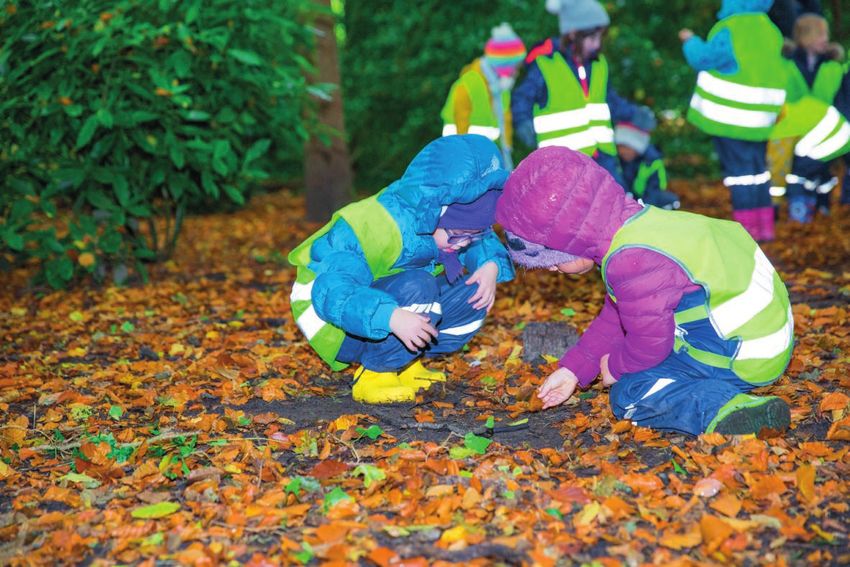
Forest School

Forest School is the name for an approach to
educating children in the outdoors environment
on a regular basis. It has been very successful in
the UK and originates from Denmark where
Forest Schools have been an integral part of
Early Years Education since the 1980s.
Forest School activities will teach the children about caring for and understanding
the natural environment. They explore and use natural materials. They will learn
different skills, including using simple tools as well as how to keep safe, how to live
in harmony with nature and how the seasons and nature change. The sessions will
support the main curriculum and also have a strong emphasis on raising self-esteem
and independence.

Forest School sessions are led by a trained Forest School Leader.

An integral part of the Forest School experience is that children will experience the
outdoors in all weathers – rain, shine, snow or frost. With the exception of very high
winds and thunder storms, please assume that your child will be outside when they
take part in forest schools, even if it is for a shortened session. We will provide all
children with a high visibility vest and waterproof trousers, but please feel free to
provide your own.
18                                                                                                                                                                                     19

Fitness and nutrition                                                                        Educational visits
FitNut

FitNut stands for Fitness & Nutrition. FitNut                                                In Reception children enjoy ball-skills activities
provides a stimulating learning experience to                                                with a specialist teacher on alternate half terms
teach children about the importance of health,                                               as well as a weekly PE session with their class
nutrition and fitness. It is hands-on and gives                                              teacher. Children develop fundamental
children a practical experience that can be                                                  movement skills, become increasingly competent
taken home.                                                                                  and confident in balance and coordination,
It has a constant and consistent healthy message to inspire the children and their family.
                                                                                             individually and with others.
                                                                                             We go on educational visits throughout the year to museums and local attractions linked
FitNut believes the key to bringing good nutrition into the home is through the children.
                                                                                             to what the children are learning. These are a wonderful opportunity for children to
                                                                                             make exciting, real-life links with their learning.
Children will enjoy fun fitness sessions using real mini gym machines and exercise
equipment followed by smoothie or juice making.

                                                      In addition to Forest School
                                                      and FitNut children also have
                                                      lessons with a visiting sports
                                                      coach. We teach yoga and
                                                      follow the massage in schools
                                                      programme.
20 21
After school care Supporting your child
Majest Global At home
The British School of Amsterdam works in There are no specific expectations but if you
partnership with after school care provider would like to help your child at home in the
Majest Global to provide reliable, good quality holiday, on the following pages there are some
after school care for children. Majest Global suggested activities to help develop gross and
provides after school care exclusively to British fine motor skills (especially for pre-writing skills).
School children between the ages 3 to 12 years.
In addition, we teach phonics using Jolly Phonics.
The facility is open every day after school You may like to download the app for your child.
3.00 – 6.30pm and during school holidays
8am to 6.30pm.
For all enquiries, please use
the contact or meet us
buttons on the school website:
www.britishschool.amsterdam22 23
Activities
To develop large motor skills To develop fine motor skills
Balancing along a bench, wall or beam Frog and rabbit jumps Cutting pictures from magazine Specific teaching of skills such as cutting
(encourage use of arms), start on a wider to make a collage (open, shut movement and finger placement)
Jumping down the stairs one step
object and over time reduce to narrow and sticking (don’t glue up in the air, glue
at a time (under guidance!) Threading beads, pasta etc.
around the edges of the object, don’t wind up
Jumping both feet together
Slithering like a snake Bread making (esp. kneading) a pritt stick too far)
Star jumps
Swimming Playdough Help with positioning for fine motor tasks
Hopping on one foot (not too near or far from a table, at
Rotating wrists whilst keeping elbows still Playing a musical instrument
comfortable height)
Standing on one foot, then the other (eg. Piano, keyboard)
Walking on tiptoes forwards and
(should be able to maintain for 10 seconds) Jigsaw puzzles
backwards Exposure to a variety of textures
Bouncing on a trampoline (sandpaper, cloth, vinyl, plastic, wood) and Doll play or soft toy play where clothes
Walking on heels forwards and backwards
ability to describe what they feel without can be changed (zips, buttons, laces)
Musical bumps
Walking on insides of feet looking
(stop still when the music stops) Experimenting with different textures
Recognizing fingers touched when Hand exercises and games (mirroring your through use of : shaving foam, clay,
What’s the time Mr. Wolf? game
obscured from view (hold a book over hand movements, clapping games, cats cradle) playdough etc.
Hopscotch hand and touch one or two fingers, can s/he
tell you which were touched) Finger rhymes and songs with actions Opening and closing containers (being
Skipping with a skipping rope shown how to do so independently)
Finger sequencing (touch thumb with each Making large arm movements (to form
(jumping from one side to the other of a
letters, numbers etc) Water play – involving pouring from
rope on the floor is enough of a challenge to finger). Left hand, then right, then both
start with) Large and free style painting and drawing one container to another
Touching end of nose with finger in an arc,
eyes closed. Repeat this several times with on very big pieces of paper Picking up beads or peas or other
Walking with fairy steps
(feet toe-to-toe) alternate arms Drawing on a (mini) whiteboard small objects from a bowl with a pair
of tweezers and placing them in a
Walking with giant steps Playgrounds and parks Drawing on a chalk board
different bowl
(see saws, swings, climbing frames)
Walking, hopping, running, skipping, Chalking on the pavement or
Sorting buttons or coins or
jumping according to given directions Dressing up play, and getting self dressed in the garden
other similar objects
(walk forward, skip to the side, and undressed
Construction activities such as lego
jump back 5 times) Learning to tie laces
Sewing/threading through large binca
Kicking a football
Craft activities related to an area of
Bowling
special interest for the child
Skittles
Marbles24 25
Extracurricular activities Home learning
What we offer Things to consider
In ‘normal’ times, we run a limited We are living in very challenging and uncertain
extracurricular activities programme in times. There is always the possibility that the
Reception. Children are able to attend one Netherlands will go into lockdown again and
extra curricular activity per week. the school will be forced to close. In such times
we will switch to our on-line home learning
programme. To make the switch easier, you may
want to consider having some resources to
hand. Some suggested items are listed below.
Children need to be seated at the table
with the laptop or tablet directly in front of them.
Essential Items: Other useful items:
Writing pencil Set of water colours
Coloured pencils Markers
Glue stick Ruler
Children’s scissors Stickers
Blank A4 workbook Eraser
Coloured paper Printer
Phonics Card and A4 paper
Number Line (supplied by the school)
Headphones
Play dough26 Here to help Contact us We are here to help you. If you ever have any questions or queries or just want to ask for some advice, please contact us. Claudia van de Laar-Newson, Head of Early Years: c.newson@britams.nl Linda Naghieh, Head of Nursery: l.naghieh@britams.nl We hope your children are looking forward to joining Reception in September.
EARLY YEARS
       SCHOOL

        JUNIOR
       SCHOOL

        SENIOR
       SCHOOL

britishschool.amsterdam

      Havenstraat 6
   1075 PR Amsterdam

    +31 20 67 97 840
You can also read


