2018 MONITORING GUIDE - For National Co-ordinators All materials and tools at: Global Partnership for Effective Development ...
←
→
Page content transcription
If your browser does not render page correctly, please read the page content below

Original: English
                                              Edition: 12 August 2018

2018 MONITORING GUIDE
     For National Co-ordinators
     from Participating Governments

All materials and tools at:
www.effectivecooperation.org/2018monitoring

For questions & help:
monitoring@effectivecooperation.org
ABOUT THIS

GUIDE           FOR NATIONAL CO-ORDINATORS

The objective of this monitoring guide is to help participating
governments lead their country’s participation in the 2018
monitoring round of the Global Partnership for Effective
Development Co-operation (hereafter “the Global Partnership”).
This document provides guidance on the process and methodology
of the monitoring exercise, and outlines how countries and their
partners can use the results. The monitoring exercise, led by
participating governments, is assisted by the OECD-UNDP Joint
Support Team of the Global Partnership.
The first deadline for countries to submit data is 31 October
2018. This will allow countries to use the findings to inform the
Sustainable Development Goals and Financing for Development
follow-up and review processes, as well as the Global Partnership
Senior-Level Meeting, scheduled to take place in July 2019 in
concurrence with the United Nations High Level Political Forum.
All countries are invited to participate in monitoring efforts. A list
of countries that have expressed their interest in participating in
the monitoring exercise is available at www.effectivecooperation.
org/2018monitoring. Countries interested in participating and not
yet included in the country list are invited to contact the OECD-
UNDP Joint Support Team at monitoring@effectivecooperation.org.

This guide and other supporting documents and tools will be
available at: www.effectivecooperation.org/2018monitoring.

                                OECD-UNDP Joint Support Team
                 Global Partnership for Effective Development Co-operation
2018 MONITORING GUIDE

CONTENT
GLOBAL PARTNERSHIP MONITORING IN A NUTSHELL

PART 1. UNDERSTANDING GLOBAL PARTNERSHIP MONITORING                         04
1.1. What is Global Partnership monitoring?                                 05
1.2. Why participate in the monitoring exercise?                            05
1.3. What does the exercise monitor?                                        08
1.4. What Sustainable Development Goals are measured?                       09
1.5. How does the monitoring round work?                                    10
Indicative 2018 Monitoring Timeline: Step by Step                           11

PART 2. MANAGING THE MONITORING PROCESS IN YOUR COUNTRY                     14
Phase 1. Launch of the monitoring round: June – July 2018                   15
Phase 2. Country-level sensitisation and preparation: July - August 2018    16
Phase 3. Data collection and validation at country level: August-October    17
2018
Phase 4. Final validation and review: November – December 2018              18
Phase 5. Analysis and outputs: January – June 2019                          19
Phase 6. Dissemination, dialogue and action on the results                  20
What support do countries and participants receive?                         22

PART 3. REPORTING ON THE GLOBAL PARTNERSHIP INDICATORS                      24
3.1.    How to sequence the data collection process efficiently             26
3.2.    How to obtain and use the data reporting tools                      27
       A. Indicators that national co-ordinators can report directly        29
              Indicator 1b                                                  29
              Indicator 5b                                                  35
              Indicator 7                                                   38
              Indicator 8                                                   41
       B. Indicators that national co-ordinators report with inputs         46
       from development partners
              Indicator 1a                                                  46
              Indicator 5a                                                  53
              Indicator 6                                                   56
              Indicator 9b                                                  58
       C. Indicators that national co-ordinators report in consultation     62
       with development partners and domestic stakeholders
              Indicator 2                                                   62
              Indicator 3                                                   68
       D. Indicators from existing assessment that national co-             74
       ordinators can complement
              Indicator 4                                                   74
              Indicator 9a                                                  79
              Indicator 10                                                  82
WHO IS WHO IN GLOBAL PARTNERSHIP MONITORING

The Global Partnership monitoring exercise is characterised by the participation of various actors. In this Monitoring
guide we use the following terminology, described below for clarity:

       PARTICIPATING                             DEVELOPMENT                            DOMESTIC ACTORS
       GOVERNMENTS                                 PARTNERS

Also known in this Guide as              These are the bilateral and              These domestic stakeholders
partner countries. These are the         multilateral agencies and funds          may include the private sector,
countries and territories leading        that provide official development        civil   society,   foundations,
the monitoring exercise.                 co-operation       funding     to        trade unions, parliaments and
Some participating countries are         participating governments --             subnational governments.
both providers and recipients of         whether concessional or not.
development co-operation.

         NATIONAL                               FOCAL POINT(S)                             OECD-UNDP
       CO-ORDINATOR                                                                    JOINT SUPPORT TEAM

The national co-ordinator is the         Focal points are appointed by the        The Joint Support Team is a team
official sitting in a core ministry      various stakeholders to facilitate       of officials based in Paris and
or agency from each participating        exchanges       and     dialogue         New York dedicated to support
government, who leads the                with national co-ordinators of           the participation of all actors in
monitoring exercise.                     participating governments.               the monitoring exercise.
GLOBAL PARTNERSHIP MONITORING IN A NUTSHELL
   The basics
    GLOBAL      What is the Global Partnership?
PARTNERSHIP     The Global Partnership for Effective Development Co-operation was established by
                163 countries in Busan (2011) as a multi-stakeholder platform that aims to advance
                the effectiveness of all development efforts and contribute to the achievement of the
                Sustainable Development Goals (SDGs). It fosters engagement and mutual learning
                on how to make development co-operation more aligned, effective, country-owned,
                results-oriented, inclusive, transparent and accountable.

   PURPOSE      What is the purpose of the Global Partnership Monitoring?
                The monitoring exercise helps countries and their development partners assess
                progress, opportunities and obstacles in aligning their efforts and partnerships
                with the effectiveness principles. Improving the quality, impact and effectiveness of
                development co-operation is crucial to ensuring that the SDGs are achieved.

 INDICATORS     What does the Global Partnership monitor?
                Its monitoring framework is comprised of 10 indicators focusing on strengthening
                and using countries’ domestic institutions, increasing transparency and predictability
                of development co-operation, and supporting better engagement of foreign and
                domestic partners in development.

   PROCESS      How does the monitoring exercise work?
                The monitoring exercise is led by national governments and brings together bilateral
                and multilateral organisations, the private sector, and civil society, among others, to
                make their partnerships more effective. Participating governments appoint a national
                co-ordinator, who collaborates with the other stakeholders and the Global Partnership
                to obtain the country results.

     ACTION     How will the data be used?
                Country-specific results of the monitoring exercise, along with global aggregates,
                provide key evidence through which partners can identify strengths and opportunities,
                and guide dialogue to action to maximise the impact of their joint work. The
                monitoring exercise helps countries and their partners identify ways to enhance their
                collaboration in working towards the SDGs. It also provides official data for several SDG
                17 and 5 targets. Implementing the commitments monitored through this exercise has
                a catalytic effect in achieving all other SDGs.

   TIMELINE     What is the timeline for the 2018 monitoring exercise?

   SUPPORT      What tools are available?
                Complementing this Guide, multiple support tools are available, including: a
                permanent helpdesk, user-friendly tools to gather and analyse the data, a checklist of
                the monitoring process, virtual trainings and self-training videos, and regular webinars.
                All tools are being made available at: effectivecooperation.org/2018monitoring
PART 1

UNDERSTANDING
GLOBAL PARTNERSHIP
MONITORING
PART 1

           UNDERSTANDING
PART 1
           GLOBAL PARTNERSHIP MONITORING

           1.1   WHAT IS THE GLOBAL PARTNERSHIP MONITORING?

           Through its monitoring exercise, the Global Partnership supports countries in tracking the
           implementation of effective development co-operation commitments, aimed at implementing
           four development effectiveness principles – country ownership, a focus on development
           results, inclusive partnerships, and enhancing transparency and mutual accountability.

           The monitoring exercise complements the Sustainable Development Goals (SDG) follow-up
           and review process by generating data for SDG 17 and SDG 5, and by helping countries assess
           how effective all actors are in working together to support national development priorities
           and development results.

           1.2   WHY PARTICIPATE IN THE MONITORING EXERCISE?

           The Global Partnership monitoring exercise helps countries and other participants strengthen
           co-ordination between all partners and alignment to development efforts with national
           priorities. National governments and their partners can use monitoring data to track progress
           in meeting effective co-operation commitments and support evidence-based dialogue on
           successes, challenges and follow-up actions.

           There are specific benefits for various stakeholder groups:

                                              2018 Monitoring Guide for National Co-ordinators         5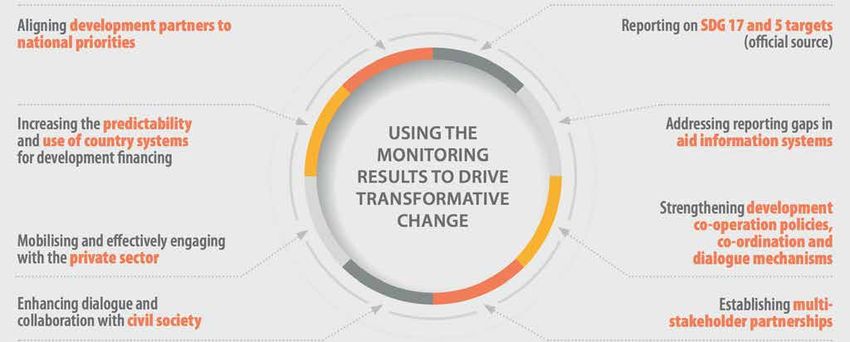
FOR PARTICIPATING GOVERNMENTS,
PARTICIPATION IN THE MONITORING EXERCISE...

              PROVIDES                                                   BUILDS
              EVIDENCE                                                   CAPACITY

… provides data and evidence to                          … builds capacity to monitor
empower decision-makers in managing                      effectiveness in country.
development co-operation.
The results of the monitoring exercise provide a         Governments choosing to participate in the monitoring
concrete foundation on which governments can hold        exercise are provided with a series of guidance and
their partners accountable to ensure effectiveness       tools to facilitate the process, as well as virtual and
commitments are met with action. The results identify    in-person trainings. This experience can serve to build
effectiveness successes and challenges, spurring         capacity in the areas of aid effectiveness, monitoring
national dialogue and driving behaviour change to        and evaluation, information management and partner
ensure improved impact of development co-operation.      coordination.

              MEASURES                                                   ENTRY POINT
              SDGS                                                       FOR PARTNERSHIPS

… supports SDG reporting.                                … serves as an entry point to mobilise and
                                                         engage with a broad range of stakeholders.

As one of the key instruments to measure the means       Effective and inclusive partnerships are vital to achieve
of implementation of the 2030 Agenda for Sustainable     the SDGs and sustainable growth. The monitoring
Development, the monitoring process generates            exercise is a concrete opportunity to start or to
data for countries to assess their progress towards      strengthen dialogue with the private sector and with
achieving three SDG targets: 5.c, 17.15 and 17.16.       civil society. In cases where engagement platforms do
More importantly, making progress in implementing        not already exist, governments can use the monitoring
effectiveness commitments, as monitored through the      exercise to create mechanisms for dialogue with other
Global Partnership exercise, has a broader catalytic     development actors.
effect in achieving all other SDGs.

              SPOTLIGHT                                                  LEADS TO ACTION

...showcases south-south and technical                   … helps guiding the actions of
co-operation.                                            development partners.
An increasing number of countries play a dual role       Development partners committed again in 2016 to
as providers and beneficiaries of development co-        “finish the unfinished business” of the aid effectiveness
operation. Through a tailored approach to the            agenda, such as delivering support in line with the
monitoring exercise, dual-role countries can highlight   national policies and priorities of partner countries,
and evaluate the effectiveness of the co-operation       and to do so while strengthening and relying upon
they provide, ensuring it is used for maximum impact.    those country institutions to deliver their support.

6       GLOBALPARTNERSHIP                                             effectivecooperation.org/2018monitoring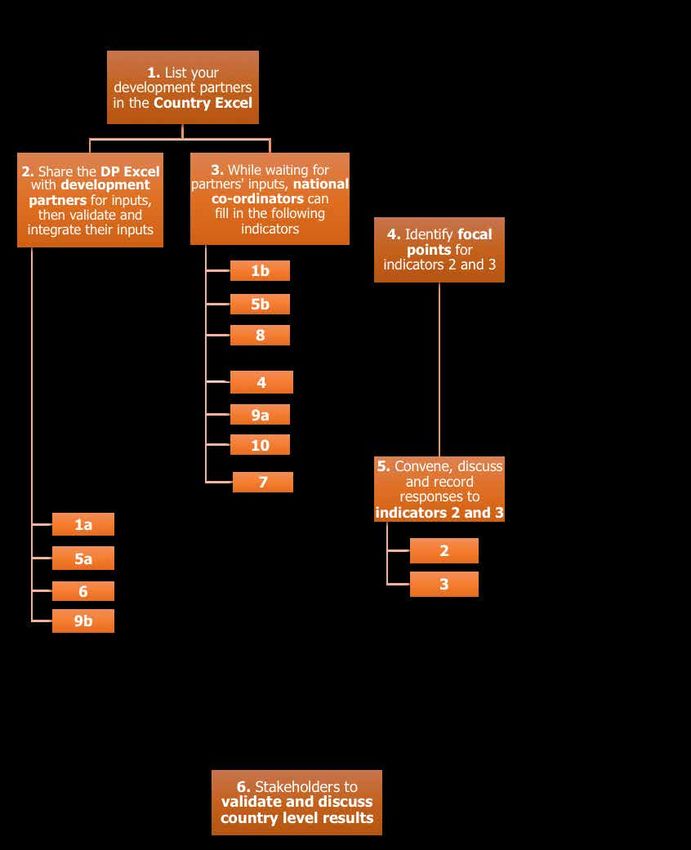
FOR DEVELOPMENT PARTNERS,
PARTICIPATION IN THE MONITORING EXERCISE...

              DEVELOPMENT                                                      JOINT
              EFFECTIVENESS                                                    SOLUTIONS

… provides an opportunity to work with                         … helps participants seek joint solutions.
partner countries more effectively.
As noted above, results of the monitoring exercise             There are often cases in which specific challenges
provide data and evidence that can be used to make             prevent partners from being able to fully implement
development co-operation more effective, thereby               effectiveness commitments in country. The monitoring
maximising development impact. However, to do so,              exercise provides the space for partners to elaborate
the active participation of development partners in the        on why this is the case, facilitating frank discussions
monitoring round is required.                                  with government counterparts on actions required
                                                               from both sides to enable more effective development
                                                               co-operation.

FOR DOMESTIC ACTORS,
PARTICIPATION IN THE MONITORING EXERCISE...

              INCLUSIVE
              PROCESS

… provides a unique multi-stakeholder
process to engage in dialogue and
identify solutions.
It is encouraged that all domestic actors are engaged in
the monitoring exercise. While not every stakeholder
will be involved in providing data and evidence, all
stakeholders can have a valuable role to play in
reviewing country results and helping identify ways
forward to boost countries’ sustainable development.

                                                           2018 Monitoring Guide for National Co-ordinators         7
1.3    WHAT DOES THE EXERCISE MONITOR?

           The Global Partnership’s monitoring framework tracks development stakeholders’ progress in
           aligning their policies and practices with four internationally agreed development effectiveness
           principles. Specifically:

             Indicator: Countries strengthen their national results frameworks (1b)
             Indicator: Development partners use country-led results frameworks (1a & SDG 17.15)

             Indicator: Development co-operation is predictable: annual predictability (5a)
             Indicator: Development co-operation is predictable: medium-term predictability (5b)
             Indicator: Quality of Countries’ Public Financial Management Systems (9a)
             Indicator: Development partners use country systems (9b)
             Indicator: Aid is untied (10)

             Indicator: Quality of Public-Private Dialogue (3)
             Indicator: Civil society organisations operate within an environment that maximises
                        their engagement in and contribution to development (2)

             Indicator: Transparent information on development co-operation is publicly available (4)
             Indicator: Mutual accountability among development actors is strengthened
                        through inclusive reviews (7)
             Indicator: Development co-operation is included in budgets subject to
                        parliamentary oversight (6)
             Indicator: Countries have systems to track and make public allocations for
                        gender equality and women’s empowerment (8 and SDG 5c)

8   GLOBALPARTNERSHIP                                            effectivecooperation.org/2018monitoring
1.4 WHAT SUSTAINABLE DEVELOPMENT GOALS ARE MEASURED
BY THIS MONITORING EXERCISE DIRECTLY?
Simply by participating in the 2018 monitoring round, countries providing and/or receiving
development co-operation obtain official estimates for SDG targets 17.16 and 17.15, which are
critical means of implementation (SDG 17) to achieve all the other Sustainable Development
Goals. Moreover, countries leading the exercise also obtain official data for SDG target 5.c.
Indicator 1a All Indicators Indicator 8
2018 Monitoring Guide for National Co-ordinators 91.5 HOW DOES THE MONITORING ROUND WORK?
Four parameters guide Global Partnership monitoring exercises, which are...
Participating countries appoint a national
…led by countries. co-ordinator to lead the exercise and liaise
with other stakeholders.
The process is undertaken in collaboration
…multistakeholder.
with relevant domestic actors and external
development partners
The results will have the ownership of all
…evidence-based and
participants, and will serve to guide actions
action-oriented.
to address bottlenecks.
The OECD-UNDP Joint Support Team provides
...closely supported. guidance and support throughout the exercise.
The indicative sequence of the 2018 monitoring exercise, also detailed in Table 1, is as follows:
1. Once a government has confirmed its interest in participating in the 2018 monitoring round, a
national co-ordinator should be appointed by the government to manage the exercise (phase 1).
2. Appointed national co-ordinators and their teams are supported by the OECD-UNDP Joint Support
Team in preparing for the monitoring exercise, with tailored guidance, training, helpdesk and
assistance (phase 2).
3. Following the appointment and preparation of national co-ordinators, the data collection process
can start in the country, running until 31 October 2018 (phase 3). As a multi-stakeholder process,
key partners are asked to share data with the government (Table 2).
4. Once the data collection is completed, results are shared and validated with the different partners
in the country, so that complete country data can be also shared with the OECD-UNDP Joint Support
Team for supporting countries in the final validation and review before 31 December 2018 (phase 4)
5. The OECD-UNDP Joint Support Team, in consultation with participating governments, prepares
country-specific reports and global aggregated reporting (phase 5).
6. Countries and partners use the monitoring results as a starting point to agree on strategies that
could help unlock bottlenecks, improve their joint partnerships, and make development co-
operation more aligned and results-oriented, country-owned, catalytic and transparent. Equally
important, the reported results also help countries and bilateral development partners prepare
their Voluntary National Reviews to the United Nations, inform global reports on the Sustainable
Development Goals and on Financing for Development, and enable all participants with evidence
to influence global dialogue and decision-making in 2019 – including in the context of the 2019 UN
High-Level Political Forum on Sustainable Development (phase 6).
10 GLOBALPARTNERSHIP effectivecooperation.org/2018monitoringTable 1. Indicative 2018 Monitoring Timeline: Step by Step
Starting Phase 1. Launch of the monitoring round
June-July • The OECD-UNDP Joint Support Team sends an official invitation to participate
2018 in the monitoring exercise from the Global Partnership ministerial Co-Chairs to
relevant authorities in partner countries and in development organisations.
• Partner country governments confirm their interest in participating in the
monitoring round and appoint a national co-ordinator to manage the exercise at
country level.
• Development partners designate a focal point in headquarters to facilitate their
participation in the monitoring exercise.
July – Phase 2. Country-level sensitisation and preparation
August • The Joint Support Team provides reporting tools and guidance, and organises a
2018 series of virtual trainings for national co-ordinators and development partners.
• National co-ordinators organise the launch of the monitoring process at the
country level – often through a kick-off meeting or workshop that involves the
full variety of development partners at country level.
• Development partners designate focal points at country level and support and/
or participate in kick-off meetings/workshops convened at the country level.
August – Phase 3. Data collection and validation at country level
October • National co-ordinators coordinate data collection. Where possible, the national
2018 co-ordinator is encouraged to use existing in-country platforms and tools to
inform data collection and related dialogue.
• Development partners & other development stakeholders participate in data
collection, providing information as requested by national co-ordinators and
participating in consultations where necessary.
• The Joint Support Team provides ongoing support to national co-ordinators
during the data collection process.
• National co-ordinators liaise with development partners and other domestic
stakeholders to validate all data before submitting it to the Joint Support Team
by 31 October 2018.
November Phase 4. Final validation and review
– December • The Joint Support Team reviews the submitted information, in consultation with
2018 national co-ordinators, to ensure data comprehensiveness and accuracy.
• Development partners at headquarters level support data review efforts,
providing additional suggested inputs to national coordinators to ensure
complete and accurate data sets.
• National co-ordinators consolidate feedback from the OECD-UNDP Joint
Support Team and development partners and submit the final dataset.
2018 Monitoring Guide for National Co-ordinators 11Table 1. Indicative 2018 Monitoring Timeline: Step by Step
January - Phase 5. Analysis and outputs
June 2019 • The Joint Support Team aggregates and analyses data, and prepares country
profiles and global reports. Data and evidence is submitted to relevant agencies
to inform the global follow-up and review of the SDGs and Financing for
Development commitments.
Throughout Phase 6. Dissemination, dialogue and action on the results
2019 • Partner country governments, development partners and other stakeholders
participate in follow-up and review of monitoring findings at country,
regional and global levels. Results can be used to introduce policy changes
and strengthen co-ordination arrangements, both in countries and within
development organisations. Data from the monitoring round can also be used to
report on progress in SDG 17 and SDG 5. Toolkits and guidance on how to move
from results to action will be made available together with the country reports.
•
12 GLOBALPARTNERSHIP effectivecooperation.org/2018monitoringPART 2 MANAGING THE MONITORING PROCESS IN YOUR COUNTRY
PART 2

                   MANAGING THE MONITORING PROCESS
PART 2
                   IN YOUR COUNTRY

      The monitoring process is a voluntary exercise led by participating countries. Participating
      governments take the lead in the process, gathering inputs and data from a variety of partners and
      domestic stakeholders, including from other parts of the public sector, bilateral and multilateral
      development partners and funds, private sector representatives, civil society organisations and
      trade unions, and in facilitating a broad validation and discussion of the results, including with
      the concurrence of parliaments, subnational governments, foundations and others, as needed.

                  Phase 1. Launch of the monitoring round: June – July 2018

  The OECD-UNDP Joint Support Team sends an official invitation to participate in the monitoring
  exercise from the Global Partnership ministerial Co-Chairs to relevant ministers in partner countries
  and to heads of organisations.
  Partner country governments confirm their interest in participating in the monitoring round and
  appoint a national co-ordinator to manage the exercise at country level. The national co-ordinator
  is usually an official sitting at the Ministry of Finance, Planning or Foreign Affairs, or equivalent, with
  responsibility for overseeing the management of development co-operation.
  Development partners appoint a headquarter (HQ) focal point, to guide their overall engagement in
  the 2018 monitoring round.

                                                    2018 Monitoring Guide for National Co-ordinators     15
Phase 2. Country-level sensitisation and preparation: July - August 2018
The national co-ordinator starts liaising with counterparts from other ministries, development partner
organisations and other stakeholders. Specific responsibilities include:
• Outreach to other relevant stakeholders in country, which is suggested to include bilateral and
multilateral development partners and funds, and representatives or focal points from domestic
actors, such as the private sector, civil society organisations, trade unions, foundations, subnational
governments and parliaments, to encourage them to learn about the monitoring process and
participate as needed.
Good practice: Organising a kick-off meeting or workshop involving the full variety of actors in the country.
As soon as partner countries confirm participation in the round, the development partners’ focal
point in headquarters can either:
• Identify a contact person in the relevant country office or embassy and share contact details with
the national co-ordinator and OECD-UNDP Joint Support Team (at monitoring@effectivecooperation.
org). Country level focal points can support and/or participate in kick-off meetings convened at the
country level.
• Serve as contact person for country data requests, if needed (e.g. due to lack of country-level
presence).
16 GLOBALPARTNERSHIP effectivecooperation.org/2018monitoringPhase 3. Data collection and validation at country level: August-October 2018
National co-ordinators liaise with relevant national stakeholders to collect data for selected indicators, as
well as consolidating and reporting data in the Global Partnership monitoring data reporting tool called
Country Excel (see Table 3). Dialogue and consultation with these stakeholders – before, during and after
the data collection process – is encouraged to ensure an easy and credible process.
Development partners and other development stakeholders participate in data collection, providing
information as requested by national co-ordinators and participating in consultations where necessary.
National co-ordinators can share with development partners another excel tool prepared by the Joint
Support Team, called DP Excel, to easily collect inputs from them.
National co-ordinators collect data using a user-friendly reporting tool (Country Excel), specifically designed
for the Global Partnership. The tool is available from the Joint Support Team and can be also downloaded
at www.effectivecooperation.org/2018monitoring. A separate reporting tool, designed for development
partners, is also available (DP Excel).
National co-ordinators and their teams can find detailed guidance on how to report on each Global
Partnership indicator in Part 3 of this document. The Joint Support Team is available to provide ongoing
support to national co-ordinators during the data collection process.
Countries participating in the monitoring process are encouraged to use their own existing frameworks,
platforms, co-ordination groups, aid information management systems and existing tools to gather
information for the monitoring process. The use of existing country level arrangements, systems and
tools is an important aspect of sustainable monitoring processes, reducing the burden on countries and
increase efficiency over time.
National co-ordinators validate country-generated data through multi-stakeholder dialogue to ensure
high-quality reporting, as well as to strengthen mutual understanding of progress and challenges in
meeting effectiveness commitments. As much as possible, to ensure broad country-level awareness and
ownership of the results, it is encouraged that representatives from across stakeholder groups, including
various government ministries, development partners, civil society, the private sector, trade unions, local
governments and parliamentarians, meet to discuss and validate the data at country-level. This is an
important step to build trust among partners and ensure that the monitoring results are well received in
later phases of the exercise. This dialogue is also helpful in identifying data gaps and challenges for future
analysis. This can allow for improvements to be identified and implemented, and in time, to help improve
the availability and capacity to manage and use data at country level.
After validation of the data collected at country level, the national co-ordinator will share the country data
with the OECD-UNDP Joint Support Team, submitting the Country Excel to monitoring@effectivecooperation.
org. National co-ordinators are requested to submit the data no later than 31 October 2018.
2018 Monitoring Guide for National Co-ordinators 17Table 2. Overview of reporting roles per indicator
This stakeholder responds to the indicator : ●
This stakeholder complements with additional inputs : ←
This stakeholder validates inputs from other stakeholder : √
This stakeholder can complement with inputs, as needed : ◌
Phase 4. Final validation and review: November – December 2018
The OECD-UNDP Joint Support Team reviews the submitted information in consultation with national
co-ordinators to ensure comprehensiveness and accuracy of data.
Headquarters’ offices of development partners support data review efforts by suggesting inputs to
national co-ordinators that could ensure completeness of country-level data.
National co-ordinators consolidate feedback from the Joint Support Team and development partners
and submit a final version to monitoring@effectivecooperation.org.
18 GLOBALPARTNERSHIP effectivecooperation.org/2018monitoringPhase 5. Analysis and outputs: January – June 2019
Following the receipt of a final data set from National co-ordinators, the OECD-UNDP Joint Support Team
will collate and close the data set to allow for aggregation and analysis. Products featuring the findings will
become available to countries throughout the first half 2019 in various formats, including:
Country and territory profiles
Individual monitoring profiles will help participating governments
summarise country-level progress, contextualise the findings, and identify
opportunities and challenges in working together more effectively.
This country-specific analysis will provide actionable evidence to guide
governments and their partners in taking forward monitoring results. The
profiles will be developed on a rolling basis, after countries complete the
data collection and validation phases, and in consultation with them.
Global reporting
Global reporting and analysis on the monitoring results will be published
to inform the upcoming 2019 High-Level Forum on Sustainable
Development, to guide collective action towards more effective
development co-operation.
Online dashboard reporting, visualising and comparing all monitoring data.
Data and evidence generated through the country-led monitoring process will also be disseminated
through the online Global Partnership Monitoring Dashboard. The Dashboard allows development
stakeholders to view, explore and compare results and progress for all participating countries,
territories, and organisations across regions and contexts.
2018 Monitoring Guide for National Co-ordinators 19Phase 6. Dissemination, dialogue and action on the results
The 2018 monitoring results provide numerous benefits to national governments, development partners
and all development actors and stakeholders that will support transformative change:
At country level
Country-specific monitoring results, along with global aggregates, provide concrete evidence through
which partners can hold each other accountable to ensure commitments are met with action, identify
challenges and jumpstart dialogue to maximise the impact of their joint work. Past participation in the
monitoring process has resulted in the establishment and strengthening of national development co-
operation policies and coordination mechanisms, as well as overall increased efficiency among national
development stakeholders to accelerate the achievement of government development priorities.
Figure 1. Using your monitoring results
As one of the key instruments to measure the means of implementation of the 2030 Agenda for Sustainable
Development, the Global Partnership monitoring process generates data for countries to assess progress
towards achieving global SDG targets on respecting countries’ policy space and leadership in setting their
development path (SDG 17.15); strengthening multi-stakeholder partnerships for development (SDG
17.16); and adopting sound policies for the promotion of gender equality and women’s empowerment
(SDG 5c). More importantly, making progress in implementing effectiveness commitments, as monitored
through the Global Partnership exercise, has a broader catalytic effect in achieving all other SDGs.
20 GLOBALPARTNERSHIP effectivecooperation.org/2018monitoringAt global level
Findings from the monitoring exercise are used to stimulate and inform international policy dialogue. The
2018 monitoring results will generate robust, comparable and timely evidence to inform international
dialogue and spur continued collective action for strengthened effective development co-operation, which
is a key driver of success to implementing the 2030 Agenda.
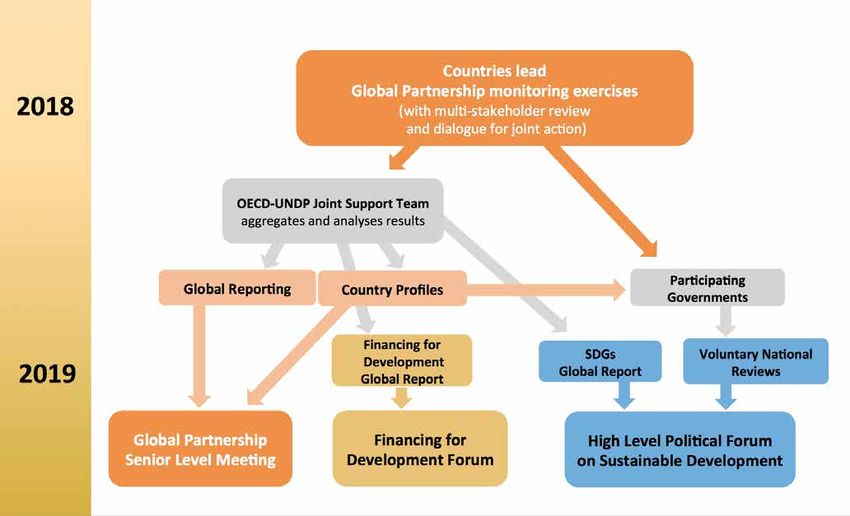
Monitoring data will inform the 2019 SDG and Financing for Development follow-up and review processes
(Figure 2). The results will also inform international policy dialogue during the 2019 High-Level Political
Forum on Sustainable Development, scheduled by the United Nations to be held in New York, July 2019.
Figure 2. How does your country-led monitoring inform SDGs follow-up and the
international dialogue on development co-operation effectiveness?
2018 Monitoring Guide for National Co-ordinators 21WHAT SUPPORT DO COUNTRIES AND PARTICIPANTS RECEIVE?
The OECD-UNDP Joint Support Team actively supports governments in leading the monitoring exercise
and the participation of other stakeholders, by providing guidance, training and support throughout
the monitoring process.
All the tools, instruments and services will be made available progressively on the dedicated website:
www.effectivecooperation.org/2018monitoring, to help national co-ordinators in leading the different
phases of the national monitoring exercise:
1. Sensitisation and awareness raising
2018 Monitoring: Country Brochure Development Partner Brochure
A four-page leaflet containing strategic information on A similar four-page leaflet to help national co-ordinators
the benefits, usefulness, timeline and steps to participate raise awareness amongst development partners on the
in the monitoring round. benefits of their active engagement in the 2018 exercise.
2. Guidance and checklists
Strategic Booklet for national co-ordinators 2018 Monitoring Guide
A short booklet that contains key information for national A detailed technical guide, available in English, French
co-ordinators on how to run the monitoring process in and Spanish, that contains step-by-step instructions on
their country for strategic management of the process. how to run the monitoring exercise and how to report on
This document is recommended for Aid Managers and Directors. the indicators. This document is recommended for technical
staff involved in data collection.
2018 monitoring process checklist Development Partners Mini Guide
An indicative list of steps to guide national co-ordinators This mini guide will help your development partners
to implement the monitoring exercise easily. This understand their role, the benefits of participating in the
document is recommended for Aid Managers, Directors and monitoring round, and how to prepare and share the
technical staff. relevant data with national co-ordinators.This document is
recommended for your development partners.
Technical Companion document (Only for reference)
The data-reporting tool (Country Excel) automatically calculates all the indicators. Nonetheless, curious participants can
learn about the methodologies to calculate the different indicators, which are detailed in this technical document.
3. Data reporting tools
Reporting country data Collecting inputs from partners
A user-friendly excel-based reporting tool (Country A second excel tool (DP Excel) will also be available
Excel) will be available in English, French and Spanish starting August. The DP Excel helps gathering inputs from
starting August to support national co-ordinators during development partners. Data reported in DP Excels can
the data collection process. be transferred into the Country Excel (by copying and
pasting “values only” from one excel to the other).
To minimise transaction costs and explanations, both excel files contain self-guided instructions, automatic checks and built-
in formulas for programmed calculations
22 GLOBALPARTNERSHIP effectivecooperation.org/2018monitoring4. Training and capacity building
Online Course on Development Virtual trainings
Effectiveness Monitoring A series of virtual trainings and webinars on the process
A self-paced, online training course to manage the and the indicator methodologies will be available to
monitoring process and report on the indicators support participants.
effectively. Participants who complete the course
successfully will earn a certification on development co-
operation effectiveness monitoring.
Short explanatory videos International workshop
Short YouTube videos will be available for on-the-spot To maximize the benefits of this exercise, countries
consultation on how to report for each indicator, with participating in the 2018 monitoring round are welcome
step-by-step guidance. to join a dedicated Global Partnership technical meeting
in Paris on 11-12 September 2018.
5. Ongoing support throughout the monitoring exercise
Helpdesk Live regular sessions
Participants can contact the OECD-UNDP Joint Regular Q&A sessions will be available on an
Support Team with questions or requests at any time on-going basis where participants can ask questions
by writing to the permanent Helpdesk: monitoring@ to the OECD-UNDP Joint Support Team for immediate
effectivecooperation.org. Specialists from OECD and answer or clarification.
UNDP will answer your message as quickly as possible.
In addition to the supporting tools, training and guidance offered by the Joint Support Team,
experience from past monitoring rounds shows that -more often than not- there are development
partners with country presence that able and interested in providing active support to national
co-ordinators. This is a good practice that should be encouraged.
When development partners have provided support to national co-ordinators, this has included some
of the following modalities:
1. Helping co-ordinate the rest of development partners to be informed and actively engage in the
exercise and in providing timely and accurate data to the national co-ordinator.
2. Providing in-kind technical support (or funding consultant support) to help national co-ordinators
in completing the technical data collection.
3. Providing (or funding) the logistics and facilitation of kick-off workshops and/or multi-stakeholder
dialogues needed to report on some indicators.
4. Helping co-ordinate or facilitate the final validation phase of the monitoring results, as well as
follow-up on actions to improve the results.
2018 Monitoring Guide for National Co-ordinators 23PART 3 REPORTING ON THE GLOBAL PARTNERSHIP INDICATORS
PART 3

                           REPORTING ON THE GLOBAL PARTNERSHIP
PART 3
                           INDICATORS: STEP-BY-STEP GUIDANCE

                           This section explains how to report on the Global Partnership indicators, step by step. It also
                           proposes an efficient sequence to report on the indicators (see section 3.1).

                           The detailed step-by-step guidance for each indicator is organised as follows:

    A. Indicators that national co-ordinators can report directly:                                                    Page
    Indicator 1b: Countries strengthen their national results frameworks                                              29
    Indicator 5b: Development co-operation is predictable: medium-term predictability                                 35
    Indicator 7: Mutual accountability among development actors is strengthened through inclusive                     38
    reviews*
    Indicator 8: Countries have systems to track and make public allocations for gender equality and                  41
    women’s empowerment

    B. Indicators that national co-ordinators report with inputs                                                      Page
    from development partners:
    Indicator 1a: Development partners use country-led results frameworks                                             46
    Indicator 5a: Development co-operation is predictable: annual predictability                                      53
    Indicator 6: Development co-operation is included in budgets subject to parliamentary oversight                   56
    Indicator 9b: Development partners use country systems                                                            58

    C. Indicators that national co-ordinators report in consultation with development                                 Page
    partners and domestic stakeholders:
    Indicator 2: Civil society organisations operate within an environment that maximises their                       62
    engagement in and contribution to development
    Indicator 3: Quality of public-private dialogue                                                                   68

    D. Indicators from existing assessments that national co-ordinators can complement:                               Page
    Indicator 4: Transparent information on development co-operation is publicly available                            74
    Indicator 9a: Quality of Countries’ Public Financial Management Systems                                           79
    Indicator 10: Aid is untied                                                                                       82
*
* Development partners are asked to provide complementary data to the national co-ordinator for this indicator.

                                                                   2018 Monitoring Guide for National Co-ordinators        25
3.1 HOW TO SEQUENCE THE DATA COLLECTION PROCESS EFFICIENTLY? 26 GLOBALPARTNERSHIP effectivecooperation.org/2018monitoring
3.2    HOW TO OBTAIN AND USE THE DATA REPORTING TOOLS?

The reporting tools will be available at the 2018 monitoring website in early August 2018.

                                                Country Excel

   • The Country Excel contains all the Global Partnership indicators, as well as instructions on
  how to report on them.
   • This is the place where national co-ordinators should ultimately reflect all the indicator inputs
  and data coming up from their own information systems, from data requests to different partners
  or from responses to questionnaires carried out with other domestic actors.

   How to use it
   • The first step is selecting your country and national co-ordinator’s name and details.
   • Next, you should list all your bilateral or multilateral
  development partners and funds providing any
  type of development finance to the country (grants,
  concessional loans, non-concessional loans, other
  types). Select them in the Development Partners
  tab. A maximum of 50 is allowed.
   • In doing so, your development partner names
  will automatically be filled in all the relevant tabs
  where their inputs are required: Tabs ”1A-M1”, “1A-
  M2”, “5a 5b 6 & 9b” and “7”. When you get data back
  from them, you will be able to copy and paste their
  responses into Country Excel by using “Paste Values
  Only” option in Excel (Edit>Paste Special>Values Only).
   • Several other indicators or indicator sections only
  require national co-ordinator inputs and can be
  filled right away (1b, 5b, 4, 7, 8 and 10).
   • Indicator 9a is a special case: the Country Excel will
  indicate whether existing assessments are available.
   Note:
   • Questions addressed to government are labelled in the questionnaires and Excel as Qg,
  while questions addressed to development partners are labelled as Qp. Questions with
  multistakeholder input are labelled as Qg+.
   • As data and responses are included in the Country Excel, a visual country overview of the
  indicator results will be generated in the tab Dashboard.
   • Currency: All figures relating to amounts have to be reported in US dollars (USD) - please refer
  to the exchange rate table provided on the monitoring website. Please only enter numbers (no
  spaces, no commas).
   • Year of reference: For all indicators unless otherwise specified, the reporting year of reference
  is the latest government fiscal year for which there is information available. For indicator 1a,
  development partners will report on their six largest interventions from all the new interventions
  equal or above USD 100,000 approved by the development partner in 2017 (independently from
  the fiscal year used to report on the other indicators).
   • Remember: All the indicator tabs are print-ready. Printed copies may help in discussing or
  validating responses with the various stakeholders.

                                                2018 Monitoring Guide for National Co-ordinators    27
Development Partner (DP) Excel
• The DP Excel is a self-explanatory excel file that will help national co-ordinators obtain inputs and
data from their development partners.
• National co-ordinators should share the DP Excel with all the bilateral and multilateral
development partners and funds working in the country, i.e. those listed by the national co-ordinator
in the Country Excel’s tab Development Partners.
• The DP Excel is self-explanatory, containing instructions and explanations. It also contain links to
the 2018 Development Partner Mini Guide and the Development Partner Brochure where they can
learn about the benefits of participating in the 2018 monitoring round and on how to report on these
indicators.
• The DP Excel contains space for development
partners to identify themselves and provide their
inputs on relevant indicators, namely on 1A-M1,
1A-M2, 5a & 9b and 7 tabs, as well as any additional
comment they may have.
How to use it
• Once you receive individual (and completed!)
responses from your development partners to the DP
Excel file shared with them, you can easily transfer
the data (from the cells shaded in blue where their
inputs are), from each Tab in the DP Excel to the
relevant Tab in the Country Excel.
• You can copy and paste, but you should “paste as
values” in the Country Excel or an error message will
appear.
• The indicator estimates will automatically appear in
the “Dashboard” tab of the Country Excel.
Obtaining data from your development partners, in a nutshell
1. Request Data 2. Clarify 3. Validate Data 4. Integrate
Share the DP Excel Help partners Once partners Validated data can be
with all your bilateral understand the submit back their copy-pasted in the
and multilateral monitoring process; individual DP Excel, Country Excel (i.e. by
development partners refer them to the review, triangulate pasting the relevant
and funds DP mini guide for and/or clarify doubts rows in Excel ‘as values’)
explanations with them.
28 GLOBALPARTNERSHIP effectivecooperation.org/2018monitoringA INDICATORS THAT NATIONAL CO-ORDINATORS CAN REPORT
DIRECTLY:
Indicator 1b Countries strengthen their national results
frameworks
Development co-operation is predictable:
Indicator 5b
medium-term predictability
Mutual accountability among development
Indicator 7 actors is strengthened through inclusive reviews
Development partners are invited to submit complementary inputs
Countries have systems to track and make
Indicator 8 public allocations for gender equality and
women’s empowerment (SDG 5c)
INDICATOR 1B:
COUNTRIES STRENGTHEN THEIR NATIONAL RESULTS FRAMEWORKS
WHAT THIS INDICATOR
MEASURES
The indicator measures whether the country has national results framework(s) in place, which are used to define
and track the country’s development priorities, targets, and results.
WHY THIS IS
IMPORTANT
National, country-led results frameworks define the government’s approach to setting development priorities
and results. Country leadership in establishing and defining its own results framework(s), including any related
monitoring and evaluation system, contributes to greater ownership of development path and a general orientation
towards development results.
2018 Monitoring Guide for National Co-ordinators 29HOW IT IS
CONSTRUCTED
The indicator is calculated on the basis of four broad criteria, defined by related sub-elements:
Criteria Sub-elements
(1) Setting transparent, country-led results frameworks 1. Approved/Established
2. Developed in an inclusive manner (whole-of-
society)
3. Transparent to the public
(2) Prioritising development results 4. Defines priorities, targets and indicators
5. Incorporates SDGs
6. Informs sector and subnational priorities
(3) Monitoring results at country level 7. Monitored regularly and transparently
8. Monitors whole-of-government engagement
9. Relies on government’s own systems and data to
monitor progress
(4) Using the results information 10. Uses the framework to inform budgeting
11. Uses the framework to guide priorities in
development co-operation
The presence of each of the sub-elements contributes towards the establishment of transparent, country-led
strategic frameworks to support national ownership, results-based decision-making and accountability.
This calculation is done automatically in the Country Excel. For further details on how the indicator is calculated
please refer to the technical companion document.
STEP BY STEP
GUIDANCE
National co-ordinator answers the 11 questions (see below) in the Country Excel (Tab “1b”).
If national development planning responsibilities sit in other government offices, it may be helpful to liaise with
these government officers in responding to the questionnaire.
Once all the questions are completed, the Country Excel will calculate the indicator scores automatically, following
the scoring method described in the technical companion document. These scores appear in the tab Dashboard.
30 GLOBALPARTNERSHIP effectivecooperation.org/2018monitoringQUESTIONNAIRE 1B
TO BE ANSWERED BY THE NATIONAL CO-ORDINATOR:
1. Setting a transparent, country-led results framework:
Qg1. Is there a national development strategy or government strategic plan? [ Yes | No ]
If Yes, what is the name? _______
which period does it cover? 20_-20_
If No, is there one under preparation? [Yes/No]
If Yes, what is the stage of its preparation? [Options provided in drop-down menu]
Qg2. To what extent did the following actors participate in developing the government strategy/plan?
Parliament: ◌ No ◌ Consulted ◌ Enacted the plan with a vote
Civil society: ◌ No ◌ Consulted ◌ Participatory process
Private sector: ◌ No ◌ Consulted ◌ Participatory process
Subnational
governments: ◌ No ◌ Consulted ◌ Participatory process
Development
Partners: ◌ No ◌ Consulted ◌ Participatory process
Qg3. Is the strategy/plan publically available online?
If yes, please include web link: [Type here]
2. Prioritising development results:
Qg4. Does the national development strategy or government strategic plan define development priorities, targets
and associated indicators?
◌ Development priorities ◌ Targets ◌ Indicators
If targets and/or indicators are missing, can these be found in sector strategies and plans instead? [Yes | No]
Qg5. How are the 2030 Agenda and SDGs incorporated or referenced in the development strategy or government
plan? [Multiple answers among the following options]
]] The 2030 Agenda/SDGs are referenced at strategic level [in the narrative]
]] SDGs are referenced at goal level [in the narrative or result framework]
2018 Monitoring Guide for National Co-ordinators 31]] SDGs are referenced at target level [in the result framework]
]] SDGs are referenced at indicator level [in the results framework]
If there is no reference to the Agenda 2030 and the SDGs in the current strategy or government plan, or that
document was approved before September 2015, is there an on-going process to incorporate SDG targets in the
country’s strategic plans? [Yes | No]
Qg6. If they exist, to what extent are sector and sub-national strategies linked to the national development strategy
(e.g. timing and sequencing, consistency of their objectives, institutional responsibilities)?
Strategic Alignment
Sector Sub-
national
Most sector/sub-national strategies are required to align to the national development strategy or
government plan, by law and in practice.
Although there is no law, in practice central authorities (e.g. planning, finance, development
ministry) oversee that new sector/sub-national strategies align to the national development
strategy or government plan.
Although there is no law or central authority enforcing alignment, sector/sub-national strategies
tend to reflect at least core priorities in the national development strategy or government plan.
Only some sector/sub-national strategies are aligned with the national development strategy or
government plan.
Sector/sub-national strategies are in general not aligned with the national development strategy
or government plan.
3. Monitoring results at country level:
Qg7. Is (Are) there a progress report(s) of the national development strategy or government strategic plan?
If Yes, how often are they formulated? [options provided in drop-down menu]
Is the most recent report publicly available? [Type web link here]
Qg8. How is the progress against the national development strategy or government plan reported?
]] A central unit collates all the data from different sources and produces a unified progress report
]] Several line ministries and entities are responsible for collating the data, and a central unit produces a unified
progress report
]] Several line ministries and entities are responsible for collating the data and producing sector or thematic
progress report(s)
]] Responsibilities for data collection are fragmented across the government, and only some entities have
produced progress report(s)
]] No progress reports have been produced yet by government entities
Qg9. To what extent do the national M&E system and statistics meet the demands for data to track the input, output
and outcome indicators identified in the national development strategy or government plan?
]] Timely, regular, accurate government data is available for all the indicators
]] Timely, regular, accurate government data is available for most indicators
]] The availability of government data to track the indicators is mixed – only some indicators have timely, regular,
accurate government data available to track progress.
]] At present, very few indicators can be tracked relying on the national M&E system and statistics.
]] There are no indicators in the national development strategy or government plan.
32 GLOBALPARTNERSHIP effectivecooperation.org/2018monitoring1B
4. Using the results information:
Qg10. Does the national development strategy or government plan include an indicative budget or costing
information?
If Yes, is that information used to inform the annual budget and the medium-term fiscal or expenditure framework
(if these exist)?
Qg11. Does the government use the national strategy/plan (or its progress reports) to inform the dialogue with
development partners on priority areas and results for development co-operation? [Dropdown menu]
DEFINITIONS
Country Results Country results frameworks (CRFs) define a country’s approach to results
Framework(s) and its associated monitoring and evaluation systems focusing on
(or National Results performance and achievement of development results. Using a minimal
Framework(s) definition, these results frameworks include agreed objectives and results
indicators (i.e. output, outcome, and/or impact). They also set targets to
measure progress in achieving the objectives defined in the government’s
planning documents. In practice, government-led results frameworks
defined at the country level are often broadly stated (e.g. long term vision
plans, national development strategies) and operationalised in more
detail at the sector level (e.g. sector strategies), where specific targets
and indicators are set for a given timeframe. The definition of country-led
results framework used in GPEDC Monitoring Framework allows for the
possibility to use equivalent priority-setting mechanisms at the country
level since not all countries articulate their priorities through consistent,
integrated Country Results Frameworks.
For the purposes of this monitoring exercise, the broad definition of
CRFs and CRF-like planning instruments include: long term vision plans;
national development strategies; joint government-multi-donor plans;
government’s sector strategies, policies and plans; subnational planning
instruments, as well as other frameworks (e.g. budget support performance
matrices, sector-wide approaches). In contrast, planning and priority setting
documents produced outside the government, such as country strategies
prepared by development partners, are not considered CRFs.
2018 Monitoring Guide for National Co-ordinators 33Government Strategic Plan A planning tool (typically for the length of the government’s mandate,
4-5 years) that articulates the government’s vision, policy intentions
and expected results. Unlike national development strategies, which
provides a comprehensive medium-term roadmap for all or most sectors,
a government strategic plan may focus on selected priority areas, and the
duration of the plan is linked to the length of the incumbent’s mandate.
Medium-Term Expenditure A framework that combines coherently a medium term (typically 3-5 years)
Framework (MTEF) fiscal framework, medium term sector strategies for key sectors of the
economy and medium term indicative expenditure plans/ceilings for each
sector.
Medium-Term Fiscal A framework that defines the overall medium term (typically 3-5 years)
Framework (MTFF) fiscal aggregates including revenue, expenditure and deficit /surplus that
a country has available in the medium term consistent with a macro-
economic framework
National development National development strategies are overarching strategic planning tools
strategy that cover the whole-of-government. These strategies/plans are typically
prepared to cover a clearly identified period of time, often covering four
to eight years. The quality of these national development strategies in
operational terms depends on the extent to which they constitute a unified
strategic framework to guide the country’s development policy and include
strategic priorities linked to a medium-term expenditure framework and
reflected in annual budgets. They are expected to have been developed
through an inclusive consultative process involving the full range of relevant
development stakeholders at country level, as to ensure legitimacy and
sustainability of national development plan in the medium term.
Participatory process In the context of developing a national development plan or government
strategy, a process of engagement with other stakeholders that offers
opportunities and mechanisms designed for reaching consensus on the
priorities and commitments. In contrast with consultative processes, which
are opportunities to input into the process, participatory processes are
characterised by the co-definition of priority areas and/or targets.
Priority / Priority Area In the context of this indicator, government-defined sectors (e.g. education,
health, transport), geographic regions, or cross-cutting issues (e.g. gender
equality, anti-corruption, climate change) explicitly reflected in key planning
tool(s).
Progress report(s) Such report(s) are typically published once or more during the
implementation of the national development strategy or government
strategic plan, and provide a comprehensive overview of progress drawing
on relevant evidence.
34 GLOBALPARTNERSHIP effectivecooperation.org/2018monitoringYou can also read


