ANALYSIS WEST AFRICA FERTILIZER WATCH - Edition No. 4 - 1 May 2020 - IFDC
←
→
Page content transcription
If your browser does not render page correctly, please read the page content below
WEST AFRICA FERTILIZER
WATCH

ANALYSIS
Edition No. 4 - 1 May 2020

   1
WEST AFRICA FERTILIZER WATCH
PROVIDING WEEKLY INFORMATION ON THE IMPACT OF COVID-19 ON THE WEST AFRICA FERTILIZER MARKET
The supply chain works, stocks are built up
HIGHLIGHTS STATS Covid Public Measures affecting Fertilizer
-19 Measures fertilizer logistics Markets
The supply chain is working, and stocks are being built up,
The distribution chainwhileis working relatively
some countries arewell formeasures
taking the moment, to open down
up. This is Country
to small producers. Deliveries under contracts and tenders
true in Ghana and Nigeria, where the economic impacts of the are
continuing, allowing for close tomay normal stocksevere
levelsthan
at this BENIN
pandemic be more the time
directof year.impacts.
health
BURKINA FASO
Government responses are being fine-tuned, with response
CAPE VERDE
In Ghana, the fertilizerplans industry
and supportwelcomes the government’s
programm for inputs (Togo, decision
Nigeria, toSenegal)
CHAD
open the country. Theybeing are seeing muchorsmoother
put in place, movement
for agricultural commodityof fertilizers.
chains (Côte
CÔTE D’IVOIRE
d’Ivoire, Mauritania, Chad).
In Nigeria, a similar
situation
Subsidies, is expected
first of all fromfor next
foodweek
crops? onwards.
While food Indeed,
crops
GAMBIA
the president announced GHANA
onlythe consumeend ofa thelittleconfinement
more than halfin(54%)the country's two
of the fertilizers
GUINEA BISSAU
main cities, Lagos and consumed
Abuja, as of May 4.
in West For and
Africa the receive
time being,
barelythe20% situation
of the
GUINEA
remains the same withrecommended
functional butinputs, impacted freight should
governments transport.
encourage local
LIBERIA
food production and maintain the production level and
MALI
Government responses purchasing power are of cash crop farmers.
becoming more
Implementation
MAURITANIA
options should be based on ECOWAS regulations and the
refined future Fertilizer Subsidy Directive, as well as existing national NIGER
subsidy programs (see the map published in Issue 2 and NIGERIA
As reported last week,RODEVA’s
the President of Nigeria ordered a reduction in the
viewpoint). SENEGAL
price of fertilizer from the Presidential Fertilizer Initiative
Responses from the seed sector are being prepared with (PFI). Under the SIERRA LEONE
normal modus operandi of thefrom
support PFI, the
CORAF,government
which notesimports large volumes
that enough certified seed TOGO
of fertilizer and obtainsforit from
rice isinternational
available for the markets at preferential
next growing season, while prices.
all other COVID-19 pandemic: Economic status: Fertilizer market indicators:
Color
diagnosed cases on a week- government measures, % stock % subsidized/ Retail/FOB
These volumes are then distributed
crops to farmers
have a shortfall in thethrough
quantityprivate
of seeddistribution
required. on-week basis logistics, finance coverage total market urea price ratio
Stable No impact &/or improvement 80% + Up to 30% 80% +
channels. Through this mechanism, the program offers a fixed and uniform Up to 25% Limited impact 50 – 80% 30 – 50% 50 – 80%
COVID-19 HEALTH ECONOMIC PORT DOMESTIC
price of 5,500 Naira per % CHANGE 50 kg bag of NPK MEASURES
MEASURES 20-10-10 fertilizer
OPERATIONS whileTRANSPORT 25% – 50% Moderate impact 30 – 50% 50 – 80% 30 – 50%
> 50% Strong impact < 30% 80% + < 30%
remunerating the private BORDERsector actors. In comparison,
AGRO INPUT INVENTORIESthe average
FERTILIZER price RETAIL/FOB
No data No data No data No data No data
CROSSING RETAIL SHOPS & STOCKS SUBSIDIES PRICE RATIO
of the same grade of fertilizer in a fully private market is around 8,000
Naira. With the special fertilizer NOUAKCHOTT
price subsidy from the PFI, fertilizer will be FERTILIZER USE FOR FOOD CROPS VS CASH CROPS
Port of
Nouakchott
sold to farmers this year at 5,000 Naira. MAURITANIA Main fertilizer usage: Cotton Cereals Cocoa
40
In Togo, the government DAKAR plans toSENEGAL announce an agricultural response plan
MALI
against COVID-19 to prevent a potential
731 NIGER CHAD
156 food crisis. The plan, details of 70 40
which have not yet been Dakar communicated, is based on three main areas: 1)
Port of
BURKINA FASO NIAMEY
the supply of agricultural
Port of
Banjul
and
BANJULirrigation equipment, 2) support OUAGADOUGOU for 247
BISSAU BAMAKO N’DJAMENA
enterprises promoting agricultural labour, and 3) the provision of input
credit at subsidized prices.Port Bissau
of
GUINEA
GAMBIA 36 2
BENIN
10 CONAKRY 167 % FERTILIZER USED
GUINEA
Port of SIERRE LEONE TOGO ABUJA
Conakry
CÔTE D’IVOIRE ON FOOD CROP
BISSAU
FREETOWN 12 61
297 COTONOU NIGERIA
5 Port of
GHANA 1,215
80% +
PORTO
Focus on the use of fertilizers in
agricultural sectors
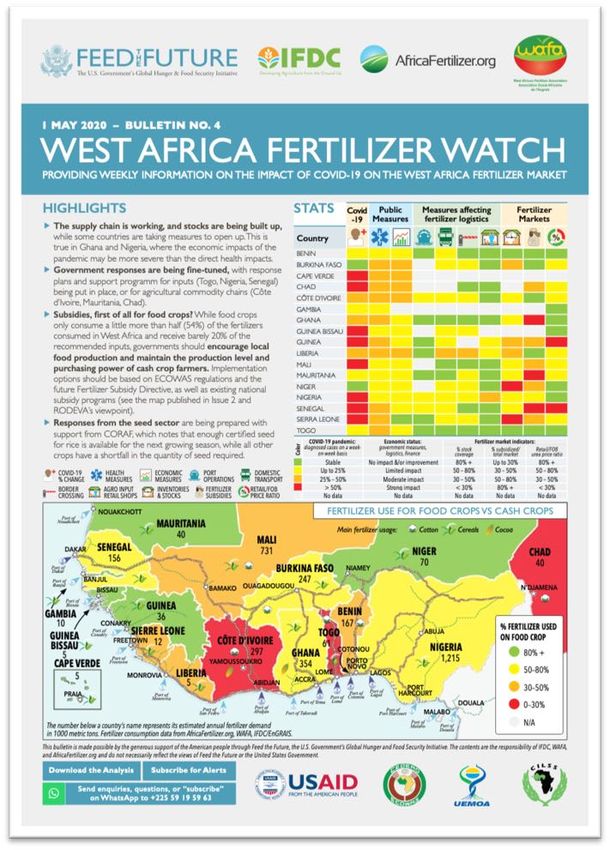
                                                                                In West Africa, food crops consume the majority of fertilizers in 10 out of
Encouraging local food production and maintaining the                           17 countries (more than 50%, orange and green), and even more than 80%
                                                                                in 6 countries (Cape Verde, Gambia, Guinea, Guinea Bissau, Mauritania
production level and purchasing power of cash crop farmers.
                                                                                and Niger). These 10 countries account for about two thirds (64%) of total
Fertilizers contribute directly to food security when used on food crops.       regional consumption. Conversely, cash crops account for more than 70%
They contribute indirectly by providing income to governments and               of the fertilizer market in Côte d'Ivoire, Chad, and Benin (cotton and cocoa,
producers of cash crops for export, or to local industries and markets.         in red on the map).

This week, our map shows the percentage of fertilizer use by food crops         According to our estimates, about 53% of fertilizers are used on food
(green if more than 80% of the market) or commercial crops (red if more         crops in the sub-region, a rate that drops to 40% in the UEMOA area due
than 70% of the market) in 2019.                                                to the predominance of cotton systems..
Food crops include cereals,
pulses, roots and tubers, and
fruits and vegetables mainly for
local consumption. Cash crops
include crops for export (cocoa,
cotton, coffee, rubber, fruit) or
local industrial processing (palm
oil, sugar cane). The data used
come from crop consumption
studies        conducted         by
AfricaFertilizer.org, WAFA, and
EnGRAIS, and from data collected
by the Fertilizer Technical
Working Groups (FTWG) and
from WAFA members and
national statistical services. They
cover the period 2015-2019.

                                                                            3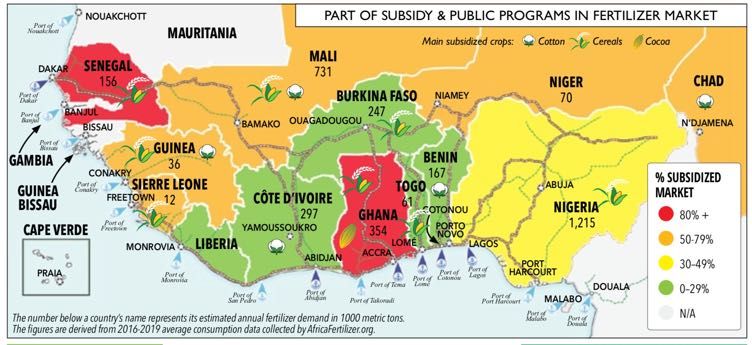
Figure 1: collection of the 4 thematic maps published since April 10th

 #4 - Fertilizer use on food and cash crops                                  #3 - Ratio of retail price to FOB price for urea in April 2020

 #2 - Share of subsidized fertilizers in the domestic market                 #1 - Coverage of fertilizer needs as of April 10, 2020

                                                                         4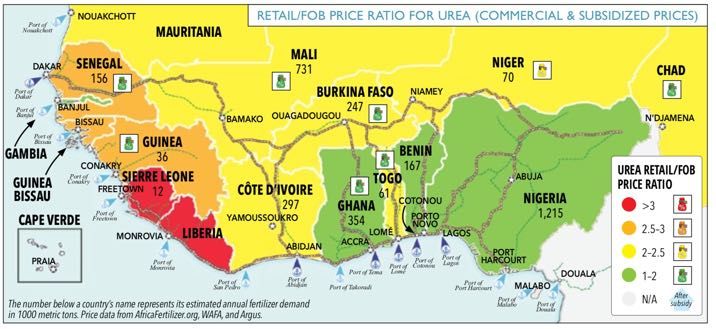
The expert view of the week, by RODEVA
                                                                                     For cash crops :
Q: What are the strategies for adjusting to COVID-19 fertilizer subsidy                  ● As the commodity chains are already structured, the
schemes according to the targeted crops? Should priority be given to food                   implementation of traceable, transparent, and private sector-
crops or cash crops or both?                                                                inclusive fertilizer subsidy systems through the use of e-systems
                                                                                            and e-vouchers remains entirely possible and advisable. And the
A: A consensus is emerging on the massive use of fertilizer subsidies to                    export of these products will contribute to the possibility for states
achieve sufficient yield levels to prevent a major food crisis on the African               to continue to subsidise fertilisers in subsequent years.
continent.                                                                               ● Since the Abuja summit in 2006, IFDC and its partners, including
                                                                                            RODEVA (then AfricAgriConsult), have joined forces to set up
For food crops:                                                                             “smart” subsidies which, over the years, have been enriched with
    ● It is necessary to ensure a sufficient harvest through a wide use of                  increasingly efficient traceability and transparency systems through
       fertilizers, by subsidizing them, in order to obtain good crop yields                the use of computer platforms, electronic reading vouchers (e-
       to ensure food self-sufficiency and a local trade of food at                         vouchers), and the affiliation of the private sector to these
       affordable prices (abundant supply) for the final consumer. In                       platforms for the "online" tracking of all transactions.
       countries where subsidy programmes are not operational, and in                    ● Convincing successes have been achieved in Rwanda, Burundi,
       view of the urgency of the situation (fertilizers must be used in                    South Sudan. Closer to home, a pilot has been carried out in Niger
       June/July), the subsidy must be accessible to all, even if in this case              (IFDC's PARSEN project on MCC / MCA funding within the
       of emergency it will be necessary to sacrifice certain principles of                 framework of the Fertilizer Sector Reform in Niger) and a study is
       traceability.                                                                        underway in Senegal with the Dundël Suuf project on USAID
    ● In countries where the "Transfert / Mobile Money" system already                      funding.
       exists (Côte d'Ivoire, Ghana, Senegal) the subsidy could be made
       available, via this channel, to beneficiaries with a basic mobile             Ongoing efforts to apply innovative principles to improve subsidy
       phone.                                                                        programs should therefore be supported as much as possible throughout
    ● In the other countries, and given the urgency we know, there is no             the ECOWAS region.
       other solution than state subsidies via the supply side with all the
       well-known disadvantages and risks of deviations from this                                                 Contacts: Joël Le Turioner
       operational mode, which can nevertheless be minimised by the                                               jlt@rodeva.com +33619322448 (WA)
       wide dissemination (by radio) of a reference price, derived from                                           www.rodeva.com
       market intelligence, which should not be exceeded.

                                                                                 5
The seed sector's responses
               are being prepared.

In this edition, CORAF's PAIRED project presents the strategy of the seed            It is recommended that, in this difficult period of closure where many
sector to fight against the impacts of COVID-19 and ensure a good supply             countries have closed their borders, member countries should ensure that
of quality seeds. In future editions, we will produce a joint special issue on       current stocks of first generation seed (EGS) and certified seed are not
customs duties and VAT rates and taxes applicable to seeds, fertilizers and          constrained when crossing borders and that every effort is made to
crop protection products in West Africa.                                             produce the necessary seed for the next production season.

                                                                                     In the meantime, CORAF will provide support on the following aspects in
CORAF's response to the COVID crisis 19 to                                           order to shed light on the seed situation in the region for the benefit of the
ensure farmers' access to quality seeds                                              respective stakeholders:
Quality seed, including vegetatively propagated material, is the basis for               ● Seed availability: Is there sufficient quantity of seed (metrics on
agricultural production. The pervasive problems associated with seeds in                    breeder, foundation and certified seed) of priority crops in
our region are availability, quality and affordability, in terms of farmers'                different countries?
physical access to the quantities required at the right time and at the right            ● What are the access points for seed deliveries?
price.                                                                                   ● Seeds are accessible: To what extent are available seeds accessible
                                                                                            to farmers?
The current COVID-19 pandemic continues to pose a growing threat to the                  ● Seed quality assurance and traceability: Does the seed of the
citizens of ECOWAS and CILSS member states, the vast majority of whom                       desired varieties have the required quality?
are farmers whose lives and livelihoods are at risk. The West and Central                ● Information on other organizations and/or initiatives at
African Council for Agricultural Research and Development (CORAF), as a                     national/regional level involved in the seed sector (What type of
major player in the seed sector in West Africa, has already warned                          intervention do they provide)
stakeholders in the region that the seed situation needs to be adequately                ● Information on measures affecting or facilitating trade and mobility
addressed to avoid the consequences of the negative impact of the COVID                     of agricultural inputs, including seeds and other plant materials.
19 crisis.

CORAF recommended that a concerted effort be made to ensure the                      Contacts: Hippolyte AFFOGNON h.affognon@coraf.org www.coraf.org
availability and access to the different seed classes (breeding, basic and
certified) of staple food crops in the ECOWAS and CILSS region so that the
next growing season can start on a good footing.

                                                                                 6
Overview of seed requirements
              for the main staple crops
              in the 2020 growing season

The West and Central African Council for Agricultural Research and                 In general, it is noteworthy that there is sufficient certified seeds for rice
Development (CORAF) has recommended that concerted effort should be                while all other crops have a deficit in the required amount of seeds for the
made to ensure the availability and access to certified seeds of major             upcoming cropping season. However, it should be noted that the informal
staple food crops in the ECOWAS and CILSS region to avert the looming              seed systems (farmer saved seed, non-supervised seed production) are
consequences of the negative impacts of the COVID 19 pandemic. In this             playing a pivotal role in the seed market in the region. The quantities of
regard, CORAF is supporting country and regional efforts in the seed sector        seed provided by the informal systems are estimated globally around 70%
by providing critical information on the region’s seed requirement vis-a-vis       of what is needed, this varies by crop and country.
the available stocks with a view to revealing the gap and therefore guiding
countries how to make required decisions.                                          Figure 2: Seed supply and demand for major crops
The graph below presents the quantities of certified seeds of priority
                                                                                                       400,000           Need (Tons)    Available (Tons)
staple crops currently available in the region and an estimate of the
quantify of seeds required for each of the major staple food crops. Data                               350,000

were collected from the national seed committee of each member State.                                  300,000

                                                                                        Metric tones
The quantities available of certified seeds are from the formal seed sector                            250,000
under the control of the national seed systems certified by government
                                                                                                       200,000
officials, while the quantities of certified seed needed are estimated based
on the area under cultivation, the seed replacement rate and trends. Data                              150,000

from Liberia, Sierra Leone and Guinea Bissau are missing and not included                              100,000
in the general situation.                                                                               50,000

                                                                                                            -

                                                                                                                                                                       n…
                                                                                                                                                t

                                                                                                                                                             a
                                                                                                                                   um
                                                                                                                        ce

                                                                                                                                             ille
                                                                                                                    e

                                                                                                                                                           pe

                                                                                                                                                                    nd
                                                                                                                 aiz

                                                                                                                        Ri

                                                                                                                                gh

                                                                                                                                            M

                                                                                                                                                        w

                                                                                                                                                                 ou
                                                                                                                 M

                                                                                                                                                      Co
                                                                                                                                 r

                                                                                                                                                                 Gr
                                                                                                                              So
                                                                                                                                        Crop

                                                                                   Source: CORAF, April 2020

                                                                               7
About the West Africa Fertilizer Watch
In response to the COVID-19 pandemic, the West Africa Fertilizer and met will an effective and coordinated response by development
Association (WAFA), the International Fertilizer Development Center partners and the private sector.
(IFDC) and its AfricaFertilizer.Org (AFO) initiative have launched the West
Africa Fertilizer Watch on April 10th. The West Africa Watch has been We expect that as the seasonal agricultural production progresses and the
greatly appreciated by private sector businesses all along the value chain, COVID-19 global health emergency evolves, other related indicators and
public sector and development partners responsible for policy and food data will need to be tracked, whereupon IFDC and AfricaFertilizer.org will
security interventions, including Government Ministries, Regional update the Watch accordingly.
Economic Communities (ECOWAS, CILSS, UEMOA), and the African Union
as a valuable tool to monitor actions and analyze data to help in decision After West Africa, the International Fertilizer Development Center (IFDC)
making related to fertilizer availability and use. and our AfricaFertilizer.Org (AFO) initiative have launched a weekly East &
Southern Africa (ESA) COVID-19 Fertilizer Watch, started Thursday, April
A one-page document will specifically track the impact of COVID-19 23rd, and intends to launch an Africa-wide COVID-19 Fertilizer Watch
country-specific mitigation measures on the delivery and use of fertilizers shortly.
in African countries and in doing so will allow public and private sectors to
monitor agricultural production and food security in the region. WAFA, IFDC/EnGRAIS and AfricaFertilizer.org would like to thank the
private and public sector partners who have provided input and vital
Over the coming months, IFDC and its partners will use the weekly Watch information for the West Africa Fertilizer Watch. We would also like to
to ensure that fertilizers are moving freely across the region, from ports thank USAID for their support through the USAID West Africa who
and plants to farms, and that sufficient quantities and appropriate supports the Feed the Future EnGRAIS project implemented by IFDC.
fertilizers are reaching farmers in time for planting, and to ensure that
COVID-19 impacts on productivity and food security can be identified early More info at https://ifdc.org/2020/04/10/west-africa-fertilizer-watch/
2About WAFA, IFDC and AfricaFertilizer.org
About IFDC About AfricaFertilizer.org About WAFA
An independent non-profit organization, The AfricaFertilizer.org (AFO) initiative is the West African Fertilizer Association (WAFA) is a
IFDC works throughout Africa and Asia to premier source for fertilizer statistics and non-profit private sector initiative established to
increase soil fertility and develop inclusive information in Africa. It is hosted by IFDC and address the challenges of the fertilizer industry in
market systems. Combining science-backed supported by several partners key among West Africa. Representing all the ECOWAS
innovations, an enabling policy them being IFA, Argus Media, and countries, the member companies combine
environment, holistic market systems Development Gateway. Since 2009, AFO has resources to find solutions to market challenges
development, and strategic partnerships, been collecting, processing, and publishing and promote best practices in fertilizer
the organization bridges the gap between fertilizer production, trade, and consumption production and use in order to optimize the
identifying and scaling sustainable statistics for the main fertilizer markets in sub- region’s potential for crop production and food
agricultural solutions, resulting in improved Saharan Africa. AFO has an extensive network security. Established in 2016, the association has
household food security and enriched family of fertilizer industry players in the main 58 member companies in 11 different countries.
livelihoods around the world. Using an fertilizer trade corridors and maintains key
inclusive approach, IFDC employs locally information on the major producers, their
driven solutions that are environmentally production facilities and capacities,
sound and impact oriented that bring importers/suppliers, various distribution
change at local, regional, and national channels, and agricultural service suppliers
levels. (laboratory services, research, credit
providers, and warehousing/storage services).
3You can also read


